F-4/A: Registration of securities, foreign private issuers, business combinations
Published on January 10, 2025
As filed with the U.S. Securities and Exchange Commission on January 10, 2025.
Registration Statement No. 333-283650
UNITED STATES
SECURITIES AND EXCHANGE COMMISSION
Washington, D.C. 20549
_____________________________
Amendment No. 1
to
Form F-4
REGISTRATION STATEMENT
UNDER
THE SECURITIES ACT OF 1933
_____________________________
Namib Minerals
For Co-Registrant, see “Table of Co-Registrant” on the following page.
(Exact Name of Registrant as Specified in Its Charter)
_____________________________
|
Cayman Islands |
1040 |
Not Applicable |
||
|
(Jurisdiction of |
(Primary Standard Industrial |
(I.R.S. Employer |
Namib Minerals
71 Fort Street, PO Box 500,
Grand Cayman, Cayman Islands, KY1-1106
Tel: (345) 769-4909
(Address, including zip code, and telephone number, including area code, of Registrant’s principal executive offices)
_____________________________
Cogency Global Inc.
122 East 42nd Street, 18th Floor
New York, NY 10168
Tel: (212) 947-7200
(Name, address, including zip code, and telephone number, including area code, of agent for service)
_____________________________
Copies to:
|
Alan I. Annex, Esq. |
Barbara A. Jones, Esq. |
Jeffrey N. Smith, Esq. |
_____________________________
Approximate date of commencement of proposed sale to the public: As soon as practicable after this Registration Statement becomes effective and upon completion of the business combination described in the enclosed proxy statement/prospectus.
If this Form is filed to register additional securities for an offering pursuant to Rule 462(b) under the Securities Act, check the following box and list the Securities Act registration statement number of the earlier effective registration statement for the same offering. ☐
If this Form is a post-effective amendment filed pursuant to Rule 462(d) under the Securities Act, check the following box and list the Securities Act registration statement number of the earlier effective registration statement for the same offering. ☐
If applicable, place an X in the box to designate the appropriate rule provision relied upon in conducting this transaction:
Exchange Act Rule 13e-4(i) (Cross-Border Issuer Tender Offer) ☐
Exchange Act Rule 14d-1(d) (Cross-Border Third-Party Tender Offer) ☐
Indicate by check mark whether the Registrant is an emerging growth company as defined in Rule 405 of the Securities Act of 1933.
Emerging growth company ☒
If an emerging growth company that prepares its financial statements in accordance with U.S. GAAP, indicate by check mark if the Registrant has elected not to use the extended transition period for complying with any new or revised financial accounting standards† provided pursuant to Section 7(a)(2)(B) of the Securities Act. ☐
____________
† The term “new or revised financial accounting standard” refers to any update issued by the Financial Accounting Standards Board to its Accounting Standards Codification after April 5, 2012.
The registrant and co-registrant hereby amend this registration statement on such date or dates as may be necessary to delay its effective date until the registrant and co-registrant shall file a further amendment which specifically states that this registration statement shall thereafter become effective in accordance with Section 8(a) of the Securities Act of 1933 or until this registration statement shall become effective on such date as the Commission, acting pursuant to said Section 8(a), may determine.
TABLE OF CO-REGISTRANT
|
Exact Name of Co-Registrant as Specified in its Charter(1)(2) |
State or |
Primary |
I.R.S. Employer |
|||
|
Greenstone Corporation |
Cayman Islands |
1040 |
Not Applicable |
____________
(1) The Co-Registrant has the following principal executive office:
71 Fort Street, PO Box 500,
Grand Cayman, Cayman Islands, KY1-1106
Tel: (345) 769-4909
(2) The agent for service for the Co-Registrant is:
Cogency Global Inc.
122 East 42nd Street, 18th Floor
New York, NY 10168
Tel: (212) 947-7200
Information contained herein is subject to completion or amendment. A registration statement relating to these securities has been filed with the Securities and Exchange Commission. These securities may not be sold nor may offers to buy be accepted prior to the time the registration statement becomes effective. This proxy statement/prospectus shall not constitute an offer to sell or the solicitation of an offer to buy nor shall there be any sale of these securities in any jurisdiction in which such offer, solicitation or sale would be unlawful.
PRELIMINARY PROXY STATEMENT FOR THE MEETING OF HENNESSY CAPITAL INVESTMENT CORP. VI’S STOCKHOLDERS AND PROSPECTUS FOR ORDINARY SHARES AND WARRANTS OF NAMIB MINERALS
SUBJECT TO COMPLETION, DATED JANUARY 10, 2025
|
|
|


195 US Hwy 50, Suite 309
Zephyr Cove, Nevada
Dear Hennessy Capital Investment Corp. VI Stockholders:
Hennessy Capital Investment Corp. VI, a Delaware corporation (“HCVI”) cordially invites you to attend a special meeting of its stockholders (the “special meeting”) to consider matters related to the proposed Business Combination. The special meeting will be held on [ ], 2024, at [ ] a.m. local time, via a virtual meeting.
On June 17, 2024, HCVI, Namib Minerals, an exempted company limited by shares incorporated under the laws of the Cayman Islands (“PubCo”) and a direct wholly-own subsidiary of The Southern SelliBen Trust, a registered New Zealand foreign trust (the “Company Requisite Shareholder”), Midas SPAC Merger Sub Inc., a Delaware corporation and a direct wholly-owned subsidiary of PubCo (“SPAC Merger Sub”), Cayman Merger Sub Ltd., an exempted company limited by shares incorporated under the laws of the Cayman Islands and a direct wholly-owned subsidiary of PubCo (“Company Merger Sub”), and Greenstone Corporation, an exempted company limited by shares incorporated under the laws of the Cayman Islands (the “Company” or “Greenstone”), entered into a business combination agreement (as amended on December 6, 2024, the “Business Combination Agreement”). The Company is an established gold producer with operations focused in Zimbabwe. Pursuant to the terms of the Business Combination Agreement, (a) Company Merger Sub will merge with and into the Company (the “Company Merger”), with the Company being the surviving entity of the Company Merger and becoming a wholly-owned subsidiary of PubCo; and (b) immediately following the Company Merger, SPAC Merger Sub will be merge with and into HCVI (the “SPAC Merger” and, together with the Company Merger, the “Mergers” and together with the other transactions contemplated by the Business Combination Agreement, the “Transactions”), with HCVI being the surviving entity of the SPAC Merger and becoming a wholly-owned subsidiary of PubCo. Upon closing of the Mergers (the “Closing,” and the date on which the Closing occurs, the “Closing Date”) HCVI and Greenstone each will become a direct wholly-owned subsidiary of PubCo, and PubCo will become a publicly traded company operating under the name “Namib Minerals.”
The aggregate consideration to be paid to existing Company shareholders (“Company Shareholders”) at the Closing is (a) $500.0 million, minus (b) the estimated indebtedness as of the Company as of the date of the Closing, plus (c) the estimated cash as of the Company as of the date of the Closing, plus (d) the amount of any filing fees paid by the Company in connection with this proxy statement/prospectus (such calculated amount being equal to the “Equity Value”). The consideration will be paid entirely in stock, comprised of PubCo Ordinary Shares (as defined below), at a price of $10.00 per ordinary share. In addition, the Company Shareholders will be entitled to receive up to 30.0 million of additional PubCo Ordinary Shares in contingent consideration, subject to the achievement of certain operational milestones over an eight-year post-Closing period. See “The Business Combination Agreement — Consideration; Conversion of Securities — Company Earnout” for further information on the contingent consideration payable to the Company Shareholders.
Pursuant to the terms of the Business Combination Agreement, at the effective times of the Mergers:
• (a) each issued and outstanding share of common stock of HCVI, par value $0.0001 per share (“SPAC Common Stock”), will be cancelled in exchange for the right to receive one ordinary share of PubCo, par value $0.0001 per share (each, a “PubCo Ordinary Share”), and (b) each outstanding warrant of HCVI (each, a “SPAC Warrant”) exercisable for one share of Class A common stock of HCVI, par value $0.0001 per share (“SPAC Class A Common Stock”), will become exercisable for one PubCo Ordinary Share on the same terms and conditions (each, a “PubCo Warrant”); and
• each ordinary share in the capital of the Company, par value $1.00 per share (each, a “Company Share”), that is issued and outstanding will be exchanged for such fraction of a newly issued PubCo Ordinary Share that is equal to the quotient of the (a) Equity Value divided by the (b) fully-diluted Company Shares, divided by (c) $10.00.
Pursuant to the terms of the Business Combination Agreement, the obligation of Greenstone to consummate the Business Combination is subject to, among other terms and conditions, a $25 million minimum cash condition, which may be satisfied with the proceeds of cash available in HCVI’s trust account after deducting the amount required to satisfy final redemptions by HCVI’s public stockholders, plus the gross amount of one or more financings entered prior to or in connection with the Closing by PubCo, HCVI, and/or any of Greenstone and its subsidiaries, on the one hand, and certain investors, on the other hand, which the parties to the Business Combination Agreement have agreed to a target of $60 million for such financings.
In connection with the Business Combination, HCVI expects to enter into one or more subscription agreements with certain investors to purchase SPAC Class A Common Stock in a separate private placement transaction (“PIPE Investment”). See “Summary of the Proxy Statement/Prospectus — PIPE Investment.” The final terms of the PIPE Investment have yet to be determined and are subject to negotiation between HCVI, PubCo, Greenstone, and the applicable investors. This proxy statement/prospectus does not constitute an offer to sell nor is soliciting an offer to buy any securities in connection with the PIPE Investment.
HCVI’s units, SPAC Class A Common Stock and SPAC Warrants are currently listed on the Nasdaq Global Market under the symbols “HCVIU,” “HCVI,” and “HCVIW,” respectively. On [ ], 2024, the closing trading prices of HCVI’s units, SPAC Class A Common Stock, and SPAC Warrants on Nasdaq were $[ ], $[ ], and $[ ], respectively. PubCo has applied for listing of its PubCo Ordinary Shares and PubCo Warrants on the Nasdaq Global Market under the ticker symbols “NAMM” and “NAMMW,” respectively, effective upon the Closing, and HCVI’s units will cease trading on the Nasdaq Global Market and will be deregistered under the Securities Exchange Act of 1934 (the “Exchange Act”).
In connection with the entry of the Business Combination Agreement, the Company Requisite Shareholder, HCVI and the Company entered into a Shareholder Support Agreement, pursuant to which, among other things, and subject to the terms and conditions set forth therein, the Company Requisite Shareholder agreed to (a) vote all Company Shares held by the Company Requisite Shareholder in favor of the Business Combination Agreement, the Transactions and any related actions, and against any other transactions or proposals intended, or would reasonably be expected, to prevent, impede, interfere with, delay, postpone or adversely affect the Transactions in any material respect or result in the failure of any closing conditions of the Business Combination Agreement, (b) adopt prior to the Closing a written resolution approving the Business Combination Agreement and the other transaction documents and approving the Mergers and other Transactions and adopting the agreed-upon form of organizational documents of PubCo to be in effect as of the Closing, (c) take all actions reasonably necessary to consummate the Transactions and (d) not transfer any Company Shares held by the Company Requisite Shareholder, subject to certain exceptions.
Hennessy Capital Partners VI LLC, a Delaware limited liability company and the existing sponsor of HCVI (the “Sponsor”), the Company, HCVI and certain stockholders of HCVI named therein, have executed a Sponsor Support Agreement, pursuant to which, among other things, and subject to the terms and conditions set forth therein, the Sponsor and certain of other stockholders of HCVI have agreed to (a) vote all of their shares of SPAC Common Stock in favor of the Business Combination Agreement, the Transactions and any related actions, and against any other transactions or proposals intended, or would reasonably be expected, to prevent, impede, interfere with, delay, postpone or adversely affect the Transactions in any material respect or result in the failure of any closing conditions of the Business Combination Agreement, (b) take all actions reasonably necessary to consummate the Transactions and (c) not transfer or redeem any shares of SPAC Common Stock and SPAC Warrants held by them prior to the Closing, subject to certain exceptions.
The Sponsor, HCVI and PubCo have also executed a Sponsor Letter Agreement pursuant to which, among other things, and subject to the terms and conditions set forth therein, the Sponsor agreed to (a) waive the anti-dilution rights of the shares of the SPAC’s Class B common stock, par value $0.0001 per share (“SPAC Class B Common Stock”), set forth in HCVI’s organizational documents in connection with the consummation of the Transactions, (b) subject certain of the PubCo Ordinary Shares that the Sponsor would receive via the SPAC Merger to certain vesting conditions and potential forfeiture (as described in the following sentence) and (c) forfeit
to HCVI (i) 1.36 million shares of SPAC Common Stock, held by the Sponsor, prior to the Closing and (ii) up to an additional 2.0 million shares of SPAC Common Stock held by the Sponsor prior to the Closing (such additional forfeited shares, if any, the “Additional Founder Forfeited Shares”) to the extent necessary to ensure that the total gross proceeds from the permitted financing set forth in the Business Combination Agreement are not less than $50.0 million. If at the Closing, certain of HCVI’s transaction expenses exceed $8 million (such excess over $8 million, the “SPAC Transaction Expenses Cap Excess”), the Sponsor will forfeit to HCVI a number of shares of SPAC Common Stock equal to (x) the amount of the SPAC Transaction Expenses Cap Excess divided by (y) $10.00. Pursuant to the Sponsor Letter Agreement, the Sponsor also agreed to subject a number of PubCo Ordinary Shares that it would otherwise receive via the SPAC Merger equal to (i) 2.0 million minus (ii) the number of Additional Founder Forfeited Shares, as unvested “Sponsor Earnout Shares” subject to certain vesting and potential forfeiture restrictions as set forth therein. Fifty percent (50%) of the Sponsor Earnout Shares will vest on the first date on which the closing price of PubCo Ordinary Shares exceeds $12.50 for any 20 trading days within a consecutive 30-trading day period. The remaining 50% of the Sponsor Earnout Shares will vest on the first date on which the closing price of PubCo Ordinary Shares exceeds $15.00 for any 20 trading days within a consecutive 30-trading day period. Upon the occurrence of a change of control (as set forth in the Sponsor Letter Agreement) of PubCo during the period commencing on the date that is 150 days after the Closing Date and ending on the eighth anniversary of the Closing Date (the “Sponsor Earnout Period”), then the vesting requirements described in the immediately preceding two sentences will be deemed to have been satisfied and vesting of the Sponsor Earnout Shares will be accelerated. Any unvested Sponsor Earnout Shares will automatically be forfeited if the Sponsor Earnout Shares have not vested prior to the end of the Sponsor Earnout Period.
Additionally, in connection with the Business Combination Agreement, certain related agreements and documents will be entered into, upon the consummation of the Mergers, including a Registration Rights and Lock-up Agreement, substantially in the form attached hereto as Annex E, with holders of the SPAC Class B Common Stock and the Company Shareholders. See “Certain Agreements Related to the Business Combination — Registration Rights and Lock-up Agreement” for further information.
HCVI cannot complete the Business Combination unless HCVI’s stockholders approve the Business Combination Agreement and the Transactions. HCVI is providing this proxy statement/prospectus and proxy card to you in connection with the solicitation of proxies to be voted at the special meeting and at any adjournments or postponements thereof. In connection with the special meeting, stockholders of SPAC Class A Common Stock have certain redemption rights, as described in more detail in this proxy statement/prospectus.
At the special meeting, HCVI stockholders will be asked to consider and vote upon a proposal to approve the Business Combination Agreement and the Transactions (the “Business Combination Proposal”).
In additional to the Business Combination Proposal, HCVI stockholders will also be asked to consider and vote upon:
(1) two proposals to approve (collectively, such proposals are referred to herein as the “Non-Binding Governance Proposals”), on a non-binding advisory basis, upon certain material differences between HCVI’s existing organizational documents and the Second Amended and Restated Memorandum and Articles of Association of PubCo, in the form attached hereto as Annex D and as will be in effect as of the Closing (the “PubCo Organizational Documents”), specifically:
(A) Number of Authorized Shares — A proposal to provide that the proposed PubCo Organizational Documents increase the total number of authorized shares of all classes of capital stock to one class of stock consisting of 500,000,000 ordinary shares with a par value of $0.0001 each; and
(B) Removal and Appointment of Directors — A proposal to provide that Namib Minerals may by ordinary resolution (defined as a resolution of a general meeting, at which a quorum is present, passed by a simple majority of the votes cast by, or on behalf of, the members entitled to vote thereon in person or by proxy, and includes a unanimous written resolution) appoint any person to be a director of PubCo or may by ordinary resolution remove any director of PubCo. The directors of PubCo may appoint any person to be a director of PubCo, either to fill a vacancy or as an additional director of PubCo provided that the appointment does not cause the number of directors of PubCo to exceed any number fixed by or in accordance with the proposed charter as the maximum number of directors of PubCo;
(2) a proposal to approve the equity incentive plan of PubCo (the “Equity Incentive Plan”) and the material terms thereunder, a copy of which is attached to this proxy statement/prospectus as Annex C (the “Equity Incentive Plan Proposal”), which will be in effect immediately prior to the Closing; and
(3) a proposal to approve the adjournment of the special meeting to a later date or dates, if necessary or appropriate, to permit further solicitation and vote of proxies in the event, based on the tabulated votes, that there are not sufficient votes at the time of the special meeting to approve any of the other proposals presented at the special meeting or in order to seek withdrawals from HCVI stockholders who have exercised their redemption right (the “Adjournment Proposal” and, together with the Business Combination Proposal, the Non-Binding Governance Proposals, and the Equity Incentive Plan Proposal, the “Proposals”).
Each Proposal is more fully described in this proxy statement/prospectus, which each stockholder is encouraged to read carefully.
Pursuant to HCVI’s amended and restated certificate of incorporation, HCVI is providing the holders of shares of SPAC Class A Common Stock originally sold as part of the units issued in HCVI’s initial public offering (the “IPO” and such holders, the “Public Stockholders”) with the opportunity to redeem, upon the Closing, shares of SPAC Class A Common Stock then held by them for cash equal to their pro rata share of the aggregate amount on deposit (as of two business days prior to the Closing) in the trust account (the “Trust Account”) that holds the proceeds (including interest not previously released to HCVI to pay its franchise and income taxes and redemption payable) from the IPO and a concurrent private placement of warrants to the Sponsor and certain other qualified institutional buyers or institutional accredited investors, on behalf of one or more funds that they advise or manage. For illustrative purposes, based on the fair value of cash held in the Trust Account as of September 30, 2024 of approximately $35.17 million (after giving effect to franchise and income taxes payable), the estimated per share redemption price would have been approximately $10.73. Public Stockholders may elect to redeem their shares whether or not they are holders as of the record date and whether or not they vote for the Business Combination Proposal. Notwithstanding the foregoing redemption rights, a Public Stockholder, together with any of his, her, or its affiliates or any other person with whom he, she or it is acting in concert or as a “group” (as defined under Section 13(d)(3) of the Securities Exchange Act of 1934, as amended), will be restricted from redeeming in the aggregate his, her, or its shares or, if part of such a group, the group’s shares, in excess of 15% of the outstanding shares of SPAC Class A Common Stock sold in the IPO. Holders of HCVI’s outstanding warrants sold in the IPO, which are exercisable for shares of SPAC Class A Common Stock under certain circumstances, do not have redemption rights in connection with the Business Combination.
The holders of the SPAC Class B Common Stock and each member of HCVI’s management team have agreed to waive their redemption rights with respect to any SPAC Class B Common Stock and any other public shares of HCVI held by them in connection with the Business Combination and the Transactions. The SPAC Class B Common Stock will be excluded from the pro rata calculation used to determine the per share redemption price applicable to the public shares that are redeemed. The holders of the SPAC Class B Common Stock have previously agreed to vote their respective SPAC Class B Common Stock and any other public shares of HCVI held by them in favor of the Business Combination Proposal and for any other proposal presented to HCVI stockholders in this proxy statement/prospectus.
After careful consideration, the board of directors of HCVI (the “HCVI Board”) has unanimously approved the Business Combination Agreement and the other proposals described in this proxy statement/prospectus, and the HCVI Board has determined that it is advisable to consummate the Business Combination. The HCVI Board took into account the oral opinion of EntrepreneurShares LLC (“EntrepreneurShares”), subsequently confirmed in writing on June 17, 2024 and attached as Annex F to this proxy statement/prospectus, to the effect that, based upon and subject to the procedures followed, assumptions made, qualifications and limitations on the review undertaken, and other matters considered by EntrepreneurShares in preparing its fairness opinion, the total consideration to be issued or paid in the Business Combination was fair from a financial point of view to the SPAC Stockholders (other than the Sponsor, any of its affiliates, and any other holder of SPAC Class B Common Stock). There has not been any prior engagement between HCVI and EntrepreneurShares prior to EntrepreneurShares’ appointment as the fairness opinion provider for the HCVI Board in connection with the Business Combination. See “The Business Combination — Fairness Opinion from EntrepreneurShares” for further information. The HCVI Board recommends that you vote “FOR” each of the Proposals described in this proxy statement/prospectus.
When you consider the HCVI Board’s recommendation of these Proposals, you should keep in mind that there may be actual or potential material conflicts of interest between or among (i) the Sponsor, its affiliates, certain HCVI directors and officers, or promoters and (ii) unaffiliated security holders of HCVI. Such conflicts of interest may include a material conflict of interest arising in determining whether to proceed with the Business Combination and a material conflict of interest arising from the interest that the Sponsor and its affiliates have in the Business Combination. Also, Greenstone and its officers have financials interests that are different from, or in addition to, the interests of unaffiliated HCVI stockholders, which could cause Greenstone to pursue terms in the Business Combination that are less favorable to non-redeeming stockholders. For additional information, see “The Business Combination — Interests of HCVI’s Directors and Officers in the Business Combination” and “Summary of the Proxy Statement/Prospectus — Interests of Greenstone’s Officers and Directors in the Business Combination.” The HCVI Board was aware of and considered these interests, among other matters, in evaluating the Business Combination, and in recommending to HCVI’s stockholders that they approve the Business Combination.
Upon the Closing, the Sponsor, its affiliates and certain transferees will receive (i) up to 9,443,318 PubCo Ordinary Shares upon the conversion of the 9,443,318 shares of SPAC Class B Common Stock (after giving effect to certain forfeitures by the Sponsor pursuant to the Sponsor Letter Agreement and based on HCVI’s estimated transaction expenses as of December 6, 2024), for which it paid $25,000 in the aggregate, of which up to 2,000,000 PubCo Ordinary Shares may be subject to certain vesting and potential forfeiture restrictions (as described further in “Certain Agreements Related to The Business Combination — Sponsor Letter Agreement” in this proxy statement/prospectus), and (ii) 2,459,217 PubCo Warrants upon the conversion of the (a) 2,359,217 SPAC Warrants issued to the Sponsor and certain holders of SPAC Common Stock in a private placement (the “SPAC Private Placement Warrants”), which were purchased for an aggregate purchase price of approximately $3.5 million simultaneously with the consummation of the IPO and (b) 100,000 SPAC Private Placement Warrants purchased by Hennessy Capital Group LLC (“HCG”), an affiliate of the Sponsor, pursuant to certain subscription agreements with Polar Multi-Strategy Master Fund (“Polar”), for an aggregate purchase price of up to $150,000 (as described further under HCVI Management’s Discussion and Analysis of Financial Condition and Results of Operations — Recent Events — Subscription Agreements”). In addition, HCVI pays $15,000 per month for office space, utilities and secretarial and administrative support to HCG. If the Sponsor, HCG or HCVI’s officers and directors make any working capital loans, up to $1,500,000 of such loans may be converted into SPAC Private Placement Warrants at a price of $1.50 per warrant at the option of the lender. Currently, there is $200,000 outstanding under an existing working capital loan from the Sponsor. Such loan bears no interest and may be converted to 133,333 SPAC Private Placement Warrants at the option of the lender. The compensation received or to be received by the Sponsor and the securities to be issued to the Sponsor in connection with the closing of the Business Combination, including upon the potential satisfaction of applicable vesting conditions, may result in a material dilution of the equity interest of non-redeeming Public Stockholders of HCVI. See “Risk Factors — Risks Related to HCVI and the Business Combination — Public Stockholders of HCVI will experience immediate dilution as a consequence of the issuance of PubCo Ordinary Shares as consideration in the Business Combination and the Permitted Financing and due to future issuances pursuant to the Equity Incentive Plan and the PubCo Warrants. Having a minority stock ownership position may reduce the influence that HCVI’s current stockholders have on the management of PubCo.”
An aggregate of $2,650,000 is payable to Polar upon the Closing as a return of capital pursuant to certain subscription agreements, which may be payable in cash or in 265,000 PubCo Ordinary Shares, or a combination of both, as well as 880,000 newly issued PubCo Ordinary Shares (as described further under “HCVI Management’s Discussion and Analysis of Financial Condition and Results of Operations — Recent Events — Subscription Agreements”).
An aggregate of approximately $1.19 million in deferred compensation is payable upon the Closing to the former Executive Vice President and Chief Financial Officer of HCVI, the former President and Chief Operating Officer and director of HCVI, and a former independent contractor and service provider of HCVI. See “Certain HCVI Relationships and Related Person Transactions — Administrative Support Agreement and Payments to Certain Officers.”
HCVI may not consummate the Business Combination unless the Business Combination Proposal and the Equity Incentive Plan Proposal are approved at the special meeting. Each of the Non-Binding Governance Proposals and the Equity Incentive Plan Proposal are conditioned on the approval of the Business Combination Proposal. The Adjournment Proposal is not conditioned on the approval of any other Proposal set forth in this proxy statement/prospectus. The approval of the Business Combination Proposal requires the affirmative vote (in person online, over the internet or by proxy) of the holders of a majority of all then-outstanding shares of SPAC Common Stock entitled to vote thereon at the special meeting. Accordingly, a HCVI stockholder’s failure to vote by proxy, over the internet or in person online at the
special meeting, an abstention from voting or a broker non-vote will have the same effect as a vote against this Proposal. Each of the Non-Binding Governance Proposals, the Equity Incentive Plan Proposal, and the Adjournment Proposal requires a majority of the shares of SPAC Common Stock represented in person online or by proxy and voted thereon at the special meeting vote. Failure to vote by proxy or to vote in person online at the special meeting or an abstention from voting will have no effect on the outcome of the vote on these Proposals.
The holders of the SPAC Class B Common Stock and each member of HCVI’s management team, which collectively own 11,364,318 SPAC Class B Common Stock, or approximately 77.6% of the outstanding SPAC Common Stock, have previously agreed to vote all of their SPAC Class B Common Stock in favor of a business combination proposed to them for approval, including the Business Combination. Accordingly, assuming holders of the SPAC Class B Common Stock vote all of their SPAC Class B Common Stock in accordance with such agreement, the Business Combination Proposal and the rest of the Proposals will be approved, and the failure of a holder of SPAC Class A Common Stock to vote in person or by proxy at the special meeting will have no effect on the outcome of the vote on any of the Proposals. The Business Combination Agreement was not structured to require the approval of at least a majority of unaffiliated securityholders of HCVI.
Upon the completion of the Business Combination, PubCo is expected to be a “controlled company” under the Nasdaq Stock Market Listing Rules. The Southern SelliBen Trust, also referred to in this document as the Company Requisite Shareholder, is expected to control approximately 50.3% of PubCo Ordinary Shares, assuming no shares of SPAC Class A Common Stock are redeemed. For additional information, please see PubCo’s beneficial ownership table, note 6, under “Security Ownership of Certain Beneficial Owners and Management.” If PubCo is a controlled company upon Closing, PubCo may elect not to comply with certain corporate governance requirements, including that (1) a majority of the board of directors of PubCo (the “PubCo Board”) consists of independent directors, as defined under Nasdaq listing rules, (2) a majority of the independent directors select or recommend its director nominees, (3) the compensation committee be responsible for determining or recommending the compensation of executive officers other than PubCo’s chief executive officer, and (4) PubCo has a compensation committee that consists entirely of independent directors. PubCo does not intend to take advantage of the foregoing exemptions. In the event that PubCo ceases to be a “controlled company” and PubCo Ordinary Shares continue to be listed on Nasdaq, PubCo will be required to comply with these provisions within the applicable transition periods. See “Management of PubCo After the Business Combination — Controlled Company.”
Following the Business Combination, PubCo will be an “emerging growth company” as defined in the Jumpstart Our Business Startups Act of 2012 and is therefore eligible to take advantage of certain reduced reporting requirements otherwise applicable to other public companies.
Following the Business Combination, PubCo will also be a “foreign private issuer” as defined in the Exchange Act, and will be exempt from certain rules under the Exchange Act that impose certain disclosure obligations and procedural requirements for proxy solicitations under Section 14 of the Exchange Act. In addition, PubCo’s officers, directors and principal shareholders will be exempt from the reporting and “short-swing” profit recovery provisions under Section 16 of the Exchange Act. Moreover, PubCo will not be required to file periodic reports and financial statements with the U.S. Securities and Exchange Commission as frequently or as promptly as U.S. companies whose securities are registered under the Exchange Act.
Your vote is very important. Please vote as soon as possible by following the instructions in this proxy statement/prospectus to ensure that your shares are represented at the special meeting. More information about HCVI, PubCo, Greenstone, the Business Combination and the Proposals is contained in this proxy statement/prospectus. HCVI and Greenstone urge you to carefully read this proxy statement/prospectus, including the financial statements and annexes and other documents referred to herein, carefully and in their entirety. In particular, you should carefully consider the matters discussed under “Risk Factors” beginning on page 33 of this proxy statement/prospectus.
If you sign, date and return your proxy card without indicating how you wish to vote, your proxy will be voted “FOR” each of the Proposals presented at the special meeting. If you fail to return your proxy card or fail to instruct your bank, broker or other nominee how to vote, and you do not attend the special meeting in person, your shares will not be counted for purposes of determining whether a quorum is present at the special meeting. If you are a shareholder of record and you attend the special meeting and wish to vote in person, you may withdraw your proxy and vote in person.
TO EXERCISE YOUR REDEMPTION RIGHTS, YOU MUST ELECT TO HAVE HCVI REDEEM YOUR SHARES FOR A PRO RATA PORTION OF THE FUNDS HELD IN THE TRUST ACCOUNT AND TENDER YOUR SHARES TO HCVI’S TRANSFER AGENT AT LEAST TWO BUSINESS DAYS PRIOR TO THE VOTE AT THE SPECIAL MEETING. YOU MAY TENDER YOUR SHARES BY EITHER DELIVERING YOUR SHARE CERTIFICATE TO THE TRANSFER AGENT OR BY DELIVERING YOUR SHARES ELECTRONICALLY USING THE DEPOSITORY TRUST COMPANY’S DWAC (DEPOSIT WITHDRAWAL AT CUSTODIAN) SYSTEM. IF THE BUSINESS COMBINATION IS NOT COMPLETED, THEN THESE SHARES WILL NOT BE REDEEMED FOR CASH. IF YOU HOLD THE SHARES IN STREET NAME, YOU WILL NEED TO INSTRUCT THE ACCOUNT EXECUTIVE AT YOUR BANK OR BROKER TO WITHDRAW THE SHARES FROM YOUR ACCOUNT IN ORDER TO EXERCISE YOUR REDEMPTION RIGHTS.
On behalf of the HCVI Board, I thank you for your support and look forward to the successful completion of the Business Combination.
|
Sincerely, |
||
|
[ ], 2024 |
|
|
|
Daniel J. Hennessy |
||
|
Chairman of the Board and Chief Executive Officer |
This proxy statement/prospectus is dated [ ], 2024 and is first being mailed to the stockholders of HCVI on or about [ ], 2024.
NEITHER THE U.S. SECURITIES AND EXCHANGE COMMISSION NOR ANY STATE SECURITIES REGULATORY AGENCY HAS APPROVED OR DISAPPROVED THE TRANSACTIONS DESCRIBED IN THIS PROXY STATEMENT/PROSPECTUS OR ANY OF THE SECURITIES TO BE ISSUED IN THE BUSINESS COMBINATION, PASSED UPON THE MERITS OR FAIRNESS OF THE BUSINESS COMBINATION OR RELATED TRANSACTIONS OR PASSED UPON THE ADEQUACY OR ACCURACY OF THE DISCLOSURE IN THIS PROXY STATEMENT/PROSPECTUS. ANY REPRESENTATION TO THE CONTRARY CONSTITUTES A CRIMINAL OFFENSE.
HENNESSY CAPITAL INVESTMENT CORP. VI
195 US Hwy 50, Suite 309
Zephyr Cove, Nevada
NOTICE OF SPECIAL MEETING OF STOCKHOLDERS
TO BE HELD ON [ ], 2024
To the Stockholders of Hennessy Capital Investment Corp. VI:
NOTICE IS HEREBY GIVEN that a special meeting of stockholders (the “special meeting”) of Hennessy Capital Investment Corp. VI, a Delaware corporation (“HCVI,” “we,” “our” or “us”), will be held on [ ], 2024, at [ ] a.m., Eastern time, via live webcast at the following address: [ ]. The special meeting will be completely virtual. You will need the 12-digit meeting control number that is printed on your proxy card to enter the special meeting. HCVI recommends that you log in at least 15 minutes before the special meeting to ensure you are logged in when the special meeting starts. Please note that you will not be able to attend the special meeting in person. You are cordially invited to attend the special meeting for the following purposes:
• The “Business Combination Proposal” — to consider and vote upon a proposal to approve and adopt the Business Combination Agreement, dated as of June 17, 2024 (as amended on December 6, 2024, the “Business Combination Agreement”), by and among HCVI, Namib Minerals, an exempted company limited by shares incorporated under the laws of the Cayman Islands (“PubCo”) and a direct wholly-own subsidiary of The Southern SelliBen Trust, a registered New Zealand foreign trust (the “Company Requisite Shareholder”), Midas SPAC Merger Sub Inc., a Delaware corporation and a direct wholly-owned subsidiary of PubCo (“SPAC Merger Sub”), Cayman Merger Sub Ltd., an exempted company limited by shares incorporated under the laws of the Cayman Islands and a direct wholly-owned subsidiary of PubCo (“Company Merger Sub”), and Greenstone Corporation, an exempted company limited by shares incorporated under the laws of the Cayman Islands (the “Company” or “Greenstone”). Pursuant to the terms of the Business Combination Agreement, (a) Company Merger Sub will be merged with and into the Company (the “Company Merger”), with the Company being the surviving entity of the Company Merger and becoming a wholly-owned subsidiary of PubCo; and (b) immediately following the Company Merger, SPAC Merger Sub will be merged with and into HCVI (the “SPAC Merger” and, together with the Company Merger, the “Mergers”), with HCVI being the surviving entity of the SPAC Merger and becoming a wholly-owned subsidiary of PubCo. Upon closing of the Mergers (the “Closing,” and the date on which the Closing occurs, the “Closing Date”) HCVI and Greenstone each will become a direct wholly-owned subsidiary of PubCo, and PubCo will become a publicly traded company operating under the name “Namib Minerals”;
• The “Non-Binding Governance Proposals” — to consider and vote upon two separate proposals to approve (collectively, such proposals are referred to herein as the “Non-Binding Governance Proposals), on a non-binding advisory basis, upon certain material differences between HCVI’s existing organizational documents and the Second Amended and Restated Memorandum and Articles of Association of PubCo, in the form attached hereto as Annex D and as will be in effect as of the Closing (the “PubCo Organizational Documents”), specifically:
(A) Number of Authorized Shares (Proposal No. 2A) — a proposal to provide that the proposed PubCo Organizational Documents increase the total number of authorized shares of all classes of capital stock to one class of stock consisting of 500,000,000 ordinary shares with a par value of $0.0001 each; and
(B) Removal and Appointment of Directors (Proposal No. 2B) — a proposal to provide that Namib Minerals may by ordinary resolution (defined as a resolution of a general meeting, at which a quorum is present, passed by a simple majority of the votes cast by, or on behalf of, the members entitled to vote thereon in person or by proxy, and includes a unanimous written resolution) appoint any person to be a director of PubCo or may by ordinary resolution remove any director of PubCo. The directors of PubCo may appoint any person to be a director of PubCo, either to fill a vacancy or as an additional director of PubCo, provided that the appointment does not cause the number of directors of PubCo to exceed any number fixed by or in accordance with the proposed charter as the maximum number of directors of PubCo; and
• The “Equity Incentive Plan Proposal” — to consider and vote upon a proposal to approve the equity incentive plan of PubCo (the “Equity Incentive Plan”) and the material terms thereunder, a copy of which is attached to this proxy statement/prospectus as Annex C (the “Equity Incentive Plan Proposal”), which will be in effect immediately prior to the Closing; and
• The “Adjournment Proposal” — to consider and vote upon the adjournment of the special meeting to a later date or dates, if necessary or appropriate, to permit further solicitation and vote of proxies in the event, based on the tabulated votes, that there are not sufficient votes at the time of the special meeting to approve any of the other proposals presented at the special meeting or in order to seek withdrawals from HCVI stockholders who have exercised their redemption right (the “Adjournment Proposal” and, together with the Business Combination Proposal, the Non-Binding Governance Proposals, and the Equity Incentive Plan Proposal, the “Proposals”).
Only holders of record of shares of Class A common stock of HCVI, par value $0.0001 per share (“SPAC Class A Common Stock”) and shares of Class B common stock of HCVI (the “SPAC Class B Common Stock”), par value $0.0001, at the close of business on [ ], 2024 are entitled to notice of the special meeting and to vote at the special meeting and any adjournments or postponements of the special meeting. A complete list of our stockholders of record entitled to vote at the special meeting will be available for ten days before the special meeting at our principal executive offices for inspection by stockholders during ordinary business hours for any purpose germane to the special meeting.
Pursuant to HCVI’s amended and restated certificate of incorporation (as amended, the “SPAC Charter”), we are providing the holders of shares of SPAC Class A Common Stock originally sold as part of the units issued in our initial public offering (the “IPO” and such holders, the “Public Stockholders”) with the opportunity to redeem, upon the Closing, shares of SPAC Class A Common Stock then held by them for cash equal to their pro rata share of the aggregate amount on deposit (as of two business days prior to the Closing) in the trust account (the “Trust Account”) that holds the proceeds (including interest not previously released to HCVI to pay its franchise and income taxes) from the IPO and a concurrent private placement of warrants to Hennessy Capital Partners VI LLC (the “Sponsor”) and certain other qualified institutional buyers or institutional accredited investors, on behalf of one or more funds that they advise or manage. For illustrative purposes, based on the fair value of cash held in the Trust Account as of September 30, 2024 of approximately $35.17 million (after giving effect to franchise and income taxes payable), the estimated per share redemption price would have been approximately $10.73. Public Stockholders may elect to redeem their shares whether or not they are holders as of the record date and whether or not they vote for the Business Combination Proposal. Notwithstanding the foregoing redemption rights, a Public Stockholder, together with any of his, her or its affiliates or any other person with whom he, she or it is acting in concert or as a “group” (as defined under Section 13(d)(3) of the Securities Exchange Act of 1934, as amended), will be restricted from redeeming in the aggregate his, her or its shares or, if part of such a group, the group’s shares, in excess of 15% of the outstanding shares of SPAC Class A Common Stock sold in the IPO. Holders of HCVI’s outstanding warrants sold in the IPO, which are exercisable for shares of SPAC Class A Common Stock under certain circumstances, do not have redemption rights in connection with the Business Combination. The Sponsor and our officers and directors have agreed to waive their redemption rights in connection with the consummation of the Business Combination with respect to any shares of SPAC Class A Common Stock they may hold. Shares of SPAC Class B Common Stock will be excluded from the pro rata calculation used to determine the per share redemption price. Currently, the Sponsor and our current and former officers and directors own approximately 77.6% of our outstanding issued and outstanding shares of our common stock, including all of the shares of SPAC Class B Common Stock. The Sponsor, officers and directors have agreed to vote any shares of SPAC Class B Common Stock owned by them in favor of the Business Combination. Accordingly, assuming holders of the SPAC Class B Common Stock vote all of their SPAC Class B Common Stock in accordance with such agreement, the Business Combination Proposal and the rest of the Proposals will be approved, and the failure of a holder of SPAC Class A Common Stock to vote in person or by proxy at the special meeting will have no effect on the outcome of the vote on any of the Proposals. The Business Combination Agreement was not structured to require the approval of at least a majority of unaffiliated securityholders of HCVI.
TO EXERCISE YOUR REDEMPTION RIGHTS, YOU MUST ELECT TO HAVE HCVI REDEEM YOUR SHARES FOR A PRO RATA PORTION OF THE FUNDS HELD IN THE TRUST ACCOUNT AND TENDER YOUR SHARES TO HCVI’S TRANSFER AGENT AT LEAST TWO BUSINESS DAYS PRIOR TO THE VOTE AT THE SPECIAL MEETING. YOU MAY TENDER YOUR SHARES BY EITHER DELIVERING YOUR SHARE CERTIFICATE TO THE TRANSFER AGENT OR BY DELIVERING YOUR SHARES ELECTRONICALLY
USING THE DEPOSITORY TRUST COMPANY’S DWAC (DEPOSIT WITHDRAWAL AT CUSTODIAN) SYSTEM. IF THE BUSINESS COMBINATION IS NOT COMPLETED, THEN THESE SHARES WILL NOT BE REDEEMED FOR CASH. IF YOU HOLD THE SHARES IN STREET NAME, YOU WILL NEED TO INSTRUCT THE ACCOUNT EXECUTIVE AT YOUR BANK OR BROKER TO WITHDRAW THE SHARES FROM YOUR ACCOUNT IN ORDER TO EXERCISE YOUR REDEMPTION RIGHTS.
We may not consummate the Business Combination unless the Business Combination Proposal and the Equity Incentive Plan Proposal are approved at the special meeting. Each of the Non-Binding Governance Proposals and the Equity Incentive Plan Proposal are conditioned on the approval of the Business Combination Proposal. The Adjournment Proposal is not conditioned on the approval of any other Proposal set forth in this proxy statement/prospectus.
The Board of Directors of HCVI has unanimously approved the Business Combination Agreement and the Transactions and recommends that you vote “FOR” the Business Combination Proposal, “FOR” each of the Non-Binding Governance Proposals and “FOR” the Equity Incentive Plan Proposal.
More information about HCVI, PubCo, Greenstone, the Business Combination, and the Proposals is contained in this proxy statement/prospectus. HCVI and Greenstone urge you to carefully read this proxy statement/prospectus, including the financial statements and annexes and other documents referred to herein, carefully and in their entirety. We encourage you to read this proxy statement/prospectus carefully. If you have any questions or need assistance voting your shares, please call our proxy solicitor, [ ], at [ ]; banks and brokers can call collect at [ ].
|
By Order of the Board of Directors, |
||
|
[ ], 2024 |
|
|
|
Daniel J. Hennessy |
||
|
Chairman of the Board and Chief Executive Officer |
i
|
Page |
||
|
Annexes |
||
|
A-1-1 |
||
|
Annex A-2: Amendment No. 1 to the Business Combination Agreement |
A-2-1 |
|
|
B-1 |
||
|
C-1 |
||
|
Annex D: Second Amended and Restated Memorandum and Articles of Association of PubCo |
D-1 |
|
|
E-1 |
||
|
F-1 |
ii
ABOUT THIS PROXY STATEMENT/PROSPECTUS
Please refer to “Frequently Used Terms” and “Technical Mining information and Special Terms” for defined terms used throughout this proxy statement/prospectus.
This document, which forms part of a registration statement on Form F-4 filed with the SEC by Namib Minerals, an exempted company limited by shares incorporated under the laws of the Cayman Islands (“PubCo”), and Greenstone Corporation (as co-registrant), an exempted company limited by shares incorporated under the laws of the Cayman Islands (“Greenstone”), constitutes a prospectus of PubCo and Greenstone under Section 5 of the Securities Act, with respect to the PubCo Ordinary Shares and PubCo Warrants to be issued to the holders of the Public Shares and Public Warrants, respectively, and the issuance of PubCo Ordinary Shares to the existing holders of Greenstone’s Ordinary Shares, if the Business Combination described herein is consummated. With respect to HCVI and the holders of Public Shares, this proxy statement/prospectus also serves as and constitutes a notice of HCVI Stockholders’ Meeting and a proxy statement under Section 14(a) of the Exchange Act with respect to the HCVI Stockholders’ Meeting to be held on [ ], 2024, where HCVI stockholders will vote on, among other things, the proposed Business Combination and related transactions and each of the Business Combination Proposal, the Non-Binding Governance Proposals, the Equity Incentive Plan Proposal, and, if presented, the Adjournment Proposal.
This document does not constitute an offer to sell or the solicitation of an offer to buy securities in any jurisdiction in which, or to any person to whom, it would be unlawful to make such offer.
No person is authorized to give any information or to make any representation with respect to the matters that this proxy statement/prospectus describes other than those contained in this proxy statement/prospectus. None of HCVI, PubCo, or Greenstone takes any responsibility for, and can provide no assurances as to the reliability of, any other information or representation others may give you. Neither the delivery of this proxy statement/prospectus nor any distribution of securities under this proxy statement/prospectus will, under any circumstances, create an implication that there has been no change in the affairs of HCVI, PubCo, or Greenstone since the date of this proxy statement/prospectus or that any information contained herein is correct as of any time subsequent to such date.
iii
ADDITIONAL INFORMATION
You may request copies of this proxy statement/prospectus and any of the documents incorporated by reference into this proxy statement/prospectus or other publicly available information concerning HCVI, free of charge, by written request to ATTN: Nicholas Geeza, Executive Vice President, Chief Financial Officer and Secretary, 195 US Hwy 50, Suite 309 Zephyr Cove, NV 89448.
In order for HCVI’s stockholders to receive timely delivery of the documents in advance of the HCVI Stockholders’ Meeting, you must request the information no later than [ ], 2024 or five business days prior to the date of the HCVI Stockholders’ Meeting. You may also obtain additional information about HCVI from documents filed with the SEC by following the instruction in the section entitled “Where You Can Find More Information.”
Financial Statement Presentation
References to “U.S. dollars” and “US$” in this proxy statement/prospectus are to United States dollars, the legal currency of the United States. Discrepancies in any table between totals and sums of the amounts listed are due to rounding. Certain amounts and percentages have been rounded; consequently, certain figures may add up to be more or less than the total amount and certain percentages may add up to be more or less than 100% due to rounding. In particular and without limitation, amounts expressed in millions contained in this proxy statement/prospectus have been rounded to a single decimal place for the convenience of readers.
The historical financial statements of Greenstone are prepared in accordance with International Financial Reporting Standards, as issued by International Accounting Standards Board (“IFRS”). Greenstone’s fiscal year ends on December 31 of each year, as does its reporting year. Greenstone’s most recent fiscal year ended on December 31, 2023. See Note 2 to Greenstone’s audited financial statements as of and for the years ended December 31, 2023, and 2022, included elsewhere in this proxy statement/prospectus, for a discussion of the basis of presentation of Greenstone’s financial statements.
The historical statement of financial position of PubCo is prepared in accordance with IFRS. PubCo’s fiscal year ends on December 31 of each year, as does its reporting year. PubCo was incorporated on May 27, 2024 and its initial fiscal year will end on December 31, 2024. See Note 3 to PubCo’s audited statement of financial position as of May 27, 2024, included elsewhere in this proxy statement/prospectus, for a discussion of the basis of presentation of PubCo’s statement of financial position.
The historical financial statements of Hennessy Capital Investment Corp. VI (“HCVI”) are prepared in accordance with U.S. Generally accepted accounting principles (“U.S. GAAP”). HCVI’s fiscal year ends on December 31 of each year, as does its reporting year. See Note 2 to HCVI’s audited financial statements as of and for the years ended December 31, 2023, and 2022, included elsewhere in this proxy statement/prospectus, for a discussion of the basis of presentation of Hennessy’s financial statements.
Trademarks, Tradenames, and Service Marks
This proxy statement/prospectus includes trademarks, tradenames, service marks and other intellectual properties, certain of which belong to HCVI or Greenstone (or one of its subsidiaries) and others that are the property of other organizations. Solely for convenience, trademarks, tradenames and service marks referred to in this proxy statement/prospectus appear without the ®, TM and SM symbols, but the absence of those symbols is not intended to indicate, in any way, that HCVI or Greenstone will not assert their rights or that the applicable owner will not assert its rights to these trademarks, tradenames and service marks to the fullest extent under applicable law. Neither HCVI nor Greenstone intend that their use or display of other parties’ trademarks, trade names or service marks to imply, and such use or display should not be construed to imply, a relationship with, or endorsement or sponsorship of HCVI or Greenstone by, these other parties.
iv
This proxy statement/prospectus contains estimates, projections, and other information concerning Greenstone’s industry and business, as well as data regarding market research, estimates, and forecasts prepared by Greenstone’s management. Information that is based on estimates, forecasts, projections, market research, or similar methodologies is inherently subject to uncertainties, and actual events or circumstances may differ materially from events and circumstances that are assumed in this information. The industry in which Greenstone operates is subject to a high degree of uncertainty and risk due to a variety of factors, including those described in the section entitled “Risk Factors.” Unless otherwise expressly stated, Greenstone obtained industry, business, market, and other data from reports, research surveys, studies, and similar data prepared by market research firms and other third parties, industry and general publications, government data, and similar sources. In some cases, Greenstone does not expressly refer to the sources from which this data is derived. In that regard, when Greenstone refers to one or more sources of this type of data in any paragraph, you should assume that other data of this type appearing in the same paragraph is derived from sources that Greenstone paid for, sponsored, or conducted, unless otherwise expressly stated or the context otherwise requires. Forecasts and other forward-looking information with respect to industry, business, market, and other data are subject to the same qualifications and additional uncertainties regarding the other forward-looking statements in this proxy statement/prospectus. See “Cautionary Note Regarding Forward-Looking Statements.”
v
TECHNICAL MINING INFORMATION AND SPECIAL TERMS
Cautionary Note Regarding Presentation of Mineral Reserve and Mineral Resource Estimates
On October 31, 2018, the SEC adopted Subpart 1300 (17 CFR 229.1300) of Regulation S-K (“Regulation S-K 1300”), along with the amendments to related rules and guidance, in order to modernize the property disclosure requirements for mining registrants under the Securities Act and the Exchange Act. Registrants engaged in mining operations must comply with Regulation S-K 1300 for fiscal years beginning on or after January 1, 2022. Mineral resource and mineral reserve estimates were prepared by Greenstone based on available data at the time of calculation and are inherently uncertain, involve subjective judgment about many relevant factors and may be materially affected by, among other things, environmental, permitting, legal, title, taxation, socio-political, marketing, or other relevant risks, uncertainties, contingencies and factors. Until mineral deposits are actually mined and processed, mineral resources and mineral reserves must be considered as estimates only.
Greenstone owns three mines, of which only the How Mine is currently in commercial operation. There is no commercial production at the Mazowe Mine or the Redwing Mine, as each mine has been on care and maintenance since August 2018 and April 2019, respectively. Formal feasibility studies for the Mazowe Mine and the Redwing Mine are currently underway and are expected to be completed during fiscal year 2025.
Greenstone has inferred, indicated, and measured mineral resources, and certain of the indicated and measured mineral resources are classified as probable and proven mineral reserves. An inferred mineral resource has a lower level of confidence than that of an indicated or measured mineral resource and may not be converted to a mineral reserve. You are cautioned that, except for that portion of mineral resources classified as mineral reserves, mineral resources do not have demonstrated economic viability. Specifically, inferred mineral resources have a high degree of uncertainty as to their existence and as to whether they can be economically or legally mined. Under Regulation S-K 1300, estimates of inferred mineral resources may not form the basis of an economic analysis. It cannot be assumed that all or any part of an inferred mineral resource will ever be upgraded to a higher category. Such upgrade would require a significant amount of exploration. Therefore, you are cautioned not to assume that all or any part of an inferred mineral resource can be economically or legally mined, or that it will ever be upgraded to a higher category. Likewise, you are cautioned not to assume that all or any part of measured or indicated mineral resources not already classified as mineral reserves will ever be upgraded to mineral reserves.
Special Mining Terms
“Assay” means chemical test performed on a sample of ores or minerals to determine the amount of valuable metals contained.
“BIF” means Banded Iron Formation.
“Carbon-in-plant” or “CIP” means gold is leached conventionally from a slurry of gold ore with cyanide in agitated tanks. The leached slurry passes into the CIP circuit where carbon granules are mixed with the slurry and gold is absorbed onto the carbon. The carbon granules are separated from the slurry and treated to remove gold.
“Care and maintenance” means the processes and conditions on a closed mine site where there is potential to recommence operations at a later date.
“Concentrate” means a clean product which has been upgraded sufficiently for downstream processing or sale.
“Contained gold” means the total gold or copper content (tons multiplied by grade) of the material being described.
“Cut-off grade” or “COG” means the grade (i.e., the concentration of metal or mineral in rock) that determines the destination of the material during mining. For purposes of establishing “prospects of economic extraction,” the cut-off grade is the grade that distinguishes material deemed to have no economic value (it will not be mined in underground mining or if mined in surface mining, its destination will be the waste dump) from material deemed to have economic value (its ultimate destination during mining will be a processing facility). Other terms used in similar fashion as cut-off grade include net smelter return, pay limit, and break-even stripping ratio.
vi
“Cyanidation” means a method of extracting exposed gold grains from crushed or ground ore by dissolving it in a weak cyanide solution. May be carried out in tanks inside a mill or in heaps of ore out of doors.
“Decline” means an inclined underground access way.
“Deposit” means an informal term for an accumulation of mineralization or other valuable earth material of any origin.
“Development” means the process of accessing an orebody through shafts or tunneling in underground mining.
“Dilution” means unmineralized rock that is, by necessity, removed along with ore during the mining process that effectively lowers the overall grade of the ore.
“Diorite” means an igneous rock formed by the solidification of molten material (magma).
“Dyke” means a long and relatively thin body of igneous rock that, while in the molten state, intruded a fissure in older rocks.
“Economically viable” means, when used in the context of Mineral Reserve determination, that the Qualified Person has determined, using a discounted cash flow analysis, or has otherwise analytically determined, that extraction of the Mineral Reserve is economically viable under reasonable investment and market assumptions.
“Elution” means the removal of the gold from the activated carbon before the zinc precipitation stage.
“Exploration” means activities associated with ascertaining the existence, location, extent, or quality of mineralized material, including economic and technical evaluation of mineralized material.
“Feasibility Study” means a comprehensive technical and economic study of the selected development option for a mineral project that includes appropriately detailed assessments of applicable modifying factors together with any other relevant operational factors and detailed financial analysis that are necessary to demonstrate at the time of reporting that extraction is reasonably justified (economically mineable). The results of the study may reasonably serve as the basis for a final decision by a proponent or financial institution to proceed with, or finance, the development of the project. The confidence level of the study will be higher than that of a prefeasibility study.
“Flotation” means a concentration of gold and gold-hosting minerals into a small mass by various techniques (e.g. collectors, frothers, agitation, air-flow) that collectively enhance the buoyancy of the target minerals, relative to unwanted gangue, for recovery into an over-flowing froth phase.
“Footwall” means the underlying side of a fault, orebody or stope.
“Geological” means relating to the study of rocks which compose the earth.
“Grade” means the quantity of ore contained within a unit weight of mineralized material generally expressed in grams per metric tonne (g/t) or ounce per short ton for gold bearing material.
“Greenschist” means a schistose metamorphic rock whose green color is due to the presence of chlorite, epidote or actinolite.
“Indicated Mineral Resource” means that part of a Mineral Resource for which quantity, grade or quality, densities, shape and physical characteristics are estimated with sufficient confidence to allow the application of modifying factors in sufficient detail to support mine planning and evaluation of the economic viability of the deposit. Geological evidence is derived from adequately detailed and reliable exploration, sampling and testing and is sufficient to assume geological and grade or quality continuity between points of observation.
“Inferred Mineral Resource” means that part of a Mineral Resource for which quantity and grade or quality are estimated based on limited geological evidence and sampling. Geological evidence is sufficient to imply, but not verify, geological and grade or quality continuity. An Inferred Mineral Resource has a lower level of confidence than that applying to an Indicated Mineral Resource and must not be converted to a Mineral Reserve. It is reasonably expected that the majority of an Inferred Mineral Resource could be upgraded to an Indicated Mineral Resource with continued exploration.
vii
“Initial assessment (also known as concept study, scoping study, conceptual study and preliminary economic assessment)” means a preliminary technical and economic study of the economic potential of all or parts of mineralization to support the disclosure of Mineral Resource. The initial assessment must be prepared by a Qualified Person and must include appropriate assessments of reasonably assumed technical and economic factors, together with any other relevant operational factors, that are necessary to demonstrate at the time of reporting that there are reasonable prospects for economic extraction. An initial assessment is required for disclosure of Mineral Resource but cannot be used as the basis for disclosure of Mineral Reserve.
“Level” means the workings or tunnels of an underground mine that are on the same horizontal plane.
“Life-of-mine” or “LOM” means number of years for which an operation is planning to mine and treat ore and is taken from the current mine plan.
“Measured Mineral Resource” means that part of a Mineral Resource for which quantity, grade or quality, densities, shape, and physical characteristics are estimated with confidence sufficient to allow the application of modifying factors to support detailed mine planning and final evaluation of the economic viability of the deposit. Geological evidence is derived from detailed and reliable exploration, sampling and testing and is sufficient to confirm geological and grade or quality continuity between points of observation. A Measured Mineral Resource has a higher level of confidence than that applying to either an Indicated or an Inferred Mineral Resource. It may be converted to either a Proven Mineral Reserve or a Probable Mineral Reserve.
“Measures” means conversion factors from metric units to U.S. units are provided below.
|
Metric Unit |
U.S. Equivalent |
|||
|
1 tonne |
= 1 t |
= 1.10231 short tons |
||
|
1 meter |
= 1 m |
= 3.28084 feet |
||
|
1 hectare |
= 1 ha |
= 2.47105 acres |
“Metallurgy” means the science and art of separating metals and metallic minerals from their ores by mechanical and chemical processes.
“Milling/mill” means the communition of the ore, although the term has come to cover the broad range of machinery inside the treatment plant where the gold is separated from the ore.
“Mine call factor (MCF)” means the ratio, expressed as a percentage, of the total quantity of recovered and unrecovered mineral product after processing with the amount estimated in the ore based on sampling. The ratio of contained gold delivered to the metallurgical plant divided by the estimated contained gold of ore mined based on sampling.
“Mineral” means a naturally occurring homogeneous substance having definite physical properties and chemical composition and, if formed under favorable conditions, a definite crystal form.
“Mineral Reserve” means the economically mineable part of a Measured and/or Indicated Mineral Resource. It includes diluting materials and allowances for losses, which may occur when the material is mined or extracted and is defined by studies at prefeasibility or feasibility level as appropriate that include application of modifying factors. Such studies demonstrate that, at the time of reporting, extraction could reasonably be justified. The reference point at which Mineral Reserves are defined, usually the point where the ore is delivered to the processing plant, must be stated. It is important that in all situations where the reference point is different, such as for a saleable product, a clarifying statement is included to ensure that the reader is fully informed as to what is being reported.
“Mineral Resource” means a concentration or occurrence of solid material of economic interest in or on the Earth’s crust in such form, grade or quality and quantity that there are reasonable prospects for eventual economic extraction. The location, quantity, grade, continuity and other geological characteristics of a Mineral Resource are known, estimated or interpreted from specific geological evidence and knowledge, including sampling.
“Mineralization” means the presence of a target mineral in a mass of host rock.
viii
“Modifying Factors” means considerations used to convert Mineral Resources to Mineral Reserves. These include, but are not restricted to, mining, processing, metallurgical, infrastructure, economic, marketing, legal, environmental, social, and governmental factors.
“MSZ” means Mineralized Shear Zones.
“Mt” or “tonne” means metric tonne, a metric measurement of weight equivalent to 1,000 kilograms or 2,204.6 pounds.
“Ore” means a mixture of mineralized material from which at least one of the contained minerals can be mined and processed at an economic profit.
“Orebody” means a well-defined mass of mineralized material of sufficient mineral content to make extractions economically viable.
“Ounce” means one Troy ounce, which equals 31.1035 grams.
“Prefeasibility Study” means a comprehensive study of a range of options for the technical and economic viability of a mineral project that has advanced to a stage where a preferred mining method, in the case of underground mining, or the pit configuration, in the case of an open-pit, is established and an effective method of mineral processing is determined. It includes a financial analysis based on reasonable assumptions on the modifying factors and the evaluation of any other relevant factors which are sufficient for a competent person, acting reasonably, to determine if all or part of the Mineral Resource may be converted to a Mineral Reserve at the time of reporting. A prefeasibility study is at a lower confidence level than a feasibility study.
“Probable Mineral Reserve” means the economically mineable part of an Indicated, and in some circumstances, a Measured Mineral Resource. The confidence in the modifying factors applying to a Probable Mineral Reserve is lower than that applying to a Proven Mineral Reserve.
“Productivity” means an expression of labor productivity based on the ratio of ounces of gold produced per month to the total number of employees in mining operations.
“Proven Mineral Reserve” means the economically mineable part of a Measured Mineral Resource. A Proven Mineral Reserve implies a high degree of confidence in the modifying factors.
“Pyrite” means a brassy-colored mineral of iron sulfide (compound of iron and sulfur).
“QP” or “Qualified Person” means, in respect of the Company’s material properties, is an individual who is (1) a mineral industry professional with at least five years of relevant experience in the type of mineralization and type of deposit under consideration and in the specific type of activity that person is undertaking on behalf of the registrant; and (2) an eligible member or licensee in good standing of a recognized professional organization at the time the technical report is prepared. Regulation S-K 1300 details further recognized professional organizations and also relevant experience.
“Quartz” means a mineral compound of silicon and oxygen.
“Recovered grade” means the recovered mineral content per unit of ore treated.
“Reef” means a gold-bearing sedimentary horizon, normally a conglomerate band, which may contain economic levels of gold.
“Regulation S-K 1300” means the Subpart 1300 of Regulation S-K (17 CFR § 229.1300) which contains the SEC’s mining property disclosure requirements for mining registrants.
“Run-of mine” or “ROM” means the unprocessed mined material which consists of the rock, minerals, middlings, contamination, and impurities.
“Sampling” means taking small pieces of rock at intervals along exposed mineralization for assay (to determine the mineral content).
“SAMREC (2016)” means South African Code for the Reporting of Exploration Results, Mineral Resources and Mineral Reserves 2016 edition.
ix
“Shaft” means a structure that provides principal access to the underground workings for transporting personnel, equipment, supplies, ore and waste. A shaft is also used for ventilation and as an auxiliary exit. It is equipped with a surface hoist system that lowers and raises conveyances for men, material, and ore in the shaft. A shaft generally has more than one conveyancing compartment.
“Smelting” means a thermal processing whereby molten metal is liberated from beneficiated mineral or concentrate with impurities separating as lighter slag.
“Stockpile” means a store of unprocessed ore.
“Stope” means the underground excavation within the orebody where the main gold production takes place.
“Strike” means the direction, or bearing from true north, of a vein or rock formation measured on a horizontal surface.
“Sulfide” means a mineral characterized by the linkages of sulfur with a metal or semi-metal, such as pyrite.
“Tailings” means finely ground rock of low residual value from which valuable minerals have been extracted is discarded and stored in a designed dam facility.
“Tonnage” means quantities where the ton or tonne is an appropriate unit of measure. Typically used to measure reserves of gold-bearing material in situ or quantities of ore and waste material mined, transported or milled.
“Trend” means the arrangement of a group of ore deposits or a geological feature or zone of similar grade occurring in a linear pattern.
“Underground mining” means the extraction of rocks, minerals and industrial materials, other than coal, oil and gas, from the earth by developing entries or shafts from the surface to the seam or deposit before recovering the product by underground extraction methods.
“Waste” means material that contains insufficient mineralization for consideration for future treatment and, as such, is discarded.
“Yield” means the actual grade of ore realized after the mining and treatment process.
x
In this document:
“Acquisition Entities” means PubCo, SPAC Merger Sub, and Company Merger Sub.
“Action” means any charge, claim, action, complaint, petition, prosecution, audit, investigation, appeal, suit, litigation, injunction, writ, order, arbitration, mediation, or other similar proceeding initiated or conducted by a mediator, arbitrator, or Governmental Authority, whether administrative, civil, regulatory, or criminal, and whether at law or in equity, or otherwise under any applicable Laws.
“Adjournment Proposal” means the proposal by ordinary resolution to, if necessary or appropriate, to permit further solicitation and vote of proxies in the event, based on the tabulated votes, that there are not sufficient votes at the time of the special meeting to approve any of the other proposals presented at the HCVI Stockholders’ Meeting or in order to seek withdrawals from HCVI stockholders who have exercised their redemption right.
“Anchor Investors” means HCVI’s Direct Anchor Investors and its Other Anchor Investors.
“Available SPAC Cash” means an amount equal to the sum of (a) the gross amount of cash available in the Trust Account following the HCVI Stockholders’ Meeting (after deducting the amount required to satisfy the amount payable to Public Stockholders exercising their Redemption Rights) plus (b) the aggregate gross amount of proceeds from Permitted Financing Agreements that have been funded, or that will be funded, in connection with the Closing.
“BCA Amendment” means that certain Amendment No. 1 to the Business Combination Agreement, dated as of December 6, 2024, by and among HCVI, Greenstone, PubCo, SPAC Merger Sub, and Company Merger Sub.
“BMC” means Bulawayo Mining Company Limited, a private company incorporated under the laws of England and Wales.
“Business Combination” means the transactions contemplated by the Business Combination Agreement.
“Business Combination Agreement” means the Business Combination Agreement, dated as of June 17, 2024, as amended by the BCA Amendment, and as may be further amended, by and among HCVI, Greenstone, PubCo, SPAC Merger Sub, and Company Merger Sub.
“Business Combination Deadline” means the date by which HCVI must complete a business combination, i.e., March 31, 2025 (or up to June 30, 2025 if the HCVI Board elects by resolution to further extend such date, as permitted by the SPAC Charter), such later date if the stockholders of HCVI approve an extension of such date, or such earlier date as determined by the HCVI Board.
“Business Combination Proposal” means the proposal by ordinary resolution to approve and adopt the Business Combination Agreement, the Business Combination and the Transaction Documents to which HCVI is or will be a party.
“Business Day” means a day on which commercial banks are open for business in New York, U.S. and the Cayman Islands, except a Saturday, Sunday, or public holiday (gazette or ungazetted and whether scheduled or unscheduled).
“Cayman Islands Companies Act” means the Companies Act (As Revised) of the Cayman Islands.
“Certificate of Merger” means the certificate of merger to be filed with the Secretary of State of the State of Delaware, in such form as is required by, and executed in accordance with, the relevant provisions of the DGCL and mutually agreed by the parties to effectuate the SPAC Merger.
“Change of Control” means (a) a sale, lease, license or other disposition, in a single transaction or a series of related transactions, of more than fifty percent (50%) of the value of the assets of PubCo and its subsidiaries, taken as a whole; (b) a merger, consolidation or other business combination of PubCo resulting in any person or “group” (within the meaning of Rules 13d-3 and 13d-5 under the Exchange Act as in effect at any particular point in time) acquiring more than fifty percent (50%) of the voting power of, or economic rights (or rights convertible or exchangeable into securities) or interests in, PubCo or the surviving person outstanding immediately after such combination (for the avoidance of doubt, excluding any Company Earnout Shares that may be issued in connection with such transaction(s) pursuant to Section 2.11 of the Business Combination Agreement); or (c) any Person or “group” (within the meaning of Rules 13d-3 and 13d-5 under the Exchange Act as in effect at any particular point in time) (i) obtaining direct or indirect beneficial ownership (as defined in Rules 13d-3 and 13d-5 under the Exchange Act as in effect at any particular point in time) of securities (or rights convertible or exchangeable into securities)
xi
representing more than fifty percent (50%) of the voting power of, or economic rights or interests in, PubCo or (ii) otherwise acquiring, directly or indirectly, the power to direct or cause the direction of the management or policies of PubCo, whether through the ability to exercise voting power, by contract or otherwise.
“Closing” means the consummation of the Business Combination.
“Closing Date” means the date upon which the Closing is to occur.
“Code” means the Internal Revenue Code of 1986, as amended.
“Company” or “Greenstone” means Greenstone Corporation, an exempted company limited by shares incorporated under the laws of the Cayman Islands.
“Company Acquisition Proposal” means, other than pursuant to the Transactions, any, direct or indirect acquisition (whether by merger, consolidation, scheme of arrangement, business combination, reorganization, recapitalization, redemption, cancellation, purchase or issuance of equity securities, tender offer, purchase or sale of assets, conveyance, transfer, assignment, assumption, delegation, secondment, or otherwise) by any third party (i.e., a person that is not an applicable controlled affiliate), in one transaction or a series of transactions, of (a)(i) any material assets or all or a material portion of the revenues or business of the Group Company taken as a whole, or (ii) any of the mining real property with respect to the Redwing Mine, the Mazowe Mine, and the How Mine, the Group Companies’ mineral rights, including under the Mining Leases, the Redwing Mine, the Mazowe Mine, or the How Mine, or (b) any equity securities of any of the Group Companies or any other Acquisition Entity.
“Company Earnout Period” means the period between the Closing Date and the eighth (8th) anniversary of the Closing Date.
“Company Material Adverse Effect” means any event that has had, or would reasonably be expected to have, individually or in the aggregate, a material adverse effect on (i) the business, properties, assets and liabilities, results of operations, cash flows, or financial condition of Greenstone and its subsidiaries, taken as a whole or (ii) the ability of Greenstone, any of its subsidiaries, or any of the Acquisition Entities to consummate the Transactions; provided, however, that in no event would any of the following, alone or in combination, be deemed to constitute, or be taken into account in determining whether there has been or will be, a “Company Material Adverse Effect”: (a) any change in applicable Laws or IFRS or any interpretation thereof following the date of the Business Combination Agreement, (b) any change in interest rates or economic, political, business, or financial market conditions generally, (c) the taking or refraining from taking, as respectively applicable, of any action expressly required to be taken, as respectively applicable, under the Business Combination Agreement or the Transaction Documents so as not to constitute a breach of the Business Combination Agreement or any Transaction Document, which SPAC has requested in writing, or to which SPAC has consented in writing, (d) any natural disaster (including hurricanes, storms, tornados, flooding, earthquakes, volcanic eruptions, or similar occurrences), epidemic or pandemic, acts of nature, or change in climate, (e) any acts of terrorism or war, the outbreak or escalation of hostilities, geopolitical conditions, local, national, or international political conditions, riots, or insurrections, (f) any failure in and of itself of the Company and any of its subsidiaries to meet any projections or forecasts; provided, however, that the exception in (f) shall not prevent or otherwise affect a determination that any change, effect, or development underlying such change has resulted in, or contributed to a Company Material Adverse Effect, (g) any Events generally applicable to the industries or markets in which the Company or any of its subsidiaries operate, or (h) the announcement of the Business Combination Agreement and the Transactions, including any termination of, reduction in, or similar adverse impact (but in each case only to the extent attributable to such announcement or consummation) on the Company’s and its subsidiaries’ relationships, contractual or otherwise, with any Governmental Authority, third parties, or other person; provided, however, that in the case of each of (b), (d), (e) and (g), any such Event to the extent it disproportionately affects the Company or any of its subsidiaries relative to other similarly situated participants in the industries and geographies in which such persons operate shall not be excluded from the determination of whether there has been, or would reasonably be expected to be, a Company Material Adverse Effect.
“Company Merger” means the merging of Company Merger Sub with and into Greenstone pursuant to the Cayman Islands Companies Act, with Greenstone surviving the Company Merger as a wholly-owned subsidiary of PubCo.
“Company Merger Effective Time” means at the effective time of the Company Merger.
xii
“Company Merger Filing Documents” means the Plan of Merger to be filed with the Registrar of Companies of the Cayman Islands related to the Company Merger and such other documents as may be required.
“Company Merger Sub” means Cayman Merger Sub Ltd., an exempted company limited by shares incorporated under the laws of the Cayman Islands and a direct wholly-owned subsidiary of PubCo.
“Company Organizational Documents” means the amended and restated memorandum and articles of association of Greenstone, as amended, modified, or supplemented from time to time.
“Company Requisite Shareholder” means The Southern SelliBen Trust, a registered New Zealand family trust.
“Company Shareholders” means the holders of Company Shares.
“Company Shares” mean the ordinary share in the capital of the Company, par value $1.00 per share.
“Company Transaction Expenses” means any out-of-pocket fees and expenses paid or payable by or on behalf of Greenstone, any of its subsidiaries or affiliates, or any of the Acquisition Entities (whether or not billed or accrued for) as a result of or in connection with the negotiation, documentation and consummation of the Transactions, including (a) all fees, costs, expenses, brokerage fees, commissions, finders’ fees, and disbursements of financial advisors, investment banks, data room administrators, attorneys, accountants, and other advisors and service providers, including consultants and public relations firms and (b) any and all filing fees payable by Greenstone or any of its subsidiaries to Governmental Authorities in connection with the Transactions.
“Continental” means Continental Stock Transfer & Trust Company, a limited purpose trust company, as HCVI’s transfer agent and warrant agent.
“Completion Window” means the period of time starting upon the consummation of the IPO and ending on the Business Combination Deadline.
“COVID-19” means the novel coronavirus known as SARS-CoV-2 or COVID-19, and any evolutions, mutations thereof or related or associated epidemics, pandemic, or disease outbreaks.
“D&O Tail” means directors’ and officers’ liability insurance “tail” policy extension of HCVI’s current directors’ and officers’ liability insurance policy obtained by any of PubCo, HCVI, or Greenstone.
“DGCL” means the General Corporation Law of the State of Delaware.
“Direct Anchor Investors” means certain funds and accounts managed by subsidiaries of BlackRock Financial Management Inc., Arena Capital Advisors, LLC, for and on behalf of the funds and accounts it manages, D. E. Shaw, certain funds managed by affiliates of Apollo Global Management, Inc., certain funds managed by Highbridge Capital Management, LLC and Antara Capital Total Return SPAC Master Fund LP that purchased securities of HCVI in a private placement in connection with the IPO.
“DRC” means the Democratic Republic of Congo.
“Equity Incentive Plan” means the equity incentive plan of PubCo and the material terms thereunder, a copy of which is attached to this proxy statement/prospectus as Annex C.
“Equity Incentive Plan Proposal” means the proposal by ordinary resolution to approve and adopt the Equity Incentive Plan.
“Equity Value” means (a) $500,000,000, minus (b) the indebtedness of the Group Companies on a consolidated basis at Closing, plus (c) all cash and cash equivalents of the Group Companies on a consolidated basis at Closing, plus (d) the amount of any filing fees paid by the Company in connection with the proxy statement/prospectus.
“Event” means any event, state of facts, development, change, circumstance, occurrence of effect.
“Exchange Act” means the Securities Exchange Act of 1934, as amended.
“Exchange Ratio” means the quotient of (a) the Equity Value divided by (b) the Fully-Diluted Company Shares divided by (c) $10.00.
xiii
“Fidelity” means Fidelity Gold Refinery (Private) Limited, a company which is controlled by the Zimbabwean authorities.
“Founder Shares” mean the Class B common stock of HCVI, par value $0.0001 per share.
“Fully-Diluted Company Shares” means as of immediately prior to the effective time of the Company Merger the sum of (i) the aggregate number of Company Shares that are issued and outstanding plus (ii) the aggregate number of Company Shares issuable (on an as-converted and net-exercised basis) upon the exercise or conversion, as applicable, of any and all unvested and vested stock-based compensation instruments, securities, instruments, or similar items convertible into Company Shares.
“Governmental Authority” means the government of any nation, province, state, city, locality, or other political subdivision of any thereof, any entity exercising executive, legislative, judicial, regulatory (including as to mining, land, environmental, licensing, permit, lease, employment, and corporate rescue matters), taxing, or administrative functions of, or pertaining to, any government, regulation, or compliance, or any arbitrator, mediator or arbitral body, any self-regulated organization, stock exchange, or quasi-governmental authority, and any company, businesses, enterprise, or other entities owned or controlled by the above Governmental Authorities.
“Greenstone” means Greenstone Corporation, an exempted company limited by shares incorporated under the laws of the Cayman Islands.
“Greenstone Disclosure Letter” means the disclosure letter delivered by Greenstone in connection with the Business Combination Agreement.
“Group Companies” means the Company and its subsidiaries, and “Group Company” means any of them.
“HCG” means Hennessy Capital Group LLC, a Delaware limited liability company.
“HCVI Board” means the board of directors of HCVI.
“HCVI Stockholders’ Meeting” means the stockholder meeting of HCVI with respect to the Proposals.
“How Mine” means the gold mine that is owned and operated by the How Mining Company in the entire mining area under the How Mine Lease, being the mining operations, the gold processing plant operations, and all operations and activities incidental thereto and related infrastructure established to access and mine minerals.
“How Mine Lease” means the mining lease by and between the Mining Affairs Board of Zimbabwe and the How Mining Company.
“How Mining Company” means Bulawayo Mining Company (Private) Limited, a Zimbabwe private limited company.
“IASB” means the International Accounting Standards Board.
“IFRS” means the International Financial Reporting Standards, as issued by IASB.
“Initial Shareholders” mean holders of Founder Shares, which include (i) the Sponsor, with such limited liability company member interests being beneficially owned by Daniel J. Hennessy as the sole managing member of HCG, (ii) Anna Brunelle, (iii) Sidney Dillard, (iv) Walter Roloson, (v) John Zimmerman, and (vi) Rick Fearon.
“Intellectual Property” means all intellectual property, industrial property, and proprietary rights in any and all jurisdictions worldwide, including rights in: (a) patents, (b) trademarks, (c) copyrights and copyrightable works, (d) trade secrets, (e) software, (f) “moral” rights, rights of publicity or privacy, data base or data collection rights and other similar intellectual property rights, (g) registrations, applications, and renewals for any of the foregoing in (a) – (f), and (h) all rights in the foregoing.
“Interim Period” means the period from the date of the Business Combination Agreement through the earlier of the Closing or valid termination of the Business Combination Agreement.
“Investment Company Act” means the Investment Company Act of 1940, as amended.
“IPO” means HCVI’s initial public offering of SPAC Units, consummated on October 1, 2021.
xiv
“Law” means any federal, national, state, county, municipal, provincial, local, foreign, or multinational statute, constitution, common law, ordinance, code, decree, order, judgment, rule, regulation, ruling, or requirement issued, enacted, adopted, promulgated, implemented, or otherwise put into effect by or under the authority of any Governmental Authority.
“Mazowe Mine” means the gold mine being, and to be, redeveloped, constructed, owned and operated by the Mazowe Mining Company in the entire mining area under the Mazowe Mine Lease, being the mining operations, the gold processing plant operations, and all operations and activities incidental thereto and related infrastructure established to access and mine minerals.
“Mazowe Mine Lease” means the mining lease by and between the Mining Affairs Board of Zimbabwe and the Mazowe Mining Company.
“Mazowe Mining Company” means Mazowe Mining Company (Private) Limited, a Zimbabwe private limited company (formerly known as Gold Fields of Mazowe (Private) Limited).
“Mergers” means, collectively, the SPAC Merger and the Company Merger.
“Minimum Cash Condition” means the Available SPAC Cash equaling no less than $25,000,000.
“Nasdaq” means The Nasdaq Stock Market LLC.
“Non-Binding Governance Proposals” means two separate proposals by ordinary resolution to approve, on a non-binding advisory basis, upon certain material differences between HCVI’s existing organizational documents and the PubCo Organizational Documents.
“Other Anchor Investors” means four unaffiliated “qualified institutional buyers” or “institutional accredited investors,” as defined in Rule 144A and Regulation D, respectively, under the Securities Act that purchased securities of the HCVI in a private placement in connection with the IPO.
“PCAOB” means the Public Company Accounting Oversight Board and any division or subdivision thereof.
“Permitted Financing,” “PIPE,” or “PIPE Investment” means one or more financings entered prior to or in connection with the Closing by PubCo, HCVI and/or any of the Group Companies, on the one hand, and certain investors, on the other hand, in each case pursuant to Permitted Financing Agreements.
“Permitted Financing Agreements” means one or more financing agreements which may be entered into among PubCo, HCVI, and/or any of the Group Companies, on the one hand, and certain investors, on the other hand, prior to or in connection with the Closing.
“Plan of Merger” means the plan of company merger attached hereto as Annex B.
“Polar” means Polar Multi-Strategy Master Fund.
“Polar Subscription Agreements” means (1) a certain subscription agreement (the “Polar Subscription Agreement I”), dated October 13, 2023, by and among HCVI, HCG, the Sponsor and Polar and (2) a certain subscription agreement (“Polar Subscription Agreement II”), dated January 16, 2024, by and among HCVI, the Sponsor, Daniel J. Hennessy and Polar.
“Proposals” means the Business Combination Proposal, the Non-Binding Governance Proposals, the Equity Incentive Plan Proposal, and, if presented, the Adjournment Proposal.
“PubCo” means Namib Minerals, an exempted company limited by shares incorporated under the laws of the Cayman Islands, and its consolidated subsidiaries after giving effect to the Business Combination.
“PubCo Board” means the board of directors of PubCo.
“PubCo Ordinary Shares” means the ordinary shares of PubCo, as described in the PubCo Organizational Documents.
“PubCo Organizational Documents” means the Second Amended and Restated Memorandum and Articles of Association of PubCo, in the form attached hereto as Annex D and as will be in effect as of the Closing.
xv
“PubCo Warrant” means a warrant (i.e., a stock acquisition right) to purchase one PubCo Ordinary Share.
“PubCo Warrant Agreement” means the SPAC Warrant Agreement once assigned to PubCo pursuant to the Warrant Assumption Agreement.
“Public Stockholders” means the holders of Public Shares that were originally issued as part of the SPAC Units sold in the IPO.
“RBZ” means the Reserve Bank of Zimbabwe.
“Redemption Rights” means the redemption rights provided for in Article IX of the SPAC Charter.
“Redwing Mine” means the gold mine being, and to be, redeveloped, constructed, owned, and operated by the Redwing Mining Company in the entire mining area under the Redwing Mine Lease, being the mining operations, the gold processing plant operations, and all operations and activities incidental thereto, and related infrastructure established to access and mine minerals.
“Redwing Mine Lease” means the mining lease between the Mining Affairs Board of Zimbabwe and the Redwing Mining Company.
“Redwing Mining Company” means Redwing Mining Company (Private) Limited, a Zimbabwe private limited company.
“Registration Rights and Lock-up Agreement” means that certain registration rights and lock-up agreement to be entered into by and among PubCo, the Initial Shareholders and the Company Shareholders at Closing, substantially in the form attached hereto as Annex E.
“RTG” means the Zimbabwe dollar.
“Sarbanes-Oxley Act” means the Sarbanes-Oxley Act of 2002, as amended.
“SEC” means the U.S. Securities and Exchange Commission.
“Securities Act” means the Securities Act of 1933, as amended.
“Shareholder Support Agreement” means each of the shareholder support agreement, entered concurrently with the execution and delivery of the Business Combination Agreement, by and among Greenstone, HCVI, and the Company Requisite Shareholder, as may be amended, modified, or supplemented from time to time.
“SPAC” or “HCVI” means Hennessy Capital Investment Corp. VI, a Delaware corporation.
“SPAC Acquisition Proposal” means (a) any, direct or indirect, acquisition, merger, domestication, reorganization, business combination, or similar transaction, in one transaction or a series of transactions, involving HCVI or involving all or a material portion of the assets, equity securities, or businesses of HCVI (whether by merger, consolidation, recapitalization, purchase or issuance of equity securities, purchase of assets, tender offer, or otherwise) or (b) any equity or similar investment in HCVI or any of its controlled affiliates; in each case, other than the Transactions.
“SPAC Bylaws” means the bylaws of HCVI.
“SPAC Charter” means the Amended and Restated Certificate of Incorporation of HCVI, filed with the Secretary of State of the State of Delaware on September 28, 2021, as amended by the First Amendment to the Amended and Restated Certificate of Incorporation, dated as of September 29, 2023, the Second Amendment to the Amended and Restated Certificate of Incorporation, dated as of January 10, 2024, the Third Amendment to the Amended and Restated Certificate of Incorporation, dated as of September 30, 2024, the Fourth Amendment to the Amended and Restated Certificate of Incorporation, dated as of September 30, 2024, and as may be further amended, modified, or supplemented from time to time.
“SPAC Class A Common Stock” or “Public Shares” means Class A common stock of HCVI, par value $0.0001 per share, as further described in the SPAC Charter.
xvi
“SPAC Class B Common Stock” means Class B common stock of HCVI, par value $0.0001 per share, as further described in the SPAC Charter.
“SPAC Class B Conversion” means the automatic conversion of each Founder Share into one Public Share, in accordance with the terms of the SPAC Charter.
“SPAC Common Stock” means, collectively, SPAC Class A Common Stock and SPAC Class B Common Stock.
“SPAC Disclosure Letter” means the disclosure letter delivered by HCVI in connection with the Business Combination Agreement.
“SPAC Material Adverse Effect” means any Event that (i) has had, or would reasonably be expected to have, individually or in the aggregate, a material adverse effect on the business, assets and liabilities, results of operations, or financial condition of HCVI or (ii) would prevent HCVI from consummating the Transactions; provided, however, that in no event would any of the following, alone or in combination, be deemed to constitute, or be taken into account in determining whether there has been or will be, a “SPAC Material Adverse Effect”: (a) any change in applicable Laws or U.S. GAAP or any interpretation thereof following the date of the Business Combination Agreement; (b) any change in interest rates or economic, political, business, or financial market conditions generally; (c) the taking or refraining from taking, as respectively applicable, of any action (1) expressly required to be taken, as respectively applicable, under the Business Combination Agreement or the Transaction Documents so as not to constitute a breach of the Business Combination Agreement or any Transactional Document, (2) which the Company has requested in writing, or (3) to which the Company has consented in writing; (d) any natural disaster (including hurricanes, storms, tornados, flooding, earthquakes, volcanic eruptions, or similar occurrences), epidemic or pandemic, acts of nature, or change in climate; (e) any acts of terrorism or war, the outbreak or escalation of hostilities, geopolitical conditions, local, national, or international political conditions, riots, or insurrections; (f) any Events that are cured by HCVI prior to the Closing; (g) the announcement or consummation of the Business Combination Agreement or the Transactions, including any termination of, reduction in or similar adverse impact (but in each case only to the extent attributable to such announcement or consummation) on HCVI’s relationships, contractual or otherwise, with any Governmental Authority, third parties, or other person; (h) the number of Public Stockholders who exercise, or who have exercised, their Redemption Right or the failure to obtain the SPAC Stockholders’ Approval, (i) any Events generally applicable to publicly traded special purpose acquisition companies, or (j) any change in the trading price or volume of the SPAC Units, Public Shares, or Public Warrants (provided that the underlying causes of such changes referred to in (j) may be considered in determining whether there is a SPAC Material Adverse Effect, except to the extent such cause is within the scope of any other exception within this definition); provided, however, that in the case of each of (b), (d), (e) and (i), any such Event to the extent it disproportionately affects HCVI relative to other publicly traded special purpose acquisition companies shall not be excluded from the determination of whether there has been, or would reasonably be expected to have, a SPAC Material Adverse Effect. Notwithstanding the foregoing, with respect to HCVI, the number of Public Stockholders who exercise their Redemption Right or the failure to obtain the SPAC Stockholders’ Approval shall not be deemed to be a SPAC Material Adverse Effect.
“SPAC Merger” means the merging of SPAC Merger Sub with and into HCVI pursuant to the DGCL, with HCVI surviving the SPAC Merger as a wholly-owned subsidiary of PubCo.
“SPAC Merger Effective Time” means filing Certificate of Merger with the Secretary of State of the State of Delaware.
“SPAC Merger Sub” means Midas SPAC Merger Sub Inc., a Delaware corporation and a direct wholly-owned subsidiary of PubCo.
“SPAC Private Placement Warrants” means, collectively, the SPAC Warrants issued to the Sponsor and certain Anchor Investors at a price of $1.50 per warrant in a private placement.
“SPAC Public Warrants” or “Public Warrants” means, collectively, the outstanding and unexercised warrants, other than SPAC Private Placement Warrants, issued by HCVI to acquire SPAC Class A Common Stock.
“SPAC Stockholder” means any holder of any shares of SPAC Common Stock and preferred stock of HCVI.
xvii
“SPAC Stockholders’ Approval” means the vote of SPAC Stockholders required to approve the Proposals, as determined in accordance with applicable Laws and the SPAC Charter.
“SPAC Transaction Expenses” means any out-of-pocket fees and expenses paid or payable by or on behalf of HCVI, the Sponsor, or their respective affiliates (whether or not billed or accrued for) as a result of or in connection with the negotiation, documentation, and consummation of a business combination (including the Transactions) or otherwise in connection with HCVI’s operation, including (a) all fees, costs, expenses, brokerage fees, commissions, finders’ fees and disbursements of financial advisors, investment banks, data room administrators, attorneys, accountants, and other advisors and service providers, and (b) HCVI’s working capital loans, and (c) any and all filing fees payable by the HCVI to the Governmental Authorities in connection with the Transactions.
“SPAC Transaction Expenses Cap Excess” means the dollar amount by which the applicable SPAC Transaction Expenses as of the Closing exceed $8,000,000.
“SPAC Unit” means a unit issued by HCVI in the IPO and the exercise of the underwriters’ overallotment option each considering of one share of SPAC Class A Common Stock and one-third of a SPAC Warrant.
“SPAC Unit Separation” means the detachment of each SPAC Unit issued and outstanding immediately prior to the effective time of the SPAC Merger and the holder thereof shall be deemed to hold one Public Share and one-third of one Public Warrant in accordance with the terms of the applicable SPAC Unit.
“SPAC Warrant” means a SPAC Public Warrant or a SPAC Private Placement Warrant, as applicable.
“SPAC Warrant Agreement” means the Warrant Agreement, dated as of September 28, 2021, by and between HCVI and Continental, as amended, modified, or supplemented from time to time.
“Sponsor” means Hennessy Capital Partners VI LLC, a Delaware limited liability company.
“Sponsor Earnout Period” means the period commencing on the date that is 150 days after the Closing Date and ending on the eighth (8th) anniversary of the Closing Date.
“Sponsor Letter Agreement” means the sponsor letter agreement entered concurrently with the execution and delivery of the Business Combination Agreement, by and among PubCo, HCVI, and the Sponsor.
“Sponsor Support Agreement” means the sponsor support agreement and deed, entered concurrently with the execution and delivery of the Business Combination Agreement, by and among HCVI, Greenstone, the Initial Shareholders, and certain other officers and directors of HCVI, as may be amended, supplemented, and/or restated from time to time.
“Transaction Documents” means, collectively, the Business Combination Agreement, the Permitted Financing Agreements, the Sponsor Support Agreement, the Shareholder Support Agreement, the Registration Rights and Lock-up Agreement, the Warrant Assumption Agreement, the Company Merger Filing Documents, the certificate of merger relating to the SPAC Merger, the Sponsor Letter Agreement, and any other agreements, documents or certificates entered into or delivered pursuant hereto and thereto, and the expression “Transaction Document” means any one of them.
“Transactions” means, collectively, the Mergers and each of the transactions contemplated by the Business Combination Agreement or any of the other Transaction Documents.
“Trust Account” means the trust account that holds a portion of the proceeds of the IPO and the simultaneous sale of the Private Placement Warrants.
“Trust Agreement” means that certain Investment Management Trust Agreement, dated as of September 28, 2021, by and between HCVI and Continental.
“Warrant Assumption Agreement” means the Warrant Assumption Agreement to be entered into by and among PubCo, HCVI, and Continental and effective at the effective time of the SPAC Merger.
“ZiG” means Zimbabwe Gold, the official currency of Zimbabwe.
xviii
QUESTIONS AND ANSWERS ABOUT THE BUSINESS COMBINATION AND
THE HCVI STOCKHOLDERS’ MEETING
The questions and answers below highlight only selected information from this proxy statement/prospectus and only briefly address some commonly asked questions about the HCVI Stockholders’ Meeting and the Proposals to be presented at the HCVI Stockholders’ Meeting, including with respect to the proposed Business Combination. The following questions and answers do not include all the information that may be important to HCVI stockholders. Stockholders are urged to read carefully this entire proxy statement/prospectus, including the accompanying financial statements, the Annexes and the other documents referred to herein, to fully understand the proposed Business Combination and the voting procedures for the HCVI Stockholders’ Meeting, which will be held virtually, at [ ].
Q. Why am I receiving this proxy statement/prospectus?
A. HCVI has entered into the Business Combination Agreement with PubCo and the other parties thereto pursuant to which (i) Company Merger Sub will merge with and into Greenstone (the “Company Merger”), with Greenstone surviving the Company Merger as a wholly-owned subsidiary of PubCo, as a result of which each Company Share that is issued and outstanding immediately prior to the Company Merger Effective Time will be exchanged for such fraction of a newly issued PubCo Ordinary Share that is equal to the quotient of (a) the Equity Value, divided by the (b) Fully-Diluted Company Shares, divided by (c) $10.00 and (ii) SPAC Merger Sub will merge with and into HCVI (the “SPAC Merger”), with HCVI surviving the SPAC Merger as a wholly-owned subsidiary of PubCo, as a result of which (a) each outstanding share of SPAC Common Stock will be cancelled in exchange for the right to receive one PubCo Ordinary Share, and (b) each outstanding SPAC Warrant will become exercisable for one PubCo Ordinary Share on the same terms and conditions. For additional information regarding the Business Combination, see “The Business Combination” and “Proposal No. 1 — The Business Combination Proposal.” A copy of the Business Combination Agreement and the BCA Amendment are attached to this proxy statement/prospectus as Annex A-1 and Annex A-2, respectively, and HCVI encourages HCVI stockholders to read both documents in their entirety.
SPAC Stockholders are being asked to consider and vote upon the Business Combination Proposal to approve and adopt of the Business Combination Agreement, among other proposals.
The SPAC Units, SPAC Class A Common Stock, and Public Warrants are currently listed on the Nasdaq Global Market under the symbols “HCVIU,” “HCVI,” and “HCVIW,” respectively. PubCo Ordinary Shares and PubCo Warrants are expected to trade on the Nasdaq Global Market under the ticker symbols “NAMM” and “NAMMW,” respectively, upon the Closing. At the Closing, each SPAC Unit will separate into its components consisting of one share of SPAC Class A Common Stock and one-third of a SPAC Warrant, and therefore there will be no Nasdaq listing of the SPAC Units following the consummation of the Business Combination.
This proxy statement/prospectus and its annexes contain important information about the proposed Business Combination and the proposals to be acted upon at the HCVI Stockholders’ Meeting. You should read this proxy statement/prospectus and its annexes carefully and in their entirety. This document also constitutes a prospectus of PubCo with respect to the PubCo Ordinary Shares and PubCo Warrants issuable in connection with the Business Combination.
Q: Who is entitled to vote at the HCVI Stockholders’ Meeting?
A. As a SPAC Stockholder, you have a right to vote on certain matters affecting HCVI. The proposals that will be presented at the HCVI Stockholders’ Meeting and upon which you are being asked to vote are summarized below and fully set forth in this proxy statement/prospectus. SPAC Stockholders will be entitled to vote or direct votes to be cast at the HCVI Stockholders’ Meeting if they owned shares of SPAC Common Stock at the close of business on [ ], 2024, which is the record date for the HCVI Stockholders’ Meeting.
Q. What are the specific proposals that stockholders are being asked to vote on at the HCVI Stockholders’ Meeting?
A. The Business Combination Proposal — to consider and vote upon a proposal to approve and adopt the Business Combination, by and among HCVI, PubCo, SPAC Merger Sub, Company Merger Sub, and Greenstone. Pursuant to the terms of the Business Combination, the following transaction will take place: (a) the Company Merger; and (b) the SPAC Merger. Upon the Closing, HCVI and Greenstone each will become a direct wholly-owned subsidiary of PubCo, and PubCo will become a publicly traded company.
xix
Non-Binding Governance Proposals — to consider and vote upon two separate proposals to approve, on a non-binding advisory basis, upon certain material differences between the SPAC Charter and the PubCo Organizational Documents, in the form attached hereto as Annex D and as will be in effect as of the Closing, specifically:
(A) Number of Authorized Shares (Proposal No. 2A) — A proposal to provide that the proposed PubCo Organizational Documents increase the total number of authorized shares of all classes of capital stock to one class of stock consisting of 500,000,000 PubCo Ordinary Shares with a par value of $0.0001 each.
(B) Removal and Appointment of Directors (Proposal No. 2B) — A proposal to provide that Namib Minerals may by ordinary resolution (defined as a resolution of a general meeting, at which a quorum is present, passed by a simple majority of the votes cast by, or on behalf of, the members entitled to vote thereon in person or by proxy, and includes a unanimous written resolution) appoint any person to be a director of PubCo or may by ordinary resolution remove any director of PubCo. The directors of PubCo may appoint any person to be a director of PubCo, either to fill a vacancy or as an additional director of PubCo provided that the appointment does not cause the number of directors of PubCo to exceed any number fixed by or in accordance with the proposed charter as the maximum number of directors of PubCo.
The Equity Incentive Plan Proposal — to consider and vote upon a proposal to approve the PubCo Equity Incentive Plan and the material terms thereunder, a copy of which is attached to this proxy statement/prospectus as Annex C, which will be in effect immediately prior to the Closing.
The Adjournment Proposal — to consider and vote upon the adjournment of the HCVI Stockholders’ Meeting to a later date or dates, if necessary or appropriate, to permit further solicitation and vote of proxies in the event, based on the tabulated votes, that there are not sufficient votes at the time of the HCVI Stockholders’ Meeting, to approve one or more proposals presented to SPAC Stockholders for vote or if the SPAC Stockholders redeem an amount of SPAC Class A Common Stock such that, together or independently from, any failure to consummate all or a portion of the PIPE or the Transactions, the Minimum Cash Condition to Greenstone and PubCo’s obligation to consummate the Business Combination would not be satisfied.
Q. Are any of the Proposals conditioned on one another?
A. Each of the Non-Binding Governance Proposals and the Equity Incentive Plan Proposal are conditioned on the approval of the Business Combination Proposal. The Adjournment Proposal is not conditioned on the approval of any other Proposal set forth in this proxy statement/prospectus.
Q. Why is HCVI proposing the Business Combination Proposal?
A. HCVI is an early-stage blank check company incorporated in January 2021 as a Delaware corporation and formed for the purpose of effecting a merger, capital stock exchange, asset acquisition, stock purchase, reorganization or similar business combination with one or more businesses.
The HCVI Board considered a wide variety of factors in connection with its evaluation of the Business Combination. The HCVI Board concluded, based on its review of the considerations in the subsection of this proxy statement/prospectus entitled “The Business Combination — HCVI’s Board of Directors’ Reasons for the Approval of the Business Combination,” that the potential benefits that it expected HCVI and SPAC Stockholders to achieve as a result of the Transactions outweighed the potentially negative factors associated with the Transactions. Accordingly, the HCVI Board unanimously determined that the Business Combination Agreement and the Transactions were advisable and in the best interests of HCVI and SPAC Stockholders. See “The Business Combination — HCVI’s Board of Directors’ Reasons for the Approval of the Business Combination.”
Q. Why is HCVI proposing the Adjournment Proposal?
A. HCVI is proposing the Adjournment Proposal to allow the HCVI Board to adjourn the HCVI Stockholders’ Meeting to a later date or dates to permit further solicitation of proxies. The Adjournment Proposal will only be presented to SPAC Stockholders to permit further solicitation and vote of proxies in the event that, upon the
xx
tabulated vote at the time of the HCVI Stockholders’ Meeting, there are not sufficient votes to approve one or more proposals presented to SPAC Stockholders for vote or if the SPAC Stockholders redeem an amount of SPAC Class A Common Stock such that, together or independently from, any failure to consummate all or a portion of the PIPE or the Transactions, the Minimum Cash Condition to Greenstone and PubCo’s obligation to consummate the Business Combination would not be satisfied. In no event will the HCVI Board adjourn the HCVI Stockholders’ Meeting or consummate the Business Combination beyond the date by which it may properly do so under the SPAC Charter and Delaware law. See “Proposal No. 4 — The Adjournment Proposal” for additional information.
Q. What are the recommendations of the HCVI Board?
A. After careful consideration, the HCVI Board (including all independent directors) unanimously approved the Business Combination Agreement and the other Proposals described in this proxy statement/prospectus, and the HCVI Board has determined that it is advisable to consummate the Business Combination. The HCVI Board recommends that you vote “FOR” each of the Proposals described in this proxy statement/prospectus. When you consider the HCVI Board’s recommendation of these Proposals, you should keep in mind that certain HCVI directors and officers have interests in the Business Combination that may conflict with your interests as a SPAC Stockholder, as described in more detail in this proxy statement/prospectus.
Q. What vote is required to approve the Proposals presented at the HCVI Stockholders’ Meeting?
A. The approval of the Business Combination Proposal requires the affirmative vote (in person online, over the internet, or by proxy) of the holders of a majority of all then-outstanding shares of SPAC Common Stock entitled to vote thereon at the HCVI Stockholders’ Meeting. Accordingly, a SPAC Stockholder’s failure to vote by proxy, over the internet, or in person online at the HCVI Stockholders’ Meeting, an abstention from voting or a broker non-vote will have the same effect as a vote against these Proposals. Pursuant to the Sponsor Support Agreement, the Sponsor and certain SPAC Stockholders that, in the aggregate, hold 11,364,318 shares of SPAC Class B Common Stock (representing 100% of SPAC Class B Common Stock outstanding), have agreed to support the adoption of the Business Combination Proposal and the Business Combination. Accordingly, assuming holders of the SPAC Class B Common Stock vote all of their SPAC Class B Common Stock in accordance with such agreement, the Business Combination Proposal and the rest of the Proposals will be approved, and the failure of a holder of SPAC Class A Common Stock to vote in person or by proxy at the special meeting will have no effect on the outcome of the vote on any of the Proposals. The Business Combination Agreement was not structured to require the approval of at least a majority of unaffiliated securityholders of HCVI.
The approval of the Non-Binding Governance Proposals, the Equity Incentive Plan Proposal, and Adjournment Proposal require the affirmative vote (in person online or by proxy) of the holders of a majority of the shares of SPAC Common Stock that are voted at the HCVI Stockholders’ Meeting. Accordingly, assuming holders of the SPAC Class B Common Stock vote all of their SPAC Class B Common Stock in accordance with such agreement, the Business Combination Proposal, and the rest of the Proposals will be approved, a SPAC Stockholder’s failure to vote by proxy or to vote in person online at the HCVI Stockholders’ Meeting, an abstention from voting, or a broker non-vote will have no effect on the outcome of any vote on these proposals.
Q. How has the announcement of the Business Combination affected the trading price of SPAC Class A Common Stock?
A. On June 17, 2024, the trading date before announcement of the execution of the Business Combination Agreement, the SPAC Units, the SPAC Class A Common Stock, and SPAC Public Warrants closed at $11.24, $10.54, and $0.13, respectively. On [ ], 2024, the trading date immediately prior to the date of this proxy statement/prospectus, the SPAC Units, SPAC Class A Common Stock, and SPAC Public Warrants closed at $[ ], $[ ], and $[ ], respectively.
Q. I am a SPAC Warrant holder. Why am I receiving this proxy statement/prospectus?
A. In connection with the Business Combination, SPAC Warrants will cease to be warrants with respect to SPAC Common Stock and will become warrants to purchase PubCo Ordinary Shares at the effective time of the SPAC Merger, subject to substantially the same respective terms and conditions prior to the effective time of
xxi
the SPAC Merger. Each whole warrant will entitle the registered holder to purchase one PubCo Ordinary Share at a price of $11.50 per share, subject to certain adjustments, at any time starting 30 days after the completion of the Business Combination. See “Description of PubCo’s Securities” for additional information.
Q. What is Greenstone?
A. Greenstone is an established gold producer with an attractive portfolio of three high-grade, low-cost gold mines in Zimbabwe, Africa. Greenstone has an extensive track record of owning and operating gold mines spans over two decades, and its strategic footprint consists of one producing gold mine and two historically producing gold mines that it is currently positioning to restart operations.
Greenstone has significant development potential in the DRC to unlock critical battery metals in the region. In the DRC, which is an established mining jurisdiction for these metals, Greenstone has an interest in 13 exploration permits, which includes six initial drilling holes with identified copper and cobalt potential. See “Business of Greenstone and Information Related to Greenstone.”
Q. What happens if a substantial number of Public Stockholders vote in favor of the Business Combination Proposal and the other proposals described in this proxy statement/prospectus and exercise their Redemption Rights?
A. Public Stockholders are not required to vote in respect of the Business Combination in order to exercise their Redemption Rights. Accordingly, the Business Combination may be consummated even though the funds available from the Trust Account and the number of Public Stockholders are reduced as a result of redemptions by Public Stockholders.
The table below presents the net tangible book value per SPAC Common Stock as of September 30, 2024, as adjusted in order to give effect to certain material probable or consummated transactions and other material effects in connection with the Business Combination, excluding the Business Combination itself, and assuming (i) no additional issuances of SPAC Common Stock, other than the PIPE Investment, (ii) all outstanding shares of SPAC Class B Common Stock automatically convert into PubCo Ordinary Shares at Closing on a one-to-one basis, (iii) there is a SPAC Transaction Expenses Cap Excess resulting in the Sponsor forfeiting 561,000 shares of SPAC Common Stock to HCVI, (iv) the Company has outstanding indebtedness of $1.10 million and cash and cash equivalents of $1.32 million, such balances representing the same amounts outstanding as of June 30, 2024, as of the Closing, and no filing fees are paid by the Company in connection with this proxy statement/prospectus, and (v) the consummation of a $60,000,000 PIPE Investment of SPAC Class A Common Stock at a price per share of $10.00. Certain figures included in this table have been rounded for ease of presentation and, as a result, percentages may not sum to 100%. In addition, the net tangible book value per share is adjusted for the following redemption scenarios: (i) all Public Shares are redeemed in connection with the Business Combination (the “Maximum Redemption Scenario”), (ii) 25% of the total Public Shares are redeemed in connection with the Business Combination (the “25% Redemption Scenario”), (iii) 50% of the total Public Shares are redeemed in connection with the Business Combination (the “50% Redemption Scenario”), (iv) 75% of the total Public Shares are redeemed in connection with the Business Combination (the “75% Redemption Scenario”), and (v) no redemptions by Public Stockholders (the “No Redemption Scenario”). The following table also presents the valuation of PubCo at each of the foregoing scenarios that would result in a non-redeeming Public Stockholder’s interest per share to be at least the IPO price per SPAC Class A Common Stock.
|
Assuming No |
Assuming 25% |
Assuming 50% |
Assuming 75% |
Assuming |
||||||
|
Net Tangible Book Value of HCVI ($)(1) |
16,241,000 |
16,241,000 |
16,241,000 |
16,241,000 |
16,241,000 |
|||||
|
Less: Estimated Non-accrued Transaction Expenses ($) |
11,997,000 |
11,997,000 |
11,997,000 |
11,997,000 |
11,997,000 |
|||||
|
Less: Repayment of Polar Subscription Agreements(2) ($) |
2,650,000 |
2,650,000 |
2,650,000 |
2,650,000 |
2,650,000 |
|||||
|
Less: Redemption Amounts per Scenario ($) |
— |
8,852,250 |
17,704,500 |
26,556,750 |
35,409,000 |
|||||
|
Plus: PIPE Investment ($) |
60,000,000 |
60,000,000 |
60,000,000 |
60,000,000 |
60,000,000 |
|||||
|
Total (a) |
61,038,000 |
52,185,750 |
43,333,500 |
34,481,250 |
25,629,000 |
xxii
|
Assuming No |
Assuming 25% |
Assuming 50% |
Assuming 75% |
Assuming |
|||||||||||
|
Shares: |
|
|
|
|
|
||||||||||
|
Issuable to Public Stockholders |
|
3,276,453 |
|
2,457,340 |
|
1,638,227 |
|
819,114 |
|
— |
|||||
|
Issuable to Sponsor and Anchor Investors(3)(4) |
|
10,198,318 |
|
10,198,318 |
|
10,198,318 |
|
10,198,318 |
|
10,198,318 |
|||||
|
Issuable to Other Initial Holders(5) |
|
125,000 |
|
125,000 |
|
125,000 |
|
125,000 |
|
125,000 |
|||||
|
Issuable to Company Shareholders(6) |
|
50,021,600 |
|
50,021,600 |
|
50,021,600 |
|
50,021,600 |
|
50,021,600 |
|||||
|
Issuable to PIPE Investors |
|
6,000,000 |
|
6,000,000 |
|
6,000,000 |
|
6,000,000 |
|
6,000,000 |
|||||
|
Total PubCo Ordinary Shares Outstanding at Closing (b) |
|
69,621,371 |
|
68,802,258 |
|
67,983,145 |
|
67,164,032 |
|
66,344,918 |
|||||
|
Per Share IPO Offering Price |
$ |
10 |
$ |
10 |
$ |
10 |
$ |
10 |
$ |
10 |
|||||
|
Net Tangible Book Value Per Share, as adjusted (a/b) |
$ |
0.88 |
$ |
0.76 |
$ |
0.64 |
$ |
0.51 |
$ |
0.39 |
|||||
|
Dilution to non-redeeming Public Stockholders |
$ |
9.12 |
$ |
9.24 |
$ |
9.36 |
$ |
9.48 |
$ |
9.61 |
|||||
|
PubCo valuation resulting in non-redeeming Public Stockholder per share interest to be at least equal to IPO price per share(7) |
$ |
696,213,710 |
$ |
688,022,580 |
$ |
679,831,450 |
$ |
671,640,320 |
$ |
663,449,180 |
|||||
____________
(1) The Net Tangible Book Value of HCVI is calculated as follows:
|
Net Tangible Book Value (as of 9/30) |
|||
|
Total Assets |
$ |
57,719,000 |
|
|
Total Intangible Assets |
|
0 |
|
|
Total Liabilities |
|
41,478,000 |
|
|
Net Tangible Book Value of HCVI as of September 30, 2024 |
$ |
16,241,000 |
|
(2) Assumes the return of capital payments pursuant to the Polar Subscription Agreements are paid in cash.
(3) Represents (i) the 9,318,318 PubCo Ordinary Shares issuable in exchange for the Sponsor’s outstanding shares of SPAC Class B Common Stock, after giving effect to the Sponsor’s forfeitures of 1,360,000 shares of SPAC Class B Common Stock pursuant to the Sponsor Letter Agreement and of 561,000 of shares of SPAC Common Stock as a result of a SPAC Transaction Expenses Cap Excess, inclusive of any Sponsor Earnout Shares, and (ii) the 880,000 PubCo Ordinary Shares issuable to Polar pursuant to the Polar Subscription Agreements.
(4) Includes PubCo Ordinary Shares that the Sponsor will be obligated to transfer or to sell at-cost to certain Anchor Investors and counterparties to certain non-redemption agreements.
(5) Represents the 125,000 PubCo Ordinary Shares issuable in exchange for 125,000 shares of SPAC Class B Common Stock held by the current and former independent directors of HCVI.
(6) Represents PubCo Ordinary Shares issuable to the Company Shareholders as the Company Shareholder Closing Consideration and excludes any Company Earnout Shares.
(7) Calculated by multiplying the Total PubCo Ordinary Shares Outstanding at Closing by the per share IPO offering price.
Q. What will be the relative equity stakes of SPAC Stockholders and the Company Shareholders in PubCo upon completion of the Business Combination?
A. The following table presents the anticipated share ownership of various holders of PubCo Ordinary Shares upon the Closing without and after giving effect to the additional dilution that may be caused by the exercise of PubCo Warrants issued in exchange for SPAC Warrants, the 265,000 PubCo Ordinary Shares issuable pursuant to the Polar Subscription Agreements, PubCo Ordinary Shares issuable under the Equity Incentive Plan, the vesting of the Company Earnout shares, and based on the following additional assumptions: (i) no additional issuances of SPAC Common Stock, other than the PIPE Investment, (ii) all outstanding shares of SPAC Class B Common Stock automatically convert into PubCo Ordinary Shares at Closing on a one-to-one basis, (iii) there is a SPAC Transaction Expenses Cap Excess resulting in the Sponsor forfeiting 561,000 shares of SPAC Common Stock to HCVI, (iv) the Company has outstanding indebtedness of $1.10 million and cash and cash equivalents of $1.32 million, such balances representing the same amounts outstanding as of June 30, 2024, as of the Closing, and no filing fees are paid by the Company in connection with this proxy statement/prospectus, and (v) the consummation of a $60,000,000 PIPE Investment of SPAC Class A Common Stock at a price per share of $10.00. Certain figures included in this table have been rounded for ease of presentation and, as a result, percentages may not sum to 100%.
xxiii
No Redemption Scenario: This scenario assumes that none of HCVI’s existing Public Stockholders exercise their Redemption Rights in connection with the Business Combination with respect to their Public Shares.
25% Redemption Scenario: This scenario assumes that 819,113 Public Shares (representing approximately 25% of the total Public Shares outstanding) are redeemed in connection with the Business Combination.
50% Redemption Scenario: This scenario assumes that 1,638,227 Public Shares (representing approximately 50% of the total Public Shares outstanding) are redeemed in connection with the Business Combination.
75% Redemption Scenario: This scenario assumes that 2,457,339 Public Shares (representing approximately 75% of the total Public Shares outstanding) are redeemed in connection with the Business Combination.
Maximum Redemption Scenario: This scenario assumes that all Public Shares are redeemed in connection with the Business Combination (the “Maximum Redemption Scenario”). The number of shares redeemed reflects the maximum number of Public Shares that can be redeemed and assumes the amount of the PIPE Investment will equal or exceed the amount required to satisfy the Minimum Cash Condition. The Minimum Cash Condition takes into account the sum of the amount of cash available in the Trust Account following the HCVI Stockholders’ Meeting (after deducting the amount required to satisfy the amount payable to Public Stockholders exercising their Redemption Rights) plus the aggregate financing amounts under all PIPE Investments.
|
No Redemption |
25% Redemption |
50% Redemption |
75% Redemption |
Maximum Redemption |
|||||||||||||||||||||
|
Shares |
% |
Shares |
% |
Shares |
% |
Shares |
% |
Shares |
% |
||||||||||||||||
|
Public Stockholders |
3,276,453 |
4.71 |
% |
2,457,340 |
3.57 |
% |
1,638,227 |
2.41 |
% |
819,114 |
1.22 |
% |
0 |
0 |
% |
||||||||||
|
Sponsor and Anchor Investors(1)(2) |
10,198,318 |
14.65 |
% |
10,198,318 |
14.82 |
% |
10,198,318 |
15.00 |
% |
10,198,318 |
15.18 |
% |
10,198,318 |
15.37 |
% |
||||||||||
|
Other Initial Holders(3) |
125,000 |
0.18 |
% |
125,000 |
0.18 |
% |
125,000 |
0.18 |
% |
125,000 |
0.19 |
% |
125,000 |
0.19 |
% |
||||||||||
|
Company Shareholders |
50,021,600 |
71.85 |
% |
50,021,600 |
72.70 |
% |
50,021,600 |
73.58 |
% |
50,021,600 |
74.48 |
% |
50,021,600 |
75.40 |
% |
||||||||||
|
PIPE Investors |
6,000,000 |
8.62 |
% |
6,000,000 |
8.72% |
|
6,000,000 |
8.83% |
|
6,000,000 |
8.93% |
|
6,000,000 |
9.04% |
|
||||||||||
|
Total PubCo Ordinary Shares Outstanding at Closing, Excluding Additional Dilution Sources |
69,621,371 |
100 |
% |
68,802,258 |
100 |
% |
67,983,145 |
100 |
% |
67,164,032 |
100 |
% |
66,344,918 |
100 |
% |
||||||||||
|
Additional Dilution Sources |
Assuming |
% of Total |
Assuming |
% of Total |
Assuming |
% of Total |
Assuming |
% of Total |
Assuming |
% of Total |
|||||||||||||||
|
Holders of SPAC Warrants(4) |
18,710,045 |
21.18 |
% |
18,710,045 |
21.38 |
% |
18,710,045 |
21.58 |
% |
18,710,045 |
21.79 |
% |
18,710,045 |
22.00 |
% |
||||||||||
|
Company Earnout Shares(5) |
30,000,000 |
30.11 |
% |
30,000,000 |
30.36 |
% |
30,000,000 |
30.62 |
% |
30,000,000 |
30.88 |
% |
30,000,000 |
31.14 |
% |
||||||||||
|
Polar Subscrription |
265,000 |
0.38 |
% |
265,000 |
0.38 |
% |
265,000 |
0.39 |
% |
265,000 |
0.39 |
% |
265,000 |
0.40 |
% |
||||||||||
|
Equity Incentive Plan awards recipients(7) |
6,962,137 |
9.09 |
% |
6,880,226 |
9.09 |
% |
6,798,315 |
9.09 |
% |
6,716,403 |
9.09 |
% |
6,634,492 |
9.09 |
% |
||||||||||
|
Total Additional Dilution |
55,937,182 |
44.55 |
% |
55,855,271 |
44.81 |
% |
55,773,360 |
45.07 |
% |
55,691,448 |
45.33 |
% |
55,609,537 |
45.60 |
% |
||||||||||
____________
Notes: —
* Less than 1%.
xxiv
(1) Represents (i) the 9,318,318 PubCo Ordinary Shares issuable in exchange for the Sponsor’s outstanding shares of SPAC Class B Common Stock, after giving effect to the Sponsor’s forfeitures of 1,360,000 shares of SPAC Class B Common Stock pursuant to the Sponsor Letter Agreement and of 561,000 of shares of SPAC Common Stock as a result of a SPAC Transaction Expenses Cap Excess, inclusive of any Sponsor Earnout Shares, and (ii) the 880,000 PubCo Ordinary Shares issuable to Polar pursuant to the Polar Subscription Agreements.
(2) Includes PubCo Ordinary Shares that the Sponsor will be obligated to transfer or to sell at-cost to certain Anchor Investors and counterparties to certain non-redemption agreements.
(3) Represents the 125,000 PubCo Ordinary Shares issuable in exchange for 125,000 shares of SPAC Class B Common Stock held by the current and former independent directors of HCVI.
(4) Represents (i) the 7,212,394 PubCo Ordinary Shares issuable upon the exercise of PubCo Warrants upon the conversion of the outstanding SPAC Private Placement Warrants, (ii) the up to 133,333 PubCo Ordinary Shares issuable upon exercise of the PubCo Warrants into which the outstanding balance of the Sponsor’s working capital loan may be converted, at the option of the Sponsor, and (iii) 11,364,318 PubCo Ordinary Shares issuable upon the exercise of the PubCo Warrants upon conversion of the outstanding SPAC Public Warrants.
(5) Represents additional PubCo Ordinary Shares issuable to the Company Shareholders upon achievement of certain operational milestones. See “The Business Combination Agreement — Consideration; Conversion of Securities — Company Earnout.”
(6) Represents the PubCo Ordinary Shares issuable to Polar as the return of capital payments pursuant to the Polar Subscription Agreements if Polar elects to be paid fully in PubCo Ordinary Shares instead of cash.
(7) Represents the PubCo Ordinary Shares issuable under the Equity Incentive Plan.
Q: Will my rights as a shareholder of PubCo be different from my rights as a SPAC Stockholder?
A. Yes, there are certain material differences between your rights as a SPAC Stockholder and your rights as a holder of PubCo Ordinary Shares. You are urged to read the sections entitled “Description of PubCo’s Securities” and “Comparison of Shareholder Rights.”
Q. Who will be the officers and directors of HCVI if the Business Combination is consummated?
A. Pursuant to the Business Combination Agreement, immediately following the SPAC Merger Effective Time, the PubCo Board will consist of (i) one (1) director designated in writing by the Sponsor, reasonably acceptable to Greenstone and qualifying as an independent director, and (ii) such other directors designated in writing by Greenstone, after consultation with HCVI. The PubCo Board as of immediately following the SPAC Merger Effective Time will comply with Nasdaq rules and will be divided into three (3) classes of directors with staggered terms. The composition of such classes and the committee membership of the directors will be determined by Greenstone. The management team of PubCo as of immediately following the SPAC Merger Effective Time will consist solely of Greenstone’s current management team. See “Management of PubCo After the Business Combination” for additional information.
Q. Did the HCVI Board obtain a third-party valuation or fairness opinion in determining whether or not to proceed with the Business Combination?
A. HCVI retained EntrepreneurShares to render an opinion to the HCVI Board. The EntrepreneurShares opinion confirmed that, as of June 17, 2024, the total consideration to be issued or paid in the Business Combination to the stockholders of Greenstone is fair from a financial point of view to the holders of SPAC Common Stock (other than the Sponsor, any of its affiliates and any other holder of SPAC Class B Common Stock) and Greenstone had a fair market value equal to at least 80% of the amount of funds held by HCVI in its Trust Account (excluding deferred underwriting commissions and taxes payable on the income earned on the Trust Account). See “The Business Combination — Fairness Opinion from EntrepreneurShares” for additional information.
Q. What interests do HCVI’s current officers and directors and other parties have in the Business Combination?
A. The Sponsor and HCVI’s current and former executive officers and directors have interests in the Business Combination that may be different from, or in addition to, the interests of other SPAC Stockholders generally. These interests include:
• the beneficial ownership of the Sponsor and certain members of the HCVI Board and officers of an aggregate of (a) 11,339,318 shares of SPAC Class B Common Stock, which were acquired for an aggregate purchase price of approximately $25,000 prior to the IPO (inclusive of the number of shares of SPAC Class B Common Stock that the Sponsor has previously agreed to transfer to third-party investors in HCVI at the Closing), which shares would likely be worthless if HCVI
xxv
is unable to effectuate an initial business combination by the Business Combination Deadline (unless such date is extended in accordance with the SPAC Charter) and HCVI is therefore required to liquidate, as shares of SPAC Class B Common Stock are not entitled to participate in any redemption or liquidation of the Trust Account and (b) (i) 2,359,217 SPAC Private Placement Warrants, which were acquired for an aggregate purchase price of approximately $3.5 million simultaneously with the consummation of the IPO and (ii) 100,000 SPAC Private Placement Warrants, which were acquired for an aggregate purchase price of up to $150,000 (as described further under HCVI Management’s Discussion and Analysis of Financial Condition and Results of Operations — Recent Events — Subscription Agreements”), which warrants would become worthless if HCVI does not complete an initial business combination within the Business Combination Deadline. Such shares of SPAC Class B Common Stock and SPAC Private Placement Warrants have an aggregate market value of approximately $[ ] million and $[ ] million, respectively, based on the closing price of SPAC Class A Common Stock of $[ ] and SPAC Public Warrants of $[ ] on Nasdaq on [ ], the record date for the HCVI Stockholders’ Meeting;
• each of HCVI’s officers and directors is a member of the Sponsor, and Daniel J. Hennessy, the Chairman and Chief Executive Officer of HCVI, is the ultimate beneficial owner with voting and investment discretion with respect to the shares of SPAC Common Stock held by the Sponsor;
• the continued indemnification of current directors and officers of HCVI and the continuation of directors’ and officers’ liability insurance after the Business Combination;
• the fact that the Sponsor and HCVI’s officers and directors will be reimbursed for out-of-pocket expenses incurred in connection with activities on HCVI’s behalf, such as identifying potential target businesses and performing due diligence on suitable business combinations. As of November 30, 2024, the current directors or officers of HCVI had not incurred any expenses which they expect to be reimbursed at the Closing;
• the fact that at the Closing, PubCo, the Sponsor, and certain of HCVI’s current and former directors and officers will enter into the Registration Rights and Lock-Up Agreement, which, among other things, provide customary registration rights, including piggy-back rights, subject to cooperation and cut-back provisions with respect to the PubCo Ordinary Shares held by such parties following the consummation of the Business Combination and will amend the existing transfer restrictions under the Sponsor Letter Agreement;
• the fact that the Sponsor, an affiliate of the Sponsor or HCVI’s officers and directors may, but are not obligated to, provide working capital loans to HCVI. The working capital loans would either be repaid upon consummation of a business combination, without interest, or, at the lender’s discretion, up to $1,500,000 of such working capital loans may be convertible into private placement warrants to purchase shares of SPAC Class A Common Stock at a price of $1.50 per warrant. If HCVI completes a business combination, HCVI will repay the working capital loans out of the proceeds of the Trust Account released to PubCo. Otherwise, the working capital loans would be repaid only out of funds held outside the Trust Account. In the event that a business combination does not close, HCVI may use a portion of proceeds held outside the Trust Account to repay the working capital loans but no proceeds held in the Trust Account would be used to repay the working capital loans. As of September 30, 2024, $200,000 of working capital loans payable to the Sponsor were outstanding;
• the fact that pursuant to the Polar Subscription Agreement II, in the event that Polar’s $1.75 million capital contribution is not repaid in full within 30 calendar days of HCVI’s liquidation or within five business days of the closing of an initial business combination, Daniel J. Hennessy, Chairman and Chief Executive Officer of HCVI, is required (in his individual capacity) to pay Polar a cash amount equal to the portion of the $1.75 million capital contribution that is not repaid by HCVI;
• the fact that the Sponsor is entitled to $15,000 per month for office space, utilities, and secretarial and administrative support to HCG, an affiliate of the Sponsor;
• the anticipated election of Daniel J. Hennessy as a director of PubCo in connection with the consummation of the Business Combination. As such, in the future, such director may receive any cash fees, share options or share awards that the PubCo Board determines to pay to such director;
xxvi
• the fact that Nicholas Petruska, the former Executive Vice President and Chief Financial Officer of HCVI, Greg Ethridge, the former President and Chief Operating Officer and director of HCVI, and Daniel Zlotnitsky, former Vice President of an affiliate of the Sponsor, HCG, in his capacity as an independent contractor service provider to HCVI, are entitled to receive, assuming the satisfaction of certain conditions, an aggregate of approximately $1.19 million in deferred compensation that is payable upon the closing of an initial business combination and such amount would be forfeited if HCVI does not complete an initial business combination prior to the Business Combination Deadline; and
• the fact that the Sponsor and HCVI’s officers and directors will lose their entire investment in HCVI and Daniel J. Hennessy (in his individual capacity) likely will be required to repay all or a portion of Polar’s $1.75 million capital contribution (as described above) if an initial business combination is not completed prior to the Business Combination Deadline.
The HCVI Board was aware of and considered these interests, among other matters, in evaluating the Business Combination, and in recommending to HCVI’s stockholders that they approve the Business Combination. Public Stockholders should take these interests into account in deciding whether to approve the Business Combination or to exercise their rights of redemption.
Greenstone and its officers and directors have financial interests that are different from, or in addition to, the interests of unaffiliated HCVI stockholders, which could cause the Company to pursue terms in the Business Combination that are less favorable to non-redeeming stockholders; Greenstone’s directors and officers do not owe a fiduciary duty to HCVI stockholders. The anticipated continuation of Greenstone’s existing directors and officers, Messrs. Tall, Sikwila, and Mchunu, as directors and officers of PubCo, may entitle such directors and officers to receive cash fees, stock options, stock awards, or other renumeration that the PubCo Board determines to pay them for their services as directors and officers. The current directors and executive officers of Greenstone beneficially own approximately 15.9% of the outstanding ordinary shares of Greenstone, and upon the consummation of the Business Combination, will hold PubCo Ordinary Shares, representing, assuming a No Redemption Scenario, approximately 11.4% of PubCo Ordinary Shares post-Closing. See “Security Ownership of Certain Beneficial Owners and Management.” In addition, upon Closing, the current directors and executive officers of Greenstone will be entitled to receive 15.9% of the Company Earnout Shares due to their current 15.9% ownership of Greenstone. See “The Business Combination Agreement — Consideration; Conversion of Securities — Company Earnout.”
Q. What interests does Jett Capital Advisors LLC (“Jett”) have in the Business Combination?
A. In addition to the interests of the Initial Shareholders and HCVI’s other current officers and directors in the Business Combination, you should be aware that HCVI’s agent and advisor, Jett, has financial interests that may conflict with your interests. Jett is serving as the non-exclusive financial advisor to HCVI and is entitled to a cash fee equal to $3.5 million from immediately available funds upon the Closing as compensation for its services to HCVI.
Q. What conditions must be satisfied to complete the Business Combination?
A. There are a number of closing conditions in the Business Combination Agreement, including that SPAC Stockholders have approved and adopted the Business Combination Agreement and that no Group Company be in bankruptcy, receivership, administration, corporate rescue, or similar proceedings. For a summary of the conditions that must be satisfied or waived prior to completion of the Business Combination, see “The Business Combination Agreement — Closing and Conditions to the Closing.”
Q. Do Greenstone’s shareholders need to approve the Business Combination?
A. Yes. Concurrently with the execution and delivery of the Business Combination Agreement, the Company Requisite Shareholder, SPAC, and Greenstone entered into the Shareholder Support Agreement, pursuant to which, among other things, and subject to the terms and conditions set forth therein, the Company Requisite Shareholder agreed to (a) vote all Company Shares held by the Company Requisite Shareholder in favor of the Business Combination Agreement and the Transactions and against any other transactions or proposals intended, or would reasonably be expected, to prevent, impede, interfere with, delay, postpone or adversely affect the Transactions in any material respect, would reasonably be expected to result in the
xxvii
failure of any closing conditions of the Business Combination Agreement or would otherwise result in a breach of any of the representations, warranties, covenants or other obligations or agreements of the parties to the Business Combination Agreement, (b) adopt prior to the Closing a written resolution approving the Business Combination Agreement and the other transaction documents and approving the Mergers and other Transactions and adopting the PubCo Organizational Documents to be in effect as of the Closing, (c) take all actions reasonably necessary to consummate the Transactions, and (d) not transfer any Company Shares held by the Company Requisite Shareholder, subject to certain exceptions. For further information, please see “Certain Agreements Related to The Business Combination — Shareholder Support Agreement.”
Q. When do you expect the Business Combination to be completed?
A. It is currently anticipated that the Business Combination will be consummated promptly following the HCVI Stockholders’ Meeting which is set for [ ] Eastern time, on [ ], 2024; however, the HCVI Stockholders’ Meeting could be adjourned, as described above. For a description of the conditions to the completion of the Business Combination, see “The Business Combination Agreement — Closing and Conditions to the Closing; The Business Combination Agreement — Termination.”
Q. What happens if the Business Combination Proposal is not approved?
A. If the Business Combination Proposal is not approved and HCVI does not consummate an initial business combination by the Business Combination Deadline or it will be required to dissolve and liquidate and the SPAC Warrants will expire worthless.
Q. What happens if I sell my shares of SPAC Class A Common Stock before the HCVI Stockholders’ Meeting?
A. The record date for the HCVI Stockholders’ Meeting will be earlier than the date that the Business Combination is expected to be completed. If you transfer your shares of SPAC Class A Common Stock after the record date, but before the HCVI Stockholders’ Meeting, unless the transferee obtains from you a proxy to vote those shares, you will retain your right to vote at the HCVI Stockholders’ Meeting. However, you will not be entitled to receive any PubCo Ordinary Share following the Closing because only HCVI’s stockholders on the date of the Closing will be entitled to receive PubCo Ordinary Shares in connection with the Closing.
Q. Do I have redemption rights?
A. HCVI will provide Public Stockholders with the opportunity to redeem all or a portion of their Public Shares upon the completion of HCVI’s initial business combination at a per share price, payable in cash, equal to the aggregate amount then on deposit in the Trust Account as of two business days prior to the consummation of HCVI’s initial business combination, including interest (net of taxes payable), divided by the number of then outstanding Public Shares, subject to the limitations described in the section of this proxy statement/prospectus entitled “Business of HCVI and Certain Information About HCVI — Redemption Rights for Public Stockholders Upon Completion of HCVI’s Initial Business Combination.
There will be no Redemption Rights upon the completion of HCVI’s initial business combination with respect to SPAC Warrants.
Q. Is there a limit on the number of shares I may redeem?
A. A Public Stockholder, together with any of his, her, or its affiliates or any other person with whom he, she or it is acting in concert or as a “group” (as defined under Section 13(d)(3) of the Exchange Act), will be restricted from redeeming in the aggregate his, her, or its Public Shares or, if part of such a group, the group’s shares, in excess of 15% of the outstanding shares of SPAC Class A Common Stock sold in the IPO.
Q. Will how I vote affect my ability to exercise Redemption Rights?
A. No. Each Public Stockholder may elect to redeem its SPAC Common Stock without voting, and if they do vote, irrespective of whether they vote for or against the proposed transaction.
xxviii
Q. How do I exercise my Redemption Rights?
A. In order to exercise your Redemption Rights, you must, prior to 5:00 p.m. Eastern time on [ ], 2024 (two business days before the HCVI Stockholders’ Meeting):
• Submit a request in writing that HCVI redeem your SPAC Class A Common Stock for cash to Continental, HCVI’s transfer agent; and
• Deliver your SPAC Class A Common Stock either physically or electronically through DTC to Continental.
The address of Continental is listed under the question “Who can help answer my questions?” below.
Public Stockholders seeking to exercise their Redemption Rights and opting to deliver physical certificates should allot sufficient time to obtain physical certificates from Continental. It is HCVI’s understanding that Public Stockholders should generally allot at least one week to obtain physical certificates from the transfer agent. However, HCVI does not have any control over this process, and it may take longer than one week. Public Stockholders who hold their shares in street name will have to coordinate with their bank, broker or other nominee to have the shares certificated or delivered electronically. If you do not submit a written request and deliver your SPAC Class A Common Stock as described above, your shares will not be redeemed.
Any demand for redemption, once made, may be withdrawn at any time until the deadline for exercising redemption requests and thereafter, with HCVI’s consent, until the vote is taken with respect to the Business Combination. If you delivered your shares for redemption to Continental and decide within the required timeframe not to exercise your Redemption Rights, you may request that Continental return the Public Shares (physically or electronically). You may make such request by contacting Continental at the phone number or address listed under the question “Who can help answer my questions?” below.
Q. What are the U.S. federal income tax consequences of exercising my Redemption Rights?
A. In the event that a U.S. holder’s shares of SPAC Common Stock are redeemed for cash pursuant to the exercise of Redemption Rights, the treatment of the redemption for U.S. federal income tax purposes depends on whether the transaction qualifies as a sale of such stock or whether the U.S. holder will be treated as receiving a corporate distribution. See “Material U.S. Federal Income Tax Considerations — U.S. Federal Income Tax Considerations of Exercising Redemption Rights to U.S. Holders.”
Q. If I hold SPAC Warrants, can I exercise redemption rights with respect to my SPAC Warrants?
A. No. There will be no Redemption Rights upon the completion of HCVI’s initial business combination with respect to SPAC Warrants.
Q. Do I have appraisal rights if I object to the proposed Business Combination?
A. No. There are no appraisal rights available to holders of SPAC Common Stock or SPAC Warrants in connection with the Business Combination.
Q. What happens to the funds held in the Trust Account upon consummation of the Business Combination?
A. If the Business Combination is consummated, the funds held in the Trust Account will be released to pay (i) SPAC Stockholders who properly exercise their Redemption Rights and (ii) expenses incurred by PubCo and HCVI in connection with the Business Combination, to the extent not otherwise paid prior to the Closing. Any additional funds available for release from the Trust Account will be used for general corporate purposes of PubCo following the Business Combination.
Q. What do I need to do now?
A. HCVI urges you to read carefully and consider the information contained in this proxy statement/prospectus, including the financial statements and the annexes, and to consider how the Business Combination will affect you as a SPAC Stockholder and/or SPAC Warrant holder. SPAC Stockholders should then vote as soon as possible in accordance with the instructions provided in this proxy statement/prospectus and on the enclosed proxy card or, if you hold your shares of SPAC Common Stock through a brokerage firm, bank or other nominee, on the voting instruction form provided by the broker, bank or nominee.
xxix
Q. How do I vote?
A. If you are a holder of record, there are three ways to vote your shares of SPAC Common Stock at the HCVI Stockholders’ Meeting:
• You can vote by completing, signing and returning the enclosed proxy card in the postage-paid envelope provided. If you hold your shares of SPAC Common Stock in “street name” through a bank, broker or other nominee, you will need to follow the instructions provided to you by your bank, broker or other nominee to ensure that your shares are represented and voted at the applicable HCVI Stockholders’ Meeting. If you vote by proxy card, your “proxy,” whose name is listed on the proxy card, will vote your shares as you instruct on the proxy card. If you sign and return the proxy card but do not give instructions on how to vote your shares of SPAC Common Stock, your shares of SPAC Common Stock will be voted as recommended by the HCVI Board. With respect to the Proposals, that means: “FOR” the Business Combination Proposal, “FOR” the Charter Proposals, “FOR” the Equity Incentive Plan Proposal, “FOR” the Employee Stock Purchase Plan Proposal, “FOR” the Share Issuance Proposal and “FOR” the Adjournment Proposal.
• You can vote over the internet prior to the HCVI Stockholders’ Meeting by visiting [ ] and entering the 12-digit meeting control number that is printed on your proxy card. You may vote by internet until the polls are closed during the HCVI Stockholders’ Meeting.
• You can attend the HCVI Stockholders’ Meeting and vote in person online. However, if your shares of SPAC Common Stock are held in the name of your broker, bank or other nominee, you must get a proxy from the broker, bank or other nominee. That is the only way we can be sure that the broker, bank or nominee has not already voted your shares of SPAC Common Stock.
Q. How many votes do I have?
A. SPAC Stockholders are entitled to one vote at the HCVI Stockholders’ Meeting for each share of SPAC Common Stock held of record as of the record date. As of the close of business on the record date for the HCVI Stockholders’ Meeting, there were [ ] shares of SPAC Common Stock outstanding, of which [ ] are SPAC Class A Common Stock and [ ] are SPAC Class B Common Stock.
Q. What will happen if I abstain from voting or fail to vote at the HCVI Stockholders’ Meeting?
A. Abstentions and broker non-votes will be counted for purposes of determining the presence of a quorum at the HCVI Stockholders’ Meeting. For purposes of approval, an abstention or failure to vote will have the same effect as a vote against the Business Combination Proposal and will have no effect on any of the other Proposals.
Q. What will happen if I sign and return my proxy card without indicating how I wish to vote?
A. If you sign, date and return your proxy card without indicating how you wish to vote, your proxy will be voted “FOR” each of the Proposals presented at the HCVI Stockholders’ Meeting.
Q. How can I attend the HCVI Stockholders’ Meeting?
A. As a registered SPAC Stockholder, you received a proxy card from Continental. The form contains instructions on how to attend the HCVI Stockholders’ Meeting including the URL address [ ], along with your 12-digit control number. You will need your control number for access. If you do not have your control number, contact Continental at the phone number or e-mail address below. Beneficial investors who hold shares of SPAC Common Stock through a bank, broker or other intermediary, will need to contact them and obtain a legal proxy. Once you have your legal proxy, contact Continental to have a control number generated. Continental contact information is as follows: (917) 262-2373, or proxy@continentalstock.com.
If you do not have internet capabilities, you can listen to the HCVI Stockholders’ Meeting by dialing: (800) 450-7155 (toll-free) within the U.S. and Canada, or (857) 999-9155 (standard rates apply) outside of the U.S. and Canada. When prompted, enter the pin number [ ]#. This is a listen-only option, and you will not be able to vote or enter questions during the HCVI Stockholders’ Meeting.
xxx
Q. Do I need to attend the HCVI Stockholders’ Meeting in person online to vote my shares?
A. No. You can vote over the internet prior to the HCVI Stockholders’ Meeting by visiting [ ] and entering the 12-digit meeting control number that is printed on your proxy card. You may vote by internet until the polls are closed during the HCVI Stockholders’ Meeting. Your vote is important. HCVI encourages you to vote as soon as possible after carefully reading this proxy statement/prospectus.
Q. If I am not going to attend the HCVI Stockholders’ Meeting, should I return my proxy card instead?
A. Yes. Even if you plan to attend the HCVI Stockholders’ Meeting, it is strongly recommended you complete and return your proxy card before the HCVI Stockholders’ Meeting, to ensure that your shares will be represented at the HCVI Stockholders’ Meeting if you are unable to attend.
Q. If my shares of SPAC Common Stock are held in “street name,” will my broker, bank or nominee automatically vote my shares for me?
A. No. Under the rules of various national and regional securities exchanges, your broker, bank or nominee cannot vote your shares with respect to non-discretionary matters unless you provide instructions on how to vote in accordance with the information and procedures provided to you by your broker, bank or nominee. HCVI believes the Proposals presented to HCVI Stockholders will be considered non-discretionary and therefore your broker, bank or nominee cannot vote your shares of SPAC Common Stock without your instruction. If you do not provide instructions with your proxy, your bank, broker or other nominee may deliver a proxy card expressly indicating that it is NOT voting your shares; this indication that a bank, broker or nominee is not voting your shares of SPAC Common Stock is referred to as a “broker non-vote.”
Q. How do I change or revoke my vote after I have voted?
A. You may change your vote by submitting another proxy by telephone or mail or through the Internet in accordance with the instructions on the accompanying proxy card or by attending the HCVI Stockholders’ Meeting and voting. You also may revoke your proxy by sending a notice of revocation to our Secretary at Hennessy Capital Investment Corp. VI, c/o Secretary, PO Box 1036, 195 US Highway 50, Suite 309, Zephyr Cove, NV 89448, which must be received by our Secretary prior to the HCVI Stockholders’ Meeting.
Please note, however, that if on the record date, your shares of SPAC Common Stock were held not in your name, but rather in an account at a brokerage firm, custodian bank, or other nominee, then you are the beneficial owner of shares held in “street name” and these proxy materials are being forwarded to you by that organization. If your shares of SPAC Common Stock are held in street name, and you wish to attend the HCVI Stockholders’ Meeting and vote, you must follow the instructions included with the enclosed proxy card.
Q. What should I do if I receive more than one set of voting materials?
A. You may receive more than one set of voting materials, including multiple copies of this Proxy Statement and multiple proxy cards or voting instruction cards, if your shares of SPAC Common Stock are registered in more than one name or are registered in different accounts. For example, if you hold your shares of SPAC Common Stock in more than one brokerage account, you will receive a separate voting instruction card for each brokerage account in which you hold your shares of SPAC Common Stock. Please complete, sign, date and return each proxy card and voting instruction card that you receive in order to cast a vote with respect to all of your shares of SPAC Common Stock.
Q. What is the quorum requirement for the HCVI Stockholders’ Meeting?
A. A quorum of stockholders is necessary to hold a valid meeting. Holders of a majority in voting power of SPAC Common Stock on the record date issued and outstanding and entitled to vote at the meeting, present in person (including virtually) or represented by proxy, constitute a “quorum.”
Your shares of SPAC Common Stock will be counted towards the quorum only if you submit a valid proxy (or one is submitted on your behalf by your broker, bank or other nominee) or if you vote online at the meeting. Abstentions will be counted towards the quorum requirement. In the absence of a quorum, the chair of the meeting has the power to adjourn the meeting. As of the record date for the meeting, [ ] shares of SPAC Common Stock would be required to achieve a quorum.
xxxi
Q. What happens to the SPAC Warrants I hold if I vote my shares of SPAC Common Stock against approval of the Business Combination Proposal and validly exercise my Redemption Rights?
A. Properly exercising your Redemption Rights as a SPAC Stockholder does not result in either a vote “FOR” or “AGAINST” the Business Combination Proposal. If the Business Combination is not completed, you will continue to hold your SPAC Warrants, and if HCVI does not otherwise consummate an initial business combination by the Business Combination Deadline or obtain the SPAC Stockholders’ Approval to extend the deadline for HCVI to consummate an initial business combination, HCVI will be required to dissolve and liquidate, and your SPAC Warrants will expire worthless.
Q. How does the Sponsor intend to vote on the Proposals?
A. The Sponsor and HCVI’s officers and directors have agreed to vote any shares of SPAC Common Stock owned by them in favor of the Business Combination, including their shares of SPAC Class B Common Stock. As of the record date, the Sponsor and HCVI’s current and former officers and directors beneficially own an aggregate of approximately 11,364,318 shares, or 100% of the outstanding shares of SPAC Class B Common Stock.
The Sponsor and HCVI’s directors, officers, advisors, or any of their respective affiliates may purchase SPAC Units, shares of SPAC Class A Common Stock or SPAC Warrants or a combination thereof in privately negotiated transactions or in the open market either prior to or following the completion of the Business Combination, although they are under no obligation to do so. If the Sponsor or its affiliates engage in such transactions prior to the completion of the Business Combination, the purchase will be at a price no higher than the price offered through the redemption process. Any such securities purchased by the Sponsor or its affiliates, or any other third party that would vote at the direction of the Sponsor or its affiliates, will not be voted in favor of approving the Business Combination. However, they have no current commitments, plans, or intentions to engage in such transactions and have not formulated any terms or conditions for any such transactions. None of the funds in the Trust Account will be used to purchase SPAC Units, shares of SPAC Class A Common Stock or SPAC Warrants in such transactions. If they engage in such transactions, they will not make any such purchases when they are in possession of any material non-public information not disclosed to the seller or if such purchases are prohibited by Regulation M under the Exchange Act or other federal securities laws. Such a purchase may include a contractual acknowledgement that such stockholder, although still the record holder of SPAC Common Stock, is no longer the beneficial owner thereof and therefore agrees not to exercise its Redemption Rights.
In the event that Sponsor and HCVI’s directors, officers, advisors, or any of their affiliates purchase shares of SPAC Class A Common Stock in privately negotiated transactions from Public Stockholders of HCVI who have already elected to exercise their Redemption Rights, such selling stockholders would be required to revoke their prior elections to redeem their shares of SPAC Class A Common Stock. The Sponsor and its affiliates have entered into an agreement with HCVI, pursuant to which they have agreed to waive their redemption rights with respect to their shares of SPAC Class B Common Stock and SPAC Class A Common Stock.
The purpose of such purchases would be to ensure that such shares would not be redeemed in connection with the Business Combination. Any such purchases of HCVI securities may result in the completion the Business Combination, which may not otherwise have been possible. Any such purchases will be reported pursuant to Section 13 and Section 16 of the Exchange Act to the extent such purchasers are subject to such reporting requirements.
In addition, if such purchases are made, the public “float” of SPAC Class A Common Stock or SPAC Warrants and the number of beneficial holders of HCVI securities may be reduced, possibly making it difficult to maintain the quotation, listing, or trading of PubCo securities on a national securities exchange post-Business Combination.
The Sponsor and HCVI’s officers, directors, advisors, and/or any of their respective affiliates anticipate that they may identify Public Stockholders with whom the Sponsor or HCVI’s officers, directors, advisors, or any of their respective affiliates may pursue privately negotiated purchases by either Public Stockholders contacting HCVI directly or by the HCVI receipt of redemption requests submitted by Public Stockholders following HCVI’s mailing of proxy materials in connection with the Business Combination. To the extent that the Sponsor or HCVI’s officers, directors, advisors, or any of their respective affiliates enter into a private
xxxii
purchase, they would identify and contact only potential selling Public Stockholders who have expressed their election to redeem their shares for a pro rata share of the Trust Account or vote against the Business Combination, but only if such shares of SPAC Common Stock have not already been voted at the special meeting. Such persons would select the Public Stockholders from whom to acquire shares based on the number of shares available, the negotiated price per share and such other factors as any such person may deem relevant at the time of purchase. The price per share paid in any such transaction may be different than, but no greater than, the amount per share a Public Stockholder would receive if it elected to redeem its shares in connection with the Business Combination. The Sponsor or HCVI’s officers, directors, advisors, or any of their respective affiliates will purchase shares only if such purchases comply with Regulation M under the Exchange Act and the other federal securities laws.
To the extent that the Sponsor and HCVI’s officers, directors, advisors, and/or any of their respective affiliates enter into any such private purchase prior to the special meeting HCVI will file a current report on Form 8-K to disclose (i) the amount of securities purchased in any such purchases, along with the purchase price; (ii) the purpose of any such purchases; (iii) the impact, if any, of any such purchases on the likelihood that the Business Combination will be approved; (iv) the identities or the nature of the security holders (e.g., 5% security holders) who sold their securities in any such purchases; and (v) the number of securities for which HCVI has received redemption requests pursuant to its shareholders’ redemption rights in connection with the Business Combination.
Any purchases by the Sponsor or HCVI’s officers, directors, advisors and/or any of their respective affiliates who are affiliated purchasers under Rule 10b-18 under the Exchange Act will only be made to the extent such purchases are made in compliance with Rule 10b-18, which is a safe harbor from liability for manipulation under Section 9(a)(2) and Rule 10b-5 of the Exchange Act. Rule 10b-18 has certain technical requirements that must be complied with in order for the safe harbor to be available to the purchaser. The Sponsor or HCVI’s officers, directors and/or any of their respective affiliates will be restricted from making purchases of SPAC Common Stock if such purchases would violate Section 9(a)(2) or Rule 10b-5 of the Exchange Act.
Q. Who will solicit and pay the cost of soliciting proxies?
A. HCVI will pay the cost of soliciting proxies for the HCVI Stockholders’ Meeting. HCVI has engaged [ ] (“[ ]”) to assist in the solicitation of proxies for the HCVI Stockholders’ Meeting. HCVI has agreed to pay [ ] a fee of up to $[ ]. Hennessy Capital will reimburse [ ] for reasonable out-of-pocket expenses and will indemnify [ ] and its affiliates against certain claims, liabilities, losses, damages, and expenses. HCVI also will reimburse banks, brokers and other custodians, nominees and fiduciaries representing beneficial owners of shares of SPAC Class A Common Stock for their expenses in forwarding soliciting materials to beneficial owners SPAC Class A Common Stock and in obtaining voting instructions from those owners. HCVI’s directors, officers and employees may also solicit proxies by telephone, by facsimile, by mail, on the Internet or in person online. They will not be paid any additional amounts for soliciting proxies.
Q. Who can help answer my questions?
A. If you have questions about the Proposals, or if you need additional copies of this proxy statement/prospectus, the proxy card or the consent card you should contact our proxy solicitor at:
[ ]
You may also contact HCVI at:
Nicholas Geeza, Executive Vice President,
Chief Financial Officer and Secretary
Hennessy Capital Investment Corp. VI
PO Box 1036, 195 US HWY 50 Suite 309
Zephyr Cove, NV 89448
Tel: (775) 339-1671
Email: ngeeza@hennessycapitalgroup.com
To obtain timely delivery, SPAC Stockholders and SPAC Warrant holders must request the materials no later than five business days prior to the HCVI Stockholders’ Meeting.
xxxiii
You may also obtain additional information about HCVI from documents filed with the SEC by following the instructions in the section of this proxy statement/prospectus entitled “Where You Can Find More Information.”
If you intend to seek redemption of your shares of SPAC Common Stock, you will need to send a letter demanding redemption and deliver your stock (either physically or electronically) to Continental prior to 5:00 p.m., New York time, on the second business day prior to the HCVI Stockholders’ Meeting. If you have questions regarding the certification of your position or delivery of your stock, please contact:
Continental Stock Transfer & Trust Company
One State Street Plaza, 30th Floor
New York, New York 10004
Attention: Mark Zimkind
E-mail: mzimkind@continentalstock.com
xxxiv
Summary of the Proxy Statement/Prospectus
This summary highlights selected information from this proxy statement/prospectus and does not contain all of the information that is important to you. To better understand the Business Combination and the proposals to be considered at the HCVI Stockholders’ Meeting, you should read this entire proxy statement/prospectus carefully, including the financial statements and the annexes. See also “Where You Can Find More Information.” Certain figures included in this section have been rounded for ease of presentation and, as a result, percentages may not sum to 100%.
Parties to the Business Combination
HCVI
HCVI is an early-stage blank check company incorporated in January 2021 as a Delaware corporation and formed for the purpose of effecting a merger, capital stock exchange, asset acquisition, stock purchase, reorganization or similar business combination with one or more businesses.
The SPAC Units, SPAC Class A Common Stock and SPAC Public Warrants trade on Nasdaq under the symbols “HCVIU,” “HCVI” and “HCVIW,” respectively. At the Closing, each SPAC Unit will automatically separate into its component parts, and the SPAC Class A Common Stock and the SPAC Warrants will be converted into PubCo Ordinary Shares and PubCo Warrants, respectively. The closing price of the SPAC Units, SPAC Cass A Common Stock, and the SPAC Public Warrants on June 17, 2024, the trading day before announcement of the execution of the Business Combination Agreement, was $11.24, $10.54, and $0.13, respectively. As of [ ], 2024, the record date for the HCVI Stockholders’ Meeting, the closing price of the SPAC Units, SPAC Class A Common Stock, and the SPAC Public Warrants was $[ ], $[ ], and $[ ], respectively.
The mailing address of HCVI’s principal executive office is 195 US Hwy 50, Suite 309, Zephyr Cove, NV.
Greenstone Corporation
Greenstone is an established gold producer with an attractive portfolio of three high-grade, low-cost gold mines in Zimbabwe, Africa. Greenstone’s historical track record of owning and operating gold mines spans over two decades, and its strategic footprint consists of one producing gold mine and two historically producing gold mines that the Company is currently positioning to restart operations. Greenstone’s How Mine is an established, high-grade, underground gold mine with a strong track record of operations having produced an aggregate of approximately 1.8Moz of gold from 1941 through December 31, 2023. The How Mine also has a history of consistently operating within budget with one of the lowest production cost profiles amongst its publicly reporting peers. The Company’s other principal assets, the Mazowe Mine and the Redwing Mine, are historically producing gold mines with significant mineral resources. These assets provide the Company with an identified pathway to operate as a multi-asset gold producer in Africa, as preparatory work is currently underway to restart operations at both mines. As of December 31, 2023, in the aggregate (exclusive of reserves), the Company’s measured and indicated gold resources totaled 1.6Moz at a grade of 3.92g/t Au and our inferred gold resources totaled 2.43Moz. In 2023, Greenstone produced 34.1koz of gold and generated $65 million of revenue, representing 27% and 37% growth, respectively, over the prior year with positive cash flow and positive comprehensive income for the year. Greenstone also has significant development potential in the DRC to unlock critical battery metals in the region. In the DRC, an established mining jurisdiction for these metals, the Company has an interest in 13 exploration permits, which includes six initial drilling holes with identified copper and cobalt potential. See “Business of Greenstone and Information Related to Greenstone — Our Competitive Strengths — Pathway to multi-asset gold production” for more information on these permits.
The mailing address of Greenstone’s principal executive office is Appleby Global Services (Cayman) Limited, 71 Fort Street, PO Box 500, Grand Cayman, Cayman Islands, KY1-1106.
For more information about Greenstone, see “Business of Greenstone and Information Related to Greenstone” and “Greenstone’s Management’s Discussion and Analysis of Financial Condition and Results of Operation.”
1
PubCo
Namib Minerals (formerly known as Greenstone Ltd.) was incorporated under the laws of the Cayman Islands on May 27, 2024 as an exempted company limited by shares with registration number 410406, having its registered office and mailing address for its principal executive office at Appleby Global Services (Cayman) Limited, 71 Fort Street, PO Box 500, Grand Cayman, Cayman Islands, KY1-1106. PubCo has nominal assets and no liabilities, has not commenced operations, and is reliant on the Company Requisite Shareholder for all funding requirements. Prior to the consummation of the Business Combination, the directors of PubCo are Tulani Sikwila, Ibrahima Tall, and Siphesihle Mchunu and the sole shareholder of PubCo is the Company Requisite Shareholder.
PubCo has applied to list its PubCo Ordinary Shares and PubCo Warrants on Nasdaq under the symbols “NAMM” and “NAMMW”, respectively.
PubCo qualifies as an “emerging growth company,” as defined in Section 2(a) of the Securities Act, as modified by the Jumpstart Our Business Startups Act of 2012 (the “JOBS Act”), which means that it can take advantage of certain exemptions from various reporting requirements that are applicable to other public companies that are not emerging growth companies.
Upon the effectiveness of the registration statement of which this proxy statement/prospectus forms a part, PubCo will report under the Exchange Act as a non-U.S. company with foreign private issuer status. Even after PubCo no longer qualifies as an emerging growth company, as long as PubCo continues to qualify as a foreign private issuer under the Exchange Act, PubCo will be exempt from certain provisions of the Exchange Act that are applicable to U.S. domestic public companies, including:
• the sections of the Exchange Act regulating the solicitation of proxies, consents, or authorizations in respect of a security registered under the Exchange Act;
• the sections of the Exchange Act requiring insiders to file public reports of their stock ownership and trading activities and liability for insiders who profit from trades made in a short period of time; and
• the rules under the Exchange Act requiring the filing with the SEC of quarterly reports on Form 10-Q containing unaudited financial and other specified information, or current reports on Form 8-K, upon the occurrence of specified significant events.
In addition, PubCo will not be required to file annual reports and financial statements with the SEC on the same schedule as U.S. domestic companies whose securities are registered under the Exchange Act and will not be required to comply with Regulation FD, which restricts the selective disclosure of material information.
As a foreign private issuer, PubCo will be permitted to follow home country corporate governance practices instead of certain corporate governance practices required by Nasdaq for U.S. domestic issuers. Upon completion of the Business Combination, PubCo is expected to be a “controlled company” within the meaning of Nasdaq corporate governance standards and eligible to take advantage of exemptions from certain Nasdaq corporate governance standards. See “Management of PubCo After the Business Combination — Controlled Company.”
SPAC Merger Sub
SPAC Merger Sub is a Delaware corporation and a direct wholly-owned subsidiary of PubCo. SPAC Merger Sub was formed solely in contemplation of the Business Combination, has not commenced any operations, has only nominal assets and has no liabilities or contingent liabilities, nor any outstanding commitments other than in connection with the Business Combination. The mailing address of SPAC Merger Sub’s principal executive office is Appleby Global Services (Cayman) Limited, 71 Fort Street, PO Box 500, Grand Cayman, Cayman Islands, KY1-1106.
Company Merger Sub
Company Merger Sub is an exempted company incorporated under the laws of the Cayman Islands with registration number 410408 and a direct wholly-owned subsidiary of PubCo. Company Merger Sub was formed solely in contemplation of the Business Combination, has not commenced any operations, has only nominal assets
2
and has no liabilities or contingent liabilities, nor any outstanding commitments other than in connection with the Business Combination. The mailing address of Company Merger Sub’s principal executive office is Appleby Global Services (Cayman) Limited, 71 Fort Street, PO Box 500, Grand Cayman, Cayman Islands, KY1-1106.
Organizational Structure
Prior to the Business Combination
The following diagram shows the current ownership structure of HCVI (excluding the impact of the shares underlying the SPAC Warrants).
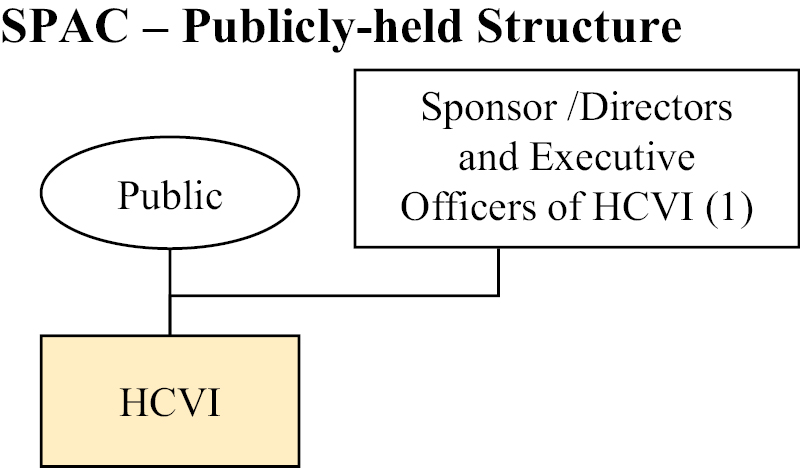
____________
(1) For more information about the ownership interests of the Initial Shareholders, including the Sponsor, prior to the Business Combination, see “Security Ownership of Certain Beneficial Owners and Management.”
The following diagram shows the current structure of Greenstone.
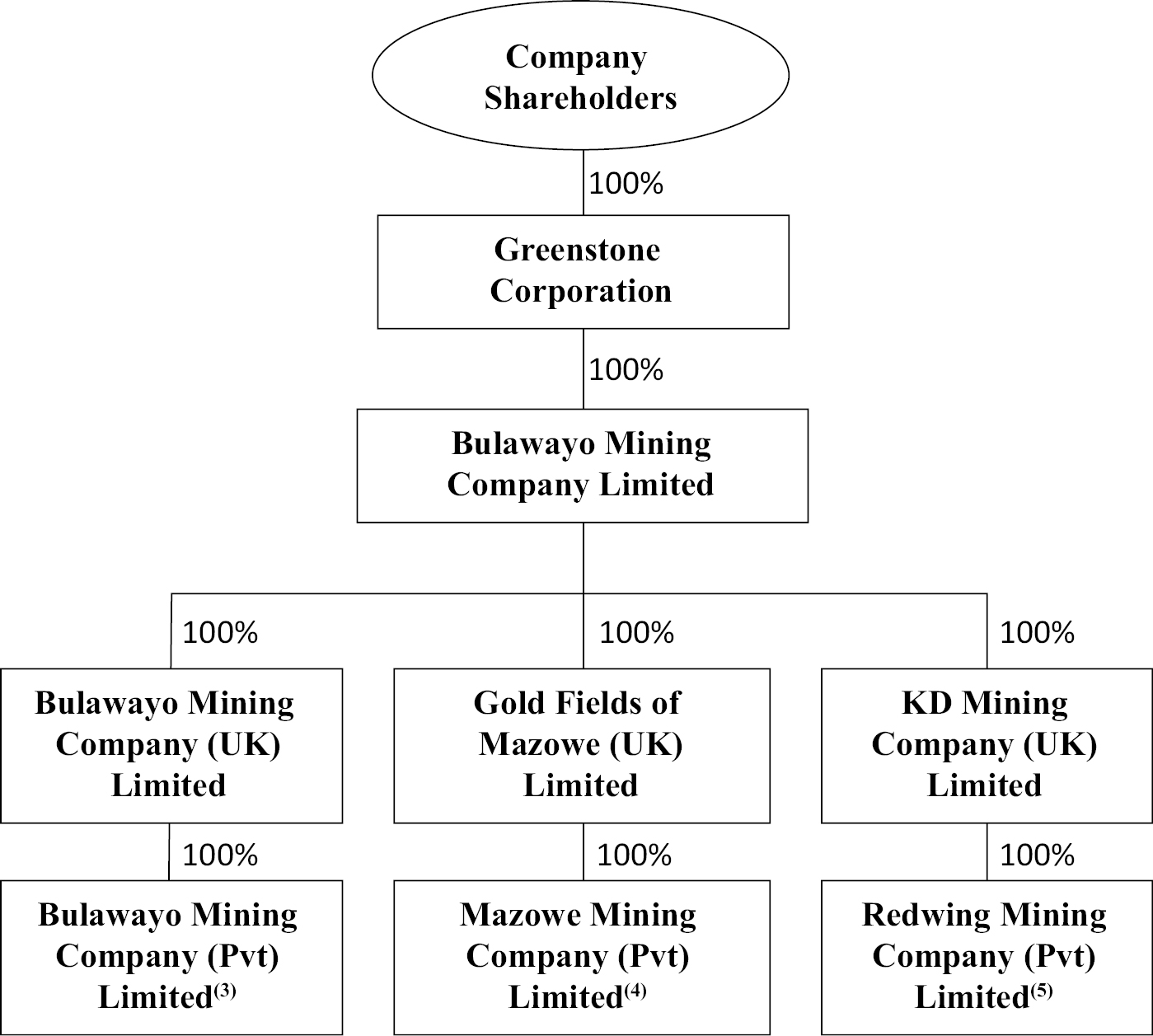
____________
(1) For more information about the ownership interests of Greenstone, prior to the Business Combination, see “Security Ownership of Certain Beneficial Owners and Management.”
(2) The diagram above only shows select subsidiaries of Greenstone.
(3) Represents the How Mining Company.
(4) Represents the Mazowe Mining Company.
(5) Represents the Redwing Mining Company.
3
Post-Closing Pro Forma PubCo Structure
The following diagram shows the pro forma ownership percentages and structure of PubCo immediately following the consummation of the Business Combination, assuming a No Redemption Scenario and assuming the consummation of a $60,000,000 PIPE Investment of SPAC Class A Common Stock at a price per share of $10.00 by certain investors and their permitted successors and assigns.
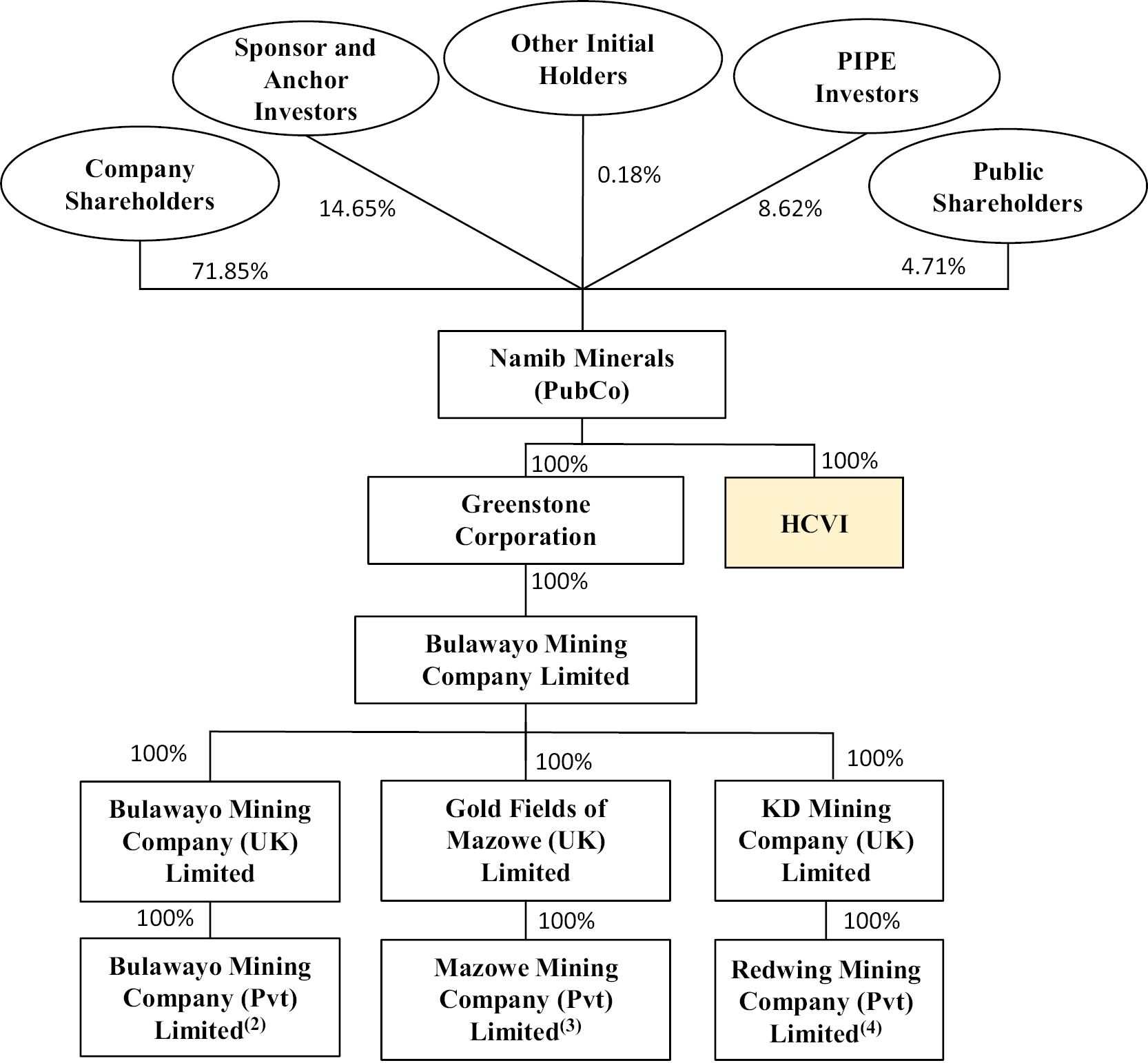
____________
(1) The diagram includes significant subsidiaries of PubCo post-closing.
(2) Represents the How Mining Company.
(3) Represents the Mazowe Mining Company.
(4) Represents the Redwing Mining Company.
The Business Combination
On June 17, 2024, SPAC, PubCo, the SPAC Merger Sub, the Company Merger Sub, and the Company entered into the Business Combination Agreement. The Company is an established gold producer with an attractive portfolio of three high-grade, low-cost gold mines in Zimbabwe, Africa.
Pursuant to the Business Combination Agreement, the parties thereto will enter into a business combination transaction by which, among other things, (a) Company Merger Sub will be merged with and into the Company, with the Company being the surviving entity of the Company Merger and becoming a wholly-owned subsidiary of PubCo; and (b) immediately following the Company Merger, SPAC Merger Sub will merge with and into SPAC, with SPAC being the surviving entity of the SPAC Merger and becoming a wholly-owned subsidiary of PubCo. Upon the Closing, SPAC and the Company each will become a direct wholly-owned subsidiary of PubCo, and PubCo will become a publicly traded company operating under the name “Namib Minerals,” and its ordinary shares and warrants are expected to trade on the Nasdaq Global Market under the ticker symbols “NAMM” and “NAMMW,” respectively.
4
The Transactions are expected to be consummated after the required approval by the shareholders of SPAC and the Company and the satisfaction of certain other conditions summarized below.
The Company Merger is to become effective when the Plan of Merger is filed with and registered by the Registrar of Companies of the Cayman Islands or at such later date and time as is agreed between the parties to the Business Combination Agreement and specified in the Plan of Merger and accepted by the Registrar of Companies, in such form as is required by, and executed in accordance with, the relevant provisions of the Companies Act and mutually agreed by the parties to the Business Combination Agreement. Simultaneously, the SPAC Merger is to become effective by filing the Certificate of Merger with the Secretary of State of the State of Delaware. Following the registration of the Plan of Merger with the Registrar of Companies, a certificate of merger will be issued by the Registrar of Companies as evidence of compliance with all statutory requirements. The parties to the Business Combination Agreement will hold the Closing on the first date on which all conditions set forth in the Business Combination Agreement required to be satisfied on or prior to the Closing are satisfied or waived (other than those conditions that by their terms are to be satisfied at the Closing, but subject to the satisfaction or waiver thereof), or at such other time or in such other manner as shall be agreed upon by HCVI and Greenstone in writing.
Consideration; Conversion of Securities
Pursuant to the terms of the Business Combination Agreement, the aggregate consideration to be paid to the Company Shareholders at Closing is (a) $500.0 million, minus (b) the indebtedness of the Group Companies on a consolidated basis at Closing, plus (c) all cash and cash equivalents of the Group Companies on a consolidated basis at Closing, plus (d) the amount of any filing fees paid by the Company in connection with this proxy statement/prospectus (such calculated amount being equal to the “Equity Value”). The consideration will be paid entirely in PubCo Ordinary Shares, at a price of $10.00 per ordinary share. In addition, the Company Shareholders will be entitled to receive up to 30.0 million of additional PubCo Ordinary Shares in contingent consideration, subject to the achievement of certain operational milestones over an eight (8) year post-Closing period, as described below under “Company Earnout.”
At the Company Merger Effective Time, each Company Share, that is issued and outstanding immediately prior to the Company Merger Effective Time will be exchanged for such fraction of a newly issued PubCo Ordinary Share that is equal to the quotient of (a) the Equity Value, divided by (b) the Fully-Diluted Company Shares (as defined in the Business Combination Agreement), divided by (c) $10.00 (the PubCo Ordinary Shares issued in exchange for Company Shares, collectively, the “Company Shareholder Closing Consideration”).
As a result of the SPAC Merger, (a) each outstanding share of SPAC Common Stock will be cancelled in exchange for the right to receive one PubCo Ordinary Share, and (b) each outstanding SPAC Warrant will become exercisable for one PubCo Ordinary Share on the same terms and conditions.
Company Earnout
During the period between the Closing Date and the eighth (8th) anniversary of the Closing Date (the “Company Earnout Period”), PubCo will issue, in addition to the Company Shareholder Closing Consideration issued at Closing, up to 30.0 million PubCo Ordinary Shares (collectively, the “Company Earnout Shares”) to the Company Shareholders as follows upon the satisfaction of the following milestones:
(i) 1.0 million PubCo Ordinary Shares, when the Company delivers a bankable feasibility study for the Mazowe Mine;
(ii) 4.0 million PubCo Ordinary Shares, if the Mazowe Mine reaches commercial production (i.e., the production of the first gold bar after processing and smelting);
(iii) 1.0 million PubCo Ordinary Shares, when the Company delivers a bankable feasibility study for the Redwing Mine;
(iv) 4.0 million PubCo Ordinary Shares, if the Redwing Mine reaches commercial production (i.e., the production of the first gold bar after processing and smelting); and
5
(v) 10.0 million PubCo Ordinary Shares, if the net present value of certain exploration projects in the DRC, as identified in a bankable feasibility study, is greater than or equal to $1.0 billion, with an additional 10.0 million shares if such net present value is greater than or equal to $2.0 billion.
Upon the occurrence of a Change of Control (as defined in the Business Combination Agreement) of PubCo during the Company Earnout Period, then all milestones described above will be deemed to have been satisfied and all Company Earnout Shares that have not been previously issued will be issued to the Company Shareholders effective as of immediately prior to the consummation of such Change of Control.
Exclusivity
From the date of the Business Combination Agreement and ending on the earlier of (a) the Closing and (b) the valid termination of the Business Combination (the “Interim Period”), Greenstone, PubCo, the SPAC Merger Sub, and the Company Merger Sub will not, and will cause its applicable control affiliates and their respective representative not to, directly or indirectly: (a) solicit, initiate, submit, facilitate (including by means of furnishing or disclosing information), discuss, or negotiate, directly or indirectly, any inquiry, proposal, or offer (written or oral) with any third-party (including any publicly traded special purpose acquisition company other than the SPAC (a “Competing SPAC”)) with respect to a Company Acquisition Proposal (such term as defined in the Business Combination Agreement); (b) furnish or disclose any non-public information to any third-party (including to any Competing SPAC) in connection with or that would reasonably be expected to lead to a Company Acquisition Proposal; (c) enter into any agreement, arrangement, or understanding with any third party (including a Competing SPAC) regarding a Company Acquisition Proposal; or (d) otherwise cooperate in any way with, or assist or participate in, or knowingly facilitate or encourage any effort or attempt by any person to do or seek to do any of the foregoing. Greenstone will, and will cause its affiliates, the Company Shareholders, and its and their respective representatives to, immediately cease any and all existing discussions or negotiations with any person conducted prior to the date hereof with respect to, or which is reasonably likely to give rise to or result in, a Company Acquisition Proposal. Greenstone will notify HCVI of any submissions, proposals, or offers made with respect to a Company Acquisition Proposal and provide copies of any such submissions, proposals, or offers to HCVI, as soon as practicable following Greenstone’s awareness thereof (but no later than two (2) business days following Greenstone’s receipt thereof).
Closing and Conditions to the Closing
Conditions to the Obligations of Each Party
The obligations of Namib Minerals, Greenstone, HCVI, SPAC Merger Sub, and Company Merger Sub to consummate the Business Combination, including the Mergers, are subject to the satisfaction or waiver (where permissible) at or prior to the Closing of the following conditions:
(a) the approval and authorization of the Transactions by the Company Requisite Shareholder will have been obtained;
(b) the Proposals will have been approved and adopted by the requisite affirmative vote of the stockholders of Hennessy Capital in accordance with this proxy statement/prospectus and applicable laws;
(c) approval by the shareholders of each of PubCo, Company Merger Sub, and SPAC Merger Sub will have been obtained;
(d) the registration statement of which this proxy statement/prospectus forms a part shall have become effective under the Securities Act and no stop order suspending the effectiveness of the registration statement shall have been issued and no proceedings for that purpose shall have been initiated or threatened in writing by the SEC and not withdrawn;
(e) PubCo’s initial listing application with Nasdaq in connection with the Transactions will have been conditionally approved and, immediately following the Closing, PubCo shall satisfy any applicable listing requirements of Nasdaq;
(f) no governmental authority will have enacted or issued any law, rule, regulation, or other judgment which has the effect of making the Business Combination illegal or otherwise prohibits the consummation of the Business Combination; and
6
(g) each of the Registration Rights and Lock-Up Agreement and the Warrant Assumption Agreement shall have been duly executed and delivered by each party thereto.
Conditions to the Obligations of HCVI
The obligation of HCVI to consummate the Business Combination is subject to the satisfaction or waiver (where permissible) at or prior to the Closing of the following additional conditions:
(a) the representations and warranties of Greenstone, Namib Minerals, SPAC Merger Sub, and Company Merger Sub contained in the sections of the Business Combination Agreement titled “Organization, Good Standing and Qualification;” “Subsidiaries;” “Capitalization of the Company;” “Capitalization of Subsidiaries;” “Authorization;” “Brokers;” “Organization, Good Standing, Corporate Power and Qualification;” “Capitalization and Voting Rights;” and “Business Activities” that are (i) qualified by materiality, “material” or “Company Material Adverse Effect” or any similar limitation, shall be true and correct in all respects, and (ii) not qualified by materiality, “material” or “Company Material Adverse Effect” or any similar limitation, shall be true and correct in all material respects, in the case of each of the foregoing clauses (i) and (ii), as of the Closing Date as though then made (except to the extent such representations and warranties expressly relate to an earlier date, and in such case, shall be so true and correct on and as of such earlier date). Each of the representations and warranties of the Company contained in Article III of the Business Combination Agreement and of the Acquisition Entities contained in Article V (other than the above listed representations and warranties), shall be true and correct (without giving any effect to any limitation as to “materiality” or “Company Material Adverse Effect” or any similar limitation set forth therein) in all respects as of the Closing Date as though then made (except to the extent such representations and warranties expressly relate to an earlier date, and in such case, shall be so true and correct on and as of such earlier date), except, in any case, where the failure of such representations and warranties to be so true and correct, individually or in the aggregate, has not had, and would not reasonably be expected to have, a Company Material Adverse Effect or an Acquisition Entities Material Adverse Effect, as applicable;
(b) each of the covenants of Greenstone and the Acquisition Entities to be performed as of or prior to the Closing Date shall have been performed in all material respects;
(c) PubCo shall have obtained and delivered to HCVI evidence of a fully-paid D&O Tail with respect to SPAC’s directors and officers prior to the Closing, which D&O Tail will be bound and fully effective upon the Closing without any further action of any party;
(d) since the date of the Business Combination Agreement, no Company Material Adverse Effect or Acquisition Entity Material Adverse Effect, as applicable, shall have occurred which is continuing and uncured;
(e) as of immediately prior to the SPAC Merger Effective Time, no Group Company or any Acquisition Entity (as defined in the Business Combination Agreement) shall be in bankruptcy, receivership, administration, restructuring, corporate rescue or other similar proceedings, and no liquidator, administrator, restructuring officer or similar Person shall have been appointed, in each case under any applicable administration, scheme of arrangement, restructuring, receivership, corporate rescue, insolvency, bankruptcy, or reorganization Laws;
(f) as of immediately prior to the SPAC Merger Effective Time, the organizational documents of PubCo shall have been amended and restated substantially in the form of the PubCo Organizational Documents; and
(g) Greenstone and each of the Acquisition Entities shall have delivered to HCVI a certificate, signed by authorized officers or directors of the Company and each Acquisition Entity, and dated as of the Closing Date, certifying the conditions set forth in (a) and (b) above have been fulfilled.
7
Conditions to the Obligations of Greenstone and the Acquisition Entities
The obligations of Greenstone, Namib Minerals, SPAC Merger Sub and Company Merger Sub to consummate the Business Combination are subject to the satisfaction or waiver (where permissible) at or prior to Closing of the following additional conditions:
(a) the representations and warranties of HCVI contained in the sections of the Business Combination Agreement titled “Organization, Good Standing, Corporate Power and Qualification;” “Capitalization and Voting Rights;” “Corporate Structure; Subsidiaries;” “Authorization;” “Brokers;” and “Business Activities;” that are that are (i) qualified by materiality, “material” or “SPAC Material Adverse Effect” or any similar limitation, shall be true and correct in all respects, and (ii) not qualified by materiality, “material” or “SPAC Material Adverse Effect” or any similar limitation, shall be true and correct in all material respects, in the case of each of the foregoing clauses (i) and (ii), as of the Closing Date as though then made (except to the extent such representations and warranties expressly relate to an earlier date, and in such case, shall be so true and correct on and as of such earlier date). Each of the representations and warranties of HCVI contained in Article IV of the Business Combination Agreement (other than the above listed representations and warranties), shall be true and correct (without giving any effect to any limitation as to “materiality” or “SPAC Material Adverse Effect” or any similar limitation set forth therein) in all respects as of the Closing Date as though then made (except to the extent such representations and warranties expressly relate to an earlier date, and in such case, shall be so true and correct on and as of such earlier date), except, in any case, where the failure of such representations and warranties to be so true and correct, individually or in the aggregate, has not had, and would not reasonably be expected to have, a SPAC Material Adverse Effect;
(b) each of the covenants of HCVI to be performed as of or prior to the Closing Date shall have been performed in all material respects;
(c) HCVI shall deliver or cause to be delivered to the Company a certificate signed by an authorized officer of HCVI, dated as of the Closing Date, certifying that the conditions specified in (a) and (b) above have been fulfilled; and
(d) Available SPAC Cash shall be not less than $25,000,000, which may consist of cash available in the Trust Account after deducting the amount required to satisfy final redemptions, plus the gross amount of the PIPE.
Termination
Termination of the Business Combination Agreement
The Business Combination Agreement may be terminated, and the Mergers and the Transactions may be abandoned at any time prior to the Company Merger Effective Time, as follows:
(a) by mutual written consent of HCVI and the Company;
(b) by either the Company or HCVI if the Closing has not occurred by March 31, 2025 and no material breach of the Business Combination Agreement by the party seeking to terminate primarily caused or resulted in the failure of the Transactions to be consummated by such time;
(c) by either the Company or HCVI if any governmental authority has enacted, issued, promulgated, enforced or entered any governmental order which has become final and nonappealable and has the effect of making consummation of the Transactions illegal or otherwise preventing or prohibiting consummation of the Transactions;
(d) by either the Company or HCVI if the SPAC Stockholders do not approve the Transactions;
(e) by HCVI if the Company Shareholders do not approve the Transactions;
(f) by HCVI if the Company fails to deliver either of a Regulation S-K 1300 compliant technical report summary or the Company’s 2023 and 2022 audited financial statements on or before August 31, 2024 (and such 2023 and 2022 audited financial statements of the Company were delivered to HCVI on September 12, 2024 and HCVI waived its right to terminate under the applicable section of the Business Combination Agreement);
8
(g) by HCVI if: (i) any PubCo, Company Merger Sub, SPAC Merger Sub, the Company, or any of the Company’s subsidiaries enters into bankruptcy, receivership, administration, restructuring, corporate rescue, or other similar proceedings or (ii) a liquidator, administrator, restructuring officer, or similar person is appointed on behalf of PubCo, Company Merger Sub, SPAC Merger Sub, the Company, or any of the Company’s subsidiaries, in each case under any applicable administration, scheme of arrangement, restructuring, receivership, corporate rescue, insolvency, bankruptcy, or reorganization laws; or
(h) by either the Company or HCVI upon a material breach of any representation, warranty, covenant or agreement on the part of the other in the Business Combination Agreement or in any other agreements relating to the Transactions and such breach is not cured within thirty (30) days following receipt of a written notice of such breach.
If the Business Combination Agreement is terminated, the Business Combination Agreement will become void, and have no effect, without any liability on the part of any party thereto or its respective affiliates, officers, directors, or shareholders, other than liability of the Company, HCVI, the SPAC Merger Sub, or the Company Merger Sub, as the case may be, for fraud or for any willful and material breach of the Business Combination Agreement occurring prior to such termination.
Effect of Termination
If the Business Combination Agreement is terminated, the Business Combination Agreement will become void, and there will be no termination fee payable or any other liability under the Business Combination Agreement on the part of any party thereto, except as set forth in the Business Combination Agreement or in the case of termination subsequent to a willful material or fraudulent breach of the Business Combination Agreement by a party thereto.
Material Tax Consequences
For a detailed discussion of certain U.S. federal income tax consequences and Cayman Islands tax consequences of the Business Combination, see “Material U.S. Federal Income Tax Considerations” and “Certain Material Cayman Islands Tax Considerations.”
Accounting Treatment
The Business Combination will be accounted for as a capital reorganization in accordance with IFRS. Under this method of accounting, while HCVI is the legal acquirer, it will be treated as the “acquired” company, and Greenstone will be the “acquirer” for accounting and financial reporting purposes. Since HCVI does not meet the definition of a “business” pursuant to IFRS 3, Business Combinations, the transaction is accounted for within the scope of IFRS 2, Share-Based Payments. Accordingly, the Business Combination will be treated as the equivalent of Greenstone issuing shares for the net assets of HCVI, with the fair value of the shares, in excess of the net assets of HCVI, being accounted for as a stock exchange listing expense under IFRS 2. The net assets of HCVI will be stated at historical cost, with no goodwill or other intangible assets recorded. Operations prior to the Business Combination will be those of Greenstone.
Appraisal or Dissenters’ Rights
With respect to the SPAC Merger, the SPAC Stockholders will have no appraisal rights under the DGCL.
Other Agreements Related to the Business Combination Agreement
Shareholder Support Agreement
Concurrently with the execution and delivery of the Business Combination Agreement, the Company Requisite Shareholder, HCVI, and the Company entered into the Shareholder Support Agreement, pursuant to which, among other things, and subject to the terms and conditions set forth therein, the Company Requisite Shareholder agreed to (a) vote all Company Shares held by the Company Requisite Shareholder in favor of the Business Combination Agreement, the Transactions and any related actions, and against any other transactions or proposals intended, or would reasonably be expected, to prevent, impede, interfere with, delay, postpone or adversely affect the Transactions in any material respect or the failure of any closing conditions of the Business Combination Agreement, (b) adopt prior to the Closing a written resolution approving the Business Combination Agreement and the other transaction
9
documents and approving the Mergers and other Transactions and adopting the PubCo Organizational Documents to be in effect as of the Closing, (c) take all actions reasonably necessary to consummate the Transactions, and (d) not transfer any Company Shares held by the Company Requisite Shareholder, subject to certain exceptions.
Sponsor Support Agreement
The Sponsor, the Company, HCVI, and certain stockholders of HCVI named therein, have executed the Sponsor Support Agreement, pursuant to which, among other things, and subject to the terms and conditions set forth therein, Sponsor and certain other stockholders of HCVI have agreed to (a) vote all of their shares of SPAC Common Stock in favor of the Business Combination Agreement, the Transactions and any related actions, and against any other transactions or proposals intended, or would reasonably be expected, to prevent, impede, interfere with, delay, postpone or adversely affect the Transactions in any material respect or the failure of any closing conditions of the Business Combination Agreement, (b) take all actions reasonably necessary to consummate the Transactions, and (c) not transfer or redeem any shares of SPAC Common Stock and SPAC Warrants held by them prior to Closing, subject to certain exceptions. No consideration (in cash or in other form of value) was provided in exchange for the entry into this agreement by the aforementioned parties.
Registration Rights and Lock-up Agreement
At Closing, PubCo, the Initial Shareholders, and the Company Shareholders (the Company Shareholders together with the Initial Shareholders are collectively referred to as the “Holders”) will enter into the Registration Rights and Lock-up Agreement, pursuant to which, among other things, effective upon the Closing, PubCo will grant the Holders customary demand and piggyback registration rights and the Holders will agree for a period of up to 12 months after Closing not to transfer any equity in PubCo acquired by such person in connection with the Business Combination, subject to exceptions. Pursuant to the Registration Rights and Lock-up Agreement, PubCo will undertake to, within 15 business days after the Closing Date, file with the SEC (at PubCo’s sole cost and expense) a registration statement registering the resale of the following securities held by the Holders and to use its reasonable best efforts to have the registration statement declared effective as soon as practicable after the initial filing thereof, but in no event later than 10 calendar days after the SEC notifies PubCo that the SEC will not review the registration statement or that the registration statement will not be subject to further review and comment, (a) PubCo Warrants converted from SPAC Private Placement Warrants (including any PubCo Ordinary Shares issuable upon the exercise of any such warrants); (b) any outstanding PubCo Ordinary Shares or any other equity security (including PubCo Ordinary Shares issued or issuable upon the exercise, exchange, or conversion of any other equity security) of PubCo held by a Holder as of the date of the Registration Rights and Lock-up Agreement; (c) any PubCo Warrants converted from SPAC Warrants (including the PubCo Ordinary Shares issued or issuable upon the exercise, exchange, or conversion of any such equity security) issuable upon conversion of any working capital loans made to SPAC by the Sponsor, an affiliate of the Sponsor, or any of SPAC’s officers or directors, if applicable; and (d) any other equity security of PubCo issued or issuable with respect to any such PubCo Ordinary Shares by way of a stock dividend or stock split or in connection with a combination of shares, recapitalization, merger, consolidation, or reorganization. In certain circumstances, the Holders can demand underwritten offerings and will be entitled to certain customary piggyback registration rights, in each case subject to certain limitations set forth in the Registration Rights and Lock-up Agreement, provided, that PubCo is not obligated to effect more than an aggregate of three (3) underwritten offerings and is not obligated to effect an underwritten offering within 90 calendar days after the closing of an underwritten offering.
Pursuant to the Registration Rights and Lock-Up Agreement, each Holder agrees to, among other things, not directly or indirectly, tender, transfer, grant, assign, offer, sell, contract to sell, hypothecate, pledge, make any short sale, or otherwise dispose of (including by gift, tender or exchange offer, merger, or operation of law), encumber, hedge, or utilize a derivative to transfer in the economic interest in any equity in PubCo acquired by such person acquired by such person in connection with the Business Combination (such securities, the “Lock-up Shares”), without the prior written consent of the PubCo Board (subject to certain exceptions, including but not limited to, in the case of the Listed Company Individual Holder (as defined in the Registration Rights and Lock-up Agreement), transfers pledged in a bona fide transaction to third parties as collateral to secure obligations pursuant to lending or other arrangements between such third parties (or their affiliates or designees) and such Holder and/or its affiliates or any similar arrangement relating to a financing arrangement for the benefit of such Holder, provided that such pledgee or other party will not foreclose on the Lock-up Shares during the Lock-up Period) during the period commencing on the Closing Date and ending on the earliest of: (i) the date falling 12 months after the Closing Date,
10
and (ii) the date following the Closing Date on which PubCo completes a liquidation, merger, share exchange, or other similar transaction that results in all of the shareholders of PubCo having the right to exchange their PubCo Ordinary Shares for cash, securities, or other property; provided that (x) 50% of the PubCo Ordinary Shares shall be released on such date on which the last reported sale price of the PubCo Ordinary Shares equals or exceeds $12.50 per PubCo Ordinary Share (as adjusted for share splits, share combinations, share dividends, reorganizations, recapitalizations and the like) for any 20 trading days within a 30-trading day period commencing at least 150 days after the Closing Date; and (y) the other 50% of the PubCo Ordinary Shares shall be released on the date on which the last reported sale price of the PubCo Ordinary Shares equals or exceeds $15.00 per PubCo Ordinary Share (as adjusted for share splits, share combinations, share dividends, reorganizations, recapitalizations, and the like) for any 20 trading days within a 30-trading day period commencing at least 150 days after the Closing Date (such period, the “Lock-up Period”).
It is expected that up to an aggregate of 96,810,645 PubCo Ordinary Shares will be entitled to registration (the “Registrable Securities”) pursuant to the Registration Rights and Lock Up Agreement, which consist of the following: (a) up to 9,443,318 PubCo Ordinary Shares upon conversion at Closing, on a one to one ratio, of the outstanding shares of SPAC Class B Common Stock held by the Sponsor and certain members of the HCVI Board and subsequent transferees (after giving effect to certain forfeitures by the Sponsor and based on HCVI’s estimated transaction expenses as of December 6, 2024), inclusive of any Sponsor Earnout Shares; (b) up to 7,345,727 PubCo Ordinary Shares issuable upon exercise of the 7,212,394 PubCo Warrants that will be outstanding upon conversion at Closing, on a one to one ratio, of the outstanding 7,212,394 SPAC Private Placement Warrants and upon exercise of the up to 133,333 PubCo Warrants into which the outstanding balance of the Sponsor’s working capital loan may be converted; and (c) up to 80,021,600 PubCo Ordinary Shares issued at Closing to the Company Shareholders as consideration in the Business Combination, inclusive of the Company Earnout Shares, assuming (i) $1.10 million of outstanding indebtedness of the Group Companies on a consolidated basis at Closing, (ii) $1.32 million of cash and cash equivalents of the Group Companies on a consolidated basis at Closing, and (iii) no filing fees are paid by the Company in connection with the proxy statement/prospectus.
PubCo Warrant Amendment
At Closing, PubCo, HCVI, and Continental will enter into the Warrant Assumption Agreement. Such agreement will amend the SPAC Warrant Agreement, as HCVI will assign all its rights, title, and interest in the SPAC Warrant Agreement to PubCo. Pursuant to the Warrant Assumption Agreement, the SPAC Warrants will no longer be exercisable for shares of SPAC Class A Common Stock, but instead will be exercisable for shares of PubCo Ordinary Shares on substantially the same terms that were in effect prior to the SPAC Merger Effective Time under the terms of the SPAC Warrant Agreement. For a more detailed description of the terms of the PubCo Warrant Agreement, see “Description of PubCo’s Securities.”
For more information, see “Certain Agreements Related to the Business Combination — PubCo Warrant Amendment.”
Sponsor Letter Agreement
The Sponsor, HCVI, and PubCo have entered into the Sponsor Letter Agreement pursuant to which, among other things, and subject to the terms and conditions set forth therein, Sponsor agreed to (a) waive the anti-dilution rights of the shares of the SPAC Class B Common Stock set forth in HCVI’s organizational documents in connection with the consummation of the Transactions, (b) subject certain of the PubCo Ordinary Shares the Sponsor would receive via the SPAC Merger to certain vesting conditions and potential forfeiture (as described below under “Sponsor Earnout Shares”) and (c) forfeit to HCVI (i) 1.36 million shares of SPAC Common Stock held by Sponsor prior to Closing and (ii) up to an additional 2.0 million shares of SPAC Common Stock held by the Sponsor prior to Closing (the “Additional Founder Forfeited Shares”) to the extent necessary to ensure that the total gross proceeds from the Permitted Financing Agreements are not less than $50.0 million. If at the Closing there is a SPAC Transaction Expenses Cap Excess, the Sponsor will forfeit to HCVI a number of shares of SPAC Common Stock equal to (x) the amount of the SPAC Transaction Expenses Cap Excess divided by (y) $10.00.
Sponsor Earnout Shares
Pursuant to the Sponsor Letter Agreement, the Sponsor also agreed to subject a number of PubCo Ordinary Shares that it would otherwise receive via the SPAC Merger equal to (i) 2.0 million minus (ii) the number of Additional Founder Forfeited Shares, as unvested “Sponsor Earnout Shares” subject to certain vesting and potential
11
forfeiture restrictions as set forth therein. Fifty percent (50%) of the Sponsor Earnout Shares will vest on the first date on which the closing price of PubCo Ordinary Shares exceeds $12.50 for any 20 trading days within a consecutive 30-trading day period. The remaining 50% of the Sponsor Earnout Shares will vest on the first date on which the closing price of PubCo Ordinary Shares exceeds $15.00 for any 20 trading days within a consecutive 30-trading day period. Upon the occurrence of a Change of Control (as defined in the Sponsor Letter Agreement) of PubCo during the Sponsor Earnout Period, then the vesting requirements described in the immediately preceding two sentences will be deemed to have been satisfied and vesting of the Sponsor Earnout Shares will be accelerated. Any unvested Sponsor Earnout Shares will automatically be forfeited if the Sponsor Earnout Shares have not vested prior to the end of the Sponsor Earnout Period.
Interests of HCVI’s Directors and Officers in the Business Combination
When considering the HCVI Board’s recommendation that HCVI’s stockholders vote in favor of the approval of the Business Combination Proposal and the other Proposals presented for stockholder approval in this proxy statement/prospectus, HCVI’s stockholders should be aware that the Sponsor and HCVI’s current and former executive officers and directors have interests in the Business Combination that may be different from, or in addition to, the interests of HCVI’s other stockholders generally. The HCVI Board was aware of and considered these interests, among other matters, in evaluating the Business Combination, and in recommending to HCVI’s stockholders that they approve the Business Combination. Public Stockholders should take these interests into account in deciding whether to approve the Business Combination or to exercise their rights of redemption. These interests include:
• the beneficial ownership of the Sponsor and certain members of the HCVI Board and officers of an aggregate of (a) 11,339,318 shares of SPAC Class B Common Stock, which were acquired for an aggregate purchase price of approximately $25,000 prior to the IPO (inclusive of the number of shares of SPAC Class B Common Stock that the Sponsor has previously agreed to transfer to third-party investors in HCVI at the Closing), which shares would likely be worthless if HCVI is unable to effectuate an initial business combination by the Business Combination Deadline (unless such date is extended in accordance with the SPAC Charter) and HCVI is therefore required to liquidate, as shares of SPAC Class B Common Stock are not entitled to participate in any redemption or liquidation of the Trust Account and (b) (i) 2,359,217 SPAC Private Placement Warrants, which were acquired for an aggregate purchase price of approximately $3.5 million simultaneously with the consummation of the IPO and (ii) 100,000 SPAC Private Placement Warrants, which were acquired for an aggregate purchase price of up to $150,000 (as described further under HCVI Management’s Discussion and Analysis of Financial Condition and Results of Operations — Recent Events — Subscription Agreements”), which warrants would become worthless if HCVI does not complete an initial business combination within the Business Combination Deadline. Such shares of SPAC Class B Common Stock and SPAC Private Placement Warrants have an aggregate market value of approximately $[ ] million and $[ ] million, respectively, based on the closing price of SPAC Class A Common Stock of $[ ] and SPAC Public Warrants of $[ ] on Nasdaq on [ ], the record date for the HCVI Stockholders’ Meeting;
• each of HCVI’s officers and directors is a member of the Sponsor, and Daniel J. Hennessy, the Chairman and Chief Executive Officer of HCVI, is the ultimate beneficial owner with voting and investment discretion with respect to the shares of SPAC Common Stock held by the Sponsor;
• the continued indemnification of current directors and officers of HCVI and the continuation of directors’ and officers’ liability insurance after the Business Combination;
• the fact that the Sponsor and HCVI’s officers and directors will be reimbursed for out-of-pocket expenses incurred in connection with activities on HCVI’s behalf, such as identifying potential target businesses and performing due diligence on suitable business combinations. As of November 30, 2024, the current directors or officers of HCVI had not incurred any expenses which they expect to be reimbursed at the Closing;
12
• the fact that at the Closing, PubCo, the Sponsor, and certain of HCVI’s current and former directors and officers will enter into the Registration Rights and Lock-Up Agreement, which, among other things, provide customary registration rights, including piggy-back rights, subject to cooperation and cut-back provisions with respect to the PubCo Ordinary Shares held by such parties following the consummation of the Business Combination and will amend the existing transfer restrictions under the Sponsor Letter Agreement;
• the fact that the Sponsor, an affiliate of the Sponsor, or HCVI’s officers and directors may, but are not obligated to, provide working capital loans to HCVI. The working capital loans would either be repaid upon consummation of a business combination, without interest, or, at the lender’s discretion, up to $1,500,000 of such working capital loans may be convertible into private placement warrants to purchase shares of SPAC Class A Common Stock at a price of $1.50 per warrant. If HCVI completes a business combination, HCVI will repay the working capital loans out of the proceeds of the Trust Account released to PubCo. Otherwise, the working capital loans would be repaid only out of funds held outside the Trust Account. In the event that a business combination does not close, HCVI may use a portion of proceeds held outside the Trust Account to repay the working capital loans but no proceeds held in the Trust Account would be used to repay the working capital loans. As of September 30, 2024, $200,000 of working capital loans payable to the Sponsor were outstanding;
• the fact that pursuant to the Polar Subscription Agreement II, in the event that Polar’s $1.75 million capital contribution is not repaid in full within 30 calendar days of HCVI’s liquidation or within five business days of the closing of an initial business combination, Daniel J. Hennessy, Chairman and Chief Executive Officer of HCVI, is required (in his individual capacity) to pay Polar a cash amount equal to the portion of the $1.75 million capital contribution that is not repaid by HCVI;
• the fact that the Sponsor is entitled to $15,000 per month for office space, utilities and secretarial and administrative support to HCG, an affiliate of the Sponsor;
• the anticipated election of Daniel J. Hennessy as a director of PubCo in connection with the consummation of the Business Combination. As such, in the future, such director may receive any cash fees, share options, or share awards that the PubCo Board determines to pay to such director;
• the fact that Nicholas Petruska, the former Executive Vice President and Chief Financial Officer of HCVI, Greg Ethridge, the former President and Chief Operating Officer and director of HCVI, and Daniel Zlotnitsky, former Vice President of an affiliate of the Sponsor, HCG, in his capacity as an independent contractor service provider to HCVI, are entitled to receive, assuming the satisfaction of certain conditions, an aggregate of approximately $1.19 million in deferred compensation that is payable upon the closing of an initial business combination and such amount would be forfeited if HCVI does not complete an initial business combination prior to the Business Combination Deadline; and
• the fact that the Sponsor and HCVI’s officers and directors will lose their entire investment in HCVI and Daniel J. Hennessy (in his individual capacity) likely will be required to repay all or a portion of Polar’s $1.75 million capital contribution (as described above) if an initial business combination is not completed prior to the Business Combination Deadline.
These interests may influence HCVI’s directors in making their recommendation to vote in favor of the approval of the Business Combination Proposal and the other proposals described in this proxy statement/prospectus. You should also read the section entitled “The Business Combination — Interests of HCVI’s Directors and Officers in the Business Combination.”
13
Interests of Greenstone’s Officers and Directors in the Business Combination
Greenstone and its officers and directors have financial interests that are different from, or in addition to, the interests of unaffiliated HCVI stockholders, which could cause the Company to pursue terms in the Business Combination that are less favorable to non-redeeming stockholders; Greenstone’s directors and officers do not owe a fiduciary duty to HCVI stockholders. The anticipated continuation of Greenstone’s existing directors and officers, Messrs. Tall, Sikwila, and Mchunu, as directors and officers of PubCo, may entitle such directors and officers to receive cash fees, stock options, stock awards, or other renumeration that the PubCo Board determines to pay them for their services as directors and officers. The current directors and executive officers of Greenstone beneficially own approximately 15.9% of the outstanding ordinary shares of Greenstone, and upon the consummation of the Business Combination, will hold PubCo Ordinary Shares, representing, assuming a No Redemption Scenario, approximately 11.4% of PubCo Ordinary Shares post-Closing. See “Security Ownership of Certain Beneficial Owners and Management.” In addition, upon Closing, the current directors and executive officers of Greenstone will be entitled to receive 15.9% of the Company Earnout Shares due to their current 15.9% ownership of Greenstone. See “The Business Combination Agreement — Consideration; Conversion of Securities — Company Earnout.”
Compensation Received by the Sponsor
Set forth below is a summary of the terms and amount of the compensation received or to be received by the Sponsor and its current and former affiliates in connection with the Business Combination or any related financing transaction, the amount of securities issued or to be issued by HCVI to the Sponsor and its current and former affiliates and the price paid or to be paid for such securities or any related financing transaction.
|
Amount of Compensation to be |
Consideration Paid or to be Paid |
|||
|
Sponsor |
Up to 9,443,318 PubCo Ordinary Shares upon conversion of the shares of SPAC Class B Common Stock held by the Sponsor, inclusive of the Sponsor Earnout Shares and shares the Sponsor has committed to transfer to third-parties in connection with the Closing and after giving effect to the required Sponsor forfeitures pursuant to the Sponsor Letter Agreement and based on HCVI's estimated transaction expenses as of December 6, 2024 |
$25,000 |
||
|
2,359,217 PubCo Warrants upon conversion of the 2,359,217 SPAC Private Placement Warrants |
$3,538,825.50 |
|||
|
Up to $1,500,000 or up to 1,000,000 SPAC Private Placement Warrants |
Repayment of loans made to HCVI to cover working capital expenses which may be convertible into SPAC Private Placement Warrants at a price of $1.50 per warrant; $200,000 of such loans are outstanding as of September 30, 2024 |
|||
|
Reimbursement for out-of-pocket expenses incurred in connection with activities on HCVI’s behalf, such as identifying potential target businesses and performing due diligence on suitable business combination |
The expenses incurred in connection with activities on HCVI’s behalf, such as identifying potential target businesses and performing due diligence on suitable business combination |
|||
|
HCG |
100,000 PubCo Warrants upon conversion of the 100,000 SPAC Private Placement Warrants |
Up to $150,000 |
14
|
Amount of Compensation to be |
Consideration Paid or to be Paid |
|||
|
HCVI Independent Directors |
25,000 PubCo Ordinary Shares to each of HCVI’s current and former independent directors upon conversion of the 25,000 SPAC Class B Common Stocks held by such person |
None |
||
|
Former HCVI Officers and Service Provider |
An aggregate of approximately $1.19 million in deferred compensation payable upon the Closing |
Services in connection with identifying, investigating and completing an initial business combination |
The securities issuable to the Sponsor and its affiliates may result in the material dilution of the equity interests of the non-redeeming holders SPAC Class A Common Stock. See the Question “What happens if a substantial number of Public Stockholders vote in favor of the Business Combination Proposal and the other proposals described in this proxy statement/prospectus and exercise their Redemption Rights?”
Redemption Rights
Pursuant to the SPAC Charter, any holders of shares of SPAC Class A Common Stock may demand that such shares be redeemed in exchange for a pro rata share of the aggregate amount on deposit in the Trust Account, including any amounts representing interest earned on the Trust Account, less taxes payable, provided that such HCVI Stockholders follow the specific procedures for redemption set forth in this proxy statement/prospectus relating to the HCVI Stockholder vote on the Business Combination. If demand is properly made and the Business Combination is consummated, these shares, immediately prior to the Business Combination, will cease to be outstanding and will represent only the right to receive a pro rata share of the aggregate amount on deposit in the Trust Account which holds the proceeds of the IPO as of two business days prior to the consummation of the Business Combination, net of any taxes payable, upon the consummation of the Business Combination. For illustrative purposes, based on funds in the Trust Account of approximately $35.17 million (after giving effect to franchise and income taxes payable) on September 30, 2024, the estimated per share redemption price would have been approximately $10.73. See “The HCVI Stockholders’ Meeting — Redemption Rights.”
PIPE Investment
In connection with the Business Combination, HCVI expects to enter into a PIPE Investment with certain investors to purchase SPAC Class A Common Stock in a separate private placement transaction. The final terms of the PIPE Investment have yet to be determined and are subject to negotiation between HCVI, PubCo, Greenstone, and the applicable investors. This proxy statement/prospectus does not constitute an offer to sell nor is soliciting an offer to buy any securities in connection with the PIPE Investment.
Pro Forma Ownership of PubCo
The following table presents the anticipated share ownership of various holders of PubCo Ordinary Shares upon the Closing without and after giving effect to the additional dilution that may be caused by the exercise of PubCo Warrants issued in exchange for SPAC Warrants, the 265,000 PubCo Ordinary Shares issuable pursuant to the Polar Subscription Agreements, PubCo Ordinary Shares issuable under the Equity Incentive Plan, the vesting of the Company Earnout shares, and based on the following additional assumptions: (i) no additional issuances of SPAC Common Stock, other than the PIPE Investment, (ii) all outstanding shares of SPAC Class B Common Stock automatically convert into PubCo Ordinary Shares at Closing on a one-to-one basis, (iii) there is a SPAC Transaction Expenses Cap Excess resulting in the Sponsor forfeiting 561,000 shares of SPAC Common Stock to HCVI, (iv) the Company has outstanding indebtedness of $1.10 million and cash and cash equivalents of $1.32 million, such balances representing the same amounts outstanding as of June 30, 2024, as of the Closing, and no filing fees are paid by the Company in connection with this proxy statement/prospectus, and (v) the consummation of a $60,000,000 PIPE Investment of SPAC Class A Common Stock at a price per share of $10.00. Certain figures included in this table have been rounded for ease of presentation and, as a result, percentages may not sum to 100%.
No Redemption Scenario: This scenario assumes that none of HCVI’s existing Public Stockholders exercise their Redemption Rights in connection with the Business Combination with respect to their Public Shares.
15
25% Redemption Scenario: This scenario assumes that 819,113 Public Shares (representing approximately 25% of the total Public Shares outstanding) are redeemed in connection with the Business Combination.
50% Redemption Scenario: This scenario assumes that 1,638,227 Public Shares (representing approximately 50% of the total Public Shares outstanding) are redeemed in connection with the Business Combination.
75% Redemption Scenario: This scenario assumes that 2,457,339 Public Shares (representing approximately 75% of the total Public Shares outstanding) are redeemed in connection with the Business Combination.
Maximum Redemption Scenario: This scenario assumes that all Public Shares are redeemed in connection with the Business Combination (the “Maximum Redemption Scenario”). The number of shares redeemed reflects the maximum number of Public Shares that can be redeemed and assumes the amount of the PIPE Investment will equal or exceed the amount required to satisfy the Minimum Cash Condition. The Minimum Cash Condition takes into account the sum of the amount of cash available in the Trust Account following the HCVI Stockholders’ Meeting (after deducting the amount required to satisfy the amount payable to Public Stockholders exercising their Redemption Rights) plus the aggregate financing amounts under all PIPE Investments.
|
No Redemption |
25% Redemption |
50% Redemption |
75% Redemption |
Maximum Redemption |
|||||||||||||||||||||
|
Shares |
% |
Shares |
% |
Shares |
% |
Shares |
% |
Shares |
% |
||||||||||||||||
|
Public Stockholders |
3,276,453 |
4.71 |
% |
2,457,340 |
3.57 |
% |
1,638,227 |
2.41 |
% |
819,114 |
1.22 |
% |
0 |
0 |
% |
||||||||||
|
Sponsor and Anchor Investors(1)(2) |
10,198,318 |
14.65 |
% |
10,198,318 |
14.82 |
% |
10,198,318 |
15.00 |
% |
10,198,318 |
15.18 |
% |
10,198,318 |
15.37 |
% |
||||||||||
|
Other Initial Holders(3) |
125,000 |
0.18 |
% |
125,000 |
0.18 |
% |
125,000 |
0.18 |
% |
125,000 |
0.19 |
% |
125,000 |
0.19 |
% |
||||||||||
|
Company Shareholders |
50,021,600 |
71.85 |
% |
50,021,600 |
72.70 |
% |
50,021,600 |
73.58 |
% |
50,021,600 |
74.48 |
% |
50,021,600 |
75.40 |
% |
||||||||||
|
PIPE Investors |
6,000,000 |
8.62 |
% |
6,000,000 |
8.72 |
% |
6,000,000 |
8.83 |
% |
6,000,000 |
8.93 |
% |
6,000,000 |
9.04 |
% |
||||||||||
|
Total PubCo Ordinary Shares Outstanding at Closing, Excluding Additional Dilution Sources |
69,621,371 |
100 |
% |
68,802,258 |
100 |
% |
67,983,145 |
100 |
% |
67,164,032 |
100 |
% |
66,344,918 |
100 |
% |
||||||||||
|
Additional Dilution Sources |
Assuming |
% of Total |
Assuming |
% of Total |
Assuming |
% of Total |
Assuming |
% of Total |
Assuming |
% of Total |
|||||||||||||||
|
Holders of SPAC Warrants(4) |
18,710,045 |
21.18 |
% |
18,710,045 |
21.38 |
% |
18,710,045 |
21.58 |
% |
18,710,045 |
21.79 |
% |
18,710,045 |
22.00 |
% |
||||||||||
|
Company Earnout Shares(5) |
30,000,000 |
30.11 |
% |
30,000,000 |
30.36 |
% |
30,000,000 |
30.62 |
% |
30,000,000 |
30.88 |
% |
30,000,000 |
31.14 |
% |
||||||||||
|
Polar Subscrription |
265,000 |
0.38 |
% |
265,000 |
0.38 |
% |
265,000 |
0.39 |
% |
265,000 |
0.39 |
% |
265,000 |
0.40 |
% |
||||||||||
|
Equity Incentive Plan awards recipients(7) |
6,962,137 |
9.09 |
% |
6,880,226 |
9.09 |
% |
6,798,315 |
9.09 |
% |
6,716,403 |
9.09 |
% |
6,634,492 |
9.09 |
% |
||||||||||
|
Total Additional Dilution |
55,937,182 |
44.55 |
% |
55,855,271 |
44.81 |
% |
55,773,360 |
45.07 |
% |
55,691,448 |
45.33 |
% |
55,609,537 |
45.60 |
% |
||||||||||
____________
Notes: —
* Less than 1%.
(1) Represents (i) the 9,318,318 PubCo Ordinary Shares issuable in exchange for the Sponsor’s outstanding shares of SPAC Class B Common Stock, after giving effect to the Sponsor’s forfeitures of 1,360,000 shares of SPAC Class B Common Stock pursuant to the Sponsor Letter Agreement and of 561,000 of shares of SPAC Common Stock as a result of a SPAC Transaction Expenses Cap Excess, inclusive of any Sponsor Earnout Shares, and (ii) the 880,000 PubCo Ordinary Shares issuable to Polar pursuant to the Polar Subscription Agreements.
16
(2) Includes PubCo Ordinary Shares that the Sponsor will be obligated to transfer or to sell at-cost to certain Anchor Investors and counterparties to certain non-redemption agreements.
(3) Represents the 125,000 PubCo Ordinary Shares issuable in exchange for 125,000 shares of SPAC Class B Common Stock held by the current and former independent directors of HCVI.
(4) Represents (i) the 7,212,394 PubCo Ordinary Shares issuable upon the exercise of the PubCo Warrants upon conversion of the outstanding SPAC Private Placement Warrants, (ii) the 133,333 PubCo Ordinary Shares issuable upon exercise of the PubCo Warrants into which the outstanding balance of the Sponsor’s working capital loan may be converted, at the option of the Sponsor, and (iii) 11,364,318 PubCo Ordinary Shares issuable upon the exercise of the PubCo Warrants upon conversion of the outstanding SPAC Public Warrants.
(5) Represents additional PubCo Ordinary Shares issuable to the Company Shareholders upon achievement of certain operational milestones. See “The Business Combination Agreement — Consideration; Conversion of Securities — Company Earnout.”
(6) Represents the PubCo Ordinary Shares issuable to Polar as the return of capital payments pursuant to the Polar Subscription Agreements if Polar elects to be paid fully in PubCo Ordinary Shares instead of cash.
(7) Represents the PubCo Ordinary Shares issuable under the Equity Incentive Plan.
Board of Directors and Management of PubCo Following the Business Combination
At the Merger Effective Time, the PubCo Board is expected to be comprised of up to nine members, including Ibrahima Tall, Tulani Sikwila, Siphesihle Mchunu, and Daniel J. Hennessy. Following the Business Combination, the executive officers of PubCo will be Ibrahima Tall as Chief Executive Officer, Tulani Sikwila as Chief Financial Officer, and Siphesihle Mchunu as General Counsel. For a detailed discussion of the management of PubCo after the Business Combination, see “Management of PubCo After the Business Combination.”
Other Proposals to be presented at the HCVI Stockholders’ Meeting
In addition to the Business Combination Proposal, HCVI stockholders will be asked to vote on the Non-Binding Governance Proposals, the Equity Incentive Plan Proposal, and the Adjournment Proposal. For more information about these proposals, see “Proposal No. 2 — The Non-Binding Governance Proposals,” “Proposal No. 3 — The Equity Incentive Plan Proposal,” and “Proposal No. 4 — The Adjournment Proposal.”
Date, Time and Place of the HCVI Stockholders’ Meeting
The HCVI Stockholders’ Meeting will be held on [ ], 2024, at [ ] a.m., Eastern time, conducted via live webcast at the following address: [ ]. You will need the control number that is printed on your proxy card to enter the HCVI Stockholders’ Meeting. HCVI recommends that you log in at least 15 minutes before the HCVI Stockholders’ Meeting to ensure you are logged in when the meeting starts. Please note that you will not be able to attend the HCVI Stockholders’ Meeting in person.
Record Date and Voting
You will be entitled to vote or direct votes to be cast at the HCVI Stockholders’ Meeting if you owned SPAC Common Stock at the close of business on [ ], 2024 which is the record date for the HCVI Stockholders’ Meeting. You are entitled to one vote for each SPAC Common Stock that you owned as of the close of business on the record date. If your shares are held in “street name” or are in a margin or similar account, you should contact your broker, bank or other nominee to ensure that votes related to the shares you beneficially own are properly counted. On the record date, there were [ ] SPAC Common Stock outstanding.
Currently, the Initial Shareholders own 77.6% of HCVI’s issued and outstanding SPAC Common Stock, including all of the Founder Shares, and the Initial Shareholders, including the directors and officers of HCVI, have agreed to vote any SPAC Class B Common Stock owned by them in favor of the Business Combination Proposal and the other proposals described in this proxy statement/prospectus. HCVI’s issued and outstanding warrants do not have voting rights at the HCVI Stockholders’ Meeting.
Solicitation of Proxies and Revoking your Proxy
Proxies may be solicited by mail. HCVI will pay the cost of soliciting proxies for the HCVI Stockholders’ Meeting. HCVI has engaged [ ] (“[ ]”) to assist in the solicitation of proxies for the HCVI Stockholders’ Meeting. If a shareholder grants a proxy, it may revoke it at any time before the HCVI Stockholders’ Meeting or at such meeting. For additional information see “The HCVI Stockholders’ Meeting — Revoking Your Proxy.”
17
Quorum and Required Vote for the Proposals
A quorum of HCVI stockholders is necessary to hold a valid meeting. A quorum will be present at the HCVI Special Meeting if a majority of the common stock outstanding and entitled to vote at the Special Meeting is represented in person (by virtual attendance) or by proxy. Abstentions will count as present for the purposes of establishing a quorum. Broker non-votes will not be counted for purposes of establishing a quorum.
The approval of each of the Business Combination Proposal, the Non-Binding Governance Proposals, the Equity Incentive Plan Proposal, and the Adjournment Proposal requires the affirmative vote of a majority of the issued and outstanding shares of SPAC Common Stock as of the record date. Accordingly, an HCVI stockholder’s failure to vote by proxy or in person (including virtually) at the HCVI Stockholders’ Meeting will not be counted towards the number of SPAC Common Stock required to validly establish a quorum and, if a valid quorum is otherwise established, such failure to vote will have no effect on the outcome of any vote on such proposals. Abstentions and broker non-votes will be counted for purposes of determining the presence of a quorum at the HCVI Stockholders’ Meeting. For purposes of approval, an abstention or failure to vote will have the same effect as a vote against the Business Combination Proposal and will have no effect on any of the other Proposals.
The Closing of the Business Combination is conditioned on the approval of the Business Combination Proposal, the Non-Binding Governance Proposals, and the Equity Incentive Plan Proposal. The Adjournment Proposal is not conditioned on the approval of any other proposal set forth in this proxy statement/prospectus.
Recommendation to HCVI Shareholders
HCVI’s board of directors believes that each of the Business Combination Proposal, Non-Binding Governance Proposals, the Equity Incentive Plan Proposal, and Adjournment Proposal, is in the best interests of HCVI and its shareholders and recommends that its shareholders vote “FOR” each of the proposals to be presented at the HCVI Stockholders’ Meeting.
Reasons for the Approval of the Business Combination
After careful consideration, the HCVI Board recommends that SPAC Stockholders vote “FOR” each proposal being submitted to a vote of the SPAC Stockholders at the HCVI Stockholders’ Meeting. The HCVI Board considered a number of positive factors including, but not limited to, (i) current profitable production at the How Mine, (ii) historical production at the Mazowe Mine and the Redwing Mine, (iii) Greenstone’s attractive comparative cost structure, (iv) Greenstone’s attractive valuation compared to producing peers, (v) Greenstone operates with high barrier to entry, (vi) Greenstone’s expansion opportunities, (vii) the impact of the Company Earnout Shares, (viii) Greenstone’s strong employee relations, (ix) high safety standards, (x) experienced management team, (xi) Greenstone will benefit substantially from being a public company, and (xii) the reasonableness of the merger consideration. The HCVI Board also gave consideration to a variety of uncertainties and risks and other potentially negative factors concerning the Business Combination, including, but not limited to, (i) macroeconomic and political risks, (ii) PubCo’s growth initiatives may not be achieved, (iii) Greenstone's geographic concentration risk, (iv) uncertainty of benefits, (v) redemption risk, (vi) liquidation of HCVI, (vii) litigation, (viii) forfeiture of mining lease title, (ix) diversion of management attention during the period prior to Closing, (x) HCVI’s stockholder vote, (xi) non-survival of the representations, warranties, or covenants, (xii) satisfaction of the conditions to the Closing, (xiii) PubCo’s public company readiness, (xiv) risks of doing business in Zimbabwe, (xv) stock exchange listing risks, (xvi) HCVI stockholders holding a minority ownership in PubCo, and (xvii) significant fees and expenses associated with completing the Business Combination. For a more detailed description of HCVI’s reasons for the approval of the Business Combination and the recommendation of the HCVI Board, see “The Business Combination — HCVI’s Board of Directors’ Reasons for the Approval of the Business Combination.”
18
Sources and Uses of Funds for the Business Combination
The following tables summarize the sources and uses for funding the Business Combination under each of the No Redemption Scenario, 25% Redemption Scenario, 50% Redemption Scenario, 75% Redemption Scenario, and Maximum Redemption Scenario:
No Redemption Scenario
|
Sources(1) |
|||
|
Proceeds from the Trust Account(2) |
$ |
35,409,000 |
|
|
Proceeds from the PIPE Investment(3) |
|
60,000,000 |
|
|
Company Shareholders – Equity Rollover(4) |
|
500,216,000 |
|
|
Total Sources |
$ |
595,625,000 |
|
|
Uses |
|||
|
Cash to Balance Sheet(5) |
$ |
74,007,313 |
|
|
Company Shareholders – Equity Rollover(4) |
|
500,216,000 |
|
|
Repayment of Polar Subscription Agreements |
|
2,650,000 |
|
|
Estimated Transaction Fees & Expenses(6) |
|
18,751,687 |
|
|
Total Uses |
$ |
595,625,000 |
|
____________
(1) Totals may be affected by rounding.
(2) Balance as of September 30, 2024.
(3) Assuming the consummation of a $60,000,000 PIPE Investment of SPAC Class A Common Stock at a price per share of $10.00.
(4) Dollar amount represents the number of PubCo Ordinary Shares that Company Shareholders will receive at Closing valued at a share price of $10.00. This amount is not impacted by the number of redemptions.
(5) Reflects Total Sources less Estimated Fees & Expenses, Repayment of Polar Subscription Agreements, and Company Shareholders Equity Rollover.
(6) Reflects the repayment of an estimated $21.4 million of legal, audit, consulting and other transaction-related expenses on behalf of HCVI and Greenstone exclusive of the repayment of Polar Subscription Agreements.
25% Redemption Scenario
|
Sources(1) |
|||
|
Proceeds from the Trust Account(2) |
$ |
26,556,750 |
|
|
Proceeds from the PIPE Investment(3) |
|
60,000,000 |
|
|
Company Shareholders – Equity Rollover(4) |
|
500,216,000 |
|
|
Total Sources |
$ |
586,772,750 |
|
|
Uses |
|||
|
Cash to Balance Sheet(5) |
$ |
65,155,063 |
|
|
Company Shareholders – Equity Rollover(4) |
|
500,216,000 |
|
|
Repayment of Polar Subscription Agreements |
|
2,650,000 |
|
|
Estimated Transaction Fees & Expenses(6) |
|
18,751,687 |
|
|
Total Uses |
$ |
586,772,750 |
|
____________
(1) Totals may be affected by rounding.
(2) Balance as of September 30, 2024 and less the assumed redemption payment under the 25% redemption scenario.
(3) Assuming the consummation of a $60,000,000 PIPE Investment of SPAC Class A Common Stock at a price per share of $10.00.
(4) Dollar amount represents the number of PubCo Ordinary Shares that Company Shareholders will receive at Closing valued at a share price of $10.00. This amount is not impacted by the number of redemptions.
(5) Reflects Total Sources less Estimated Fees & Expenses, Repayment of Polar Subscription Agreements, and Company Shareholders Equity Rollover.
(6) Reflects the repayment of an estimated $21.4 million of legal, audit, consulting and other transaction-related expenses on behalf of HCVI and Greenstone exclusive of the repayment of Polar Subscription Agreements.
19
50% Redemption Scenario
|
Sources(1) |
|||
|
Proceeds from the Trust Account(2) |
$ |
17,704,500 |
|
|
Proceeds from the PIPE Investment(3) |
|
60,000,000 |
|
|
Company Shareholders – Equity Rollover(4) |
|
500,216,000 |
|
|
Total Sources |
$ |
577,920,500 |
|
|
Uses |
|||
|
Cash to Balance Sheet(5) |
$ |
56,302,813 |
|
|
Company Shareholders – Equity Rollover(4) |
|
500,216,000 |
|
|
Repayment of Polar Subscription Agreements |
|
2,650,000 |
|
|
Estimated Transaction Fees & Expenses(6) |
|
18,751,687 |
|
|
Total Uses |
$ |
577,920,500 |
|
____________
(1) Totals may be affected by rounding.
(2) Balance as of September 30, 2024 and less the assumed redemption payment under the 50% redemption scenario.
(3) Assuming the consummation of a $60,000,000 PIPE Investment of SPAC Class A Common Stock at a price per share of $10.00.
(4) Dollar amount represents the number of PubCo Ordinary Shares that Company Shareholders will receive at Closing valued at a share price of $10.00. This amount is not impacted by the number of redemptions.
(5) Reflects Total Sources less Estimated Fees & Expenses, Repayment of Polar Subscription Agreements, and Company Shareholders Equity Rollover.
(6) Reflects the repayment of an estimated $21.4 million of legal, audit, consulting and other transaction-related expenses on behalf of HCVI and Greenstone exclusive of the repayment of Polar Subscription Agreements.
75% Redemption Scenario
|
Sources(1) |
|||
|
Proceeds from the Trust Account(2) |
$ |
8,852,250 |
|
|
Proceeds from the PIPE Investment(3) |
|
60,000,000 |
|
|
Company Shareholders – Equity Rollover(4) |
|
500,216,000 |
|
|
Total Sources |
$ |
569,068,250 |
|
|
Uses |
|||
|
Cash to Balance Sheet(5) |
$ |
47,450,563 |
|
|
Company Shareholders – Equity Rollover(4) |
|
500,216,000 |
|
|
Repayment of Polar Subscription Agreements |
|
2,650,000 |
|
|
Estimated Transaction Fees & Expenses(6) |
|
18,751,687 |
|
|
Total Uses |
$ |
569,068,250 |
|
____________
(1) Totals may be affected by rounding.
(2) Balance as of September 30, 2024 and less the assumed redemption payment under the 75% redemption scenario.
(3) Assuming the consummation of a $60,000,000 PIPE Investment of SPAC Class A Common Stock at a price per share of $10.00.
(4) Dollar amount represents the number of PubCo Ordinary Shares that Company Shareholders will receive at Closing valued at a share price of $10.00. This amount is not impacted by the number of redemptions.
(5) Reflects Total Sources less Estimated Fees & Expenses, Repayment of Polar Subscription Agreements, and Company Shareholders Equity Rollover.
(6) Reflects the repayment of an estimated $21.4 million of legal, audit, consulting and other transaction-related expenses on behalf of HCVI and Greenstone exclusive of the repayment of Polar Subscription Agreements.
20
Maximum Redemption Scenario
|
Sources(1) |
|||
|
Proceeds from the Trust Account(2) |
$ |
0 |
|
|
Proceeds from the PIPE Investment(3) |
|
60,000,000 |
|
|
Company Shareholders – Equity Rollover(4) |
|
500,216,000 |
|
|
Total Sources |
$ |
560,216,000 |
|
|
Uses |
|||
|
Cash to Balance Sheet(5) |
$ |
38,598,313 |
|
|
Company Shareholders – Equity Rollover(4) |
|
500,216,000 |
|
|
Repayment of Polar Subscription Agreements |
|
2,650,000 |
|
|
Estimated Transaction Fees & Expenses(6) |
|
18,751,687 |
|
|
Total Uses |
$ |
560,216,000 |
|
____________
(1) Totals may be affected by rounding.
(2) Balance as of September 30, 2024 and less the assumed redemption payment under the maximum redemption scenario.
(3) Assuming the consummation of a $60,000,000 PIPE Investment of SPAC Class A Common Stock at a price per share of $10.00.
(4) Dollar amount represents the number of PubCo Ordinary Shares that Company Shareholders will receive at Closing valued at a share price of $10.00. This amount is not impacted by the number of redemptions.
(5) Reflects Total Sources less Estimated Fees & Expenses, Repayment of Polar Subscription Agreements, and Company Shareholders Equity Rollover.
(6) Reflects the repayment of an estimated $21.4 million of legal, audit, consulting and other transaction-related expenses on behalf of HCVI and Greenstone exclusive of the repayment of Polar Subscription Agreements.
All of the sources and uses above are for illustrative purposes only. Where actual amounts are not known or knowable, the figures above represent the Company’s and HCVI’s good faith estimate of such amounts.
Summary Risk Factors
In evaluating the proposals set forth in this proxy statement/prospectus, you should carefully read this proxy statement/prospectus, including the annexes, and especially consider the factors discussed in the section entitled “Risk Factors.” Some of the risks related to HCVI and Greenstone are summarized below:
HCVI
• HCVI may not be able to consummate an initial business combination by the Business Combination Deadline, in which case it would cease all operations except for the purpose of winding up and it would redeem the SPAC Class A Common Stock and liquidate, in which case the stockholders of HCVI may only receive $10.00 per share, or less than such amount in certain circumstances, and the SPAC Warrants will expire worthless.
• Public Stockholders of HCVI will not have any rights or interests in funds from the Trust Account, except under certain limited circumstances. To liquidate their investment, therefore, Public Stockholders of HCVI may be forced to sell their SPAC Class A Common Stock or SPAC Warrants, potentially at a loss.
• HCVI stockholders may be held liable for claims by third parties against HCVI to the extent of distributions received by them upon redemption of their shares.
• The Sponsor, officers and directors have potential conflicts of interest in recommending that stockholders vote in favor of approval of the Business Combination Proposal and approval of the other proposals described in this proxy statement/prospectus.
• Public Stockholders of HCVI will experience immediate dilution as a consequence of the issuance of PubCo Ordinary Shares as consideration in the Business Combination and the Permitted Financing and due to future issuances pursuant to the Equity Incentive Plan and the PubCo Warrants. Having a minority stock ownership position may reduce the influence that HCVI’s current stockholders have on the management of PubCo.
21
• HCVI may waive one or more of the conditions to the Business Combination.
• There can be no assurance that HCVI will be able to comply with the continued listing standards of Nasdaq.
Greenstone
• We are subject to risks related to the development of existing and new mining projects that may adversely affect our results of operations and profitability.
• We will require significant additional capital to fund our business, and no assurance can be given that such capital will be available at all or available on terms acceptable to us.
• Our Mineral Resource and Mineral Reserve estimates may be materially different from mineral quantities we may ultimately recover, our life-of-mine estimates may prove inaccurate, and changes in operating and capital costs may render mineral resources uneconomic to mine.
• Our ability to replenish Mineral Reserves is subject to uncertainty and risks inherent in exploration, pre-feasibility and feasibility studies, and other project evaluation activities as well as competition within the industry for exploration, development, and operational projects.
• Mining is inherently hazardous and the related risks of disruptions to our mining operations may adversely impact the environment, the health, safety or security of our workers or the local community, production, cash flows and overall profitability.
• Theft of the mineral concentrate, final metals, and production inputs may occur. These activities are difficult to control, can disrupt our business, and can expose us to liability.
• The assets and operations of Greenstone are subject to political, economic, and other uncertainties as a result of being located in Zimbabwe and the DRC.
• Investor perceptions of risks in developing countries or emerging markets, including in Zimbabwe and the DRC, could reduce investor appetite for investments Greenstone’s securities.
• Fluctuating foreign currency and exchange rates as well as Zimbabwean exchange controls may negatively impact our business, results of operations, and financial position.
• We have identified material weaknesses in our internal control over financial reporting. If we are unable to remediate these material weaknesses, identify additional material weaknesses in the future, or otherwise fail to implement and maintain an effective system of internal controls, we may be unable to accurately or timely report our results of operations or prevent fraud, and investor confidence and the market price of PubCo Ordinary Shares may be materially and adversely affected.
• The price of gold is subject to volatility and may have a significant effect on our future activities and profitability.
• We cannot guarantee that there will not be an increase in input costs affecting our results of operations and financial performance.
• Our operations are vulnerable to infrastructure constraints, including power and water supply.
• Mining operations and projects are vulnerable to supply chain disruptions such that operations and development projects could be adversely affected.
• We derive all of our revenues from the sale of gold to one company which is controlled by the Zimbabwean authorities.
• Our rights to mine in Zimbabwe are derived from each of the How Mine Lease, the Mazowe Mine Lease, and the Redwing Mine Lease, the loss of which would have a material adverse effect on our financial condition and results of operations.
22
• Acquisitions, strategic partnerships, joint ventures and other partnerships may not perform in accordance with expectations, may fail to receive required regulatory approvals or may disrupt our operations and adversely affect our credit ratings and profitability.
• We may be unable to identify acquisition opportunities and successfully execute and close acquisitions, which could limit our potential for growth.
• We may not be able to comply with the financial covenants related to our current or future bank borrowings or arrangements.
• The mining industry is highly competitive and there is no guarantee we will always be able to compete effectively.
• We depend on key personnel for the success of our business.
• Most of our employees are members of the Associated Mine Workers Union of Zimbabwe and any work stoppage or industrial action implemented by the union may affect our business, results of operations, and financial performance.
• We are subject to labor and employment laws and regulations, which could increase our costs and restrict our operations in the future.
• Our business and results of operations may be adversely affected by the occurrence of an outbreak of infectious diseases, a pandemic or other public health threats, and natural disasters.
• Our management of workplace health and safety matters may expose our business to significant risk.
• Our operations are underpinned by numerous contractual arrangements with third parties and non-compliance with these arrangements may substantially affect our operations or profits.
• Our insurance coverage may not be sufficient in all possible contexts and we may not be able to rely upon our insurance in certain circumstances.
• If our operations do not perform as expected, we may be required to write down the carrying value of our investments, which could affect any future profitability and our ability to pay dividends.
• Since operations at our Mazowe Mine and Redwing Mine were halted in 2018 and 2019, respectively, we have been subject to litigation regarding disputed debts and corporate rescue proceedings pursuant to Zimbabwean insolvency laws.
• Greenstone’s purchase of the Mazowe Mine, the Redwing Mine, and the How Mine may be subject to potential claims if the Guarantors fail to satisfy their indemnification obligations to Greenstone under the share purchase agreement pursuant to which such mines were acquired.
• Lawsuits may be filed against us and an adverse ruling in any such lawsuit could have a material adverse effect on our business, results of operations and financial performance.
• Security breaches, loss of data, and other disruptions could compromise sensitive information related to our business and prevent us from accessing critical information or expose us to liability.
• Cybersecurity breaches and other disruptions or failures in our information technology systems could compromise our information, result in the unauthorized disclosure of confidential supplier, employee, and Company information, damage our reputation, and expose us to liability.
• Our operations are subject to various government approvals, permits, licenses and legal regulation for which no assurance can be provided that such approvals, permits or licenses will be obtained or if obtained will not be revoked or suspended.
• Failure to comply with the U.S. Foreign Corrupt Practices Act and similar laws in Zimbabwe and elsewhere associated with our activities could subject us to penalties and other adverse consequences.
23
• Existing and future environmental laws may increase our costs of doing business, result in significant liabilities, fines, or penalties, and may restrict our operations.
• We are subject to complex laws and regulations, which could have a material adverse effect on our operations and financial results.
• Existing and future laws and regulations governing issues involving climate change, and public sentiment regarding climate change, could result in increased operating costs or otherwise impact our operations.
• PubCo and Greenstone may be subject to Zimbabwean capital gains tax as a result of the Business Combination and Greenstone’s acquisition of BMC.
• There is general market uncertainty as a result of the conflicts in Ukraine and Israel-Gaza.
24
Selected Historical Financial Data of HCVI
The following tables set forth selected historical financial data for HCVI derived from HCVI’s audited financial statements as of and for the fiscal years ended December 31, 2023 and 2022 and HCVI’s interim unaudited condensed financial statements as of September 30, 2024 and for the nine-month periods ended September 30, 2024 and September 30, 2023, each of which is included elsewhere in this proxy statement/prospectus. Such interim unaudited condensed financial statements have been prepared on a basis consistent with HCVI’s audited financial statements and should be read in conjunction with the interim unaudited condensed financial statements and audited financial statements and related notes included elsewhere in this proxy statement/prospectus. The historical financial statements of HCVI have been prepared in accordance with U.S. GAAP.
The historical results included below and elsewhere in this proxy statement/prospectus are not necessarily indicative of the future performance of HCVI, and the results for any interim period are not necessarily indicative of the results that may be expected for a full fiscal year or any future period. You should read the following selected financial data in conjunction with HCVI’s historical financial statements and related notes and the section entitled “HCVI Management’s Discussion and Analysis of Financial Condition and Results of Operations” included elsewhere in this proxy statement/prospectus. All amounts are in U.S. dollars. Certain amounts that appear in this section may not sum due to rounding.
|
For the Nine Months Ended |
For the Year Ended |
|||||||||||||||
|
2024 |
2023 |
2023 |
2022 |
|||||||||||||
|
Statements of Operations Data: |
|
|
|
|
|
|
|
|
||||||||
|
General and administrative expenses |
$ |
5,634,000 |
|
$ |
4,153,000 |
|
$ |
4,825,000 |
|
$ |
2,309,000 |
|
||||
|
Estimated fair value of Founder Shares provided in Non-Redemption Agreements |
|
8,170,000 |
|
|
1,825,000 |
|
|
1,825,000 |
|
|
— |
|
||||
|
Loss from operations |
|
(13,804,000 |
) |
|
(5,978,000 |
) |
|
(6,650,000 |
) |
|
(2,309,000 |
) |
||||
|
Other income (expense): |
|
|
|
|
|
|
|
|
||||||||
|
Interest income earned on |
|
2,202,000 |
|
|
12,309,000 |
|
|
15,526,000 |
|
|
4,786,000 |
|
||||
|
Other interest income |
|
15,000 |
|
|
— |
|
|
— |
|
|
— |
|
||||
|
Change in fair value of extension notes payable |
|
(7,138,000 |
) |
|
— |
|
|
— |
|
|
— |
|
||||
|
Change in fair value of derivative warrant liabilities |
|
(186,000 |
) |
|
(371,000 |
) |
|
744,000 |
|
|
13,747,000 |
|
||||
|
Income (loss) before provision for income tax |
|
(18,911,000 |
) |
|
5,960,000 |
|
|
9,620,000 |
|
|
16,224,000 |
|
||||
|
Provision for income tax |
|
(476,000 |
) |
|
(2,553,000 |
) |
|
(3,221,000 |
) |
|
(920,000 |
) |
||||
|
Net income (loss) |
$ |
(19,387,000 |
) |
$ |
3,407,000 |
|
$ |
6,399,000 |
|
$ |
15,304,000 |
|
||||
|
Weighted average shares of Class A common stock outstanding – basic and diluted |
|
5,946,000 |
|
|
34,032,000 |
|
|
31,957,000 |
|
|
34,093,000 |
|
||||
|
Net income (loss) per share of Class A common stock – basic and diluted |
$ |
(1.12 |
) |
$ |
0.08 |
|
$ |
0.15 |
|
$ |
0.34 |
|
||||
|
Weighted average shares of Class B common stock outstanding – basic and diluted |
|
11,364,000 |
|
|
11,364,000 |
|
|
11,364,000 |
|
|
11,364,000 |
|
||||
|
Net income (loss) per share of Class B common stock – Basic and diluted |
$ |
(1.12 |
) |
$ |
0.08 |
|
$ |
0.15 |
|
$ |
0.34 |
|
||||
25
|
As of |
As of |
|||||||
|
Balance Sheet Data: |
|
|
|
|
||||
|
Cash |
$ |
890,000 |
|
$ |
462,000 |
|
||
|
Non-current asset – investments held in Trust Account |
|
35,409,000 |
|
|
270,953,000 |
|
||
|
Total assets |
|
57,719,000 |
|
|
271,456,000 |
|
||
|
Total liabilities |
|
41,478,000 |
|
|
7,258,000 |
|
||
|
Common stock subject to possible redemption |
|
35,166,000 |
|
|
270,232,000 |
|
||
|
Total stockholders’ deficit |
|
(18,925,000 |
) |
|
(6,034,000 |
) |
||
Statement of Cash Flows Data
|
For the Nine Months Ended |
For the Year Ended |
|||||||||||||||
|
2024 |
2023 |
2023 |
2022 |
|||||||||||||
|
Net cash provided by (used in) operating activities |
$ |
(2,328,000 |
) |
$ |
(2,664,000 |
) |
$ |
14,921,000 |
|
$ |
10,156,000 |
|
||||
|
Net cash provided by (used in) investing activities |
|
1,006,000 |
|
|
1,735,000 |
|
|
(5,625,000 |
) |
|
(7,034,000 |
) |
||||
|
Net cash provided by (used in) financing activities |
|
1,750,000 |
|
|
200,000 |
|
|
(9,066,000 |
) |
|
(3,808,000 |
) |
||||
26
SUMMARY HISTORICAL CONSOLIDATED FINANCIAL DATA OF GREENSTONE
The following tables set forth summary consolidated historical financial data for Greenstone derived from Greenstone’s audited financial statements as of and for the fiscal years ended December 31, 2023 and 2022 and Greenstone’s interim unaudited condensed financial statements as of June 30, 2024 and for the six-month periods ended June 30, 2024 and June 30, 2023, each of which was prepared in accordance with IFRS, as issued by the IASB, and is included elsewhere in this proxy statement/prospectus. Such interim unaudited condensed financial statements have been prepared on a basis consistent with Greenstone’s audited financial statements and should be read in conjunction with the audited financial statements and related notes included elsewhere in this proxy statement/prospectus.
The historical results included below and elsewhere in this proxy statement/prospectus are not necessarily indicative of the future performance of Greenstone, and the results for any interim period are not necessarily indicative of the results that may be expected for a full fiscal year or any future period. You should read the following summary historical consolidated financial data in conjunction with Greenstone’s historical financial statements and related notes and the sections entitled “Risk Factors — Risks Related to Greenstone” and “Greenstone Management’s Discussion and Analysis of Financial Condition and Results of Operations” included elsewhere in this proxy statement/prospectus. All amounts are in U.S. dollars. Certain amounts that appear in this section may not sum due to rounding.
Summary of Profit or Loss and Other Comprehensive Income (Loss) Data
|
(In thousands) |
For the |
For the |
For the |
For the |
||||||||||||
|
Revenue |
$ |
41,917 |
|
$ |
33,615 |
|
$ |
65,063 |
|
$ |
47,663 |
|
||||
|
Production costs |
|
(19,019 |
) |
|
(19,494 |
) |
|
(36,742 |
) |
|
(32,416 |
) |
||||
|
Depreciation |
|
(1,666 |
) |
|
(1,323 |
) |
|
(2,705 |
) |
|
(2,201 |
) |
||||
|
Royalties |
|
(2,089 |
) |
|
(1,642 |
) |
|
(3,159 |
) |
|
(2,326 |
) |
||||
|
Gross profit |
|
19,143 |
|
|
11,156 |
|
|
22,457 |
|
|
10,720 |
|
||||
|
Other income |
|
561 |
|
|
1,469 |
|
|
3,915 |
|
|
3,167 |
|
||||
|
Administrative expenses |
|
(7,864 |
) |
|
(4,494 |
) |
|
(8,992 |
) |
|
(8,848 |
) |
||||
|
Allowance for credit losses |
|
(23 |
) |
|
(618 |
) |
|
(1,283 |
) |
|
(957 |
) |
||||
|
Foreign exchange gain |
|
654 |
|
|
2,485 |
|
|
1,458 |
|
|
6,372 |
|
||||
|
Impairment |
|
— |
|
|
— |
|
|
— |
|
|
(7,040 |
) |
||||
|
Operating profit |
|
12,471 |
|
|
9,998 |
|
|
17,555 |
|
|
3,414 |
|
||||
|
Finance cost |
|
(1,057 |
) |
|
(1,549 |
) |
|
(2,415 |
) |
|
(2,145 |
) |
||||
|
(Loss) gain on sale |
|
— |
|
|
(41 |
) |
|
(41 |
) |
|
8,250 |
|
||||
|
Related party credit loss |
|
(552 |
) |
|
(6,405 |
) |
|
(6,818 |
) |
|
(2,202 |
) |
||||
|
Interest income |
|
— |
|
|
102 |
|
|
114 |
|
|
131 |
|
||||
|
Financial guarantee remeasurement |
|
2,746 |
|
|
— |
|
|
486 |
|
|
— |
|
||||
|
Profit before taxation |
|
13,608 |
|
|
2,105 |
|
|
8,881 |
|
|
7,448 |
|
||||
|
Income tax expense |
|
(4,433 |
) |
|
(2,674 |
) |
|
(5,254 |
) |
|
(4,520 |
) |
||||
|
Profit/(loss) for the year |
|
9,175 |
|
|
(569 |
) |
|
3,627 |
|
|
2,928 |
|
||||
|
Other comprehensive income |
|
— |
|
|
— |
|
|
— |
|
|
— |
|
||||
|
Total comprehensive income/(loss) |
$ |
9,175 |
|
$ |
(569 |
) |
$ |
3,627 |
|
$ |
2,928 |
|
||||
|
|
|
|
|
|
|
|
|
|||||||||
|
Earnings per share |
|
|
|
|
|
|
|
|
||||||||
|
Basic earnings per share |
$ |
9 |
|
$ |
(1 |
) |
$ |
36 |
|
$ |
29 |
|
||||
|
Diluted earnings per share |
$ |
9 |
|
$ |
(1 |
) |
$ |
36 |
|
$ |
29 |
|
||||
27
Summary of Statement of Cash Flows Data
|
(In thousands) |
For the |
For the |
For the |
For the |
||||||||||||
|
Net cash provided by operating activities |
$ |
11,396 |
|
$ |
7,006 |
|
$ |
14,921 |
|
$ |
10,156 |
|
||||
|
Net cash used in investing activities |
|
(3,681 |
) |
|
(2,091 |
) |
|
(5,625 |
) |
|
(7,034 |
) |
||||
|
Net cash used in financing activities |
|
(6,654 |
) |
|
(3,997 |
) |
|
(9,066 |
) |
|
(3,808 |
) |
||||
Summary of Financial Position Data
|
(In thousands) |
As of |
As of |
As of |
As of |
||||||||||||
|
Total assets |
$ |
49,236 |
|
$ |
38,749 |
|
$ |
40,978 |
|
$ |
41,350 |
|
||||
|
Total liabilities |
|
74,575 |
|
|
63,062 |
|
|
69,326 |
|
|
60,094 |
|
||||
|
Total shareholders’ deficit |
|
(25,339 |
) |
|
(24,313 |
) |
|
(28,348 |
) |
|
(18,744 |
) |
||||
28
SUMMARY Unaudited Pro Forma Condensed CONSOLIDATED
Combined Financial Information
The following summary unaudited pro forma condensed consolidated combined financial data (the “summary pro forma data”) gives effect to the Business Combination and related transactions described in the section entitled “Unaudited Pro Forma Condensed Consolidated Combined Financial Information.” The Business Combination will be accounted for as a capital reorganization in accordance with IFRS. Under this method of accounting, while HCVI is the legal acquirer, it will be treated as the “acquired” company, and Greenstone will be the “acquirer” for accounting and financial reporting purposes. Since HCVI does not meet the definition of a “business” pursuant to IFRS 3, Business Combinations, the transaction is accounted for within the scope of IFRS 2, Share-Based Payments. Accordingly, the Business Combination will be treated as the equivalent of Greenstone issuing shares for the net assets of HCVI, with the fair value of the shares, in excess of the net assets of HCVI, being accounted for as a stock exchange listing expense under IFRS 2. The net assets of HCVI will be stated at historical cost, with no goodwill or other intangible assets recorded. Operations prior to the Business Combination will be those of Greenstone.
The summary unaudited pro forma condensed consolidated combined statement of profit or loss data for the year ended December 31, 2023, and for the six months ended June 30, 2024, gives pro forma effect to the Business Combination and related transactions as if they had been consummated on January 1, 2023. The summary unaudited pro forma condensed consolidated combined statement of financial position as of June 30, 2024 gives pro forma effect to the Business Combination and related transactions as if they had been consummated on June 30, 2024.
The summary pro forma data have been derived from, and should be read in conjunction with, the unaudited pro forma condensed consolidated combined financial information and accompanying notes, appearing elsewhere in this proxy statement/prospectus. The unaudited pro forma condensed consolidated combined financial information is based upon, and should be read in conjunction with, the historical financial statements of HCVI and related notes, and the historical financial statements of Greenstone and related notes included elsewhere in this proxy statement/prospectus. The summary pro forma data have been presented for informational purposes only and are not necessarily indicative of what the combined company’s financial position or statement of profit or loss actually would have been had the Business Combination and related transactions been completed as of the dates indicated. In addition, the summary pro forma data do not purport to project the future financial position or operating results of the combined company.
The following table presents summary pro forma data after giving effect to the Business Combination and related transactions, assuming three redemption scenarios as follows:
• Assuming No Additional Redemptions: Other than the September 2024 Redemptions, this scenario assumes that none of HCVI’s existing Public Stockholders exercise their Redemption Rights in connection with the Business Combination with respect to their Public Shares.
• Assuming 50% Redemptions: This scenario assumes that 50% of HCVI’s existing Public Stockholders exercise their Redemption Rights in connection with the Business Combination Agreement with respect to their Public Shares.
29
• Assuming Maximum Redemptions: This scenario assumes that all Public Shares are redeemed in connection with the Business Combination. The number of shares redeemed reflects the maximum number of Public Shares that can be redeemed and assumes the amount of the PIPE Investment will equal or exceed the amount required to satisfy the Minimum Cash Condition. The Minimum Cash Condition takes into account the sum of the amount of cash available in the Trust Account following the HCVI Stockholders’ Meeting (after deducting the amount required to satisfy the amount payable to Public Stockholders exercising their Redemption Rights) plus the aggregate financing amounts under all PIPE Investments.
|
($ in thousands, except share and per share data) |
Pro Forma |
Pro Forma |
Pro Forma |
|||||||
|
Summary Unaudited Pro Forma Condensed Consolidated Combined Statement of Profit or Loss for the Year Ended December 31, 2023 |
|
|
|
|
||||||
|
Revenue |
$ |
65,063 |
|
65,063 |
|
65,063 |
|
|||
|
Loss for the year |
$ |
(146,045 |
) |
(146,406 |
) |
(146,767 |
) |
|||
|
Loss per common share – basic and diluted |
$ |
(2.10 |
) |
(2.15 |
) |
(2.21 |
) |
|||
|
($ in thousands, except share and per share data) |
Pro Forma |
Pro Forma |
Pro Forma |
||||
|
Summary Unaudited Pro Forma Condensed Consolidated Combined Statement of Profit or Loss for the Six Months Ended June 30, 2024 |
|
||||||
|
Revenue |
$ |
41,917 |
41,917 |
41,917 |
|||
|
Profit for the period |
$ |
1,948 |
1,948 |
1,948 |
|||
|
Profit per common share – basic and diluted |
$ |
0.03 |
0.03 |
0.03 |
|||
|
($ in thousands, except share and per share data) |
Pro Forma |
Pro Forma |
Pro Forma |
|||||||
|
Summary Unaudited Pro Forma Condensed Consolidated Combined Statement of Financial Position As of June 30, 2024 |
|
|
|
|
||||||
|
Total assets |
$ |
125,371 |
|
107,776 |
|
90,181 |
|
|||
|
Total liabilities |
$ |
190,173 |
|
192,238 |
|
194,915 |
|
|||
|
Total shareholders’ deficit |
$ |
(64,802 |
) |
(84,462 |
) |
(104,734 |
) |
|||
30
Cautionary Note Regarding Forward-Looking Statements
This proxy statement/prospectus contains a number of forward-looking statements that involve substantial risks and uncertainties. All statements other than statements of historical facts contained in this proxy statement/prospectus, including statements regarding HCVI’s, Greenstone’s, or PubCo’s future financial position, results of operations, business strategy and plans and objectives of their respective management teams for future operations, are forward-looking statements. Any statements that refer to projections, forecasts or other characterizations of future events or circumstances, including any underlying assumptions, are also forward-looking statements. In some cases, you can identify forward-looking statements by words such as “estimate,” “plan,” “project,” “forecast,” “intend,” “expect,” “anticipate,” “believe,” “seek,” “strategy,” “future,” “opportunity,” “may,” “target,” “should,” “will,” “would,” “will be,” “will continue,” “will likely result,” “preliminary,” or similar expressions that predict or indicate future events or trends or that are not statements of historical matters.
Forward-looking statements include, without limitation, Greenstone’s, HCVI’s, or their respective management teams’ expectations concerning the outlook for their or PubCo’s business, productivity, plans, and goals for future operational improvements and capital investments, operational performance, future market conditions, or economic performance and developments in the capital and credit markets and expected future financial performance, including the restart of the Mazowe Mine and the Redwing Mine and related expansion plans, capital expenditure plans and timeline, the development and goals of the prospective exploration licenses in the DRC, 2024 and 2025 estimates of financial and operational performance, economic outlook for the gold mining industry, mineral reserve and resource estimates, outlook for investing in Zimbabwe, expectations regarding gold prices and exchange rates, production, total cash costs, all-in costs, cost savings and other operating results, productivity improvements, expected net proceeds, expected additional funding, the percentage of redemption of SPAC’s Public Stockholders, growth prospects and outlook of Greenstone’s operations, individually or in the aggregate, including the achievement of project milestones, commencement and completion of commercial operations of certain of Greenstone’s exploration and production projects, as well as any information concerning possible or assumed future results of operations of PubCo as set forth in the sections of this proxy statement/prospectus. Forward-looking statements also include statements regarding the expected benefits of the Business Combination.
The forward-looking statements are based on the current expectations of the respective management teams of HCVI and Greenstone, as applicable, and are inherently subject to uncertainties and changes in circumstance and their potential effects and speak only as of the date of such statement. There can be no assurance that future developments will be those that have been anticipated. These forward-looking statements involve a number of risks, uncertainties or other assumptions that may cause actual results or performance to be materially different from those expressed or implied by these forward-looking statements. These risks and uncertainties include, but are not limited to, those factors described in the section entitled “Risk Factors,” those discussed and identified in public filings made with the SEC by HCVI and the following important factors:
• the Business Combination may not be completed in a timely manner or at all, which may adversely affect the price of HCVI’s securities;
• the risks that the Business Combination may not be completed by the Business Combination Deadline and the potential failure to obtain an extension of the Business Combination Deadline if sought by HCVI;
• the failure to satisfy the conditions to the consummation of the Business Combination, including the adoption of the Business Combination Agreement by Public Stockholders and Greenstone’s shareholders, the satisfaction of the $25 million Minimum Cash Condition, and the receipt of required regulatory approvals;
• market risks, including the price of gold;
• the occurrence of any event, change, or other circumstance that could give rise to the termination of the Business Combination Agreement;
• the effect of the announcement or pendency of the Business Combination on Greenstone’s business relationships, performance, and business generally;
• the outcome of any legal proceedings that may be instituted against Greenstone or HCVI related to the Business Combination;
31
• failure to realize the anticipated benefits of the Business Combination;
• the inability to maintain the listing of HCVI’s securities or to meet listing requirements and maintain the listing of PubCo’s securities on Nasdaq;
• the inability to remediate the identified material weaknesses in Greenstone’s internal control over financial reporting, which, if not corrected, could adversely affect the reliability of Greenstone’s and PubCo’s financial reporting;
• the risk that the price of PubCo’s securities may be volatile due to a variety of factors, including changes in the highly competitive industries in which Greenstone plans to operate, variations in performance across competitors, changes in laws, regulations, technologies, natural disasters or health epidemics/pandemics, national security tensions, macro-economic and social environments affecting its business, and changes in the combined capital structure;
• the inability to implement business plans, forecasts, and other expectations after the completion of the Business Combination, identify and realize additional opportunities, and manage its growth and expanding operations;
• the risk that Greenstone may not be able to successfully develop its assets, including expanding the How Mine, restarting and expanding its other mines in Zimbabwe, or developing its exploration permits in the DRC;
• the risk that Greenstone will be unable to raise additional capital to execute its business plan, which may not be available on acceptable terms or at all;
• political and social risks of operating in Zimbabwe and the DRC;
• the operational hazards and risks that Greenstone faces; and
• the risk that additional financing in connection with the Business Combination may not be raised on favorable terms in a sufficient amount to satisfy the minimum $25 million (post-redemption) Minimum Cash Condition to the Business Combination Agreement, or at all.
The risks outlined above and others described under the section entitled “Risk Factors” are not exhaustive. In addition, as a result of a number of known and unknown risks and uncertainties, including those listed above, PubCo’s actual results or performance may be materially different from those expressed or implied by certain forward-looking statements.
These risks and uncertainties include, but are not limited to, those factors described herein under the heading “Risk Factors.” Should one or more of these risks or uncertainties materialize or should any of the assumptions made by the management teams of HCVI and Greenstone prove incorrect, actual results may vary in material respects from those projected in these forward-looking statements.
Before any HCVI shareholder grants its proxy or instructs how its vote should be cast or vote on the proposals to be put to the HCVI Stockholders’ Meeting, such HCVI shareholder should be aware that the occurrence of the events described in the “Risk Factors” section and elsewhere in this proxy statement/prospectus may adversely affect Greenstone and/or HCVI.
Forward-looking statements reflect current beliefs and are based on information currently available as of the date a forward-looking statement is made. Accordingly, forward-looking statements set forth herein speak only as of the date of this proxy statement/prospectus.
Neither HCVI nor Greenstone undertakes any obligation to revise forward-looking statements to reflect future events, changes in circumstances, or changes in beliefs. In the event that any forward-looking statement is updated, no inference should be made that HCVI or Greenstone will make additional updates with respect to that statement, related matters, or any other forward-looking statements. Any corrections or revisions and other important assumptions and factors that could cause actual results to differ materially from forward-looking statements, including discussions of significant risk factors, may appear, up to the consummation of the Business Combination, in HCVI’s or PubCo’s public filings with the SEC, which are or will be (as appropriate) accessible at www.sec.gov, and which you are advised to consult.
32
In addition to the other information contained in (or incorporated by reference into) this proxy statement/prospectus, including the matters addressed under the heading “Cautionary Note Regarding Forward-Looking Statements,” you should carefully consider the following risk factors in deciding how to vote on the proposals presented in this proxy statement/prospectus. The occurrence of one or more of the events or circumstances described in these risk factors, alone or in combination with other events or circumstances, may have a material adverse effect on PubCo’s business, reputation, revenue, financial condition, results of operations, and future prospects, in which event the market price of the PubCo Ordinary Shares could decline, and you could lose part or all of your investment. Unless otherwise indicated, reference in this section and elsewhere in this proxy statement/prospectus to Greenstone’s business being adversely affected, negatively impacted, or harmed will include an adverse effect on, or a negative impact or harm to, the business, reputation, financial condition, results of operations, revenue, and future prospects of PubCo.
References in this section to “we,” “our,” “us” or “Greenstone” generally refer to Greenstone Corporation.
Risks Related to Greenstone
We are subject to risks related to the development of existing and new mining projects that may adversely affect our results of operations and profitability.
Development of our existing and new mining projects may be subject to unexpected problems, costs, and delays that could impact our ability to develop or operate the relevant project as planned. For example, constraints on the supply of mining and processing equipment, increases in capital and operating costs, or reduced availability of utilities could result in delays in completing projects.
We are currently engaged in further development activities at the How Mine, the Mazowe Mine, and the Redwing Mine. The Mazowe Mine and the Redwing Mine are currently under care and maintenance and work is currently underway to restart operations there. Estimates and targets for future production at these sites are based on technical expertise, historical production, mining plans, and an understanding of the orebody of each and are subject to change. Production estimates and production targets are subject to risks associated with our mining operations and, as a result, no assurance can be given that future production estimates or targets will be achieved. Actual production may vary from estimated or targeted production for reasons which we may not be able to control.
Ultimately, we may prove unable to successfully operate existing mine sites, restart our Mazowe Mine and Redwing Mine which have paused operations since 2018 and 2019, respectively, or to develop potential exploration sites due to, for example, unanticipated variations in mined tonnages and geological conditions, accident, plant and equipment breakdown, expiration of useful life, obsolescence, replacement, changes in metal prices, changes in the cost and supply of inputs, social and community opposition, vandalism, theft, destruction, encroachment, title challenges, litigation, governmental regulatory or administrative proceedings, changes in applicable regulations or other requirements, the classification of land covered by mining titles as an environmentally-protected area, ore body grades, the inability of any such project to meet our investment hurdle rate, and delays or the inability of obtaining or renewing permits. For example, while our Mazowe Mine and Redwing Mine have been under care and maintenance programs, many of the related operational permits have expired and will need to be renewed or reissued before commercial operations may resume. Failure to comply with these requirements could result in enforcement proceedings, claims, suspension of operations, community protest and/or additional capital or operating expenditures that could adversely impact our financial condition or reputation. The remote location of mining properties, delays in obtaining or failure to obtain necessary environmental and other governmental permits and approvals, the impact of public health crises, epidemics or pandemics (for example, the Mpox epidemic, particularly in Africa, and the COVID-19 pandemic) as well as third-party legal challenges to individual mining projects and broader social or political opposition to mining may increase the cost, timing and complexity of mine development and construction.
Accordingly, our future development activities may not result in the expansion or replacement of current production, or one or more production sites or facilities may not be developed as planned or may be less profitable than anticipated or even be loss-making. A failure in Greenstone’s ability to develop and operate mining projects in accordance with, or in excess of, expectations could negatively impact its results of operations, as well as its financial condition and prospects.
33
We will require significant additional capital to fund our business, and no assurance can be given that such capital will be available at all or available on terms acceptable to us.
We require a substantial amount of capital to progress and develop our metals mining business. Mining requires a substantial amount of capital in order to identify and delineate mineral resources through geological mapping and drilling, identify geological features that may prevent or restrict the extraction of ore, construct extraction and processing facilities, expand production capacity, replenish reserves, purchase, maintain and improve assets, equipment, buildings, plants and other infrastructure, comply with legal or regulatory requirements or industry standards, and meet unexpected liabilities. Large amounts of capital are required to implement projects, and long-term production and processing require both significant capital expenditures and ongoing maintenance and working capital expenditures.
A substantial amount of capital will be required to restart the Mazowe Mine and the Redwing Mine, which have been in care and maintenance and not operational since 2018 and 2019, respectively, and expand such historical operations, including plant processing capacity. Such capital expenditures are anticipated to include expenditures for feasibility studies, upgrading infrastructure, pumping out water that has flooded a portion of the mines, environmental assessments, procuring and restoring equipment, and recommencing commercial operations. These capital expenditures do not include any taxes or other required payments outstanding from the Mazowe Mine and the Redwing Mine being placed in care and maintenance, such as social program funding obligations. We also expect to materially increase our capital expenditures to support the growth in our business and operations at our How Mine and to explore mining opportunities in the DRC. We may also require additional capital to fund acquisitions going forward.
Our business is based on, among other things, expectations as to future capital expenditures, and if we are unable to fund those capital expenditures, as a result of our operations being unable to generate sufficient cash flow or as a result of difficulties in raising debt or equity funding on acceptable terms or at all, we will not be able to recommence operations of the Redwing Mine and the Mazowe Mine at the planned capacity, or at all, or be able to develop future capital projects such as those in the DRC. In addition, we may be unable to develop new capital projects to continue production at cost-effective levels. Furthermore, any such reduction in capital expenditures may cause us to forgo some of the benefits of any future increases in commodity prices, as it is generally costly or impossible to resume production immediately or complete a deferred expansionary capital expenditure project.
As of June 30, 2024, Greenstone had cash and cash equivalents of $1.3 million and negative working capital of $(36.1) million, and as of June 30, 2024, after giving effect to the Business Combination and the PIPE Investment and assuming a No Redemption Scenario, we had consolidated cash and cash equivalents of $77.3 million and negative working capital of $(72.6) million on a pro forma basis. We intend to use the cash balance of the combined company following the completion of the Business Combination and the proceeds of the PIPE Financing to finance a portion of our continued development.
It is possible that we will borrow money to finance future capital expenditures or for other uses. Our capital expenditures financed by borrowing may increase our leverage and make it more difficult for us to satisfy our obligations, limit our ability to obtain additional financing to operate our business, or require us to dedicate a substantial portion of our cash flow to make payments on our debt. This may reduce our ability to use our cash flow to fund working capital, capital expenditures, and other general corporate requirements.
Any future debt we incur and other agreements we enter into may contain, among other provisions, covenants that restrict our ability to finance future operations or capital needs or to engage in other business activities. Given the long-term nature of such agreements, these covenants and restrictions may present a material constraint on our operational and strategic flexibility and may preclude us from entering into strategic transactions that would be beneficial to us. A breach of any of these covenants could result in an event of default under the relevant agreement, and any such event of default or resulting acceleration under such agreements could result in an event of default under other agreements.
Our Mineral Resource and Mineral Reserve estimates may be materially different from mineral quantities we may ultimately recover, our life-of-mine estimates may prove inaccurate, and changes in operating and capital costs may render mineral resources uneconomic to mine.
We have reported our mineral resources in accordance with the requirements of the Modernization of Property Disclosures for Mining Registrants set forth in Regulation S-K 1300. There are numerous uncertainties inherent in estimating quantities of mineral resources and in projecting potential future mineral reserves and rates of mineral production, including many factors beyond our control. The accuracy of any mineral resource and mineral reserves
34
estimate is a function of a number of factors, including the quality of the methodologies employed, the quality and quantity of available data and geological interpretation and judgment, and is also dependent on economic conditions, such as commodity prices and exchange rates, and market prices being generally in line with estimates.
Furthermore, estimates of different geologists and mining engineers may vary, and results of our mining and production subsequent to the date of an estimate may lead to revision of estimates due to, for example, fluctuations in the market price of ores and metals, reduced metal recovery or increased production costs due to inflation or other factors which may render mineral resources containing lower grades of mineralization uneconomic to exploit and may ultimately result in a restatement of mineral resources and may adversely impact future cash flows. Mineral Resource and Mineral Reserve estimates are based on limited sampling and, consequently, are uncertain as the samples may not be representative of the entire body of mineralization. As a better understanding of a body of mineralization is obtained, the estimates may change significantly. The mineral reserves we ultimately exploit may not conform to geological, metallurgical, or other expectations and the volume and grade of ore recovered may be below the estimated levels. Mineral resources data is not indicative of future production.
Developing new properties requires substantial capital expenditures to identify and delineate mineral resources through geological and geotechnical surveying and drilling, to identify geological features that may prevent or restrict the extraction of ore, to determine the metallurgical processes to extract the metals from the ore, and to construct mining and processing facilities. Accordingly, it may not always be possible or economical to conduct such exercises at regular intervals or at all in the future.
There can be no assurance that we will in the long term be able to identify additional mineral resources and reserves or continue to extend the mine life of our existing operations. Without such additional mineral resources and reserves, any increase in the level of annual production would therefore shorten the life of our existing operations. Any failure to identify, delineate and realize mineral resources and reserves in the future could have an adverse effect on our business, financial condition, results of operations, prospects, or liquidity.
Our ability to replenish Mineral Reserves is subject to uncertainty and risks inherent in exploration, technical and economic pre-feasibility and feasibility studies and other project evaluation activities as well as competition within the industry for exploration, development, and operational projects which meet our investment criteria.
We must continually replenish Mineral Reserves depleted by mining and production to maintain or increase production levels in the long term. This process includes exploration activities that are speculative in nature. Our ability to sustain or increase our present levels of gold production depends in part on the success of our exploration activities and related projects and we may be unable to sustain or increase such production levels. Project studies and exploration activities necessary to determine the current or future viability of a mining operation, including estimates of tonnages, grades, and metallurgical characteristics of the ore, are often unproductive and unpredictable. Such activities often require substantial expenditure on exploration drilling to establish the presence, extent, and grade (metal content) of mineralized material. Following, and in parallel with, ongoing exploration activities we undertake project studies to estimate the technical and economic viability of mining projects and to determine appropriate mining methods and metallurgical recovery processes. For example, for the restart of the Mazowe Mine and the Redwing Mine, we anticipate completing feasibility studies to evaluate the current technical and economic potential of the mines. Additionally, estimates of Mineral Resources may not be converted to Mineral Reserves in amounts anticipated or at all.
Once mineralization is discovered, it may take several years to determine whether an adequate Mineral Reserve exists, during which time the economic viability of the project may change due to fluctuations in factors that affect both revenue and costs.
Mining is inherently hazardous and the related risks of events that cause disruptions to our mining operations may adversely impact the environment or the health, safety, or security of our workers or the local community, production, cash flows, and overall profitability.
Gold mining operations are subject to risks of hazards and other events that may adversely impact our ability to produce gold and meet production and cost targets, and our level of profitability, if any, in future years may be materially impacted. These hazards and events include, but are not limited to:
• accidents or incidents, including due to human error, during exploration, production, drilling, blasting, or transportation resulting in injury, disease, loss of life, or damage to equipment or infrastructure;
• air, land, and water pollution;
35
• social or community disputes or interventions;
• security, environmental, or safety incidents, including as the result of the activities of artisanal or illegal miners, trespassers, squatters, and other forms of encroachment;
• surface or underground fires or explosions;
• labor force disputes and disruptions;
• loss of information integrity or data;
• mechanical failure or breakdowns and ageing infrastructure;
• failure of unproven or evolving technologies;
• unusual or unexpected geological formations, ground conditions, including lack of mineable face length and ore-pass blockages;
• fall-of-ground accidents in underground operations;
• cave-ins, sinkholes, subsidence, rock falls, rock bursts, or landslides;
• failure of mining pit slopes, heap-leach facilities, water or solution dams, waste stockpiles, and tailings facility walls;
• flooding or inundation of mine pits, shafts, or tunnels;
• safety-related stoppages;
• seismic activity; and
• other natural phenomena, such as floods, droughts, or other weather conditions, potentially exacerbated by climate change.
For example, over the last several years there have been several accidents at the mines, the vast majority of which were the result of illegal mining activities at the Redwing Mine and the Mazowe Mine. In 2024, 15 illegal artisanal miners were trapped for three days at the Redwing Mine before being rescued and over 30 have died at the Mazowe Mine or the Redwing Mine in various incidences related to illegal mining activity, including cave-ins and a blasting incident. However, we are not able to track all incidences from illegal mining due to the nature of the activity. We continue our efforts to secure the Redwing Mine and Mazowe Mine from trespassers and illegal miners and to coordinate with governmental authorities as appropriate.
In addition, there have been safety incidences at the How Mine resulting from our ongoing mining operations. For example, in 2019, there was an accident at the How Mine involving a rock fall during a shaft examination that resulted in the fatality of one employee and injuries to four others. More recently, in 2023 and through October 31, 2024, there were a combined total of four lost-time injuries and several minor accidents due to rock falls and machinery that did not result in lost time. The Company conducts training sessions in order to promote safety protocols in an effort to reduce such incidences.
Further, in 2018, the Mazowe Mine suffered flooding which caused damage to mining shafts, a common issue for mining operations. Similarly, in 2015 the Redwing Mine experienced significant flooding, leading to a suspension of operations and causing substantial damage to submerged equipment and rendered developed mineable reserves inaccessible.
Further, environmental, health, and safety legislation applicable to us could suspend part or all of our operations. Environmental, health, and safety incidents could therefore lead to increased unit production costs or lower production which could negatively affect our business, operating and/or financial results.
As a result of the foregoing, our exploration, development, and production activities in Zimbabwe and our exploration of mining opportunities in the DRC may be substantially affected by factors beyond our control, any of which could materially adversely affect our financial position or results from operations. Additional flooding or other natural hazards may occur in the future.
36
Theft of the mineral concentrate, final metals, and production inputs may occur. These activities are difficult to control, can disrupt our business and can expose us to liability.
We may experience trespassers, illegal and artisanal mining activities, and theft of metals bearing materials (which may be by employees or third parties) and final metallic products, or theft of or damage to infrastructure such as water pumps and environmental monitoring equipment. The activities of trespassers and illegal and artisanal miners could lead to reduction of mineral resources, potentially affecting the economic viability of mining certain areas and shortening the lives of the operations as well as causing possible operational disruption, project delays, disputes with illegal miners and communities, pollution, or damage to property for which we could potentially be held responsible, leading to fines or other costs. Rising metal prices may result in an increase in mineral and metal theft. Further, in the case of any mineral projects which we may acquire in the future and which have historically had mining activity, we face an increased risk of theft with artisanal miners.
During the period in which the Mazowe Mine and the Redwing Mine were under corporate rescue, illegal miners operated in the mines and dug open pits which were left unfilled. While we intend to backfill the pits in compliance with applicable laws, such acts negatively impact our operations and efforts to restart the mines. In addition, there is a risk of unauthorized third-party miners encroaching on our properties, and evictions of such unauthorized third-party miners may take time to complete. The occurrence of any of these events could have a material adverse effect on our business, financial condition, results of operations, prospects, or liquidity.
The assets and operations of Greenstone are subject to political, economic, and other uncertainties as a result of being located in Zimbabwe and the DRC.
Greenstone’s projects are located in Zimbabwe, and we are exploring mining opportunities in the DRC. The assets and operations of Greenstone may therefore be subject to various political, economic, and other uncertainties, including, among other things, the risks of war and civil unrest, hostage taking, terrorist actions, expropriation, nationalization, renegotiation or nullification of existing licenses, delays in obtaining government permits, approvals and contracts, taxation policies, sudden and arbitrary changes to laws and regulations, foreign exchange and repatriation restrictions, corruption and bribery, changing political conditions, international monetary fluctuations, currency controls, and limitations on foreign ownership and foreign governmental regulations that favor or require the awarding of contracts to local contractors or require foreign contractors to employ citizens of, or purchase supplies from, a particular jurisdiction. Changes, if any, in mining or investment policies or shifts in political climate in Zimbabwe and the DRC may adversely affect Greenstone’s operations or profitability. Operations may be affected in varying degrees by government regulations with respect to, but not limited to, restrictions on production, price controls, export controls, currency remittance, income taxes, foreign investment, maintenance of claims, environmental legislation, land use, land claims of local people, water use, and mine safety. Failure to comply strictly with applicable laws, regulations, and local practices relating to mineral rights could result in loss, reduction, or expropriation of entitlements. In addition, in the event of a dispute arising from operations in Zimbabwe or the DRC, Greenstone may be subject to the exclusive jurisdiction of foreign courts or may not be successful in subjecting foreign persons to the jurisdiction of courts in the United States or elsewhere. Greenstone also may be hindered or prevented from enforcing its rights with respect to a governmental instrumentality because of the doctrine of sovereign immunity. It is not possible for Greenstone to accurately predict such developments or changes in laws or policy or to what extent any such developments or changes may have a material adverse effect on Greenstone’s operations. Should Greenstone’s rights or its titles not be honored or become unenforceable for any reason, or if any material term of these agreements is arbitrarily changed by the government of Zimbabwe or the DRC, Greenstone’s business, financial condition, and prospects will be materially adversely affected.
The DRC is a developing nation emerging from a period of civil war and conflict. Physical and institutional infrastructure throughout the DRC is in a debilitated condition. The DRC is in transition from a largely state-controlled economy to one based on free market principles, and from a non-democratic political system with a centralized ethnic power base to one based on more democratic principles. There can be no assurance that these changes will be effected or that the achievement of these objectives will not have material adverse consequences for Greenstone and its operations. The DRC continues to experience instability in parts of the country due to certain militia and criminal elements. While the government and United Nations forces are working to support the extension of central government authority throughout the country, there can be no assurance that such efforts will be successful.
37
Investor perceptions of risks in developing countries or emerging markets, including in Zimbabwe and the DRC, could reduce investor appetite for investments in these countries or for the securities of issuers operating in these countries, such as Greenstone.
Emerging markets, including Zimbabwe and the DRC, are generally subject to greater risks, including legal, regulatory, economic, and political risks, than more developed markets. There may also be unpredictability with respect to court judgments, including in cases involving the local government. Accordingly, investors should exercise particular care in evaluating the risks involved and should consider whether, in light of these risks, investing in the shares of a company whose assets and operations are based in an emerging market is appropriate. Economic crises in one or more such countries may reduce overall investor appetite for securities of issuers operating in developing countries generally, even for such issuers that operate outside the regions directly affected by the crises. Past economic crises in developing countries have often resulted in significant outflows of international capital and caused issuers operating in developing countries to face higher costs for raising funds, and in some cases have effectively impeded access to international capital markets for extended periods.
Thus, even if the economies of the countries in which Greenstone operates remain relatively stable, financial turmoil in any developing market country could have an adverse effect on our business, financial condition, results of operations, prospects, or liquidity.
Fluctuating foreign currency and exchange rates as well as Zimbabwean exchange controls may negatively impact our business, results of operations, and financial position.
All of our mined gold is sold to Fidelity at prices reflecting spot pricing of gold and the official exchange rate on the date of sale. We are paid in part with Zimbabwe’s local currency and part with U.S. dollars. Since February 2023, we received 75% of our proceeds in U.S. dollars and 25% in local currency. Local currency has been paid in ZiG, Zimbabwe’s currency since April 2024, but has historically been paid in RTGs. Zimbabwe’s local currency has been subject to hyperinflation, and annual inflation was measured at approximately 58% in April 2024. Exchange rates of RTG for U.S. dollars have varied vastly over the last several years. In June 2023, the exchange rate was approximately 7,000 RTGs per U.S. dollar and in February 2024, the exchange rate was approximately 13,590 RTGs per U.S. dollar.
On April 5, 2024, the Reserve Bank of Zimbabwe issued a Monetary Statement policy that introduced a structured currency (which is generally defined as a currency that is pegged to a specific exchange rate or currency basket and backed by a bundle of foreign exchange assets (including gold)). The structured currency called the ZiG replaced the RTG. Banks were instructed to convert the RTG balances into the new currency to foster simplicity, certainty, and predictability in monetary and financial affairs. The new currency will co-circulate with other foreign currencies in the economy. The exchange rate for ZiG was approximately 25 ZiGs per U.S. dollar during December 2024. Devaluations of the ZiG or the introduction of new currencies could cause inflation or could otherwise increase the cost of our operations and decrease the value of our assets in Zimbabwe. We do not currently hedge our exposure to gold price fluctuation or changes in inflation or exchange rates, and we do not currently have plans to put hedges in place. Additionally, exchange control approvals from the RBZ are required to transfer funds in and out of Zimbabwe, and we currently have the necessary approvals from the RBZ to transfer foreign currency.
If inflation and exchange rates for Zimbabwe’s local currency continue to be volatile, it may have a negative impact on our business, results of operations, and financial position. For example, due to political unrest and hyperinflation in 2007, we ceased mining operations in Zimbabwe and placed all then current mines in care and maintenance, and we did not resume operations until 2009 with several of the mines requiring rehabilitation work. Additionally, although we have received RBZ approval to transfer foreign currency, no assurance can be given that we will retain such approval going forward on the same terms or at all.
The price of gold is subject to volatility and may have a significant effect on our future activities and profitability.
Nearly all revenues are derived from the sale of gold and, to a much lesser extent, silver. The market prices for these commodities fluctuate significantly. These fluctuations are caused by numerous factors beyond the Company’s control. For example, the market price of gold may change for a variety of reasons, including:
• speculative positions taken by investors or traders in gold;
• monetary policies announced or implemented by central banks, including the U.S. Federal Reserve, such as changes in interest rates;
38
• changes in the demand for gold as an investment;
• changes in the demand for gold used in jewelry and for other industrial uses, including as a result of prevailing economic conditions;
• changes in the supply of gold from production, divestment, scrap, and hedging;
• financial market expectations regarding interest rates and the rate of inflation;
• the strength of the U.S. dollar (the currency in which gold trades internationally) relative to other currencies;
• actual or anticipated sales or purchases of gold by central banks and the International Monetary Fund (“IMF”);
• gold hedging and unwinding of hedging by gold producers;
• global or regional political or economic events; and
• the cost of gold production in major gold-producing countries.
The market price of gold has been and continues to be significantly volatile. During 2023, the market spot gold price traded between a low of $1,810 per ounce and a high of $2,077 per ounce. During 2024, the market spot gold price traded between a low of $1,992 per ounce and a high of $2,788 per ounce. In addition to protracted declines, the price of gold is also often subject to sharp, short-term changes. For example, the market spot gold price decreased from a high of $1,674 per ounce on March 6, 2020 to a low of $1,470 per ounce on March 19, 2020 in the midst of a wider market dislocation related to the COVID-19 pandemic and despite the alleged investor perception of gold as a relatively safe haven in periods of market volatility.
Any sharp or prolonged fluctuations in the price of gold can have a material adverse impact on our profitability and financial condition.
In addition, any announcements or proposals by central banks, such as the U.S. Federal Reserve, or any of its board members or regional presidents or other similar officials in other major economies, may materially and adversely affect the price of gold and, as a result, our financial condition and results of operations.
Events that affect the supply and demand of gold may also have an impact on the price of gold. Demand for gold is also significantly impacted by trends in China and India, which account for the highest gold consumption worldwide. Government policies in these countries or other large gold-importing countries could adversely affect demand for, and consequently prices of, gold and, as a result, may adversely affect our financial condition and results of operations.
Furthermore, the shift in demand from physical gold to gold-related investments and speculative instruments may exacerbate the volatility of the gold price. Slower consumption of physical gold, resulting from a move toward gold-tracking investments or otherwise, may have an adverse impact on global demand for, and prices of, gold.
A sustained period of significant gold price volatility may adversely affect our ability to evaluate the feasibility of undertaking new capital projects or the continuity of existing operations, to meet our operational targets or to make other long-term strategic decisions. Lower and more volatile gold prices, together with other factors, may lead us to alter our expansion and development strategy and consider ways to align our asset portfolio to take account of such expectations and trends. As a result, we may decide to curtail or temporarily or permanently shut down certain of our exploration and production operations, which may be difficult and costly. For example, in part due to reduced prices of gold, we halted operations at our Mazowe Mine and Redwing Mine in 2018 and 2019, respectively. A sustained decrease in the price of gold could also have a material adverse effect on our financial condition and results of operations, as we may be unable to quickly adjust our cost structure to reflect the reduced gold price environment. The market value of gold inventory may be reduced, and marginal stockpile and heap leach inventories may be written down to net realizable value or may not be processed further as it may not be economically viable at lower gold prices. In addition, we are obligated to meet certain financial covenants under the terms of a $4 million bank facility
39
arrangement between the How Mining Company and African Banking Corporation of Zimbabwe Limited (“ABC Banc”). See “Greenstone Management’s Discussion and Analysis of Financial Condition and Results of Operations — Liquidity and Capital Resources.” Our ability to continue to meet these covenants could be adversely affected by a further sustained decrease in the price of gold. The use of lower gold prices in Mineral Resource and Mineral Reserve estimates or life-of-mine plans from those prices used previously to determine such estimates or life-of-mine plans could also result in material impairments of our investment in mining properties or a reduction in our Mineral Resource and Mineral Reserve estimates and corresponding restatements of our Mineral Resource and Mineral Reserve estimates and increased amortization, reclamation and closure charges. We do not currently have any hedges for the price of gold and do not currently intend on entering any.
We cannot guarantee that there will not be an increase in input costs affecting our results of operations and financial performance.
Mining companies could experience higher costs of steel, reagents, labor, electricity, government levies, fees, royalties, and other direct and indirect taxes. Efficiencies at existing operations and planned growth may assist in curbing cost increases and/or allow the fixed cost component to be absorbed over increased production assisting in alleviating the net cash effect of any further cost increases and potentially increase revenue cash flows. However, there can be no assurance that we will be able to control such input costs and any increase in input costs above our expectations may have a negative result on our results of operations and financial performance.
Our operations are vulnerable to infrastructure constraints, including power and water supply.
Mining, processing, development, and exploration activities depend on adequate infrastructure. Reliable rail, roads, bridges, power sources, power transmission facilities, and water supply are critical to our business operations and affect capital and operating costs. These infrastructures and services are often provided by third parties and governments whose operational activities are outside our control.
We use water in the metallurgical process, some of which is provided by dams, diverted rivers, or pumped from underground. We believe that there is enough water from current sources to maintain operations and support expansion. However, water supplies are subject to change, especially if there is prolonged drought, and inadequate water supply would cause operations to become more costly or have to be curtailed, suspended, or even terminated, which may have adverse consequences on our business and financial condition.
We obtain the majority of our electricity from Zimbabwe’s national power suppliers. Zimbabwe’s electricity generation is mainly from the Kariba hydro station on the Zambezi River, the Hwange coal-fired station and several other much smaller coal-fired power stations. Even if Zimbabwe’s installed generating capacity is fully operational, it cannot generate enough electricity to meet its requirements. Consequently, Zimbabwe imports electricity from Mozambique and South Africa. Load shedding is frequent. We are undertaking measures to reduce the risk of inadequate power supply, including the installation of solar power generation and the entry into a power supply agreement with Intensive Energy Users Group, an independent power supply group, but we may not be able to realize the anticipated benefits. If an electricity shortage or outage persists, operations may become more costly or have to be curtailed, suspended, or even terminated which may have serious adverse consequences to the viability of production from the mines that could, in turn, have adverse consequences on our business and financial condition.
Interferences in the maintenance or provision of infrastructure, including unusual weather phenomena, sabotage, drought and social unrest could impede our ability to maintain operations and adversely affect our business, results of operations and financial condition.
Establishing infrastructure for our development projects requires significant resources, identification of adequate sources of raw materials and supplies, and necessary cooperation from national and regional governments, none of which can be assured.
The lack of availability on acceptable terms or the delay in the availability of any one or more of these items could prevent or delay exploration, development, or exploitation of our mineral projects. If adequate infrastructure is not available, the future mining or development of our projects may not be commenced or completed on a timely basis, or at all, the resulting operations may not achieve the anticipated production volume and the construction costs and operating costs associated with the mining and/or development of our projects may be higher than anticipated.
40
Mining operations and projects are vulnerable to supply chain disruptions such that operations and development projects could be adversely affected by shortages of, as well as extended lead times to deliver, strategic spares, critical consumables, mining equipment, or metallurgical plant.
Our operations and development projects could be adversely affected by both shortages and long lead times to deliver strategic spares, critical consumables, mining equipment, and metallurgical plant, as well as transportation delays. Import restrictions can also delay the delivery of parts and equipment. In the past, we and other gold mining companies experienced shortages in critical consumables, particularly as production capacity in the global mining industry expanded in response to increased demand for commodities. We have also experienced increased delivery times for these items.
Individually, we and other mining companies have limited influence over manufacturers and suppliers of these items. In certain cases, there are a limited number of suppliers for certain strategic spares, critical consumables, mining equipment, or metallurgical plant who command superior bargaining power relative to Greenstone. We could at times face limited supply or increased lead time in the delivery of such items.
We primarily source our mining, processing equipment, and consumables from suppliers by using a procurement house. Our procurement policy is to source from suppliers that meet our corporate values and ethical standards. However, there is a risk that we may fail to identify actual instances of unethical conduct by those suppliers or other activities that are inconsistent with our values and standards. In certain locations, where a limited number of suppliers meet these standards, additional strain is placed on the supply chain, thereby increasing the cost of supply and delivery times. Further, there is a risk that the procurement house we use may be unable to source mining, processing equipment, and consumables from suppliers in a timely manner, or at all, which could impede our ability to maintain operations and adversely affect our business.
We derive all of our revenues from the sale of gold to one company which is controlled by the Zimbabwean authorities. There is no assurance that such counterparty may not default in such obligation causing us to incur a financial loss.
Credit risk is the risk that a party with a contractual obligation with us will default in fulfilling their obligations. Regulations introduced by the Zimbabwean Ministry of Finance in January 2014 require that all gold produced in Zimbabwe must be sold to Fidelity, a company which is controlled by the Zimbabwean authorities. Accordingly, all of our production from our mines was sold to Fidelity in 2023. However, this arrangement concentrates our credit risk exposure that receivables and performance due from Fidelity will not be paid or performed in a timely manner, or at all. If Fidelity or the Zimbabwean government were unable or unwilling to conduct business with us, satisfy obligations to us, or is otherwise late on the typical 30-day settlement period, we could experience a material adverse effect upon our operations and financial performance.
Our rights to mine in Zimbabwe are derived from each of the How Mine Lease, the Mazowe Mine Lease, and the Redwing Mine Lease, the loss of which would have a material adverse effect on our financial condition and results of operations.
Our operations are substantially dependent on the mining rights we derive from the How Mine Lease, the Mazowe Mine Lease, and the Redwing Mine Lease. Each lease is subject to annual renewal upon the completion of an inspection certificate from the provincial mining director and the payment of a fee and may be subject to forfeiture if we do not timely renew. In addition, the Zimbabwe government may have rights to acquire all or any portion of land subject to a mining lease for a public purpose. No assurances can be provided that such a taking would not happen in the future, and, in cases where compensation is required for such a taking, no assurance can be provided that any such compensation would be adequate. Our mining rights may also be lost or diminished if we fail to comply with the terms and conditions of the lease or if we fail to pay any taxes or royalties due to the Zimbabwe government after receiving 30 days’ notice. Our mining rights may also be lost if we fail to adequately operate the mining location and either the holder of a contiguous mining location initiates a hostile takeover of the applicable mining location by applying to the Zimbabwe government or the Mining Minister of Zimbabwe finds, at his discretion, that the mine’s operations were inappropriately stopped for an unreasonably long period of time. Challenges to our rights to the mining leases, as transferees or otherwise, including outdated mining record documentation or chain of title issues with the provincial mining office, may also occur and if successful could result in the loss of our rights under the mining leases. The loss of our rights under any of our mining leases would have a material adverse effect on our financial condition and results of operations.
41
Acquisitions, strategic partnerships, joint ventures, and other partnerships may not perform in accordance with expectations, may fail to receive required regulatory approvals, or may disrupt our operations and adversely affect our credit ratings and profitability.
We may enter into joint ventures, strategic partnerships, partnership arrangements, or acquisition agreements with other parties in relation to our metal exploration and mining business. Any such arrangement may not be successful or provide the anticipated benefits. Any failure of other parties to meet their obligations to us or to third parties, or any disputes with respect to the parties’ respective rights and obligations could have a material adverse effect on us, the development and operations of our business, and future joint ventures, if any, or their properties, and therefore could have a material adverse effect on our business, financial condition, results of operations, prospects, or liquidity. Further, we may be unable to exert control over strategic decisions made in respect of such properties.
We have entered into a memorandum of understanding with a party that holds exploration permits in the DRC. Pursuant to the memorandum of understanding, we have agreed to explore mining potential underlying such exploration permits and to enter into a joint venture of which we will own 50% with such party if feasibility studies support commercial operations. However, there is no certainty that we will discover mineral resources in amounts and in conditions that would support commercial operations or that we will be able to mine any mineral deposits in commercial amounts and for profit. Further, the memorandum of understanding only provides a high-level framework for a joint venture if commercial deposits are discovered. There could also be claims that arise with respect to the assignment of rights under the memorandum of understanding in connection with the Business Combination. As a result, there is no certainty that we will successfully reach an acceptable arrangement for the joint venture if commercial deposits are discovered.
The process of integrating an acquired business into our business may divert management’s attention from our core businesses. The integration of any acquired assets requires management capacity. There can be no assurance that our current management team has sufficient capacity, or that it can acquire additional skills to supplement that capacity, to integrate any acquired or new assets and operations and to realize cost and operational efficiencies at the acquired assets or maintain those at the existing operations. It may result in unforeseen operating difficulties and expenditures and generate unforeseen pressures and strains on our organizational culture. There can be no guarantee that we will succeed in retaining the key personnel of any acquired businesses. Moreover, we may be unable to realize the expected benefits, synergies, or developments that we initially anticipate from such a strategic transaction.
We may be unable to identify acquisition opportunities and successfully execute and close acquisitions, which could limit our potential for growth.
We expect to actively seek new acquisitions to expand our business, including in the DRC, that management believes will provide meaningful opportunities for growth by increasing our existing capabilities and expanding into new areas and markets of operations. However, we may not be able to identify suitable acquisition candidates or complete acquisitions on acceptable terms and conditions. Other companies in our industry have similar investment and acquisition strategies to ours, and competition for acquisitions may intensify. If we are unable to identify acquisition candidates that meet our criteria, or complete acquisitions on acceptable terms and condition, our potential for growth may be restricted. Additionally, because we may actively pursue a number of opportunities simultaneously, we may encounter unforeseen expenses, complications, and delays in connection with identifying or acquiring suitable acquisition targets.
We may not be able to comply with the financial covenants related to our current bank borrowings or arrangements or in future borrowings or arrangements with financial institutions and we may not be able to obtain extensions of the maturity of our current or future borrowings or arrangements.
In 2024, the How Mining Company entered into a $4 million Facility Agreement (the “2024 Facility”) with ABC Banc, pursuant to which the How Mining Company is subject to restrictive covenants, including limitations on additional debt, the maintenance of debt service cover ratio and limitations on certain liens. Amounts outstanding under the 2024 Facility are subject to a security agreement covering the How Mine’s assets, a $15 million deed of hypothecation covering the How Mine Lease, and a cession of insurance covering the secured property. As of December 31, 2024, there was approximately $3.0 million outstanding under the 2024 Facility. See “Greenstone Management’s Discussion and Analysis of Financial Condition and Results of Operations — Liquidity and Capital Resources.”
42
We may incur significant amounts of additional debt for acquisitions or capital expenditures and any future debt we incur and other agreements we enter into may contain, among other provisions, covenants that restrict our ability to finance future operations or capital needs or to engage in other business activities. Given the long-term nature of such agreements, these covenants and restrictions may present a material constraint on our operational and strategic flexibility and may preclude us from entering into strategic transactions that would be beneficial to us. If we fail to comply with these financial covenants, including those of the 2024 Facility, the applicable lending institutions may not be willing to extend the maturity of the outstanding loans and may accelerate the amounts we have borrowed under the various loan agreements.
The mining industry is highly competitive and there is no guarantee we will always be able to compete effectively.
The mining industry is a highly diverse and competitive international business. The selection of geographic areas of interest are only limited by the degree of risk a company is willing to accept by the acquisition of properties in emerging or developed markets and/or prospecting in explored or unexplored territory. Mining, by its nature, is a competitive business with the search for new opportunities with good exploration potential and the raising of the requisite capital to move projects forward to production. There is aggressive competition within the mining industry for the discovery and acquisition of properties considered to have commercial potential. We will compete with other interests, many of which have greater financial resources than we will have, for the opportunity to participate in promising projects. Such competition may have better access to potential resources, more developed infrastructure, more available capital, have better access to necessary financing, and more knowledgeable and available employees than us. We may encounter competition in acquiring mineral properties, hiring mining professionals, obtaining mining resources, such as manpower, facilities, and other mining equipment. Such competitors could outbid us for potential projects or produce gold at lower costs. Increased competition could also affect our ability to attract necessary capital funding or acquire suitable properties or prospects for gold exploration or production in the future. Significant capital investment is required to achieve commercial production from successful exploration and development efforts. Globally, the mining industry is prone to cyclical variations in the price of the commodities produced by it, as dictated by supply and demand factors, speculative factors and industry-controlled marketing cartels. If we are unable to successfully compete for properties, capital, customers, or employees it could have a materially adverse effect on our results of operations.
We depend on key personnel for the success of our business.
We depend on the continued services and performance of key personnel, including members of our senior management among other key staff. If one or more of our senior management or other key employees cannot, or choose not to continue their employment with us, we might not be able to replace them easily or in a timely manner, or at all. In addition, the risk that competitors or other companies may poach our talent increases as we become more well-known. Key management personnel may elect to leave us which would cause a loss of continuity that may negatively impact our production and costs. The loss of key personnel, including members of management, could disrupt our operations and have a material adverse effect on our business, financial condition, and results of operations.
Our future success will depend upon our continued ability to identify, hire, develop, motivate, and retain highly skilled individuals, with the continued contributions of our senior management being especially critical to our success. We face intense competition in the industry for well-qualified, highly skilled employees and our continued ability to compete effectively depends, in part, upon our ability to attract and retain new employees. There is no assurance that we will always be able to locate and hire all the personnel that we may require. Where appropriate, we may engage with consulting and service companies to undertake some of the work functions. If we fail to effectively manage our hiring needs and successfully integrate our new hires, among other factors, our efficiency and ability to meet our forecasts and our ability to maintain our culture, employee morale, productivity, and retention could suffer, and our business, financial condition, and results of operations could be materially adversely affected.
Currently, we have many operational and mining contractors on short-term contracts and there is no guarantee that we will be able to re-contract with these miners. We might not be able to easily replace operational and mining contractors in a timely manner or at all.
43
Finally, effective succession planning will be important to our future success. If we fail to ensure the effective transfer of senior management knowledge and to create smooth transitions involving senior management, our ability to execute short and long term strategic, financial, and operating goals, as well as our business, financial condition, and results of operations generally could be materially adversely affected.
Most of our employees are members of the Associated Mine Workers Union of Zimbabwe and any work stoppage or industrial action implemented by the union may affect our business, results of operations, and financial performance.
Most of the employees are members of either the Associated Mine Workers Union of Zimbabwe or Zimbabwe Diamond and Allied Minerals Workers Union. Pay rates for all wage-earning staff are negotiated on a Zimbabwe industry-wide basis between the union and representatives of the mine owners. Any industrial action called by the union may affect our operations even though our operations may not be at the root cause of the action. Strikes, lockouts or other work stoppages could have a material adverse effect on our business, results of operations and financial performance. In addition, any work stoppage or labor disruption at key customers or service providers could impede our ability to supply products, to receive critical equipment and supplies for our operations or to collect payment from customers encountering labor disruptions. Work stoppages or other labor disruptions could increase our costs or impede our ability to operate.
We were required to facilitate the economic participation of certain indigenous groups in our business and may be subject to outstanding and remaining liabilities and claims as a result.
The government of Zimbabwe introduced legislation in 2012 requiring companies to facilitate participation in their shareholdings and business enterprises by the indigenous population (typically referred to as indigenization).
Pronouncements from the Zimbabwe government following the appointment of the new President in late 2017 announced a relaxation in the indigenization policy which, amongst other things, included the removal of an indigenization requirement for gold mining companies. These pronouncements were passed into law in March 2018. Although we never entered into any agreements as a result of the legislation, we may be subject to outstanding and remaining liabilities and claims as a result of our participation in the government of Zimbabwe’s indigenization policy.
We are subject to labor and employment laws and regulations, which could increase our costs and restrict our operations in the future.
As of June 30, 2024, we had 1,430 employees. Our management believes that our employee relations are strong. However, further organizing activities, collective bargaining, or changes in the regulatory framework for employment may increase our employment-related costs or may result in work stoppages or other labor disruptions. Moreover, as employers are subject to various employment-related claims, such as individual and class actions relating to alleged employment discrimination and wage-hour and labor standards issues. For example, certain employees of the Mazowe Mining Company and the Redwing Mining Company claimed they were not paid an aggregate of approximately $2.5 million of wages owed to them when the Mazowe Mine and the Redwing Mine entered into care and maintenance programs in 2018 and 2019, respectively. In response, the Mazowe Mining Company is making payments in installments, and the Redwing Mining Company has entered into compromise agreements with some employees and is in continued discussions to enter into additional comprise agreements. However, such claims have not been fully resolved and we may be subject to additional wage or other labor-related claims in the future. Such actions, if brought against us and successful in whole or in part, may affect our ability to compete or have a material adverse effect on our business, financial condition, and results of operations.
Our business, financial condition, and results of operations may be adversely affected by the occurrence of an outbreak of infectious diseases, a pandemic or other public health threats, and natural disasters.
Our business, financial condition, and results of operations may be adversely affected by an outbreak of infectious diseases, a pandemic or other public health threat, such as the COVID-19 pandemic, the Mpox epidemic, or an outbreak of the Ebola virus.
44
Our operations could be disrupted if our employees become ill or are otherwise absent from work as a result of an infectious disease or other global health pandemics. Governmental restrictions, including travel restrictions, quarantines, shelter-in-place orders, business closures, new safety requirements or regulations, restrictions on the import or export of certain materials, or other operational issues related to pandemics may have an adverse effect on our business, financial condition, and results of operations. We continue to monitor our operations and governmental recommendations and have made modifications for an indefinite period to our normal operations because of the COVID-19 pandemic. Additionally, while the potential economic impacts brought by and the duration of pandemics are difficult to assess or predict, the impact of any pandemic on the global financial markets may reduce our ability to access capital, which could negatively affect our short-and long-term liquidity.
Similarly, an outbreak of infectious diseases, a pandemic, or other public health threat, or a fear of any of the foregoing, could adversely impact our operations by causing supply chain delays and disruptions, import restrictions or shipping disruptions, as well as operational shutdowns (including as part of government-mandated containment measures). Furthermore, in response to the COVID-19 pandemic, several governments imposed significant restrictions on the movement of goods, services, and persons (including travel), including nationwide lockdowns of businesses and their citizens (quarantine) and even temporary suspension of mining activities. Such disruptions and other manufacturing and logistical restraints could result in extended lead times in supply and distribution networks, as well as the exercise of force majeure measures, the impacts of which could eventually result in stoppage of mining operations. They could also result in the need to increase inventories on long lead time items and critical consumables and spares which may lead to an increase in working capital. We cannot guarantee that our crisis management measures will be adequate, that the supply chain and operations will not be adversely affected by future epidemic or pandemic outbreaks, or that there would be no related consequences, such as severe food shortages and social impact.
Furthermore, our operations may be impacted by natural disasters, such as earthquakes, severe weather, such as storms, heavy rainfall, and other impacts that may be increasing due to climate change, as well as other phenomena that include unrest, strikes, theft, and fires. The occurrence of one or more of these events may result in the death of, or personal injury to, personnel, the loss of mining and refining equipment, damage to or destruction of mineral properties or production and infrastructure facilities, disruptions in production, increased costs, environmental damage, and potential legal liabilities. Furthermore, supply chains and rates can be impacted from the occurrence of natural disasters. If we experience shortages, or increased lead times in the delivery of strategic spares, critical consumables, mining equipment, or processing plants, we might be forced to suspend some of our operations or cease operations.
The occurrence of one or more of these events could have an adverse effect on our business, financial condition, results of operations, prospects, or liquidity. In addition, the impact of an outbreak of infectious diseases or a natural disaster could exacerbate other risks we face, including those described elsewhere in “Risk Factors.”
Our management of workplace health and safety matters may expose our business to significant risk.
There are health and safety risks associated with our operations in Zimbabwe and the DRC. Given the inherent dangers associated with mining, many of our workforce (including contractors) may be exposed to substantial risk of serious injury or death from hazards, including motor vehicle incidents on or off-site, electrical incidents, falls from height, being struck by suspended loads, seismicity-induced and other rock falls underground, fire, and confined space incidents. Workers may also be subject to longer-term health risks, including due to exposure to noise and hazardous substances (such as dust and other particulate matter). While we regularly and actively review our workplace health and safety systems and monitor compliance with workplace health and safety regulations, no assurance can be made that we have been or will be at all times in full compliance with all applicable laws and regulations, or that workplace accidents will not occur. As the operator of mines, we have extensive regulatory and legal obligations to ensure that our personnel and contractors operate in a safe working environment. A failure to comply with such obligations or workplace health and safety laws and regulations could result in civil claims, criminal prosecutions, or statutory penalties which may adversely affect our business, financial position, and performance, as well as causing long-term reputational damage.
45
Our operations are underpinned by numerous contractual arrangements with third parties and non-compliance with these arrangements may substantially affect our operations or profits.
Our capacity to efficiently conduct our operations depends upon third party products and service providers and contractual arrangements that we have entered into to provide for these arrangements. Our ability to ultimately receive benefits from these contracts is dependent upon the relevant third party complying with our contractual obligations. To the extent that such third parties default in their obligations, it may be necessary for us to enforce our rights under the relevant contracts and pursue legal action. Such legal action may be costly and no guarantee can be given that a legal remedy will ultimately be obtained on commercial terms.
Our insurance coverage may not be sufficient in all possible contexts and we may not be able to rely upon our insurance in certain circumstances.
Our mining, exploration, and development operations involve numerous risks, including unexpected or unusual geological operating conditions, rock bursts, cave-ins, ground or slope failures, fires, floods, earthquakes and other environmental occurrences, political, and social instability that could result in damage to or destruction of mineral properties or producing facilities, personal injury or death, environmental damage, delays in mining caused by industrial accidents or labor disputes, changes in regulatory environment, monetary losses, and possible legal liability. We maintain insurance within ranges of coverage we believe to be consistent with industry practice and having regard to the nature of activities being conducted and associated risks as set out above; however, we ceased insurance coverage for the Mazowe Mine and the Redwing Mine once mining operations were halted in 2018 and 2019, respectively, and intend on obtaining insurance coverage as part of the restart process. However, no assurance can be given that we will be able to continue to obtain insurance coverage at all times, that such coverage will be at reasonable rates or that any coverage we arrange will be adequate and available to cover all such claims. Further, in connection with the 2024 Facility, we entered into a cession of insurance with ABC Banc covering assets of the How Mining Company. In addition, we may elect to not purchase insurance for certain risks due to various factors (such as cost, likelihood of risks eventuating and industry practice). The lack of, or insufficiency of, insurance coverage could adversely affect our business, financial position, and performance.
If our operations do not perform in line with expectations, we may be required to write down the carrying value of our investments, which could affect any future profitability and our ability to pay dividends.
Under IFRS, we are required to test the carrying value of long-term assets or cash-generating units for impairment at least annually and more frequently if we have reason to believe that our expectations for the future cash flows generated by our assets may no longer be valid. If the results of operations and cash flows generated by our metals extraction operations are not in line with our expectations, we may be required to write down the carrying value of these assets. Any write-down could materially affect our business, operating results, operations, and financial condition.
Since operations at our Mazowe Mine and Redwing Mine were halted in 2018 and 2019, respectively, we have been subject to litigation regarding disputed debts and corporate rescue proceedings pursuant to Zimbabwean insolvency laws.
In November 2018, certain assets of the Mazowe Mine were sold at an auction to satisfy a judgment obtained by the Zimbabwe Electricity Transmission and Distribution Company (“ZETDC”) with respect to amounts alleged owed to ZETDC. The assets consist of plant material and remain at the Mazowe Mine; however, the assets are not required for the restart of the Mazowe Mine and are not anticipated to be utilized for future operations. We believe the decision is improper and are appealing. However, no assurance can be given that we will be successful in our appeal, and we may lose the benefit of such assets.
The concept of corporate rescue was introduced in Zimbabwe law by the enactment of the Insolvency Act (Chapter 6:07) in 2018, which replaced judicial management procedures. Corporate rescue is a process to restructure the affairs of a company and rehabilitate financially distressed companies under the temporary supervision of a corporate rescue practitioner. In Zimbabwe, the placement of a company under supervision and corporate rescue proceedings may be commenced by a resolution of the applicable company or by certain parties enumerated by statute.
46
Operations at the Mazowe Mine and the Redwing Mine halted in 2018 and 2019, respectively, and were placed under care and maintenance programs. Soon after the Mazowe Mine and the Redwing Mine ceased operations, applications were filed in Zimbabwe to place the Redwing Mining Company and the Mazowe Mining Company in corporate rescue proceedings. The applications were initially granted. As a result, our management was separated from control of the mines. During the existence of the corporate rescue order for the Redwing Mine, the corporate rescue practitioner entered into a tribute agreement with Betterbrand (Private) Limited.
Corporate rescue application approvals were overturned by the Supreme Court of Zimbabwe in 2021, in the case of the Mazowe Mine, and 2022, in the case of the Redwing Mine. As a result of the Supreme Court of Zimbabwe setting aside the corporate rescue application for the Redwing Mine, the tribute agreement with Betterbrands (Private) Limited is no longer recorded in the mining lease title records with the mining affairs board and Betterbrands (Private) Limited was eventually evicted from the Redwing Mine.
In 2023, employees of our Redwing Mine applied to have the Redwing Mining Company placed under corporate rescue proceedings but the case was dismissed by the High Court of Zimbabwe.
On February 15, 2024, another application was filed with the High Court of Zimbabwe to place the Mazowe Mining Company in corporate rescue proceedings. The application has been challenged by the Company, and a hearing date has not yet been set. In management’s view, the application is without merit and does not comply with applicable laws and rules. However, no assurance can be given that the case will be dismissed or that additional applications may not be filed, despite the recent withdrawal of the principal petitioner’s application. If corporate rescue proceedings are approved at the Mazowe Mining Company or the Redwing Mining Company, our plans to restart the mines and our interests in the assets may be materially adversely affected. In addition, the obligation of HCVI to consummate the Business Combination is subject to the condition that Greenstone and its subsidiaries, including the Mazowe Mining Company and the Redwing Mining Company, not be in bankruptcy, receivership, administration, corporate rescue, or similar proceedings. If applications for corporate rescue proceedings are approved at either the Mazowe Mining Company or the Redwing Mining Company, then HCVI would not be obligated to consummate the Business Combination and HCVI would be permitted to terminate the Business Combination Agreement unless, in each case, HCVI waives such condition.
Greenstone’s purchase of the Mazowe Mine, the Redwing Mine, and the How Mine from Metallon may be subject to potential claims if the Guarantors fail to satisfy their indemnification obligations to Greenstone under the share purchase agreement pursuant to which such mines were acquired.
On June 17, 2024, Greenstone entered into a share purchase agreement (the “BMC Purchase Agreement”) with Metallon Corporation Limited, a company incorporated in England and Wales and undergoing insolvency proceedings (the “Administration”) in the U.K. (“Metallon”), the appointed administrators of Metallon (the “Administrators”), Mzilakazi Godfrey Khumalo (“Khumalo”), and the Company Requisite Shareholder (together with Khumalo, the “Guarantors”), pursuant to which, among other things, Metallon sold (the “BMC Sale”) all of the shares of BMC to Greenstone in exchange for consideration of approximately £53.2 million (the “Purchase Price”) to be paid by the Guarantors. Under the terms of the BMC Purchase Agreement, the Guarantors have agreed to keep the Administrators, Metallon, and Greenstone fully indemnified, for a period of six years, against any and all claims or expenses arising directly or indirectly in connection with the BMC Sale. BMC indirectly holds the Mazowe Mine, the Redwing Mine, and the How Mine and represents substantially all of Greenstone’s assets.
The BMC Purchase Agreement requires the Guarantors to pay the Purchase Price, and to date the Purchase Price has not been satisfied. Greenstone expects that the Guarantors will pay the Purchase Price prior to or in conjunction with Closing. Notwithstanding the nonpayment of the Purchase Price by the Guarantors, Greenstone is the registered owner of all of the shares of BMC. The Administration may not be completed until such payment is satisfied. Shortly after the Purchase Price is satisfied, Greenstone expects that all third-party creditor liabilities of Metallon will be discharged in accordance with and in satisfaction of the Administration. While the BMC Sale is not conditioned on the Guarantors’ payment of the Purchase Price, if the Purchase Price is not satisfied pursuant to the BMC Purchase Agreement or the Administration is not completed with all related potential claims discharged or waived, then there is a risk that a claim may be made against the BMC Sale or Greenstone, notwithstanding the provisions of the BMC Purchase Agreement. Greenstone is indemnified by the Guarantors in connection with any such potential claim or proceeding. However, if the Guarantors are not able to, or do not, satisfy their indemnification obligations, such claims could have a material adverse effect on the Company’s assets and operations.
47
Lawsuits may be filed against us and an adverse ruling in any such lawsuit could have a material adverse effect on our business, results of operations and financial performance.
We may become party to legal claims arising in the ordinary course of business, including liabilities from competing mining claims, trespassers, or artisanal mining activities, the Redwing Mine tribute agreement claims, unauthorized open pits, or environmental concerns. There can be no assurance that unforeseen circumstances resulting in legal claims will not result in significant costs or losses. The outcome of outstanding, pending, or future proceedings cannot be predicted with certainty and may be determined adversely to us and as a result, could have a material adverse effect on our assets, liabilities, business, financial condition, and results of operations. Even if we prevail in any such legal proceedings, the proceedings could be costly and time-consuming and may divert the attention of management and key personnel from our business operations, which could adversely affect our financial condition. In the event of a dispute arising in respect of our foreign operations, we may be subject to the exclusive jurisdiction of foreign courts or may not be successful in subjecting foreign persons to the jurisdiction of courts in the United States of America, Zimbabwe, the DRC, the United Kingdom, the Cayman Islands, or international arbitration. The legal and political environments in which we operate may make it more likely that laws will not be enforced and that judgments will not be upheld. If we are unsuccessful in enforcing our rights under the agreements to which we are party to or judgments that have been granted, or if laws are not appropriately enforced, it could have a material adverse effect on our business, results of operations, and financial performance.
Risks Related to Cybersecurity
Security breaches, loss of data, and other disruptions could compromise sensitive information related to our business, prevent us from accessing critical information or expose us to liability, which could adversely affect our business and our reputation.
We rely on computer systems and network infrastructure throughout our operations. We use the server of a third-party hosting service provider. Our operations depend on our ability to protect our computer equipment and systems from damage from physical theft, fire, power outages, telecommunications failures, and other catastrophic events, as well as from internal and external security breaches, viruses, worms, and other destructive problems. Any disruption to our operations due to damage to or failure of our computer systems, network infrastructure or servers could have a material adverse effect on our business and could subject us to regulatory action or litigation. A significant network breach in the security of these systems because of ineffective operation of these systems, maintenance issues, upgrades, migrations to new platforms, cyberattacks or other failures to maintain an ongoing and secure cyber network could result in further damage, delays in customer service, and reduced efficiency in our operations. This could include the theft of our intellectual property and trade secrets, improper use of personal information, and other forms of identity theft. While we utilize our own personnel and various hardware and software to monitor our systems, controls, firewalls, and encryption, and intend to maintain and upgrade our security technology and operating procedures to prevent damage, breaches, and other disruptions, there is no guarantee that these security measures will be successful. Any such claims, proceedings, or actions by regulatory authorities, or adverse publicity resulting from such claims, could adversely affect our business and results of operations.
We use information technology systems and networks to process, transmit, and store electronic information in connection with our business activities. As the use of digital technology increases, cyber incidents, including intentional attacks and unauthorized access attempts to computer systems and networks, are becoming more frequent and sophisticated. These threats pose a risk to the security of our systems and networks, and to the confidentiality, availability, and integrity of data that is critical to our business and business strategy. There can be no assurance that we will be successful in preventing cyberattacks or successfully mitigating their effects.
Despite the implementation of security measures, our computer systems and our current and future third-party service providers are susceptible to damage or interruption due to hacking, computer viruses, software bugs, unauthorized access or disclosure, natural disasters, terrorism, war, telecommunications, equipment, and electrical failures. There is no guarantee that we will be able to promptly detect such events. If such an event occurs, we will have a difficult time responding to it. Unauthorized access, loss, or dissemination could disrupt our operations, including our research and development activities, the processing and preparation of our financial information, and our ability to manage various general and administrative aspects of our business. To the extent that such disruptions or security breaches result in loss of or damage to our data or applications, or inappropriate disclosure or theft
48
of confidential, proprietary, or personal information, we could be subject to liability, reputational damage, poor performance, or regulatory action by the government authorities where we operate. Any of these could have an adverse effect on our business.
In addition, our information technology systems may be vulnerable to damage or interruption from circumstances beyond our control, including fire, natural disasters, power outages, systems failures, and viruses. If we are unable to execute our disaster recovery and business if our plans prove insufficient for a particular situation or take longer than expected to implement in a crisis situation, it could have a material adverse effect on our business, financial condition, and results of operations, and our business interruption insurance may not adequately compensate us for losses that may occur.
Cybersecurity breaches and other disruptions or failures in our information technology systems could compromise our information, result in the unauthorized disclosure of confidential supplier, employee, and Company information, damage our reputation, and expose us to liability, which could negatively impact our business.
In the normal course of our business, we may collect, process, and store sensitive data, including our own business information; information about our suppliers, and business partners; and personally identifiable information about our employees, contractors, and counterparties that resides in our data centers and on our networks. The secure processing, maintenance, and transmission of this information is essential to our business operations. We also depend on the information technology systems of third parties for the analysis, data storage, and communication.
We rely on commercially available systems, software, tools, and monitoring to provide security for the processing, transmission, and storage of sensitive information. Despite the security measures and ongoing vigilance, we have in place to protect sensitive information, our systems and those of our third-party service providers may be vulnerable to security breaches, hacker attacks, vandalism, computer viruses, loss or misplacement of data, human error, or other malfunctions and attacks. Such breaches may compromise our network and information stored therein may be accessed, disclosed, lost, or stolen. Advances in computer and software capabilities and encryption technology, new tools, and other developments may increase the risk of a breach or compromise. Technological interruptions would also disrupt our operations, including our ability to timely manage our supply chain. In the event we experience significant disruptions, we may be unable to repair our systems in an efficient and timely manner and such events may disrupt or reduce the efficiency of our entire operation for a prolonged period. The occurrence of these incidents could result in diminished internal and external reporting capabilities, impaired ability to process transactions, harm to our control environment, diminished employee productivity, and unanticipated increases in costs, including substantial legal costs in connection with the defending of any lawsuits that may arise from such incidents.
We are increasingly dependent on complex information technology to manage our infrastructure. Our information systems require an ongoing commitment of significant resources to maintain, protect, and enhance our existing systems. Failure to maintain or protect our information systems and data integrity effectively could negatively affect our business, financial condition and results of operations.
Risks Related to Laws and Regulations
Our operations are subject to various government approvals, permits, licenses, and legal regulation for which no assurance can be provided that such approvals, permits, or licenses will be obtained or if obtained will not be revoked or suspended.
Government approvals, permits, and licenses are required in connection with a number of our activities and additional approvals, permits, and licenses may be required in the future. The duration and success of our efforts to obtain approvals, permits, and licenses are contingent upon many variables outside of our control. Obtaining governmental approvals, permits and licenses can increase costs and cause delays depending on the nature of the activity and the interpretation of applicable requirements implemented by the relevant authority. While we and our affiliates currently hold, or in the process of renewing, the necessary licenses to conduct operations there can be no assurance that all necessary approvals, permits and licenses will be maintained or obtained or that the costs involved will not exceed our estimates or that we will be able to maintain such permits or licenses. To the extent such approvals, permits, and licenses are not obtained or maintained, we may be prohibited from proceeding with planned drilling, exploration, development, or operation of properties which could have a material adverse effect on our business, results of operations, and financial performance. See “Business of Greenstone and Information Related to Greenstone — Mineral Resource and Mineral Reserve Individual Property Disclosure — How Mine — Mineral
49
Tenure” for more information on the permits and licenses issued as at December 31, 2023, related to the How Mine. As part of the process to restart operations at the Mazowe Mine and the Redwing Mine, we are in the process of renewing the required permits and licenses with respect to those mines.
In addition, failure to comply with applicable laws, regulations, and requirements in the countries in which we operate may result in enforcement action, including orders calling for the curtailment or termination of operations on our property, or calling for corrective or remedial measures requiring considerable capital investment. Although we believe that our activities are currently carried out in all material respects in accordance with applicable rules and regulations, no assurance can be given that new rules and regulations will not be enacted or that existing rules and regulations will not be applied in a manner that could limit or curtail production or development of our properties or otherwise have a material adverse effect on our business, results of operations, and financial performance.
Failure to comply with the U.S. Foreign Corrupt Practices Act and similar laws in Zimbabwe and elsewhere associated with our activities could subject us to penalties and other adverse consequences.
All of our revenues are currently from Zimbabwe. Consequently, we face significant risks if we fail to comply with Zimbabwe’s applicable laws relating to corruption and bribery, the U.S. Foreign Corrupt Practices Act (“FCPA”), and other laws that prohibit improper payments or offers of payment to governments and their officials and political parties by us and other business entities for the purpose of obtaining or retaining business. In addition, we cannot guarantee the compliance by our partners, suppliers, and agents with applicable laws. Therefore, there can be no assurance that none of our employees or agents will take actions in violation of our policies or of applicable laws, for which we may be ultimately held responsible. Any violation of the Zimbabwean laws, the FCPA, or related laws and policies could result in severe criminal or civil sanctions, which could have a material and adverse effect on our reputation, business, financial condition, and results of operations.
Existing and future environmental laws may increase our costs of doing business, result in significant liabilities, fines, or penalties, and may restrict our operations.
The nature of our mining operations carries the potential for environmental disturbance and harm, with implications for surrounding ecosystems, water supply, and land use. This could be due to, among other things, physical disruption from land clearing and excavation and use of groundwater supplies in mining operations, or the uncontrolled release of contaminants into soil and waterways.
We are subject to various environmental laws and regulations, including those related to wastewater discharge, solid waste discharge, pollution, air emissions, and the disposal of hazardous materials and other waste products from our operations. Such laws and regulations may subject us to liabilities, including liabilities associated with contamination of the environment, damage to natural resources, rehabilitation costs and the disposal of waste products that may occur as the result of our operations. For example, as of December 31, 2023, our provision for rehabilitation costs was $20.1 million. Future expenditures on rehabilitation might not be complete or accurately provided for due to higher-than-expected cost increases, changes in legislation, unidentified factors, or other factors out of our control. If we fail to comply with environmental laws and regulations, the relevant governmental authorities may impose fines or deadlines to cure instances of noncompliance and may order us to cease operations. We may also suffer from negative publicity and reputational damage as a result of such non-compliance. In addition, if any third party suffers any loss as a result of our emissions, release of hazardous substances, our improper handling of minerals or other waste products, or our non-compliance with environmental laws and regulations, such third parties may seek damages from us.
With an increasing global focus and public sensitivity to environmental sustainability and environmental regulation becoming more stringent, we could be subject to further environmental related responsibilities and associated liability. Environmental legislation and permitting requirements are likely to evolve in a manner which will require stricter standards and enforcement, increased fines and penalties for non-compliance, more stringent environmental assessments of proposed projects, an increase in capital expenditure, and a heightened degree of responsibility for companies and their directors and employees.
Future changes to environmental laws and regulations may also require us to install new equipment or otherwise change operations or incur costs in order to comply with any such change in laws or regulations. We cannot assure you that we will be able to comply with all environmental laws and regulations at all times as such
50
laws and regulations are evolving and tend to become more stringent. Therefore, if governments in areas where we operate impose more stringent laws and regulations in the future, we will have to incur additional, potentially substantial costs and expenses in order to comply, which may negatively affect our results of operations.
We are subject to complex laws and regulations, which could have a material adverse effect on our operations and financial results.
As a business with international reach, we are subject to complex laws and regulations, including investment screening laws, in jurisdictions in which we operate. Those laws and regulations may be interpreted in different ways. They may also change from time to time, as may related interpretations and other guidance. Changes in laws or regulations could result in higher expenses and payments, and uncertainty relating to laws or regulations may also affect how we conduct our operations and structure our investments and could limit our ability to enforce our rights.
New legislation may require different operating methodologies or additional capital or operating expense to satisfy new rules and regulations. Changes in environmental and climate laws or regulations could lead to new or additional investment in manufacturing designs, could subject us to additional costs and restrictions, including increased energy and raw materials costs, and could increase environmental compliance expenditures.
We may be subject to review and enforcement actions under domestic and foreign laws that screen investments and to other national-security-related laws and regulations. In certain jurisdictions, these legal and regulatory requirements may be more stringent than in the United States and may impact mining companies more specifically. As a result of these laws and regulations, investments by particular investors may need to be filed with local regulators, which in turn may impose added costs on our business, impact our operations, and/or limit our ability to engage in strategic transactions that might otherwise be beneficial to us and our investors.
Existing and future laws and regulations governing issues involving climate change, and public sentiment regarding climate change, could result in increased operating costs or otherwise impact our operations, which could have a material adverse effect on our business.
A number of governments or governmental bodies have introduced or are contemplating regulatory changes in response to the possible impact of climate change. Laws, treaties, international agreements, and increased regulation or disclosure requirements regarding climate change could impose significant costs on us and our suppliers, including costs related to increased energy requirements, capital equipment, environmental monitoring and reporting, and other costs to comply with such laws and regulations. For example, in March 2024, the SEC adopted final rules under SEC Release No. 33-11275, The Enhancement and Standardization of Climate-Related Disclosures for Investors (the “Final Rules”), which will require registrants to provide certain climate-related information in their registration statements and annual reports. While the SEC stayed the effectiveness of the Final Rules in April 2024 and it is uncertain if or when compliance will be mandated, a number of other jurisdictions, including the European Union, are also mandating disclosure of climate-related risks and effects. These recently enacted and proposed regulations may impose meaningful costs and demand significant attention from management, all of which could affect our business and our results of operations. Any future climate change laws and regulations could also negatively impact our ability to compete with companies situated in areas not subject to such limitations.
At this time, we cannot predict with any certainty how such future laws and regulations will affect our financial condition, operating performance or ability to compete. Furthermore, even without such laws and regulation, increased awareness and any adverse publicity in the global marketplace about possible impacts on climate change by us or other companies in our industry could harm our reputation. The potential physical impacts of climate change on our operations, if any, are highly uncertain and, if present, would be particular to the geographic circumstances in areas in which we operate. Nevertheless, these impacts could adversely impact the cost, production and financial performance of our operations.
PubCo and Greenstone may be subject to Zimbabwean capital gains tax as a result of the Business Combination and Greenstone’s acquisition of BMC.
Effective January 1, 2024, amendments to Zimbabwe’s Capital Gains Tax Act (Chapter 23:01) went into effect and provide for a capital gains tax of up to 20% on direct and indirect transfers of mining title. The statute provides that the tax may apply to both domestic and foreign entities, even if the applicable offshore entity is not a tax resident of Zimbabwe and regardless of whether the transaction occurs offshore of Zimbabwe. The new capital gains tax also has a lookback period of ten years prior to January 1, 2024.
51
Judicial interpretations of the capital gains tax are not currently available and the implications of such amendments and potential enforcement of such remain unclear. We are evaluating the amendments and considering the potential impact on PubCo and Greenstone as a result of the Business Combination and the previous transaction by which Greenstone obtained its interest in BMC, the holding company of our mining assets. If the new capital gains tax were to apply to such transactions, it could have a material adverse effect on our business and financial condition.
There is general market uncertainty as a result of the conflicts in Ukraine and Israel-Gaza.
The conflict in Ukraine which began in February 2022, and the accompanying international response including economic sanctions, has been extremely disruptive to the world economy, with increased volatility in commodity markets, including higher oil and gasoline prices, international trade and financial markets, all of which have a trickle-down effect on supply chains, equipment and construction. There is substantial uncertainty about the extent to which this conflict will continue to impact economic and financial affairs, as the numerous issues arising from the conflict are in flux and there is the potential for escalation of the conflict both within Europe and globally. There is a risk of substantial market and financial turmoil arising from the conflict which could have a material adverse effect on the economics of our projects, and our ability to operate its business and advance project development.
Even though we do not have any operations or direct suppliers located in Israel, tensions in the Middle East centered around the Israel-Gaza conflict could result in disruptions to our business and operations, adversely affect our anticipated unit and production costs, increase raw material costs, increase inflationary pressures, impacting our ability to successfully contract with suppliers, and could have other adverse impacts on our anticipated costs. We have not experienced any direct impacts from the conflicts thus far.
Risks Related to PubCo
PubCo will incur increased costs as a result of operating as a public company, and its management will devote substantial time to new compliance initiatives.
If PubCo completes the Business Combination and becomes a public company, it will incur significant legal, accounting, and other expenses that it did not incur as a private company, and these expenses may increase after PubCo is no longer an emerging growth company, as defined in Section 2(a) of the Securities Act. As a public company, PubCo will be subject to the reporting requirements of the Exchange Act, the Sarbanes-Oxley Act, the Dodd-Frank Wall Street Reform and Consumer Protection Act, as well as rules adopted, and to be adopted, by the SEC and, if the PubCo Ordinary Shares and PubCo Warrants are approved for listing, Nasdaq. However, there can be no assurance that such listing will be approved, and, if the Nasdaq listing condition under the Business Combination Agreement is waived, there can be no assurance that the PubCo Ordinary Shares or PubCo Warrants will be listed on Nasdaq or another national securities exchange in the United States following the consummation of the Business Combination. PubCo’s management and other personnel will need to devote a substantial amount of time to these compliance initiatives. Moreover, PubCo expects these rules and regulations to substantially increase its legal and financial compliance costs and to make some activities more time consuming and costly. For example, these rules and regulations could make it more difficult and more expensive for PubCo to obtain director and officer liability insurance and as a result, PubCo may be forced to accept reduced policy limits or incur substantially higher costs to maintain the same or similar coverage. PubCo cannot predict or estimate the amount or timing of additional costs it may incur to respond to these requirements. The impact of these requirements could also make it more difficult for PubCo to attract and retain qualified persons to serve on its board of directors or as executive officers.
PubCo’s management has limited experience in operating a Nasdaq-listed public company.
PubCo’s executive officers have limited experience in the management of a publicly traded company that is listed on a U.S. stock exchange and subject to SEC reporting obligations. PubCo’s management team may not successfully or effectively manage its transition to a public company that will be subject to significant regulatory oversight and reporting obligations under federal securities laws. Their limited experience in dealing with the increasingly complex laws pertaining to public companies could be a significant disadvantage in that it is likely that an increasing amount of their time may be devoted to these activities which will result in less time being devoted to the management and growth of PubCo. PubCo may not have adequate personnel with the appropriate level of knowledge, experience, and training in the accounting policies, practices, or internal controls over financial reporting required of public companies in the United States. The development and implementation of the standards and controls necessary for PubCo to achieve the level of accounting standards required of a public
52
company in the United States may require costs greater than expected. It is possible that PubCo will be required to expand its employee base and hire additional employees to support its operations as a public company, which will increase its operating costs in future periods.
Uncertainties about the Business Combination prior to Closing may cause a loss of key personnel or cause key suppliers, customers, or other partners to delay or defer decisions concerning Greenstone or seek to change existing arrangements.
PubCo’s success following the Business Combination will depend in part upon its ability to retain Greenstone’s existing key management personnel and other key employees and attract new management personnel and other key employees. Prior to the Closing, current and prospective employees of Greenstone may experience uncertainty about their roles with Greenstone after the Business Combination, which may adversely affect the ability of Greenstone to retain or attract management personnel and other key employees.
Additionally, uncertainty regarding whether the Business Combination will occur may cause key suppliers, customers, or other partners to delay or defer decisions concerning PubCo, which could negatively affect Greenstone’s business. Key suppliers, customers or other partners may seek to change existing agreements with PubCo as a result of the Business Combination for these or other reasons.
There can be no assurance that the PubCo Ordinary Shares that will be issued in connection with the Business Combination or the PubCo Warrants will be approved for listing on Nasdaq or, if approved, will continue to be so listed following the closing of the Business Combination, or that PubCo will be able to comply with the continued listing standards of Nasdaq.
PubCo’s eligibility for listing may depend on, among other things, the number of Public Shares that are redeemed. PubCo has applied to list the PubCo Warrants on the Nasdaq Global Market. If Nasdaq denies its application for failure to meet the listing standards, PubCo and its shareholders could face significant material adverse consequences, including:
• a limited availability of market quotations for its securities;
• reduced liquidity for its securities;
• a determination that the PubCo Ordinary Shares are a “penny stock” which will require brokers trading in the PubCo Ordinary Shares to adhere to more stringent rules and possibly result in a reduced level of trading activity in the secondary trading market for its securities;
• a limited amount of news and analyst coverage; and
• a decreased ability to issue additional securities or obtain additional financing in the future.
The National Securities Markets Improvement Act of 1996, which is a federal statute, prevents or preempts the states from regulating the sale of certain securities, which are referred to as “covered securities.” If the PubCo Ordinary Shares and the PubCo Warrants of PubCo are listed on Nasdaq, they will be covered securities. Although the states are preempted from regulating the sale of PubCo’s securities, the federal statute does allow the states to investigate companies if there is a suspicion of fraud, and, if there is a finding of fraudulent activity, then the states can regulate or bar the sale of covered securities in a particular case. While PubCo is not aware of a state, other than the State of Idaho, having used these powers to prohibit or restrict the sale of securities issued by blank check companies, certain state securities regulators view blank check companies unfavorably and might use these powers, or threaten to use these powers, to hinder the sale of securities of blank check companies in their states. Further, if PubCo was not listed on Nasdaq, its securities would not be covered securities and it would be subject to regulation in each state in which it offers its securities.
PubCo is expected to be a “controlled company” under Nasdaq rules and able to rely on exemptions from certain corporate governance requirements that could adversely affect PubCo’s public shareholders.
Upon the Closing of the Business Combination, the Southern SelliBen Trust is expected to control approximately 50.3% of PubCo Ordinary Shares, assuming (for illustrative purposes) a No Redemption Scenario. For additional information, see PubCo’s beneficial ownership table, note 6, under “Security Ownership of Certain
53
Beneficial Owners and Management.” Therefore, PubCo is expected to qualify as a “controlled company” under the Nasdaq rules. Under these rules, a company of which more than 50% of the voting power is held by an individual, group, or another company is a controlled company and may elect not to comply with certain corporate governance requirements, including the requirement that a majority of its directors be independent and the requirement that the compensation committee and nominating and corporate governance committee of PubCo consist entirely of independent directors. PubCo currently does not intend to rely on these exemptions. However, if PubCo decides to rely on exemptions applicable to controlled companies under the Nasdaq rules in the future, its public shareholders will not have the same protections afforded to shareholders of companies that are subject to all of Nasdaq corporate governance requirements.
Concentration of ownership after the Business Combination may have the effect of delaying or preventing a change in control.
It is anticipated that, following the completion of the Business Combination and assuming (for illustrative purposes) a No Redemption Scenario, HCVI’s existing stockholders, including the Sponsor, will have an ownership interest of 19.5% of PubCo Ordinary Shares, and the Company Shareholders will have an ownership interest of 71.9% of PubCo Ordinary Shares, with the Southern SelliBen Trust controlling approximately 50.3%. These relative percentages assume that PubCo issued 6 million PubCo Ordinary Shares pursuant to the Permitted Financing. As a result, the Southern SelliBen Trust is expected to have the ability to determine the outcome of corporate actions requiring PubCo shareholder approval, including elections of the PubCo Board. This concentration of ownership may have the effect of delaying or preventing a change in control and might adversely affect the market price of PubCo’s securities. See “Unaudited Pro Forma Condensed Consolidated Combined Financial Information” for further information.
We may redeem your unexpired warrants prior to their exercise at a time that is disadvantageous to you, thereby making your warrants worthless.
PubCo will have the ability to redeem outstanding PubCo Warrants at any time after they become exercisable and prior to their expiration, at a price of $0.01 per warrant, provided that the last reported sales price of PubCo Ordinary Shares equals or exceeds $18.00 per share (as adjusted for share sub-divisions, share dividends, rights issuances, subdivisions, reorganizations, recapitalizations, and the like) for any 20 trading days within a 30-trading-day period ending on the third trading day prior to the date we send the notice of such redemption to the warrant holders. If and when the warrants become redeemable by us, we may exercise our redemption right even if we are unable to register or qualify the underlying securities for sale under all applicable state securities laws.
In addition, PubCo will have the ability to redeem the outstanding PubCo Warrants at any time after they become exercisable and prior to their expiration, at a price of $0.10 per warrant upon a minimum of 30 days’ prior written notice of redemption provided that the closing price of our PubCo Ordinary Shares equals or exceeds $10.00 per share (as adjusted for share sub-divisions, share dividends, rights issuances, subdivisions, reorganizations, recapitalizations, and the like) for any 20 trading days within a 30 trading-day period ending on the third trading day prior to proper notice of such redemption and provided that certain other conditions are met, including that holders will be able to exercise their warrants prior to redemption for a number of shares of PubCo Ordinary Shares determined based on the redemption date and the fair market value of our PubCo Ordinary Shares. The value received upon exercise of the warrants (1) may be less than the value the holders would have received if they had exercised their warrants at a later time where the underlying share price is higher and (2) may not compensate the holders for the value of the warrants, including because the number of ordinary shares received is capped at 0.361 shares of ordinary shares per warrant (subject to adjustment) irrespective of the remaining life of the warrants.
If the Reference Value is less than $18.00 per share (as adjusted for share splits, share dividends, rights issuances, subdivisions, reorganizations, recapitalizations and the like), then the PubCo Warrants issued in exchange for SPAC Private Placement Warrants must also concurrently be called for redemption on the same terms described above.
For context regarding the thresholds above, historical trading prices for Public Shares from inception through January 7, 2025 have varied between a low of approximately $9.59 per share on March 1, 2022 to a high of approximately $11.59 per share on September 30, 2024, but have not approached the $18.00 per share threshold for redemption (which, as described above, would be required for 20 trading days within a 30 trading-day period after
54
they become exercisable and prior to their expiration). We have no obligation to notify holders of the warrants that they have become eligible for redemption. However, pursuant to the PubCo Warrant Agreement, in the event we decide to redeem the warrants, a notice of redemption shall be mailed by PubCo by first class mail, postage prepaid, not less than 30 days prior to the date fixed for redemption to the registered holders of the warrants to be redeemed at their last addresses as they appear on the warrant register. Any notice mailed in such manner shall be conclusively presumed to have been duly given. In addition, beneficial owners of the warrants will be notified of such redemption by our posting of the redemption notice to DTC.
The PubCo Warrant Agreement designates the courts of the State of New York or the United States District Court for the Southern District of New York as the sole and exclusive forum for certain types of actions and proceedings that may be initiated by holders of our warrants, which could limit the ability of warrant holders to obtain a favorable judicial forum for disputes with our company.
The PubCo Warrant Agreement provides that, subject to applicable law, (i) any action, proceeding or claim against us arising out of or relating in any way to the agreement, including under the Securities Act, will be brought and enforced in the courts of the State of New York or the United States District Court for the Southern District of New York and (ii) we irrevocably submit to such jurisdiction, which will be the exclusive forum for any such action, proceeding or claim. We will waive any objection to such exclusive jurisdiction and that such courts represent an inconvenient forum.
Notwithstanding the foregoing, these provisions of the PubCo Warrant Agreement do not apply to suits brought to enforce any liability or duty created by the Exchange Act or any other claim for which the federal district courts of the United States of America are the sole and exclusive forum. Any person or entity purchasing or otherwise acquiring any interest in any of our warrants will be deemed to have notice of and to have consented to the forum provisions in the agreement. Investors cannot waive compliance with the federal securities laws and the rules and regulations thereunder.
If any action, the subject matter of which is within the scope of the forum provisions of the PubCo Warrant Agreement, is filed in a court other than a court of the State of New York or the United States District Court for the Southern District of New York (a “foreign action”) in the name of any holder of our warrants, such holder will be deemed to have consented to: (x) the personal jurisdiction of the state and federal courts located in the State of New York in connection with any action brought in any such court to enforce the forum provisions (an “enforcement action”) and (y) having service of process made upon such warrant holder in any such enforcement action by service upon such warrant holder’s counsel in the foreign action as agent for such warrant holder.
This exclusive forum provision may limit a warrant holder’s ability to bring a claim in a judicial forum that it finds favorable for disputes with our company and may limit a warrant holder’s ability to bring a claim in a judicial forum that it finds favorable for disputes with PubCo and may result in increased costs to bring a claim, which may further limit warrant holders’ ability to bring a claim and discourage such lawsuits. Alternatively, if a court were to find this provision of the PubCo Warrant Agreement inapplicable or unenforceable with respect to one or more of the specified types of actions or proceedings, we may incur additional costs associated with resolving such matters in other jurisdictions, and such costs could materially and adversely affect our business, financial condition and results of operations and could result in a diversion of the time and resources of our management and board of directors.
It is not expected that PubCo will pay dividends in the foreseeable future after the Business Combination.
It is expected that PubCo will retain most, if not all, of its available funds and any future earnings after the Business Combination to fund the development and growth of its business. As a result, it is not expected that PubCo will pay any cash dividends in the foreseeable future.
Following the consummation of the Business Combination, the PubCo Board will have discretion as to whether to distribute dividends. Even if the board of directors intends to declare and pay dividends, the timing, amount, and form of future dividends, if any, will depend on the future results of operations and cash flow, capital requirements and surplus, the amount of distributions, if any, received by PubCo from subsidiaries, PubCo’s financial condition, contractual restrictions, and other factors deemed relevant by the board of directors. There is no guarantee that the PubCo Ordinary Shares will appreciate in value after the Business Combination or that the trading price of the PubCo Ordinary Shares will not decline.
55
Following the consummation of the Business Combination, the only significant assets of PubCo will be ownership of 100% of the securities of Greenstone and HCVI, and PubCo does not currently intend to pay dividends on its ordinary shares and, consequently, your ability to achieve a return on your investment will depend on appreciation in the price of PubCo’s ordinary shares.
Following the consummation of the Business Combination, PubCo will have no direct operations and no significant assets other than the ownership of 100% of the securities of Greenstone and HCVI. PubCo will, therefore, be dependent on payments, dividends, and distributions from its subsidiaries to generate the funds necessary to meet its financial obligations, including its expenses as a publicly traded company and any debt obligations, and to pay any dividends with respect to its ordinary shares. Applicable law and contractual restrictions, including in agreements governing the current or future indebtedness of PubCo’s subsidiaries, as well as the financial condition and operating requirements of such subsidiaries, may limit PubCo’s ability to obtain cash from its subsidiaries. Furthermore, exchange rate fluctuations will affect the U.S. dollar value of any distributions our subsidiaries and joint ventures make with respect to our equity interests in those subsidiaries. In the event that the PubCo Board and shareholders of PubCo were to approve a sale of all of PubCo’s direct and indirect interests in Greenstone and HCVI, your equity interest would be in a holding company with no material assets other than those assets and other consideration received in such transaction.
PubCo’s Second Amended and Restated Memorandum and Articles of Association contain certain provisions, including anti-takeover provisions, that limit the ability of shareholders to take certain actions and could delay or discourage takeover attempts that shareholders may consider favorable.
In connection with the Business Combination, PubCo will adopt a second amended and restated memorandum and articles of association that will become effective immediately prior to the consummation of the Business Combination. The PubCo Organizational Documents will contain provisions to limit the ability of others to acquire control of PubCo or cause PubCo to engage in change of control transactions. These provisions could have the effect of depriving PubCo shareholders of an opportunity to sell their PubCo Ordinary Shares at a premium over prevailing market prices by discouraging third-parties from seeking to obtain control of PubCo in a tender offer or proxy contest, merger, or similar transaction. For example, the PubCo Board will be classified into three classes of directors, and as a result, in most circumstances, a person can gain control of the PubCo Board only by successfully engaging in a proxy contest at two or more shareholder meetings. Additionally, PubCo’s board of directors will have the authority, subject to any resolution of the shareholders to the contrary, to issue shares with preferences, including in regard to distribution, voting, return of capital, or otherwise, any or all of which may be greater than the powers and rights associated with PubCo Ordinary Shares. Shares could be issued with terms calculated to delay or prevent a change in control of PubCo or make removal of management more difficult. If the PubCo Board decides to issue shares with preferences, the price of PubCo Ordinary Shares may fall and the voting and other rights of the holders of PubCo Ordinary Shares may be materially and adversely affected.
PubCo has no operating or financial history and its results of operations may differ significantly from the unaudited pro forma financial data included in this proxy statement.
PubCo has no operating history and no revenues. This proxy statement/prospectus includes unaudited pro forma condensed consolidated combined financial statements for PubCo. The unaudited pro forma condensed consolidated combined statements of profit or loss of PubCo combines the historical audited financial statements of HCVI and Greenstone for the year ended December 31, 2023 and the historical unaudited financial statements of HCVI and Greenstone for the six months ended June 30, 2024, as applicable, and gives pro forma effect to the Business Combination as if it had been consummated on January 1, 2023. The unaudited pro forma condensed consolidated combined statement of financial position of PubCo as of June 30, 2024 combines the historical balance sheets of HCVI and Greenstone as of June 30, 2024 and gives pro forma effect to the Business Combination as if it had been consummated on June 30, 2024.
The unaudited pro forma condensed consolidated combined financial statements are presented for illustrative purposes only, are based on certain assumptions, address a hypothetical situation, and reflect limited historical financial data. Therefore, the unaudited pro forma condensed consolidated combined financial statements are not necessarily indicative of the results of operations and financial position that would have been achieved had the Business Combination been consummated on the dates indicated above, or the future consolidated results of operations or financial position of PubCo. Accordingly, PubCo’s business, assets, cash flows, results of operations, and financial condition may differ significantly from those indicated by the unaudited pro forma condensed consolidated combined financial statements included in this document. For more information, please see “Unaudited Pro Forma Condensed Consolidated Combined Financial Information.”
56
PubCo may not be able to complete the Permitted Financing in connection with the Business Combination.
PubCo may not be able to complete the Permitted Financing on terms that are acceptable to it, or at all. If PubCo does not complete the Permitted Financing, it may not be able to complete the Business Combination. The terms of any alternative financing may be more onerous to PubCo than the Permitted Financing, and PubCo may be unable to obtain alternative financing on terms that are acceptable to it, or at all. If PubCo does not complete the Permitted Financing, and does not obtain alternative financing, it may not be able to complete the Business Combination. The failure to secure additional financing could have a material adverse effect on the continued development or growth of PubCo. None of PubCo’s officers, directors, or stockholders is required to provide any financing to it in connection with or after the Business Combination.
If the Business Combination’s benefits do not meet the expectations of investors or securities analysts, the market price of HCVI’s securities or, following the Closing, PubCo’s securities, may decline. A market for PubCo’s securities may not continue, which would adversely affect the liquidity and price of its securities.
If the perceived benefits of the Business Combination do not meet the expectations of investors or securities analysts, the market price of HCVI’s securities prior to the Closing may decline.
Following the Business Combination, the price of PubCo’s securities may fluctuate significantly due to the market’s reaction to the Business Combination and general market and economic conditions. An active trading market for PubCo’s securities following the Business Combination may never develop or, if developed, it may not be sustained. In addition, the price of PubCo’s securities after the Business Combination may vary due to general economic conditions and forecasts, its general business condition, and the release of its financial reports.
Additionally, if its securities are not listed on, or become delisted from, Nasdaq for any reason, and are quoted on the OTC Bulletin Board, an inter-dealer automated quotation system for equity securities that is not a national securities exchange, the liquidity and price of its securities may be more limited than if it were quoted or listed on Nasdaq or another national securities exchange. You may be unable to sell your securities unless a market can be established or sustained.
If, following the Business Combination, securities or industry analysts do not publish or cease publishing research or reports about PubCo, its business, or its market, or if they change their recommendations regarding the PubCo Ordinary Shares adversely, then the price and trading volume of the PubCo Ordinary Shares could decline.
The trading market for the PubCo Ordinary Shares will be influenced by the research and reports that industry or securities analysts may publish about PubCo, its business, its market, or its competitors. Securities and industry analysts do not currently, and may never, publish research on PubCo. If no securities or industry analysts commence coverage of PubCo, the PubCo Ordinary Share price and trading volume would likely be negatively impacted. If any of the analysts who may cover PubCo change their recommendation regarding the PubCo Ordinary Shares adversely, or provide more favorable relative recommendations about PubCo’s competitors, the price of the PubCo Ordinary Shares would likely decline. If any analyst who may cover PubCo were to cease coverage of PubCo or fail to regularly publish reports on it, PubCo could lose visibility in the financial markets, which could cause the price or trading volume of the PubCo Ordinary Shares to decline.
We have identified material weaknesses in our internal control over financial reporting. If we are unable to remediate these material weaknesses, identify additional material weaknesses in the future, or otherwise fail to implement and maintain an effective system of internal controls, we may be unable to accurately or timely report our results of operations or prevent fraud, and investor confidence and the market price of our PubCo Ordinary Shares may be materially and adversely affected.
Prior to the Closing, we were a private company with limited accounting personnel resources. Furthermore, our management has not performed an assessment of the effectiveness of our internal control over financial reporting, and our independent registered public accounting firm has not conducted an audit of our internal control over financial reporting. Effective internal control over financial reporting is necessary for us to provide reliable financial reports and, together with adequate disclosure controls and procedures, are designed to prevent fraud.
57
While we and our independent registered public accounting firm did not and were not required to perform an audit of our internal control over financial reporting, in connection with the audit of Greenstone’s consolidated financial statements included elsewhere in this proxy statement/prospectus, we identified control deficiencies that constituted material weaknesses. The PCAOB has defined a material weakness as “a deficiency, or a combination of deficiencies in internal control over financial reporting, such that there is a reasonable possibility that a material misstatement of the annual or interim statements will not be prevented or detected on a timely basis.” The material weaknesses identified include: (i) the lack of formal processes and controls and lack of IFRS technical expertise related to accounting matters requiring significant judgment, estimates, and oversight of third party specialists, including the evaluation of asset impairment, review, and accounting for resource and reserve reports, and oversight of specialist review of annual rehabilitation, and (ii) the lack of formal financial close procedures and controls related to the timely and accurate preparation of financial reports and related disclosures.
We are undertaking measures to remediate the material weaknesses identified above by implementing detailed and documented policies and procedures across all business units and intend on hiring additional qualified accounting and reporting personnel with the technical experience to provide us with expertise in IFRS and SEC reporting requirements. We plan on establishing an internal audit function as well as additional control testing and monitoring procedures that will be reviewed by both internal audit and management. Furthermore, in an effort to improve our financial closing policies and procedures for the preparation of consolidated financial statements and disclosure notes in accordance with IFRS and relevant SEC financial reporting requirements, we intend to undertake the following remediation initiatives over the next 12 to 24 months: (i) implement IFRS accounting, tax compliance, and financial reporting training programs for our accounting and finance personnel; and (ii) formalize and standardize the financial reporting control procedures and policy manuals to improve the quality and accuracy of the period end financial closing processes.
Although we plan to complete our planned remediation as quickly as possible, we are unable, at this time, to estimate how long it will take. We can give no assurance that our planned remediation will be properly implemented or will be sufficient to eliminate our identified material weaknesses or that material weaknesses or significant deficiencies in our internal control over financial reporting will not be identified in the future. Ineffective internal control over financial reporting could expose us to increased risk of fraud or misuse of corporate assets and subject us to potential delisting from the stock exchange on which we are listed, regulatory investigations, and civil or criminal sanctions. We may also be required to restate our financial statements from prior periods. Our failure to implement and maintain effective internal controls over financial reporting could result in errors in our financial statements that could result in a restatement of our financial statements, cause us to fail to meet our reporting obligations, and cause investors to lose confidence in our reported financial information, which may result in volatility in and a decline in the market price of our PubCo Ordinary Shares.
PubCo may not be able to timely and effectively implement internal controls and procedures required by Section 404 of the Sarbanes-Oxley Act that will be applicable to it after the Business Combination is completed.
Upon completion of the Business Combination, PubCo will become subject to the Sarbanes-Oxley Act of 2002. Section 404 of the Sarbanes-Oxley Act, or Section 404, will require that PubCo include a report from management on the effectiveness of PubCo’s internal control over financial reporting in PubCo’s annual report on Form 20-F beginning with PubCo’s annual report in PubCo’s second annual report on Form 20-F after becoming a public company. In addition, once PubCo ceases to be an “emerging growth company” as such term is defined in the JOBS Act, PubCo’s independent registered public accounting firm must attest to and report on the effectiveness of PubCo’s internal control over financial reporting. Moreover, even if PubCo’s management concludes that PubCo’s internal control over financial reporting is effective, PubCo’s independent registered public accounting firm, after conducting its own independent testing, may issue an adverse opinion on the effectiveness of internal control over financial reporting if it is not satisfied with PubCo’s internal controls or the level at which PubCo’s controls are documented, designed, operated or reviewed, or if it interprets the relevant requirements differently from PubCo. In addition, after PubCo becomes a public company, PubCo’s reporting obligations may place a significant strain on PubCo’s management and operational and financial resources and systems for the foreseeable future. PubCo may be unable to timely complete its evaluation testing and any required remediation.
During the course of documenting and testing PubCo’s internal control procedures, in order to satisfy the requirements of Section 404, PubCo may identify weaknesses and deficiencies in PubCo’s internal control over financial reporting. If PubCo fails to maintain the adequacy of its internal control over financial reporting, as these
58
standards are modified, supplemented, or amended from time to time, PubCo may not be able to conclude on an ongoing basis that it has effective internal control over financial reporting in accordance with Section 404. Generally speaking, if PubCo fails to achieve and maintain an effective internal control environment, it could result in material misstatements in PubCo’s financial statements and could also impair PubCo’s ability to comply with applicable financial reporting requirements and related regulatory filings on a timely basis. As a result, PubCo’s businesses, financial condition, results of operations, and prospects, as well as the trading price of the PubCo Ordinary Shares, may be materially and adversely affected. Additionally, ineffective internal control over financial reporting could expose PubCo to increased risk of fraud or misuse of corporate assets and subject PubCo to potential delisting from the stock exchange on which PubCo lists, regulatory investigations, and civil or criminal sanctions. PubCo may also be required to restate its financial statements from prior periods.
After PubCo is no longer an “emerging growth company,” PubCo may incur significant expenses and devote substantial management effort toward ensuring compliance with the requirements of Section 404 and the other rules and regulations of the SEC.
Subsequent to the consummation of the Business Combination, PubCo may be required to take write-downs or write-offs, or PubCo may be subject to restructuring, impairment, or other charges that could have a significant negative effect on PubCo’s financial condition, results of operations, or the price of PubCo Ordinary Shares, which could cause you to lose some or all of your investment.
Although HCVI has conducted due diligence on PubCo, this diligence may not reveal all material issues that may be present with PubCo’s business. Factors outside of PubCo’s and HCVI’s control may, at any time, arise. As a result of these factors, PubCo may be forced to later write-down or write-off assets, restructure operations, or incur impairment or other charges that could result in PubCo reporting losses. Even if HCVI’s due diligence successfully identified certain risks, unexpected risks may arise, and previously known risks may materialize in a manner not consistent with HCVI’s preliminary risk analysis. Even though these charges may be non-cash items and therefore not have an immediate impact on PubCo’s liquidity, the fact that PubCo reports charges of this nature could contribute to negative market perceptions about PubCo or its securities. In addition, charges of this nature may cause PubCo to be unable to obtain future financing on favorable terms or at all.
We could be subject to securities class action litigation.
In the past, securities class action lawsuits have often been filed against companies after the market price of their securities has declined. If we were to face such a lawsuit, it could result in significant costs and require diversion of management’s attention and resources, which could adversely affect our business.
PubCo will qualify as an “emerging growth company” within the meaning of the Securities Act and the Exchange Act, and if it takes advantage of certain exemptions from disclosure requirements available to emerging growth companies, it could make PubCo’s securities less attractive to investors and may make it more difficult to compare PubCo’s performance to the performance of other public companies.
PubCo will qualify as an “emerging growth company” as defined in Section 2(a)(19) of the Securities Act, as modified by the JOBS Act. As such, PubCo will be eligible for and intends to take advantage of certain exemptions from various reporting requirements applicable to other public companies that are not emerging growth companies for as long as it continues to be an emerging growth company, including, but not limited to, (a) not being required to comply with the auditor attestation requirements of Section 404 of the Sarbanes-Oxley Act, (b) reduced disclosure obligations regarding executive compensation in PubCo’s periodic reports and proxy statements, and (c) exemptions from the requirements to hold a nonbinding advisory votes on executive compensation and to obtain shareholder approval of any golden parachute payments not previously approved. As a result, PubCo’s shareholders may not have access to certain information they may deem important. PubCo will remain an emerging growth company until the earliest of (1) the last day of the fiscal year (a) following the fifth anniversary of the closing of the IPO, (b) in which PubCo has total annual gross revenue of at least $1.235 billion, or (c) in which PubCo is deemed to be a large accelerated filer, which means the market value of shares of the PubCo Ordinary Shares that are held by non-affiliates exceeds $700.0 million as of the prior June 30, and (2) the date on which PubCo has issued more than $1.0 billion in non-convertible debt during the prior three-year period. HCVI cannot predict whether investors will find PubCo’s securities less attractive because it will rely on these exemptions. If some investors find PubCo’s
59
securities less attractive as a result of PubCo’s reliance on these exemptions, the trading prices of PubCo’s securities may be lower than they otherwise would be, there may be a less active trading market for PubCo’s securities and the trading prices of PubCo’s securities may be more volatile.
Further, Section 102(b)(1) of the JOBS Act exempts emerging growth companies from being required to comply with new or revised financial accounting standards until private companies (that is, those that have not had a Securities Act registration statement declared effective or do not have a class of securities registered under the Exchange Act) are required to comply with the new or revised financial accounting standards. The JOBS Act provides that a company can elect to opt out of the extended transition period and comply with the requirements that apply to non-emerging growth companies, but any such an election to opt out is irrevocable. PubCo has elected not to opt out of such extended transition period, which means that when a standard is issued or revised and it has different application dates for public or private companies, we, as an emerging growth company, can adopt the new or revised standard at the time private companies adopt the new or revised standard. This may make comparison of PubCo’s financial statements with another public company which is neither an emerging growth company nor an emerging growth company which has opted out of using the extended transition period difficult or impossible because of the potential differences in accounting standards used.
Risks Related to Investment in a Cayman Company and PubCo’s Status as a Foreign Private Issuer
As a foreign private issuer, PubCo will be exempt from a number of U.S. securities laws and rules promulgated thereunder and will be permitted to publicly disclose less information than U.S. public companies must. This may limit the information available to holders of PubCo Ordinary Shares.
PubCo will qualify as a “foreign private issuer,” as defined in the SEC’s rules and regulations, and, consequently, PubCo will not be subject to all of the disclosure requirements applicable to public companies organized within the United States. For example, PubCo will be exempt from certain rules under the Exchange Act that regulate disclosure obligations and procedural requirements related to the solicitation of proxies, consents or authorizations applicable to a security registered under the Exchange Act. In addition, PubCo’s officers and directors are exempt from the reporting and “short-swing” profit recovery provisions of Section 16 of the Exchange Act and related rules with respect to their purchases and sales of PubCo’s securities. For example, some of PubCo’s key executives may sell a significant amount of PubCo Ordinary Shares and such sales will not be required to be disclosed as promptly as public companies organized within the United States would have to disclose. Accordingly, once such sales are eventually disclosed, the price of the PubCo Ordinary Shares may decline significantly. Moreover, PubCo will not be required to file periodic reports and financial statements with the SEC as frequently or as promptly as U.S. public companies. PubCo will also not be subject to Regulation FD under the Exchange Act, which would prohibit PubCo from selectively disclosing material nonpublic information to certain persons without concurrently making a widespread public disclosure of such information. Accordingly, there may be less publicly available information concerning PubCo than there is for U.S. public companies.
As a foreign private issuer, PubCo will file an annual report on Form 20-F within four months of the close of each fiscal year ended December 31 and furnish reports on Form 6-K relating to certain material events promptly after PubCo publicly announces these events. However, because of the above exemptions for foreign private issuers, which PubCo intends to rely on, PubCo shareholders will not be afforded the same information generally available to investors holding shares in public companies that are not foreign private issuers.
PubCo may lose its foreign private issuer status in the future, which could result in significant additional costs and expenses. This would subject PubCo to U.S. GAAP reporting requirements which may be difficult for it to comply with.
As a “foreign private issuer,” PubCo will not be required to comply with the same level of periodic disclosure and current reporting requirements of the Exchange Act and related rules and regulations as U.S. domestic issuers. Under those rules, the determination of foreign private issuer status is made annually on the last business day of an issuer’s most recently completed second fiscal quarter, and, accordingly, the next determination will be made with respect to PubCo on June 30, 2025.
In the future, PubCo could lose its foreign private issuer status if a majority of its voting securities are held by residents in the United States and it fails to meet any one of the additional “business contacts” requirements. Although PubCo intends to follow certain practices that are consistent with U.S. regulatory provisions applicable
60
to U.S. companies, PubCo’s loss of foreign private issuer status would make such provisions mandatory. The regulatory and compliance costs to PubCo under U.S. securities laws if it is deemed a U.S. domestic issuer may be significantly higher. If PubCo is not a foreign private issuer, PubCo will be required to file periodic reports and registration statements on U.S. domestic issuer forms with the SEC, which are more detailed and extensive than the forms available to a foreign private issuer. For example, PubCo would become subject to Regulation FD, aimed at preventing issuers from making selective disclosures of material information. PubCo also may be required to modify certain of its policies to comply with good governance practices associated with U.S. domestic issuers. Such conversion and modifications will involve additional costs. In addition, assuming PubCo’s securities are approved for listing on Nasdaq, the assurance of which cannot be provided, PubCo may thereafter lose its ability to rely upon exemptions from certain corporate governance requirements of Nasdaq that are available to foreign private issuers. For example, Nasdaq’s corporate governance rules require listed companies to have, among other things, a majority of independent board members and independent director oversight of executive compensation, nomination of directors, and corporate governance matters. As a foreign private issuer, PubCo would be permitted to follow home country practice in lieu of the above requirements. As long as PubCo relies on the foreign private issuer exemption to certain of Nasdaq’s corporate governance standards, a majority of the directors on its board of directors are not required to be independent directors, its remuneration committee is not required to be comprised entirely of independent directors, and it will not be required to have a nominating and corporate governance committee. Also, if PubCo loses its foreign private issuer status, PubCo would be required to change its basis of accounting from IFRS as issued by the IASB to U.S. GAAP, which may be difficult and costly for it to comply with. If PubCo loses its foreign private issuer status and fails to comply with U.S. securities laws applicable to U.S. domestic issuers, PubCo may have to de-list from Nasdaq and could be subject to investigation by the SEC, Nasdaq, and other regulators, among other materially adverse consequences.
Your ability to protect your rights through U.S. courts may be limited as PubCo is incorporated under the law of the Cayman Islands. PubCo conducts substantially all of its operations, and a majority of its directors and executive officers reside, outside of the United States.
PubCo is an exempted company incorporated under the laws of the Cayman Islands. PubCo’s corporate affairs are governed by the PubCo Organizational Documents, the Cayman Islands Companies Act (As Revised), and the common law of the Cayman Islands. Substantially all of PubCo’s assets are located outside the United States. A majority of PubCo’s officers and directors following the consummation of the Transactions reside outside the United States and a portion of the assets of those persons are located outside of the United States. As a result, it could be difficult or impossible for you to bring an action against PubCo or against these individuals outside of the United States in the event that you believe that your rights have been infringed upon under the applicable securities laws or otherwise. Even if you are successful in bringing an action of this kind, the laws of the Cayman Islands could render you unable to enforce a judgment obtained in the United States courts against PubCo’s assets or the assets of PubCo’s directors and officers.
You may face difficulties in protecting your interests because PubCo is incorporated under Cayman Islands law.
The rights of shareholders to take action against PubCo’s directors, actions by PubCo’s minority shareholders, and the fiduciary duties of PubCo’s directors to PubCo under Cayman Islands law are to a large extent governed by the common law of the Cayman Islands. The common law of the Cayman Islands is derived in part from comparatively limited judicial precedent in the Cayman Islands as well as from the common law of England and Wales, the decisions of whose courts are of persuasive authority, but are not binding, on a court in the Cayman Islands. The rights of PubCo’s shareholders and the fiduciary duties of PubCo’s directors under Cayman Islands law are not as clearly established as they would be under statutes or judicial precedent in some jurisdictions in the United States. In particular, the Cayman Islands have a less developed body of securities laws than the United States. Some U.S. states, such as Delaware, have more fully developed and judicially interpreted bodies of corporate law than the Cayman Islands. In addition, Cayman Islands companies may not have standing to initiate a shareholder derivative action in a federal court of the United States.
Shareholders of Cayman Islands exempted companies like PubCo have no general rights under Cayman Islands law to inspect corporate records (other than the memorandum and articles of association, special resolutions which have been passed by shareholders, register of mortgages and charges, and a list of current directors) or to obtain copies of lists of shareholders of these companies. PubCo’s directors have discretion under its articles of association that will become effective immediately prior to completion of the Business Combination to determine
61
whether or not, and under what conditions, its corporate records may be inspected by its shareholders, but are not obliged to make them available to its shareholders. This may make it more difficult for you to obtain the information needed to establish any facts necessary for a shareholder motion or to solicit proxies from other shareholders in connection with a proxy contest.
PubCo has been advised by Appleby (Cayman) Ltd., its Cayman Islands legal counsel, that the courts of the Cayman Islands are unlikely (1) to recognize or enforce against PubCo judgments of courts of the United States predicated upon the civil liability provisions of the federal securities laws of the United States or any state; and (2) in original actions brought in the Cayman Islands, to impose liabilities against PubCo predicated upon the civil liability provisions of the federal securities laws of the United States or any state, so far as the liabilities imposed by those provisions are penal in nature. In those circumstances, although there is no statutory enforcement in the Cayman Islands of judgments obtained in the United States, the courts of the Cayman Islands will recognize and enforce a foreign money judgment of a foreign court of competent jurisdiction without retrial on the merits based on the principle that a judgment of a competent foreign court imposes upon the judgment debtor an obligation to pay the sum for which judgment has been given provided certain conditions are met. For a foreign judgment to be enforced in the Cayman Islands, such judgment must be final and conclusive and for a liquidated sum, and must not be in respect of taxes or a fine or penalty, inconsistent with a Cayman Islands judgment in respect of the same matter, impeachable on the grounds of fraud or obtained in a manner, or be of a kind the enforcement of which is, contrary to natural justice or the public policy of the Cayman Islands (awards of punitive or multiple damages may well be held to be contrary to public policy). A Cayman Islands Court may stay enforcement proceedings if concurrent proceedings are being brought elsewhere.
Certain corporate governance practices in the Cayman Islands, which is PubCo’s home country, differ significantly from requirements for companies incorporated in other jurisdictions such as the United States. To the extent PubCo chooses to follow home country practice with respect to corporate governance matters, its shareholders may be afforded less protection than they otherwise would under rules and regulations applicable to U.S. domestic issuers. See “Management of PubCo After the Business Combination — Foreign Private Issuer Exemption.”
As a result of all of the above, PubCo’s public shareholders may have more difficulty in protecting their interests in the face of actions taken by PubCo’s management, users of the board of directors, or controlling shareholders than they would as public shareholders of a company incorporated in the United States.
Cayman Islands economic substance requirements may have an effect on PubCo’s business and operations.
The Cayman Islands enacted the International Tax Co-operation (Economic Substance) Act (As Revised) (the “Cayman Economic Substance Act”) in January 2019. PubCo will be required to comply with the Cayman Economic Substance Act and related regulations and guidelines. As PubCo is a Cayman Islands exempted company, compliance obligations will include filing annual notifications, in which it will need to state whether it is carrying out any relevant activities and if so, whether it has satisfied economic substance tests to the extent required under the Cayman Economic Substance Act and the filing of an annual return with the Department of International Tax Co-Operation. PubCo may need to allocate additional resources and make changes to its operations in order to comply with all requirements under the Cayman Economic Substance Act. Failure to satisfy these requirements may subject us to penalties under the Cayman Economic Substance Act.
Risks Related to HCVI and the Business Combination
Sponsor, officers, and directors have agreed to vote in favor of the Business Combination, regardless of how the Public Stockholders of HCVI vote.
Unlike many other blank check companies in which the sponsor, officers, and directors agree to vote their Founder Shares in accordance with the majority of the votes cast by the Public Stockholders of HCVI in connection with an initial business combination, HCVI’s Sponsor, officers, and directors have agreed to vote any shares of SPAC Class B Common Stock owned by them in favor of the Business Combination. As of the record date, the Sponsor, officers, and directors beneficially own an aggregate of approximately 11,339,318 shares of the outstanding shares of SPAC Common Stock. Assuming the Sponsor, such officers, and such directors vote all of their shares of SPAC Class B Common Stock in accordance to such agreement, the Business Combination Proposal and the rest of the Proposals will be approved, and a Public Stockholder’s failure to vote in person or by proxy at the special meeting will have no effect on the outcome of the vote on any of the Proposals.
62
HCVI may not be able to consummate an initial business combination by the Business Combination Deadline, in which case it would cease all operations except for the purpose of winding up and it would redeem the SPAC Class A Common Stock and liquidate, in which case the stockholders of HCVI may only receive $10.00 per share, or less than such amount in certain circumstances, and the SPAC Warrants will expire worthless.
The SPAC Charter provides that HCVI must complete an initial business combination within the Completion Window. HCVI may not be able to complete an initial business combination within such timeframe. If HCVI has not completed an initial business combination within the Completion Window it will: (i) cease all operations except for the purpose of winding up, (ii) as promptly as reasonably possible but not more than ten business days thereafter, redeem the SPAC Class A Common Stock, at a per-share price, payable in cash, equal to the aggregate amount then on deposit in the Trust Account including interest earned on the funds held in the Trust Account and not previously released to HCVI to pay its taxes (less up to $100,000 of interest to pay dissolution expenses), divided by the number of then-outstanding SPAC Class A Common Stock, which redemption will completely extinguish the Public Stockholders’ rights as stockholders (including the right to receive further liquidating distributions, if any), subject to applicable law, and (iii) as promptly as reasonably possible following such redemption, subject to the approval of HCVI’s remaining stockholders and the HCVI Board, dissolve and liquidate, subject in each case to its obligations under Delaware law to provide for claims of creditors and the requirements of other applicable law. In such case, the Public Stockholders of HCVI may only receive $10.00 per share, and the SPAC Warrants will expire worthless. In certain circumstances, the Public Stockholders of HCVI may receive less than $10.00 per share on the redemption of their shares.
The Sponsor and HCVI’s directors, officers, advisors, and their affiliates may elect to purchase SPAC Units, shares of SPAC Class A Common Stock, or SPAC Warrants from Public Stockholders of HCVI, which may influence the vote on the Business Combination and reduce the public “float” of SPAC Class A Common Stock.
The Sponsor and HCVI’s directors, officers, advisors, or any of their respective affiliates may purchase SPAC Units, shares of SPAC Class A Common Stock, or SPAC Warrants or a combination thereof in privately negotiated transactions or in the open market either prior to or following the completion of the Business Combination, although they are under no obligation to do so. If the Sponsor or its affiliates engage in such transactions prior to the completion of the Business Combination, the purchase will be at a price no higher than the price offered through the redemption process. Any such securities purchased by the Sponsor or its affiliates, or any other third party that would vote at the direction of the Sponsor or its affiliates, will not be voted in favor of approving the Business Combination. However, they have no current commitments, plans, or intentions to engage in such transactions and have not formulated any terms or conditions for any such transactions. None of the funds in the Trust Account will be used to purchase SPAC Units, shares of SPAC Class A Common Stock or SPAC Warrants in such transactions. If they engage in such transactions, they will not make any such purchases when they are in possession of any material non-public information not disclosed to the seller or if such purchases are prohibited by Regulation M under the Exchange Act or other federal securities laws. Such a purchase may include a contractual acknowledgement that such stockholder, although still the record holder of SPAC Common Stock, is no longer the beneficial owner thereof and therefore agrees not to exercise its Redemption Rights.
In the event that Sponsor and HCVI’s directors, officers, advisors, or any of their affiliates purchase shares of SPAC Class A Common Stock in privately negotiated transactions from Public Stockholders of HCVI who have already elected to exercise their Redemption Rights, such selling stockholders would be required to revoke their prior elections to redeem their shares of SPAC Class A Common Stock. The Sponsor and its affiliates have entered into an agreement with HCVI, pursuant to which they have agreed to waive their redemption rights with respect to their shares of SPAC Class B Common Stock and SPAC Class A Common Stock.
The purpose of such purchases would be to ensure that such shares would not be redeemed in connection with the Business Combination. Any such purchases of HCVI securities may result in the completion the Business Combination, which may not otherwise have been possible. Any such purchases will be reported pursuant to Section 13 and Section 16 of the Exchange Act to the extent such purchasers are subject to such reporting requirements.
In addition, if such purchases are made, the public “float” of SPAC Class A Common Stock or SPAC Warrants and the number of beneficial holders of HCVI securities may be reduced, possibly making it difficult to maintain the quotation, listing or trading of PubCo securities on a national securities exchange post-Business Combination.
63
The Sponsor and HCVI’s officers, directors, advisors, and/or any of their respective affiliates anticipate that they may identify Public Stockholders with whom the Sponsor or HCVI’s officers, directors, advisors, or any of their respective affiliates may pursue privately negotiated purchases by either Public Stockholders contacting HCVI directly or by the HCVI receipt of redemption requests submitted by Public Stockholders following HCVI’s mailing of proxy materials in connection with the Business Combination. To the extent that the Sponsor or HCVI’s officers, directors, advisors, or any of their respective affiliates enter into a private purchase, they would identify and contact only potential selling Public Stockholders who have expressed their election to redeem their shares for a pro rata share of the Trust Account or vote against the Business Combination, but only if such shares of SPAC Common Stock have not already been voted at the special meeting. Such persons would select the Public Stockholders from whom to acquire shares based on the number of shares available, the negotiated price per share and such other factors as any such person may deem relevant at the time of purchase. The price per share paid in any such transaction may be different than, but no greater than, the amount per share a Public Stockholder would receive if it elected to redeem its shares in connection with the Business Combination. The Sponsor or HCVI’s officers, directors, advisors, or any of their respective affiliates will purchase shares only if such purchases comply with Regulation M under the Exchange Act and the other federal securities laws.
Entering into any such arrangements may have an adverse effect on the price of HCVI’s and PubCo’s securities. For example, as a result of these arrangements, an investor or holder may have the ability to effectively purchase shares at a price lower than market price and may therefore be more likely to sell the shares he owns, either prior to or immediately after the special meeting.
Public Stockholders of HCVI will experience immediate dilution as a consequence of the issuance of PubCo Ordinary Shares as consideration in the Business Combination and the Permitted Financing and due to future issuances pursuant to the Equity Incentive Plan and the PubCo Warrants. Having a minority stock ownership position may reduce the influence that HCVI’s current stockholders have on the management of PubCo.
Public Stockholders of HCVI who do not redeem their SPAC Class A Common Stock will experience immediate dilution as a consequence of the issuance of PubCo Ordinary Shares as consideration in the Business Combination and may experience dilution from several additional sources to varying degrees in connection with and after the Business Combination, including the following:
• Approximately 50 million PubCo Ordinary Shares are anticipated to be issued as consideration in the Business Combination, valued at $10.00 per share. This represents approximately 71.9% or 75.4% of the number of PubCo Ordinary Shares that will be outstanding following the consummation of the Business Combination, assuming the No Redemption Scenario and the Maximum Redemption Scenario, respectively;
• 6 million PubCo Ordinary Shares are anticipated to be issued to PIPE Investors pursuant to the PIPE Financing, at a price of $10.00 per share. This represents approximately 8.6% or 9.0% of the number of PubCo Ordinary Shares that will be outstanding following the consummation of the Business Combination, assuming the No Redemption Scenario and the Maximum Redemption Scenario, respectively;
• 18,710,045 PubCo Warrants will be outstanding following the Business Combination. The warrants, which will not be redeemed in connection with the redemption by Public Stockholders of Public Shares, will be exercisable at any time commencing on the date that is 30 days after the completion of the Business Combination. The PubCo Ordinary Shares underlying these warrants, represent approximately 21.2% or 22.0% of the fully-diluted number of PubCo Ordinary Shares immediately following the consummation of the Business Combination, assuming the No Redemption Scenario and the Maximum Redemption Scenario, respectively. See “— PubCo Warrants will become exercisable for PubCo Ordinary Shares, which would increase the number of shares eligible for future resale in the public market and result in dilution to our stockholders.” The significant majority of the PubCo Warrants outstanding after the Business Combination will not be redeemable, including 7,212,394 PubCo Warrants held by our initial stockholders, including the Sponsor. As such, PubCo will have no opportunity to manage the dilution therefrom; and
64
• PubCo will reserve 10% of the number of outstanding PubCo Ordinary Shares (as of immediately following the Business Combination) pursuant to the Equity Incentive Plan and expects to grant equity awards under the Equity Incentive Plan. The granted awards, when vested and settled or exercisable, may result in the issuance of additional shares up to the amount of the share reserve under the Equity Incentive Plan.
The issuance of additional PubCo Ordinary Shares (or other equity securities of equal or senior rank) including through the exercise of warrants or options, could have the following effects for Public Stockholders of HCVI who elect not to redeem their shares:
• your proportionate ownership interest in PubCo will decrease;
• the relative voting strength of each previously outstanding PubCo Ordinary Share will be diminished; or
• the market price of PubCo Ordinary Shares may decline.
HCVI may waive one or more of the conditions to the Business Combination.
HCVI may agree to waive, in whole or in part, some of the conditions to its obligations to complete the Business Combination, to the extent permitted by the Existing Charter and applicable laws. For example, it is a condition to HCVI’s obligations to close the Business Combination that certain of Greenstone’s representations and warranties are true and correct in all respects as of the closing date, except where the failure of such representations and warranties to be true and correct, taken as a whole, does not result in a material adverse effect. However, if the HCVI Board determines that it is in its stockholders’ best interest to waive any such breach, then the HCVI Board may elect to waive that condition and close the Business Combination. HCVI is not able to waive the condition that its stockholders approve the Business Combination.
The existence of the financial and personal interests of the HCVI directors may result in a conflict of interest on the part of one or more of the directors between what such director or directors may believe is best for HCVI and what such director or directors may believe is best for themselves in determining whether or not to take the requested action. As of the date of this proxy statement/prospectus, HCVI does not believe there will be any material changes or waivers that HCVI’s directors and officers would be likely to make after the mailing of this proxy statement/prospectus. HCVI will circulate a new or amended proxy statement/prospectus if changes to the terms of the Business Combination that would have a material impact on its stockholders are required prior to the vote on the Business Combination Proposal.
Public Stockholders of HCVI will not have any rights or interests in funds from the Trust Account, except under certain limited circumstances. To liquidate their investment, therefore, Public Stockholders of HCVI may be forced to sell their SPAC Class A Common Stock or SPAC Warrants, potentially at a loss.
Public Stockholders of HCVI will be entitled to receive funds from the Trust Account only upon the earliest to occur of: (i) HCVI’s completion of an initial business combination, and then only in connection with those shares of SPAC Class A Common Stock that such Public Stockholder of HCVI properly elected to redeem, subject to the limitations described herein, (ii) the redemption of any SPAC Class A Common Stock properly submitted in connection with a stockholder vote to amend the SPAC Charter (A) to modify the substance or timing of HCVI’s obligation to redeem 100% of the SPAC Class A Common Stock if HCVI does not complete an initial business combination within the Completion Window or (B) with respect to any other provision relating to stockholders’ rights or pre-initial business combination activity and (iii) the redemption of the SPAC Class A Common Stock if HCVI is unable to complete an initial business combination within the Completion Window, subject to applicable law and as further described herein. In no other circumstances will a Public Stockholder have any right or interest of any kind in the Trust Account. Holders of SPAC Warrants will not have any right to the proceeds held in the Trust Account with respect to the SPAC Warrants. Accordingly, to liquidate their investment, Public Stockholders of HCVI may be forced to sell their SPAC Class A Common Stock or SPAC Warrants, potentially at a loss.
65
If third parties bring claims against HCVI, the proceeds held in the Trust Account could be reduced and the per-share redemption amount received by Public Stockholders may be less than $10.00 per share.
HCVI’s placing of funds in the Trust Account may not protect those funds from third-party claims against HCVI. Although HCVI has sought to have all vendors, service providers, prospective target businesses and other entities with which it does business (except its independent registered accounting firm) execute agreements with HCVI waiving any right, title, interest or claim of any kind in or to any monies held in the Trust Account for the benefit of the Public Stockholders of HCVI, such parties may not execute such agreements, or even if they execute such agreements they may not be prevented from bringing claims against the Trust Account, including, but not limited to, fraudulent inducement, breach of fiduciary responsibility or other similar claims, as well as claims challenging the enforceability of the waiver, in each case in order to gain advantage with respect to a claim against HCVI’s assets, including the funds held in the Trust Account. If any third-party refuses to execute an agreement waiving such claims to the monies held in the Trust Account, HCVI’s management will perform an analysis of the alternatives available to it and will only enter into an agreement with a third-party that has not executed a waiver if management believes that such third-party’s engagement would be significantly more beneficial to HCVI than any alternative. HCVI is not aware of any product or service providers who have not or will not provide such waiver other than the underwriters of its IPO and HCVI’s independent registered public accounting firm.
Examples of possible instances where HCVI may engage a third-party that refuses to execute a waiver include the engagement of a third-party consultant whose particular expertise or skills are believed by management to be significantly superior to those of other consultants that would agree to execute a waiver or in cases where management is unable to find a service provider willing to execute a waiver. In addition, there is no guarantee that such entities will agree to waive any claims they may have in the future as a result of, or arising out of, any negotiations, contracts or agreements with HCVI and will not seek recourse against the Trust Account for any reason. Upon redemption of the SPAC Class A Common Stock, if HCVI is unable to complete its initial business combination within the prescribed timeframe, or upon the exercise of a redemption right in connection with its initial business combination, HCVI will be required to provide for payment of claims of creditors that were not waived that may be brought against HCVI within the 10 years following redemption. Accordingly, the per-share redemption amount received by Public Stockholders of HCVI could be less than the $10.00 per share initially held in the Trust Account, due to claims of such creditors. Pursuant to a letter agreement, the Sponsor has agreed that it will be liable to HCVI if and to the extent any claims by a third-party for services rendered or products sold to us, or a prospective target business with which HCVI has entered into a written letter of intent, confidentiality or similar agreement or merger agreement, reduce the amount of funds in the Trust Account to below the lesser of (i) $10.00 per SPAC Class A Common Stock and (ii) the actual amount per SPAC Class A Common Stock held in the Trust Account as of the date of the liquidation of the Trust Account, if less than $10.00 per share due to reductions in the value of the trust assets, less taxes payable, provided that such liability will not apply to any claims by a third-party or prospective target business who executed a waiver of any and all rights to the monies held in the Trust Account (whether or not such waiver is enforceable) nor will it apply to any claims under HCVI’s indemnity of the underwriters of the IPO against certain liabilities, including liabilities under the Securities Act. However, HCVI has not asked the Sponsor to reserve for such indemnification obligations, nor has HCVI independently verified whether the Sponsor has sufficient funds to satisfy its indemnity obligations and believes that the Sponsor’s only assets are securities of HCVI. Therefore, HCVI cannot assure you that the Sponsor would be able to satisfy those obligations. None of HCVI’s officers or directors will indemnify HCVI for claims by third parties including, without limitation, claims by vendors and prospective target businesses.
If HCVI consummates a business combination, on the other hand, HCVI will be liable for all such claims. These obligations of the Sponsor may have influenced the HCVI Board’s decision to approve the Business Combination and to continue to pursue such merger. In considering the recommendations of the HCVI Board to vote for the Business Combination Proposal and other proposals herein, HCVI’s stockholders should consider these interests.
Nasdaq may delist our securities from trading on its exchange, which could limit investors’ ability to make transactions in our securities and subject us to additional trading restrictions. In addition, if HCVI’s securities are delisted from Nasdaq, they will cease to be recognized as “covered securities” under the National Securities Markets Improvement Act of 1996.
HCVI’s securities are currently listed on Nasdaq. However, HCVI cannot assure you that our securities will continue to be listed on Nasdaq in the future or prior to our initial business combination, and if HCVI is delisted from Nasdaq, it may harm HCVI’s ability to complete the Business Combination or an alternative initial business combination, as HCVI may no longer be attractive as a merger partner if it is no longer listed on Nasdaq or another
66
national securities exchange. In order to continue listing HCVI securities on Nasdaq prior to HCVI’s initial business combination, HCVI must maintain certain financial, distribution and stock price levels. Generally, HCVI must maintain a minimum amount in stockholders’ equity (generally $2,500,000) and a minimum number of holders of our securities (300 round-lot holders). Additionally, in connection with HCVI’s initial business combination, HCVI will be required to demonstrate compliance with Nasdaq’s initial listing requirements, which are more rigorous than Nasdaq’s continued listing requirements, in order to continue to maintain the listing of HCVI securities on Nasdaq. For instance, HCVI’s stock price would generally be required to be at least $4.00 per share, HCVI’s stockholders’ equity would generally be required to be at least $4.0 million and HCVI would be required to have a minimum of 300 round lot holders of HCVI securities. HCVI cannot assure you that it will be able to meet those initial listing requirements at that time.
On October 1, 2024, HCVI received a notice from the staff of the Listing Qualifications Department of The Nasdaq Stock Market LLC (“Nasdaq”) indicating that, unless HCVI timely requested a hearing before the Nasdaq Hearings Panel (the “Panel”), HCVI’s securities (SPAC Common Stock, SPAC Warrants, and SPAC Units) would be subject to suspension and delisting from The Nasdaq Global Market due to HCVI’s non-compliance with Nasdaq IM-5101-2, which requires that a special purpose acquisition company complete one or more business combinations within 36 months of the effectiveness of its IPO registration statement. HCVI timely requested a hearing before the Panel to request additional time to complete the Business Combination. The hearing request resulted in a stay of any suspension or delisting action pending the Panel’s decision after the hearing, which occurred on November 19, 2024. On December 19, 2024, HCVI received written notification (the “Letter”) from Nasdaq notifying HCVI of the Panel’s decision to grant HCVI’s request to continue its listing on Nasdaq until March 31, 2025, subject to HCVI’s compliance with the conditions outlined in the Letter.
On November 19, 2024, HCVI received a deficiency letter from the Listing Qualifications Department of Nasdaq notifying HCVI that, for the preceding 30 consecutive business days, HCVI’s market value of listed securities (“MVLS”) was below $50 million minimum requirement for continued listing on The Nasdaq Global Market pursuant to Nasdaq Listing Rule 5450(b)(2) (the “MVLS Requirement”). While this notification has no immediate effect on HCVI’s listing, Nasdaq has provided HCVI an initial period of 180 calendar days, or until May 19, 2025 (the “Compliance Date”), to regain compliance with the MVLS Requirement. To regain compliance with the MVLS Requirement, HCVI’s MVLS must close at $50 million or more for a minimum of ten consecutive business days prior to the Compliance Date. If HCVI does not regain compliance by the Closing or through an alternative method by the Compliance Date, HCVI’s securities will be subject to delisting. At that time, HCVI may appeal any such delisting determination to the Panel. However, there can be no assurance that, if HCVI receives a delisting notice from Nasdaq and appeals the delisting determination, such appeal will be successful.
If Nasdaq delists HCVI securities from trading on its exchange and HCVI is not able to list its securities on another national securities exchange, HCVI expects its securities could be quoted on an over-the-counter market. If this were to occur, HCVI could face significant material adverse consequences, including (i) limited availability of market quotations for HCVI securities, (ii) reduced liquidity for HCVI securities, (iii) a determination that SPAC Common Stock is a “penny stock” which will require brokers trading in SPAC Common Stock to adhere to more stringent rules and possibly result in a reduced level of trading activity in the secondary trading market for HCVI securities as described in more detail below, (iv) a limited amount of news and analyst coverage in the future, (iv) institutional investors losing interest in HCVI securities, (v) subjection to stockholder litigation, (vi) a decreased ability to issue additional securities or obtain additional financing in the future, and (vii) making HCVI a less attractive acquisition vehicle to a target business in connection with an initial business combination.
In addition, the National Securities Markets Improvement Act of 1996, which is a federal statute, prevents or preempts the states from regulating the sale of certain securities, which are referred to as “covered securities.” Because HCVI’s securities are currently listed on Nasdaq, they are covered securities. Although the states are preempted from regulating the sale of covered securities, the federal statute does allow the states to investigate companies if there is a suspicion of fraud, and, if there is a finding of fraudulent activity, then the states can regulate or bar the sale of covered securities in a particular case. Further, if HCVI’s securities were to be delisted from Nasdaq, HCVI’s securities would cease to be recognized as covered securities, and HCVI would be subject to regulation in each state in which HCVI offers its securities.
67
HCVI does not have a specified maximum redemption threshold. The absence of such a redemption threshold may make it possible for HCVI to complete the Business Combination with which a substantial majority of SPAC Stockholders do not agree, which may increase the number of Public Shares that are redeemed and the risk of being subject to the “penny stock” rules and may also increase the risk that HCVI’s securities may be delisted from Nasdaq.
The SPAC Charter does not provide a specified maximum redemption threshold. As a result, HCVI may be able to complete the Business Combination even though a substantial majority of SPAC Stockholders do not agree with the Business Combination and have redeemed their shares. Furthermore, HCVI may be able to redeem its Public Shares in an amount that would cause its net tangible assets to be less than $5,000,001 upon consummation of its initial business combination (such that it may become subject to the SEC’s “penny stock” rules). The “penny stock” rules impose additional sales practice requirements on broker-dealers who sell securities to persons other than established customers and accredited investors. For transactions covered by these rules, the broker-dealer must make a special suitability determination for the purchase of securities and have received the purchaser’s written consent to the transaction before the purchase. Additionally, for any transaction involving a penny stock, unless exempt, the broker-dealer must deliver, before the transaction, a disclosure schedule prescribed by the SEC relating to the penny stock market. The broker-dealer also must disclose the commissions payable to both the broker-dealer and the registered representative and current quotations for the securities. Finally, monthly statements must be sent disclosing recent price information on the limited market in penny stocks. Although HCVI expects to meet Nasdaq’s initial listing requirements upon closing of the Business Combination and to not be subject to “penny stock” rules, these additional burdens imposed on broker-dealers restrict the ability and decrease the willingness of broker-dealers to sell SPAC Common Stock, which we believe results in decreased liquidity for our Public Shares as well as increased transaction costs for sales and purchases of our Public Shares as compared to other securities.
Moreover, if HCVI redeems its Public Shares in an amount that would cause its net tangible assets to be less than $5,000,001 and its securities do not meet Nasdaq’s continued listing requirements, Nasdaq may delist HCVI’s securities from trading on its exchange. If Nasdaq delists any of HCVI’s securities from trading on its exchange and HCVI is not able to list such securities on another approved national securities exchange, HCVI expects that such securities could be quoted on an over-the-counter market. If this were to occur, HCVI could face significant material adverse consequences, including (i) limited availability of market quotations for HCVI securities, (ii) reduced liquidity for HCVI securities, (iii) a determination that SPAC Common Stock is a “penny stock” which will require brokers trading in SPAC Common Stock to adhere to more stringent rules and possibly result in a reduced level of trading activity in the secondary trading market for HCVI securities as described in more detail above, (iv) a limited amount of news and analyst coverage in the future, (iv) institutional investors losing interest in HCVI securities, (v) subjection to stockholder litigation, (vi) a decreased ability to issue additional securities or obtain additional financing in the future, and (vii) making HCVI a less attractive acquisition vehicle to a target business in connection with an initial business combination.
HCVI’s directors may decide not to enforce the indemnification obligations of the Sponsor, resulting in a reduction in the amount of funds in the Trust Account available for distribution to the Public Stockholders of HCVI.
In the event that the proceeds in the Trust Account are reduced below the lesser of (i) $10.00 per SPAC Class A Common Stock and (ii) the actual amount per share held in the Trust Account as of the date of the liquidation of the Trust Account if less than $10.00 per share due to reductions in the value of the trust assets, in each case net of the interest which may be withdrawn to pay taxes, and the Sponsor asserts that it is unable to satisfy its obligations or that it has no indemnification obligations related to a particular claim, HCVI’s independent directors would determine whether to take legal action against the Sponsor to enforce its indemnification obligations.
While HCVI currently expects that its independent directors would take legal action on its behalf against the Sponsor to enforce its indemnification obligations to HCVI, it is possible that HCVI’s independent directors in exercising their business judgment and subject to their fiduciary duties may choose not to do so in any particular instance if, for example, the cost of such legal action is deemed by the independent directors to be too high relative to the amount recoverable or if the independent directors determine that a favorable outcome is not likely. If HCVI’s independent directors choose not to enforce these indemnification obligations, the amount of funds in the Trust Account available for distribution to the Public Stockholders of HCVI may be reduced below $10.00 per share.
68
HCVI may not have sufficient funds to satisfy indemnification claims of its directors and executive officers.
HCVI has agreed to indemnify its officers and directors to the fullest extent permitted by law. However, HCVI’s officers and directors have agreed to waive any right, title, interest or claim of any kind in or to any monies in the Trust Account and not to seek recourse against the Trust Account for any reason whatsoever. Accordingly, any indemnification provided will be able to be satisfied by HCVI only if (i) HCVI has sufficient funds outside of the Trust Account or (ii) HCVI consummates an initial business combination. HCVI’s obligation to indemnify its officers and directors may discourage stockholders from bringing a lawsuit against its officers or directors for breach of their fiduciary duty. These provisions also may have the effect of reducing the likelihood of derivative litigation against HCVI’s officers and directors, even though such an action, if successful, might otherwise benefit HCVI and its stockholders. Furthermore, a stockholder’s investment may be adversely affected to the extent HCVI pays the costs of settlement and damage awards against its officers and directors pursuant to these indemnification provisions.
If, after HCVI distributes the proceeds in the Trust Account to the Public Stockholders of HCVI, it files a bankruptcy petition or an involuntary bankruptcy petition is filed against HCVI that is not dismissed, a bankruptcy court may seek to recover such proceeds, and HCVI and its board may be exposed to claims of punitive damages.
If, after HCVI distributes the proceeds in the Trust Account to its stockholders, it files a bankruptcy petition or an involuntary bankruptcy petition is filed against HCVI that is not dismissed, any distributions received by HCVI’s stockholders could be viewed under applicable debtor/creditor and/or bankruptcy laws as either a “preferential transfer” or a “fraudulent conveyance.” As a result, a bankruptcy court could seek to recover all amounts received by HCVI’s stockholders. In addition, the HCVI Board may be viewed as having breached its fiduciary duty to its creditors and/or having acted in bad faith, thereby exposing itself and HCVI to claims of punitive damages, by paying HCVI’s stockholders from the Trust Account prior to addressing the claims of creditors.
If, before distributing the proceeds in the Trust Account to the public stockholders of HCVI, HCVI files a bankruptcy petition or an involuntary bankruptcy petition is filed against HCVI that is not dismissed, the claims of creditors in such proceeding may have priority over the claims of HCVI’s stockholders and the per-share amount that would otherwise be received by HCVI’s stockholders in connection with HCVI’s liquidation may be reduced.
If, before distributing the proceeds in the Trust Account to the Public Stockholders of HCVI, HCVI files a bankruptcy petition or an involuntary bankruptcy petition is filed against HCVI that is not dismissed, the proceeds held in the Trust Account could be subject to applicable bankruptcy law, and may be included in HCVI’s bankruptcy estate and subject to the claims of third parties with priority over the claims of HCVI’s stockholders. To the extent any bankruptcy claims deplete the Trust Account, the per-share amount that would otherwise be received by HCVI’s stockholders in connection with HCVI’s liquidation may be reduced.
The Business Combination may be delayed or ultimately prohibited since the Business Combination may be subject to regulatory review and approval requirements, including pursuant to foreign investment regulations and review by governmental entities such as the Committee on Foreign Investment in the United States (“CFIUS”).
Certain investments that involve, directly or indirectly, the acquisition of, or investment in, a U.S. business by a non-U.S. investor may be subject to review and approval by CFIUS. Whether CFIUS has jurisdiction to review an acquisition or investment transaction depends on, among other factors, the nature and structure of the transaction, including the level of non-U.S. beneficial ownership interest and the nature of any information or governance rights involved. For example, investments that result in “control” of a U.S. business by a foreign person always are subject to CFIUS jurisdiction. Significant CFIUS reform legislation, which was fully implemented through regulations that became effective on February 13, 2020, expanded the scope of CFIUS’s jurisdiction to investments that do not result in control of a U.S. business by a foreign person but afford certain foreign investors certain information or governance rights in a U.S. business that has a nexus to “critical technologies,” certain “critical infrastructure” and/or “sensitive personal data.” If a potential business combination falls within CFIUS’s jurisdiction, the parties may be required to make a mandatory filing or determine to submit a voluntary notice to CFIUS, or to proceed with the business combination without notifying CFIUS and risk CFIUS intervention, before or after closing the business combination.
The Sponsor is a Delaware corporation controlled by Hennessy Capital Group LLC, and Daniel J. Hennessy, the Sponsor’s sole managing member, is a citizen of the United States of America. As a result, the Sponsor is a U.S. person under CFIUS regulations. Other entities or individuals associated with or otherwise involved in the Business Combination are controlled by, or have substantial ties with, a non-U.S. person. Specifically, PubCo and
69
Greenstone (together, the “Target Companies”) are each exempted companies limited by shares incorporated under the laws of the Cayman Islands, and Greenstone’s operations are located in Zimbabwe and the DRC. As a result, each of PubCo and Greenstone is a non-U.S. person under CFIUS regulations.
However, the Target Companies and HCVI do not believe that there are any risks related to non-U.S. person control or influence that could impact the ability to complete the Business Combination because neither Target Company is a U.S. company and the Target Companies do not own any assets in the United States. Therefore, the Target Companies and HCVI do not anticipate the Business Combination will be subject to review by CFIUS. The only U.S. business involved in the Business Combination is HCVI, a special purpose vehicle which does not engage in any business activities that would trigger a mandatory CFIUS filing requirement, such as the design, fabrication, development, testing, production, or manufacture any “critical technologies,” the collection or maintenance of “sensitive personal data,” or ownership or operation of any “critical infrastructure.”
If CFIUS does determine to intervene in the Business Combination, parties to the transaction may be required to make a mandatory filing or they may choose to submit a notification to CFIUS. CFIUS ultimately has the power to block or delay the Business Combination, impose conditions to mitigate national security concerns with respect to the Business Combination or order the divestment of all or a portion of a U.S. business (if any) of PubCo, which may limit the attractiveness of or prevent PubCo from pursuing certain opportunities in the United States that PubCo believes would otherwise be beneficial to it and its shareholders.
The process of government review, whether by CFIUS or otherwise, could be lengthy. Because HCVI must complete its initial business combination before the Business Combination Deadline, its failure to obtain any required approvals within the requisite time period may require it to liquidate. If HCVI winds up and liquidates, its Public Stockholders may only receive the redemption value per share, and its warrants will expire worthless. This will also cause investors to lose any potential investment opportunity in Greenstone.
HCVI stockholders may be held liable for claims by third parties against HCVI to the extent of distributions received by them upon redemption of their shares.
Under the DGCL, stockholders may be held liable for claims by third parties against a corporation to the extent of distributions received by them in a dissolution. The pro rata portion of the Trust Account distributed to the Public Stockholders of HCVI upon the redemption of the SPAC Class A Common Stock in the event HCVI does not complete an initial business combination within the Completion Window may be considered a liquidating distribution under Delaware law. If a corporation complies with certain procedures set forth in Section 280 of the DGCL intended to ensure that it makes reasonable provision for all claims against it, including a 60-day notice period during which any third-party claims can be brought against the corporation, a 90-day period during which the corporation may reject any claims brought, and an additional 150-day waiting period before any liquidating distributions are made to stockholders, any liability of stockholders with respect to a liquidating distribution is limited to the lesser of such stockholder’s pro rata share of the claim or the amount distributed to the stockholder, and any liability of the stockholder would be barred after the third anniversary of the dissolution. However, it is HCVI’s intention to redeem the SPAC Class A Common Stock as soon as reasonably possible following the end of the Completion Window in the event it does not complete its initial business combination and, therefore, HCVI does not intend to comply with the foregoing procedures.
Because HCVI will not be complying with Section 280 of the DGCL, Section 281(b) of the DGCL requires HCVI to adopt a plan, based on facts known to HCVI at such time that will provide for HCVI’s payment of all existing and pending claims or claims that may be potentially brought against HCVI within the 10 years following its dissolution. However, because HCVI is a blank check company, rather than an operating company, and HCVI’s operations are limited to searching for prospective target businesses to acquire, the only likely claims to arise would be from HCVI’s vendors (such as lawyers, investment bankers, etc.) or prospective target businesses. If HCVI’s plan of distribution complies with Section 281(b) of the DGCL, any liability of stockholders with respect to a liquidating distribution is limited to the lesser of such stockholder’s pro rata share of the claim or the amount distributed to the stockholder, and any liability of the stockholder would likely be barred after the third anniversary of the dissolution. HCVI cannot assure you that it will properly assess all claims that may be potentially brought against us. As such, HCVI’s stockholders could potentially be liable for any claims to the extent of distributions received by them (but no more) and any liability of HCVI’s stockholders may extend beyond the third anniversary of such date. Furthermore, if the pro rata portion of the Trust Account distributed to the Public Stockholders of HCVI upon the redemption of the SPAC Class A Common Stock in the event HCVI does not complete an initial business combination within the Completion Window is not considered a
70
liquidating distribution under Delaware law and such redemption distribution is deemed to be unlawful (potentially due to the imposition of legal proceedings that a party may bring or due to other circumstances that are currently unknown), then pursuant to Section 174 of the DGCL, the statute of limitations for claims of creditors could then be six years after the unlawful redemption distribution, instead of three years, as in the case of a liquidating distribution.
The Sponsor and the SPAC’s officers and directors have potential conflicts of interest in recommending that stockholders vote in favor of approval of the Business Combination Proposal and approval of the other proposals described in this proxy statement/prospectus, and Greenstone’s officers and directors have financials interests that are different from, or in addition to, the interests of unaffiliated HCVI stockholders.
When considering the HCVI Board’s recommendation that HCVI’s stockholders vote in favor of the approval of the Business Combination Proposal, HCVI’s stockholders should be aware that certain of HCVI’s Sponsor, executive officers, and directors have interests in the Business Combination that may be different from or in addition to (and which may conflict with) the interests of HCVI’s stockholders. These interests include:
• the beneficial ownership of the Sponsor and certain members of the HCVI Board and officers of an aggregate of (a) 11,339,318 shares of SPAC Class B Common Stock, which were acquired for an aggregate purchase price of approximately $25,000 prior to the IPO (inclusive of the number of shares of SPAC Class B Common Stock that the Sponsor has previously agreed to transfer to third-party investors in HCVI at the Closing), which shares would likely be worthless if HCVI is unable to effectuate an initial business combination by the Business Combination Deadline and HCVI is therefore required to liquidate, as shares of SPAC Class B Common Stock are not entitled to participate in any redemption or liquidation of the Trust Account and (b) (i) 2,359,217 SPAC Private Placement Warrants, which were acquired for an aggregate purchase price of approximately $3.5 million simultaneously with the consummation of the IPO and (ii) 100,000 SPAC Private Placement Warrants, which were acquired for an aggregate purchase price of up to $150,000 (as described further under HCVI Management’s Discussion and Analysis of Financial Condition and Results of Operations — Recent Events — Subscription Agreements”), which warrants would become worthless if HCVI does not complete an initial business combination within the Business Combination Deadline. Such shares and warrants have an aggregate market value of approximately $[ ] million and $[ ] million, respectively, based on the closing price of SPAC Class A Common Stock of $[ ] and SPAC Public Warrants of $[ ] on Nasdaq on [ ], the record date for the HCVI Stockholders’ Meeting;
• each of HCVI’s officers and directors is a member of the Sponsor, and Daniel J. Hennessy, the Chairman and Chief Executive Officer of HCVI, is the ultimate beneficial owner with voting and investment discretion with respect to the shares of SPAC Common Stock held by the Sponsor;
• the continued indemnification of current directors and officers of HCVI and the continuation of directors’ and officers’ liability insurance after the Business Combination;
• the fact that the Sponsor and HCVI’s officers and directors will be reimbursed for out-of-pocket expenses incurred in connection with activities on HCVI’s behalf, such as identifying potential target businesses and performing due diligence on suitable business combinations. As of November 30, 2024, the current directors or officers of HCVI had not incurred any expenses which they expect to be reimbursed at the Closing;
• the fact that at the Closing, PubCo, the Sponsor, and certain of HCVI’s current and former directors and officers will enter into the Registration Rights and Lock-Up Agreement, which, among other things, provide customary registration rights, including piggy-back rights, subject to cooperation and cut-back provisions with respect to the PubCo Ordinary Shares held by such parties following the consummation of the Business Combination and will amend the existing transfer restrictions under the Sponsor Letter Agreement;
• the fact that the Sponsor, an affiliate of the Sponsor, or HCVI’s officers and directors may, but are not obligated to, provide working capital loans to HCVI. The working capital loans would either be repaid upon consummation of a business combination, without interest, or, at the lender’s discretion, up to $1,500,000 of such working capital loans may be convertible into private placement warrants to purchase shares of SPAC Class A Common Stock at a price of $1.50 per warrant. If HCVI completes a business combination, HCVI will repay the working capital loans out of the proceeds of the Trust Account released to PubCo. Otherwise, the working capital loans would be repaid only out of funds held outside
71
the Trust Account. In the event that a business combination does not close, HCVI may use a portion of proceeds held outside the Trust Account to repay the working capital loans but no proceeds held in the Trust Account would be used to repay the working capital loans. As of September 30, 2024, $200,000 of working capital loans payable to the Sponsor were outstanding;
• the fact that pursuant to a certain subscription agreement (“Polar Subscription Agreement II”), dated January 16, 2024, by and among HCVI, the Sponsor, Daniel J. Hennessy and Polar, in the event that Polar’s $1.75 million capital contribution is not repaid in full within 30 calendar days of HCVI’s liquidation or within five business days of the closing of an initial business combination, Daniel J. Hennessy, Chairman and Chief Executive Officer of HCVI, is required (in his individual capacity) to pay Polar a cash amount equal to the portion of the $1.75 million capital contribution that is not repaid by HCVI;
• the fact that the Sponsor is entitled to $15,000 per month for office space, utilities, and secretarial and administrative support to HCG, an affiliate of the Sponsor;
• the anticipated election of Daniel J. Hennessy as a director of PubCo in connection with the consummation of the Business Combination. As such, in the future, such director may receive any cash fees, share options, or share awards that the PubCo Board determines to pay to such director;
• the fact that Nicholas Petruska, the former Executive Vice President and Chief Financial Officer of HCVI, Greg Ethridge, the former President and Chief Operating Officer and director of HCVI, and Daniel Zlotnitsky, former Vice President of an affiliate of the Sponsor, HCG, in his capacity as an independent contractor service provider to HCVI, are entitled to receive, assuming the satisfaction of certain conditions, an aggregate of approximately $1.19 million in deferred compensation that is payable upon the closing of an initial business combination and such amount would be forfeited if HCVI does not complete an initial business combination prior to the Business Combination Deadline; and
• the fact that the Sponsor and HCVI’s officers and directors will lose their entire investment in HCVI and Daniel J. Hennessy (in his individual capacity) likely will be required to repay all or a portion of Polar’s $1.75 million capital contribution (as described above) if an initial business combination is not completed prior to the Business Combination Deadline.
These interests may influence HCVI’s directors in making their recommendation that you vote in favor of the Business Combination Proposal and the transactions contemplated thereby. These interests were considered by the HCVI Board when it approved the Business Combination. See “The Business Combination — Interests of HCVI’s Directors and Officers in the Business Combination.”
Greenstone and its officers and directors have financial interests that are different from, or in addition to, the interests of unaffiliated HCVI stockholders, which could cause the Company to pursue terms in the Business Combination that are less favorable to non-redeeming stockholders; Greenstone’s directors and officers do not owe a fiduciary duty to HCVI stockholders. The anticipated continuation of Greenstone’s existing directors and officers, Messrs. Tall, Sikwila, and Mchunu, as directors and officers of PubCo, may entitle such directors and officers to receive cash fees, stock options, stock awards, or other renumeration that the PubCo Board determines to pay them for their services as directors and officers. The current directors and executive officers of Greenstone beneficially own approximately 15.9% of the outstanding ordinary shares of Greenstone, and upon the consummation of the Business Combination, will hold PubCo Ordinary Shares, representing, assuming a No Redemption Scenario, approximately 11.4% of the PubCo Ordinary Shares post-Closing. See “Security Ownership of Certain Beneficial Owners and Management.” In addition, upon Closing, the current directors and executive officers of Greenstone will be entitled to receive 15.9% of the Company Earnout Shares due to their current 15.9% ownership of Greenstone. See “The Business Combination Agreement — Consideration; Conversion of Securities — Company Earnout.”
Investors should be aware that the gratuitous waiver of all or part of the deferred underwriting fee is unusual and some investors may find the Business Combination less attractive as a result. This may make it more difficult for HCVI to complete the Business Combination.
Citigroup Global Markets Inc., Barclays Capital Inc, D.A. Davidson & Co., and Northland Securities, Inc. (collectively, the “Underwriters”) were underwriters in the IPO. Pursuant to the IPO underwriting agreement, dated as of September 28, 2021, by and among HCVI and the Underwriters (the “Underwriting Agreement”), the Underwriters are entitled to receive, upon consummation of a Business Combination, a deferred underwriting
72
fee in the aggregate amount of approximately $11,933,000 as consideration for services rendered to HCVI in connection with the IPO. HCVI management approached the Underwriters and requested they waive entitlement to their remaining deferred discount to be paid pursuant to the Underwriting Agreement in connection with the 2023 Extension Meeting whereby HCVI approved the 2023 Extension Amendment. In September and October 2023, at the request of HCVI, each of the Underwriters entered into a waiver agreement pursuant to which such Underwriter agreed to irrevocably waive its entitlement to its remaining deferred discount to be paid pursuant to the Underwriting Agreement. Accordingly, the Underwriters will not receive any portion of the approximately $11,933,000 deferred underwriting fee. None of the Underwriters provided any additional detail regarding why they agreed to waive their respective underwriting fees. Each Underwriter has performed all of its obligations under the Underwriting Agreement to obtain the deferred underwriting fee, but voluntarily waived its right to be compensated for such fee. Such waiver was provided without any consideration from HCVI and without any conditions. The Underwriters have no other contractual relationship with HCVI. Investors should be aware that the gratuitous waiver of all or part of the deferred underwriting fee is unusual and some investors may find the Business Combination less attractive as a result. This may make it more difficult for HCVI to complete the Business Combination.
None of the Underwriters was responsible for the preparation of any disclosure that is included in this proxy statement/prospectus, including any analysis underlying such disclosure and has not had a role in the Business Combination. HCVI is not aware of any disagreements between HCVI and any of the Underwriters with respect to the Underwriters’ waiver. Additionally, none of the Underwriters have had any further communication with HCVI since its delivery of its respective waivers and has not otherwise confirmed whether it agrees with the disclosure made in this proxy statement/prospectus relating to its resignation and/or refusal to act in the Business Combination, as applicable. Therefore, there can be no assurances that the Underwriters agree with such disclosure, and no inference can be drawn to this effect. Further, investors should not place any reliance on the fact that the Underwriters were previously involved with HCVI’s IPO.
The SPAC Charter requires, to the fullest extent permitted by law, that derivative actions brought in HCVI’s name, actions against HCVI’s directors, officers, other employees, or stockholders for breach of fiduciary duty and other similar actions may be brought only in the Court of Chancery in the State of Delaware and, if brought outside of Delaware, the stockholder bringing the suit will be deemed to have consented to service of process on such stockholder’s counsel, which may have the effect of discouraging lawsuits against HCVI’s directors, officers, other employees, or stockholders.
The SPAC Charter requires, to the fullest extent permitted by law, that derivative actions brought in HCVI’s name, actions against HCVI’s directors, officers, other employees, or stockholders for breach of fiduciary duty and other similar actions may be brought only in the Court of Chancery in the State of Delaware and, if brought outside of Delaware, the stockholder bringing the suit will be deemed to have consented to service of process on such stockholder’s counsel except any action (A) as to which the Court of Chancery in the State of Delaware determines that there is an indispensable party not subject to the jurisdiction of the Court of Chancery (and the indispensable party does not consent to the personal jurisdiction of the Court of Chancery within ten days following such determination), (B) which is vested in the exclusive jurisdiction of a court or forum other than the Court of Chancery, (C) for which the Court of Chancery does not have subject matter jurisdiction or (D) any action arising under the Securities Act, as to which the Court of Chancery and the federal district court for the District of Delaware will have concurrent jurisdiction. Any person or entity purchasing or otherwise acquiring any interest in shares of SPAC Common Stock will be deemed to have notice of and to have consented to the forum provisions in the Existing Charter. This choice of forum provision may limit a stockholder’s ability to bring a claim in a judicial forum that it finds favorable for disputes with HCVI or any of its directors, officers, other employees, or stockholders, which may discourage lawsuits with respect to such claims, although HCVI’s stockholders will not be deemed to have waived its compliance with federal securities laws and the rules and regulations thereunder. However, there is no assurance that a court would enforce the choice of forum provision contained in the Existing Charter. If a court were to find such provision to be inapplicable or unenforceable in an action, HCVI may incur additional costs associated with resolving such action in other jurisdictions, which could harm PubCo’s business, operating results, and financial condition.
The SPAC Charter provides that the exclusive forum provision will be applicable to the fullest extent permitted by applicable law. Section 27 of the Exchange Act creates exclusive federal jurisdiction over all suits brought to enforce any duty or liability created by the Exchange Act or the rules and regulations thereunder. As a result, the exclusive forum provision will not apply to suits brought to enforce any duty or liability created by the Exchange Act or any other claim for which the federal courts have exclusive jurisdiction.
73
If HCVI is deemed to be an investment company for purposes of the Investment Company Act, HCVI would be required to institute burdensome compliance requirements and HCVI’s activities would be severely restricted. As a result, in such circumstances, unless HCVI is able to modify its activities so that it would not be deemed an investment company, HCVI may choose to abandon its efforts to complete an initial business combination and to liquidate instead. To mitigate the risk of being deemed to be an investment company for purposes of the Investment Company Act, in October 2023, HCVI instructed its trustee to liquidate the securities held in the Trust Account and instead hold all funds in the Trust Account in cash items until the earlier of the consummation of HCVI’s initial business combination or its liquidation. As a result, following such liquidation of investments in the Trust Account, HCVI will receive less interest on the funds held in the Trust Account than HCVI would have received had it not liquidated such investments in the Trust Account, which will reduce the dollar amount Public Stockholders would receive upon any redemption or liquidation of HCVI.
As described below, the SPAC Guidance relates to, among other things, the circumstances in which SPACs such as HCVI could potentially be subject to the Investment Company Act and the regulations thereunder. Whether a SPAC is an investment company will be a question of facts and circumstances under the subjective test of Section 3(a)(1)(A) of the Investment Company Act. A specific duration period of a SPAC is not the sole determinant, but one of the long-standing factors to consider in determination of a SPAC’s status under the Investment Company Act. A SPAC could be deemed as an investment company at any stage of its operation. The determination of a SPAC’s status as an investment company includes analysis of a SPAC’s activities, depending upon the facts and circumstances, including but not limited to, the nature of SPAC assets and income, the activities of a SPAC’s officers, directors, and employees, the duration of a SPAC, the manner a SPAC holding itself out to investors, and the merging with an investment company.
Until October 2023, the amounts held in the Trust Account had been invested in permitted United States “government securities” within the meaning of Section 2(a)(16) of the Investment Company Act, having a maturity of 185 days or less or in money market funds meeting certain conditions under Rule 2a-7 promulgated under the Investment Company Act that invest only in direct U.S. government treasury obligations. However, to mitigate the risk of HCVI being deemed to be an unregistered investment company (including under the subjective test of Section 3(a)(1)(A) of the Investment Company Act) and thus subject to regulation under the Investment Company Act, in October 2023, HCVI instructed Continental, the trustee with respect to the Trust Account, to liquidate the U.S. government treasury obligations or money market funds held in the Trust Account and thereafter to hold all funds in the Trust Account in cash as cash items until the earlier of the consummation of an initial business combination or the liquidation of HCVI. Following such liquidation, HCVI will likely receive less interest on the funds held in the Trust Account. However, interest previously earned on the funds held in the Trust Account still may be released to HCVI to pay its taxes, if any, and certain other expenses as permitted. As a result, any decision to liquidate the investments held in the Trust Account in October 2023 and thereafter holding all funds in the Trust Account in cash items will reduce the dollar amount Public Stockholders would receive upon any redemption or liquidation of HCVI as compared to what they would have received had HCVI not liquidated such investments in the Trust Account.
It is possible that a claim could be made that HCVI has been operating as an unregistered investment company, including under the subjective test of Section 3(a)(1)(A) of the Investment Company Act, based on the current views of the SEC. If HCVI is deemed to be an investment company for purposes of the Investment Company Act, HCVI’s activities would be severely restricted, HCVI would be subject to burdensome compliance requirements and HCVI might be forced to abandon its efforts to complete an initial business combination and instead be required to liquidate. If HCVI is required to liquidate, HCVI’s investors would not be able to realize the benefits of owning shares in a successor operating business, including the potential appreciation in the value of SPAC Common Stock and SPAC Warrants following such a transaction, and SPAC Warrants would expire worthless.
Changes to laws or regulations or in how such laws or regulations are interpreted or applied, or a failure to comply with any laws, regulations, interpretations or applications, may adversely affect HCVI’s business, including HCVI’s ability to negotiate and complete an initial business combination.
HCVI is subject to the laws and regulations, and interpretations and applications of such laws and regulations, of national, regional, state, and local governments and, potentially, non-U.S. jurisdictions. In particular, HCVI is required to comply with certain SEC and potentially other legal and regulatory requirements, and HCVI’s consummation of an initial business combination (such as the Business Combination) may be contingent upon HCVI’s ability to comply with certain laws, regulations, interpretations, and applications and any post-business combination company may be subject to additional laws, regulations, interpretations, and applications. Compliance
74
with, and monitoring of, the foregoing may be difficult, time consuming and costly. Those laws and regulations and their interpretation and application may also change from time to time, and those changes could have a material adverse effect on HCVI’s business, including HCVI’s ability to negotiate and complete an initial business combination. A failure to comply with applicable laws or regulations, as interpreted and applied, could have a material adverse effect on HCVI’s business, including HCVI’s ability to negotiate and complete an initial business combination. The SEC has, in the past year, adopted certain rules and may, in the future adopt other rules, which may have a material effect on HCVI’s activities and on HCVI’s ability to consummate an initial business combination, including the SPAC Rules described below.
In January 2024, the SEC issued final rules to regulate SPACs. Certain of the procedures that we, a potential business combination target, or others may determine to undertake in connection with such rules may increase our costs and the time needed to complete a Business Combination and may constrain the circumstances under which we could complete a Business Combination.
On January 24, 2024, the SEC issued final rules (the “SPAC Rules”) relating to, among other things, disclosures in business combination transactions between SPACs such as us and private operating companies; the condensed financial statement requirements applicable to transactions involving shell companies; and the use of projections by SPACs in SEC filings in connection with proposed business combination transactions. The SPAC Rules became effective on May 28, 2024, 125 days after their publication in the Federal Register. In connection with the issuance of the SPAC Rules, the SEC also issued guidance for SPACs regarding the potential liability of certain participants in proposed business combination transactions and the extent to which SPACs could become subject to regulation under the Investment Company Act based on certain facts and circumstances such as duration, asset composition, sources of income, business purpose and activities of the SPAC and its management team in furtherance of such goals.
Certain of the procedures that HCVI, a potential business combination target, or others may determine to undertake in connection with the SPAC Rules, or pursuant to the SEC’s views expressed in the SPAC Guidance, may increase the costs and the time required to consummate a Business Combination, and may constrain the circumstances under which HCVI could complete a Business Combination.
The SPAC Warrants have been accounted for as a warrant liability and recorded at fair value upon issuance with any changes in fair value each period reported in HCVI’s statement of operations, which may have an adverse effect on the market price of HCVI’s securities prior to the Closing or PubCo’s securities following the Closing.
As of September 30, 2024, HCVI had 18,576,712 SPAC Warrants outstanding, comprised of 11,364,318 SPAC Public Warrants included in the SPAC Units issued in the IPO and the 7,212,394 SPAC Private Placement Warrants. HCVI recorded the warrant liability at fair value upon issuance as determined by it based upon a valuation report obtained from an independent third-party valuation firm. The warrant liability has been adjusted for the change in fair value each period with a charge or credit recognized in HCVI’s statement of operations. The impact of changes in fair value on earnings, which may be material, may have an adverse effect on the market price of HCVI’s securities prior to the Closing or PubCo’s securities following the Closing.
Tax Risk Factors
Tax matters and changes in tax laws could materially and adversely affect PubCo’s business, results of operations, or financial condition.
PubCo will have commercial operations in Zimbabwe and will therefore be subject to income taxes in Zimbabwe. As its commercial footprint expands, PubCo may also in the future become subject to income taxes in other jurisdictions. PubCo’s effective income tax rate could be adversely affected by a number of factors, including changes in the valuation of deferred tax assets and liabilities, changes in tax laws, changes in accounting and tax standards or practices, changes in the composition of operating income, changes in PubCo’s operating results before taxes, the unavailability, reduction or elimination of tax incentives, and the outcome of income tax audits in Zimbabwe or other jurisdictions. PubCo will regularly assess all of these matters to determine the adequacy of its tax liabilities. Due to the complexity of multinational tax obligations and filings, PubCo may have a heightened risk related to audits or examinations by national and local taxing authorities in the jurisdictions in which it operates. Outcomes from these audits or examinations, including transfer pricing adjustments, could subject PubCo to additional income tax expenses and materially and adversely affect PubCo’s business, results of operations, or financial condition.
75
There may be U.S. federal income tax consequences of the Business Combination that may adversely affect holders of SPAC Common Stock or SPAC Warrants.
Although we expect the exchange of SPAC Common stock for PubCo Ordinary Shares pursuant to the Business Combination to qualify as a tax-deferred exchange for U.S. federal income tax purposes, the requirements for tax-deferred treatment are complex and qualification for such treatment could be adversely affected by events or actions that occur following the Business Combination that are beyond HCVI’s control. To the extent the Business Combination does not so qualify, it could result in the imposition of substantial taxes on HCVI’s stockholders.
Subject to the limitations, assumptions, and qualifications more fully described in “Material U.S. Federal Income Tax Considerations — U.S. Federal Income Tax Considerations of the SPAC Merger to U.S. Holders,” including the discussion below of Section 367, we expect the SPAC Merger should, when taken together with the related transactions in the Business Combination, qualify as a transaction described in Section 351 of the Code for U.S. federal income tax purposes (a “Section 351 Exchange”). However, the provisions of Section 351 of the Code are complex and qualification as a non-recognition transaction thereunder could be adversely affected by events or actions that occur following the Business Combination that are beyond HCVI’s control and so qualification of the SPAC Merger as a Section 351 Exchange is not free from doubt.
Although the parties to the Business Combination Agreement also intend that the SPAC Merger will qualify as a tax-deferred “reorganization” under Section 368(a) of the Code (a “Reorganization”), there are significant factual and legal uncertainties as to whether the SPAC Merger qualifies as a Reorganization, including that the assets of HCVI are only investment-type assets and that it cannot be determined until following the closing of the Business Combination whether PubCo will continue a significant line of HCVI’s historic business or use a significant portion of HCVI’s historic business assets. Due to the absence of guidance bearing directly on how the above rules apply in the case of an acquisition of a corporation with investment-type assets, such as HCVI, the qualification of the SPAC Merger as a Reorganization is not free from doubt and the IRS or a court could take a different position. Moreover, qualification of the SPAC Merger as a Reorganization is based on facts which will not be known until the closing of the Business Combination. As a result, Sidley Austin LLP is unable to opine as to whether the SPAC Merger constitutes a Reorganization. The closing of the Business Combination (including the SPAC Merger) is not conditioned upon the receipt of an opinion of counsel that the Business Combination so qualifies as a Reorganization, and neither the HCVI nor PubCo intends to request a ruling from the IRS regarding the U.S. federal income tax treatment of the Business Combination (including the SPAC Merger). The IRS may disagree with the descriptions of U.S. federal income tax consequences contained herein, and its determination may be upheld by a court. Any such determination could subject an investor or HCVI to adverse U.S. federal income tax consequences that would be different than those described herein.
The appropriate U.S. federal income tax treatment of the U.S. holders exchanging SPAC Common Stock and SPAC Warrants for PubCo Ordinary Shares and PubCo Warrants in connection with the Business Combination is uncertain and depends on whether the SPAC Merger qualifies as a Reorganization. It is possible that a U.S. holder (as defined in “Material U.S. Federal Income Tax Considerations”) of SPAC Warrants could be treated as exchanging such SPAC Warrants and SPAC Common stock, if any, for “new” PubCo Warrants and PubCo Ordinary Shares, if any, in a transaction that qualifies as a Reorganization, subject to potential gain recognition which may be required under Section 367(a) of the Code. Alternatively, it is also possible that the U.S. holder could be treated as transferring its SPAC Warrants and SPAC Common stock to PubCo in an exchange governed only by Section 351 of the Code (and not by Section 368 of the Code), in which case such U.S. holder would recognize gain (but not loss) in an amount equal to the lesser of (i) the amount of gain realized by such holder (generally, the excess of (x) the sum of the fair market values of the PubCo Warrants and the PubCo Ordinary Shares received by such holder, if any, over (y) such U.S. holder’s aggregate adjusted tax basis in the SPAC Warrants and SPAC Common stock exchanged therefor) and (ii) the fair market value of the PubCo Warrants received by such holder in such exchange.
In addition, Section 367(a) of the Code generally requires a U.S. holder of stock in a U.S. corporation to recognize gain (but not loss) when such stock is exchanged for stock of a non-U.S. corporation in an exchange that would otherwise qualify for nonrecognition treatment under Section 351 or Section 368(a) of the Code unless certain conditions are met. U.S. holders are cautioned that the potential application of Section 367(a) of the Code to the SPAC Merger is complex and subject to significant factual and legal uncertainties, and depends on factors that cannot be determined until the closing of the SPAC Merger and the interpretation of legal authorities and facts relating to the Business Combination. Accordingly, there can be no assurance that the IRS will not take the position that Section 367 of the Code applies to cause U.S. holders to recognize gain as a result of the Business Combination or that a court will not agree with such a position of the IRS in the event of litigation.
76
The requirements for tax-deferred treatment, including Section 351, 367 or 368 of the Code, are discussed in more detail under the section titled “Material U.S. Federal Income Tax Considerations — U.S. Federal Income Tax Considerations of the SPAC Merger to U.S. Holders.” Such requirements are highly complex and subject to uncertainty. If you are a U.S. holder exchanging SPAC Common Stock in the SPAC Merger or holding SPAC Warrants at the time of the consummation of the SPAC Merger, you are strongly urged to consult your own tax advisors to determine the tax consequences thereof.
The IRS may not agree that PubCo should be treated as a non-U.S. corporation for U.S. federal income tax purposes.
A corporation is generally considered for U.S. federal income tax purposes to be a tax resident in the jurisdiction of its organization or incorporation. Accordingly, under the generally applicable U.S. federal income tax rules, PubCo, which is incorporated under the laws of the Cayman Islands, would be classified as a non-U.S. (i.e., foreign) corporation (and, therefore, not a U.S. tax resident) for U.S. federal income tax purposes. Section 7874 of the Code provides an exception to this general rule under which a non-U.S. incorporated entity may, in certain circumstances, be treated as a U.S. corporation for U.S. federal income tax purposes.
As more fully described in the section titled “Material U.S. Federal Income Tax Considerations — U.S. Federal Income Tax Treatment of PubCo,” based on the terms of the Business Combination and certain factual assumptions, PubCo is not currently expected to be treated as a U.S. corporation for U.S. federal income tax purposes under Section 7874 of the Code after the Business Combination. However, the application of Section 7874 of the Code is complex and is subject to detailed regulations (the application of which is uncertain in various respects and would be impacted by changes in such U.S. Treasury regulations with possible retroactive effect) and is subject to certain factual uncertainties. In addition, the application of Section 7874 of the Code to the Business Combination must be finally determined after completion of the SPAC Merger, by which time there could be changes to the relevant facts and circumstances that could affect such determination. Accordingly, there can be no assurance that the IRS will not challenge the status of PubCo as a foreign corporation under Section 7874 of the Code or that such challenge would not be sustained by a court.
If the IRS were to successfully challenge under Section 7874 of the Code PubCo’s status as a foreign corporation for U.S. federal income tax purposes, PubCo and certain holder of PubCo Securities would be subject to significant adverse tax consequences, including a higher effective corporate income tax rate on PubCo and future withholding taxes on certain holder of PubCo Securities, depending on the application of any income tax treaty that might apply to reduce such withholding taxes. See “Material U.S. Federal Income Tax Considerations — U.S. Federal Income Tax Treatment of PubCo” for a more detailed discussion of the application of Section 7874 of the Code to the Business Combination. Investors in PubCo should consult their own advisors regarding the application of Section 7874 of the Code to the Business Combination.
If PubCo is characterized as a passive foreign investment company for U.S. federal income tax purposes, its U.S. shareholders may suffer adverse tax consequences.
For U.S. federal income tax purposes, PubCo will generally be a passive foreign investment company (“PFIC”) within the meaning of Section 1297 of the Internal Revenue Code for any taxable year in which, either (i) at least 75% of our gross income consists of passive income or (ii) at least 50% of the average value of our assets (generally determined on a quarterly basis) consists of assets that produce, or are held for the production of, passive income. Whether PubCo is a PFIC for any taxable year is a fact-intensive inquiry that depends, in part, upon the composition and classification of PubCo’s income and assets from time to time. The tests for determining PFIC status are applied annually after the close of the taxable year, and it is difficult to predict accurately future income and assets relevant to this determination. Accordingly, there can no assurance that PubCo will not be a PFIC for its taxable year that includes the date of the SPAC Merger or any future taxable year.
If PubCo is or becomes a PFIC for any taxable year (or portion thereof) during which a U.S. holder (as defined in “Material U.S. Federal Income Tax Considerations — U.S. Federal Income Tax Considerations of the Ownership and Disposition of PubCo Ordinary Shares and Warrants — Passive Foreign Investment Company Status”) holds PubCo Ordinary Shares or PubCo Warrants, certain adverse U.S. federal income tax consequences may apply to such U.S. holder, including (i) the treatment of all or a portion of any gain on disposition as ordinary income, (ii) the application of a deferred interest charge on such gain and the receipt of certain dividends, and (iii) compliance with certain reporting requirements. PubCo does not intend to provide the information that would enable investors to make a qualified electing fund election that could mitigate the adverse U.S. federal income tax consequences should PubCo be classified as a PFIC.
77
Please see “Material U.S. Federal Income Tax Considerations — U.S. Federal Income Tax Considerations of the Ownership and Disposition of PubCo Ordinary Shares and Warrants — Passive Foreign Investment Company Status” for a more detailed discussion with respect to PubCo’s potential PFIC status. U.S. holders are urged to consult their tax advisors regarding the possible application of the PFIC rules to holders of the PubCo Ordinary Shares or PubCo Warrants.
If a U.S. person is treated as owning at least 10% of the stock of PubCo, such person may be subject to adverse U.S. federal income tax consequences.
If a U.S. person is treated as owning (directly, indirectly or constructively) at least 10% of the value or voting power of the stock of PubCo, such person may be treated as a “United States shareholder” with respect to each of PubCo and its direct and indirect subsidiaries (the “PubCo Group”) that is a “controlled foreign corporation,” or CFC, for U.S. federal income tax purposes. A non-U.S. corporation is considered a CFC if more than 50% of (1) the total combined voting power of all classes of stock of such corporation entitled to vote, or (2) the total value of the stock of such corporation is owned, or is considered as owned by applying certain constructive ownership rules, by United States shareholders on any day during the taxable year of such non-U.S. corporation. If the PubCo Group includes one or more U.S. subsidiaries, certain of PubCo’s non-U.S. subsidiaries could be treated as CFCs regardless of whether PubCo is treated as a CFC. Immediately following the consummation of the Business Combination, the PubCo Group will include a U.S. subsidiary.
If PubCo or any of its non-U.S. subsidiaries is a CFC, 10% “United States shareholders” will be subject to adverse income inclusion and reporting requirements with respect to such CFC. No assurance can be provided that PubCo will assist holders in determining whether it or any of its non-U.S. subsidiaries is treated as a CFC or whether any holder is treated as a United States shareholder with respect to any of such CFCs or furnish to any holder information that may be necessary to comply with reporting and tax payment obligations with respect to such CFCs.
Unanticipated tax laws or any change in the application of existing tax laws to PubCo may adversely impact its profitability and business.
PubCo or Greenstone may in the future operate and become subject to income and other taxes in jurisdictions throughout the world. Existing tax laws, statutes, rules, regulations, or ordinances could be interpreted, changed, modified, or applied adversely to PubCo or Greenstone (possibly with retroactive effect), which could require PubCo or Greenstone to change its transfer pricing policies and pay additional tax amounts, fines or penalties, surcharges, and interest charges for past amounts due, the amounts and timing of which are difficult to discern. Furthermore, changes to tax laws on income, sales, use, duties, tariffs, indirect, or other tax laws, statutes, rules, regulations, or ordinances on multinational corporations could affect PubCo or Greenstone. Certain contemplated tax initiatives, if finalized and adopted by countries, may materially and adversely impact PubCo or Greenstone’s operating activities, transfer pricing policies, effective tax rate, deferred tax assets, operating income, and cash flows.
There is uncertainty regarding the U.S. federal income tax consequences of the redemption to the holders of SPAC Common Stock.
There is some uncertainty regarding the U.S. federal income tax consequences to holders of SPAC Common Stock who exercise their Redemption Rights. The uncertainty of tax consequences relates primarily to the individual circumstances of the taxpayer and include (i) whether the redemption results in a dividend, taxable as ordinary income, or a sale, taxable as capital gain and (ii) whether such capital gain is “long-term” or “short-term.” Whether the redemption qualifies for sale treatment, resulting in taxation as capital gain rather than ordinary income, will depend largely on whether the holder owns (or is deemed to own) any shares of SPAC Common Stock following the redemption, and if so, the total number of shares of SPAC Common Stock held by the holder both before and after the redemption relative to all shares of SPAC Common Stock outstanding both before and after the redemption. The redemption generally will be treated as a sale, rather than a dividend, if the redemption (i) is “substantially disproportionate” with respect to the holder, (ii) results in a “complete termination” of the holder’s interest in the SPAC, or (iii) is “not essentially equivalent to a dividend” with respect to the holder. Due to the fact specific and subjective nature of certain of such tests, and the absence of clear guidance from the IRS, there is uncertainty as to whether a holder who elects to exercise its Redemption Rights will be taxed on any gain from the redemption as ordinary income or capital gain. See “Material U.S. Federal Income Tax Considerations — U.S. Federal Income Tax Considerations of Exercising Redemption Rights to U.S. Holders.” You are urged to consult with your own tax advisors as to the tax consequences of redemption.
78
There may be tax consequences of the Business Combination that adversely affect U.S. holders of Company Shares.
In the opinion of Greenberg Traurig, LLP, counsel to Greenstone, the Company Merger, taken together with certain related transactions, should constitute an integrated transaction that qualifies under Section 351(a) of the Code, subject to the assumptions, qualifications and limitations described herein and in the opinion included as Exhibit 8.2 hereto. If the Company Merger, taken together with certain related transactions, qualifies under Section 351(a) of the Code, a U.S. holder that exchanges Company Shares in the Company Merger for PubCo Ordinary Shares generally should not recognize any gain or loss on such exchange, subject to Section 367(a) of the Code and the PFIC rules discussed in the section entitled “Material U.S. Federal Income Tax Considerations — U.S. Federal Income Tax Considerations of the Business Combination to U.S. Holders of Company Shares.” However, because the provisions of Section 351(a) of the Code are complex and qualification thereunder could be adversely affected by events or actions that occur following the Business Combination that are beyond the control of Greenstone or PubCo, the qualification of the Company Merger for tax-deferred treatment is not free from doubt. If the Company Merger, taken together with certain related transactions, does not qualify under Section 351(a) of the Code, a U.S. holder of Company Shares may be required to recognize gain on the Company Merger.
The requirements for tax-free treatment, including the rules of Section 367(a) of the Code and the PFIC rules, are discussed in more detail under the section entitled “Material U.S. Federal Income Tax Considerations — U.S. Federal Income Tax Considerations of the Business Combination to U.S. Holders of Company Shares.” If you are a U.S. holder of Company Shares, you should consult with your tax advisors to determine the tax consequences of the Company Merger to you.
79
Unaudited Pro Forma Condensed CONSOLIDATED Combined Financial Information
Defined terms included below have the same meaning as terms defined and included elsewhere in this proxy statement/prospectus.
Introduction
PubCo is providing the following unaudited pro forma condensed consolidated combined financial statements to aid you in your analysis of the financial aspects of the Business Combination and other events contemplated by the Business Combination Agreement, the PIPE Investment, the Polar Subscription Agreement I, the Polar Subscription Agreement II, and the September 2024 Redemptions, each defined below, which are collectively referred to as the “Pro Forma Transactions.”
The unaudited pro forma condensed consolidated combined statement of financial position as of June 30, 2024 gives effect to the Pro Forma Transactions as if they occurred on June 30, 2024. The unaudited pro forma condensed consolidated combined statement of profit or loss for six months ended June 30, 2024 and the year ended December 31, 2023 gives effect to the Pro Forma Transactions as if they had been completed on January 1, 2023.
The unaudited pro forma condensed consolidated combined financial information has been derived from and should be read in conjunction with:
• the accompanying notes to the unaudited pro forma condensed consolidated combined financial information;
• the historical unaudited financial statements of HCVI as of and for the six months ended June 30, 2024 and the related notes included elsewhere in this proxy statement/prospectus;
• the historical unaudited consolidated financial statements of Greenstone as of and for the six months ended June 30, 2024 and the related notes included elsewhere in this proxy statement/prospectus;
• the historical audited financial statements of HCVI for the year ended December 31, 2023 and the related notes included elsewhere in this proxy statement/prospectus;
• the historical audited consolidated financial statements of Greenstone for the year ended December 31, 2023 and the related notes included elsewhere in this proxy statement/prospectus; and
• the sections titled “Management’s Discussion and Analysis of Financial Condition and Results of Operations of HCVI,” and “Management’s Discussion and Analysis of Financial Condition and Results of Operations of Greenstone” and other financial information included elsewhere in this proxy statement/prospectus.
PubCo was incorporated on May 27, 2024 for the sole purpose of effectuating the Business Combination described herein and has not been included in the unaudited pro forma condensed consolidated combined financial information as PubCo was incorporated with nominal capital, has no material assets, and operates no businesses.
As described in “The Business Combination — Accounting Treatment of the Business Combination,” the Business Combination will be accounted for as a capital reorganization in accordance with IFRS. Under this method of accounting, while HCVI is the legal acquirer, it will be treated as the “acquired” company, and Greenstone will be the “acquirer” for accounting and financial reporting purposes. Refer to Note 3 for additional discussion regarding the accounting treatment for the Business Combination.
The unaudited pro forma condensed consolidated combined financial statements have been presented for illustrative purposes only and do not necessarily reflect what PubCo’s financial condition or results of operations would have been had the Pro Forma Transactions occurred on the dates indicated. Further, the unaudited pro forma condensed consolidated combined financial information may not be useful in predicting the future financial condition and results of operations of PubCo. The actual financial position and results of operations may differ significantly from the pro forma amounts reflected herein due to a variety of factors. See “Cautionary Note Regarding Forward-Looking Statements” and “Risk Factors.” The unaudited pro forma transaction accounting adjustments represent management’s estimates based on information available as of the date of the unaudited pro
80
forma condensed consolidated combined financial statements and are subject to change as additional information becomes available and analyses are performed. The assumptions and estimates underlying the pro forma adjustments are described in the accompanying notes.
Business Combination
On June 17, 2024, HCVI entered into the Business Combination Agreement with PubCo, the Company Requisite Shareholder, SPAC Merger Sub, Company Merger Sub, and Greenstone. The cash components of the Business Combination will be funded by cash in the Trust Account of $56.17 million as of June 30, 2024 (assuming no additional redemptions) and PIPE financing of $60 million. On December 6, 2025, the BCA Amendment was entered into which amends the Business Combination Agreement to extend the outside date to March 31, 2025. The Business Combination is expected to close in the first quarter of 2025 and remains subject to customary closing conditions.
Pursuant to the Business Combination Agreement, Company Merger Sub will merge with and into Greenstone, with Greenstone continuing as the surviving company and becoming a wholly-owned subsidiary of PubCo, and SPAC Merger Sub will merge with and into HCVI, with HCVI continuing as the surviving company, and becoming a wholly-owned subsidiary of PubCo.
The Business Combination Agreement provides the following significant terms:
• SPAC Common Stock: each share of SPAC Class A and Class B Common Stock (collectively “SPAC Common Stock”) shall be cancelled in exchange for the right to receive one (1) ordinary share of PubCo, par value $0.0001 per share (the “PubCo Ordinary Share”).
• SPAC Warrants: each SPAC Warrant issued by HCVI shall cease to represent a right to acquire the number of shares of SPAC Common Stock and shall be converted into a right to acquire the same number of the PubCo Ordinary Shares (the “PubCo Warrants”) on substantially the same terms as were in effect immediately prior to the close of the Business Combination.
• Earnout: during the period between the close of the Business Combination (the “Closing Date”) and 8th anniversary of the Closing Date (the “Company Earnout Period”), PubCo shall issue up to 30 million PubCo Ordinary Shares (collectively, the “Company Earnout Shares”) to the shareholders of Greenstone, when the relevant milestones (the “Company Earnout Milestones”) are achieved (the “Company Earnouts”).
• Company Shares: Each share of the Greenstone’s share capital shall be exchanged for such fraction of a newly issued PubCo Ordinary Share that is equal to the Exchange Ratio.
Concurrent with the execution of the Business Combination Agreement, the sponsor of HCVI, Hennessy Capital Partners VI LLC (the “Sponsor”), PubCo, and HCVI entered a sponsor letter agreement (“Sponsor Letter Agreement”) pursuant to which the Sponsor agreed to forfeit certain shares of SPAC Common Stock immediately prior to and contingent upon the closing of the Business Combination, in order to incentivize investors to enter a PIPE Subscription Agreement (as defined below). Pursuant to the Sponsor Letter Agreement, the Sponsor agrees to forfeit:
a. 1,360,000 shares of SPAC Common Stock; and
b. up to 2,000,000 additional shares of SPAC Common Stock to HCVI to the extent necessary to ensure the total gross proceeds from the PIPE Subscription Agreement are not less than $50,000,000 (the “Additional Sponsor Forfeited Shares”).
Pursuant to the Sponsor Letter Agreement, certain PubCo Ordinary Shares issued to the Sponsor upon the close of the Business Combination will be subject to earnout provisions (the “Sponsor Earnout”). The PubCo Ordinary Shares subject to the Sponsor Earnout will be equal to 2,000,000 minus the number of Additional Sponsor Forfeited Shares (the “Sponsor Earnout Shares”). Under the terms of the Sponsor Earnout, the Sponsor Earnout Shares are subject to vesting conditions commencing on the Sponsor Earnout Period. Failure to meet the vesting conditions within the Sponsor Earnout Period will result in forfeiture of any unvested Sponsor Earnout Shares. Under the vesting conditions, 50% of the Sponsor Earnout Shares will vest if the closing price of PubCo Ordinary Shares as reported on Nasdaq (or the exchange on which PubCo Ordinary Shares are then listed) is greater than $12.50 for any twenty (20) trading days within a consecutive thirty-(30)-trading day period. The remaining 50% of
81
the Sponsor Earnout Shares will vest if the closing price of PubCo Ordinary Shares as reported on Nasdaq (or the exchange on which PubCo Ordinary Shares are then listed) is greater than $15.00 for any twenty (20) trading days within a consecutive thirty-(30)-trading day period.
PIPE Investment
On [ ], HCVI entered into a subscription agreement (the “PIPE Subscription Agreements”) with [ ] (such investors and their permitted successors and assigns, the “Subscribers”) to purchase an assumed number of 6,000,000 shares of SPAC Class A Common Stock (the “PIPE Shares”) at an assumed price of $10.00 per share, for an aggregate purchase price of $60,000,000, in a private placement (the “PIPE Investment”) that is expected to be consummated upon the closing of the Business Combination (the “Closing Date”).
Pursuant to the terms of the Business Combination Agreement, PubCo must meet a “Minimum Cash Condition” at the closing of the Business Combination. The Minimum Cash Condition requires $25 million of available cash, which may consist of cash available in the Trust Account after deducting the amount required to satisfy final redemptions, plus the gross amount of the PIPE Investment.
Extension Amendment and September 2024 Redemptions
On September 30, 2024, HCVI held a special meeting of stockholders (the “September 2024 Extension Meeting”), at which its stockholders approved a proposal to amend HCVI’s certificate of incorporation to extend the date by which HCVI must (i) consummate an initial business combination, (ii) cease all operations except for the purpose of winding up, and (iii) redeem or repurchase 100% of the shares of SPAC Class A Common Stock included as part of the units sold in the Public Offering from the Extended Date to the Business Combination Deadline.
In September 2024, in connection with the September 2024 Extension Meeting, stockholders holding 1,992,461 shares of SPAC Class A Common Stock exercised their right to redeem such shares for a pro rata portion of the funds in the Trust Account (the “September 2024 Redemptions”). As such, in September 2024, HCVI redeemed 1,992,461 shares of SPAC Class A Common Stock for approximately $21,400,000, or $10.74 per share.
Polar Subscription Agreement I and II
On October 13, 2023, HCVI entered into Polar Subscription Agreement I with HCG, the Sponsor, and Polar, pursuant to which Polar provided a $900,000 cash contribution to HCVI (the “First Capital Contribution”) to cover HCVI’s working capital expenses. This contribution is repayable at the closing of the Business Combination, and Polar has the option to receive repayment in cash or shares of SPAC Class A Common Stock of the surviving entity (the “Surviving Entity”) in HCVI’s initial business combination. HCVI has agreed to issue, or to cause the Surviving Entity to issue, 0.9 of a share of SPAC Class A Common Stock of the Surviving Entity for each dollar of the First Capital Contribution funded as of or prior to the Closing (810,000 shares).
On January 16, 2024, HCVI and Polar entered into Polar Subscription Agreement II, pursuant to which Polar made a $1,750,000 cash contribution to HCVI (the “Second Capital Contribution”) on April 1, 2024 to cover HCVI’s working capital expenses and potential excise tax obligations. This contribution is also repayable at the Closing, and Polar has the option to receive repayment in cash or shares of SPAC Class A Common Stock of the Surviving Entity. HCVI has agreed to issue, or to cause the Surviving Entity to issue, 70,000 Subscription Shares to Polar and ensure their registration following the Closing.
82
UNAUDITED PRO FORMA CONDENSED CONSOLIDATED COMBINED
STATEMENT OF FINANCIAL POSITION
As of June 30, 2024
(U.S. Dollars, in thousands)
|
Historical |
Historical |
IFRS Policy |
Assuming No Additional |
Assuming 50% |
Assuming Maximum |
||||||||||||||||||||||||||||||||
|
Greenstone |
HCVI |
Transaction |
Pro Forma |
Transaction |
Pro Forma |
Transaction |
Pro Forma |
||||||||||||||||||||||||||||||
|
ASSETS |
|
|
|
|
|
|
|
|
|
|
|
||||||||||||||||||||||||||
|
Current assets |
|
|
|
|
|
|
|
|
|
|
|
||||||||||||||||||||||||||
|
Inventories |
$ |
3,239 |
|
— |
— |
|
|
— |
|
$ |
3,239 |
— |
|
$ |
3,239 |
|
— |
|
$ |
3,239 |
|||||||||||||||||
|
Trade and other receivables, net |
|
4,268 |
|
— |
— |
|
|
— |
|
|
4,268 |
— |
|
|
4,268 |
|
— |
|
|
4,268 |
|||||||||||||||||
|
Cash and cash equivalents |
|
1,318 |
|
980 |
— |
|
|
56,170 |
|
A |
|
77,277 |
(17,595 |
) |
E |
|
59,682 |
|
(17,595 |
) |
E |
|
42,087 |
||||||||||||||
|
|
— |
|
— |
— |
|
|
60,000 |
|
C |
|
— |
— |
|
|
— |
|
— |
|
|
— |
|||||||||||||||||
|
|
— |
|
— |
— |
|
|
(7,795 |
) |
D |
|
— |
— |
|
|
— |
|
— |
|
|
— |
|||||||||||||||||
|
|
— |
|
— |
— |
|
|
(11,997 |
) |
F |
|
— |
— |
|
|
— |
|
— |
|
|
— |
|||||||||||||||||
|
|
— |
|
— |
— |
|
|
(21,399 |
) |
M |
|
— |
— |
|
|
— |
|
— |
|
|
— |
|||||||||||||||||
|
Prepaid expenses |
|
— |
|
176 |
— |
|
|
— |
|
|
176 |
— |
|
|
176 |
|
— |
|
|
176 |
|||||||||||||||||
|
Short-term prepayments |
|
1,189 |
|
— |
— |
|
|
— |
|
|
1,189 |
— |
|
|
1,189 |
|
— |
|
|
1,189 |
|||||||||||||||||
|
Total current assets |
|
10,014 |
|
1,156 |
— |
|
|
74,979 |
|
|
86,149 |
(17,595 |
) |
|
68,554 |
|
(17,595 |
) |
|
50,959 |
|||||||||||||||||
|
Non-current assets |
|
|
|
|
|
|
|
|
|
|
|
||||||||||||||||||||||||||
|
Property, plant and equipment, net |
|
35,074 |
|
— |
— |
|
|
— |
|
|
35,074 |
— |
|
|
35,074 |
|
— |
|
|
35,074 |
|||||||||||||||||
|
Exploration and evaluation assets, net |
|
1,072 |
|
— |
— |
|
|
— |
|
|
1,072 |
— |
|
|
1,072 |
|
— |
|
|
1,072 |
|||||||||||||||||
|
Long-term prepayments |
|
1,856 |
|
— |
— |
|
|
— |
|
|
1,856 |
— |
|
|
1,856 |
|
— |
|
|
1,856 |
|||||||||||||||||
|
Amounts due from related party |
|
1,108 |
|
— |
— |
|
|
— |
|
|
1,108 |
— |
|
|
1,108 |
|
— |
|
|
1,108 |
|||||||||||||||||
|
Investments held in Trust Account |
|
|
56,170 |
— |
|
|
(56,170 |
) |
A |
|
— |
|
|
— |
|
— |
|
|
— |
||||||||||||||||||
|
Staff loan receivables |
|
112 |
|
|
|
|
|
|
|
|
112 |
|
|
|
112 |
|
|
|
|
112 |
|||||||||||||||||
|
Total non-current assets |
|
39,222 |
|
56,170 |
— |
|
|
(56,170 |
) |
|
39,222 |
— |
|
|
39,222 |
|
— |
|
|
39,222 |
|||||||||||||||||
|
Total Assets |
$ |
49,236 |
|
57,326 |
— |
|
$ |
18,809 |
|
$ |
125,371 |
(17,595 |
) |
$ |
107,776 |
$ |
(17,595 |
) |
$ |
90,181 |
|||||||||||||||||
|
LIABILITIES |
|
|
|
|
|
|
|
|
|
|
|
||||||||||||||||||||||||||
|
Current liabilities |
|
|
|
|
|
|
|
|
|
|
|
||||||||||||||||||||||||||
|
Trade and other payables |
$ |
23,851 |
$ |
127 |
— |
|
$ |
(127 |
) |
D |
$ |
23,851 |
— |
|
$ |
23,851 |
|
— |
|
$ |
23,851 |
||||||||||||||||
|
Dividend payable |
|
6,141 |
|
— |
— |
|
|
— |
|
|
6,141 |
— |
|
|
6,141 |
|
— |
|
|
6,141 |
|||||||||||||||||
|
Current tax liabilities |
|
9,126 |
|
— |
— |
|
|
— |
|
|
9,126 |
— |
|
|
9,126 |
|
— |
|
|
9,126 |
|||||||||||||||||
|
Borrowings |
|
1,102 |
|
— |
— |
|
|
— |
|
|
1,102 |
— |
|
|
1,102 |
|
— |
|
|
1,102 |
|||||||||||||||||
|
Amounts due to related parties |
|
5,872 |
|
— |
— |
|
|
— |
|
|
5,872 |
— |
|
|
5,872 |
|
— |
|
|
5,872 |
|||||||||||||||||
|
Accrued liabilities |
|
|
5,396 |
— |
|
|
(5,396 |
) |
D |
|
— |
— |
|
|
— |
|
— |
|
|
— |
|||||||||||||||||
|
Extension notes payable |
|
— |
|
5,802 |
— |
|
|
(5,802 |
) |
L |
|
— |
— |
|
|
— |
|
— |
|
|
— |
||||||||||||||||
|
Working capital |
|
— |
|
200 |
— |
|
|
(200 |
) |
D |
|
— |
— |
|
|
— |
|
— |
|
|
— |
||||||||||||||||
|
Deferred compensation – related parties |
|
— |
|
1,159 |
— |
|
|
(1,159 |
) |
D |
|
— |
— |
|
|
— |
|
— |
|
|
— |
||||||||||||||||
|
Excise tax payable |
|
— |
|
862 |
— |
|
|
(862 |
) |
D |
|
— |
— |
|
|
— |
|
— |
|
|
— |
||||||||||||||||
|
Earn out liability |
|
— |
|
— |
— |
|
|
1,369 |
|
G |
|
113,369 |
(2,065 |
) |
G |
|
111,304 |
|
(2,677 |
) |
G |
|
108,627 |
||||||||||||||
|
|
— |
|
— |
|
|
112,000 |
|
O |
|
— |
— |
|
|
— |
|
— |
|
|
— |
||||||||||||||||||
|
Franchise and income taxes payable |
|
|
51 |
— |
|
|
(51 |
) |
D |
|
— |
— |
|
|
— |
|
— |
|
|
— |
|||||||||||||||||
|
Common stock subject to possible redemption |
|
|
— |
56,119 |
|
K |
|
(34,720 |
) |
B |
|
— |
— |
|
|
— |
|
— |
|
|
— |
||||||||||||||||
|
|
|
|
— |
— |
|
|
(21,399 |
) |
M |
|
— |
— |
|
|
— |
|
— |
|
|
— |
|||||||||||||||||
|
Total current liabilities |
|
46,092 |
|
13,597 |
56,119 |
|
|
43,653 |
|
|
159,461 |
(2,065 |
) |
|
157,396 |
|
(2,677 |
) |
|
154,719 |
|||||||||||||||||
|
Non-Current liabilities |
|
|
|
|
|
|
|
|
|
|
|
||||||||||||||||||||||||||
|
Provision for rehabilitation cost |
|
21,159 |
|
— |
— |
|
|
— |
|
|
21,159 |
— |
|
|
21,159 |
|
— |
|
|
21,159 |
|||||||||||||||||
|
Deferred tax liability |
|
7,324 |
|
— |
— |
|
|
— |
|
|
7,324 |
— |
|
|
7,324 |
|
— |
|
|
7,324 |
|||||||||||||||||
|
Derivative warrant liabilities |
|
— |
|
2,787 |
— |
|
|
(558 |
) |
N |
|
2,229 |
— |
|
|
2,229 |
|
— |
|
|
2,229 |
||||||||||||||||
|
Deferred underwriting compensation |
|
— |
|
— |
— |
|
|
— |
|
|
— |
— |
|
|
— |
|
— |
|
|
— |
|||||||||||||||||
|
Total non-current |
|
28,483 |
|
2,787 |
— |
|
|
(558 |
) |
|
30,712 |
— |
|
|
30,712 |
|
— |
|
|
30,712 |
|||||||||||||||||
|
Total Liabilities |
|
74,575 |
|
16,384 |
56,119 |
|
|
43,095 |
|
|
190,173 |
(2,065 |
) |
|
188,108 |
|
(2,677 |
) |
|
185,431 |
|||||||||||||||||
|
Class A common stock subject to possible redemption |
|
— |
|
56,119 |
(56,119 |
) |
K |
|
— |
|
|
— |
— |
|
|
— |
|
— |
|
|
— |
||||||||||||||||
83
UNAUDITED PRO FORMA CONDENSED CONSOLIDATED COMBINED
STATEMENT OF FINANCIAL POSITION — (Continued)
As of June 30, 2024
(U.S. Dollars, in thousands, except for share data)
|
Historical |
Historical |
IFRS Policy |
Assuming No Additional |
Assuming 50% |
Assuming Maximum |
||||||||||||||||||||||||||||||||||||
|
Greenstone |
HCVI |
Transaction |
Pro Forma |
Transaction |
Pro Forma |
Transaction |
Pro Forma |
||||||||||||||||||||||||||||||||||
|
EQUITY |
|
|
|
|
|
|
|
|
|
|
|
|
|
|
|
||||||||||||||||||||||||||
|
Shareholder’s equity |
|
|
|
|
|
|
|
|
|
|
|
|
|
|
|
||||||||||||||||||||||||||
|
Ordinary Shares |
|
— |
|
|
— |
|
— |
|
1 |
|
B |
|
8 |
|
— |
|
|
8 |
|
|
— |
|
|
8 |
|
||||||||||||||||
|
|
— |
|
|
— |
|
— |
|
1 |
|
C |
|
— |
|
— |
|
|
— |
|
|
— |
|
|
— |
|
|||||||||||||||||
|
|
— |
|
|
— |
|
— |
|
1 |
|
G |
|
— |
|
— |
|
|
— |
|
|
— |
|
|
— |
|
|||||||||||||||||
|
|
|
|
|
|
5 |
|
I |
|
— |
|
— |
|
|
— |
|
|
— |
|
|
— |
|
||||||||||||||||||||
|
Class A common stock |
|
— |
|
|
— |
|
— |
|
— |
|
|
— |
|
— |
|
|
— |
|
|
— |
|
|
— |
|
|||||||||||||||||
|
Class B common stock |
|
— |
|
|
1 |
|
— |
|
(1 |
) |
G |
|
— |
|
— |
|
|
— |
|
|
— |
|
|
— |
|
||||||||||||||||
|
Share capital |
|
1 |
|
|
— |
|
— |
|
(1 |
) |
I |
|
— |
|
— |
|
|
— |
|
|
— |
|
|
— |
|
||||||||||||||||
|
Share premium |
|
— |
|
|
— |
|
— |
|
34,719 |
|
B |
|
114,685 |
|
(17,595 |
) |
E |
|
99,516 |
|
|
(17,595 |
) |
E |
|
84,959 |
|
||||||||||||||
|
|
— |
|
|
— |
|
— |
|
59,999 |
|
C |
|
— |
|
2,065 |
|
G |
|
— |
|
|
2,677 |
|
G |
|
|
||||||||||||||||
|
|
— |
|
|
— |
|
— |
|
(1,369 |
) |
G |
|
— |
|
361 |
|
J |
|
— |
|
|
361 |
|
J |
|
|
||||||||||||||||
|
|
— |
|
|
— |
|
— |
|
(15,178 |
) |
H |
|
— |
|
— |
|
|
— |
|
|
— |
|
|
— |
|
|||||||||||||||||
|
|
— |
|
|
— |
|
— |
|
(4 |
) |
I |
|
— |
|
— |
|
|
— |
|
|
— |
|
|
— |
|
|||||||||||||||||
|
|
— |
|
|
— |
|
— |
|
138,702 |
|
J |
|
— |
|
— |
|
|
— |
|
|
— |
|
|
— |
|
|||||||||||||||||
|
|
— |
|
|
— |
|
— |
|
9,258 |
|
L |
|
— |
|
|
— |
|
|
|
— |
|
|
— |
|
||||||||||||||||||
|
|
— |
|
|
— |
|
— |
|
558 |
|
N |
|
— |
|
— |
|
|
— |
|
|
— |
|
|
— |
|
|||||||||||||||||
|
|
— |
|
|
— |
|
— |
|
(112,000 |
) |
O |
|
— |
|
— |
|
|
— |
|
|
— |
|
|
— |
|
|||||||||||||||||
|
Additional paid-in capital |
|
— |
|
|
3,325 |
|
— |
|
(3,325 |
) |
H |
|
— |
|
— |
|
|
— |
|
|
— |
|
|
— |
|
||||||||||||||||
|
Shareholders’ deficit |
|
(25,340 |
) |
|
(18,503 |
) |
— |
|
(11,997 |
) |
F |
|
(179,495 |
) |
(361 |
) |
J |
|
(179,856 |
) |
|
(361 |
) |
J |
|
(180,217 |
) |
||||||||||||||
|
|
— |
|
|
— |
|
— |
|
18,503 |
|
H |
|
— |
|
— |
|
|
— |
|
|
— |
|
|
— |
|
|||||||||||||||||
|
|
— |
|
|
— |
|
— |
|
(138,702 |
) |
J |
|
— |
|
— |
|
|
— |
|
|
— |
|
|
— |
|
|||||||||||||||||
|
|
— |
|
|
— |
|
— |
|
(3,456 |
) |
L |
|
— |
|
— |
|
|
— |
|
|
— |
|
|
— |
|
|||||||||||||||||
|
Total Equity |
|
(25,339 |
) |
|
(15,177 |
) |
— |
|
(24,286 |
) |
|
(64,802 |
) |
(15,530 |
) |
|
(80,332 |
) |
|
(14,918 |
) |
|
(95,250 |
) |
|||||||||||||||||
|
Total Liabilities, Class A common stock subject to possible redemption and Equity |
$ |
49,236 |
|
$ |
57,326 |
|
— |
$ |
18,809 |
|
$ |
125,371 |
|
(17,595 |
) |
$ |
107,776 |
|
$ |
(17,595 |
) |
$ |
90,181 |
|
|||||||||||||||||
See accompanying notes to unaudited pro forma condensed consolidated combined financial information.
84
UNAUDITED PRO FORMA CONDENSED CONSOLIDATED COMBINED
STATEMENT OF PROFIT OR LOSS
For the Six Months Ended June 30, 2024
(U.S. Dollars, in thousands, except for per share data)
|
Historical |
Historical |
IFRS Policy |
Assuming No Additional |
Assuming 50% |
Assuming Maximum |
|||||||||||||||||||||||||||
|
Greenstone |
HCVI |
Transaction |
Pro Forma |
Transaction |
Pro Forma |
Transaction |
Pro Forma |
|||||||||||||||||||||||||
|
Revenue |
$ |
41,917 |
|
|
— |
|
— |
|
— |
|
$ |
41,917 |
|
— |
$ |
41,917 |
|
— |
$ |
41,917 |
|
|||||||||||
|
Production costs |
|
(19,019 |
) |
|
— |
|
— |
|
— |
|
|
(19,019 |
) |
— |
|
(19,019 |
) |
— |
|
(19,019 |
) |
|||||||||||
|
Depreciation |
|
(1,666 |
) |
|
— |
|
— |
|
— |
|
|
(1,666 |
) |
— |
|
(1,666 |
) |
— |
|
(1,666 |
) |
|||||||||||
|
Royalties |
|
(2,089 |
) |
|
— |
|
— |
|
— |
|
|
(2,089 |
) |
— |
|
(2,089 |
) |
— |
|
(2,089 |
) |
|||||||||||
|
Gross profit |
|
19,143 |
|
|
— |
|
— |
|
— |
|
|
19,143 |
|
— |
|
19,143 |
|
— |
|
19,143 |
|
|||||||||||
|
Other income |
|
561 |
|
|
— |
|
— |
|
— |
|
|
561 |
|
— |
|
561 |
|
— |
|
561 |
|
|||||||||||
|
Administrative expenses |
|
(7,864 |
) |
|
(4,323 |
) |
— |
|
90 |
|
CC |
|
(12,097 |
) |
— |
|
(12,097 |
) |
— |
|
(12,097 |
) |
||||||||||
|
Allowance for credit losses, net of recoveries |
|
(23 |
) |
|
— |
|
— |
|
— |
|
|
(23 |
) |
— |
|
(23 |
) |
— |
|
(23 |
) |
|||||||||||
|
Foreign exchange gain |
|
654 |
|
|
— |
|
— |
|
— |
|
|
654 |
|
— |
|
654 |
|
— |
|
654 |
|
|||||||||||
|
Estimated fair value of Founder Shares provided in Non-Redemption Agreements |
|
— |
|
|
(1,500 |
) |
— |
|
— |
|
|
(1,500 |
) |
— |
|
(1,500 |
) |
— |
|
(1,500 |
) |
|||||||||||
|
Operating profit (loss) |
|
12,471 |
|
|
(5,823 |
) |
— |
|
90 |
|
|
6,738 |
|
— |
|
6,738 |
|
— |
|
6,738 |
|
|||||||||||
|
Finance cost |
|
(1,057 |
) |
|
— |
|
— |
|
— |
|
|
(1,057 |
) |
— |
|
(1,057 |
) |
— |
|
(1,057 |
) |
|||||||||||
|
Related party credit loss |
|
(552 |
) |
|
|
— |
|
— |
|
|
(552 |
) |
— |
|
(552 |
) |
— |
|
(552 |
) |
||||||||||||
|
Financial guarantee remeasurement |
|
2,746 |
|
|
— |
|
— |
|
— |
|
|
2,746 |
|
— |
|
2,746 |
|
— |
|
2,746 |
|
|||||||||||
|
Interest income earned on Trust Account |
|
— |
|
|
1,563 |
|
— |
|
(1,563 |
) |
BB |
|
— |
|
— |
|
— |
|
— |
|
— |
|
||||||||||
|
Other interest income |
|
— |
|
|
6 |
|
— |
|
—— |
|
|
6 |
|
— |
|
6 |
|
— |
|
6 |
|
|||||||||||
|
Change in fair value of extension notes payable |
|
— |
|
|
(3,152 |
) |
— |
|
3,152 |
|
FF |
|
— |
|
— |
|
— |
|
— |
|
— |
|
||||||||||
|
Change in fair value of derivative warrant |
|
— |
|
|
(1,673 |
) |
— |
|
— |
|
|
(1,673 |
) |
— |
|
(1,673 |
) |
— |
|
(1,673 |
) |
|||||||||||
|
Profit before taxation |
|
13,608 |
|
|
(9,079 |
) |
— |
|
1,679 |
|
|
6,208 |
|
— |
|
6,208 |
|
— |
|
6,208 |
|
|||||||||||
|
Income tax expense |
|
(4,433 |
) |
|
(336 |
) |
— |
|
509 |
|
EE |
|
(4,260 |
) |
— |
|
(4,260 |
) |
— |
|
(4,260 |
) |
||||||||||
|
Profit for the year |
$ |
9,175 |
|
$ |
(9,415 |
) |
— |
$ |
2,188 |
|
$ |
1,948 |
|
— |
$ |
1,948 |
|
— |
$ |
1,948 |
|
|||||||||||
|
|
|
|
|
|
|
|
|
|
|
|
|
|||||||||||||||||||||
|
Earnings per share |
|
|
|
|
|
|
|
|
|
|
|
|
||||||||||||||||||||
|
Basic earnings per share |
|
9,175 |
|
|
0.53 |
|
|
|
|
0.03 |
|
|
0.03 |
|
|
0.03 |
|
|||||||||||||||
|
Diluted earnings per share |
|
9,175 |
|
|
0.53 |
|
|
|
|
0.03 |
|
|
0.03 |
|
|
0.03 |
|
|||||||||||||||
See accompanying notes to unaudited pro forma condensed consolidated combined financial information.
85
UNAUDITED PRO FORMA CONDENSED CONSOLIDATED COMBINED
STATEMENT OF PROFIT OR LOSS
For the Year Ended December 31, 2023
(U.S. Dollars, in thousands, except for per share data)
|
Historical |
Historical |
IFRS Policy |
Assuming No Additional |
Assuming |
Assuming Maximum |
|||||||||||||||||||||||||||||||||||
|
Greenstone |
HCVI |
Transaction |
Pro Forma |
Transaction |
Pro Forma |
Transaction |
Pro Forma |
|||||||||||||||||||||||||||||||||
|
Revenue |
$ |
65,063 |
|
|
— |
|
— |
|
— |
|
$ |
65,063 |
|
|
— |
|
$ |
65,063 |
|
|
— |
|
$ |
65,063 |
|
|||||||||||||||
|
Production costs |
|
(36,742 |
) |
|
— |
|
— |
|
— |
|
|
(36,742 |
) |
|
— |
|
|
(36,742 |
) |
|
— |
|
|
(36,742 |
) |
|||||||||||||||
|
Depreciation |
|
(2,705 |
) |
|
— |
|
— |
|
— |
|
|
(2,705 |
) |
|
— |
|
|
(2,705 |
) |
|
— |
|
|
(2,705 |
) |
|||||||||||||||
|
Royalties |
|
(3,159 |
) |
|
— |
|
— |
|
— |
|
|
(3,159 |
) |
|
— |
|
|
(3,159 |
) |
|
— |
|
|
(3,159 |
) |
|||||||||||||||
|
Gross profit |
|
22,457 |
|
|
— |
|
— |
|
— |
|
|
22,457 |
|
|
— |
|
|
22,457 |
|
|
— |
|
|
22,457 |
|
|||||||||||||||
|
Other income |
|
3,915 |
|
|
— |
|
— |
|
— |
|
|
3,915 |
|
|
— |
|
|
3,915 |
|
|
— |
|
|
3,915 |
|
|||||||||||||||
|
Administrative expenses |
|
(8,992 |
) |
|
(4,825 |
) |
— |
|
(16,580 |
) |
AA |
|
(168,919 |
) |
|
(361 |
) |
DD |
|
(169,280 |
) |
|
(361 |
) |
DD |
|
(169,641 |
) |
||||||||||||
|
|
|
|
|
— |
|
180 |
|
CC |
|
— |
|
|
— |
|
|
|
|
— |
|
|
— |
|
||||||||||||||||||
|
|
|
|
|
— |
|
(138,702 |
) |
DD |
|
— |
|
|
— |
|
|
|
|
— |
|
|
— |
|
||||||||||||||||||
|
Allowance for credit losses, net of recoveries |
|
(1,283 |
) |
|
— |
|
— |
|
— |
|
|
(1,283 |
) |
|
— |
|
|
(1,283 |
) |
|
— |
|
|
(1,283 |
) |
|||||||||||||||
|
Foreign exchange gain |
|
1,458 |
|
|
— |
|
— |
|
— |
|
|
1,458 |
|
|
— |
|
|
1,458 |
|
|
— |
|
|
1,458 |
|
|||||||||||||||
|
Estimated fair value of Founder Shares provided in Non-Redemption Agreements |
|
— |
|
|
(1,825 |
) |
— |
|
— |
|
|
(1,825 |
) |
|
— |
|
|
(1,825 |
) |
|
— |
|
|
(1,825 |
) |
|||||||||||||||
|
Operating profit (loss) |
|
17,555 |
|
|
(6,650 |
) |
— |
|
(155,102 |
) |
|
(144,197 |
) |
|
(361 |
) |
|
(144,558 |
) |
|
(361 |
) |
|
(144,919 |
) |
|||||||||||||||
|
Finance cost |
|
(2,415 |
) |
|
— |
|
— |
|
— |
|
|
(2,415 |
) |
|
— |
|
|
(2,415 |
) |
|
— |
|
|
(2,415 |
) |
|||||||||||||||
|
Loss on sale |
|
(41 |
) |
|
— |
|
— |
|
— |
|
|
(41 |
) |
|
— |
|
|
(41 |
) |
|
— |
|
|
(41 |
) |
|||||||||||||||
|
Related party credit loss |
|
(6,818 |
) |
|
— |
|
— |
|
— |
|
|
(6,818 |
) |
|
— |
|
|
(6,818 |
) |
|
— |
|
|
(6,818 |
) |
|||||||||||||||
|
Interest income |
|
114 |
|
|
— |
|
— |
|
— |
|
|
114 |
|
|
— |
|
|
114 |
|
|
— |
|
|
114 |
|
|||||||||||||||
|
Financial guarantee remeasurement |
|
486 |
|
|
— |
|
— |
|
— |
|
|
486 |
|
|
— |
|
|
486 |
|
|
— |
|
|
486 |
|
|||||||||||||||
|
Interest income earned on Trust Account |
|
— |
|
|
15,526 |
|
— |
|
(15,526 |
) |
BB |
|
|
|
— |
|
|
|
|
— |
|
|
— |
|
||||||||||||||||
|
Change in fair value of derivative warrant liabilities |
|
— |
|
|
744 |
|
— |
|
— |
|
|
744 |
|
|
— |
|
|
744 |
|
|
— |
|
|
744 |
|
|||||||||||||||
|
Profit before taxation |
|
8,881 |
|
|
9,620 |
|
— |
|
(170,628 |
) |
|
(152,127 |
) |
|
(361 |
) |
|
(152,488 |
) |
|
(361 |
) |
|
(152,849 |
) |
|||||||||||||||
|
Income tax expense |
|
(5,254 |
) |
|
(3,221 |
) |
— |
|
14,557 |
|
EE |
|
6,082 |
|
|
— |
|
|
6,082 |
|
|
— |
|
|
6,082 |
|
||||||||||||||
|
Profit for the year |
$ |
3,627 |
|
$ |
6,399 |
|
— |
$ |
(156,071 |
) |
$ |
(146,045 |
) |
$ |
(361 |
) |
$ |
(146,406 |
) |
$ |
(361 |
) |
$ |
(146,767 |
) |
|||||||||||||||
|
|
|
|
|
|
|
|
|
|
|
|
|
|
|
|
|
|||||||||||||||||||||||||
|
Earnings per share |
|
|
|
|
|
|
|
|
|
|
|
|
|
|
|
|
||||||||||||||||||||||||
|
Basic earnings per share |
|
36,270 |
|
|
0.15 |
|
|
|
|
(2.10 |
) |
|
|
|
(2.15 |
) |
|
|
|
(2.21 |
) |
|||||||||||||||||||
|
Diluted earnings per share |
|
36,270 |
|
|
0.15 |
|
|
|
|
(2.10 |
) |
|
|
|
(2.15 |
) |
|
|
|
(2.21 |
) |
|||||||||||||||||||
See accompanying notes to unaudited pro forma condensed consolidated combined financial information.
86
NOTES TO THE UNAUDITED PRO FORMA
CONDENSED CONSOLIDATED COMBINED FINANCIAL STATEMENTS
1. Basis of Presentation
Reorganization Transaction
On June 17, 2024, Metallon Corporation Limited entered a share purchase agreement with Greenstone Corporation for the sale of 100% of Metallon Corporation Limited’s equity interest in Bulawayo Mining Company Limited (“BMC”) to Greenstone Corporation (the “Reorganization Transaction”). The Reorganization Transaction signified a continuation of BMC’s operations, rather than the initiation of new business activities. The Reorganization Transaction represents an internal reorganization of entities under common control and is not within the scope of IFRS Accounting Standards 3, Business Combinations. As a result, the consolidated financial statements for periods prior to the Reorganization Transaction reflect the operations of the predecessor, BMC. Refer to Note 1 of our audited consolidated financial statements included elsewhere in this proxy statement/prospectus.
Basis of Pro Forma Presentation
The unaudited pro forma condensed consolidated combined financial information was prepared in accordance with Article 11 of Regulation S-X. The unaudited pro forma condensed consolidated combined statement of financial position as of June 30, 2024 gives effect to the Pro Forma Transactions as if they occurred on June 30, 2024. The unaudited pro forma condensed consolidated combined statement of profit or loss for the six months ended June 30, 2024 and for the year ended December 31, 2023 gives effect to the Pro Forma Transactions as if they had been completed on January 1, 2023. Management has made significant estimates and assumptions in its determination of the pro forma adjustments, which are described in these notes. The pro forma adjustments may be revised as additional information becomes available and is evaluated. Therefore, it is likely that the actual adjustments will differ from the pro forma adjustments and it is possible the differences may be material. Management believes the methodologies and assumptions used provide a reasonable basis for presenting all of the significant effects of the Pro Forma Transactions based on information available at this time and that the pro forma adjustments give appropriate effect to those assumptions and are properly applied in the unaudited pro forma condensed consolidated combined financial information.
The unaudited pro forma condensed consolidated combined financial statements do not give effect to any anticipated synergies, operating efficiencies, tax savings, or cost savings that may be associated with the Business Combination.
The historical consolidated financial statements of Greenstone have been prepared in accordance with IFRS as issued by the IASB. The historical financial statements of HCVI have been prepared in accordance with U.S. GAAP. The financial statements of HCVI have been converted to IFRS for the purposes of presentation in the unaudited pro forma condensed consolidated combined financial information.
The unaudited pro forma condensed consolidated combined financial statements have been prepared using the assumptions below with respect to the potential redemption into cash of SPAC Class A Common Stock subject to possible redemption:
• Assuming No Additional Redemptions: Other than the September 2024 Redemptions, this scenario assumes that none of HCVI’s existing Public Stockholders exercise their Redemption Rights in connection with the Business Combination with respect to their Public Shares.
• Assuming 50% Redemptions: This scenario assumes that 50% of HCVI’s existing Public Stockholders exercise their Redemption Rights in connection with the Business Combination with respect to their Public Shares.
87
• Assuming Maximum Redemptions: This scenario assumes that all Public Shares are redeemed in connection with the Business Combination. The number of shares redeemed reflects the maximum number of Public Shares that can be redeemed and assumes the amount of the PIPE Investment will equal or exceed the amount required to satisfy the Minimum Cash Condition. The Minimum Cash Condition takes into account the sum of the amount of cash available in the Trust Account following the HCVI Stockholders’ Meeting (after deducting the amount required to satisfy the amount payable to Public Stockholders exercising their Redemption Rights) plus the aggregate financing amounts under all PIPE Investments.
The following table summarizes the pro forma ordinary shares outstanding under the three redemption scenarios:
|
Assuming No |
% |
Assuming 50% |
% |
Assuming |
% |
||||||||||
|
SPAC Sponsor and Anchor Investors |
10,198,318 |
14 |
% |
10,198,318 |
15 |
% |
10,198,318 |
15 |
% |
||||||
|
Other Initial Holders |
125,000 |
0 |
% |
125,000 |
0 |
% |
125,000 |
1 |
% |
||||||
|
SPAC Public Stockholders |
3,276,453 |
5 |
% |
1,638,227 |
2 |
% |
— |
— |
|
||||||
|
Greenstone Rollover Shares |
50,021,600 |
72 |
% |
50,021,600 |
74 |
% |
50,021,600 |
75 |
% |
||||||
|
PIPE Shares |
6,000,000 |
9 |
% |
6,000,000 |
9 |
% |
6,000,000 |
9 |
% |
||||||
|
Pro Forma Ordinary Shares at June 30, 2024 |
69,621,371 |
100 |
% |
67,983,145 |
100 |
% |
66,344,918 |
100 |
% |
||||||
2. IFRS Policy and Presentation Alignment
The historical financial information of HCVI has been adjusted to give effect to the differences between U.S. GAAP and IFRS as issued by the IASB for the purposes of the unaudited pro forma condensed consolidated combined financial information. Based on a preliminary analysis, the only adjustment required to convert HCVI’s financial statements from U.S. GAAP to IFRS for purposes of the unaudited pro forma condensed consolidated combined financial information was to reclassify SPAC Class A Common Stock subject to possible redemption to current financial liabilities under International Accounting Standard 32, Financial Instruments: Presentation (“IAS 32”), as HCVI’s stockholders have the right to redeem their Public Shares and HCVI has the irrevocable obligation to deliver cash or another financial instrument for such redemption. As a result of this adjustment, there will also be an adjustment to present the accretion of SPAC Class A Common Stock subject to possible redemption as an expense, historically recognized directly in equity under U.S. GAAP. As noted, the adjustment reflected is preliminary, and additional U.S. GAAP to IFRS conversion adjustments may be identified based on a full analysis upon the close of the Business Combination.
Further, as part of the preparation of the unaudited pro forma condensed consolidated combined financial information, certain reclassifications were made to align HCVI’s historical financial information in accordance with the presentation of Greenstone’s historical financial information.
3. Accounting Treatment
Business Combination
As described in the section of this proxy statement/prospectus entitled “The Business Combination — Accounting Treatment,” the Business Combination will be accounted for as a capital reorganization in accordance with IFRS. Under this method of accounting, while HCVI is the legal acquirer, it will be treated as the “acquired” company, and Greenstone will be the “acquirer” for accounting and financial reporting purposes. Since HCVI does not meet the definition of a “business” pursuant to IFRS 3, Business Combinations, the transaction is accounted for within the scope of IFRS 2, Share-Based Payments. Accordingly, the Business Combination will be treated as the equivalent of Greenstone issuing shares for the net assets of HCVI, with the fair value of the shares, in excess of the net assets of HCVI, being accounted for as a stock exchange listing expense under IFRS 2. The net assets of HCVI will be stated at historical cost, with no goodwill or other intangible assets recorded. Operations prior to the Business Combination will be those of Greenstone.
88
Greenstone was determined to be the accounting acquirer primarily based on the evaluation of the following facts and circumstances:
• Greenstone’s existing shareholders will have the greatest voting interest in PubCo under the minimum, 50%, and maximum redemption scenarios with approximately 72%, 74%, and 75% voting interest, respectively;
• Greenstone’s existing shareholders will have the ability to control decisions regarding election and removal of directors of the PubCo Board;
• Greenstone’s existing senior management team will comprise the senior management of PubCo;
• Greenstone will comprise the ongoing operations of PubCo; and
• From an employee base and business operation standpoint, Greenstone is the larger entity in terms of relative size.
Management determined it should allocate the fair value of the PubCo Ordinary Shares, which represent consideration paid to acquire HCVI, to instruments subject to IFRS 2, representing the portion paid to acquire the listing status of HCVI, and to instruments subject to IAS 32, representing the portion paid to acquire the net assets HCVI. The excess of the fair value of the PubCo Ordinary Shares and the fair value of the identifiable net assets of HCVI will be recognized as a listing service expense in accordance with IFRS 2. The PubCo Ordinary Shares issued will be classified as equity in PubCo’s consolidated financial statements.
Earnouts
With respect to the Company Earnouts, during the Company Earnout Period, PubCo will issue up to 30.0 million PubCo Ordinary Shares to the shareholders of Greenstone (as determined on the Closing Date) upon the satisfaction of the following milestones:
i. 1.0 million PubCo Ordinary Shares, when PubCo delivers a bankable feasibility study for the Mazowe Mine;
ii. 4.0 million PubCo Ordinary Shares, if Mazowe Mine reaches commercial production (i.e., the production of the first gold bar after processing and smelting);
iii. 1.0 million PubCo Ordinary Shares, when PubCo delivers a bankable feasibility study for the Redwing Mine;
iv. 4.0 million PubCo Ordinary Shares, if Redwing Mine reaches commercial production (i.e., the production of the first gold bar after processing and smelting); and
v. 10.0 million PubCo Ordinary Shares, if the net present value of certain exploration projects in the Democratic Republic of the Congo, as identified in a bankable feasibility study, is greater than or equal to $1.0 billion, with an additional 10.0 million shares if such net present value is greater than or equal to $2.0 billion.
Management determined the Company Earnouts are not compensatory in nature and therefore not within the scope of IFRS 2. The Company Earnouts are not treated as a component of the equity exchange between Greenstone and HCVI and have the effect of reducing the value of the PubCo Ordinary Shares issued to HCVI. The Company Earnouts will be accounted for as derivative liabilities under IAS 32/IFRS 9.
Sponsor Earnout
Management determined it should allocate the fair value of the Sponsor Earnout, which represents consideration paid to acquire HCVI, to instruments subject to IFRS 2, representing the portion paid to acquire the listing status of HCVI, and to instruments subject to IAS 32, representing the portion paid to acquire the net assets HCVI. The excess of the fair value of the PubCo Ordinary Shares and the fair value of the identifiable net assets of HCVI will be recognized as a listing service expense in accordance with IFRS 2.
89
Warrants
The PubCo Warrants issued are a replacement of the SPAC Warrants and represent liabilities assumed in the Business Combination. The PubCo Warrants are not part of the consideration issued by Greenstone to acquire HCVI. The PubCo Warrants are derivative liabilities under IAS 32/IFRS 9. The difference in the fair value between the PubCo Warrants and the SPAC Warrants is recorded through profit and loss.
4. Adjustments to Unaudited Pro Forma Condensed Consolidated Combined Financial Information
The unaudited pro forma condensed consolidated combined financial information has been prepared to illustrate the effect of the Pro Forma Transactions (the “Transaction Accounting Adjustments”) and has been prepared for informational purposes only.
Adjustments to Unaudited Pro Forma Condensed Consolidated Combined Statement of Financial Position
The adjustments included in the unaudited pro forma condensed consolidated combined financial position as of June 30, 2024 are as follows:
A. Represents the reclassification of the remaining $56.17 million of cash and cash equivalents held in the Trust Account at the financial position date that becomes available to fund the Business Combination.
B. Reflects the reclassification of 3,276,453 of SPAC Class A Common Stocks subject to possible redemption to PubCo Ordinary Shares with a par value of $0.0001 per share and share premium.
C. Reflects the net proceeds from the PIPE Investment from the corresponding issuance of 6,000,000 PubCo Ordinary Shares at $10.00 per share.
D. Reflects the settlement of existing HCVI liabilities upon the consummation of the Business Combination.
E. Reflects the redemption of 1,638,227 SPAC Class A Common Stock under 50% Redemptions scenario and an additional 1,638,227 SPAC Class A Common Stocks under Maximum Redemptions scenario for aggregate redemption payments of $17.59 million under the 50% Redemptions scenario and an additional $17.59 million under the Maximum Redemptions scenario, allocated to SPAC Common Stock and share premium using par value of $0.0001 per share at a pro rata redemption price of $10.74 per share.
F. Represents incurred and estimated transaction costs inclusive of advisory, banking, printing, legal and accounting fees that are expensed as a part of the Business Combination, as they are listing costs under IAS 32. Of the total incurred transaction costs, an aggregate of $7.5 million were accrued by Greenstone and HCVI as of June 30, 2024.
G. Reflects the Sponsor’s related adjustment as part of the Business Combination as specified below:
1) Forfeiture of 1,360,000 Shares held by the Sponsor as prescribed in the Sponsor Agreement.
2) Forfeiture of 561,000 shares held by the Sponsor at the Closing, in connection with the payment of the transaction expenses in excess of amount prescribed in Business Combination Agreement.
3) Recognition of the liability classified portion of the Sponsor Earnout subject to IAS 32, which represents the portion of the Sponsor Earnout paid to acquire the net assets of HCVI, as described in Note 3.
4) Recognition of the reclassification of 9,443,318 SPAC Class B Common Stock into PubCo Ordinary Shares at the Closing, net of the forfeitures described in G1 and G2 above.
90
H. Reflects as part of the recapitalization at the Closing the elimination of Accumulated deficit and Additional paid in capital of HCVI amounting to $18.50 million and $3.32 million, respectively.
I. Reflects the conversion of Greenstone Rollover Shares into 50,021,600 PubCo ordinary shares.
J. Represents the preliminary estimated expense recognized, in accordance with IFRS 2, for the excess of the sum of the fair value of PubCo Ordinary Shares issued and the Sponsor Earnout, as compared to the fair value of HCVI’s identifiable net assets at the date of the Business Combination, resulting in a $138.70 million, $139.06 million and $139.42 million decrease to accumulated deficit assuming No Redemptions, 50% Redemptions, and Maximum Redemptions, respectively. For purposes of this computation, the identifiable net assets of HCVI were adjusted for the cash paid for the September 2024 Redemptions. The fair value of shares issued was estimated based on a market price of $10.52 per share as of November 25, 2024. The value is preliminary and will change based on the fluctuations in the share price of SPAC Common Stock through the Closing Date. A one percent change in the market price per share would result in a change of $1.34 million, $1.17 million, and $0.99 million in the estimated expense assuming No Redemptions, 50% Redemptions, and Maximum Redemptions, respectively.
The stock-based compensation expense under IFRS 2, which is a non-cash and non-recurring expense, is summarized below:
|
Assuming No |
Assuming 50% |
Assuming |
|||||||||
|
Fair value of PubCo Ordinary Shares issued to SPAC Public Stockholders |
$ |
34,468,286 |
$ |
17,234,143 |
|
$ |
— |
|
|||
|
Fair value of PubCo Ordinary Shares issued to SPAC Sponsor and Anchor Investors |
|
99,343,705 |
|
99,343,705 |
|
|
99,343,705 |
|
|||
|
Fair value of Sponsor Earnout |
|
17,020,000 |
|
17,020,000 |
|
|
17,020,000 |
|
|||
|
Fair value of all the consideration issued by target to acquire the SPAC |
$ |
150,831,991 |
$ |
133,597,848 |
|
$ |
116,363,705 |
|
|||
|
Less: Net assets of HCVI |
|
12,129,762 |
|
(5,465,130 |
) |
|
(23,060,022 |
) |
|||
|
IFRS 2 charge for listing services |
$ |
138,702,229 |
$ |
139,062,978 |
|
$ |
139,423,727 |
|
|||
K. See Note 3 for explanation of IFRS policy and presentation adjustment to common stock.
L. Reflects the settlement of Extension Notes Payable to Polar at Closing, totaling $900,000 under the Polar Subscription Agreement I and $1,750,000 under the Polar Subscription Agreement II and the issuance of PubCo Ordinary Shares to Polar for the Polar Subscription Agreement I (810,000 shares) and Polar Subscription Agreement II (70,000 shares). The settlements are assumed to be paid in cash.
M. Reflects the redemption of 1,992,461 of SPAC Class A Common Stocks which occurred on September 30, 2024.
N. Reflects the change in fair value of the warrants as if the transaction occurred on the pro forma balance sheet date.
O. Reflects the recognition of the Company Earnout, which is classified as a liability at fair value in accordance with the requirements of IAS 32.
91
Adjustments to Unaudited Pro Forma Condensed Consolidated Combined Statements of Profit or Loss
The transaction accounting adjustments included in the unaudited pro forma condensed consolidated combined statements of profit or loss for the six months ended June 30, 2024 and for the year ended December 31, 2023 are as follows:
AA. Reflects the total transaction costs that are expected to be incurred and recorded as an expense in relation to the Business Combination. Transaction costs are reflected as if incurred on January 1, 2023, the date the Business Combination occurred for the purposes of the unaudited pro forma condensed combined statements of operations. These costs are being expensed as they relate to listing expenses, not the issuance of equity, under IAS 32. These costs are a nonrecurring item.
BB. Reflects the elimination of interest earned on cash and marketable securities held in the Trust Account.
CC. Reflects the elimination of historical expenses related to HCVI’s office space and secretarial and administrative services. Pursuant to the Administrative Support Agreement, the services will be terminated upon the consummation of the Business Combination.
DD. Reflects the expense recognized of $138.70 million under No Redemptions scenario, $139.06 million under 50% Redemptions scenario, and $139.42 million under Maximum Redemptions scenario, in accordance with IFRS 2, for the difference between the fair value of PubCo Ordinary Shares issued and the Sponsor Earnout, as compared to the fair value of HCVI’s identifiable net assets at the date of the Business Combination, as described in (K). The fair value of shares issued was estimated based on a market price of $10.52 per share as of November 25, 2024. The value is preliminary and will change based on the fluctuations in the share price of the SPAC Common Stock through the closing date. A one percent change in the market price per share would result in a change of $1.34 million, $1.17 million and $0.99 million in the estimated expense assuming No Redemptions, 50% Redemptions, and Maximum Redemptions, respectively. These costs are a nonrecurring item.
EE. Reflects the estimated income tax impact related to the pro forma adjustments. The tax impact of the pro forma adjustments was determined based on the jurisdiction in which the adjustment was or will be incurred. The listing charge expense (DD) was not taxed as it is an expense which will be incurred by Pubco, a Cayman Islands exempted company for tax purposes. Similarly, transaction costs which will be incurred by Greenstone were not taxed, as Greenstone is also a Cayman Islands exempted company. The tax impact of the pro forma adjustments to income or expense which were or will be incurred by HCVI were determined based on the effective tax rate of HCVI for each period presented.
FF. Reflects the reversal of the change in fair value of the Extension Notes Payable as part of settling the Polar Subscription Agreement I and Polar Subscription Agreement II in cash.
5. Pro Forma Earnings (Loss) Per Share Information
The pro forma basic and diluted earnings (loss) per share amounts presented in the unaudited pro forma condensed consolidated combined statements of profit or loss are based upon the number of PubCo Ordinary Shares outstanding, assuming the Business Combination occurred on January 1, 2023.
The pro forma earnings (loss) per share information is derived from the earnings per share calculated with the number of shares outstanding at the Closing Date and the issuance of additional shares issued due to the Business Combination, treated as if they were outstanding from January 1, 2023. This treatment aligns with the presentation of the Business Combination as if it occurred at the start of the period, with all related shares considered issued for the full duration. In the event of a maximum share redemption, the weighted average will be adjusted retrospectively to remove these shares for the entire period.
92
The unaudited pro forma condensed consolidated combined financial information has been prepared assuming three alternative levels of redemption into cash of shares of SPAC Class A Common Stock for the six months ended June 30, 2024 and for the year ended December 31, 2023:
|
Six Months Ended June 30, 2024 |
Year Ended December 31, 2023 |
||||||||||||||||||||
|
(USD in thousands, except |
Assuming No |
Assuming |
Assuming |
Assuming No |
Assuming |
Assuming |
|||||||||||||||
|
Numerator: |
|
|
|
|
|
|
|
|
|
||||||||||||
|
Pro forma net profit (loss) |
$ |
1,948 |
$ |
1,948 |
$ |
1,948 |
$ |
(146,045 |
) |
$ |
(146,406 |
) |
$ |
(146,767 |
) |
||||||
|
Denominator: |
|
|
|
|
|
|
|
|
|
||||||||||||
|
Public Stockholders |
|
3,276,453 |
|
1,638,227 |
|
— |
|
3,276,453 |
|
|
1,638,227 |
|
|
— |
|
||||||
|
Sponsor and Anchor Investors |
|
10,198,318 |
|
10,198,318 |
|
10,198,318 |
|
10,198,318 |
|
|
10,198,318 |
|
|
10,198,318 |
|
||||||
|
Other Initial Holders |
|
125,000 |
|
125,000 |
|
125,000 |
|
125,000 |
|
|
125,000 |
|
|
125,000 |
|
||||||
|
Company Shareholders |
|
50,021,600 |
|
50,021,600 |
|
50,021,600 |
|
50,021,600 |
|
|
50,021,600 |
|
|
50,021,600 |
|
||||||
|
PIPE Investors |
|
6,000,000 |
|
6,000,000 |
|
6,000,000 |
|
6,000,000 |
|
|
6,000,000 |
|
|
6,000,000 |
|
||||||
|
Weighted average common shares outstanding – basic and diluted(1) |
|
69,621,371 |
|
67,983,145 |
|
66,344,918 |
|
69,621,371 |
|
|
67,983,145 |
|
|
66,344,918 |
|
||||||
|
Net profit (loss) per share attributable to common stockholders – basic and diluted |
$ |
0.03 |
$ |
0.03 |
$ |
0.03 |
$ |
(2.10 |
) |
$ |
(2.15 |
) |
$ |
(2.21 |
) |
||||||
____________
(1) Conversion of PubCo Warrants, the issuance of Company Earnout shares, and the issuance of PubCo Ordinary Shares under the Equity Incentive Plan may result in dilution after the Closing Date. Potential dilution related to PubCo Warrants will be dependent on current period profit or loss and the exercise price relative to the fair value. Potential dilution related to the Company Earnout shares will be dependent on the Company’s ability to meet the specified milestone achievements.
93
The HCVI Stockholders’ Meeting
The HCVI Stockholders’ Meeting
HCVI is furnishing this proxy statement/prospectus to you as part of the solicitation of proxies by its board of directors for use at the HCVI Stockholders’ Meeting to be held on [ ], 2024, and at any adjournment or postponement thereof. This proxy statement/prospectus is first being furnished to SPAC Stockholders on or about [ ], 2024. This proxy statement/prospectus provides you with information you need to know to be able to vote or instruct your vote to be cast at the HCVI Stockholders’ Meeting.
Date, Time and Place of the HCVI Stockholders’ Meeting
The HCVI Stockholders’ Meeting will be held on [ ], 2024, at [ ] a.m., Eastern time, conducted via live webcast at the following address: [ ]. You will need the control number that is printed on your proxy card to enter the HCVI Stockholders’ Meeting. HCVI recommends that you log in at least 15 minutes before the HCVI Stockholders’ Meeting to ensure you are logged in when the meeting starts. Please note that you will not be able to attend the HCVI Stockholders’ Meeting in person.
Purpose of the HCVI Stockholders’ Meeting
At the HCVI Stockholders’ Meeting, HCVI will ask the SPAC Stockholders to vote in favor of the following proposals:
• The Business Combination Proposal — to consider and vote upon a proposal to approve and adopt the Business Combination, by and among HCVI, PubCo, SPAC Merger Sub, Company Merger Sub, and Greenstone. Pursuant to the terms of the Business Combination, the following transaction will take place: (a) the Company Merger; and (b) the SPAC Merger. Upon the Closing, HCVI and Greenstone each will become a direct wholly-owned subsidiary of PubCo, and PubCo will become a publicly traded company.
• The Non-Binding Governance Proposals — to consider and vote upon two separate proposals to approve (collectively, such proposals are referred to herein as the “Non-Binding Governance Proposals”), on a non-binding advisory basis, upon certain material differences between HCVI’s existing organizational documents and the PubCo Organizational Documents, in the form attached hereto as Annex D and as will be in effect as of the Closing, specifically:
(A) Number of Authorized Shares (Proposal No. 2A) — A proposal to provide that the proposed PubCo Organizational Documents increase the total number of authorized shares of all classes of capital stock to one class of stock consisting of 500,000,000 PubCo Ordinary Shares with a par value of $0.0001 each.
(B) Removal and Appointment of Directors (Proposal No. 2B) — A proposal to provide that Namib Minerals may by ordinary resolution (defined as a resolution of a general meeting, at which a quorum is present, passed by a simple majority of the votes cast by, or on behalf of, the members entitled to vote thereon in person or by proxy, and includes a unanimous written resolution) appoint any person to be a director of PubCo or may by ordinary resolution remove any director of PubCo. The directors of PubCo may appoint any person to be a director of PubCo, either to fill a vacancy or as an additional director of PubCo provided that the appointment does not cause the number of directors of PubCo to exceed any number fixed by or in accordance with the proposed charter as the maximum number of directors of PubCo.
• The Equity Incentive Plan Proposal — to consider and vote upon a proposal to approve the PubCo Equity Incentive Plan and the material terms thereunder, a copy of which is attached to this proxy statement/prospectus as Annex C (the “Equity Incentive Plan Proposal”), which will be in effect immediately prior to the Closing; and
94
• The Adjournment Proposal — to consider and vote upon the adjournment of the HCVI Stockholders’ Meeting to a later date or dates, if necessary or appropriate, to permit further solicitation and vote of proxies in the event, based on the tabulated votes, that there are not sufficient votes at the time of the HCVI Stockholders’ Meeting, to approve one or more proposals presented to SPAC Stockholders for vote or if the SPAC Stockholders redeem an amount of SPAC Class A Common Stock such that, together or independently from, any failure to consummate all or a portion of the PIPE or the Transactions, the Minimum Cash Condition to Greenstone and PubCo’s obligation to consummate the Business Combination would not be satisfied (the “Adjournment Proposal” and, together with the Business Combination Proposal, the Non-Binding Governance Proposals, and the Equity Incentive Plan Proposal, the “Proposals”).
Recommendation of the HCVI Board of Directors
HCVI Board believes that each of the Business Combination Proposal, the Non-Binding Governance Proposals, the Equity Incentive Plan Proposal, and the Adjournment Proposal to be presented at the HCVI Stockholders’ Meeting is in the best interests of HCVI and SPAC Stockholders and unanimously recommends that SPAC Stockholders vote “FOR” each of these proposals.
When you consider the recommendation of the HCVI Board in favor of approval of the Business Combination Proposal, you should keep in mind that our directors and officers have interests in the Business Combination that are different from or in addition to (or which may conflict with) your interests as a SPAC Stockholder. These interests include, among other things:
• the beneficial ownership of the Sponsor and certain members of the HCVI Board and officers of an aggregate of (a) 11,339,318 shares of SPAC Class B Common Stock, which were acquired for an aggregate purchase price of approximately $25,000 prior to the IPO (inclusive of the number of shares of SPAC Class B Common Stock that the Sponsor has previously agreed to transfer to third-party investors in HCVI at the Closing), which shares would likely be worthless if HCVI is unable to effectuate an initial business combination by the Business Combination Deadline and HCVI is therefore required to liquidate, as shares of SPAC Class B Common Stock are not entitled to participate in any redemption or liquidation of the Trust Account and (b) (i) 2,359,217 SPAC Private Placement Warrants, which were acquired for an aggregate purchase price of approximately $3.5 million simultaneously with the consummation of the IPO and (ii) 100,000 SPAC Private Placement Warrants, which were acquired for an aggregate purchase price of up to $150,000 (as described further under HCVI Management’s Discussion and Analysis of Financial Condition and Results of Operations — Recent Events — Subscription Agreements”), which warrants would become worthless if HCVI does not complete an initial business combination within the Business Combination Deadline. Such shares and warrants have an aggregate market value of approximately $[ ] million and $[ ] million, respectively, based on the closing price of SPAC Class A Common Stock of $[ ] and SPAC Public Warrants of $[ ] on Nasdaq on [ ], the record date for the special meeting of stockholders;
• Daniel J. Hennessy, the Chairman and Chief Executive Officer of HCVI, is the ultimate beneficial owner with voting and investment discretion with respect to the shares of SPAC Common Stock held by the Sponsor;
• the continued indemnification of current directors and officers of HCVI and the continuation of directors’ and officers’ liability insurance after the Business Combination;
• the fact that the Sponsor and HCVI’s officers and directors will be reimbursed for out-of-pocket expenses incurred in connection with activities on HCVI’s behalf, such as identifying potential target businesses and performing due diligence on suitable business combinations. As of November 30, 2024, the current directors or officers of HCVI had not incurred any expenses which they expect to be reimbursed at the Closing;
• the fact that at the Closing, PubCo, the Sponsor, and certain of HCVI’s current and former directors and officers will enter into the Registration Rights and Lock-Up Agreement, which, among other things, provide customary registration rights, including piggy-back rights, subject to cooperation and cut-back
95
provisions with respect to the PubCo Ordinary Shares held by such parties following the consummation of the Business Combination and will amend the existing transfer restrictions under the Sponsor Letter Agreement;
• the fact that the Sponsor, an affiliate of the Sponsor or HCVI’s officers and directors may, but are not obligated to, provide working capital loans to HCVI. The working capital loans would either be repaid upon consummation of a business combination, without interest, or, at the lender’s discretion, up to $1,500,000 of such working capital loans may be convertible into SPAC Private Placement Warrants to purchase shares of SPAC Class A Common Stock at a price of $1.50 per warrant. If HCVI completes a business combination, HCVI will repay the working capital loans out of the proceeds of the Trust Account released to PubCo. Otherwise, the working capital loans would be repaid only out of funds held outside the Trust Account. In the event that a business combination does not close, HCVI may use a portion of proceeds held outside the Trust Account to repay the working capital loans but no proceeds held in the Trust Account would be used to repay the working capital loans. As of September 30, 2024, $200,000 of working capital loans payable to the Sponsor were outstanding;
• the fact that pursuant to a certain subscription agreement (“Polar Subscription Agreement II”), dated January 16, 2024, by and among HCVI, the Sponsor, Daniel J. Hennessy and Polar, in the event that Polar’s $1.75 million capital contribution is not repaid in full within 30 calendar days of HCVI’s liquidation or within five business days of the closing of an initial business combination, Daniel J. Hennessy, Chairman and Chief Executive Officer of HCVI, is required (in his individual capacity) to pay Polar a cash amount equal to the portion of the $1.75 million capital contribution that is not repaid by HCVI;
• the fact that the Sponsor is entitled to $15,000 per month for office space, utilities and secretarial and administrative support to HCG, an affiliate of the Sponsor;
• the anticipated election of Daniel J. Hennessy as a director of PubCo in connection with the consummation of the Business Combination. As such, in the future, such director may receive any cash fees, share options or share awards that the PubCo Board determines to pay to such director;
• the fact that Nicholas Petruska, the former Executive Vice President and Chief Financial Officer of HCVI, Greg Ethridge, the former President and Chief Operating Officer and director of HCVI, and Daniel Zlotnitsky, former Vice President of an affiliate of the Sponsor, HCG, in his capacity as an independent contractor service provider to HCVI, are entitled to receive, assuming the satisfaction of certain conditions, an aggregate of approximately $1.19 million in deferred compensation that is payable upon the closing of an initial business combination and such amount would be forfeited if HCVI does not complete an initial business combination prior to the Business Combination Deadline; and
• the fact that the Sponsor and HCVI’s officers and directors will lose their entire investment in HCVI and Daniel J. Hennessy (in his individual capacity) likely will be required to repay all or a portion of Polar’s $1.75 million capital contribution (as described above) if an initial business combination is not completed prior to the Business Combination Deadline.
These interests may influence the HCVI Board in making their recommendation that you vote in favor of the Business Combination Proposal and the Business Combination contemplated thereby. These interests were considered by the HCVI Board when it approved the Business Combination.
Greenstone and its officers and directors have financial interests that are different from, or in addition to, the interests of unaffiliated HCVI stockholders, which could cause the Company to pursue terms in the Business Combination that are less favorable to non-redeeming stockholders, Greenstone’s directors and officers do not owe a fiduciary duty to HCVI stockholders. The anticipated continuation of Greenstone’s existing directors and officers, Messrs. Tall, Sikwila, and Mchunu, as directors and officers of PubCo, may entitle such directors and officers to receive cash fees, stock options, stock awards, or other renumeration that the PubCo Board determines to pay them for their services as directors and officers. The current directors and executive officers of Greenstone beneficially own approximately 15.9% of the outstanding ordinary shares of Greenstone, and upon the consummation of the Business Combination, will hold PubCo Ordinary Shares, representing, assuming a No Redemption Scenario, approximately 11.4% of the PubCo Ordinary Shares post-Closing. See “Security Ownership of Certain Beneficial
96
Owners and Management.” In addition, upon Closing, the current directors and executive officers of Greenstone will be entitled to receive 15.9% of the Company Earnout Shares due to their current 15.9% ownership of Greenstone. See “The Business Combination Agreement — Consideration; Conversion of Securities — Company Earnout.”
Record Date and Voting
You will be entitled to vote or direct votes to be cast at the HCVI Stockholders’ Meeting if you owned SPAC Common Stock at the close of business on [ ], 2024 which is the record date for the HCVI Stockholders’ Meeting. You are entitled to one vote for each SPAC Common Stock that you owned as of the close of business on the record date. If your shares are held in “street name” or are in a margin or similar account, you should contact your broker, bank or other nominee to ensure that votes related to the shares you beneficially own are properly counted. On the record date, there were [ ] SPAC Class A Common Stock outstanding and [ ] SPAC Class B Common Stock outstanding, of which [ ] shares of SPAC Class B Common Stock are held by the Sponsor and the other current directors and officers of HCVI.
The Sponsor and the other current directors and officers of HCVI have agreed to vote all of their shares of SPAC Class B Common Stock in favor of the Business Combination Proposal and the other proposals described in this proxy statement/prospectus. HCVI’s issued and outstanding SPAC Warrants do not have voting rights at the HCVI Stockholders’ Meeting.
Pursuant to that certain Sponsor Support Agreement, the Sponsor and certain SPAC Stockholders that, in the aggregate, hold 11,364,318 shares of SPAC Class B Common Stock (representing 100% of SPAC Class B Common Stock outstanding), have agreed to support the adoption of the Business Combination Proposal and the Business Combination. As such, approval of the Business Combination Proposal requires the affirmative vote (in person online or by proxy) of the holders of a majority of all then-outstanding shares of SPAC Common Stock entitled to vote thereon at the HCVI Stockholders’ Meeting. Accordingly, assuming holders of the SPAC Class B Common Stock vote all of their SPAC Class B Common Stock in accordance with such agreement, the Business Combination Proposal and the rest of the Proposals will be approved, and the failure of a holder of SPAC Class A Common Stock to vote in person or by proxy at the special meeting will have no effect on the outcome of the vote on any of the Proposals.
Voting Your Shares
Each share of SPAC Class A Common Stock or SPAC Class B Common Stock that you own in your name entitles you to one vote on each of the Proposals. Your one or more proxy cards show the number of shares of SPAC Common Stock that you own.
If you are a holder of record, there are three ways to vote your shares of SPAC Common Stock at the HCVI Stockholders’ Meeting:
• You can vote by completing, signing, and returning the enclosed proxy card in the postage-paid envelope provided. If you hold your shares of SPAC Common Stock in “street name” through a bank, broker, or other nominee, you will need to follow the instructions provided to you by your bank, broker or other nominee to ensure that your shares of SPAC Common Stock is represented and voted at the HCVI Stockholders’ Meeting. If you vote by proxy card, your “proxy,” whose name is listed on the proxy card, will vote your shares as you instruct on the proxy card. If you sign and return the proxy card but do not give instructions on how to vote your shares, your shares of SPAC Common Stock will be voted as recommended by the HCVI Board. With respect to the Proposals, that means: “FOR” the Business Combination Proposal, “FOR” the Charter Proposals, “FOR” the Equity Incentive Plan Proposal, “FOR” the Employee Stock Purchase Plan Proposal, “FOR” the Share Issuance Proposal, and “FOR” the Adjournment Proposal.
• You can vote over the internet prior to the special meeting by visiting [ ] and entering the 12-digit meeting control number that is printed on your proxy card. You may vote by internet until the polls are closed during the special meeting.
97
• You can attend the HCVI Stockholders’ Meeting and vote in person online. However, if your shares of SPAC Common Stock are held in the name of your broker, bank, or other nominee, you must get a proxy from the broker, bank, or other nominee. That is the only way we can be sure that the broker, bank or nominee has not already voted your shares of SPAC Common Stock.
Who Can Answer Your Questions About Voting Your Shares
If you have any questions about how to vote or direct a vote in respect of your shares of SPAC Common Stock, you may contact HCVI’s proxy solicitor:
[ ]
Quorum and Vote Required for the Proposals
A quorum of HCVI Stockholders is necessary to hold a valid meeting. A quorum will be present at the HCVI Stockholders’ Meeting if a majority of the SPAC Common Stock outstanding and entitled to vote at the HCVI Stockholders’ Meeting is represented in person online or by proxy. Abstentions will count as present for the purposes of establishing a quorum. Broker non-votes will not be counted for the purpose of determining the existence of a quorum.
The approval of the Business Combination Proposal requires the affirmative vote (in person online, over the internet or by proxy) of the holders of a majority of all then-outstanding shares of SPAC Common Stock entitled to vote thereon at the HCVI Stockholders’ Meeting. Accordingly, an HCVI stockholder’s failure to vote by proxy, over the internet, or in person online at the HCVI Stockholders’ Meeting, an abstention from voting or a broker non-vote will have the same effect as a vote against these Proposals.
The approval of the Non-Binding Governance Proposals, the Equity Incentive Plan Proposal, and Adjournment Proposal require the affirmative vote (in person online or by proxy) of the holders of a majority of the shares of SPAC Common Stock that are voted at the HCVI Stockholders’ Meeting. Accordingly, an HCVI Stockholder’s failure to vote by proxy or to vote in person online at the HCVI Stockholders’ Meeting, an abstention from voting, or a broker non-vote will have no effect on the outcome of any vote on these Proposals.
Abstentions and Broker Non-Votes
Under the rules of various national and regional securities exchanges, your broker, bank, or nominee cannot vote your shares with respect to non-discretionary matters unless you provide instructions on how to vote in accordance with the information and procedures provided to you by your broker, bank or nominee. HCVI believes the Proposals presented to SPAC Stockholders will be considered non-discretionary and therefore your broker, bank, or nominee cannot vote your shares of SPAC Common Stock without your instruction. If you do not provide instructions with your proxy, your bank, broker, or other nominee may deliver a proxy card expressly indicating that it is NOT voting your shares of SPAC Common Stock; this indication that a bank, broker, or nominee is not voting your shares is referred to as a “broker non-vote.”
Abstentions and broker non-votes will be counted for purposes of determining the presence of a quorum at the HCVI Stockholders’ Meeting. For purposes of approval, an abstention or failure to vote will have the same effect as a vote against the Business Combination Proposal and will have no effect on any of the other Proposals.
Revoking Your Proxy
If you give a proxy, you may revoke it at any time before the HCVI Stockholders’ Meeting or at such meeting by doing any one of the following:
• you may send another proxy card with a later date;
• you may notify Nicholas Geeza, HCVI’s Executive Vice President, Chief Financial Officer and Secretary, by telephone at (847) 447-8504, by email at ngeeza@hennessycapitalgroup.com or in writing to c/o Hennessy Capital Investment Corp. VI, PO Box 1036, 195 US HWY 50, Suite 309, Zephyr Cove, Nevada 89448 before the HCVI Stockholders’ Meeting that you have revoked your proxy;
98
• you may revoke your proxy and vote over the internet prior to the HCVI Stockholders’ Meeting, as indicated above; or
• you may attend the HCVI Stockholders’ Meeting, revoke your proxy, and vote in person online, as indicated above.
Redemption Rights
Pursuant to the SPAC Charter, any holders of shares of SPAC Class A Common Stock may demand that such Public Shares be redeemed in exchange for a pro rata share of the aggregate amount on deposit in the Trust Account, including any amounts representing interest earned on the Trust Account, less taxes payable, provided that such Public Stockholders follow the specific procedures for redemption set forth in this proxy statement/prospectus relating to the SPAC Stockholder vote on the Business Combination. If demand is properly made and the Business Combination is consummated, these shares, immediately prior to the Business Combination, will cease to be outstanding and will represent only the right to receive a pro rata share of the aggregate amount on deposit in the Trust Account which holds the proceeds of the IPO as of two business days prior to the consummation of the Business Combination, net of any taxes payable, upon the consummation of the Business Combination. For illustrative purposes, based on funds in the Trust Account of approximately $35.17 million (after giving effect to franchise and income taxes payable) on September 30, 2024, the estimated per share redemption price would have been approximately $10.73.
Redemption rights are not available to holders of SPAC Warrants in connection with the Business Combination.
In order to exercise your Redemption Rights, you must, prior to 5:00 p.m., Eastern time, on [ ], 2024 (two business days before the HCVI Stockholders’ Meeting), both:
• Submit a request in writing that HCVI redeem your SPAC Class A Common Stock for cash to Continental Stock Transfer & Trust Company, HCVI’s transfer agent, at the following address:
Continental Stock Transfer & Trust Company
One State Street Plaza, 30th Floor
New York, New York 10004
Attention:
E-mail:
• Deliver your SPAC Class A Common Stock either physically or electronically through DTC to Continental. SPAC Stockholders seeking to exercise their Redemption Rights and opting to deliver physical certificates should allot sufficient time to obtain physical certificates from the transfer agent. It is HCVI’s understanding that SPAC Stockholders should generally allot at least one week to obtain physical certificates from Continental. However, HCVI does not have any control over this process and it may take longer than one week. SPAC Stockholders who hold their shares in street name will have to coordinate with their bank, broker or other nominee to have the shares certificated or delivered electronically. If you do not submit a written request and deliver your SPAC Class A Common Stock as described above, your shares will not be redeemed.
Any demand for redemption, once made, may be withdrawn at any time until the deadline for exercising redemption requests and thereafter, with HCVI’s consent, until the vote is taken with respect to the Business Combination. If you delivered your shares of SPAC Common Stock for redemption to Continental and decide within the required timeframe not to exercise your Redemption Rights, you may request that Continental return the shares of SPAC Common Stock (physically or electronically). You may make such request by contacting Continental at the phone number or address listed above.
Prior to exercising Redemption Rights, SPAC Stockholders should verify the market price of their SPAC Class A Common Stock as they may receive higher proceeds from the sale of their SPAC Class A Common Stock in the public market than from exercising their Redemption Rights if the market price per Public Share is higher than the redemption price. HCVI cannot assure you that you will be able to sell your SPAC Class A Common Stock in the open market, even if the market price per Public Share is higher than the redemption price stated above, as there may not be sufficient liquidity in the SPAC Class A Common Stock when you wish to sell your shares.
99
If you exercise your Redemption Rights, your SPAC Class A Common Stock will cease to be outstanding immediately prior to the Business Combination and will only represent the right to receive a pro rata share of the aggregate amount on deposit in the Trust Account, including any amounts representing interest earned on the Trust Account, less taxes payable. You will no longer own those Public Shares. You will be entitled to receive cash for these Public Shares only if you properly demand redemption.
If the Business Combination Proposal is not approved and HCVI does not consummate an initial business combination by the Business Combination Deadline or obtain the approval of HCVI Stockholders to extend the deadline for HCVI to consummate an initial business combination, it will be required to dissolve and liquidate and the SPAC Warrants will expire worthless.
Holders of SPAC Units must separate the underlying SPAC Class A Common Stock and SPAC Warrants prior to exercising Redemption Rights with respect to the SPAC Class A Common Stock.
If you hold SPAC Units registered in your own name, you must deliver the certificate for such SPAC Units to Continental with written instructions to separate such SPAC Units into SPAC Class A Common Stock and SPAC Warrants. This must be completed far enough in advance to permit the mailing of the SPAC Class A Common Stock certificates back to you so that you may then exercise your Redemption Rights upon the separation of the SPAC Class A Common Stock from the SPAC Units.
Appraisal or Dissenters’ Rights
No appraisal or dissenters’ rights are available to holders of shares of SPAC Common Stock or SPAC Warrants in connection with the Business Combination.
Solicitation of Proxies
HCVI will pay the cost of soliciting proxies for the HCVI Stockholders’ Meeting. HCVI has engaged [ ] (“[ ]”) to assist in the solicitation of proxies for the HCVI Stockholders’ Meeting. HCVI has agreed to pay [ ] a fee of up to $[ ]. HCVI will reimburse [ ] for reasonable out-of-pocket expenses and will indemnify [ ] and its affiliates against certain claims, liabilities, losses, damages and expenses. HCVI also will reimburse banks, brokers and other custodians, nominees, and fiduciaries representing beneficial owners of shares of SPAC Class A Common Stock for their expenses in forwarding soliciting materials to beneficial owners SPAC Class A Common Stock and in obtaining voting instructions from those owners. HCVI’s directors, officers and employees may also solicit proxies by telephone, by facsimile, by mail, on the Internet, or in person. They will not be paid any additional amounts for soliciting proxies.
Stock Ownership
As of the record date, the Sponsor, directors and executive officers of HCVI beneficially own an aggregate of approximately 77.6% of the outstanding shares of SPAC Common Stock. The Sponsor, directors and executive officers of HCVI have agreed to vote all of their shares of SPAC Class B Common Stock in favor of the Business Combination Proposal. As of the date of this proxy statement/prospectus, none of the Sponsor, director, or executive officers of HCVI have acquired any additional shares of SPAC Common Stock.
100
The Background of the Business Combination
The proposed Business Combination is the result of a search by HCVI for a potential business combination using the network, investment, and operating experience of its management team. The terms of the proposed Business Combination with Greenstone are the result of arm’s-length negotiations between HCVI and Greenstone. The following is a brief summary of the background of this process, related transactions, and the proposed Business Combination. This summary does not purport to describe all correspondence or communications among HCVI, Greenstone, and the other parties involved in the business combination search and negotiation.
HCVI is a blank check company that was incorporated on January 22, 2021 as a Delaware corporation formed for the purpose of effecting a merger, capital stock exchange, asset acquisition, stock purchase, reorganization or similar business combination with one or more businesses in the industrial sector.
HCG is the sole managing member of the Sponsor. Daniel J. Hennessy, HCVI Chairman and Chief Executive Officer, is the sole managing member of HCG.
In January 2021, HCVI issued an aggregate of 4,312,500 shares of SPAC Class B Common Stock to the Sponsor in exchange for $25,000, or approximately $0.006 per share.
In March and September 2021, the Sponsor transferred an aggregate of 150,000 shares of SPAC Class B Common Stock to HCVI’s independent directors. In March 2021, HCVI effected a stock dividend of 0.33333333 of a share of SPAC Class B Common Stock for each outstanding share of SPAC Class B Common Stock, and in September 2021, HCVI effected a second stock dividend of 1 share of SPAC Class B Common Stock for each outstanding share of SPAC Class B Common Stock, which stock dividends resulted in the Sponsor and HCVI’s independent directors holding an aggregate of 11,500,000 shares of SPAC Class B Common Stock. Because the underwriters’ exercised their over-allotment in part, in connection of the IPO, 135,682 shares of SPAC Class B Common Stock were forfeited by the Sponsor leaving 11,364,318 shares of SPAC Class B common Stock outstanding.
In October 2021, HCVI consummated its IPO of 34,092,954 units (including the underwriters’ partial exercise of their over-allotment option), each unit consisting of one share of SPAC Class A Common Stock, and one-third of one SPAC Warrant, each whole SPAC Warrant entitling the holder thereof to purchase one share of SPAC Class A Common Stock for $11.50 per share, subject to adjustment. The units were sold at a price of $10.00 per unit, and the IPO generated gross proceeds of approximately $340,930,000 (before the redemptions in September 2023 and January 2024, as described below).
Also in connection with the IPO, the Sponsor agreed to offer the Direct Anchor Investors the right to purchase from the Sponsor an aggregate of up to 2,068,902 shares of SPAC Class B Common Stock at the Closing, at a purchase price of approximately $0.002 per share. However, each Direct Anchor Investor has agreed that, if it does not own at least 4.9% (or 9.9% in the case of some Direct Anchor Investors) of the Public Shares at the time of HCVI Stockholder’s Meeting or the business day immediately prior to the Closing, such Direct Anchor Investor’s right to purchase shares of SPAC Class B Common Stock from the Sponsor will be reduced proportionally. In addition, our Direct Anchor Investors have agreed that, if the Sponsor’s managing member deems it necessary in order to facilitate an initial business combination for the Sponsor to forfeit, transfer, exchange or amend the terms of all or any portion of its SPAC Class B Common Stock or SPAC Warrants or to enter into any other arrangements with respect to such securities, the Direct Anchor Investors will be subject to the same changes on a pro rata basis.
On September 29, 2023, at a special meeting of the stockholders of HCVI (the “2023 Extension Meeting”), the SPAC Stockholders approved the proposal (the “2023 Extension Amendment”) to amend and restate the HCVI certificate of incorporation to extend the date by which HCVI must (i) consummate an initial business combination or (ii) cease all operations except for the purpose of winding up and redeem or repurchase 100% of the shares of SPAC Class A Common Stock included as part of the units sold in the IPO from October 1, 2023 to January 10, 2024 (or such earlier date as determined by the board of directors of HCVI, the “Initial Extended Date”). On September 29, 2023, HCVI and J.V.B. Financial Group, LLC, acting through its Cohen & Company Capital Markets division (“Cohen”), entered into an engagement letter, pursuant to which Cohen agreed to act as HCVI’s capital markets advisor in connection with one or more extensions of its deadline to complete an initial business combination, including in connection with non-redemption agreements with third-party investors, in exchange for a $2.5 million transaction fee payable upon the closing of HCVI’s initial business combination, which
101
Cohen subsequently agreed to waive in full in exchange for an agreement by Mr. Hennessy to engage Cohen to act as “left” book running and lead manager of the next two SPAC initial public offerings for which Mr. Hennessy or any of his controlled entities served as a sponsor (the “Waiver Agreement”). Prior to its unanimous approval of the Business Combination Agreement and recommendation to SPAC Stockholders to approve and adopt the Business Combination Agreement, the HCVI Board considered the potential conflict of interest involving Cohen due to its role as capital markets advisor to HCVI and its role as non-exclusive financial advisor to Metallon, as well as the Waiver Agreement. In particular, the HCVI Board noted that, at the outset of discussions between HCVI and Metallon, Cohen fully disclosed these roles to HCVI and also that HCVI did not rely on Cohen as its financial advisor when negotiating the terms Business Combination, and instead hired HCVI’s own financial advisor in connection with the Business Combination, as described below.
In connection with the 2023 Extension Meeting, SPAC Stockholders holding 8,295,189 shares of SPAC Class A Common Stock exercised their right to redeem such shares for a pro rata portion of the funds in the Trust Account. As such, in October 2023, HCVI redeemed 8,295,189 shares of SPAC Class A Common Stock for approximately $86,171,000, or approximately $10.39 per share. Additionally, in September and October 2023, the underwriters of HCVI’s IPO agreed to waive their deferred underwriting compensation of $11,933,000.
On January 10, 2024, at a special meeting of the SPAC Stockholders (the “January 2024 Extension Meeting”), the SPAC Stockholders approved the proposal (the “January 2024 Extension Amendment”) to amend and restate the SPAC Charter to extend the date by which HCVI must (i) consummate an initial business combination or (ii) cease all operations except for the purpose of winding up and redeem or repurchase 100% of the shares of SPAC Class A Common Stock included as part of the units sold in the IPO from the Initial Extended Date to September 30, 2024 (or such earlier date as determined by the board of directors of HCVI, the “Extended Date”).
In connection with the January 2024 Extension Meeting, SPAC Stockholders holding 20,528,851 shares of SPAC Class A Common Stock exercised their right to redeem such shares for a pro rata portion of the funds in the Trust Account. As such, in January 2024, HCVI redeemed 20,528,851 shares of SPAC Class A Common Stock for approximately $215,340,000, or approximately $10.49 per share.
On September 30, 2024, at a special meeting of the SPAC Stockholders (the “September 2024 Extension Meeting”), the SPAC Stockholders approved the proposal (the “September 2024 Extension Amendment”) to amend and restate the SPAC Charter (1) extend the Extended Date from September 30, 2024 until to March 31, 2025 (the “September 2024 Extension”), or such earlier date as determined by the HCVI Board, and to allow HCVI, without another SPAC Stockholder vote, to elect, by resolution of the HCVI Board, to further extend the September 2024 Extension to consummate an initial business combination up to three times for an additional one month each time, until up to June 30, 2025, unless the closing of an initial business combination shall have occurred prior thereto; and (2) remove the limitation from the SPAC Charter that HCVI may not redeem Public Shares to the extent that such redemption would result in HCVI’s failure to have net tangible assets in excess of $5,000,000.
In connection with the September 2024 Extension Meeting, SPAC Stockholders holding 1,992,461 shares of SPAC Class A Common Stock exercised their right to redeem such shares for a pro rata portion of the funds in the Trust Account. As such, in October 2024, HCVI redeemed 1,992,461 shares of SPAC Class A Common Stock for approximately $21,399,000, or approximately $10.74 per share. Immediately following such redemptions, HCVI had 3,276,453 Public Shares outstanding and approximately $35,190,000 held in the Trust Account.
Timeline of the General Search Process
Prior to the consummation of the IPO, neither HCVI, nor its directors, officers, or anyone on its behalf, selected any specific target business or initiated any discussions, directly or indirectly, with any target business with respect to a transaction with HCVI.
From the date of the IPO through execution of the Business Combination Agreement on June 17, 2024, HCVI management considered a number of potential target companies with the objective of consummating an acquisition. Representatives of HCVI contacted and were contacted by a number of individuals and entities who offered to present ideas for acquisition opportunities, including financial advisors and companies within the
102
industrial technology sectors. HCVI management compiled a list of high priority potential targets and updated and supplemented such list from time to time. HCVI focused its initial search on business combination targets in the industrial technology sectors in the United States (which may include a business based in the United States which has operations or opportunities outside of the United States) with an aggregate enterprise value of $1 billion or greater. Subsequent to the redemptions of SPAC Stockholders in connection with the 2023 Extension Meting and January 2024 Extension Meeting and resulting reduction in the size of the Trust Account, HCVI focused on acquiring one or more businesses with an aggregate enterprise value of $500 million or greater. However, HCVI was not limited by these target characteristics and took a multidisciplinary approach towards consummating an initial business combination with an emphasis on building significant shareholder value over the long-term.
During that period, HCVI management and representatives of HCVI:
• Identified and evaluated over 390 potential acquisition target companies (including Metallon);
• Completed meaningful reviews of 115 potential acquisition targets (including Metallon);
• Entered into non-disclosure agreements with 93 potential acquisition targets (including Metallon);
• Provided an initial non-binding indication of interest to 23 potential acquisition targets or their representatives (including Metallon); and
• Submitted non-binding letters of intent with respect to three potential acquisition targets (including Metallon).
During the search process, HCVI conducted an evaluation of potential targets based on the criteria set forth in HCVI’s prospectus for the IPO and other relevant considerations, factors and criteria. HCVI, its Sponsor, its financial advisor, and its affiliates identified potential target companies across various industries and made contact with representatives of such potential target companies to discuss the potential for a business combination transaction, which included targets in the industrial technology industries, among others. As part of its evaluation of potential acquisition targets, HCVI’s management and the HCVI Board discussed on a regular basis the status of HCVI management’s and its representatives’ discussions with various acquisition targets. These updates generally addressed the potential targets under consideration and the status of the discussions, if any, with the respective acquisition targets. These updates continued throughout the period of time when HCVI was evaluating various acquisition targets. The Sponsor is not a sponsor to any other SPAC vehicles and thus only considered HCVI as a potential acquirer when contemplating potential business combinations.
Before entering into a non-binding letter of intent with Greenstone, HCVI’s management, led by Mr. Hennessy, pursued potential business combinations, conducted preliminary due diligence on, had management team meetings with, entered into non-binding letters of intent with, and negotiated preliminary terms of two potential transactions with the below potential business combination targets:
• Candidate A: In February 2023, HCVI engaged in discussion with Candidate A, a privately held mining company focused on a range of rare earth metals, regarding a potential business combination. HCVI began receiving due diligence materials from Candidate A and provided Candidate A with a draft of a non-binding letter of intent. The parties negotiated and executed the letter of intent in late February 2023. In early March, HCVI received a draft of a business combination agreement from counsel of Candidate A and began negotiations on terms and structure of a potential business combination. In early May 2023, HCVI and Candidate A mutually agreed to terminate further discussions on a potential business combination, citing market conditions and concern over Candidate A’s immediate funding needs and public company readiness.
• Candidate B: In mid-February 2023, HCVI began discussions with Candidate B, a privately held clean energy company focused on electricity generation from radioactive materials, regarding a potential business combination, and HCVI began reviewing due diligence materials from Candidate B. Following mutual termination of the non-binding letter of intent with Candidate A, HCVI re-engaged with Candidate B and entered into a non-binding letter of intent in May 2023. Candidate B then pursued a round of interim equity financing, which ultimately did not advance materially. Between May and
103
July 2023, the parties negotiated the terms of a draft business combination agreement, though such agreement was never finalized or executed by the parties. In July 2023, the parties ultimately terminated discussions on a potential business combination due to market conditions and Candidate B’s inability to timely obtain interim equity financing.
HCVI decided to pursue a combination with Metallon (Greenstone’s predecessor) having determined that Metallon represented a compelling opportunity because (i) the current profitable production at the How Mine and the historical production at the Mazowe Mine and the Redwing Mine provide great clarity on the production capacity and required capital expenditure; (ii) high barriers of entry will reinforce Metallon’s strong competitive positioning; (iii) Metallon’s presence in DRC provides further expansion opportunities; (iv) Metallon presents an attractive market valuation; (v) Metallon has an experienced management team with extensive experience in key aspects of the mining business; and (vi) Metallon expects to benefit from broader access to capital and public profile following the Closing. For additional details about the HCVI Board’s reasons for approving the Business Combination, see “The Business Combination Agreement — HCVI’s Board of Directors’ Reasons for the Approval of the Business Combination.”
HCVI, in consultation with its advisors, determined that the other alternative business combination targets were less suitable than Metallon when taking into account their management teams, strategies, business prospects, structures, valuations, and likelihood of execution.
Timeline of the Proposed Business Combination with Greenstone
On February 1, 2024, Brandon Sun from Cohen contacted Mr. Hennessy regarding the Metallon opportunity based on Cohen’s familiarity with HCVI, including its prior engagement in 2023 as HCVI’s capital markets advisor and in connection with advising HCVI on its SPAC extensions in October 2023 and January 2024 and the pre-existing relationship with HCVI management through their mutual activity in the SPAC sector. Cohen was engaged as a non-exclusive financial advisor to Metallon on February 5, 2024 to assist Metallon with various financial matters, including extraordinary transactions such as a merger with a special purpose acquisition company. Metallon sought listing on a U.S. exchange in order to, in the short term, access U.S. capital markets with an intention of raising working capital to expand the business in Zimbabwe and, in the long term, eventually acquire additional assets within the region and Africa as a whole, utilizing Greenstone management’s expertise in identifying viable targets and thereby acting as a bridge between U.S. capital and African opportunities. During the videoconference, Mr. Sun presented an overview of Metallon’s business to Mr. Hennessy, Mr. Petruska, and Mr. Zlotnitsky.
On February 13, 2024, Mr. Sun and Rahul Wadhwa as representatives of Cohen held an introductory meeting with Mr. Hennessy, Mr. Petruska, and Mr. Zlotnitsky as representatives of HCVI and Ibrahima Tall, Tulani Sikwila, and Siphesihle (Sphe) Mchunu, as senior members of Metallon management (whom are referred to collectively herein as “Greenstone management”) involved with the existing and planned operations of certain of Metallon’s assets (the “Greenstone Assets”). Greenstone management expressed their interest in potentially pursuing a business combination with a SPAC partner and provided HCVI management with a brief overview of the business of the Greenstone Assets and current and planned operations and opportunities. On February 23, 2024, HCVI and an affiliate of Metallon entered into a non-disclosure agreement covering preliminary due diligence, process information, and materials relating to the Greenstone Assets. Upon entry of the non-disclosure agreement, initial background materials about the Greenstone Assets were shared with HCVI and Jett Capital Advisors, LLC (“Jett”), whom HCVI had retained as financial advisor given Jett’s experience in the mining and natural resources sectors. Greenstone management delivered preliminary financial projections of the How Mining Company to HCVI on February 13, 2024, which were updated in June 2024 solely to update the assumed market price of gold from $1,950 per ounce to $2,250 per ounce (consistent with contemporaneous trading prices at such time), and which were also later supplemented by the preliminary operational and financial projections included in the draft Regulation S-K 1300 reports delivered to the HCVI Board prior to the execution of the Business Combination Agreement.
On February 26, 2024, Mr. Hennessy, Mr. Petruska, and Mr. Zlotnitsky as representatives of HCVI, Joseph Riggio and Quentin Anlian on behalf of Jett, Mr. Sun and Badis Friaa on behalf of Cohen, and Mr. Tall, Mr. Sikwila and Mr. Mchunu on behalf of Metallon conducted an in-person meeting in which the Cohen representatives and Greenstone management answered follow-up due diligence questions from representatives of HCVI and Jett.
104
On February 28, 2024, Greenstone management invited HCVI management and certain of its advisors into a virtual dataroom. Greenstone continued to update the virtual dataroom with new materials up until the entry of the Business Combination Agreement.
On March 5, 2024, Mr. Hennessy, Mr. Petruska, and Mr. Zlotnitsky as representatives of HCVI discussed with Mr. Riggio and Mr. Anlian on behalf of Jett potential business combination strategies, including the Greenstone Assets opportunity, and the potential entry of the letter of intent with a Metallon affiliate of the Greenstone Assets.
On March 7, 2024, Mr. Hennessy, Mr. Petruska, and Mr. Zlotnitsky on behalf of HCVI had a meeting with Mr. Tall, Mr. Sikwila, and Mr. Mchunu on behalf of Metallon in which parties had due diligence discussion around the business, operational, and financial model of the proposed Greenstone assets and operations. Subsequently, Greenstone management provided responses to written financial due diligence questions from HCVI.
On March 8, 2024, upon reviewing the financial due diligence responses, HCVI management submitted a draft non-binding letter of intent to Greenstone management and Cohen, providing for the following terms:
• an enterprise valuation of Greenstone at $500 million, less outstanding indebtedness and plus cash held at Greenstone, at an assumed value of $10.00 per share of SPAC Class A Common Stock (which valuation was derived from a peer comparison analysis, consisting of other African gold companies at similar stages of development, based on an EV/Resource (total ounces of gold) multiple of approximately $71 – $72 applied to the estimated resources of approximately 5.2 million ounces of gold provided by Greenstone management, and additional credit for Greenstone’s past producing assets with existing infrastructure and capital spend in the ground, historical production, cash flows from ongoing production and existing mining permits), plus up to an additional $100 million of equity value tied to achievement of operational milestones at each of the Mazowe Mine (up to 5 million shares of SPAC Class A Common Stock) and the Redwing Mine (up to 5 million shares of SPAC Class A Common Stock) over a 5-year term;
• binding written commitments for debt and/or equity private placement transactions with institutional investors in an aggregate amount of $60 million to be funded in connection with the closing of the Business Combination;
• Sponsor to transfer up to 3 million shares of SPAC Class B Common Stock to other investors to help facilitate investment interest in the PIPE Financing, in the event the total proceeds from the private placement are less than $60 million, with the remaining shares of SPAC Class B Common Stock and any of the 3 million shares of SPAC Class B Common Stock not necessary to incentivize private placement investors, if any, being retained by the Sponsor;
• binding written commitments with one or more institutional investors to provide a committed equity facility in an aggregate amount of at least $75 million at closing;
• customary lockup provisions, including a 180-day post-closing lockup for all holders of Greenstone equity interests and all holders of shares of SPAC Class B Common Stock;
• agreement relating to the payment of expenses upon execution of definitive agreements, including Greenstone covering half the cost of HCVI’s extension of the date to consummate a business combination, if required, up to $2 million;
• customary registration rights for certain shareholders of the post-closing company, including demand and piggyback rights, in a form to be mutually agreed upon between the parties; and
• an initial board of the post-closing company for which Greenstone will have the right to designate the directors, with one director to be nominated by the Sponsor (which governance right would only be with respect to the initial board at closing).
105
In deriving the $500 million enterprise valuation of Greenstone referenced above in the March 8, 2024 draft non-binding letter of intent to Greenstone management and Cohen, Greenstone was compared to the following African gold companies at a similar stage of development on an Enterprise Value (“EV”)/Resource basis (as of March 4, 2024):
|
Mining Companies |
Ticker |
Enterprise |
Market |
EV/ |
Past |
Historical |
Cash |
Mine |
|||||||||||
|
Endeavor Mining Plc |
EDR-US |
$ |
5,503 |
$ |
4,705 |
$ |
176.50 |
Yes |
Yes |
Yes |
Yes |
||||||||
|
Perseus Mining Limited |
PRU-AU |
$ |
1,534 |
$ |
1,822 |
$ |
246.80 |
Yes |
Yes |
Yes |
Yes |
||||||||
|
Centamin Resources |
CEE-CA |
$ |
1,443 |
$ |
1,596 |
$ |
91.60 |
Yes |
Yes |
Yes |
Yes |
||||||||
|
West African Resources Ltd |
WAF-AU |
$ |
604 |
$ |
682 |
$ |
48.10 |
Yes |
Yes |
Yes |
Yes |
||||||||
|
Resolute Mining, Inc. |
RSG-AU |
$ |
495 |
$ |
536 |
$ |
44.30 |
Yes |
Yes |
Yes |
Yes |
||||||||
|
Tietto Minerals Limited |
TIE-AU |
$ |
479 |
$ |
457 |
$ |
125.00 |
Yes |
Yes |
Yes |
Yes |
||||||||
|
Asante Gold Corporation |
ASE-CA |
$ |
439 |
$ |
435 |
$ |
224.50 |
Yes |
Yes |
Yes |
Yes |
||||||||
|
Orezone Gold Corporation |
ORE-CA |
$ |
307 |
$ |
243 |
$ |
59.90 |
Yes |
Yes |
Yes |
Yes |
||||||||
|
Predictive Discovery Limited |
PDI-AU |
$ |
293 |
$ |
310 |
$ |
54.40 |
No |
No |
No |
No |
||||||||
|
Hummingbird Resources Plc |
HUM-UK |
$ |
282 |
$ |
121 |
$ |
40.60 |
Yes |
Yes |
Yes |
Yes |
||||||||
|
Caledonia Mining Corporation Plc |
CMCL-US |
$ |
242 |
$ |
208 |
$ |
48.30 |
Yes |
Yes |
Yes |
Yes |
||||||||
|
Shanta Gold Ltd |
SHG-UK |
$ |
198 |
$ |
183 |
$ |
83.00 |
Yes |
Yes |
Yes |
Yes |
||||||||
|
Robex Resources Inc. |
RBX-CA |
$ |
196 |
$ |
168 |
$ |
96.90 |
Yes |
Yes |
Yes |
Yes |
||||||||
|
Galiano Gold |
GAU-US |
$ |
160 |
$ |
301 |
$ |
34.90 |
Yes |
Yes |
Yes |
Yes |
||||||||
|
EV/Resource |
With |
Without |
||||
|
Median |
$ |
71.45 |
$ |
83.00 |
||
|
Mean |
$ |
98.20 |
$ |
101.57 |
||
|
Greenstone Resource |
Valuation (US$): |
With |
Without |
|||||
|
5,223,000.00 |
Median |
$ |
373,183,350 |
$ |
433,509,000 |
|||
|
Mean |
$ |
512,898,600 |
$ |
530,496,092 |
||||
Across all African gold comparison companies, the median EV/Resource multiple was $71.45, and the average EV/Resource multiple was $98.20. Applying these multiples to Greenstone’s resource of 5,223,000 oz of gold implied an enterprise valuation for Greenstone of $373,183,350 and $512,898,600. Additional credit was given to Greenstone for its past producing assets with existing infrastructure and capital spend in the ground, historical production, cash flows from ongoing production and existing mining permits. To quantify this additional credit to Greenstone’s valuation, Predictive Discovery Limited was removed from the comparison companies analysis as they were the only comparison company not in production and without a mining permit or mining infrastructure in place. With Predictive Discovery Limited removed from the comparison companies analysis, the median EV/Resource multiple was $83.00, and the average EV/Resource was $101.57. Applying these multiples to Greenstone’s resource of 5,223,000 oz of gold implied an enterprise valuation for Greenstone of $433,509,000 and $530,496,092.
On March 11, 2024, Greenstone management and Cohen shared a revised draft of the non-binding letter of intent with HCVI and Jett, providing for the following changes to the March 8, 2024 draft:
• increasing the contingent consideration from $100 to $300 million of additional equity value (at an assumed value of $10.00 per share of SPAC Class A Common Stock) tied to achievement of operational milestones at each of the Mazowe Mine (up to 5 million shares of SPAC Class A Common Stock), the Redwing Mine (up to 5 million shares of SPAC Class A Common Stock) and Greenstone’s interests in development permits in the DRC (the “DRC Project”) (up to 20 million shares of SPAC Class A Common Stock) over a 5-year term;
• Reduced binding written commitments for PIPE Financing to $50 million to be funded at closing;
• Sponsor to forfeit 1.36 million shares of SPAC Class B Common Stock to HCVI to be used to incentivize private placement investors in connection with the private placement transaction;
106
• Sponsor to retain 10 million shares of SPAC Class B Common Stock, of which 4 million shares will be subject to share price based milestone of $12.50 (2 million shares) and $15.00 (2 million shares) (the “Sponsor Earnout Shares”);
• Sponsor to forfeit up to 2 million shares of SPAC Class B Common Stock from the Sponsor Earnout Shares to help facilitate investment interest in the PIPE Financing, in the event the total proceeds from the private placement are less than $50 million;
• The remaining shares of SPAC Class B Common Stock and any of the 2 million Sponsor Earnout Shares not necessary to incentivize investors, if any, will be retained by the Sponsor;
• removal of a binding written commitments with one or more institutional investors to provide a committed equity facility in an aggregate amount of at least $75 million;
• a minimum cash condition of $25 million between the private placement and Trust Account proceeds;
• restriction on HCVI’s submission of any offers to other companies during a 45-day exclusivity period; and
• extension of the lock-up period to one year post-closing, with early termination triggers if certain share prices are satisfied.
On March 11, 2024 and March 12, 2024, Mr. Tall, Mr. Sikwila, and Mr. Mchunu on behalf of Metallon, Mr. Riggio and Mr. Anlian on behalf of Jett, Mr. Hennessy, Mr. Petruska, and Mr. Zlotnitsky as representatives of HCVI, and Mr. Sun on behalf of Cohen engaged in multiple in-person meetings and agreed to the following changes to the March 11, 2024 draft letter of intent: providing for PubCo’s obligation to obtain binding written commitments in connection with a private placement transaction with investors in an aggregate amount of $60 million or greater and restrictions on HCVI’s pursuit, negotiation, or issuance of proposals to third parties during the exclusivity period. On March 12, 2024, HCVI and Metallon entered into the non-binding letter of intent (as so revised). It was the understanding of the parties that Greenstone would be incorporated prior to signing in order to enter into a share purchase agreement prior to signing for the acquisition of all of the Greenstone Assets from Metallon, and Greenstone subsequently was incorporated on March 27, 2024 and entered into a share purchase agreement to acquire the Greenstone Assets from Metallon on June 17, 2024.
Beginning on March 12, 2024 and continuing through execution of the Business Combination Agreement on June 17, 2024, HCVI, Jett, Sidley Austin LLP (“Sidley”), legal advisor to HCVI, and Gill, Godlonton & Gerrans (“GGG”), Zimbabwe legal advisor to HCVI, submitted business and legal diligence inquiries to Greenstone management and received both written and oral responses, and Greenstone management uploaded various documents to the virtual data room for HCVI’s diligence. HCVI management and its advisors conducted an extensive business, operational, and legal due diligence examination of the Greenstone Assets and business, including an examination of Greenstone’s governance, personnel, key contracts, mining assets, political and economic environment, financial performance, equity securities information, and other key business and legal considerations.
Also beginning on that same date, Greenstone management, HCVI management, Jett, Cohen, Sidley, and Greenberg Traurig, LLP (“GT”), legal advisors to Greenstone, began hosting regular discussions regarding the diligence timeline, initial drafting responsibility of definitive deal documentation, other timing considerations relating to the Business Combination, and audit and financial statement requirements. The parties continued to hold regular status update discussions regarding Greenstone and the contemplated transaction throughout the process until the signing of the Business Combination Agreement.
On April 2, 2024, HCVI engaged Bara Consulting Ltd. (“Bara”), an engineering consultancy providing consulting services to the global mining industry, to perform on-site due diligence on the assets of Greenstone.
On April 9, 2024, HCVI signed an engagement letter with Jett to formalize its engagement of Jett as a non-exclusive financial advisor to HCVI in connection with the Business Combination, pursuant to which Jett agreed to provide support with financial due diligence, assist in capital raises, and devise strategies for the Business Combination, among other items. As compensation for Jett’s services, Jett is entitled to a cash fee equal to $3.5 million from immediately available funds upon the Closing.
On April 15, 2024, GT distributed an initial draft of the Business Combination Agreement to Sidley and HCVI.
107
On May 7, 2024, Sidley provided a revised draft of the Business Combination Agreement to GT and Greenstone, with the following material modifications, among others: (i) expanding the various representations and warranties to be given by Greenstone, including with respect to Greenstone’s mining operations and mineral rights; (ii) expanding the definition of “Indebtedness” to include additional debt-like items and requiring a preliminary estimated closing statement to be delivered by Greenstone to HCVI; (iii) requiring that all interim financing by Greenstone require the reasonable consent of HCVI; (iv) removing automatic acceleration of the vesting of the Company Earnout Shares upon a change of control transaction; (v) modifying and expanding certain covenants, including relating to notice of certain insolvency or corporate rescue events, the delivery of Greenstone’s Regulation S-K 1300 compliant reports and audited financial statements, taxes, and efforts to consummate the transaction; (vi) adding closing conditions related to the delivery of a fully-paid D&O tail policy, no material adverse effects, and none of Greenstone or its subsidiaries being in insolvency or corporate rescue proceedings; and (vii) adding termination rights for HCVI if Greenstone failed to deliver the Regulation S-K 1300 compliant reports and audited financial statements before an agreed upon date or if any of Greenstone or its subsidiaries entered into insolvency or corporate rescue proceedings and removing the termination right for Greenstone to terminate if it reasonably determined that the minimum cash condition was unlikely to be satisfied by the “outside” termination date.
Between April 28, 2024 and May 3, 2024, Mr. Hennessy visited Zimbabwe to meet with members of Metallon’s management, including Mr. Tall and Mr. Sikwila, Mr. Khumalo, and local officials and conduct an on-site visit of Greenstone’s mining operations. On April 30, 2024, Mr. Hennessy toured the How Mine, and Mr. Tall led Mr. Hennessy on a detailed guided tour of the How Mine and its operations. On April 30, 2024, Mr. Hennessy visited the Mazowe Mine.
Between April 30, 2024 and May 3, 2024, Bara conducted on-site due diligence and visited each of the How Mine, the Mazowe Mine, and the Redwing Mine.
On May 1, 2024, HCVI and Greenstone entered into an amended and restated non-binding letter of intent to extend the exclusivity period to May 31, 2024.
On May 7, 2024, GT distributed the initial drafts of the form of Registration Rights Agreement and the Lock-Up Agreement to Sidley and HCVI.
On May 8, 2024, Sidley distributed an initial draft of the Sponsor Support Agreement and the Shareholder Support Agreement to GT and Greenstone.
On May 13, 2024 and May 14, 2024, Mr. Petruska and Mr. Zlotnitsky met in-person with Mr. Tall, Mr. Sikwila, and Mr. Mchunu on behalf of Metallon, Mr. Anlian on behalf of Jett, and Mr. Sun and Mr. Friaa on behalf of Cohen to revise the working draft of a joint investor presentation to be used in connection with the Business Combination, including raising the PIPE Financing.
On May 15, 2024, GT sent Sidley a revised draft of the Business Combination Agreement, which provided the following material modifications, among others: (i) revising the minimum cash condition to be $25 million on a “net” basis (i.e., after deducting for all transaction expenses); (ii) removing HCVI’s consent requirement for interim financings by Greenstone; (iii) removing certain categories of “Indebtedness” and excluding all account or trade payables from “Indebtedness”; (iv) adding automatic acceleration of the vesting of the Company Earnout Shares upon a change of control transaction; (v) narrowing the representations made by Greenstone; (vi) modifying and removing certain covenants, including relating to notice of certain insolvency or corporate rescue events and efforts to consummate the transaction; (vii) removing the closing condition related to Greenstone or its subsidiaries being in insolvency or corporate rescue proceedings; and (viii) removing termination rights for HCVI if Greenstone failed to deliver the Regulation S-K 1300 compliant reports and audited financial statements before an agreed upon date, or if any of Greenstone or its subsidiaries entered into insolvency or corporate rescue proceedings, and reinserting the termination right for Greenstone to terminate if it reasonably determined that the minimum cash condition was unlikely to be satisfied by the outside date.
On May 21, 2024, Sidley and GT discussed GT’s draft of the Business Combination Agreement.
On May 25, 2024, Sidley provided an initial draft of the Sponsor Letter Agreement to GT and Greenstone which provides for the following terms, consistent with the executed letter of intent:
• The Sponsor will forfeit to HCVI 1,360,000 shares of SPAC Class B Common Stock held by the Sponsor prior to Closing;
108
• The Sponsor will forfeit to HCVI up to 2,000,000 Sponsor Earnout Shares to the extent such shares are reasonably necessary to incentivize investors to invest in the private placement in connection with the Business Combination and to ensure the gross proceeds from such private placement are not less than $50 million;
• 4,000,000 shares of the Sponsor’s outstanding shares of SPAC Class B Common Stock would be Sponsor Earnout Shares which are subject to potential forfeiture if certain share price thresholds ($12.50 per PubCo Ordinary Share for 50% of the Sponsor Earnout Shares and $15.00 per PubCo Ordinary Share for the remaining 50% of the Sponsor Earnout Shares) do not occur during the Sponsor Earnout Period and any unvested Sponsor Earnout Shares as of the end of the Sponsor Earnout Period will be automatically forfeited to PubCo for no consideration; and
• The Sponsor Earnout Shares would automatically accelerate in connection with a change of control transaction to the extent the consideration payable exceeded $10 per PubCo Ordinary Share.
On May 25, 2024, Sidley send GT a revised draft of the Business Combination Agreement, which provided the following material modifications, among others: (i) modifying the minimum cash condition back to $25 million on a “gross” basis (i.e., before deducting for any transaction expenses); (ii) adding clarification and specificity about the definition of “Commercial Production” as used for the earnout milestones relating to the Mazowe Mine and the Redwing Mine; (iii) adding automatic acceleration of the vesting of the Company Earnout Shares upon a change of control transaction only if the implied change of control transaction value exceeded the equivalent of $10 per PubCo Ordinary Share; (iv) requiring that all interim financing by Greenstone require the reasonable consent of HCVI; (v) adding back certain categories of “Indebtedness” and removing the blanket exclusion of trade and account payables; (vi) further updating the Greenstone representations and warranties, including with respect to its mining operations and mineral rights and the financial statements to be delivered at signing; (vii) modifying and expanding certain covenants, including relating to notice of certain insolvency or corporate rescue events and efforts to consummate the transaction; (viii) adding a closing condition related to none of Greenstone or its subsidiaries being in insolvency or corporate rescue proceedings; and (ix) adding termination rights for HCVI if Greenstone failed to deliver the Regulation S-K 1300 compliant reports and audited financial statements before an agreed upon date, or if any of Greenstone or its subsidiaries entered into insolvency or corporate rescue proceedings, and removing the termination right for Greenstone to terminate if it reasonably determined that the minimum cash condition was unlikely to be satisfied by the outside date.
On May 28, 2024, Sidley and GT discussed Sidley’s draft of the Business Combination Agreement, during which GT communicated Greenstone’s positions, among other items, to accept a “gross” $25 million minimum cash condition in exchange for mutual $7 million dollar transaction fee caps, with any excise taxes payable in connection with redemptions counted toward HCVI’s transaction expenses, to reject HCVI’s consent right over Greenstone’s interim financings and instead offer matching rights to the Sponsor, to extend the deadline to deliver the Regulation S-K 1300 compliant reports and audited financials to August 31, 2024, and to reject the $10.00 per PubCo Ordinary Share implied change of control transaction value condition to acceleration of the Company Earnout Shares upon a change of control and to add $12.50 and $15.00 share price thresholds for the Sponsor Earnout Shares.
On May 29, 2024, GT circulated revised drafts of the Sponsor Support Agreement and Shareholder Support Agreement to Sidley and HCVI, containing minor revisions, and which was agreed upon as final form following immaterial cleanup comments prior to execution. Also on May 29, 2024, Sidley circulated a revised draft of the form of Registration Rights and Lock-Up Agreement which, among others, consolidated the terms of the Lock-Up Agreement into the Registration Rights Agreement.
On May 29, 2024 and May 30, 2024, Mr. Petruska and Mr. Zlotnitsky met in-person with Mr. Tall, Mr. Sikwila, and Mr. Mchunu on behalf of Metallon, Mr. Anlian on behalf of Jett, and Mr. Sun and Mr. Friaa on behalf of Cohen to further revise the working draft of the joint investor presentation.
On May 30, 2024, Sidley sent to GT a business issues list that communicated that HCVI rejected the proposed transaction expenses fee caps, required a consent right over Greenstone’s interim financings, offered a compromise position on the treatment of certain “Indebtedness” items, proposed a deadline of July 21, 2024 for Greenstone to deliver the Regulation S-K 1300 compliant reports and audited financials to August 31, 2024, and required matching
109
acceleration of vesting upon a change of control for the Company Earnout Shares and the Sponsor Earnout Shares at $10.00 per PubCo Ordinary Share. Also on May 30, 2024, GT circulated a revised draft of the form of Registration Rights and Lock-Up Agreement to Sidley.
On May 31, 2024, the HCVI Board met with Mr. Tall, Mr. Sikwila, and Mr. Mchunu who presented to the HCVI Board on the business and operation of the Greenstone Assets. During the presentation, the independent directors asked various questions regarding valuation and the operations and growth plans for the Greenstone Assets.
On June 1, 2024, Sidley circulated to GT revised drafts of the Shareholder Support Agreement and Sponsor Support Agreement.
On June 3, 2024, GT sent Sidley a revised draft of the Business Combination Agreement, which provided the following material modifications, among others: (i) adding $7 million transaction fee caps for Greenstone and HCVI; (ii) revising the definition of “Commercial Production” as used for the earnout milestones relating to the Mazowe Mine and the Redwing Mine; (iii) removing HCVI’s consent requirement for interim financings by Greenstone; (iv) removing certain categories of “Indebtedness” and excluding all account or trade payables from “Indebtedness;” (v) adding automatic acceleration of the vesting of the Company Earnout Shares upon a change of control transaction; (v) narrowing the representations made by Greenstone; and (vi) modifying certain covenants, including to efforts to consummate the transaction. On June 4, 2024, GT and Sidley exchanged additional revisions to the form of Registration Rights and Lock-Up Agreement.
On June 5, 2024, GT sent to Sidley a revised draft of the Sponsor Letter Agreement with the following changes:
• Sponsor will forfeit to HCVI 1,360,000 shares of SPAC Class A Common Stock or SPAC Class B Common Stock held by the Sponsor prior to Closing;
• HCVI to forfeit a number of SPAC Class A Common Stock or SPAC Class B Common Stock if, at Closing, there is a transaction expenses cap excess for HCVI; and
• The Sponsor Earnout Shares would automatically accelerate in connection with a change of control transaction to the extent the consideration payable exceeds the $12.50 or $15.00 per PubCo Ordinary Share vesting thresholds.
Beginning June 7, 2024 through June 17, 2024, HCVI management (including Mr. Hennessy, Mr. Petruska and Mr. Zlotnitsky), Sidley, members of Metallon management (including Mr. Tall, Mr. Sikwila and Mr. Mchunu), GT, Jett (including Mr. Riggio and Mr. Anlian), and Cohen (including Mr. Sun), participated in numerous in-person and virtual discussions, exchanged multiple business issues list, exchanged multiple additional drafts of the Business Combination Agreement to negotiate the open business and legal points and complete the legal documentation, and the following material terms were agreed to and reflected in the execution versions of Business Combination Agreement and Sponsor Letter Agreement: (i) with respect to the Company Earnout Shares and Sponsor Earnout Shares, using “first pour” to define “Commercial Production” for the earnout milestones relating to the Mazowe Mine and the Redwing Mine, accelerating vesting of both the Company Earnout Shares and Sponsor Earnout Shares upon a change of control, reducing the Sponsor Earnout Shares from 4 million to 2 million and extending the earnout periods from five years to eight years; (ii) Greenstone agreeing to inform, consult with and consider in good faith feedback from HCVI regarding any interim financings of Greenstone; and (iii) agreed-upon changes to the definition of “Indebtedness,” certain representations and warranties and covenants.
On June 7, 2024, HCVI engaged Ogier as its legal advisor on certain aspect of the laws of Cayman Islands in connection with the Business Combination.
On June 12, 2024, Bara and Control Risks Group, LLC (“Control Risks”) had a meeting with the HCVI Board to present their reports on the How Mine, the Redwing Mine, and the Mazowe Mine risks and related to Metallon, its key personnel, the mining industry, regulatory environment, and economic environment in Zimbabwe. See “The Business Combination — HCVI Board of Directors’ Reasons for the Approval of the Business Combination” for additional information.
On June 13, 2024, GGG and Sidley presented to the HCVI Board their reports on legal due diligence. Sidley also presented on the material terms of the Business Combination transaction documents. On the same day, EntrepreneurShares LLC (“EntrepreneurShares”), fairness opinion provider to HCVI, presented their analysis done in
110
connection with rendering a fairness opinion and concluded the total consideration to be issued or paid in the Business Combination to the shareholders of Greenstone is fair from a financial point of view to the holders of SPAC Common Stock (other than the Sponsor, any of its affiliates, and any other holder of SPAC Class B Common Stock) and Greenstone had a fair market value equal to at least 80% of the amount of funds held by HCVI in its Trust Account (excluding deferred underwriting commissions and taxes payable on the income earned on the Trust Account). See “The Business Combination — Fairness Opinion from EntrepreneurShares” for additional information.
On June 14, 2024, HCVI management provided further updates to the HCVI Board on diligence and current negotiations of the Business Combination Agreement, including but not limited to the amount of Sponsor Earnout Shares.
On June 15, 2024, Greenstone provided HCVI and its advisors with a preliminary draft of the Regulation S-K 1300 reports.
On June 17, 2024, Sidley presented the proposed final terms of the Business Combination Agreement to the HCVI Board, as well as EntrepreneurShares’s updated presentation addressing the Company Earnout Shares and upon conclusion of the presentation, the HCVI Board (including all independent directors) unanimously approved and adopted the proposed Business Combination Agreement, Sponsor Support Agreement, Sponsor Letter Agreement, Shareholder Support Agreement, and all other transactions and transaction documents contemplated thereby, and EntrepreneurShares delivered its executed fairness opinion letter to the HCVI Board.
On June 17, 2024, the parties executed the Business Combination Agreement, the Sponsor Support Agreement, the Shareholder Support Agreement, the Sponsor Letter Agreement, and all other transaction documents.
On June 18, 2024, HCVI and Greenstone issued a joint press release announcing the parties’ entrance into the agreements. On that same date, HCVI filed with the SEC a Current Report on Form 8-K describing the Business Combination, Sponsor Support Agreement, Shareholder Support Agreement, Sponsor Letter Agreement, form of Registration Rights and Lock-Up Agreements, and the transactions contemplated thereby.
On December 6, 2024, the parties to the Business Combination Agreement entered into the BCA Amendment, amending the Business Combination Agreement to extend the outside date for consummating the Business Combination from December 16, 2024 to March 31, 2025.
The parties have continued, and expect to continue, regular discussions regarding the timing to consummate the Business Combination and necessary preparation in connection therewith.
HCVI’s Board of Directors’ Reasons for the Approval of the Business Combination
Before unanimously approving the Business Combination Agreement and Transactions and determining that the Business Combination is in the best interests of HCVI and its stockholders, the HCVI Board reviewed the results of the due diligence conducted by its management team and HCVI’s advisors, which included:
• research on comparable companies and transactions within the gold mining sector in Zimbabwe and southern and western Africa;
• research on the global gold mining sector and the political, sector and regulatory analysis of Zimbabwe specifically, including, sector trends, regulatory matters, market growth opportunities and projections, operating cost projections, and other industry factors;
• extensive meetings and calls with Greenstone’s management team and its representatives regarding Greenstone’s historical, current and planned operations, planned capital expenditures and the regulatory overlay; Greenstone’s timeline and projected budgets to reopen the Mazowe Mine and the Redwing Mine and corresponding assumptions and risks; Greenstone’s commercial relationships; and Greenstone’s financial prospects, including its projections and the underlying assumptions; among other typical due diligence matters;
• a facilities tour of Greenstone’s How Mine, Redwing Mine, and Mazowe Mine in Zimbabwe;
• review of Greenstone’s mining leases and licenses matters, environmental matters, regulatory matters, material contracts, permitting, litigation and corporate rescue matters, labor matters and other legal due diligence matters;
111
• consultation with legal and financial advisors and industry experts;
• review of the preliminary drafts of the Technical Report Summaries of the How Mine, the Mazowe Mine, and the Redwing Mine for the fiscal year ending December 31, 2023; and
• extensive third-party due diligence including commercial and industry assessments of Greenstone and assessments of Greenstone’s current and planned mining operations and key personnel and confirmatory due diligence focused on financial and accounting, legal, tax and risk and insurance, matters, among others.
In approving the Business Combination, the HCVI Board obtained a fairness opinion from EntrepreneurShares. The officers and directors of HCVI have substantial experience in evaluating the operating and financial merits of companies from a wide range of industries and concluded that their experience and background, together with experience and sector expertise of HCVI’s financial advisors, enabled them to make the necessary analyses and determinations regarding the Business Combination. In addition, HCVI’s officers, directors, and advisors have substantial experience with public and private mergers and acquisitions, including multiple prior de-SPAC transactions completed by its management team.
The HCVI Board considered a wide variety of factors in connection with its evaluation of the Business Combination. In light of the complexity of those factors, the HCVI Board, as a whole, did not consider it practicable to, nor did it attempt to, quantify or otherwise assign relative weights to the specific factors it took into account in reaching its decision. Individual members of the HCVI Board may have given different weight to different factors in reaching the directors’ respective decisions. This explanation of the HCVI Board’s reasons for approving the Business Combination, and all other information presented in this section, is not intended to be exhaustive but includes material factors considered by the HCVI Board and is forward-looking in nature and, therefore, should be read in light of the factors discussed under the section of this proxy statement/prospectus entitled “Cautionary Note Regarding Forward-Looking Statements.”
In considering the Business Combination, the HCVI Board considered a number of positive factors including, but not limited to, the following material factors, which are not necessarily presented in the order of relative importance:
• Current Profitable Production at the How Mine. Greenstone operates an existing underground mine with an established operating track record of profitable operations. Historically, the How Mine has produced in aggregate approximately 1.8Moz of gold as of December 2023, and it produced approximately 33.7koz of gold in 2023. During 2022 through 2023, Greenstone had strong gross profit, comprehensive income, and Adjusted EBITDA.
• Historical Production at the Mazowe Mine and the Redwing Mine. The Mazowe Mine and the Redwing Mine have previously produced gold commercially, with approximately 1.4Moz and 1.3Moz of gold, respectively, produced in aggregate as of December 31, 2023, and the Mazowe Mine and the Redwing Mine produced approximately 13,230oz and 11,089oz, respectively, of gold in 2016. The HCVI board believes the historical production provides greater clarity on the plans to restart gold production and the required capital expenditures at these mines.
• Attractive Comparative Cost Structure. Greenstone had lower estimated Q1 2024 C1 Costs and Q1 2024 all-in sustaining costs (“AISC”) as compared to the respective peer averages. See “Greenstone Management’s Discussion and Analysis of Financial Condition and Results of Operations” for further discussions on C1 Costs and ASIC of Greenstone.
• Attractive Valuation Compared to Producing Peers. Greenstone is attractively priced compared to peers, particularly those with similar efficiency and cost structure. As of May 21, 2024, Greenstone had an enterprise value/resource of $96.62 per ounce, compared to a peer average of $108 per ounce. Greenstone’s peer set was comprised of Perseus Mining Limited (enterprise value/resource: $268.75), West African Resources (enterprise value/resource: $79.98), Endeavour Mining (enterprise value/resource: $223.78), Caledonia Mining Corporation Plc (enterprise value/resource: $51.43), Centamin Plc (enterprise value/resource: $102.98), Orezone Gold Corporation (enterprise value/resource: $51.45), Galiano Gold (enterprise value/resource: $76.91), Tietto Minerals Ltd. (enterprise value/resource: $130.74), Asante Gold Corporation (enterprise value/resource: $113.19) Robex Resources Inc. (enterprise value/resource: $56.29), and Allied Gold Corp. (enterprise value/resource: $35.26).
112
• Greenstone Operates with High Barriers to Entry. The HCVI Board believes structural barriers to entry exist in the form of the ownership of high-cost equipment, high capital costs for new mines, industry experience, difficulty in achieving required safety standards, and the limited availability of land leases at proven and prospective mining sites.
• Expansion Opportunities. Greenstone is taking steps to become a multi-jurisdiction metals mining company through the development of its interests in development permits in the DRC Project and potential future joint venture with respect to the DRC Project.
• Company Earnout Shares. The Company Earnout Shares are structured to promote value-accretive developments by PubCo. The Company Earnout shares with respect to the Mazowe Mine will fully vest upon the Mazowe Mine reaching commercial production; the Company Earnout shares with respect to the Redwing Mine will fully vest upon the Redwing Mine reaching commercial production; and the Company Earnout shares with respect to DRC Project will fully vest upon the net present value of the DRC Project being equal to or greater than $2,000,000,000, as identified in a third-party Regulation S-K 1300 compliant bankable feasibility study.
• Strong Employee Relations. Greenstone has an established record in investing in its employees and maintaining its community development.
• High Safety Standards. Greenstone achieved a Lost Time Injury Frequency Rate of 0.86 in 2023, outperforming the benchmark set by the National Social Security Authority and Chamber of Mines of Zimbabwe of 1.00. Three of Greenstone’s basic management systems under the Safety, Health, Environment and Quality initiative are certified to ISO Standards.
• Experienced Management Team. The current Greenstone management team has successfully repositioned the How Mine into a top-tier asset and has established a strong operational track record. Greenstone management has extensive experience in key aspects of the mining business. Greenstone management is led by Ibrahima Tall, who serves as the Chief Executive Officer of Greenstone and has over 24 years of experience in mining in West and South Africa. Other Greenstone executives collectively have decades of experience in finance, construction, and infrastructure. Greenstone management will continue with the combined company following the Business Combination. For additional information regarding Greenstone’s executive officers, see “Management of PubCo After the Business Combination.”
• Greenstone will Benefit Substantially from Being a Public Company. The Business Combination is expected to enhance Greenstone’s public profile with potential capital sources and other key partners, and Greenstone expects its status as a public company to expand the available capital and financing sources for the future development of the Mazowe Mine, the Redwing Mine, and its interests in the DRC. The HCVI Board and Greenstone believe the enhanced transparency of being a public company will have a positive impact on its development and production potentials.
• Reasonableness of Merger Consideration. Following a review of the financial data provided to HCVI, including the historical financial statements of the predecessor to Greenstone and for the How Mining Company, the Mazowe Mining Company and the Redwing Mining Company and certain unaudited prospective financial information discussed in the section entitled “The Business Combination — Certain Unaudited How Mining Company Prospective Financial Information” and HCVI’s due diligence review and financial and valuation analyses of Greenstone, the HCVI Board considered the transaction consideration to be issued to HCVI’s stockholders and determined that the consideration was reasonable in light of such data and financial information.
• Other Terms and Conditions of the Business Combination Agreement. In addition to the attractive market valuation of the financial terms of the Business Combination Agreement, the HCVI Board considered the other terms and conditions of the Business Combination Agreement, including the nature and scope of the closing conditions, the likelihood of obtaining any necessary regulatory approvals, and the arm’s length negotiations between HCVI and Greenstone.
• Pro Forma Ownership. The HCVI Board took note of the fact that, following completion of the Business Combination and assuming (for illustrative purposes) no redemptions of the SPAC Class A Common Stock, immediately following the Closing, existing Greenstone equity holders would own
113
approximately 75.0% of the outstanding PubCo Ordinary Shares post-Business Combination and are receiving no cash as part of the Business Combination, and HCVI’s existing stockholders, including the Sponsor, will retain an ownership interest of approximately 25.0% of the outstanding PubCo Ordinary Shares post-Business Combination. The pro forma ownership percentages of the preceding sentence exclude the Company Earnout Shares, the Sponsor Earnout Shares, any PIPE Shares, any PubCo Ordinary Shares issuable under the Equity Incentive Plan, and any PubCo Ordinary Shares issuable upon exercise of PubCo Warrants. While existing HCVI stockholders will collectively be minority shareholders of PubCo, this is reflective of the existing Greenstone equity holders’ agreement to an all-stock merger, which preserves cash proceeds from the Trust Account and the PIPE Financing at the Closing for investment in PubCo’s future business plans and growth strategies. Existing Greenstone equity holders are not directly exiting or reducing their equity positions at the Closing as there is no cash component of the consideration.
• Other Alternatives. The HCVI Board believes, after a review of other opportunities reasonably available to HCVI, that the proposed Business Combination represents an optimal potential business combination opportunity for HCVI.
• Lock-Up. All of Greenstone’s shareholders, the Sponsor, and the other holders of Founder Shares will be restricted from transferring their PubCo Ordinary Shares for 12 months following the Closing, subject to early release and certain permitted transfer as further described in the section of this proxy statement/prospectus entitled “Certain Agreements Related to the Business Combination — Registration Rights and Lock-Up Agreement.”
• Fairness Opinion. HCVI obtained a third-party fairness opinion from EntrepreneurShares in connection with the Business Combination that was presented to the HCVI Board.
The HCVI Board also gave consideration to a variety of uncertainties and risks and other potentially negative factors concerning the Business Combination including, but not limited to, the following negative factors, although not weighted or presented in any order of significance:
• Macroeconomic and Political Risks: Macroeconomic and political uncertainties in the geographic regions in which Greenstone operates and the effects they could have on Greenstone’ production, revenues, and profitability in the future;
• Growth Initiatives May Not be Achieved: The risk that the growth initiatives, including PubCo’s planned resumption of production at the Mazowe Mine and the Redwing Mine and the related capital expenditures, may not be achieved within the expected timeframe or at all, may not achieve the desired results, or may not be completed within budget amounts;
• Concentration Risk: The risk that Greenstone’s business historically has operated in Zimbabwe with limited international operations;
• Uncertainty of Benefits: The risk that the potential benefits of the Transactions may not be fully achieved or may not be achieved within the expected timeframe;
• Redemption Risk: The risk that some of HCVI’s stockholders decide to exercise their Redemption Rights, thereby depleting the amount of cash available in the Trust Account to meet the Minimum Cash Condition and adequately support Greenstone’ growth agenda following completion of the Business Combination;
• Liquidation of HCVI: The risks and costs to HCVI if the Business Combination is not completed, including the risk of diverting management focus and resources from other business combination opportunities, which could result in HCVI being unable to effectuate a business combination by the Business Combination Deadline, and force HCVI to liquidate in accordance with the SPAC Charter;
• Litigation: The possibility of litigation challenging the Business Combination, the Company or that an adverse judgment granting permanent injunctive relief could indefinitely enjoin consummation of the Business Combination and the possibility of litigation that could adversely affect the operations and prospects of Greenstone, including corporate rescue proceedings relating to the Redwing Mine and the Mazowe Mine;
114
• Forfeiture of Mining Lease Title: The risk of failure of a mine to obtain inspection license on its mining leases, resulting in forfeiture of the mining claim and lease title or any other loss of rights under its mining leases;
• Mazowe Mine Assets: The risk created by certain assets of the Mazowe Mine having been recently sold at an auction to satisfy a judgment and the appeal related to the judgment on such assets may be unsuccessful, and HCVI did not adjust its valuation in respect of such risk because the assets in dispute are not required for the restart of the Mazowe Mine or anticipated to be utilized for future operations based on Greenstone’s current plans for restarting the Mazowe Mine, including related capital expenditures;
• Diversion of Management: The potential for diversion of management and employee attention during the period prior to the completion of the Business Combination, and the potential negative effects on Greenstone’s business as a result thereof;
• Shareholder Vote: The risk that HCVI Stockholders may fail to provide the respective votes necessary to effectuate the Business Combination;
• Non-Survival: That the remedies for breach of representations, warranties, or covenants will not survive the Closing;
• Closing Conditions: That completion of the Transactions is conditioned on the satisfaction of certain closing conditions that are not within HCVI’s control, including (i) approval by HCVI Stockholders and (ii) possible redemption by HCVI Stockholders of an amount of SPAC Class A Common Stock such that the Minimum Cash Condition would not be satisfied;
• Public Company Readiness: The challenges associated with preparing PubCo, a foreign, private entity, for the applicable disclosure and listing requirements to which PubCo will be subject to as a publicly traded company, including the time and attention of management and employees that will be diverted from operating matters to achieve and maintain such requirements;
• Risks of Doing Business in Zimbabwe: The risks associated with operating gold mines in Zimbabwe, including the risk of uncertain prospects for local economic growth and potential economic instability, civil unrest, potential power shortages, local and foreign currency risks, bribery and corruption risks within the gold mining industry, the risk that future legislation and regulations may impede Greenstone’s operations or impair the benefits to investors, and the risk of illegal third-party mining activities;
• Listing Risks: The risk of the inability of HCVI to maintain its listing on Nasdaq prior to the Business Combination and the inability of PubCo to maintain its listing following the Business Combination;
• Minority Ownership: The risk that current HCVI stockholders will hold a minority position in PubCo;
• Fees and Expenses: The significant fees and expenses associated with completing the Business Combination; and
• Other: Various other risks and uncertainties associated with the Transactions, the business of HCVI, and the business of Greenstone, as described further under the section of this proxy statement/prospectus entitled “Risk Factors.”
In addition to considering the factors described above, the HCVI Board also considered that certain of the officers and directors of HCVI may have interests in the Transactions as individuals that are in addition to, and that may be different from, the interests of HCVI Stockholders as described in the section of this proxy statement/prospectus entitled “The Business Combination — Interests of Certain Persons in the Business Combination.” However, the HCVI Board concluded that such potentially disparate interests would be mitigated because (i) these interests were disclosed in the prospectus for the IPO and are included in this proxy statement/prospectus, (ii) most of these disparate interests would exist with respect to a business combination by HCVI with any other target business or businesses, and (iii) such officers and directors of HCVI hold equity interests in HCVI with value that, after the Closing, will be based on the future performance of Greenstone. Additionally, HCVI’s independent directors reviewed and considered these interests during the negotiation of the Transaction and in evaluating and unanimously approving, as members of the HCVI Board, the Business Combination Agreement and the Transactions, including
115
the Business Combination. The independent directors of HCVI did not retain an unaffiliated representative to act solely on behalf of unaffiliated security holders for purposes of negotiating the terms of the Business Combination Agreement and/or preparing a report concerning the approval of the Business Combination Agreement.
The HCVI Board concluded, based on its review of the foregoing considerations as a whole, that the potential benefits that it expected HCVI and its stockholders to achieve as a result of the Transactions outweighed the potentially negative factors associated with the Transactions. Accordingly, the HCVI Board unanimously determined that the Business Combination Agreement and the Transactions were advisable and in the best interests of HCVI and its stockholders. The HCVI Board realized that there can be no assurance about future results, including results considered or expected, as disclosed in the foregoing reasons.
Interests of HCVI’s Directors and Officers in the Business Combination
When considering the HCVI Board’s recommendation that HCVI’s stockholders vote in favor of the approval of the Business Combination Proposal and the other Proposals presented for stockholder approval in this proxy statement/prospectus, HCVI’s stockholders should be aware that the Sponsor and HCVI’s current and former executive officers and directors have interests in the Business Combination that may be different from, or in addition to, the interests of HCVI’s other stockholders generally. The HCVI Board was aware of and considered these interests, among other matters, in evaluating the Business Combination, and in recommending to HCVI’s stockholders that they approve the Business Combination. Public Stockholders should take these interests into account in deciding whether to approve the Business Combination or to exercise their rights of redemption. These interests include:
• the beneficial ownership of the Sponsor and certain members of the HCVI Board and officers of an aggregate of (a) 11,339,318 shares of SPAC Class B Common Stock, which were acquired for an aggregate purchase price of approximately $25,000 prior to the IPO (inclusive of the number of shares of SPAC Class B Common Stock that the Sponsor has previously agreed to transfer to third-party investors in HCVI at the Closing), which shares would likely be worthless if HCVI is unable to effectuate an initial business combination by the Business Combination Deadline (unless such date is extended in accordance with the SPAC Charter) and HCVI is therefore required to liquidate, as shares of SPAC Class B Common Stock are not entitled to participate in any redemption or liquidation of the Trust Account and (b) (i) 2,359,217 SPAC Private Placement Warrants, which were acquired for an aggregate purchase price of approximately $3.5 million simultaneously with the consummation of the IPO and (ii) 100,000 SPAC Private Placement Warrants, which were acquired for an aggregate purchase price of up to $150,000 (as described further under HCVI Management’s Discussion and Analysis of Financial Condition and Results of Operations — Recent Events — Subscription Agreements”), which warrants would become worthless if HCVI does not complete an initial business combination within the Business Combination Deadline. Such shares of SPAC Class B Common Stock and SPAC Private Placement Warrants have an aggregate market value of approximately $[ ] million and $[ ] million, respectively, based on the closing price of SPAC Class A Common Stock of $[ ] and SPAC Public Warrants of $[ ] on Nasdaq on [ ], the record date for the HCVI Stockholders’ Meeting;
• each of HCVI’s officers and directors is a member of the Sponsor, and Daniel J. Hennessy, the Chairman and Chief Executive Officer of HCVI, is the ultimate beneficial owner with voting and investment discretion with respect to the shares of SPAC Common Stock held by the Sponsor;
• the continued indemnification of current directors and officers of HCVI and the continuation of directors’ and officers’ liability insurance after the Business Combination;
• the fact that the Sponsor and HCVI’s officers and directors will be reimbursed for out-of-pocket expenses incurred in connection with activities on HCVI’s behalf, such as identifying potential target businesses and performing due diligence on suitable business combinations. As of November 30, 2024, the current directors or officers of HCVI had not incurred any expenses which they expect to be reimbursed at the Closing;
• the fact that at the Closing, PubCo, the Sponsor, and certain of HCVI’s current and former directors and officers will enter into the Registration Rights and Lock-Up Agreement, which, among other things, provide customary registration rights, including piggy-back rights, subject to cooperation and cut-back
116
provisions with respect to the PubCo Ordinary Shares held by such parties following the consummation of the Business Combination and will amend the existing transfer restrictions under the Sponsor Letter Agreement;
• the fact that the Sponsor, an affiliate of the Sponsor or HCVI’s officers and directors may, but are not obligated to, provide working capital loans to HCVI. The working capital loans would either be repaid upon consummation of a business combination, without interest, or, at the lender’s discretion, up to $1,500,000 of such working capital loans may be convertible into private placement warrants to purchase shares of SPAC Class A Common Stock at a price of $1.50 per warrant. If HCVI completes a business combination, HCVI will repay the working capital loans out of the proceeds of the Trust Account released to PubCo. Otherwise, the working capital loans would be repaid only out of funds held outside the Trust Account. In the event that a business combination does not close, HCVI may use a portion of proceeds held outside the Trust Account to repay the working capital loans but no proceeds held in the Trust Account would be used to repay the working capital loans. As of September 30, 2024, $200,000 of working capital loans payable to the Sponsor were outstanding;
• the fact that pursuant to the Polar Subscription Agreement II, in the event that Polar’s $1.75 million capital contribution is not repaid in full within 30 calendar days of HCVI’s liquidation or within five business days of the closing of an initial business combination, Daniel J. Hennessy, Chairman and Chief Executive Officer of HCVI, is required (in his individual capacity) to pay Polar a cash amount equal to the portion of the $1.75 million capital contribution that is not repaid by HCVI;
• the fact that the Sponsor is entitled to $15,000 per month for office space, utilities and secretarial and administrative support to HCG, an affiliate of the Sponsor;
• the anticipated election of Daniel J. Hennessy as a director of PubCo in connection with the consummation of the Business Combination. As such, in the future, such director may receive any cash fees, share options or share awards that the PubCo Board determines to pay to such director;
• the fact that Nicholas Petruska, the former Executive Vice President and Chief Financial Officer of HCVI, Greg Ethridge, the former President and Chief Operating Officer and director of HCVI, and Daniel Zlotnitsky, former Vice President of an affiliate of the Sponsor, HCG, in his capacity as an independent contractor service provider to HCVI, are entitled to receive, assuming the satisfaction of certain conditions, an aggregate of approximately $1.19 million in deferred compensation that is payable upon the closing of an initial business combination and such amount would be forfeited if HCVI does not complete an initial business combination prior to the Business Combination Deadline; and
• the fact that the Sponsor and HCVI’s officers and directors will lose their entire investment in HCVI and Daniel J. Hennessy (in his individual capacity) likely will be required to repay all or a portion of Polar’s $1.75 million capital contribution (as described above) if an initial business combination is not completed prior to the Business Combination Deadline.
Litigation Relating to the Business Combination
To the knowledge of HCVI, there have been no proceedings brought against HCVI in relation to the Business Combination or the Business Combination Agreement as of the date of this proxy statement/prospectus
Listing of PubCo Ordinary Shares
Approval of the listing on Nasdaq of the PubCo Ordinary Shares to be issued in the Business Combination, subject to official notice of issuance, is a condition to each party’s obligation to complete the Business Combination.
Certain Engagements in Connection with the Business Combination and Related Transactions
Cohen & Company Capital Markets, a division of J.V.B. Financial Group LLC (“Cohen”), is serving as exclusive financial advisor and lead capital markets advisor to Namib. Jett Capital Advisors LLC (“Jett”) is serving as financial advisor to HCVI.
117
Each of Cohen and Jett (together with their respective affiliates) is a financial institution engaged in various activities, which may include sales and trading, commercial and investment banking, advisory, investment management, wealth management, investment research, principal investing, lending, financing, hedging, market making, brokerage, and other financial and non-financial activities and services. In addition, Cohen, Jett, and their respective affiliates may provide investment banking and other commercial dealings to Namib and HCVI and their respective affiliates in the future, for which they would expect to receive customary compensation.
In addition, in the ordinary course of its business activities, each of Cohen, Jett, and their respective affiliates, officers, directors, and employees may make or hold a broad array of investments and actively trade debt and equity securities (or related derivative securities) and financial instruments (including bank loans) for their own account and for the accounts of their customers. Such investments and securities activities may involve securities and/or instruments of Namib, HCVI, or their respective affiliates. Each of Cohen, Jett, and their respective affiliates may also make investment recommendations and/or publish or express independent research views in respect of such securities or financial instruments and may hold, or recommend to clients that they acquire, long and/or short positions in such securities and instruments.
Accounting Treatment of the Business Combination
The Business Combination will be accounted for as a capital reorganization in accordance with IFRS. Under this method of accounting, while HCVI is the legal acquirer, it will be treated as the “acquired” company, and Greenstone will be the “acquirer” for accounting and financial reporting purposes. Since HCVI does not meet the definition of a “business” pursuant to IFRS 3, Business Combinations, the transaction is accounted for within the scope of IFRS 2, Share-Based Payments. Accordingly, the Business Combination will be treated as the equivalent of Greenstone issuing shares for the net assets of HCVI, with the fair value of the shares, in excess of the net assets of HCVI, being accounted for as a stock exchange listing expense under IFRS 2. The net assets of HCVI will be stated at historical cost, with no goodwill or other intangible assets recorded. Operations prior to the Business Combination will be those of Greenstone.
Certain Unaudited How Mining Company Prospective Financial Information
Basis of Presentation
The discussion below contains estimates of certain forward-looking information of the How Mining Company, an indirect subsidiary of Greenstone and owner of the How Mine, prepared by Greenstone in June 2024 relating to future periods (the “Projections”). Neither Greenstone nor HCVI, as a matter of policy or practice, publicly disclose internal projections of future operating or financial performance, revenue, earnings, financial condition, or other results. However, in connection with evaluation of the Business Combination by the HCVI Board, Greenstone’s management prepared and provided to HCVI management certain non-public internal, unaudited prospective financial information relating to the How Mining Company for the 2024 and 2025 fiscal years. The Projections set forth below and delivered to HCVI management in June 2024 do not differ from those that were provided to HCVI management on February 13, 2024, other than updates to reflect a change in the assumed price of gold. Projections related to Greenstone, including projections related to the Mazowe Mining Company and Redwing Mining Company, were not included in the Projections given the How Mine is the only mine assumed to be operational during the Projections period and given HCVI evaluated Mazowe Mine and Redwing Mine on the basis of their estimated gold resources rather than projected financial performance during the Projections period. See “ — Fairness Opinion from EntrepreneurShares” below for more information on the valuation of Greenstone and its assets. The Projections are being included in this proxy statement/prospectus solely because they were made available to HCVI in connection with the negotiation, evaluation, and approval of the Business Combination.
Greenstone prepared the Projections based on Greenstone management’s judgment and assumptions regarding the How Mining Company’s expected future performance at the time that the Projections were prepared. The Projections are presented in an abbreviated form and do not include all of the statements, disclosures, or comparative information required under IFRS. The inclusion of the prospective financial information should not be regarded as an indication that HCVI or any other recipient of this information considered, or now considers, it to be necessarily predictive of actual future results, and readers of this proxy statements/prospectus are cautioned not to place undue reliance on the Projections. Inclusion of the Projections is not intended to influence your decision whether to vote for the Business Combination.
118
Greenstone management regularly uses a variety of financial measures that are not prepared in accordance with IFRS for forecasting, budgeting, and measuring financial performance. The adjusted financial measures are not meant to be considered in isolation or as a substitute for, or superior to, comparable IFRS measures. These adjusted financial measures are not prepared in accordance with IFRS and may not be directly comparable to similarly titled measures of Greenstone’s competitors due to potential differences in the method of calculation. Financial measures provided to a financial advisor or to the other party in connection with a business combination transaction are excluded from the definition of non-IFRS financial measures and therefore are not subject to SEC rules regarding disclosures of non-IFRS financial measures, which would otherwise require a reconciliation of a non-IFRS financial measure to an IFRS financial measure. For these reasons, and because Greenstone is unable without unreasonable effort to predict with reasonable certainty the amount or timing of non-IFRS adjustments that are used to calculate these adjusted financial measures, Greenstone has not provided a reconciliation of such adjusted financial measures included in the Projections to the relevant IFRS financial measures.
The Projections are subjective and are thus susceptible to multiple interpretations and revisions based on actual experience and business developments. As a result, there can be no assurance that the Projections will be realized or that actual results will not be significantly higher or lower than estimated. In addition, Greenstone management believed the assumptions and estimates underlying the Projections, including the assumptions and estimates described below, were reasonable at the time the Projections were prepared, given the information Greenstone management had at the time. However, various assumptions and estimates underlying the Projections, including the assumptions and estimates described below, may prove to not have been accurate. While presented here with numeric specificity, the Projections are based on numerous variables and assumptions that are inherently uncertain and may be beyond the control of Greenstone’s management, due to, among other potential reasons, the matters described under the sections entitled “Risks to the Projections” below and “Risk Factors” and “Cautionary Note Regarding Forward-Looking Statements” included elsewhere in this proxy statement/prospectus.
The Projections were not prepared with a view toward public disclosure or compliance with the published guidelines of the SEC, or the guidelines established by the American Institute of Certified Public Accountants for the preparation and presentation of financial forecasts. No independent auditors have audited, reviewed, examined, compiled, or applied agreed-upon procedures with respect to the Projections, and, accordingly, none of PubCo, HCVI, WithumSmith+Brown, HCVI’s independent registered public accounting firm, Greenstone, and BDO South Africa Incorporated, Greenstone’s independent registered public accounting firm, express an opinion or any other form of assurance with respect thereto or its achievability, and assume no responsibility for, and disclaim any association with, the prospective financial information.
EXCEPT TO THE EXTENT REQUIRED BY APPLICABLE FEDERAL SECURITIES LAWS, NEITHER GREENSTONE, PUBCO, NOR HCVI INTENDS TO MAKE PUBLICLY AVAILABLE ANY UPDATE OR OTHER REVISION TO THE PROJECTIONS. THE PROJECTIONS BELOW DO NOT TAKE INTO ACCOUNT ANY CIRCUMSTANCES OR EVENTS OCCURRING AFTER THE DATE THAT INFORMATION WAS PREPARED. READERS OF THIS INFORMATION ARE CAUTIONED NOT TO PLACE UNDUE RELIANCE ON THE PROJECTIONS IN MAKING A DECISION REGARDING THE BUSINESS COMBINATION, AS SUCH PROJECTIONS MAY BE MATERIALLY DIFFERENT THAN ACTUAL RESULTS. NONE OF GREENSTONE, PUBCO, HCVI, NOR ANY OF THEIR RESPECTIVE AFFILIATES, OFFICERS, DIRECTORS, ADVISORS, OR OTHER REPRESENTATIVES HAS MADE OR MAKES ANY REPRESENTATION TO ANY COMPANY SHAREHOLDER, HCVI STOCKHOLDER OR ANY OTHER PERSON THAT THE RESULTS CONTAINED IN THE PROJECTIONS WILL BE ACHIEVED. NEITHER PUBCO NOR HCVI INTENDS TO REFERENCE THE PROJECTIONS IN ITS FUTURE PERIODIC REPORTS FILED UNDER THE EXCHANGE ACT.
We encourage you to review the financial statements of Greenstone included elsewhere in this proxy statement/prospectus as well as the financial information in the section of this proxy statement/prospectus entitled “Unaudited Pro Forma Condensed Consolidated Combined Financial Information” and to not rely on any single financial measure.
119
Assumptions
The Projections were prepared by Greenstone on a basis it considered reasonable under the facts and circumstances it was aware of at the time of their preparation, and rely on the following assumptions:
• Total ore milled at the How Mine of approximately 470,000 tonnes in 2024 and approximately 560,000 tonnes in 2025, compared to approximately 446,000 in 2023. The nameplate processing capacity at the How Mine is assumed to remain consistent with recent performance of approximately 40.5kt per month through the second quarter 2025. Following the implementation of a $4.2 million development project, consisting primarily of processing plant capacity and power upgrades, the How Mine is projected to operate at a nameplate capacity of approximately 48kt per month from the second quarter 2025 through the end of the Projections period.
• The grade encountered at the How Mine during the projected periods is assumed to approximate recently encountered grades of 2.45g/t Au and 2.52g/t Au in 2022 and 2023, respectively. Based on Greenstone management’s analysis of the conditions at the How Mine, the grade is not expected to deviate significantly over the period of the Projections.
• No interruptions longer than approximately 10 days per annum in production in the period of the Projections are assumed at the How Mine, which includes downtime for planned maintenance and is in line with management’s experience at How Mine in recent periods.
• The price of gold is assumed to be $2,250 per ounce during the projected periods, which is consistent with recent trading prices at the time the Projections were prepared. Taxes, royalties, production fees, offtake charges, and other fees and expenses related to the sale of gold are expected to remain consistent with recent prior periods.
• C1 Costs at the How Mine of approximately $1,050/oz - $1,100/oz are assumed for 2024 and 2025, which is approximately 8% below 2023 levels. This reduction during the Projection periods is based on the migration in December 2023 of the primary power source from the national utility to an independent supply group which benefits from a lower tariff, installation of capacitors in June 2024 to manage reactive energy costs, drilling boreholes in April 2024 to augment local water supplies, and other ongoing improvement efforts to gain efficiencies.
• AISC costs are projected to increase modestly in 2024 to approximately $1,420/oz, primarily as a result of an increase in sustaining capital expenditures at the How Mine. In 2025, AISC costs as a percentage of net revenue are assumed to decline by approximately 14% compared to 2024 due to forecasted increased production at the How Mine.
• Depreciation and amortization at the How Mine is assumed to increase to approximately $5 million for each of 2024 and 2025, compared to $3 million in 2023, primarily as a result of increased sustaining capital expenditures directed towards mine shaft deepening and facility expansion and maintenance.
• Unlevered Free Cash Flow, defined as tax adjusted EBIT plus Depreciation and Amortization less capital expenditures less increase in net working capital, is expected to increase by 36% during the Projection periods due to greater operating leverage achieved at the How Mine as a result of increased production. Capital expenditures at the How Mine in 2024 and 2025 are expected to be $10.4 million and $6.2 million, respectively.
The Projections
The following table sets forth the Projections for the How Mining Company:
|
($ in thousands) |
2024E |
2025E |
||||
|
Net Revenue(1) |
$ |
70,625 |
$ |
86,988 |
||
|
EBIT |
$ |
32,643 |
$ |
42,088 |
||
|
EBITDA |
$ |
37,660 |
$ |
47,877 |
||
|
Profit |
$ |
25,187 |
$ |
30,972 |
||
|
Unlevered Free Cash Flow |
$ |
21,949 |
$ |
29,942 |
||
____________
(1) Net Revenue is defined as Revenue less realization charges and royalties.
120
Since the date of the Projections, Greenstone has revised its expectations for total ore milled by the How Mining Company during the year ending 2025 to reduce it by approximately 40,000 tonnes to 520,000 tonnes (from 560,000 tonnes assumed for purposes of the Projections), due to modest delays in sourcing a new mill for the How Mine. However, the impact of this expected reduction in total ore milled on the Projections is expected to be offset by an increase in the expected price of gold based on recent prices in the market and third-party market projections. For purposes of these revised expectations, Greenstone assumed the price of gold during the projected periods to be $2,350 per ounce, which represents a 10% discount to the price of gold on January 7, 2025. The market price of gold has been and continues to be significantly volatile, and may change for a variety of reasons beyond Greenstone’s control. Greenstone management estimates that each 5% increase or decrease in the market price of gold (relative to the assumed market price of $2,350 per ounce, and assuming no changes in Greenstone’s cost structure) would result in a corresponding increase or decrease, as applicable, to the How Mining Company 2025 Projections of approximately 5.0% in net revenue, 10% in EBIT, and 8.8% in EBITDA.
Greenstone has affirmed to HCVI that the Projections reflect the view of Greenstone’s management about the How Mining Company’s future performance as of January 9, 2025.
Risks to the Projections
Actual results may vary from the Projections for any reason, expected or unexpected, including the following:
• The price of gold in the spot market may decline below projected levels, and taxes, royalties, production fees, offtake charges, and other fees or expenses related to the sale of gold could increase as a result of governmental, market, or other factors.
• The grade encountered during operations at the How Mine may not be as favorable as expected, and therefore gold production may be lower than forecasted or the tonnes required to be milled to achieve the forecasted gold production may be greater than what was anticipated and actual costs could exceed projected costs.
• Interruptions in production at the How Mine may occur for any reason, including unanticipated health, safety or environmental conditions, power interruptions or unanticipated equipment failure.
• C1 Costs and AISC costs at the How Mine may exceed estimates due to increases in labor, materials, energy, or other costs.
• Capital expenditures may be underestimated or fail to produce the expected production or other benefits.
• Overhead costs may exceed estimates for a number of reasons, including costs related to operating as a public company in the United States, which are not reflected in the Projections.
See the section entitled “Risk Factors” contained elsewhere in this proxy statement/prospectus for additional risks.
Fairness Opinion from EntrepreneurShares
HCVI retained EntrepreneurShares to render an opinion to the HCVI Board as to (i) the fairness of the total consideration to be issued or paid in the Business Combination to the stockholders of the Company from a financial point of view to the HCVI stockholders (other than the Sponsor, any of its affiliates and any other holder of SPAC Class B Common Stock) and (ii) whether the Company has a fair market value equal to at least 80% of the amount of funds held by HCVI in its Trust Account (excluding deferred underwriting commissions and taxes payable on the income earned on the Trust Account). For purposes of EntrepreneurShares’ analyses and opinion, EntrepreneurShares was directed by the HCVI Board to consider the fairness of the transaction under multiple scenarios assuming (i) no Company Earnout Shares are issued and (ii) alternatively, that all milestones are fully achieved and the maximum number of Company Earnout Shares are issued. Neither HCVI nor the Sponsor imposed any limitations on the scope of EntrepreneurShares’ investigation.
In selecting EntrepreneurShares to provide a fairness opinion, HCVI considered, among other factors, EntrepreneurShares’ qualifications, experience, fees, required time to prepare its report, and reputation, including their academic qualifications in finance and experiences in investment modeling and capital markets development, and the fact that EntrepreneurShares is regularly engaged in the valuation of businesses and their securities and the provision of fairness opinions in connection with business combination transactions. After reviewing such factors and upon consultation with the HCVI Board, HCVI selected EntrepreneurShares as the fairness opinion provider.
121
EntrepreneurShares was not requested to, and it did not, recommend or determine the specific consideration payable in the Business Combination. The type and amount of consideration payable in the Business Combination were determined through negotiations between representatives of HCVI and Greenstone, and HCVI’s decision to enter into the Business Combination Agreement was solely that of the HCVI Board. EntrepreneurShares’ opinion was only one of many factors considered by the HCVI Board in its evaluation and unanimous approval of the Business Combination and should not be viewed as determinative of the views of the HCVI Board or HCVI management with respect to the Business Combination or the aggregate consideration. See “ — HCVI’s Board of Directors’ Reasons for the Approval of the Business Combination.”
EntrepreneurShares’ delivered its opinion to the HCVI Board, subsequently confirmed in writing on June 17, 2024 (the “Opinion”), which sets forth, among other things, the procedures followed, assumptions made, matters considered, and qualifications and limitations on the scope of review undertaken in rendering the Opinion, which is attached to this proxy statement/prospectus as Annex F and is hereby incorporated by reference. The Opinion confirmed that, as of June 17, 2024, the total consideration to be issued or paid in the Business Combination to the stockholders of the Company is fair from a financial point of view to the HCVI stockholders (other than the Sponsor, any of its affiliates and any other holder of SPAC Class B Common Stock) and the Company had a fair market value equal to at least 80% of the amount of funds held by HCVI in its Trust Account (excluding deferred underwriting commissions and taxes payable on the income earned on the Trust Account). The Opinion does not constitute a recommendation to the relevant directors and officers of HCVI or to any other persons in respect of the Business Combination, including as to how any holders of SPAC Class A Common Stock should vote or act in respect of the Business Combination.
In connection with rendering the Opinion, EntrepreneurShares, among other things:
• Reviewed the financial terms and conditions of the proposed Business Combination set forth in the drafts of the Business Combination Agreement;
• Reviewed certain operating and financial information, including the Projections (as defined above);
• Reviewed certain guideline public companies and precedent transactions which EntrepreneurShares viewed as having attributes similar to the Company;
• Reviewed other publicly available industry information (i.e., various equity analyst reports, macroeconomic reports, and public information about guideline companies), information available from the virtual data room, and relevant market data from databases such as S&P Capital IQ (“CapIQ”);
• Engaged in confirmatory discussions with Company’s management regarding Company’s business and key assumptions and risks associated with Company’s business plans thereof, including working capital and capital expenditure assumptions; and
• Engaged in confirmatory discussions with Company’s management on appropriate unit economics and key metrics associated with its business.
For purposes of its analysis and the Opinion, EntrepreneurShares assumed and relied upon the accuracy and completeness of the financial and other information publicly available, and all of the information supplied or otherwise made available to, discussed with or reviewed by EntrepreneurShares, without any independent verification of such information (and assumed no responsibility or liability for any independent verification of such information), and further relied upon the assurances of HCVI management that they were not aware of any facts or circumstances that would make such information inaccurate or misleading. With respect to the Projections, EntrepreneurShares assumed that they were reasonably prepared on bases reflecting the best currently available estimates and good faith judgments of the Company’s management as to the future financial performance of the How Mining Company, assuming that the assumptions incorporated therein materialize.
For purposes of its analysis and the Opinion, EntrepreneurShares assumed, in all respects material to its analysis, that the representations and warranties of each party contained in the Business Combination Agreement were true and correct, that each party would perform all of the covenants and agreements required to be performed by it under the Business Combination Agreement and that all conditions to the consummation of the Business Combination would be satisfied without waiver or modification thereof. EntrepreneurShares further assumed, in all respects material to its analysis, that all governmental, regulatory, or other consents, approvals, or releases necessary
122
for the consummation of the Business Combination would be obtained without any delay, limitation, restriction, or condition that would have an adverse effect on the consummation of the Business Combination or reduce the contemplated benefits to the holders of SPAC Class A Common Stock.
EntrepreneurShares did not, in connection with the Opinion, conduct any physical inspection of properties or facilities associated with the Company. The Opinion is necessarily based upon information made available to EntrepreneurShares as of June 17, 2024, and financial, economic, market, and other conditions as they existed and as could be evaluated as of that date and does not reflect any subsequent developments. EntrepreneurShares does not have any obligation to update, revise, or reaffirm the Opinion.
EntrepreneurShares was not asked to opine on, and the Opinion does not express any views on, (i) any other terms of the Business Combination, (except as expressly addressed herein), (ii) HCVI’s underlying business decision to proceed with or effect the Business Combination, (iii) the merits of the Business Combination relative to any alternative transaction or business strategy that may be available to HCVI, (iv) the amount or nature of the compensation to any officer, director, or employee, or any class of such persons, relative to the compensation to be received by the holders of any class of securities, creditors, or other constituencies of HCVI or the Company in the Business Combination, or relative to or in comparison with the total consideration paid to stockholders of the Company, (v) the fairness of the Business Combination to any particular group or class of securities, creditors, or other constituencies of HCVI, other than those set forth in the Opinion, (vi) the solvency, creditworthiness, or fair value of the Company or any other participant in the Business Combination under any applicable laws relating to bankruptcy, insolvency or similar matters, or (vii) the fair value of the Company independent from the Business Combination taken as a whole.
Set forth below is a summary of the material financial analyses carried out by EntrepreneurShares in connection with EntrepreneurShares rendering the Opinion. The following summary, however, does not purport to be a complete description of the analyses performed by EntrepreneurShares. The order of the analyses described and the results of these analyses do not represent relative importance or weight given to these analyses by EntrepreneurShares. Except as otherwise noted, the following quantitative information, to the extent that it is based on market data, is based on market data that existed on or before June 17, 2024, and is not necessarily indicative of current market conditions.
Summary of EntrepreneurShares’ Financial Analysis of Company
The Company currently operates the operational How Mine (the “How Mine”) via its indirect ownership of the How Mining Company and possesses two non-operational mines (“Mazowe Mine” and “Redwing Mine” via its indirect ownership of the Mazowe Mining Company and the Redwing Mining Company, respectively). The How Mining Company actively engages in the extraction and production of gold. According to reports provided by Greenstone management prior to the execution of the Business Combination Agreement, the Mazowe Mine and the Redwing Mine held estimated gold resources of 1.7 million ounces and 2.5 million ounces, respectively, when they ceased operations in 2018, and as of December 31, 2023, the How Mine contained an estimated resources of 543,000 ounces of gold. EntrepreneurShares employed distinct valuation methodologies for both the operational and non-operational mines.
Market Method
The primary method EntrepreneurShares used as the basis for the fairness opinion assessment was a Market Method, which relied on a combination of (a) a Commodity Based Valuation Analysis (“CBV Analysis”), (b) a Guideline Publicly Traded Companies Analysis (“GPC Analysis”), (c) a Guideline Transaction Analysis (“GTM Analysis”), and (d) a Guideline Companies Analysis (“GCM Analysis”), each as further described below.
For the non-operational Mazowe Mine and Redwing Mine, EntrepreneurShares relied solely on the CBV Analysis, as described below. EntrepreneurShares evaluated solely the How Mining Company for the remainder of the valuation methodologies, integrating the derived pricing from the CBV Analysis of the Mazowe Mine and the Redwing Mine to establish a consolidated valuation range using the other conventional techniques. EntrepreneurShares considered other approaches in valuing the non-operational mines. However, EntrepreneurShares believed the optimal method for valuing the non-operational mines to be the CBV Analysis adjusted for variations in gold price appreciation and size of gold resources. EntrepreneurShares believed that the CBV Analysis captured the inherent characteristics associated with the non-operational mines’ country risk, geography, general ecosystem, and business specific risks.
123
Commodity Based Valuation Analysis
The CBV Analysis is a market indicator used to assess the value of a business based on estimated resources of extractable commodities. In conducting the CBV Analysis for the non-operational mines, EntrepreneurShares reviewed and analyzed publicly available data obtained through the paid search platform CapIQ regarding mines with attributes similar to the Mazowe Mine and the Redwing Mine. There are no directly comparable guideline transactions for the Mazowe Mine and the Redwing Mine. EntrepreneurShares selected the former Shamva mine, which Metallon Corporation (“Metallon”) offered for sale in 2018 (the “Guideline Mine”), for the CBV Analysis. In 2018, based upon information contained publicly available new articles and assuming a gold price of $1,298 per ounce, the approximate high price point in the second half of 2018, the Guideline Mine held gold resources of 2.5 million ounces and had an estimated value of $167 million. EntrepreneurShares evaluated the Guideline Mine particulars and used it as a proxy for evaluating the Mazowe Mine and the Redwing Mine due to similarities associated with proximity and country specific risk. The price of gold in 2018, the approximate valuation date for the Guideline Mine, was assumed at $1,298 per ounce which was close to the high point in the second half of 2018. As of June 10, 2024 (“the Valuation Date”), the price of gold was $2,294 per ounce. In 2018, when they were placed into care and maintenance, the Mazowe Mining Company and the Redwing Mining Company had combined gold resources of 4.2 million ounces. Given that the Mazowe Mine and the Redwing Mine are non-operational, like the Guideline Mine, the discount rate was unchanged. The valuation of the Mazowe Mine and the Redwing Mine was adjusted for 1.7 million ounces difference in gold resource quantities and commodity prices, resulting in a combined valuation of $486 million for these mines.
EntrepreneurShares applied the CBV Analysis to the How Mine. EntrepreneurShares determined the implied discount rate for valuing the Guideline Mine and adjusted it to align with the operational nature and characteristics of the How Mine, which did not merit the same discount rate. The implied discount rate for the Guideline Mine was calculated after adjusting for the additional investment that would be required to make the Guideline Mine operational. Based on the information publicly available news articles from 2018, an additional investment of $200 million would have been required to make the Guideline Mine operational. EntrepreneurShares then assumed that the cash flows from the Guideline Mine would extend over a period of 16 years. This implied a 29.45% discount rate for the non-operational Guideline Mine. The discount rate of approximately 20% for the How Mine was derived using the mid-point of the Aggressive Weighted Average Cost of Capital (“WACC”) (i.e., 15.64%) and the conservative WACC (i.e., 24.39%) which was calculated to adjust for the operational nature of the How Mine. The method of calculating the WACC is explained in the subsection below entitled “— Income Method — Discounted Cash Flow Analysis.” After making adjustments for the discount rate of 29.45%, differences in gold resources quantities, and variations in gold prices, EntrepreneurShares’ CBV Analysis resulted in a valuation of approximately $194 million for the How Mine.
The aggregate valuation of all three mines based on the CBV Analysis was approximately $680 million. Based on the derived aggregate valuation of approximately $680 million, the transaction based on a pre-money total enterprise value of $500 million was deemed to be fair from a financial point of view under this methodology.
Guideline Publicly Traded Companies Analysis
The GPC Analysis is a market indicator used to value a business. EntrepreneurShares reviewed and analyzed publicly available data on CapIQ about companies that were considered to have attributes similar to the How Mining Company. There are no guideline public companies that are directly comparable to the How Mining Company’s future prospective business. EntrepreneurShares selected a group of 69 guideline public companies (“GPC Guideline Companies,” collectively, the “Guideline Companies Group”) to use for purposes of the GPC Analysis.
EntrepreneurShares utilized the platform and analytical tools of CapIQ’s public company database (the “database,” unless otherwise indicated, as accessed as of June 11, 2024 (the “Access Date”)), to assist with the identification of GPC Guideline Companies and to obtain certain publicly available information about those companies. Of the total number of companies with securities listed on a U.S. or non-U.S. national securities exchange (“Public Companies”) included in the database, EntrepreneurShares selected the 69 GPC Guideline Companies as follows.
124
The GPC Guideline Companies are as follows:
|
• Perseus Mining Limited • Equinox Gold Corp. • Coeur Mining, Inc. • IAMGOLD Corporation • Koza Altin Islemeleri A.S. • PT Aneka Tambang Tbk • OceanaGold Corporation • New Gold Inc. • Ramelius Resources Limited • Genesis Minerals Limited • Sichuan Gold Co., Ltd. • Centerra Gold Inc. • Dundee Precious Metals Inc. • Torex Gold Resources Inc. • K92 Mining Inc. • Orla Mining Ltd. • Gold Road Resources Limited • Wesdome Gold Mines Ltd. • Capricorn Metals Ltd • West African Resources Limited • Lingbao Gold Group Company Ltd. • PT Archi Indonesia Tbk • Ora Banda Mining Limited • Argonaut Gold Inc. • i-80 Gold Corp. • Asante Gold Corporation • Apex Mining Co., Inc. • Robex Resources Inc. • Orezone Gold Corporation • Persistence Resources Group Ltd • Jaguar Mining Inc. • St Barbara Limited • Thor Explorations Ltd. • Shandong Humon Smelting Co., Ltd. |
• Compañía Minera Poderosa S.A. • Emerald Resources NL • Centamin PLC • Sandstorm Gold Ltd. • Western Region Gold Co., Ltd. • Calibre Mining Corp. • SSR Mining Inc. • Red 5 Limited • Silver Lake Resources Limited • Beijing Kingee Culture Development Co., Ltd. • Regis Resources Limited • Resolute Mining Limited • Westgold Resources Limited • Karora Resources Inc. • DRDGOLD Limited • Aura Minerals Inc. • Aris Mining Corporation • Pan African Resources PLC • McEwen Mining Inc. • Allied Gold Corporation • Pantoro Limited • Victoria Gold Corp. • Kingsgate Consolidated Limited • Tongguan Gold Group Limited • PT J Resources Asia Pasifik Tbk • Mineros S.A. • Alkane Resources Limited • Caledonia Mining Corporation Plc • Mako Mining Corp. • Catalyst Metals Limited • Mandalay Resources Corporation • Dynacor Group Inc. • Tribune Resources Limited • Fortitude Gold Corporation |
125
• Worldwide Presence: Of the total number of companies included in the database, EntrepreneurShares selected a group of 70,975 Public Companies with securities listed on various national exchanges globally in order to incorporate in the GPC Guideline Companies with operations and foci outside as well as inside of Africa (the “Worldwide Presence Category”).
• All Materials: Within the companies in the Worldwide Presence Category, EntrepreneurShares narrowed its search to approximately 7,206 Public Companies that fall within the Global Industry Classification Standards classifications developed by S&P Dow Jones Indices and MSCI, as of the Access Date (“GICS”) general “Materials” classification, which incorporates, among other companies, metals, exploration, and mining companies (the “General Materials Category”).
• Narrow Metals and Mining Categories: EntrepreneurShares’ search was further narrowed to approximately 3,902 companies within the General Materials Category categorized as falling within one of the following GICS subcategories, which EntrepreneurShares considered to have attributes or potential similarities to the Company: (i) Metals and (ii) Mining (the “Narrow Metals and Mining Category”).
• Specific Metals and Mining Categories: EntrepreneurShares’ search was further narrowed to approximately 2,919 companies within the Narrow Metals and Mining Category categorized as falling within one of the following GICS subcategories, which EntrepreneurShares considered to have attributes or potential similarities to one of the Company: (i) Copper, (ii) Diversified Metals and Mining, (iii) Gold, and (iv) Precious Metals and Minerals (the “Specific Metals and Mining Category”).
• Specific Gold Category: EntrepreneurShares’ search was further narrowed to approximately 784 companies within the Specific Metals and Mining Category categorized as falling within one of the following GICS subcategories, which EntrepreneurShares considered to have attributes or potential similarities to Company: Gold (the “Specific Gold Category”).
• Total Last Twelve Months (“LTM”) Revenue greater than $50 Million: Among the companies within the Specific Gold Category, EntrepreneurShares focused on 120 companies with LTM revenues greater than $50 million, which EntrepreneurShares considered relevant to the Company given its historical and projected 2025 revenues.
• Market Capitalization between $100 Million to $2.5 Billion: Among the companies within the Specific Gold Category, having LTM Revenues greater than $50 million, EntrepreneurShares chose the 69 companies with market capitalization between $100 million to $2.5 billion, which EntrepreneurShares considered most relevant to the Company given its potential enterprise value upon consummation of the Business Combination.
Based upon each of the GPC Guideline Companies identified above, a forward next twelve months (“NTM”) Enterprise Value-to-Revenue (EV/Revenue) multiple range of 1.69x to 2.15x, a forward NTM Enterprise Value-to-EBITDA (EV/EBITDA) multiple range of 4.18x to 13.06x, and a forward NTM Enterprise Value-to-net income (Forward PE) multiple range of 10.30x to 14.28x were selected as the comparable valuation metric. The multiples used were reflected in the most recent public filings made by the GPC Guideline Companies and consensus estimates obtained from publicly available equity research analysts’ projections made available by CapIQ as of the Access Date. EntrepreneurShares derived a multiple range based on the mean and median multiples of the GPC Guideline Companies and applied the multiple range to the How Mining Company’s FY2025 Net Revenue, EBITDA, and Profit forecasts resulting in an implied valuation range of the How Mining Company of $155 million to $564 million. The implied valuation range for the How Mining Company of $155 million to $564 million was discounted using a period factor of 0.57 and discount rate of 20% calculated as the WACC. After accounting for the value of the Mazowe Mining Company and the Redwing Mining Company, an aggregate Enterprise Value range of $626 million to $1.05 billion was calculated for Company’s consolidated potential future business. The How Mining Company FY2025 Net Revenue, EBITDA, and Profit forecasts were based on the operational forecasts provided by Company Management and assumed gold price as of the Valuation Date, which was $2,294/ounce. See “Certain Unaudited How Mining Company Prospective Financial Information” for additional information about the Projections. Based on the derived valuation range of approximately $626 million to $1.05 billion, the transaction based on a pre-money total enterprise value of $500 million fell below the derived valuation range and was deemed to be fair from a financial point of view under this methodology.
126
Guideline Transaction Analysis
The GTM Analysis is a market method examining comparable transactions. Based on EntrepreneurShares’ review and analysis of publicly available data (sourced through the subscription database Pitchbook) about initial public offering and “go-public” transactions (in this case so-called “reverse mergers”). Within these guidelines, the following factors were considered in determining the appropriateness of transactions for inclusion in the GTM Analysis carried out by EntrepreneurShares: (i) sector, (ii) business status, and (iii) deal type — initial public offerings and reverse merger. Utilizing the criteria set forth above, EntrepreneurShares identified 12 guideline transactions (the “GTM Guideline Transactions” and, collectively, the “Guideline Transactions Group”) that EntrepreneurShares considered relevant for comparative purposes, though, as described below, none of the selected transactions has characteristics identical to the proposed Business Combination or involves businesses that are identical to How Mining Company. The categories of transactions used by EntrepreneurShares as criteria for inclusion in the Guideline Transactions Group can be summarized as follows, based on information accessed by EntrepreneurShares through Pitchbook on June 11, 2024:
The GTM Guideline Transactions are as follows:
|
• Amman Mineral Internasional • Al Masane Al Kobra Mining • Acacia • Hochschild Mining • Polymetal International • Franco-Nevada |
• Centerra Gold • VI Mining • Heaven-Sent Gold Group • Sichuan Rongda Gold • Tulla Resources • Hycroft Mining |
• Metals, Minerals, and Mining Sector Gold Mining: EntrepreneurShares focused on transactions involving companies falling in the Pitchbook Industries and Verticals Metals, Minerals, and Mining Sector, specifically in the Gold mining sector, which it considered most likely to encompass companies that have similarities to the Company in terms of operation characteristics and trajectories.
• Reverse Merger Transactions: Among transactions falling into the gold mining category, EntrepreneurShares selected transactions resulting in a previously privately owned company becoming a public company through a reverse merger (generally involving a merger of a private company with and into an existing public “shell” company that has no operating business at the time of the merger) with shares listed on a U.S. national exchange. EntrepreneurShares considered these types of transactions to be similar to the proposed Business Combination, following which the Company is expected to be a wholly-owned subsidiary of a public company with shares listed on a U.S. national exchange.
• IPO Transactions: Among transactions falling into the Gold mining category, EntrepreneurShares alternatively selected transactions resulting in a previously privately owned company becoming a public company through an initial public offering (generally involving a first time offering of shares of a company stock to the public). EntrepreneurShares considered these types of transactions to be similar to the proposed Business Combination, given the similarities these companies had to the business lines of the Company.
Based upon each of the GTM Guideline Transactions identified above, as reflected in public filings made by the companies involved in the GTM Guideline Transactions, an actual Enterprise Value-to-Revenue (EV/Revenue) multiple range of 7.03x to 10.64x, an actual Enterprise Value-to-EBITDA (EV/EBITDA) multiple range of 17.47x to 20.63x, an actual Enterprise Value-to-EBIT (EV/EBIT) multiple range of 22.77x to 31.61x, and an actual Enterprise Value-to-net income (Forward PE) multiple range of 41.03x to 45.84x were selected as the comparable valuation metrics. EntrepreneurShares derived a multiple range based on the mean and median multiples of the GTM Guideline Transactions and applied the multiple range to the How Mining Company’s FY2025 Revenue, EBITDA, EBIT, and Profit forecasts resulting in an implied valuation range of the How Mining Company of $643 million to $1.42 billion. The implied valuation range for the How Mining Company of $643 million to $1.42 billion was discounted using a discount rate of 20% calculated as the WACC. After accounting for the value of Mazowe Mining Company and Redwing Mining Company, an aggregate Enterprise Value range of $1.07 billion to $1.77 billion was calculated for the Company’s consolidated potential future business. How Mining Company’s FY2025 Revenue, EBITDA, and Profit forecasts were based on the operational forecasts provided by Company Management and assumed gold price as of
127
the Valuation Date, which was $2,294/ounce. See “Certain Unaudited How Mining Company Prospective Financial Information” for additional information about the Projections. Based on the derived valuation range of approximately $1.06 billion to $1.77 billion, the transaction based on a pre-money total enterprise value of $500 million fell below the derived valuation range and was deemed to be fair from a financial point of view under this methodology.
Guideline Companies Analysis
The GCM Analysis is a market indicator used to value a business, based on trading multiples derived from publicly traded companies that are similar to How Mining Company. EntrepreneurShares reviewed and compared certain financial information of How Mining Company to corresponding trading multiples and financial ratios for the following selected publicly traded peers in selected segments of the materials, metals and mining industry such as Copper, Diversified Metals and Mining, Gold, Precious Metals, and Minerals (referred to in this section as the “Comparable Companies”):
The Comparable Companies are as follows:
|
• Kinross Gold Corporation • AngloGold Ashanti, PLC • Gold Fields Limited • TRX Gold Corporation • Pan African Resources PLC • Triple Flag Precious Metals Corp. |
• Royal Gold, Inc. • Harmony Gold Mining Company Limited • DRDGOLD Limited • Centamin PLC • West African Resources Limited |
|
Company Name |
NTM |
NTM |
NTM |
NTM |
||||
|
Kinross Gold Corporation (TSX:K) |
2.36x |
5.37x |
13.77x |
12.80x |
||||
|
Royal Gold, Inc. (NasdaqGS:RGLD) |
11.29x |
14.27x |
25.98x |
19.4x |
||||
|
AngloGold Ashanti plc (NYSE:AU) |
2.08x |
4.75x |
9.12x |
8.03x |
||||
|
Harmony Gold Mining Company Limited (JSE:HAR) |
1.51x |
4.19x |
7.75x |
5.21x |
||||
|
Gold Fields Limited (JSE:GFI) |
2.8x |
5.01x |
11.49x |
6.66x |
||||
|
DRDGOLD Limited (NYSE:DRD) |
1.81x |
— |
11.34x |
— |
||||
|
TRX Gold Corporation (TSX:TRX) |
1.8x |
— |
6.7x |
5.38x |
||||
|
Centamin plc (LSE:CEY) |
1.61x |
3.01x |
8.75x |
4.48x |
||||
|
Pan African Resources PLC (AIM:PAF) |
1.52x |
3.33x |
5.22x |
4.07x |
||||
|
West African Resources Limited (ASX:WAF) |
2.5x |
4.99x |
10.54x |
6.06x |
||||
|
Triple Flag Precious Metals Corp. (TSX:TFPM) |
12.26x |
15.5x |
28.94x |
24.3x |
Source: CapIQ; figures as of June 17, 2024
Although none of the Comparable Companies listed above are directly comparable to the Company, EntrepreneurShares selected these companies based on its professional judgment due to similar operating industries with business characteristics that, for purposes of its analysis, EntrepreneurShares considered as close proxies the business characteristics of the current and planned operations of the Company indicated by that Company management, including at least partial exposure to mining activity in Africa.
For each of the Comparable Companies identified above, a forward NTM Enterprise Value-to-Revenue (EV/Revenue) multiple range of 2.1x to 3.8x, a forward Enterprise Value-to-net income (Forward PE) multiple range of 5.0x to 6.7x, a forward NTM Enterprise Value-to-EBIT (EV/EBIT) multiple range of 10.5x to 12.7x, and a forward NTM Enterprise Value-to-EBIT (EV/EBIT) multiple range of 6.4x to 9.6x were selected as the comparable valuation metrics. EntrepreneurShares derived a multiple range based on the mean and median multiples of the Comparable
128
Companies and applied the multiple range to the How Mining Company’s FY2025 Revenue, EBITDA, EBIT, and Profit forecasts resulting in an implied valuation range of How Mining Company of $190 million to $405 million. The implied valuation range for How Mining Company of $190 million to $405 million was discounted using a discount rate of 20% calculated as the WACC. After accounting for the value of the Mazowe Mining Company and the Redwing Mining Company, an aggregate implied Enterprise Value range of $658 million to $852 million was calculated for the Company’s consolidated potential future business. The multiples identified were reflected in the most recent public filings made by the Comparable Companies and consensus estimates obtained from publicly available equity research analysts’ projections made available by CapIQ as of the date of valuation. The How Mining Company’s FY2025 Revenue, EBITDA and Profit forecasts were based on the operational forecasts provided by Greenstone Management and assumed gold price as of the Valuation Date, which was $2,294/ounce. See “Certain Unaudited How Mining Company Prospective Financial Information” for additional information about the Projections. Based on the derived valuation range of approximately $658 million to $852 million, the transaction based on a pre-money total enterprise value of $500 million fell below the derived valuation range and was deemed to be fair from a financial point of view under this methodology.
Income Method — Discounted Cash Flow Analysis
EntrepreneurShares also conducted and analyzed a discounted cash flow analysis to calculate the implied enterprise value of the How Mining Company, utilizing estimates of the illustrative standalone, unlevered, after-tax free cash flows during a one and a half-year period based on the Projections. EntrepreneurShares first calculated the values of the Mazowe Mining Company and the Redwing Mining Company derived based on the CBV analysis above, the values were then added to the value of the How Mining Company to derive a consolidated valuation of the Company.
For purposes of its discounted cash flow analysis, unlevered free cash flow was defined as Earnings Before Interest and after tax, plus depreciation and amortization expenses, less capital expenditures and less working capital investments.
EntrepreneurShares calculated the illustrative terminal value of the How Mining Company’s future potential business using the Gordon Growth Method for a business in a mature state, under the premise of a going concern. The Gordon Growth Method was applied to the estimate of the terminal year unlevered free cash flow reflected in the Projections.
EntrepreneurShares discounted How Mining Company’s illustrative unlevered free cash flows over a one-and-a-half-year forecast horizon, as well as the terminal value using the method described above, to arrive at an estimated Enterprise Value as at the date of valuation using a time-weighted discount rate based on a WACC range of 15.64% to 24.39%, taking into account of the potential future business of the How Mining Company, in conjunction with industry and economic indicators. The WACC has been calculated based on the cost of debt and cost of equity using an assumed 50% debt-to-equity ratio, based on discussions with Greenstone Management. The after-tax cost of debt was approximately 12%. The cost of equity was calculated to be a range of 18.83% to 36.90% based on a risk premium range of 7.50% to 25%, which was assigned to the How Mining Company based on EntrepreneurShares’ evaluation of the particular risk profile given various factors such as stage of business, expected liquidity, size of the company, nature of industry, and geographic location of business operations among other factors, which would require an additional risk premium over the risk-free rate and equity risk premium. The valuation range under this method was calculated to be between $149 million to $233 million for the How Mining Company. Upon determining the value of the How Mining Company, the values of Redwing Mining Company and the Mazowe Mining Company were calculated ($486 million), which were then added to the value of the How Mining Company to calculate an aggregate value. The aggregate valuation range was calculated to be between $635 million to $720 million.
Based on the derived valuation range of approximately $635 million to $720 million, the transaction based on a pre-money total enterprise value of $500 million fell below the derived valuation range and was deemed to be fair from a financial point of view under this methodology.
Earnouts
The issuance of 10 million Company Earnout Shares is contingent upon achieving specific milestones related to obtaining a bankable feasibility study and commencing commercial production at the Mazowe Mine and the Redwing Mine. EntrepreneurShares conducted a valuation of the Mazowe Mine and the Redwing Mine assuming they were operational to determine the potential net present value associated with achieving these milestones was
129
$381 million. The discount rate to account the operational nature was brought down from the non-operational discount rate of 29.45% to the conservative WACC for the operational mine which is 24.39%. The downward discount rate revision increased the valuation of the Redwing Mine and the Mazowe Mine from $486 million to $1.27 billion. After adjusting for the assumed additional capital expenditure of $400 million that would be required to commence operations, the revised valuation of the Mazowe Mine and the Redwing Mine was estimated to be approximately $867 million. In comparison, the present value of the Mazowe Mine and the Redwing Mine as non-operational mines (i.e., $486 million), the additional value unlocked due to the conversion of the mines from non-operational to operational was estimated to be $381 million. The incremental value resulting from the attainment of these milestones was found to be accretive to the holders of the SPAC Class A Common Stock after the allocation of the 10 million Company Earnout Shares to the Company.
The remaining 20 million Company Earnout Shares is contingent upon successful milestones reached for the DRC Project that requires a minimum of $2.0 billion (collective) identified net present value (“NPV”) associated with new DRC projects. Given the future, speculative nature of this earnout, with highly variable risk-return elements in a high-profile environment, a time period of 8 years was assumed for the milestones to be achieved. The minimum NPV of $2 billion was discounted at a rate of 29.45%, in line with the non-operational mine implied discount rate for a period of 8 years, which resulted in an NPV for the full issuance of the Company Earnout Shares in connection with the DRC Project of approximately $254 million. The incremental value resulting from the attainment of these milestones was found to be accretive to the holders of the SPAC Class A Common Stock after the allocation of the 20 million Company Earnout Shares to the Company.
80% Determination
As of May 31, 2024, the amount of funds held by HCVI in the Trust Account was approximately $56.13 million. The calculated valuation based on the CBV Analysis was approximately $680 million, the calculated valuation based on the GPC Analysis ranged from approximately $626 million to $1.05 billion, the calculated valuation based on the GTM Analysis ranged from approximately $1.07 billion to $1.77 billion, the calculated valuation based on the GCM Analysis ranged from approximately $658 million to $852 million, and the calculated valuation based on the discounted cash flow analysis ranged from approximately $635 million to $720 million.
Based on the potential valuation ranges of the pre-money enterprise value of the Company calculated using the various different valuation methodologies discussed above, the fair market value was found to be equal to at least 80% of the amount of funds held by HCVI in the Trust Account (excluding deferred underwriting commissions and taxes payable on the income earned on the Trust Account).
Miscellaneous
The foregoing summary of certain financial analyses does not purport to be a complete description of the analyses or data presented by EntrepreneurShares and is qualified in its entirety by reference to the full text of the Opinion, which is as attached as Annex F to this proxy statement/prospectus. In connection with the evaluation of the Business Combination, EntrepreneurShares performed a variety of financial and comparative analyses for the purpose of rendering the Opinion. The preparation of a fairness opinion is a complex process and is not necessarily susceptible to partial analysis or summary descriptions. Selecting portions of the analyses or of the summary described above, without considering the analyses as a whole, could create an incomplete view of the processes underlying EntrepreneurShares’ opinion. In arriving at its fairness determination, EntrepreneurShares considered the results of all the analyses and did not draw, in isolation, conclusions from or with regard to any one analysis or factor considered by it for purposes of the Opinion. Rather, EntrepreneurShares made its determination as to fairness on the basis of its experience and professional judgment after considering the results of all the analyses. In addition, EntrepreneurShares may have given certain analyses and factors more or less weight than others and may have deemed certain assumptions more or less probable than others. As a result, the range of valuations resulting from any particular analysis or combination of analyses described above should not be taken to be the view of EntrepreneurShares with respect to the actual value of the potential future value of Company. Further, EntrepreneurShares’ analyses involve complex considerations and judgments concerning financial and operating characteristics and other factors that could affect the acquisition, public trading or other values of the companies used, including judgments and assumptions with regard to industry performance, general business, economic, market and financial conditions, and other matters, many of which are beyond the control of HCVI, the Company, or their respective officers, managers, and advisors.
130
HCVI retained EntrepreneurShares to render an opinion to the HCVI Board as to (i) the fairness of the total consideration to be issued or paid in the Business Combination to the stockholders of the Company from a financial point of view to the HCVI stockholders (other than the Sponsor, any of its affiliates and any other holder of SPAC Class B Common Stock) and (ii) whether the Company has a fair market value equal to at least 80% of the amount of funds held by HCVI in its Trust Account (excluding deferred underwriting commissions and taxes payable on the income earned on the Trust Account). These analyses do not purport to be appraisals or to necessarily reflect the prices at which the business or securities actually may be sold. The results, information, and estimates contained in these analyses are not intended to be, and should not be interpreted or construed as, indicative of actual future results, which may be significantly more or less favorable than those suggested by such estimates. Furthermore, EntrepreneurShares’ analysis is dependent entirely on information, including the Projections, that was provided to EntrepreneurShares by the Company, without independent verification by EntrepreneurShares. Estimates, forecasts, illustrative information, business plans, prospects, and other information that was used in, and the results derived from, EntrepreneurShares’ analyses are inherently subject to substantial uncertainty, and EntrepreneurShares assumes no responsibility if future results are materially different from those forecasted in such estimates.
As compensation for EntrepreneurShares’ service in connection with the rendering the Opinion to the HCVI Board, HCVI agreed to pay EntrepreneurShares a fee of $125,000. An initial payment of $15,000 was made upon commencement of the engagement, $35,000 of the fee was paid upon delivery of the Opinion, and the remaining $75,000 is payable upon the earlier of (1) consummation of the Business Combination or (2) May 31, 2025. No portion of EntrepreneurShares’ fee is refundable or contingent upon either the conclusion reached in its Opinion or whether or not the Business Combination is successfully consummated. There has not been any prior engagement between HCVI and EntrepreneurShares prior to EntrepreneurShares’ appointment as the fairness opinion provider for the HCVI Board in connection with the Business Combination.
The HCVI Board was aware of the terms of EntrepreneurShares’ engagement, including the fact that a majority of the fee payable to EntrepreneurShares for its services is contingent upon the earlier of the consummation of the Business Combination and May 31, 2025, and concluded that such terms did not present a conflict of interest for delivery of the Opinion.
Pro Forma Ownership of PubCo
The following table presents the anticipated share ownership of various holders of PubCo Ordinary Shares upon the Closing without and after giving effect to the additional dilution that may be caused by the exercise of PubCo Warrants issued in exchange for SPAC Warrants, the 265,000 PubCo Ordinary Shares issuable pursuant to the Polar Subscription Agreements, PubCo Ordinary Shares issuable under the Equity Incentive Plan, the vesting of the Company Earnout shares, and based on the following additional assumptions: (i) no additional issuances of SPAC Common Stock, other than the PIPE Investment, (ii) all outstanding shares of SPAC Class B Common Stock automatically convert into PubCo Ordinary Shares at Closing on a one-to-one basis, (iii) there is a SPAC Transaction Expenses Cap Excess resulting in the Sponsor forfeiting 561,000 shares of SPAC Common Stock to HCVI, (iv) the Company has outstanding indebtedness of $1.10 million and cash and cash equivalents of $1.32 million, such balances representing the same amounts outstanding as of June 30, 2024, as of the Closing, and no filing fees are paid by the Company in connection with this proxy statement/prospectus, and (v) the consummation of a $60,000,000 PIPE Investment of SPAC Class A Common Stock at a price per share of $10.00. Certain figures included in this table have been rounded for ease of presentation and, as a result, percentages may not sum to 100%.
No Redemption Scenario: This scenario assumes that none of HCVI’s existing Public Stockholders exercise their Redemption Rights in connection with the Business Combination with respect to their Public Shares.
25% Redemption Scenario: This scenario assumes that 819,113 Public Shares (representing approximately 25% of the total Public Shares outstanding) are redeemed in connection with the Business Combination.
50% Redemption Scenario: This scenario assumes that 1,638,227 Public Shares (representing approximately 50% of the total Public Shares outstanding) are redeemed in connection with the Business Combination.
75% Redemption Scenario: This scenario assumes that 2,457,339 Public Shares (representing approximately 75% of the total Public Shares outstanding) are redeemed in connection with the Business Combination.
131
Maximum Redemption Scenario: This scenario assumes that all Public Shares are redeemed in connection with the Business Combination (the “Maximum Redemption Scenario”). The number of shares redeemed reflects the maximum number of Public Shares that can be redeemed and assumes the amount of the PIPE Investment will equal or exceed the amount required to satisfy the Minimum Cash Condition. The Minimum Cash Condition takes into account the sum of the amount of cash available in the Trust Account following the HCVI Stockholders’ Meeting (after deducting the amount required to satisfy the amount payable to Public Stockholders exercising their Redemption Rights) plus the aggregate financing amounts under all PIPE Investments.
|
No Redemption |
25% Redemption |
50% Redemption |
75% Redemption |
Maximum Redemption |
|||||||||||||||||||||
|
Shares |
% |
Shares |
% |
Shares |
% |
Shares |
% |
Shares |
% |
||||||||||||||||
|
Public Stockholders |
3,276,453 |
4.71 |
% |
2,457,340 |
3.57 |
% |
1,638,227 |
2.41 |
% |
819,114 |
1.22 |
% |
0 |
0 |
% |
||||||||||
|
Sponsor and Anchor Investors(1)(2) |
10,198,318 |
14.65 |
% |
10,198,318 |
14.82 |
% |
10,198,318 |
15.00 |
% |
10,198,318 |
15.18 |
% |
10,198,318 |
15.37 |
% |
||||||||||
|
Other Initial Holders(3) |
125,000 |
0.18 |
% |
125,000 |
0.18 |
% |
125,000 |
0.18 |
% |
125,000 |
0.19 |
% |
125,000 |
0.19 |
% |
||||||||||
|
Company Shareholders |
50,021,600 |
71.85 |
% |
50,021,600 |
72.70 |
% |
50,021,600 |
73.58 |
% |
50,021,600 |
74.48 |
% |
50,021,600 |
75.40 |
% |
||||||||||
|
PIPE Investors |
6,000,000 |
8.62 |
% |
6,000,000 |
8.72% |
|
6,000,000 |
8.83% |
|
6,000,000 |
8.93% |
|
6,000,000 |
9.04% |
|
||||||||||
|
Total PubCo Ordinary Shares Outstanding at Closing, Excluding Additional Dilution Sources |
69,621,371 |
100 |
% |
68,802,258 |
100 |
% |
67,983,145 |
100 |
% |
67,164,032 |
100 |
% |
66,344,918 |
100 |
% |
||||||||||
|
Additional Dilution Sources |
Assuming |
% of Total |
Assuming |
% of Total |
Assuming |
% of Total |
Assuming |
% of Total |
Assuming |
% of Total |
|||||||||||||||
|
Holders of SPAC Warrants(4) |
18,710,045 |
21.18 |
% |
18,710,045 |
21.38 |
% |
18,710,045 |
21.58 |
% |
18,710,045 |
21.79 |
% |
18,710,045 |
22.00 |
% |
||||||||||
|
Company Earnout Shares(5) |
30,000,000 |
30.11 |
% |
30,000,000 |
30.36 |
% |
30,000,000 |
30.62 |
% |
30,000,000 |
30.88 |
% |
30,000,000 |
31.14 |
% |
||||||||||
|
Polar Subscrription |
265,000 |
0.38 |
% |
265,000 |
0.38 |
% |
265,000 |
0.39 |
% |
265,000 |
0.39 |
% |
265,000 |
0.40 |
% |
||||||||||
|
Equity Incentive Plan awards recipients(7) |
6,962,137 |
9.09 |
% |
6,880,226 |
9.09 |
% |
6,798,315 |
9.09 |
% |
6,716,403 |
9.09 |
% |
6,634,492 |
9.09 |
% |
||||||||||
|
Total Additional Dilution |
55,937,182 |
44.55 |
% |
55,855,271 |
44.81 |
% |
55,773,360 |
45.07 |
% |
55,691,448 |
45.33 |
% |
55,609,537 |
45.60 |
% |
||||||||||
____________
Notes: —
* Less than 1%.
(1) Represents (i) the 9,318,318 PubCo Ordinary Shares issuable in exchange for the Sponsor’s outstanding shares of SPAC Class B Common Stock, after giving effect to the Sponsor’s forfeitures of 1,360,000 shares of SPAC Class B Common Stock pursuant to the Sponsor Letter Agreement and of 561,000 of shares of SPAC Common Stock as a result of a SPAC Transaction Expenses Cap Excess, inclusive of any Sponsor Earnout Shares, and (ii) the 880,000 PubCo Ordinary Shares issuable to Polar pursuant to the Polar Subscription Agreements.
(2) Includes PubCo Ordinary Shares that the Sponsor will be obligated to transfer or to sell at-cost to certain Anchor Investors and counterparties to certain non-redemption agreements.
(3) Represents the 125,000 PubCo Ordinary Shares issuable in exchange for 125,000 shares of SPAC Class B Common Stock held by the current and former independent directors of HCVI.
(4) Represents (i) the 7,212,394 PubCo Ordinary Shares issuable upon the exercise of the PubCo Warrants upon conversion of the outstanding SPAC Private Placement Warrants, (ii) the up to 133,333 PubCo Ordinary Shares issuable upon exercise of the PubCo Warrants into which the outstanding balance of the Sponsor’s working capital loan may be converted, at the option of the Sponsor, and (iii) 11,364,318 PubCo Ordinary Shares issuable upon the exercise of the PubCo Warrants upon conversion of the outstanding SPAC Public Warrants.
132
(5) Represents additional PubCo Ordinary Shares issuable to the Company Shareholders upon achievement of certain operational milestones. See “The Business Combination Agreement — Consideration; Conversion of Securities — Company Earnout.”
(6) Represents the PubCo Ordinary Shares issuable to Polar as the return of capital payments pursuant to the Polar Subscription Agreements if Polar elects to be paid fully in PubCo Ordinary Shares instead of cash.
(7) Represents the PubCo Ordinary Shares issuable under the Equity Incentive Plan.
Sources and Uses of Funds for the Business Combination
The following tables summarize the sources and uses for funding the Business Combination under each of the No Redemption Scenario, 25% Redemption Scenario, 50% Redemption Scenario, 75% Redemption Scenario, and Maximum Redemption Scenario:
No Redemption Scenario
|
Sources(1) |
|||
|
Proceeds from the Trust Account(2) |
$ |
35,409,000 |
|
|
Proceeds from the PIPE Investment(3) |
|
60,000,000 |
|
|
Company Shareholders – Equity Rollover(4) |
|
500,216,000 |
|
|
Total Sources |
$ |
595,625,000 |
|
|
Uses |
|||
|
Cash to Balance Sheet(5) |
$ |
74,007,313 |
|
|
Company Shareholders – Equity Rollover(4) |
|
500,216,000 |
|
|
Repayment of Polar Subscription Agreements |
|
2,650,000 |
|
|
Estimated Transaction Fees & Expenses(6) |
|
18,751,687 |
|
|
Total Uses |
$ |
595,625,000 |
|
____________
(1) Totals may be affected by rounding.
(2) Balance as of September 30, 2024.
(3) Assuming the consummation of a $60,000,000 PIPE Investment of SPAC Class A Common Stock at a price per share of $10.00.
(4) Dollar amount represents the number of PubCo Ordinary Shares that Company Shareholders will receive at Closing valued at a share price of $10.00. This amount is not impacted by the number of redemptions.
(5) Reflects Total Sources less Estimated Fees & Expenses, Repayment of Polar Subscription Agreements, and Company Shareholders Equity Rollover.
(6) Reflects the repayment of an estimated $21.4 million of legal, audit, consulting and other transaction-related expenses on behalf of HCVI and Greenstone exclusive of the repayment of Polar Subscription Agreements.
25% Redemption Scenario
|
Sources(1) |
|||
|
Proceeds from the Trust Account(2) |
$ |
26,556,750 |
|
|
Proceeds from the PIPE Investment(3) |
|
60,000,000 |
|
|
Company Shareholders – Equity Rollover(4) |
|
500,216,000 |
|
|
Total Sources |
$ |
586,772,750 |
|
|
Uses |
|||
|
Cash to Balance Sheet(5) |
$ |
65,155,063 |
|
|
Company Shareholders – Equity Rollover(4) |
|
500,216,000 |
|
|
Repayment of Polar Subscription Agreements |
|
2,650,000 |
|
|
Estimated Transaction Fees & Expenses(6) |
|
18,751,687 |
|
|
Total Uses |
$ |
586,772,750 |
|
____________
(1) Totals may be affected by rounding.
(2) Balance as of September 30, 2024 and less the assumed redemption payment under the 25% redemption scenario.
(3) Assuming the consummation of a $60,000,000 PIPE Investment of SPAC Class A Common Stock at a price per share of $10.00.
133
(4) Dollar amount represents the number of PubCo Ordinary Shares that Company Shareholders will receive at Closing valued at a share price of $10.00. This amount is not impacted by the number of redemptions.
(5) Reflects Total Sources less Estimated Fees & Expenses, Repayment of Polar Subscription Agreements, and Company Shareholders Equity Rollover.
(6) Reflects the repayment of an estimated $21.4 million of legal, audit, consulting and other transaction-related expenses on behalf of HCVI and Greenstone exclusive of the repayment of Polar Subscription Agreements.
50% Redemption Scenario
|
Sources(1) |
|||
|
Proceeds from the Trust Account(2) |
$ |
17,704,500 |
|
|
Proceeds from the PIPE Investment(3) |
|
60,000,000 |
|
|
Company Shareholders – Equity Rollover(4) |
|
500,216,000 |
|
|
Total Sources |
$ |
577,920,500 |
|
|
Uses |
|||
|
Cash to Balance Sheet(5) |
$ |
56,302,813 |
|
|
Company Shareholders – Equity Rollover(4) |
|
500,216,000 |
|
|
Repayment of Polar Subscription Agreements |
|
2,650,000 |
|
|
Estimated Transaction Fees & Expenses(6) |
|
18,751,687 |
|
|
Total Uses |
$ |
577,920,500 |
|
____________
(1) Totals may be affected by rounding.
(2) Balance as of September 30, 2024 and less the assumed redemption payment under the 50% redemption scenario.
(3) Assuming the consummation of a $60,000,000 PIPE Investment of SPAC Class A Common Stock at a price per share of $10.00.
(4) Dollar amount represents the number of PubCo Ordinary Shares that Company Shareholders will receive at Closing valued at a share price of $10.00. This amount is not impacted by the number of redemptions.
(5) Reflects Total Sources less Estimated Fees & Expenses, Repayment of Polar Subscription Agreements, and Company Shareholders Equity Rollover.
(6) Reflects the repayment of an estimated $21.4 million of legal, audit, consulting and other transaction-related expenses on behalf of HCVI and Greenstone exclusive of the repayment of Polar Subscription Agreements.
75% Redemption Scenario
|
Sources(1) |
|||
|
Proceeds from the Trust Account(2) |
$ |
8,852,250 |
|
|
Proceeds from the PIPE Investment(3) |
|
60,000,000 |
|
|
Company Shareholders – Equity Rollover(4) |
|
500,216,000 |
|
|
Total Sources |
$ |
569,068,250 |
|
|
Uses |
|||
|
Cash to Balance Sheet(5) |
$ |
47,450,563 |
|
|
Company Shareholders – Equity Rollover(4) |
|
500,216,000 |
|
|
Repayment of Polar Subscription Agreements |
|
2,650,000 |
|
|
Estimated Transaction Fees & Expenses(6) |
|
18,751,687 |
|
|
Total Uses |
$ |
569,068,250 |
|
____________
(1) Totals may be affected by rounding.
(2) Balance as of September 30, 2024 and less the assumed redemption payment under the 75% redemption scenario.
(3) Assuming the consummation of a $60,000,000 PIPE Investment of SPAC Class A Common Stock at a price per share of $10.00.
(4) Dollar amount represents the number of PubCo Ordinary Shares that Company Shareholders will receive at Closing valued at a share price of $10.00. This amount is not impacted by the number of redemptions.
(5) Reflects Total Sources less Estimated Fees & Expenses, Repayment of Polar Subscription Agreements, and Company Shareholders Equity Rollover.
(6) Reflects the repayment of an estimated $21.4 million of legal, audit, consulting and other transaction-related expenses on behalf of HCVI and Greenstone exclusive of the repayment of Polar Subscription Agreements.
134
Maximum Redemption Scenario
|
Sources(1) |
|||
|
Proceeds from the Trust Account(2) |
$ |
0 |
|
|
Proceeds from the PIPE Investment(3) |
|
60,000,000 |
|
|
Company Shareholders – Equity Rollover(4) |
|
500,216,000 |
|
|
Total Sources |
$ |
560,216,000 |
|
|
Uses |
|||
|
Cash to Balance Sheet(5) |
$ |
38,598,313 |
|
|
Company Shareholders – Equity Rollover(4) |
|
500,216,000 |
|
|
Repayment of Polar Subscription Agreements |
|
2,650,000 |
|
|
Estimated Transaction Fees & Expenses(6) |
|
18,751,687 |
|
|
Total Uses |
$ |
560,216,000 |
|
____________
(1) Totals may be affected by rounding.
(2) Balance as of September 30, 2024 and less the assumed redemption payment under the maximum redemption scenario.
(3) Assuming the consummation of a $60,000,000 PIPE Investment of SPAC Class A Common Stock at a price per share of $10.00.
(4) Dollar amount represents the number of PubCo Ordinary Shares that Company Shareholders will receive at Closing valued at a share price of $10.00. This amount is not impacted by the number of redemptions.
(5) Reflects Total Sources less Estimated Fees & Expenses, Repayment of Polar Subscription Agreements, and Company Shareholders Equity Rollover.
(6) Reflects the repayment of an estimated $21.4 million of legal, audit, consulting and other transaction-related expenses on behalf of HCVI and Greenstone exclusive of the repayment of Polar Subscription Agreements.
All of the sources and uses above are for illustrative purposes only. Where actual amounts are not known or knowable, the figures above represent the Company’s and HCVI’s good faith estimate of such amounts.
135
The Business Combination Agreement
This section of the proxy statement/prospectus describes the material provisions of the Business Combination Agreement but does not purport to describe all of the terms of the Business Combination Agreement. This summary is qualified in its entirety by reference to the Business Combination Agreement and the BCA Amendment, copies of which are attached as Annex A-1 and Annex A-2, respectively, hereto and are incorporated by reference into this proxy statement/prospectus. Certain figures included in this section have been rounded for ease of presentation and, as a result, percentages may not sum to 100%.
The Business Combination Agreement contains representations and warranties that HCVI, PubCo, Greenstone, SPAC Merger Sub, and Company Merger Sub and their respective subsidiaries, as applicable, have made to one another as of specific dates set forth therein. These representations and warranties have been made for the benefit of the other parties to the Business Combination Agreement and may be intended not as statements of fact but rather as a way of allocating the risk to one of the parties if those statements prove to be incorrect. In addition, the assertions embodied in the representations and warranties are qualified by information in confidential disclosure schedules exchanged by the parties in connection with signing the Business Combination Agreement. While HCVI, PubCo, and Greenstone do not believe that these disclosure schedules contain information required to be publicly disclosed under the applicable securities laws, other than information that has already been so disclosed, the disclosure schedules do contain information that modifies, qualifies, and creates exceptions to the representations and warranties set forth in the attached Business Combination Agreement. Accordingly, you should not rely on the representations and warranties as current characterizations of factual information about HCVI, PubCo, Greenstone, SPAC Merger Sub, or Company Merger Sub, and their respective subsidiaries, because they were made as of specific dates, may be intended merely as a risk allocation mechanism among HCVI, PubCo, Greenstone, SPAC Merger Sub, and Company Merger Sub, and are modified by the disclosure schedules.
The Business Combination; Structure of the Business Combination
Pursuant to the Business Combination Agreement: (a) Company Merger Sub will merge with and into Greenstone in accordance with the Cayman Islands Companies Act, with the result being Greenstone the surviving entity of the merger and a wholly-owned subsidiary of PubCo; and (b) immediately following the Company Merger, SPAC Merger Sub will, in accordance with the applicable provisions of the DGCL, merge with and into HCVI with HCVI being the surviving entity of the SPAC Merger and a wholly-owned subsidiary of PubCo.
The Company Merger is to become effective when the Plan of Merger is filed with and registered by the registrar of companies of the Cayman Islands (the “Registrar of Companies”) or at such later date and time as is agreed between the parties to the Business Combination Agreement and specified in the Plan of Merger and accepted by the Registrar of Companies, in such form as is required by, and executed in accordance with, the relevant provisions of the Cayman Islands Companies Act and mutually agreed by the parties to the Business Combination Agreement; and, immediately following the effectiveness of the Company Merger, the SPAC Merger is to become effective by filing the certificate of merger with the Secretary of State of the State of Delaware, in such form as is required by, and executed in accordance with the relevant provisions of the DGCL and mutually agreed by the parties to the Business Combination Agreement. Following the registration of the Plan of Merger with the Registrar of Companies, a certificate of merger will be issued by the Registrar of Companies as evidence of compliance with all statutory requirements. The parties to the Business Combination Agreement will hold the Closing on the first date on which all conditions set forth in Article IX of the Business Combination Agreement are required to be satisfied on or prior to the Closing are satisfied or waived (other than those conditions that by their terms are to be satisfied at the Closing, but subject to the satisfaction or waiver thereof), or at such other time or in such other manner as shall be agreed upon by HCVI and Greenstone in writing.
Consideration; Conversion of Securities
Pursuant to the terms of the Business Combination Agreement, the aggregate consideration to be paid to the Company Shareholders at Closing is (a) $500.0 million, minus (b) the indebtedness of the Group Companies on a consolidated basis at Closing, plus (c) all cash and cash equivalents of the Group Companies on a consolidated basis at Closing, plus (d) the amount of any filing fees paid by the Company in connection with this proxy statement/prospectus. The consideration will be paid entirely in stock, comprised of newly issued PubCo
136
Ordinary Shares, at a price of $10.00 per ordinary share. In addition, the Company Shareholders will be entitled to receive up to 30.0 million shares of additional PubCo Ordinary Shares in contingent consideration, subject to the achievement of certain operational milestones over an eight (8) year post-Closing period.
At the Company Merger Effective Time, each Company Share that is issued and outstanding immediately prior to the Company Merger Effective Time will be exchanged for such fraction of a newly issued PubCo Ordinary Share that is equal to the Exchange Ratio.
As a result of the SPAC Merger, (a) each outstanding share of SPAC Common Stock will be cancelled in exchange for the right to receive one PubCo Ordinary Share, and (b) each outstanding SPAC Warrant will become exercisable for one PubCo Ordinary Share on the same terms and conditions.
Company Earnout
During the Company Earnout Period, PubCo will issue, in addition to the Company Shareholder Closing Consideration issued at Closing, up to 30.0 million PubCo Ordinary Shares to the Company Shareholders as follows upon the satisfaction of the following milestones:
(i) 1.0 million PubCo Ordinary Shares, when the Company delivers a bankable feasibility study for the Mazowe Mine;
(ii) 4.0 million PubCo Ordinary Shares, if the Mazowe Mine reaches commercial production (i.e., the production of the first gold bar after processing and smelting);
(iii) 1.0 million PubCo Ordinary Shares, when the Company delivers a bankable feasibility study for the Redwing Mine;
(iv) 4.0 million PubCo Ordinary Shares, if the Redwing Mine reaches commercial production (i.e., the production of the first gold bar after processing and smelting); and
(v) 10.0 million PubCo Ordinary Shares, if the net present value of certain exploration projects in the Democratic Republic of the Congo, as identified in a bankable feasibility study, is greater than or equal to $1.0 billion, with an additional 10.0 million shares if such net present value is greater than or equal to $2.0 billion.
Upon the occurrence of a Change of Control of PubCo during the Company Earnout Period, then all milestones described above will be deemed to have been satisfied and all Company Earnout Shares that have not been previously issued will be issued to the Company Shareholders effective as of immediately prior to the consummation of such Change of Control.
Exclusivity
From the date of the Business Combination Agreement and ending on the earlier of (a) the Closing and (b) the valid termination of the Business Combination, Greenstone, PubCo, the SPAC Merger Sub, and the Company Merger Sub will not and cause its applicable control affiliates and their respective representative not to, directly or indirectly: (a) solicit, initiate, submit, facilitate (including by means of furnishing or disclosing information), discuss, or negotiate, directly or indirectly, any inquiry, proposal, or offer (written or oral) with any third-party (including any Competing SPAC) with respect to a Company Acquisition Proposal; (b) furnish or disclose any non-public information to any third-party (including to any Competing SPAC) in connection with or that would reasonably be expected to lead to a Company Acquisition Proposal; (c) enter into any agreement, arrangement, or understanding with any third party (including a Competing SPAC) regarding a Company Acquisition Proposal; or (d) otherwise cooperate in any way with, or assist or participate in, or knowingly facilitate or encourage any effort or attempt by any Person (as defined in the Business Combination Agreement) to do or seek to do any of the foregoing. Greenstone will, and will cause its affiliates, the Company Shareholders, and its and their respective representatives to, immediately cease any and all existing discussions or negotiations with any Person conducted prior to the date hereof with respect to, or which is reasonably likely to give rise to or result in, a Company Acquisition Proposal. Greenstone will notify HCVI of any submissions, proposals, or offers made with respect to a Company Acquisition Proposal and provide copies of any such submissions, proposals, or offers to HCVI, as soon as practicable following Greenstone’s awareness thereof (but no later than two (2) business days following Greenstone’s receipt thereof).
137
Representation and Warranties
The Business Combination Agreement contains customary representations, warranties, and covenants of (a) Greenstone, (b) HCVI, and (c) PubCo, SPAC Merger Sub, and Company Merger Sub, relating to, among other things, their ability to enter into the Business Combination Agreement and their outstanding capitalization. The representations and warranties of HCVI, Greenstone, PubCo, Company Merger Sub, and SPAC Merger Sub will not survive the Closing, and the Business Combination Agreement does not provide for indemnification with respect to any of the representations and warranties of the parties thereto.
The Business Combination Agreement contains representations and warranties made by Greenstone and its subsidiaries to HCVI relating to a number of matters, including the following:
• organization, good standing, corporate power, and qualification to do business;
• subsidiaries;
• capitalization;
• authority to enter into the Business Combination Agreement;
• no conflicts and consents;
• compliance with laws and permits;
• taxes;
• financial statements;
• absence of certain changes;
• absence of litigation;
• liabilities;
• material contracts and commitments;
• real property and title;
• intellectual property, IT systems, and data protection;
• labor and employment matters;
• employee benefits;
• brokers;
• proxy and registration statement;
• environmental matters;
• insurance;
• company related parties;
• mining real property, mining rights, and operations; and
• exclusivity of the representations and warranties.
The Business Combination Agreement contains representations and warranties made by PubCo, SPAC Merger Sub, and Company Merger Sub to HCVI relating to a number of matters, including the following:
• organization, good standing, corporate power, and qualification to do business;
• capitalization and voting rights;
• corporate structure and subsidiaries;
138
• authority to enter into the Business Combination Agreement;
• no conflicts and consents;
• absence of certain changes;
• absence of litigation;
• brokers;
• proxy and registration statement; and
• no prior operations of PubCo, SPAC Merger Sub, and Company Merger Sub.
The Business Combination Agreement contains representations and warranties made by HCVI to PubCo relating to a number of matters, including the following:
• organization, good standing, corporate power, and qualification to do business;
• capitalization and voting rights;
• corporate structure and subsidiaries;
• authority to enter into the Business Combination Agreement;
• no conflicts and consents;
• taxes;
• financial statements;
• absence of certain changes;
• absence of litigation;
• brokers;
• proxy and registration statement;
• SEC filings;
• the Trust Account;
• Investment Company Act, JOBS Act;
• certain business activities;
• registration and listing of SPAC Class A Common Stock, SPAC Public Warrants, and SPAC Units;
• related parties;
• material contracts;
• deferred underwriting fee waivers; and
• exclusivity of the representations and warranties.
Covenants of the Parties
Greenstone, PubCo, Company Merger Sub, and SPAC Merger Sub have agreed that, prior to the Closing or the earlier termination of the Business Combination Agreement, they will use reasonable best efforts to conduct their business, and cause their subsidiaries to conduct their respective businesses, in all material respects in the ordinary course of business and in accordance with applicable law. Greenstone, PubCo, Company Merger Sub, and SPAC Merger Sub have also agreed to use commercially reasonable efforts to preserve the Group Companies’ business, assets, and material operational relationships in all material respects with the suppliers and customers of any Group Company.
139
In addition to the general covenants above, Greenstone, PubCo, Company Merger Sub, and SPAC Merger Sub have agreed that from the date of the Business Combination Agreement through the earlier of the Closing or valid termination of the Business Combination Agreement subject to specified exceptions, it will not, and will cause its subsidiaries not to, without the written consent of HCVI (which may not be unreasonably conditioned, withheld or delayed):
• amend the PubCo Organization Documents or the Group Companies’ articles of incorporation or other organizational documents (whether by merger, consolidation, amalgamation or otherwise);
• liquidate, dissolve, reorganize, or otherwise wind-up its business or operations, or propose or adopt a plan of complete or partial liquidation or dissolution, consolidation, restructuring, recapitalization, reclassification, or similar change in capitalization, or other reorganization;
• set aside, make or declare any dividend or other distribution to the Company Shareholders (whether in cash, shares, equity securities or property) or redeem, purchase, or otherwise acquire any of the equity securities of the Group Companies;
• other than (x) in the ordinary course or (y) in connection with any interim financing of the Company, incur, assume, guarantee, repurchase, or otherwise become liable for any indebtedness, or issue or sell any debt securities or options, warrants, or other rights to acquire debt securities;
• other than in connection with any interim financing of the Company, transfer, issue, sell, grant, pledge, place any encumbrance on, or otherwise dispose of (i) any of the equity securities of the Company, any Acquisition Entity, or any of their subsidiaries to a third party, or (ii) any options, warrants, rights of conversion or other rights, agreements, arrangements, or commitment obligations of Greenstone, any Acquisition Entity, or any of their subsidiaries to purchase or obtain any equity securities of the Company, any Acquisition Entity, or any of their subsidiaries to a third party;
• sell, lease, sublease, license, transfer, abandon, allow to lapse, impose any encumbrance upon, or otherwise dispose of any material property (including certain mining real property, the Group Companies’ mineral rights, the Redwing Mine, the Mazowe Mine, and the How Mine) or assets, in any single transaction or series of related transactions, except for (i) transactions pursuant to contracts entered into in the ordinary course or (ii) dispositions of obsolete, surplus, or worn out assets that are no longer useful in the conduct of the business of Greenstone or its subsidiaries in the ordinary course;
• merge, consolidate, or amalgamate with or into any Person;
• make any acquisition of, or investment in, a business, by purchase of stock, securities or assets, merger or consolidation, or contributions to capital, or loans or advances, in any such case with a value or purchase price in excess of $250,000 in the aggregate and so long as no additional disclosure would be required in the proxy/registration statement and no additional financial information would be required to be included in the proxy/registration statement pursuant to Rule 3-05 of Regulation S-X under the Securities Act;
• settle any action by any governmental authority or any other third party material to the business of the Company and its subsidiaries taken as a whole;
• (i) split, combine, subdivide, adjust, recapitalize, reclassify, or otherwise effect any change in respect of any of its equity securities, except for any such transaction by a wholly-owned subsidiary of Greenstone that remains a wholly-owned subsidiary of Greenstone after consummation of such transaction, (ii) redeem, repurchase, cancel or otherwise acquire or offer to redeem, repurchase, or otherwise acquire any of the equity securities of Greenstone, any Acquisition Entity, or any of their subsidiaries, or (iii) amend any term or alter any rights of any of its outstanding equity securities;
• authorize, make, or incur any capital expenditures or obligations or liabilities in connection therewith, other than (i) maintenance in the ordinary course or (ii) in accordance with the capital expenditures budget of the Group Companies for calendar year 2024 as set forth in the disclosure schedule in the Business Combination Agreement;
• except in the ordinary course, enter into or amend any material contract of the Company, or extend, transfer, terminate, or waive any right or entitlement of material value under any material contract of the Company;
140
• except in the ordinary course, voluntarily terminate (other than expiration in accordance with its terms), suspend, abrogate, amend or modify any material permit;
• make any material change in its accounting principles or methods unless required by IFRS or applicable laws;
• except in the ordinary course or as otherwise required by applicable laws, (i) make, change, or revoke any material election in respect of taxes, (ii) adopt or change any material tax accounting method, (iii) amend any material tax return, (iv) enter into any material tax closing agreement, (v) settle or compromise any material tax claim, action, or assessment or any material tax liability, (vi) surrender any right to claim a refund of material taxes, (vii) consent to any extension or waiver of the limitation period applicable to or relating to any material tax claim or assessment, (viii) fail to pay any tax that became due and payable (including estimated tax payments), (ix) enter into a tax sharing agreement, tax indemnification agreement, tax allocation agreement, or similar contract (other than customary commercial contracts the primary purpose of which is not related to the sharing of taxes), or (x) change its jurisdiction of tax residency;
• take any action or fail to take any action that would reasonably be expected to prevent the Transactions from qualifying for the intended tax treatment;
• except in the ordinary course, (i) increase the compensation or benefits payable or provided, or to become payable or provided to, any current or former directors, officers, employee, individual consultant, or other individual service provider of any Group Company whose annual base compensation exceeds $250,000 (or the local equivalent thereof), (ii) pay, announce, or grant any cash or equity or equity-based incentive awards, bonuses, transaction, retention, severance, or other additional compensation or benefits to any current or former directors, officers, employee, individual consultant, or other individual service provider of any Group Company, or (iii) take any action to accelerate the time of payment, vesting, or funding of any compensation or benefits or increase in the benefits or compensation provided under any benefit plan or otherwise due to any of its current or former employees, directors, officers, individual consultants, or other individual service providers of any Group Company;
• make any loans or advance or contribute any money or other property to any Person, other than (a) advances in the ordinary course to employees or officers of a Group Company for expenses not to exceed $25,000 individually or $100,000 in the aggregate, (b) prepayments and deposits paid to suppliers of the group companies in the ordinary course, or (c) trade credit extended to customers of the Group Companies in the ordinary course;
• amend, modify, or terminate any benefit plan or adopt, establish, or enter into a new benefit plan (or any plan, program, agreement or other arrangement that would be a benefit plan if in effect as of the date of the Business Combination Agreement), except as required under applicable law or in connection with annual renewals for benefit plans that are health and welfare programs in the ordinary course;
• waive or release any non-competition, non-solicitation or non-disparagement obligation of any current or former director, officer, or employee of any Group Company or Acquisition Entity;
• (i) modify, extend, amend, negotiate, terminate, or enter into any collective bargaining agreement or other contract with any union or (ii) recognize or certify any union or group of employees as the bargaining representative for any employees of Greenstone, any Acquisition Entity, or any of their subsidiaries;
• implement or announce any plant closing, group layoff of employees, reduction-in-force, furlough, or similar action, in each case triggering advance notice requirement (or payment in lieu thereof) under any applicable law; or
• enter into any agreement or otherwise make a commitment to do any of the foregoing.
HCVI agreed that, prior to the Closing or the earlier termination of the Business Combination Agreement, the business of HCVI will be conducted in the ordinary course of business. From the date of the Business Combination Agreement through Closing, HCVI has also agreed to use reasonable best efforts to ensure SPAC remains listed as a public company on Nasdaq.
141
In addition, HCVI has agreed that prior to the Closing or the earlier termination of the Business Combination Agreement, subject to specified exceptions, it will not, without the written consent of Greenstone (which may not be unreasonably withheld, conditioned, or delayed):
• (i) seek any approval from SPAC Stockholders to change, modify, or amend the Trust Agreement or the SPAC Charter, except as contemplated by the Proposals or (ii) change, modify, or amend the Trust Agreement or its organizational documents, except as expressly contemplated by the Proposals;
• (i) set aside, make, or declare any dividend or other distribution to SPAC Stockholders (whether in cash, shares, equity securities, or property), (ii) split, combine, reclassify, or otherwise amend any terms of any shares or series of its capital stock or equity securities or (iii) purchase, repurchase, redeem, or otherwise acquire any of its issued and outstanding share capital, warrants, or other equity securities, other than a redemption of shares of SPAC Class A Common Stock in connection with the exercise of any Public Stockholder Redemption Right by any Public Stockholder;
• merge, consolidate, or amalgamate with or into, or acquire (by purchasing a substantial portion of the assets of or equity in, or by any other manner) or make any advance or loan to or investment in any other Person or be acquired by any other person;
• except in the ordinary course or as otherwise required by applicable laws, (i) make, change, or revoke any material election in respect of taxes, (ii) adopt or change any material tax accounting method, (iii) amend any material tax return, (iv) enter into any material tax closing agreement, (v) settle or compromise any material tax claim, action, or assessment or any material tax liability, (vi) surrender any right to claim a refund of material taxes, (vii) consent to any extension or waiver of the limitation period applicable to or relating to any material tax claim or assessment, (viii) fail to pay any tax that became due and payable (including estimated tax payments); (ix) enter into a tax sharing agreement, tax indemnification agreement, tax allocation agreement, or similar contract (other than customary commercial contracts the primary purpose of which is not related to the sharing of taxes), or (x) change its jurisdiction of tax residency;
• take any action or fail to take any action that would reasonably be expected to prevent the Transactions from qualifying for the intended tax treatment;
• enter into, renew, or amend in any material respect, any transaction or material contracts of the SPAC, except for material contracts entered into in the ordinary course;
• incur, guarantee, or otherwise become liable for any Indebtedness or other material liability, other than HCVI’s working capital loans;
• make any change in its accounting principles or methods unless required by U.S. GAAP or applicable Laws;
• other than in connection with HCVI’s working capital loans or the Permitted Financing Agreements, (x) issue any equity securities or (y) grant any options, warrants, or other equity-based awards;
• settle or agree to settle any action before any governmental authority or that imposes injunctive or other non-monetary relief on SPAC;
• form any subsidiary;
• liquidate, dissolve, reorganize, or otherwise wind-up the business and operations of SPAC; or
• enter into any agreement or otherwise make a commitment to do any of the foregoing.
Material Adverse Effect
Greenstone Material Adverse Effect
Pursuant to the Business Combination Agreement: Company Material Adverse Effect means any event (other than the events set forth in the disclosure letter of Greenstone for the Business Combination Agreement which are described therein as being excluded from the “Company Material Adverse Effect”) that (i) has had, or would reasonably be expected to have, individually or in the aggregate, a material adverse effect on the business,
142
properties, assets and liabilities, results of operations, cash flows, or financial condition of the Group Companies, taken as a whole or (ii) would prevent the Group Companies or any of the Acquisition Entities from consummating the Transactions; provided, however, that in no event would any of the following, alone or in combination, be deemed to constitute, or be taken into account in determining whether there has been or will be, a Company Material Adverse Effect: (a) any change in applicable laws or IFRS or any interpretation thereof following the date of the Business Combination Agreement, (b) any change in interest rates or economic, political, business, or financial market conditions generally, (c) the taking or refraining from taking, as respectively applicable, of any action (1) expressly required to be taken or refrained from being taken, as respectively applicable, under the Transaction Documents so as not to constitute a breach of the Business Combination Agreement or any Transaction Document, (2) which HCVI has requested in writing, or (3) to which HCVI has consented in writing, (d) any natural disaster (including hurricanes, storms, tornados, flooding, earthquakes, volcanic eruptions, or similar occurrences), epidemic or pandemic, acts of nature, or change in climate, (e) any acts of terrorism or war, the outbreak or escalation of hostilities, geopolitical conditions, local, national, or international political conditions, riots, or insurrections, (f) any failure in and of itself of the Group Companies to meet any projections or forecasts, provided, however, that the exception in this clause (f) shall not prevent or otherwise affect a determination that any change, effect, or development underlying such change has resulted in or contributed to a Company Material Adverse Effect, (g) any events generally applicable to the industries or markets in which the Group Companies operate, or (h) the announcement or consummation of the Business Combination Agreement or the Transactions, including any termination of, reduction in, or similar adverse impact (but in each case only to the extent attributable to such announcement or consummation) on the Group Companies’ relationships, contractual or otherwise, with any governmental authority, third parties, or other person; provided, however, that in the case of each of clauses (b), (d), (e), and (g), any such event to the extent it disproportionately affects the Group Companies relative to other similarly situated participants in the industries and geographies in which such Persons operate shall not be excluded from the determination of whether there has been, or would reasonably be expected to be, a Company Material Adverse Effect.
HCVI Material Adverse Effect
Pursuant to the Business Combination Agreement: SPAC Material Adverse Effect means any event that (i) has had, or would reasonably be expected to have, individually or in the aggregate, a material adverse effect on the business, assets and liabilities, results of operations, or financial condition of HCVI or (ii) would prevent HCVI from consummating the Business Combination; provided, however, that in no event would any of the following, alone or in combination, be deemed to constitute, or be taken into account in determining whether there has been or will be, a “SPAC Material Adverse Effect”: (a) any change in applicable laws or U.S. GAAP or any interpretation thereof following the date of the Business Combination Agreement, (b) any change in interest rates or economic, political, business, or financial market conditions generally, (c) the taking or refraining from taking, as respectively applicable, of any action (1) expressly required to be taken or refrained from being taken, as respectively applicable, under the Transaction Documents so as not to constitute a breach of the Business Combination Agreement or any Transaction Document, (2) which Greenstone has requested in writing, or (3) to which Greenstone has consented in writing, (d) any natural disaster (including hurricanes, storms, tornados, flooding, earthquakes, volcanic eruptions, or similar occurrences), epidemic or pandemic, acts of nature, or change in climate, (e) any acts of terrorism or war, the outbreak or escalation of hostilities, geopolitical conditions, local, national, or international political conditions, riots, or insurrections, (f) any Events that are cured by HCVI prior to the Closing, (g) the announcement or consummation of the Business Combination Agreement or the Transactions, including any termination of, reduction in or similar adverse impact (but in each case only to the extent attributable to such announcement or consummation) on HCVI’s relationships, contractual or otherwise, with any Governmental Authority, third parties, or other Person, (h) the number of Public Stockholders who exercise, or who have exercised, their Redemption Right or the failure to obtain SPAC Stockholders’ Approval, (i) any Events generally applicable to publicly traded special purpose acquisition companies, or (j) any change in the trading price or volume of the SPAC Units, SPAC Common Stock, or SPAC Warrants (provided that the underlying causes of such changes referred to in this clause (j) may be considered in determining whether there is a SPAC Material Adverse Effect except to the extent such cause is within the scope of any other exception within this definition); provided, however, that in the case of each of clauses (b), (d), (e) and (i), any such Event to the extent it disproportionately affects HCVI relative to other publicly traded special purpose acquisition companies shall not be excluded from the determination of whether there has been, or would reasonably be expected to have, a SPAC Material Adverse Effect. Notwithstanding the foregoing, with respect to HCVI, the number of Public Stockholders who exercise their Redemption Right or the failure to obtain SPAC Stockholders’ Approval shall not be deemed to be a SPAC Material Adverse Effect.
143
Board of Directors and Officers
Pursuant to the Business Combination Agreement: immediately following the SPAC Merger Effective Time, the board of directors of PubCo will consist of (i) one (1) director designated in writing by the Sponsor, reasonably acceptable to Greenstone and qualifying as an independent director, and (ii) such other directors designated in writing by Greenstone, after consultation with HCVI. The PubCo Board as of immediately following the SPAC Merger Effective Time will comply with Nasdaq rules and will be divided into three (3) classes of directors with staggered terms. The composition of such classes and the committee membership of the directors will be determined by Greenstone. The management team of PubCo as of immediately following the SPAC Merger Effective Time will consist solely of Greenstone’s current management team.
Closing and Conditions to the Closing
Conditions to the Obligations of Each Party
The obligations of PubCo, Greenstone, HCVI, SPAC Merger Sub, and Company Merger Sub to consummate the Business Combination, including the Mergers, are subject to the satisfaction or waiver (where permissible) at or prior to the Closing of the following conditions:
(a) the approval and authorization of the Transactions by the Company Requisite Shareholder will have been obtained;
(b) Proposals will have been approved and adopted by the requisite affirmative vote of the SPAC Stockholders in accordance with this proxy statement/prospectus and applicable laws;
(c) approval by the shareholders of each of PubCo, Company Merger Sub, and SPAC Merger Sub will have been obtained;
(d) the registration statement of which this proxy statement/prospectus forms a part shall have become effective under the Securities Act and no stop order suspending the effectiveness of the registration statement shall have been issued and no proceedings for that purpose shall have been initiated or threatened in writing by the SEC and not withdrawn;
(e) PubCo’s initial listing application with Nasdaq in connection with the Transactions will have been conditionally approved and, immediately following the Closing, PubCo shall satisfy any applicable listing requirements of Nasdaq;
(f) no governmental authority will have enacted or issued any law, rule, regulation, or other judgment which has the effect of making the Business Combination illegal or otherwise prohibits the consummation of the Business Combination; and
(g) each of the Registration Rights and Lock-Up Agreement and the Warrant Assumption Agreement shall have been duly executed and delivered by each party thereto.
Conditions to the Obligations of HCVI
The obligation of HCVI to consummate the Business Combination is subject to the satisfaction or waiver (where permissible) at or prior to the Closing of the following additional conditions:
(a) the representations and warranties of Greenstone, Namib Minerals, SPAC Merger Sub and Company Merger Sub contained in the sections of the Business Combination Agreement titled “Organization, Good Standing and Qualification;” “Subsidiaries;” “Capitalization of the Company;” “Capitalization of Subsidiaries;” “Authorization;” “Brokers;” “Organization, Good Standing, Corporate Power and Qualification;” “Capitalization and Voting Rights;” and “Business Activities” that are (i) qualified by materiality, “material,” or “Company Material Adverse Effect,” or any similar limitation, shall be true and correct in all respects, and (ii) not qualified by materiality, “material,” or “Company Material Adverse Effect,” or any similar limitation, shall be true and correct in all material respects, in the case of each of the foregoing clauses (i) and (ii), as of the Closing Date as though then made (except to the extent such representations and warranties expressly relate to an earlier date, and in such case, shall be so true
144
and correct on and as of such earlier date). Each of the representations and warranties of the Company contained in Article III of the Business Combination Agreement and of the Acquisition Entities contained in Article V (other than the above listed representations and warranties), shall be true and correct (without giving any effect to any limitation as to “materiality” or “Company Material Adverse Effect,” or any similar limitation set forth therein) in all respects as of the Closing Date as though then made (except to the extent such representations and warranties expressly relate to an earlier date, and in such case, shall be so true and correct on and as of such earlier date), except, in any case, where the failure of such representations and warranties to be so true and correct, individually or in the aggregate, has not had, and would not reasonably be expected to have, a Company Material Adverse Effect or an Acquisition Entities Material Adverse Effect (as defined in the Business Combination Agreement), as applicable;
(b) each of the covenants of Greenstone and the Acquisition Entities to be performed as of or prior to the Closing Date shall have been performed in all material respects;
(c) PubCo shall have obtained and delivered to HCVI evidence of a fully-paid D&O Tail with respect to SPAC’s directors and officers prior to the Closing, which D&O Tail will be bound and fully effective upon the Closing without any further action of any party;
(d) since the date of the Business Combination Agreement, no Company Material Adverse Effect or Acquisition Entity Material Adverse Effect (as defined in the Business Combination Agreement), as applicable, shall have occurred which is continuing and uncured;
(e) as of immediately prior to the SPAC Merger Effective Time, no Group Company or any Acquisition Entity shall be in bankruptcy, receivership, administration, restructuring, corporate rescue, or other similar proceedings, and no liquidator, administrator, restructuring officer, or similar Person shall have been appointed, in each case under any applicable administration, scheme of arrangement, restructuring, receivership, corporate rescue, insolvency, bankruptcy, or reorganization Laws;
(f) as of immediately prior to the SPAC Merger Effective Time, the organizational documents of PubCo shall have been amended and restated substantially in the form of the PubCo Organizational Documents; and
(g) Greenstone and each of the Acquisition Entities shall have delivered to HCVI a certificate, signed by authorized officers or directors of the Company and each Acquisition Entity, and dated as of the Closing Date, certifying the conditions set forth in (a) and (b) above have been fulfilled.
Conditions to the Obligations of Greenstone and the Acquisition Entities
The obligations of Greenstone, Namib Minerals, SPAC Merger Sub, and Company Merger Sub to consummate the Business Combination are subject to the satisfaction or waiver (where permissible) at or prior to Closing of the following additional conditions:
(a) the representations and warranties of HCVI contained in the sections of the Business Combination Agreement titled “Organization, Good Standing, Corporate Power and Qualification;” “Capitalization and Voting Rights;” “Corporate Structure; Subsidiaries;” “Authorization;” “Brokers;” and “Business Activities;” that are that are (i) qualified by materiality, “material,” “SPAC Material Adverse Effect,” or any similar limitation, shall be true and correct in all respects, and (ii) not qualified by materiality, “material,” “SPAC Material Adverse Effect,” or any similar limitation, shall be true and correct in all material respects, in the case of each of the foregoing clauses (i) and (ii), as of the Closing Date as though then made (except to the extent such representations and warranties expressly relate to an earlier date, and in such case, shall be so true and correct on and as of such earlier date). Each of the representations and warranties of HCVI contained in Article IV of the Business Combination Agreement (other than the above listed representations and warranties), shall be true and correct (without giving any effect to any limitation as to “materiality,” “SPAC Material Adverse Effect,” or any similar limitation set forth therein) in all respects as of the Closing Date as though then made (except to the extent such representations and warranties expressly relate to an earlier date, and in such case, shall be so true and correct on and as of such earlier date), except, in any case, where the failure of such representations and warranties to be so true and correct, individually or in the aggregate, has not had, and would not reasonably be expected to have, a SPAC Material Adverse Effect;
145
(b) each of the covenants of HCVI to be performed as of or prior to the Closing Date shall have been performed in all material respects;
(c) HCVI shall deliver or cause to be delivered to the Company a certificate signed by an authorized officer of HCVI, dated as of the Closing Date, certifying that the conditions specified in (a) and (b) above have been fulfilled; and
(d) Available SPAC Cash shall be not less than $25,000,000.
Termination
Termination of the Business Combination Agreement
The Business Combination Agreement may be terminated and the Mergers and the Transactions may be abandoned at any time prior to the Company Merger Effective Time, as follows:
(a) by mutual written consent of SPAC and the Company;
(b) by either the Company or SPAC if the Closing has not occurred by March 31, 2025; provided that the right to terminate the Business Combination Agreement pursuant to this termination right will not be available to any party whose breach of the Business Combination Agreement primarily caused or resulted in the failure of the Transactions to be consummated by such time;
(c) by either the Company or SPAC if any governmental authority has enacted, issued, promulgated, enforced, or entered any governmental order which has become final and nonappealable and has the effect of making consummation of the Transactions illegal or otherwise preventing or prohibiting consummation of the Transactions;
(d) by either the Company or SPAC if the SPAC Stockholders’ Approval has not been obtained by reason of the failure to obtain the required vote at the HCVI Stockholders’ Meeting; provided that such termination right shall not be exercisable by SPAC if SPAC has materially breached certain of its obligations under the Business Combination Agreement;
(e) by SPAC if the approval by the Company Requisite Shareholder has not been obtained;
(f) by SPAC if the Company fails to deliver either of a Regulation S-K 1300 compliant technical report summary or the Company’s 2023 and 2022 audited financial statements on or before August 31, 2024 (and such 2023 and 2022 audited financial statements of the Company were delivered to the SPAC on September 12, 2024 and the SPAC waived its right to terminate under the applicable section of the Business Combination Agreement);
(g) by SPAC if: (i) any PubCo, Company Merger Sub, SPAC Merger Sub, the Company or any of the Company’s subsidiaries enters into bankruptcy, receivership, administration, restructuring, corporate rescue or other similar proceedings or (ii) a liquidator, administrator, restructuring officer, or similar person is appointed on behalf of PubCo, Company Merger Sub, SPAC Merger Sub, or the Group Companies, in each case under any applicable administration, scheme of arrangement, restructuring, receivership, corporate rescue, insolvency, bankruptcy, or reorganization laws; or
(h) by either the Company or SPAC upon a material breach of any representation, warranty, covenant or agreement on the part of the other in the Business Combination Agreement or in any other agreements relating to the Transactions and such breach is not cured within thirty (30) days following receipt of a written notice of such breach.
If the Business Combination Agreement is terminated, the Business Combination Agreement will become void, and have no effect, without any liability on the part of any party thereto or its respective affiliates, officers, directors or shareholders, other than liability of the Company, SPAC, the SPAC Merger Sub, or the Company Merger Sub, as the case may be, for fraud or for any willful and material breach of the Business Combination Agreement occurring prior to such termination.
146
Effect of Termination
If the Business Combination Agreement is terminated, the Business Combination Agreement will become void, and there will be no termination fee payable or any other liability under the Business Combination Agreement on the part of any party thereto, except as set forth in the Business Combination Agreement or in the case of termination subsequent to a willful material or fraudulent breach of the Business Combination Agreement by a party thereto.
Amendment; Waiver and Extension of the Business Combination Agreement
Amendment
The Business Combination Agreement may be amended or modified in whole or in part prior to the Company Merger Effective Time, only by a duly authorized agreement in writing in the same manner as the Business Combination Agreement, which makes reference to the Business Combination Agreement and which shall be executed by Greenstone, HCVI, and the Acquisition Entities; provided, however, that after the Company Requisite Shareholder’s approval or the HCVI Stockholders’ Approval has been obtained, there shall be no amendment or waiver that by applicable Law requires further approval by the Company Shareholders or the SPAC Stockholders, respectively, without such approval having been obtained. The approval of the Business Combination Agreement by the stockholders of any of the parties shall not restrict the ability of the board of directors (or other body performing similar functions) of any of the parties to terminate the Business Combination Agreement in accordance with the relevant section therein or to cause such party to enter into an amendment to the Business Combination Agreement pursuant to the relevant section therein.
Waiver
Any party to the Business Combination Agreement may, at any time prior to the Closing, by action taken by its board of directors or officers or persons thereunto duly authorized, (a) extend the time for the performance of the obligations or acts of the other parties hereto, (b) waive any inaccuracies in the representations and warranties (of another party hereto) that are contained in the Transaction Documents or (c) subject to requirements of applicable law, waive compliance by the other parties hereto with any of the agreements or conditions contained in the Business Combination Agreement, but such extension or waiver shall be valid only if set forth in an instrument in writing signed by the party granting such extension or waiver. Notwithstanding the foregoing, no failure or delay by a party hereto in exercising any right hereunder shall operate as a waiver thereof nor shall any single or partial exercise thereof preclude any other or further exercise of any other right hereunder.
Expenses
If the Closing occurs, PubCo shall pay, or cause to be paid, the accrued and unpaid SPAC Transaction Expenses and the accrued and unpaid Company Transaction Expenses. If the Business Combination and the other Transactions are not consummated, each party hereto shall be responsible for and pay its own expenses incurred in connection with the Business Combination Agreement, the Transaction Documents, and the Transactions, including all fees of its legal counsel, financial advisors, and accountants, except that HCVI and Greenstone shall each pay one-half of all filing fees in connection with the proxy/registration statement. The amount of any filing fees paid by Greenstone in connection with the proxy/registration statement shall be credited towards the Equity Value. For the avoidance of doubt, any payments to be made (or caused to be made) by HCVI shall be paid upon consummation of the Transactions and release of proceeds from the Trust Account. Further, if at the Closing there is a SPAC Transaction Expenses Cap Excess, HCVI shall cause the Sponsor to, in connection with the payment of the SPAC Transaction Expenses in accordance with the Business Combination Agreement on the Closing Date, irrevocably forfeit and surrender to HCVI for no consideration a number of shares of SPAC Class A Common Stock or SPAC Class B Common Stock equal to the quotient of (x) the amount of the SPAC Transaction Expenses Cap Excess divided by (y) $10.00. HCVI shall cause the Sponsor to take any other action reasonably requested by Greenstone to evidence the forfeiture and surrender of such shares.
147
Governing Law; Consent to Jurisdiction
The Business Combination Agreement, and any claim or cause of action hereunder based upon, arising out of or related to the Business Combination Agreement (whether based on law, in equity, in contract, in tort or any other theory) or the negotiation, execution, performance or enforcement of the Business Combination Agreement, shall be governed by and construed in accordance with the laws of the State of Delaware. However, the following matters will be governed by the laws of the Cayman Islands: (a) the Company Merger and (b) following the Company Merger, (x) the vesting of the rights and the property of every description including choses in action, business, undertaking, goodwill, benefits, immunities and privileges, contracts, obligations, claims, debts, and liabilities of Company Merger Sub and the Company in the Company Merger Surviving Corporation and (y) the cancellation of the shares, the rights provided in Section 238 of the Cayman Islands Companies Act, the fiduciary or other duties of the board of directors of the Company and the board of directors of Company Merger Sub, and the internal corporate affairs of the Company and Company Merger Sub.
The parties to the Business Combination Agreement consent to be submitted to the exclusive jurisdiction of the state or federal courts of the State of Delaware.
Enforcement
Pursuant to the Business Combination Agreement: all parties thereto agree that irreparable damage would occur in the event that any of the provisions of the Business Combination Agreement or the other transaction documents were not fully or timely performed in accordance with their specific terms or were otherwise breached. The parties thereto agree that (a) each party thereto shall be entitled to an injunction or injunctions to prevent breaches of the Business Combination Agreement or the other Transaction Documents and to specific enforcement of the terms and provisions of the Business Combination Agreement and the other Transaction Documents, in addition to any other remedy to which any party is entitled at law or in equity and (b) the right of specific enforcement is an integral part of the Transactions and without that right, none of the parties hereto would have entered into the Business Combination Agreement. In the event that any Action shall be brought in equity to enforce the provisions of the Business Combination Agreement or the other Transaction Documents, no party shall allege, and each party hereby waives the defense, that there is an adequate remedy at law, and each party hereby also waives any requirement for the securing or posting of any bond in connection therewith.
Non-Recourse
The Business Combination Agreement may only be enforced against, and any claim or cause of action based upon, arising out of, or related to the Business Combination Agreement may only be brought against, the persons that are expressly named as parties thereto and then only with respect to the specific obligations set forth therein with respect to such party. Except to the extent a party thereto (and then only to the extent of the specific obligations undertaken by such party to the Business Combination Agreement), (i) no past, present, or future director, officer, employee, incorporator, member, partner, shareholder, stockholder, affiliate, agent, attorney, advisor, or other representative of any party thereto and (ii) no past, present, or future director, officer, employee, incorporator, member, partner, shareholder, stockholder, affiliate, agent, attorney, advisor, or other representative of any of the foregoing shall have any liability (whether in contract, tort, equity, or otherwise) for any one or more of the representations, warranties, covenants, agreements, or other obligations or liabilities of any one or more of the Company, any Acquisition Entity or HCVI under the Business Combination Agreement of or for any claim based on, arising out of, or related to the Business Combination Agreement.
Non-Survival of Representations, Warranties and Covenants
Except as otherwise contemplated in the Business Combination Agreement under the section titled “Effect of Termination,” or in the case of claims against a person in respect of such person’s fraud, the representations, warranties, covenants, obligations, or other agreements in the Business Combination Agreement or in any certificate (including confirmations therein), statement, or instrument delivered pursuant to the Business Combination Agreement, including any rights arising out of any breach of such representations, warranties, covenants, obligations, agreements, and other provisions, shall not survive the Closing and shall terminate and expire upon the occurrence of the Closing (and there shall be no liability after the Closing in respect thereof), except for (a) those covenants and agreements contained in the Business Combination Agreement that by their terms expressly apply in whole or in part after the Closing, and then only with respect to any breaches occurring after the Closing and (b) those under Article XI of the Business Combination Agreement.
148
Certain Agreements Related to the Business Combination
Shareholder Support Agreement
Concurrently with the execution and delivery of the Business Combination Agreement, the Company Requisite Shareholder, SPAC, and the Company entered into the Shareholder Support Agreement, pursuant to which, among other things, and subject to the terms and conditions set forth therein, the Company Requisite Shareholder agreed to (a) vote all Company Shares held by the Company Requisite Shareholder in favor of the Business Combination Agreement, the Transactions, and any related actions, and against any other transactions or proposals intended, or would reasonably be expected, to prevent, impede, interfere with, delay, postpone, or adversely affect the Transactions in any material respect or the failure of any closing conditions of the Business Combination Agreement, (b) adopt prior to the Closing a written resolution approving the Business Combination Agreement and the other Transaction Documents and approving the Mergers and other Transactions and adopting the PubCo Organizational Documents to be in effect as of the Closing, (c) take all actions reasonably necessary to consummate the Transactions, and (d) not transfer any Company Shares held by the Company Requisite Shareholder, subject to certain exceptions.
Sponsor Support Agreement
The Sponsor, the Company, the SPAC, and certain stockholders of the SPAC named therein, have executed the Sponsor Support Agreement, pursuant to which, among other things, and subject to the terms and conditions set forth therein, Sponsor and certain other SPAC Stockholders have agreed to (a) vote all of their shares of SPAC Common Stock in favor of the Business Combination Agreement, the Transactions, and any related actions, and against any other transactions or proposals intended, or would reasonably be expected, to prevent, impede, interfere with, delay, postpone, or adversely affect the Transactions in any material respect or the failure of any closing conditions of the Business Combination Agreement, (b) take all actions reasonably necessary to consummate the Transactions, and (c) not transfer or redeem any shares of SPAC Common Stock and SPAC Warrants held by them prior to Closing, subject to certain exceptions. No consideration (in cash or in other form of value) was provided in exchange for the entry into this agreement by the aforementioned parties.
Registration Rights and Lock-up Agreement
At Closing, PubCo, the Initial Shareholders, and the Company Shareholders will enter into the Registration Rights and Lock-up Agreement, pursuant to which, among other things, effective upon the Closing, PubCo will grant the Holders customary demand and piggyback registration rights and the Holders will agree for a period of up to 12 months after Closing not to transfer any equity in PubCo acquired by such person in connection with the Business Combination, subject to certain exceptions. Pursuant to the Registration Rights and Lock-up Agreement, PubCo will undertake to, within 15 business days after the Closing Date, file with the SEC (at PubCo’s sole cost and expense) a registration statement registering the resale of the following securities held by the Holders and to use its reasonable best efforts to have the registration statement declared effective as soon as practicable after the initial filing thereof, but in no event later than 10 calendar days after the SEC notifies PubCo that the SEC will not review the Resale Registration Statement or that the Resale Registration Statement will not be subject to further review and comment, (a) PubCo Warrants converted from SPAC Private Placement Warrants (including any PubCo Ordinary Shares issuable upon the exercise of any such warrants); (b) any outstanding PubCo Ordinary Shares or any other equity security (including PubCo Ordinary Shares issued or issuable upon the exercise, exchange, or conversion of any other equity security) of PubCo held by a Holder as of the date of the Registration Rights and Lock-up Agreement; (c) any PubCo Warrants converted from SPAC Warrants (including the PubCo Ordinary Shares issued or issuable upon the exercise, exchange, or conversion of any such equity security) issuable upon conversion of any working capital loans made to SPAC by the Sponsor, an affiliate of the Sponsor, or any of SPAC’s officers or directors, if applicable; and (d) any other equity security of PubCo issued or issuable with respect to any such PubCo Ordinary Shares by way of a stock dividend or stock split or in connection with a combination of shares, recapitalization, merger, consolidation, or reorganization. In certain circumstances, the Holders can demand underwritten offerings and will be entitled to certain customary piggyback registration rights, in each case subject to certain limitations set forth in the Registration Rights and Lock-up Agreement, provided, that PubCo is not obligated to effect more than an aggregate of three (3) underwritten offerings and is not obligated to effect an underwritten offering within 90 calendar days after the closing of an underwritten offering.
149
Pursuant to the Registration Rights and Lock-Up Agreement, each Holder agrees to, among other things, not directly or indirectly, tender, transfer, grant, assign, offer, sell, contract to sell, hypothecate, pledge, make any short sale, or otherwise dispose of (including by gift, tender or exchange offer, merger, or operation of law), encumber, hedge, or utilize a derivative to transfer in the economic interest in any equity in PubCo acquired by such person acquired by such person in connection with the Business Combination (such securities, the “Lock-up Shares”), without the prior written consent of the PubCo Board (subject to certain exceptions, including but not limited to, in the case of the Listed Company Individual Holder (as defined in the Registration Rights and Lock-up Agreement), transfers pledged in a bona fide transaction to third parties as collateral to secure obligations pursuant to lending or other arrangements between such third parties (or their affiliates or designees) and such Holder and/or its affiliates or any similar arrangement relating to a financing arrangement for the benefit of such Holder, provided that such pledgee or other party will not foreclose on the Lock-up Shares during the Lock-up Period) during the period commencing on the Closing Date and ending on the earliest of: (i) the date falling 12 months after the Closing Date, and (ii) the date following the Closing Date on which PubCo completes a liquidation, merger, share exchange, or other similar transaction that results in all of the shareholders of PubCo having the right to exchange their PubCo Ordinary Shares for cash, securities, or other property; provided that (x) 50% of the PubCo Ordinary Shares shall be released on such date on which the last reported sale price of the PubCo Ordinary Shares equals or exceeds $12.50 per PubCo Ordinary Share (as adjusted for share splits, share combinations, share dividends, reorganizations, recapitalizations and the like) for any 20 trading days within a 30-trading day period commencing at least 150 days after the Closing Date; and (y) the other 50% of the PubCo Ordinary Shares shall be released on the date on which the last reported sale price of the PubCo Ordinary Shares equals or exceeds $15.00 per PubCo Ordinary Share (as adjusted for share splits, share combinations, share dividends, reorganizations, recapitalizations and the like) for any 20 trading days within a 30-trading day period commencing at least 150 days after the Closing Date.
It is expected that up to an aggregate of 96,810,645 PubCo Ordinary Shares will be entitled to registration (the “Registrable Securities”) pursuant to the Registration Rights and Lock Up Agreement, which consist of the following: (a) up to 9,443,318 PubCo Ordinary Shares upon conversion at Closing, on a one to one ratio, of the outstanding shares of SPAC Class B Common Stock held by the Sponsor and certain members of the HCVI Board and subsequent transferees (after giving effect to certain forfeitures by the Sponsor and based on HCVI’s estimated transaction expenses as of December 6, 2024), inclusive of any Sponsor Earnout Shares; (b) up to 7,345,727 PubCo Ordinary Shares issuable upon exercise of the 7,212,394 PubCo Warrants that will be outstanding upon conversion at Closing, on a one to one ratio, of the outstanding 7,212,394 SPAC Private Placement Warrants and upon exercise of the up to 133,333 PubCo Warrants into which the outstanding balance of the Sponsor’s working capital loan may be converted; and (c) up to 80,021,600 PubCo Ordinary Shares issued at Closing to the Company Shareholders as consideration in the Business Combination, inclusive of the Company Earnout Shares, assuming (i) $1.10 million of outstanding indebtedness of the Group Companies on a consolidated basis at Closing, (ii) $1.32 million of cash and cash equivalents of the Group Companies on a consolidated basis at Closing, and (iii) no filing fees are paid by the Company in connection with the proxy statement/prospectus.
PubCo Warrant Amendment
At Closing, PubCo, HCVI, and Continental will enter into the Warrant Assumption Agreement. Such agreement will amend the SPAC Warrant Agreement, as HCVI will assign all its rights, title, and interest in the SPAC Warrant Agreement to PubCo. Pursuant to the Warrant Assumption Agreement, the SPAC Warrants will no longer be exercisable for shares of SPAC Class A Common Stock, but instead will be exercisable for shares of PubCo Ordinary Shares on substantially the same terms that were in effect prior to the SPAC Merger Effective Time under the terms of the SPAC Warrant Agreement. For a more detailed description of the terms of the PubCo Warrant Agreement, see “Description of PubCo’s Securities.”
Sponsor Letter Agreement
The Sponsor, HCVI, and PubCo have entered into the Sponsor Letter Agreement pursuant to which, among other things, and subject to the terms and conditions set forth therein, Sponsor agreed to (a) waive the anti-dilution rights of the shares of the SPAC Class B Common Stock set forth in the SPAC Charter in connection with the consummation of the Transactions, (b) subject certain of the PubCo Ordinary Shares the Sponsor would receive via the SPAC Merger to certain vesting conditions and potential forfeiture (as described below under “Sponsor Earnout Shares”), and (c) forfeit to HCVI (i) 1.36 million shares of SPAC Common Stock, held by Sponsor, prior to Closing and (ii) up to an additional 2.0 million shares of SPAC Common Stock held by the Sponsor prior to Closing to the
150
extent necessary to ensure that the total gross proceeds from the Permitted Financing Agreements are not less than $50.0 million. If at the Closing, there is SPAC Transaction Expenses Cap Excess, the Sponsor will forfeit to HCVI a number of shares of SPAC Common Stock equal to (x) the amount of the SPAC Transaction Expenses Cap Excess divided by (y) $10.00.
Sponsor Earnout Shares
Pursuant to the Sponsor Letter Agreement, the Sponsor also agreed to subject a number of PubCo Ordinary Shares that it would otherwise receive via the SPAC Merger equal to (i) 2.0 million minus (ii) the number of Additional Founder Forfeited Shares, as unvested “Sponsor Earnout Shares” subject to certain vesting and potential forfeiture restrictions as set forth therein. Fifty percent (50%) of the Sponsor Earnout Shares will vest on the first date on which the closing price of PubCo Ordinary Shares exceeds $12.50 for any 20 trading days within a consecutive 30-trading day period. The remaining 50% of the Sponsor Earnout Shares will vest on the first date on which the closing price of PubCo Ordinary Shares exceeds $15.00 for any 20 trading days within a consecutive 30-trading day period. Upon the occurrence of a Change of Control (as defined in the Sponsor Letter Agreement) of PubCo during the Sponsor Earnout Period, then the vesting requirements described in the immediately preceding two sentences will be deemed to have been satisfied and vesting of the Sponsor Earnout Shares will be accelerated. Any unvested Sponsor Earnout Shares will automatically be forfeited if the Sponsor Earnout Shares have not vested prior to the end of the Sponsor Earnout Period.
151
certain material CAYMAN ISLANDS TAX CONSIDERATIONS
The following description is not intended to constitute a complete analysis of all tax consequences relating to the acquisition, ownership, and disposition of the PubCo Ordinary Shares and should not be construed as legal or professional tax advice. You should consult your own tax advisor concerning the tax consequences of your particular situation, as well as any tax consequences that may arise under the laws of any state, local, foreign, or other taxing jurisdiction.
Prospective investors should consult their advisors on the possible tax consequences of investing in our securities under the laws of their country of citizenship, residence, or domicile.
Cayman Islands Tax Considerations
The following is a discussion on certain Cayman Islands income tax consequences of an investment in the securities of PubCo. The discussion is a general summary of present law, which is subject to prospective and retroactive change. It is not intended as tax advice, does not consider any investor’s particular circumstances, and does not consider tax consequences other than those arising under Cayman Islands law.
Under Existing Cayman Islands Laws
Any payments of dividends and capital in respect of our securities will not be subject to taxation in the Cayman Islands and no withholding will be required on the payment of a dividend or capital to any holder of the securities nor will gains derived from the disposal of the securities be subject to Cayman Islands income or corporate tax. The Cayman Islands currently has no income, corporate, or capital gains tax and no estate duty, inheritance tax, or gift tax.
No stamp duty is payable in respect of the issue of PubCo Ordinary Shares or on an instrument of transfer in respect of such shares. However, an instrument of transfer in respect of shares is stampable if executed in or brought into the Cayman Islands.
PubCo has been incorporated under the laws of the Cayman Islands as an exempted company limited by shares and, as such, has applied for and received an undertaking from the Financial Secretary of the Cayman Islands in substantially the following form:
The Tax Concessions Act
(As Revised)
Undertaking as to Tax Concessions
In accordance with the provision of Section 6 of The Tax Concessions Act (As Revised), the following undertaking is hereby given to PubCo:
1. That no law which is hereafter enacted in the Islands imposing any tax to be levied on profits, income, gains or appreciations shall apply to PubCo or its operations; and
2. In addition, that no tax to be levied on profits, income, gains or appreciations or which is in the nature of estate duty or inheritance tax shall be payable:
2.1 On or in respect of the shares, debentures or other obligations of PubCo; or
2.2 by way of the withholding in whole or part, of any relevant payment as defined in Section 6(3) of the Tax Concessions Act (As Revised).
These concessions shall be for a period of 30 years from the date hereof.
The Cayman Islands currently levy no taxes on individuals or corporations based upon profits, income, gains, or appreciations and there is no taxation in the nature of inheritance tax or estate duty. There are no other taxes likely to be material to PubCo levied by the Government of the Cayman Islands save certain stamp duties which may be applicable, from time to time, on certain instruments executed in or brought into the jurisdiction of the Cayman Islands.
152
MATERIAL U.S. FEDERAL INCOME TAX CONSIDERATIONS
The following section is a summary of material U.S. federal income tax consequences generally applicable to (A) holders of SPAC Common Stock and SPAC Warrants (collectively “SPAC Securities”) other than the Sponsor and its affiliates of (i) electing to have their SPAC Common Stock redeemed for cash if the Business Combination is completed, (ii) participating in the SPAC Merger, and (iii) the ownership and disposition of PubCo Ordinary Shares and PubCo Warrants (collectively “PubCo Securities”) acquired pursuant to the SPAC Merger, and (B) beneficial owners of Company Shares as a result of the Business Combination. This discussion addresses only those SPAC security holders (other than the Sponsor and its affiliates) or Company Shareholders, as the case may be, that hold their securities or shares as a capital asset within the meaning of Section 1221 of the Code and does not address all the U.S. federal income tax consequences that may be relevant to particular holders in light of their individual circumstances or to holders that are subject to special rules, such as:
• financial institutions;
• entities classified as partnerships or other pass-through entities for U.S. federal income tax purposes;
• insurance companies;
• real estate investment trusts or regulated investment companies,
• accrual method taxpayers subject to special tax accounting rules as a result of their use of financial statements;
• investors who are U.S. expatriates, former U.S. citizens, or former long term residents of the United States;
• controlled foreign corporations;
• passive foreign investment companies;
• mutual funds;
• individual retirement or other tax-deferred accounts;
• holders liable for alternative minimum tax;
• holders that actually, indirectly, or constructively owns 10% or more of (i) the total combined voting power of all classes of PubCo’s voting stock or (ii) the total value of all classes of PubCo’s stock;
• tax-exempt organizations;
• dealers in securities, commodities, or currencies;
• traders in securities that elect to use a mark-to-market method of accounting;
• holders owning or treated as owning 5% or more of SPAC Common Stock, PubCo Ordinary Shares, or Company Shares (except as described below);
• persons holding SPAC Common Stock or Company Shares as part of a “straddle,” “hedge,” “conversion transaction,” “synthetic security,” or other integrated investment;
• a U.S. holder (as defined below) whose functional currency is not the U.S. dollar; and
• Non-U.S. holders (as defined below, and except as otherwise discussed below).
If an entity or arrangement treated as a partnership (or other pass-through entity or arrangement) for U.S. federal income tax purposes holds SPAC Securities, PubCo Securities or Company Shares, the tax treatment of the persons treated as partners (or other owners) in the partnership will depend on the status of the partners, the activities of the partnership and certain determinations made at the partner level. Accordingly, partnerships (or other pass-through entities or arrangements) holding SPAC Securities, PubCo Securities or Company Shares and the partners (or other owners) in such partnerships (or other pass-through entities or arrangements) are urged to consult their tax advisors regarding the U.S. federal income tax consequences to them.
153
This discussion is based upon the Code, applicable treasury regulations thereunder, published rulings, and court decisions, all as currently in effect as of the date hereof, and all of which are subject to change, possibly with retroactive effect. Tax considerations under state, local, and foreign laws, or federal laws other than those pertaining to U.S. federal income tax, are not addressed. Additionally, this discussion does not discuss the tax consequences under the alternative minimum tax or the Medicare surtax on net investment income. None of SPAC, PubCo or Greenstone intends to request any ruling from the U.S. Internal Revenue Service (the “IRS”) as to the U.S. federal income tax consequences of the Business Combination.
For purposes of this discussion, a “U.S. holder” is a beneficial owner of SPAC Securities, PubCo Securities or Company Shares, as the case may be, who or which is any of the following for U.S. federal income tax purposes:
• an individual who is a citizen or resident of the U.S.;
• a corporation, including any entity treated as a corporation for U.S. federal income tax purposes, created or organized in or under the laws of the U.S., any state thereof, or the District of Columbia;
• an estate if its income is subject to U.S. federal income taxation regardless of its source; or
• a trust, if (a) a U.S. court can exercise primary supervision over its administration and one or more U.S. persons have the authority to control all of its substantial decisions or (b) it has in effect a valid election under applicable U.S. Treasury regulations to be treated as a U.S. person.
THE U.S. FEDERAL INCOME TAX TREATMENT OF THE BUSINESS COMBINATION AND THE U.S. FEDERAL INCOME TAX TREATMENT OF HOLDERS OF SPAC COMMON STOCK, SPAC WARRANTS AND COMPANY SHARES DEPENDS IN SOME INSTANCES ON DETERMINATIONS OF FACT AND INTERPRETATIONS OF COMPLEX PROVISIONS OF U.S. FEDERAL INCOME TAX LAW FOR WHICH NO CLEAR PRECEDENT OR AUTHORITY MAY BE AVAILABLE. IN ADDITION, THE U.S. FEDERAL INCOME TAX TREATMENT OF THE BUSINESS COMBINATION AND THE U.S. FEDERAL INCOME TAX TREATMENT OF OWNING PUBCO ORDINARY SHARES AND PUBCO WARRANTS TO ANY PARTICULAR STOCKHOLDER WILL DEPEND ON THE STOCKHOLDER’S PARTICULAR TAX CIRCUMSTANCES. YOU ARE URGED TO CONSULT YOUR TAX ADVISOR REGARDING THE U.S. FEDERAL, STATE, LOCAL, AND NON-U.S. INCOME AND OTHER TAX CONSEQUENCES TO YOU, IN LIGHT OF YOUR PARTICULAR INVESTMENT OR TAX CIRCUMSTANCES, OF ACQUIRING, HOLDING, AND DISPOSING OF PUBCO ORDINARY SHARES AND PUBCO WARRANTS.
U.S. Federal Income Tax Treatment of PubCo
A corporation is generally considered for U.S. federal income tax purposes to be a tax resident in the jurisdiction of its organization or incorporation. Accordingly, under generally applicable U.S. federal income tax rules, PubCo, which is incorporated under the laws of the Cayman Islands, would be classified as a foreign corporation (and, therefore, not a U.S. tax resident) for U.S. federal income tax purposes. Section 7874 of the Code provides an exception to this general rule under which a non-U.S. incorporated entity may be treated as a U.S. corporation for U.S. federal income tax purposes if each of the following three conditions is met: (i) the non-U.S. corporation acquires, directly or indirectly, substantially all of the assets held, directly or indirectly, by a U.S. corporation; (ii) the non-U.S. corporation’s “expanded affiliated group” does not have “substantial business activities” in the non-U.S. corporation’s country of organization or incorporation; and (iii) after the acquisition, the former shareholders of the acquired U.S. corporation hold at least 80% (by either vote or value) of the shares of the non-U.S. acquiring corporation by reason of holding shares in the U.S. acquired corporation (taking into account the receipt of the non-U.S. corporation’s shares in exchange for the U.S. corporation’s shares) as determined for purposes of Section 7874 (the “ownership test”). The ownership test is modified with respect to potential “third-country transactions” such that the ownership test will be met if, after the acquisition, the former shareholders of the acquired U.S. corporation hold at least 60% (by either vote or value) of the shares of the non-U.S. acquiring corporation by reason of holding shares in the U.S. acquired corporation (the “modified ownership test”). Because the Business Combination is a potential third-country transaction, and if so treated, the modified ownership test will apply to determine whether PubCo is treated as a U.S. corporation under Section 7874 of the Code. Further, the Treasury Regulations under Section 7874 further provide for a number of special rules that aggregate multiple acquisitions of U.S. corporations for purposes of Section 7874 that are conducted as part of a plan or conducted over a 36-month period, making it more likely that Section 7874 will apply to a foreign acquiring corporation.
154
For purposes of Section 7874 of the Code, the first two conditions described above are expected be met with respect to the Business Combination because PubCo will acquire indirectly all of the assets of SPAC through the SPAC Merger, and PubCo, including its “expanded affiliated group,” is not expected to satisfy the substantial business activities test upon consummation of the Business Combination. As a result, whether Section 7874 will apply to cause PubCo to be treated as a U.S. corporation for U.S. federal income tax purposes following the SPAC Merger should depend on the satisfaction of the modified ownership test.
Based upon the terms of the Business Combination, the rules for determining share ownership under Section 7874 of the Code and the Treasury Regulations promulgated thereunder, and certain factual assumptions, the SPAC and PubCo currently expect that the Section 7874 ownership percentage of the SPAC Stockholders in PubCo should be less than 60% and thus the Business Combination is not expected to cause PubCo to be treated as a U.S. corporation for U.S. federal income tax purposes or to otherwise be subject to Section 7874 of the Code. However, the calculations for determining share ownership for purposes of Section 7874 of the Code are complex, subject to detailed rules and regulations (the application of which is uncertain in various respects and could be impacted by changes to applicable rules and regulations under U.S. federal income tax laws, with possible retroactive effect), and subject to certain factual uncertainties. In addition, the application of Section 7874 of the Code to the Business Combination must be finally determined after completion of the SPAC Merger, by which time there could be changes to the relevant facts and circumstances that could affect such determination. If PubCo were to be treated as a U.S. corporation for U.S. federal income tax purposes (and as a result holders of PubCo Securities were treated as holders of securities of a U.S. corporation), PubCo and certain holders of PubCo Securities would be subject to significant adverse tax consequences, including a higher effective corporate income tax rate on PubCo and future withholding taxes on certain holders of PubCo Securities, depending on the application of any income tax treaty that might apply to reduce such withholding taxes. However, even if PubCo were respected as a foreign corporation under Section 7874, PubCo may be limited in using its equity to engage in future acquisitions of U.S. corporations over a 36-month period following the SPAC Merger. If PubCo were to be treated as acquiring substantially all of the assets of a U.S. corporation within a 36-month period after the Merger, Section 7874 would exclude certain shares of PubCo attributable to the SPAC Merger for purposes of determining whether Section 7874 applies to that subsequent acquisition, making it more likely that Section 7874 would apply to such subsequent acquisition.
The remainder of this discussion assumes that PubCo will not be treated as a U.S. corporation for U.S. federal income tax purposes under Section 7874 of the Code.
U.S. Federal Income Tax Considerations of the SPAC Merger to U.S. Holders
Subject to the limitations, assumptions, and qualifications described herein, including the discussion below of Section 367, and in the opinion filed as Exhibit 8.1 to the registration statement of which this proxy statement/prospectus forms a part, and based on customary tax representations to be obtained from SPAC, PubCo and Greenstone, it is the opinion of Sidley Austin LLP, counsel to SPAC, that the SPAC Merger should, when taken together with the related transactions in the Business Combination, qualify as a transaction described in Section 351 of the Code for U.S. federal income tax purposes (a “Section 351 Exchange”). However, the provisions of Section 351 of the Code are complex and qualification as a non-recognition transaction thereunder could be adversely affected by events or actions that occur following the Business Combination that are beyond SPAC’s control and so qualification of the SPAC Merger as a Section 351 Exchange is not free from doubt. For example, if more than 20% of the PubCo Ordinary Shares were subject to an arrangement or agreement to be sold or disposed of at the time of their issuance in the Business Combination, one of the requirements for qualifying as a Section 351 Exchange would not be met. The closing of the Business Combination is not conditioned on an opinion of counsel as to the tax treatment of the SPAC Merger or the Company Merger, and there can be no assurance that the IRS will not successfully challenge this position. If so challenged, the exchange of SPAC Common Stock for PubCo Ordinary Shares pursuant to the SPAC Merger could be a taxable exchange, and the consequences to U.S. holders will be materially different from those described below, unless the SPAC Merger qualifies as a tax-free reorganization as discussed below. The remainder of this disclosure assumes the SPAC Merger so qualifies.
Although the parties to the Business Combination Agreement also intend that the SPAC Merger will qualify as a tax-deferred “reorganization” under Section 368(a) of the Code (a “Reorganization”), there are significant factual and legal uncertainties as to whether the SPAC Merger qualifies as a tax-deferred Reorganization, including that the assets of SPAC are only investment-type assets and that it cannot be determined until following the closing of the Business Combination whether PubCo will continue a significant line of SPAC’s historic business or use a
155
significant portion of SPAC’s historic business assets. To qualify as a Reorganization, a transaction must satisfy certain requirements, some of which are based upon factual determinations, and the reorganization treatment could be adversely affected by events or actions that occur or are taken after the SPAC Merger. One such requirement, among others, is that “substantially all” of SPAC’s assets are required to be retained by SPAC for some time following the completion of the SPAC Merger. If a significant number of shareholders decide to redeem their SPAC Common Stock, SPAC may not be able to meet this requirement and the SPAC Merger may not so qualify. Thus, the treatment of the SPAC Merger as a Reorganization may depend on the extent to which shareholders of SPAC decide to exchange their SPAC Common Stock for PubCo Ordinary Shares rather than causing their SPAC Common Stock to be redeemed for cash, which cannot be determined as of the date of this proxy statement/prospectus. In addition, to qualify as a Reorganization, the acquiring corporation is required to continue, either directly or indirectly through certain controlled corporations, either a significant line of the acquired corporation’s historic business or use a significant portion of the acquired corporation’s historic business assets in a business, in each case, within the meaning of Treasury regulations Section 1.368-1(d). However, due to the absence of guidance bearing directly on how the above rules apply in the case of an acquisition of a corporation with investment-type assets, such as SPAC, the qualification of the SPAC Merger as a Reorganization is not free from doubt and the IRS or a court could take a different position. Moreover, qualification of the SPAC Merger as a Reorganization is based on facts which will not be known until the closing of the Business Combination. As a result, Sidley Austin LLP is unable to opine as to whether the SPAC Merger constitutes a Reorganization. The closing of the Business Combination (including the SPAC Merger) is not conditioned upon the receipt of an opinion of counsel that the Business Combination so qualifies as a Reorganization, and neither the SPAC nor PubCo intends to request a ruling from the IRS regarding the U.S. federal income tax treatment of the Business Combination (including the SPAC Merger). The IRS may disagree with the descriptions of U.S. federal income tax consequences contained herein, and its determination may be upheld by a court. Any such determination could subject an investor or SPAC to adverse U.S. federal income tax consequences that would be different than those described herein.
U.S. holders of SPAC Securities are urged to consult their tax advisors regarding the proper U.S. federal income tax treatment of the SPAC Merger, including with respect to the potential qualification of the SPAC Merger as a Section 351 Exchange or a Reorganization.
Additional Requirements for Tax Deferral
Section 367 of the Code and the Treasury regulations promulgated thereunder provide that, where a U.S. person exchanges stock or securities in a U.S. corporation for stock or securities in a foreign corporation in a transaction that otherwise qualifies for non-recognition under Sections 351 or 368(a) of the Code, the U.S. person is required to recognize any gain, but not loss, realized on such exchange unless certain additional requirements are met.
In general, for an exchange of SPAC Securities for PubCo Securities by a U.S. holder in the SPAC Merger to meet these additional requirements, certain reporting requirements must be satisfied and each of the following conditions must be met: (i) no more than 50% of both the total voting power and the total value of the stock of the transferee foreign corporation is received, in the aggregate, by the “U.S. transferors” (as defined in the Treasury regulations and computed taking into account direct, indirect and constructive ownership) in the transaction; (ii) no more than 50% of each of the total voting power and the total value of the stock of the transferee foreign corporation is owned, in the aggregate, immediately after the transaction by “U.S. persons” (as defined in the Treasury regulations) that are either officers or directors or “five-percent target shareholders” (as defined in the Treasury regulations and computed taking into account direct, indirect and constructive ownership) of the U.S. corporation; (iii) either (A) the U.S. holder is not a “five-percent transferee shareholder” (as defined in the Treasury regulations and computed taking into account direct, indirect and constructive ownership) of the transferee foreign corporation or (B) the U.S. holder is a “five-percent transferee shareholder” of the transferee foreign corporation and enters into an agreement with the IRS to recognize gain under certain circumstances; and (iv) the “active trade or business test” is satisfied (as defined in Treasury Regulation Section 1.367(a)-3(c)(3)).
The “active trade or business test” generally requires (A) that the foreign corporation be engaged in an “active trade or business” outside of the United States for the 36-month period immediately before the exchange and that neither the transferors of the U.S. corporation’s stock nor the foreign corporation has an intention to substantially dispose of or discontinue such trade or business, and (B) that the fair market value of the foreign corporation be at least equal to the fair market value of the U.S. corporation, as specifically determined for purposes of Section 367 of the Code, as of the closing of the exchange (the “substantiality test”). For purposes of applying the substantiality
156
test to the SPAC Merger, the fair market value of SPAC generally will be deemed to include the value of any non-ordinary course distributions, as determined under applicable Treasury Regulations, made by SPAC during the 36-month period ending on the closing of the SPAC Merger, which, for this purpose, includes the distributions made to redeeming SPAC stockholders during such period.
Because of the inherently factual nature of these tests under the applicable Treasury Regulations, and the fact that these tests are generally applied based on the relevant facts at the time of, and following, the completion of the Business Combination, counsel is unable to opine on the application of Section 367(a) of the Code to the exchange by a U.S. holder of SPAC Securities in the Business Combination. Accordingly, even if the SPAC Merger qualifies as a Section 351 Exchange or a Reorganization, no assurance can be given that a U.S. holder participating in the SPAC Merger would not be required to recognize gain under Section 367(a) of the Code in connection with the SPAC Merger. Even if the requisite requirements are satisfied with respect to the SPAC Merger, a U.S. holder that is a “five-percent transferee shareholder” is required to enter into a “gain recognition agreement” with the IRS to recognize gain under certain circumstances to avoid gain recognition under Section 367(a) of the Code at the closing of the SPAC Merger.
If the Merger qualifies as a Section 351 Exchange or as a Reorganization but any requirement for an exception to Section 367(a) of the Code is not satisfied, then a U.S. holder of SPAC Securities generally would recognize gain (but not loss) in an amount equal to the excess, if any, of the fair market value of the PubCo Securities received by such holder in the SPAC Merger over such U.S. holder’s tax basis in the SPAC Securities surrendered by such U.S. holder in the SPAC Merger.
The rules dealing with Section 367 of the Code discussed above are very complex and are affected by various factors in addition to those described above. Accordingly, U.S. holders are strongly urged to consult their tax advisor concerning the application of these rules to the Business Combination under their particular, circumstances, including whether the U.S. holder will be a five-percent transferee shareholder and the possibility of entering into a “gain recognition agreement” under applicable Treasury Regulations.
U.S. holders exchanging only SPAC Common Stock for PubCo Ordinary Shares
If the SPAC Merger qualifies either as a Section 351 Exchange or a Reorganization, subject to the discussion above of Section 367 of the Code, a U.S. holder that owns only SPAC Common Stock but not SPAC Warrants and that exchanges such common shares for PubCo Ordinary Shares generally should not recognize gain or loss. The aggregate tax basis for U.S. federal income tax purposes of the PubCo Ordinary Shares received by such U.S. holder in the SPAC Merger should be the same as the aggregate adjusted tax basis of the SPAC Common Stock surrendered in exchange therefor. A U.S. holder’s holding period in the PubCo Ordinary Shares received should include the holding period of the SPAC Common Stock exchanged therefor.
U.S. holders exchanging only SPAC Warrants for PubCo Warrants
A U.S. holder of SPAC Warrants that does not also own SPAC Common Stock generally would recognize gain or loss in an amount equal to the difference between the fair market value of the PubCo Warrants deemed received and such holder’s tax basis in the SPAC Warrants deemed exchanged therefor.
U.S. holders exchanging SPAC common shares and warrants for PubCo Ordinary Shares and Warrants
The U.S. federal income tax consequences of the exchange by U.S. holders of SPAC Warrants for PubCo Warrants in the SPAC Merger depends on whether the SPAC Merger qualifies as a Reorganization. If the SPAC Merger qualifies as a Reorganization, a U.S. holder whose SPAC Warrant is converted into a warrant to purchase PubCo Ordinary Shares should not recognize gain or loss on such exchange. In such case, a U.S. holder’s tax basis in the PubCo Warrant received should be equal to the holder’s adjusted tax basis in the SPAC Warrant exchanged therefor. A U.S. holder’s holding period in the PubCo Warrants received should include the holding period of the SPAC Warrants exchanged therefor.
If the SPAC Merger qualifies as a Section 351 Exchange, but not as a Reorganization, the treatment of a U.S. holder whose SPAC Warrants automatically converts into a warrant to purchase PubCo Ordinary Shares is uncertain. It is possible that the SPAC Warrants are treated for U.S. federal income tax purposes as having been exchanged by the holders of such warrants for new warrants. In such case, a U.S. holder is required to recognize
157
gain or loss upon the deemed exchange equal to the difference between the fair market value of the PubCo Warrant received and such U.S. holder’s adjusted tax basis in its SPAC Warrant. A U.S. holder’s tax basis in its PubCo Warrant deemed received in the SPAC Merger should equal the fair market value of such warrant. A U.S. holder’s holding period in its PubCo Warrant should begin on the day after the SPAC Merger.
Alternatively, it is also possible that a U.S. holder of SPAC Warrants could be treated as transferring its SPAC Warrants and SPAC Common Stock to PubCo in exchange for PubCo Warrants and PubCo Ordinary Shares in a Section 351 Exchange. If so treated, a U.S. holder should be required to recognize gain (but not loss) in an amount equal to the lesser of (i) the amount of gain realized by such holder (generally, the excess of (x) the sum of the fair market values of the PubCo Warrants treated as received by such holder and the shares of PubCo Ordinary Shares received by such holder over (y) such holder’s aggregate adjusted tax basis in the SPAC Warrants and SPAC Common Stock treated as having been exchanged therefor) and (ii) the fair market value of the PubCo Warrants treated as having been received by such holder in such exchange. Any such gain should generally be long-term capital gain if the U.S. holder’s holding period for the shares of SPAC Common Stock and SPAC Warrants was more than one year at the time of the SPAC Merger. It is unclear whether certain redemption rights may have suspended the running of the applicable holding period for this purpose. Long-term capital gains of non-corporate U.S. holders (including individuals) currently are eligible for preferential U.S. federal income tax rates. However, the deductibility of capital losses is subject to limitations. The U.S. holder’s tax basis in the PubCo Warrants treated as having been received in the exchange should be equal to the fair market value of such PubCo Warrants at the time of the SPAC Merger, and such U.S. holder’s holding period in such PubCo Warrants should begin the day after the SPAC Merger. Due to the absence of authority on the U.S. federal income tax consequences of an exchange of warrants if the SPAC Merger is not treated as a Reorganization, U.S. holders should consult their tax advisors.
U.S. Federal Income Tax Considerations of Exercising Redemption Rights to U.S. Holders
In the event that a U.S. holder’s shares of SPAC Common Stock are redeemed for cash pursuant to the exercise of Redemption Rights, the treatment of the redemption for U.S. federal income tax purposes depends on whether the transaction qualifies as a sale of such stock or whether the U.S. holder will be treated as receiving a corporate distribution. Whether the U.S. holder’s receipt of cash for SPAC Common Stock qualifies for sale treatment will depend largely on the total number of shares of SPAC Common Stock treated as held by the U.S. holder (including any stock constructively owned by the U.S. holder as a result of, among other things, owning warrants) relative to all of shares of SPAC Common Stock both before and after the redemption, taking into account other transactions occurring in connection with the redemption (including transactions pursuant to the Business Combination Agreement). The redemption of stock generally will be treated as a sale of the stock (rather than as a corporate distribution) if the redemption is “substantially disproportionate” with respect to the U.S. holder, results in a “complete termination” of the U.S. holder’s interest in SPAC or is “not essentially equivalent to a dividend” with respect to the U.S. holder. These tests are explained more fully below.
In determining whether any of the foregoing tests are satisfied, a U.S. holder takes into account not only stock actually owned by the U.S. holder, but also shares of SPAC that are constructively owned by such U.S. holder. A U.S. holder may constructively own, in addition to stock owned directly, stock owned by certain related individuals and entities in which the U.S. holder has an interest or that have an interest in such U.S. holder, as well as any stock the U.S. holder has a right to acquire by exercise of an option, which generally would include common stock that could be acquired pursuant to the exercise of the warrants. In order to meet the substantially disproportionate test, the percentage of SPAC’s outstanding voting stock actually and constructively owned by the U.S. holder immediately following the redemption of SPAC must, among other requirements, be less than 80% of the percentage of SPAC’s outstanding voting stock actually and constructively owned by the U.S. holder immediately before the redemption. There will be a complete termination of a U.S. holder’s interest if either all the shares of SPAC actually and constructively owned by the U.S. holder are redeemed or all the shares of SPAC actually owned by the U.S. holder are redeemed and the U.S. holder is eligible to waive, and effectively waives in accordance with specific rules, the attribution of stock owned by certain family members and the U.S. holder does not constructively own any other stock. The redemption of the SPAC Common Stock will not be essentially equivalent to a dividend if a U.S. holder’s redemption results in a “meaningful reduction” of the U.S. holder’s proportionate interest in SPAC. Whether the redemption will result in a meaningful reduction in a U.S. holder’s proportionate interest in SPAC will depend on the particular facts and circumstances. However, the IRS has indicated in a published ruling that even a small reduction
158
in the proportionate interest of a small minority stockholder in a publicly held corporation who exercises no control over corporate affairs may constitute such a “meaningful reduction.” A U.S. holder should consult with its own tax advisors as to the tax consequences of redemption.
If the redemption qualifies as a sale of stock by the U.S. holder under Section 302 of the Code, the U.S. holder should generally be required to recognize gain or loss in an amount equal to the difference, if any, between the amount of cash received and the tax basis of the shares of SPAC Common Stock redeemed. Such gain or loss should be treated as capital gain or loss if such shares were held as a capital asset on the date of the redemption. A U.S. holder’s tax basis in such holder’s shares of SPAC Common Stock generally will equal the cost of such shares. A U.S. holder that purchased SPAC Units would have been required to allocate the cost between the shares of SPAC ordinary shares and the warrants comprising the SPAC Units based on their relative fair market values at the time of the purchase.
If the redemption does not qualify as a sale of stock under Section 302 of the Code, then the U.S. holder will be treated as receiving a corporate distribution. Such distribution generally will constitute a dividend for U.S. federal income tax purposes to the extent paid from current or accumulated earnings and profits, as determined under U.S. federal income tax principles. Distributions in excess of current and accumulated earnings and profits will constitute a return of capital that will be applied against and reduce (but not below zero) the U.S. holder’s adjusted tax basis in such U.S. holder’s SPAC Common Stock. Any remaining excess will be treated as gain realized on the sale or other disposition of the SPAC Common Stock. After the application of the foregoing rules, any remaining tax basis of the U.S. holder in the redeemed SPAC Common Stock will be added to the U.S. holder’s adjusted tax basis in its remaining SPAC Common Stock, or, to the basis of stock constructively owned by such holder if the stock actually owned by the holder is completely redeemed.
Dividends (including constructive dividends paid pursuant to a redemption of SPAC Common Stock) that SPAC pays to a U.S. holder that is a taxable corporation generally will qualify for the dividends received deduction if the requisite holding period is satisfied. With certain exceptions, and provided that certain holding period requirements are met, dividends that SPAC pays to a non-corporate U.S. holder generally will constitute “qualified dividends” that will be subject to tax at the maximum tax rate accorded to long-term capital gains. It is unclear whether the right to exercise the redemption rights with respect to the SPAC Common Stock described in this proxy statement/prospectus may prevent a U.S. holder from satisfying the applicable holding period requirements with respect to the dividends received deduction or the preferential tax rate on qualified dividend income, as the case may be, because there is no authority directly on point with respect to whether such redemption rights diminish a U.S. holder’s risk of loss with respect to the SPAC Common Stock in a manner that suspends the holding period for such SPAC Common Stock under the applicable holding period requirements.
U.S. Federal Income Tax Considerations of the Ownership and Disposition of PubCo Ordinary Shares and Warrants
The following discussion is a summary of certain material U.S. federal income tax consequences of the ownership and disposition of PubCo Ordinary Shares to U.S. Holders who receive such PubCo Ordinary Shares pursuant to the Business Combination in exchange for SPAC Common Stock.
Distributions on PubCo Ordinary Shares
Subject to the discussion below under “Passive Foreign Investment Company Status,” the gross amount of any distribution on PubCo Ordinary Shares that is made out of PubCo’s current or accumulated earnings and profits (as determined for U.S. federal income tax purposes) generally will be taxable to a U.S. holder as ordinary dividend income on the date such distribution is actually or constructively received. Any such dividends will not be eligible for the dividends received deduction allowed to corporations in respect of dividends received from other U.S. corporations. However, a non-corporate U.S. holder may be eligible for taxation at the lower rates applicable to long-term capital gain, provided that such dividends constitute qualified dividend income with respect to such U.S. holder. Qualified dividend income generally includes a dividend paid by a foreign corporation if (i) the stock with respect to which the dividend is paid is readily tradable on an established securities market in the United States (such as Nasdaq, on which certain PubCo Ordinary Shares will be listed), (ii) the foreign corporation is not a PFIC for the taxable year during which the dividend is paid and the immediately preceding taxable year (as discussed
159
below), and (iii) the U.S. holder has owned the stock for more than 60 days during the 121-day period beginning 60 days before the date on which the stock become ex-dividend (and has not entered into certain risk limiting transactions with respect to such stock).
To the extent that the amount of the distribution exceeds PubCo’s current and accumulated earnings and profits (as determined under U.S. federal income tax principles), such excess amount will be treated first as a non-taxable return of capital to the extent of the U.S. holder’s tax basis in its PubCo Ordinary Shares, and thereafter as capital gain recognized on a sale or exchange. PubCo may not maintain calculations of its earnings and profits under U.S. federal income tax principles and, therefore, U.S. holders should expect that the entire amount of any distribution generally will be reported as dividend income to them.
Sale, exchange, redemption, or other taxable disposition of PubCo’s Shares or warrants
Subject to the discussion below under “Passive Foreign Investment Company Status,” a U.S. holder generally will recognize gain or loss on any sale, exchange, redemption, or other taxable disposition of PubCo Ordinary Shares or warrants in an amount equal to the difference between (i) the amount realized on the disposition and (ii) such U.S. holder’s adjusted tax basis in such shares or such warrants. Any gain or loss recognized by a U.S. holder on a taxable disposition of PubCo Ordinary Shares or warrants generally will be capital gain or loss and will be long-term capital gain or loss if the holder’s holding period in such shares or such warrants exceeds one year at the time of the disposition. Preferential tax rates may apply to long-term capital gains of non-corporate U.S. holders (including individuals). The deductibility of capital losses is subject to limitations.
Exercise or lapse of a PubCo Warrant
Subject to the PFIC rules discussed below, and except as discussed below with respect to the cashless exercise of a PubCo Warrant, a U.S. holder generally will not recognize gain or loss upon the acquisition of a PubCo Ordinary Share on the exercise of a PubCo Warrant for cash. A U.S. holder’s tax basis in a PubCo Ordinary Share received upon exercise of the PubCo Warrant generally will be an amount equal to the sum of the U.S. holder’s tax basis in the PubCo Warrant exchanged therefor and the exercise price. The U.S. holder’s holding period for a PubCo Ordinary Share received upon exercise of the PubCo Warrant will begin on the date following the date of exercise (or possibly the date of exercise) of the PubCo Warrant and will not include the period during which the U.S. holder held the PubCo Warrant. If a warrant is allowed to lapse unexercised, a U.S. holder generally will recognize a capital loss equal to such holder’s tax basis in the warrant.
The tax consequences of a cashless exercise of a PubCo Warrant are not clear under current law. A cashless exercise may not be taxable, either because the exercise is not a realization event or because the exercise is treated as a “recapitalization” for U.S. federal income tax purposes. In either situation, a U.S. holder’s tax basis in the PubCo Ordinary Shares received generally would equal the U.S. holder’s tax basis in the PubCo Warrants exercised therefor. If the cashless exercise were not a realization event, it is unclear whether a U.S. holder’s holding period for the PubCo Ordinary Shares will commence on the date of exercise of the PubCo Warrant or the day following the date of exercise of the PubCo Warrant. If the cashless exercise were treated as a recapitalization, the holding period of the PubCo Ordinary Shares would include the holding period of the PubCo Warrants exercised therefor.
It is also possible that a cashless exercise could be treated in whole or in part as a taxable exchange in which gain or loss would be recognized with respect to the portion of the exercised PubCo Warrants treated as surrendered to pay the exercise price of the PubCo Warrants. In such event, a U.S. holder could be deemed to have surrendered a number of warrants having an aggregate value (as measured by the excess of the fair market value of the PubCo Ordinary Shares over the exercise price of the PubCo Warrants) equal to the exercise price for the total number of PubCo Warrants to be exercised (i.e., the PubCo Warrants underlying the number of PubCo Ordinary Shares actually received by the U.S. holder pursuant to the cashless exercise). In this case, the U.S. holder would recognize capital gain or loss in an amount equal to the difference between the value of the PubCo Warrants deemed surrendered and the U.S. holder’s tax basis in such PubCo Warrants. Such gain or loss would be long-term or short-term, depending on the U.S. holder’s holding period in the PubCo Warrants deemed surrendered. In this case, a U.S. holder’s tax basis in the PubCo Ordinary Shares received would equal the sum of the U.S. holder’s tax basis in the PubCo Warrants exercised and the exercise price of such PubCo Warrants. It is unclear whether a U.S. holder’s holding period for the PubCo Ordinary Shares would commence on the date following the date of exercise or on the date of exercise of the PubCo Warrant; in either case, the holding period
160
would not include the period during which the U.S. holder held the PubCo Warrant. Alternative characterizations are also possible (including as a taxable exchange of all of the PubCo Warrants surrendered by the U.S. holder for PubCo Ordinary Shares received upon exercise). Due to the absence of authority on the U.S. federal income tax treatment of a cashless exercise, including when a U.S. holder’s holding period would commence with respect to the PubCo Ordinary Shares received, there can be no assurance which, if any, of the alternative tax consequences and holding periods described above would be adopted by the IRS or a court of law. Accordingly, U.S. holders should consult their tax advisors regarding the tax consequences of a cashless exercise.
If PubCo redeems the PubCo Warrants for cash pursuant to the terms thereof or if PubCo purchases PubCo Warrants in an open market transaction, such redemption or purchase generally will be treated as a taxable disposition to the U.S. holder, taxed as described above under “Sale, exchange, redemption, or other taxable disposition of PubCo’s Shares or warrants.”
Possible Constructive Distributions
The terms of each PubCo Warrant provide for an adjustment to the number of PubCo Ordinary Shares for which the PubCo Warrant may be exercised or to the exercise price of the PubCo Warrant in certain events, as described in the section of this proxy statement/prospectus captioned “Description of PubCo’s Securities — Warrants — Anti-dilution Adjustments.” An adjustment which has the effect of preventing dilution generally is not taxable. U.S. holders of PubCo Warrant would, however, be treated as receiving a constructive distribution from PubCo if, for example, the adjustment increases such U.S. holders’ proportionate interest in our assets or earnings and profits (e.g., through an increase in the number of PubCo Ordinary Shares that would be obtained upon exercise or through a decrease in the exercise price of the PubCo Warrant), which adjustment may be made as a result of a distribution of cash or other property to the holders of PubCo Ordinary Shares. Such constructive distribution to a U.S. Holder of PubCo Warrants would be treated as if such U.S. holder had received a cash distribution from PubCo generally equal to the fair market value of such increased interest (taxed generally as described above under “Material U.S. Federal Income Tax Considerations — U.S. Federal Income Tax Considerations of the Ownership and Disposition of PubCo Ordinary Shares and Warrants — Distributions on PubCo Ordinary Shares”).
Passive Foreign Investment Company Status
The treatment of U.S. holders of the PubCo Ordinary Shares could be materially different from that described above, if PubCo is treated as a passive foreign investment company (a “PFIC”), for U.S. federal income tax purposes. A non-U.S. corporation, such as PubCo, will be a PFIC for U.S. federal income tax purposes for any taxable year in which, after the application of certain look-through rules either: (i) 75% or more of its gross income for such taxable year is passive income or (ii) 50% or more of the total value of its assets (generally based on an average of the quarterly values of the assets during such year) is attributable to assets, including generally cash, that produce passive income or are held for the production of passive income. Cash is generally a passive asset. Goodwill is active to the extent attributable to activities that produce or are intended to produce active income. Passive income generally includes dividends, interest, royalties, rents, annuities, net gains from the sale or exchange of property producing such income, and net foreign currency gains. The determination of whether PubCo is a PFIC is based upon the composition of the PubCo’s income and assets, (including, among others, corporations in which PubCo owns at least a 25% interest), and the nature of PubCo’s activities.
Whether PubCo is a PFIC for any taxable year is a fact-intensive inquiry that depends, in part, upon the composition and classification of PubCo’s income and assets from time to time. The tests for determining PFIC status are applied annually after the close of the taxable year, and it is difficult to predict accurately future income and assets relevant to this determination. The fair market value of the assets of PubCo is expected to depend, in part, upon (a) the market value of the PubCo Ordinary Shares and (b) the composition of the assets and income of PubCo. A decrease in the market value of the PubCo Ordinary Shares and/or an increase in cash or other passive assets (including as a result of the SPAC Merger) would increase the relative percentage of its passive assets. Accordingly, there can no assurance that PubCo will not be a PFIC for its taxable year that includes the date of the SPAC Merger or any future taxable year.
161
If PubCo is or becomes a PFIC during any year in which a U.S. holder holds PubCo Ordinary Shares, unless the U.S. holder makes a qualified electing fund (QEF) election or mark-to-market election with respect to the shares, as described below, a U.S. holder generally would be subject to additional taxes (including taxation at ordinary income rates and an interest charge) on any gain realized from a sale or other disposition of the PubCo Ordinary Shares and on any “excess distributions” received from PubCo, regardless of whether PubCo qualifies as a PFIC in the year in which such distribution is received or gain is realized. For this purpose, a pledge of the PubCo Ordinary Shares as security for a loan may be treated as a disposition. The U.S. holder would be treated as receiving an excess distribution in a taxable year to the extent that distributions on the shares during that year exceed 125% of the average amount of distributions received during the three preceding taxable years (or, if shorter, the U.S. holder’s holding period). To compute the tax on excess distributions or on any gain, (i) the excess distribution or gain would be allocated ratably over the U.S. holder’s holding period, (ii) the amount allocated to the current taxable year and any year before the first taxable year for which PubCo was a PFIC would be taxed as ordinary income in the current year and (iii) the amount allocated to other taxable years would be taxed at the highest applicable marginal rate in effect for each such year (i.e., at ordinary income tax rates) and an interest charge would be imposed to recover the deemed benefit from the deferred payment of the tax attributable to each such prior year.
If PubCo were to be treated as a PFIC, a U.S. holder may avoid the excess distribution rules described above by electing to treat PubCo (for the first taxable year in which the U.S. holder owns any shares) and any lower-tier PFIC (for the first taxable year in which the U.S. holder is treated as owning an equity interest in such lower-tier PFIC) as a QEF. If a U.S. holder makes an effective QEF election with respect to PubCo (and any lower-tier PFIC), the U.S. holder will be required to include in gross income each year, whether or not PubCo makes distributions (as capital gains), its pro rata share of PubCo’s (and such lower-tier PFIC’s) net capital gains and its pro rata share of PubCo’s (and such lower-tier PFIC’s) net earnings in excess of its net capital gains (as ordinary income). U.S. holders can make a QEF election only if PubCo (and each lower-tier PFIC) provides certain information, including the amount of its ordinary earnings and net capital gains determined under U.S. tax principles. PubCo does not expect to provide the information necessary for a U.S. holder to make a qualified electing fund election if PubCo is classified as a PFIC.
As an alternative to making a QEF election, a U.S. holder may also be able to avoid some of the adverse U.S. tax consequences of PFIC status by making an election to mark the PubCo Ordinary Shares to market annually. A U.S. holder may elect to mark-to-market the PubCo Ordinary Shares only if they are “marketable stock.” The PubCo Ordinary Shares will be treated as “marketable stock” if they are regularly traded on a “qualified exchange.” Nasdaq, where the PubCo Ordinary Shares are expected to be listed, is a qualified exchange for these purposes. The PubCo Ordinary Shares will be treated as regularly traded in any calendar year in which more than a de minimis quantity of the PubCo Ordinary Shares are traded on at least 15 days during each calendar quarter.
The application of the PFIC rules to U.S. holders of PubCo Warrants is unclear. Section 1298(a)(4) of the Code provides that, to the extent provided in Treasury Regulations, any person who has an option to acquire stock in a PFIC shall be considered to own such stock in the PFIC for purposes of certain PFIC rules. Proposed Treasury Regulations under Section 1298(a)(4) of the Code, which were promulgated with a retroactive effective date, generally treat an “option” (which would include a PubCo Warrant) to acquire the stock of a PFIC as stock of the PFIC. However, no final Treasury Regulations are currently in effect under Section 1298(a)(4) of the Code. Therefore, it is possible that the proposed Treasury Regulations if finalized in their current form would apply to cause gain recognized on the taxable disposition of PubCo Warrants to be subject to the excess distribution regime discussed above in. Additionally, final Treasury Regulations issued under the PFIC rules provide that the QEF election does not apply to options and no mark-to-market election is currently available with respect to options.
A U.S. holder that owns (or is deemed to own) shares in a PFIC during any taxable year of the U.S. holder generally is required to file an IRS Form 8621 with such U.S. holder’s U.S. federal income tax return and provide such other information as the IRS may require. Failure to file IRS Form 8621 for each applicable taxable year may result in substantial penalties and result in the U.S. holder’s taxable years being open to audit by the IRS until such forms are properly filed.
U.S. holders should consult their tax advisors regarding the U.S. federal income tax consequences of the PFIC rules. If PubCo is treated as a PFIC, each U.S. holder generally will be required to file a separate annual information return with the IRS with respect to PubCo and any lower-tier PFICs.
162
Additional reporting requirements
Certain U.S. holders may be required to file an IRS Form 926 (Return by a U.S. Transferor of Property to a Foreign Corporation) to report a transfer of property PubCo in connection with the SPAC Merger. In addition, certain U.S. holders holding specified foreign financial assets with an aggregate value in excess of the applicable dollar thresholds are required to report information to the IRS relating to PubCo Ordinary Shares, subject to certain exceptions (including an exception for PubCo Ordinary Shares held in accounts maintained by U.S. financial institutions), by attaching a complete IRS Form 8938 (Statement of Specified Foreign Financial Assets), with their tax return, for each year in which they hold PubCo Ordinary Shares. Substantial penalties apply to any failure to file IRS Form 8938, unless the failure is shown to be due to reasonable cause and not willful neglect. Also, in the event a U.S. holder does not file IRS Form 8938 or fails to report a specified foreign financial asset that is required to be reported, the statute of limitations on the assessment and collection of U.S. federal income taxes of such U.S. holder for the related taxable year may not close before the date which is three years after the date on which the required information is filed. U.S. holders should consult their tax advisors regarding the effect, if any, of these rules on the ownership and disposition of PubCo Ordinary Shares.
Non-U.S. Holders
The section applies to non-U.S. holders of SPAC Common Stock. For purposes of this discussion, a non-U.S. holder means a beneficial owner (other than a partnership or an entity or arrangement so characterized for U.S. federal income tax purposes) of SPAC Common Stock or SPAC Warrants or PubCo Ordinary Shares or PubCo Warrants that is not a U.S. Holder, including:
• a nonresident alien individual, other than certain former citizens and residents of the United States;
• a non-U.S. corporation; or
• a non-U.S. estate or trust.
Non-U.S. Holders Exercising Redemption Rights with Respect to SPAC Common Stock
The characterization for U.S. federal income tax purposes of the redemption of a non-U.S. holder’s SPAC Common Stock generally will correspond to the U.S. federal income tax characterization of such a redemption of a U.S. holder’s SPAC Common Stock, as described above under “Material U.S. Federal Income Tax Considerations — U.S. Federal Income Tax Considerations of Exercising Redemption Rights to U.S. Holders.”
Because it may not be certain at the time a non-U.S. holder is redeemed whether such non-U.S. holder’s redemption will be treated as a sale of SPAC Common Stock or a distribution constituting a dividend, and because such determination will depend in part on a non-U.S. holder’s particular circumstances, SPAC or the applicable withholding agent may not be able to determine whether (or to what extent) a non-U.S. holder is treated as receiving a divided for U.S. federal income tax purposes. Therefore, SPAC or the applicable withholding agent may withhold tax at a rate of 30% (or such lower rate as may be specified by an applicable income tax treaty) on the gross amount of any consideration paid to a non-U.S. holder in redemption of such non-U.S. holder’s SPAC Common Stock, unless (i) SPAC or the applicable withholding agent has established special procedures allowing non-U.S. holders to certify that they are exempt from such withholding tax and (ii) such non-U.S. holders certify that they meet the requirements of such exemption (e.g., because such non-U.S. holders are not treated as receiving a dividend under the tests in Section 302 of the Code described under “Material U.S. Federal Income Tax Considerations — U.S. Federal Income Tax Considerations of Exercising Redemption Rights to U.S. Holders” above). However, there can be no assurance that SPAC or any applicable withholding agent will establish such special certification procedures. If SPAC or an applicable withholding agent withholds excess amounts from the amount payable to a non-U.S. holder, such non-U.S. holder generally may obtain a refund of any such excess amounts by timely filing an appropriate claim for refund with the IRS. Non-U.S. holders should consult their tax advisors regarding the application of the foregoing rules in light of their particular facts and circumstances and any applicable procedures or certification requirements.
163
U.S. Federal Income Tax Considerations of the Business Combination to U.S. Holders of Company Shares
In General
In the opinion of Greenberg Traurig, LLP, counsel to Greenstone, the Company Merger, taken together with certain related transactions, should constitute an integrated transaction that qualifies under Section 351(a) of the Code (the “Intended Tax Treatment”), subject to the assumptions, qualifications and limitations described herein and in the opinion included as Exhibit 8.2 hereto. The parties to the Business Combination Agreement have agreed to report the Company Merger, together with certain related transactions, consistently with the Intended Tax Treatment for U.S. federal income tax purposes. However, because the provisions of Section 351(a) of the Code are complex and qualification thereunder could be adversely affected by events or actions that occur following the Business Combination that are beyond the control of Greenstone or PubCo, the qualification of the Company Merger for the Intended Tax Treatment is not free from doubt. For example, if more than 20% of the PubCo Ordinary Shares are subject to an arrangement or agreement to be sold or disposed of at the time of their issuance in the Business Combination, one of the requirements for the Intended Tax Treatment may not be satisfied.
An opinion of counsel is not binding on the IRS or any court, and there can be no assurance that the IRS or any court will agree with this position. Neither Greenstone nor PubCo has requested or will request a ruling from the IRS with respect to any aspect of the U.S. federal income tax treatment of the Company Merger. Accordingly, no assurance can be given that the IRS will not challenge the qualification of the Company Merger for the Intended Tax Treatment or that a court will not sustain such a challenge by the IRS.
If the Company Merger, taken together with certain related transactions, qualifies for the Intended Tax Treatment, a U.S. holder that exchanges Company Shares in the Company Merger for PubCo Ordinary Shares generally should not recognize any gain or loss on such exchange, subject to Section 367(a) of the Code and the PFIC rules discussed below. In such case, assuming gain recognition is not required under Section 367(a) of the Code or the PFIC rules as described below, the aggregate adjusted tax basis of the PubCo Ordinary Shares received in the Company Merger by a U.S. holder should be equal to the adjusted tax basis of the Company Shares surrendered in the Company Merger in exchange therefor and the holding period of the PubCo Ordinary Shares should include the holding period during which the Company Shares surrendered in the Company Merger in exchange therefor were held by such U.S. holder.
If the Company Merger, taken together with certain related transactions, does not qualify for the Intended Tax Treatment, a U.S. holder that exchanges Company Shares in the Company Merger for PubCo Ordinary Shares generally would be required to recognize gain or loss equal to the difference, if any, between (i) the fair market value of the PubCo Ordinary Shares received by such U.S. holder and (ii) such U.S. holder’s adjusted tax basis in the Company Shares exchanged therefor. Subject to the PFIC rules discussed below, such gain or loss would be capital gain or loss and generally would be long-term capital gain or loss if the U.S. holder’s holding period for such Company Shares exceeds one year. It is unclear, however, whether the redemption rights of a U.S. holder with respect to the Company Shares may suspend the running of the applicable holding period for this purpose. Net short-term capital gain generally is taxed at regular ordinary income tax rates. Long-term capital gain recognized by non-corporate U.S. holders may be taxed at reduced rates. The deductibility of capital losses is subject to limitations. A U.S. holder would have an aggregate tax basis in any PubCo Ordinary Shares received in the Company Merger that is equal to the fair market value of such PubCo Ordinary Shares as of the effective date of the Company Merger, and the holding period of such PubCo Ordinary Shares would begin on the day following the Company Merger.
As discussed below under the headings “Section 367(a)” and “PFIC Rules,” even if the Company Merger qualifies for the Intended Tax Treatment, U.S. holders could be required to recognize gain (but not permitted to recognize loss) on the Company Merger by reason of Section 367(a) of the Code or the PFIC rules.
U.S. holders of Company Shares are urged to consult their tax advisors regarding the proper U.S. federal income tax treatment of the Company Merger.
Section 367(a)
Section 367(a) of the Code and the Treasury Regulations promulgated thereunder, in certain circumstances described below, impose additional requirements for a U.S. holder to qualify for tax-deferred treatment under Section 351 of the Code with respect to the exchange of Company Shares in the Company Merger. Specifically, a
164
U.S. holder that is a “five-percent transferee shareholder” with respect to PubCo immediately after the transfer may be required to enter into a gain recognition agreement with respect to the transfer of its Company Shares in order to obtain non-recognition treatment in the Company Merger.
In general, a “five-percent transferee shareholder” is a U.S. holder who holds Company Shares and will own directly, indirectly or constructively through attribution rules, at least five percent of either the total voting power or total value of PubCo stock immediately after the Business Combination. The attribution rules for determining ownership are complex, and neither Greenstone nor PubCo can offer any assurance that a U.S. holder will not be a five-percent transferee shareholder based on its particular facts and circumstances.
U.S. holders of Company Shares are strongly urged to consult their tax advisors concerning the application of these rules to the Business Combination under their particular circumstances, including whether the U.S. holder will be a five-percent transferee shareholder and the possibility of entering into a gain recognition agreement under applicable Treasury Regulations.
PFIC Rules
Even if the exchange of Company Shares in the Company Merger for PubCo Ordinary Shares qualifies for the Intended Tax Treatment, a U.S. holder that transfers Company Shares pursuant to the Company Merger could nevertheless recognize gain if Greenstone is a PFIC for any taxable year (or portion thereof) that is included in that U.S. holder’s holding period. Section 1291(f) of the Code requires that, to the extent provided in Treasury Regulations, a U.S. holder who disposes of stock of a PFIC recognizes gain notwithstanding any other provision of the Code. No final Treasury Regulations are currently in effect under Section 1291(f) of the Code. However, proposed Treasury Regulations under Section 1291(f) of the Code have been promulgated with a retroactive effective date. If finalized in their current form or if the IRS successfully asserts that Section 1291(f) of the Code is self-executing notwithstanding the absence of final or temporary Treasury Regulations, a U.S. holder of Company Shares may recognize gain in connection with the Company Merger if: (i) Greenstone is a PFIC for any taxable year (or portion thereof) that is included in such U.S. holder’s holding period for Company Shares, (ii) such U.S. holder has not made a QEF election or mark-to-market election (each as described above under “U.S. Federal Income Tax Considerations of the Ownership and Disposition of PubCo Ordinary Shares and Warrants — Passive Foreign Investment Company Status”) and (iii) PubCo is not a PFIC in the taxable year that includes the day after the Company Merger. Any such gain generally would be subject to the PFIC rules described above under “U.S. Federal Income Tax Considerations of the Ownership and Disposition of PubCo Ordinary Shares and Warrants — Passive Foreign Investment Company Status.”
It is not possible to predict whether, in what form and with what effective date, final Treasury Regulations under Section 1291(f) of the Code will be adopted and whether the IRS would assert that Section 1291(f) of the Code is self-executing notwithstanding the absence of final or temporary Treasury Regulations. Therefore, a U.S. holder of Company Shares that has not made a timely QEF election or mark-to-market election may, pursuant to the proposed Treasury Regulations, be subject to taxation under the PFIC rules on the Company Merger if Greenstone is a PFIC for any taxable year (or portion thereof) that is included in such U.S. holder’s holding period for Company Shares.
THE RULES DEALING WITH PFICS IN THE CONTEXT OF THE Company Merger ARE VERY COMPLEX AND ARE IMPACTED BY VARIOUS FACTORS. ALL U.S. HOLDERS ARE URGED TO CONSULT THEIR TAX ADVISORS CONCERNING THE CONSEQUENCES TO THEM OF THE PFIC RULES, AND WHETHER A QEF ELECTION, A MARK-TO-MARKET ELECTION OR ANY OTHER ELECTION IS AVAILABLE AND THE CONSEQUENCES TO THEM OF ANY SUCH ELECTION, AND THE IMPACT OF ANY PROPOSED OR FINAL PFIC TREASURY REGULATIONS.
Information Reporting and Backup Withholding
In general, information reporting requirements may apply to cash received in redemption of the SPAC Common Stock, dividends received by U.S. holders of PubCo Ordinary Shares, and the proceeds received on the sale, exchange or redemption of SPAC Common Stock or SPAC Warrants or PubCo Ordinary Shares or PubCo Warrants effected within the United States (and, in certain cases, outside the United States), in each case other than U.S. holders that are exempt recipients (such as corporations). Backup withholding (currently at a rate of 24%) may apply to such amounts if the U.S. holder fails to provide an accurate taxpayer identification number
165
(generally on an IRS Form W-9 provided to the paying agent of the U.S. holder’s broker) or is otherwise subject to backup withholding. Any redemptions treated as dividend payments with respect to SPAC Common Stock or PubCo Ordinary Shares and proceeds from the sale, exchange, redemption, or other disposition of SPAC Securities or PubCo Securities may be subject to information reporting to the IRS and possible U.S. backup withholding. U.S. holders should consult their tax advisors regarding the application of the U.S. information reporting and backup withholding rules.
Information returns may be filed with the IRS in connection with, and non-U.S. holders may be subject to backup withholding on, amounts received in respect of their SPAC Securities or PubCo Securities, unless the non-U.S. holder furnishes to the applicable withholding agent the required certification as to its non-U.S. status, such as by providing a valid IRS Form W-8BEN, IRS Form W-8BEN-E or IRS Form W-8ECI, as applicable, or the non-U.S. holder otherwise establishes an exemption. Dividends paid (including any redemptions treated as a dividend) with respect to SPAC Common Stock or PubCo Ordinary Shares and proceeds from the sale of other disposition of SPAC Securities or PubCo Securities received in the United States by a non-U.S. holder through certain U.S.-related financial intermediaries may be subject to information reporting and backup withholding unless such non-U.S. holder provides proof an applicable exemption or complies with certain certification procedures described above, and otherwise complies with the applicable requirements of the backup withholding rules.
Backup withholding is not an additional tax. Amounts withheld as backup withholding may be credited against the U.S. holder’s U.S. federal income tax liability, and a U.S. holder may obtain a refund of any excess amounts withheld under the backup withholding rules by timely filing the appropriate claim for a refund with the IRS and furnishing any required information.
The conclusions expressed above are based on current law. Future legislative, administrative or judicial changes or interpretations, which can apply retroactively, could affect the accuracy of those conclusions. This discussion is intended to provide only a summary of the material U.S. federal income tax consequences of the Business Combination to holders of SPAC Common Stock, SPAC Warrants, or Company Shares. It does not purport to be a complete analysis of the potential tax considerations relating to the Business Combination, and is not legal or tax advice. It does not address tax consequences that may vary with, or are contingent on, your individual circumstances. In addition, the discussion does not address any non-U.S. federal income tax or any non-U.S. or U.S. state or local tax consequences of the business combination. Accordingly, you are strongly urged to consult with your tax advisor to determine the particular U.S. federal, state, local, or non-U.S. income or other tax consequences to you of the Business Combination.
166
Proposal no. 1 — The Business Combination Proposal
Vote Required for Approval
The approval of the Business Combination Proposal requires the affirmative vote (in person online, over the internet or by proxy) of the holders of a majority of all then-outstanding shares of SPAC Common Stock entitled to vote thereon at the HCVI Stockholders’ Meeting. Accordingly, an HCVI Stockholder’s failure to vote by proxy, over the internet, or in person online at the HCVI Stockholders’ Meeting, an abstention from voting or a broker non-vote will have the same effect as a vote against these proposals. Please see “The Business Combination Agreement” for additional information.
Recommendation of the Board
HCVI’S BOARD OF DIRECTORS UNANIMOUSLY RECOMMENDS THAT SPAC STOCKHOLDERS VOTE “FOR” THE APPROVAL OF THE BUSINESS COMBINATION PROPOSAL.
167
Proposal no. 2 — Non-Binding governance proposals
Overview
In connection with the consummation of the Business Combination, PubCo will adopt the proposed PubCo Organizational Documents (“Proposed Organizational Documents”) in the form set forth on Annex D. Assuming the Business Combination Proposal is approved, HCVI is also asking SPAC Stockholders to vote on the Non-Binding Governance Proposals referred to below. This proposal is being presented as separate sub-proposals to give SPAC Stockholders the opportunity to present their separate views on important corporate governance provisions contained in the Proposed Organizational Documents. Each sub-proposal will be voted upon on a non-binding advisory basis.
In the judgment of the HCVI Board, these provisions are necessary to adequately address the needs of PubCo and its shareholders following the consummation of the Business Combination. Accordingly, regardless of the outcome of the non-binding advisory votes on these proposals, PubCo intends that the Proposed Organizational Documents will be effective upon consummation of the Business Combination.
The Proposed Organizational Documents differ in certain material respects from HCVI’s existing organizational documents (the “Existing Organizational Document”). The following table sets forth a summary of the principal proposed changes and the differences between the HCVI’s Existing Organizational Documents and the Proposed Organizational Documents that PubCo will adopt. This summary is qualified by reference to the complete text of each Proposed Organizational Document, a copy of which is attached to this proxy statement/prospectus as Annex D. SPAC Stockholders are encouraged to read the Proposed Organizational Documents in its entirety for a more complete description of its terms and to read the section of this proxy statement/prospectus entitled “Comparison of Shareholder Rights” for a summary comparison of the corporate governance and shareholder rights associated with each of HCVI and PubCo accordingly to applicable law.
|
Existing Organizational Document |
Proposed Organizational Document |
|||
|
Number of Authorized Shares (Proposal No. 2A) |
The Existing Organizational Documents provide that the total number of authorized shares of all classes of capital stock is 221,000,000 shares, each with a par value of $0.0001, consisting of (a) 220,000,000 shares of common stock, including (i) 200,000,000 shares of SPAC Class A Common Stock, and (ii) 20,000,000 shares of SPAC Class B Common Stock, and (b) 1,000,000 shares of preferred stock. |
The Proposed Organizational Documents increases the total number of authorized shares of all classes of capital stock to one class of stock consisting of 500,000,000 PubCo Ordinary Shares with a par value of $0.0001 each. |
||
|
Removal and Appointment of Directors (Proposal No. 2B) |
Prior to the closing of the initial Business Combination, the holders of SPAC Class B Common Stock and the holders of SPAC Class A Common Stock, together as a single class, have the exclusive right to vote for the election of directors. Any or all of the directors may be removed from office at any time, but only for cause and only by the affirmative vote of holders of a majority of the voting power of all then outstanding shares of capital stock of HCVI entitled to vote generally in the election of directors, voting together as a single class. |
Namib Minerals may by ordinary resolution (defined as a resolution of a general meeting, at which a quorum is present, passed by a simple majority of the votes cast by, or on behalf of, the members entitled to vote thereon in person or by proxy, and includes a unanimous written resolution) appoint any person to be a director of PubCo or may by ordinary resolution remove any director of PubCo. The directors of PubCo may appoint any person to be a director of PubCo, either to fill a vacancy or as an additional director of PubCo provided that the appointment does not cause the number of directors of PubCo to exceed any number fixed by or in accordance with the proposed charter as the maximum number of directors of PubCo. |
168
Reasons for the Non-Binding Governance Proposals
In the judgement of the HCVI Board, the proposed Non-Binding Governance Proposals are necessary to address the needs of PubCo. In particular:
• Number of Authorized Shares (Proposal No. 2A) — The greater number of authorized shares of share capital is desirable for Namib Minerals to have sufficient shares to not only complete the Business Combination, but also for PubCo to have available for issuance a number of authorized shares sufficient to support its growth and to provide flexibility for future corporate needs (including, if needed, as part of financing for future growth acquisitions). The HCVI Board believes that these additional shares will provide PubCo with needed flexibility to issue shares in the future in a timely manner and under circumstances we consider favorable without incurring the risk, delay, and potential expense incident to obtaining stockholder approval for a particular issuance.
• Removal and Appointment of Directors (Proposal No. 2B) — The purpose of this proposal is to provide for director appointment rights in respect of the PubCo Board such that holders of PubCo Ordinary Shares may appoint a director of Namib Minerals by ordinary resolution.
Vote Required
The Non-Binding Governance Proposals will be approved and adopted if the holders of a majority of the shares of SPAC Common Stock represented in person online or by proxy and voted thereon at the HCVI Stockholders’ Meeting vote “FOR” the Non-Binding Governance Proposals. Failure to vote by proxy or to vote in person online at the HCVI Stockholders’ Meeting or an abstention from voting will have no effect on the outcome of the vote on the Non-Binding Governance Proposals.
As discussed above, a vote to approve the Non-Binding Governance Proposals is an advisory vote, and therefore, is not binding on HCVI, PubCo, Greenstone, or their respective boards of directors. Accordingly, regardless of the outcome of the non-binding advisory vote, PubCo and Greenstone intend that the Proposed Organizational Documents, containing the provisions described above, will be effective upon consummation of the Business Combination, assuming adoption of the Business Combination Proposal.
Recommendation of the Board
HCVI’s BOARD OF DIRECTORS UNANIMOUSLY RECOMMENDS THAT
SPAC STOCKHOLDERS VOTE “FOR” THE NON-BINDING GOVERNANCE PROPOSALS.
169
PROPOSAL NO. 3 — THE EQUITY INCENTIVE PLAN PROPOSAL
This section describes certain terms of the Equity Incentive Plan, which may be material, but does not purport to describe all of the terms thereof. The following summary is qualified in its entirety by reference to the complete text of the Equity Incentive Plan. The full text of the Equity Incentive Plan is attached as Annex C and incorporated into this proxy statement/prospectus by reference. HCVI stockholders and other interested parties are urged to read the Equity Incentive Plan in its entirety prior to voting on the proposals presented at the General Meeting.
Overview
If the Equity Incentive Plan Proposal is approved by HCVI stockholders, then PubCo will adopt the Equity Incentive Plan, a copy of which is attached to this proxy statement/prospectus as Annex C, prior to the Closing and the Equity Incentive Plan will be effective upon the consummation of the Business Combination.
The purpose of the Equity Incentive Plan is to enhance PubCo’s profitability and value for the benefit of its shareholders by enabling PubCo to offer participants share-based incentives to attract, retain and reward such individuals and strengthen the mutuality of interests between such individuals and its shareholders.
Shares Available for Awards
Under the Equity Incentive Plan, the total number of PubCo Ordinary Shares reserved and available for delivery with respect to awards granted under the Equity Incentive Plan (collectively, “Awards”) at any time during the term of the Equity Incentive Plan will be equal to 10% of the total number of PubCo Ordinary Shares outstanding as of the date of Closing (the “Share Pool”), subject to adjustment as described below. In addition, the Share Pool also includes an “evergreen” share refresh feature which will provide that the number of PubCo Ordinary Shares available for issuance under the Equity Incentive Plan will automatically increase on January 1st of each year during the term of the Equity Incentive Plan, commencing on the first January 1 following the effective date, in an amount equal to the lesser of (i) 5% of the total number of PubCo Ordinary Shares outstanding on the December 31 immediately prior to the applicable such January 1 and (ii) such smaller number of PubCo Ordinary Shares as is determined by the PubCo Board. Such shares may be either authorized and unissued PubCo Ordinary Shares or PubCo Ordinary Shares held in or acquired for the treasury of PubCo or both. On January 7, 2025, the closing sales price per share of SPAC Class A Common Stock, as reported on Nasdaq, was $10.64.
If any PubCo Ordinary Shares subject to an Award are forfeited, expire or otherwise terminate without issuance of such PubCo Ordinary Shares, or an Award is settled for cash or otherwise does not result in the issuance of all or a portion of the PubCo Ordinary Shares subject to such Award, the PubCo Ordinary Shares to which those Awards were subject, will, to the extent of such forfeiture, expiration, termination, non-issuance or cash settlement, be added back to the share pool and again be available for delivery with respect to Awards under the Equity Incentive Plan. In addition, PubCo Ordinary Shares withheld to pay the exercise price and/or applicable tax withholdings with respect to an Award, will go back into the Share Pool and will again be available for new Awards under the Equity Incentive Plan.
Substitute Awards will not reduce the Share Pool. Additionally, in the event that a company acquired by PubCo or any subsidiary or with which PubCo or any subsidiary combines has shares available under a pre-existing plan approved by its shareholders and not adopted in contemplation of such acquisition or combination, the shares available for delivery pursuant to the terms of such pre-existing plan (as adjusted, to the extent appropriate, using the exchange ratio or other adjustment or valuation ratio or formula used in such acquisition or combination to determine the consideration payable to the holders of common stock of the entities party to such acquisition or combination) may be used for Awards under the Equity Incentive Plan and will not reduce the Share Pool. Awards using such available shares will not be made after the date awards or grants could have been made under the terms of the pre-existing plan, absent the acquisition or combination, and will only be made to individuals who were not employees or directors of PubCo or its subsidiaries prior to such acquisition or combination.
The aggregate fair market value of PubCo Ordinary Shares, determined as of the date of grant of the underlying incentive share options that can be exercisable by any individual for the first time during any year cannot exceed $100,000 (or such other amount as specified in Section 422 of the Internal Revenue Code of 1986, as amended (the “Code”)). Any excess will be treated as a non-qualified share option.
170
The maximum number of PubCo Ordinary Shares that may be delivered under the Equity Incentive Plan as a result of the exercise of incentive share options is equal to 10% of the total number of PubCo Ordinary Shares outstanding as of the date of Closing, subject to certain adjustments for corporate transactions, as described below.
In the event of any merger, consolidation, reorganization, recapitalization, extraordinary dividend or other distribution (whether in the form of cash, shares, or other property), forward or reverse split, spin-off, combination, repurchase, share exchange, liquidation, dissolution or other similar corporate transaction or event affects the PubCo Ordinary Shares and/or such other securities of PubCo, the Compensation Committee (as defined below) shall make an equitable or proportionate adjustment to each outstanding Award that the Compensation Committee considers appropriate. The Compensation Committee has the authority to adjust: (i) the number and kind of shares which may be delivered in connection with Awards granted thereafter under the Equity Incentive Plan; (ii) the number and kind of shares subject to or deliverable in respect of outstanding Awards granted under the Equity Incentive Plan; (iii) the exercise price, grant price or purchase price relating to any Award and/or make provision for payment of cash or other property in respect of any outstanding Award granted under the Equity Incentive Plan; and (iv) any other aspect of any Award that the Compensation Committee determines to be appropriate in order to prevent the reduction or enlargement of benefits under any Award granted under the Equity Incentive Plan.
Administration
The Equity Incentive Plan will be administered by the compensation committee of the PubCo Board (the Compensation Committee”); provided, however, that except as otherwise expressly provided in the Equity Incentive Plan, the Board may elect to exercise any power or authority granted to the Compensation Committee under the Equity Incentive Plan. Subject to the terms of the Equity Incentive Plan, the Compensation Committee is authorized to select eligible persons to receive Awards, grant Awards, determine the type, number and other terms and conditions of, and all other matters relating to, Awards, prescribe Award agreements (which need not be identical for each participant) and the rules and regulations for the administration of the Equity Incentive Plan, construe and interpret the Equity Incentive Plan and Award agreements, correct defects, supply omissions or reconcile inconsistencies therein, and make all other decisions and determinations as the Compensation Committee may deem necessary or advisable for the administration of the Equity Incentive Plan. The Compensation Committee may delegate to a member of the PubCo Board, the chief executive officer or other officer or manager of PubCo the authority to grant share options and other awards to eligible service providers who are not subject to the reporting and other provisions of Section 16 of the Exchange Act, subject to certain limitations and guidelines. Decisions of the Compensation Committee shall be final, conclusive, and binding on all persons or entities, including PubCo, any subsidiary or any participant or beneficiary, or any transferee under the Equity Incentive Plan or any other person claiming rights from or through any of the foregoing persons or entities.
Eligibility
Full or part-time officers, employees, non-employee directors, and other key persons (including consultants and other service providers) as selected from time to time by the Compensation Committee in its discretion are eligible to participate in the Equity Incentive Plan; provided, however, that only employees of PubCo or its subsidiaries are eligible to receive incentive share options. As of June 30, 2024, approximately 1,430 employees would be eligible to participate in the Equity Incentive Plan and we anticipate up to 4 non-employee directors would be eligible as of Closing, if selected by the Compensation Committee.
Share Options
The Equity Incentive Plan permits the granting by the Compensation Committee of both options to purchase ordinary shares intended to qualify as incentive share options under Section 422 of the Code and options that do not so qualify. Options granted under the Equity Incentive Plan will be non-qualified options if they fail to qualify as incentive share options or exceed the annual limit on incentive share options. Incentive share options may only be granted to employees of PubCo and its subsidiaries. Non-qualified options may be granted to any persons eligible to receive incentive share options and to non-employee directors and key persons. The option exercise price of each option will be determined by the Compensation Committee but may not be less than 100% of the fair market value of ordinary shares on the date of grant unless the option is granted (i) pursuant to a transaction described in, and in a manner consistent with, Section 424(a) of the Code or (ii) to individuals who are not subject to U.S. income tax.
171
The term of each option will be fixed by our Compensation Committee and may not exceed ten (10) years from the date of grant or, in the case of incentive share options granted to certain employees, five (5) years. The Compensation Committee will determine at what time or times each option may be exercised, including the ability to accelerate the vesting of such options.
Upon exercise of options, the option exercise price must be paid in full in a form acceptable to the Compensation Committee, including, without limitation, cash or PubCo Ordinary Shares.
SARs
The Compensation Committee may grant share appreciation rights subject to such conditions and restrictions as it may determine. Share appreciation rights entitle the recipient to shares of ordinary shares or, if specified in the Award agreement, cash, equal to the value of the appreciation in PubCo’s share price over the exercise price. The exercise price may not be less than 100% of the fair market value of PubCo’s share price on the date of grant unless the share appreciation right is granted to individuals who are not subject to U.S. income tax. The term of each share appreciation right will be fixed by the Compensation Committee and may not exceed ten (10) years from the date of grant. The Compensation Committee will determine at what time or times each Share appreciation right may be exercised.
Share Awards
The Compensation Committee is authorized to grant Awards of ordinary shares pursuant to the terms of the Equity Incentive Plan as additional compensation or in lieu of other compensation for services to PubCo. With respect to the ordinary shares subject to a share Award, the participant shall have all of the rights of a holder of ordinary shares, including the right to receive dividends and to vote the shares, unless the Compensation Committee determines otherwise on the date of grant. To the extent that any dividends are payable with respect to ordinary shares that are subject to a vesting schedule or other restrictions, the Compensation Committee shall either (a) require that any cash dividends paid on a restricted ordinary share be automatically reinvested in additional restricted ordinary shares, or (b) require that payment be delayed (with or without interest at such rate, if any, as the Compensation Committee shall determine) and remain subject to restrictions and a risk of forfeiture to the same extent as the underlying ordinary shares with respect to which such cash dividend is payable, in each case in a manner that does not violate the requirements of Section 409A of the Code. Unless otherwise determined by the Compensation Committee, ordinary shares distributed in connection with a stock split or stock dividend, and other property distributed as a dividend, shall be subject to restrictions and a risk of forfeiture to the same extent as the restricted ordinary shares with respect to which such ordinary shares or other property have been distributed.
Restricted Stock and Restricted Stock Units
The Compensation Committee is authorized to issue restricted ordinary shares and restricted stock units pursuant to the terms of the Equity Incentive Plan. A restricted stock Award is a grant of ordinary shares which are subject to such risks of forfeiture and other restrictions as the Compensation Committee may impose, including time or performance restrictions or both, each as specified in the Award agreement. A participant granted restricted stock generally has all of the rights of a shareholder of PubCo (including voting and dividend rights), unless otherwise determined by the Compensation Committee. A restricted stock unit is the right to receive ordinary shares, cash measured based upon the value of shares of ordinary shares, or a combination thereof, each as specified in the Award agreement. The settlement of a restricted stock unit granted by the Compensation Committee shall occur following the expiration of the deferral period specified for such restricted stock unit Award by the Compensation Committee (or, if permitted by the Compensation Committee, as elected by the participant in a manner that does not violate the requirements of Section 409A of the Code).
Performance Awards
The Equity Incentive Plan provides for performance-based Awards, the grant or vesting of which is dependent upon attainment of objective performance targets relative to certain performance measures. The performance criteria to be achieved during any performance period, the length of the performance period, the performance goals (as described below) to be achieved, and the amount of the Award shall be determined by the Compensation
172
Committee upon the grant of each performance Award. Performance Awards may be paid in a lump sum or in installments following the expiration of the performance period or, in accordance with procedures established by the Compensation Committee, on a deferred basis in a manner that does not violate the requirements of Section 409A of the Code.
The performance goals may consist of the following (determined for PubCo, on a consolidated basis, and/or for related entities, or for business or geographical units of PubCo and/or a related entity), without limitation: (1) earnings per share; (2) revenues or margins; (3) cash flow (including operating cash flow, free cash flow, discounted return on investment, and cash flow in excess of cost of capital); (4) operating margin; (5) return on net assets, investment, capital, or equity; (6) economic value added; (7) direct contribution; (8) net income; pretax earnings; earnings before all or some of the following items: interest, taxes, depreciation, amortization, stock-based compensation, ASC 718 expense, or any extraordinary or special items; earnings after interest expense and before extraordinary or special items; operating income or income from operations; income before interest income or expense, unusual items and income taxes, local, state or federal and excluding budgeted and actual bonuses which might be paid under any ongoing bonus plans of PubCo; (9) working capital; (10) management of fixed costs or variable costs; (11) identification or consummation of investment opportunities or completion of specified projects in accordance with corporate business plans, including strategic mergers, acquisitions or divestitures; (12) total stockholder return; (13) debt reduction; (14) market share; (15) entry into new markets, either geographically or by business unit; (16) customer retention and satisfaction; (17) strategic plan development and implementation, including turnaround plans; and/or (18) the fair market value of an ordinary share.
Other Terms of Awards
Awards may be settled in the form of cash, PubCo Ordinary Shares, other Awards or other property, in the discretion of the Compensation Committee and as specified in the Award agreement. The Compensation Committee may require or permit participants to defer the settlement of all or part of an Award in accordance with such terms and conditions as the Compensation Committee may establish, including payment or crediting of interest or dividend equivalents on deferred amounts, and the crediting of earnings, gains and losses based on deemed investment of deferred amounts in specified investment vehicles. The Compensation Committee may condition any payment relating to an Award on the withholding of taxes and may provide that a portion of any PubCo Ordinary Shares or other property to be distributed will be withheld (or that previously acquired PubCo Ordinary Shares or other property be surrendered by the participant) to satisfy withholding and other tax obligations. Awards granted under the Equity Incentive Plan generally may not be pledged or otherwise encumbered and are not transferable except by will or by the laws of descent and distribution, or to a designated beneficiary upon the participant’s death, except that the Compensation Committee may, in its discretion, permit transfers, subject to any terms and conditions the Compensation Committee may impose pursuant to the express terms of an Award agreement. A beneficiary, transferee, or other person claiming any rights under the Equity Incentive Plan from or through any participant will be subject to all terms and conditions of the Equity Incentive Plan and any Award Agreement applicable to such participant, except as otherwise determined by the Compensation Committee, and to any additional terms and conditions deemed necessary or appropriate by the Compensation Committee.
Awards under the Equity Incentive Plan generally are granted without a requirement that the participant pay consideration in the form of cash or property for the grant (as distinguished from the exercise), except to the extent required by law. The Compensation Committee may, however, grant Awards in exchange for other Awards under the Equity Incentive Plan, awards under other PubCo plans, or other rights to payment from PubCo, and may grant Awards in addition to and in tandem with such other Awards, rights or other awards.
Non-Employee Director Compensation Limit
The aggregate value of all compensation granted or paid following the effective date of the Equity Incentive Plan to any individual for service as a non-employee director with respect to any fiscal year, including Awards granted under the Equity Incentive Plan (valued based on the grant date fair value for financial reporting purposes) and cash fees paid by PubCo to such non-employee director, will not exceed $750,000 in total value.
173
Acceleration of Vesting; Change in Control
The Compensation Committee may, in its discretion, accelerate the exercisability, the lapsing of restrictions or the expiration of deferral or vesting periods of any Award. In the event of a “change in control” of PubCo, as defined in the Equity Incentive Plan, and only to the extent provided in any employment or other agreement between the participant and PubCo or any related entity, or in any Award agreement, or to the extent otherwise determined by the Compensation Committee in its sole discretion in each particular case, (i) any option or share appreciation right that was not previously vested and exercisable at the time of the “change in control” will become immediately vested and exercisable; (ii) any restrictions, deferral of settlement and forfeiture conditions applicable to a restricted stock Award, restricted stock unit Award or any other share-based Award subject only to future service requirements will lapse and such Awards will be deemed fully vested; and (iii) with respect to any outstanding Award subject to achievement of performance goals and conditions under the Equity Incentive Plan, the Compensation Committee may, in its discretion, consider such Awards to have been earned and payable based on achievement of performance goals or based upon target performance (either in full or pro-rata based on the portion of the performance period completed as of the “change in control”).
Subject to any limitations contained in the Equity Incentive Plan relating to the vesting of Awards in the event of any merger, consolidation or other reorganization in which PubCo does not survive, or in the event of any “change in control,” the agreement relating to such transaction and/or the Compensation Committee may provide for: (i) the continuation of the outstanding Awards by PubCo, if PubCo is a surviving entity; (ii) the assumption or substitution for outstanding Awards by the surviving entity or its parent or subsidiary pursuant to the provisions contained in the Equity Incentive Plan; (iii) full exercisability or vesting and accelerated expiration of the outstanding Awards; or (iv) the settlement of the value of the outstanding Awards in cash or cash equivalents or other property followed by cancellation of such. Subject to the terms in any employment or other agreement between the participant and PubCo or any related entity, or in any Award Agreement, the foregoing actions may be taken without the consent or agreement of a participant in the Equity Incentive Plan and without any requirement that all such participants be treated consistently.
Clawback of Benefits
PubCo may (i) cause the cancellation of any Award, (ii) require reimbursement of any Award by a participant or beneficiary, and (iii) effect any other right of recoupment of equity or other compensation provided under the Equity Incentive Plan or otherwise in accordance with any PubCo policies that currently exist or that may from time to time may be adopted or modified in the future by PubCo and/or applicable law, which we refer to each as a “clawback policy.” In addition, a participant may be required to repay to PubCo certain previously paid compensation, whether provided under the Equity Incentive Plan or an Award agreement or otherwise, in accordance with any clawback policy adopted by PubCo. By accepting an Award, a participant is also agreeing to be bound by any existing or future clawback policy adopted by PubCo, or any amendments that may from time to time be made to the clawback policy in the future by PubCo in its discretion (including without limitation any clawback policy adopted or amended to comply with applicable laws or stock exchange requirements) and is further agreeing that all of the participant’s Award agreements (and/or awards issued under the prior plan) may be unilaterally amended by PubCo, without the participant’s consent, to the extent that PubCo in its discretion determines to be necessary or appropriate to comply with any clawback policy.
Amendment and Termination
Notwithstanding any other provision in the Equity Incentive Plan, the PubCo Board may amend, alter, suspend, discontinue, or terminate the Equity Incentive Plan or the Compensation Committee’s authority to grant Awards without the consent of shareholders or participants or beneficiaries, except that shareholder approval must be obtained for any amendment or alteration if such approval is required by law or regulation or under the rules of any stock exchange or quotation system on which PubCo Ordinary Shares may then be listed or quoted; provided that, except as otherwise permitted by the Equity Incentive Plan or an Award agreement, without the consent of an affected participant, no such board action may materially and adversely affect the rights of such participant under the terms of any previously granted and outstanding Award. The Compensation Committee may waive any conditions or rights under, or amend, alter, suspend, discontinue, or terminate any Award theretofore granted and any Award agreement relating thereto, except as otherwise provided in the Equity Incentive Plan; provided that, except as
174
otherwise permitted by the Equity Incentive Plan or Award agreement, without the consent of an affected participant, no such Compensation Committee action may materially and adversely affect the rights of such participant under terms of such Award. The Equity Incentive Plan will terminate at the earliest of (i) such time as no PubCo Ordinary Shares remain available for issuance under the Equity Incentive Plan, (ii) termination of the Equity Incentive Plan by the PubCo Board, or (iii) the tenth anniversary of the effective date of the Equity Incentive Plan. Awards outstanding upon expiration of the Equity Incentive Plan will remain in effect until they have been exercised or terminated or have expired.
New Plan Benefits
The number of share options or other forms of Awards that will be granted under the Equity Incentive Plan is not currently determinable.
U.S. Federal Income Tax Consequences
The following is a general summary of certain U.S. federal income tax consequences of Awards issuable under the Equity Incentive Plan, based upon the U.S. tax laws in effect on December 31, 2023. This summary is not intended as tax guidance to participants in the Equity Incentive Plan or to stockholders. The discussion does not take into account a number of considerations which may apply in light of the circumstances of a particular participant under the Equity Incentive Plan. This summary does not cover foreign, state or law tax laws that may apply, and the income tax consequences under applicable foreign, state, and local tax laws may not be the same as under U.S. federal income tax laws.
Non-Qualified Share Options (“NQSOs”) and Share Appreciation Rights (“SARs”)
A participant will not recognize taxable income at the time of grant of a NQSO or SAR, and neither PubCo nor an affiliate employer will be entitled to a tax deduction at such time. A participant will recognize compensation taxable as ordinary income (and subject to income tax withholding in respect of an employee), upon exercise of a NQSO, equal to the excess of the fair market value of the PubCo Ordinary Shares purchased over their exercise price and, upon exercise of a SAR, equal to the fair market value of any PubCo Ordinary Shares delivered or cash paid. PubCo (or, if applicable, the affiliate employer) will generally be entitled to a corresponding U.S. federal income tax deduction at the same time the participant recognizes ordinary income.
Incentive Share Options (“ISOs”)
A participant will not recognize taxable income at the time of grant of an ISO or, except for purposes of the alternative minimum tax, upon exercise of an ISO. If the PubCo Ordinary Shares acquired by exercise of an ISO are held for the longer of two years from the date the option was granted and one year from the date the option was exercised, any gain or loss arising from a subsequent disposition of such shares will be taxed as long-term capital gain or loss, and neither PubCo nor the affiliate employer will be entitled to any deduction. If, however, such shares are disposed of within two years from the date the option was granted or one year from the date the option was exercised, then in the year of such disposition the participant will recognize compensation taxable as ordinary income equal to the excess of the lesser of the amount realized upon such disposition and the fair market value of such PubCo Ordinary Shares on the date of exercise over the exercise price, and PubCo (or, if applicable, the affiliate employer) generally will be entitled to a corresponding U.S. federal income tax deduction.
Other Awards
For other Awards authorized under the Equity Incentive Plan, a participant will generally recognize compensation taxable as ordinary income (i) for restricted stock, at the time restrictions constituting a substantial risk of forfeiture lapse in an amount equal to the excess of the fair market value of the PubCo Ordinary Shares at such time over the amount, if any, paid for such shares; (ii) at the time of settlement of restricted stock units in an amount equal to the fair market value of any PubCo Ordinary Shares delivered as of such date or cash paid by PubCo; and (iii) at the time of grant of a nonforfeitable share Award, in an amount equal to the excess of the fair market value of the PubCo Ordinary Shares at such time over the amount, if any, paid for the shares. PubCo (or, if applicable, the affiliate employer) will generally be entitled to a corresponding U.S. federal income tax deduction at the same time the participant recognizes ordinary income.
175
Importance of Consulting Tax Adviser
The information set forth above is a summary only and does not purport to be complete. In addition, the information is based upon current U.S. federal income tax rules and therefore is subject to change when those rules change. Moreover, because the tax consequences to any recipient may depend on his or her particular situation, each recipient should consult his or her tax adviser as to the U.S. federal, state, local, foreign and other tax consequences of the grant or exercise of an Award or the disposition of PubCo Ordinary Shares acquired as a result of an Award.
Vote Required for Approval
The Equity Incentive Plan Proposal will be approved and adopted if the holders of a majority of the shares of SPAC Common Stock represented in person online or by proxy and voted thereon at the HCVI Stockholders’ Meeting vote “FOR” the Equity Incentive Plan Proposal. Failure to vote by proxy or to vote in person online at the HCVI Stockholders’ Meeting or an abstention from voting will have no effect on the outcome of the vote on the Equity Incentive Plan Proposal.
Recommendation of the HCVI Board of Directors
THE HCVI’S BOARD OF DIRECTORS UNANIMOUSLY RECOMMENDS THAT SPAC STOCKHOLDERS VOTE “FOR” THE APPROVAL OF THE EQUITY INCENTIVE PLAN PROPOSAL.
176
Proposal no. 4 — THE ADJOURNMENT PROPOSAL
Overview
The Adjournment Proposal, if adopted, will allow the HCVI Board to adjourn the HCVI Stockholders’ Meeting to a later date or dates to permit further solicitation of proxies. The Adjournment Proposal will only be presented to SPAC Stockholders to permit further solicitation and vote of proxies in the event that, upon the tabulated vote at the time of the HCVI Stockholders’ Meeting, there are not sufficient votes to approve one or more Proposals presented to SPAC Stockholders for vote or if the Public Stockholders redeem an amount of SPAC Class A Common Stock such that, together or independently from, any failure to consummate all or a portion of the PIPE or the Transactions, the Minimum Cash Condition to each party’s obligation to consummate the Business Combination would not be satisfied. In no event will the HCVI Board adjourn the HCVI Stockholders’ Meeting or consummate the Business Combination beyond the date by which it may properly do so under the SPAC Charter and Delaware law.
Consequences if the Adjournment Proposal is Not Approved
If the Adjournment Proposal is not approved by SPAC Stockholders, the HCVI Board may not be able to adjourn the HCVI Stockholders’ Meeting to a later date in the event that, based on the tabulated votes, there are not sufficient votes at the time of the HCVI Stockholders’ Meeting to approve one or more of the Proposals presented at the HCVI Stockholders’ Meeting.
Vote Required for Approval
Adoption of the Adjournment Proposal is not conditioned upon the adoption of any of the other Proposals.
The Adjournment Proposal will be approved and adopted if the holders of a majority of the shares of SPAC Common Stock represented in person online or by proxy and voted thereon at the HCVI Stockholders’ Meeting vote “FOR” the Adjournment Proposal. Failure to vote by proxy or to vote in person online at the HCVI Stockholders’ Meeting or an abstention from voting will have no effect on the outcome of the vote on the Adjournment Proposal.
Recommendation of HCVI’s Board of Directors
IF PRESENTED, THE HCVI BOARD UNANIMOUSLY RECOMMENDS THAT
SPAC STOCKHOLDERS VOTE “FOR” THE APPROVAL OF THE ADJOURNMENT PROPOSAL.
177
Business of HCVI and Certain Information about HCVI
References in this section to “we”, “our”, “us”, “SPAC” or “HCVI” generally refer to HCVI.
Overview
HCVI is an early-stage blank check company incorporated in January 2021 as a Delaware corporation and formed for the purpose of effecting a merger, capital stock exchange, asset acquisition, stock purchase, reorganization, or similar business combination with one or more businesses, which HCVI refers to throughout this proxy statement/prospectus as HCVI’s initial business combination.
HCVI’s registration statement for the IPO became effective on September 28, 2021. On October 1, 2021, HCVI consummated the IPO of 30,000,000 units, generating gross proceeds of $300.0 million, and incurring offering costs of approximately $16.5 million, inclusive of approximately $10.5 million in deferred underwriting commissions.
Substantially concurrently with the closing of the IPO, HCVI consummated a private placement of 6,666,667 SPAC Private Placement Warrants at a price of $1.50 per SPAC Private Placement Warrant to the Sponsor, its Direct Anchor Investors, and its Other Anchor Investors, generating gross proceeds of $10.0 million.
Upon the closing of the IPO and the private placement, $300.0 million ($10.00 per unit) of the net proceeds of the IPO and certain of the proceeds of the private placement were placed in the Trust Account located in the United States and invested in U.S. government securities, within the meaning set forth in Section 2(a)(16) of the Investment Company Act), with a maturity of 185 days or less, or in any open-ended investment company that holds itself out as a money market fund meeting certain conditions of Rule 2a-7 of the Investment Company Act and that invest only in direct U.S. government obligations, until the earlier of: (i) the completion of HCVI’s initial business combination and (ii) the distribution of the funds in the Trust Account as described below.
On October 21, 2021, HCVI announced that HCVI closed the sale of an additional 4,092,954 units pursuant to the underwriters’ over-allotment option granted in connection with the IPO. Such over-allotment units were sold at an offering price of $10.00 per unit, generating additional gross proceeds to us of approximately $40.9 million and bringing the total gross proceeds of the IPO to approximately $340.9 million, and incurring additional offering costs of approximately $2.2 million, inclusive of approximately $1.4 million in deferred underwriting commissions. An additional $40.9 million was placed into the Trust Account, resulting in a total of approximately $340.9 million in the Trust Account. Simultaneously with the closing of the sale of the over-allotment units, HCVI completed the private placement and sale of an additional 545,727 SPAC Private Placement Warrants at a purchase price of $1.50 per SPAC Private Placement Warrant, generating additional gross proceeds to us of approximately $0.8 million.
On November 18, 2021, HCVI announced that, commencing November 19, 2021, holders of the 34,092,954 units sold in the IPO may elect to separately trade the shares of SPAC Class A Common Stock and the Public Warrants included in the units. Those units not separated continued to trade on the Nasdaq Global Market under the symbol “HCVIU” and the shares of SPAC Class A Common Stock and the Public Warrants that were separated trade under the symbols “HCVI” and “HCVIW,” respectively.
On September 29, 2023, HCVI amended the SPAC Charter to extend its completion window from October 1, 2023 until January 10, 2024 (the “September 2023 Extension”). Public Stockholders holding 8,295,189 Public Shares exercised their right to redeem such shares for a pro rata portion of the funds in the Trust Account. As a result, approximately $86.1 million (approximately $10.38 per share) was removed from the Trust Account to pay such holders. Following such redemptions, HCVI had 25,797,765 Public Shares outstanding. Additionally, in September and October 2023, the underwriters of the IPO agreed to waive their deferred underwriting compensation of $11,933,000.
On January 10, 2024, HCVI further amended the SPAC Charter to extend HCVI’s completion window from January 10, 2024 until September 30, 2024 (the “January 2024 Extension”). Public Stockholders holding 20,528,851 Public Shares exercised their right to redeem such shares for a pro rata portion of the funds in the Trust Account. As a result, approximately $215.3 million (approximately $10.49 per share) was removed from the Trust Account to pay such holders. Following such redemptions, HCVI has 5,268,914 Public Shares outstanding.
178
On September 30, 2024, HCVI further amended the SPAC Charter to: (1) extend HCVI’s completion window from September 30, 2024 until to March 31, 2025, or such earlier date as determined by the HCVI Board, and to allow HCVI, without another vote by the SPAC Stockholders, to elect, by resolution of the HCVI Board, to further extend the completion window up to three times for an additional one month each time, until up to June 30, 2025, unless the closing of an initial business combination shall have occurred prior thereto; and (2) remove the limitation from the SPAC Charter that HCVI may not redeem Public Shares to the extent that such redemption would result in HCVI’s failure to have net tangible assets in excess of $5,000,000. Public Stockholders holding 1,992,461 Public Shares exercised their right to redeem such shares for a pro rata portion of the funds in the Trust Account. As a result, approximately $21.4 million (approximately $10.74 per share) was removed from the Trust Account to pay such holders. Following such redemptions, HCVI has 3,276,453 Public Shares outstanding.
Subsequent to September 30, 2024, on October 1, 2024, HCVI received a written notice (the “Delisting Notice”) from the Listing Qualifications Department of Nasdaq indicating that HCVI has failed to comply with Nasdaq Listing Rule IM-5101-2, which requires that a special purpose acquisition company must complete one or more business combinations within 36 months of the effectiveness of its initial public offering registration statement. Since HCVI’s registration statement became effective on September 28, 2021, it was required to complete its initial business combination by no later than September 28, 2024.
HCVI has made a timely request for a hearing to appeal this determination before The Nasdaq Hearings Panel (the “Panel”) to request additional time to complete the Business Combination. The hearing request resulted in a stay of any suspension or delisting action pending the Panel’s decision after the hearing, which occurred on November 19, 2024. On December 19, 2024, HCVI received written notification (the “Letter”) from Nasdaq notifying HCVI of the Panel’s decision to grant HCVI’s request to continue its listing on Nasdaq until March 31, 2025, subject to HCVI’s compliance with the conditions outlined in the Letter. On November 19, 2024, HCVI received a deficiency letter from the Listing Qualifications Department of Nasdaq notifying HCVI that, for the preceding 30 consecutive business days, HCVI’s MVLS was below $50 million minimum requirement for continued listing on The Nasdaq Global Market pursuant to the MVLS Requirement. While this notification has no immediate effect on HCVI’s listing, Nasdaq has provided HCVI an initial period of 180 calendar days, or until May 19, 2025, to regain compliance with the MVLS Requirement. To regain compliance with the MVLS Requirement, HCVI’s MVLS must close at $50 million or more for a minimum of ten consecutive business days prior to the Compliance Date. If HCVI does not regain compliance by the Closing or through an alternative method by the Compliance Date, HCVI’s securities will be subject to delisting. At that time, HCVI may appeal any such delisting determination to the Panel. However, there can be no assurance that, if HCVI receives a delisting notice from Nasdaq and appeals the delisting determination, such appeal will be successful. See “Risk Factors — Nasdaq may delist our securities from trading on its exchange, which could limit investors’ ability to make transactions in our securities and subject us to additional trading restrictions.”
While HCVI may pursue an acquisition opportunity in any business, industry, sector, or geographical location, HCVI has stated an intention to focus on industries that complement HCVI’s management team’s background and capitalizing on the ability of HCVI’s management team to identify and acquire a business focusing on industrial technology sectors in the United States (which may include a business based in the United States which has operations or opportunities outside of the United States). HCVI has sought to acquire one or more businesses with an aggregate enterprise value of $500 million or greater.
At September 30, 2024, HCVI had not commenced any operations. All activity for the period from January 22, 2021 (inception) through September 30, 2024 relates to HCVI’s formation and the IPO and, subsequent to the IPO, identifying and completing a suitable business combination. HCVI will not generate any operating revenues until after completion of its initial business combination, at the earliest. HCVI generates non-operating income in the form of interest income from the proceeds derived from the IPO.
The Sponsor
The Sponsor is a Delaware limited liability company formed for the purpose of serving as HCVI’s sponsor in connection with its search for an initial business combination. The roles and responsibilities of the Sponsor and its affiliates are to initiate the creation of HCVI through an initial public offering, to identify, acquire and operate one or more businesses, and to hold security interests in HCVI. See “— Management of HCVI Prior to the Business Combination.”
179
The following entities and individuals have a direct or indirect material interest in the Sponsor:
(i) HCG has a direct material interest in the Sponsor as the sole managing member of the Sponsor; and
(ii) Daniel J. Hennessy has an indirect material interest in the Sponsor as the sole managing member and majority equity owner of HCG.
Below are experiences the Sponsor, its affiliates, and any of its promoters have had in organizing SPACs and other SPACs in which the Sponsor, its affiliates, and any of its promoters are involved, along with certain other information:
• SPAC (Hennessy Capital Acquisition Corp. (“Hennessy I”)), Target (Blue Bird Corp. (“Blue Bird”)). Hennessy I’s initial public offering closed January 16, 2014. No extension of the SPAC term and approximately 64.8% redemptions in connection with business combination. Hennessy I’s business combination with School Bus Holdings, Inc. closed on February 24, 2015. Shares of Blue Bird common stock trade on the Nasdaq Stock Market under the symbol “BLBD”, and the price of the common stock has ranged from $7.14 to $59.40 following consummation of the business combination, with a closing price of $43.37 on October 22, 2024.
• SPAC (Hennessy Capital Acquisition Corp. II (“Hennessy II”)), Target (Daseke, Inc. (“Daseke”)). Hennessy II’s initial public offering closed July 22, 2015. No extension of SPAC term. Approximately 58.1% redemptions in connection with business combination. Hennessy II’s business combination with Daseke, Inc. closed on February 27, 2017. Shares of Daseke common stock traded on the Nasdaq Stock Market under the symbol “DSKE”, and the price of the common stock has ranged from $0.86 to $14.47 following consummation of the business combination. Daseke was acquired by TFI International on April 3, 2024 for $8.30 per share.
• SPAC (Hennessy Capital Acquisition Corp. III (“Hennessy III”)), Target (NRC Group Holdings Corp. (“NRC Group”)). Hennessy III’s initial public offering closed June 22, 2017. No extension of SPAC term. Approximately 81.6% redemptions in connection with business combination. Hennessy III’s business combination with NRC Group closed on October 17, 2018. Prior to its acquisition by US Ecology, Inc., shares of NRC Group common stock traded on the NYSE American under the symbol “NRCG”, and the price of the common stock ranged from $6.65 to $13.00 following consummation of the business combination. NRC Group was acquired by US Ecology, Inc. on November 1, 2019 for $12.16 per share.
• SPAC (Hennessy Capital Acquisition Corp. IV (“Hennessy IV”)), Target (Canoo Inc. (“Canoo”)). Hennessy IV’s initial public offering closed February 28, 2019. SPAC term was extended. Approximately 0.8% redemptions in connection with extension and no redemptions in connection with business combination. Hennessy IV’s business combination with Canoo closed on December 21, 2020. Shares of Canoo common stock trades on the Nasdaq Stock Market under the symbol “GOEV”, and the price of the common stock, after giving effect to its reverse stock split, has ranged from $0.88 to $572.68 following consummation of the business combination, with a closing price of $0.96 on October 22, 2024.
• SPAC (Hennessy V). Hennessy V’s initial public offering closed September 28, 2021. Hennessy V was liquidated in December 2022.
• SPAC (Compass Digital Acquisition Corp. (“Compass Digital”)), Target (EEW Renewables Ltd (“EEW”)). Compass Digital’s initial public offering closed October 14, 2021. Compass Digital and EEW executed a definitive merger agreement on September 6, 2024 and is expected to close in the first quarter of 2025.
• SPAC (two (“two”)), Target (Logistics Properties of the Americas (“Logistics”)). two’s initial public offering closed March 30, 2021. SPAC term was extended twice. Approximately 76.7% and 16.2% redemptions, respectively, in connection with extensions and approximately 97.5% in connection with the business combination. two’s business combination with Logistics closed on March 27, 2024. Shares of Logistics common stock trade on the NYSE American under the symbol “LPA”, and the price of the common stock, after giving effect to its stock split, has ranged from $5.59 to $525.00 following consummation of the business combination, with a closing price of $8.45 on October 22, 2024.
180
Initial Business Combination
Nasdaq rules require that HCVI must complete one or more business combinations having an aggregate fair market value of at least 80% of the value of the assets held in the Trust Account (excluding the deferred underwriting commissions and taxes payable on the interest earned on the Trust Account) at the time of signing a definitive agreement in connection with an initial business combination. The HCVI Board will make the determination as to the fair market value of an initial business combination. If the HCVI Board is not able to independently determine the fair market value of an initial business combination, HCVI will obtain an opinion from an independent investment banking firm that is a member of FINRA or an independent accounting firm with respect to the satisfaction of such criteria. While HCVI considers it unlikely that the HCVI Board will not be able to make an independent determination of the fair market value of an initial business combination, it may be unable to do so if it is less familiar or experienced with the business of a particular target or if there is a significant amount of uncertainty as to the value of a target’s assets or prospects. Additionally, pursuant to Nasdaq rules, any initial business combination must be approved by a majority of HCVI’s independent directors.
HCVI anticipates structuring an initial business combination either (i) in such a way so that the post- transaction company in which SPAC Stockholders own shares will own or acquire 100% of the equity interests or assets of the target business or businesses, or (ii) in such a way so that the post-transaction company owns or acquires less than 100% of such interests or assets of the target business in order to meet certain objectives of the target management team or stockholders, or for other reasons. However, HCVI will only complete an initial business combination if the post-transaction company owns or acquires 50% or more of the outstanding voting securities of the target or otherwise acquires a controlling interest in the target sufficient for it not to be required to register as an investment company under the Investment Company Act. Even if the post-transaction company owns or acquires 50% or more of the voting securities of the target, SPAC Stockholders prior to the initial business combination may collectively own a minority interest in the post-transaction company, depending on valuations ascribed to the target and HCVI in the initial business combination. For example, HCVI could pursue a transaction in which it issues a substantial number of new shares in exchange for all of the outstanding capital stock, of a target. In this case, HCVI would acquire a 100% controlling interest in the target. However, as a result of the issuance of a substantial number of new shares, SPAC Stockholders immediately prior to an initial business combination could own less than a majority of HCVI’s outstanding shares subsequent to an initial business combination. If less than 100% of the equity interests or assets of a target business or businesses are owned or acquired by the post-transaction company, the portion of such business or businesses that is owned or acquired is what will be taken into account for purposes of Nasdaq’s 80% of net assets test. If the initial business combination involves more than one target business, the 80% of net assets test will be based on the aggregate value of all of the transactions, and HCVI will treat the target businesses together as the initial business combination for purposes of a tender offer or for seeking stockholder approval, as applicable.
HCVI has identified the following general criteria and guidelines that it believes are important in evaluating prospective target businesses. HCVI has used these criteria and guidelines in evaluating acquisition opportunities, but HCVI may decide to enter into an initial business combination with a target business that does not meet these criteria and guidelines.
• $500 Million+ Target Business Size. HCVI will seek to acquire one or more businesses with an aggregate enterprise value of $500 million or greater, determined in the sole discretion of HCVI’s officers and directors according to reasonably accepted valuation standards and methodologies.
• Large Addressable Market. HCVI will target companies that operate in large addressable markets within industrial technology sectors. HCVI believes its management team and its board are skilled in analyzing and evaluating companies in these markets based on their significant past SPAC execution, investing, and operating experience.
• Scalable and Sustainable Growth Platform. HCVI intends to focus on segments and businesses within its target sectors that are poised for scalable, sustainable growth due to shifting customer preferences in favor of products and technologies that enable improvements in automation, efficiency, and customer experience.
• Strong Competitive Positioning and Differentiated Technology. HCVI plans to focus on attractive companies with distinct intellectual property and highly defensible, differentiated technology aimed at solving critical challenges in their areas of focus. Companies with unique and disruptive platforms and product offerings, including technology innovators, will be at the forefront of HCVI’s evaluation
181
process. HCVI’s management team and the HCVI Board have extensive operational, commercial and transactional experience with technology-driven companies in HCVI’s target sectors, and HCVI intends to use these skills to identify market leaders.
• Experienced Management Team. HCVI will seek to acquire one or more businesses with a complete, experienced management team that provides a platform for us to further develop the acquired business’s management capabilities. HCVI will seek to partner with a potential target’s management team and expect that the operating and financial abilities of HCVI’s executive team and board will complement management’s capabilities.
• Partnership Approach. HCVI will pursue a partnership approach to working with a management team that shares HCVI’s strategic vision and believes HCVI can help them achieve the full potential of their business. HCVI’s management team and board have a long history of starting and growing businesses, and will use its collective experience to help guide management teams of target businesses.
• Benefit from Being a Public Company. HCVI intends to acquire one or more businesses that will benefit from being publicly traded and can effectively utilize the broader access to capital and public profile that are associated with being a publicly traded company.
These criteria are not intended to be exhaustive. Any evaluation relating to the merits of a particular initial business combination may be based, to the extent relevant, on these general guidelines as well as other considerations, factors and criteria that HCVI’s management may deem relevant.
HCVI’s Business Combination Process
In evaluating prospective business combinations, HCVI conducts a thorough due diligence review process that encompasses, among other things, a review of historical and projected financial and operating data, meetings with management and their advisors (if applicable), on-site inspection of facilities and assets, discussion with customers and suppliers, legal reviews and other reviews as HCVI deems appropriate. HCVI utilizes its expertise analyzing companies in industrial technology sectors in evaluating operating projections, financial projections and determining the appropriate return expectations given the risk profile of the target business.
HCVI is not prohibited from pursuing an initial business combination with a company that is affiliated with an HCVI sponsor, officer, or director. In the event HCVI seeks to complete its initial business combination with a company that is affiliated with a HCVI sponsor, officer, or director, HCVI, or a committee of independent directors, will obtain an opinion from an independent investment banking firm that is a member of FINRA or an independent accounting firm that HCVI’s initial business combination is fair to HCVI from a financial point of view.
HCVI’s officers and directors currently own, either directly or indirectly, Founder Shares and/or SPAC Private Placement Warrants. Because of this ownership, HCVI’s officers and directors may have a conflict of interest in determining whether a particular target business is an appropriate business with which to effectuate HCVI’s initial business combination. Further, each of HCVI’s officers and directors may have a conflict of interest with respect to evaluating a particular business combination if the retention or resignation of any such officers and directors were to be included by a target business as a condition to any agreement with respect to HCVI’s initial business combination. See “Management of HCVI Prior to the Business Combination — Conflicts of Interest” for additional information regarding HCVI’s officers’ and directors’ fiduciary duties and potential conflicts of interest.
Each of HCVI’s officers and directors presently has, and any of them in the future may have additional, fiduciary, contractual or other obligations or duties to one or more other entities, pursuant to which such officer or director is or will be required to present a business combination opportunity. Accordingly, if any of HCVI’s officers or directors becomes aware of a business combination opportunity which is suitable for one or more entities to which he or she has fiduciary, contractual or other obligations or duties, he or she may honor these obligations and duties to present such business combination opportunity to such entities first, and only present it to HCVI if such entities reject the opportunity and he or she determines to present the opportunity to HCVI. These conflicts may not be resolved in HCVI’s favor and a potential target business may be presented to another entity prior to its presentation to HCVI.
HCVI does not believe, however, that the fiduciary, contractual, or other obligations or duties of HCVI’s officers or directors will materially affect HCVI’s ability to complete HCVI’s initial business combination. The SPAC Charter provides that HCVI renounce its interest in any corporate opportunity offered to any director or
182
officer unless (i) such opportunity is expressly offered to such person solely in his or her capacity as a director or officer of HCVI, (ii) such opportunity is one HCVI is legally and contractually permitted to undertake and would otherwise be reasonable for HCVI to pursue, and (iii) the director or officer is permitted to refer the opportunity to HCVI without violating another legal obligation.
The Sponsor and HCVI’s officers and directors may participate in the formation of, or become an officer or director of, any other blank check company prior to completion of HCVI’s initial business combination. As a result, the Sponsor and HCVI’s officers or directors could have conflicts of interest in determining whether to present business combination opportunities to HCVI or to any other blank check company with which they may become involved. Although HCVI has no formal policy in place for vetting potential conflicts of interest, the HCVI Board will review any potential conflicts of interest on a case by case basis. In particular, affiliates of the Sponsor may sponsor one or more other blank check companies. Any such companies may present additional conflicts of interest in pursuing an acquisition target.
HCVI’s Management Team
Members of HCVI’s management team are not obligated to devote any specific number of hours to HCVI matters but they devote as much of their time as they deem necessary to HCVI affairs until HCVI has completed HCVI’s initial business combination. The amount of time that any member of HCVI’s management team devotes in any time period may vary based on whether a target business has been selected for HCVI’s initial business combination and the current stage of the business combination process.
HCVI believes the management team’s operating and transaction experience and relationships with companies provide HCVI with a substantial number of potential business combination targets. Over the course of their careers, the members of HCVI’s management team have developed a broad network of contacts and corporate relationships in various industries in connection with industrial technology investing. This network has grown through the activities of HCVI’s management team sourcing, acquiring and financing businesses, the management team’s relationships with sellers, financing sources and target management teams and the experience of the management team in executing transactions under varying economic and financial market conditions.
This network has provided HCVI’s management team with a flow of referrals that have resulted in numerous transactions. HCVI believes that the network of contacts and relationships of the management team will provide HCVI with an important source of acquisition opportunities. In addition, HCVI anticipates that target business candidates will also be brought to HCVI’s attention from various unaffiliated sources, including investment bankers, private investment funds, and other intermediaries. Target businesses may be brought to HCVI’s attention by such unaffiliated sources as a result of being solicited by HCVI through calls or mailings. These sources may also introduce HCVI to target businesses in which they think HCVI may be interested on an unsolicited basis, since many of these sources will have read this proxy statement/prospectus and know the types of businesses HCVI is targeting. HCVI’s officers and directors, as well as their affiliates, may also bring to HCVI’s attention target business candidates that they become aware of through their business contacts as a result of formal or informal inquiries or discussions they may have, as well as attending trade shows or conventions. In addition, HCVI expects to receive a number of proprietary opportunities that would not otherwise necessarily be available to HCVI as a result of the track record and business relationships of HCVI’s officers and directors, and the success of Hennessy Capital Acquisition Corp., Hennessy Capital Acquisition Corp. II, Hennessy Capital Acquisition Corp. III, and Hennessy Capital Acquisition Corp. IV, which are well-known to many market participants. In connection with their duties with Hennessy Capital Acquisition Corp., Hennessy Capital Acquisition Corp. II, Hennessy Capital Acquisition Corp. III, Hennessy Capital Acquisition Corp. IV, Hennessy Capital Investment Corp. V, and Hennessy Capital Investment Corp. VI, HCVI’s current and former executive officers have reviewed over 700 potential targets since 2014.
Financial Position
With funds in the Trust Account available for a business combination in the amount of approximately $35.4 million (as of September 30, 2024) assuming no redemptions, HCVI offers a target business a variety of options such as creating a liquidity event for its owners, providing capital for the potential growth and expansion of its operations or strengthening its balance sheet by reducing its debt ratio. Because HCVI is able to complete its initial business combination using its cash, debt or equity securities, or a combination of the foregoing, HCVI has
183
the flexibility to use the most efficient combination that will allow HCVI to tailor the consideration to be paid to the target business to fit its needs and desires. However, HCVI has not taken any steps to secure third party financing and there can be no assurance it will be available to HCVI.
Effecting HCVI’s Initial Business Combination
HCVI is not presently engaged in, and will not engage in, any operations for an indefinite period of time. HCVI intends to effectuate its initial business combination using cash from the proceeds of the IPO and the private placement of the SPAC Private Placement Warrants, the proceeds of the sale of Public Shares in connection with its initial business combination (pursuant to backstop agreements HCVI may enter into), shares issued to the owners of the target, debt issued to bank or other lenders or the owners of the target, or a combination of the foregoing. HCVI may seek to complete its initial business combination with a company or business that may be financially unstable or in its early stages of development or growth, which would subject HCVI to the numerous risks inherent in such companies and businesses. If HCVI’s initial business combination is paid for using equity or debt securities, or not all of the funds released from the Trust Account are used for payment of the consideration in connection with its initial business combination or used for redemptions of SPAC Class A Common Stock, HCVI may apply the balance of the cash released to HCVI from the Trust Account for general corporate purposes, including for maintenance or expansion of operations of the post-transaction company, the payment of principal or interest due on indebtedness incurred in completing its initial business combination, to fund the purchase of other companies, or for working capital. HCVI may seek to raise additional funds through a private offering of debt or equity securities in connection with the completion of its initial business combination, and HCVI may effectuate its initial business combination using the proceeds of such offering rather than using the amounts held in the Trust Account. In addition, HCVI intends to target businesses larger than HCVI could acquire with the net proceeds of the IPO and the sale of the SPAC Private Placement Warrants, and may as a result be required to seek additional financing to complete such proposed initial business combination. Subject to compliance with applicable securities laws, HCVI would expect to complete such financing only simultaneously with the completion of its initial business combination. In the case of an initial business combination funded with assets other than the Trust Account assets, HCVI proxy materials or tender offer documents disclosing the initial business combination would disclose the terms of the financing and, only if required by law, HCVI would seek SPAC Stockholders’ approval of such financing. There are no prohibitions on HCVI’s ability to raise funds privately or through loans in connection with its initial business combination. At this time, HCVI is not a party to any arrangement or understanding with any third party with respect to raising any additional funds through the sale of securities or otherwise.
Although HCVI’s management will assess the risks inherent in a particular target business with which HCVI may combine, HCVI cannot assure you that this assessment will result in HCVI identifying all risks that a target business may encounter. Furthermore, some of those risks may be outside of HCVI’s control, meaning that HCVI can do nothing to control or reduce the chances that those risks will adversely impact a target business.
The time required to select and evaluate a target business and to structure and complete HCVI’s initial business combination, and the costs associated with this process, are not currently ascertainable with any degree of certainty. Any costs incurred with respect to the identification and evaluation of a prospective target business with which HCVI’s initial business combination is not ultimately completed will result in HCVI incurring losses and will reduce the funds HCVI can use to complete another business combination.
Permitted Purchases of HCVI’s Securities
In the event HCVI seeks SPAC Stockholders’ approval of HCVI’s initial business combination and HCVI does not conduct redemptions in connection with the initial business combination pursuant to the tender offer rules, the Sponsor, directors, officers, advisors, or any of their respective affiliates may purchase SPAC Units, Public Shares or Public Warrants or a combination thereof in privately negotiated transactions or in the open market either prior to or following the completion of the initial business combination. There is no limit on the number of securities the Initial Shareholders or HCVI’s directors, officers, advisors, or their affiliates may purchase in such transactions, subject to compliance with applicable law and Nasdaq rules. If the Sponsor or its affiliates engage in such transactions prior to the completion of the Business Combination, the purchase will be at a price no higher than the price offered through the redemption process. Any such securities purchased by the Sponsor or its affiliates, or any other third party that
184
would vote at the direction of the Sponsor or its affiliates, will not be voted in favor of approving the Business Combination. However, they have no current commitments, plans, or intentions to engage in such transactions and have not formulated any terms or conditions for any such transactions. None of the funds in the Trust Account will be used to purchase SPAC Units, Public Shares or Public Warrants in such transactions. If they engage in such transactions, they will be restricted from making any such purchases when they are in possession of any material non-public information not disclosed to the seller or if such purchases are prohibited by Regulation M under the Exchange Act. Such a purchase may include a contractual acknowledgement that such Public Stockholder, although still the record holder of Public Shares, is no longer the beneficial owner thereof and therefore agrees not to exercise its Redemption Rights. HCVI has an insider trading policy which will require insiders to (1) refrain from purchasing securities when they are in possession of any material non-public information and (2) to clear all trades with HCVI’s compliance personnel or legal counsel prior to execution. HCVI cannot currently determine whether its insiders will make such purchases pursuant to a Rule 10b5-1 plan, as it will be dependent upon several factors, including but not limited to, the timing and size of such purchases. Depending on such circumstances, HCVI’s insiders may either make such purchases pursuant to a Rule 10b5-1 plan or determine that such a plan is not necessary.
In the event that the Sponsor and HCVI’s directors, officers, advisors, or any of their respective affiliates purchase Public Shares in privately negotiated transactions from Public Stockholders who have already elected to exercise their Redemption Rights or submitted a proxy to vote against HCVI’s initial business combination, such selling Public Stockholders would be required to revoke their prior elections to redeem their shares. The Sponsor and its affiliates have entered into an agreement with HCVI, pursuant to which they have agreed to waive their redemption rights with respect to their shares of SPAC Class B Common Stock and SPAC Class A Common Stock. HCVI does not currently anticipate that such purchases, if any, would constitute a tender offer subject to the tender offer rules under the Exchange Act or a going-private transaction subject to the going-private rules under the Exchange Act; however, if the purchasers determine at the time of any such purchases that the purchases are subject to such rules, the purchasers will comply with such rules.
The purpose of such purchases would be to ensure that such Public Shares would not be redeemed in connection with an initial business combination. This may result in the completion of HCVI’s initial business combination that may not otherwise have been possible. Any such purchases will be reported pursuant to Section 13 and Section 16 of the Exchange Act to the extent such purchasers are subject to such reporting requirements.
In addition, if such purchases are made, the public “float” of SPAC Common Stock may be reduced and the number of beneficial holders of HCVI securities may be reduced, which may make it difficult to maintain or obtain the quotation, listing or trading of HCVI securities on a national securities exchange.
The Sponsor and HCVI’s officers, directors, advisors, and/or any of their respective affiliates anticipate that they may identify Public Stockholders with whom the Sponsor or HCVI’s officers, directors, advisors, or any of their respective affiliates may pursue privately negotiated purchases by either Public Stockholders contacting HCVI directly or by the HCVI receipt of redemption requests submitted by Public Stockholders following HCVI’s mailing of proxy materials in connection with HCVI’s initial business combination. To the extent that the Sponsor or HCVI’s officers, directors, advisors, or any of their respective affiliates enter into a private purchase, they would identify and contact only potential selling Public Stockholders who have expressed their election to redeem their shares for a pro rata share of the Trust Account or vote against HCVI’s initial business combination, but only if such shares of SPAC Common Stock have not already been voted at the special meeting. Such persons would select the Public Stockholders from whom to acquire shares based on the number of shares available, the negotiated price per share and such other factors as any such person may deem relevant at the time of purchase. The price per share paid in any such transaction may be different than, but not higher than, the amount per share a Public Stockholder would receive if it elected to redeem its shares in connection with HCVI’s initial business combination. The Sponsor or HCVI’s officers, directors, advisors, or any of their respective affiliates will purchase shares only if such purchases comply with Regulation M under the Exchange Act and the other federal securities laws.
Any purchases by the Sponsor or HCVI’s officers, directors, advisors and/or any of their respective affiliates who are affiliated purchasers under Rule 10b-18 under the Exchange Act will only be made to the extent such purchases are made in compliance with Rule 10b-18, which is a safe harbor from liability for manipulation under Section 9(a)(2) and Rule 10b-5 of the Exchange Act. Rule 10b-18 has certain technical requirements that must be complied with in order for the safe harbor to be available to the purchaser. The Sponsor or HCVI’s officers, directors and/or any of their respective affiliates will be restricted from making purchases of SPAC Common Stock if such purchases would violate Section 9(a)(2) or Rule 10b-5 of the Exchange Act.
185
Redemption Rights for Public Stockholders Upon Completion of HCVI’s Initial Business Combination
HCVI will provide Public Stockholders with the opportunity to redeem all or a portion of their Public Shares upon the completion of HCVI’s initial business combination at a per share price, payable in cash, equal to the aggregate amount then on deposit in the Trust Account as of two business days prior to the consummation of HCVI’s initial business combination, including interest (net of taxes payable), divided by the number of then outstanding Public Shares, subject to the limitations described herein. The amount in the Trust Account as of September 30, 2024 is approximately $10.73 per Public Share (after giving effect to franchise and income taxes payable). The Redemption Right will include the requirement that any beneficial owner on whose behalf a Redemption Right is being exercised must identify itself in order to validly redeem its shares. Each Public Stockholder may elect to redeem its Public Shares without voting, and if they do vote, irrespective of whether they vote for or against the proposed transaction. There will be no Redemption Rights upon the completion of HCVI’s initial business combination with respect to SPAC Warrants. HCVI sponsor, officers and directors have entered into a letter agreement with HCVI, pursuant to which they have agreed to waive their Redemption Rights with respect to any Founder Shares and any Public Shares held by them in connection with the completion of HCVI’s initial business combination.
Manner of Conducting Redemptions
HCVI will provide its Public Stockholders with the opportunity to redeem all or a portion of their shares of SPAC Class A Common Stock upon the completion of HCVI’s initial business combination either: (1) in connection with a SPAC Stockholder meeting called to approve the business combination or (2) by means of a tender offer. The decision as to whether HCVI will seek SPAC Stockholders’ approval of a proposed business combination or conduct a tender offer will be made by HCVI, solely in HCVI’s discretion, and will be based on a variety of factors such as the timing of the transaction and whether the terms of the transaction would require HCVI to seek the approval of SPAC Stockholders under applicable law or stock exchange listing requirement. Under Nasdaq rules, asset acquisitions and stock purchases would not typically require SPAC Stockholder approval while direct mergers with HCVI where HCVI does not survive and any transactions where HCVI issues more than 20% of HCVI outstanding SPAC Common Stock or seek to amend the SPAC Charter would require SPAC Stockholders’ approval. If HCVI structures a business combination transaction with a target company in a manner that requires SPAC Stockholders’ approval, HCVI will not have discretion as to whether to seek a SPAC Stockholder vote to approve the proposed business combination. HCVI currently intends to conduct redemptions pursuant to a SPAC Stockholder vote unless SPAC Stockholders’ approval is not required by applicable law or stock exchange listing requirement and HCVI chooses to conduct redemptions pursuant to the tender offer rules of the SEC for business or other legal reasons. So long as HCVI maintains a listing for HCVI’s securities on Nasdaq, HCVI is required to comply with such rules.
If a SPAC Stockholder vote is not required and HCVI does not decide to hold a SPAC Stockholder vote for business or other reasons, HCVI will, pursuant to the SPAC Charter:
• conduct the redemptions pursuant to Rule 13e-4 and Regulation 14E of the Exchange Act, which regulate issuer tender offers; and
• file tender offer documents with the SEC prior to completing HCVI’s initial business combination which contain substantially the same financial and other information about the initial business combination and the Redemption Rights as is required under Regulation 14A of the Exchange Act, which regulates the solicitation of proxies.
Upon the public announcement of HCVI’s initial business combination, HCVI and its sponsor will terminate any plan established in accordance with Rule 10b5-1 to purchase shares of SPAC Class A Common Stock in the open market if HCVI elects to redeem Public Shares through a tender offer, to comply with Rule 14e-5 under the Exchange Act.
In the event HCVI conducts redemptions pursuant to the tender offer rules, HCVI’s offer to redeem will remain open for at least 20 business days, in accordance with Rule 14e-1(a) under the Exchange Act, and HCVI will not be permitted to complete HCVI’s initial business combination until the expiration of the tender offer period.
186
If, however, SPAC Stockholders’ approval of the transaction is required by applicable law or stock exchange listing requirement, or HCVI decides to obtain SPAC Stockholders’ approval for business or other reasons, HCVI will, pursuant to the SPAC Charter:
• conduct the redemptions in conjunction with a proxy solicitation pursuant to Regulation 14A of the Exchange Act, which regulates the solicitation of proxies, and not pursuant to the tender offer rules; and
• file proxy materials with the SEC.
HCVI expects that a final proxy statement would be mailed to SPAC Stockholders at least 10 days prior to the SPAC Stockholder vote. However, HCVI expects that a draft proxy statement would be made available to SPAC Stockholders well in advance of such time, providing additional notice of redemption if HCVI conducts redemptions in conjunction with a proxy solicitation. Although HCVI is not required to do so, HCVI currently intends to comply with the substantive and procedural requirements of Regulation 14A in connection with any SPAC Stockholder vote even if HCVI is not able to maintain its Nasdaq listing or Exchange Act registration.
In the event that HCVI seeks SPAC Stockholders’ approval of HCVI’s initial business combination, HCVI will distribute proxy materials and, in connection therewith, provide Public Stockholders with the Redemption Rights described above upon completion of the initial business combination.
If HCVI seeks SPAC Stockholders’ approval, unless otherwise required by applicable law, regulation or stock exchange rules, HCVI will complete HCVI’s initial business combination only if a majority of the outstanding shares of SPAC Common Stock voted are voted in favor of the business combination. A quorum for such meeting will consist of the holders present in person or by proxy of shares of outstanding capital stock of the company representing a majority of the voting power of all outstanding shares of SPAC Common Stock entitled to vote at such meeting. The Initial Shareholders and HCVI’s officers and directors will count toward this quorum and have agreed to vote any Founder Shares held by them in favor of HCVI’s initial business combination. These quorum and voting thresholds, and agreements, may make it more likely that HCVI will consummate HCVI’s initial business combination. Each Public Stockholder may elect to redeem its Public Shares without voting, and if they do vote irrespective of whether they vote for or against the proposed transaction. In addition, the Sponsor and HCVI’s officers and directors have entered into a letter agreement with HCVI, pursuant to which they have agreed to waive their Redemption Rights with respect to any Founder Shares and any Public Shares held by them in connection with the completion of a business combination.
A new 1% U.S. federal excise tax would be imposed on us in connection with redemptions of Public Shares upon completion of HCVI’s initial business combination, pursuant to the Inflation Reduction Act of 2022 (the “IR Act”) signed into federal law on August 16, 2022. The IR Act provides for, among other things, a new U.S. federal 1% excise tax on certain repurchases (including redemptions) of stock by publicly traded domestic (i.e., U.S.) corporations and certain domestic subsidiaries of publicly traded foreign corporations. However, for purposes of calculating the excise tax, repurchasing corporations are permitted to net the fair market value of certain new stock issuances against the fair market value of stock repurchases during the same taxable year. Whether and to what extent HCVI would be subject to the excise tax in connection with a business combination would depend on a number of factors, including (i) the fair market value of the redemptions and repurchases in connection with the business combination, (ii) the structure of the business combination, (iii) the nature and amount of any PIPE or other equity issuances in connection with the business combination (or otherwise issued not in connection with the business combination but issued within the same taxable year of the business combination), and (iv) the content of regulations and other guidance from the U.S. Department of the Treasury (the “Treasury”).
Redemptions of Public Shares may also be subject to a higher net tangible asset test or cash requirement pursuant to an agreement relating to HCVI’s initial business combination. For example, the proposed business combination may require: (1) cash consideration to be paid to the target or its owners, (2) cash to be transferred to the target for working capital or other general corporate purposes, or (3) the retention of cash to satisfy other conditions in accordance with the terms of the proposed business combination. In the event the aggregate cash consideration HCVI would be required to pay for all shares of SPAC Class A Common Stock that are validly submitted for redemption plus any amount required to satisfy cash conditions pursuant to the terms of the proposed initial business combination exceed the aggregate amount of cash available to HCVI, HCVI will not complete the business combination or redeem any shares, and all shares of SPAC Class A Common Stock submitted for redemption will be returned to the holders thereof.
187
Limitation on Redemption Upon Completion of HCVI’s Initial Business Combination if HCVI Seeks SPAC Stockholders’ Approval
Notwithstanding the foregoing, if HCVI seeks SPAC Stockholders’ approval of HCVI’s initial business combination and HCVI does not conduct redemptions in connection with its initial business combination pursuant to the tender offer rules, the SPAC Charter provides that a Public Stockholder, together with any affiliate of such Public Stockholder or any other person with whom such Public Stockholder is acting in concert or as a “group” (as defined under Section 13 of the Exchange Act), will be restricted from seeking Redemption Rights with respect to more than an aggregate of 15% of the shares sold in the IPO, without HCVI prior consent, which HCVI refers to as the “Excess Shares.” HCVI believes this restriction will discourage Public Stockholders from accumulating large blocks of shares, and subsequent attempts by such holders to use their ability to exercise their Redemption Rights against a proposed business combination as a means to force HCVI or HCVI’s affiliates to purchase their shares at a significant premium to the then-current market price or on other undesirable terms. Absent this provision, a Public Stockholder holding more than an aggregate of 15% of the shares sold in the IPO could threaten to exercise its Redemption Rights if such holder’s shares are not purchased by HCVI or HCVI’s affiliates at a premium to the then-current market price or on other undesirable terms. By limiting Public Stockholders’ ability to redeem no more than 15% of the shares sold in the IPO, HCVI believes it will limit the ability of a small group of Public Stockholders to unreasonably attempt to block HCVI’s ability to complete HCVI’s initial business combination, particularly in connection with a business combination with a target that requires as a closing condition that HCVI has a minimum net worth or a certain amount of cash. However, HCVI would not be restricting Public Stockholders’ ability to vote all of their shares (including Excess Shares) for or against HCVI’s initial business combination.
Tendering Stock Certificates in Connection with a Tender Offer or Redemption Rights
HCVI may require Public Stockholders seeking to exercise their Redemption Rights, whether they are record holders or hold their shares in “street name,” to either tender their certificates to HCVI’s transfer agent prior to the date set forth in the tender offer documents or proxy materials mailed to such holders, or up to two business days prior to the vote on the proposal to approve the business combination in the event HCVI distributes proxy materials, or to deliver their shares to the transfer agent electronically using The Depository Trust Company’s DWAC (Deposit/Withdrawal At Custodian) System, rather than simply voting against the initial business combination, at the holder’s option. The tender offer or proxy materials, as applicable, that HCVI will furnish to holders of Public Shares in connection with HCVI’s initial business combination will indicate whether HCVI is requiring Public Stockholders to satisfy such delivery requirements, which will include the requirement that any beneficial owner on whose behalf a Redemption Right is being exercised must identify itself in order to validly redeem its shares. Accordingly, a Public Stockholder would have from the time HCVI sends out HCVI’s tender offer materials until the close of the tender offer period, or up to two business days prior to the vote on the business combination if HCVI distributes proxy materials, as applicable, to tender its shares if it wishes to seek to exercise its Redemption Rights. Pursuant to the tender offer rules, the tender offer period will be not less than 20 business days and, in the case of a SPAC Stockholder vote, a final proxy statement would be mailed to Public Stockholders at least 10 days prior to the SPAC Stockholder vote. However, HCVI expects that a draft proxy statement would be made available to such SPAC Stockholders well in advance of such time, providing additional notice of redemption if HCVI conducts redemptions in conjunction with a proxy solicitation. Given the relatively short exercise period, it is advisable for Public Stockholders to use electronic delivery of their SPAC Class A Common Stock.
There is a nominal cost associated with the above-referenced tendering process and the act of certificating the shares or delivering them through The Depository Trust Company’s DWAC (Deposit/Withdrawal-At-Custodian) System. The transfer agent will typically charge the tendering broker $80.00 and it would be up to the broker whether or not to pass this cost on to the redeeming holder. However, this fee would be incurred regardless of whether or not HCVI requires Public Stockholders seeking to exercise Redemption Rights to tender their SPAC Class A Common Stock. The need to deliver shares is a requirement of exercising Redemption Rights regardless of the timing of when such delivery must be effectuated. In order to perfect redemption rights in connection with their business combinations, many blank check companies would distribute proxy materials for the stockholders’ vote on an initial business combination, and a holder could simply vote against a proposed business combination and check a box on the proxy card indicating such holder was seeking to exercise his or her redemption rights. After the business combination was approved, the company would contact such stockholder to arrange for him or her to deliver his or her certificate to verify ownership. As a result, the stockholder then had an “option window” after the completion of the business combination during which he or she could monitor the price of the company’s stock in the market. If
188
the price rose above the redemption price, he or she could sell his or her shares in the open market before actually delivering his or her shares to the company for cancellation. As a result, the redemption rights, to which stockholders were aware they needed to commit before the stockholder meeting, would become “option” rights surviving past the completion of the business combination until the redeeming holder delivered its certificate. The requirement for physical or electronic delivery prior to the meeting ensures that a redeeming holder’s election to redeem is irrevocable once the business combination is approved.
Any request to redeem such shares, once made, may be withdrawn at any time up to the date set forth in the tender offer materials or the date of the SPAC Stockholder meeting set forth in HCVI’s proxy materials, as applicable. Furthermore, if a holder of a Public Share delivered its certificate in connection with an election of Redemption Rights and subsequently decides prior to the applicable date not to elect to exercise such rights, such holder may simply request that the transfer agent return the certificate (physically or electronically). It is anticipated that the funds to be distributed to holders of Public Shares electing to redeem their shares will be distributed promptly after the completion of HCVI’s initial business combination.
If HCVI’s initial business combination is not approved or completed for any reason, then Public Stockholders who elected to exercise their Redemption Rights would not be entitled to redeem their shares for the applicable pro rata share of the Trust Account. In such case, HCVI will promptly return any certificates delivered by Public Stockholders who elected to redeem their Public Shares.
If HCVI’s initial proposed business combination is not completed, HCVI may continue to try to complete a business combination with a different target until the Business Combination Deadline.
Redemption of Public Shares and Liquidation if no Initial Business Combination
The SPAC Charter provides that HCVI will have only until the Business Combination Deadline, to complete HCVI’s initial business combination. If HCVI is unable to complete its initial business combination within the Completion Window, HCVI will: (1) cease all operations except for the purpose of winding up, (2) as promptly as reasonably possible but not more than ten business days thereafter, redeem the Public Shares, at a per share price, payable in cash, equal to the aggregate amount then on deposit in the Trust Account including interest (net of taxes payable), divided by the number of then outstanding Public Shares, which redemption will completely extinguish Public Stockholders’ rights as SPAC Stockholders (including the right to receive further liquidating distributions, if any), subject to applicable law, and (3) as promptly as reasonably possible following such redemption, subject to the approval of remaining SPAC Stockholders and the HCVI Board, dissolve and liquidate, subject in each case to HCVI’s obligations under Delaware law to provide for claims of creditors and the requirements of other applicable law. The HCVI Board has waived HCVI’s right under the SPAC Charter to access up to $100,000 of net interest from the Trust Account. The Sponsor has agreed to pay up to $100,000 of dissolution expenses that might occur in the event HCVI’s initial business combination does not occur. There will be no Redemption Rights or liquidating distributions with respect to SPAC Warrants, which will expire worthless if HCVI fails to complete HCVI’s initial business combination within the Completion Window.
The Initial Shareholders and HCVI’s officers and directors have entered into a letter agreement with HCVI pursuant to which they have waived their rights to liquidating distributions from the Trust Account with respect to any Founder Shares held by them if HCVI fails to complete the initial business combination within the Completion Window. However, if the Sponsor or any of HCVI officers and directors acquires Public Shares after the IPO, they will be entitled to liquidating distributions from the Trust Account with respect to such Public Shares if HCVI fails to complete the initial business combination within the Completion Window.
The Sponsor and HCVI’s officers and directors have agreed, pursuant to a written agreement with HCVI, that they will not propose any amendment to the SPAC Charter to modify the substance or timing of HCVI’s obligation to provide for the redemption of Public Shares in connection with an initial business combination or to redeem 100% of Public Shares if HCVI does not complete HCVI’s initial business combination within the Completion Window, unless HCVI provides Public Stockholders with the opportunity to redeem their shares of SPAC Class A Common Stock upon approval of any such amendment at a per share price, payable in cash, equal to the aggregate amount then on deposit in the Trust Account, including interest (net of taxes payable), divided by the number of then outstanding Public Shares.
189
HCVI expects that all costs and expenses associated with implementing HCVI’s plan of dissolution, as well as payments to any creditors, will be funded from amounts remaining out of the approximately $910,000 of proceeds held outside the Trust Account (as of September 30, 2024), although there is no assurance that there will be sufficient funds for such purpose. However, if those funds are not sufficient to cover the costs and expenses associated with implementing HCVI’s plan of dissolution, to the extent that there is any interest accrued in the Trust Account not required to pay taxes, the SPAC Charter permits HCVI to request that the trustee to release to HCVI an additional amount of up to $100,000 of such accrued interest to pay those costs and expenses. However, the HCVI Board has waived HCVI’s right under the SPAC Charter to access up to $100,000 of net interest from the Trust Account, and the Sponsor has agreed to pay up to $100,000 of dissolution expenses that might occur in the event HCVI’s initial business combination does not occur.
If HCVI were to expend all of the net proceeds of the IPO and the sale of the SPAC Private Placement Warrants, other than the proceeds deposited in the Trust Account, and without taking into account interest, if any, earned on the Trust Account and any tax payments or expenses for the dissolution of the trust, the per-share redemption amount received by SPAC Stockholders upon HCVI’s dissolution would be approximately $10.00. The proceeds deposited in the Trust Account could, however, become subject to the claims of HCVI’s creditors which would have higher priority than the claims of Public Stockholders. There is no assurance that the actual per share redemption amount received by Public Stockholders will not be substantially less than $10.00. Under Section 281(b) of the DGCL, HCVI’s plan of dissolution must provide for all claims against HCVI to be paid in full or make provision for payments to be made in full, as applicable, if there are sufficient assets. These claims must be paid or provided for before HCVI makes any distribution of its remaining assets to SPAC Stockholders. While HCVI intends to pay such amounts, if any, there is no assurance that HCVI will have funds sufficient to pay or provide for all creditors’ claims.
Although HCVI has sought and will continue to seek to have all vendors, service providers (other than HCVI’s independent registered public accounting firm), prospective target businesses or other entities with which HCVI does business, execute agreements with HCVI waiving any right, title, interest, or claim of any kind in or to any monies held in the Trust Account for the benefit of Public Stockholders, there is no guarantee that they will execute such agreements or even if they execute such agreements that they would be prevented from bringing claims against the Trust Account including but not limited to fraudulent inducement, breach of fiduciary responsibility or other similar claims, as well as claims challenging the enforceability of the waiver, in each case in order to gain an advantage with respect to a claim against HCVI’s assets, including the funds held in the Trust Account. If any third party refuses to execute an agreement waiving such claims to the monies held in the Trust Account, HCVI’s management will perform an analysis of the alternatives available to it and will only enter into an agreement with a third party that has not executed a waiver if management believes that such third party’s engagement would be significantly more beneficial to HCVI than any alternative. Examples of possible instances where HCVI may engage a third party that refuses to execute a waiver include the engagement of a third party consultant whose particular expertise or skills are believed by management to be significantly superior to those of other consultants that would agree to execute a waiver or in cases where HCVI is unable to find a service provider willing to execute a waiver.
In addition, there is no guarantee that such entities will agree to waive any claims they may have in the future as a result of, or arising out of, any negotiations, contracts or agreements with HCVI and will not seek recourse against the Trust Account for any reason. In order to protect the amounts held in the Trust Account, the Sponsor has agreed that it will be liable to HCVI if and to the extent any claims by a third party (other than HCVI’s independent registered public accounting firm) for services rendered or products sold to HCVI, or a prospective target business with which HCVI has entered into a transaction agreement, reduce the amount of funds in the Trust Account to below (1) $10.00 per Public Share or (2) the actual amount per Public Share held in the Trust Account as of the date of the liquidation of the Trust Account, if less than $10.00 per share due to reductions in the value of the trust assets in each case net of taxes payable, except as to any claims by a third party that executed a waiver of any and all rights to the monies held in the Trust Account (whether any such waiver is enforceable) and except as to any claims under HCVI’s indemnity of the underwriters of HCVI’s IPO against certain liabilities, including liabilities under the Securities Act. HCVI has not independently verified whether the Sponsor has sufficient funds to satisfy its indemnity obligations and believe that the Sponsor’s only assets are securities of HCVI and, therefore, the Sponsor may not be able to satisfy these obligations. HCVI has not asked the Sponsor to reserve for such obligations. Therefore, there is no assurance that the Sponsor would be able to satisfy those obligations. As a result, if any such claims were successfully made against the Trust Account, the funds available for HCVI’s initial business combination and redemptions could be reduced to less than $10.00 per Public Share. In such event, HCVI may not
190
be able to complete HCVI’s initial business combination, and a holder would receive such lesser amount per share in connection with any redemption of their Public Shares. None of HCVI’s officers or directors will indemnify HCVI for claims by third parties including, without limitation, claims by vendors and prospective target businesses.
In the event that the proceeds in the Trust Account are reduced below: (1) $10.00 per Public Share, or (2) the actual amount per Public Share held in the Trust Account as of the date of the liquidation of the Trust Account, if less than $10.00 per share due to reductions in the value of the trust assets, in each case net of taxes payable, and the Sponsor asserts that it is unable to satisfy its indemnification obligations or that it has no indemnification obligations related to a particular claim, HCVI’s independent directors would determine whether to take legal action against the Sponsor to enforce its indemnification obligations. While HCVI currently expects that HCVI’s independent directors would take legal action on HCVI’s behalf against the Sponsor to enforce its indemnification obligations to HCVI, it is possible that HCVI’s independent directors in exercising their business judgment may choose not to do so in certain instances. For example, the cost of such legal action may be deemed by the independent directors to be too high relative to the amount recoverable or the independent directors may determine that a favorable outcome is not likely. Accordingly, there is no assurance that due to claims of creditors the actual value of the per share redemption price will not be substantially less than $10.00 per Public Share.
HCVI will seek to reduce the possibility that the Sponsor will have to indemnify the Trust Account due to claims of creditors by endeavoring to have all vendors, service providers (other than HCVI’s independent registered public accounting firm), prospective target businesses or other entities with which HCVI does business, execute agreements with HCVI waiving any right, title, interest or claim of any kind in or to monies held in the Trust Account. The Sponsor will also not be liable as to any claims under HCVI’s indemnity of the underwriters of the IPO against certain liabilities, including liabilities under the Securities Act. In the event that HCVI liquidates and it is subsequently determined that the reserve for claims and liabilities is insufficient, SPAC Stockholders who received funds from the Trust Account could be liable for claims made by creditors.
Under the DGCL, SPAC Stockholders may be held liable for claims by third parties against a corporation to the extent of distributions received by them in a dissolution. The pro rata portion of the Trust Account distributed to Public Stockholders upon the redemption of Public Shares in the event HCVI does not complete an initial business combination within the Completion Window may be considered a liquidating distribution under Delaware law. If a corporation complies with certain procedures set forth in Section 280 of the DGCL intended to ensure that it makes reasonable provision for all claims against it, including a 60-day notice period during which any third-party claims can be brought against the corporation, a 90-day period during which the corporation may reject any claims brought, and an additional 150-day waiting period before any liquidating distributions are made to SPAC Stockholders, any liability of SPAC Stockholders with respect to a liquidating distribution is limited to the lesser of such SPAC Stockholder’s pro rata share of the claim or the amount distributed to the SPAC Stockholder, and any liability of the SPAC Stockholder would be barred after the third anniversary of the dissolution.
Furthermore, if the pro rata portion of the Trust Account distributed to Public Stockholders upon the redemption of Public Shares in the event HCVI does not complete an initial business combination within the Completion Window, is not considered a liquidating distribution under Delaware law and such redemption distribution is deemed to be unlawful, then pursuant to Section 174 of the DGCL, the statute of limitations for claims of creditors could then be six years after the unlawful redemption distribution, instead of three years, as in the case of a liquidating distribution. If HCVI is unable to complete an initial business combination within the Completion Window, HCVI will: (1) cease all operations except for the purpose of winding up; (2) as promptly as reasonably possible but not more than ten business days thereafter, redeem the Public Shares, at a per-share price, payable in cash, equal to the aggregate amount then on deposit in the Trust Account, including interest (net of taxes payable), divided by the number of then outstanding Public Shares, which redemption will completely extinguish Public Stockholders’ rights as SPAC Stockholders (including the right to receive further liquidating distributions, if any), subject to applicable law; and (3) as promptly as reasonably possible following such redemption, subject to the approval of remaining Public Stockholders and the HCVI Board, dissolve and liquidate, subject in each case to HCVI’s obligations under Delaware law to provide for claims of creditors and the requirements of other applicable law. Accordingly, it is HCVI’s intention to redeem Public Shares as soon as reasonably possible following the end
191
of the Completion Window and, therefore, HCVI does not intend to comply with those procedures. As such, Public Stockholders could potentially be liable for any claims to the extent of distributions received by them (but no more) and any liability of Public Stockholders may extend well beyond the third anniversary of such date.
Because HCVI does not intend to comply with Section 280, Section 281(b) of the DGCL requires HCVI to adopt a plan, based on facts known to HCVI at such time that will provide for HCVI’s payment of all existing and pending claims or claims that may be potentially brought against HCVI within the ten years following HCVI’s dissolution. If HCVI’s plan of distribution complies with Section 281(b) of the DGCL, any liability of SPAC Stockholders with respect to a liquidating distribution is limited to the lesser of such SPAC Stockholder’s pro rata share of the claim or the amount distributed to the SPAC Stockholder, and any liability of the SPAC Stockholder would likely be barred after the third anniversary of the dissolution. However, because HCVI is a blank check company, rather than an operating company, and HCVI’s operations are limited to searching for prospective target businesses to acquire, the only likely claims to arise would be from HCVI’s vendors (such as lawyers, investment bankers, consultants, etc.) or prospective target businesses. As described above, pursuant to the obligation contained in HCVI’s underwriting agreement, HCVI has sought and will continue to seek to have all vendors, service providers (other than HCVI’s independent registered public accounting firm), prospective target businesses, or other entities with which HCVI does business, execute agreements with HCVI waiving any right, title, interest, or claim of any kind in or to any monies held in the Trust Account. As a result of this obligation, the claims that could be made against HCVI are significantly limited and the likelihood that any claim that would result in any liability extending to the Trust Account is remote.
Further, the Sponsor may be liable only to the extent necessary to ensure that the amounts in the Trust Account are not reduced below: (1) $10.00 per Public Share or (2) the actual amount per Public Share held in the Trust Account as of the date of the liquidation of the Trust Account, if less than $10.00 per share due to reductions in value of the trust assets, in each case net of taxes payable, and will not be liable as to any claims under HCVI’s indemnity of the underwriters of the IPO against certain liabilities, including liabilities under the Securities Act.
If HCVI files a bankruptcy petition or an involuntary bankruptcy petition is filed against HCVI that is not dismissed, the proceeds held in the Trust Account could be subject to applicable bankruptcy law, and may be included in HCVI’s bankruptcy estate and subject to the claims of third parties with priority over the claims of SPAC Stockholders. To the extent any bankruptcy claims deplete the Trust Account, there is no assurance that HCVI will be able to return $10.00 per share to Public Stockholders. Additionally, if HCVI files a bankruptcy petition or an involuntary bankruptcy petition is filed against HCVI that is not dismissed, any distributions received by SPAC Stockholders could be viewed under applicable debtor/creditor and/or bankruptcy laws as either a “preferential transfer” or a “fraudulent conveyance.” As a result, a bankruptcy court could seek to recover some or all amounts received by SPAC Stockholders. Furthermore, the HCVI Board may be viewed as having breached its fiduciary duty to HCVI’s creditors and/or may have acted in bad faith, and thereby exposing itself and HCVI to claims of punitive damages, by paying Public Stockholders from the Trust Account prior to addressing the claims of creditors. There is no assurance that claims will not be brought against HCVI for these reasons.
A Public Stockholder will be entitled to receive funds from the Trust Account only upon the earlier to occur of: (1) the completion of HCVI’s initial business combination, and then, only in connection with those Public Shares that such Public Stockholder has properly elected to redeem, subject to the limitations described in this Report; (2) the redemption of any Public Shares properly submitted in connection with a SPAC Stockholder vote to amend the SPAC Charter to modify the substance or timing of HCVI’s obligation to provide for the redemption of Public Shares in connection with an initial business combination or to redeem 100% of Public Shares if HCVI does not complete an initial business combination within the Completion Window, and (3) the redemption of all of Public Shares if HCVI is unable to complete an initial business combination within the Completion Window, subject to applicable law. In no other circumstances will a Public Stockholder have any right or interest of any kind to or in the Trust Account. In the event HCVI seeks SPAC Stockholder approval in connection with an initial business combination, a SPAC Stockholder’s voting in connection with an initial business combination alone will not result in a SPAC Stockholder’s redeeming its shares to HCVI for an applicable pro rata share of the Trust Account. Such SPAC Stockholder must have also exercised its Redemption Rights as described above.
192
The SPAC Charter
The SPAC Charter contains certain requirements and restrictions relating to the IPO that will apply to HCVI until the consummation of HCVI’s initial business combination. If HCVI seeks to amend any provisions of the SPAC Charter to modify the substance or timing of HCVI’s obligation to provide for the redemption of Public Shares in connection with an initial business combination or to redeem 100% of Public Shares if HCVI does not complete an initial business combination within the Completion Window or with respect to any other material provisions relating to the rights of holders of SPAC Class A Common Stock or pre-initial business combination business activity, HCVI will provide Public Stockholders with the opportunity to redeem their Public Shares in connection with any such vote. The Initial Shareholders and HCVI’s officers and directors have agreed to waive any Redemption Rights with respect to any Founder Shares and any Public Shares held by them in connection with the completion of HCVI’s initial business combination. Specifically, the SPAC Charter provides, among other things, that:
• prior to the consummation of an initial business combination, HCVI shall either: (1) seek SPAC Stockholders’ approval of an initial business combination at a meeting called for such purpose at which SPAC Stockholders may seek to redeem their shares, regardless of whether they vote for or against, or abstain from voting on, the proposed business combination, into their pro rata share of the aggregate amount on deposit in the Trust Account as of two business days prior to the consummation of an initial business combination, including interest (net of taxes payable); or (2) provide Public Stockholders with the opportunity to tender their Public Shares to us by means of a tender offer (and thereby avoid the need for a SPAC Stockholder vote) for an amount equal to their pro rata share of the aggregate amount on deposit in the Trust Account as of two business days prior to the consummation of an initial business combination, including interest (net of taxes payable), in each case subject to the limitations described herein;
• if HCVI’s initial business combination is not consummated within the Completion Window, then HCVI’s existence will terminate and HCVI will distribute all amounts in the Trust Account; and
• prior to an initial business combination, HCVI may not issue additional shares of capital stock that would entitle the holders thereof to (1) receive funds from the Trust Account or (2) vote on any initial business combination.
These provisions cannot be amended without the approval of holders of 65% of SPAC Common Stock. In the event HCVI seeks SPAC Stockholder approval in connection with an initial business combination, the SPAC Charter provides that, unless otherwise required by applicable law or stock exchange rules, HCVI may consummate an initial business combination only if approved by a majority of the shares of SPAC Stockholders voted by SPAC Stockholders at a duly held SPAC Stockholders meeting.
Competition
In identifying, evaluating, and selecting a target business for HCVI’s initial business combination, HCVI has encountered, and expect to continue to encounter, intense competition from other entities having a business objective similar to HCVI’s, including private investors (which may be individuals or investment partnerships), other blank check companies, private equity groups and leveraged buyout funds, public companies, operating businesses and other entities, domestic and international, competing for the types of businesses HCVI intends to acquire. Many of these individuals and entities are well-established and have extensive experience in identifying and effecting business combinations or acquisitions, directly or through affiliates. Many of these competitors possess greater technical, human and other resources or more local industry knowledge than HCVI does and HCVI’s financial resources are relatively limited when contrasted with those of many of these competitors. While HCVI believes there are numerous target businesses HCVI could potentially acquire with the net proceeds of the IPO and the sale of the SPAC Private Placement Warrants, HCVI’s ability to compete with respect to the acquisition of certain target businesses that are sizable is limited by HCVI’s available financial resources. This inherent competitive limitation gives others an advantage in pursuing the acquisition of certain target businesses. Furthermore, HCVI’s obligation to pay cash in connection with Public Stockholders who exercise their redemption rights may reduce the resources available to us for HCVI’s initial business combination and SPAC Warrants, and the future dilution they potentially represent, may not be viewed favorably by certain target businesses. Any of these obligations may place HCVI at a competitive disadvantage in successfully negotiating and completing a business combination.
193
Sponsor Indemnity
The Sponsor has agreed that it will be liable to HCVI if and to the extent any claims by a third party (other than HCVI’s independent registered public accounting firm) for services rendered or products sold to HCVI, or a prospective target business with which HCVI has discussed entering into a transaction agreement, reduce the amount of funds in the Trust Account to below: (1) $10.00 per Public Share or (2) the actual amount per Public Share held in the Trust Account as of the date of the liquidation of the Trust Account, if less than $10.00 per share due to reductions in the value of the trust assets, in each case, net of taxes payable, except as to any claims by a third party that executed a waiver of any and all rights to the monies held in the Trust Account (whether any such waiver is enforceable) and except as to any claims under HCVI’s indemnity of the underwriters of the IPO against certain liabilities, including liabilities under the Securities Act. HCVI has not independently verified whether the Sponsor has sufficient funds to satisfy its indemnity obligations and believe that the Sponsor only assets are securities of HCVI and, therefore, the Sponsor may not be able to satisfy those obligations. HCVI has not asked the Sponsor to reserve for such obligations. Therefore, HCVI cannot assure you that the Sponsor would be able to satisfy those obligations. HCVI believes the likelihood of the Sponsor having to indemnify the Trust Account is limited because HCVI will endeavor to have all vendors and prospective target businesses as well as other entities execute agreements with HCVI waiving any right, title, interest or claim of any kind in or to monies held in the Trust Account.
Periodic Reporting and Financial Information
SPAC Units, SPAC Class A Common Stock, and SPAC Warrants are registered under the Exchange Act and HCVI has reporting obligations, including the requirement that HCVI files annual, quarterly and current reports with the SEC. In accordance with the requirements of the Exchange Act, this proxy statement/prospectus contains financial statements audited and reported on by HCVI independent registered public accounting firm.
HCVI will provide SPAC Stockholders with audited financial statements of the prospective target business as part of the tender offer materials or proxy solicitation materials sent to SPAC Stockholders to assist them in assessing the target business. These financial statements may be required to be prepared in accordance with, or be reconciled to, U.S. GAAP or IFRS, depending on the circumstances, and the historical financial statements may be required to be audited in accordance with the standards of the PCAOB. These financial statement requirements may limit the pool of potential target businesses HCVI may acquire because some targets may be unable to provide such financial statements in time for us to disclose such financial statements in accordance with federal proxy rules and complete HCVI’s initial business combination within the Completion Window. There is no assurance that any particular target business identified by HCVI as a potential business combination candidate will have financial statements prepared in accordance with U.S. GAAP or that the potential target business will be able to prepare its financial statements in accordance with the requirements outlined above. To the extent that these requirements cannot be met, HCVI may not be able to acquire the proposed target business. While this may limit the pool of potential business combination candidates, HCVI does not believe that this limitation will be material.
Section 404 of the Sarbanes-Oxley Act requires that HCVI evaluate and report on HCVI’s system of internal controls beginning with this Annual Report on Form 10-K for the year ended December 31, 2022. Only in the event HCVI is deemed to be a large accelerated filer or an accelerated filer, and no longer qualify as an emerging growth company, will HCVI be required to have HCVI’s internal control procedures audited. A target business may not be in compliance with the provisions of the Sarbanes-Oxley Act regarding adequacy of their internal controls. The development of the internal controls of any such entity to achieve compliance with the Sarbanes-Oxley Act may increase the time and costs necessary to complete any such acquisition. HCVI has filed a registration statement on Form 8-A with the SEC to voluntarily register HCVI securities under Section 12 of the Exchange Act. As a result, HCVI is subject to the rules and regulations promulgated under the Exchange Act. HCVI has no current intention of filing a Form 15 to suspend HCVI’s reporting or other obligations under the Exchange Act prior or subsequent to the consummation of HCVI’s initial business combination.
HCVI is an “emerging growth company,” as defined in Section 2(a) of the Securities Act, as modified by the JOBS Act. As such, HCVI is eligible to take advantage of certain exemptions from various reporting requirements that are applicable to other public companies that are not “emerging growth companies” including, but not limited to, not being required to comply with the independent registered public accounting firm attestation requirements of
194
Section 404 of the Sarbanes-Oxley Act, reduced disclosure obligations regarding executive compensation in periodic reports and proxy statements, and exemptions from the requirements of holding a non-binding advisory vote on executive compensation and stockholder approval of any golden parachute payments not previously approved. If some investors find HCVI securities less attractive as a result, there may be a less active trading market for HCVI securities and the prices of HCVI securities may be more volatile. In addition, Section 107 of the JOBS Act also provides that an “emerging growth company” can take advantage of the extended transition period provided in Section 7(a)(2)(B) of the Securities Act for complying with new or revised accounting standards. In other words, an “emerging growth company” can delay the adoption of certain accounting standards until those standards would otherwise apply to private companies. HCVI has taken advantage of the benefits of this extended transition period.
HCVI will remain an emerging growth company until the earlier of (1) the last day of the fiscal year (a) following October 1, 2026, (b) in which HCVI has total annual gross revenue of at least $1.235 billion, or (c) in which HCVI is deemed to be a large accelerated filer, which means the market value of SPAC Common Stock that is held by non-affiliates exceeds $700 million as of the end of the prior fiscal year’s second fiscal quarter; and (2) the date on which HCVI has issued more than $1.00 billion in non-convertible debt during the prior three-year period.
Additionally, HCVI is a “smaller reporting company” as defined in Rule 10(f)(1) of Regulation S-K. Smaller reporting companies may take advantage of certain reduced disclosure obligations, including, among other things, providing only two years of audited financial statements. HCVI will remain a smaller reporting company until the last day of the fiscal year in which (1) the market value of SPAC Common Stock held by non-affiliates equaled or exceeded $250 million as of the end of that year’s second fiscal quarter, and (2) HCVI annual revenues equaled or exceeded $100 million during such completed fiscal year or the market value of SPAC Common Stock held by non-affiliates equaled or exceeded $700 million as of the end of that year’s second fiscal quarter.
Properties
HCVI does not own any real estate or other physical properties materially important to HCVI’s operation. HCVI currently maintains a principal executive offices at 195 US Hwy 50, Suite 309 Zephyr Cove, Nevada 89448. The cost for this space is included in the $15,000 per-month aggregate fee an affiliate of the Sponsor charges HCVI for general and administrative services. HCVI considers its current office space, combined with the other office space otherwise available to its executive officers, adequate for HCVI’s current operations.
Legal Proceedings
To the knowledge of HCVI’s management, there is no litigation currently pending against HCVI, any of HCVI’s officers or directors in their capacity as such or against any of HCVI’s property.
Executive Compensation.
Executive Officer and Director Compensation
None of HCVI’s officers or directors received during 2023 any cash compensation for services rendered to HCVI except that Mr. Petruska received compensation of approximately $435,000 (approximately $210,000 of which is deferred) and Mr. Ethridge received compensation of approximately $232,000 (approximately $112,000 of which is deferred) pursuant to the arrangement described below. HCVI has agreed to pay an affiliate of the Sponsor a total of $15,000 per month for office space, utilities and secretarial and administrative support. Upon completion of HCVI’s initial business combination or HCVI’s liquidation, HCVI will cease paying these monthly fees. HCVI paid Mr. Petruska, the former Chief Financial Officer (until July 2024) and Mr. Ethridge, the former President and Chief Operating Officer (until September 2023), $29,000 per month for their services prior to the consummation of HCVI’s initial business combination, of which $14,000 per month is payable upon the successful completion of an initial business combination. The Sponsor and HCVI’s officers, directors and their respective affiliates are reimbursed for any out-of-pocket expenses incurred in connection with activities on HCVI’s behalf such as identifying potential target businesses and performing due diligence on suitable business combinations. HCVI’s audit committee reviews on a quarterly basis all payments that were made by HCVI to the Sponsor, HCVI, or HCVI’s officers or directors or any of their respective affiliates.
195
After the completion of an initial business combination, directors or members of the management team who remain with HCVI may be paid consulting, management or other compensation from the combined company. All compensation will be fully disclosed to SPAC Stockholders, to the extent then known, in the tender offer materials or proxy solicitation materials furnished to SPAC Stockholders in connection with a proposed business combination. It is unlikely the amount of such compensation will be known at the time, because the directors of the post-combination business will be responsible for determining executive officer and director compensation. Any compensation to be paid to HCVI’s officers after the completion of an initial business combination will be determined by a compensation committee constituted solely by independent directors.
HCVI is not party to any agreements with HCVI’s executive officers and directors that provide for benefits upon termination of employment. The existence or terms of any such employment or consulting arrangements may influence HCVI’s management’s motivation in identifying or selecting a target business, and HCVI does not believe that the ability of HCVI’s management to remain with HCVI after the consummation of HCVI’s initial business combination should be a determining factor in HCVI’s decision to proceed with any potential business combination.
196
MANAGEMENT OF HCVI PRIOR TO THE BUSINESS COMBINATION
The following information concerning the management of HCVI reflects the current management, prior to giving effect to the Business Combination.
|
Name |
Age |
Title |
||
|
Daniel J. Hennessy |
66 |
Chairman of the Board of Directors and Chief Executive Officer |
||
|
Nicholas Geeza |
39 |
Executive Vice President, Chief Financial Officer and Secretary |
||
|
Anna Brunelle |
56 |
Independent Director |
||
|
Sidney Dillard |
60 |
Independent Director |
||
|
Walter Roloson |
42 |
Independent Director |
||
|
John Zimmerman |
60 |
Independent Director |
Daniel J. Hennessy, our Chairman and Chief Executive Officer since our formation, is also the Managing Member of Hennessy Capital Group LLC, an alternative investment firm he established in 2013 that focuses on sustainable industrial technology and infrastructure sectors. Mr. Hennessy has also served as a director of Innventure, Inc. (NASDAQ: INV) since October 2024. Since September 2023, Mr. Hennessy has served as the Chairman of the Board of Directors of Compass Digital Acquisition Corp. (NASDAQ: CDAQ). He also served as Chairman of the Board and CEO of Hennessy Capital Investment Corp. V (NASDAQ: HCIC), or Hennessy V, from October 2020 until its liquidation in December 2022. Mr. Hennessy served as Chairman of the Board and CEO of Hennessy Capital Acquisition Corp. IV, or Hennessy IV, from March 2019 until its business combination with Canoo Holdings Ltd, which closed on December 21, 2020 and is now known as Canoo Inc. (NASDAQ: GOEV). He also served as a senior advisor to PropTech Investment Corporation II (NASDAQ: PTIC), a special purpose acquisition company targeting businesses in the real estate technology industry, and 7GC & Co. Holdings Inc. (NASDAQ: VII), a special purpose acquisition company targeting businesses in the technology industry. Mr. Hennessy previously served as senior advisor to PropTech Acquisition Corporation (NASDAQ: PTAC), a special purpose acquisition company targeting businesses in the real estate technology industry, which closed its initial business combination with Porch Group Inc. (Nasdaq: PRCH) in December 2020. From January 2017 to October 2018, Mr. Hennessy served as Chairman of the Board and Chief Executive Officer of Hennessy Capital Acquisition Corp. III, or Hennessy III, which merged with NRC Group Holdings, LLC, a global provider of comprehensive environmental, compliance and waste management services, in October 2018, and in November 2019, NRC Group Holdings Corp. merged with U.S. Ecology, Inc., and Mr. Hennessy served as a director of NRC Group Holdings Corp. from October 2018 to October 2019. From April 2015 to February 2017, Mr. Hennessy served as Chairman of the Board and CEO of Hennessy Capital Acquisition Corp. II, or Hennessy II, which merged in February 2017 with Daseke, which was subsequently acquired in April 2024 by TFI International (NYSE and TSX: TFII). Mr Hennessy served as Vice Chairman of the Board of Daseke from February 2017 to June 2021. From September 2013 to February 2015, Mr. Hennessy served as Chairman of the Board and Chief Executive Officer of Hennessy Capital Acquisition Corp., or Hennessy I, which merged with School Bus Holdings Inc. in February 2015 and is now known as Blue Bird Corporation (NASDAQ: BLBD), and Mr. Hennessy served as Vice Chairman of the Board of Blue Bird Corporation from February 2015 to April 2019. Mr. Hennessy holds a B.A. degree, magna cum laude, from Boston College and an M.B.A. from the University of Michigan Ross School of Business. Mr. Hennessy is well qualified to serve as director due to his experience in private equity and public and private company board governance, as well as his background in finance and his experience with Hennessy I, Hennessy II, Hennessy III, Hennessy IV and Hennessy V.
Nicholas Geeza, our Executive Vice President, Chief Financial Officer and Secretary since August 2024, has served as Head of Business Development of Hennessy Capital Growth Strategies, an alternative investment company, since April 2023, and as Chief Financial Officer of Compass Digital Acquisition Corp (NASDAQ: CDAQ), a special purpose acquisition company, since August 2023, and as Chief Financial Officer of Global Technology Acquisition Corp. I (NASDAQ: GTAC), a special purpose acquisition company, from April 2024 until its liquidation in October 2024. Mr. Geeza previously served as Chief Financial Officer of two (NYSE: TWOA), a special purpose acquisition company, from May 2023 to March 2024, and as Enterprise Sales Director for Capital Preferences, Ltd., a wealth technology platform focused on using behavioral economics to reveal client preferences and drive increased assets under management for global enterprise financial institutions, from March 2022 to April 2023. From November 2007 to March 2022, Mr. Geeza served as Senior Vice President in the Derivative Products Group at U.S. Bank National Association, where he was responsible for developing and servicing client relationships in the
197
National Corporate Banking Technology, Automotive and Insurance divisions. During his tenure, Mr. Geeza assisted in the development and successful implementation of a dynamic hedging platform, advised on compliance with U.S. GAAP accounting requirements, and negotiated International Swaps and Derivatives Association, Dodd-Frank, and collateral management documentation. Prior to U.S. Bank, Mr. Geeza worked at JP Morgan Chase & Co. in New York. Mr. Geeza graduated Cum Laude with a B.S. from Georgetown University and earned an MBA from the University of Chicago Booth School of Business.
Anna Brunelle has served as a member of our board of directors since our initial public offering and chairs our audit committee. Since October 2023, Ms. Brunelle has served as the Chief Financial Officer of May Mobility, an autonomous driving company. Ms. Brunelle previously served as Chief Financial Officer of Ouster Inc. which completed a business combination with Colonnade Acquisition Corp., a special purpose acquisition company, in March 2021 (NYSE: OUST). Ms. Brunelle has served as the Chief Financial Officer of OUST since August 2020 until completion of its merger with Velodyne Lidar, Inc. (previously NASDAQ: VLDR) in February 2023. She previously served as Chief Financial Officer of Kinestral Technologies from April 2018 through May 2020 and Chief Financial Officer and Interim Chief Operating Officer of Soylent from March 2016 through October 2017. She has also served as Chief Financial Officer of GlobalLogic, Chief Financial Officer of Tivo, Inc., and Senior Consultant for Deloitte & Touche, LLP. Ms. Brunelle currently serves as a director of Compass Digital Acquisition Corp. (NASDAQ: CDAQ) and as a director of Bolt Threads, Inc. and previously served as a director of Halio International from March 2019 through May 2020. During her tenure in leadership positions, she has worked on successful IPOs of technology companies and completed multiple private and public acquisitions and divestitures. Ms. Brunelle received her B.S. in Business Administration (accounting concentration) from California Polytechnic State University — San Luis Obispo. Ms. Brunelle was selected to serve as a director due to her background in accounting and finance and her experience as the chief financial officer for both public and private companies and as a director.
Sidney Dillard has served as a member of our board of directors since our initial public offering. Since August 2002, Ms. Dillard has served as Partner and Head of Corporate Investment Banking at Loop Capital Markets. Prior to Loop Capital Markets, Ms. Dillard served in multiple roles at Northern Trust Bank, including as Senior Vice President and Division Manager. Ms. Dillard was appointed to the board of directors of Health Care Service Corporation (a Mutual Legal Reserve Company) in October 2022. Ms. Dillard serves as Board Chair for Girl Scouts of Greater Chicago and Northwest Indiana and as a Board Member for The Chicago Network, IFF (f/k/a/ Illinois Facilities Fund), Window to the World Communications, Inc. (PBS affiliate: WTTW and WFMT) and the Economic Club of Chicago. Ms. Dillard received her A.B. in Economics from Stanford University and M.B.A. from Northwestern University — Kellogg School of Management. Ms. Dillard was selected to serve as a director due to her finance and investment banking background and her foreign and domestic capital markets experience.
Walter Roloson has served as a member of our board of directors since our initial public offering. Mr. Roloson currently serves as a Senior Vice President at Capital One Financial Corporation and as Co-head of its Capital One Shopping business, leading its sales, marketing, strategy, and finance functions. Previously, he co- founded Wikibuy in 2013 and served as Co-CEO through its sale to Capital One in November 2018. Mr. Roloson previously served in various investment and operational positions at LinkedIn Corporation, Tiger Global Management, LLC, Greenhill & Co Inc., and Jefferies Financial Group Inc. He earned his B.A. in Computer Science and B.B.A. in Finance from The University of Texas at Austin in 2004. Mr. Roloson was selected to serve as a director due to his operational, investment, and financial background and his experience of leading the strategic sale of Wikibuy as Co-CEO.
John Zimmerman has served as a member of our board of directors since our initial public offering and chairs our compensation committee. Mr. Zimmerman served as President of Gates Capital Partners and President and Chief Investment Officer of Crosscreek Capital Group from January 2018 to January 2022. He was appointed as a Partner at Oak Hill Capital Partners in July 2021, having previously served as Senior Advisor to Oak Hill Capital Partners from June 2015 through June 2020. From 1999 through 2014, Mr. Zimmerman served in a variety of positions, including as Main Board Director and Chief Financial Officer, of Tomkins plc, which was publicly traded on the London Stock Exchange until it was taken private in 2010. He earned a Graduate Diploma in Accounting and a Post Graduate Honors Degree in Commerce (Information Systems) from the University of Cape Town, South Africa. He is a Chartered Accountant (South African Institute of Chartered Accountants). Mr. Zimmerman was selected to serve as a director due to his investing and financial background and his experience as the chief financial officer of a publicly-traded company and as a director.
198
Conflicts of Interest
The Sponsor and HCVI’s officers and directors may participate in the formation of, or become an officer or director of, any other blank check company prior to completion of our initial business combination. Although we have no formal policy in place for vetting potential conflicts of interest, our board of directors will review any potential conflicts of interest on a case-by-case basis.
Potential investors should also be aware of the following other potential conflicts of interest:
• None of the HCVI’s officers or directors is required to commit his or her full time to our affairs and, accordingly, may have conflicts of interest in allocating his or her time among various business activities.
• In the course of their other business activities, HCVI’s officers and directors may become aware of investment and business opportunities which may be appropriate for presentation to HCVI as well as the other entities with which they are affiliated. HCVI’s management may have conflicts of interest in determining to which entity a particular business opportunity should be presented.
• The interests described in “The Business Combination — Interests of HCVI’s Directors and Officers in the Business Combination.”
The conflicts described above may not be resolved in HCVI’s favor.
Accordingly, as a result of multiple business affiliations, HCVI’s directors and officers have similar legal obligations relating to presenting business opportunities to multiple entities. Below is a table summarizing all of the entities to which HCVI’s directors and officers currently have fiduciary duties or contractual obligations, all of which may pose a conflict of interest with HCVI:
|
Individual |
Entity |
Entity’s Business |
Affiliation |
|||
|
Daniel J. Hennessy |
SIRVA Worldwide Relocation & Moving |
Relocation services |
Director |
|||
|
Innventure, Inc. |
Technology Solutions |
Director |
||||
|
Hennessy Capital Group LLC |
Investments |
Managing Member |
||||
|
Hennessy Capital Partners VI LLC |
Investments |
Member |
||||
|
Compass Digital Acquisition Corp. |
Blank Check Company |
Chairman of the Board of Directors |
||||
|
Nicholas Geeza |
Hennessy Capital Growth Strategies |
Investments |
Head of Business Development |
|||
|
Compass Digital Acquisition Corp |
Blank Check Company |
Chief Financial Officer |
||||
|
Global Technology Acquisition Corp. I |
Blank Check Company |
Chief Financial Officer |
||||
|
Anna Brunelle |
May Mobility |
Autonomous Driving |
Chief Financial Officer |
|||
|
Bolt Threads, Inc. |
Fabricated Textile Products |
Director |
||||
|
Compass Digital Acquisition Corp. |
Blank Check Company |
Director |
||||
|
Sidney Dillard |
Girl Scouts of Greater Chicago and Northwest Indiana |
Non-profit |
Board Chair |
|||
|
The Chicago Network |
Non-profit |
Board Member |
||||
|
Loop Capital Markets |
Investment Banking |
Partner and Head of Corporate Investment Banking |
||||
|
Health Care Service Corporation |
Health Care |
Director |
||||
|
Window to the World Communications, Inc. |
Communications |
Board Member |
||||
|
Economic Club of Chicago |
Non-profit |
Board Member |
199
|
Individual |
Entity |
Entity’s Business |
Affiliation |
|||
|
Walter Roloson |
Capital One Financial Corporation |
Financial Services |
Managing Vice President |
|||
|
John Zimmerman |
Oak Hill Capital Partners |
Investments |
Partner |
Accordingly, if any of the above directors or officers become aware of a business combination opportunity which is suitable for any of the above entities (or any other entity, including additional special purpose acquisition companies, they become involved with) to which he or she has then-current fiduciary or contractual obligations, he or she will be obligated to honor his or her fiduciary or contractual obligations to present such business combination opportunity to such entity, and only present it to HCVI if such entity rejects the opportunity, subject to his or her fiduciary duties under Delaware law. HCVI does not believe, however, that any of the foregoing fiduciary duties or contractual obligations will materially affect HCVI’s ability to identify and pursue business combination opportunities or complete an initial business combination.
The Business of the Sponsor
The Sponsor is a Delaware limited liability company formed for the purposes of serving as HCVI’s sponsor in connection with the Business Combination. The Sponsor has no prior or current involving in other special acquisition companies. The business of the Sponsor is managed by HCG. Subject to the Sponsor Support Agreement, the Sponsor agreed to (i) vote all of their shares of SPAC Common Stock in favor of the Business Combination Agreement, the Transactions, and any related actions, and against any other transactions or proposals intended, or would reasonably be expected, to prevent, impede, interfere with, delay, postpone, or adversely affect the Transactions in any material respect or the failure of any closing conditions of the Business Combination Agreement, (b) take all actions reasonably necessary to consummate the Transactions, and (c) not transfer or redeem any shares of SPAC Common Stock and SPAC Warrants held by them prior to Closing, in each case, on the terms and subject to the conditions set forth in the Sponsor Support Agreement.
200
HCVI Management’s Discussion and Analysis of
Financial Condition and Results of Operations
References in this section to “we,” “our,” or “us” refer to Hennessy Capital Investment Corp. VI. References to our “management” or our “management team” refer to our officers and directors. References to the “Sponsor” refer to Hennessy Capital Partners VI LLC. The following discussion and analysis of HCVI’s financial condition and results of operations should be read in conjunction with the financial statements and the notes thereto contained elsewhere in this proxy statement/prospectus.
Overview
We are an early-stage blank check company incorporated on January 22, 2021, as a Delaware corporation and formed for the purpose of effecting a merger, capital stock exchange, asset acquisition, stock purchase, reorganization, or similar business combination with one or more businesses. As discussed below under Recent Events, on June 17, 2024 we entered into the Business Combination Agreement. We intend to effectuate our initial business combination using cash from the proceeds of the IPO and the sale of the SPAC Private Warrants, each of which entitles the holder to purchase one share SPAC Class A Common Stock at $11.50 per share, our capital stock, debt, or a combination of cash, stock, and debt.
The issuance of additional shares of SPAC Common Stock or SPAC preferred stock in an initial business combination:
• may significantly dilute the equity interest of investors in the IPO;
• may subordinate the rights of holders of SPAC Common Stock if SPAC preferred stock is issued with rights senior to those afforded the SPAC Common Stock;
• could cause a change of control if a substantial number of shares of SPAC Common Stock are issued, which may affect, among other things, HCVI’s ability to use its net operating loss carry forwards, if any, and could result in the resignation or removal of HCVI’s present officers and directors; and
• may adversely affect prevailing market prices for the SPAC Class A Common Stock and/or SPAC Public Warrants.
Similarly, if HCVI issues debt securities or otherwise incur significant indebtedness to finance HCVI’s initial business combination, it could result in:
• default and foreclosure on HCVI’s assets if HCVI’s operating revenues after an initial business combination are insufficient to repay its debt obligations;
• acceleration of HCVI’s obligations to repay the indebtedness even if we make all principal and interest payments when due if we breach certain covenants that require the maintenance of certain financial ratios or reserves without a waiver or renegotiation of that covenant;
• our immediate payment of all principal and accrued interest, if any, if the debt is payable on demand;
• our inability to obtain necessary additional financing if the debt contains covenants restricting our ability to obtain such financing while the debt is outstanding;
• our inability to pay dividends on the SPAC Common Stock;
• using a substantial portion of our cash flow to pay principal and interest on our debt, which will reduce the funds available for dividends on the SPAC Common Stock if declared, expenses, capital expenditures, acquisitions and other general corporate purposes;
• limitations on our flexibility in planning for and reacting to changes in our business and in the industry in which we operate;
• increased vulnerability to adverse changes in general economic, industry and competitive conditions, and adverse changes in government regulation;
201
• limitations on our ability to borrow additional amounts for expenses, capital expenditures, acquisitions, debt service requirements, execution of our strategy, and other purposes; and
• other disadvantages compared to our competitors who have less debt.
We had approximately $890,000 in cash and approximately $17,626,000 of negative working capital (excluding approximately $243,000 of taxes payable that will be paid from interest income earned on assets held in the Trust Account) at September 30, 2024. Further, we have segregated approximately $861,000 of cash for the payment of excise taxes on the 2023 redemptions of SPAC Class A Common Stock. Further, we are incurring, and expect to continue to incur, significant costs in the pursuit of an initial business combination. We cannot assure you that our plans to raise capital or to complete our initial business combination will be successful.
Recent Events
Nasdaq Delisting Notice
Subsequent to September 30, 2024, on October 1, 2024, HCVI received a delisting notice from Nasdaq under their requirement that special purpose acquisition companies complete a business combination within three years of the effectiveness of its IPO registration statement. HCVI has made a timely request for a hearing to appeal this determination before The Nasdaq Hearings Panel (the “Panel”) to request additional time to complete its previously announced business combination agreement with Greenstone. The hearing request has stayed any suspension or delisting action pending the Panel’s decision after the hearing, which occurred on November 19, 2024. On December 19, 2024, HCVI received written notification (the “Letter”) from Nasdaq notifying HCVI of the Panel’s decision to grant HCVI’s request to continue its listing on Nasdaq until March 31, 2025, subject to HCVI’s compliance with the conditions outlined in the Letter.
Business Combination Agreement
On June 17, 2024, HCVI, PubCo and the Company Requisite Shareholder, the SPAC Merger Sub, Company Merger Sub, and Greenstone, entered into the Business Combination Agreement. Greenstone is an established gold producer with an attractive portfolio of three high-grade, low-cost gold mines in Zimbabwe, Africa.
Pursuant to the Business Combination Agreement, the parties thereto intend to enter into the Transactions by which, among other things, (a) Company Merger Sub is expected to be merged with and into Greenstone, with Greenstone being the surviving entity (the “Surviving Entity”) of the Company Merger and becoming a wholly-owned subsidiary of PubCo; and (b) immediately following the Company Merger, SPAC Merger Sub is expected to be merged with and into HCVI, with HCVI being the Surviving Entity of the SPAC Merger and becoming a wholly-owned subsidiary of PubCo. Upon closing of the Mergers (the “Closing,” and the date on which the Closing occurs, the “Closing Date”) HCVI and Greenstone each is expected to become a direct wholly-owned subsidiary of PubCo, and PubCo is expected to become a publicly traded company operating under the name “Namib Minerals,” and its ordinary shares and warrants are expected to trade on the Nasdaq Global Market under the ticker symbols “NAMM” and “NAMMW,” respectively.
The Closing will occur on the first date following the satisfaction or waiver of all of the closing conditions, or at such other time or in such other manner as agreed upon by Greenstone and HCVI in writing.
The obligations of the parties to consummate the Mergers and the Transactions are subject to the satisfaction or waiver (where permissible) at or prior to the Closing of the following closing conditions: (i) approval of the Transactions by the shareholders of PubCo, HCVI, Company Merger Sub and Greenstone; (ii) the registration statement on Form F-4 having become effective under the Securities Act; (iii) PubCo’s initial listing application with Nasdaq will have been conditionally approved and, immediately following the Closing, PubCo will satisfy any applicable listing requirements of Nasdaq; (iv) no governmental authority will have enacted, issued, promulgated, enforced or entered any law or governmental order that makes the Closing illegal or otherwise prevents the Closing; (v) none of PubCo, Company Merger Sub, SPAC Merger Sub, Greenstone or any of Greenstone’s subsidiaries will be in bankruptcy, receivership, administration, restructuring, corporate rescue or other similar proceedings, and no liquidator, administrator, restructuring officer or similar person will have been appointed, in each case under any applicable administration, scheme of arrangement, restructuring, receivership, corporate rescue, insolvency, bankruptcy, or reorganization laws; (vi) (a) the gross amount of cash available in the Trust Account following redemptions of Public Shares plus (b) the aggregate gross amount of proceeds from any permitted financing
202
under the Business Combination Agreement that have been (or will be) funded at the Closing will be not less than $25.0 million; and (vii) other customary closing conditions set forth in the Business Combination Agreement. See “The Business Combination Agreement” for further information.
Extensions of Time to Complete Business Combination, Related Redemptions of Shares of SPAC Class A Common Stock and Related Excise Tax
At a special meeting of SPAC Stockholders held on September 29, 2023 (the “2023 Extension Meeting”), SPAC Stockholders approved the proposal (the “2023 Extension Amendment”) to amend and restate the SPAC Charter to extend the date by which HCVI must (i) consummate an initial business combination, (ii) cease all operations except for the purpose of winding up, and (iii) redeem or repurchase 100% of the Public Shares that was consummated on October 1, 2021, from October 1, 2023 to January 10, 2024 (or such earlier date as determined by the HCVI Board, the “Initial Extended Date”).
At a special meeting of SPAC Stockholders held on January 10, 2024 (the “January 2024 Extension Meeting”), the SPAC Stockholders approved the proposal (the “January 2024 Extension Amendment”) to amend and restate the SPAC Charter to extend the date by which HCVI must (i) consummate an initial business combination, (ii) cease all operations except for the purpose of winding up, and (iii) redeem or repurchase 100% of the Public Shares from the Initial Extended Date, January 10, 2024, to September 30, 2024 (or such earlier date as determined by HCVI Board).
At a special meeting of SPAC Stockholders held on September 30, 2024 (the “September 2024 Extension Meeting”), the SPAC Stockholders approved the proposal (the “September 2024 Extension Amendment,” together with January 2024 Extension Amendment, the “2024 Extension Amendments”) to amend and restate the SPAC Charter to (1) extend the date by which the HCVI must (i) consummate an initial business combination, (ii) cease all operations except for the purpose of winding up, and (iii) redeem or repurchase 100% of the SPAC Class A Common Stock included as part of the units sold in the IPO from September 30, 2024 to March 31, 2025 (or such earlier date as determined by the HCVI Board, the “Extended Date”), and to allow HCVI, without another stockholder vote, to elect, by resolution of the HCVI Board, to further extend the Extended Date to consummate a Business Combination up to three times for an additional one month each time, until up to June 30, 2025, unless the closing of a Business Combination shall have occurred prior thereto; and (2) remove the limitation from the SPAC Charter that HCVI may not redeem any SPAC Class A Common Stock issued pursuant to the IPO to the extent that such redemption would result in the HCVI’s failure to have net tangible assets in excess of $5 million (the “Redemption Limitation Amendment”).
The SPAC Charter provides that, other than the withdrawal of interest to pay tax obligations, if any (less up to $100,000 of interest to pay dissolution expenses), none of the funds held in trust will be released until the earliest of: (a) the completion of the initial business combination, (b) the redemption of any Public Shares properly submitted in connection with a SPAC Stockholders’ vote to amend the SPAC Charter (i) to modify the substance or timing of HCVI’s obligation to redeem 100% of the Public Shares if HCVI does not complete an initial business combination by the Business Combination Deadline or (ii) with respect to any other provision relating to SPAC Stockholders’ rights or pre-business combination activity, and (c) the redemption of the Public Shares if HCVI is unable to complete an initial business combination prior to the Business Combination Deadline, subject to applicable law. The proceeds deposited in the Trust Account could become subject to the claims of creditors, if any, which could have priority over the claims of the Public Stockholders.
On September 29, 2023, in connection with the 2023 Extension Meeting, SPAC Stockholders holding 8,295,189 Public Shares exercised their right to redeem such shares for a pro rata portion of the funds in the Trust Account. As such, on October 12, 2023, HCVI redeemed 8,295,189 shares of Public Shares for approximately $86,171,000, or approximately $10.39 per share. Subsequent to December 31, 2023, in January 2024, HCVI redeemed 20,528,851 shares of SPAC Class A Common Stock for approximately $215,340,000, or approximately $10.49 per share.
On September 30, 2024, in connection with the September 2024 Extension Meeting, SPAC Stockholders holding 1,992,461 shares of SPAC Class A Common Stock exercised their right to redeem such shares for a pro rata portion of the funds in the Trust Account. As such, subsequent to September 30, 2024, in October 2024, HCVI redeemed 1,992,461 shares of SPAC Class A Common Stock for approximately $21,400,000, or approximately $10.74 per share. Following the redemptions in connection with the September 2024 Extension Meeting, HCVI had 3,276,453 shares of SPAC Class A Common Stock outstanding.
203
Management has evaluated the requirements of the Inflation Reduction Act and HCVI’s operations, and has recorded a liability of 1% of the amount of the October 2023 redemptions, approximately $861,000, as of December 31, 2023. This liability is recorded as a reduction to accumulated deficit as it is related to the capital stock of HCVI. This liability will be reevaluated and remeasured at the end of such subsequent period until it is settled. Management is continuing to evaluate the requirements of the Inflation Reduction Act and HCVI’s operations, with respect to the January 2024 redemptions and September 2024 redemptions and has concluded that substantial uncertainties exist as to whether such redemptions would result in additional liability at June 30, 2024 and at September 30, 2024 as such no amount of potential additionally liability has been recorded.
Non-Redemption Agreements
September 2023 Redemption Agreements — In September 2023, HCVI and the Sponsor entered into non-redemption agreements (the “2023 Non-Redemption Agreements”) with twenty-one unaffiliated third-party investors in exchange for such investors agreeing not to redeem an aggregate of 25,688,054 Public Shares (“September 2023 Non-Redeemed Shares”) at the 2023 Extension Meeting. In exchange for the foregoing commitment not to redeem the September 2023 Non-Redeemed Shares, the Sponsor agreed to transfer to such investors an aggregate of 2,568,805 Founder Shares held by the Sponsor, promptly following the closing of HCVI’s initial business combination if they did not exercise their Redemption Rights with respect to the September 2023 Non-Redeemed Shares in connection with the 2023 Extension Meeting and the 2023 Extension Amendment was approved and effected by HCVI’s filing with the Secretary of the State of Delaware of the First Amendment to the SPAC Charter.
HCVI has estimated, with the assistance of valuation professionals, the aggregate fair value of 2,568,805 Founder Shares to be transferred pursuant to the 2023 Non-Redemption Agreements to be approximately $0.71 per Founder Share. The estimated fair value, approximately $1,825,000, was determined to be a deemed contribution to the capital of HCVI from the Sponsor in the statements of stockholders’ deficit in accordance with Staff Accounting Bulletin (“SAB”) Topic 5T, and a business combination cost in the statement of operations. Pursuant to the 2023 Non-Redemption Agreements, HCVI agreed not to satisfy any of its excise tax obligations from the interest earned on the funds in the Trust Account.
January 2024 Redemption Agreements — In January 2024, HCVI and the Sponsor entered into agreements (“January 2024 Non-Redemption Agreements”) with fourteen unaffiliated third-party investors in exchange for such investors agreeing not to redeem an aggregate of 5,112,264 Public Shares (“January 2024 Non-Redeemed Shares”) at the January 2024 Extension Meeting. In exchange for the foregoing commitment not to redeem the January 2024 Non-Redeemed Shares, the Sponsor agreed to transfer to such investors an aggregate of 1,022,453 Founder Shares held by the Sponsor, promptly following the closing of HCVI’s initial business combination if they did not exercise their Redemption Rights with respect to the January 2024 Non-Redeemed Shares in connection with the January 2024 Extension Meeting and that the January 2024 Extension Amendment was approved and effected by HCVI’s filing with the Secretary of the State of Delaware of the Second Amendment to the SPAC Charter. The January 2024 Non-Redemption Agreement increased the amount of funds that remain in the Trust Account following the January 2024 Extension Meeting.
HCVI has estimated, with the assistance of valuation professionals, the aggregate fair value of 1,022,453 Founder Shares to be transferred pursuant to the January 2024 Non-Redemption Agreements to be approximately $1.47 per Founder Share. The estimated fair value, approximately $1,500,000, was determined to be a deemed contribution to the capital of HCVI from the Sponsor in the statements of stockholders’ deficit in accordance with Staff Accounting Bulletin (“SAB”) Topic 5T, and a business combination cost in the statement of operations. Pursuant to the 2024 Non-Redemption Agreements, HCVI agreed not to satisfy any of its excise tax obligations from the interest earned on the funds in the Trust Account.
September 2024 Redemption Agreements — In September 2024, HCVI and the Sponsor entered into agreements (“September 2024 Non-Redemption Agreements” together with the January 2024 Non-Redemption Agreements, the “2024 Non-Redemption Agreements”) with nine unaffiliated third-party investors in exchange for such investors agreeing not to redeem an aggregate of 3,238,379 shares of HCVI’s Class A common stock (“September 2024 Non-Redeemed Shares”) at the September 2024 Extension Meeting. In exchange for the foregoing commitment not to redeem the September 2024 Non-Redeemed Shares, the Sponsor has agreed to transfer to such investors an aggregate of 809,594 Founder Shares held by the Sponsor, promptly following the
204
closing of HCVI’s initial business combination if they do not exercise their redemption rights with respect to the September 2024 Non-Redeemed Shares in connection with the September 2024 Extension Meeting and that the September 2024 Extension Amendment proposal is approved and effected by HCVI’s filing with the Secretary of the State of Delaware of a Certificate of Amendment to the SPAC Charter. The September 2024 Non-Redemption Agreements increased the amount of funds that remain in the Trust Account following the September 2024 Extension Meeting.
HCVI has estimated, with the assistance of valuation professionals, the aggregate fair value of 809,594 Founder Shares to be transferred pursuant to the September 2024 Non-Redemption Agreements to be approximately $8.11 per Founder Share. The estimated fair value, approximately $6,670,000, was determined to be a deemed contribution to the capital of HCVI from the Sponsor in the statements of stockholders’ deficit in accordance with SAB Topic 5T, and a business combination cost in the statement of operations. Pursuant to the September 2024 Non-Redemption Agreements, HCVI agreed not to satisfy any of its excise tax obligations from the interest earned on the funds in the Trust Account.
Subscription Agreements
On October 13, 2023, HCVI entered into a subscription agreement (the “Polar Subscription Agreement I”) with HCG, the Sponsor and Polar, pursuant to which Polar agreed to make a $900,000 cash contribution to HCVI (the “First Capital Contribution”) to cover working capital expenses of HCVI in accordance with the terms and conditions set forth therein. Pursuant to the Polar Subscription Agreement I, the First Capital Contribution shall be repaid to Polar by HCVI upon closing of an initial business combination (the “Initial Business Combination Closing”). Polar may elect to receive such repayment (i) in cash or (ii) in shares of SPAC Class A Common Stock of the surviving entity in such initial business combination (the “Surviving Entity”) at a rate of one share of SPAC Class A Common Stock for each ten dollars ($10.00) of the First Capital Contribution. In consideration of the foregoing First Capital Contribution, HCVI has agreed to issue, or to cause the Surviving Entity to issue, 0.9 of a share of SPAC Class A Common Stock of the Surviving Entity for each dollar ($1.00) of the First Capital Contribution funded as of or prior to the Initial Business Combination Closing. Pursuant to the Polar Subscription Agreement I, the Surviving Entity shall use its reasonable best efforts to cause any shares of SPAC Class A Common Stock issued to Polar pursuant to the Polar Subscription Agreement I to be registered on the first registration statement filed by the Surviving Company following the Initial Business Combination Closing, which shall be filed no later than 30 days following the Initial Business Combination Closing and declared effective no later than 90 days following the Initial Business Combination Closing. Upon certain events of default under the Polar Subscription Agreement I or if the Surviving Entity fails to file a registration statement to register the shares of SPAC Class A Common Stock issued to Polar within 30 days after the Initial Business Combination Closing and to have such registration statement declared effective within 90 days after the Initial Business Combination Closing, HCVI (or the Surviving Entity, as applicable) shall issue to Polar an additional 0.1 of a share of SPAC Class A Common Stock for each dollar of the First Capital Contribution funded as of the date of such default, and for each month thereafter until such default of failure is cured, subject to certain limitations provided for therein. In the event HCVI liquidates without consummating an initial business combination, any amounts remaining in HCVI’s cash accounts (excluding the Trust Account) will be paid to Polar by HCVI within five (5) calendar days of the liquidation, and such amounts shall be the sole recourse for Polar.
HCG agreed to purchase from Polar, and Polar agreed to transfer to HCG, effective upon execution of the Polar Subscription Agreement I, (i) 100,000 redeemable SPAC Private Placement Warrants and (ii) 37.5% of Polar’s right under its existing 2021 subscription agreement (entered into in connection with the IPO) to purchase up to 150,000 shares of SPAC Class B Common Stock from the Sponsor, for an aggregate cash purchase price of $150,000.
On January 16, 2024, HCVI entered into the Polar Subscription Agreement II with the Sponsor and Polar pursuant to which Polar agreed to make the Second Capital Contribution to cover working capital expenses and certain potential excise tax obligations of HCVI in accordance with the terms and conditions set forth therein. Pursuant to the Polar Subscription Agreement II, the Second Capital Contribution shall be repaid to Polar by HCVI upon Initial Business Combination Closing. Polar may elect to receive such repayment (i) in cash or (ii) in shares of SPAC Class A Common Stock of the Surviving Entity at a rate of one share of SPAC Class A Common Stock for each ten dollars ($10.00) of the Second Capital Contribution. In consideration of the foregoing Second Capital Contribution, HCVI has agreed to issue, or to cause the Surviving Entity to issue, 70,000 shares of SPAC Class A
205
Common Stock of the Surviving Entity (the “Subscription Shares”) to Polar as of or prior to the Initial Business Combination Closing. Pursuant to the Polar Subscription Agreement II, the Surviving Entity shall use its reasonable best efforts to cause the Subscription Shares issued to Polar pursuant to the Polar Subscription Agreement II to be registered on the first registration statement filed by the Surviving Company following the Initial Business Combination Closing, which shall be filed no later than 30 days following the Initial Business Combination Closing and declared effective no later than 90 days following the Initial Business Combination Closing. Upon certain events of default under the Polar Subscription Agreement II or if the Surviving Entity fails to file a registration statement to register the Subscription Shares issued to Polar within 30 days after the Initial Business Combination Closing and to have such registration statement declared effective within 90 days after the Initial Business Combination Closing, HCVI (or the Surviving Entity, as applicable) shall issue to Polar an additional 0.1 of a share of SPAC Class A Common Stock for each one dollar ($1.00) of the Second Capital Contribution funded as of the date of such default, and for each month thereafter until such default of failure is cured, subject to certain limitations provided for therein. In the event HCVI (1) liquidates without consummating an initial business combination or (2) consummates an initial business combination, HCVI shall repay the Second Capital Contribution within 30 calendar days of the liquidation or within five (5) business days of the Initial Business Combination Closing (as applicable, the “Specified Period”). In the event that such Second Capital Contribution is not repaid in full within the Specified Period, Daniel J. Hennessy, our Chairman and Chief Executive Officer, has agreed (in his individual capacity) to purchase from Polar all of Polar’s remaining rights under the Polar Subscription Agreement II (excluding the right to receive the Subscription Shares, which shall remain with Polar) for a cash amount equal to the portion of the Second Capital Contribution not repaid by HCVI.
On April 1, 2024, HCVI received proceeds of $1,750,000 under the Polar Subscription Agreement II.
HCVI elected the fair value option to account for amounts received from the Polar Subscription Agreement I and Polar Subscription Agreement II. As a result of applying the fair value option, HCVI recognizes the amounts received at fair value, with subsequent changes in fair value recognized as a change in fair value in the consolidated statements of operations. The fair value is based on prices or valuation techniques that require significant inputs that are both unobservable and significant to the overall fair value measurement. These inputs reflect HCVI management’s own estimates about the assumptions a market participant would use in pricing the liability.
The estimated fair value of the Polar Subscription Agreement I was $7,302,000 at September 30, 2024 (an increase of $3,504,000 in the three months then ended), was determined by summing (1) the future cash payment discounted at a risk-adjusted discount rate, which is an income approach, and (2) 0.9 shares of SPAC Common Stock for each dollar of the 2023 Capital Contribution valued using the closing stock price, then adjusting such amount by the probability of an initial business combination. The significant unobservable inputs, or Level 3 measurements, at September 30, 2024, included the probability of an initial business combination closing of 70%.
The estimated fair value of the Polar Subscription Agreement II would have been approximately $1,750,000 upon subscription at January 10, 2024 if it had been drawn down at that date and it was approximately $2,004,000 at September 30, 2024. The subscription was funded on April 1, 2024. The estimated fair value of the Polar Subscription Agreement II was approximately $2,486,000 at September 30, 2024 (an increase of approximately $482,000 during the three months then ended). The significant unobservable inputs, or Level 3 measurements, at September 30, 2024 included the risk-adjusted discount rate of 10% and probability of an initial business combination closing of 70%.
Amendments to Subscription Agreements and the Non-Redemption Agreements
In connection with entry of the Business Combination Agreement, HCVI, beginning in June 2024 and continuing through the second half of 2024, the Sponsor and each of the Anchor Investors, and each of the investors parties to the 2023 Non-Redemption Agreements and the January 2024 Non-Redemption Agreements (the “investor parties”) entered into amendments to the subscription agreements executed in connection with the IPO and the 2023 Non-Redemption Agreements and the January 2024 Non-Redemption Agreements, respectively, which amendments amend the amount of SPAC Class B Common Stock the Anchor Investors and the investors parties will purchase or receive, as applicable from the Sponsor at Closing. Part of the amount of SPAC Class B Common Stock to be purchased will be tied to the Sponsor earnout as set forth in the Sponsor Letter Agreement, by and among HCVI,
206
the Sponsor and PubCo, dated June 18, 2024. Further, the amendments also provide that the Anchor Investors and the investors parties will enter into a registration rights and lock-up agreement, in the form included to the Business Combination Agreement, upon closing of the Business Combination.
Results of Operations and Known Trends or Future Events
We have neither engaged in any operations nor generated any revenues to date. Our only activities since inception have been organizational activities and those necessary to prepare for and consummate the IPO and, subsequent to completion of the IPO on October 1, 2021, identifying and completing a suitable initial business combination. Following the IPO, we do not and will not generate any operating revenues until after completion of our initial business combination, if at all. We currently generate non-operating income in the form of interest income on cash and investments after the IPO. Since the IPO, we have incurred increased expenses as a result of being a public company (for legal, financial reporting, accounting and auditing compliance), as well as for professional and consulting fees and travel associated with evaluating various initial business combination candidates, as well as costs in connection with negotiating and executing a definitive agreement and related agreements and proxy materials. Our expenses have increased, and will likely continue to increase, substantially since the closing of the IPO on October 1, 2021.
We account for the Public Warrants and SPAC Private Placement Warrants issued in connection with the IPO as warrant liabilities and not equity. As a result, we are required to measure the fair value of the SPAC Warrants when they are issued and then at the end of each reporting period and to recognize changes in the fair value from the prior period in our operating results for each current period. Such amounts can be material and can be either other income or other expense. We account for all of the SPAC Class A Common Stock issued in the IPO as redeemable stock and not permanent equity and so we report negative stockholders’ deficit and expect to continue to do so.
HCVI elected the fair value option to account for amounts received from the Polar Subscription Agreements. As a result of applying the fair value option, HCVI recognizes the amounts received at fair value, with subsequent changes in fair value recognized as a change in fair value in the consolidated statements of operations. The fair value is based on prices or valuation techniques that require significant inputs that are both unobservable and significant to the overall fair value measurement. These inputs reflect HCVI management’s own estimates about the assumptions a market participant would use in pricing the liability.
HCVI accounts for the aggregate fair value of founder shares to be transferred pursuant to the 2023 Non-Redemption Agreements and the 2024 Non-Redemption Agreements as a deemed contribution to the capital of HCVI from the Sponsor in the unaudited condensed statements of stockholders’ equity in accordance with SAB Topic 5T, and as a business combination cost in the unaudited statement of operations.
General and administrative expenses
For the three and nine months ended September 30, 2024, we had a loss from operations of approximately $7,980,00 and $13,804,000, respectively, consisting of the estimated fair value of Founders Shares provided as compensation to investors for entering into the 2024 Non Redemption Agreements of approximately $6,670,000 and $8,170,000, respectively, as well as the costs of being a public company of approximately $381,000 and $917,000, respectively (including approximately proxy-related costs in the three and nine months), compensation of approximately $54,000 and $378,000, respectively (approximately $27,000 and $186,000, respectively, of which is deferred), approximately $50,000 and $150,000, respectively, of franchise taxes, approximately $45,000 and $135,000, respectively, of administrative fees to the Sponsor, and approximately $777,000 and $4,050,000, respectively, of costs associated with the Business Combination and other costs.
For the three and nine months ended September 30, 2023, we had a loss from operations of approximately $2,760,000 and $5,978,000, respectively, consisting primarily of costs associated with the estimated fair value of Founder Shares provided as compensation to investors for entering into the 2023 Non-Redemption Agreements of approximately $1,825,000 in both periods, costs for being a public company of approximately $260,000 and $626,000, respectively (including proxy-related costs in the nine months), compensation of approximately $220,000 and $718,000, respectively (approximately $107,000 and $351,000 of which is deferred), approximately $50,000 and $150,000, respectively, of franchise taxes, approximately $45,000 and $135,000, respectively, of administrative fees to the Sponsor, and approximately $340,000 and $2,405,000, respectively, of costs associated with searching for a suitable business combination and other costs.
207
For the three and six months ended June 30, 2024, we had a loss from operations of approximately $3,502,00 and $5,823,000, respectively, consisting of the costs of being a public company of approximately $247,000 and $486,000, respectively (including approximately $55,000 of proxy-related costs in the six months), compensation of approximately $162,000 and $324,000, respectively (approximately $80,000 and $160,000, respectively, of which is deferred), approximately $50,000 and $100,000, respectively, of franchise taxes, approximately $45,000 and $90,000, respectively, of administrative fees to the Sponsor, and approximately $2,997,000 and $3,324,000, respectively, of costs associated with the Business Combination and other costs.
For the three and six months ended June 30, 2023, we had a loss from operations of approximately $2,173,000 and $3,217,000, respectively, consisting primarily of costs of being a public company of approximately $181,000 and $333,000, respectively, compensation of approximately $249,000 and $498,000, respectively (approximately $122,000 and $144,000 of which is deferred), approximately $50,000 and $100,000, respectively, of franchise taxes, approximately $45,000 and $90,000, respectively, of administrative fees to the Sponsor, and approximately $1,650,000 and $2,161,000, respectively, of costs associated with searching for a suitable business combination and other costs.
For the year ended December 31, 2023, we had a loss from operations of approximately $6,650,000 consisting primarily of costs associated with the estimated fair value of Founder Shares provided as compensation to investors for entering into the Non-Redemption Agreements of approximately $1,825,000, costs for being a public company of approximately $857,000, compensation of approximately $880,000 (approximately $430,000 of which is deferred), approximately $200,000 of franchise taxes, approximately $180,000 of administrative fees to the Sponsor, and approximately $2,708,000 of costs associated with searching for a suitable business combination and other costs.
For the year ended December 31, 2022 we had a loss from operations of approximately $2,309,000 consisting primarily of costs for being a public company of approximately $724,000 compensation of approximately $996,000 (approximately $486,000 of which is deferred), approximately $200,000 of franchise taxes, approximately $180,000 of administrative fees to the Sponsor, and approximately $140,000 of costs associated with searching for a suitable business combination and other costs.
Other income (expense)
In addition to operating costs, for the three and nine months ended September 30, 2024, we had other expense consisting of the following item: the costs associated with the change in fair value of both our extension notes payable (approximately $3,986,000 and $7,138,000, respectively) and our warrant liabilities (approximately $1,487,000 of other income and $186,000 of other expense, respectively) all partially offset by interest income of approximately $647,000 and $2,217,000 on our demand deposits in the Trust Account and our operating account.
For the three and nine months ended September 30, 2023, we had other income of approximately $3,953,000 and $11,938,000, respectively, representing interest income of approximately $4,510,000 and 12,309,000, respectively, on our investments in the Trust Account partially offset by the increase in fair value of our warrant liability during the period of approximately $557,000 and $371,000, respectively.
The change in the interest income is the result of market conditions as well as significant decreases in the Trust Account due to redemptions in September 2023 and January 2024. Further decrease is to be expected after additional redemptions of approximately $21,400,000 at September 30, 2024.
In addition to operating costs, for the three and six months ended June 30, 2024, we had other expense of approximately $1,523,000 and $3,256,000, respectively, representing primarily the costs associated with the change in fair value of: (i) our extension notes payable (approximately $1,236,000 and $3,152,000, respectively) and (ii) our warrant liabilities (approximately $929,000 and $1,673,000, respectively) as well as, in the six months ended June 30, 2024, the estimated fair value of Founder Shares provided as compensation to investors for entering into the 2023 Non-Redemption Agreements and the 2024 Non-Redemption Agreements of approximately $1,500,000 all partially offset by interest income of approximately $642,000 and $1,569,000 on our demand deposits in the Trust Account and, in the three months ended June 30, 2024, our operating account.
208
For the three and six months ended June 30, 2023, we had other income of approximately $3,271,000 and $4,767,000, respectively, representing the decrease in fair value of our warrant liability during the periods of $1,300,000 and $186,000, respectively, and interest income of approximately $4,144,000 and 7,798,000, respectively, on our cash and investments in the Trust Account.
The change in the interest income is the result of market conditions as well as significant decreases in the Trust Account due to redemptions in September 2023 and January 2024.
In addition to operating costs, for the year ended December 31, 2023, we had other income of approximately $16,270,000 representing interest income of approximately $15,526,000 on our investments in the Trust Account and the decrease in fair value of our warrant liability during the period of approximately $744,000.
In addition to operating costs, for the year ended December 31, 2022, we had other income of approximately $18,533,000. Other income includes the reduction in fair value of our warrant liability during the periods of approximately $13,747,000 and interest income of approximately $4,786,000.
The change in the interest income is the result of market conditions of significant increase in interest rates beginning in 2022 and continuing in 2023, as well as the reduction in invested assets due to Public Stockholder redemptions.
Provision for income taxes
The provision for income taxes in the three and nine months ended September 30, 2024, $140,000 and $476,000, respectively, results from taxable interest income offset by deductible franchise taxes. Since HCVI’s operating expenses are considered non-deductible start-up costs or business combination expenses, they are not deductible for income tax purposes. Further, the change in value of our derivative warrant liabilities and our extension notes, as well as the estimated fair value of founder shares provided in 2023 Non-Redemption Agreements and the 2024 Non-Redemption Agreements do not result in taxable income or expense.
The provision for income taxes in the three and nine months ended September 30, 2023, $943,000 and $2,553,000, respectively, results from the significantly higher taxable interest income in those periods prior to stockholder redemptions in October 2023 and January 2024. Since HCVI’s operating expenses are considered non-deductible start-up costs or business combination expenses, they are not deductible for income tax purposes.
The provision for income taxes in the three and six months ended June 30, 2024, $123,000 and $336,000, respectively, results from taxable interest income offset by deductible franchise taxes. Since HCVI’s operating expenses are considered non-deductible start-up costs or business combination expenses, they are not deductible for income tax purposes. Further, the change in value of our derivative warrant liabilities and our extension notes, as well as the estimated fair value of Founder Shares provided in 2023 Non-Redemption Agreements and the 2024 Non-Redemption Agreements do not result in taxable income or expense.
The provision for income taxes in the three and six months ended June 30, 2023, $840,000 and $1,610,000, respectively, results from the significantly higher taxable interest income in those periods prior to Public Stockholder redemptions in October 2023 and January 2024. Since HCVI’s operating expenses are considered non-deductible start-up costs or business combination expenses, they are not deductible for income tax purposes.
The provision for income taxes in the years ended December 31, 2023 and 2022, is $3,221,000 and $920,000, respectively, resulted from taxable interest income, net of franchise taxes. Since HCVI’s operating expenses are considered non-deductible start-up costs or business combination expenses, they are not deductible for income tax purposes. Further, the change in value of our derivative warrant liabilities does not result in taxable income or expense.
Liquidity and Capital Resources
Our liquidity needs prior to the completion of the IPO were satisfied through receipt of $25,000 from the sale of the Founder Shares and up to $500,000 in loans from the Sponsor under an unsecured promissory note, $195,000 of which was borrowed prior to, and then fully repaid at, the October 1, 2021 closing of the IPO. The net proceeds from: (1) the sale of SPAC Units in the IPO (including the additional SPAC Units sold on October 21, 2021 pursuant to the partial exercise of the underwriters’ over-allotment option), after deducting offering expenses
209
of approximately $990,000 and underwriting commissions of approximately $6,819,000 (excluding total deferred underwriting commissions of $11,933,000 at the time of the IPO), and (2) the sale of the SPAC Private Placement Warrants (including the additional SPAC Private Placement Warrants sold on October 21, 2021 in connection with the partial exercise of the underwriters’ over-allotment option) for a purchase price of approximately $10,819,000, was $343,940,000. Of this amount, approximately $340,930,000, which includes approximately $11,933,000 of total deferred underwriting commissions at the time of the IPO, was deposited into the Trust Account. The remaining approximately $3,010,000 has not been held in the Trust Account. The funds in the Trust Account have been held in an interest-bearing demand deposit account or invested only in U.S. government treasury bills with a maturity of 185 days or less or in money market funds that meet certain conditions under Rule 2a-7 under the Investment Company Act and that invest only in direct U.S. government obligations.
We intend to use substantially all of the funds held in the Trust Account, including any amounts representing interest earned on the Trust Account (which interest shall be net of taxes payable), if any, to complete our initial business combination. We have made and will make withdrawals from the Trust Account to pay our taxes, including franchise taxes and income taxes. Delaware franchise tax is based on our authorized shares or on our assumed par and non-par capital, whichever yields a lower result. Under the authorized shares method, each share is taxed at a graduated rate based on the number of authorized shares with a maximum aggregate tax of $200,000 per year. Under the assumed par value capital method, Delaware taxes each $1,000,000 of assumed par value capital at the rate of $400; where assumed par value would be (1) our total gross assets divided by (2) our total issued shares of common stock, multiplied by (3) the number of our authorized shares. Based on the number of shares of SPAC Common Stock authorized and outstanding and our total gross assets, our annual franchise tax obligation is expected to be capped at the maximum amount of annual franchise taxes payable by us as a Delaware corporation of $200,000. Our annual income tax obligations will depend on the amount of interest and other income earned on the amounts held in the Trust Account. We expect the only taxes payable by us out of the funds in the Trust Account will be income and franchise taxes. To the extent that SPAC Common Stock or debt is used, in whole or in part, as consideration to complete our initial business combination, the remaining proceeds held in the Trust Account will be used as working capital to finance the operations of the target business or businesses, make other acquisitions and pursue our growth strategies.
Prior to the completion of our initial business combination, in addition to our costs associated with operating as a listed public company, our principal use of working capital is to fund our activities to identify and evaluate target businesses, perform business due diligence on prospective target businesses, travel to and from the offices or similar locations of prospective target businesses or their representatives or owners, review corporate documents and material agreements of prospective target businesses, structure, negotiate and complete an initial business combination.
In addition, we may pay commitment fees for financing, fees to consultants to assist us with our search for a target business or as a down payment or to fund a “no-shop” provision (a provision designed to keep target businesses from “shopping” around for transactions with other companies or investors on terms more favorable to such target businesses) with respect to a particular proposed business combination, although we do not have any current intention to do so. If we entered into an agreement where we paid for the right to receive exclusivity from a target business, the amount that would be used as a down payment or to fund a “no-shop” provision would be determined based on the terms of the specific business combination and the amount of our available funds at the time. Our forfeiture of such funds (whether as a result of our breach or otherwise) could result in our not having sufficient funds to continue searching for, or conducting due diligence with respect to, prospective target businesses.
In June 2023, the Sponsor loaned $200,000 to HCVI, and in October 2023, Polar made a capital contribution to HCVI of $900,000 and subsequent to December 31, 2023, in January 2024, Polar made a commitment to make a capital contribution to HCVI on April 1, 2024 of $1,750,000, each as described under “HCVI Management’s Discussion and Analysis of Financial Condition and Results of Operations — Recent Events — Subscription Agreements” above.
On September 29, 2023, in connection with the 2023 Extension Meeting, Public Stockholders holding 8,295,189 shares of SPAC Class A Common Stock exercised their right to redeem such shares for a pro rata portion of the funds in the Trust Account. As such, on October 12, 2023, HCVI redeemed 8,295,189 shares of SPAC Class A Common Stock for approximately $86,171,000, or approximately $10.39 per share. Management has evaluated the requirements of the Inflation Reduction Act and HCVI’s operations, and has recorded an excise tax liability of 1% of
210
the redemption amount, approximately $861,000, as of September 30, 2023. This liability is recorded as a reduction to SPAC Stockholders’ deficit as it is related to the SPAC Common Stock. This liability will be reevaluated and remeasured at the end of such subsequent period until it is settled.
In January 2024, in connection with the January 2024 Extension Meeting, Public Stockholders holding 20,528,851 shares of SPAC Class A Common Stock exercised their right to redeem such shares for a pro rata portion of the funds in the Trust Account. As such, in January 2024, HCVI redeemed 20,528,851 shares of SPAC Class A Common Stock for approximately $215,340,000, or approximately $10.49 per share.
On September 30, 2024, in connection with the September 2024 Extension Meeting, stockholders holding 1,992,461 shares of SPAC Class A Common Stock exercised their right to redeem such shares for a pro rata portion of the funds in the Trust Account. As such, subsequent to September 30, 2024, in October 2024, HCVI redeemed 1,992,461 shares of SPAC Class A Common Stock for approximately $21,400,000, or approximately $10.74 per share.
Management is continuing to evaluate the requirements of the Inflation Reduction Act and HCVI’s operations with respect to the January 2024 and September 2024 redemptions and has concluded that substantial uncertainties exist as to whether such redemptions would result in additional liability at June 30, 2024 and at September 30, 2024. As such no amount of potential additionally liability has been recorded at this time.
Mandatory Liquidation, Liquidity and Going Concern
HCVI had approximately $890,000 in cash and approximately $17,625,000 of negative working capital (excluding approximately $243,000 of taxes payable that will be paid from interest income earned on assets held in the Trust Account) at September 30, 2024. Further, HCVI has segregated approximately $861,000 of cash for the payment of excise taxes on the 2023 redemptions of Public Shares.
Further, we are incurring, and expect to continue to incur, significant costs in the pursuit of an initial business combination. These conditions indicate that HCVI needs additional working capital. In addition, if HCVI cannot complete a business combination before the Business Combination Deadline, it could be forced to wind up its operations and liquidate unless it receives an extension approval from SPAC Stockholders. These conditions raise substantial doubt about HCVI’s ability to continue as a going concern for a period of time within one year after the date that the unaudited condensed financial statements are issued. HCVI’s plan to deal with this uncertainty is to complete a business combination prior to the Business Combination Deadline to receive working capital from the Sponsor and/or external financing sources to the extent necessary and to work with creditors to defer payments. There is no assurance that HCVI’s plans to consummate a business combination, work with creditors to defer payments and continue to receive loans, if available, from the Sponsor and/or external financing sources will be successful or successful within the required timeframe. The unaudited condensed financial statements do not include any adjustments that might result from the outcome of these uncertainties.
We cannot assure you that our plans to raise capital or to consummate an initial business combination will be successful.
The Sponsor, an affiliate of the Sponsor, or our officers and directors may, but none of them is obligated to, loan us funds as may be required to fund our working capital requirements. Up to $1,500,000 of such loans may be convertible into SPAC Warrants at a price of $1.50 per SPAC Warrant at the option of the lender. The SPAC Warrants would be identical to the Private Placement Warrants issued to the Sponsor and the Direct Anchor Investors and the Other Anchor Investors. The terms of such loans by the Sponsor, an affiliate of the Sponsor, or our officers and directors, if any, have not been determined and no written agreements exist with respect to such loans. In June 2023, the Sponsor loaned $200,000 to HCVI. Such loan bears no interest and may be converted to 133,333 SPAC Warrants at the option of the lender as described above. HCVI has determined that the fair value of the conversion feature is immaterial and therefore the loan has been recorded at par value. As of December 31, 2023, there was $200,000 outstanding under the working capital loan.
On October 13, 2023, HCVI entered into the Polar Subscription Agreement I, pursuant to which Polar agreed to make a $900,000 cash contribution to HCVI to cover working capital expenses of HCVI in accordance with the terms and conditions set forth therein and as further described in “HCVI Management’s Discussion and Analysis of Financial Condition and Results of Operations — Recent Events — Subscription Agreements” above.
211
On January 10, 2024, HCVI entered into the Polar Subscription Agreement II with HCG, Daniel J. Hennessy, the Sponsor, and Polar, pursuant to which Polar agreed to make a $1,750,000 cash contribution to HCVI to cover working capital expenses of HCVI in accordance with the terms and conditions set forth therein and as further provided in “HCVI Management’s Discussion and Analysis of Financial Condition and Results of Operations — Recent Events — Subscription Agreements” above.
If we complete our initial business combination, we would repay amounts loaned under the Sponsor’s working capital loan and return the Capital Contribution made by Polar pursuant to the terms of the Polar Subscription Agreement I and II out of the proceeds of the Trust Account released to us. In the event that our initial business combination does not close, we may use a portion of the working capital held outside the Trust Account to repay such amounts but no proceeds from the Trust Account would be used for such repayment.
We do not expect to seek loans from parties other than the Sponsor, Polar, an affiliate of the Sponsor, or our officers and directors, if any, as we do not believe third parties will be willing to loan such funds and provide a waiver against any and all rights to seek access to funds in the Trust Account.
If our estimates of the costs of identifying a target business, undertaking in-depth due diligence and negotiating an initial business combination exceed our expectations, we may have insufficient funds available to operate our business prior to our initial business combination. Moreover, we may need to obtain additional financing either to complete our initial business combination or because we become obligated to redeem a significant number of the Public Shares upon completion of our initial business combination, in which case we may issue additional securities or incur debt in connection with such initial business combination. In addition, we intend to target businesses with enterprise values that are greater than we could acquire with the net proceeds of the IPO and the sale of the Private Placement Warrants, and, as a result, if the cash portion of the purchase price exceeds the amount available from the Trust Account, net of amounts needed to satisfy redemptions by Public Stockholders, we may be required to seek additional financing to complete such proposed initial business combination. We may also obtain financing prior to the closing of our initial business combination to fund our working capital needs and transaction costs in connection with our search for and completion of our initial business combination. There is no limitation on our ability to raise funds through the issuance of equity or equity-linked securities or through loans, advances or other indebtedness in connection with our initial business combination, including pursuant to forward purchase agreements or backstop arrangements we may enter into following the consummation of the IPO. Subject to compliance with applicable securities laws, we would only complete such financing simultaneously with the completion of our initial business combination. If we are unable to complete our initial business combination because we do not have sufficient funds available to us, we will be forced to cease operations and liquidate the Trust Account. In addition, following our initial business combination, if cash on hand is insufficient, we may need to obtain additional financing in order to meet our obligations.
Off-balance sheet financing arrangements
As of each of December 31, 2023, June 30, 2024, and September 30, 2024, we have no obligations, assets or liabilities which would be considered off-balance sheet arrangements. We do not participate in transactions that create relationships with unconsolidated entities or financial partnerships, often referred to as variable interest entities, which would have been established for the purpose of facilitating off-balance sheet arrangements.
We have not entered into any off-balance sheet financing arrangements, established any special purpose entities, guaranteed any debt or commitments of other entities, or entered into any agreements for non-financial assets.
Contractual obligations
At each of December 31, 2023, June 30, 2024, and September 30, 2024, we did not have any long-term debt, capital lease obligations, operating lease obligations or long-term liabilities. In connection with the IPO, we entered into an Administrative Support Agreement with HCG, an affiliate of the Sponsor, pursuant to which HCVI pays HCG $15,000 per month for office space, utilities and secretarial and administrative support.
In June 30, 2023, the Sponsor loaned $200,000 to HCVI. Such loan bears no interest and may be converted to 133,333 SPAC Warrants at the option of the lender as described in “— Liquidity and Capital Resources — Mandatory Liquidation, Liquidity and Going Concern” above.
212
In October 2023, HCVI entered into the Polar Subscription Agreement I with HCG, the Sponsor and Polar, pursuant to which HCVI agreed to return the First Capital Contribution to Polar. Polar may elect to receive such repayment (i) in cash or (ii) in shares of Common Stock at a rate of one share of Common Stock for each ten dollars ($10.00) of the First Capital Contribution. HCVI must also issue to Polar 0.9 of a share of Common Stock for each dollar ($1.00) of the First Capital Contribution funded as of or prior to the Initial Business Combination Closing. The terms and conditions of the Subscription Agreement are described in additional detail in “HCVI Management’s Discussion and Analysis of Financial Condition and Results of Operations — Recent Events — Subscription Agreements” above.
On January 16, 2024, HCVI entered into the Polar Subscription Agreement II with the Sponsor and Polar pursuant to which Polar agreed to make the Second Capital Contribution to cover working capital expenses and certain potential excise tax obligations of HCVI in accordance with the terms and conditions set forth therein. Pursuant to the Polar Subscription Agreement II, the Second Capital Contribution shall be repaid to Polar by HCVI upon Initial Business Combination Closing. Polar may elect to receive such repayment (i) in cash or (ii) in shares of SPAC Class A Common Stock of the Surviving Entity at a rate of one share of SPAC Class A Common Stock for each ten dollars ($10.00) of the Second Capital Contribution. In consideration of the foregoing Second Capital Contribution, HCVI has agreed to issue, or to cause the Surviving Entity to issue, 70,000 shares of SPAC Class A Common Stock of the Surviving Entity (the “Subscription Shares”) to Polar as of or prior to the Initial Business Combination Closing. The terms and conditions of the Subscription Agreement are described in additional detail in “HCVI Management’s Discussion and Analysis of Financial Condition and Results of Operations — Recent Events — Subscription Agreements” above.
Also, commencing on September 29, 2021, the date our securities were first listed on the Nasdaq Global Market, we began to compensate each of our President and Chief Operating Officer as well as our Chief Financial Officer $29,000 per month prior to the consummation of our initial business combination, of which $14,000 per month is payable upon the completion of our initial business combination and $15,000 per month was payable currently for their services. Commencing January 1, 2022, we began compensating a Vice President of HCG, in his capacity as an independent contract service provider to HCVI, at the rate of $25,000 per month, $12,500 of which was paid currently for his services and $12,500 of which is payable upon the closing of our initial business combination. An aggregate of approximately $54,000 and $378,000, respectively, was charged for operations for the three and nine months ended September 30, 2024. Deferred compensation — related parties includes approximately $1,186,000 under this obligation for the period from September 29, 2021 to September 30, 2024.
During September 2023, payments to HCVI’s Chief Operating Officer ceased in connection with his resignation as an officer (but not as a director) of HCVI. During August 2024, he resigned as a director of HCVI.
During August 2024, payments to HCVI’s Chief Financial Officer and to the independent contractor service provider to HCVI (who is Vice President of HCG) ceased in connection with their resignations from HCVI. If such former Chief Financial Officer and independent contractor service provider provide reasonable and timely cooperation to transfer their knowledge and duties as reasonably requested by HCVI following their separation, they will remain entitled to receive their respective previously accrued deferred compensation (approximately $476,000 and $388,000, respectively, through September 30, 2024), payable upon closing of HCVI’s initial business combination.
In connection with identifying an initial business combination candidate and negotiating an initial business combination, we may enter into engagement letters or agreements with various consultants, advisors, professionals and others in connection with an initial business combination. The services under these engagement letters and agreements can be material in amount and in some instances can include contingent or success fees. Contingent or success fees (but not deferred underwriting compensation) would be charged to operations in the quarter that our initial business combination is consummated. In most instances (except with respect to our independent registered public accounting firm), these engagement letters and agreements are expected to specifically provide that such counterparties waive their rights to seek repayment from the funds in the Trust Account.
213
Critical Accounting Estimates
The preparation of financial statements and related disclosures in conformity with U.S. GAAP requires management to make estimates and assumptions that affect the reported amounts of assets and liabilities, disclosure of contingent assets and liabilities at the date of the financial statements, and income and expenses during the periods reported. Actual results could materially differ from those estimates.
In October 2023 and January 2024, HCVI entered into Polar Subscription Agreement I and Polar Subscription Agreement II for which HCVI received cash contributions to HCVI of $900,000 and $1,750,000 to cover working capital expenses of HCVI in accordance with the terms and conditions set forth therein. Such contributions shall be repaid upon closing of an initial business combination and contain various conversion or share issuance opportunities that make them complex financial instruments. HCVI has adopted the fair value option in accounting for such agreements. The fair value option requires that a valuation be made of each instrument at each reporting date. Because there are limited observable inputs, such valuations are made using Level 3 estimates of value using unobservable inputs. Making such judgments of value is subjective and involves professional valuation skill. Because of that, HCVI engaged valuation professionals to make such fair value assessments. As such, the fair value of HCVI’s extension promissory notes is a critical accounting estimate. A key metric used to calculate fair value is the probability of the closing of a business combination.
Since the initial October 2023 subscription agreement this valuation metric has varied from 9.7% at inception in October and again at December 31, 2023, then 14% at inception of the Polar Subscription Agreement II in January 2024 and 30% at March 31, 2024, 40% at June 30, 2024 and 70% at September 30, 2024.
The change from 9.7% at inception in October 2023 to 70% at September 30, 2024 had a $6,402,000 impact (increase) on the amount initially recorded at inception ($900,000) and on the Polar Subscription Agreement II the impact (increase) on the amount initially recorded at inception ($1,750,000) was approximately $736,000.
HCVI’s management does not believe that HCVI has any other critical accounting estimates.
214
Certain HCVI Relationships and Related Person Transactions
References in this section to “we”, “our”, “us”, “SPAC” or “HCVI” generally refer to HCVI.
Founder Shares
In January 2021 the Sponsor purchased 4,312,500 shares of SPAC Class B Common Stock for $25,000, or approximately $0.006 per share (up to 562,500 of which were subject to forfeiture to the extent the underwriters’ over-allotment option was not exercised in full). In March and September 2021, the Sponsor transferred an aggregate of 150,000 SPAC Class B Common Stock to the HCVI’s independent directors. In March 2021, HCVI effected a stock dividend of 0.33333333 of a SPAC Class B Common Stock for each outstanding SPAC Class B Common Stock, and in September 2021, HCVI effected a second stock dividend of 1 SPAC Class B Common Stock for each outstanding SPAC Class B Common Stock, which stock dividends resulted in the Sponsor and HCVI’s independent directors holding an aggregate of 11,500,000 SPAC Class B Common Stock (up to 1,500,000 of which were subject to forfeiture by the Sponsor depending on the extent to which the underwriters’ option to purchase additional SPAC Units was exercised). The share and per share amounts related to the stock dividend have been retroactively restated in the accompanying financial statements. SPAC Class B Common Stock are identical to the SPAC Class A Common Stock included in the SPAC Units sold in the IPO, except that the SPAC Class B Common Stock automatically convert into shares of SPAC Class A Common Stock at the time of an initial business combination and are subject to certain transfer restrictions, as described in more detail below. The Sponsor agreed to forfeit up to 1,500,000 SPAC Class B Common Stock to the extent that the over-allotment option was not exercised in full by the underwriters. The forfeiture was to be adjusted to the extent that the over-allotment option was not exercised in full by the underwriters so that the initial stockholders would own 25.0% of HCVI’s issued and outstanding shares after the IPO. The underwriters’ exercised their over-allotment in part, and therefore 135,682 SPAC Class B Common Stock were forfeited by the Sponsor.
Initial HCVI Stockholders have agreed not to transfer, assign or sell any of their SPAC Class B Common Stock until the earlier of (A) one year after the completion of the HCVI’s initial business combination, or (B) subsequent to HCVI’s initial business combination, if (x) the last reported sale price of SPAC Class A Common Stock equals or exceeds $12.00 per share (as adjusted for stock splits, stock dividends, reorganizations, recapitalizations and the like) for any 20 trading days within any 30-trading day period commencing at least 150 days after the HCVI’s initial business combination or (y) the date on which HCVI completes a liquidation, merger, stock exchange or other similar transaction after the initial business combination that results in all of HCVI Stockholders having the right to exchange their shares of SPAC Common Stock for cash, securities or other property.
Private Placement Warrants
Simultaneously with the closing of the IPO on October 1, 2021 and the partial exercise of the underwriters’ over-allotment option on October 21, 2021, the Sponsor and the Direct Anchor Investors, and the Other Anchor Investors, purchased from HCVI an aggregate of 7,212,394 Private Placement Warrants at a price of $1.50 per warrant (an aggregate purchase price of approximately $10,819,000). The Sponsor purchased 2,359,217 Private Placement Warrants and the Direct Anchor Investors and Other Anchor Investors purchased an aggregate of 4,853,177 Private Placement Warrants in connection with the IPO. Each Private Placement Warrant entitles the holder to purchase one share of SPAC Class A Common Stock at $11.50 per share. A portion of the purchase price of the Private Placement Warrants was added to the proceeds from the IPO and deposited in the Trust Account pending completion of HCVI’s initial business combination. The Private Placement Warrants are identical to the Public Warrants included in the SPAC Units sold as part of the SPAC Units in the IPO, except that the Private Placement Warrants, so long as they are held by the Sponsor, the Direct Anchor Investors, the Other Anchor Investors or their respective permitted transferees, (i) will not be redeemable by HCVI (except if the Reference Value is less than $18.00 per share (as adjusted for share splits, share dividends, rights issuances, subdivisions, reorganizations, recapitalizations and the like), in which case the Private Placement Warrants must also concurrently be called for redemption on the same terms as the outstanding Public Warrants), (ii) may not (including the shares of SPAC Class A Common Stock issuable upon the exercise of such Private Placement Warrants), subject to certain limited exceptions, be transferred, assigned or sold until 30 days after the completion of HCVI’s initial business combination, (iii) may be exercised on a cashless basis and (iv) the holders thereof (including with respect to the
215
shares of SPAC Class A Common Stock issuable upon exercise of such Private Placement Warrants) are entitled to registration rights. Otherwise, the Private Placement Warrants have terms and provisions that are identical to those of the Public Warrants being sold as part of the SPAC Units in the IPO and have no net cash settlement provisions.
If HCVI does not complete a business combination, then the proceeds from the sale of the Private Placement Warrants deposited in the Trust Account will be part of the liquidating distribution to the SPAC Stockholders and the Private Placement Warrants issued to the Sponsor, the Direct Anchor Investors and the Other Investors will expire worthless.
Registration Rights
HCVI’s initial stockholders and the holders of the Private Placement Warrants are entitled to registration rights pursuant to a registration rights agreement executed on the date of the prospectus for the IPO. These holders are entitled to make up to three demands, excluding short form registration demands, that HCVI register such securities for sale under the Securities Act. In addition, these holders have “piggy-back” registration rights to include their securities in other registration statements filed by HCVI. HCVI will bear the expenses incurred in connection with the filing of any such registration statements. There will be no penalties associated with delays in registering the securities under the registration rights agreement.
Related Party Loans
If the Sponsor, an affiliate of the Sponsor or HCVI’s officers and directors make any working capital loans, up to $1,500,000 of such loans may be converted into SPAC Public Warrants, at the price of $1.50 per warrant, at the option of the lender. Such SPAC Public Warrants would be identical to the Private Placement Warrants. In June 2023, the Sponsor loaned $200,000 to HCVI. Such loan bears no interest and may be converted to 133,333 SPAC Public Warrants at the option of the lender as described above. HCVI has determined that the value of the conversion feature is immaterial at September 30, 2024 and December 31, 2023 and therefore the loan has been recorded at par value. As of September 30, 2024 and December 31, 2023, there was $200,000 outstanding at each date under the working capital loan.
Administrative Support Agreement and Payments to Certain Officers
HCVI has agreed to pay $15,000 per month for office space, utilities and secretarial and administrative support to an affiliate of the Sponsor. Services commenced on September 29, 2021, the date HCVI’s securities were first listed on Nasdaq, and will terminate upon the earlier of the consummation by HCVI of an initial business combination or the liquidation of HCVI. Charges to operations under the agreement for the three months ended September 30, 2024 and 2023 were $45,000 and $45,000, respectively, and for the nine months ended September 30, 2024 and 2023, such charges were approximately $135,000 and $135,000. There was approximately $60,000 payable at September 30, 2024 and no amount payable at December 31, 2023.
Also, commencing on September 29, 2021, HCVI began to compensate each of its President and Chief Operating Officer as well as its Chief Financial Officer $29,000 per month prior to the consummation of HCVI’s initial business combination, of which $14,000 per month is payable upon the completion of HCVI’s initial business combination and $15,000 per month was payable currently for their services. In addition, in January 2022, HCVI began to compensate a Vice President of an affiliate of the Sponsor, in his capacity as an independent contractor service provider to HCVI, $25,000 per month, $12,500 of which is payable upon the completion of the HCVI’s initial business combination and $12,500 of which was payable currently for his services. An aggregate of approximately $378,000 and $718,000, respectively, (approximately $186,000 and $351,000, respectively, of which is deferred) was charged to operations for the nine months ended September 30, 2024 and 2023. An aggregate of approximately $54,000 and $220,000, respectively, (approximately $27,000 and $107,000, respectively, of which is deferred) was charged to operations for the three months ended September 30, 2024 and 2023. Total Deferred compensation — related parties includes approximately $1,186,000 and $1,000,000, respectively, under this obligation at September 30, 2024 and December 31, 2023.
During September 2023, payments to HCVI’s Chief Operating Officer ceased in connection with his resignation as an officer (but not as a director) of HCVI. During August 2024, he resigned as a director of HCVI.
216
In August 2024, payments to HCVI’s Chief Financial Officer and to the independent contractor service provider to HCVI (who is Vice President to an affiliate of the Sponsor) ceased in connection with their resignations from HCVI. If such former Chief Financial Officer and independent contractor service provider provide reasonable and timely cooperation to transfer their knowledge and duties as reasonably requested by HCVI following their separation, they will remain entitled to receive their respective previously accrued deferred compensation (approximately $476,000 and $388,000, respectively, through September 30, 2024), payable upon closing of the HCVI’s initial business combination.
Subscription Agreements
On October 13, 2023, HCVI entered into a subscription agreement (the “Polar Subscription Agreement I”) with HCG, the Sponsor, and Polar, pursuant to which Polar agreed to make a $900,000 cash contribution to HCVI (the “First Capital Contribution”) to cover working capital expenses of HCVI in accordance with the terms and conditions set forth therein. Pursuant to the Polar Subscription Agreement I, the First Capital Contribution shall be repaid to Polar by HCVI upon the Closing. Polar may elect to receive such repayment (i) in cash or (ii) in shares of SPAC Class A Common Stock of the surviving entity in such initial business combination (the “Surviving Entity”) at a rate of one share of SPAC Class A Common Stock for each ten dollars ($10.00) of the First Capital Contribution. In consideration of the foregoing First Capital Contribution, HCVI has agreed to issue, or to cause the Surviving Entity to issue, 0.9 of a share of SPAC Class A Common Stock of the Surviving Entity for each dollar ($1.00) of the First Capital Contribution funded as of or prior to the Closing. Pursuant to the Polar Subscription Agreement I, the Surviving Entity shall use its reasonable best efforts to cause any shares of SPAC Class A Common Stock issued to Polar pursuant to the Polar Subscription Agreement I to be registered on the first registration statement filed by the Surviving Company following the Closing, which shall be filed no later than 30 days following the Closing and declared effective no later than 90 days following the Closing. Upon certain events of default under the Polar Subscription Agreement I or if the Surviving Entity fails to file a registration statement to register the shares of SPAC Class A Common Stock issued to Polar within 30 days after the Closing and to have such registration statement declared effective within 90 days after the Closing, HCVI (or the Surviving Entity, as applicable) shall issue to Polar an additional 0.1 of a share of SPAC Class A Common Stock for each dollar of the First Capital Contribution funded as of the date of such default, and for each month thereafter until such default or failure is cured, subject to certain limitations provided for therein. In the event HCVI liquidates without consummating an initial business combination, any amounts remaining in HCVI’s cash accounts (excluding the Trust Account) will be paid to Polar by HCVI within five (5) calendar days of the liquidation, and such amounts shall be the sole recourse for Polar.
HCG agreed to purchase from Polar, and Polar agreed to transfer to HCG, effective upon execution of the Polar Subscription Agreement I, (i) 100,000 SPAC Private Placement Warrants and (2) 37.5% of Polar’s right under its existing 2021 subscription agreement (entered into in connection with the IPO) to purchase up to 150,000 shares of SPAC Class B Common Stock from the Sponsor, for an aggregate cash purchase price of $150,000.
On January 16, 2024, HCVI entered into the Polar Subscription Agreement II with the Sponsor and Polar pursuant to which Polar agreed to make a $1,750,000 cash contribution to the HCVI (the “Second Capital Contribution”) to cover working capital expenses and certain potential excise tax obligations of HCVI in accordance with the terms and conditions set forth therein. Pursuant to the Polar Subscription Agreement II, the Second Capital Contribution shall be repaid to Polar by HCVI upon the Closing. Polar may elect to receive such repayment (i) in cash or (ii) in shares of SPAC Class A Common Stock of the Surviving Entity at a rate of one share of SPAC Class A Common Stock for each ten dollars ($10.00) of the Second Capital Contribution. In consideration of the foregoing Second Capital Contribution, HCVI has agreed to issue, or to cause the Surviving Entity to issue 70,000 shares of SPAC Class A Common Stock of the Surviving Entity (the “Subscription Shares”) to Polar as of or prior to the Closing. Pursuant to the Polar Subscription Agreement II, the Surviving Entity shall use its reasonable best efforts to cause the Subscription Shares issued to Polar pursuant to the Polar Subscription Agreement II to be registered on the first registration statement filed by the Surviving Entity following the Closing, which shall be filed no later than 30 days following the Closing and declared effective no later than 90 days following the Closing. Upon certain events of default under the Polar Subscription Agreement II or if the Surviving Entity fails to file a registration statement to register the Subscription Shares issued to Polar within 30 days after the Closing and to have such registration statement declared effective within 90 days after the Closing, the Company (or the Surviving Entity, as applicable) shall issue to Polar an additional 0.1 of a share of SPAC Class A Common Stock for each one dollar ($1.00) of the Second Capital Contribution funded as of the date of such default, and for each month thereafter until such default
217
or failure is cured, subject to certain limitations provided for therein. In the event the Company (1) liquidates without consummating an initial business combination or (2) consummates an initial business combination, the Company shall repay the Second Capital Contribution within 30 calendar days of the liquidation or within five (5) business days of the Closing (as applicable, the “Specified Period”).
In the event that such Second Capital Contribution is not repaid in full within the Specified Period, HCVI’s Chairman and Chief Executive Officer has agreed (in his individual capacity) to purchase from Polar (as defined above) all of Polar’s remaining rights under the Polar Subscription Agreement II (excluding the right to receive the Subscription Shares, which shall remain with Polar) for a cash amount equal to the portion of the a $1,750,000 cash contribution to HCVI not repaid by HCVI.
On April 1, 2024, the Company received proceeds of $1,750,000 under the Polar Subscription Agreement II.
Non-Redemption Agreements
In September 2023, HCVI and the Sponsor entered into non-redemption agreements (the “2023 Non-Redemption Agreements”) with twenty-one unaffiliated third-party investors in exchange for such investors agreeing not to redeem an aggregate of 25,688,054 Public Shares (“2023 Non-Redeemed Shares”) at the 2023 Extension Meeting. In exchange for the foregoing commitment not to redeem the 2023 Non-Redeemed Shares, the Sponsor agreed to transfer to such investors an aggregate of 2,568,805 shares of SPAC Class B Common Stock held by the Sponsor, promptly following Closing, if they did not exercise their Redemption Rights with respect to the 2023 Non-Redeemed Shares in connection with the 2023 Extension Meeting and the related SPAC Charter extension amendment was approved and effected by HCVI’s filing with the Secretary of the State of Delaware of the First Amendment to the SPAC Charter.
In January 2024, HCVI and the Sponsor entered into non-redemption agreements (the “2024 Non-Redemption Agreements”) with fourteen unaffiliated third-party investors in exchange for such investors agreeing not to redeem an aggregate of 5,112,264 Public Shares (“January 2024 Non-Redeemed Shares”) at the January 2024 Extension Meeting. In exchange for the foregoing commitment not to redeem the January 2024 Non-Redeemed Shares, the Sponsor agreed to transfer to such investors an aggregate of 1,022,453 shares of SPAC Class B Common Stock held by the Sponsor, promptly following the closing of HCVI’s initial business combination if they did not exercise their Redemption Rights with respect to the January 2024 Non-Redeemed Shares in connection with the January 2024 Extension Meeting and that the related SPAC Charter extension amendment was approved and effected by HCVI’s filing with the Secretary of the State of Delaware of the Second Amendment to the SPAC Charter.
Amendment to Subscription Agreements and the Non-Redemption Agreement
In connection with entry of the Business Combination Agreement, HCVI, beginning in June 2024 and continuing through the third quarter of 2024, the Sponsor and the Anchor Investors and the investors parties to the 2023 Non-Redemption Agreements and the 2024 Non-Redemption Agreements (the “investor parties”) entered into amendments to the subscription agreements executed in connection with the IPO and the 2023 Non-Redemption Agreements and the 2024 Non-Redemption Agreements, respectively. The amendments amend the number of shares of SPAC Class B Common Stock the Anchor Investors and the investor parties will purchase or receive, as applicable from the Sponsor at the Closing. Part of the shares of SPAC Class B Common Stock to be purchased or received, as applicable, will be Sponsor Earnout Shares. Further, the amendments provide that the Anchor Investors and the investor parties will enter into a registration rights and lock-up agreement, in the form included to the Business Combination Agreement, upon the Closing.
218
Business of Greenstone and Information related to Greenstone
References in this section to “we”, “our”, “us” or “Greenstone” generally refer to Greenstone Corporation and its subsidiaries, including Bulawayo Mining Company Limited, a private company incorporated under the laws of England and Wales (“BMC”), the indirect owner of the How Mine, the Redwing Mine and the Mazowe Mine.
Overview
Our mission is to become a leading Pan-African multi-asset mining platform for precious and critical metals, particularly gold, and to create safe, sustainable, and profitable mining operations for our employees, our communities, and our shareholders.
We are an established gold producer with an attractive portfolio of three high-grade, low-cost gold mines in Zimbabwe, Africa. Our extensive track record of owning and operating gold mines spans over two decades, and our strategic footprint consists of one producing gold mine and two historically producing gold mines that we are currently positioning to restart operations. Our How Mine is an established, high-grade, underground gold mine with a strong track record of operations having produced an aggregate of approximately 1.8Moz of gold from 1941 through December 31, 2023. The How Mine also has a history of consistently operating within budget with one of the lowest production cost profiles amongst its publicly reporting peers. Our other principal assets, the Mazowe Mine and the Redwing Mine, are historically producing gold mines with significant mineral resources. These assets provide us with an identified pathway to operate as a multi-asset gold producer in Africa, as preparatory work is currently underway to restart operations at both mines. As of December 31, 2023, in the aggregate (exclusive of reserves) our measured and indicated gold resources totaled 1.6Moz at a grade of 3.92g/t Au and our inferred gold resources totaled 2.43Moz. In 2023, we produced 34.1koz of gold and generated $65 million of revenue, representing 27% and 37% growth, respectively, over the prior year with positive cash flow and positive comprehensive income for the year. We also have significant development potential in the Democratic Republic of Congo (“DRC”) to unlock critical battery metals in the region. In the DRC, an established mining jurisdiction for these metals, we have an interest in 13 exploration permits, which includes six initial drilling holes with identified copper and cobalt potential. See “— Our Competitive Strengths — Pathway to multi-asset gold production” for more information on these permits.
The table below sets forth our current consolidated gold Mineral Resources and Mineral Reserves as of December 31, 2023. Mineral Resources are reported on an in-situ basis, assuming a gold metallurgical recovery of 89.5%, 88.0%, and 90.0% with respect to each of the How Mine, Mazowe Mine, and Redwing Mine, respectively. Mineral Reserves are reported on a plant feed basis, inclusive of dilution and ore loss modifying factors, assuming a gold metallurgical recovery of 89.5%.
|
Mineral Resources and Mineral Reserves Summary |
||||||
|
Tonnage |
Grade |
Gold |
||||
|
Proved |
390 |
2.35 |
29 |
|||
|
Probable |
450 |
2.42 |
35 |
|||
|
Subtotal Underground Reserves |
840 |
2.39 |
64 |
|||
|
Dumps |
820 |
0.88 |
23 |
|||
|
Total Reserves |
1,650 |
1.66 |
88 |
|||
|
Measured & Indicated |
12,890 |
3.92 |
1,626 |
|||
|
Inferred (Underground) |
21,130 |
3.57 |
2,425 |
|||
|
Inferred (Surface) |
11,070 |
0.60 |
213 |
|||
We believe our portfolio of gold mining assets positions us for continued growth as one of Zimbabwe’s leading gold producers. We believe that our strong free cash flow generation from our current operations at the How Mine will assist in facilitating new project development across all of our mining assets and allow us to pursue additional exploration initiatives. We are currently investing in a shaft sinking development project and milling plant expansion at the How Mine, with operation anticipated to commence in the third quarter 2025, completion of which is expected to increase How Mine milled tonnage capacity by up to 20%. We also believe the historical track record of production at the Mazowe Mine and the Redwing Mine, combined with our operational experience at these mines and in Zimbabwe, position us to restart production more efficiently.
Our gold mines include:
• How Mine: The How Mine is one of the most historically prolific gold mines in Zimbabwe having produced approximately 1.8Moz from 1941 through December 2023. The How Mine operates at a relatively shallow depth which we believe helps make our operations inherently safer and more
219
efficient. We have a processing facility in place at the How Mine that can support a milling capacity of approximately 475ktpa, which is meaningfully in excess of our recent milling rate of 450kt during the year ended December 31, 2023. As we continually seek to explore growth opportunities at the How Mine, we are currently in the process of implementing a $4.2 million development project, primarily consisting of processing plant capacity and power upgrades, which is anticipated to increase milled tonnage capacity from approximately 40ktpm to 47ktpm. Running concurrently with this project, we are developing Life-of-mine (“LOM”) extension projects of exploration and shaft sinking on the downdip of the How Mine, which is anticipated to allow for the extraction of resources below our current operating depth. In addition to the strong asset quality at the How Mine, the operations are also safe and sustainable, having achieved recertification on all three International Organization for Standardization (“ISO”) based management systems during the year ended December 31, 2023. As of December 31, 2023, the How Mine had 1.7Mt of total reserves, 2.07Mt of total measured and indicated resources, and 13.08Mt of inferred resources on a tonnage basis, representing 88koz of gold reserves, 147koz of total measured and indicated gold resources, and 395koz of inferred gold resources, respectively.
• Mazowe Mine: The Mazowe Mine is one of the oldest mines in Zimbabwe, with exploration and development dating back to 1890. In August 2018, the Mazowe Mine was placed into care and maintenance, which means processes and conditions on a closed mine site where there is potential to recommence operations at a later date, due to economic challenges, natural events including flooding, and milling capacity constraints. As of 2023, the Mazowe Mine had produced approximately 1.36Moz. The Mazowe Mine still has significant production potential with 1.17Mt of total measured and indicated gold resources and 3.29Mt of inferred gold resources on a tonnage basis, representing 291koz of total measured and indicated gold resources and 915koz of inferred gold resources, respectively, as of December 31, 2023. In order to unlock this resource potential, we have begun preparatory work to restart operations at the Mazowe Mine. We believe the Mazowe Mine boasts one of the highest ore grades among our publicly reporting peers at 7.77g/t Au for total measured and indicated gold resources, and 8.65g/t Au for inferred gold resources. Our strategic exploration and expansion of measured, indicated, and inferred resources at the Mazowe Mine is expected to require the construction and development of plant, surface infrastructure, and a Tailing Storage Facility (“TSF”) as well as underground development and mine dewatering operations. Assuming we obtain the required capital resources, we expect that the strategic exploration and expansion could be completed in a 24- to 30-month period following receipt of project financing. See “— Mineral Resources and Mineral Reserve Summary Disclosure — Mazowe Mine — Plans to Recommence Operations” for more information on the restart of the Mazowe Mine.
• Redwing Mine: The Redwing Mine is the largest mine in our portfolio and is located 20km North-Northeast of Mutare, Zimbabwe. In April 2019, the Redwing Mine was also placed into care and maintenance due to economic challenges and milling capacity constraints. As of December 31, 2023, the Redwing Mine had 9.65Mt of total measured and indicated gold resources and 15.83Mt of inferred gold resources on a tonnage basis, representing 1.19Moz of measured and indicated gold resources and 1.33Moz of inferred gold resources, respectively. In order to unlock this mineral resource potential, we have begun preparatory work to restart operations at the Redwing Mine. In addition to the existing estimated gold resources, we believe there is significant upside potential, subject to further geological investigation. Our strategic exploration and expansion of measured, indicated, and inferred resources at the Redwing Mine is expected to require the construction and development of plant, mine shallow, sink shaft, and TSF as well as underground development and mine dewatering operations. Assuming we obtain the required capital resources, we expect that the strategic exploration and expansion could be completed in a 24- to 30-month period following receipt of project financing. See “— Mineral Resources and Mineral Reserve Summary Disclosure — Redwing Mine — Plans to Recommence Operations” for more information on the restart of the Redwing Mine.
Our portfolio of assets benefits from the critical importance of gold mining to the economic health and prospects of Zimbabwe. According to the 2023 Annual Report of the Chamber of Mines of Zimbabwe (“COMZ”), gold output in Zimbabwe reached a record high of 37.3 tonnes in 2022, up from 31.5 tonnes in 2021, and was 32.4 tonnes in 2023. The country’s topography and geological characteristics provide several attractive mining belts with potential for further discoveries, evidenced by over 4,000 documented gold deposits according to the Zimbabwe Investment Development Agency. Mining is a significant part of Zimbabwe’s economy, accounting for 80% of exports, 19% of government revenues, and 14% of national income, according to the COMZ’s 2024 Mining Industry
220
Prospects Report. We believe that a combination of these factors provides strong tailwinds for the current and future importance of gold mining to the Zimbabwean economy. Overall, we believe that the legislative environment is very supportive of mining and development. For example, in May 2023, Zimbabwe passed the Responsible Mining Initiative to combat illegal mining and removed the historical indigenization rule, which required 51% local investor ownership, thus making the country more attractive for foreign direct investment (“FDI”). Additionally, the Mines and Minerals Act provides for the establishment of a Special Mining Lease (“SML”), allowing for the direct export of gold and increased exposure to the U.S. dollar. We intend to pursue SMLs for our Mazowe Mine and Redwing Mine in part to reduce our risk exposure to local currency dynamics, including inflation.
As a long-term gold mining operator in Zimbabwe, we are committed to the sustainable development of our projects by deeply embedding environmental, social, and governance (“ESG”) criteria in our decision-making framework from the earliest stages of project exploration and development. We have historically been committed to analyzing and improving working conditions for our employees through our Safety, Health, Environment, and Quality (SHEQ) Initiative. This comprehensive program encompasses an environmental management system, an occupational health and safety system, and a quality management system, all geared towards realizing our vision of fostering a “zero-harm environment.” The How Mine operates under the SHEQ systems and complies with ISO standards (14001, 9001 and 45001) for environmental responsibility, quality, and occupational health and safety, illustrating our dedication to safety and compliance, and we plan to adopt similar systems at the Redwing Mine and the Mazowe Mine. In addition to our adherence to strict safety standards, we also prioritize sustainably operating in the Zimbabwean gold mining industry with a collective growth mission to generate community development. Community development and a “safety-first” approach to doing business are core tenants of our operational focus.
Industry Overview and Market Opportunity
The Gold Industry
Gold is typically mined from gold-bearing deposits using various methods, including underground mining, open-pit mining, placer mining, and heap leaching. The choice of mining method depends on factors such as location, deposit size, grade, and economic considerations.
Gold has long been prized for its role as a strategic financial investment. Its value can hold steady or even rise during economic turmoil, making it a valuable tool for diversification. The gold market is highly liquid, with consistent trading liquidity that allows for efficient buying and selling of the asset on international exchanges, as well as direct purchases between industry participants. Historically, gold prices have shown a strong upward trend, with an increase of nearly 8% per annum in U.S. dollars since 1971, according to the World Gold Council. The price of gold closed at $2,652/oz on January 7, 2025, which is 31% higher on a year-over-year basis. The price of gold has continued its strong performance more recently, reaching an all-time high of $2,788/oz on October 30, 2024.
Recent Gold Prices
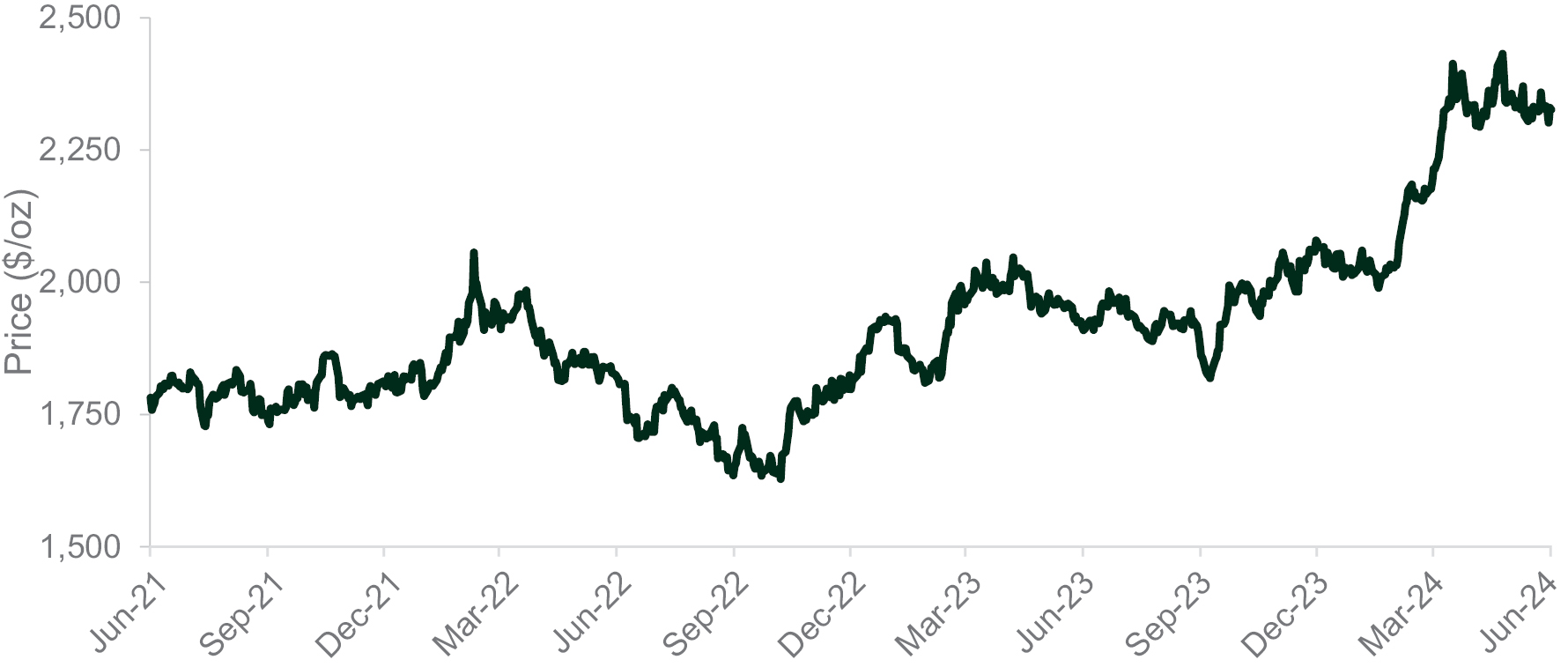
Source: Gold prices as reported by S&P.
221
Total demand for gold continues to be bolstered by central banks. In addition to central bank purchases, gold demand is also bolstered by the asset’s use in jewelry, electronics, and other industrial end-market applications. Gold, with strong conductivity properties, is critical for many electrical applications. The recent rise in the demand for artificial intelligence (“AI”) computing power and the associated electronics required have played an increasingly relevant role in the gold markets, with demand for gold from the technology sector increasing 12% in the quarter ending December 31, 2023 on a year-over-year basis, according to the World Gold Council. As of March 31, 2024, the largest end-market uses for gold consisted of jewelry (49%), bars and coins (28%), central banks, electronically traded funds and other institutions (16%), and technology & electronics (7%), according to the World Gold Council.
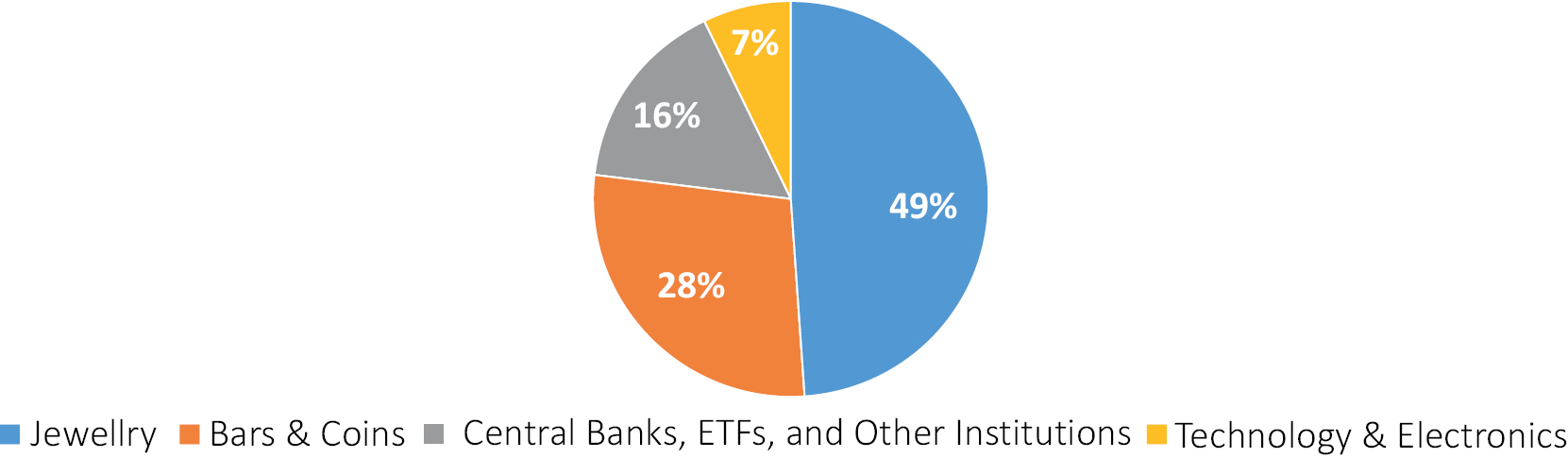
Source: Data sourced from World Gold Council. Defined as Total Above-Ground Gold Stock as of March 31, 2024.
On the supply side, gold mining output historically has not kept pace with the increased levels of demand as increasingly sophisticated techniques are needed to extract the ever-dwindling accessible global reserves. Mined gold output, which was comprised of approximately 74% of total gold supply declined 2% to 931 tonnes during the three months ended December 31, 2023, according to the World Gold Council.
Gold Demand Summary
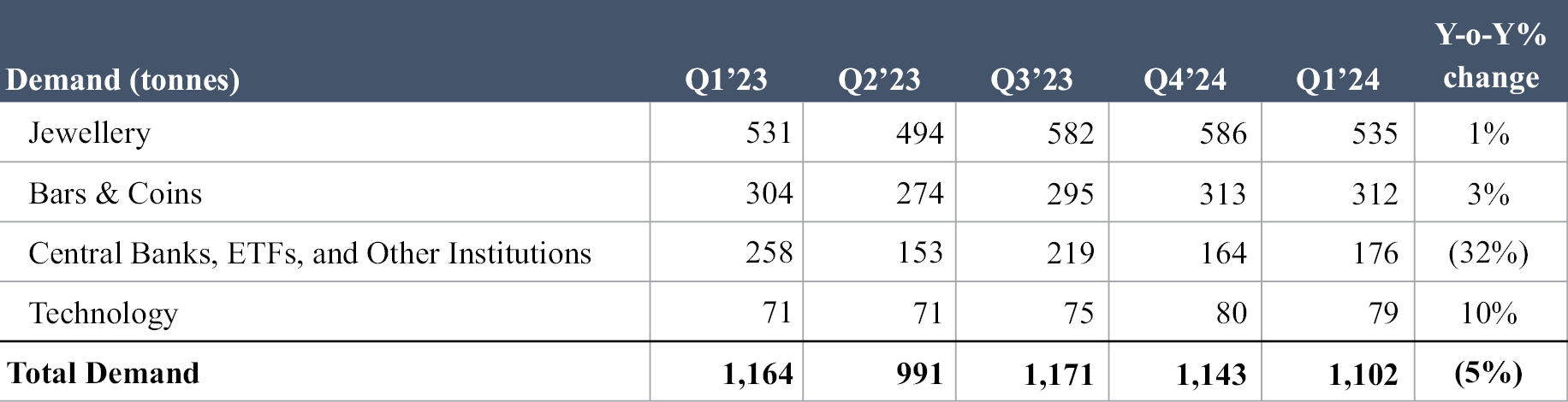
Source: Data sourced from World Gold Council.
Gold Mining in Zimbabwe
Zimbabwe is a highly prolific gold producer. According to the COMZ 2023 Annual Report, gold output in Zimbabwe reached a record high of 37.3 tonnes in 2022, up from 31.5 tonnes in 2021, and was 32.4 tonnes in 2023. The country’s topography and geological characteristics provide several attractive mining belts with potential for further discoveries, evidenced by over 4,000 documented mineral deposits according to the Zimbabwe Investment Development Agency. Beyond gold, Zimbabwe has other key active mining resources including copper, lithium, nickel, coal, and platinum. Mining is a significant part of Zimbabwe’s economy, accounting for 80% of exports, 19% of government revenues, and 14% of national income, according to the COMZ’s 2024 Mining Industry Prospects Report. The country’s mining industry is characterized by professionally run mines with low costs of production and resilient infrastructure, including extensive road and railway networks. In addition, government incentives have driven the adoption of solar power, providing access to a sustainable energy supply that is cost effective, and specialized mining training programs in Zimbabwe provide ready access to a skilled labor force. We believe that a combination of these factors provides strong tailwinds for the current and future importance of gold mining to the Zimbabwean economy. Overall, we believe that the legislative environment is very supportive of mining and development. For example, in May 2023, Zimbabwe passed the Responsible Mining Initiative to combat illegal mining and removed the historical indigenization rule, which required 51% local investor ownership,
222
thus making the country more attractive for FDI. Additionally, the Mines and Minerals Act provides for the establishment of a SML, allowing for the direct export of gold and increased exposure to the U.S. dollar. We believe the use of SMLs will propel the development of the sector in Zimbabwe by allowing gold miners to avoid financial implications of dealing in local market currencies. We intend to pursue SMLs for our Mazowe Mine and Redwing Mine in part to reduce our risk exposure to local currency dynamics, including inflation.
The Copper and Cobalt Industry
Copper and cobalt are increasingly viewed as strategic investments crucial for the clean energy transition. Their value is tied to their critical role in technologies like electric vehicles and renewable energy infrastructure. Copper has highly conductive properties which are essential to building the electronics required for clean energy developments, driving significant demand for the metal. According to a May 2024 report by the International Energy Agency, copper demand is projected to eclipse 36 million tonnes by 2040, representing an increase of over 40% from 2023. As a result, copper prices have experienced a significant increase in pricing, having recently reached a near-record high of nearly $11,000 per tonne in May 2024.
Historical Copper Prices
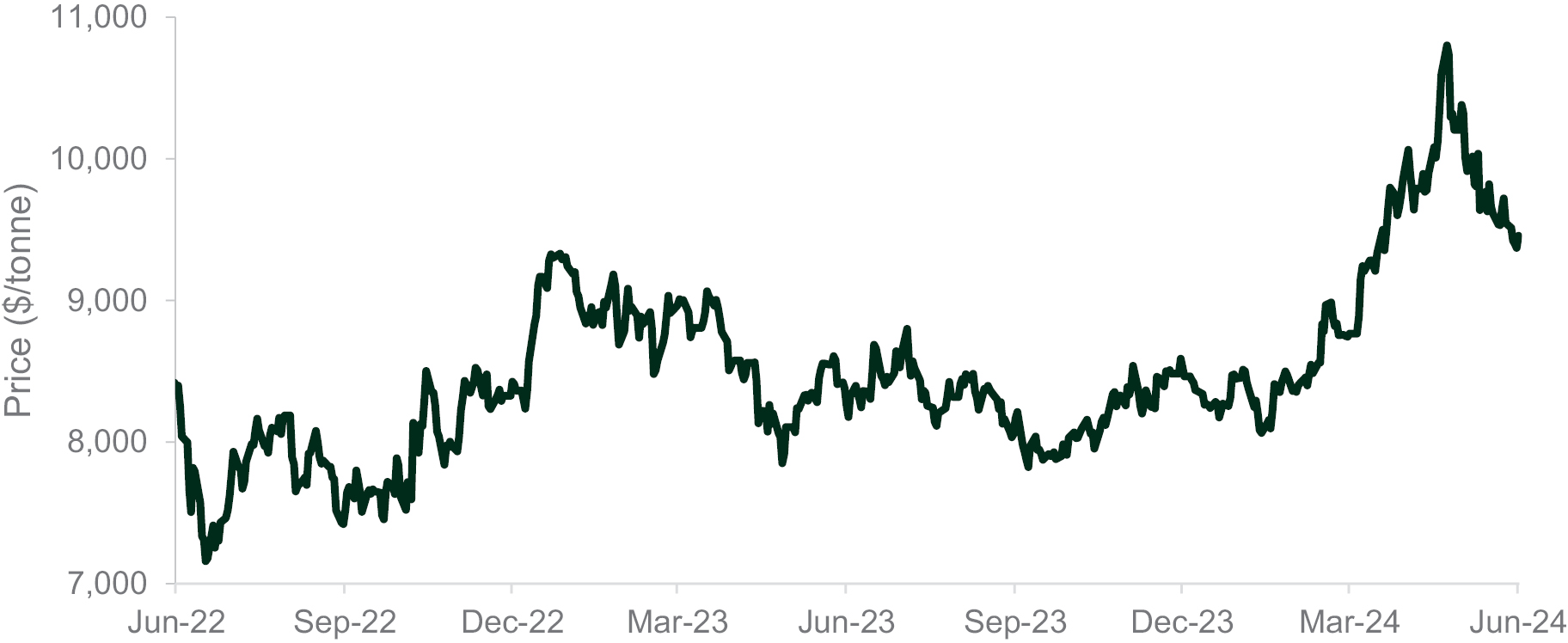
Source:Copper prices as reported by S&P. Chart represents the USD Grade A cash copper spot price per tonne on London Metal Exchange.
Similar to copper, cobalt is an essential metal for the electrification of vehicles, with demand consistently rising over the past few years as the electric vehicle market has accelerated. Cobalt’s unique properties make it essential for lithium-ion batteries that power electric vehicles and energy storage systems. Cobalt demand is forecasted to grow 14% in 2024, reaching 226kt and building on growth of 10% year-over-year in 2023, according to Benchmark Mineral Intelligence. Cobalt reserves are primarily concentrated in a few geographical regions, such as the DRC, and, unlike copper, cobalt is primarily a byproduct of other mining operations, introducing additional complexities to direct access to these resources. Overall, the markets for both copper and cobalt are highly liquid, ensuring efficient trade execution. The confluence of rising demand and limited geographic availability of the resources makes copper and cobalt integral considerations for the clean energy market.
Our Competitive Strengths
We believe that our high-quality asset base and differentiated approach to becoming a leading multi-asset and multi-jurisdiction mining platform in Africa distinguishes us from our peers and creates a unique opportunity for growth and value creation. Our competitive strengths include:
Significant resource base with substantial, high-grade mineral resources. The foundation of our business is our portfolio of gold mines and our substantial and attractive resource base. On a consolidated basis, at December 31, 2023, we had 1.7Mt of total reserves, 12.9Mt of total measured and indicated gold resources, and 32.2Mt of inferred gold resources on a tonnage basis, representing 88koz of gold reserves, 1.6Moz of measured and indicated gold resources, and 2.4Moz of inferred gold resources, respectively. This total resource base, including
223
reserves, consists of high-grade gold, with 1.66g/t Au for gold reserves and an average of 3.92g/t Au for total measured and indicated resources as of December 31, 2023. The quality of these facilitates greater recovery rates and allow us to produce gold at significantly lower costs compared to lower grade resources. Our existing resource base is well positioned to provide further exploration upside as we have already identified multiple additional targets down-shaft and on surface to increase reserves.
Established gold producer with low-cost base driving strong margins. We are an established African gold producer with a long operating history in Zimbabwe. Since its inception in 1941, the How Mine has produced approximately 1.8Moz of gold. Of this production, 0.9Moz was produced since the 2002 takeover by BMC, including approximately 34koz in 2023. The relatively shallow nature of the resources and the minerology of the ore (free milling) resulted in the How Mine operating at one of the lowest C1 Costs amongst its publicly reporting peers. Complementing these cost efficiencies is our ability to conduct our operations primarily in U.S. dollars, which further enhances our cost profile and mitigates potential risks relating to local market currency dynamics, including inflation.
Well positioned to capitalize on strong and improving gold fundamentals. Gold has long been prized for its role as a strategic financial investment. Its value can hold steady or even rise during economic turmoil, making it a valuable tool for diversification. Historically, gold prices have shown a strong upward trend, with an increase of nearly 8% per annum in USD since 1971, according to the World Gold Council, hitting an all-time high of $2,801/oz on October 30, 2024. The gold market is highly liquid, with consistent trading liquidity that allows for efficient buying and selling of the asset on international exchanges, as well as direct purchases between industry participants. Demand for gold continues to be bolstered by central banks, uses in jewelry and electronics, and other industrial end-market applications including technology products with strong exposure to trends in artificial intelligence. We believe we currently represent a highly attractive opportunity for investors to gain exposure to a primary gold company with attractive gold mining and reserves assets.
Pathway to multi-asset gold production. In addition to the strong financial profile of the How Mine, we have two additional historically gold-producing mines, the Mazowe Mine and the Redwing Mine, with preparatory work to restart operations underway to return them to production.
• Mazowe Mine. The Mazowe Mine has significant production potential with 1.17Mt of total measured and indicated mineral resources and 3.29Mt of inferred mineral resources on a tonnage basis, representing 291koz of measured and indicated gold resources and 915koz of inferred gold resources, respectively, as of December 31, 2023, and has a domestic water supply in place and power linked to the national grid. The Mazowe Mine will require additional capital expenditures to return to production, and, assuming we obtained the required capital resources, we expect the restart could be completed in a 24- to 30-month period upon receipt of financing. See “— Mineral Resources and Mineral Reserve Summary Disclosure — Mazowe Mine — Plans to Recommence Operations” for more information on the restart of the Mazowe Mine.
• Redwing Mine. The Redwing Mine has measured and indicated resources of 1.19Moz at 3.8g/t Au and inferred resources of 1.33Moz at 2.61g/t Au, as of December 31, 2023, and like the Mazowe Mine, the Redwing Mine is supplied with domestic water and is linked to the national power grid. The Redwing Mine will require additional capital expenditures to return to production, and, assuming we obtained the required capital resources, we expect the restart could be completed in a 24- to 30-month period upon receipt of financing. See “— Mineral Resources and Mineral Reserve Summary Disclosure — Redwing Mine — Plans to Recommence Operations” for more information on the restart of the Redwing Mine.
In addition to our core gold assets, we also have significant development potential in the DRC to unlock battery metals, particularly copper and cobalt, in the region. We have an interest in 13 exploration permits in the DRC, which includes six initial drilling holes with identified copper and cobalt potential. We believe identifying and mining significant battery metals will enable us to become a leading multi-asset, multi-jurisdiction mining enterprise. Our interest in the permits is governed by a Memorandum of Understanding, dated as of February 7, 2024, with two counterparties (the “DRC MOU”). The counterparties own the exploration permits. Pursuant to the DRC MOU, the counterparties have granted us the right to assist in assessing the value of such permits, and upon such valuation, we and the counterparties have agreed to form a joint venture to which the permits will be transferred, with each party to hold an indirect economic interest through such joint venture in any future mining activity pursuant to the permits. The valuation process has not begun and thus the joint venture has not yet been formed pursuant to the DRC MOU.
224
Below is a map showing the land area covered by the 13 exploration permits, denoted by yellow-colored boxes, in the southern region of the DRC.
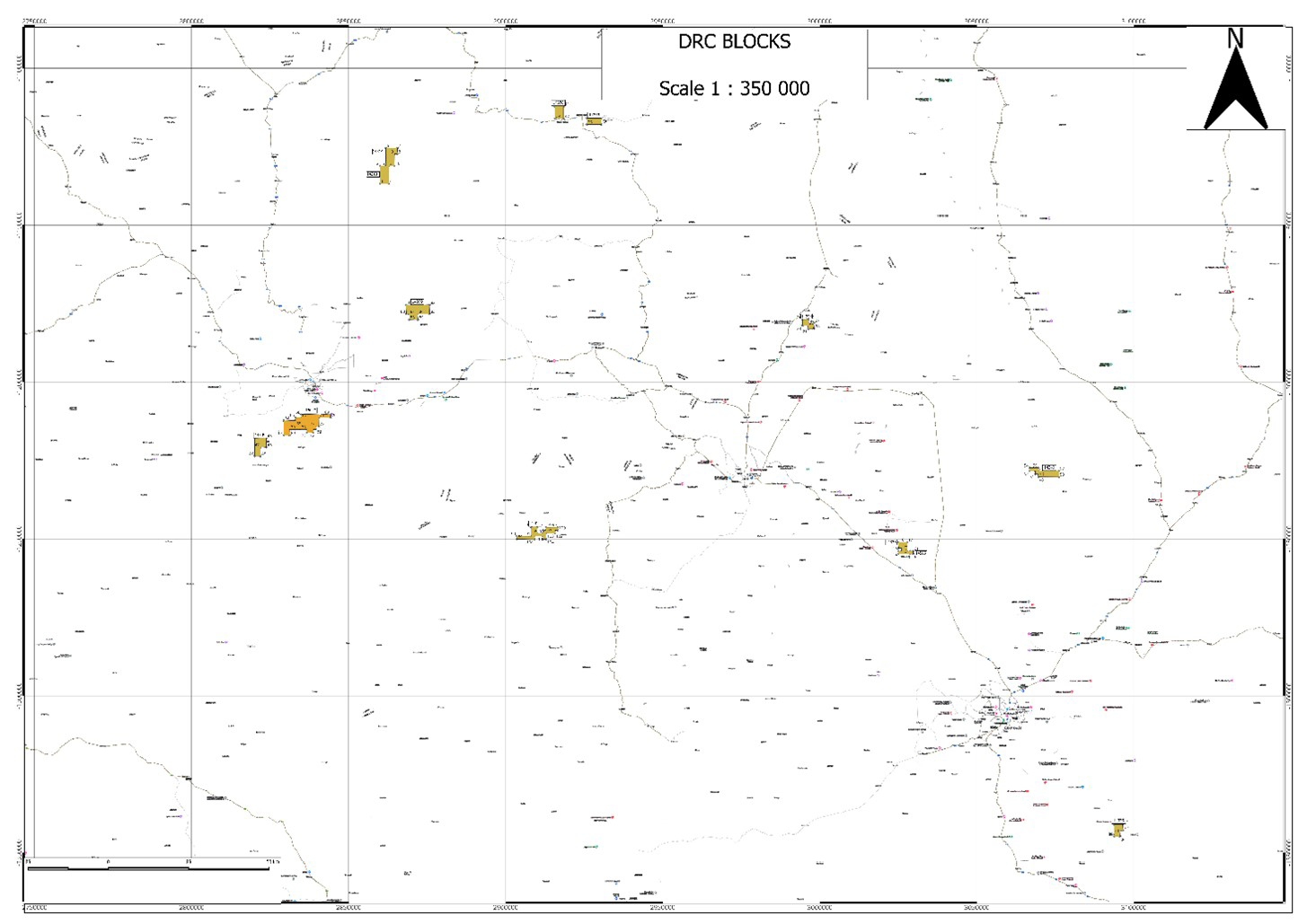
Areas covered by seven of the exploration permits have prospects for copper and cobalt, with one such area having undergone geochemical sampling and drilling and the rest of the areas having undergone greenfield exploration activity. Areas covered by two of the permits have prospects for copper, lead, and zinc, and areas covered by four of the permits have prospects for copper, silver, and tin, with each such area having undergone greenfield exploration activity. If the joint venture is formed pursuant to the DRC MOU, the parties intend to undertake geochemical surveying and mapping of the areas having undergone greenfield exploration activity, and intend to undertake induced polarization and electromagnetic geophysics measures and further drilling at the area having undergone geochemical sampling and drilling.
Strong commitment to our people, our communities, and the environment. As a long-term gold mining operator in Zimbabwe, we are committed to the sustainable development of our projects by deeply embedding ESG criteria in our decision-making framework from the earliest stages of project exploration and development. We have historically been committed to analyzing and improving working conditions for our employees through our Safety, Health, Environment, and Quality (SHEQ) Initiative. This comprehensive program encompasses an environmental management system, an occupational health and safety system, and a quality management system, all geared towards realizing our vision of fostering a “zero-harm environment.” The How Mine operates under the SHEQ systems and complies with ISO standards (14001, 9001 and 45001) for environmental responsibility, quality, and occupational health and safety, and we plan to adopt similar systems at the Redwing Mine and the Mazowe Mine. In addition, our hazardous waste management protocols comply with international protocols (Stockholm Convention) to minimize waste and promote recycling, while our biodiversity and climate change policies are designed to maximize the protection of wildlife, rehabilitation of disturbed areas, and monitoring of emissions (aligned with UN conventions). We believe that our detailed safety plan has positioned us as an industry leader in terms of safety standards. In addition to our adherence to strict safety standards, we also prioritize sustainably operating in the Zimbabwean gold mining industry with a collective growth mission to generate community development. For example:
• Healthcare: We have provided free medical services to local surrounding communities and have donated medical equipment and funds for the renovation of local hospitals;
225
• Education: We have promoted STEM education through investments in local high schools and the Zimbabwe School of Mines; and
• Rapid response force: We have established an emergency response team to respond to surrounding communities’ calls.
Community development and improvement and a “safety-first” approach to doing business are engrained in our culture and are core tenants of our operational focus.
Experienced team with a proven track record in mining and operating in Zimbabwe. We have an experienced management team with a track record of successfully identifying and developing mineral discoveries, having operated in Zimbabwe for more than 20 years. Our Chief Executive Officer and Director, and our former Chief Mining Engineer, Ibrahima Tall, has over 18 years of experience in West African mining. Mr. Tall leads our management team, which has over 45 years of combined experience in the mining sector, including expertise in exploration, development, and operational areas. Tulani Sikwila is our Chief Financial Officer and Director and has over 20 years of operational, accounting, and finance expertise in the mining industry. Mr. Sikwila commenced his career at Ernst & Young in 2001 and is a chartered accountant.
Our Growth Strategies
We believe we can achieve our goal of becoming a leading Pan-African multi-asset mining platform for precious and critical metals by executing the following strategies:
Strategically expand our gold production capacity in a capital efficient manner. We continually seek to increase the life of our current mining operations through efficient expenditures on effective and de-risked mining development initiatives. By leveraging our geological understanding and extensive familiarity and knowledge of our deposits, we believe we can identify and delineate new mineral reserves and mineral resources more deliberately and less speculatively. In order to optimize our gold production and grow our free cash flow, we undertake continuous exploration and development to replace the mineral reserves that we mine so we can maintain and grow our reserve base over time. For example, our future development strategy for the How Mine is focused on expanding the production capacity in carefully planned and designed stages to maximize results while managing capital requirements, and our target is to increase production capacity at the How Mine to 47ktpm by the third quarter of 2025. For our Mazowe Mine and Redwing Mine, we have a competitive advantage because we are able to rely on historical production knowledge and data to strategically design our restart initiative. We are working to complete a prefeasibility study for both mines, and our goal is to complete the dewatering, mine design, facility upgrades, and equipping of the Mazowe Mine and the Redwing Mine within 24 – 30 months of raising the requisite capital to fund these projects. See “— Mineral Resources and Mineral Reserve Summary Disclosure — Mazowe Mine — Plans to Recommence Operations” and “— Mineral Resources and Mineral Reserve Summary Disclosure — Redwing Mine — Plans to Recommence Operations” for more information on the restart of the Mazowe Mine and Redwing Mine.
Drive additional cost efficiencies in our mining operations. While we have already achieved favorable cost advantages relative to our peers, we have identified additional opportunities that we expect to reduce our ongoing operating costs over time while simultaneously reducing our carbon footprint. More specifically, we intend to focus on mine development and production rate increases, productivity increases, fixed cost management initiatives, and operational stability and efficiency through new energy sources. At the How Mine, we believe we can further improve our C1 Costs by:
• Negotiating attractive long-term contracts for solar power integration;
• Migrating the power source toward an Independent Supplying Group;
• Installing capacitors to better manage volatile energy costs; and
• Drilling boreholes for potable water to reduce the consumption of high-cost water.
We intend to leverage our expertise and long history of mining exploration and production experience to implement operational improvements and continue to identify and evaluate new opportunities to achieve our objectives and long-term goals.
Continue to drive safe and sustainable operations for our employees, our communities and our shareholders. Our safety-first and community development approaches to doing business will remain a core tenet of our operational focus and business strategy. We are committed to continually improving working conditions for our employees through Safety, Health, Environment, and Quality (SHEQ) Initiatives, which are designed to
226
help us realize our vision of a “zero-harm environment.” We also plan to be a leading participant of the African mining industry in increasing the sustainability of our operations through our collective growth mission to further community development. Our commitment to investing in medical services, local education, and a rapid response force to emergency calls all play critical roles in fostering symbiotic relationships with the communities in which we operate. We believe that continuing to focus on our people, communities and the environment will position us to attract the best local talent and ensure that we have efficient, stable, and long-term operations that continually elevate the people around our operations and where they live.
Pursue attractive mining opportunities for copper and cobalt. Fueled by the global push for clean energy, demand for copper, cobalt, and other battery metals is experiencing significant growth according to a May 2024 report by the International Energy Agency. We plan to focus on developing our significant potential in the DRC to unlock critical battery metals in the region. We have begun exploration work at 13 permitted sites located near the Haut Katanga and Lualaba Provinces in the DRC, spanning a total area of 205km. Initial drilling has encountered copper mineralization in intervals up to 3.28% Cu within 150m of the surface. We believe that our mining expertise and our extensive experience operating in Africa will allow us to efficiently pursue our expansion strategy in the DRC and capitalize on this large and growing market opportunity. See “— Our Competitive Strengths — Pathway to multi-asset gold production” for more information on these permits.
Opportunistically acquire, develop, and operate complementary mining assets. We continuously analyze new opportunities to expand our portfolio of mining assets. Our senior management team has a demonstrated track record of identifying and acquiring high-quality mining assets at attractive valuations. We believe that our assets and those that we seek to acquire are geologically and logistically advantaged based on their ore grade and access to consistent power supply and qualified local labor. Once acquired, we have demonstrated success in the prompt exploration and permitting of new mines and the building of long-lived resources through targeted development. We intend to continue to pursue similar opportunities within the gold industry as well as copper, cobalt and other battery metals that would be strategic and complementary to our existing high-quality portfolio of gold mines in Africa.
Our History
Greenstone Corporation was incorporated in March 2024 and in June 2024, in connection with the execution of the Business Combination Agreement, we acquired from Metallon and one of its affiliates 100% of the outstanding shares of BMC and the interests in 13 exploration permits in the DRC. BMC owns all of the interests in How Mining Company, the Mazowe Mining Company, and the Redwing Mining Company. Prior to June 2024, Greenstone had no operating activity. The historical financial information presented herein as of and for the years ended December 31, 2023 and 2022, reflect the results of BMC. BMC and our predecessor companies acquired the How Mine, the Mazowe Mine, and the Redwing Mine in 2002. By 2007 we had grown to become one of the largest gold producers in Zimbabwe with a peak production capacity of approximately 92kozpa. In 2008, significant inflation in Zimbabwe led to an economic downturn and production halt, at which time we placed all of our mines into care and maintenance. By 2009, we began recommencement of mining operations and by 2013 production had nearly doubled from 2010 levels. In 2018 and 2019, the Mazowe Mine and the Redwing Mine, respectively, were again placed again into care and maintenance due to an unattractive economic profile caused in part by implications of Zimbabwean monetary policy. Currently, preparatory work is underway to recommence operations at the Mazowe Mine and the Redwing Mine.
MINERAL RESOURCE AND MINERAL RESERVE SUMMARY DISCLOSURE
On October 31, 2018, the SEC adopted Subpart 1300 (17 CFR 229.1300) of Regulation S-K (“Regulation S-K 1300”) along with the amendments to related rules and guidance in order to modernize the property disclosure requirements for mining registrants under the Securities Act and the Exchange Act. Registrants engaged in mining operations must comply with Regulation S-K 1300 for the first fiscal year beginning on or after January 1, 2022. Accordingly, Greenstone is providing disclosure in compliance with Regulation S-K 1300 for its fiscal year ending December 31, 2023. This disclosure should be read in conjunction with the Technical Report Summaries of the How Mine, the Mazowe Mine, and the Redwing Mine, filed herewith as Exhibits 96.1, 96.2, and 96.3, respectively.
Mineral Resources and Mineral Reserves are estimates that contain inherent risk and depend upon geologic interpretation and statistical inferences drawn from drilling and sampling analysis, which may prove to be unreliable. For additional information on the risks and uncertainties associated with Greenstone’s mining properties, see “Risk Factors — Our Mineral Resource and Mineral Reserve estimates may be materially different from mineral quantities we may ultimately recover, our life-of-mine estimates may prove inaccurate, and changes in operating and capital costs may render mineral resources uneconomic to mine” and “Risk Factors — Our ability to replenish Mineral
227
Reserves is subject to uncertainty and risks inherent in exploration, technical and economic pre-feasibility and feasibility studies and other project evaluation activities as well as competition within the industry for exploration, development, and operational projects which meet our investment criteria.”
Greenstone’s operations include three mines within Zimbabwe as assets owned by three indirect subsidiaries: the How Mining Company owns the How Mine; the Mazowe Mining Company owns the Mazowe Mine; and the Redwing Mining Company owns the Redwing Mine. The principal activities of each of the subsidiaries include the exploration, development, and operation of precious metals mineral assets within each of the mines.
Combined, these account for measured and indicated gold Mineral Resources (exclusive of Mineral Reserves) of 1.63Moz, inferred gold Mineral Resources (exclusive of Mineral Reserves) of 2.43Moz, and Mineral Reserves of 88koz at December 31, 2023.
Locations of Properties
Maps showing the location of individual properties as well as infrastructure and licenses are shown in “Mineral Resource and Mineral Reserve Individual Property Disclosure” below.
Overview of Mining Properties and Operations
The following table sets out the aggregate production of Greenstone’s mining operations for the years ended December 31, 2023, 2022 and 2021. The table excludes production during those years from Mazowe Mine and Redwing Mine related to artisanal mining or shallow surface workings within 30 meters of the surface, as such production is not derived from the stated Mineral Resource and is regarded as non-material by Greenstone management. See “Risk Factors — Risks Related to Greenstone — Theft of the mineral concentrate, final metals, and production inputs may occur. These activities are difficult to control, can disrupt our business and can expose us to liability” for additional information.
|
Fiscal year ended December 31, |
||||||
|
Gold production |
2023 |
2022 |
2021 |
|||
|
Tonnes milled (kt) |
450 |
379 |
364 |
|||
|
Ounces produced (koz) |
34 |
27 |
30 |
|||
See “Mineral Resource and Mineral Reserve Individual Property Disclosure” for more information on the location of the properties; the type and amount of ownership interests; the identity of the operators; titles, mineral rights, leases or options and acreage involved; the stages of the properties (exploration, development or production); key permit conditions; mine types and mineralization styles; and processing plants and other available facilities.
Methodology
Mineral Resources
A Mineral Resource is a concentration or occurrence of solid material of economic interest in or on the Earth’s crust in such form, grade or quality and quantity that there are reasonable prospects for eventual economic extraction. The location, quantity, grade, continuity and other geological characteristics of a Mineral Resource are known, estimated, or interpreted from specific geological evidence and knowledge, including sampling.
An Inferred Mineral Resource is that part of a Mineral Resource for which quantity and grade or quality are estimated based on limited geological evidence and sampling. Geological evidence is sufficient to imply but not verify geological and grade or quality continuity. An Inferred Resource has a lower level of confidence than that applying to an Indicated Mineral Resource and must not be converted to a Mineral Reserve. It is reasonably expected that the majority of an Inferred Mineral Resource could be upgraded to an Indicated Mineral Resource with continued exploration.
An Indicated Mineral Resource is that part of a Mineral Resource for which quantity, grade or quality, densities, shape, and physical characteristics are estimated with sufficient confidence to allow the application of modifying factors in sufficient detail to support mine planning and evaluation of the economic viability of the deposit. Geological evidence is derived from adequately detailed and reliable exploration, sampling, and testing and is sufficient to assume geological and grade or quality continuity between points of observation.
228
A Measured Mineral Resource is that part of a Mineral Resource for which quantity, grade or quality, densities, shape, and physical characteristics are estimated with confidence sufficient to allow the application of modifying factors to support detailed mine planning and final evaluation of the economic viability of the deposit. Geological evidence is derived from detailed and reliable exploration, sampling, and testing and is sufficient to confirm geological and grade or quality continuity between points of observation. A Measured Mineral Resource has a higher level of confidence than that applying to either an Indicated or an Inferred Mineral Resource. It may be converted to either a Proven Mineral Reserve or a Probable Mineral Reserve.
Mineral Resource Estimation
To meet the requirements of the Southern African Code for the Reporting of Exploration Results, Mineral Resources and Mineral Reserves, 2016 edition (“SAMREC (2016)”) that this solid material reported as a Mineral Resource should have “reasonable and realistic prospects for eventual economic extraction,” Greenstone has determined an appropriate cut-off grade which has been applied to the quantified mineralized body according to a process incorporating a long-term view on future economic modifying factors. In applying this process, Greenstone uses a gold price of U.S. $2,700 per ounce (reflecting a 50% increase over the three-year trailing average of $1,800 per ounce) to derive a cut-off grade to determine the Mineral Resources at the How Mine and U.S. $2,340 per ounce (reflecting a 30% increase over the three-year trailing average of $1,800 per ounce) to derive a cut-off grade to determine the Mineral Resources at the Mazowe Mine and the Redwing Mine. The QPs deem the use of either of these price assumptions as good practice in the calculation of Mineral Resource cut-off grades. However, the QPs associate the increased price assumption with the How Mine since they view it as having a longer time horizon. As support, the QPs observe that the How Mine is an active mining operation with longer term prospects for price improvements, has potential for further resource definition, has potential for process recovery improvement, and experiences a negligible impact from the resulting lower COG on its underground Mineral Resource.
The estimation of Mineral Resources is based on geoscientific knowledge and borehole and sampling data, with input from Greenstone’s managers, geologists, and geostatistical staff. All sampling done is subject to quality assurance and quality control, as prescribed by SAMREC (2016), to ensure data quality and accuracy. Each mine’s Mineral Resource is categorized — based on similarities in geology, facies, grade, and structure, the orebody is divided into geozones. It is then blocked-out and ascribed an estimated value. A computerized geostatistical estimation process is used at all our mines.
Conversion of Mineral Resources to Mineral Reserves
To define that portion of a Measured and Indicated Mineral Resource that can be converted to a Proven and Probable Mineral Reserve, Greenstone applies the concept of a cut-off grade. At its mines, this is done by defining the optimal cut-off as the lowest grade at which an orebody can be mined such that the total profits, under a specified set of mining parameters, are maximized.
Mineral Reserves represent that portion of the Measured and Indicated Mineral Resources above the cut-off grade in the LOM plan and are estimated after consideration of the factors affecting extraction, including mining, metallurgical, economic, marketing, legal, environmental, social, and governmental factors. At the How Mine, the reported Mineral Reserves are accessible from existing infrastructure and/or infrastructure that is in the process of being developed.
A range of disciplines, including geology, survey, planning, mining engineering, rock engineering, metallurgy, financial management, human resources management, and environmental management, are involved at each mine in the LOM planning process and the conversion of Mineral Resources into Mineral Reserves.
The modifying factors that are used to convert Mineral Resources to Mineral Reserves are stated for the How Mine. While there are some differences between the definitions pursuant to SAMREC (2016) and Regulation S-K 1300, only the Mineral Reserves as at December 31, 2023 that qualify as Mineral Reserves for purposes of Regulation S-K 1300 are presented in the tables below.
Mineral Reserve Estimation
A Mineral Reserve is the economically mineable part of a Measured and/or Indicated Mineral Resource. It includes diluting materials and allowances for losses, which may occur when the material is mined or extracted and is defined by studies at prefeasibility or feasibility level as appropriate that include application of modifying factors. Such studies demonstrate that, at the time of reporting, extraction could reasonably be justified. The reference point
229
at which Mineral Reserves are defined, usually the point where the ore is delivered to the processing plant, must be stated. It is important that in all situations where the reference point is different, such as for a saleable product, a clarifying statement is included to ensure that the reader is fully informed as to what is being reported.
A Probable Mineral Reserve is the economically mineable part of an Indicated, and in some circumstances, a Measured Mineral Resource. The confidence in the modifying factors applying to a Probable Mineral Reserve is lower than that applying to a Proven Mineral Reserve.
A Proven Mineral Reserve is the economically mineable part of a Measured Mineral Resource. A Proven Mineral Reserve implies a high degree of confidence in the modifying factors.
A prefeasibility study is a comprehensive study of a range of options for the technical and economic viability of a mineral project that has advanced to a stage where a preferred mining method, in the case of underground mining, or the pit configuration, in the case of an open-pit, is established and an effective method of mineral processing is determined. It includes a financial analysis based on reasonable assumptions on the modifying factors and the evaluation of any other relevant factors which are sufficient for a competent person, acting reasonably, to determine if all or part of the Mineral Resource may be converted to a Mineral Reserve at the time of reporting. A prefeasibility study is at a lower confidence level than a feasibility study.
A feasibility study is a comprehensive technical and economic study of the selected development option for a mineral project that includes appropriately detailed assessments of applicable modifying factors together with any other relevant operational factors and detailed financial analysis that are necessary to demonstrate at the time of reporting that extraction is reasonably justified (economically mineable). The results of the study may reasonably serve as the basis for a final decision by a proponent or financial institution to proceed with, or finance, the development of the project. The confidence level of the study will be higher than that of a prefeasibility study.
For the reporting of Mineral Reserves the following parameters were applied:
• a gold price of US$1,850 per ounce; and
• an exchange rate of 13.30 ZiG per U.S. dollar.
Mineral Resources (exclusive of Mineral Reserves)
As at December 31, 2023, Greenstone had aggregate attributable Measured and Indicated Resources (exclusive of Mineral Reserves) of approximately 1,626koz of gold. Mineral Resources are reported on an in-situ basis, assuming a gold metallurgical recovery of 89.5%, 88.0%, and 90.0% with respect to each of the How Mine, Mazowe Mine, and Redwing Mine, respectively.
|
Tonnes |
Au Grade |
Au Metal |
||||
|
How Mine |
||||||
|
Measured Resources |
0.41 |
2.51 |
33 |
|||
|
Indicated Resources |
1.66 |
2.14 |
114 |
|||
|
Total Measured and Indicated |
2.07 |
2.21 |
147 |
|||
|
Inferred Resources |
2.01 |
2.82 |
182 |
|||
|
Inferred Resources (Sands (Tailings)) |
11.07 |
0.60 |
213 |
|||
|
Mazowe Mine |
||||||
|
Measured Resources |
0.26 |
9.01 |
75 |
|||
|
Indicated Resources |
0.91 |
7.45 |
217 |
|||
|
Total Measured and Indicated |
1.17 |
7.77 |
291 |
|||
|
Inferred Resources |
3.29 |
8.65 |
915 |
|||
|
Redwing Mine |
||||||
|
Measured Resources |
1.45 |
2.92 |
136 |
|||
|
Indicated Resources |
8.20 |
3.99 |
1,052 |
|||
|
Total Measured and Indicated |
9.65 |
3.83 |
1,188 |
|||
|
Inferred Resources |
15.83 |
2.61 |
1,328 |
230
Mineral Reserves
As at December 31, 2023, Greenstone had aggregate attributable Proven and Probable Mineral Reserves of approximately 88koz of gold. Mineral Reserves are reported on a plant feed basis, inclusive of dilution and ore loss modifying factors, assuming a gold metallurgical recovery of 89.5%.
|
Tonnes |
Au Grade |
Au Metal |
||||
|
How Mine |
||||||
|
Underground Proven Reserves |
390 |
2.35 |
29 |
|||
|
Underground Probable Reserves |
450 |
2.42 |
35 |
|||
|
Underground Total |
840 |
2.39 |
64 |
|||
|
Surface Probable Reserves |
820 |
0.88 |
23 |
|||
|
Total |
1,650 |
1.66 |
88 |
MINERAL RESOURCE AND MINERAL RESERVE INDIVIDUAL PROPERTY DISCLOSURE
How Mine
Property Description
The How Mine is located in the Matabeleland South Province, Zimbabwe, approximately 30 kilometers (km) southeast of the city of Bulawayo (latitude 20°18’S and longitude 28°46’E), in the Bulawayo Mining District of Zimbabwe. The How Mine is classified as a production stage property.
The How Mine is situated within the Mining Lease (“ML”) 28 tenement (“ML 28”), which has a surface area of 2,408 hectares (“ha”). The How Mining Company, which is a wholly owned subsidiary of Bulawayo Mining Company (UK) Limited (“BMC UK”), which is a wholly owned subsidiary of BMC, currently holds ML 28.
The following graphic illustrates the location of the How Mine and its proximity to major infrastructure.
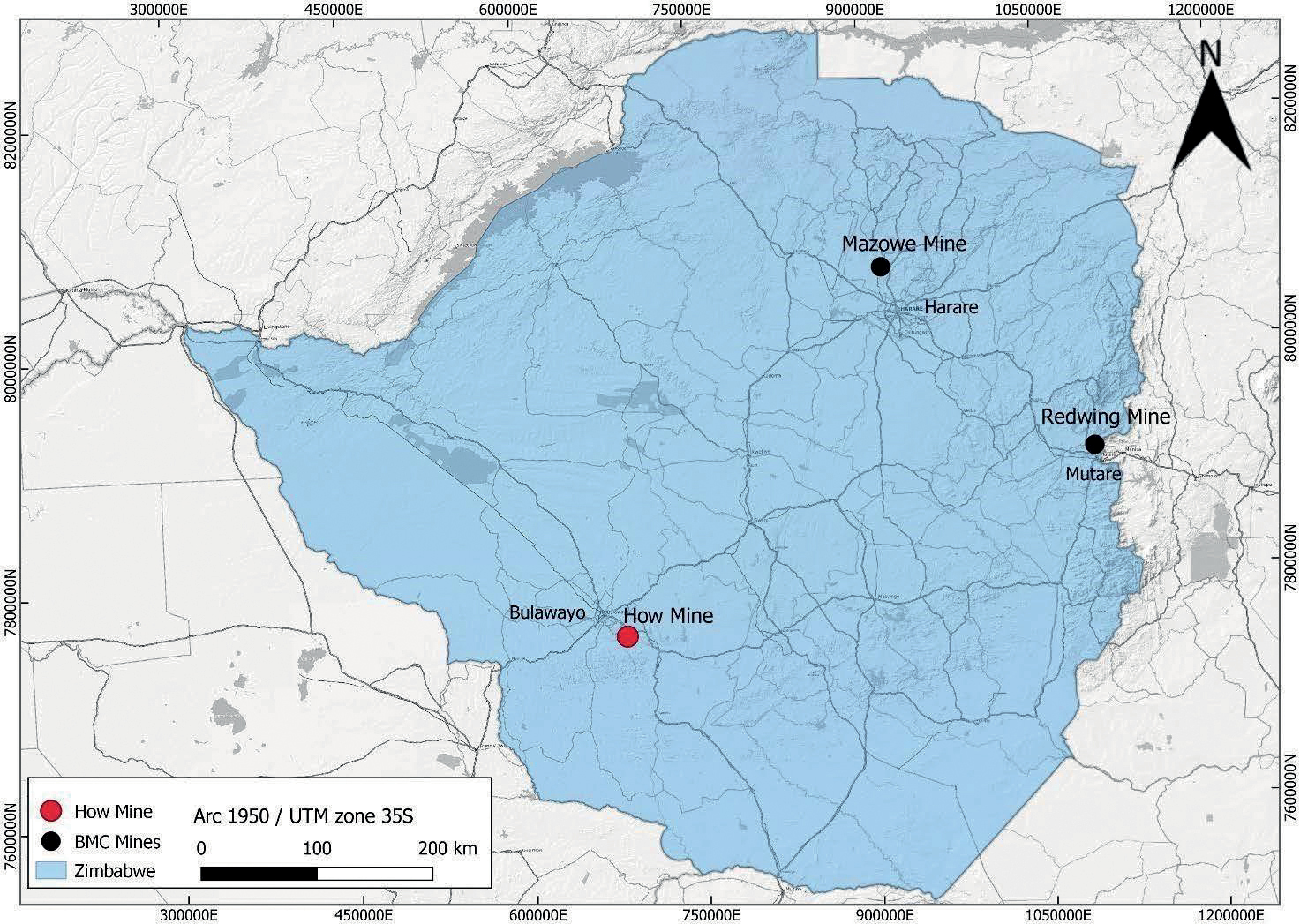
231
There are no known significant encumbrances to the How Mine that would impact the current Mineral Resources or Mineral Reserves.
Operational Infrastructure
The How Mine is serviced by its own dedicated processing facilities and accompanying infrastructure.
The How Mine is accessible via a sealed road from Bulawayo, which is in good condition. The principal raw materials used in the mining operations are fuel, electricity, and water. The regional infrastructure includes access to a national power supply grid and water supply by way of dams and water bores. The mine has completed upgrading the on-site fuel pump station to a holding capacity of 35,000 liters.
At the How Mine, we have installed a series of shafts, with hoists, through which personnel and material may access the mine from the surface. The How Mine is served by two vertical shafts from surface (the North and the Main shafts) and one internal shaft. The North Shaft is devoted to hoisting ore from underground. The Main Shaft is used for transporting personnel and material. The How Mine advises that there is no need to define minimum mining widths given the wide mineralized zones. Production is derived from open stoping, development, and pillar recovery where possible. Ore hoisted from the North Shaft is processed at the mine’s carbon-in-plant (“CIP”) plant. Electricity is supplied from the national grid through Springs and Criterion lines, operated by Zimbabwe Electricity Supply Authority (“ZESA”).
Currently, the How Mine is concluding phase 2 of the shaft sinking project which will allow mining between the 32 Level and 30 Level. Thereafter, we intend to sink the How Mine to the 38 Level. We have also installed an HP300 cone crusher, making the crushing plant a two-stage crushing circuit, with the intention to increase capacity while being energy efficient. A surface conveyor from shaft bin to plant was also installed to remove locomotive conveyance of ore from shaft bin to plan.
The existing process facility at the How Mine has a record of successful operation. Plant and equipment has been in use for several years but is in good physical condition. A continuous capital replacement program is in place through annual sustaining capital expenditure budgets to replace old equipment. We also have in place a comprehensive maintenance program, supported by an inventory of critical spare equipment to facilitate uninterrupted production. The net book value of property, plants, and equipment at How Mine at June 30, 2024 is $35,769,715.
Geology
The How Mine is located in the Umzingwane Formation of the Bulawayo Greenstone Belt. The lithological units characteristic of the Umzingwane Formation include clastic metasediments, fine-grained tuffaceous rocks, banded shales and siltstones, ferruginous cherts or Banded Iron Formation (“BIF”) and rhyodacites and andesitic lavas. This assemblage has been subjected to metamorphism of lower greenschist facies.
The surface footprint of the mineral rights owned by Greenstone at the How Mine covers an area of 2,408 ha. Isolated cases of illegal gold mining activities have been reported along some streams and historical workings located within the ML. The majority of artisanal mining activity is concentrated along the Mzingwane River, on the southern margins of the ML area.
History
The How Mine draws on over 60 years of exploration field activities and previous studies. The How Mine claims were first pegged as a greenfields discovery in July 1941. Since 1970, the mine has operated continuously and is one of the largest gold producers in the Matabeleland region.
Mineral Tenure
Access to the mine site and to the ore, as well as mining exploration and exploitation works, are authorized by the applicable mining legislation and How Mining Company’s title and mining rights. Other required permits and authorizations (e.g., environmental, building, etc.) are applied for by How Mining Company in accordance with the applicable legislation.
232
The How Mining Company, a wholly owned subsidiary of BMC UK, which is a wholly owned subsidiary of BMC, holds ML 28. The area covered by ML 28 has a surface area of 2,408 ha. ML 28 is renewed annually, and the current certificate is valid until August 17, 2024.
A summary of the status of environmental permits and licenses issued as at December 31, 2023, related to the How Mine is presented in the table below.
|
Reference No. |
Permit/License |
Issued by |
Date Granted |
Validity |
||||
|
0000010445 |
Waste Disposal – Slimes Dam 5 |
Environmental Management Agency |
03/19/2024 |
12/31/2024 |
||||
|
0000010444 |
Effluent Disposal Sewage Treatment plant |
Environmental Management Agency |
03/19/2024 |
12/31/2024 |
||||
|
HW16/GEN 8000097469 |
Hazardous waste generation licence |
Environmental Management Agency |
05/29/2024 |
05/29/2025 |
||||
|
0000010446 |
Solid waste disposal licence – Decommissioned Tailings Dump |
Environmental Management Agency |
03/19/2024 |
12/31/2024 |
||||
|
0000010443 |
Air Emissions licence – Clinic Incinerator |
Environmental Management Agency |
03/19/2024 |
12/31/2024 |
||||
|
0000010441 |
Air emissions licence (Assay Laboratory) |
Environmental Management Agency |
03/19/2024 |
12/31/2024 |
||||
|
0000010442 |
Air Emissions licence – Mine Generator |
Environmental Management Agency |
03/19/2024 |
12/31/2024 |
||||
|
0000019735 |
Transportation of hazardous substances |
Environmental Management Agency |
05/29/2024 |
05/29/2025 |
||||
|
0000019733 |
Hazardous Substances – Storage and Use |
Environmental Management Agency |
05/29/2024 |
05/29/2025 |
||||
|
80000085127 |
Environmental impact assessment – exploration, mining and processing |
Environmental Management Agency |
06/21/24 |
06/20/25 |
||||
|
8000098882 |
Environmental impact assessment – Exploration and Mining – Three castles |
Environmental Management Agency |
2010/2022 |
10/19/24 |
||||
|
80000118812 |
Environmental impact assessment – Exploration and Mining – Bulawayo south |
Environmental Management Agency |
05/30/2023 |
05/30/2025 |
||||
|
000080 |
To purchase, acquire and possess explosives |
Chief Inspector of explosives |
07/07/20 |
06/30/25 |
||||
|
000657,000658 and 0006659 |
Storage of explosives |
Chief Inspector of explosives |
07/07/20 |
06/30/25 |
||||
|
NA |
One hour re-entry |
Chief Inspector of explosives |
07/31/23 |
06/01/24 |
||||
|
M00603 M01489 |
Surface Water Abstraction permit |
ZINWA |
11/29/19 |
04/14/24 |
||||
|
979851 – 7A |
Firearms Certificates File No 59673. |
Central Firearms Registry |
12/01/20 |
12/01/24 |
||||
|
NA |
Health Professions Authority (Clinic premises) |
Health Professions Authority |
02/22/2024 |
12/31/2024 |
||||
|
NA |
Medical Doctor’s Practicing certificate |
Medical and Dental Practitioners Council of Zimbabwe |
01/06/2024 |
12/31/2024 |
||||
|
103P0034 |
License For Premises (Industrial Clinic) |
Medicine control Authority of Zimbabwe |
10/29/2023 |
09/30/2024 |
||||
|
C010022 |
License For Persons |
Medicine control Authority of Zimbabwe |
08/25/23 |
09/30/2024 |
||||
|
8000332711 |
How Mine Club Liquor Licence |
Liquor Board |
07/01/2024 |
07/01/2025 |
233
|
Reference No. |
Permit/License |
Issued by |
Date Granted |
Validity |
||||
|
TBA |
How Mine Club Kitchen |
Mzingwane Rural District Council |
07/01/2024 |
07/01/2025 |
||||
|
8000332715 |
How Mine Beerhall Liquor Licence |
Liquor Board |
07/01/2024 |
07/01/2025 |
||||
|
200135654 |
Tax Clearance |
ZIMRA |
05/06/2024 |
12/31/2024 |
||||
|
Import Licence |
ZIMRA |
12/25/2023 |
12/24/2024 |
|||||
|
ML28 |
How Mine Lease |
Ministry of Mines |
08/17/2023 |
08/17/2024 |
Mining Method
The How Mine is an underground rail mine in active operation using narrow vein underground techniques.
Shafts are used to access the relatively steeply dipping orebody on approximately 30-meter level intervals. Sublevels are developed on approximately 10- to 12-meter intervals and mined on retreat by adopting underhand/long-hole open stoping methods using sub-level breaking into a common slot. Broken ore is collected in draw-points or boxes. Cone levels (extraction draw cones) are developed to 8 to 10 meters above haulage drives, and sub-levels are developed above the cone drives at approximately 10- to 12-meter intervals. Drilling and blasting is conducted by retreating from a central slot to rib pillars or other demarcated points by downhole (underhand) and uphole (overhand) drilling.
Mineral Processing
The existing process facility at the How Mine has a record of successful operation and the QP expects that the current program of refurbishment and capital upgrades will facilitate escalation of plant throughput.
Metallurgical operations at the How Mine are carried out in a run-of-mine to handle a throughput of 40.5kt per month. Processing of ore retrieved from the How Mine includes crushing, grinding, thickening, soaking, draining, neutralizing, eluting and treatment with acids to extract gold.
Qualified Persons
Information in the How Mine Technical Report Summary has been prepared under the supervision of the WSP QPs. Neither WSP nor the QPs are insiders, associates, or affiliates of Greenstone or any of its subsidiaries. The results of the technical review by the QPs are not dependent on any prior agreements concerning the conclusions to be reached, nor are there any undisclosed understandings concerning any future business dealings. Information regarding the QPs’ qualifications, affiliations, dates of personal inspection of the How Mine, and areas of responsibility is summarized in the table below.
|
QP |
Qualifications/ |
Date of Personal |
Areas of |
|||
|
Aaron Radonich |
Fellow AusIMM, PGCert Geostatistics, BSc (Hons.), BSc |
May 2024 |
Sections 1.1, 1.2, 1.3, 1.4, 1.7, 1.8.1, 2, 3, 4, 5, 6, 7, 8, 9.1, 11, 20, 21, 22,1, 23.1, 24 and 25. |
|||
|
Allan Blair |
FAusIMM, MBA, BSc, BAppSc Mining Engineering |
May 2024 |
Mineral Reserves, Sections 1.5, 1.6, 12 – 19, 22.2, 23.2. |
Exploration
Exploration at the How Mine is based on detailed geological mapping that established the following sequence from southwest to northeast: talc-chlorite schist, laminated black shale, silicate facies BIF, tuffaceous units, and siltstone. The occurrence of felsic porphyry intrusions, and mafic dykes in historical quarries is also expressed in underground exposures. This shows that the mineralization channel locally transgresses lithological boundaries and is therefore not strictly strata-bound.
234
Channel sampling, diamond drilling, and sludge drilling samples were used for the purposes of geological modelling and Mineral Resource estimation.
Diamond drill core is logged and sampled at a nominal one-meter interval, depending on geology. Samples are taken to at least five meters beyond the geologically defined mineralization boundary in all drill holes. Core recovery averages over 98%.
Sludge drilling was formerly used for resource evaluation purposes. Sludge drill holes were sampled on one-meter intervals. Historical sludge drilling results remain in the resource database for orebodies on or above the 20 Level. Sludge drilling has been phased out entirely due to questionable reliability. All evaluation below the 20 Level is based on diamond core, and channel sampling only.
The QP considers the data collected including method of collection and storage to be appropriate for the preparation of geological models and Mineral Resources estimates, and that the data has been considered during resource classification.
Exploration
From 2012 to 2023, exploration holes were drilled, of which all hole collars were machine surveyed and downhole surveys were completed for determination of dip and azimuth deviations. Until the end of 2024, our exploration plan for the How Mine includes deep drilling from the 30 Level drilling platforms to a depth at the 40 Level, targeting certain orebodies and potential resources in the footwall, at a cost of approximately $2.4 million. In connection therewith, by the end of 2025, we plan to land two underground drilling rigs and one surface drilling rig at the How Mine. From 2025 through to 2029, we intend to undertake further exploration drilling, at a cost of approximately $12.9 million per year.
Mineral Resource Estimate
The relevant QPs are satisfied that there has been sufficient orebody knowledge work completed to support reasonable prospects for economic extraction at the How Mine from a Mineral Resources perspective.
The Mineral Resources estimate, as of December 31, 2023, has been defined, classified, and reported by the How Mining Company according to the guiding principles and minimum standards set out in SAMREC (2016). Based upon the analysis by WSP, there are no material differences between SAMREC (2016) and Regulation S-K 1300 requirements for the reporting of Mineral Resources.
The total estimated measured and indicated Mineral Resource (exclusive of Mineral Reserves) is approximately 2.07Mt at 2.21g/t Au, for approximately 542koz of gold, and the estimated inferred Mineral Resource (exclusive of Mineral Reserves) is approximately 13.08Moz at 0.94g/t Au, for approximately 395koz of gold. These are conservative estimates due to the use of a COG of 1.4g/t. Classification of blocks into relevant groupings was completed following standard procedures as defined and recommended in the SAMREC (2016). The stoping pay-limit defines the lower grade cut-off that is used in the process. Blocks possessing a tonnage of less than 5.0 kt and blocks possessing a grade less than 1.40g/t Au not interfering with the mining sequence (all Mineral Resource categories) were excluded from the December 31, 2023 Mineral Resource estimate. Blocks assumed to have collapsed, as well as blocks assumed to have been affected by a rib pillar failure in November 2016 (all Mineral Resource categories), were excluded from the December 31, 2023 Mineral Resource estimate.
The COGs were calculated from an assumed Au price of US$2,700 per oz (reflecting a 50% increase over the three-year trailing average of $1,800 per ounce). WSP deem it good practice to calculate Mineral Resource COGs using the three-year trailing average Au price +30 or +50%, which would result in Mineral Resources COGs of 1.1g/t and 1.0g/t respectively. The sands COGs would be 0.7g/t and 0.6g/t respectively.
|
Parameter |
Mineral |
Tailings |
||
|
COG (g/t) |
1.0 |
0.6 |
||
|
Gold Price |
$2,700/oz |
$2,700/oz |
235
Evaluation data collection includes diamond drilling, channel sampling, and sludge drilling.
The following table presents the underground Mineral Resources (exclusive of Mineral Reserves) reported as at December 31, 2023 and 2022. This is a conservative estimate due to the use of an Au COG of 1.4 g/t. Mineral Resources are reported on an in-situ basis, assuming a gold metallurgical recovery of 89.5%.
|
Fiscal Year Ended December 31, |
||||||||||||
|
2023 |
2022 |
|||||||||||
|
Mineral Resource Category |
Tonnes |
Grade |
Au Metal |
Tonnes |
Grade |
Au Metal |
||||||
|
Measured |
405 |
2.51 |
33 |
473 |
2.60 |
39 |
||||||
|
Indicated |
1,601 |
2.14 |
114 |
248 |
1.90 |
15 |
||||||
|
Total Measured and Indicated |
2,066 |
2.22 |
147 |
721 |
2.35 |
55 |
||||||
|
Inferred |
13,079 |
0.94 |
395 |
3,254 |
2.71 |
283 |
||||||
____________
Notes: Mt = Million tonnes; Au Grade g/t = gold grams per tonne; koz = thousand ounces.
It should be noted that the underground and surface Mineral Resources estimate for the How Mine is reported exclusive of Mineral Reserves. The Mineral Resources presented in this Section are not Mineral Reserves, and do not reflect demonstrated economic viability. The reported Inferred Mineral Resources are considered too speculative geologically to have the economic considerations applied to them that would enable them to be categorized as Mineral Reserves. There is no certainty that all or any part of this Mineral Resource will be converted into Mineral Reserve. All figures are rounded to reflect the relative accuracy of the estimates and totals may not add correctly.
Mineral Reserve Estimate
The Mineral Reserves have been defined, classified, and reported by the How Mining Company according to the guiding principles and minimum standards set out in SAMREC (2016).
Underground Mineral Reserves have been defined using Vulcan™ software for block modelling and manual polygonal methods according to conventional South African techniques. Both underground mining reserves and surface sands stockpile (old historical TSF) reserves have been estimated. There has been no downgrading of underground Measured Resources to Probable Reserves category arising from reduced confidence in modifying factors on the reserve.
Surface sands stockpiles (old tailings) are converted from Measured Resources and downgraded to Probable Reserve category material in the Mineral Reserve due to a higher degree of uncertainty, relatively lower confidence in the grade estimate and process recovery. Processing of surface sands stockpiles are not currently considered in the LOM plan since it would displace higher grade feed from underground sources.
The relevant QPs are satisfied that there has been sufficient standard of evaluation to support estimation of a Mineral Reserve that has been demonstrated to be technically and economically viable.
Based upon the analysis by WSP, there are material differences between the SAMREC (2016) and Regulation S-K 1300 requirements for reporting Mineral Reserves. WSP has adjusted the SAMREC (2016) estimate reported by BMC for the How Mine to reflect the extractable (92% recovered) portion adjusted for the average Mine Call Factor applied to grade (101.06% of resource grade), reflecting both plan dilution and positive reconciliation as a three-year trailing average excluding outliers (+10%) as at end December 2023 (103.9%).
The Pay Limit (COG) was calculated from a three-year trailing average Au price of US$1,800 per oz.
|
Parameter |
Mineral |
|
|
Pay Limit (g/t) |
1.40 |
|
|
Gold Price |
$1,800/oz |
236
The following table presents the How Mine Mineral Reserves estimate as at December 31, 2023 and 2022. Mineral Reserves are reported on a plant feed basis, inclusive of dilution and ore loss modifying factors, assuming a gold metallurgical recovery of 89.5%.
|
Fiscal Year Ended December 31, |
||||||||||||
|
2023 |
2022 |
|||||||||||
|
Mineral Reserves |
Tonnes |
Grade |
Au Metal |
Tonnes |
Grade |
Au Metal |
||||||
|
Proven Mineral Reserves (Underground) |
390 |
2.35 |
29 |
340 |
2.58 |
28 |
||||||
|
Probable Mineral Reserves (Underground) |
450 |
2.42 |
35 |
420 |
2.41 |
33 |
||||||
|
Total Mineral Reserves (Underground) |
840 |
2.39 |
64 |
760 |
2.49 |
61 |
||||||
|
Probable Mineral Reserves (Sands) |
820 |
0.88 |
23 |
820 |
0.88 |
23 |
||||||
Quality Assurance Quality Control
Quality Assurance and Quality Control (“QAQC”) procedures used at the How Mine are as follows.
For channel samples, repeats are used, and a Certified Reference Material (“CRM”) sample is inserted into each sample batch. All CRM samples are tested for compliance to set tolerance ranges, typically ± 2 Standard Deviations (“SD”) from the designated mean value. Rejected assay batches are subjected to either re-assay or are discarded, with appropriate qualifications, such as for contamination, ticket mix up, or transcription errors. Data is subjected to routine analyses by way of scatter and regression plots.
For core sampling, for every 14 samples of exploration diamond drill core, at least one CRM sample and one blank sample is inserted into the sampling stream. Core sample is halved using a core splitter, with one half sent for assay, and the other half stored in the core library on site for future reference. For cases where the site core splitter is not functioning, core sample pulp is stored as reference material should the need arise. All CRM samples are tested for compliance to set tolerance ranges, typically ± 2 SD from the designated mean value. Rejected assay batches are subjected to either re-assay or are discarded, with appropriate qualifications, such as for contamination, ticket mix-up, or transcription errors. Data is subjected to routine analyses by way of scatter and regression plots.
For grab sampling, at least one blank sample is inserted per shift for all main tramming levels, such as for the 26 and 28 Levels. All CRM samples are tested for compliance to set tolerance ranges, typically ± 2 SD from the designated mean value. Rejected assay batches are subjected to either re-assay or are discarded, with appropriate qualifications, such as for contamination, ticket mix up, or transcription errors. Data is subjected to routine analyses by way of scatter and regression plots.
Our general guidelines include the following. At least 5% of samples submitted to the on-site assay laboratory are check samples. All check/CRM/blank, and duplicate sample records are kept in the QAQC file on site. Soft copy records are generated, showing the date of sampling, the mean value, the assay value, and the percentage variance. All CRM and sampling stream data is subjected to QAQC (scatter and regression plots) and analyzed for compliance to quality tolerance boundaries. For any other sampling projects carried out on surface or underground, outside of the normal sampling types, CRM samples are inserted to test for compliance to set tolerance ranges. Anomalous results are handled in the same manner as channel, core, and grab samples.
The relevant QP has validated How Mine metallurgical processing by way of documentation provided, which includes metallurgical reports and performance, technical reports, and business improvement projects. In the opinion of the relevant QP, the processing and recovery methods data used to inform the Mineral Reserves estimate are adequate for the purposes for which it is used.
The relevant QP is satisfied that the stated Mineral Resources classification reflects the appropriate level of confidence and considers those factors relevant to the deposit. The application of resource categories appropriately considers the relevant factors used in the classification process. Some examples of specific factors that can influence the risk and uncertainty of the Mineral Resources estimates that are considered in the resource classification include: (1) interpretation of the mineralization boundary; (2) drill hole spacing and adequacy in defining geology, mineralization, structure, and grade; (3) quality of samples, assays, and geological information; (4) the Mineral
237
Resources estimates have been estimated to two decimal places for gold grade, and to the nearest tonne for tonnage, but have been reported to one decimal place for gold grade, to the neatest ounce for metal content, and to the nearest kt for tonnage; (5) the Mineral Resources estimation has only been subjected to visual validation by How Mining Company staff, while standard industry practice is to conduct both visual, and statistical validation.
Mazowe Mine
Property Description
The Mazowe Mine is located in Mashonaland Central, Zimbabwe, approximately 50 kilometers (km) northwest of the City of Harare (latitude 17°28’S and longitude 30°55’E). The Mazowe Mining Company, a wholly owned subsidiary of Gold Fields of Mazowe (UK) Limited (“GFM”), which is a wholly owned subsidiary of BMC, possesses total ground holdings under Mining Lease 35 (“ML 35”) totaling 1,955.5 ha. The Mazowe Mine is classified as an exploration stage property and is currently in care and maintenance.
The following graphic illustrates the location of the Mazowe Mine and its proximity to major infrastructure.
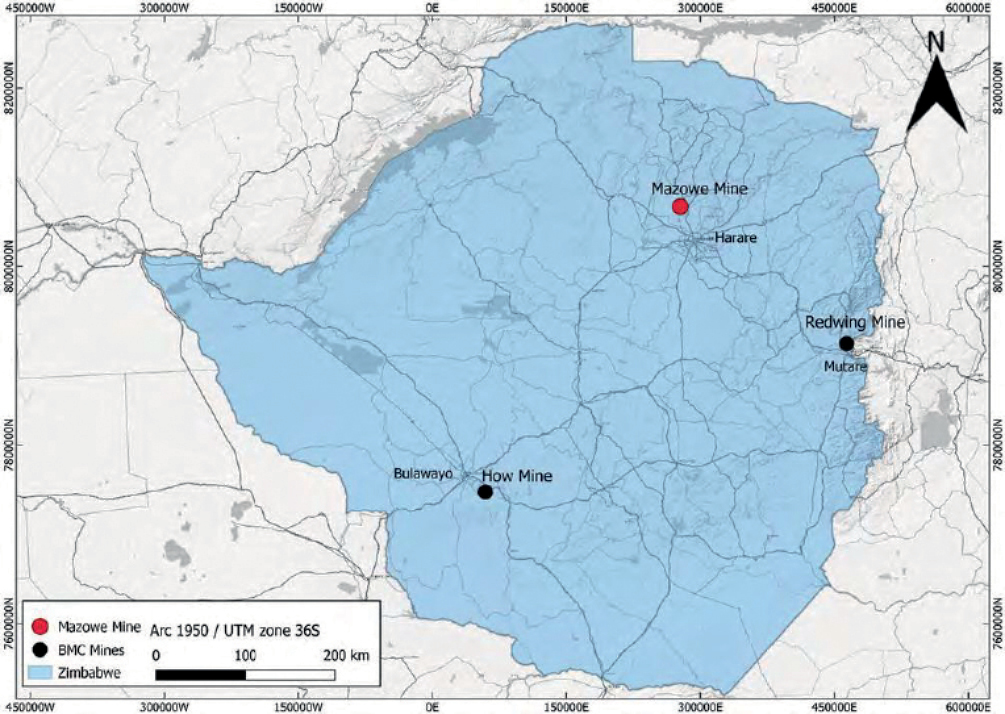
There are no known significant encumbrances to the Mazowe Mine that would impact the current Mineral Resources, risks to access the Mazowe Mine, or title or right to perform work.
Plans to Recommence Operations
The Mazowe Mine is currently in care and maintenance. We intend to prepare for recommencement of operations at Mazowe Mine, with such preparatory work first consisting of completing scoping and prefeasibility studies, which are already underway and are anticipated to be completed within 9 to 15 months at a cost of approximately $2.5 million. Concurrently, surface exploration will commence in 2025. Thereafter, we intend to dewater the flooded working areas of the mine, which will take approximately 12 months, at a cost of approximately $1.5 million. We then intend to backfill illegally mined holes, upgrade four of the main shafts, construct recycling tanks and upgrade other water-related items, purchase new compressors and create supporting infrastructure, and install a new processing
238
plant. Assuming we obtain the required capital resources, we expect that recommencement of mine operations could occur within a 24- to 30-month period following receipt of financing. However, if the current application to place the Mazowe Mine under corporate rescue is accepted, the restart process will be delayed until the corporate rescue process is resolved. For more information on such corporate rescue proceedings, see “Risk Factors — Since operations at our Mazowe Mine and Redwing Mine were halted in 2018 and 2019, respectively, we have been subject to litigation regarding disputed debts and corporate rescue proceedings pursuant to Zimbabwean insolvency laws.”
Operational Infrastructure
The Mazowe Mine has a series of historical shafts that have been equipped with hoists through which personnel and material may access the mine from the surface. We have also constructed a milling plant and a Carbon in Pulp (CIP) processing plant. Accordingly, the Mazowe Mine is serviced by its own dedicated processing facilities and accompanying infrastructure. The Mazowe Mine is accessible via the A11 between Harare, and Glendale. A railway line passes through the Mazowe Mine, linking up with the regional centers of Glendale, Bindura, and Shamva. Consumables and spares are sourced locally with a few exceptional cases where some are imported, especially from South Africa. The regional infrastructure includes access to a national power supply grid and water supply by way of an underground supply from which it is pumped.
The net book value for property, plants, and equipment at the Mazowe Mine at June 30, 2024 is $371,336. The plant and equipment at the Mazowe Mine is obsolete and is not considered for the planned resumption of operations.
Geology
The Mazowe Mine is situated within the Harare-Bindura-Shamva greenstone belt of the Zimbabwean (Archaean) Craton, on the margin of the Chinhamhora Batholith. The Harare-Bindura-Shamva greenstone belt comprises major meta-volcano-sedimentary sequences, structurally intruded by the Chinhamhora Batholith, linking northwards through the Mazowe Mine area, and then eastwards along the Mazowe Valley, through the Harare-Bindura-Shamva greenstone belt.
History
The history of the Mazowe Mine is largely associated with that of the Jumbo Mine. It is estimated that prior to 1980, at least 150koz of gold were extracted. In 1903, the Jumbo Gold Mining Company was created.
In 1953, all existing tributes were terminated, and holdings were acquired by Lonrho Zimbabwe Ltd (“Lonrho”), which operated the area as a single entity. This was achieved using a system of cross-cuts, mined to link the various holdings. Today these cross-cuts serve as haulages. During this period, both Nucleus and Carnbrae continued to operate separately under the Murdoch Eaton brothers, but were finally acquired by Lonrho in 1962. From 1962 onwards, production became steady and continuous. Production peaked between 1965 and 1973 when it averaged approximately 3.2koz per month. After 1973, it declined reaching its lowest levels in 1991. In the same year, Independence Gold Mining (Pvt) Limited (“IGM”) took over the mine.
In 2002, BCM acquired IGM and took over GFM. Since then, post-Independence gold mining production rose from a low of 12.1koz in 2001 to 15.1koz in 2005. After 2005, production declined due to poor economic conditions. Gold production sat at around ten to 12koz for the period 2012 to 2016 and declined to approximately 6koz in 2017 and 1koz in 2018 when the mine was placed on care and maintenance.
The Zimbabwe Supreme Court ordered a Corporate Rescue of the mine in February 2020. The Corporate Rescue proceedings were nullified in October 2021.
Mineral Tenure
Access to the mine site and to the ore is authorized by the applicable mining legislation and the Mazowe Mining Company’s title and mining rights. Mining exploration and exploitation works conducted or to be conducted on site are authorized in accordance with the applicable legislation and the Mazowe Mining Company’s title and mining rights. Other required permits and authorizations (e.g., environmental, building, etc.) are applied for by the Mazowe Mining Company in accordance with the applicable legislation.
The Mazowe Mining Company currently possesses total ground holdings under ML 35 totaling 1,955.5 ha.
239
Renewal of environmental permits and licenses is part of the process to restart operations of the Mazowe Mine and is currently underway.
Mining Method
Mazowe underground mining operation has historically used traditional narrow vein mining methods with labor-intensive handheld techniques, rail transport, and shaft hoisting. The mine is pneumatic powered with rail haulage via lead acid battery powered locomotives hauling rail cars to a shaft where it is hoisted to surface. Mining is conducted using conventional drilling and blasting techniques using handheld jackhammer machines. Minimal support is used, and explosives are manually initiated. Scrapers and hand lashing are used to move muck into passes and chutes with fines swept and bagged for transport to the plant.
Operations were halted and the Mazowe Mine was placed on care and maintenance in August 2018. Efforts to resume are underway. Due to this pause, flooding of the mine to approximately 50 m below surface has occurred.
Mineral Processing
Prior to August 2018, the Mazowe Mining Company applied a standard minimum stope width of 0.87 meters at the Mazowe Mine for the purpose of defining stope envelopes for estimating Mineral Reserves. During that time, ore was processed via treatment in stages comprising rushing, milling, gravity concentration, cyanidation, adsorption, elution, electro-winning, and smelting. However, the existing process plant for underground ore at the Mazowe Mine is in poor condition and utilizes old process technology and equipment. Such plant will require re-evaluation and a determination of either upgrading or replacement prior to the restart of operations. The sands re-processing plant and tailings ownership currently resides with another party following auction and disposal by the receiver, now the subject of a legal dispute in progress. It will be necessary to successfully resolve legal proceedings to establish ownership and future potential.
Qualified Persons
Information in the Mazowe Mine Technical Report Summary has been prepared under the supervision of the WSP QPs. Neither WSP nor the QPs are insiders, associates, or affiliates of Greenstone or any of its subsidiaries. The results of the technical review by the QPs are not dependent on any prior agreements concerning the conclusions to be reached, nor are there any undisclosed understandings concerning any future business dealings. Information regarding the QPs’ qualifications, affiliations, dates of personal inspection of the Mazowe Mine, and areas of responsibility is summarized in the table below.
|
QP |
Qualifications/ |
Date of Personal |
Areas of |
|||
|
Aaron Radonich |
Fellow AusIMM, PGCert Geostatistics, BSc (Hons.), BSc |
May 2024 |
Sections 1.1, 1.2, 1.3, 1.4, 1.7, 1.8.1, 2, 3, 4, 5, 6, 7, 8, 9.1, 11, 20, 21, 22,1, 23.1, 24 and 25. |
|||
|
Allan Blair |
FAusIMM, MBA, BSc, BAppSc Mining Engineering |
May 2024 |
Sections 1.5, 1.6, 12 – 19, 22.2, 23.2. |
Exploration
Underground diamond core drilling is the primary drilling method employed at the Mazowe Mine. Diamond drill core is logged and sampled, with sample length dictated by the width of the mineralized shear zone. One sample each of the barren hanging wall and footwall is also taken and submitted for assay. Surface exploration consisting of a ground magnetic survey and reverse circulation drilling was conducted on the Amatola Prospect during 2016, aimed at exploring near-surface gold resources with the potential for open-pit mining.
The QP considers the data collected, including the method of collection and storage, to be appropriate for the preparation of geological models and Mineral Resources estimates, and that the data has been considered during resource classification.
The Mazowe orebodies are predominantly characterized by multitudes of subparallel, auriferous shear zones. Thus, we plan to concentrate exploration in and around the current workings from 2025 through 2030, at a cost of approximately $4.6 million, before exploring surrounding properties and claims holdings. We are also planning exploratory surface drilling in 2025.
240
Mineral Resource Estimate
The relevant QPs are satisfied that there has been sufficient orebody knowledge work completed to support reasonable prospects for economic extraction at the Mazowe Mine from a Mineral Resources perspective. The effective date of the Mineral Resources estimates is December 31, 2023. The total estimated underground measured and indicated Mineral Resource is approximately 1.17Mt at 7.77g/t Au, for approximately 291koz of gold, and the estimated underground inferred Mineral Resource is approximately 3.29Mt at 8.65g/t Au, for approximately 915koz of gold.
Given there has been no mining or exploration conducted since the mine was placed on care and maintenance while the workings have been flooded, in the QPs opinion the 2018 assumptions for definition of the resource base, including those described below, remain current as of December 31, 2023.
A new COG for 2023 was calculated based on the three-year trailing average gold price at December 2023 (with a gold price multiplier of 30%), applicable mill recovery, and revised operating and sustaining capital costs.
|
Parameter |
Mineral |
|
|
Au COG (g/t) |
2.58 |
|
|
Gold Price |
$2,340/oz |
The below table presents the Mineral Resources (exclusive of Mineral Reserves) reported as at December 31, 2023 and 2022. Mineral Resources are reported on an in-situ basis, assuming a gold metallurgical recovery of 88.0%.
|
Fiscal Year Ended December 31, |
||||||||||||
|
2023 |
2022 |
|||||||||||
|
Mineral Resource Category |
Tonnes |
Grade |
Au Metal |
Tonnes |
Grade |
Au Metal |
||||||
|
Measured |
260 |
9.01 |
75 |
260 |
8.99 |
75 |
||||||
|
Indicated |
910 |
7.45 |
217 |
910 |
7.42 |
217 |
||||||
|
Total Measured and Indicated |
1,170 |
7.77 |
291 |
1,170 |
7.75 |
292 |
||||||
|
Inferred |
3,290 |
8.65 |
915 |
3,320 |
8.60 |
917 |
||||||
Notes: Mt = Million tonnes; Au Grade g/t = gold grams per tonne; koz = thousand ounces.
It should be noted that the underground and surface Mineral Resources estimate for the Mazowe Mine is reported exclusive of Mineral Reserves. The Mineral Resources presented in this Section are not Mineral Reserves and do not reflect demonstrated economic viability. The reported Inferred Mineral Resources are considered too speculative geologically to have the economic considerations applied to them that would enable them to be categorized as Mineral Reserves. There is no certainty that all or any part of this Mineral Resource will be converted into Mineral Reserve.
Mineral Reserve Estimate
No Mineral Reserves have been estimated as of December 31, 2023. Any future estimation of Mineral Reserves and potential recommencement of operations will require the support of an additional drilling and resource definition campaign and at least a pre-feasibility to feasibility level of evaluation.
Quality Assurance Quality Control
Quality Assurance and Quality Control (“QAQC”) procedures used at the Mazowe Mine are as follows.
For channel sampling, one CRM sample (either a standard or a blank) is inserted for every bench sampled, or one in every twelve samples. All CRM samples are tested for compliance to set tolerance ranges, typically ± 2 SD from the designated mean value. Assay batches that are rejected are subjected to either re-assay or discarded with appropriate qualifications, such as for contamination, sample ticket mix up, or transcription errors. Channel sampling assay data is routinely subjected to validation by way of scatter and regression plots.
241
For core sampling, for every 10 samples of diamond drill core, at least one CRM sample (either a standard or a blank) is inserted into the sampling stream. Core being sampled is halved, with one half of the core taken for assay and the other half being stored in the core library as a duplicate. For cases where the core splitter is not functioning, the full core is sampled, and the resultant pulp is stored in the core library as a duplicate. If the tenth drill core sample is a blank, then the twentieth sample becomes a standard and the thirtieth becomes a duplicate. This cycle is on occasion rotated to avoid predictability of results. All CRM samples are tested for compliance to set tolerance ranges, typically ± 2 standard deviations (SD) from the designated mean value. Assay batches that are rejected are subjected to either re-assay or discarded with appropriate qualifications such as for, contamination, sample ticket mix up, and transcription errors. Core drilling assay data is routinely subjected to validation by way of scatter and regression plots.
For grab sampling, at least one CRM sample (either a standard or a blank) is inserted per day for each main tramming level. All CRM samples are tested for compliance to set tolerance ranges, typically ± 2 SD from the designated mean value. Assay batches that are rejected are subjected to either re-assay or discarded with appropriate qualifications such as for, contamination, sample ticket mix up, and transcription errors. Grab sampling assay data is routinely subjected to validation by way of scatter and regression plots.
Under our general guidelines, a minimum of fifteen CRM samples (standards and/or blanks) are submitted every month. All standards, blanks, and duplicates are recorded in the site QAQC book along with the sampling date, mean value, assay value, and SD. The Section Geologist compiles a QAQC report as part of the site weekly report. All assay data is subjected to QAQC iterations, such as line graphs and regression plots, and is analyzed for compliance with the set tolerance ranges, typically ± 2 SD from the designated mean value. For any other sampling projects carried out on surface or underground, outside of the normal sampling processes, CRM samples are inserted and analyzed for compliance with set tolerance ranges, typically ±2 SD from the designated mean value. Anomalous results are handled in the same manner that core drilling, grab sample, and channel samples are handled.
The process plant remains on care and maintenance, and accordingly, in the opinion of the relevant QP, the processing and recovery methods data used to inform product predictions are adequate for the purposes used.
The relevant QP is satisfied that the stated Mineral Resources classification reflects the appropriate level of confidence and considers those factors relevant to the deposit, and that the application of resource categories appropriately considers the relevant factors used in the classification process. Examples of specific factors that can influence the risk and uncertainty of the Mineral Resources estimates that are considered in the resource classification include: (1) interpretation of the mineralization boundary; (2) drill hole spacing and adequacy in defining geology, mineralization, structure, and grade; (3) quality of samples, assays, and geological information; (4) a COG for certain surface resources will be required; (5) pay limits are average block cut-off gold grades used to filter stoping blocks as either economic, or sub-economic; (6) the COG previously applied is not adequately explained but is understood to generally correspond with the “upper” COG to achieve breakeven, inclusive of the cost of all mine development, stoping, process, and administration costs; (7) the Mineral Resources estimates have been estimated to two decimal places for gold grade, and to the nearest tonne for tonnage, but have been reported to one decimal place for gold grade, to the neatest ounce for metal content, and to the nearest thousand tonnes for tonnage when previously reported; (8) the Mineral Resource estimation has only been subjected to visual validation by Mazowe Mining Company staff, while standard industry practice is to conduct both visual and statistical validation.
Redwing Mine
Property Description
The Redwing Mine is located in Penhalonga, approximately 20 km north-northeast of the City of Mutare, Manicaland Province, in the Mutare Mining District of Zimbabwe. The Redwing Mining Company, a wholly owned subsidiary of KD Mining Company (UK) Limited, which is a wholly owned subsidiary of BMC, currently holds Mining Lease 34 (“ML 34”). The Redwing Mine is classified as an exploration stage property and is currently in care and maintenance.
242
The following graphic illustrates the location of the Redwing Mine and its proximity to major infrastructure.
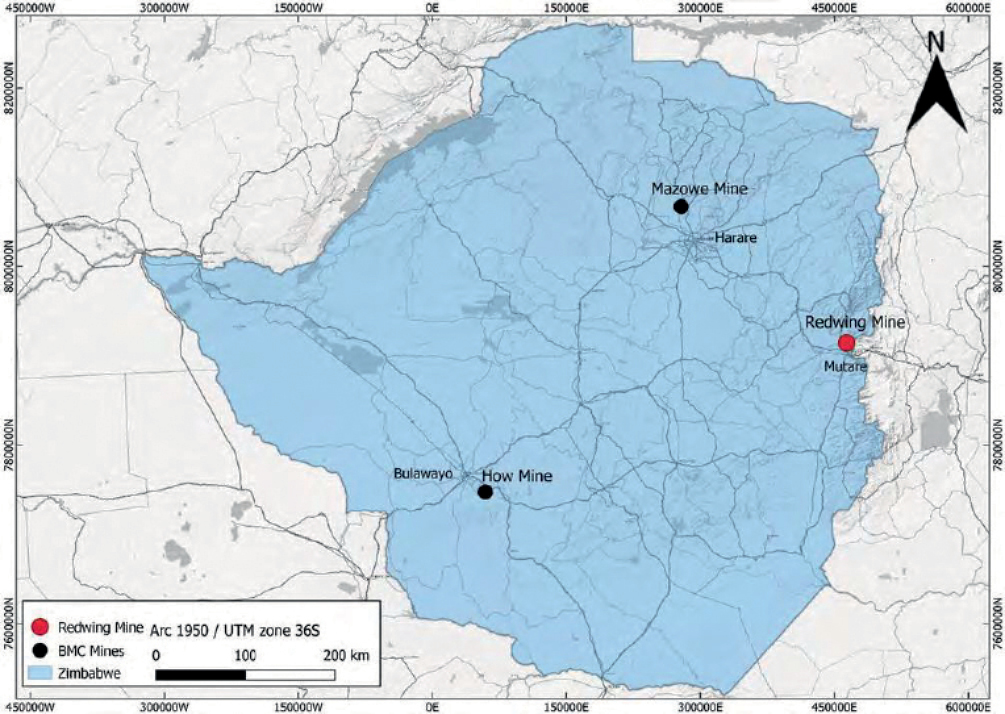
There are no known significant encumbrances to the Redwing Mine that would impact the current Mineral Resources, risks to access the Redwing Mine, or title or right to perform work.
Plans to Recommence Operations
The Redwing Mine is currently in care and maintenance. We intend to prepare for recommencement of operations at the Redwing Mine, with such preparatory work first consisting of completing a scoping study and prefeasibility study, which is anticipated to be completed within 9 to 15 months at a cost of approximately $2.5 million. At the same time, we intend to dewater the flooded working areas of the mine, which will take approximately 15 months, at a cost of approximately $1.0 million. We then intend to commence exploratory drilling, initiate small-scale production to comply with certain obligations, upgrade a decline and a hoist, construct a tailings storage facility, construct a new shaft, and install a new processing plant. Assuming we obtain the required capital resources, we expect that recommencement of mine operations could occur within a 24- to 30-month period following receipt of financing.
Operational Infrastructure
The Redwing Mine contains a series of five access shafts, with hoists, through which personnel and material may access the mine from the surface. In 2018, we had been working on the refurbishment of a rod mill and its associated circuit to improve milling capacity. Although the rod mill was expected to be commissioned by the end of 2018, certain operational challenges prevented its commissioning and mining operations were consequently suspended in March 2019, at which time Redwing Mine was placed in care and maintenance.
When operational, the Redwing Mine is serviced by its own dedicated processing facilities and accompanying infrastructure. The Redwing Mine is linked to major commercial centers by a well-established network of primary asphalt roads and is accessible from the surrounding communities through secondary gravel roads. Consumables and
243
spares are sourced locally with a few exceptional cases where some are imported, especially from South Africa. The regional infrastructure includes access to a national power supply grid and water supply by way of river diversion and a sump pump.
The net book value for property, plants, and equipment at the Redwing Mine at June 30, 2024 is $3,690. The plant and equipment at the Redwing Mine is obsolete and is not considered for the planned resumption of operations.
Geology
The Redwing Mine is located within the Mutare Greenstone Belt (“MGB”) which extends from the Mozambique Belt in the east into the granites and gneisses of the Zimbabwe Craton in the west. The geology is dominated by an east-west trending series of metavolcanics consisting of olivine cumulates, komatiites, komatiitic basalts, and high iron tholeiites. The rocks are extrusive, indicated by the presence of spinifex texture and pillow lavas as well as lenses of intercalated clastic sediments and discontinuous strings of BIF. The MGB is bounded by the Penhalonga Diorite to the north and south.
History
Portions of the Redwing Mine are part of the shallow historical workings that exploited the MSZ above the water table. In 1889, Baron de Rezende and James Henry Jeffreys pegged the Rezende Mineralised Shear Zone and began mining operations.
In 2008, the Redwing Mine was flooded. The causes of flooding were attributed to a shortage of foreign currency emanating from the global recession in 2008, prolonged power outages, and ZESA’s inability to supply adequate power to the region. The situation was worsened by aged pumps that were due for replacement. Consequently, in September 2008, the mine suspended operations as working areas and other critical equipment were submerged. The mine subsequently acquired five submersible pumps in the first quarter of 2010, each pumping an average of 140 cubic meters per hour. Two pumps were installed in the Rezende shaft, two in the Redwing main shaft and one in the old west shaft. The pumps were commissioned in March 2010.
The Redwing Mine resumed operations in September 2009 with re-treatment of tailings (sands) dumps, namely the Duiker and Concentrate Dumps. This re-treatment ceased in September 2013, mainly due to depressed feed grades that rendered re-processing of sands not economically viable. After pumping water to below a workable level, the Redwing Mine resumed underground mining in February 2015 in preparation of production of gold from underground that commenced in November 2015.
Following an organizational re-structuring process which became effective in June 2016, the Redwing Mine was owned by The King’s Daughter Mining Company (Private) Limited, a wholly owned subsidiary of BMC.
The Redwing Mine was placed on care and maintenance in April 2019. Supreme Court-ordered corporate rescue proceedings were implemented in July 2020. During the corporate rescue period, Betterbrands Mining Company (Pvt) Ltd. (“BBM”) was engaged as a tributor to the Redwing Mine on ML 34. Mine dewatering was maintained until suspended in December 2020 due to power supply disconnections. The water level has since risen to approximately 47 meters from the Redwing Shaft surface collar and has been stagnant at that level since April 2021. Any recommencement of mining operations will require dewatering to access Mineral Resources. The Corporate Rescue proceedings were nullified in September 2022.
In January 2024, 15 artisanal miners were trapped for three days at the Redwing Mine. On March 8, 2024, the non-standard tribute agreement with BBM was cancelled, and BBM was evicted from ML 34.
Mineral Tenure
Access to the mine site and to the ore, as well as mining exploration and exploitation works conducted or to be conducted on site, are authorized by applicable mining legislation and the Redwing Mining Company’s title and mining rights. Other required permits and authorizations (e.g., environmental, building, etc.) are applied for by the Redwing Mining Company in accordance with the applicable legislation.
The Redwing Mining Company holds ML 34. The area covered by the ML was surveyed in 2015 as having a surface area of 1,254 ha. Cases of illegal gold mining activities have been reported in some sections of the ML, including along the Mutare River.
244
Renewal of environmental permits and licenses is part of the process to restart operations of the Redwing Mine and is currently underway.
Mining Method
Three mining methods are applied at the Redwing Mine depending on the nature of the orebody and the rock mechanics considerations. The geometry of each stoping block in terms of dip and width and the nature of the mineralization largely determines the mining method:
• Up-Dip Room and Pillar: For stoping of the wide and shallow dipping felsite.
• Long Hole Open Stope: Used for the steeply dipping Rezende and Village North reefs. As conditions warrant, used in combination with the underhand mining method.
• Underhand Mining Method: Used for the narrow, steeply dipping Bromley and Kent reefs.
The mine formerly operated as a rail mine serviced by vertical and underlay (inclined shafts). Level development headings are of relatively small dimension of approximately 2 mW x 2 mH installed on approximately 100-foot intervals. The mine is pneumatic powered with rail haulage via lead acid battery powered locomotives hauling rail cars to a shaft where it is hoisted to surface. Mining is conducted using conventional drilling and blasting techniques using handheld jackhammer machines. Minimal support is used, and explosives are manually initiated. Larger long hole stoping and underhand benching has employed larger pneumatic drill rigs secured by bar and arm.
There is no backfill used for stope support apart from opportunistic disposal of development waste. Further options for mechanizing the method to improve productivity could be considered, including alternate decline access and extraction.
Operations were halted and the Redwing Mine was placed on care and maintenance in April 2019. Efforts to resume are underway. Due to this pause, flooding of the mine to approximately 50m below surface has occurred.
Mineral Processing
Prior to 2019, the Redwing Mine applied a standard minimum stope width of 90 cm for the purpose of defining stope envelopes for estimating Mineral Reserves. During that time, ore was processed via treatment in stages comprising crushing, milling, gravity separation, flotation, Merril-Crowe Process, CIP, and elution. However, the existing process plant for underground ore at the Redwing Mine is in poor condition and utilizes old process technology and equipment. Such plant will require re-evaluation and a determination of either upgrading or replacement prior to the restart of operations.
Qualified Persons
Information in the Redwing Mine Technical Report Summary has been prepared under the supervision of the WSP QPs. Neither WSP nor the QPs are insiders, associates, or affiliates of Greenstone or any of its subsidiaries. The results of the technical review by the QPs are not dependent on any prior agreements concerning the conclusions to be reached, nor are there any undisclosed understandings concerning any future business dealings. Information regarding the QPs’ qualifications, affiliations, dates of personal inspection of the Redwing Mine, and areas of responsibility is summarized in the table below.
|
QP |
Qualifications/Affiliation |
Date of Personal |
Areas of Responsibility |
|||
|
Aaron Radonich |
Fellow AusIMM, PGCert Geostatistics, BSc (Hons.), BSc |
May 2024 |
Sections 1.1, 1.2, 1.3, 1.4, 1.7, 1.8.1, 2, 3, 4, 5, 6, 7, 8, 9.1, 11, 20, 21, 22,1, 23.1, 24 and 25. |
|||
|
Allan Blair |
FAusIMM, MBA, BSc, BAppSc Mining Engineering |
May 2024 |
Sections 1.5, 1.6, 12 through 19, 22.2, 23.2. |
245
Exploration
An exploration drilling campaign targeting mostly the felsite orebody was carried out around the Redwing Mine in the early 1980s. A total of 78 vertical holes were drilled. Currently, diamond core drilling is the drilling method employed at the Redwing Mine. Diamond drill core is logged and sampled on a one-meter interval depending on geology. Samples are taken to at least one meter beyond the geologically defined mineralization boundary in all drill holes. Core size drilled at the Redwing Mine is typically AXT (35.51 mm core diameter) and BQ (36.50 mm core diameter) for evaluation and exploration drill holes respectively. All exploration drill holes are collar and downhole surveyed.
The QP considers the data collected, including the method of collection and storage to be appropriate for the preparation of geological models and Mineral Resources estimates, and that the data has been considered during resource classification.
We plan to concentrate exploration in and around the down dip and strike extensions of the various reefs and felsite orebody of the Redwing Mine, outside the confines of the inferred mineral resource blocks. We intend to conduct such exploration, which is intended to include both surface and underground from 2024 through 2028 at a cost of $9.5 million.
Mineral Resource Estimate
The relevant QPs are satisfied that there has been sufficient orebody knowledge work completed to support reasonable prospects for economic extraction at the Redwing Mine from a Mineral Resources perspective. The effective date of the Mineral Resources estimates is December 31, 2023. The total estimated underground measured and indicated Mineral Resource is approximately 9.65Mt at 3.83g/t Au for approximately 1,188koz of gold, and the underground inferred Mineral Resource is approximately 15.83Mt at 2.61g/t Au for approximately 1,328koz of gold.
Given there has been no mining or exploration conducted since the mine was placed on care and maintenance while the workings have been flooded, in the QPs opinion the 2018 assumptions for definition of the resource base, including those described below, remain current as of December 31, 2023. Classification of blocks into relevant groupings was completed following standard procedures as defined and recommended in the SAMREC (2016). The stoping pay-limit defines the lower grade cut-off that is used in the process.
A new COG for 2023 was calculated based on the three-year trailing average gold price at December 2023 (with a gold price multiplier of 30%), applicable mill recovery, and revised operating and sustaining capital costs.
|
Parameter |
ROM Felsite |
ROM MSZ |
Combined |
|||
|
Pay Limit (g/t) |
1.06 |
1.53 |
1.26 |
|||
|
Gold Price |
$2,340/oz |
$2,340/oz |
$2,340/oz |
The below table presents the underground Mineral Resources (exclusive of Mineral Reserves) reported as at December 31, 2023 and 2022. Mineral Resources are reported on an in-situ basis, assuming a gold metallurgical recovery of 90.0%.
|
Fiscal Year Ended December 31, |
||||||||||||
|
2023 |
2022 |
|||||||||||
|
Mineral Resource Category |
Tonnes |
Grade |
Au Metal |
Tonnes |
Grade |
Au Metal |
||||||
|
Measured |
1,450 |
2.92 |
136 |
1,450 |
2.92 |
136 |
||||||
|
Indicated |
8,200 |
3.99 |
1,052 |
8,200 |
3.99 |
1,052 |
||||||
|
Total Measured and Indicated |
9,650 |
3.83 |
1,188 |
9,650 |
3.83 |
1,88 |
||||||
|
Inferred |
15,830 |
2.61 |
1,328 |
15,380 |
2.61 |
1,328 |
||||||
____________
Notes: Mt = Million tonnes; Au Grade g/t = gold grams per tonne; koz = thousand.
It should be noted that the underground and surface Mineral Resources estimate for the Redwing Mine is reported exclusive of Mineral Reserves. The Mineral Resources presented in this Section are not Mineral Reserves and do not reflect demonstrated economic viability. The reported Inferred Mineral Resources are
246
considered too speculative geologically to have the economic considerations applied to them that would enable them to be categorized as Mineral Reserves. There is no certainty that all or any part of this Mineral Resource will be converted into Mineral Reserve.
Mineral Reserve Estimate
No Mineral Reserves have been estimated as of December 31, 2023. Any future estimation of Mineral Reserves and potential recommencement of operations will require the support of an additional drilling and resource definition campaign and at least a pre-feasibility to feasibility level of evaluation.
Quality Assurance Quality Control
Quality Assurance and Quality Control (“QAQC”) procedures used at the Redwing Mine are as follows.
For drill core, core derived from surface exploration activities is logged and split into two halves using a core splitter prior to sampling. Underground core (both exploration and evaluation) is logged and sampled without being split. Standard and duplicate samples are inserted at a rate of 10%, while blank samples are inserted at a rate of 20%. An accredited laboratory is used for analysis of surface exploration diamond drill core samples. A separate laboratory is used as an umpire laboratory, analyzing pulp duplicate samples. The on-site assay laboratory is used for analysis of drill core derived from underground exploration and evaluation drilling. Reference material is tested for compliance to set standards, typically ± 2 SD from the designated mean value. Assay batches that are rejected are subject to either re-assay or discarded with appropriate qualifications, such as for contamination, ticket mix-up, or transcription errors.
For channel and grab samples, house standards, duplicate samples, and blank samples are used for QAQC to monitor the day-to-day running of the mining operation. These samples are inserted at a rate of 20%. Reference material is tested for compliance to set standards, typically ± 2 SD from the designated mean value. Assay batches that are rejected are subject to either re-assay or discarded with appropriate qualifications, such as for contamination, ticket mix-up, or transcription errors. The on-site assay laboratory has its own duplicate and standard samples that the chief assayer uses to monitor laboratory performance. For every batch of 16 samples, one high-grade standard and one low-grade standard sample are utilized. Blanks are inserted at a rate of 20% for drill core, channel samples, and grab samples.
Regarding duplicates, an accredited laboratory is used for analysis of surface exploration diamond drill core samples. A separate laboratory is used as an umpire laboratory, analyzing pulp duplicate samples. The on-site assay laboratory is used for analysis of drill core derived from underground exploration and evaluation drilling. The on-site assay laboratory has its own duplicate and standard samples that the chief assayer uses to monitor laboratory performance of channel and grab samples. For every batch of 16 samples, one high-grade standard and one low-grade standard sample are utilized.
The process plant remains on care and maintenance, and accordingly, in the opinion of the relevant QP, the processing and recovery methods data used to inform product predictions are adequate for the purposes used.
The relevant QP is satisfied that the stated Mineral Resources classification reflects the appropriate level of confidence and considers those factors relevant to the deposit, and that the application of resource categories appropriately considers the relevant factors used in the classification process. Examples of specific factors that can influence the risk and uncertainty of the Mineral Resources estimates that are considered in the resource classification include: (1) interpretation of the mineralization boundary; (2) drill hole spacing and adequacy in defining geology, mineralization, structure, and grade; (3) quality of samples, assays, and geological information; (4) the Mineral Resource estimation has only been subjected to visual validation, while standard industry practice is to conduct both visual and statistical validation; (5) the COG used for Mineral Resource estimation seems reasonable on face value; however; the methodology used for determination of these values has not been clearly reported by Redwing Mining Company and requires further explanation; (6) the nominal estimates for extraction ratio are presumably based on historical experience and may require a more targeted application based on stoping area, method, orebody disposition and ground conditions; and (7) the Mineral Resources estimates have been estimated to two decimal places for gold grade, and to the nearest tonne for tonnage, but have been reported to one decimal place for gold grade, to the neatest ounce for metal content, and to the nearest thousand tonnes for tonnage when previously reported.
247
Sales Arrangements
Greenstone sells all of its gold production in Zimbabwe to Fidelity, as required by Zimbabwean legislation. All sales are at the London Base Metal Association spot price at the date of the transaction and the official exchange rate on the date of sale. Gold sales are generally subject to a 5% royalty payment if sold at a time when its price is above $1,200 per ounce and a 3% royalty payment if the price is below $1,200 per ounce. During 2023, all of Greenstone’s gold sales incurred a 5% royalty.
We are paid in part with Zimbabwe’s local currency and part with U.S. Dollars, as required by law. The proportion to be paid in U.S. Dollars and Zimbabwe’s local currency is set from time to time by the Zimbabwean government, and since February 2023, we received 75% of our proceeds in U.S. Dollars and 25% in local currency. See “Risk Factors — Fluctuating foreign currency and exchange rates as well as Zimbabwean exchange controls may negatively impact our business, results of operations, and financial position.” Local currency has been paid in ZiG, Zimbabwe’s currency since April 2024, but has historically been paid in RTG. Exchange rates of RTG for U.S. Dollars have varied vastly over the last several years. A holder of a special mining lease is permitted to directly export of its gold and thereby increase the amount it can be paid in U.S. Dollars.
Intellectual Property
Greenstone does not hold any patents and is not dependent on intellectual property (including patents or licenses), industrial, commercial or financial contracts (including contracts with customers or suppliers) or new manufacturing processes for the conduct of its business as a whole.
Seasonality
We operate our mines continuously throughout the year, with no interruptions due to seasonal changes.
Raw Materials
The principal raw materials used in the mining operations are fuel, electricity, and water. Diesel fuel is used to power front-end loaders, tractors, motor vehicles and standby power generators. Oil and energy prices are important costs for the Company’s business. During 2023, as a result of geopolitical tensions, such as the war between Russia and Ukraine, and the more recent conflict in the Middle East, the price of oil has been volatile. We obtain the majority of our electricity from the national grid in Zimbabwe and a portion of our electricity pursuant to a private arrangement whereby electricity is imported. We are also seeking to develop solar power generation at the How Mine. Greenstone also uses chemicals, including cyanide and hydrogen peroxide, in the production of gold. These chemicals are available from a number of suppliers and do not represent a material portion of Greenstone’s costs. We are not currently experiencing any supply shortages on critical consumables utilized in the production of gold across our operations. In addition, our stocking strategies account for potential lead time variation and supply constraints, thus minimizing the risk of changes in the marketplace. Recently, for example, the How Mine completed upgrading the on-site fuel pump station to a holding capacity of 35,000 liters. The higher cost for basic commodities used in our communities, and as key production inputs, could impact the costs of our raw materials. See “Risk Factors — We cannot guarantee that there will not be an increase in input costs affecting our results of operations and financial performance” and “Risk Factors — Our operations are vulnerable to infrastructure constraints, including power and water supply.”
Environmental, Health, and Safety Matters
As a long-term gold mining operator in Zimbabwe, we are committed to the sustainable development of our projects by deeply embedding ESG criteria in our decision-making framework from the earliest stages of project exploration and development. We have historically been committed to analyzing and improving working conditions for our employees through our SHEQ Initiative. This comprehensive program encompasses an environmental management system, an occupational health and safety system, and a quality management system, all geared towards realizing our vision of fostering a “zero-harm environment.” The How Mine operates under the SHEQ systems and complies with ISO standards (14001, 9001, and 45001) for environmental responsibility, quality, and occupational health and safety. However, mining is inherently hazardous and there are related risks. See “Risk Factors — Mining is inherently hazardous and the related risks of events that cause disruptions to our mining operations may adversely impact the environment or the health, safety, or security of our workers or the local community, production, cash
248
flows, and overall profitability.” In addition, we develop Environmental Management Plans for our operations that encompass biodiversity management, greenhouse gas emissions, water impact practices, mine closure practices, among other operational aspects to ensure compliant and consistent practices. For example, the greenhouse gas emissions component of our Environmental Management Plan at the How Mine includes a process for evaluating yearly emissions and ongoing investigations to seek ways to reduce emissions.
Greenstone also recognizes its responsibility to the community and actively engages in corporate social responsibility initiatives to address local challenges. Current and recent initiatives include a fund supporting underprivileged school children with tuition fees, providing primary healthcare services to community members, offering free medical support to employees and their families, and facilitating transport for children from nearby communities to related primary and secondary schools.
Government and Environmental Regulations
Greenstone’s rights to own and develop mineral resources and deposits are governed by the laws and regulations of the jurisdictions in which these mineral properties are located.
Greenstone is subject to a wide range of laws and regulations governing all aspects of its operations, including with respect to environmental protection, reclamation, exploration, development, production, taxes, immigration, labor standards and employment issues, occupational health, mine safety, dam safety, toxic substances and wastes, securities and foreign corrupt practices. Greenstone has made, and expects to make in the future, significant expenditures to comply with these laws and regulations. Non-compliance can result in violations and legal claims, as well as substantial fines, penalties, reputational damage and delays in or suspension of day-to-day operations. Pending or proposed changes to existing laws and regulations, as well as any proposed or contemplated new laws or regulations, could also have significant impacts on Greenstone’s business and results of operations, the extent of which cannot always be predicted.
For more information on the risks and uncertainties associated with Greenstone’s mining rights, see “Risk Factors — Our rights to mine in Zimbabwe are derived from each of the How Mine Lease, the Mazowe Mine Lease, and the Redwing Mine Lease, the loss of which would have a material adverse effect on our financial condition and results of operations”, and “Risk Factors — Since operations at our Mazowe Mine and Redwing Mine were halted in 2018 and 2019, respectively, we have been subject to litigation regarding disputed debts and corporate rescue proceedings pursuant to Zimbabwean insolvency laws.”
Zimbabwe
General laws relating to mining
The mining industry in Zimbabwe is primarily regulated by The Mines and Minerals Act [Chapter 21:05] commenced on November 1, 1961 (the “Mining Act”) and the Environmental Management Act [Chapter 20:27] commenced on March 17, 2003, as amended (the “Environmental Act”).
To conduct mining exploration, a company needs to be in possession of the applicable license, grant or order pursuant to the terms of the Mining Act. The Mining Affairs Board is generally responsible for granting certain mining rights, the withdrawal or cancellation of such rights, the approval of certain agreements and transactions in the mining sector and making recommendations to the Minister of Mines and Mineral Development or the President of Zimbabwe concerning the granting or withdrawal of certain mining titles. The President of Zimbabwe also possesses the right to grant and withdraw certain mining rights, and the Minister of Mines and Mineral Development and the Ministry of Mines and Development Secretary issue certain mining titles, licenses, approvals and order. Rights relating to exploration and mining can be owned entirely by foreign entities. The government amended previous legislation in December of 2020 to remove restrictions that prohibited more than forty-nine percent ownership by foreigners in businesses involved in the exploration and mining of platinum and diamonds.
A mining lease may be issued pursuant to Part VIII of the Mining Act after application to the Mining Affairs Board and must be renewed annually with an inspection and the payment of fees. A mining lease grants the holder an exclusive right of mining any ore or deposit of any mineral which occurs within the vertical limits of the area covered by the applicable mining lease. There are not necessarily time limits associated with a mining lease, but the holder must comply with the terms and conditions of the lease as well as the requirements to obtain annual
249
inspection certificates. The Mining Act requires the government provide notification to a holder in case the holder fails to timely obtain an inspection certificate. Transferring a mining lease requires governmental permission. Greenstone’s rights to mine are derived from the How Mine Lease, the Mazowe Mine Lease and the Redwing Mine Lease, and each lease is current in its annual inspections and in the payment of fees.
Special mining leases are provided for in Part IX of the Mining Act and may only be issued upon the President of Zimbabwe’s approval, with the recommendation of the Minister of Mines and Mining Development. A holder of a registered mining location may apply for a special mining lease and must demonstrate the capacity to invest at least $100 million in the applicable mining location. Special mining leases can be issued for up to 25 years with 10-year renewal periods, depending on the life of the mine. Section 168 of the Mining Act provides that the same provisions relating to mining leases, including the rights and obligations thereof, apply in relation to special mining leases. This includes the preservation, cancellation and restriction of transfers of mining leases. However, a holder of a special mining lease is subject to a 15% tax rate instead of the general rate of 25.75% and is also allowed to make direct exports of gold at spot prices.
Environmental Act regulations are designed to ensure that mining takes place in a manner that sustainably protects the environment and requires that mining projects. The Environmental Act requires the Environmental Management Agency to approve an environmental impact assessment report and issue a certificate before mining activities may commence at a project or mine. An environmental impact assessment report should include, among other things, details of how tailings and other waste products will be handled and how the miner will mitigate environmental damages. Other related environmental licenses are required depending on the nature of operations, including water disposal licenses and emissions license. Companies that do not comply with certain environmental regulations may be prosecuted under the Environmental Act and be subject to fines. In addition, a company may also be sued for damages by any affected person and be ordered to pay for environmental reparations.
Pursuant to Zimbabwe law, all gold from authorized mining activities in Zimbabwe must be sold to Fidelity, a company controlled by the Zimbabwean authorities.
In May 2023, Zimbabwe passed the Responsible Mining Initiative to combat illegal mining and removed the historical indigenization rule, which required 51% local investor ownership.
Tax laws relating to mining
The Income Tax Act (the “Tax Act”) sets out a comprehensive tax and customs regime that is applicable to mining activities. Under the Tax Act, taxation on most mining leases is at a flat rate of 25.75%. For holders of special mining leases, taxation is at a flat rate of 15%; however, holders may be liable to additional profit tax. The Tax Act further provides for the deduction of capital expenditures incurred exclusively for mining operations. Investors in mining companies are permitted to borrow locally for working capital purposes. Offshore borrowings require approval from the RBZ.
Effective January 1, 2024, amendments to Zimbabwe’s Capital Gains Tax Act (Chapter 23:01) went into effect and provide for a capital gains tax of up to 20% on direct and indirect transfers of mining title. The statute provides that the tax may apply to both domestic and foreign entities, even if the applicable offshore entity is not a tax resident of Zimbabwe and regardless of whether the transaction occurs offshore of Zimbabwe. The new capital gains tax also has a lookback period of ten years prior to January 1, 2024. Judicial interpretations of the capital gains tax are not available and the implications of such amendments and potential enforcement of such remain unclear. We are evaluating the amendments and considering the potential impact on PubCo and Greenstone as a result of the Business Combination and the previous transaction by which Greenstone obtained its interest in BMC, the holding company of our mining assets. If the new capital gains tax were to apply to such transactions, it could have a material adverse effect on our business and financial condition.
Gold sales to Fidelity were zero rated for Value Added Tax purposes (“VAT”) until December 29, 2023 which meant that no VAT was payable on gold sales. On December 29, 2023, the Zimbabwe government introduced statutory instrument 248/2023 which removed the zero-rating provisions and VAT on sales of gold then became payable. However, in June 2024 the Zimbabwe government restored the zero rating of gold sales through statutory instrument 105/2024.
250
Mining entities are also required to pay royalties to the government of Zimbabwe depending on the type of mineral. Gold is generally subject to a 5% royalty payment if sold at a time when its price is above $1,200 per ounce and a 3% royalty payment if the price is below $1,200 per ounce. Royalties are calculated as a percentage of the gross fair market value of minerals produced and sold. Greenstone paid a 5% royalty to the Zimbabwean government in 2023.
Foreign Exchange Controls
Exchange control approvals from the RBZ are required on the flow of funds in and out of Zimbabwe. Greenstone has obtained the necessary approvals from the RBZ to transfer foreign currency.
Investment Protection
Foreign investors are required to register their investments with the Zimbabwe Investment and Development Agency (“ZIDA”). Registration with ZIDA ensures repatriation of capital and dividends and protection of investments under any existing investment protection agreements (BIPPAs) between Zimbabwe and the foreign country. It also protects against direct and indirect expropriation without fair compensation. Investments made before the act came into force in 2020 can be registered with ZIDA. The Company has obtained ZIDA licenses for the How Mining Company, the Mazowe Mining Company, and the Redwing Mining Company.
Democratic Republic of the Congo (DRC)
General laws relating to mining
The mining industry in the DRC is primarily regulated by Law No. 007/2002 dated July 11, 2002 (the “2002 DRC Code”), as amended and supplemented by Law No. 18/001 dated 9 March 2018 (the “Reformed DRC Mining Code”) and Decree No. 038/2003 dated March 26, 2003, as amended and supplemented by Decree No. 18/024 dated June 8, 2018 (the “Reformed DRC Mining Regulations”).
Companies holding mining titles issued prior to the entry into force of the Reformed DRC Mining Code and Reformed DRC Mining Regulations have claims to a ten-year stability provision in accordance with prior mining legislation. Notwithstanding the adoption of the new regulatory regime, their rights with respect to such stability provision are reserved.
The Reformed DRC Mining Code grants the DRC Minister of Mines the authority to grant, refuse, suspend or terminate mineral rights, subject to conditions set out in the Reformed DRC Mining Code. Mineral rights may be granted in the form of exploration permits for an initial period of five years renewable once for a further five-year period or in the form of exploitation permits which are granted for an initial period of 25 years, renewable several times for 15-year periods until the end of the mine’s life. The holder of mining title is obliged to treat and transform the mineral substances exploited by the holder in the DRC. Prior to commencing exploration work, the holder of an exploration permit must submit for approval a mitigation and rehabilitation plan pursuant to which it must undertake to carry out certain mitigation measures of the impact of its activities on the environment, as well as rehabilitation measures. Exploitation permits are granted upon successful completion of exploration and satisfaction of certain requirements, including approval of a feasibility study, an environmental and social impact study and an environmental and social management plan. The holder of an exploitation permit is required to commence development and mine construction within three years of the grant of such permit. This period is one year for the holder of a research (exploration) permit. The holder of an exploitation permit pays for annual surface rights the sum in Congolese Francs equivalent to $5.00 U.S. dollars per hectare regardless of the validity period of title. Failure to do so may lead to forfeiture of the exploitation permit. To protect and enforce rights acquired under an exploration or exploitation permit, the Reformed DRC Mining Code provides, depending on the nature of the dispute or controversy, administrative, judicial and national or international arbitral recourses. Holders of mining rights who have lost their rights and whose titles are withdrawn can only obtain new mining rights or authorization to operate permanent quarries after a period of five years from the date of entry of the withdrawal in the register held by the Mining Cadastre.
Mining companies are required to grant a free-carried and non-contributory participation to the DRC government. The DRC government’s free participation was originally set at five percent, which was increased to ten percent in respect of exploitation permits issued after the entry into force of the Reformed DRC Mining Code. All
251
mining companies are required to grant an additional five percent free-carried participation to the DRC government upon each renewal of their exploitation permit. Under the Reformed DRC Mining Code, a ten percent local contributory participation is also mandatory for exploitation permits issued after its entry into force.
In the event that it is recognized as necessary to carry out work of common interest for two neighboring mines, the applicable holders cannot object. The holder of mining rights is required, from the delivery of mining title and at the latest within six months before the start of exploitation, to develop and submit specifications defining social responsibility for local communities affected by mining activities and to obtain approval from the Provincial Government after advice from technical services. DRC law also provides for fines ranging from $10,000 U.S. dollars to $250,000 U.S. dollars, against anyone who engages, without authorization, in research or exploitation of mines.
Tax laws relating to mining
The Reformed DRC Mining Code sets out an exclusive and comprehensive tax and customs regime that is applicable to mining activities. Mining title holders are subject, amongst other things, to a corporate income tax of 30 percent, a windfall tax of 50 percent (subject to certain prerequisites) and are required to pay mining royalties to the DRC government. The royalty rate applicable to gold has been set at 3.5 percent. Mining title holders are also required to contribute a minimum of 0.3 percent of total turnover to community development. This grant is made available and managed by a legal entity comprising representatives of the holder and the surrounding local communities directly affected by the project. The standard rate of VAT is 16 percent and is applicable to all mining companies.
The Reformed DRC Mining Code also provides for a level of fiscal stability. A stability clause stipulates that existing tax, customs and exchange control provisions applicable to mining activities are guaranteed to remain unchanged for a period of five years from the enactment of the Reformed DRC Mining Code.
Foreign exchange control regime
The Reformed DRC Mining Code imposed new exchange control rules requiring that mining title holders repatriate onshore 60 percent of sale revenues received during the investment amortization period and 100 percent once the investment amortization is completed.
Legal Proceedings
In addition to the proceedings described below, we become involved, from time to time, in various claims, legal proceedings and complaints incidental to the ordinary course of business. For example, our operations are underpinned by numerous contractual agreements with third parties and non-compliance by the relevant third party to our contractual obligations may require us to enforce our rights under the relevant contracts and pursue legal action. The outcome of outstanding, pending or future proceedings cannot be predicted with certainty and may be determined adversely to us and as a result, could have a material adverse effect on our assets, liabilities, business, financial condition and results of operations.
• Mazowe Corporate Rescue Proceedings: On February 15, 2024, a court application was filed in the High Court of Zimbabwe to place the Mazowe Mining Company under supervision and commencement of Corporate Rescue Proceedings in terms of the Insolvency Act (Chapter 6:07) in 2018 (the “Mazowe Corporate Rescue Proceedings”). The application has been challenged by the Company, and a hearing date has not yet been set. In the Company’s view, the application for the Mazowe Corporate Rescue Proceedings is without merit as it does not comply with applicable laws and rules. Soon after the Mazowe Mine and the Redwing Mine ceased operations, applications were filed in Zimbabwe to place the Redwing Mining Company and the Mazowe Mining Company in corporate rescue proceedings. The applications were initially granted. As a result, our management was separated from control of the mines until the application approvals were overturned by the Supreme Court of Zimbabwe in 2021, in the case of the Mazowe Mine, and 2022, in the case of the Redwing Mine. In 2023, employees of our Redwing Mine applied to have the Redwing Mining Company placed under corporate rescue proceedings but the case was dismissed by the High Court of Zimbabwe. See “Risk Factors — Since operations at our Mazowe Mine and Redwing Mine were halted in 2018 and 2019, respectively, we have been subject to litigation regarding disputed debts and corporate rescue proceedings pursuant to Zimbabwean insolvency laws.”
252
• Employee Compromise Agreements: In connection with the Mazowe Mine and the Redwing Mine care and maintenance, certain employees of the Mazowe Mining Company and the Redwing Mining Company claimed they were not paid an aggregate of approximately $2.5 million wages owed to them. In response, the Mazowe Mining Company is making payments in installments, and the Redwing Mining Company has entered into compromise agreements with some employees and is in continued discussions to enter into additional compromise agreements. See “Risk Factors — We are subject to labor and employment laws and regulations, which could increase our costs and restrict our operations in the future.”
Competition
There is aggressive competition within the precious metals industry. We compete in efforts to finance, explore and develop projects with other gold producers and mineral miners. Our current mining operations are focused primarily on Zimbabwe, and we face competition from other operators local to Zimbabwe as well as international companies, such as Caledonia Mining Corporation Plc which is a publicly traded company with operations focused in Zimbabwe. In the future, we may compete with such companies to acquire additional properties. We similarly face competition in connection with the exploration of our DRC interests, primarily from international companies, such as Ivahoe Mines and Zijin Mining Group, who have a joint venture to own and operate the Kamoa-Kakula Copper Mine, one of the largest mines in the DRC, and CMOC Group, which operates the Tenke Fungurume Mine. Such competitors in Zimbabwe and the DRC could outbid us for potential projects or produce gold or copper and cobalt at lower costs. In addition, we also encounter competition from these companies and other for the hiring of key personnel. See “Risk Factors — The mining industry is highly competitive and there is no guarantee we will always be able to compete effectively.”
However, as significant volumes of gold and gold derivatives trade in the world markets independent of gold mine supply and all of Greenstone’s sales are required by law to be made to Fidelity at market spot prices, Greenstone does not consider that competition for gold sales, other than the impacts of changes in demand or supply may have on the spot price of gold on global markets, plays any role in its operations as a gold producer. Until we are able to successfully develop our interests in the DRC and begin commercially mining copper or cobalt in the DRC, we do not currently face competition in the export or sale of any metals in the DRC.
Human Resources Capital
As of June 30, 2024, Greenstone had 1,430 full-time employees. In Zimbabwe, most of our employees working in our mining operations are represented by the Associated Mine Workers Union of Zimbabwe. Although we believe our employee relations to be strong, we have been subject to various employment related claims. For example, certain employees of the Mazowe Mining Company and the Redwing Mining Company claimed they were not paid wages owed to them beginning around when the Mazowe Mine and the Redwing Mine entered into care and maintenance programs in 2018 and 2019, respectively. In response, the Mazowe Mining Company is making payments in installments, and the Redwing Mining Company has entered into compromise agreements with some employees and is in continued discussions to enter into additional comprise agreements. In addition, certain employees of the Mazowe Mining Company have from time to time alleged non-payment of salaries on the basis of their refusal to accept payment in Zimbabwe legal tender, demanding to be paid in U.S. dollars instead. The demands do not involve material amounts and we believe that the allegations have no merit. With respect to one such claim by employees that has been litigated, Zimbabwe courts have dismissed the claim.
For additional discussion on the relationship between management and labor unions, see “Risk Factor — We are subject to labor and employment laws and regulations, which could increase our costs and restrict our operations in the future” and “Risk Factor — Most of our employees are members of the Associated Mine Workers Union of Zimbabwe and any work stoppage or industrial action implemented by the union may affect our business, results of operations, and financial performance.”
253
Executive Officers and Board of Directors
References in this section to “we”, “our”, “us”, the “Company”, or “PubCo” generally refer to PubCo and its consolidated subsidiaries.
The names, ages, and current positions of Greenstone’s current executive officers and board of directors are listed in the table below. Greenstone expects that these executive officers and members of its senior management team will continue as executive officers and directors of PubCo following the Business Combination, except where otherwise noted. See “Management of PubCo After the Business Combination.”
|
Name |
Age |
Title |
||
|
Ibrahima Tall |
46 |
Chief Executive Officer and Director |
||
|
Siphesihle Mchunu |
35 |
General Counsel and Director |
||
|
Tulani Sikwila |
45 |
Chief Financial Officer and Director |
Executive Officers and Directors
Ibrahima Tall. Upon the closing of the Business Combination, Mr. Tall will serve as a Director and the Chief Executive Officer of PubCo. Mr. Tall holds a master’s degree in civil engineering from Ecole Hassania des travaux Publics (EHTP) of Casablanca Morocco and has over 24 years of experience in mining operations and management in West and South Africa. Mr. Tall joined Greenstone and its predecessor companies in January 2019 as Chief Operating Officer and has served as Chief Executive Officer since June 2022. Prior to his time at Greenstone, Mr. Tall served in various management roles at Semafo and Managem. Mr. Tall is also a director of Standard Telecom Congo, a private company.
Siphesihle Mchunu. Upon the closing of the Business Combination, Mr. Mchunu will serve as a Director and the General Counsel of PubCo. Mr. Mchunu holds a Master of Laws from the University of Cape Town and a Bachelor of Laws from the University of Johannesburg and has over ten years of experience with a focus in energy, infrastructure, and mining. Mr. Mchunu joined Greenstone and its predecessor companies as its General Counsel in June 2020 and is responsible for managing the Company’s legal affairs. Prior to his time at Greenstone, Mr. Mchunu worked as an associate and/or senior associate at Poswa Incorporated, Routledge Modise (formerly Eversheds), and Hogan Lovells in South Africa. Mr. Mchunu also serves as a director of Standard Telecom Congo, a private company.
Tulani Sikwila. Upon the closing of the Business Combination, Mr. Sikwila will serve as a Director and the Chief Financial Officer of PubCo. Mr. Sikwila is a Chartered Accountant of England and Wales and holds an Executive M.Sc., Finance from HEC Paris. He has over 20 years of operational, accounting and finance expertise. Mr. Sikwila has spent over 19 years at Greenstone and its predecessor companies and has served in a variety of roles, most recently as Chief Financial Officer and Director. His long-standing association with the Company has provided him with an unparalleled understanding of its operations, strategies, and challenges. Mr. Sikwila is responsible for the company’s investment management, corporate finance, tax and compliance functions. Prior to his time at Greenstone, Mr. Sikwila worked as an auditor at Ernst & Young in Zimbabwe. Mr. Sikwila serves as a director and the Chief Executive Officer of Metallon Corporation Limited, a private company.
Compensation of Greenstone’s Executive Officers and Directors
For the year ended December 31, 2023, Greenstone executive officers received an aggregate compensation of approximately $1 million and non-executive director fees were approximately $288 thousand. The aggregate compensation paid directly or indirectly to Greenstone’s executive officers consists of wages. Greenstone does not have in place any equity incentive plan and has not set aside or accrued any amount to provide pension, retirement or other similar benefits to its executive officers and directors.
254
Greenstone Management’s Discussion and Analysis of
Financial Condition and Results of Operations
The following discussion and analysis of the financial condition and results of operations of Greenstone (together with its subsidiaries, the “Company,” “we,” “us” and “our”) should be read together with Greenstone’s audited, consolidated financial statements as of and for the years ended December 31, 2023, and 2022, and Greenstone’s unaudited condensed consolidated interim financial statements as of June 30, 2024, and for the six months ended June 30, 2024 and 2023, together with related notes thereto, which are included elsewhere in this proxy statements/prospectus. The discussion and analysis should also be read together with the sections entitled “Business of Greenstone and Information Related to Greenstone,” and “Risk Factors” and the unaudited condensed consolidated combined pro forma financial information in the section of this proxy statement/prospectus entitled “Unaudited Pro Forma Condensed Consolidated Combined Financial Information.” In addition to historical financial information, the following discussion contains forward-looking statements that reflect future plans, estimates, beliefs, and expected performance. The forward-looking statements are dependent upon events, risks and uncertainties that may be outside of our control. Our actual results may differ significantly from those projected in the forward-looking statements. Factors that might cause future results to differ materially from those projected in the forward-looking statements include, but are not limited to, those discussed in the sections entitled “Risk Factors” and “Cautionary Note Regarding Forward-Looking Statements” included elsewhere in this proxy statement/prospectus.
Overview
Our mission is to become a leading Pan-African multi-asset mining platform for precious and critical metals, particularly gold, and to create safe, sustainable, and profitable mining operations for our employees, our communities, and our shareholders.
We are an established gold producer with an attractive portfolio of three high-grade, low-cost gold mines in Zimbabwe, Africa. Our extensive track record of owning and operating gold mines spans over two decades, and our strategic footprint consists of one producing gold mine and two historically producing gold mines that we are currently positioning to restart operations. Our How Mine is an established, high-grade, underground gold mine with a strong track record of operations having produced an aggregate of approximately 1.8Moz of gold from 1941 through December 31, 2023. The How Mine also has a history of consistently operating within budget with one of the lowest production cost profiles amongst its publicly reporting peers. Our other principal assets, the Mazowe Mine and the Redwing Mine, are historically producing gold mines with significant mineral resources. These assets provide us with an identified pathway to operate as a multi-asset gold producer in Africa, as preparatory work is currently underway to restart operations at both mines. As of December 31, 2023, in the aggregate (exclusive of reserves), our measured and indicated gold resources totaled 1.6Moz at a grade of 3.92g/t Au and our inferred gold resources totaled 2.43Moz. In 2023, we produced 34.1koz of gold and generated $65 million of revenue, representing 27% and 37% growth, respectively, over the prior year with positive cash flow and positive comprehensive income for the year. We also have significant development potential in the Democratic Republic of Congo (“DRC”) to unlock critical battery metals in the region. In the DRC, an established mining jurisdiction for these metals, we have an interest in 13 exploration permits, which includes six initial drilling holes with identified copper and cobalt potential. See “Business of Greenstone and Information Related to Greenstone — Our Competitive Strengths — Pathway to multi-asset gold production” for more information on these permits.
Recent Developments
Purchase of BMC
On June 17, 2024, we entered into an Agreement (the “BMC Purchase Agreement”) among Metallon Corporation Limited, a company incorporated in England and Wales and undergoing insolvency proceedings (the “Administration”) in the U.K. (“Metallon”), the appointed administrators of Metallon (the “Administrators”), Mzilakazi Godfrey Khumalo (“Khumalo”), and the Company Requisite Shareholder (together with Khumalo, the “Guarantors”), pursuant to which, among other things, Metallon sold (the “BMC Sale”) all of the shares of BMC to Greenstone in exchange for consideration of approximately £53.2 million (the “Purchase Price”) to be paid by the Guarantors, who are affiliates of Greenstone due to their shareholdings in the Company. Greenstone is the current beneficial owner of all of the shares of BMC. The Guarantors controlled an aggregate of 84% of Metallon prior to its administration. Under the terms of the BMC Purchase Agreement, the Guarantors have also agreed to keep the Administrators, Metallon, and Greenstone fully indemnified, for a period of six years, against any and all claims
255
or expenses arising directly or indirectly in connection with the purchase of BMC pursuant to the BMC Purchase Agreement. See “Risk Factors — Greenstone’s purchase of the Mazowe Mine, the Redwing Mine, and the How Mine from Metallon may be subject to potential claims if the Guarantors fail to satisfy their indemnification obligations to Greenstone under the share purchase agreement pursuant to which such mines were acquired.”
For accounting purposes, under IFRS 10 the transaction represents a continuation of BMC’s operations and an internal reorganization of entities under common control. Refer to Note 1 of our audited consolidated financial statements and Note 1 of our unaudited condensed consolidated interim financial statements, which are included elsewhere in this proxy statement/prospectus.
Business Combination Agreement
On June 17, 2024, we entered into the Business Combination Agreement with HCVI. The closing of the Business Combination is subject to customary closing conditions, including certain stockholder approvals, as discussed in section “The Business Combination Agreement — Closing and Conditions to the Closing.” PubCo, which will be the combined public company, will be named “Namib Minerals” and is expected to list its PubCo Ordinary Shares and PubCo Warrants under the new ticker symbols “NAMM” and “NAMMW”, respectively, subject to approval of its listing application.
As a result of the Business Combination, PubCo expects to benefit from continued operational efficiency and cash flow generation from its producing How Mine and the build-out of PubCo’s multi-asset growth path. The proceeds from the transaction will facilitate our growth plans, including the restart of the Mazowe Mine and the Redwing Mine and the expansion into the DRC for battery metals exploration. Our current shareholders will convert their equity stakes into PubCo, expecting to collectively own approximately 71.8% assuming a No Redemption Scenario.
On December 6, 2024, we entered into the BCA Amendment, amending the Business Combination Agreement to extend the outside date for consummating the Business Combination from December 16, 2024 to March 31, 2025.
Key Factors and Trends Affecting Performance
As a producer of gold and other metals, we operate within the economic and regulatory environment surrounding the mining industry. Our performance and results of operations are driven by key external trends and factors including the supply and demand in the gold and metals markets, and the economic and legislative environment as well as internal factors including production, capital expenditures, reserves, and health and safety programs.
Gold Prices
Our results of operations are largely driven by the price and demand for gold. Gold has long maintained a key role as a strategic long-term investment and a critical component of investor diversification strategies. Historically, investors have gravitated toward gold for its safe-haven status during periods of economic uncertainty. This safe-haven status is driven by gold’s high liquidity, lack of credit risk, and scarcity. Gold prices have risen by nearly 8% per annum in U.S. dollars since 1971, according to the World Gold Council, and have recently reached all-time record highs with the spot price reaching $2,801/oz on October 30, 2024. An increased price of gold drives increasing revenues and cash flows for the Company. Significant changes in the pricing, demand and supply of gold can significantly impact our revenue and cash flow projections and future results.
Economic and Legislative Environment
Gold mining is critically important to the economic health of, and the prospects for, Zimbabwe, which is a highly prolific producer of gold. Mining accounts for 80% of Zimbabwe’s exports, 19% of government revenues, and 14% of national income, according to the COMZ’s 2024 Mining Industry Prospects Report.
We believe that the legislative environment is supportive of mining and development. For example, Zimbabwe passed the Responsible Mining Initiative in May 2023 to combat illegal mining, and in 2020 Zimbabwe removed the historical indigenization rule which required 51% indigenous Zimbabwean investor ownership. Special mining leases (“SMLs”), allowing for the direct export of gold and increased exposure to the U.S. dollar which reduces foreign exchange risk for entities operating in Zimbabwe. We intend to pursue SMLs for our Mazowe Mine and Redwing Mine in part to reduce our risk exposure to local currency dynamics, including inflation. The Gold Trade Act requires us to pay 5% of gold sales refined in-country to the Zimbabwean Government, which is reflected in our royalties expense. A change in the percentage remitted to the government would impact our royalty expense recognized and our results of operations.
256
As we expand our efforts in the DRC we will be subject to additional regulations. The mining industry in the DRC is primarily regulated by the Mining Code which outlines the legal framework for exploration and extraction of minerals. The Mining Code was last revised in 2018. Future economic and legislative issues in the DRC or other jurisdictions in which we operate could significantly impact our results. See “Risk Factors — Risks Related to Greenstone — The assets and operations of Greenstone are subject to political, economic, and other uncertainties as a result of being located in Zimbabwe and the DRC” for additional information.
As part of our Company’s environmental initiative, we recognize a provision for rehabilitation when the obligation under current environmental legislation to settle environmental disturbances created as a result of our mines’ production arises. This provision reflects our legal commitment to responsible environmental stewardship and is based on the anticipated costs that will be incurred during the decommissioning of our plant and equipment at the end of the life of the mine, as well as reclamation activities related to the restoration of the environment at each mine. Rehabilitation will occur at the end of the life of the mine, which is expected to begin in 2031 for the How Mine. With respect to the Mazowe Mine and the Redwing Mine, the timing of rehabilitation costs to be incurred is dependent on the timing of the Company restarting each mine’s operations and will be determined in a future period. We calculate the provisions using a 4.3% discount rate for the How Mine, 4.7% for the Redwing Mine, and 4.7% at the Mazowe Mine. These rates are based on the present value of each mine’s provision for rehabilitation cost based on a risk-free rate with cash flows adjusted for an average 2.3% inflation. Changes in discount rates used for each mine could significantly impact the recorded rehabilitation provisions.
Health and Safety Initiatives
We are committed to ensuring the safety of our mines through our Safety, Health, Environment, and Quality (“SHEQ”) Initiative in an effort to create a company-wide “zero harm” environment. This program intends to create a “zero-harm” environment through occupational health and safety and dedication to safety and adherence to safety standards. Our Lost Time Injury Frequency Rate for the year ended December 31, 2023 is 0.86, which outperformed the benchmark set by the National Social Security Authority and Chamber of Mines of Zimbabwe of 1.00. For the six months ended June 30, 2024, our Lost Time Injury Frequency Rate is 1.59. Safety incidents could lead to increased costs, including administrative costs related to legal fees and insurance expenses, employee costs related to loss of productivity and medical expenses, and losses related to any damage caused to the mine assets. Additionally, we anticipate costs related to maintaining safety initiatives to increase in the foreseeable future as we continue to invest in occupational health, medical examinations, training, emergency preparedness, and reducing our environmental impact.
Impairment charges
Our operational performance and asset valuations are subject to the influence of unforeseen natural events. These events have previously caused impairments to our mining assets. For instance, we experienced considerable flooding at the Redwing Mine in 2015, and the Mazowe Mine was similarly affected in 2018. These natural events resulted in damage to the infrastructure and equipment, rendering reserves inaccessible and necessitating the decommissioning of certain mine shafts.
The impact of these natural events on our operations underscores the necessity of integrating climate-related risk assessments into our strategic planning. While our How Mine is insured against a variety of risks, the occurrence of such events can lead to considerable financial implications, including asset impairment and increased insurance premiums. We ceased insurance coverage for the Mazowe Mine and the Redwing Mine once mining operations were halted in 2018 and 2019, respectively, but intend on obtaining insurance coverage as part of the restart process at each mine.
Reserves and changes in reserves
The integrity and performance of our operations are intrinsically linked to the estimation and management of our ore reserves. Our property, plant, and equipment assets are subject to regular reviews for impairment, with recoverability assessed against the higher of ‘value in use’ and ‘fair value less costs to sell’. These assessments hinge on the precision of our estimates regarding economically recoverable ore reserves, anticipated production levels, commodity prices, and operational costs. Fluctuations in these variables can lead to significant adjustments in impairment losses, thereby influencing our financial outcomes.
257
Depreciation of our mining assets is calculated on a straight-line basis over the LOM, which is determined by the estimated quantities of mineral resources and reserves, encompassing measured, indicated, and inferred categories. The inherent uncertainties in estimating mineral resources and ore reserves mean that assumptions made at the time of estimation may later be altered by new information. Factors such as expected production from inferred resources and the quality and quantity of ore extracted are critical to these estimations.
Currency fluctuations and inflation
Our financial performance is influenced by currency fluctuations and inflationary pressures, which impact on operational costs, revenue, and profitability. Historically, our operations have been susceptible to the economic environment in which we operate, as exemplified by the hyperinflationary period in Zimbabwe in 2008 and 2009. The hyperinflation experienced in Zimbabwe led to an economic downturn that resulted in a halt in operations in 2008; however, we have been able to continuously produce since this period of instability.
The volatility of local currencies against the U.S. dollar, which is the currency in which we primarily conduct our transactions, can lead to substantial variations in conversion rates, affecting the cost of procurement and operational expenses. Inflation, particularly in the form of hyperinflation, can erode the purchasing power of money, disrupt supply chains, and escalate the costs of inputs and labor. These factors combined can diminish our financial stability and strain our cash flow management. See “Risk Factors — Risks Related to Greenstone — Fluctuating foreign currency and exchange rates as well as Zimbabwean exchange controls may negatively impact our business, results of operations, and financial position” for additional information.
Our revenues are generated primarily from sales of gold, the majority of which are settled in U.S. dollars and the remaining portion in local currency. Our functional currency is the U.S. dollar and greater than 90% of our transactions are conducted in U.S. dollars. These factors combined minimize our exposure to movement in foreign currency exchange rates. We incur some expenses in foreign currencies, predominantly the Zimbabwean dollar, and now in ZiG. To further reduce exposure to currency fluctuation, we seek to settle obligations due in local currency from recent sales settled in local currency. Zimbabwe’s past hyperinflation and currency crisis inhibited mining operations due to the country’s poor economic condition. Future decreases in the value of the Zimbabwe dollar or high rates of inflation could negatively impact our results of operations.
Availability and cost of energy
The availability and cost of energy are key factors affecting the performance of our mining operations in Zimbabwe. The country’s energy infrastructure can be challenged by an inadequate electricity supply, which is further complicated by the need to import power due to local generation limitations. The primary electricity sources, such as the Kariba hydro station and coal-fired power stations, are subject to fluctuations in output due to environmental and regional factors, which can lead to inconsistent power delivery to our mines. See “Risk Factors — Our operations are vulnerable to infrastructure constraints, including power and water supply.”
In addition to supply concerns, the price of energy represents a significant component of our operational expenses. Energy price volatility can have a direct and material impact on our cost structure and overall financial results. Fluctuations in the cost of diesel fuel, which is used in our backup power solutions, can lead to further increased operational costs.
Production
The performance of our mining operations is driven by various factors influencing production. Unplanned downtime due to labor supply, safety incidents, geological, or geopolitical issues could significantly decrease production and impact the amount of gold we are able to mine and sell. Increasing labor costs and increasing energy costs will lead to an increased cost of production, which could negatively impact our results of operations. Additionally, we estimate the grade of the ore we mine. If the ore mined results in a lower density of gold than anticipated, our production will be less efficient and result in lower quantities of gold produced.
258
Capital Expenditures
Over the next three years, we anticipate approximately $4.0 million of additional capital expenditures to increase the capacity of the How Mine and the Mazowe Mine and the Redwing Mine restorations will require additional capital expenditures to return to production, and, assuming we obtained the required capital resources, we expect each restart could be completed in a 24- to 30-month period upon receipt of financing. See “— Mineral Resources and Mineral Reserve Summary Disclosure — Mazowe Mine — Plans to Recommence Operations” and “— Mineral Resources and Mineral Reserve Summary Disclosure — Redwing Mine — Plans to Recommence Operations” for more information on the restart of the Mazowe Mine and Redwing Mine. As of October 31, 2024, we have not yet incurred capital expenditures for the Mazowe and Redwing Mine restorations. We expect these expenditures to result in more productive and diversified operations. Evolving economic conditions, the potential for increased maintenance costs, and deviations from our cash flow estimates from the capital expenditures could result in less-productive investments than we anticipate. Our cash flow and operating results could be negatively impacted by the actual returns on our capital expenditures. While our current operations provide sufficient funding to sustain operations at the How Mine, our future capital expenditures to restore the Mazowe and Redwing mines and to expand investment in the DRC are expected to be financed with external sources of financing.
Copper and Cobalt Market Dynamics
In addition to our gold mining activities, we have significant opportunities in the DRC to mine battery metals including copper and cobalt, which play a critical role in technologies like electric vehicles and renewable energy infrastructure. Due to an increase in demand for these metals, we currently hold an interest in 13 exploration permits in the DRC under which six initial drilling sites have identified copper and cobalt potential.
Key Performance Indicators
The following table presents a summary of our key performance indicators for the six months ended June 30, 2023, and June 30, 2024:
|
Six months ended June 30, |
||||||
|
(In thousands, except percentages) |
2024 |
2023 |
||||
|
Gold produced – oz(1) |
|
19,765 |
|
17,228 |
||
|
Tonnage(2) |
|
241 |
|
228 |
||
|
Grade – (g/t)(3) |
|
2.8 |
|
2.6 |
||
|
Recovery – (%)(4) |
|
91 |
|
90 |
||
|
Net realized price(5) |
$ |
2,023 |
$ |
1,785 |
||
|
Operating profit |
$ |
12,471 |
$ |
9,998 |
||
|
C1 cost per ounce ($/oz)(6) |
$ |
1,073 |
$ |
1,203 |
||
|
AISC per ounce ($/oz)(7) |
$ |
1,661 |
$ |
1,458 |
||
|
Adjusted EBITDA(8) |
$ |
16,971 |
$ |
11,321 |
||
|
Net cash flow generated from operating activities |
$ |
11,396 |
$ |
7,006 |
||
____________
(1) Gold production is defined as the ounces of gold produced in the period presented.
(2) Tonnage is defined as the total weight in tons of all material mined.
(3) Grade is defined as the average amount of gold contained in the mined ore. A higher grade represents higher density of gold in the ore.
(4) Recovery is defined as the percentage of gold in the raw ore collected in the concentrate, which is the product created from separating valuable minerals in the mined ore from the commercially valueless material in which ore is found.
(5) Net realized price is the actual selling price of an ounce of gold less costs to complete and sell.
(6) C1 cost per ounce is a non-IFRS financial measure. For the definition of C1 cost per ounce and a reconciliation to the most directly comparable financial measure calculated and presented in accordance with IFRS, see “Non-IFRS Measures” below.
(7) AISC per ounce is a non-IFRS financial measure. For the definition of AISC per ounce and a reconciliation to the most directly comparable financial measure calculated and presented in accordance with IFRS, see “Non-IFRS Measures” below.
(8) Adjusted EBITDA is a non-IFRS financial measure. For the definition of Adjusted EBITDA and a reconciliation to the most directly comparable financial measure calculated and presented in accordance with IFRS, see “Non-IFRS Measures” below.
259
The following table presents a summary of our key performance indicators for the years ended December 31, 2023, and December 31, 2022:
|
(In thousands, except percentages) |
2023 |
2022 |
||||
|
Gold produced – oz(1) |
|
34,123 |
|
26,866 |
||
|
Tonnage(2) |
|
454 |
|
381 |
||
|
Grade - (g/t)(3) |
|
2.6 |
|
2.5 |
||
|
Recovery - (%)(4) |
|
90 |
|
90 |
||
|
Net realized price(5) |
$ |
1,776 |
$ |
1,662 |
||
|
Operating profit |
$ |
17,555 |
$ |
3,414 |
||
|
C1 cost per ounce ($/oz)(6) |
$ |
1,174 |
$ |
1,303 |
||
|
AISC per ounce ($/oz)(7) |
$ |
1,628 |
$ |
1,874 |
||
|
Adjusted EBITDA(8) |
$ |
20,260 |
$ |
12,655 |
||
|
Net cash flow generated from operating activities |
$ |
14,921 |
$ |
10,156 |
||
____________
(1) Gold production is defined as the ounces of gold produced in the period presented.
(2) Tonnage is defined as the total weight in tons of all material mined.
(3) Grade is defined as the average amount of gold contained in the mined ore. A higher grade represents higher density of gold in the ore.
(4) Recovery is defined as the percentage of gold in the raw ore collected in the concentrate, which is the product created from separating valuable minerals in the mined ore from the commercially valueless material in which ore is found.
(5) Net realized price is the actual selling price of an ounce of gold less costs to complete and sell.
(6) C1 cost per ounce is a non-IFRS financial measure. For the definition of C1 cost per ounce and a reconciliation to the most directly comparable financial measure calculated and presented in accordance with IFRS, see “Non-IFRS Measures” below.
(7) AISC per ounce is a non-IFRS financial measure. For the definition of AISC per ounce and a reconciliation to the most directly comparable financial measure calculated and presented in accordance with IFRS, see “Non-IFRS Measures” below.
(8) Adjusted EBITDA is a non-IFRS financial measure. For the definition of Adjusted EBITDA and a reconciliation to the most directly comparable financial measure calculated and presented in accordance with IFRS, see “Non-IFRS Measures” below.
Non-IFRS Measures
We utilize non-IFRS financial measures, including Adjusted EBITDA, C1 cost per ounce, and AISC per ounce, to complement our IFRS reporting and provide stakeholders with a deeper understanding of our operational performance and financial health. These measures offer insights into trends and factors that IFRS metrics may not fully capture, and we believe they are essential for formulating strategic decisions and business plans. Non-IFRS financial measures should not be considered in isolation from, or as a substitute for, financial information presented in compliance with IFRS, and non-IFRS financial measures as used by Greenstone may not be comparable to similarly titled amounts used by other companies. While not a substitute for IFRS results, they exclude items not indicative of our core operations, enhancing comparability across periods.
260
Adjusted EBITDA
We define Adjusted EBITDA as profit for the period before finance cost, (loss) gain on sale, related party credit loss, taxes, depreciation, impairment of long lived assets, interest income, and financial guarantee remeasurement. The tables below present our Adjusted EBITDA, reconciled to our Profit for the six-month periods ended June 30, 2024 and 2023 and the years ended December 31, 2023 and 2022, which is the most comparable IFRS measure, for the periods indicated:
|
Six months ended June 30, |
|||||||
|
(In thousands) |
2024 |
2023 |
|||||
|
Profit/(loss) for the period |
$ |
9,175 |
|
(569) |
|
||
|
Finance cost |
|
1,057 |
|
1,549 |
|
||
|
Loss on sale |
|
— |
|
41 |
|
||
|
Related party credit loss |
|
552 |
|
6,405 |
|
||
|
Income tax expense |
|
4,433 |
|
2,674 |
|
||
|
Depreciation |
|
1,666 |
|
1,323 |
|
||
|
Interest income |
|
— |
|
(102 |
) |
||
|
Financial guarantee remeasurement |
|
(2,746 |
) |
— |
|
||
|
Share-based payments |
|
2,834 |
|
— |
|
||
|
Adjusted EBITDA |
$ |
16,971 |
|
11,321 |
|
||
|
Years ended December 31, |
|||||||
|
(In thousands) |
2023 |
2022 |
|||||
|
Profit for the year |
$ |
3,627 |
|
2,928 |
|
||
|
Finance cost |
|
2,415 |
|
2,145 |
|
||
|
Loss (gain) on sale |
|
41 |
|
(8,250 |
) |
||
|
Related party credit loss |
|
6,818 |
|
2,202 |
|
||
|
Income tax expense |
|
5,254 |
|
4,520 |
|
||
|
Depreciation |
|
2,705 |
|
2,201 |
|
||
|
Impairment |
|
— |
|
7,040 |
|
||
|
Interest income |
|
(114 |
) |
(131 |
) |
||
|
Financial guarantee remeasurement |
|
(486 |
) |
— |
|
||
|
Adjusted EBITDA |
$ |
20,260 |
|
12,655 |
|
||
C1 cost per ounce
We define C1 cost as the sum of IFRS production costs and royalties expense. C1 cost per ounce is calculated as the C1 cost divided by the ounces of gold sold.
|
($ in thousands, unless |
How Mine |
Redwing Mine |
Total |
||||||||||
|
Six months ended June 30, |
Six months ended June 30, |
Six months ended June 30, |
|||||||||||
|
2024 |
2023 |
2024 |
2023 |
2024 |
2023 |
||||||||
|
Production cost (IFRS) |
$ |
19,007 |
19,446 |
12 |
48 |
19,019 |
19,494 |
||||||
|
Royalties |
|
2,088 |
1,640 |
1 |
2 |
2,089 |
1,642 |
||||||
|
C1 cost |
$ |
21,095 |
21,086 |
13 |
50 |
21,108 |
21,136 |
||||||
|
Gold sales (oz) |
|
19,611 |
17,476 |
61 |
88 |
19,672 |
17,564 |
||||||
|
C1 cost per ounce ($/oz) |
$ |
1,076 |
1,207 |
213 |
568 |
1,073 |
1,203 |
||||||
|
($ in thousands, unless |
How Mine |
Redwing Mine |
Total |
||||||||||
|
2023 |
2022 |
2023 |
2022 |
2023 |
2022 |
||||||||
|
Production cost (IFRS) |
$ |
36,501 |
32,401 |
241 |
15 |
36,742 |
32,416 |
||||||
|
Royalties |
|
3,153 |
2,324 |
6 |
2 |
3,159 |
2,326 |
||||||
|
C1 cost |
$ |
39,654 |
34,725 |
247 |
17 |
39,901 |
34,742 |
||||||
|
Gold sales (oz) |
|
33,585 |
26,572 |
409 |
99 |
33,994 |
26,671 |
||||||
|
C1 cost per ounce ($/oz) |
$ |
1,181 |
1,307 |
604 |
172 |
1,174 |
1,303 |
||||||
261
AISC per ounce
We define AISC as the sum of C1 cost, sustaining capital expenditure, administrative expenditure, and silver by-product credit. We define sustaining capital expenditure as capital expenditures which are necessary to maintain current gold production and execute our current mine plans. Unless otherwise specified, our sustaining capital expenditures are determined based on our additions to property, plant and equipment in any given reporting period, and are inclusive of additions included in trade payables. The silver by-product credit represents small quantities of silver which are extracted during the gold production process and sold together with gold bullion. The silver by-product credit is calculated based on a specified sale price for the by-product, which is exclusive of sale price for gold bullion. Sales of the silver by-product are reported as “Silver sales” within the notes to our consolidated financial statements.
AISC per ounce is calculated as the AISC divided by the ounces of gold sold. We use this metric to measure the cost of extracting an ounce of gold and measure the efficiency of our mining operations. The table below presents our AISC per ounce, reconciled to our Production cost, which is the most comparable IFRS measure, for the periods indicated.
|
($ in thousands, unless |
How Mine |
Redwing Mine |
Mazowe Mine |
Total |
|||||||||||||||||
|
Six months ended |
Six months ended |
Six months ended |
Six months ended |
||||||||||||||||||
|
2024 |
2023 |
2024 |
2023 |
2024 |
2023 |
2024 |
2023 |
||||||||||||||
|
Production cost (IFRS) |
$ |
19,007 |
|
19,446 |
|
12 |
48 |
— |
— |
19,019 |
|
19,494 |
|
||||||||
|
Royalties |
|
2,088 |
|
1,640 |
|
1 |
2 |
— |
— |
2,089 |
|
1,642 |
|
||||||||
|
C1 cost |
$ |
21,095 |
|
21,086 |
|
13 |
50 |
— |
— |
21,108 |
|
21,136 |
|
||||||||
|
Sustaining capital expenditure |
|
3,733 |
|
— |
|
— |
— |
— |
— |
3,733 |
|
— |
|
||||||||
|
Administrative expenditures(1) |
|
558 |
|
501 |
|
1,165 |
1,412 |
949 |
2,551 |
7,864 |
|
4,494 |
|
||||||||
|
Silver by product credit |
|
(27 |
) |
(17 |
) |
— |
— |
— |
— |
(27 |
) |
(17 |
) |
||||||||
|
AISC |
$ |
25,359 |
|
21,570 |
|
1,178 |
1,462 |
949 |
2,551 |
32,678 |
|
25,613 |
|
||||||||
|
Gold sales (oz) |
|
19,611 |
|
17,476 |
|
61 |
88 |
— |
— |
19,672 |
|
17,564 |
|
||||||||
|
AISC per ounce ($/oz) |
$ |
1,293 |
|
1,234 |
|
19,311 |
16,614 |
NM |
NM |
1,661 |
|
1,458 |
|
||||||||
NM — not meaningful
____________
(1) The six months ended June 30, 2024 total administrative expenditures of $7,864 thousand includes $5,192 thousand of expenditures and the six months ended June 30, 2023 total administrative expenditures of $4,494 thousand includes $30 thousand of expenditures which are not attributable to the How Mine, the Redwing Mine, or the Mazowe Mine.
|
($ in thousands, unless |
How Mine |
Redwing Mine |
Mazowe Mine |
Total |
|||||||||||||||||
|
2023 |
2022 |
2023 |
2022 |
2023 |
2022 |
2023 |
2022 |
||||||||||||||
|
Production cost (IFRS) |
$ |
36,501 |
|
32,401 |
|
241 |
15 |
— |
— |
36,742 |
|
32,416 |
|
||||||||
|
Royalties |
|
3,153 |
|
2,324 |
|
6 |
2 |
— |
— |
3,159 |
|
2,326 |
|
||||||||
|
C1 cost |
$ |
39,654 |
|
34,725 |
|
247 |
17 |
39,901 |
|
34,742 |
|
||||||||||
|
Sustaining capital expenditure |
|
6,481 |
|
6,439 |
|
— |
— |
— |
— |
6,481 |
|
6,439 |
|
||||||||
|
Administrative expenditures |
|
1,029 |
|
3,193 |
|
3,244 |
3,088 |
4,689 |
2,567 |
8,992 |
|
8,848 |
|
||||||||
|
Silver by product credit |
|
(32 |
) |
(35 |
) |
— |
— |
— |
— |
(32 |
) |
(35 |
) |
||||||||
|
AISC |
$ |
47,162 |
|
44,322 |
|
3,491 |
3,105 |
4,689 |
2,567 |
55,342 |
|
49,994 |
|
||||||||
|
Gold sales (oz) |
|
33,585 |
|
26,572 |
|
409 |
99 |
— |
— |
33,994 |
|
26,671 |
|
||||||||
|
AISC per ounce ($/oz) |
$ |
1,403 |
|
1,668 |
|
8,535 |
31,364 |
NM |
NM |
1,627 |
|
1,874 |
|
||||||||
NM — not meaningful
262
Components of Results of Operations
Revenue
Our revenue from operations is comprised primarily of the sale of gold. Additional revenues from operations include royalties received from third-party miners contracted to mine surface level ore. All revenues recognized from the sale of gold are attributable to a single customer, Fidelity Gold Refinery, LTD.
Production costs
Production costs consist of mine labor costs, stores costs, electricity costs, bullion transportation costs, fuel issue costs, bullion refinery charges, and repairs and renewals costs.
Depreciation
Depreciation consists of depreciation of property, plant and equipment involved in the extraction of gold, as well as exploration expenditures and exploration licenses, which are depreciated over the life of the mine.
Royalties
Royalties primarily consist of the 5% royalty paid on gold sales refined in-country remitted to the Zimbabwean government under the Mines and Minerals Act.
Other income
Other income primarily consists of scrap sales, income associated with insurance proceeds and rental income.
Administrative expenses
Administrative costs primarily consist of staff costs, general and administrative charges, share-based payments, welfare costs, fines and penalties, directors’ fees, audit fees, consultancy fees and other items.
Allowance for credit losses, net of recoveries
The allowance for credit losses primarily relate to the receivables from royalty revenues recognized on the arrangements with third-party miners contracted to mine surface level ore.
Loss on sale
A loss on sale was recognized for the six months ended June 30, 2023 in relation to the Company’s sale of 100% of its equity interest in Motapa Mining Company UK Limited (“Motapa Sale”) to Caledonia Mining Corporation PLC (“Caledonia”) in 2022 in exchange for cash and a note receivable. The loss on sale recognized is related to arrangements entered with third-parties through which the Company sold its interest in the note receivable from Caledonia.
Related party credit loss
The related party credit losses relate to amounts loaned to Metallon Corporation Limited which were later deemed unrecoverable.
Foreign exchange gain
Our functional currency is the United States Dollar, and a majority of revenue was received in the United States Dollar. Foreign exchange gains primarily relate to amounts settled in local currency.
Impairment
Our impairment costs consist of write-downs of the fair value of non-financial assets other than inventories and deferred tax assets. These costs primarily consist of impairment charges related to our capital assets including shafts, surface plant and equipment, and pre-production assets.
263
Finance cost
Our finance costs consist of interest on borrowings, the unwinding of the discount relating to the provision for rehabilitation costs, and finance charges on trade payables and other payables.
Financial Guarantee Remeasurement
Our financial guarantee remeasurement relates to the reversal of loss allowances recognized on a financial guarantee.
Income tax expense
We are subject to tax in multiple jurisdictions, including those in Zimbabwe, the U.K., and the Cayman Islands. The tax jurisdictions in which we operate have different statutory tax rates. Accordingly, our effective tax rate will vary depending on the relative proportion of income in each jurisdiction, changes in the valuation allowance on our deferred tax assets, and changes in tax laws.
Results of Operations
Comparison of the results of operations for the six months ended June 30, 2024 and the six months ended June 30, 2023
The following table sets forth a summary of our consolidated results of operations for the six months ended June 30, 2024, compared to results for the six months ended June 30, 2023.
|
Six Months Ended June 30, |
|||||||||||||||
|
(In thousands, except for percentages) |
2024 |
2023 |
$ Change |
% Change |
|||||||||||
|
Revenue |
$ |
41,917 |
|
$ |
33,615 |
|
$ |
8,302 |
|
25 |
% |
||||
|
Production costs |
|
(19,019 |
) |
|
(19,494 |
) |
|
475 |
|
(2 |
)% |
||||
|
Depreciation |
|
(1,666 |
) |
|
(1,323 |
) |
|
(343 |
) |
26 |
% |
||||
|
Royalties |
|
(2,089 |
) |
|
(1,642 |
) |
|
(447 |
) |
27 |
% |
||||
|
Gross profit |
|
19,143 |
|
|
11,156 |
|
|
7,987 |
|
72 |
% |
||||
|
Other income |
|
561 |
|
|
1,469 |
|
|
(908 |
) |
(62 |
)% |
||||
|
Administrative expenses |
|
(7,864 |
) |
|
(4,494 |
) |
|
(3,370 |
) |
75 |
% |
||||
|
Allowance for credit losses |
|
(23 |
) |
|
(618 |
) |
|
595 |
|
(96 |
)% |
||||
|
Foreign exchange gain |
|
654 |
|
|
2,485 |
|
|
(1,831 |
) |
(74 |
)% |
||||
|
Operating profit |
|
12,471 |
|
|
9,998 |
|
|
2,473 |
|
25 |
% |
||||
|
Finance cost |
|
(1,057 |
) |
|
(1,549 |
) |
|
492 |
|
(32 |
)% |
||||
|
Loss on sale |
|
— |
|
|
(41 |
) |
|
41 |
|
(100 |
)% |
||||
|
Related party credit loss |
|
(552 |
) |
|
(6,405 |
) |
|
5,853 |
|
(91 |
)% |
||||
|
Interest income |
|
— |
|
|
102 |
|
|
(102 |
) |
(100 |
)% |
||||
|
Financial guarantee remeasurement |
|
2,746 |
|
|
— |
|
|
2,746 |
|
— |
|
||||
|
Profit before taxation |
|
13,608 |
|
|
2,105 |
|
|
11,503 |
|
546 |
% |
||||
|
Income tax expense |
|
(4,433 |
) |
|
(2,674 |
) |
|
(1,759 |
) |
66 |
% |
||||
|
Profit/(loss) for the year |
$ |
9,175 |
|
$ |
(569) |
|
$ |
9,744 |
|
(1,712 |
)% |
||||
264
The following table provides summarized financial information for our reportable segments for the six months ended June 30, 2024, compared to results for the six months ended June 30, 2023.
|
Six Months Ended June 30, |
|||||||||||||||
|
(In thousands, except for percentages) |
2024 |
2023 |
$ Change |
% Change |
|||||||||||
|
How Mine |
|
|
|
|
|
|
|
||||||||
|
Revenue |
$ |
41,790 |
|
$ |
32,852 |
|
$ |
8,938 |
|
27 |
% |
||||
|
Production costs |
|
(19,007 |
) |
|
(19,446 |
) |
|
439 |
|
(2 |
)% |
||||
|
Depreciation |
|
(1,643 |
) |
|
(1,300 |
) |
|
(343 |
) |
26 |
% |
||||
|
Royalties |
|
(2,088 |
) |
|
(1,640 |
) |
|
(448 |
) |
27 |
% |
||||
|
|
|
|
|
|
|
|
|||||||||
|
Mazowe Mine |
|
|
|
|
|
|
|
||||||||
|
Revenue |
|
— |
|
|
— |
|
|
— |
|
— |
|
||||
|
Production costs |
|
— |
|
|
— |
|
|
— |
|
— |
|
||||
|
Depreciation |
|
(23 |
) |
|
(23 |
) |
|
— |
|
— |
|
||||
|
Royalties |
|
— |
|
|
— |
|
|
— |
|
— |
|
||||
|
|
|
|
|
|
|
|
|||||||||
|
Redwing Mine |
|
|
|
|
|
|
|
||||||||
|
Revenue |
|
127 |
|
|
763 |
|
|
(636 |
) |
(83 |
)% |
||||
|
Production costs |
|
(12 |
) |
|
(48 |
) |
|
36 |
|
(75 |
)% |
||||
|
Depreciation |
|
— |
|
|
— |
|
|
— |
|
— |
|
||||
|
Royalties |
|
(1 |
) |
|
(2 |
) |
|
1 |
|
(50 |
)% |
||||
Revenue
Our revenue increased by $8.3 million, or 25%, to $41.9 million during the six months ended June 30, 2024 from $33.6 million during the six months ended June 30, 2023, primarily driven by an increase in production and the price of gold. We increased production by 15%, from 17.2 thousand to 19.8 thousand ounces, and average net realized gold prices increased by $238, from $1,785 per ounce to $2,023 per ounce, or 13%.
Revenue for the How Mine increased by $8.9 million, or 27%, to $41.8 million during the six months ended June 30, 2024 from $32.9 million during the six months ended June 30, 2023, primarily driven by an increase in production and the price of gold. We increased production by 15%, from 17.1 thousand to 19.7 thousand ounces, and average net realized gold prices increased by $238, from $1,785 per ounce to $2,023 per ounce, or 10%.
Nominal revenues were recognized during the six-month periods ended June 30, 2024 and 2023 for the Redwing Mine through access to surface level ore, under an arrangement with a third-party miner. These amounts aren’t reflective of the expected operating capacity of the mine.
The Mazowe Mine was inactive during the six-month periods ended June 30, 2024 and 2023, and therefore had no production or revenue.
Production costs
Our production costs, primarily attributable to the How Mine, decreased by $0.5 million, or 2%, to $19.0 million during the six months ended June 30, 2024 from $19.5 million during the six months ended June 30, 2023, primarily driven by the decrease in storage costs during the six months ended June 30, 2024. Production costs accounted for approximately 45% of our revenue during the six months ended June 30, 2024, as compared to 59% of our revenue during the six months ended June 30, 2023.
Depreciation
Our depreciation expense increased by $0.4 million, or 26%, to $1.7 million during the six months ended June 30, 2024 from $1.3 million during the six months ended June 30, 2023 primarily driven by increases in the asset basis as well as decrease in life of mine resulting in a higher depreciation charge relative to the comparative period. Depreciation accounted for approximately 4% of our revenue in both the six months ended June 30, 2024, and the six months ended June 30, 2023.
265
Royalties
Our royalty expense increased by $0.5 million, or 27%, to $2.1 million during the six months ended June 30, 2024 from $1.6 million during the six months ended June 30, 2023. The increase in royalty expense is attributable to the increase in revenues from sales of gold extracted from the How Mine. Royalties accounted for approximately 5% of our revenue in both the six months ended June 30, 2024 and the six months ended June 30, 2023.
Administrative expenses
Administrative expenses increased by $3.4 million during the six months ended June 30, 2024, or 75%, to $7.9 million during the six months ended June 30, 2024 from $4.5 million during the six months ended June 30, 2023, primarily driven by an increase in share-based payments, general and administrative costs, staff costs, fines and penalties, bank charges and fuel.
Foreign exchange gain
Foreign exchange gain decreased by $1.8 million, or 74%, to $0.7 million during the six months ended June 30, 2024, from $2.5 million during the six months ended June 30, 2023, primarily driven by fluctuating exchange rates and the volume of transactions denominated in a currency other than our reporting currency. The Company’s exposure to foreign currency exchange movement is primarily related to historical liabilities associated with the Redwing and Mazowe Mines which are denominated in ZiG$ as of June 30, 2024 and in ZWL$ as of June 30, 2023. The Zimbabwean currency has experienced many fluctuations due to economic factors, hyperinflation, and monetary policy decisions made by the Zimbabwean government and the Reserve Bank of Zimbabwe.
Comparison of the results of operations for the Year Ended December 31, 2023 and the Year Ended December 31, 2022
The following table sets forth a summary of our consolidated results of operations for the years indicated, and the changes between periods.
|
Year Ended December 31, |
|||||||||||||||
|
(In thousands, except for percentages) |
2023 |
2022 |
$ Change |
% Change |
|||||||||||
|
Revenue |
$ |
65,063 |
|
$ |
47,663 |
|
$ |
17,400 |
|
37 |
% |
||||
|
Production costs |
|
(36,742 |
) |
|
(32,416 |
) |
|
(4,326 |
) |
13 |
% |
||||
|
Depreciation |
|
(2,705 |
) |
|
(2,201 |
) |
|
(504 |
) |
23 |
% |
||||
|
Royalties |
|
(3,159 |
) |
|
(2,326 |
) |
|
(833 |
) |
36 |
% |
||||
|
Gross profit |
|
22,457 |
|
|
10,720 |
|
|
11,737 |
|
109 |
% |
||||
|
Other income |
|
3,915 |
|
|
3,167 |
|
|
748 |
|
24 |
% |
||||
|
Administrative expenses |
|
(8,992 |
) |
|
(8,848 |
) |
|
(144 |
) |
2 |
% |
||||
|
Allowance for credit losses, net of recoveries |
|
(1,283 |
) |
|
(957 |
) |
|
(326 |
) |
34 |
% |
||||
|
Foreign exchange gain |
|
1,458 |
|
|
6,372 |
|
|
(4,914 |
) |
(77 |
)% |
||||
|
Impairment |
|
— |
|
|
(7,040 |
) |
|
7,040 |
|
(100 |
)% |
||||
|
Operating profit |
|
17,555 |
|
|
3,414 |
|
|
14,141 |
|
414 |
% |
||||
|
Finance cost |
|
(2,415 |
) |
|
(2,145 |
) |
|
(270 |
) |
13 |
% |
||||
|
(Loss) gain on sale |
|
(41 |
) |
|
8,250 |
|
|
(8,291 |
) |
(100 |
)% |
||||
|
Related party credit loss |
|
(6,818 |
) |
|
(2,202 |
) |
|
(4,616 |
) |
210 |
% |
||||
|
Interest income |
|
114 |
|
|
131 |
|
|
(17 |
) |
(13 |
)% |
||||
|
Financial guarantee remeasurement |
|
486 |
|
|
— |
|
|
486 |
|
100 |
% |
||||
|
Profit before taxation |
|
8,881 |
|
|
7,448 |
|
|
1,433 |
|
19 |
% |
||||
|
Income tax expense |
|
(5,254 |
) |
|
(4,520 |
) |
|
(734 |
) |
16 |
% |
||||
|
Profit for the year |
$ |
3,627 |
|
$ |
2,928 |
|
$ |
699 |
|
24 |
% |
||||
266
The following table provides summarized financial information for our reportable segments for the year ended December 31, 2023, compared to results for the year ended December 31, 2022.
|
Year Ended December 31, |
|||||||||||||||
|
(In thousands, except for percentages) |
2023 |
2022 |
$ Change |
% Change |
|||||||||||
|
How Mine |
|
|
|
|
|
|
|
||||||||
|
Revenue |
$ |
63,069 |
|
$ |
46,506 |
|
$ |
16,563 |
|
36 |
% |
||||
|
Production costs |
|
(36,501 |
) |
|
(32,401 |
) |
|
(4,100 |
) |
13 |
% |
||||
|
Depreciation |
|
(2,647 |
) |
|
(2,180 |
) |
|
(467 |
) |
21 |
% |
||||
|
Royalties |
|
(3,153 |
) |
|
(2,324 |
) |
|
(829 |
) |
36 |
% |
||||
|
|
|
|
|
|
|
|
|||||||||
|
Mazowe Mine |
|
|
|
|
|
|
|
||||||||
|
Revenue |
|
— |
|
|
— |
|
|
— |
|
— |
|
||||
|
Production costs |
|
— |
|
|
— |
|
|
— |
|
— |
|
||||
|
Depreciation |
|
(57 |
) |
|
(21 |
) |
|
(36 |
) |
171 |
% |
||||
|
Royalties |
|
— |
|
|
— |
|
|
— |
|
— |
|
||||
|
|
|
|
|
|
|
|
|||||||||
|
Redwing Mine |
|
|
|
|
|
|
|
||||||||
|
Revenue |
|
1,994 |
|
|
1,157 |
|
|
837 |
|
72 |
% |
||||
|
Production costs |
|
(241 |
) |
|
(15 |
) |
|
(226 |
) |
1507 |
% |
||||
|
Depreciation |
|
(1 |
) |
|
— |
|
|
(1 |
) |
100 |
% |
||||
|
Royalties |
|
(6 |
) |
|
(2 |
) |
|
(4 |
) |
200 |
% |
||||
Revenue
Our revenue increased by $17.4 million, or 37%, to $65.1 million in 2023 from $47.7 million in 2022, primarily driven by an increase in production and the price of gold. We increased production by 27%, from 26.9 thousand to 34.1 thousand ounces, and average net realized gold prices increased by $114, from $1,662 per ounce to $1,776 per ounce, or 7%.
Revenue for the How Mine increased by $16.6 million, or 36%, to $63.1 million in 2023 from $46.5 million in 2022, primarily driven by an increase in production and the price of gold. We increased production by 26%, from 26.8 thousand to 33.7 thousand ounces, and average net realized gold prices increased by $87, from $1,687 per ounce to $1,774 per ounce, or 5%.
Nominal revenues were recognized in 2022 and 2023 for the Redwing Mine through access to surface level ore, under an arrangement with a third-party miner. These amounts aren’t reflective of the expected operating capacity of the mine.
The Mazowe Mine was inactive in 2022 and 2023, and therefore had no production or revenue.
Production costs
Our production costs, primarily attributable to the How Mine, increased by $4.3 million, or 13%, to $36.7 million in 2023 from $32.4 million in 2022, primarily driven by the total increase in tonnage milled of 19%, directionally in line with the increase in production of 27%. Production costs accounted for approximately 56% of our revenue in 2023, as opposed to 68% of our revenue in 2022.
Depreciation
Our depreciation expense increased by $0.5 million, or 23%, to $2.7 million in 2023 from $2.2 million in 2022, as the Mazowe and Redwing Mines were impaired in 2018 and therefore were not considered depreciable assets in 2023. Depreciation accounted for approximately 4% of our revenue in 2023, as opposed to 5% of our revenue in 2022.
Royalties
Our royalties expense increased by $0.9 million, or 36%, to $3.2 million in 2023 from $2.3 million in 2022, primarily driven by increased royalties paid on increased revenues from sales of gold extracted from the How Mine. Royalties accounted for approximately 5% of our revenue in both 2023 and 2022.
267
Administrative expenses
Administrative expenses increased by $0.2 million in 2023, or 2%, to $9.0 million in 2023 from $8.8 million in 2022, primarily driven by an increase in general and administrative costs, staff costs, and fuel.
Foreign exchange gain
Foreign exchange gain decreased by $4.9 million, or 77%, to $1.5 million in 2023 from $6.4 million in 2022, primarily driven by fluctuating exchange rates and the volume of transactions denominated in a currency other than our reporting currency. The Company’s exposure to foreign currency exchange movement is primarily related to historical liabilities associated with the Redwing and Mazowe Mines which are denominated in ZWL$. The Zimbabwean dollar has experienced many fluctuations due to economic factors, hyperinflation, and monetary policy decisions made by the Zimbabwean government and the Reserve Bank of Zimbabwe.
Impairment
No impairment was recognized in 2023, as compared to $7.0 million in 2022. The impairment in 2022 was the result of changes in estimate related to the provision for rehabilitation for the Redwing and Mazowe Mines. The increase to property, plant, and equipment resulting from the change in estimate on the provision for rehabilitation was immediately impaired given the Redwing and Mazowe mines remain under care and maintenance. Substantially all of the capital assets associated with the Redwing and Mazowe Mines were fully impaired in 2018 and 2019 respectively due to flood-related damage.
Liquidity and Capital Resources
We measure liquidity in terms of our ability to fund the cash requirements of our business operations, including working capital needs, capital expenditures, contractual obligations, debt service, and other commitments with cash flows from operations and other sources of funding. Our principal sources of liquidity to date have included cash from operating activities, cash on hand, and debt.
As of June 30, 2024, our current liabilities due within one year are trade and other payables of $23.9 million, dividend payable of $6.1 million, current tax payable of $9.1 million, borrowings of $1.1 million, and amounts due to related parties of $5.9 million. This represents a total of $46.1 million due within one year, compared to a total of $41.3 million due within the same period as of December 31, 2023. Our current assets as of June 30, 2024, totaled $10.0 million, compared to $4.3 million as of December 31, 2023.
The Group has historically been profitable, generating positive net earnings and positive operating cash flows, and able to satisfy its obligations when due. Management anticipates that the Group will continue to be able to meet its liquidity requirements based on the Group’s cash flows projections indicating the same for the next two years. The Group’s cash flows projections indicate working capital improvements over the next two years resulting from the Group’s planned increase in gold production at the How Mine which, in tandem with rising gold prices, result in increased profitability and increased cash flows.
In September 2023, the Company entered into an agreement with Africorp Solutions and Advisory Ltd (“Africorp”) to guarantee $3.2 million of Metallon Corporation Limited’s outstanding loans with Africorp (the “Guarantee”). As of June 30, 2024, the Company was released of all obligations under the Guarantee.
In 2021, the Company entered into a $4.0 million Facility Agreement (the “2021 Facility”) with African Banking Corporation of Zimbabwe Limited (“ABC Banc”). As of June 30, 2024, there was approximately $0.7 million outstanding under the 2021 Facility. See Note 21 “Borrowings” of Greenstone’s interim unaudited condensed financial statements as of and for the six months ended June 30, 2024 and 2023, included elsewhere in this proxy statement/prospectus.
In July 2024, the Company entered into a $1.0 million overdraft Facility Agreement (the “Overdraft Facility”) with ABC Banc and drew $1.0 million thereunder. On December 9, 2024, the Company entered into a $4.0 million Facility Agreement (the “2024 Facility”) with ABC Banc which replaced the 2021 Facility and the Overdraft Facility in their entirety. The 2024 Facility rolled the borrowings outstanding at the time under the 2021 Facility and the Overdraft Facility of $0.5 million and $1 million, respectively, into the 2024 Facility, and provided an additional $4.0 million available to be drawn in term loans until September 30, 2025 with each expiring 36 months from
268
drawdown. The 2024 Facility was entered into to finance capital expenditures. The Company drew $2.0 million of the available 2024 Facility amount of $4.0 million on December 18, 2024, and as of December 31, 2024, there was approximately $3.0 million outstanding under the 2024 Facility.
The 2024 Facility provides for restrictive covenants, including limitations on additional debt, the maintenance of a debt service cover ratio, and limitations on certain liens. The interest rate on borrowings under the 2024 Facility is based on the base lending rate quoted by ABC Banc.
Our commitments include minimal short-term lease contracts as of June 30, 2024, and purchase commitments for plant, property, and equipment in the aggregate of $1.6 million for the six months ended June 30, 2024.
Cash Flows
The following table summarizes our cash flows and cash and cash equivalents, for the periods indicated:
|
Six months ended June 30, |
|||||||
|
(In thousands) |
2024 |
2023 |
|||||
|
Net cash provided by operating activities |
$ |
11,396 |
$ |
7,006 |
|
||
|
Net cash used in investing activities |
|
(3,681) |
|
(2,091 |
) |
||
|
Net cash used in financing activities |
|
(6,654) |
|
(3,997 |
) |
||
|
Net increase/(decrease) in cash and cash equivalents |
|
1,061 |
|
918 |
|
||
|
Effect of exchange rate fluctuation on cash and cash equivalents |
|
(21) |
|
9 |
|
||
|
Cash and cash equivalents at the beginning of the period |
|
278 |
|
59 |
|
||
|
Cash and cash equivalents at the end of the period |
$ |
1,318 |
$ |
986 |
|
||
Net cash provided by operating activities
Net cash provided by operating activities increased by $4.4 million, or 63%, to $11.4 million in the six-month period ended June 30, 2024 compared to $7.0 million in the six-month period ended June 30, 2023, primarily reflecting increased sales and decreased costs as a percentage of sales, which contributed to an increase in operating cash flows.
Net cash used in investing activities
Net cash used in investing activities increased by $1.6 million, or 76%, to $3.7 million in the six-month period ended June 30, 2024 compared to $2.1 million in the six-month period ended June 30, 2023, primarily reflecting increased capital expenditures related to development and infrastructure related to our mines and the lack of loan settlement proceeds for the six-month period ended June 30, 2024 compared to the six-month period ended June 30, 2023.
Net cash used in financing activities
Net cash used in financing activities increased by $2.7 million, or 66%, to $6.7 million in the six month period ended June 30, 2024 compared to $4.0 million in the six-month period ended June 30, 2023, primarily reflecting increased dividends paid and decreased proceeds from borrowings, partially offset by increased loans advanced from related parties.
The following table summarizes our cash flows and cash and cash equivalents, for the periods indicated:
|
Year Ended December 31, |
||||||||
|
(In thousands) |
2023 |
2022 |
||||||
|
Net cash provided by operating activities |
$ |
14,921 |
|
$ |
10,156 |
|
||
|
Net cash used in investing activities |
|
(5,625 |
) |
|
(7,034 |
) |
||
|
Net cash used in financing activities |
|
(9,066 |
) |
|
(3,808 |
) |
||
|
Net increase/(decrease) in cash and cash equivalents |
|
230 |
|
|
(686 |
) |
||
|
Effect of exchange rate fluctuation on cash and cash equivalents |
|
(11 |
) |
|
(6 |
) |
||
|
Cash and cash equivalents at the beginning of year |
|
59 |
|
|
751 |
|
||
|
Cash and cash equivalents at the end of year |
$ |
278 |
|
$ |
59 |
|
||
269
Net cash provided by operating activities
Net cash provided by operating activities increased by $4.8 million, or 47%, to $14.9 million in 2023 compared to $10.2 million in 2022, primarily reflecting increased sales and decreased costs as a percentage of sales, which contributed to an increase in operating cash flows.
Net cash used in investing activities
Net cash used in investing activities decreased by $1.4 million, or 20%, to $5.6 million in 2023 compared to $7.0 million in 2022, primarily reflecting proceeds received on settlement of loan notes and decreased capital expenditures related to exploration, construction and development, and infrastructure related to our mines.
Net cash used in financing activities
Net cash used in financing activities increased by $5.3 million, or 138%, to $9.1 million in 2023 compared to $3.8 million in 2022, primarily reflecting payments made on long-term debt and short-term borrowings.
Critical Accounting Policies and Estimates
Our consolidated financial statements have been prepared in accordance with IFRS. Preparation of the financial statements requires our management to make judgments, estimates and assumptions that impact the reported number of net sales and expenses, assets and liabilities and the disclosure of contingent assets and liabilities. We consider an accounting judgment, estimate or assumption to be critical when the estimate or assumption is complex in nature or requires a high degree of judgment and the use of different judgments, estimates and assumptions could have a material impact on our consolidated financial statements. Management periodically reviews the Company’s estimates and makes adjustments when facts and circumstances dictate. To the extent that there are material differences between these estimates and actual results, its financial condition or results of operations will be affected.
An accounting policy is considered to be critical if it requires an accounting estimate to be made based on assumptions about matters that are highly uncertain at the time the estimate is made, and if different estimates that reasonably could have been used, or changes in the accounting estimates that are reasonably likely to occur periodically, could materially impact the consolidated financial statements. The Company believes that its critical accounting policies reflect the more significant estimates and assumptions used in the preparation of its consolidated financial statements. The critical accounting policies, judgments and estimates should be read in conjunction with the Company’s consolidated financial statements and the notes thereto and other disclosures included elsewhere in this proxy statement/prospectus.
Our significant accounting policies are described in Note 3 to our audited consolidated financial statements included elsewhere in this proxy statement /prospectus. Our critical accounting policies are described below.
Revenue Recognition
Revenue from the sale of precious metals is recognized at the point in time when control is transferred to the refinery, and the receipt of proceeds is substantially assured. We measure revenue based on the metal price at the transaction date, reflecting the consideration we are entitled to in exchange for the goods transferred.
Impairment of Financial Assets and Property, Plant, and Equipment
We assess our financial assets and property, plant, and equipment for impairment at each reporting date. This process involves judgments about whether there is observable data indicating a measurable decrease in estimated future cash flows. For financial assets, we use historical experience, external indicators, and forward-looking information to calculate expected credit losses. For property, plant, and equipment, impairment reviews are conducted when there are indications that the carrying amount may not be recoverable. The recoverable amount is based on the higher of value in use and fair value less costs to sell, which are derived from estimates of future cash flows, commodity prices, and production costs.
Depreciation
Mining assets, which includes infrastructure, property plant and equipment, and buildings used in mining production, are depreciated on a straight-line basis over the life of the mine. Estimating the quantities of economically recoverable ore reserves and mineral resources used in the life of mine estimate is inherently uncertain.
270
Assumptions about commodity prices, exchange rates, production costs, and recovery rates are subject to change and can significantly affect the economic viability of our reserves. These changes could impact depreciation and amortization rates, asset carrying values, and our provision for rehabilitation costs. Our estimates are based on the best available information and are reviewed periodically to reflect the latest data and economic conditions.
Provision for Rehabilitation Cost
As a mining company, we recognize a provision for rehabilitation costs when there is a present obligation under environmental laws and our social responsibility commitments to remediate environmental disturbances caused by our mining activities. The determination of these provisions is complex and requires management to make significant judgments about the future outflow of resources to settle these obligations. We estimate the costs based on current legal requirements and our understanding of the extent of the disturbance. These estimates are reviewed regularly to ensure that the carrying amount aligns with the fair value at the end of the reporting period. Any changes in the fair value estimates are recognized in profit or loss and accumulated in the rehabilitation reserve, reflecting the inherent risks and uncertainties of such obligations.
Exploration and Evaluation Assets
We recognize that the value of our exploration and evaluation assets are based in future events and circumstances, including our mining projects’ future technical feasibility and commercial viability. These assumptions may change as new information becomes available; in which case we assess if the recovery of expenditures is unlikely. The recoverable amount is dependent on the availability of sufficient funding to bring the properties into commercial production, the price of the products to be recovered and the undertaking of profitable mining operations.
New Accounting Standards
New accounting standards are described in Note 3.17 to our audited consolidated financial statements and in Note 2 to our unaudited condensed consolidated interim financial statements included elsewhere in this proxy statement/prospectus.
Quantitative and Qualitative Disclosures About Market Risk
Our future income, cash flows and fair values relevant to financial instruments are dependent upon prevailing market interest rates. Market risk refers to the risk of loss from adverse changes in market prices and interest rates. The primary market risk we are exposed to are the prevailing market prices of gold and silver. These prices fluctuate for many reasons, including speculative positions taken by investors or traders in gold, monetary policies announced or implemented by central banks, including the U.S. Federal Reserve, changes in the demand for gold as an investment or as a result of leasing arrangements, and changes in the demand for gold used in jewelry and for other industrial uses, including as a result of prevailing economic conditions. Generally, we sell our products at current market price and do not enter into hedging arrangements.
We operate on an international scale and engage in transactions denominated in the U.S dollar, Zimbabwean dollar, South African Rand, and more recently, ZiG. As a result, we are exposed to market risks associated with currency exchange rate fluctuations. The volatility of currency exchange rates may lead to significant fluctuations in our financial results from period to period. We recognize gains and losses from currency exchange rate movements in our financial statements, which can materially affect our net income. Operations in Zimbabwe expose us to risks related to hyperinflationary conditions. Zimbabwe has experienced significant economic challenges, including high inflation rates, currency devaluation, and currency changes evidenced by the reintroduction of the Zimbabwean dollar in 2019 as the sole legal tender, followed in 2024 by the monetary policy update requiring the ZiG to be used by all entities in Zimbabwe effective April 8, 2024. These factors contribute to a highly unpredictable operating environment, with frequent changes in monetary and exchange rate policies that can affect the stability and convertibility of the local currency. Additionally, our expenses paid in the Zimbabwean dollar, such as production labor costs, are likely to fluctuate greatly as the exchange rate between that and the U.S. dollar changes. It is important to note that while we strive to manage our currency risk effectively, there is no assurance that our efforts will fully mitigate currency and exchange risks. We analyze our sensitivity of income to foreign exchange rate changes. In this analysis, if there is a 5% strengthening or weakening of the ZiG local currency against the U.S. Dollar functional currency, we estimate that there would be either a $10,000 increase (in case of a 5% strengthening) or a $10,000 decrease (in case of a 5% weakening) to our profit for the six months ended June 30, 2024.
271
Certain Greenstone Relationships and Related Person Transactions
The following includes summaries of transactions or agreements, since January 1, 2021, to which Greenstone has been a party, and in which any of its directors (including nominees) and executive officers who will serve as a director or executive officer of PubCo, or affiliates of any of the foregoing persons, had or will have a direct or indirect material interest, other than equity and other compensation, termination, change in control and other similar arrangements, which are described under “Management of Greenstone” or “Security Ownership of Certain Beneficial Owners and Management.”
Agreement for the Purchase of BMC
On June 17, 2024, Greenstone entered into a Share Purchase Agreement (the “BMC Purchase Agreement”) with Metallon Corporation Limited, a company incorporated in England and Wales and undergoing insolvency proceedings (the “Administration”) in the U.K. (“Metallon”), the appointed administrators of Metallon (the “Administrators”), Mzilakazi Godfrey Khumalo (“Khumalo”), and the Company Requisite Shareholder (together with Khumalo, the “Guarantors”), pursuant to which, among other things, Metallon sold (the “BMC Sale”) all of the shares of BMC to Greenstone in exchange for consideration of approximately £53.2 million (the “Purchase Price”) to be paid by the Guarantors, who are affiliates of Greenstone due to their shareholdings in the Company. The Guarantors controlled an aggregate of 84% of Metallon prior to its administration. Under the terms of the BMC Purchase Agreement, the Guarantors have agreed to indemnify and keep the Administrators, Metallon, and Greenstone fully indemnified, for a period of six years, against any and all claims or expenses arising directly or indirectly in connection with the purchase of BMC pursuant to the BMC Purchase Agreement.
The BMC Purchase Agreement requires the Guarantors to pay the Purchase Price, and to date the Purchase Price has not been satisfied. Notwithstanding the nonpayment of the Purchase Price by the Guarantors, Greenstone is the current beneficial owner of all of the shares of BMC in accordance with the terms of the BMC Purchase Agreement. Legal title to the shares will be transferred once payment of the applicable U.K. stamp duty tax is made and the shares are registered with U.K. Companies House in Greenstone’s name. The Administration may not be completed until such payment is satisfied. Shortly after the Purchase Price is satisfied, Greenstone expects that all third-party creditor liabilities of Metallon will be discharged in accordance with and in satisfaction of the Administration. See “Risk Factors — Greenstone’s purchase of the Mazowe Mine, the Redwing Mine, and the How Mine from Metallon may be subject to potential claims if the Guarantors fail to satisfy their indemnification obligations to Greenstone under the share purchase agreement pursuant to which such mines were acquired.”
Relationship with the Company Requisite Shareholder
Upon the completion of the Business Combination, the Southern SelliBen Trust is expected to control approximately 50.3% of PubCo Ordinary Shares assuming a No Redemption Scenario. Three Rivers PTC Limited (“Three Rivers”) is the trustee of the Company Requisite Shareholder. Tulani Sikwila, the Chief Financial Officer and Director of both Greenstone and PubCo, is one of four members of the board of directors of Three Rivers.
Guarantee of Metallon Debt by BMC
In September 2023, BMC granted a security interest in all of the shares of Gold Fields of Mazowe (UK) Limited, which holds all of the shares of the Mazowe Mining Company, in connection with a guarantee of certain outstanding debt of Metallon owed to Africorp Solutions and Advisory (PTY) Ltd. The security interest was released and the guarantee was terminated in June 2024. See Note 27 “Financial Guarantee” of Greenstone’s consolidated interim unaudited financial statements as of and for the six months ended June 30, 2024 and 2023, included elsewhere in this proxy statement/prospectus.
Guarantee of How Mining Debt by Metallon
On December 1, 2021, the How Mining Company entered into a $4 million Facility Agreement (the “2021 Facility”) with African Banking Corporation of Zimbabwe Limited (“ABC Banc”) which was guaranteed by Metallon (the “Metallon Guarantee”). See Note 21 “Borrowings” of Greenstone’s interim unaudited condensed financial statements as of and for the six months ended June 30, 2024 and 2023, included elsewhere in this proxy statement/prospectus. On July 8, 2024, the How Mining Company entered into a $1 million overdraft Facility Agreement (the “Overdraft Facility”) with ABC Banc. On December 9, 2024, the How Mining Company entered
272
into a $4 million Facility Agreement (the “2024 Facility”) with ABC Banc that was guaranteed by the Metallon Guarantee and replaced both the 2021 Facility and the Overdraft Facility. The aggregate borrowings of $1.5 million outstanding under the 2021 Facility and the Overdraft Facility were rolled into the 2024 Facility, and the 2024 Facility provided an additional $4.0 million available to be drawn. On December 18, 2024, the How Mining Company borrowed $2.0 million under the 2024 Facility, and as of December 31, 2024, there was approximately $3.0 million outstanding thereunder.
Payment of Employees, Short-term Borrowings, and General Administrative Expenses
BMC and Metallon have historically incurred various general and administrative expenses on behalf of each other. As of December 31, 2023 and June 30, 2024, BMC recorded a receivable on its balance sheet of approximately $0.7 million and $1.1 million, respectively, for general administrative expenses BMC incurred on behalf of Metallon and Metallon Management Services (“MMS”), a wholly owned subsidiary of Metallon, and BMC recorded a liability of approximately $2.3 million and $5.9 million, respectively, related to general administrative expenses that were paid by Metallon and MMS on behalf of BMC. See Note 24 “Related party balances and transactions” of Greenstone’s interim unaudited condensed financial statements as of and for the six months ended June 30, 2024 and 2023 and Note 27 “Related party balances and transactions” of Greenstone’s consolidated audited financial statements as of and for the year ended December 31, 2024 and 2023 included elsewhere in this proxy statement/prospectus. In addition, a wholly owned subsidiary of Metallon has historically paid certain executives of the Company. Upon Closing, the payment of PubCo’s executives will be made by Greenstone.
BMC also issued short-term notes to various lenders that were secured by assets pledged by Metallon Gold Zimbabwe, an affiliate of Metallon. The aggregate outstanding amounts of such short-term notes were $0.8 million and $0.5 million as of December 31, 2023 and 2022, respectively, and $0.4 million as of June 30, 2024. BMC repaid in full all such notes in 2024.
Proceeds Related to Asset Sale
On November 1, 2022, BMC divested 100% of its equity interest in an entity which held mining rights in Zimbabwe for total consideration of $1.0 million in cash and a $7.3 million note receivable (the “Note Receivable”). BMC entered into arrangements in 2022 and 2023 with third-party purchasers to convey the Note Receivable to such third parties in exchange for cash payments (“Cash Arrangement Payments”). BMC agreed for Cash Arrangement Payments of $4.8 million and $2.2 million in 2023 and 2022, respectively, to be paid directly to Metallon to assist with its working capital needs. BMC recognized estimated credit losses of $4.8 million in 2023 and $2.2 million in 2022 for such payments due to solvency and liquidity concerns at Metallon. See Note 28 “Sale of Motapa” of Greenstone’s interim unaudited condensed financial statements as of and for the six months ended June 30, 2024 and 2023, included elsewhere in this proxy statement/prospectus.
273
Management of PubCo after the Business Combination
References in this section to “we”, “our”, “us” and the “Company” generally refer to Greenstone and its consolidated subsidiaries, prior to the Business Combination, and PubCo and its consolidated subsidiaries after giving effect to the Business Combination.
Management and Board of Directors
The following table sets forth the persons HCVI and Greenstone anticipate will become the executive officers and directors of PubCo. The PubCo Board is expected to be comprised of up to seven directors. Pursuant to the Business Combination Agreement, the following individuals are expected to comprise the initial PubCo Board: Tulani Sikwila; Ibrahima Tall; Siphesihle Mchunu; and Daniel J. Hennessy. See “Certain Agreements Related to the Business Combination — Nomination Agreement” for more information.
For biographical information concerning the executive officers and board of directors after the Closing, see “Management of Greenstone” and “Business of HCVI and Certain Information about HCVI — Directors and Executive Officers.”
The directors of PubCo are to be divided into three (3) classes designated as Class I, Class II and Class III, respectively. At the 2025 annual general meeting, the term of office of the Class I directors shall expire and Class I directors are to be elected for a full term of three (3) years. At the 2026 annual general meeting, the term of office of the Class II directors shall expire and Class II directors shall be elected for a full term of three (3) years. At the 2027 annual general, meeting, the term of office of the Class III directors shall expire and Class III directors are to be elected for a full term of three (3) years. At each succeeding annual general meeting, the PubCo directors are to be elected for a full term of three (3) years to succeed the PubCo directors of the class whose terms expire at such annual general meeting. No decrease in the number of PubCo directors constituting the PubCo directors is to shorten the term of any incumbent PubCo director.
|
Name |
Age |
Title |
Class |
Term |
||||
|
Ibrahima Tall |
46 |
Chief Executive Officer and Director |
||||||
|
Tulani Sikwila |
45 |
Chief Financial Officer and Director |
||||||
|
Siphesihle Mchunu |
35 |
General Counsel and Director |
||||||
|
Daniel J. Hennessy |
66 |
Director |
Foreign Private Issuer Exemption
We are a “foreign private issuer,” as defined by the SEC. As a result, in accordance with Nasdaq rules, we will comply with home country governance requirements and certain exemptions thereunder rather than complying with Nasdaq corporate governance standards. While we expect to voluntarily follow most Nasdaq corporate governance rules, we may choose to take advantage of certain limited exemptions, such as:
• Exemption from filing quarterly reports on Form 10-Q containing unaudited financial and other specified information or current reports on Form 8-K upon the occurrence of specified significant events;
• Exemption from Section 16 under the Exchange Act, which requires insiders to file public reports of their securities ownership and trading activities and provides for liability for insiders who profit from trades in a short period of time;
• Exemption from Nasdaq rules applicable to domestic issuers requiring disclosure within four business days of any determination to grant a waiver of the code of business conduct and ethics to directors and officers;
• Exemption from the requirement to obtain shareholder approval for certain issuances of securities, including shareholder approval of share option plans;
• Exemption from the requirement that our board have a compensation committee that is composed entirely of independent directors with a written charter addressing the committee’s purpose and responsibilities; and
274
• Exemption from the requirements that director nominees are selected, or recommended for selection by our board, either by (i) independent directors constituting a majority of our board’s independent directors in a vote in which only independent directors participate, or (ii) a committee comprised solely of independent directors, and that a formal written charter or board resolution, as applicable, addressing the nominations process is adopted.
Furthermore, Nasdaq Rule 5615(a)(3) provides that a foreign private issuer, such as us, may rely on home country corporate governance practices in lieu of certain of the rules in Nasdaq Rule 5600 Series and Rule 5250(d), provided that we nevertheless comply with Nasdaq’s Notification of Noncompliance requirement (Rule 5625), the Voting Rights requirement (Rule 5640) and that we have an audit committee that satisfies Rule 5605(c)(3), consisting of committee members that meet the independence requirements of Rule 5605(c)(2)(A)(ii). We intend to comply with Nasdaq corporate governance rules applicable to foreign private issuers, which means that we are permitted to follow certain corporate governance rules that conform to Cayman Islands requirements in lieu of many of Nasdaq corporate governance rules. Accordingly, our shareholders will not have the same protections afforded to shareholders of companies that are subject to all of the corporate governance requirements of Nasdaq. We may utilize these exemptions for as long as we continue to qualify as a foreign private issuer.
Controlled Company
Upon closing of the Business Combination, the Southern SelliBen Trust is expected to control approximately 50.3% of the voting power of the outstanding PubCo Ordinary Shares, assuming a No Redemption Scenario, without taking into account potential sources of dilution. For additional information, see PubCo’s beneficial ownership table, note 6, under “Security Ownership of Certain Beneficial Owners and Management.” As a result, PubCo is expected to be a “controlled company” within the meaning of Nasdaq listing standards. Under these rules, a company of which more than 50% of the voting power is held by an individual, group or another company is a “controlled company.” For so long as PubCo is a “controlled company,” it may elect not to comply with certain corporate governance requirements, including:
• the requirement that a majority of the board of directors consist of independent directors;
• the requirement that we have a compensation committee that is composed entirely of independent directors with a written charter addressing the committee’s purpose and responsibilities;
• the requirement that we have a nominating and corporate governance committee that is composed entirely of independent directors with a written charter addressing the committee’s purpose and responsibilities; and
• the requirement for an annual performance evaluation of the nominating and corporate governance and compensation committees.
Upon closing of the Business Combination, PubCo does not currently intend to rely on these exemptions. In the event that we cease to be a “controlled company” and our ordinary shares continue to be listed on Nasdaq, we will be required to comply with these provisions within the applicable transition periods.
Corporate Governance
We will structure our corporate governance in a manner HCVI and Greenstone believe will closely align our interests with those of our shareholders following the Business Combination. Notable features of this corporate governance include:
• we will have a majority of independent directors and independent director representation on our audit, compensation and nominating committees immediately following the consummation of the Business Combination, and our independent directors will meet regularly in executive sessions without the presence of our corporate officers or non-independent directors;
• at least one of our directors will qualify as an “audit committee financial expert” as defined by the SEC; and
• we will implement a range of other corporate governance practices, including implementing a robust director education program.
275
Insider Trading Policy
Upon closing of the Business Combination, PubCo intends to adopt an insider trading policy governing the purchase, sale, and other dispositions of PubCo’s securities by its directors, executive officers, employees, and agents that are designed to promote compliance with applicable insider trading laws, rules and regulations, including in the United States and the Cayman Islands, and Nasdaq listing standards.
Independence of our Board of Directors
PubCo currently expects that upon consummation of the Business Combination, [ ] of its [ ] directors will be independent directors and the PubCo Board will have an independent audit committee, nominating committee and compensation committee. We anticipate that [ ], [ ], and [ ] will be “independent directors,” as defined in Nasdaq listing standards and applicable SEC rules.
Directors may be appointed and removed by an ordinary resolution of the shareholders. In addition, directors may be appointed either to fill a vacancy arising from the resignation of a former director or as an addition to the existing board by the affirmative vote of a simple majority of the directors present and voting at a board meeting. A director may be removed by a resolution passed by all of the other directors at a meeting of the directors, or by written notice from all of the other directors. Each of our directors holds office until he or she resigns or is vacated from office. There will be a three-year rotation pattern.
Our board will be divided into three (3) classes designated as Class I, Class II and Class III, respectively serving staggered three-year terms. Upon expiration of the term of a class of directors, directors in that class will be eligible to be elected for a new three-year term at the annual meeting of stockholders in the year in which their term expires. As a result of this classification of directors, it generally takes at least [ ] annual meetings of stockholders for stockholders to effect a change in a majority of the members of our board of directors. Messrs. [ ] and [ ] will be Class I directors and will serve until our annual meeting in 2025. Messrs. [ ], [ ] and [ ] are Class II directors and will serve until our annual meeting in 2026. Messrs. [ ], [ ] and [ ] are Class III directors and will serve until our annual meeting in 2027.
Upon completion of the Business Combination, the board of directors has determined that [ ], [ ], and [ ] would satisfy the general independence requirements under SEC and Nasdaq rules. Audit committee members must also satisfy the independence criteria set forth in Rule 10A-3 under the Exchange Act and the listing requirements of Nasdaq.
Board Committees
Audit Committee
Our audit committee will be responsible for, among other things:
• appointing, compensating, retaining, evaluating, terminating and overseeing our independent registered public accounting firm;
• discussing with our independent registered public accounting firm their independence from management;
• reviewing, with our independent registered public accounting firm, the scope and results of their audit;
• approving all audit and permissible non-audit services to be performed by our independent registered public accounting firm;
• overseeing the financial reporting process and discussing with management and our independent registered public accounting firm the annual financial statements that we file with the SEC;
• overseeing our financial and accounting controls and compliance with legal and regulatory requirements;
• reviewing our policies on risk assessment and risk management;
276
• reviewing related person transactions; and
• establishing procedures for the confidential anonymous submission of concerns regarding questionable accounting, internal controls or auditing matters.
Upon consummation of the Business Combination, we anticipate that PubCo’s audit committee will consist of [ ], [ ], and [ ], each of whom will qualify as independent directors according to the rules and regulations of the SEC and Nasdaq with respect to audit committee membership. In addition, all of the audit committee members will meet the requirements for financial literacy under applicable SEC and Nasdaq rules and [ ] will qualify as an “audit committee financial expert,” as such term is defined in Item 407(d) of Regulation S-K. The PubCo Board will adopt a new written charter for the audit committee, which will be available on PubCo’s website after adoption. The reference to PubCo’s website address in this proxy statement/prospectus does not include or incorporate by reference the information on PubCo’s website into this proxy statement/prospectus.
Compensation Committee
Our compensation committee will be responsible for, among other things:
• reviewing and approving the corporate goals and objectives, evaluating the performance of and reviewing and approving, (either alone or, if directed by the board of directors, in conjunction with a majority of the independent members of the board of directors) the compensation of our Chief Executive Officer;
• overseeing an evaluation of the performance of and reviewing and setting or making recommendations to our board of directors regarding the compensation of our other executive officers;
• reviewing and approving or making recommendations to our board of directors regarding our incentive compensation and equity-based plans, policies and programs;
• reviewing and approving all employment agreement and severance arrangements for our executive officers;
• making recommendations to our board of directors regarding the compensation of our directors; and
• retaining and overseeing any compensation consultants.
Upon consummation of the Business Combination, we anticipate that PubCo’s compensation committee will consist of [ ], [ ], and [ ], each of whom will qualify as independent directors according to the rules and regulations of the SEC and Nasdaq with respect to compensation committee membership, including the heightened independence standards for members of a compensation committee. The PubCo Board will adopt a new written charter for the compensation committee, which will be available on PubCo’s website after adoption. The reference to PubCo’s website address in this proxy statement/prospectus does not include or incorporate by reference the information on PubCo’s website into this proxy statement/prospectus.
Nominating and Corporate Governance Committee
Our nominating and corporate governance committee will be responsible for, among other things:
• evaluating the qualifications of potential directors proposed for appointment pursuant to the Nomination Agreement;
• identifying individuals qualified to become members of our board of directors, consistent with criteria approved by our board of directors;
• overseeing succession planning for our Chief Executive Officer and other executive officers;
• periodically reviewing our board of directors’ leadership structure and recommending any proposed changes to our board of directors;
• reviews developments in corporate governance practices;
277
• overseeing an annual evaluation of the effectiveness of our board of directors and its committees; and
• developing and recommending to our board of directors a set of corporate governance guidelines.
Upon consummation of the Business Combination, we anticipate that PubCo’s nominating and corporate governance committee will consist of [ ], [ ], and [ ], each of whom will qualify as independent directors according to the rules and regulations of the SEC and Nasdaq with respect to nominating corporate governance committee membership. The PubCo Board will adopt a new written charter for the nominating and corporate governance committee, which will be available on PubCo’s website after adoption. The reference to PubCo’s website address in this proxy statement/prospectus does not include or incorporate by reference the information on PubCo’s website into this proxy statement/prospectus.
Duties of Directors
Under Cayman Islands law, our directors owe fiduciary duties to our company. These include, among others (i) duty to act in good faith in what the director believes to be in the best interests of the company as a whole; (ii) duty to exercise powers for the purposes for which those powers were conferred and not for a collateral purpose; (iii) directors should not improperly fetter the exercise of future discretion; (iv) duty not to put themselves in a position in which there is a conflict between their duty to the company and their personal interests; and (v) duty to exercise independent judgment. In addition to the above, our directors also owe a duty to act with skill, care and diligence. This duty has been defined as a requirement to act as a reasonably diligent person having both the general knowledge, skill and experience that may reasonably be expected of a person carrying out the same functions as are carried out by that director in relation to the company and the general knowledge skill and experience which that director has.
As set out above, our directors have a duty not to put themselves in a position of conflict and this includes a duty not to engage in self-dealing, or to otherwise benefit as a result of their position. However, in some instances what would otherwise be a breach of this duty can be forgiven and/or authorized in advance by the shareholders provided that there is full disclosure by the directors. This can be done by way of permission granted in the PubCo Organizational Documents or alternatively by shareholder approval at general meetings.
Our board of directors has all the powers necessary for managing, and for directing and supervising, our business affairs. The functions and powers of our board of directors include, among others:
• convening shareholders’ annual and extraordinary general meetings and reporting its work to shareholders at such meetings;
• declaring dividends and distributions;
• appointing officers and determining the term of office of the officers;
• exercising the borrowing powers of our company and mortgaging the property of our company; and
• approving the transfer of PubCo Ordinary Shares in our company, including the registration of such shares in our share register.
Risk Oversight
Our board of directors is responsible for overseeing our risk management process. Our board of directors focuses on our general risk management strategy, the most significant risks facing us, and oversees the implementation of risk mitigation strategies by management. Our audit committee is also responsible for discussing our policies with respect to risk assessment and risk management. Our board of directors believes its administration of its risk oversight function has not negatively affected our board of directors’ leadership structure.
278
Code of Ethics
The PubCo Board will adopt a Code of Ethics applicable to our directors, executive officers and team members that complies with the rules and regulations of Nasdaq and the SEC. The Code of Ethics will be available on PubCo’s website. In addition, PubCo intends to post on the Corporate Governance section of its website all disclosures that are required by law or Nasdaq listing standards concerning any amendments to, or waivers from, any provision of the Code of Ethics. The reference to PubCo’s website address in this proxy statement/prospectus does not include or incorporate by reference the information on PubCo’s website into this proxy statement/prospectus.
Compensation of Directors and Officers
Following the Closing of the Business Combination, we expect PubCo’s executive compensation program to reflect Greenstone’s compensation policies and philosophies, as they may be modified and updated from time to time.
Following the Closing of the Business Combination, we expect that decisions with respect to the compensation of our executive officers and senior management team, including our named executive officers, will be made by the Compensation Committee of the PubCo Board. Greenstone’s executive compensation for 2023 is further described above under “Management of Greenstone — Compensation of Greenstone Executive Officers and Directors.”
Post-Business Combination Incentive Plans
PubCo Equity Incentive Plan
In connection with the Business Combination and prior to the Closing Date, PubCo intends to adopt the Equity Incentive Plan in form and substance reasonably satisfactory to the Company in consultation with HCVI. Under the Equity Incentive Plan, the post-Business Combination company may grant cash and equity incentive awards to eligible service providers in order to attract, motivate and retain the talent for which the post-Business Combination company competes. Equity-based awards for our directors and named executive officers will be awarded in future years under the Equity Incentive Plan. For a description of the Equity Incentive Plan, see “Proposal No. 3 — The Equity Incentive Plan Proposal.”
279
Description of PubCo’s Securities
As a result of the Business Combination, HCVI shareholders and Company Shareholders who receive PubCo Ordinary Shares in the Business Combination will become PubCo shareholders. Your rights as PubCo shareholders will be governed by the laws of the Cayman Islands and the PubCo Organizational Documents. The following description of the material terms of PubCo’s share capital, including the PubCo Ordinary Shares to be issued in the Business Combination, reflects the anticipated state of affairs immediately upon completion of the Business Combination. We urge you to read the applicable provisions of Cayman Islands law and the PubCo Organizational Documents carefully and in their entirety because they describe your rights as a holder of PubCo Ordinary Shares upon consummation of the Business Combination.
The following description of the material terms of the securities of PubCo following the closing of the Business Combination includes a summary of specified provisions of the PubCo Organizational Documents that will be in effect upon closing of the Business Combination. This description does not purport to be complete, and is subject, and qualified by reference, to the proposed PubCo Organizational Documents, as will be in effect upon consummation of the Business Combination, substantially in the form attached to this proxy statement/prospectus as Annex D and incorporated in this proxy statement/prospectus by reference. In this section, the terms “we”, “our” or “us” refer to PubCo (that is, Namib Minerals following the consummation of the Business Combination), and all capitalized terms used in this section are as defined in the PubCo Organizational Documents, unless elsewhere defined herein.
PubCo is a Cayman Islands exempted company and its affairs are governed by the PubCo Organizational Documents, the Cayman Islands Companies Act and the common law of the Cayman Islands.
PubCo is authorized to issue 500,000,000 ordinary shares, of a par value of $0.0001 each.
Upon Closing, PubCo will have one class of issued ordinary shares, the PubCo Ordinary Shares, which will have identical rights in all respects and shall rank pari passu with one another in all respects.
As of the date of this proxy statement/prospectus, there is one PubCo Ordinary Share issued and outstanding and no PubCo Warrants issued and outstanding. PubCo expects to have approximately 69,621,371 PubCo Ordinary Shares outstanding immediately after the consummation of the Business Combination, assuming a No Redemption Scenario.
An application will be made to list PubCo Ordinary Shares and PubCo Warrants on Nasdaq upon Closing, under the ticker symbols “NAMM” and “NAMMW,” respectively.
PubCo Ordinary Shares
General
Holders of PubCo Ordinary Shares will be entitled to one vote for each share held of record on all matters to be voted on by shareholders. Except as disclosed otherwise in this proxy statement/prospectus, none of the holders of PubCo Ordinary Shares have different voting rights from the other holders after the consummation of the Business Combination.
Unless specified in the Cayman Islands Companies Act, the PubCo Organizational Documents or applicable securities exchange rules, the affirmative vote of a majority of PubCo Ordinary Shares that are voted is required to approve any such matter voted on by PubCo shareholders. Approval of certain actions will require a special resolution under Cayman Islands law and pursuant to the PubCo Organizational Documents. Such actions include amending PubCo’s amended and restated memorandum and articles of association and approving a statutory merger or consolidation with another company.
Holders of PubCo Ordinary Shares will not have any conversion, pre-emptive or other subscription rights and there will be no sinking fund or redemption provisions applicable to the PubCo Ordinary Shares.
Directors are elected for a term expiring at the next succeeding annual general meeting after their election, and until their successors are appointed and qualified. There is no cumulative voting with respect to the election of directors.
280
Dividends
PubCo shareholders are entitled to receive ratable dividends when, as and if declared by the PubCo Board out of funds legally available therefor.
The payment of cash dividends in the future, if any, will be at the discretion of the PubCo Board and will depend upon such factors as revenues, earnings levels, capital requirements, contractual restrictions, PubCo’s overall financial condition, available distributable reserves and any other factors deemed relevant by the PubCo Board. Under Cayman Islands law, a Cayman Islands company may pay a dividend out of either profits (including retained earnings) or share premium, provided that in no circumstances may a dividend be paid if this would result in PubCo being unable to pay its debts as they fall due in the ordinary course of its business.
Even if the PubCo Board decides to pay dividends, the form, frequency and amount will depend upon PubCo’s future operations and earnings, capital requirements and surplus, general financial condition, contractual restrictions and other factors that the PubCo Board may deem relevant. In addition, PubCo is a holding company and depends on the receipt of dividends and other distributions from its majority-owned entities, controlled entities and corporate joint venture to pay dividends on PubCo Ordinary Shares. When making recommendations on the timing, amount and form of future dividends, if any, the PubCo Board will consider, among other things:
• PubCo’s results of operations and cash flow;
• PubCo’s expected financial performance and working capital needs;
• PubCo’s future prospects;
• PubCo’s capital expenditures and other investment plans;
• other investment and growth plans;
• dividend yields of comparable companies globally;
• restrictions on payment of dividend that may be imposed on PubCo by financing arrangements; and
• the general economic and business conditions and other factors deemed relevant by the PubCo Board and statutory restrictions on the payment of dividends.
PubCo is a holding company and depends on the receipt of dividends and other distributions from its majority-owned entities, controlled entities and corporate joint venture to pay dividends on PubCo Ordinary Shares. There are no foreign exchange controls or foreign exchange regulations under current applicable laws of the various places of incorporation of PubCo’s significant subsidiaries that would affect the payment or remittance of dividends.
Liquidation
On a winding-up or other return of capital, subject to any special rights attaching to any other class of shares, holders of PubCo Ordinary Shares will be entitled to participate in any surplus assets in proportion to their shareholdings.
Transfers of Shares
Subject to the restrictions contained in the PubCo Organizational Documents, the Registration Rights and Lock-up Agreement and the rules or regulations of Nasdaq or any relevant securities laws, any PubCo shareholders may transfer all or any of his or her PubCo Ordinary Shares by an instrument of transfer in the usual or common form or in a form prescribed by Nasdaq or in any other form approved by the PubCo directors. However, the PubCo directors may, in their absolute discretion, decline to register any transfer of PubCo Ordinary Shares, subject to any applicable requirements imposed from time to time by the SEC and Nasdaq. For a description of the Registration Rights and Lock-Up Agreement, see “Summary of the Proxy Statement/Prospectus — Other Agreements Related to the Business Combination Agreement” under “The Business Combination.”
281
Register of Members
Under Cayman Islands law, PubCo must keep a register of members and there shall be entered therein:
• the names and addresses of the members of the company, a statement of the shares held by each member, which:
• distinguishes each share by its number (so long as the share has a number),
• confirms the amount paid, or agreed to be considered as paid, on the shares of each member,
• confirms the number and category of shares held by each member, and
• confirms whether each relevant category of shares held by a member carries voting rights under the articles of association, and if so, whether such voting rights are conditional;
• the date on which the name of any person was entered on the register as a member; and
• the date on which any person ceased to be a member.
For these purposes, “voting rights” means rights conferred on shareholders, including the right to appoint or remove directors, in respect of their shares to vote at general meetings of the company on all or substantially all matters. A voting right is conditional where the voting right arises only in certain circumstances.
Under Cayman Islands law, the register of members of PubCo is prima facie evidence of the matters set out therein (that is, the register of members will raise a presumption of fact on the matters referred to above unless rebutted) and a member registered in the register of members shall be deemed as a matter of Cayman Islands law to have legal title to the shares as set against its name in the register of members. Upon the consummation of the Business Combination, the register of members shall be immediately updated to reflect the issue of shares by PubCo. Once PubCo’s register of members has been updated, the shareholders recorded in the register of members shall be deemed to have legal title to the shares set against their name. However, there are certain limited circumstances where an application may be made to a Cayman Islands court for a determination on whether the register of members reflects the correct legal position. Further, the Cayman Islands court has the power to order that the register of members maintained by a company should be rectified where it considers that the register of members does not reflect the correct legal position. If an application for an order for rectification of the register of members were made in respect of PubCo’s Ordinary Shares, then the validity of such shares may be subject to re-examination by a Cayman Islands court.
Calls on Shares and Forfeiture of Shares
The PubCo Board may from time to time make calls upon shareholders for any amounts unpaid on their PubCo Ordinary Shares. If a call or instalment of a call remains unpaid after it has become due and payable the PubCo Board may give to the person from whom it is due not less than fourteen clear days’ notice requiring payment of the amount unpaid together with any interest which may have accrued and any expenses incurred by PubCo by reason of such non-payment. If the notice is not complied with, any PubCo Ordinary Shares in respect of which it was given may, before the payment required by the notice has been made, be forfeited by a resolution of the PubCo Board. Such forfeiture shall include all dividends, other distributions or other monies payable in respect of the forfeited PubCo Ordinary Share and not paid before the forfeiture.
Redemption and Repurchase of Shares
Subject to the provisions of the Cayman Islands Companies Act, PubCo may issue shares that are to be redeemed or are liable to be redeemed at the option of the shareholder or PubCo. The redemption of such shares will be effected in such manner and upon such other terms as PubCo’s directors, determine before the issue of the shares. PubCo may also purchase its own shares (including any redeemable shares) on such terms and in such manner as the directors may determine and agree with the relevant shareholder(s).
282
Directors
Voting
The PubCo Organizational Documents provide that its directors may vote on resolutions relating to any contract or proposed contract or arrangement in which he/she is interested (and count as part of the quorum at any meetings where any such contract or proposed contract or arrangement is being considered) provided the nature of that interest has been disclosed to the other directors in accordance with the terms of the PubCo Organizational Documents. These provisions may be varied by a shareholders’ special resolution to make corresponding amendments to the PubCo Organizational Documents.
The above is also subject to (i) the PubCo’s directors’ ongoing adherence to their fiduciary duties (including to act in the best interests of the company) and (ii) certain limited scenarios provided in the PubCo Organizational Documents.
Appointment and removal
The Proposed Articles of Association provide that the number of directors shall be fixed by the directors from time to time, but shall not be less than one director. So long as the PubCo Ordinary Shares are listed on the Designated Stock Exchange (as defined in the PubCo Organizational Documents), the board of directors shall include such number of “independent directors” as the relevant rules applicable to the listing of any PubCo Ordinary Shares on the Designated Stock Exchange require, including applicable exemptions.
The directors of PubCo are to be divided into three (3) classes designated as Class I, Class II and Class III, respectively. At the 2025 annual general meeting, the term of office of the Class I directors shall expire and Class I directors are to be elected for a full term of three (3) years. At the 2026 annual general meeting, the term of office of the Class II directors shall expire and Class II directors shall be elected for a full term of three (3) years. At the 2027 annual general, meeting, the term of office of the Class III directors shall expire and Class III directors are to be elected for a full term of three (3) years. At each succeeding annual general meeting, the PubCo directors are to be elected for a full term of three (3) years to succeed the PubCo directors of the class whose terms expire at such annual general meeting. No decrease in the number of PubCo directors constituting the PubCo directors is to shorten the term of any incumbent PubCo director.
The directors of PubCo by the affirmative vote of a simple majority of the remaining directors of PubCo present and voting at a meeting of the directors of PubCo, even if less than a quorum, shall have the power from time to time and at any time to appoint any person as a director to fill a casual vacancy on the board of directors of PubCo or as an addition to the existing board of directors of PubCo, subject to the PubCo Organizational Documents, the rules and regulations of the Designated Stock Exchange, the SEC and/or any other competent regulatory authority or otherwise under applicable law. A director of PubCo appointed to fill a vacancy in accordance with the PubCo Organizational Documents shall be of the same class of director as the director he or she replaced and the term of such appointment shall terminate in accordance with that class of director. Any director so appointed shall hold office until the expiration of his or her term, until his or her successor shall have been duly elected and qualified or until his or her earlier death, resignation or removal.
PubCo may by ordinary resolution appoint any person to be a director or may by ordinary resolution remove any director. The office of a PubCo director shall be vacated if: (a) the PubCo director gives notice in writing to PubCo that they resign the office of director; or (b) the PubCo director is absent (for the avoidance of doubt, without being represented by proxy or an alternate director appointed by them) from three (3) consecutive meetings of the PubCo Board without special leave of absence from the PubCo directors, and the PubCo directors pass a resolution that they have by reason of such absence vacated office; or (c) the PubCo director dies, becomes bankrupt or makes any arrangement or composition with their creditors generally; or (d) is prohibited by applicable law or the Designated Stock Exchange, the SEC and/or any other competent regulatory authority or otherwise under applicable law from being a director; or (e) the PubCo director is found to be or becomes of unsound mind; or (f) all of the other PubCo directors (being not less than two (2) in number) determine that he should be removed as a PubCo director, either by a resolution passed by all of the other PubCo directors at a meeting of the PubCo directors duly convened and held in accordance with the PubCo Organizational Documents or by a resolution in writing signed by all of the other PubCo directors.
283
Warrants
At Closing, PubCo, HCVI, and Continental will enter into the Warrant Assumption Agreement which will amend the SPAC Warrant Agreement, as HCVI will assign all its rights, title, and interest in the SPAC Warrant Agreement to PubCo. Pursuant to the Warrant Assumption Agreement, the SPAC Warrants will no longer be exercisable for shares of SPAC Class A Common Stock, but instead will be exercisable for shares of PubCo Ordinary Shares on substantially the same terms that were in effect prior to the SPAC Merger Effective Time under the terms of the SPAC Warrant Agreement. Accordingly, upon the effectiveness of the Warrant Assumption Agreement, SPAC Warrants and the SPAC Warrant Agreement will become PubCo Warrants and the PubCo Warrant Agreement, respectively. The following is a description of the PubCo Warrants. We urge you to read the applicable provisions of the PubCo Warrant Agreement carefully and in its entirety because it governs the terms of the PubCo Warrants.
PubCo Warrants
Pursuant to the PubCo Warrant Agreement, each PubCo Warrant will entitle the registered holder to purchase one PubCo Ordinary Share at a price of $11.50 per share, subject to certain adjustments, at any time starting 30 days after the completion of the Business Combination. Pursuant to the PubCo Warrant Agreement, a warrant holder may exercise its warrants only for a whole number of PubCo Ordinary Shares. This means that only a whole warrant may be exercised at any given time by a warrant holder. PubCo Warrants will expire five years after the completion of the Business Combination, at 5:00 p.m., New York City time, or earlier upon redemption or liquidation.
PubCo will not be obligated to deliver any PubCo Ordinary Shares pursuant to the exercise of a PubCo Warrant and will have no obligation to settle such warrant exercise unless a registration statement under the Securities Act covering the issuance of the PubCo Ordinary Shares issuable upon exercise of the warrants is then effective and a current prospectus relating thereto is available, subject to PubCo satisfying its obligations described below with respect to registration. No PubCo Warrant will be exercisable for cash or on a cashless basis, and PubCo will not be obligated to issue any shares to holders seeking to exercise their warrants, unless the issuance of the shares upon such exercise is registered or qualified under the securities laws of the state of the exercising holder, or an exemption from registration is available. In the event that the conditions in the two immediately preceding sentences are not satisfied with respect to a PubCo Warrant, the holder of such warrant will not be entitled to exercise such warrant and such warrant may have no value and expire worthless.
PubCo is obligated to, as soon as practicable, but in no event later than 15 business days after the closing of the Business Combination, to use its reasonable best efforts to file with the SEC, and within 60 business days following the Business Combination, to have declared effective, a registration statement covering issuance of the PubCo Ordinary Shares issuable upon exercise of the warrants and to maintain a current prospectus relating to those shares of PubCo Ordinary Shares until the warrants expire or are redeemed.
Notwithstanding the above, if the PubCo Ordinary Shares are at the time of any exercise of a PubCo Warrant not listed on a national securities exchange such that they satisfy the definition of a “covered security” under Section 18(b)(1) of the Securities Act, PubCo may, at its option, require holders of PubCo Warrants who exercise their warrants to do so on a “cashless basis” in accordance with Section 3(a)(9) of the Securities Act and, in the event PubCo so elects, PubCo will not be required to file or maintain in effect a registration statement, but will use its reasonable best efforts to qualify the shares under the applicable blue sky laws to the extent an exemption is not available.
PubCo has agreed that, subject to applicable law, (i) any action, proceeding or claim against PubCo arising out of or relating in any way to the PubCo Warrant Agreement will be brought and enforced in the courts of the State of New York in the Borough of Manhattan or the United States District Court for the Southern District of New York, and (ii) that PubCo irrevocably submits to such jurisdictions, which jurisdictions shall be the exclusive forums for any such action, proceeding or claim. PubCo will waive any objection to such exclusive jurisdictions and that such courts represent inconvenient forums. This provision applies to claims under the Securities Act but does not apply to claims under the Exchange Act or any claim for which the federal district courts of the United States of America are the sole and exclusive forum.
Redemption of PubCo Warrants when the price per PubCo Ordinary Share equals or exceeds $18.00
Once the PubCo Warrants become exercisable, PubCo may call the warrants for redemption (except as described herein with respect to the PubCo Warrants issued in exchange for SPAC Private Placement Warrants):
• in whole and not in part;
• at a price of $0.01 per warrant;
284
• upon not less than 30 days’ prior written notice of redemption, or the 30-day redemption period, to each warrant holder; and
• if, and only if, the reported last reported sale price of the PubCo Ordinary Shares equal or exceed $18.00 per share (as adjusted for share subdivisions, share consolidations, share capitalizations, rights issuances, reorganizations, recapitalizations and the like) for any 20 trading days within a 30-trading day period ending on the third trading day prior to the date PubCo sends the notice of redemption to the warrant holders.
If and when the warrants become redeemable by PubCo pursuant to the foregoing redemption method, PubCo may exercise its redemption right even if PubCo is unable to register or qualify the underlying securities for sale under all applicable state securities laws.
If the foregoing conditions are satisfied and PubCo issues a notice of redemption of the warrants, each warrant holder will be entitled to exercise his, her, or its warrant prior to the scheduled redemption date. However, the price of the PubCo Ordinary Shares may fall below the $18.00 redemption trigger price as well as the $11.50 warrant exercise price after the redemption notice is issued.
Redemption of PubCo Warrants when the price per PubCo Ordinary Share equals or exceeds $10.00
Once the PubCo Warrants become exercisable, PubCo may call the warrants for redemption (except as described herein with respect to PubCo Warrants issued in exchange for SPAC Private Placement Warrants):
• in whole and not in part;
• at $0.10 per warrant upon a minimum of 30 days’ prior written notice of redemption provided that holders will be able to exercise their warrants on a cashless basis prior to redemption and receive that number of shares determined by reference to the table below, based on the redemption date and the “fair market value” of a PubCo Ordinary Share except as otherwise described below;
• if, and only if, the closing price of a PubCo Ordinary Share equals or exceeds $10.00 per public share (as adjusted for adjustments to the number of shares issuable upon exercise or the exercise price of a warrant as described under the heading “Description of PubCo’s Securities — Warrants — Anti-Dilution Adjustments”) on the trading day prior to the date on which we send the notice of redemption to the warrant holders; and
• if, and only if, the closing price of a PubCo Ordinary Share (as adjusted for stock splits, stock dividends, reorganizations, recapitalizations and the like) for any 20 trading days within a 30-trading day period ending on the third trading day prior to the date on which we send the notice of redemption to the warrant holders (the “Reference Value”) is less than $18.00 per share (as adjusted for share splits, share dividends, reorganizations, recapitalizations and the like), then the PubCo Warrants issued in exchange for SPAC Private Placement Warrants must also concurrently be called for redemption on the same terms (except as described herein with respect to a holder’s ability to cashless exercise its warrants).
Beginning on the date the notice of redemption is given until PubCo Warrants are redeemed or exercised, holders may elect to exercise their PubCo Warrants on a cashless basis. The numbers in the table below represent the number of shares of PubCo Ordinary Shares that a warrant holder will receive upon such cashless exercise in connection with a redemption by PubCo pursuant to this redemption feature, based on the “fair market value” of a PubCo Ordinary Share on the corresponding redemption date (assuming holders elect to exercise their warrants and such warrants are not redeemed for $0.10 per warrant), determined for these purposes based on volume weighted average price of a PubCo Ordinary Share for the 10 trading days immediately following the date on which the notice of redemption is sent to the holders of warrants, and the number of months that the corresponding redemption date precedes the expiration date of the warrants, each as set forth in the table below. We will provide our warrant holders with the final fair market value no later than one business day immediately following the 10 trading day period described above ends.
285
The share prices set forth in the column headings of the table below will be adjusted as of any date on which the number of shares issuable upon exercise of a warrant or the exercise price of a warrant is adjusted as set forth under the heading “Description of PubCo’s Securities — Warrants — Anti-dilution Adjustments” below. If the number of shares issuable upon exercise of a warrant is adjusted, the adjusted share prices in the column headings will equal the share prices immediately prior to such adjustment, multiplied by a fraction, the numerator of which is the exercise price of the warrant after such adjustment and the denominator of which is the exercise price of the warrant immediately prior to such adjustment. In such an event, the number of shares in the table below shall be adjusted by multiplying such share amounts by a fraction, the numerator of which is the number of shares deliverable upon exercise of a warrant immediately prior to such adjustment and the denominator of which is the number of shares deliverable upon exercise of a warrant as so adjusted. If the exercise price of a warrant is adjusted, (a) in the case of an adjustment pursuant to the fifth paragraph under the heading “Description of PubCo’s Securities — Warrants — Anti-dilution Adjustments” below, the adjusted share prices in the column headings will equal the unadjusted share price multiplied by a fraction, the numerator of which is the higher of the Market Value and the Newly Issued Price as set forth under the heading “Description of PubCo’s Securities — Warrants — Anti-dilution Adjustments” and the denominator of which is $10.00 and (b) in the case of an adjustment pursuant to the second paragraph under the heading “Description of PubCo’s Securities — Warrants — Anti-dilution Adjustments” below, the adjusted share prices in the column headings will equal the unadjusted share price less the decrease in the exercise price of a warrant pursuant to such exercise price adjustment.
|
Redemption Date |
|
|||||||||||||||||
|
<10.00 |
11.00 |
12.00 |
13.00 |
14.00 |
15.00 |
16.00 |
17.00 |
>18.00 |
||||||||||
|
60 months |
0.261 |
0.281 |
0.297 |
0.311 |
0.324 |
0.337 |
0.348 |
0.358 |
0.361 |
|||||||||
|
57 months |
0.257 |
0.277 |
0.294 |
0.310 |
0.324 |
0.337 |
0.348 |
0.358 |
0.361 |
|||||||||
|
54 months |
0.252 |
0.272 |
0.291 |
0.307 |
0.322 |
0.335 |
0.347 |
0.357 |
0.361 |
|||||||||
|
51 months |
0.246 |
0.268 |
0.287 |
0.304 |
0.320 |
0.333 |
0.346 |
0.357 |
0.361 |
|||||||||
|
48 months |
0.241 |
0.263 |
0.283 |
0.301 |
0.317 |
0.332 |
0.344 |
0.356 |
0.361 |
|||||||||
|
45 months |
0.235 |
0.258 |
0.279 |
0.298 |
0.315 |
0.330 |
0.343 |
0.356 |
0.361 |
|||||||||
|
42 months |
0.228 |
0.252 |
0.274 |
0.294 |
0.312 |
0.328 |
0.342 |
0.355 |
0.361 |
|||||||||
|
39 months |
0.221 |
0.246 |
0.269 |
0.290 |
0.309 |
0.325 |
0.340 |
0.354 |
0.361 |
|||||||||
|
36 months |
0.213 |
0.239 |
0.263 |
0.285 |
0.305 |
0.323 |
0.339 |
0.353 |
0.361 |
|||||||||
|
33 months |
0.205 |
0.232 |
0.257 |
0.280 |
0.301 |
0.320 |
0.337 |
0.352 |
0.361 |
|||||||||
|
30 months |
0.196 |
0.224 |
0.250 |
0.274 |
0.297 |
0.316 |
0.335 |
0.351 |
0.361 |
|||||||||
|
27 months |
0.185 |
0.214 |
0.242 |
0.268 |
0.291 |
0.313 |
0.332 |
0.350 |
0.361 |
|||||||||
|
24 months |
0.173 |
0.204 |
0.233 |
0.260 |
0.285 |
0.308 |
0.329 |
0.348 |
0.361 |
|||||||||
|
21 months |
0.161 |
0.193 |
0.223 |
0.252 |
0.279 |
0.304 |
0.326 |
0.347 |
0.361 |
|||||||||
|
18 months |
0.146 |
0.179 |
0.211 |
0.242 |
0.271 |
0.298 |
0.322 |
0.345 |
0.361 |
|||||||||
|
15 months |
0.130 |
0.164 |
0.197 |
0.230 |
0.262 |
0.291 |
0.317 |
0.342 |
0.361 |
|||||||||
|
12 months |
0.111 |
0.146 |
0.181 |
0.216 |
0.250 |
0.282 |
0.312 |
0.339 |
0.361 |
|||||||||
|
9 months |
0.090 |
0.125 |
0.162 |
0.199 |
0.237 |
0.272 |
0.305 |
0.336 |
0.361 |
|||||||||
|
6 months |
0.065 |
0.099 |
0.137 |
0.178 |
0.219 |
0.259 |
0.296 |
0.331 |
0.361 |
|||||||||
|
3 months |
0.034 |
0.065 |
0.104 |
0.150 |
0.197 |
0.243 |
0.286 |
0.326 |
0.361 |
|||||||||
|
0 months |
— |
— |
0.042 |
0.115 |
0.179 |
0.233 |
0.281 |
0.323 |
0.361 |
|||||||||
The exact fair market value and redemption date may not be set forth in the table above, in which case, if the fair market value is between two values in the table or the redemption date is between two redemption dates in the table, the number of PubCo Ordinary Shares to be issued for each warrant exercised will be determined by a straight-line interpolation between the number of shares set forth for the higher and lower fair market values and the earlier and later redemption dates, as applicable, based on a 365 or 366-day year, as applicable. For example, if the volume weighted average price of a PubCo Ordinary Share for the 10 trading days ending on the third trading day prior to the date on which the notice of redemption is sent to the holders of the warrants is $11.00 per share, and at such time there are 57 months until the expiration of the warrants, holders may choose to, in connection with this redemption feature, exercise their warrants for 0.277 shares of PubCo Ordinary Shares for each whole warrant. For an example where the exact fair market value and redemption date are not as set forth in the table above, if the
286
volume weighted average price of a PubCo Ordinary Share for the 10 trading days ending on the third trading day prior to the date on which the notice of redemption is sent to the holders of the warrants is $13.50 per share, and at such time there are 38 months until the expiration of the warrants, holders may choose to, in connection with this redemption feature, exercise their warrants for 0.298 shares of PubCo Ordinary Shares for each whole warrant. In no event will the warrants be exercisable on a cashless basis in connection with this redemption feature for more than 0.361 shares of PubCo Ordinary Shares per warrant (subject to adjustment). Finally, as reflected in the table above, if the warrants are out of the money and about to expire, they cannot be exercised on a cashless basis in connection with a redemption by us pursuant to this redemption feature, since they will not be exercisable for any shares of PubCo Ordinary Shares.
This redemption feature is structured to allow for all of the outstanding PubCo Warrants to be redeemed when the shares of PubCo Ordinary Shares are trading at or above $10.00 per public share, which may be at a time when the trading price of PubCo Ordinary Shares is below the exercise price of the warrants. This will provide PubCo the ability to redeem the warrants without the warrants having to reach the $18.00 per share threshold set forth above under “Description of PubCo’s Securities — Warrants — Redemption of warrants when the price PubCo Ordinary Share equals or exceeds $18.00.”
As stated above, we can redeem the warrants when the PubCo Ordinary Shares are trading at a price starting at $10.00, which is below the exercise price of $11.50. If we choose to redeem the warrants when the PubCo Ordinary Share is trading at a price below the exercise price of the PubCo Warrants, this could result in the warrant holders receiving fewer shares of PubCo Ordinary Shares than they would have received if they had chosen to wait to exercise their warrants for shares of PubCo Ordinary Shares if and when such PubCo Ordinary Share was trading at a price higher than the exercise price of $11.50.
No fractional shares of PubCo Ordinary Shares will be issued upon exercise. If, upon exercise, a holder would be entitled to receive a fractional interest in a share, we will round down to the nearest whole number of the number of shares of PubCo Ordinary Shares to be issued to the holder. If, at the time of redemption, the PubCo Warrants are exercisable for a security other than the PubCo Ordinary Share pursuant to the PubCo Warrant Agreement, the warrants may be exercised for such security. At such time as the warrants become exercisable for a security other than the PubCo Ordinary Share, the Company (or surviving company) will use its commercially reasonable efforts to register under the Securities Act the security issuable upon the exercise of the PubCo Warrants.
Anti-dilution Adjustments
If the number of issued and outstanding PubCo Ordinary Shares is increased by a capitalization or share dividend payable in PubCo Ordinary Shares, or by a subdivision of PubCo Ordinary Shares or other similar event, then, on the effective date of such capitalization, share dividend, subdivision or similar event, the number of PubCo Ordinary Shares issuable on exercise of each PubCo Warrant will be increased in proportion to such increase in the issued and outstanding PubCo Ordinary Shares. A rights offering made to all or substantially all holders of PubCo Ordinary Shares entitling holders to purchase PubCo Ordinary Shares at a price less than the “historical fair market value” (as defined below) will be deemed a share dividend of a number of PubCo Ordinary Shares equal to the product of (i) the number of PubCo Ordinary Shares actually sold in such rights offering (or issuable under any other equity securities sold in such rights offering that are convertible into or exercisable for PubCo Ordinary Shares) multiplied by (ii) one minus the quotient of (x) the price per PubCo Ordinary Shares paid in such rights offering divided by (y) the historical fair market value. For these purposes (i) if the rights offering is for securities convertible into or exercisable for PubCo Ordinary Shares, in determining the price payable for PubCo Ordinary Shares, there will be taken into account any consideration received for such rights, as well as any additional amount payable upon exercise or conversion and (ii) “historical fair market value” means the volume weighted average price of PubCo Ordinary Shares as reported during the 10-day trading period ending on the trading day prior to the first date on which the PubCo Ordinary Shares trade on the applicable exchange or in the applicable market, regular way, without the right to receive such rights.
In addition, if PubCo, at any time while the PubCo Warrants are issued and outstanding and unexpired, pay to all or substantially all of the holders of PubCo Ordinary Shares a dividend or make a distribution in cash, securities or other assets to the holders of PubCo Ordinary Shares on account of such PubCo Ordinary Shares (or other securities into which the warrants are convertible), other than (i) as described above or (ii) certain ordinary
287
cash dividends, then the warrant exercise price will be decreased, effective immediately after the effective date of such event, by the amount of cash and/or the fair market value of any securities or other assets paid on each PubCo Ordinary Share in respect of such event.
If the number of issued and outstanding PubCo Ordinary Shares is decreased by a consolidation, combination, reverse share subdivision, or reclassification of PubCo Ordinary Shares or other similar event, then, on the effective date of such consolidation, combination, reverse share subdivision reclassification, or similar event, the number of PubCo Ordinary Shares issuable on exercise of each warrant will be decreased in proportion to such decrease in issued and outstanding PubCo Ordinary Shares.
Whenever the number of PubCo Ordinary Shares purchasable upon the exercise of the PubCo Warrants is adjusted, as described above, the warrant exercise price will be adjusted by multiplying the warrant exercise price immediately prior to such adjustment by a fraction (i) the numerator of which will be the number of PubCo Ordinary Shares purchasable upon the exercise of the warrants immediately prior to such adjustment and (ii) the denominator of which will be the number of PubCo Ordinary Shares so purchasable immediately thereafter.
In case of any reclassification or reorganization of the issued and outstanding PubCo Ordinary Shares (other than those described above or that solely affects the par value of such PubCo Ordinary Shares), or in the case of any merger or consolidation of PubCo with or into another corporation (other than a consolidation or merger in which PubCo is the continuing corporation and that does not result in any reclassification or reorganization of PubCo’s issued and outstanding PubCo Ordinary Shares), or in the case of any sale or conveyance to another corporation or entity of the assets or other property of PubCo as an entirety or substantially as an entirety in connection with which PubCo is dissolved, the holders of PubCo Warrants will thereafter have the right to purchase and receive, upon the basis and upon the terms and conditions specified in the warrants and in lieu of PubCo Ordinary Shares immediately theretofore purchasable and receivable upon the exercise of the rights represented thereby, the kind and amount of shares, stock, or other securities or property (including cash) receivable upon such reclassification, reorganization, merger or consolidation, or upon a dissolution following any such sale or transfer, that the holder of PubCo Warrants would have received if such holder had exercised their warrants immediately prior to such event. However, if such holders were entitled to exercise a right of election as to the kind or amount of securities, cash or other assets receivable upon such consolidation or merger, then the kind and amount of securities, cash or other assets for which each PubCo Warrant will become exercisable will be deemed to be the weighted average of the kind and amount received per share by such holders in such consolidation or merger that affirmatively make such election, and if a tender, exchange or redemption offer has been made to and accepted by such holders under circumstances in which, upon completion of such tender or exchange offer, the maker thereof, together with members of any group (within the meaning of Rule 13d-5(b)(1) under the Exchange Act) of which such maker is a part, and together with any affiliate or associate of such maker (within the meaning of Rule 12b-2 under the Exchange Act) and any members of any such group of which any such affiliate or associate is a part, own beneficially (within the meaning of Rule 13d-3 under the Exchange Act) more than 50% of the issued and outstanding PubCo Ordinary Shares, the holder of a PubCo Warrant will be entitled to receive the highest amount of cash, securities or other property to which such holder would actually have been entitled as a shareholder if such warrant holder had exercised the warrant prior to the expiration of such tender or exchange offer, accepted such offer and all of the PubCo Ordinary Shares held by such holder had been purchased pursuant to such tender or exchange offer, subject to adjustment (from and after the consummation of such tender or exchange offer) as nearly equivalent as possible to the adjustments provided for in the PubCo Warrant Agreement. Additionally, if less than 70% of the consideration receivable by the holders of PubCo Ordinary Shares in such a transaction is payable in the form of PubCo Ordinary Shares in the successor entity that is listed for trading on a national securities exchange or is quoted in an established over-the-counter market, or is to be so listed for trading or quoted immediately following such event, and if the registered holder of the warrant properly exercises the warrant within 30 days following public disclosure of such transaction, the warrant exercise price will be reduced as specified in the PubCo Warrant Agreement based on the per share consideration minus Black-Scholes Warrant Value (as defined in the PubCo Warrant Agreement) of the warrant.
You should review a copy of the PubCo Warrant Agreement, which will be filed as an exhibit to the registration statement of which this proxy statement/prospectus is a part, for a complete description of the terms and conditions applicable to the PubCo Warrants. The PubCo Warrant Agreement provides that the terms of the warrants
288
may be amended without the consent of any holder to cure any ambiguity or correct any defective provision, but requires the approval by the holders of at least a majority of the then issued and outstanding warrants to make any change that adversely affects the interests of the registered holders of warrants.
The warrants may be exercised upon surrender of the warrant certificate on or prior to the expiration date at the offices of the warrant agent, with the exercise form on the reverse side of the warrant certificate completed and executed as indicated, accompanied by full payment of the exercise price (or on a cashless basis, if applicable), by certified or official bank check payable to PubCo, for the number of PubCo Warrants being exercised. The warrant holders do not have the rights or privileges of holders of PubCo Ordinary Shares and any voting rights until they exercise their PubCo Warrants and receive PubCo Ordinary Shares. After the issuance of PubCo Ordinary Shares upon exercise of the PubCo Warrants, each holder will be entitled to one vote for each PubCo Ordinary Share held of record on all matters to be voted on by shareholders.
PubCo Warrants may be exercised only for a whole number of PubCo Ordinary Shares. No fractional shares will be issued upon exercise of the warrants. If, upon exercise of the warrants, a holder would be entitled to receive a fractional interest in a share, PubCo will, upon exercise, round down to the nearest whole number the number of PubCo Ordinary Shares to be issued to the warrant holder.
PubCo Warrants issued in exchange for SPAC Private Placement Warrants
Each PubCo Warrant issued in exchange for SPAC Private Placement Warrants is exercisable for one PubCo Ordinary Share. These PubCo Warrants (including the PubCo Ordinary Shares issuable upon their exercise) (i) are not transferable, assignable or salable until 30 days after the Business Combination, (ii) are not be redeemable by PubCo (except if the Reference Value is less than $18.00 per share (as adjusted for share splits, share dividends, rights issuances, subdivisions, reorganizations, recapitalizations and the like), in which case these PubCo Warrants must also concurrently be called for redemption on the same terms), (iii) may be exercised on a cashless basis, and (iv) the holders thereof (including with respect to the shares of PubCo Ordinary Shares issuable upon exercise of such warrants) are entitled to registration rights. Otherwise, these PubCo Warrants have terms and provisions that are identical to those of the other PubCo Warrants and have no net cash settlement provisions.
Transfer Agent
The transfer agent for PubCo’s Ordinary Shares is Continental.
PubCo will indemnify Continental in its roles as transfer agent, its agents and each of its shareholders, directors, officers and employees against all liabilities, including judgments, costs and reasonable counsel fees that may arise out of acts performed or omitted for its activities in that capacity, except for any liability due to any gross negligence, willful misconduct or bad faith of the indemnified person or entity.
Certain Differences in Corporate Law
Cayman Islands companies are governed by the Cayman Islands Companies Act. The Cayman Islands Companies Act is modeled on English law but does not follow recent English law statutory enactments and differs from laws applicable to United States corporations and their shareholders. Set forth below is a summary of the material differences between the provisions of the Cayman Islands Companies Act applicable to PubCo and the laws applicable to the SPAC and companies incorporated in the United States and their shareholders.
Mergers and Similar Arrangements
In certain circumstances, the Cayman Islands Companies Act allows for mergers or consolidations between two Cayman Islands companies, or between a Cayman Islands exempted company and a company incorporated in another jurisdiction (provided that is facilitated by the laws of that other jurisdiction).
Where the merger or consolidation is between two Cayman Islands companies, the directors of each company must approve a written plan of merger or consolidation containing certain prescribed information. That plan or merger or consolidation must then be authorized by either (i) a special resolution (usually a majority of 662/3% in value of the voting shares that attend and vote at a general meeting) of the shareholders of each company or (ii) such
289
other authorization, if any, as may be specified in such constituent company’s articles of association. No shareholder resolution is required for a merger between a parent company (i.e., a company that owns at least 90% of the issued shares of each class in a subsidiary company) and its subsidiary company.
The consent of each holder of a fixed or floating security interest of a constituent company must be obtained, unless the court waives such requirement. If the Registrar of Companies of the Cayman Islands is satisfied that the requirements of the Cayman Islands Companies Act (which includes certain other formalities) have been complied with, the Registrar of Companies of the Cayman Islands will register the plan of merger or consolidation.
Where the merger or consolidation involves a foreign company, the procedure is similar, save that with respect to the foreign company, the directors of the Cayman Islands exempted company are required to make a declaration to the effect that, having made due enquiry, they are of the opinion that the requirements set out below have been met: (i) that the merger or consolidation is permitted or not prohibited by the constitutional documents of the foreign company and by the laws of the jurisdiction in which the foreign company is incorporated, and that those laws and any requirements of those constitutional documents have been or will be complied with; (ii) that no petition or other similar proceeding has been filed and remains outstanding or order made or resolution adopted to wind up or liquidate the foreign company in any jurisdictions; (iii) that no receiver, trustee, administrator or other similar person has been appointed in any jurisdiction and is acting in respect of the foreign company, its affairs or its property or any part thereof; and (iv) that no scheme, order, compromise or other similar arrangement has been entered into or made in any jurisdiction whereby the rights of creditors of the foreign company are and continue to be suspended or restricted.
Where the surviving company is the Cayman Islands exempted company, the directors of the Cayman Islands exempted company are further required to make a declaration to the effect that, having made due enquiry, they are of the opinion that the requirements set out below have been met: (i) that the foreign company is able to pay its debts as they fall due and that the merger or consolidation is bona fide and not intended to defraud unsecured creditors of the foreign company; (ii) that in respect of the transfer of any security interest granted by the foreign company to the surviving or consolidated company (a) consent or approval to the transfer has been obtained, released or waived; (b) the transfer is permitted by and has been approved in accordance with the constitutional documents of the foreign company; and (c) the laws of the jurisdiction of the foreign company with respect to the transfer have been or will be complied with; (iii) that the foreign company will, upon the merger or consolidation becoming effective, cease to be incorporated, registered or exist under the laws of the relevant foreign jurisdiction; and (iv) that there is no other reason why it would be against the public interest to permit the merger or consolidation.
Where the above procedures are adopted, the Cayman Islands Companies Act provides for a right of dissenting shareholders to be paid a payment of the fair value of his shares upon their dissenting to the merger or consolidation if they follow a prescribed procedure. In essence, that procedure is as follows: (i) the shareholder must give his written objection to the merger or consolidation to the constituent company before the vote on the merger or consolidation, including a statement that the shareholder proposes to demand payment for his shares if the merger or consolidation is authorized by the vote; (ii) within 20 days following the date on which the merger or consolidation is approved by the shareholders, the constituent company must give written notice to each shareholder who made a written objection; (iii) a shareholder must within 20 days following receipt of such notice from the constituent company, give the constituent company a written notice of his intention to dissent including, among other details, a demand for payment of the fair value of his shares; (iv) within seven days following the date of the expiration of the period set out in paragraph (ii) above or seven days following the date on which the plan of merger or consolidation is filed, whichever is later, the constituent company, the surviving company or the consolidated company must make a written offer to each dissenting shareholder to purchase his shares at a price that the company determines is the fair value and if the company and the shareholder agree the price within 30 days following the date on which the offer was made, the company must pay the shareholder such amount; and (v) if the company and the shareholder fail to agree a price within such 30 day period, within 20 days following the date on which such 30 day period expires, the company (and any dissenting shareholder) must file a petition with the Cayman Islands courts to determine the fair value and such petition must be accompanied by a list of the names and addresses of the dissenting shareholders with whom agreements as to the fair value of their shares have not been reached by the company. At the hearing of that petition, the court has the power to determine the fair value of the shares together with a fair rate of interest, if any, to be paid by the company upon the amount determined to be the fair value. Any dissenting shareholder whose name appears on the list filed by the company may participate fully in all proceedings until the determination of fair value is reached. These rights of a dissenting shareholder are not available in certain circumstances, for
290
example, to dissenters holding shares of any class in respect of which an open market exists on a recognized stock exchange or recognized interdealer quotation system at the relevant date or where the consideration for such shares to be contributed are shares of any company listed on a national securities exchange or shares of the surviving or consolidated company.
Moreover, Cayman Islands law also has separate statutory provisions that facilitate the reconstruction or amalgamation of companies in certain circumstances, and schemes of arrangement will generally be more suited for complex mergers or other transactions involving widely held companies, commonly referred to in the Cayman Islands as a “scheme of arrangement” which may be tantamount to a merger. In the event that a merger was sought pursuant to a scheme of arrangement (the procedures for which are more rigorous and take longer to complete than the procedures typically required to consummate a merger in the United States), the arrangement in question must be approved by a majority in number of each class of shareholders and creditors with whom the arrangement is to be made and who must in addition represent three-fourths in value of each such class of shareholders or creditors, as the case may be, that are present and voting either in person or by proxy at an annual general meeting, or extraordinary general meeting summoned for that purpose. The convening of the meetings and subsequently the terms of the arrangement must be sanctioned by the Cayman Islands courts. While a dissenting shareholder would have the right to express to the court the view that the transaction should not be approved, the court can be expected to approve the arrangement if it satisfies itself that:
• the company is not proposing to act illegally or beyond the scope of its corporate authority and the statutory provisions as to majority vote have been complied with;
• the shareholders have been fairly represented at the meeting in question;
• the arrangement is such as a businessman would reasonably approve; and
• the arrangement is not one that would more properly be sanctioned under some other provision of the Cayman Islands Companies Act or that would amount to a “fraud on the minority.”
If a scheme of arrangement or takeover offer (as described below) is approved, any dissenting shareholder would have no rights comparable to appraisal rights (providing rights to receive payment in cash for the judicially determined value of the shares), which would otherwise ordinarily be available to dissenting shareholders of United States corporations.
Squeeze-Out Provisions
When a takeover offer is made and accepted by holders of 90% of the shares to whom the offer relates within four months, the offeror may, within a two-month period, require the holders of the remaining shares to transfer such shares on the terms of the offer. An objection can be made to the Cayman Islands courts, but this is unlikely to succeed unless there is evidence of fraud, bad faith, collusion or inequitable treatment of the shareholders.
Further, transactions similar to a merger, reconstruction and/or an amalgamation may in some circumstances be achieved through means other than these statutory provisions, such as a share capital exchange, asset acquisition or control, or through contractual arrangements of an operating business.
Shareholders Suits
Derivative actions have been brought in the Cayman Islands courts, and the Cayman Islands courts have confirmed the availability for such actions. In most cases, PubCo will be the proper plaintiff in any claim based on a breach of duty owed to PubCo, and a claim against (for example) PubCo’s officers or directors usually may not be brought by a shareholder. However, based both on Cayman Islands authorities and on English authorities, which would in all likelihood be of persuasive authority and be applied by a court in the Cayman Islands, exceptions to the foregoing principle apply in circumstances in which:
• a company is acting, or proposing to act, illegally or beyond the scope of its authority;
• the act complained of, although not beyond the scope of the authority, could be effected if duly authorized by more than the number of votes which have actually been obtained; or
• those who control the company are perpetrating a “fraud on the minority.”
291
A shareholder may have a direct right of action against us where the individual rights of that shareholder have been infringed or are about to be infringed.
Enforceability of Civil Liability under Cayman Islands Law
The Cayman Islands has a different body of securities laws as compared to the United States and provides less protection to investors. Additionally, Cayman Islands companies may not have standing to sue before the federal courts of the United States.
PubCo has been advised by Appleby (Cayman) Ltd., PubCo’s Cayman Islands legal counsel, that the courts of the Cayman Islands are unlikely (i) to recognize, or enforce against PubCo, judgments of courts of the United States predicated upon the civil liability provisions of the securities laws of the United States or any State; and (ii) in original actions brought in the Cayman Islands, to impose liabilities against PubCo predicated upon the civil liability provisions of the securities laws of the United States or any State, so far as the liabilities imposed by those provisions are penal in nature. In those circumstances, although there is no statutory enforcement in the Cayman Islands of judgments obtained in the United States, the courts of the Cayman Islands will recognize and enforce a foreign money judgment of a foreign court of competent jurisdiction without retrial on the merits based on the principle that a judgment of a competent foreign court imposes upon the judgment debtor an obligation to pay the sum for which judgment has been given provided certain conditions are met. For a foreign judgment to be enforced in the Cayman Islands, such judgment must be final and conclusive and for a liquidated sum, and must not be in respect of taxes or a fine or penalty, inconsistent with a Cayman Islands judgment in respect of the same matter, impeachable on the grounds of fraud or obtained in a manner, and or be of a kind the enforcement of which is, contrary to natural justice or the public policy of the Cayman Islands (awards of punitive or multiple damages may well be held to be contrary to public policy). A Cayman Islands court may stay enforcement proceedings if concurrent proceedings are being brought elsewhere.
Special Considerations for Exempted Companies
PubCo is an exempted company with limited liability (meaning PubCo’s public shareholders have no liability, as members of PubCo, for liabilities of PubCo over and above the amount paid for their shares) under the Cayman Islands Companies Act. The Cayman Islands Companies Act distinguishes between ordinary resident companies and exempted companies. Any company that is registered in the Cayman Islands but conducts business mainly outside of the Cayman Islands may apply to be registered as an exempted company. The requirements for an exempted company are essentially the same as for an ordinary company except for the exemptions and privileges listed below:
• an exempted company does not have to file an annual return of its shareholders with the Registrar of Companies of the Cayman Islands;
• an exempted company’s register of members is not open to inspection;
• an exempted company does not have to hold an annual general meeting;
• an exempted company may issue shares with no par value;
• an exempted company may obtain an undertaking against the imposition of any future taxation (such undertakings are usually given for 20 years in the first instance);
• an exempted company may register by way of continuation in another jurisdiction and be deregistered in the Cayman Islands;
• an exempted company may register as a limited duration company; and
• an exempted company may register as a segregated portfolio company.
“Limited liability” means that the liability of each shareholder is limited to the amount unpaid by the shareholder on the shares of the company (except in exceptional circumstances, such as involving fraud, the establishment of an agency relationship or an illegal or improper purpose or other circumstances in which a court may be prepared to pierce or lift the corporate veil).
292
Indemnification of Directors and Executive Officers and Limitation of Liability
Cayman Islands law does not limit the extent to which a company’s articles of association may provide for indemnification of officers and directors, except to the extent any such provision may be held by the Cayman Islands courts to be contrary to public policy, such as to provide indemnification against civil fraud or the consequences of committing a crime. The PubCo Organizational Documents permits indemnification of officers and directors for any liability, action, proceeding, claim, demand, costs, damages or expenses, including legal expenses, incurred in their capacities as such unless such liability (if any) arises from dishonesty, willful default or fraud which may attach to such directors or officers. This standard of conduct is generally the same as permitted under the DGCL for a Delaware corporation. In addition, PubCo intends to enter into indemnification agreements with PubCo’s directors and executive officers that will provide such persons with additional indemnification beyond that provided in the PubCo Organizational Documents.
Insofar as indemnification for liabilities arising under the Securities Act may be permitted to PubCo’s directors, officers or persons controlling PubCo under the foregoing provisions, PubCo has been informed that, in the opinion of the SEC, such indemnification is against public policy as expressed in the Securities Act and is therefore unenforceable.
Directors’ Fiduciary Duties
Under Delaware corporate law, a director of a Delaware corporation has a fiduciary duty to the corporation and its shareholders. This duty has two components: the duty of care and the duty of loyalty. The duty of care requires that a director act in good faith, with the care that an ordinarily prudent person would exercise under similar circumstances. Under this duty, a director must inform himself or herself of, and disclose to shareholders, all material information reasonably available regarding a significant transaction. The duty of loyalty requires that a director act in a manner he or she reasonably believes to be in the best interests of the corporation. A director must not use his or her corporate position for personal gain or advantage. This duty prohibits self-dealing by a director and mandates that the best interest of the corporation and its shareholders take precedence over any interest possessed by a director, officer or controlling shareholder and not shared by the shareholders generally. In general, actions of a director are presumed to have been made on an informed basis, in good faith and in the honest belief that the action taken was in the best interests of the corporation. However, this presumption may be rebutted by evidence of a breach of one of the fiduciary duties. Should such evidence be presented concerning a transaction by a director, a director must prove the procedural fairness of the transaction, and that the transaction was of fair value to the corporation.
Under Cayman Islands law, directors and officers owe the following fiduciary duties:
• duty to act in good faith in what the director or officer believes to be in the best interests of the company as a whole;
• duty to exercise powers for the purposes for which those powers were conferred and not for a collateral purpose;
• directors should not improperly fetter the exercise of future discretion;
• duty to exercise powers fairly as between different sections of shareholders;
• duty not to put themselves in a position in which there is a conflict between their duty to the company and their personal interests; and
• duty to exercise independent judgment.
In addition to the above, directors also owe a duty of care which is not fiduciary in nature. This duty has been defined as a requirement to act as a reasonably diligent person having both the general knowledge, skill and experience that may reasonably be expected of a person carrying out the same functions as are carried out by that director in relation to the company and the general knowledge skill and experience of that director.
293
As set out above, directors have a duty not to put themselves in a position of conflict and this includes a duty not to engage in self-dealing, or to otherwise benefit as a result of their position. However, in some instances what would otherwise be a breach of this duty can be forgiven and/or authorized in advance by the shareholders provided that there is full disclosure by the directors. This can be done by way of permission granted in the amended and restated memorandum and articles of association or alternatively by shareholder approval at general meetings.
General Meetings of Shareholders
As a Cayman Islands exempted company, PubCo is not obliged by law to call shareholders’ annual general meetings. PubCo may (unless required by applicable securities exchange rules, as applicable under the Securities Act and/or all other applicable laws, rules and regulations) in accordance with the PubCo Organizational Documents hold a general meeting each year as its annual general meeting. The PubCo board of directors may also convene a general meeting at such time and place as they may determine. At least five clear days’ notice shall be given for any general meeting. or applicable securities exchange rules
Certain Anti-Takeover Provisions of the PubCo Second Amended and Restated Memorandum and Articles of Association
PubCo’s authorized but unissued ordinary shares are available for future issuances without shareholder approval and could be utilized for a variety of corporate purposes, including future offerings to raise additional capital, acquisitions and employee benefit plans. The existence of authorized but unissued and unreserved ordinary shares could render more difficult or discourage an attempt to obtain control of PubCo by means of a proxy contest, tender offer, merger or otherwise.
Anti-Money Laundering — Cayman Islands
In order to comply with legislation or regulations aimed at the prevention of money laundering, we may be required to adopt and maintain anti-money laundering procedures, and may require subscribers to provide evidence to verify their identity. Where permitted, and subject to certain conditions, we may also delegate the maintenance of our anti-money laundering procedures (including the acquisition of due diligence information) to a suitable person.
We reserve the right to request such information as is necessary to verify the identity of a subscriber. In the event of delay or failure on the part of the subscriber in producing any information required for verification purposes, we may refuse to accept the application, in which case any funds received will be returned without interest to the account from which they were originally debited.
We also reserve the right to refuse to make any redemption payment to a shareholder if directors or officers suspect or are advised that the payment of redemption proceeds to such shareholder might result in a breach of applicable anti-money laundering or other laws or regulations by any person in any relevant jurisdiction, or if such refusal is considered necessary or appropriate to ensure compliance with any such laws or regulations in any applicable jurisdiction.
If any person in the Cayman Islands knows or suspects or has reasonable grounds for knowing or suspecting that another person is engaged in criminal conduct or money laundering or is involved with terrorism or terrorist financing and property and the information for that knowledge or suspicion came to their attention in the course of business in the regulated sector, or other trade, profession, business or employment, the person will be required to report such knowledge or suspicion to (i) the Financial Reporting Authority of the Cayman Islands, pursuant to the Proceeds of Crime Act (As Revised) of the Cayman Islands if the disclosure relates to criminal conduct or money laundering, or (ii) a police officer of the rank of constable or higher, or the Financial Reporting Authority, pursuant to the Terrorism Act (As Revised) of the Cayman Islands, if the disclosure relates to involvement with terrorism or terrorist financing and property. Such a report shall not be treated as a breach of confidence or of any restriction upon the disclosure of information imposed by any enactment or otherwise.
Data Protection — Cayman Islands
PubCo has certain duties under the Data Protection Act (As Revised) of the Cayman Islands (the “DPL”) based on internationally accepted principles of data privacy.
294
Prospective investors should note that, by virtue of making investments in the PubCo’s securities and the associated interactions with PubCo and its affiliates and/or the PubCo’s third party service providers, or by virtue of providing PubCo with personal data on individuals connected with the investor (including but not limited to directors, trustees, employees, representatives, shareholders, investors, clients, beneficial owners or agents) such individuals will be providing PubCo and its affiliates and/or third party service providers with certain personal data within the meaning of the DPL.
PubCo shall act as a data controller in respect of this personal data and its affiliates and/or third party service providers, will normally act as data processors. Where those affiliates or third party service providers make their own decisions regarding the processing of personal data they hold, in certain circumstances they may also be data controllers in their own right under the DPL.
By investing in PubCo’s securities, a holder of securities, or a holder, shall be deemed to have read in detail and understood the Privacy Notice set out below. This Notice provides an outline of the holder’s data protection rights and obligations as they relate to their investment.
Oversight and enforcement of the DPL is the responsibility of the Cayman Islands’ Ombudsman. Breach of the DPL by PubCo could lead to enforcement action by the Ombudsman, including the imposition of remediation orders, financial penalties or referral for criminal prosecution. The Ombudsman’s address is set out at the end of the Notice.
Privacy Notice
Introduction
This privacy notice puts PubCo’s shareholders on notice that through your investment in PubCo you will provide PubCo with certain personal information which constitutes personal data within the meaning of the DPL (“personal data”). In the following discussion, the “company” refers to PubCo and PubCo’s affiliates and/or delegates, except where the context requires otherwise.
Investor Data
PubCo will collect, use, disclose, retain and secure personal data to the extent reasonably required only and within the parameters that could be reasonably expected during the normal course of business. PubCo will only process, disclose, transfer or retain personal data to the extent legitimately required to conduct PubCo’s activities of on an ongoing basis or to comply with legal and regulatory obligations to which PubCo is subject. PubCo will only transfer personal data in accordance with the requirements of the DPL, and will apply appropriate technical and organizational information security measures designed to protect against unauthorized or unlawful processing of the personal data and against the accidental loss, destruction or damage to the personal data.
In PubCo’s use of this personal data, PubCo will be characterized as a “data controller” for the purposes of the DPL, while PubCo’s affiliates and service providers who may receive this personal data from PubCo in the conduct of PubCo’s activities may either act as PubCo’s “data processors” for the purposes of the DPL or may process personal information for their own lawful purposes in connection with services provided to PubCo.
PubCo may also obtain personal data from other public sources. Personal data includes, without limitation, the following information relating to a shareholder and/or any individuals connected with a shareholder as an investor: name, residential address, email address, contact details, corporate contact information, signature, nationality, place of birth, date of birth, tax identification, credit history, correspondence records, passport number, bank account details, source of funds details and details relating to the shareholder’s investment activity.
Who this Affects
If you are a natural person, this will affect you directly. If you are a corporate investor (including, for these purposes, legal arrangements such as trusts or exempted limited partnerships) that provides PubCo with personal data on individuals connected to you for any reason in relation your investment in PubCo, this will be relevant for those individuals and you should transmit the content of this Privacy Notice to such individuals or otherwise advise them of its content.
295
How PubCo May Use a Shareholder’s Personal Data
PubCo, as the data controller, may collect, store and use personal data for lawful purposes, including, in particular:
• where this is necessary for the performance of PubCo’s rights and obligations under any purchase agreements;
• where this is necessary for compliance with a legal and regulatory obligation to which PubCo is subject (such as compliance with anti-money laundering and FATCA/CRS requirements); and/or
• where this is necessary for the purposes of PubCo’s legitimate interests and such interests are not overridden by your interests, fundamental rights or freedoms.
Should PubCo wish to use personal data for other specific purposes (including, if applicable, any purpose that requires your consent), PubCo will contact you.
Why PubCo May Transfer Your Personal Data
In certain circumstances PubCo may be legally obliged to share personal data and other information with respect to your shareholding with the relevant regulatory authorities such as the Cayman Islands Monetary Authority or the Tax Information Authority. They, in turn, may exchange this information with foreign authorities, including tax authorities.
PubCo anticipates disclosing personal data to persons who provide services to PubCo and their respective affiliates (which may include certain entities located outside the United States, the Cayman Islands or the European Economic Area), who will process your personal data on PubCo’s behalf.
The Data Protection Measures PubCo Takes
Any transfer of personal data by PubCo or PubCo’s duly authorized affiliates and/or delegates outside of the Cayman Islands shall be in accordance with the requirements of the DPL.
PubCo and PubCo’s duly authorized affiliates and/or delegates shall apply appropriate technical and organizational information security measures designed to protect against unauthorized or unlawful processing of personal data, and against accidental loss or destruction of, or damage to, personal data.
PubCo shall notify you of any personal data breach that is reasonably likely to result in a risk to your interests, fundamental rights or freedoms or those data subjects to whom the relevant personal data relates.
296
Comparison of Shareholder Rights
We are currently an exempted company incorporated under the Cayman Islands Companies Act. The Cayman Islands Companies Act and the proposed PubCo Organizational Documents shall govern the rights of PubCo’s shareholders. The Cayman Islands Companies Act differs in some material respects from the DGCL. In addition, there are differences between the SPAC Charter, the memorandum and articles of association, as amended and restated of Greenstone (the “Greenstone Articles”) and the PubCo Organizational Documents arising from, among other things, the difference between the DGCL and the Cayman Islands Companies Act and the typical form of organizational documents under each such body of law.
Below is a summary chart outlining important similarities and differences in the corporate governance and shareholder rights associated with each of HCVI, Greenstone, and PubCo according to applicable law and/or the organizational documents of HCVI and PubCo. You should review the SPAC Charter, the DGCL, the Greenstone Articles, and the PubCo Organizational Documents attached hereto as Annex D as well as the corporate laws of the Cayman Islands, including the Cayman Islands Companies Act, to understand how these laws apply to HCVI, Greenstone, and PubCo respectively.
|
Delaware |
Greenstone |
PubCo |
||||
|
SHAREHOLDER APPROVAL OF BUSINESS COMBINATIONS |
Under Delaware law, mergers generally require approval of a majority of all outstanding shares. Mergers in which less than 20% of the acquirer’s stock is issued do not require acquirer stockholder approval if the corporation’s certificate of incorporation is not amended and there is no change in the characteristics of the outstanding shares of the surviving corporation. Mergers in which one corporation owns 90% or more outstanding shares of a second corporation may be completed without the vote of the second corporation’s board of directors or stockholders. |
Under Cayman Islands law, mergers require approval of two-thirds of the shares present and voting at a shareholder meeting, and any other authorization as may be specified in the relevant articles of association. Parties holding certain security interests in the constituent companies must also consent. All mergers (other than parent/subsidiary mergers) require shareholder approval; there are no exceptions for smaller mergers. If holders of not less than 90% of each class or series (generally excluding shares already owned by the acquiror) approve of a tender offer, then the remaining shareholders are generally compelled, subject to court approval, to transfer their shares on the same terms as the accepting shareholders. |
Under Cayman Islands law, mergers require approval of two-thirds of the shares present and voting at a shareholder meeting, and any other authorization as may be specified in the relevant articles of association. Parties holding certain security interests in the constituent companies must also consent. All mergers (other than parent/subsidiary mergers) require shareholder approval; there are no exceptions for smaller mergers. If holders of not less than 90% of each class or series (generally excluding shares already owned by the acquiror) approve of a tender offer, then the remaining shareholders are generally compelled, subject to court approval, to transfer their shares on the same terms as the accepting shareholders. |
297
|
Delaware |
Greenstone |
PubCo |
||||
|
A Cayman Islands company may also be acquired through a “scheme of arrangement” sanctioned by a Cayman Islands court and approved by 50% plus one in number and 75% in value of shareholders in attendance and voting at a shareholders’ meeting. |
A Cayman Islands company may also be acquired through a “scheme of arrangement” sanctioned by a Cayman Islands court and approved by 50% plus one in number and 75% in value of shareholders in attendance and voting at a shareholders’ meeting. |
|||||
|
SPECIAL VOTE REQUIRED FOR COMBINATIONS WITH INTERESTED SHAREHOLDERS |
Unless a Delaware corporation’s certificate of incorporation provides that it elects not to be governed by Section 203 of the DGCL, a Delaware corporation shall not engage in any business combination with any interested stockholder for a period of three years following the time that such stockholder became an interested stockholder, unless (i) prior to such time the board of directors of the corporation approved either the business combination or the transaction which resulted in the stockholder becoming an interested stockholder; |
No similar provision to Section 203 of the DGCL. |
No similar provision to Section 203 of the DGCL. |
|||
|
(ii) upon consummation of the transaction which resulted in the stockholder becoming an interested stockholder, the interested stockholder owned at least 85% of the voting stock of the corporation outstanding at the time the transaction commenced (excluding shares owned by directors and officers of the corporation and shares held in certain types of employee stock plans); or (iii) at or subsequent such time the business combination is approved by the board of directors and authorized at an annual or special meeting of stockholders by the affirmative vote of at least two-thirds of the outstanding voting shares which is not owned by the interested stockholder. |
298
|
Delaware |
Greenstone |
PubCo |
||||
|
For purposes of Section 203, Delaware law, subject to specified exceptions, generally defines an interested stockholder to include any person who, together with that person’s affiliates or associates, |
||||||
|
(i) owns 15% or more of the outstanding voting stock of the corporation (including any rights to acquire stock pursuant to an option, warrant, agreement, arrangement or understanding, or upon the exercise of conversion or exchange rights, and stock with respect to which the person has voting rights only), or |
||||||
|
(ii) is an affiliate or associate of the corporation and owned 15% or more of the outstanding voting stock of the corporation at any time within the previous three years. HCVI is subject to Section 203 of the DGCL as the SPAC Charter does not elect out of Section 203. |
||||||
|
ISSUANCE OF SHARES AND CHANGES TO CAPITAL |
HCVI’s board of directors has the power to authorize the issuance of stock. It may authorize capital stock to be issued for consideration consisting of cash, any tangible or intangible property or any benefit to the corporation or any combination thereof. Under Delaware law, a corporation may amend its certificate of incorporation, from time to time, as provided in its charter and bylaws, to change its authorized capital stock, including by (i) increasing or decreasing its authorized capital stock, (ii) changing the number, par value, designations of capital stock; (iii) cancel or otherwise affect the right of holders of shares of to receive dividends; or (iv) create new classes of stock having rights and preferences superior or subordinate to the stock of any class then authorized, whether issued or unissued. |
Pursuant to the Greenstone Articles, its shareholders may by ordinary resolution increase its share capital by such sum as the ordinary resolution shall prescribe and with such rights, priorities and privileges annexed thereto as Greenstone in general meeting may determine. Under the Cayman Islands Companies Act, a company limited by shares and having a share capital, if so authorized by its articles of association, may alter the conditions of its memorandum of association to: (a) increase its share capital by new shares of such amount as it thinks expedient; provided that an exempted company having no shares of a fixed amount may increase its share capitalby such number of shares without nominal or par value, or may |
Pursuant to the PubCo Organizational Documents, PubCo may by ordinary resolution increase its share capital by such sum as the ordinary resolution shall prescribe and with such rights, priorities and privileges annexed thereto as PubCo in general meeting may determine. Under the Cayman Islands Companies Act, a company limited by shares and having a share capital, if so authorized by its articles of association, may alter the conditions of its memorandum of association to: (a) increase its share capital by new shares of such amount as it thinks expedient; provided that an exempted company having no shares of a fixed amount may increase its share capital by such number of shares without nominal or par value, or may increase the |
299
|
Delaware |
Greenstone |
PubCo |
||||
|
Pursuant to the SPAC Charter, HCVI has the authority to create and issue rights, warrants and options entitling the holders thereof to acquire from HCVI any shares of its capital stock of any class, or classes, with such rights, warrants and options to be evidenced by or in instrument(s) approved by the board. The board is empowered to set the exercise price, duration, times for exercise and other terms and conditions of such rights, warrants or options; provided, however, that the consideration to be received for any shares of capital stock issuable upon exercise thereof may not be less than the par value thereof. |
increase the aggregate consideration for which such shares may be issued, as it thinks expedient; (b) consolidate and divide all or any of its share capital into shares of larger amount than its existing shares; (c) convert all or any of its paid-up shares into stock, and reconvert that stock into paid-up shares of any denomination; (d) subdivide its shares or any of them, into shares of an amount smaller than that fixed by the memorandum, so, however, that in the subdivision the proportion between the amount paid and the amount, if any, unpaid on each reduced share shall be the same as it was in case of the share from which the reduced share is derived; and (e) cancel shares which, at the date of the passing of the resolution in that behalf, have not been taken or agreed to be taken by any person, and diminish the amount of its share capital by the amount of the shares so cancelled or, in the case of shares without nominal or par value, diminish the number of shares into which its capital is divided. Paragraphs (b), (c) and (d) above shall have no application to shares without nominal or par value. The powers described above may not be exercised except by a resolution of the shareholders of the Company in accordance with the articles of association of the Company. Pursuant to the Greenstone Articles, the board of directors of Greenstone may allot, issue, grant options over or otherwise dispose of shares (including fractions of a share) with or |
aggregate consideration for which such shares may be issued, as it thinks expedient; (b) consolidate and divide all or any of its share capital into shares of larger amount than its existing shares; (c) convert all or any of its paid-up shares into stock, and reconvert that stock into paid-up shares of any denomination; (d) subdivide its shares or any of them, into shares of an amount smaller than that fixed by the memorandum, so, however, that in the subdivision the proportion between the amount paid and the amount, if any, unpaid on each reduced share shall be the same as it was in case of the share from which the reduced share is derived; and (e) cancel shares which, at the date of the passing of the resolution in that behalf, have not been taken or agreed to be taken by any person, and diminish the amount of its share capital by the amount of the shares so cancelled or, in the case of shares without nominal or par value, diminish the number of shares into which its capital is divided. Paragraphs (b), (c) and (d) above shall have no application to shares without nominal or par value. The powers described above may not be exercised except by a resolution of the shareholders of the company in accordance with the articles of association of the company. Pursuant to the PubCo Organizational Documents, the board of directors of PubCo may allot, issue, grant options over or otherwise dispose of |
300
|
Delaware |
Greenstone |
PubCo |
||||
|
without preferred, deferred or other rights or restrictions, whether in regard to dividends or other distributions, voting, return of capital or otherwise and to such persons, at such times and on such other terms as they think proper. Pursuant to Greenstone Articles, the board of directors of Greenstone may issue rights, options, warrants or convertible securities or securities of similar nature conferring the right upon the holders thereof to subscribe for, purchase or receive any class of shares or other securities in Greenstone on such terms as the board of directors of Greenstone may from time to time determine. Greenstone may issue units of securities in Greenstone, which may be comprised of whole or fractional shares, rights, options, warrants or convertible securities or securities of similar nature conferring the right upon the holders thereof to subscribe for, purchase or receive any class of shares or other securities in Greenstone, upon such terms as the board of directors of Greenstone may from time to time determine. |
shares (including fractions of a share) with or without preferred, deferred or other rights or restrictions, whether in regard to dividends or other distributions, voting, return of capital or otherwise and to such persons, at such times and on such other terms as they think proper. Pursuant to PubCo Organizational Documents, the PubCo Board may issue rights, options, warrants or convertible securities or securities of similar nature conferring the right upon the holders thereof to subscribe for, purchase or receive any class of shares or other securities in PubCo on such terms as the PubCo Board may from time to time determine. PubCo may issue units of securities in PubCo, which may be comprised of whole or fractional shares, rights, options, warrants or convertible securities or securities of similar nature conferring the right upon the holders thereof to subscribe for, purchase or receive any class of shares or other securities in PubCo, upon such terms as the PubCo Board may from time to time determine. |
|||||
|
APPRAISAL RIGHTS |
Under Delaware law, a stockholder of a publicly traded corporation generally does not have appraisal rights in connection with a merger except in certain circumstances. |
Subject to certain statutory limitations, minority shareholders that dissent from a merger are entitled to be paid the fair market value of their shares, which if necessary may ultimately be determined by the court. |
Subject to certain statutory limitations, minority shareholders that dissent from a merger are entitled to be paid the fair market value of their shares, which if necessary may ultimately be determined by the court. |
|||
|
SHAREHOLDER CONSENT TO ACTION WITHOUT MEETING |
Pursuant to the SPAC Charter, except as may be otherwise provided for or fixed pursuant to the same relating to the rights of the holders of any outstanding series of Preferred Stock, any action required or permitted to be taken by the stockholders of the corporation must be effected by a duly called annual or special meeting of such stockholders and may not be effected by written consent of the stockholders, other than with respect to the Class B Common Stock with respect to which action may be taken by written consent. |
Written resolutions by way of special resolution or ordinary resolution must be by unanimous written resolution. |
Written resolutions by way of special resolution or ordinary resolution must be by unanimous written resolution. |
301
|
Delaware |
Greenstone |
PubCo |
||||
|
MEETINGS OF SHAREHOLDERS |
Under the SPAC Bylaws, the annual meeting of stockholders is held at such place, and on such date and at such time as may be designated from time to time by the board of directors of HCVI. Pursuant to the SPAC Charter, subject to the rights, if any, of the holders of any series of preferred stock, special meetings of stockholders of HCVI may be called only by the chairman of the board, the chief executive officer, or the board of directors. The SPAC Charter does not permit stockholders to call a special meeting. |
Pursuant to Greenstone Articles, the directors of Greenstone may proceed to convene a general meeting whenever they think fit, including, without limitation, for the purposes of considering a liquidation of the Company, and they shall convene a general meeting on the requisition of the shareholders holding at the date of the deposit of the requisition not less than one half of such of the paid up capital of the Company as at the date of the deposit carries the right of voting at general meetings. Any annual general meeting shall be held at such time and place as the directors shall approve in accordance with the PubCo Organizational Documents. If the directors of Greenstone do not within twenty-one (21) days from the date of the deposit of the requisition duly proceed to convene a general meeting to be held within a further twenty-one (21) days, the requisitionists, or any of them representing more than one half of the total voting rights of all of them, may themselves convene a general meeting, but any meeting so convened shall not be held after the expiration of three months after the expiration of the said twenty-one (21) day period. A general meeting convened as aforesaid by requisitionists shall be convened in the same manner as nearly as possible as that in which general meetings are convened by the directors of Greenstone. A general meeting may be convened in the Cayman Islands or at such other location, as the directors of Greenstone think fit. Subject to the articles of association, matters which require shareholder approval, whether under Cayman Islands statute or the company’s articles of association, are determined by simple majority of the shares present and voting at a meeting of shareholders. Where the proposed action requires |
Pursuant to PubCo Organizational Documents, all general meetings other than annual general meetings shall be called extraordinary general meetings. In addition, pursuant to the PubCo Organizational Documents, PubCo may, but shall not be obliged to (unless required by applicable securities exchange rules, as applicable under the Securities Act and/or all other applicable laws, rules and regulations), in each year hold a general meeting as its annual general meeting, and specify the meeting as such in the notices calling it. Any annual general meeting shall be held at such time and place as the directors shall approve in accordance with the PubCo Organizational Documents. The directors, the chief executive officer or the chairperson of the board of directors may call general meetings, and they shall on a shareholders’ requisition forthwith proceed to convene an extraordinary general meeting. Pursuant to the PubCo Organizational Documents, such requisition is a requisition of PubCo’s shareholders holding at the date of deposit of the requisition not less than fifty per cent (50%) in par value of the issued shares (held by shareholders of PubCo) which as at that date carry the right to vote at general meetings of PubCo. Subject to the articles of association, matters which require shareholder approval, whether under Cayman Islands statute or the company’s articles of association, are determined by simple majority of the shares present and voting at a meeting of shareholders. Where the proposed action requires approval by “special resolution” (such as the amendment of the company’s constitutional documents) the approval of not less than two-thirds of the shares present and voting at a meeting of shareholders is required. |
302
|
Delaware |
Greenstone |
PubCo |
||||
|
approval by “special resolution” (such as the amendment of the Company’s constitutional documents) the approval of not less than two-thirds of the shares present and voting at a meeting of shareholders is required. |
||||||
|
DISTRIBUTIONS AND DIVIDENDS; REPURCHASES AND REDEMPTIONS |
Subject to Delaware law and the rights, if any, of the holders of any outstanding series of the preferred stock, the holders of shares of HCVI common stock shall be entitled to receive such dividends and other distributions (payable in cash, property or capital stock of HCVI) when, as and if declared thereon by the board from time to time out of any assets or funds of HCVI legally available therefor and shall share equally on a per share basis in such dividends and distributions. Prior to the consummation of its initial business combination, HCVI shall provide all holders of offering shares with the opportunity to have their offering shares redeemed upon the consummation of the initial business combination pursuant to, and subject to the limitations of, the provisions provided in the SPAC Charter. |
Under Cayman Islands law, the board of directors may declare the payment of dividends to holders of shares out of the company’s (1) profits available for distribution, (2) “share premium account”, which represents the excess of the price paid to the company on the issue of its shares over the par or “nominal” value of those shares and is similar to the U.S. law concept of additional paid — in capital or (3) any other fund or account which can be authorized for the purpose in accordance with the Cayman Islands law. However, no dividends may be paid if, after payment, the Company would not be able to pay its debts as they come due in the ordinary course of business. |
Under Cayman Islands law, the board of directors may declare the payment of dividends to holders of shares out of the company’s (1) profits available for distribution, (2) “share premium account”, which represents the excess of the price paid to the company on the issue of its shares over the par or “nominal” value of those shares and is similar to the U.S. law concept of additional paid — in capital or (3) any other fund or account which can be authorized for the purpose in accordance with the Cayman Islands law. However, no dividends may be paid if, after payment, the company would not be able to pay its debts as they come due in the ordinary course of business. |
|||
|
NUMBER OF DIRECTORS |
The number of directors of HCVI, other than those who may be elected by the holders of one or more series of the preferred stock voting separately by class or series, shall be fixed from time to time exclusively by the board pursuant to a resolution adopted by a majority of the board. |
Pursuant to the Greenstone Articles, unless otherwise determined by Greenstone by ordinary resolution, the minimum number of directors of Greenstone shall be one (exclusive of alternate directors of Greenstone, as applicable) and the maximum number of directors of Greenstone shall be unlimited. |
Pursuant to the PubCo Organizational Documents, the board of directors shall consist of not less than one person provided however that the PubCo may by ordinary resolution increase or reduce the limits in the number of directors. |
|||
|
VACANCIES ON BOARD OF DIRECTORS |
Pursuant to the SPAC Charter, subject to the rights of the holders of any series of preferred stock, any vacancies on the HCVI board resulting from death, resignation, disqualification, removal or other causes and any newly created directorships resulting from any increase in the number of directors, shall solely and exclusively by a majority vote of the remaining directors then in office, even if less than a quorum, or by a sole remaining director (and not by stockholders), and any director so chosen shall hold office for the |
Pursuant to the Company Organizational Documents and except as applicable law may otherwise require, in the interim between annual general meetings or an extraordinary general meeting called for the election of directors and/or the removal of one or more directors and the filling of any vacancy in that connection, additional directors and any vacancies in the board of directors, including unfilled vacancies resulting from the removal of directors for cause, may be filled by the vote |
Pursuant to the PubCo Organizational Documents and except as applicable law may otherwise require, in the interim between annual general meetings or an extraordinary general meeting called for the election of directors and/or the removal of one or more directors and the filling of any vacancy in that connection, additional directors and any vacancies in the board of directors, including unfilled vacancies resulting from the removal of directors for cause, may be filled by the vote |
303
|
Delaware |
Greenstone |
PubCo |
||||
|
remainder of the full term of the class of directors to which the new directorship was added or in which the vacancy occurred and until his or her successor has been elected and qualified. |
of a majority of the remaining directors then in office, although less than a quorum (as defined in Company Organizational Documents), or by the sole remaining director. All directors shall hold office until the expiration of their respective terms of office and until their successors shall have been elected and qualified. A director elected to fill a vacancy resulting from the death, resignation or removal of a director shall serve for the remainder of the full term of the director whose death, resignation or removal shall have created such vacancy and until his successor shall have been elected and qualified. |
of a majority of the remaining directors then in office, although less than a quorum (as defined in PubCo Organizational Documents), or by the sole remaining director. All directors shall hold office until the expiration of their respective terms of office and until their successors shall have been elected and qualified. A director elected to fill a vacancy resulting from the death, resignation or removal of a director shall serve for the remainder of the full term of the director whose death, resignation or removal shall have created such vacancy and until his successor shall have been elected and qualified. |
||||
|
REMOVAL OF DIRECTORS; STAGGERED TERM OF DIRECTORS |
Pursuant to the SPAC Charter, any individual director or directors may be removed with cause by the affirmative vote of the holders of at least a majority of the voting power of all then-outstanding shares of capital stock of PubCo entitled to vote generally at an election of directors. |
Pursuant to the Greenstone Articles, Greenstone may, by ordinary resolution, appoint any person to be a director and may in like manner remove any director and may appoint another person in the director’s stead. Without prejudice to the power of Greenstone by ordinary resolution to appoint a person to be a director, the board of directors of Greenstone, so long as a quorum of directors remains in office, shall have the power at any time and from time to time to appoint any person to be a director so as to fill a casual vacancy or otherwise. |
Pursuant to PubCo Organizational Documents, PubCo may, by ordinary resolution of the shareholders, appoint any person to be a director or may, by ordinary resolution of the shareholders, remove any director. |
|||
|
COMMITTEES |
The business and affairs of HCVI shall be managed by, or under the direction of, the board. The HCVI board may by resolution designate one or more committees, each committee to consist of one or more of the directors. Any committee established, to the extent permitted by applicable law and by resolution of the HCVI board, shall have and may exercise all of the powers and authority of the HCVI board in the management of the business and affairs of HCVI, and may authorize the seal of HCVI to be affixed to all papers that may require it. |
Pursuant to the Greenstone Articles, the directors of Greenstone may delegate any of their powers to committees consisting of such member or members of their body as they think fit. Any committee so formed shall, in the exercise of the powers so delegated, conform to any regulations that may be imposed on them by the directors of Greenstone. The directors of Greenstone may, by power of attorney or otherwise, appoint any person to be an agent of Greenstone on such condition as the directors of Greenstone may determine, provided that the delegation is not to the exclusion of their own powers. |
Pursuant to the PubCo Organizational Documents, the directors may delegate any of their powers, authorities and discretions, including the power to sub-delegate, to any committee consisting of one or more directors. |
304
|
Delaware |
Greenstone |
PubCo |
||||
|
AMENDMENT OF GOVERNING DOCUMENTS |
The SPAC Charter provides that an amendment to the SPAC Charter requires the affirmative vote of at least 65% of its outstanding shares of common stock as well as the approval of a majority of the shares of the HCVI Class B Common Stock, voting separately as a single class. Subject to Delaware law, the SPAC Charter provides that the HCVI board has the power to amend the SPAC Bylaws. The SPAC Charter also provides that stockholders of HCVI may amend the bylaws. The affirmative vote of the holders of a majority of the voting power of all then outstanding shares of capital stock of the Corporation entitled to vote generally in the election of directors, voting together as a single class, shall be required for the stockholders of HCVI to adopt, amend, alter or repeal the SPAC Bylaws. |
Pursuant to the Greenstone Articles and subject to Cayman Islands law, Greenstone may by special resolution: change its name; alter or add to its articles of association; alter or add to its memorandum of association with respect to any objects, powers or other matters specified therein; and reduce its share capital or any capital redemption reserve fund. Under Cayman Islands law, a resolution is a special resolution when: (a) it has been passed by a majority of at least two-thirds of such shareholders entitled vote in person or, where proxies are allowed, by proxy at a general meeting of which notice specifying the intention to propose the resolution as a special resolution has been duly given, except that Greenstone may in its articles of association specify that the required majority shall be a number greater than two-thirds, and may additionally so provide that any such majority (being not less than two-thirds) may differ as between matters required to be approved by a special resolution; or |
Pursuant to the PubCo Organizational Documents and subject to Cayman Islands law, PubCo may by special resolution: change its name; alter or add to its articles of association; alter or add to its memorandum of association with respect to any objects, powers or other matters specified therein; and reduce its share capital or any capital redemption reserve fund. Under Cayman Islands law, a resolution is a special resolution when: (a) it has been passed by a majority of at least two-thirds of such shareholders entitled vote in person or, where proxies are allowed, by proxy at a general meeting of which notice specifying the intention to propose the resolution as a special resolution has been duly given, except that PubCo may in its articles of association specify that the required majority shall be a number greater than two-thirds, and may additionally so provide that any such majority (being not less than two- thirds) may differ as between matters required to be approved by a special resolution; or |
|||
|
(b) if so authorized by its articles of association, it has been approved in writing by all of the shareholders entitled to vote at a general meeting of the company in one or more instruments each signed by one or more of the shareholders aforesaid, and the effective date of the special resolution so adopted shall be the date on which the instrument or the last of such instruments, if more than one, is executed. |
(b) if so authorized by its articles of association, it has been approved in writing by all of the shareholders entitled to vote at a general meeting of the company in one or more instruments each signed by one or more of the shareholders aforesaid, and the effective date of the special resolution so adopted shall be the date on which the instrument or the last of such instruments, if more than one, is executed. |
305
|
Delaware |
Greenstone |
PubCo |
||||
|
INDEMNIFICATION OF DIRECTORS AND OFFICERS |
To the extent permitted by Delaware law, HCVI provides for the indemnification of (and advancement of expenses to) directors, officers and agents of HCVI (and any other persons to which Delaware law permits HCVI to provide indemnification). |
A Cayman Islands exempted company generally may indemnify its directors or officers, except in instances of dishonesty, willful default or fraud. |
A Cayman Islands exempted company generally may indemnify its directors or officers, except in instances of dishonesty, willful default or fraud. |
|||
|
LIMITED LIABILITY OF DIRECTORS |
Pursuant to the SPAC Charter, a director of HCVI shall not be personally liable to HCVI or its stockholders for monetary damages for breach of fiduciary duty as a director, except to the extent such exemption from liability or limitation thereof is not permitted under Delaware law as the same exists or may hereafter be amended. |
Liability of directors may be limited, except in instances of own fraud or willful default. |
Liability of directors may be limited, except in instances of own fraud or willful default. |
|||
|
ADVANCE NOTIFICATION REQUIREMENTS FOR PROPOSALS OF SHAREHOLDERS |
No business may be transacted at an annual meeting of HCVI stockholders, other than business that is either (i) specified in HCVI’s notice of meeting (or any supplement thereto) given by or at the direction of HCVI board, (ii) otherwise properly brought before the annual meeting by or at the direction of the HCVI board or (iii) otherwise properly brought before the annual meeting by any stockholder of HCVI who is a stockholder of record entitled to vote at such annual meeting on the date of the giving of the notice provided for in the SPAC bylaws and on the record date for the determination of stockholders entitled to vote at such annual meeting and who complies with the notice procedures provided in the SPAC Bylaws. A HCVI stockholder generally must provide notice to the secretary of HCVI not later than the close of business on the 90th day nor earlier than the opening of business on the 120th day before the anniversary date of the immediately preceding annual meeting of stockholders. |
Any advance notification requirements shall be determined pursuant to the Greenstone Articles. |
Any advance notification requirements shall be determined pursuant to the PubCo Organizational Documents. |
306
|
Delaware |
Greenstone |
PubCo |
||||
|
SHAREHOLDERS’ SUITS |
Under Delaware law, a stockholder may bring a derivative action on behalf of a corporation to enforce the rights of the corporation. A person may generally institute and maintain such suits only if such person was a stockholder at the time of the transaction which is the subject of the derivative suit or became a stockholder by operation of law from one who was a shareholder at the time of the transaction. Delaware law also requires that the derivative plaintiff must make a demand on the board to assert the claim or take suitable actions, and the demand to be refused by the board, before the suit may be prosecuted by the derivative plaintiff, unless such demand would be futile (and if futile, the derivative plaintiff must make clear the reasons why such demand would be futile. An individual also may commence a lawsuit separately or bring a class action suit on behalf of such individual and other similarly situated stockholders where the requirements for maintaining a class action under Delaware law have been met. A stockholder of HCVI may bring a derivative suit subject to procedural requirements (including adopting Delaware as the exclusive forum, pursuant to the SPAC Charter). |
In the Cayman Islands, the decision to institute proceedings on behalf of a company is generally taken by the company’s board of directors. A shareholder may be entitled to bring a derivative action on behalf of the company, but only in certain limited circumstances. |
In the Cayman Islands, the decision to institute proceedings on behalf of a company is generally taken by the company’s board of directors. A shareholder may be entitled to bring a derivative action on behalf of the company, but only in certain limited circumstances. |
307
Shares Eligible for Future Sale
Immediately following the Closing, PubCo is expected to have an authorized share capital of 500,000,000 PubCo Ordinary Shares. Immediately following the Closing (assuming a No Redemption Scenario), PubCo is expected to have 69,621,371 PubCo Ordinary Shares issued and outstanding, of which 10,323,318 PubCo Ordinary Shares are held by the Sponsor, the Anchor Investors, and other Initial Shareholders and 50,021,600 PubCo Ordinary Shares held by the Company Requisite Shareholder, Mzilakazi Godfrey Khumalo (“Khumalo”), and the other Company Shareholders will be subject to certain lock-up arrangements pursuant to the Registration Rights and Lock-up Agreement.
Further, PubCo is expected to have 18,710,045 PubCo Warrants issued and outstanding in exchange for SPAC Warrants, each exercisable for one PubCo Ordinary Share at $11.50 per PubCo Ordinary Share, 2,459,217 of which are held by the Sponsor, its affiliates and other Initial Shareholders and will be subject to certain lock-up arrangements pursuant to the Registration Rights and Lock-up Agreement. Subject to lock-up restrictions mentioned above, all of the PubCo Ordinary Shares and PubCo Warrants issued in connection with the Business Combination will be freely transferable by persons other than by certain affiliates of PubCo, Greenstone, and HCVI without restriction or further registration under the Securities Act. Sales of substantial amounts of the PubCo Ordinary Shares in the public market could adversely affect prevailing market prices of the PubCo Ordinary Shares. Prior to the Business Combination, there has been no public market for PubCo Ordinary Shares. PubCo intends to apply for listing of the PubCo Ordinary Shares and PubCo Warrants on Nasdaq, but PubCo cannot assure you that a regular trading market will develop in PubCo Ordinary Shares or the PubCo Warrants. Additionally, there can be no assurance that such listing on Nasdaq will be approved, and, if the Nasdaq listing condition under the Business Combination Agreement is waived, there can be no assurance that the PubCo Ordinary Shares or PubCo Warrants will be listed on Nasdaq or another national securities exchange in the United States following the consummation of the Business Combination.
Company Earnout Shares
During the Company Earnout Period, PubCo will issue up to 30.0 million PubCo Ordinary Shares to the Company Shareholders as follows:
(i) 1.0 million PubCo Ordinary Shares, when the Company delivers a bankable feasibility study for the Mazowe Mine;
(ii) 4.0 million PubCo Ordinary Shares, if the Mazowe Mine reaches commercial production (i.e., the production of the first gold bar after processing and smelting);
(iii) 1.0 million PubCo Ordinary Shares, when the Company delivers a bankable feasibility study for the Redwing Mine;
(iv) 4.0 million PubCo Ordinary Shares, if the Redwing Mine reaches commercial production (i.e., the production of the first gold bar after processing and smelting); and
(v) 10.0 million PubCo Ordinary Shares, if the net present value of certain exploration projects in the Democratic Republic of the Congo, as identified in a bankable feasibility study, is greater than or equal to $1.0 billion, with an additional 10.0 million shares if such net present value is greater than or equal to $2.0 billion.
Upon the occurrence of a Change of Control (as defined in the Business Combination Agreement) of PubCo during the Company Earnout Period, then all milestones described above will be deemed to have been satisfied and all Company Earnout Shares that have not been previously issued will be issued to the Company Shareholders effective as of immediately prior to the consummation of such Change of Control. For more details, see “The Business Combination Agreement — Consideration; Conversion of Securities — Company Earnout.”
308
Registration Rights and Lock-up Agreement
At Closing, PubCo, the Initial Shareholders, and the Company Shareholders (the Company Shareholders together with the Initial Shareholders are collectively referred to as the “Holders”) will enter into the Registration Rights and Lock-up Agreement, pursuant to which, among other things, effective upon the Closing, (i) PubCo will grant the Holders customary demand and piggyback registration rights, (ii) PubCo will undertake to, within 15 business days after the Closing Date, file with the SEC a registration statement registering the resale of the certain securities held by them and to use its reasonable best efforts to have the registration statement declared effective as soon as practicable after the initial filing thereof, but in no event later than 10 calendar days after the SEC notifies PubCo that the SEC will not review or that the registration statement will not be subject to further review and comment, and (iii) and the Holders will agree for a period of up to 12 months after Closing not to transfer any equity in PubCo acquired by such person in connection with the Business Combination, if any, subject to exceptions. For more details, see “Certain Agreements Related to the Business Combination — Registration Rights and Lock-up Agreement.”
Rule 144
All of PubCo’s equity shares that will be outstanding upon the completion of the Business Combination, other than those registered pursuant to the registration statement of which this proxy statement/prospectus forms a part, are “restricted securities” as that term is defined in Rule 144 under the Securities Act, including the shares issued to subscribers in the PIPE, and may be sold publicly in the United States only if they are subject to an effective registration statement under the Securities Act or pursuant to an exemption from the registration requirement such as those provided by Rule 144 and Rule 701 promulgated under the Securities Act. In general, beginning 90 days after the date of this proxy statement/prospectus, a person (or persons whose shares are aggregated) who, at the time of a sale, is not, and has not been during the three months preceding the sale, an affiliate of PubCo and has beneficially owned PubCo’s restricted securities for at least six months will be entitled to sell the restricted securities without registration under the Securities Act, subject only to the availability of current public information about PubCo. Persons who are affiliates of PubCo and have beneficially owned PubCo’s restricted securities for at least six months may sell a number of restricted securities within any three-month period that does not exceed the greater of the following:
• 1% of the then outstanding equity shares of the same class; or
• the average weekly trading volume of PubCo Ordinary Shares of the same class during the four calendar weeks preceding the date on which notice of the sale is filed with the SEC.
Sales by affiliates of PubCo under Rule 144 are also subject to certain requirements relating to manner of sale, notice and the availability of current public information about PubCo.
Restrictions on the Use of Rule 144 by Shell Companies or Former Shell Companies
Rule 144 is not available for the resale of securities initially issued by shell companies (other than business combination-related shell companies) or issuers that have been at any time previously a shell company. However, Rule 144 also includes an important exception to this prohibition if the following conditions are met:
• the issuer of the securities that was formerly a shell company has ceased to be a shell company;
• the issuer of the securities is subject to the reporting requirements of Section 13 or 15(d) of the Exchange Act;
• the issuer of the securities has filed all Exchange Act reports and material required to be filed, as applicable, during the preceding 12 months (or such shorter period that the issuer was required to file such reports and materials); and
• at least one year has elapsed from the time that the issuer filed Form 20-F type information with the SEC, which is expected to be filed promptly after completion of the Business Combination, reflecting its status as an entity that is not a shell company.
309
Security Ownership of Certain Beneficial Owners and Management
The following table sets forth information regarding the beneficial ownership of SPAC Common Stock as of December 31, 2024 by:
• each person known by HCVI to beneficially own more than 5% of any class of outstanding SPAC Common Stock;
• each of HCVI’s current executive officers and directors; and
• all of HCVI’s current executive officers and directors as a group.
In the table below, percentage ownership is based on 3,276,453 Public Shares (including Public Shares that are underlying the SPAC Units) and 11,364,318 Founder Shares outstanding as of November 30, 2024. The table below does not include the common shares underlying the SPAC Warrants, as it is uncertain as to whether they are exercisable within 60 days of this proxy statement/prospectus.
|
Name and Address of Beneficial Owner(1)(2) |
SPAC Class A Common |
SPAC Class B Common |
||||||||
|
Number |
Percentage of |
Number of |
Percentage of |
|||||||
|
Hennessy Capital Partners VI LLC(3) |
— |
— |
|
11,239,318 |
98.90 |
% |
||||
|
Daniel J. Hennessy(3) |
— |
— |
|
11,239,318 |
98.90 |
% |
||||
|
Nicholas Geeza |
— |
— |
|
— |
— |
% |
||||
|
Anna Brunelle(4) |
— |
|
25,000 |
* |
% |
|||||
|
Sidney Dillard(4) |
— |
— |
|
25,000 |
* |
% |
||||
|
Walter Roloson(4) |
— |
— |
|
25,000 |
* |
% |
||||
|
John Zimmerman(4) |
— |
— |
|
25,000 |
* |
% |
||||
|
All directors and executive officers and directors as a group (6 individuals) |
— |
— |
|
11,339,318 |
99.78 |
% |
||||
|
These stockholders known to us to beneficially own more than 5 percent of our outstanding Common Stock as of December 31, 2023 are: |
|
|
||||||||
|
Atlas Merchant Capital SPAC Fund LLP(5) |
500,000 |
15.26 |
% |
— |
— |
|
||||
|
Walleye Capital LLC(6) |
500,421 |
15.27 |
% |
— |
— |
|
||||
|
AQR Capital Management, LLC(7) |
280,000 |
8.55 |
% |
— |
— |
|
||||
|
Polar Asset Management Partners Inc.(8) |
525,000 |
16.02 |
% |
— |
— |
|
||||
|
RiverNorth Capital Management, LLC(9) |
500,000 |
15.26 |
% |
— |
— |
|
||||
____________
* Less than 1%.
(1) The table above does not include the shares of common stock underlying the SPAC Private Placement Warrants because these securities are not exercisable within 60 days of this proxy statement/prospectus.
(2) Unless otherwise noted, the business address of each of the following entities or individuals is c/o Hennessy Capital Investment Corp. VI, 195 US Hwy 50, Suite 309, Zephyr Cove, Nevada 89448.
(3) Hennessy Capital Partners VI LLC is the record holder of the shares reported herein. HCG is the managing member of the Sponsor. Daniel J. Hennessy, our Chairman and Chief Executive Officer, is the sole managing member of HCG. Consequently, Mr. Hennessy may be deemed the beneficial owner of the Founder Shares held by the Sponsor and have shared voting and dispositive control over such securities. Mr. Hennessy disclaims beneficial ownership over any securities owned by the Sponsor in which he does not have any pecuniary interest.
(4) Does not include any shares indirectly owned by this individual as a result of his or her direct or indirect ownership interest in the Sponsor.
(5) This information is based solely on a Schedule 13G/A filed on February 14, 2024 jointly by Atlas Merchant Capital SPAC Fund I LP (the “Fund”), Atlas Merchant Capital LLC (the “Advisor”), Atlas Merchant Capital Holdings, Ltd. (the “Holdings”), Atlas Merchant Capital GP LLC (“AMC-GP”), AMC SPAC Fund GP LP (the “GP”), AMC SPAC Fund MGP LLC (the “AMC MGP”) and Robert E. Diamond, JR and David I. Schamis as the sole members of AMC-GP and AMC MGP (together, with the Fund, the Advisor, the Holdings, AMC-GP, GP and AMC MGP, the “ Atlas Reporting Persons”). The Atlas Reporting Persons have a shared voting power and a shared dispositive power of 500,000 shares. The principal business address of the Atlas Reporting Persons is 477 Madison Avenue, 22nd FL, New York, New York 10022.
310
(6) This information is based solely on Schedule 13G filed November 13, 2024 by Walleye Capital LLC (“Walleye”). The principal business address of the Walleye is 315 Park Ave. South, New York, NY 10010.
(7) This information is based solely on a Schedule 13G filed November 14, 2024 jointly by AQR Capital Management, LLC, AQR Capital Management Holdings, LLC and AQR Arbitrage, LLC (collectively, the “AQR Reporting Persons”). AQR Capital Management, LLC is a wholly owned subsidiary of AQR Capital Management Holdings, LLC. AQR Arbitrage, LLC is deemed to be controlled by AQR Capital Management, LLC. The AQR Reporting Persons have shared voting power and shared dispositive power of 280,000 shares. The principal business address of the AQR Reporting Persons is One Greenwich Plaza, Greenwich, CT 06830.
(8) This information is based solely on a Schedule 13G filed November 14, 2024 by Polar Asset Management Partners Inc. (the “Polar Reporting Person”). The Polar Reporting Person has sole voting power and sole dispositive power of 525,000 shares. The principal business address of the Polar Reporting Person is 16 York Street, Suite 2900, Toronto, ON, Canada M5J 0E6.
(9) This information is based solely on a Schedule 13G filed November 14, 2024 by RiverNorth Capital Management, LLC (the “RiverNorth Reporting Person”). The RiverNorth Reporting Person has sole voting power and sole dispositive power of 500,000 shares. The principal business address of the RiverNorth Reporting Person is 360 S. Rosemary Avenue, Ste. 1420, West Palm Beach, Florida 33401.
The following table shows the beneficial ownership of Company Shares as of December 31, 2024 by:
• each person known by Greenstone to beneficially own more than 5% of the outstanding Company Shares;
• each of Greenstone named executive officers and directors; and
• all of Greenstone’s executive officers and directors as a group.
Unless otherwise indicated, Greenstone believes that all persons named in the table have sole voting and investment power with respect to all shares beneficially owned by them. Except as otherwise noted herein, the number and percentage of Company Shares beneficially owned is determined in accordance with Rule 13d-3 of the Exchange Act, and the information is not necessarily indicative of beneficial ownership for any other purpose. Under such rule, beneficial ownership includes any Company Shares as to which the holder has sole or shared voting power or investment power and also any Company Shares which the holder has the right to acquire within 60 days of the date of this proxy statement/prospectus through the exercise of any option, conversion or any other right. The table does not include stock options and restricted shares held by the executive officers that do not vest or become exercisable, and do not provide voting rights, within 60 days of the date of this proxy statement/prospectus. See “Management of Greenstone.” As of August 14, 2024, there were 1,000 Company Shares outstanding (excluding treasury shares).
Except as noted in the footnotes to the table below, the address for all of the shareholders in the table is Appleby Global Services (Cayman) Limited, 71 Fort Street, PO Box 500, Grand Cayman, Cayman Islands, KY1-1106.
|
Name and Address of Beneficial Owner |
Amount and |
Approximate |
|||
|
Ibrahima Tall(1) |
40 |
4.0 |
% |
||
|
Tulani Sikwila(2) |
99 |
9.9 |
% |
||
|
Siphesihle Mchunu(3) |
20 |
2.0 |
% |
||
|
All directors and executive officers as a group (3 individuals) |
159 |
15.9 |
% |
||
|
Five Percent Holders: |
|
||||
|
Tulani Sikwila(2) |
99 |
9.9 |
% |
||
|
Mzilakazi Godfrey Khumalo(4) |
100 |
10.0 |
% |
||
|
The Southern SelliBen Trust(5) |
700 |
70.0 |
% |
||
____________
Notes: —
* Less than 1%.
(1) The South Rivers Foundation, a revocable trust, directly holds 40 Company Shares, and Ibrahima Tall exercises sole voting and dispositive power over the 40 Company Shares.
(2) The NostroHeritage Foundation, a revocable trust, directly holds 99 Company Shares, and Tulani Sikwila exercises sole voting and dispositive power over the 99 Company Shares.
311
(3) The Red Richmond Foundation, a revocable trust, directly holds 20 Company Shares, and Siphesihle Mchunu exercises sole voting and dispositive power over the 20 Company Shares.
(4) The address of Mr. Khumalo is Francois-Bellot 6, 1206 Geneva, Switzerland.
(5) The address of the Southern SelliBen Trust (the “Trust”) is Cone Marshall Limited, Floor 3, 32 Mahuhu Crescent, Auckland Central, 1010, New Zealand. The voting and dispositive power with respect to the securities held by the Trust is exercised by its trustee, Three Rivers PTC Limited (“Three Rivers”). Decisions at Three Rivers are made by majority decisions of a board of four directors which includes Tulani Sikwila, PubCo’s and Greenstone’s Chief Financial Officer and Director. None of the directors of Three Rivers has beneficial ownership (within the meaning of Rule 13d-3 promulgated under the Exchange Act) of any securities held by the Trust. Mr. Sikwila, in his role as a director of Three Rivers, disclaims any beneficial ownership of the securities held by the Trust. The assets held by the Trust are held for the benefit of Mr. Khumalo’s family. Mr. Khumalo is the settlor of the Trust but has no voting or dispositive power over the securities held by the Trust and disclaims beneficial ownership over the securities held by the Trust.
The following table shows the beneficial ownership of PubCo Ordinary Shares following the consummation of the Business Combination by:
• each person known to PubCo who will beneficially own more than 5% of the PubCo Ordinary Shares issued and outstanding immediately after the consummation of the Business Combination;
• each person who is expected to become an executive officer or a director of PubCo upon consummation of the Business Combination; and
• all of the executive officers and directors of PubCo as a group upon consummation of the Business Combination.
Except as otherwise noted herein, the number and percentage of PubCo Ordinary Shares beneficially owned is determined in accordance with Rule 13d-3 of the Exchange Act, and the information is not necessarily indicative of beneficial ownership for any other purpose. Under such rule, beneficial ownership includes any PubCo Ordinary Shares as to which the holder has sole or shared voting power or investment power and also any PubCo Ordinary Shares which the holder has the right to acquire within 60 days of December 31, 2024 through the exercise of any option, warrant or any other right.
The expected beneficial ownership of PubCo Ordinary Shares immediately following the consummation of the Business Combination has been determined based upon the following: (i) no additional issuances of SPAC Common Stock, other than the PIPE Investment, (ii) all outstanding shares of SPAC Class B Common Stock automatically convert into PubCo Ordinary Shares at Closing on a one-to-one basis, (iii) there is a SPAC Transaction Expenses Cap Excess resulting in the Sponsor forfeiting 561,000 shares of SPAC Common Stock to HCVI, (iv) the Company has outstanding indebtedness of $1.10 million and cash and cash equivalents of $1.32 million, such balances representing the same amounts outstanding as of June 30, 2024, as of the Closing, and no filing fees are paid by the Company in connection with this proxy statement/prospectus, and (v) the consummation of a $60,000,000 PIPE Investment of SPAC Class A Common Stock at a price per share of $10.00. Certain figures included in this table have been rounded for ease of presentation and, as a result, percentages may not sum to 100%.
No Redemption Scenario: This scenario assumes that none of HCVI’s existing Public Stockholders exercise their Redemption Rights in connection with the Business Combination with respect to their Public Shares and the total number of PubCo Ordinary Shares expected to be outstanding after the Closing will be 69,621,371.
50% Redemption Scenario: This scenario assumes that 1,638,227 Public Shares (representing approximately 50% of the total Public Shares outstanding) are redeemed in connection with the Business Combination and the total number of PubCo Ordinary Shares expected to be outstanding after the Closing will be 67,983,145.
Maximum Redemption Scenario: This scenario assumes that all Public Shares are redeemed in connection with the Business Combination. The number of shares redeemed reflects the maximum number of Public Shares that can be redeemed and assumes the amount of the PIPE Investment will equal or exceed the amount required to satisfy the Minimum Cash Condition. The Minimum Cash Condition takes into account the sum of the amount of cash available in the Trust Account following the HCVI Stockholders’ Meeting (after deducting the amount required to satisfy the amount payable to Public Stockholders exercising their Redemption Rights) plus the aggregate financing amounts under all PIPE Investments. The total number of PubCo Ordinary Shares expected to be outstanding after the Closing under this scenario is 66,344,918.
312
Except as noted in the footnotes to the table below, the address for all of the shareholders in the table is Appleby Global Services (Cayman) Limited, 71 Fort Street, PO Box 500, Grand Cayman, Cayman Islands, KY1-1106.
|
Amount and |
Approximate Percentage of Outstanding Shares |
||||||||||
|
Name and Address of Beneficial Owner |
No |
50% |
Maximum |
||||||||
|
Ibrahima Tall(1) |
2,000,864 |
2.9 |
% |
2.9 |
% |
3.0 |
% |
||||
|
Tulani Sikwila(2) |
4,952,138 |
7.1 |
% |
7.3 |
% |
7.5 |
% |
||||
|
Siphesihle Mchunu(3) |
1,000,432 |
1.4 |
% |
1.5 |
% |
1.5 |
% |
||||
|
Daniel J. Hennessy(4) |
9,318,318 |
13.4 |
% |
13.7 |
% |
14.0 |
% |
||||
|
All directors and executive officers as a group (4 individuals) |
17,271,752 |
24.8 |
% |
25.4 |
% |
26.0 |
% |
||||
|
Five Percent Holders: |
|
|
0.0 |
% |
|||||||
|
Tulani Sikwila(2) |
4,952,138 |
7.1 |
% |
7.3 |
% |
7.5 |
% |
||||
|
Mzilakazi Godfrey Khumalo(5) |
5,002,160 |
7.2 |
% |
7.4 |
% |
7.5 |
% |
||||
|
Hennessy Capital Partners VI LLC(4) |
9,318,318 |
13.4 |
% |
13.7 |
% |
14.0 |
% |
||||
|
The Southern SelliBen Trust(6) |
35,015,120 |
50.3 |
% |
51.5 |
% |
52.8 |
% |
||||
____________
Notes: —
* Less than 1%.
(1) Represents securities held by The South Rivers Foundation, a revocable trust, and Ibrahima Tall exercises sole voting and dispositive power over such securities.
(2) Represents securities held by The NostroHeritage Foundation, a revocable trust, and Tulani Sikwila exercises sole voting and dispositive power over such securities.
(3) Represents securities held by The Red Richmond Foundation, a revocable trust, and Siphesihle Mchunu exercises sole voting and dispositive power over such securities.
(4) The address of Daniel J. Hennessy and Hennessy Capital Partners VI LLC is c/o Hennessy Capital Group LLC, 195 US Hwy 50, Suite 309 Zephyr Cove, NV. Hennessy Capital Partners VI LLC is the current record holder of the shares reported herein, including the shares of SPAC Class B Common Stock to be transferred to third-parties in connection with the Closing. HCG is the managing member of the Sponsor. Daniel J. Hennessy, HCVI’s Chairman and Chief Executive Officer, is the sole managing member of HCG. Consequently, Mr. Hennessy may be deemed the beneficial owner of the Founder Shares held by the Sponsor, and have shared voting and dispositive control over such securities. Mr. Hennessy disclaims beneficial ownership over any securities owned by the Sponsor in which he does not have any pecuniary interest.
(5) The address of Mr. Khumalo is Francois-Bellot 6, 1206 Geneva, Switzerland.
(6) The address of the Southern SelliBen Trust (the “Trust”) is Cone Marshall Limited, Floor 3, 32 Mahuhu Crescent, Auckland Central, New Zealand. The voting and dispositive power with respect to the securities held by the Trust is exercised by its trustee, Three Rivers PTC Limited (“Three Rivers”). Decisions at Three Rivers are made by majority decisions of a board of four directors which includes Tulani Sikwila, PubCo’s and Greenstone’s Chief Financial Officer and Director. None of the directors of Three Rivers has beneficial ownership (within the meaning of Rule 13d-3 promulgated under the Exchange Act) of any securities held by the Trust. Mr. Sikwila, in his role as a director of Three Rivers, disclaims any beneficial ownership of the securities held by the Trust. The assets held by the Trust are held for the benefit of Mr. Khumalo’s family. Mr. Khumalo is the settlor of the Trust but has no voting or dispositive power over the securities held by the Trust.
Recent Sales of Unregistered Securities
The Company issued 1,000 Company Shares to the Company Requisite Shareholder at par value of $1.00 per share in connection with the Company’s formation. The Company has not issued or sold any other securities.
313
Price Range of Securities and Dividends
Market Price
SPAC Units, SPAC Class A Common Stock, and the SPAC Public Warrants are currently listed on the Nasdaq Global Market under the symbols “HCVIU,” “HCVI,” and “HCVIW,” respectively. The closing price of the SPAC Units, SPAC Class A Common Stock, and the SPAC Public Warrants on June 17, 2024, the last trading day before announcement of the execution of the Business Combination Agreement, was $11.24, $10.54 and $0.13, respectively. As of [ ], 2024, the record date for the HCVI Stockholders’ Meeting, the closing price of the SPAC Units, SPAC Class A Common Stock, and the SPAC Public Warrants was $[ ], $[ ], and $[ ], respectively.
There is currently no public market for the equity securities of Greenstone or PubCo. We are applying to list the PubCo Ordinary Shares and PubCo Warrants on Nasdaq upon the Closing under the ticker symbols “NAMM” and “NAMMW,” respectively.
Dividends
HCVI, Greenstone, and PubCo have not paid any cash dividends on their equity securities to date and do not intend to pay cash dividends prior to the completion of the Business Combination. The payment of cash dividends by PubCo in the future will be dependent upon the revenues and earnings, if any, capital requirements and general financial condition subsequent to the completion of the Business Combination. Following the completion of the Business Combination, the PubCo Board will consider whether or not to institute a dividend policy. It is presently intended that PubCo will retain its earnings for use in business operations and, accordingly, it is not anticipated that the PubCo Board will declare dividends in the foreseeable future.
314
Submission of Future Proposals
HCVI’s board of directors is not currently aware of any business to be acted upon at the HCVI Stockholders’ Meeting other than the matters discussed in this proxy statement. The form of proxy accompanying this proxy statement/prospectus confers discretionary authority upon the named proxy holders with respect to amendments or variations to the matters identified in the accompanying Notice of HCVI Stockholders’ Meeting and with respect to any other matters which may properly come before the HCVI Stockholders’ Meeting.
HCVI does not expect to hold a 2025 annual general meeting because it will not be a separate public company if the Business Combination is completed. Alternatively, if HCVI does not consummate a business combination by the Business Combination Deadline (or further extended pursuant to the SPAC Charter), HCVI is required to begin the dissolution process provided for in the SPAC Charter. HCVI will liquidate as soon as practicable following any such dissolution and will conduct no annual meetings thereafter.
Delivery of Documents to Shareholders
Unless HCVI has received contrary instructions, it may send a single copy of this proxy statement/prospectus to any household at which two or more shareholders reside if HCVI believes the stockholders are members of the same family. This process, known as “householding,” reduces the volume of duplicate information received at any one household and helps to reduce expenses. A number of brokers with account holders who are HCVI Stockholders will be “householding” this proxy statement/prospectus. HCVI Stockholders who participate in “householding” will continue to receive separate proxy cards. If stockholders prefer to receive multiple sets of disclosure documents at the same address, such stockholder should follow the instructions described below. Similarly, if an address is shared with another stockholder and together both of the stockholders would like to receive only a single set of disclosure documents, the shareholders should follow these instructions:
• If the shares are registered in the name of the stockholder, the stockholder should contact HCVI at its offices at ATTN: Nicholas Geeza, Executive Vice President, Chief Financial Officer and Secretary, 195 US Hwy 50, Suite 309 Zephyr Cove, NV 89448 or by telephone at (847) 477-8504, to inform HCVI of his or her request; or
• If a broker, bank or other nominee holds the shares, the stockholder should contact the broker, bank or other nominee directly.
Transfer Agent, Warrant Agent and Registrar
The registrar and transfer agent HCVI and PubCo securities is Continental Stock Transfer & Trust Company.
315
The validity of the PubCo Ordinary Shares to be issued in connection with the Business Combination will be passed upon by Appleby (Cayman) Ltd. and the material U.S. federal income tax consequences of the Business Combination will be passed upon by Sidley Austin LLP. Certain legal matters relating to U.S. law will be passed upon for PubCo by Greenberg Traurig, LLP and for HCVI by Sidley Austin LLP.
The consolidated financial statements of Bulawayo Mining Company Limited (referred to as Greenstone Corporation) as of December 31, 2023 and 2022 and for the years then ended, included elsewhere in this proxy statement/prospectus, have been audited by BDO South Africa Incorporated, an independent registered public accounting firm, as stated in their report appearing herein and elsewhere in the proxy statement/prospectus. Such financial statements are included in reliance upon the report of such firm given upon their authority as experts in accounting and auditing.
The statement of financial position of Namib Minerals as of May 27, 2024 (inception), included elsewhere in this proxy statement/prospectus, has been audited by BDO South Africa Incorporated, an independent registered public accounting firm, as stated in their report appearing herein and elsewhere in the proxy statement/prospectus. Such statement of financial position is included in reliance upon the report of such firm given upon their authority as experts in accounting and auditing.
The financial statements of HCVI as of December 31, 2023 and 2022 and for the years then ended, appearing in this proxy statement/prospectus have been audited by WithumSmith+Brown, PC, an independent registered public accounting firm, as stated in their report, which includes an explanatory paragraph as to HCVI’s ability to continue as a going concern, appearing herein. Such financial statements are included in reliance upon the report of such firm given upon their authority as experts in accounting and auditing.
Aaron Radonich and Allan Blair have prepared the Technical Report Summaries with respect to the How Mine, the Redwing Mine and the Mazowe Mine which are incorporated by reference in this proxy statement/prospectus. Each of Mr. Radonich and Allan Blair is a qualified person as defined in Regulation S-K 1300 and employed by WSP Australia Pty Limited (WSP).
ENFORCEABILITY OF CIVIL LIABILITIES
PubCo is a corporation organized under the law of the Cayman Islands. The majority of its directors and executive officers reside outside of the United States, and significantly all of its assets and the assets of such persons are located outside of the United States. As a result, it may not be possible for shareholders to effect service of process within the United States upon these persons or PubCo, or to enforce against them or PubCo judgments obtained in U.S. courts, whether or not predicated upon the civil liability provisions of the federal securities laws of the United States or of the securities laws of any state of the United States.
The courts of the Cayman Islands are unlikely (i) to recognize, or enforce against PubCo, judgments of courts of the United States predicated upon the civil liability provisions of the securities laws of the United States or any State; and (ii) in original actions brought in the Cayman Islands, to impose liabilities against PubCo predicated upon the civil liability provisions of the securities laws of the United States or any State, so far as the liabilities imposed by those provisions are penal in nature. In those circumstances, although there is no statutory enforcement in the Cayman Islands of judgments obtained in the United States, the courts of the Cayman Islands will recognize and enforce a foreign money judgment of a foreign court of competent jurisdiction without retrial on the merits based on the principle that a judgment of a competent foreign court imposes upon the judgment debtor an obligation to pay the sum for which judgment has been given provided certain conditions are met. For a foreign judgment to be enforced in the Cayman Islands, such judgment must be final and conclusive and for a liquidated sum, and must not be in respect of taxes or a fine or penalty, inconsistent with a Cayman Islands judgment in respect of the same matter, impeachable on the grounds of fraud or obtained in a manner, and or be of a kind the enforcement of which is, contrary to natural justice or the public policy of the Cayman Islands (awards of punitive or multiple damages may well be held to be contrary to public policy). A Cayman Islands Court may stay enforcement proceedings if concurrent proceedings are being brought elsewhere.
316
Where You Can Find More Information
As a foreign private issuer, after consummation of the Business Combination, PubCo will be required to file its annual report on Form 20-F with the SEC no later than four months following its fiscal year end. HCVI files annual, quarterly, and current reports, proxy statements and other information with the SEC as required by the Exchange Act. You can read HCVI’s SEC filings, including this proxy statement/prospectus, over the Internet at the SEC’s website at http://www.sec.gov.
All documents subsequently filed by HCVI pursuant to Sections 13(a), 13(c), 14 or 15(d) of the Exchange Act, prior to the date on which the HCVI Stockholders’ Meeting is held, shall be deemed to be incorporated by reference into this proxy statement/prospectus.
If you would like additional copies of this proxy statement/prospectus or if you have questions about the Business Combination or the proposals to be presented at the HCVI Stockholders’ Meeting, you should contact us by telephone or in writing:
ATTN: Nicholas Geeza, Executive Vice President, Chief Financial Officer and Secretary
Hennessy Capital Investment Corp. VI
PO Box 1036, 195 US HWY 50 Suite 309
Zephyr Cove, NV 89448
Tel: (775) 339-1671
You may also obtain these documents by requesting them in writing or by telephone from HCVI’s proxy solicitation agent at the following address, telephone number and email:
[ ]
If you are a shareholder of HCVI and would like to request documents, please do so by [ ], 2024 to receive them before the HCVI Stockholders’ Meeting. If you request any documents from us, we will mail them to you by first class mail, or another equally prompt means.
All information in this proxy statement/prospectus relating to HCVI has been supplied by HCVI, and all such information relating to Greenstone has been supplied by Greenstone. Information provided by either HCVI or Greenstone does not constitute any representation, estimate or projection of any other party.
Greenstone does not file any annual, quarterly, and current reports, proxy statements and other information with the SEC.
None of HCVI, PubCo, or Greenstone has authorized anyone to give any information or make any representation about the Business Combination or their companies that is different from, or in addition to, that contained in this proxy statement/prospectus or in any of the materials that have been incorporated in this proxy statement/prospectus. Therefore, if anyone does give you information of this sort, you should not rely on it. If you are in a jurisdiction where offers to exchange or sell, or solicitations of offers to exchange or purchase, the securities offered by this proxy statement/prospectus or the solicitation of proxies is unlawful, or if you are a person to whom it is unlawful to direct these types of activities, then the offer presented in this proxy statement/prospectus does not extend to you.
The information contained in this proxy statement/prospectus speaks only as of the date of this proxy statement/prospectus unless the information specifically indicates that another date applies.
317
HENNESSY CAPITAL INVESTMENT CORP. VI
|
Page |
||
|
Unaudited Interim Financial Statements |
||
|
Condensed Balance Sheets as of September 30, 2024 (unaudited) and December 31, 2023 |
F-2 |
|
|
F-3 |
||
|
F-4 |
||
|
Unaudited Condensed Statements of Cash Flows for the nine months ended September 30, 2024 and 2023 |
F-6 |
|
|
F-7 |
||
|
Unaudited Interim Financial Statements |
||
|
Condensed Balance Sheets as of June 30, 2024 (unaudited) and December 31, 2023 |
F-30 |
|
|
F-31 |
||
|
F-32 |
||
|
Unaudited Condensed Statements of Cash Flows for the six months ended June 30, 2024 and 2023 |
F-34 |
|
|
F-35 |
||
|
Audited Financial Statements |
||
|
Report of Independent Registered Public Accounting Firm (PCAOB ID: 100) |
F-57 |
|
|
F-58 |
||
|
Statements of Operations for the years ended December 31, 2023 and 2022 |
F-59 |
|
|
Statements of Changes in Stockholders’ Deficit for the years ended December 31, 2023 and 2022 |
F-60 |
|
|
Statements of Cash Flows for the years ended December 31, 2023 and 2022 |
F-61 |
|
|
F-62 |
GREENSTONE CORPORATION
|
Unaudited Interim Financial Statements |
||
|
F-81 |
||
|
F-82 |
||
|
F-83 |
||
|
F-84 |
||
|
Notes to Condensed Consolidated Interim Financial Statements |
F-85 |
|
|
Audited Financial Statements |
||
|
Report of Independent Registered Public Accounting Firm (PCAOB ID: 1368) |
F-102 |
|
|
F-103 |
||
|
Consolidated Statements of Financial Position as of December 31, 2023 and 2022 |
F-104 |
|
|
F-105 |
||
|
Consolidated Statements of Cash Flows for the years ended December 31, 2023 and 2022 |
F-106 |
|
|
F-107 |
NAMIB MINERALS
|
Audited Financial Statements |
||
|
Report of Independent Registered Public Accounting Firm (PCAOB ID: 1368) |
F-137 |
|
|
F-138 |
||
|
F-139 |
F-1
HENNESSY CAPITAL INVESTMENT CORP. VI
CONDENSED BALANCE SHEETS
|
September 30, |
December 31, |
|||||||
|
(unaudited) |
||||||||
|
ASSETS |
|
|
|
|
||||
|
Current assets: |
|
|
|
|
||||
|
Cash |
$ |
890,000 |
|
$ |
462,000 |
|
||
|
Prepaid expenses |
|
20,000 |
|
|
41,000 |
|
||
|
Cash held in Trust Account for redeeming stockholders |
|
21,400,000 |
|
|
— |
|
||
|
Total current assets |
|
22,310,000 |
|
|
503,000 |
|
||
|
|
|
|
|
|||||
|
Non-current asset – cash held in Trust Account |
|
35,409,000 |
|
|
270,953,000 |
|
||
|
Total assets |
$ |
57,719,000 |
|
$ |
271,456,000 |
|
||
|
|
|
|
|
|||||
|
LIABILITIES, CLASS A COMMON STOCK SUBJECT TO POSSIBLE REDEMPTION AND STOCKHOLDERS’ DEFICIT |
|
|
|
|
||||
|
Current liabilities: |
|
|
|
|
||||
|
Redemptions payable to Class A common stockholders |
$ |
21,400,000 |
|
$ |
— |
|
||
|
Accounts payable |
|
239,000 |
|
|
99,000 |
|
||
|
Accrued liabilities |
|
6,261,000 |
|
|
2,363,000 |
|
||
|
Extension notes payable |
|
9,788,000 |
|
|
900,000 |
|
||
|
Working capital loans – related party |
|
200,000 |
|
|
200,000 |
|
||
|
Deferred compensation – related parties |
|
1,186,000 |
|
|
1,000,000 |
|
||
|
Excise tax payable |
|
861,000 |
|
|
861,000 |
|
||
|
Franchise and income taxes payable |
|
243,000 |
|
|
721,000 |
|
||
|
Total current liabilities |
|
40,178,000 |
|
|
6,144,000 |
|
||
|
Other liabilities: |
|
|
|
|
||||
|
Derivative warrant liabilities |
|
1,300,000 |
|
|
1,114,000 |
|
||
|
Total liabilities |
|
41,478,000 |
|
|
7,258,000 |
|
||
|
Commitments and contingencies |
|
|
|
|
||||
|
Class A common stock subject to possible redemption; 3,276,453 and 25,797,765 shares at $10.73 and $10.48 per share at September 30, 2024 and December 31, 2023, respectively |
|
35,166,000 |
|
|
270,232,000 |
|
||
|
Stockholders’ deficit: |
|
|
|
|
||||
|
Preferred stock, $0.0001 par value; 1,000,000 authorized shares; none issued or outstanding at September 30, 2024 and December 31, 2023 |
|
— |
|
|
— |
|
||
|
Class A common stock, $0.0001 par value; 200,000,000 authorized shares; no non-redeemable shares issued or outstanding at September 30, 2024 and December 31, 2023 |
|
— |
|
|
— |
|
||
|
Class B common stock, $0.0001 par value, 20,000,000 authorized shares; 11,364,318 shares issued and outstanding at September 30, 2024 and December 31, 2023 |
|
1,000 |
|
|
1,000 |
|
||
|
Additional paid-in capital |
|
9,995,000 |
|
|
1,825,000 |
|
||
|
Accumulated deficit |
|
(28,921,000 |
) |
|
(7,860,000 |
) |
||
|
Total stockholders’ deficit |
|
(18,925,000 |
) |
|
(6,034,000 |
) |
||
|
Total liabilities, Class A common stock subject to possible redemption and stockholders’ deficit |
$ |
57,719,000 |
|
$ |
271,456,000 |
|
||
See accompanying notes to unaudited condensed financial statements
F-2
HENNESSY CAPITAL INVESTMENT CORP. VI
UNAUDITED CONDENSED STATEMENTS OF OPERATIONS
|
For the three months ended |
For the nine months ended |
|||||||||||||||
|
2024 |
2023 |
2024 |
2023 |
|||||||||||||
|
General and administrative expenses |
$ |
1,310,000 |
|
$ |
935,000 |
|
$ |
5,634,000 |
|
$ |
4,153,000 |
|
||||
|
Estimated fair value of Founder Shares provided in Non-Redemption Agreements |
|
6,670,000 |
|
|
1,825,000 |
|
|
8,170,000 |
|
|
1,825,000 |
|
||||
|
Loss from operations |
|
(7,980,000 |
) |
|
(2,760,000 |
) |
|
(13,804,000 |
) |
|
(5,978,000 |
) |
||||
|
Other income (expense): |
|
|
|
|
|
|
|
|
||||||||
|
Interest income earned on Trust |
|
639,000 |
|
|
4,510,000 |
|
|
2,202,000 |
|
|
12,309,000 |
|
||||
|
Other interest income |
|
8,000 |
|
|
— |
|
|
15,000 |
|
|
— |
|
||||
|
Change in fair value of extension notes payable |
|
(3,986,000 |
) |
|
— |
|
|
(7,138,000 |
) |
|
— |
|
||||
|
Change in fair value of derivative warrant liabilities |
|
1,487,000 |
|
|
(557,000 |
) |
|
(186,000 |
) |
|
(371,000 |
) |
||||
|
Income (loss) before provision for income tax |
|
(9,832,000 |
) |
|
1,193,000 |
|
|
(18,911,000 |
) |
|
5,960,000 |
|
||||
|
Provision for income tax |
|
(140,000 |
) |
|
(943,000 |
) |
|
(476,000 |
) |
|
(2,553,000 |
) |
||||
|
Net income (loss) |
$ |
(9,972,000 |
) |
$ |
250,000 |
|
$ |
(19,387,000 |
) |
$ |
3,407,000 |
|
||||
|
|
|
|
|
|
|
|
|
|||||||||
|
Weighted average shares of Class A common stock outstanding – basic and diluted |
|
5,269,000 |
|
|
33,911,000 |
|
|
5,946,000 |
|
|
34,032,000 |
|
||||
|
Net income (loss) per share of Class A common stock – basic and diluted |
$ |
(0.60 |
) |
$ |
0.01 |
|
$ |
(1.12 |
) |
$ |
0.08 |
|
||||
|
|
|
|
|
|
|
|
|
|||||||||
|
Weighted average shares of Class B common stock outstanding – basic and diluted |
|
11,364,000 |
|
|
11,364,000 |
|
|
11,364,000 |
|
|
11,364,000 |
|
||||
|
Net income (loss) per share of Class B common stock – Basic and diluted |
$ |
(0.60 |
) |
$ |
0.01 |
|
$ |
(1.12 |
) |
$ |
0.08 |
|
||||
See accompanying notes to unaudited condensed financial statements
F-3
HENNESSY CAPITAL INVESTMENT CORP. VI
UNAUDITED CONDENSED STATEMENTS OF CHANGES IN STOCKHOLDERS’ DEFICIT
For the three months ended September 30, 2024:
|
Common Stock |
Additional |
Accumulated |
Stockholders’ |
||||||||||||||||||
|
Class A |
Amount |
Class B |
Amount |
||||||||||||||||||
|
Balances, June 30, 2024 (unaudited) |
— |
$ |
— |
11,364,318 |
$ |
1,000 |
$ |
3,325,000 |
$ |
(18,503,000 |
) |
$ |
(15,177,000 |
) |
|||||||
|
Accretion of Class A common stock subject to possible redemption |
— |
|
— |
— |
|
— |
|
— |
|
(446,000 |
) |
|
(446,000 |
) |
|||||||
|
Estimated fair value of deemed contribution Founders Shares |
— |
|
— |
— |
|
— |
|
6,670,000 |
|
— |
|
|
6,670,000 |
|
|||||||
|
Net loss |
— |
|
— |
— |
|
— |
|
— |
|
(9,972,000 |
) |
|
(9,972,000 |
) |
|||||||
|
Balances, September 30, 2024 (unaudited) |
— |
$ |
— |
11,364,318 |
$ |
1,000 |
$ |
9,995,000 |
$ |
(28,921,000 |
) |
$ |
(18,925,000 |
) |
|||||||
For the three months ended: September 30, 2023:
|
Common Stock |
Additional |
Accumulated |
Stockholders’ |
||||||||||||||||||
|
Class A |
Amount |
Class B |
Amount |
||||||||||||||||||
|
Balances, June 30, 2023 (unaudited) |
— |
$ |
— |
11,364,318 |
$ |
1,000 |
$ |
— |
$ |
(16,257,000 |
) |
$ |
(16,256,000 |
) |
|||||||
|
Accretion of Class A common stock subject to redemption |
— |
|
— |
— |
|
— |
|
— |
|
2,807,000 |
|
|
2,807,000 |
|
|||||||
|
Estimated fair value of deemed contribution Founders Shares |
— |
|
— |
— |
|
— |
|
1,825,000 |
|
— |
|
|
1,825,000 |
|
|||||||
|
Excise tax payable on redemptions |
— |
|
— |
— |
|
— |
|
— |
|
(861,000 |
) |
|
(861,000 |
) |
|||||||
|
Net income |
— |
|
— |
— |
|
— |
|
— |
|
250,000 |
|
|
250,000 |
|
|||||||
|
Balances, September 30, 2023 (unaudited) |
— |
$ |
— |
11,364,318 |
$ |
1,000 |
$ |
1,825,000 |
$ |
(14,061,000 |
) |
$ |
(12,235,000 |
) |
|||||||
See accompanying notes to unaudited condensed financial statements
F-4
HENNESSY CAPITAL INVESTMENT CORP. VI
UNAUDITED CONDENSED STATEMENTS OF CHANGES IN STOCKHOLDERS’ DEFICIT — (Continued)
For the nine months ended September 30, 2024:
|
Common Stock |
Additional |
Accumulated |
Stockholders’ |
||||||||||||||||||
|
Class A |
Amount |
Class B |
Amount |
||||||||||||||||||
|
Balances, December 31, 2023 |
— |
$ |
— |
11,364,318 |
$ |
1,000 |
$ |
1,825,000 |
$ |
(7,860,000 |
) |
$ |
(6,034,000 |
) |
|||||||
|
Accretion of Class A common stock subject to possible redemption |
— |
|
— |
— |
|
— |
|
— |
|
(1,674,000 |
) |
|
(1,674,000 |
) |
|||||||
|
Estimated fair value of deemed contribution Founders Shares |
— |
|
— |
— |
|
— |
|
8,170,000 |
|
— |
|
|
8,170,000 |
|
|||||||
|
Net loss |
— |
|
— |
— |
|
— |
|
— |
|
(19,387,000 |
) |
|
(19,387,000 |
) |
|||||||
|
Balances, September 30, 2024 (unaudited) |
— |
$ |
— |
11,364,318 |
$ |
1,000 |
$ |
9,995,000 |
$ |
(28,921,000 |
) |
$ |
(18,925,000 |
) |
|||||||
For the nine months ended: September 30, 2023:
|
Common Stock |
Additional |
Accumulated |
Stockholders’ |
||||||||||||||||||
|
Class A |
Amount |
Class B |
Amount |
||||||||||||||||||
|
Balances, December 31, 2022 |
— |
$ |
— |
11,364,318 |
$ |
1,000 |
$ |
— |
$ |
(13,326,000 |
) |
$ |
(13,325,000 |
) |
|||||||
|
Accretion of Class A common stock subject to possible redemption |
— |
|
— |
— |
|
— |
|
— |
|
(3,281,000 |
) |
|
(3,281,000 |
) |
|||||||
|
Estimated fair value of deemed contribution Founders Shares |
— |
|
— |
— |
|
— |
|
1,825,000 |
|
— |
|
|
1,825,000 |
|
|||||||
|
Excise tax payable on redemptions |
— |
|
— |
— |
|
— |
|
— |
|
(861,000 |
) |
|
(861,000 |
) |
|||||||
|
Net income |
— |
|
— |
— |
|
— |
|
— |
|
3,407,000 |
|
|
3,407,000 |
|
|||||||
|
Balances, September 30, 2023 (unaudited) |
— |
$ |
— |
11,364,318 |
$ |
1,000 |
$ |
1,825,000 |
$ |
(14,061,000 |
) |
$ |
(12,235,000 |
) |
|||||||
See accompanying notes to unaudited condensed financial statements
F-5
HENNESSY CAPITAL INVESTMENT CORP. VI
UNAUDITED CONDENSED STATEMENTS OF CASH FLOWS
|
For the nine months ended |
||||||||
|
2024 |
2023 |
|||||||
|
Cash flows from operating activities: |
|
|
|
|
||||
|
Net (loss) income |
$ |
(19,387,000 |
) |
$ |
3,407,000 |
|
||
|
Adjustments to reconcile net income (loss) to net cash used in operating activities: |
|
|
|
|
||||
|
Interest income earned in the Trust Account |
|
(2,202,000 |
) |
|
(12,309,000 |
) |
||
|
Estimated fair value of Founders Shares provided in Non-Redemption Agreements |
|
8,170,000 |
|
|
1,825,000 |
|
||
|
Change in fair value of derivative liabilities |
|
186,000 |
|
|
371,000 |
|
||
|
Change in fair value of extension notes payable |
|
7,138,000 |
|
|
— |
|
||
|
Changes in operating assets and liabilities: |
|
|
|
|
||||
|
Decrease in prepaid expenses |
|
21,000 |
|
|
321,000 |
|
||
|
Increase in accounts payable |
|
140,000 |
|
|
185,000 |
|
||
|
Increase in accrued liabilities |
|
3,898,000 |
|
|
2,188,000 |
|
||
|
Increase in deferred compensation – related parties |
|
186,000 |
|
|
378,000 |
|
||
|
Decrease (increase) in franchise and income taxes payable |
|
(478,000 |
) |
|
970,000 |
|
||
|
Net cash used in operating activities |
|
(2,328,000 |
) |
|
(2,664,000 |
) |
||
|
|
|
|
|
|||||
|
Cash flows from investing activities: |
|
|
|
|
||||
|
Cash withdrawn from Trust Account for taxes |
|
1,006,000 |
|
|
1,735,000 |
|
||
|
Net cash provided by investing activities |
|
1,006,000 |
|
|
1,735,000 |
|
||
|
|
|
|
|
|||||
|
Cash flows from financing activities: |
|
|
|
|
||||
|
Cash received from subscription agreements |
|
1,750,000 |
|
|
— |
|
||
|
Issuance of working capital loans |
|
— |
|
|
200,000 |
|
||
|
Net cash provided by financing activities |
|
1,750,000 |
|
|
200,000 |
|
||
|
|
|
|
|
|||||
|
Net increase (decrease) in cash |
|
428,000 |
|
|
(729,000 |
) |
||
|
Cash at beginning of period |
|
462,000 |
|
|
732,000 |
|
||
|
Cash at end of period |
$ |
890,000 |
|
$ |
3,000 |
|
||
|
|
|
|
|
|||||
|
Supplemental disclosure of non-cash financing activities: |
|
|
|
|
||||
|
Cash paid for income taxes |
$ |
983,000 |
|
$ |
1,566,000 |
|
||
|
Redemption payable to Class A common stock holders |
$ |
21,400,000 |
|
|
— |
|
||
See accompanying notes to unaudited condensed financial statements
F-6
HENNESSY CAPITAL INVESTMENT CORP. VI
Unaudited Notes to Condensed Financial Statements
NOTE 1 — DESCRIPTION OF ORGANIZATION AND BUSINESS OPERATIONS
Organization and General:
Hennessy Capital Investment Corp. VI (the “Company”) was incorporated in Delaware on January 22, 2021. The Company was formed for the purpose of effecting a merger, capital stock exchange, asset acquisition, stock purchase, reorganization or similar business combination with one or more businesses (the “Business Combination”). The Company is an “emerging growth company,” as defined in Section 2(a) of the Securities Act of 1933, as amended, or the “Securities Act,” as modified by the Jumpstart Our Business Startups Act of 2012 (the “JOBS Act”).
At September 30, 2024, the Company had not commenced any operations. All activity for the period from January 22, 2021 (inception) through September 30, 2024 relates to the Company’s formation and the initial public offering (“Public Offering”) described below and, subsequent to the Public Offering, identifying and completing a suitable Business Combination. The Company will not generate any operating revenues until after completion of its initial Business Combination, at the earliest. The Company generates non-operating income in the form of interest income from the proceeds derived from the Public Offering.
All dollar amounts are rounded to the nearest thousand dollars.
Sponsor and Financing:
The Company’s sponsor is Hennessy Capital Partners VI LLC, a Delaware limited liability company (the “Sponsor”). The Company intends to finance a Business Combination with proceeds from the $340,930,000 Public Offering (Note 5) and a $10,819,000 private placement of warrants (the “Private Placement Warrants”) to our Sponsor, our Direct Anchor Investors (as defined below) and Other Anchor Investors (as defined below) (“Private Placement”) (Note 4). Upon the closing of the Public Offering and the Private Placement (including the underwriters’ over-allotment option exercise), $340,930,000 was deposited in a trust account (the “Trust Account”). However, due to redemptions in October 2023, January 2024 and September 2024, the Trust Account is approximately $35,409,000 and $270,953,000 at September 30, 2024 (after giving effect to redemptions payable at that date) and December 31, 2023, respectively.
The Trust Account:
The funds in the Trust Account have been held in an interest-bearing demand deposit account or invested only in U.S. government treasury bills with a maturity of one hundred and eighty-five (185) days or less or in money market funds meeting certain conditions under Rule 2a-7 under the Investment Company Act of 1940 which invest only in direct U.S. government obligations. Funds will remain in the Trust Account until the earlier of (i) the consummation of the initial Business Combination or (ii) the distribution of the Trust Account as described below. The remaining funds outside the Trust Account have been used to pay for business, legal and accounting due diligence on prospective acquisition targets and continuing general and administrative expenses.
Extensions of Time to Complete Business Combination, Related Redemptions of Shares of Class A Common Stock and Related Excise Tax:
At a special meeting of stockholders held on September 29, 2023 (the “2023 Extension Meeting”), the Company’s stockholders approved the proposal (the “2023 Extension Amendment”) to amend and restate the Company’s certificate of incorporation to extend the date by which the Company must (i) consummate an initial Business Combination, (ii) cease all operations except for the purpose of winding up, and (iii) redeem or repurchase 100% of the Company’s Class A common stock included as part of the units sold in the Public Offering from October 1, 2023 to January 10, 2024 (or such earlier date as determined by the board of directors of the Company, the “Initial Extended Date”).
F-7
HENNESSY CAPITAL INVESTMENT CORP. VI
Unaudited Notes to Condensed Financial Statements
NOTE 1 — DESCRIPTION OF ORGANIZATION AND BUSINESS OPERATIONS (cont.)
At a special meeting of stockholders held on January 10, 2024 (the “2024 Extension Meeting”), the Company’s stockholders approved the proposal (the “2024 Extension Amendment”) to amend and restate the Company’s certificate of incorporation to extend the date by which the Company must (i) consummate an initial Business Combination, (ii) cease all operations except for the purpose of winding up, and (iii) redeem or repurchase 100% of the Company’s Class A common stock included as part of the units sold in the Public Offering from the Initial Extended Date to September 30, 2024 (or such earlier date as determined by the board of directors of the Company).
At a special meeting of stockholders held on September 30, 2024 (the “2024 Extension Meeting II”), the Company’s stockholders approved the proposal (the “2024 Extension Amendment II,” together with 2024 Extension Amendment, the “2024 Extension Amendments”) to amend and restate the Company’s certificate of incorporation to (1) extend the date by which the Company must (i) consummate an initial Business Combination, (ii) cease all operations except for the purpose of winding up, and (iii) redeem or repurchase 100% of the Company’s Class A common stock included as part of the units sold in the Public Offering from September 30, 2024 to March 31, 2025 (or such earlier date as determined by the board of directors of the Company, the “Extended Date”), and to allow the Company, without another stockholder vote, to elect, by resolution of the Company’s board of directors, to further extend the Extended Date to consummate a Business Combination up to three times for an additional one month each time, until up to June 30, 2025, unless the closing of a Business Combination shall have occurred prior thereto; and (2) remove the limitation from the Company’s certificate of incorporation that the Company may not redeem any Class A common stock issued pursuant to the Public Offering (“public shares”) to the extent that such redemption would result in the Company’s failure to have net tangible assets in excess of $5 million (the “Redemption Limitation Amendment”).
The Company’s amended and restated certificate of incorporation provides that, other than the withdrawal of interest to pay tax obligations, if any (less up to $100,000 of interest to pay dissolution expenses), none of the funds held in trust will be released until the earliest of: (a) the completion of the initial Business Combination, (b) the redemption of any public shares properly submitted in connection with a stockholder vote to amend the Company’s amended and restated certificate of incorporation (i) to modify the substance or timing of the Company’s obligation to redeem 100% of the public shares if the Company does not complete the initial Business Combination by the Extended Date, or such later date up to June 30, 2025 as may be resolved by the Company’s board of directors or if stockholders approve an extension of such date, or (ii) with respect to any other provision relating to stockholders’ rights or pre-Business Combination activity, and (c) the redemption of the public shares if the Company is unable to complete the initial Business Combination prior to the Extended Date, or such later date up to June 30, 2025 as may be resolved by the Company’s board of directors, or if stockholders approve an extension of such date, subject to applicable law. The proceeds deposited in the Trust Account could become subject to the claims of creditors, if any, which could have priority over the claims of the Company’s public stockholders.
On September 29, 2023, in connection with the 2023 Extension Meeting, stockholders holding 8,295,189 shares of Class A common stock exercised their right to redeem such shares for a pro rata portion of the funds in the Trust Account. As such in October 2023, the Company redeemed 8,295,189 shares of Class A common stock for approximately $86,171,000, or approximately $10.39 per share.
In January 2024, in connection with the 2024 Extension Meeting, stockholders holding 20,528,851 shares of Class A common stock exercised their right to redeem such shares for a pro rata portion of the funds in the Trust Account. As such, in January 2024, the Company redeemed 20,528,851 shares of Class A common stock for approximately $215,340,000, or approximately $10.49 per share.
On September 30, 2024, in connection with the 2024 Extension Meeting II, stockholders holding 1,992,461 shares of Class A common stock exercised their right to redeem such shares for a pro rata portion of the funds in the Trust Account. As such, in October 2024, the Company redeemed 1,992,461 shares of Class A common stock for approximately $21,400,000, or approximately $10.74 per share.
F-8
HENNESSY CAPITAL INVESTMENT CORP. VI
Unaudited Notes to Condensed Financial Statements
NOTE 1 — DESCRIPTION OF ORGANIZATION AND BUSINESS OPERATIONS (cont.)
Management has evaluated the requirements of the Inflation Reduction Act and the Company’s operations, and has recorded a liability of 1% of the amount of the October 2023 redemptions, approximately $861,000, as of December 31, 2023. This liability is recorded as a reduction to accumulated deficit as it is related to the capital stock of the Company. This liability will be reevaluated and remeasured at the end of such subsequent period until it is settled. Management is continuing to evaluate the requirements of the Inflation Reduction Act and the Company’s operations, with respect to the January 2024 and September 30, 2024 redemptions and has concluded that substantial uncertainties exist as to whether such redemptions would result in additional liability at September 30, 2024 as such no amount of potential additionally liability has been recorded.
Business Combination:
The Company’s management has broad discretion with respect to the specific application of the net proceeds of the Public Offering and the sale of the Private Placement Warrants, although substantially all of the net proceeds of the Public Offering are intended to be generally applied toward consummating a Business Combination with (or acquisition of) a Target Business. As used herein, “Target Business” is one or more target businesses that together have a fair market value equal to at least 80% of the balance in the Trust Account (less the deferred underwriting commissions and taxes payable on interest earned) at the time of signing a definitive agreement in connection with the Company’s initial Business Combination. There is no assurance that the Company will be able to successfully effect a Business Combination.
The Company, after signing a definitive agreement for a Business Combination, will either (i) seek stockholder approval of the Business Combination at a meeting called for such purpose in connection with which stockholders may seek to redeem their shares, regardless of whether they vote for or against the Business Combination, for cash equal to their pro rata share of the aggregate amount then on deposit in the Trust Account as of two business days prior to the consummation of the initial Business Combination, including interest but less taxes payable, or (ii) provide stockholders with the opportunity to have their shares redeemed by the Company by means of a tender offer (and thereby avoid the need for a stockholder vote) for an amount in cash equal to their pro rata share of the aggregate amount then on deposit in the Trust Account as of two business days prior to commencement of the tender offer, including interest but less taxes payable. The decision as to whether the Company will seek stockholder approval of the Business Combination or will allow stockholders to sell their shares in a tender offer will be made by the Company, solely in its discretion, and will be based on a variety of factors such as the timing of the transaction and whether the terms of the transaction would otherwise require the Company to seek stockholder approval unless a vote is required by the rules of the Nasdaq Global Market. If the Company seeks stockholder approval, it will complete its Business Combination only if a majority of the outstanding shares of Class A and Class B common stock voted are voted in favor of the Business Combination.
If the Company holds a stockholder vote or there is a tender offer for shares in connection with a Business Combination, a public stockholder will have the right to redeem its shares for an amount in cash equal to its pro rata share of the aggregate amount then on deposit in the Trust Account as of two business days prior to the consummation of the initial Business Combination, including interest but less taxes payable. As a result, such shares of Class A common stock are recorded at redemption amount and classified as temporary equity, in accordance with the Financial Accounting Standards Board (“FASB”) Accounting Standards Codification (“ASC”) 480, “Distinguishing Liabilities from Equity.” The amount in the Trust Account was initially $10.00 per public share of Class A common stock ($340,930,000 held in the Trust Account divided by 34,092,954 public shares).
The Company has until the Extended Date (or until June 30, 2025 if so resolved by the Company’s board of directors), to complete its initial Business Combination unless stockholders approve an extension of such date. If the Company does not complete a Business Combination within this period of time, it shall (i) cease all operations except for the purposes of winding up; (ii) as promptly as reasonably possible, but not more than ten business days thereafter, redeem the public shares of Class A common stock for a per share pro rata portion of the Trust Account, including interest, but less taxes payable (less up to $100,000 of such net interest to pay dissolution expenses) and (iii) as promptly as possible following such redemption, dissolve and liquidate the balance of the Company’s net
F-9
HENNESSY CAPITAL INVESTMENT CORP. VI
Unaudited Notes to Condensed Financial Statements
NOTE 1 — DESCRIPTION OF ORGANIZATION AND BUSINESS OPERATIONS (cont.)
assets to its creditors and remaining stockholders, as part of its plan of dissolution and liquidation. The Sponsor and the Company’s independent directors (collectively, the “initial stockholders”) have waived their rights to participate in any redemption with respect to their Founder Shares (as defined in Note 5); however, if the initial stockholders or any of the Company’s officers, directors or affiliates acquire shares of Class A common stock in or after the Public Offering, they will be entitled to a pro rata share of the Trust Account upon the Company’s redemption or liquidation in the event the Company does not complete a Business Combination by the Extended Date, or such later date as may be resolved by the Company’s board of directors as permitted, or if stockholders approve an extension of such date.
In the event of such distribution, it is possible that the per share value of the residual assets remaining available for distribution (including Trust Account assets) will be less than the price per Unit in the Public Offering.
Nasdaq Delisting Notice Subsequent to September 30, 2024:
Subsequent to September 30, 2024, on October 1, 2024, the Company received a delisting notice from Nasdaq under their requirement that special purpose acquisition companies complete a business combination within three years of the effectiveness of its IPO registration statement. The Company has made a timely request for a hearing to appeal this determination before The Nasdaq Hearings Panel (the “Panel”) to request additional time to complete its previously announced business combination agreement with Greenstone (as defined below). The hearing request has stayed any suspension or delisting action pending the hearing. There can be no assurance that the Panel will grant the Company’s request for an extension or continued listing on Nasdaq.
NOTE 2 — BUSINESS COMBINATION AGREEMENT
On June 17, 2024, the Company, Namib Minerals, an exempted company limited by shares incorporated under the laws of the Cayman Islands (“PubCo”) and a direct wholly-own subsidiary of The Southern SelliBen Trust, a registered New Zealand foreign trust (the “Company Requisite Shareholder”), Midas SPAC Merger Sub Inc., a Delaware corporation and a direct wholly-owned subsidiary of PubCo (“SPAC Merger Sub”), Cayman Merger Sub Ltd., an exempted company limited by shares incorporated under the laws of the Cayman Islands and a direct wholly-owned subsidiary of PubCo (“Company Merger Sub”), and Greenstone Corporation, an exempted company limited by shares incorporated under the laws of the Cayman Islands (“Greenstone”), entered into a business combination agreement (the “Business Combination Agreement”). Greenstone is a gold producer, developer and explorer with operations focused in Zimbabwe.
Pursuant to the Business Combination Agreement, the parties thereto intends to enter into a business combination transaction (the “Proposed Business Combination” and, together with the other transactions contemplated thereby, the “Transactions”) by which, among other things, (a) Company Merger Sub is expected to be merged with and into the Company (the “Company Merger”), with Greenstone being the surviving entity of the Company Merger and becoming a wholly-owned subsidiary of PubCo; and (b) immediately following the Company Merger, SPAC Merger Sub is expected to be merged with and into the Company (the “SPAC Merger” and, together with the Company Merger, the “Mergers”), with SPAC being the surviving entity of the SPAC Merger and becoming a wholly-owned subsidiary of PubCo. Upon closing of the Mergers (the “Closing,” and the date on which the Closing occurs, the “Closing Date”) the Company and Greenstone each is expected to become a direct wholly-owned subsidiary of PubCo, and PubCo is expected to become a publicly traded company operating under the name “Namib Minerals,” and its ordinary shares and warrants are expected to trade on the Nasdaq Capital Market under the ticker symbols “NAMM” and “NAMMW,” respectively.
The Closing will occur on the first date following the satisfaction or waiver of all of the closing conditions, or at such other time or in such other manner as agreed upon by Greenstone and the Company in writing.
The obligations of the parties to consummate the Mergers and the Transactions are subject to the satisfaction or waiver (where permissible) at or prior to the Closing of the following closing conditions: (i) approval of the Transactions by the shareholders of PubCo, the Company, Company Merger Sub and Greenstone; (ii) the
F-10
HENNESSY CAPITAL INVESTMENT CORP. VI
Unaudited Notes to Condensed Financial Statements
NOTE 2 — BUSINESS COMBINATION AGREEMENT (cont.)
Registration Statement on Form F-4 having become effective under the Securities Act of 1933, as amended (the “Securities Act”); (iii) PubCo’s initial listing application with Nasdaq will have been conditionally approved and, immediately following the Closing, PubCo will satisfy any applicable listing requirements of Nasdaq; (iv) no governmental authority will have enacted, issued, promulgated, enforced or entered any law or governmental order that makes the Closing illegal or otherwise prevents the Closing; (v) none of PubCo, Company Merger Sub, SPAC Merger Sub, Greenstone or any of the Greenstone’s subsidiaries will be in bankruptcy, receivership, administration, restructuring, corporate rescue or other similar proceedings, and no liquidator, administrator, restructuring officer or similar person will have been appointed, in each case under any applicable administration, scheme of arrangement, restructuring, receivership, corporate rescue, insolvency, bankruptcy, or reorganization laws; (vi) (a) the gross amount of cash available in the Trust Account following redemptions of Company public shares plus (b) the aggregate gross amount of proceeds from any permitted financing under the Business Combination Agreement that have been (or will be) funded at the Closing will be not less than $25.0 million; and (vii) other customary closing conditions set forth in the Business Combination Agreement.
Unless specifically stated, this Quarterly Report on Form 10-Q does not give effect to the proposed Transactions and does not contain the risks associated with the proposed Transactions. Such risks and effects relating to the proposed Transactions will be included in a Registration Statement on Form F-4 that PubCo intends to file with the SEC relating to the Proposed Business Combination.
For more information about the Proposed Business Combination and the Business Combination Agreement, see the Company’s Current Report on Form 8-K filed with the SEC on June 18, 2024.
NOTE 3 — SUMMARY OF SIGNIFICANT ACCOUNTING POLICIES
Basis of Presentation:
The accompanying unaudited condensed financial statements of the Company are presented in U.S. dollars and have been prepared in accordance with accounting principles generally accepted in the United States of America (“U.S. GAAP”) for interim financial information and in accordance with the instructions to Form 10-Q and Article 8 of Regulation S-X promulgated under the Securities Act. Certain information or footnote disclosures normally included in financial statements prepared in accordance with U.S. GAAP have been condensed or omitted, pursuant to the rules and regulations of the Securities and Exchange Commission (“SEC”) for interim financial reporting. Accordingly, they do not include all the information and footnotes necessary for a complete presentation of financial position, results of operations, or cash flows. In the opinion of management, the accompanying unaudited condensed financial statements include all adjustments, consisting of a normal recurring nature, which are necessary for a fair presentation of the financial position, operating results and cash flows for the periods presented.
The accompanying unaudited condensed financial statements should be read in conjunction with the Company’s Annual Report on Form 10-K for the year ended December 31, 2023 as filed with the SEC on March 29, 2024. The interim results for the three and nine months ended September 30, 2024 are not necessarily indicative of the results to be expected for the period ending December 31, 2024 or for any other future periods.
Mandatory Liquidation, Liquidity and Going Concern:
The Company had approximately $890,000 in cash and approximately $17,625,000 of negative working capital (excluding approximately $243,000 of taxes payable that will be paid from interest income earned on assets held in the Trust Account) at September 30, 2024. Further, the Company has segregated approximately $861,000 of cash for the payment of excise taxes on the redemptions of Class A common stock in connection with the 2023 Extension Meeting. Further, the Company is incurring, and expects to continue to incur, significant costs in the pursuit of an initial business combination. These conditions indicate that the Company needs additional working capital. In addition, if the Company cannot complete a Business Combination before the Extended Date, March 31, 2025 (or June 30, 2025 if extended as permitted by the board of directors), or such later date if stockholders approve an extension of such date, it could be forced to wind up its operations and liquidate unless it receives an extension
F-11
HENNESSY CAPITAL INVESTMENT CORP. VI
Unaudited Notes to Condensed Financial Statements
NOTE 3 — SUMMARY OF SIGNIFICANT ACCOUNTING POLICIES (cont.)
approval from its stockholders. These conditions raise substantial doubt about the Company’s ability to continue as a going concern for a period of time within one year after the date that the unaudited condensed financial statements are issued. The Company’s plan to deal with this uncertainty is to complete a Business Combination prior to the Extended Date, or such later date up to June 30, 2025, as may be resolved by the Company’s board of directors, or if stockholders approve an extension of such date, to receive working capital from its Sponsor and/or external financing sources to the extent necessary and to work with creditors to defer payments. There is no assurance that the Company’s plans to consummate a Business Combination, work with creditors to defer payments and continue to receive loans, if available, from its Sponsor and/or external financing sources will be successful or successful within the required timeframe. The unaudited condensed financial statements do not include any adjustments that might result from the outcome of these uncertainties.
Emerging Growth Company:
Section 102(b)(1) of the JOBS Act exempts emerging growth companies from being required to comply with new or revised financial accounting standards until private companies (that is, those that have not had a Securities Act registration statement declared effective or do not have a class of securities registered under the Securities Exchange Act of 1934, as amended (the “Exchange Act”)) are required to comply with the new or revised financial accounting standards. The JOBS Act provides that a company can elect to opt out of the extended transition period and comply with the requirements that apply to non-emerging growth companies but any such an election to opt out is irrevocable. The Company has elected not to opt out of such extended transition period which means that when an accounting standard is issued or revised and it has different application dates for public or private companies, the Company, as an emerging growth company, can adopt the new or revised standard at the time private companies adopt the new or revised standards. This may make comparison of the Company’s unaudited condensed financial statements with another public company which is neither an emerging growth company nor an emerging growth company which has opted out of using the extended transition period difficult or impossible because of the potential differences in accounting standards used.
Net Income or Loss per Share of Common Stock:
The Company complies with accounting and disclosure requirements of FASB ASC Topic 260, “Earnings Per Share.” Net income or loss per share of common stock is computed by dividing net income or loss applicable to common stockholders by the weighted average number of shares of common stock outstanding during the period plus, to the extent dilutive, the incremental number of shares of common stock to settle Warrants, as calculated using the treasury stock method.
The Company has not considered the effect of the Warrants sold in the Public Offering and Private Placement to purchase an aggregate of 18,576,712 shares of Class A common stock in the calculation of diluted income (loss) per share, since their inclusion would be anti-dilutive under the treasury stock method and are contingent on future events. As a result, diluted income (loss) per share of Class A common stock is the same as basic income (loss) per share of common stock for the periods presented.
The Company has two classes of common stock, which are referred to as shares of Class A common stock and shares of Class B common stock. Income and losses are shared pro rata among the two classes of common stock. Net income (loss) per share of common stock is calculated by dividing the net income (loss) by the weighted average number of shares of common stock outstanding during the respective period. The changes in redemption value that are accreted to Class A common stock subject to redemption (see below) are representative of fair value and therefore is not factored into the calculation of earnings per share.
F-12
HENNESSY CAPITAL INVESTMENT CORP. VI
Unaudited Notes to Condensed Financial Statements
NOTE 3 — SUMMARY OF SIGNIFICANT ACCOUNTING POLICIES (cont.)
The following tables reflect the net (loss) per share after allocating income between the shares based on outstanding shares:
|
Three months ended |
Three months ended |
|||||||||||||
|
Class A |
Class B |
Class A |
Class B |
|||||||||||
|
Numerator: |
|
|
|
|
|
|
||||||||
|
Basic and diluted net income (loss) per share of common stock: |
|
|
|
|
|
|
||||||||
|
Allocation of income (loss) – basic and diluted |
$ |
(3,159,000 |
) |
$ |
(6,813,000 |
) |
$ |
187,000 |
$ |
63,000 |
||||
|
Denominator: |
|
|
|
|
|
|
||||||||
|
Basic and diluted weighted average shares of common stock: |
|
5,269,000 |
|
|
11,364,000 |
|
|
33,911,000 |
|
11,364,000 |
||||
|
|
|
|
|
|
|
|||||||||
|
Basic and diluted net income (loss) per share of common stock |
$ |
(0.60 |
) |
$ |
(0.60 |
) |
$ |
0.01 |
$ |
0.01 |
||||
|
Nine months ended |
Nine months ended |
|||||||||||||
|
Class A |
Class B |
Class A |
Class B |
|||||||||||
|
Numerator: |
|
|
|
|
|
|
||||||||
|
Basic and diluted net income (loss) per share of common stock: |
|
|
|
|
|
|
||||||||
|
Allocation of income (loss) – basic and diluted |
$ |
(6,659,000 |
) |
$ |
(12,728,000 |
) |
$ |
2,553,000 |
$ |
853,000 |
||||
|
Denominator: |
|
|
|
|
|
|
||||||||
|
Basic and diluted weighted average shares of common stock: |
|
5,946,000 |
|
|
11,364,000 |
|
|
34,032,000 |
|
11,364,000 |
||||
|
|
|
|
|
|
|
|||||||||
|
Basic and diluted net income (loss) per share of common stock |
$ |
(1.12 |
) |
$ |
(1.12 |
) |
$ |
0.08 |
$ |
0.08 |
||||
Cash and Cash Equivalents:
The Company considers all highly liquid instruments with original maturities of three months or less when acquired, to be cash equivalents. The Company had no cash equivalents at September 30, 2024 or December 31, 2023.
Concentration of Credit Risk:
Financial instruments that potentially subject the Company to concentrations of credit risk consist of cash accounts in a financial institution, which at times, may exceed the Federal Deposit Insurance Corporation coverage of $250,000. Any loss incurred or lack of access to such funds could have a significant adverse impact on the Company’s financial condition, results of operations and cash flows.
Fair Value of Financial Instruments:
The fair value of the Company’s assets and liabilities, which qualify as financial instruments under FASB ASC 820, “Fair Value Measurements and Disclosures,” approximates the carrying amounts represented in the unaudited condensed balance sheets primarily due to their short-term nature, except for derivative warrant liabilities (see Note 7).
F-13
HENNESSY CAPITAL INVESTMENT CORP. VI
Unaudited Notes to Condensed Financial Statements
NOTE 3 — SUMMARY OF SIGNIFICANT ACCOUNTING POLICIES (cont.)
Fair value is defined as the price that would be received for sale of an asset or paid for transfer of a liability, in an orderly transaction between market participants at the measurement date. U.S. GAAP establishes a three-tier fair value hierarchy, which prioritizes the inputs used in measuring fair value. The hierarchy gives the highest priority to unadjusted quoted prices in active markets for identical assets or liabilities (Level 1 measurements) and the lowest priority to unobservable inputs (Level 3 measurements). These tiers include:
• Level 1, defined as observable inputs such as quoted prices (unadjusted) for identical instruments in active markets;
• Level 2, defined as inputs other than quoted prices in active markets that are either directly or indirectly observable such as quoted prices for similar instruments in active markets or quoted prices for identical or similar instruments in markets that are not active; and
• Level 3, defined as unobservable inputs in which little or no market data exists, therefore requiring an entity to develop its own assumptions, such as valuations derived from valuation techniques in which one or more significant inputs or significant value drivers are unobservable.
In some circumstances, the inputs used to measure fair value might be categorized within different levels of the fair value hierarchy. In those instances, the fair value measurement is categorized in its entirety in the fair value hierarchy based on the lowest level input that is significant to the fair value measurement.
Use of Estimates:
The preparation of the unaudited condensed financial statements in conformity with U.S. GAAP requires the Company’s management to make estimates and assumptions that affect the reported amounts of assets and liabilities and disclosure of contingent assets and liabilities at the date of the unaudited condensed financial statements and the reported amounts of expenses during the reporting period.
Making estimates requires management to exercise significant judgment. It is at least reasonably possible that the estimate of the effect of a condition, situation or set of circumstances that existed as of September 30, 2024 and December 31, 2023, which management considered in formulating its estimate, could change in the near term due to one or more future confirming events. Accordingly, the actual results could differ significantly from those estimates.
Offering Costs:
The Company complies with the requirements of FASB ASC 340-10-S99-1 and SEC Staff Accounting Bulletin (SAB) Topic 5A — “Expenses of Offering.” Costs incurred in connection with preparation for the Public Offering totaled approximately $19,740,000 including Company costs of approximately $990,000 together with $18,750,000 of underwriters’ discount, have been allocated to Class A common stock subject to redemption ($19,018,000) and derivative warrant liabilities ($722,000), based on their relative values, and charged to temporary equity or expense (in the case of the portion allocated to derivative warrant liabilities) upon completion of the Public Offering.
Income Taxes:
The Company follows the asset and liability method of accounting for income taxes under FASB ASC, 740, “Income Taxes.” Deferred tax assets and liabilities are recognized for the estimated future tax consequences attributable to differences between the unaudited condensed balance sheet carrying amounts of existing assets and liabilities and their respective tax bases. Deferred tax assets and liabilities are measured using enacted tax rates expected to apply to taxable income in the years in which those temporary differences are expected to be recovered or settled. The effect on deferred tax assets and liabilities of a change in tax rates is recognized in income in the period that included the enactment date. Valuation allowances are established, when necessary, to reduce deferred tax assets to the amount expected to be realized.
F-14
HENNESSY CAPITAL INVESTMENT CORP. VI
Unaudited Notes to Condensed Financial Statements
NOTE 3 — SUMMARY OF SIGNIFICANT ACCOUNTING POLICIES (cont.)
The Company’s currently taxable income consists of interest income on the Trust Account net of taxes. The Company’s general and administrative costs are generally considered either start-up or business combination costs and are not currently deductible. Further, warrant costs and income from change in fair value of derivative warrant liabilities may not be deductible or includible in taxable income. During the three months ended September 30, 2024 and 2023, the Company recorded income tax expense of approximately $140,000 and $943,000, respectively, and during the nine months ended September 30, 2024 and 2023, the Company recorded income tax expense of approximately $476,000 and $2,553,000, respectively. The tax provision results from taxable interest income earned on the Trust Account, which was partially offset by deductible franchise taxes. The Company’s effective tax rate for three months ended September 30, 2024 and 2023 was approximately 1% and 79%, respectively, and for nine months ended September 30, 2024 and 2023 the effective tax rate was approximately 3% and 48%, respectively. The effective tax rates differ from the expected income tax rate primarily due to substantial non-deductible income or expense from warrant fair value adjustments, subscription agreement fair value adjustments and the estimated fair-value of Founder Shares provided in non-redemption agreements, as well as by the start-up costs (discussed above) which are not currently deductible and business combination costs which may not be deductible or taxable. At September 30, 2024 and December 31, 2023, the Company has a gross deferred tax asset of approximately $2,650,000 and $1,490,000, respectively, primarily related to start-up and business combination costs. Management has determined that a full valuation allowance of the deferred tax asset is appropriate at this time.
FASB ASC 740 prescribes a recognition threshold and a measurement attribute for the financial statement recognition and measurement of tax positions taken or expected to be taken in a tax return. For those benefits to be recognized, a tax position must be more-likely-than-not to be sustained upon examination by taxing authorities. There were no unrecognized tax benefits as of September 30, 2024 or December 31, 2023. The Company recognizes accrued interest and penalties related to unrecognized tax benefits as income tax expense. No amounts were accrued for the payment of interest and penalties at September 30, 2024 or December 31, 2023. The Company is currently not aware of any issues under review that could result in significant payments, accruals or material deviation from its position. The Company has been subject to income tax examinations by major taxing authorities since inception.
Class A Common Stock Subject to Possible Redemption:
As discussed in Note 4, all of the 34,092,954 public shares sold as part of Units in the Public Offering contain a redemption feature which allows for the redemption of public shares if the Company holds a stockholder vote or there is a tender offer for shares in connection with a Business Combination. In accordance with FASB ASC 480, redemption provisions not solely within the control of the Company require the security to be classified outside of permanent equity. Ordinary liquidation events, which involve the redemption and liquidation of all of the entity’s equity instruments, are excluded from the provisions of FASB ASC 480. As a result of an amendment to its certificate of incorporation at September 30, 2024, the Company no longer has a maximum redemption threshold upon the closing of a Business Combination.
All shares of Class A common stock are redeemable and classified as such on the Company’s unaudited condensed balance sheet until such time as a redemption event takes place. At September 30, 2024, the value of Class A common stock that may be redeemed is equal to $10.73 per share (which is the assumed redemption price) multiplied by 3,276,453 shares of Class A common stock (after deducting the 1,992,461 and 20,528,851 shares, respectively, redeemed by stockholders on September 30, 2024 and January 10, 2024). At December 31, 2023, the value of Class A common stock that may be redeemed is equal to approximately $10.48 per share (which is the assumed redemption price) multiplied by 25,797,765 shares of Class A common stock (after deducting the 8,295,189 shares redeemed by stockholders on September 29, 2023).
F-15
HENNESSY CAPITAL INVESTMENT CORP. VI
Unaudited Notes to Condensed Financial Statements
NOTE 3 — SUMMARY OF SIGNIFICANT ACCOUNTING POLICIES (cont.)
The Company recognizes changes immediately as they occur and adjusts the carrying value of the securities at the end of each reporting period. Increases or decreases in the carrying amount of redeemable Class A common stock are affected by adjustments to accumulated deficit. Accordingly, at September 30, 2024 and December 31, 2023, all of the 3,276,453 and 25,797,765 public shares, respectively, were classified outside of permanent equity. Class A common stock subject to possible redemption consist of:
|
Dollars |
Shares |
||||||
|
Gross proceeds of Public Offering |
$ |
340,930,000 |
|
34,092,954 |
|
||
|
Less: Proceeds allocated to Public Warrants |
|
(11,935,000 |
) |
— |
|
||
|
Offering costs |
|
(19,018,000 |
) |
— |
|
||
|
Plus: Accretion of carrying value to redemption value in 2021 |
|
30,953,000 |
|
— |
|
||
|
Subtotal at date of Public Offering and December 31, 2021 |
|
340,930,000 |
|
34,092,954 |
|
||
|
Plus: Accretion of carrying value to redemption value in 2022 |
|
3,468,000 |
|
— |
|
||
|
Subtotal at December 31, 2022 |
|
344,398,000 |
|
34,092,954 |
|
||
|
Less: Redemptions at September 29, 2023 |
|
(86,171,000 |
) |
(8,295,189 |
) |
||
|
Plus: Forgiveness of deferred underwriting compensation |
|
11,933,000 |
|
— |
|
||
|
Plus: Accretion of carrying value to possible redemption value in 2023 |
|
72,000 |
|
— |
|
||
|
Shares of Class A common stock subject to possible redemption at December 31, 2023 |
$ |
270,232,000 |
|
25,797,765 |
|
||
|
Less: Redemptions in January 2024 |
|
(215,340,000 |
) |
(20,528,851 |
) |
||
|
Redemptions Payable as of September 30, 2024 |
|
(21,400,000 |
) |
(1,992,461 |
) |
||
|
Plus: Accretion of carrying value to possible redemption value to September 30, 2024 |
|
1,674,000 |
|
— |
|
||
|
Shares of Class A common stock subject to possible redemption at September 30, 2024 |
$ |
35,166,000 |
|
3,276,453 |
|
||
Derivative Warrant Liabilities:
The Company accounts for Warrants as either equity-classified or liability-classified instruments based on an assessment of the warrant’s specific terms and applicable authoritative guidance FASB ASC 480, Distinguishing Liabilities from Equity (“ASC 480”) and ASC 815, Derivatives and Hedging (“ASC 815”). The assessment considers whether the Warrants are freestanding financial instruments pursuant to ASC 480, meet the definition of a liability pursuant to ASC 480, and whether the Warrants meet all of the requirements for equity classification under ASC 815, including whether the Warrants are indexed to the Company’s own shares, among other conditions for equity classification. This assessment, which requires the use of professional judgment, is conducted at the time of warrant issuance and as of each subsequent quarterly period end date while the Warrants are outstanding.
For issued or modified Warrants that meet all of the criteria for equity classification, the Warrants are required to be recorded as a component of additional paid-in capital at the time of issuance. For issued or modified Warrants that do not meet all the criteria for equity classification, the Warrants are required to be recorded at their initial fair value on the date of issuance, and each unaudited condensed balance sheet date thereafter. Changes in the estimated fair value of the Warrants are recognized as a non-cash gain or loss on the statements of operations. Costs associated with issuing the Warrants accounted for as liabilities are charged to operations when the Warrants are issued. The fair value of the Warrants as described below in Note 7, is based upon or derived from the trading price of our warrants issued initially as part of the units offered in our initial public offering (the “Public Warrants”) but now trade separately in an active, open market.
Subscription Agreement/Extension Notes
The Company elected the fair value option to account for amounts received from its 2023 Subscription Agreement as well as its 2024 Subscription Agreement, each as defined and described in Note 8. As a result of applying the fair value option, the Company recognizes the amounts received at fair value, with subsequent changes
F-16
HENNESSY CAPITAL INVESTMENT CORP. VI
Unaudited Notes to Condensed Financial Statements
NOTE 3 — SUMMARY OF SIGNIFICANT ACCOUNTING POLICIES (cont.)
in fair value recognized as a change in fair value in the statements of operations. The fair value is based on prices or valuation techniques that require inputs that are both unobservable and significant to the overall fair value measurement. These inputs reflect management’s own estimates about the assumptions a market participant would use in pricing the liability.
Founder Shares Granted Under Non-Redemption Agreements
The Company accounts for the aggregate fair value of founder shares to be transferred pursuant to the 2023 Non-Redemption Agreements and 2024 Non-Redemption Agreements (each as defined in Note 9 below) as a deemed contribution to the capital of the Company from our Sponsor in the unaudited condensed statements of stockholders’ deficit in accordance with Staff Accounting Bulletin (“SAB”) Topic 5T, and as a business combination cost in the unaudited statements of operations.
Recent Accounting Pronouncements:
Management does not believe that any recently issued, but not yet effective, accounting pronouncements, if currently adopted, would have a material effect on the Company’s unaudited condensed financial statements.
Subsequent Events:
Management has evaluated subsequent events and transactions occurring after September 30, 2024 (the unaudited condensed balance sheet date), up to the date of the unaudited condensed financial statements were issued, including redemptions in connection with the 2024 Extension Meeting II that were paid after September 30, 2024 and the Nasdaq delisting notice received on October 1, 2024. These matters are discussed in Notes 1, 2, 3 and elsewhere in these unaudited condensed financial statements. The Company has concluded that all such events and transactions that would require adjustment or disclosure in the unaudited condensed financial statements have been recognized or disclosed.
NOTE 4 — PUBLIC OFFERING
In October 2021, the Company consummated the Public Offering of 34,092,954 units (including the underwriters’ partial exercise of their over-allotment option) at a price of $10.00 per unit (the “Units”). Each Unit consists of one share of the Company’s Class A common stock, $0.0001 par value and one-third of one redeemable warrant (the “Warrants”). Each whole Warrant offered in the Public Offering is exercisable to purchase one share of Class A common stock at $11.50 per share, subject to adjustment (Note 7).
The Company granted the underwriters a 45-day option to purchase up to 4,500,000 additional Units to cover any over-allotments, at the Public Offering price less the underwriting discounts and commissions. On October 21, 2021, the underwriters’ exercised their option with respect to 4,092,954 Units. The Warrants issued in connection with 4,092,954 over-allotment Units are identical to the Public Warrants and have no net cash settlement provisions.
The Company paid an underwriting discount of 2.0% of the per Unit price to the underwriters at the closing of the Public Offering and over-allotment option exercise (an aggregate of approximately $6,819,000), with an additional fee (the “Deferred Discount”) of 3.5% (an aggregate of approximately $11,933,000) of the gross offering proceeds payable upon the consummation of the initial Business Combination. The Deferred Discount will become payable to the underwriters from the amounts held in the Trust Account solely in the event the Company completes its initial Business Combination. During the year ended December 31, 2023, underwriters representing all of the approximately $11,933,000 of deferred underwriting compensation agreed to waive their right to such compensation. As such, this amount was credited to Class A common stock subject to possible redemption.
F-17
HENNESSY CAPITAL INVESTMENT CORP. VI
Unaudited Notes to Condensed Financial Statements
NOTE 4 — PUBLIC OFFERING (cont.)
The Company intends to finance a Business Combination with proceeds of approximately $340,930,000 (before redemptions in September 2023, January 2024 and September 30, 2024 discussed below) from the Public Offering and $10,819,000 from the private placement (Note 5), net of expenses of the offering and amounts allocated to working capital. Upon the closing of the Public Offering, the over-allotment option and the Private Placement, approximately $340,930,000 was deposited in the Trust Account.
In July and August 2021, the Company entered into subscription agreements with the Direct Anchor Investors (as defined below) and the Other Anchor Investors (as defined below) to purchase 4,853,177 Private Placement Warrants at $1.50 per Warrant. The Direct Anchor Investors, the Other Anchor Investors and one strategic investment fund that is focused on end markets similar to those on which the Company intends to concentrate (collectively, the “Anchor Investors”) also purchased an aggregate of $321.1 million of Units in the Public Offering. The Anchor Investors are also entitled to purchase from the Sponsor, upon consummation of the initial Business Combination and subject to certain conditions, an aggregate of up to 49% of the number of Founder Shares outstanding upon closing of the Public Offering, at a purchase price of approximately $0.002 per share.
As indicated in Notes 1 and 3, in connection with the 2023 Extension Amendment, holders of 8,295,189 shares of Class A common stock elected to redeem their shares and as such approximately $86,171,000 was removed from the Trust Account in 2023 to pay such redemptions. Further, and also as indicated in Notes 1 and 3, holders of 20,528,851 and 1,992,461 shares, respectively, of Class A common stock elected to redeem their shares in January 2024 and September 30, 2024, in connection with the 2024 Extension Amendments, and as such approximately $215,340,000 and $21,400,000, respectively, was removed from the Trust Account in 2024 (including $21,400,000 that was payable at September 30, 2024 and was paid in October 2024) to pay such redemptions.
NOTE 5 — RELATED PARTY TRANSACTIONS
Founder Shares
In January 2021 the Sponsor purchased 4,312,500 shares of Class B common stock (the “Founder Shares”) for $25,000, or approximately $0.006 per share (up to 562,500 of which were subject to forfeiture to the extent the underwriters’ over-allotment option was not exercised in full). In March and September 2021, the Sponsor transferred an aggregate of 150,000 Founder Shares to the Company’s independent directors. In March 2021, the Company effected a stock dividend of 0.33333333 of a Founder Share for each outstanding Founder Share, and in September 2021, the Company effected a second stock dividend of 1 Founder Share for each outstanding Founder Share, which stock dividends resulted in the Sponsor and the Company’s independent directors holding an aggregate of 11,500,000 Founder Shares (up to 1,500,000 of which were subject to forfeiture by the Sponsor depending on the extent to which the underwriters’ option to purchase additional Units was exercised). The share and per share amounts related to the stock dividend have been retroactively restated in the accompanying unaudited condensed financial statements. The Founder Shares are identical to the Class A common stock included in the Units sold in the Public Offering, except that the Founder Shares automatically convert into shares of Class A common stock at the time of the initial Business Combination and are subject to certain transfer restrictions, as described in more detail below. The Sponsor agreed to forfeit up to 1,500,000 Founder Shares to the extent that the over-allotment option was not exercised in full by the underwriters. The forfeiture was to be adjusted to the extent that the over-allotment option was not exercised in full by the underwriters so that the initial stockholders would own 25.0% of the Company’s issued and outstanding shares after the Public Offering. The underwriters’ exercised their over-allotment in part, and therefore 135,682 Founder Shares were forfeited by the Sponsor.
The Company’s initial stockholders have agreed not to transfer, assign or sell any of their Founder Shares until the earlier of (A) one year after the completion of the Company’s initial Business Combination, or (B) subsequent to the Company’s initial Business Combination, if (x) the last reported sale price of the Company’s Class A common stock equals or exceeds $12.00 per share (as adjusted for stock splits, stock dividends, reorganizations, recapitalizations and the like) for any 20 trading days within any 30-trading day period commencing at least 150 days after the Company’s initial Business Combination or (y) the date on which the Company completes a
F-18
HENNESSY CAPITAL INVESTMENT CORP. VI
Unaudited Notes to Condensed Financial Statements
NOTE 5 — RELATED PARTY TRANSACTIONS (cont.)
liquidation, merger, stock exchange or other similar transaction after the initial Business Combination that results in all of the Company’s stockholders having the right to exchange their shares of common stock for cash, securities or other property.
Private Placement Warrants
Simultaneously with the closing of the Public Offering on October 1, 2021 and the partial exercise of the underwriters’ over-allotment option on October 21, 2021, the Sponsor and certain funds and accounts managed by subsidiaries of BlackRock, Inc., Arena Capital Advisors, LLC, for and on behalf of the funds and accounts it manages, D. E. Shaw Valence Investments (Cayman) Limited and D. E. Shaw Valence Portfolios, L.L.C., certain funds managed by affiliates of Apollo Global Management, Inc., certain funds managed by Highbridge Capital Management, LLC and Antara Capital Total Return SPAC Master Fund LP (collectively, the “Direct Anchor Investors”), and four other unaffiliated qualified institutional buyers or institutional accredited investors, on behalf of one or more funds that they advise or manage (collectively, the “Other Anchor Investors”), purchased from the Company in a private placement an aggregate of 7,212,394 Warrants at a price of $1.50 per warrant (an aggregate purchase price of approximately $10,819,000). The Sponsor purchased 2,359,217 Private Placement Warrants and the Direct Anchor Investors and Other Anchor Investors purchased an aggregate of 4,853,177 Private Placement Warrants. Each Private Placement Warrant entitles the holder to purchase one share of Class A common stock at $11.50 per share. A portion of the purchase price of the Private Placement Warrants was added to the proceeds from the Public Offering and deposited in the Trust Account pending completion of the Company’s initial Business Combination. The Private Placement Warrants are identical to the Warrants included in the Units sold as part of the Units in the Public Offering, except that the Private Placement Warrants, so long as they are held by the Sponsor, the Direct Anchor Investors, the Other Anchor Investors or their respective permitted transferees, (i) will not be redeemable by the Company (except if the Reference Value is less than $18.00 per share (as adjusted for share splits, share dividends, rights issuances, subdivisions, reorganizations, recapitalizations and the like), in which case the Private Placement Warrants must also concurrently be called for redemption on the same terms as the outstanding Warrants), (ii) may not (including the shares of Class A common stock issuable upon the exercise of such Private Placement Warrants), subject to certain limited exceptions as described in the Registration Statement, be transferred, assigned or sold until 30 days after the completion of the Company’s initial Business Combination, (iii) may be exercised on a cashless basis and (iv) the holders thereof (including with respect to the shares of Class A common stock issuable upon exercise of such Private Placement Warrants) are entitled to registration rights. Otherwise, the Private Placement Warrants have terms and provisions that are identical to those of the Warrants being sold as part of the Units in the Public Offering and have no net cash settlement provisions.
If the Company does not complete a Business Combination, then the proceeds from the sale of the Private Placement Warrants deposited in the Trust Account will be part of the liquidating distribution to the public stockholders and the Private Placement Warrants issued to the Sponsor, the Direct Anchor Investors and the Other Investors will expire worthless.
Registration Rights
The Company’s initial stockholders and the holders of the Private Placement Warrants are entitled to registration rights pursuant to a registration rights agreement executed on the date of the prospectus for the Public Offering. These holders are entitled to make up to three demands, excluding short form registration demands, that the Company register such securities for sale under the Securities Act. In addition, these holders have “piggy-back” registration rights to include their securities in other registration statements filed by the Company. The Company will bear the expenses incurred in connection with the filing of any such registration statements. There will be no penalties associated with delays in registering the securities under the registration rights agreement.
F-19
HENNESSY CAPITAL INVESTMENT CORP. VI
Unaudited Notes to Condensed Financial Statements
NOTE 5 — RELATED PARTY TRANSACTIONS (cont.)
Related Party Loans
If the Sponsor, an affiliate of the Sponsor or the Company’s officers and directors make any working capital loans, up to $1,500,000 of such loans may be converted into Warrants, at the price of $1.50 per warrant, at the option of the lender. Such Warrants would be identical to the Private Placement Warrants. In June 2023, the Sponsor loaned $200,000 to the Company. Such loan bears no interest and may be converted to 133,333 Warrants at the option of the lender as described above. The Company has determined that the value of the conversion feature is immaterial at September 30, 2024 and December 31, 2023 and therefore the loan has been recorded at par value. As of September 30, 2024 and December 31, 2023, there was $200,000 outstanding at each date under the working capital loan.
Administrative Support Agreement and Payments to Certain Officers
The Company has agreed to pay $15,000 per month for office space, utilities and secretarial and administrative support to an affiliate of the Sponsor, Hennessy Capital Group LLC (“HCG”). Services commenced on September 29, 2021, the date the Company’s securities were first listed on the Nasdaq Global Market, and will terminate upon the earlier of the consummation by the Company of an initial Business Combination or the liquidation of the Company. Charges to operations under the agreement for the three months ended September 30, 2024 and 2023 were $45,000 and $45,000, respectively, and $135,000 and $135,000, respectively, for the nine months ended September 30, 2024 and 2023. There was approximately $60,000 and $ 0, respectively, payable at September 30, 2024 and December 31, 2023.
Also, commencing on September 29, 2021, the Company began to compensate each of its President and Chief Operating Officer as well as its Chief Financial Officer $29,000 per month prior to the consummation of the Company’s initial Business Combination, of which $14,000 per month is payable upon the completion of the Company’s initial Business Combination and $15,000 per month was payable currently for their services. In addition, in January 2022, the Company began to compensate a Vice President of HCG , in his capacity as an independent contractor service provider to the Company, $25,000 per month, $12,500 of which is payable upon the completion of the Company’s initial Business Combination and $12,500 of which was payable currently for his services. An aggregate of approximately $378,000 and $718,000, respectively, (approximately $186,000 and $351,000, respectively, of which is deferred) was charged to operations for the nine months ended September 30, 2024 and 2023. An aggregate of approximately $54,000 and $220,000, respectively, (approximately $27,000 and $107,000, respectively, of which is deferred) was charged to operations for the three months ended September 30, 2024 and 2023. Total Deferred compensation — related parties includes approximately $1,186,000 and $1,000,000, respectively, under this obligation at September 30, 2024 and December 31, 2023.
During September 2023, payments to the Company’s Chief Operating Officer ceased in connection with his resignation as an officer (but not as a director) of the Company. During August 2024, he resigned as a director of the Company.
In August 2024, payments to the Company’s Chief Financial Officer and to the independent contractor service provider to the Company (who is Vice President of HCG) ceased in connection with their resignations from the Company. If such former Chief Financial Officer and independent contractor service provider provide reasonable and timely cooperation to transfer their knowledge and duties as reasonably requested by the Company following their separation, they will remain entitled to receive their respective previously accrued deferred compensation (approximately $476,000 and $388,000, respectively, through September 30, 2024), payable upon closing of the Company’s initial Business Combination.
Related Party Agreement in Connection with the 2024 Subscription Agreement
The Company’s Chairman and Chief Executive Officer has agreed (in his individual capacity) to purchase from Polar (as defined in Note 8) all of Polar’s remaining rights under the 2024 Subscription Agreement (excluding the right to receive the Subscription Shares, which shall remain with Polar) for a cash amount equal to the portion of the 2024 Capital Contribution (as defined in Note 8) not repaid by the Company. See Note 8 Working Capital Subscription Agreements — 2024 Subscription Agreement.
F-20
HENNESSY CAPITAL INVESTMENT CORP. VI
Unaudited Notes to Condensed Financial Statements
NOTE 6 — TRUST ACCOUNT AND FAIR VALUE MEASUREMENT OF TRUST ACCOUNT
The Company complies with FASB ASC 820, Fair Value Measurements, for its financial assets and liabilities that are re-measured and reported at fair value at each reporting period, and non-financial assets and liabilities that are re-measured and reported at fair value at least annually.
Upon the closing of the Public Offering and the Private Placement, a total of $340,930,000 was deposited into the Trust Account. The proceeds in the Trust Account may be invested in either cash, U.S. government treasury bills with a maturity of 185 days or less or in money market funds meeting certain conditions under Rule 2a-7 under the Investment Company Act of 1940, as amended, and that invest solely in U.S. government treasury obligations.
As indicated in Notes 1 and 3, in connection with the 2023 Extension Amendment, holders of 8,295,189 shares of Class A common stock elected to redeem their shares and as such approximately $86,171,000 was removed from the Trust Account in 2023 to pay such redemptions. Further, and as discussed in Notes 1 and 3, in January 2024 and September 2024, respectively, in connection with the 2024 Extension Amendments, holders of 20,528,851 and 1,992,461 shares of Class A common stock elected to redeem their shares and as such approximately $215,340,000 and $21,400,000 (which amount is recorded as redemptions payable at September 30, 2024 and was paid subsequent to September 30, 2024 in October 2024) was removed from the Trust Account in 2024 to pay such redemptions.
At September 30, 2024 and December 31, 2023, the balance in the Trust Account was held in a demand deposit account. The balance in the Trust Account is presented at fair value. During the three months ended September 30, 2024 and 2023 the Company withdrew approximately $0 and $0, respectively, and during the nine months ended September 30, 2024 and 2023, the Company withdrew approximately $1,006,000 and $1,735,000, respectively, to fund the payment of income and franchise taxes.
When it has them, the Company classifies its U.S. government treasury bills and equivalent securities as held-to-maturity in accordance with FASB ASC 320, “Investments — Debt and Equity Securities.” Held-to-maturity securities are those securities which the Company has the ability and intent to hold until maturity. Held-to-maturity U.S. government treasury bills are recorded at amortized cost and adjusted for the amortization of discounts. There are no held-to-maturity securities held by the Company at September 30, 2024 or December 31, 2023.
NOTE 7 — WARRANT LIABILITIES
At September 30, 2024 and December 31, 2023, the Company has 18,576,712 Warrants outstanding, including 11,364,318 Public Warrants and 7,212,394 Private Placement Warrants. The Company is required to record the Warrants at fair value at each reporting period, with changes in fair value recognized in the unaudited condensed statements of operations.
The following tables present information about the Company’s Warrant liabilities that are measured at fair value on a recurring basis at September 30, 2024 (unaudited) and December 31, 2023 and indicate the fair value hierarchy of the valuation inputs the Company utilized to determine such fair value:
|
Description |
September 30, |
Quoted |
Significant |
Significant |
||||||||
|
Warrant Liabilities: |
|
|
|
|
||||||||
|
Public Warrants |
$ |
795,000 |
$ |
795,000 |
$ |
— |
$ |
— |
||||
|
Private Placement Warrants |
|
505,000 |
|
— |
|
505,000 |
|
— |
||||
|
Derivative warrant liabilities at September 30, 2024 |
$ |
1,300,000 |
$ |
795,000 |
$ |
505,000 |
$ |
— |
||||
F-21
HENNESSY CAPITAL INVESTMENT CORP. VI
Unaudited Notes to Condensed Financial Statements
NOTE 7 — WARRANT LIABILITIES (cont.)
|
Description |
December 31, |
Quoted |
Significant |
Significant |
||||||||
|
Warrant Liabilities: |
|
|
|
|
||||||||
|
Public Warrants |
$ |
682,000 |
$ |
682,000 |
$ |
— |
$ |
— |
||||
|
Private Placement Warrants |
|
432,000 |
|
— |
|
432,000 |
|
— |
||||
|
Derivative warrant liabilities at December 31, 2023 |
$ |
1,114,000 |
$ |
682,000 |
$ |
432,000 |
$ |
— |
||||
There were no transfers between levels during three and nine months ended September 30, 2024 and the year ended December 31, 2023.
At September 30, 2024 and December 31, 2023, the Company valued its Public Warrants based on publicly observable inputs (Level 1 inputs) from the trading of the Public Warrants in an active market ($0.07 and $0.06 per warrant on September 30, 2024 and December 31, 2023, respectively). Since the Private Placement Warrants are substantially similar to the Public Warrants but do not trade, the Company valued them based on the value of the Public Warrants (significant other observable inputs — Level 2).
The derivative warrant liabilities are not subject to qualified hedge accounting.
Public Warrants
At September 30, 2024 and December 31, 2023, there were 11,364,318 Public Warrants outstanding. Each whole Warrant offered in the Public Offering is exercisable to purchase one share of Class A common stock. Under the terms of the warrant agreement, the Company has agreed to use its reasonable best efforts to file a new registration statement under the Securities Act, following the completion of the Company’s initial Business Combination. No fractional Warrants have been or will be issued upon separation of the Units and only whole Warrants trade. Each Warrant will become exercisable on the later of (a) 30 days after the completion of a Business Combination or (b) 12 months from the closing of the Public Offering; provided in each case that the Company has an effective registration statement under the Securities Act covering the shares of Class A common stock issuable upon exercise of the Warrants and a current prospectus relating to them is available (or the Company permits holders to exercise their Warrants on a cashless basis and such cashless exercise is exempt from registration under the Securities Act). The Company has agreed that as soon as practicable, but in no event later than 15 business days after the closing of the initial Business Combination, the Company will use its reasonable best efforts to file with the SEC and have an effective registration statement covering the shares of Class A common stock issuable upon exercise of the Warrants and to maintain a current prospectus relating to those shares of Class A common stock until the Warrants expire or are redeemed. If a registration statement covering the Class A common stock issuable upon exercise of the Warrants is not effective by the 60th business day after the closing of the initial Business Combination, Warrant holders may, until such time as there is an effective registration statement and during any period when the Company will have failed to maintain an effective registration statement, exercise Warrants on a “cashless basis” in accordance with Section 3(a)(9) of the Securities Act or another exemption. Notwithstanding the above, if the Company’s shares of Class A common stock are at the time of any exercise of a Warrant not listed on a national securities exchange such that they satisfy the definition of a “covered security” under Section 18(b)(1) of the Securities Act, the Company may, at its option, require holders of Warrants who exercise their Warrants to do so on a “cashless basis” in accordance with Section 3(a)(9) of the Securities Act and, in the event the Company so elects, it will not be required to file or maintain in effect a registration statement, and in the event the Company does not so elect, it will use its reasonable best efforts to register or qualify the shares under applicable blue sky laws to the extent an exemption is not available.
F-22
HENNESSY CAPITAL INVESTMENT CORP. VI
Unaudited Notes to Condensed Financial Statements
NOTE 7 — WARRANT LIABILITIES (cont.)
The Warrants have an exercise price of $11.50 per share, subject to adjustments, and expire five years after the completion of a Business Combination or earlier upon redemption or liquidation. In addition, if (x) the Company issues additional shares of Class A common stock or equity-linked securities for capital raising purposes in connection with the closing of the initial Business Combination at an issue price or effective issue price of less than $9.20 per share of Class A common stock (with such issue price or effective issue price to be determined in good faith by the Company’s board of directors and, in the case of any such issuance to the Company’s initial stockholders or their affiliates or the Anchor Investors (as defined below), without taking into account any Founder Shares or Warrants held by the Company’s initial stockholders or such affiliates, as applicable, or the Anchor Investors, as applicable, prior to such issuance) (the “Newly Issued Price”), (y) the aggregate gross proceeds from such issuances represent more than 60% of the total equity proceeds, and interest thereon, available for the funding of the initial Business Combination on the date of the consummation of the initial Business Combination (net of redemptions), and (z) the volume weighted average trading price of Class A common stock during the 20 trading day period starting on the trading day prior to the day on which the Company consummates its initial Business Combination (such price, the “Market Value”) is below $9.20 per share, the exercise price of the Warrants will be adjusted (to the nearest cent) to be equal to 115% of the greater of the Market Value and the Newly Issued Price, the $18.00 per share redemption trigger price will be adjusted (to the nearest cent) to be equal to 180% of the higher of the Market Value and the Newly Issued Price, and the $10.00 per share redemption trigger price will be adjusted (to the nearest cent) to be equal to the higher of the Market Value and the Newly Issued Price.
Redemption of Warrants when the price per share of Class A common stock equals or exceeds $18.00. Once the Warrants become exercisable, the Company may redeem the outstanding Warrants for cash (except as described herein with respect to the Private Placement Warrants):
• in whole and not in part;
• at a price of $0.01 per Warrant;
• upon a minimum of 30 days’ prior written notice of redemption; and
• if, and only if, the closing price of Class A common stock equals or exceeds $18.00 per share (as adjusted for stock splits, stock dividends, reorganizations, recapitalizations and the like) for any 20 trading days within a 30-trading day period ending on the third trading day prior to the date on which the Company sends the notice of redemption to the Warrant holders (the “Reference Value”).
Redemption of Warrants when the price per share of Class A common stock equals or exceeds $10.00. Once the Warrants become exercisable, the Company may redeem the outstanding Warrants (except as described with respect to the Private Placement Warrants):
• in whole and not in part;
• at $0.10 per Warrant upon a minimum of 30 days’ prior written notice of redemption provided that holders will be able to exercise their Warrants on a cashless basis prior to redemption and receive that number of shares determined by reference to an agreed table based on the redemption date and the fair market value of the shares of Class A common stock;
• if, and only if, the closing price of the shares of Class A common stock equals or exceeds $10.00 per public share (as adjusted) on the trading day prior to the date on which the Company sends the notice of redemption to the Warrant holders; and
• if the Reference Value is less than $18.00 per share (as adjusted for share splits, share dividends, rights issuances, subdivisions, reorganizations, recapitalizations and the like), then the Private Placement Warrants must also concurrently be called for redemption on the same terms (except as described herein with respect to a holder’s ability to cashless exercise its Warrants) as the outstanding Warrants.
F-23
HENNESSY CAPITAL INVESTMENT CORP. VI
Unaudited Notes to Condensed Financial Statements
NOTE 7 — WARRANT LIABILITIES (cont.)
In no event will the Company be required to net cash settle any Warrant. f the Company is unable to complete the initial Business Combination prior to the Extended Date, or such later date up to June 30, 2025 as may be resolved by the Company’s board of directors, or if stockholders approve and extension of such date, and the Company liquidates the funds held in the Trust Account, holders of Warrants will not receive any of such funds with respect to their Warrants, nor will they receive any distribution from the Company’s assets held outside of the Trust Account with the respect to such Warrants. Accordingly, the Warrants may expire worthless.
Private Placement Warrants
See Note 5 for information about the Company’s outstanding Private Placement Warrants to purchase 7,212,394 shares of Class A common stock.
NOTE 8 — WORKING CAPITAL SUBSCRIPTION AGREEMENTS
The fair value of the 2023 Subscription Agreement and 2024 Subscription Agreement (described below) are as follow:
|
Description |
September 30, |
Quoted |
Significant |
Significant |
||||||||
|
Subscription Agreements: |
|
|
|
|
||||||||
|
2023 Subscription Agreement |
$ |
7,302,000 |
$ |
— |
$ |
— |
$ |
7,302,000 |
||||
|
2024 Subscription Agreement |
|
2,486,000 |
|
— |
|
— |
|
2,486,000 |
||||
|
Subscription Agreements at September 30, 2024 (unaudited) |
$ |
9,788,000 |
$ |
— |
$ |
— |
$ |
9,788,000 |
||||
|
Description |
December 31, |
Quoted |
Significant |
Significant |
||||||||
|
Subscription Agreements: |
|
|
|
|
||||||||
|
2023 Subscription Agreement |
|
900,000 |
|
— |
|
— |
|
900,000 |
||||
|
Subscription Agreements at December 31, 2023 |
$ |
900,000 |
$ |
— |
$ |
— |
$ |
900,000 |
||||
2023 Subscription Agreement
On October 13, 2023, the Company entered into a subscription agreement (the “2023 Subscription Agreement”) with Hennessy Capital Group LLC, a Delaware limited liability company (“HCG”), the Sponsor, and Polar Multi-Strategy Master Fund (“Polar”), pursuant to which Polar agreed to make a $900,000 cash contribution to the Company (the “2023 Capital Contribution”) to cover working capital expenses of the Company in accordance with the terms and conditions set forth therein. In October 2023, the Company received the entire $900,000 commitment, which shall be repaid to Polar by the Company upon the closing of an initial Business Combination. Polar may elect to receive such repayment (i) in cash or (ii) in shares of Class A common stock of the surviving entity in such initial Business Combination (the “Surviving Entity”) at a rate of one share of Class A common stock of the Surviving Entity (“Common Stock”) for each ten dollars ($10.00) of the 2023 Capital Contribution. In connection with the 2023 Subscription Agreement, the Company agreed to issue, or to cause the Surviving Entity to issue, 0.9 of a share of Common Stock for each dollar ($1.00) of the 2023 Capital Contribution funded as of or prior to the Closing. The Surviving Entity shall use its reasonable best efforts to cause any shares of Common Stock issued to Polar pursuant to the 2023 Subscription Agreement to be registered on the first registration statement filed by the Surviving Company following the Closing, which shall be filed no later than 30 days following the Closing
F-24
HENNESSY CAPITAL INVESTMENT CORP. VI
Unaudited Notes to Condensed Financial Statements
NOTE 8 — WORKING CAPITAL SUBSCRIPTION AGREEMENTS (cont.)
and declared effective no later than 90 days following the Closing. Upon certain events of default or if the Surviving Entity fails to file a registration statement to register the shares of Common stock issued to Polar within 30 days after the Closing and to have such registration statement declared effective within 90 days after the Closing, the Company (or the Surviving Entity, as applicable) shall issue to Polar an additional 0.1 of a share of Common Stock for each dollar of the 2023 Capital Contribution funded as of the date of such default, and for each month thereafter until such default of failure is cured, subject to certain limitations provided for therein. In the event the Company liquidates without consummating an initial business combination, any amounts remaining in the Company’s cash accounts (excluding the Trust Account) will be paid to Polar by the Company within five (5) calendar days of the liquidation, and such amounts shall be the sole recourse for Polar.
The Company elected the fair value option to account for amounts received from the 2023 Subscription Agreement. As a result of applying the fair value option, the Company recognizes the amounts received at fair value, with subsequent changes in fair value recognized as a change in fair value in the consolidated statements of operations. The fair value is based on prices or valuation techniques that require significant inputs that are both unobservable and significant to the overall fair value measurement. These inputs reflect management’s own estimates about the assumptions a market participant would use in pricing the liability.
The estimated fair value of the 2023 Subscription Agreement was $900,000 at issuance and at December 31, 2023. The estimated fair value at issuance and December 31, 2023, was determined by summing (1) the future cash payment discounted at a risk-adjusted discount rate, which is an income approach, and (2) 0.9 shares of Common Stock for each dollar of the 2023 Capital Contribution valued using the closing stock price, then adjusting such amount by the probability of an initial Business Combination. The significant unobservable inputs, or Level 3 measurements, at the date of issuance and December 31, 2023, included the probability of business combination closing of 9.8%.
The estimated fair value of the 2023 Subscription Agreement was $7,302,000 at September 30, 2024 (an increase of $3,504,000 in the three months then ended), was determined by summing (1) the future cash payment discounted at a risk-adjusted discount rate, which is an income approach, and (2) 0.9 shares of Common Stock for each dollar of the 2023 Capital Contribution valued using the closing stock price, then adjusting such amount by the probability of an initial Business Combination. The significant unobservable inputs, or Level 3 measurements, at September 30, 2024, included the probability of an initial Business Combination closing of 70%.
2024 Subscription Agreement
On January 16, 2024, the Company entered into a subscription agreement (the “2024 Subscription Agreement”) with its Sponsor, Daniel J. Hennessy and Polar Multi-Strategy Master Fund (“Polar”), pursuant to which Polar agreed to make a $1,750,000 cash contribution to the Company (the “2024 Capital Contribution”) to cover working capital expenses and certain potential excise tax obligations of the Company in accordance with the terms and conditions set forth therein, on April 1, 2024. Pursuant to the 2024 Subscription Agreement, the 2024 Capital Contribution shall be repaid to Polar by the Company upon closing of an initial business combination (the “Closing”). Polar may elect to receive such repayment (i) in cash or (ii) in shares of Class A common stock (the “Common Stock”) of the surviving entity in such initial business combination (the “Surviving Entity”) at a rate of one share of Common Stock for each ten dollars ($10.00) of the 2024 Capital Contribution. In consideration of the foregoing 2024 Capital Contribution, the Company has agreed to issue, or to cause the Surviving Entity to issue, 70,000 shares of Class A common stock of the Surviving Entity (the “Subscription Shares”) to Polar as of or prior to the Closing. Pursuant to the 2024 Subscription Agreement, the Surviving Entity shall use its reasonable best efforts to cause the Subscription Shares issued to Polar pursuant to the 2024 Subscription Agreement to be registered on the first registration statement filed by the Surviving Company following the Closing, which shall be filed no later than 30 days following the Closing and declared effective no later than 90 days following the Closing. Upon certain events of default under the 2024 Subscription Agreement or if the Surviving Entity fails to file a registration statement to register the Subscription Shares issued to Polar within 30 days after the Closing and to have such registration statement declared effective within 90 days after the Closing, the Company (or the Surviving Entity, as
F-25
HENNESSY CAPITAL INVESTMENT CORP. VI
Unaudited Notes to Condensed Financial Statements
NOTE 8 — WORKING CAPITAL SUBSCRIPTION AGREEMENTS (cont.)
applicable) shall issue to Polar an additional 0.1 of a share of Class A common stock for each one dollar ($1.00) of the 2024 Capital Contribution funded as of the date of such default, and for each month thereafter until such default of failure is cured, subject to certain limitations provided for therein. In the event the Company (1) liquidates without consummating an initial business combination or (2) consummates an initial business combination, the Company shall repay the 2024 Capital Contribution within 30 calendar days of the liquidation or within five (5) business days of the Closing (as applicable, the “Specified Period”). In the event that such 2024 Capital Contribution is not repaid in full within the Specified Period, Daniel J. Hennessy, the Chairman and Chief Executive Officer of the Company, has agreed (in his individual capacity) to purchase from Polar all of Polar’s remaining rights under the 2024 Subscription Agreement (excluding the right to receive the Subscription Shares, which shall remain with Polar) for a cash amount equal to the portion of the 2024 Capital Contribution not repaid by the Company.
On April 1, 2024, the Company received proceeds of $1,750,000 under the 2024 Subscription Agreement.
The Company elected the fair value option to account for amounts received from the 2024 Subscription Agreement. As a result of applying the fair value option, the Company recognizes the amounts received at fair value, with subsequent changes in fair value recognized as a change in fair value in the consolidated statements of operations. The fair value is based on prices or valuation techniques that require significant inputs that are both unobservable and significant to the overall fair value measurement. These inputs reflect management’s own estimates about the assumptions a market participant would use in pricing the liability.
The estimated fair value of the 2024 Subscription Agreement was approximately $1,750,000 upon subscription at January 16, 2024; however, the subscription was not funded until April 1, 2024. The estimated fair value at issuance, was determined by summing the future cash payment discounted at a risk-adjusted discount rate, which is an income approach, then adjusting such amount by the probability of an initial Business Combination. The significant unobservable inputs, or Level 3 measurements, at the date of issuance and January 16, 2024. included the risk-adjusted discount rate of 12.5% and probability of business combination closing of 14%.
The estimated fair value of the 2024 Subscription Agreement was approximately $2,486,000 at September 30, 2024 (an increase of approximately $482,000 during the three months then ended). The significant unobservable inputs, or Level 3 measurements, at September 30, 2024 included the risk-adjusted discount rate of 10% and probability of business combination closing of 70%.
Amendment to Subscription Agreements and the Non-Redemption Agreements
In connection with entry of the Business Combination Agreement, the Company, beginning in June 2024 and continuing through the second half of 2024, the Sponsor and certain of the Anchor Investors and the investors parties to the 2023 Non-Redemption Agreements and the 2024 Non-Redemption Agreements (collectively, the “investor parties”) entered into amendments to the subscription agreements executed with the Anchor Investors in connection with the IPO and the 2023 Non-Redemption Agreements and the 2024 Non-Redemption Agreements, respectively, which amendments amend the amount of Founder Shares the Anchor Investors and the investors parties will purchase or receive, as applicable, from the Sponsor at the Closing. Certain of the Founder Shares to be purchased will be tied to the Sponsor earnout as set forth in the Sponsor Letter Agreement, by and among the Company, the Sponsor and PubCo, dated June 18, 2024. Further, the amendments also provide that the Anchor Investors and the investors parties will enter into a registration rights and lock-up agreement, in the form included to the Business Combination Agreement, upon closing of the Business Combination.
NOTE 9 — STOCKHOLDERS’ DEFICIT
Common Stock
The authorized common stock of the Company is 220,000,000 shares, including 200,000,000 shares of Class A common stock, par value $0.0001 per share, and 20,000,000 shares of Class B common stock, par value $0.0001 per share. Upon completion of the Company’s initial Business Combination, the Company may (depending on the
F-26
HENNESSY CAPITAL INVESTMENT CORP. VI
Unaudited Notes to Condensed Financial Statements
NOTE 9 — STOCKHOLDERS’ DEFICIT (cont.)
terms of the Business Combination) be required to increase the authorized number of shares at the same time as its stockholders vote on the Business Combination to the extent the Company seeks stockholder approval in connection with its initial Business Combination. Holders of the Company’s Class A and Class B common stock vote together as a single class and are entitled to one vote for each share of Class A and Class B common stock in connection with the initial Business Combination. In March 2021 and December 31, 2021, the Company effected a stock dividend of 0.33333333 of Founder Share for each outstanding Founder Share, and the Company effected a second stock dividend of 1 Founder Share for each outstanding Founder Share in September 2021, which stock dividends resulted in the Sponsor and the Company’s independent directors holding an aggregate of 11,500,000 shares of Class B common stock (up to 1,500,000 of which were subject to forfeiture by the Sponsor depending on the extent to which the underwriters’ option to purchase additional Units was exercised). Because the underwriters’ exercised their over-allotment in part, 135,682 shares of Class B common stock were forfeited by the Sponsor leaving 11,364,318 shares of Class B common stock outstanding at September 30, 2024 and December 31, 2023.
At September 30, 2024 and December 31, 2023, all 3,276,453 and 25,797,765, respectively, shares of Class A common stock issued and outstanding as of such date are reflected as common stock subject to redemption. At September 30, 2024 and December 31, 2023, 1,992,461 and 0 shares, respectively, of Class A common stock are reflected as common stock to be redeemed.
As indicated in Notes 1, 3 and 4, in connection with the 2023 Extension Amendment holders of 8,295,189 shares of Class A common stock elected to exercise their right to redeem such shares for a pro rata portion of the funds in the Trust Account and such shares were redeemed in October 2023. Further, and also as indicated in Notes 1, 3 and 4, in connection with the 2024 Extension Amendments, holders of 20,528,851 and 1,992,461 shares, respectively, of Class A common stock elected to redeem their shares in January 2024 and September 30, 2024, and as such shares were redeemed in January 2024 and subsequent to September 30, 2024 in October 2024.
Non-Redemption Agreements
2023 Non-Redemption Agreements — In September 2023, the Company and its Sponsor entered into agreements (“2023 Non-Redemption Agreements”) with twenty-one unaffiliated third-party investors in exchange for such investors agreeing not to redeem an aggregate of 25,688,054 shares of the Company’s Class A common stock (“2023 Non-Redeemed Shares”) at the 2023 Extension Meeting. In exchange for the foregoing commitment not to redeem the Non-Redeemed Shares, the Sponsor has agreed to transfer to such investors an aggregate of 2,568,805 Founder Shares held by the Sponsor, promptly following the closing of the Company’s initial Business Combination if they do not exercise their redemption rights with respect to the 2023 Non-Redeemed Shares in connection with the 2023 Extension Meeting and that the 2023 Extension Amendment proposal is approved and effected by the Company’s filing with the Secretary of the State of Delaware of a Certificate of Amendment to the Charter. The 2023 Non-Redemption Agreement resulted in there being a higher amount of funds that remain in the Trust Account following the 2023 Extension Meeting.
The Company has estimated, with the assistance of valuation professionals, the aggregate fair value of 2,568,805 Founder Shares to be transferred pursuant to the 2023 Non-Redemption Agreements to be approximately $0.71 per Founder Share. The estimated fair value, approximately $1,825,000, was determined to be a deemed contribution to the capital of the Company from the Sponsor in the statements of stockholders’ deficit in accordance with Staff Accounting Bulletin (“SAB”) Topic 5T, and a business combination cost in the statement of operations. Pursuant to the 2023 Non-Redemption Agreements, the Company agreed not to satisfy any of its excise tax obligations from the interest earned on the funds in the Trust Account.
2024 Non-Redemption Agreements —
January 2024 Redemption Agreements — In January 2024, the Company and its Sponsor entered into agreements (“January 2024 Non-Redemption Agreements”) with fourteen unaffiliated third-party investors in exchange for such investors agreeing not to redeem an aggregate of 5,112,264 shares of the Company’s Class A common stock (“2024 Non-Redeemed Shares”) at the 2024 Extension Meeting. In exchange for the foregoing
F-27
HENNESSY CAPITAL INVESTMENT CORP. VI
Unaudited Notes to Condensed Financial Statements
NOTE 9 — STOCKHOLDERS’ DEFICIT (cont.)
commitment not to redeem the 2024 Non-Redeemed Shares, the Sponsor has agreed to transfer to such investors an aggregate of 1,022,453 Founder Shares held by the Sponsor, promptly following the closing of the Company’s initial Business Combination if they do not exercise their redemption rights with respect to the 2024 Non-Redeemed Shares in connection with the 2024 Extension Meeting and that the 2024 Extension Amendment proposal is approved and effected by the Company’s filing with the Secretary of the State of Delaware of a Certificate of Amendment to the Charter. The January 2024 Non-Redemption Agreement increased the amount of funds that remain in the Trust Account following the 2024 Extension Meeting.
The Company has estimated, with the assistance of valuation professionals, the aggregate fair value of 1,022,453 Founder Shares to be transferred pursuant to the January 2024 Non-Redemption Agreements to be approximately $1.47 per Founder Share. The estimated fair value, approximately $1,500,000, was determined to be a deemed contribution to the capital of the Company from the Sponsor in the statements of stockholders’ deficit in accordance with Staff Accounting Bulletin (“SAB”) Topic 5T, and a business combination cost in the statement of operations. Pursuant to the 2024 Non-Redemption Agreements, the Company agreed not to satisfy any of its excise tax obligations from the interest earned on the funds in the Trust Account.
September 2024 Redemption Agreements — In September 2024, the Company and its Sponsor entered into agreements (“September 2024 Non-Redemption Agreements” together with the January 2024 Non-Redemption Agreements, the “2024 Non-Redemption Agreements”) with nine unaffiliated third-party investors in exchange for such investors agreeing not to redeem an aggregate of 3,238,379 shares of the Company’s Class A common stock (“September 2024 Non-Redeemed Shares”) at the 2024 Extension Meeting II. In exchange for the foregoing commitment not to redeem the 2024 Non-Redeemed Shares II, the Sponsor has agreed to transfer to such investors an aggregate of 809,594 Founder Shares held by the Sponsor, promptly following the closing of the Company’s initial Business Combination if they do not exercise their redemption rights with respect to the 2024 Non-Redeemed Shares II in connection with the 2024 Extension Meeting II and that the 2024 Extension Amendment II proposal is approved and effected by the Company’s filing with the Secretary of the State of Delaware of a Certificate of Amendment to the Charter. The September 2024 Non-Redemption Agreement increased the amount of funds that remain in the Trust Account following the 2024 Extension Meeting II.
The Company has estimated, with the assistance of valuation professionals, the aggregate fair value of 809,594 Founder Shares to be transferred pursuant to the September 2024 Non-Redemption Agreements to be approximately $8.11 per Founder Share. The estimated fair value, approximately $6,670,000, was determined to be a deemed contribution to the capital of the Company from the Sponsor in the statements of stockholders’ deficit in accordance with SAB Topic 5T, and a business combination cost in the statement of operations. Pursuant to the September 2024 Non-Redemption Agreements, the Company agreed not to satisfy any of its excise tax obligations from the interest earned on the funds in the Trust Account.
Preferred Stock
The Company is authorized to issue 1,000,000 shares of preferred stock, par value $0.0001, with such designations, voting and other rights and preferences as may be determined from time to time by the Company’s board of directors. At September 30, 2024 and December 31, 2023, there were no shares of preferred stock issued or outstanding.
NOTE 10 — COMMITMENTS AND CONTINGENCIES
Risks and Uncertainties —
Conflict in Ukraine — In February 2022, the Russian Federation and Belarus commenced a military action against the country of Ukraine. As a result of this action, various nations, including the United States, have instituted economic sanctions against the Russian Federation and Belarus. The impact of this action and related sanctions on the world economy are not determinable as of the date of these unaudited condensed financial statements.
F-28
HENNESSY CAPITAL INVESTMENT CORP. VI
Unaudited Notes to Condensed Financial Statements
NOTE 10 — COMMITMENTS AND CONTINGENCIES (cont.)
Excise Tax on Certain Repurchases of Stock (Including Redemptions) By Publicly Traded Domestic Corporations —
On August 16, 2022, the Inflation Reduction Act of 2022 (the “IR Act”) was signed into federal law. The IR Act provides for, among other things, a new U.S. federal 1% excise tax on certain repurchases (including redemptions) of stock by publicly traded domestic (i.e., U.S.) corporations, among others. The excise tax is imposed on the repurchasing corporation itself, not its stockholders from which shares are repurchased. The amount of the excise tax is generally 1% of the fair market value of the shares repurchased at the time of the repurchase. However, for purposes of calculating the excise tax, repurchasing corporations are permitted to net the fair market value of certain new stock issuances against the fair market value of stock repurchases during the same taxable year. In addition, certain exceptions apply to the excise tax. Any redemption or other repurchase that occurs on or after January 1, 2023, in connection with a Business Combination, extension vote or otherwise, may be subject to the excise tax. Whether and to what extent the Company would be subject to the excise tax in connection with a Business Combination, extension vote or otherwise would depend on a number of factors, including (i) the fair market value of the redemptions and repurchases in connection with the Business Combination, extension or otherwise, (ii) the structure of the Business Combination, (iii) the nature and amount of any “PIPE” or other equity issuances in connection with the Business Combination (or otherwise issued not in connection with the Business Combination but issued within the same taxable year of the Business Combination) and (iv) the content of regulations and other guidance from the Treasury. In addition, because the excise tax would be payable by the Company and not by the redeeming holder, the mechanics of any required payment of the excise tax have not been determined. The foregoing could cause a reduction in the cash available on hand to complete a Business Combination and in the Company’s ability to complete a Business Combination. The Company has agreed that any such excise taxes shall not be paid from the interest earned on the funds held in the Trust Account.
As discussed in Note 1 and elsewhere, during September 2023, holders of 8,295,189 shares of Class A common Stock elected to redeem their shares in connection with the 2023 Extension Meeting. As a result, approximately $86,171,000 was removed from the Company’s Trust Account to pay such holders. Management has evaluated the requirements of the IR Act and the Company’s operations, and has recorded a liability of approximately $862,000 as of September 30, 2024. This liability was recorded as a reduction to accumulated deficit as it is related to the capital stock of the Company. This liability will be reevaluated and remeasured at the end of such subsequent period until it is settled.
Management is continuing to evaluate the requirements of the Inflation Reduction Act and the Company’s operations with respect to the January 2024 and September 30, 2024 redemptions and has concluded that substantial uncertainties exist as to whether such redemptions would result in additional liability at September 30, 2024. As such no amount of potential additionally liability, which could potentially be material, has been recorded at this time.
F-29
HENNESSY CAPITAL INVESTMENT CORP. VI
CONDENSED BALANCE SHEETS
|
June 30, |
December 31, |
|||||||
|
(unaudited) |
||||||||
|
ASSETS |
|
|
|
|
||||
|
Current assets: |
|
|
|
|
||||
|
Cash |
$ |
980,000 |
|
$ |
462,000 |
|
||
|
Prepaid expenses |
|
176,000 |
|
|
41,000 |
|
||
|
Total current assets |
|
1,156,000 |
|
|
503,000 |
|
||
|
|
|
|
|
|||||
|
Non-current asset – cash held in Trust Account |
|
56,170,000 |
|
|
270,953,000 |
|
||
|
Total assets |
$ |
57,326,000 |
|
$ |
271,456,000 |
|
||
|
|
|
|
|
|||||
|
LIABILITIES, CLASS A COMMON STOCK SUBJECT TO POSSIBLE REDEMPTION AND STOCKHOLDERS’ DEFICIT |
|
|
|
|
||||
|
Current liabilities: |
|
|
|
|
||||
|
Accounts payable |
$ |
127,000 |
|
$ |
99,000 |
|
||
|
Accrued liabilities |
|
5,396,000 |
|
|
2,363,000 |
|
||
|
Extension notes payable |
|
5,802,000 |
|
|
900,000 |
|
||
|
Working capital loans – related party |
|
200,000 |
|
|
200,000 |
|
||
|
Deferred compensation – related parties |
|
1,159,000 |
|
|
1,000,000 |
|
||
|
Excise tax payable |
|
862,000 |
|
|
861,000 |
|
||
|
Franchise and income taxes payable |
|
51,000 |
|
|
721,000 |
|
||
|
Total current liabilities |
|
13,597,000 |
|
|
6,144,000 |
|
||
|
Other liabilities: |
|
|
|
|
||||
|
Derivative warrant liabilities |
|
2,787,000 |
|
|
1,114,000 |
|
||
|
Total liabilities |
|
16,384,000 |
|
|
7,258,000 |
|
||
|
Commitments and contingencies |
|
|
|
|
||||
|
Class A common stock subject to possible redemption; 5,268,914 and 25,797,765 shares at $10.65 and $10.48 per share at June 30, 2024 and December 31, 2023, respectively |
|
56,119,000 |
|
|
270,232,000 |
|
||
|
Stockholders’ deficit: |
|
|
|
|
||||
|
Preferred stock, $0.0001 par value; 1,000,000 authorized shares; none issued or outstanding at June 30, 2024 and December 31, 2023 |
|
— |
|
|
— |
|
||
|
Class A common stock, $0.0001 par value; 200,000,000 authorized shares; no non-redeemable shares issued or outstanding at June 30, 2024 and December 31, 2023 |
|
— |
|
|
— |
|
||
|
Class B common stock, $0.0001 par value, 20,000,000 authorized shares; 11,364,318 shares issued and outstanding at June 30, 2024 and December 31, 2023 |
|
1,000 |
|
|
1,000 |
|
||
|
Additional paid-in capital |
|
3,325,000 |
|
|
1,825,000 |
|
||
|
Accumulated deficit |
|
(18,503,000 |
) |
|
(7,860,000 |
) |
||
|
Total stockholders’ deficit |
|
(15,177,000 |
) |
|
(6,034,000 |
) |
||
|
|
|
|
|
|||||
|
Total liabilities, Class A common stock subject to possible redemption and stockholders’ deficit |
$ |
57,326,000 |
|
$ |
271,456,000 |
|
||
See accompanying notes to unaudited condensed financial statements
F-30
HENNESSY CAPITAL INVESTMENT CORP. VI
UNAUDITED CONDENSED STATEMENTS OF OPERATIONS
|
For the three months |
For the six months |
|||||||||||||||
|
2024 |
2023 |
2024 |
2023 |
|||||||||||||
|
General and administrative expenses |
$ |
3,502,000 |
|
$ |
2,173,000 |
|
$ |
4,323,000 |
|
$ |
3,217,000 |
|
||||
|
Estimated fair value of Founder Shares provided in Non-Redemption Agreements |
|
— |
|
|
— |
|
|
1,500,000 |
|
|
— |
|
||||
|
Loss from operations |
|
(3,502,000 |
) |
|
(2,173,000 |
) |
|
(5,823,000 |
) |
|
(3,217,000 |
) |
||||
|
Other income (expense): |
|
|
|
|
|
|
|
|
||||||||
|
Interest income earned on Trust Account |
|
636,000 |
|
|
4,144,000 |
|
|
1,563,000 |
|
|
7,798,000 |
|
||||
|
Other interest income |
|
6,000 |
|
|
— |
|
|
6,000 |
|
|
— |
|
||||
|
Change in fair value of extension notes payable |
|
(1,236,000 |
) |
|
— |
|
|
(3,152,000 |
) |
|
— |
|
||||
|
Change in fair value of derivative warrant liabilities |
|
(929,000 |
) |
|
1,300,000 |
|
|
(1,673,000 |
) |
|
186,000 |
|
||||
|
Income (loss) before provision for income tax |
|
(1,523,000 |
) |
|
3,271,000 |
|
|
(3,256,000 |
) |
|
4,767,000 |
|
||||
|
Provision for income tax |
|
(123,000 |
) |
|
(840,000 |
) |
|
(336,000 |
) |
|
(1,610,000 |
) |
||||
|
Net income (loss) |
$ |
(5,148,000 |
) |
$ |
2,431,000 |
|
$ |
(9,415,000 |
) |
$ |
3,157,000 |
|
||||
|
|
|
|
|
|
|
|
|
|||||||||
|
Weighted average shares of Class A common stock outstanding – basic and diluted |
|
5,269,000 |
|
|
34,093,000 |
|
|
6,397,000 |
|
|
34,093,000 |
|
||||
|
Net income (loss) per share of Class A common stock – basic and diluted |
$ |
(0.31 |
) |
$ |
0.05 |
|
$ |
(0.53 |
) |
$ |
0.07 |
|
||||
|
|
|
|
|
|
|
|
|
|||||||||
|
Weighted average shares of Class B common stock outstanding – basic and diluted |
|
11,364,000 |
|
|
11,364,000 |
|
|
11,364,000 |
|
|
11,364,000 |
|
||||
|
Net income (loss) per share of Class B common stock – Basic and diluted |
$ |
(0.31 |
) |
$ |
0.05 |
|
$ |
(0.53 |
) |
$ |
0.07 |
|
||||
See accompanying notes to unaudited condensed financial statements
F-31
HENNESSY CAPITAL INVESTMENT CORP. VI
UNAUDITED CONDENSED STATEMENTS OF CHANGES IN STOCKHOLDERS’ DEFICIT
For the three months ended June 30, 2024:
|
Common Stock |
Additional |
Accumulated |
Stockholders’ |
||||||||||||||||||
|
Class A |
Amount |
Class B |
Amount |
||||||||||||||||||
|
Balances, March 31, 2024 (unaudited) |
— |
$ |
— |
11,364,318 |
$ |
1,000 |
$ |
3,325,000 |
$ |
(12,891,000 |
) |
$ |
(9,565,000 |
) |
|||||||
|
Accretion of Class A common stock subject to possible redemption |
— |
|
— |
— |
|
— |
|
— |
|
(464,000 |
) |
|
(464,000 |
) |
|||||||
|
Net loss |
— |
|
— |
— |
|
— |
|
— |
|
(5,148,000 |
) |
|
(5,148,000 |
) |
|||||||
|
Balances, June 30, 2024 (unaudited) |
— |
$ |
— |
11,364,318 |
$ |
1,000 |
$ |
3,325,000 |
$ |
(18,503,000 |
) |
$ |
(15,177,000 |
) |
|||||||
For the three months ended: June 30, 2023:
|
Common Stock |
Additional |
Accumulated |
Stockholders’ |
||||||||||||||||||
|
Class A |
Amount |
Class B |
Amount |
||||||||||||||||||
|
Balances, March 31, 2023 (unaudited) |
— |
$ |
— |
11,364,318 |
$ |
1,000 |
$ |
— |
$ |
(15,433,000 |
) |
$ |
(15,432,000 |
) |
|||||||
|
Accretion of Class A common stock subject to redemption |
— |
|
— |
— |
|
— |
|
— |
|
(3,255,000 |
) |
|
(3,255,000 |
) |
|||||||
|
Net income |
— |
|
— |
— |
|
— |
|
— |
|
2,431,000 |
|
|
2,431,000 |
|
|||||||
|
Balances, June 30, 2023 (unaudited) |
— |
$ |
— |
11,364,318 |
$ |
1,000 |
$ |
— |
$ |
(16,257,000 |
) |
$ |
(16,256,000 |
) |
|||||||
F-32
HENNESSY CAPITAL INVESTMENT CORP. VI
UNAUDITED CONDENSED STATEMENTS OF CHANGES IN STOCKHOLDERS’ DEFICIT — (Continued)
For the six months ended June 30, 2024:
|
Common Stock |
Additional |
Accumulated |
Stockholders’ |
||||||||||||||||||
|
Class A |
Amount |
Class B |
Amount |
||||||||||||||||||
|
Balances, December 31, 2023 |
— |
$ |
— |
11,364,318 |
$ |
1,000 |
$ |
1,825,000 |
$ |
(7,860,000 |
) |
$ |
(6,034,000 |
) |
|||||||
|
Accretion of Class A common stock subject to possible redemption |
— |
|
— |
— |
|
— |
|
|
(1,228,000 |
) |
|
(1,228,000 |
) |
||||||||
|
Estimated fair value of deemed contribution Founders Shares |
— |
|
— |
— |
|
— |
|
1,500,000 |
|
— |
|
|
1,500,000 |
|
|||||||
|
Net (loss) |
— |
|
— |
— |
|
— |
|
— |
|
(9,415,000 |
) |
|
(9,415,000 |
) |
|||||||
|
Balances, June 30, 2024 (unaudited) |
— |
$ |
— |
11,364,318 |
$ |
1,000 |
$ |
3,325,000 |
$ |
(18,503,000 |
) |
$ |
(15,177,000 |
) |
|||||||
For the six months ended: June 30, 2023:
|
Common Stock |
Additional |
Accumulated |
Stockholders’ |
||||||||||||||||||
|
Class A |
Amount |
Class B |
Amount |
||||||||||||||||||
|
Balances, December 31, 2022 |
— |
$ |
— |
11,364,318 |
$ |
1,000 |
$ |
— |
$ |
(13,326,000 |
) |
$ |
(13,325,000 |
) |
|||||||
|
Accretion of Class A common stock subject to possible redemption |
— |
|
— |
— |
|
— |
|
— |
|
(6,088,000 |
) |
|
(6,088,000 |
) |
|||||||
|
Net income |
— |
|
— |
— |
|
— |
|
— |
|
3,157,000 |
|
|
3,157,000 |
|
|||||||
|
Balances, June 30, 2023 (unaudited) |
— |
$ |
— |
11,364,318 |
$ |
1,000 |
$ |
— |
$ |
(16,257,000 |
) |
$ |
(16,256,000 |
) |
|||||||
See accompanying notes to unaudited condensed financial statements
F-33
HENNESSY CAPITAL INVESTMENT CORP. VI
UNAUDITED CONDENSED STATEMENTS OF CASH FLOWS
|
For the six months ended |
||||||||
|
2024 |
2023 |
|||||||
|
Cash flows from operating activities: |
|
|
|
|
||||
|
Net (loss) income |
$ |
(9,415,000 |
) |
$ |
3,157,000 |
|
||
|
Adjustments to reconcile net income (loss) to net cash used in operating activities: |
|
|
|
|
||||
|
Interest income earned in the Trust Account |
|
(1,563,000 |
) |
|
(7,798,000 |
) |
||
|
Estimated fair value of Founders Shares provided in Non-Redemption Agreements |
|
1,500,000 |
|
|
— |
|
||
|
Change in fair value of derivative liabilities |
|
1,673,000 |
|
|
(186,000 |
) |
||
|
Change in fair value of extension notes payable |
|
3,152,000 |
|
|
— |
|
||
|
Changes in operating assets and liabilities: |
|
|
|
|
||||
|
(Increase) decrease increase in prepaid expenses |
|
(135,000 |
) |
|
191,000 |
|
||
|
Increase (decrease) in accounts payable |
|
28,000 |
|
|
95,000 |
|
||
|
Increase in accrued liabilities |
|
3,033,000 |
|
|
1,819,000 |
|
||
|
Increase in deferred compensation – related parties |
|
159,000 |
|
|
243,000 |
|
||
|
Decrease in franchise and income taxes payable and other |
|
(670,000 |
) |
|
(26,000 |
) |
||
|
Net cash used in operating activities |
|
(2,238,000 |
) |
|
(2,505,000 |
) |
||
|
|
|
|
|
|||||
|
Cash flows from investing activities: |
|
|
|
|
||||
|
Cash withdrawn from Trust Account for redemptions |
|
215,340,000 |
|
|
— |
|
||
|
Cash withdrawn from Trust Account for taxes |
|
1,006,000 |
|
|
1,736,000 |
|
||
|
Net cash provided by investing activities |
|
216,346,000 |
|
|
1,736,000 |
|
||
|
|
|
|
|
|||||
|
Cash flows from financing activities: |
|
|
|
|
||||
|
Cash received from subscription agreements |
|
1,750,000 |
|
|
— |
|
||
|
Issuance of working capital loans |
|
|
|
200,000 |
|
|||
|
Redemption of Class A common stock |
|
(215,340,000 |
) |
|
— |
|
||
|
Net cash provided by (used in) financing activities |
|
(213,590,000 |
) |
|
200,000 |
|
||
|
|
|
|
|
|||||
|
Net increase in cash |
|
518,000 |
|
|
(569,000 |
) |
||
|
Cash at beginning of period |
|
462,000 |
|
|
732,000 |
|
||
|
Cash at end of period |
$ |
980,000 |
|
$ |
163,000 |
|
||
|
|
|
|
|
|||||
|
Supplemental disclosure of non-cash financing activities: |
|
|
|
|
||||
|
Cash paid for income taxes |
$ |
983,000 |
|
$ |
1,566,000 |
|
||
See accompanying notes to unaudited condensed financial statements
F-34
HENNESSY CAPITAL INVESTMENT CORP. VI
Unaudited Notes to Condensed Financial Statements
NOTE 1 — DESCRIPTION OF ORGANIZATION AND BUSINESS OPERATIONS
Organization and General:
Hennessy Capital Investment Corp. VI (the “Company”) was incorporated in Delaware on January 22, 2021. The Company was formed for the purpose of effecting a merger, capital stock exchange, asset acquisition, stock purchase, reorganization or similar business combination with one or more businesses (the “Business Combination”). The Company is an “emerging growth company,” as defined in Section 2(a) of the Securities Act of 1933, as amended, or the “Securities Act,” as modified by the Jumpstart Our Business Startups Act of 2012 (the “JOBS Act”).
At June 30, 2024, the Company had not commenced any operations. All activity for the period from January 22, 2021 (inception) through June 30, 2024 relates to the Company’s formation and the initial public offering (“Public Offering”) described below and, subsequent to the Public Offering, identifying and completing a suitable Business Combination. The Company will not generate any operating revenues until after completion of its initial Business Combination, at the earliest. The Company generates non-operating income in the form of interest income from the proceeds derived from the Public Offering.
All dollar amounts are rounded to the nearest thousand dollars.
Sponsor and Financing:
The Company’s sponsor is Hennessy Capital Partners VI LLC, a Delaware limited liability company (the “Sponsor”). The Company intends to finance a Business Combination with proceeds from the $340,930,000 Public Offering (Note 5) and a $10,819,000 private placement of warrants (the “Private Placement Warrants”) to our Sponsor, our Direct Anchor Investors (as defined below) and Other Anchor Investors (as defined below) (“Private Placement”) (Note 4). Upon the closing of the Public Offering and the Private Placement (including the underwriters’ over-allotment option exercise), $340,930,000 was deposited in a trust account (the “Trust Account”). However, due to redemptions in October 2023 and January 2024, the Trust account is approximately $56,170,000 and $270,953,000 at June 30, 2024 and December 31, 2023, respectively.
The Trust Account:
The funds in the Trust Account have been held in an interest-bearing demand deposit account or invested only in U.S. government treasury bills with a maturity of one hundred and eighty-five (185) days or less or in money market funds meeting certain conditions under Rule 2a-7 under the Investment Company Act of 1940 which invest only in direct U.S. government obligations. Funds will remain in the Trust Account until the earlier of (i) the consummation of the initial Business Combination or (ii) the distribution of the Trust Account as described below. The remaining funds outside the Trust Account have been used to pay for business, legal and accounting due diligence on prospective acquisition targets and continuing general and administrative expenses.
Extensions of Time to Complete Business Combination, Related Redemptions of Shares of Class A Common Stock and Related Excise Tax:
At a special meeting of stockholders held on September 29, 2023 (the “2023 Extension Meeting”), the Company’s stockholders approved the proposal (the “2023 Extension Amendment”) to amend and restate the Company’s certificate of incorporation to extend the date by which the Company must (i) consummate an initial Business Combination, (ii) cease all operations except for the purpose of winding up, and (iii) redeem or repurchase 100% of the Company’s Class A common stock included as part of the units sold in the Public Offering from October 1, 2023 to January 10, 2024 (or such earlier date as determined by the board of directors of the Company, the “Initial Extended Date”).
At a special meeting of stockholders held on January 10, 2024 (the “2024 Extension Meeting”), the Company’s stockholders approved the proposal (the “2024 Extension Amendment”) to amend and restate the Company’s certificate of incorporation to extend the date by which the Company must (i) consummate an initial
F-35
HENNESSY CAPITAL INVESTMENT CORP. VI
Unaudited Notes to Condensed Financial Statements
NOTE 1 — DESCRIPTION OF ORGANIZATION AND BUSINESS OPERATIONS (cont.)
Business Combination, (ii) cease all operations except for the purpose of winding up, and (iii) redeem or repurchase 100% of the Company’s Class A common stock included as part of the units sold in the Public Offering from the Initial Extended Date to September 30, 2024 (or such earlier date as determined by the board of directors of the Company, the “Extended Date”).The Company’s amended and restated certificate of incorporation provides that, other than the withdrawal of interest to pay tax obligations, if any (less up to $100,000 of interest to pay dissolution expenses), none of the funds held in trust will be released until the earliest of: (a) the completion of the initial Business Combination, (b) the redemption of any shares of Class A common stock issued pursuant to the Public Offering (“public shares”) properly submitted in connection with a stockholder vote to amend the Company’s amended and restated certificate of incorporation (i) to modify the substance or timing of the Company’s obligation to redeem 100% of the public shares if the Company does not complete the initial Business Combination by the Extended Date, or such later date if stockholders approve an extension of such date, or (ii) with respect to any other provision relating to stockholders’ rights or pre-Business Combination activity, and (c) the redemption of the public shares if the Company is unable to complete the initial Business Combination prior to the Extended Date, or such later date if stockholders approve an extension of such date, subject to applicable law. The proceeds deposited in the Trust Account could become subject to the claims of creditors, if any, which could have priority over the claims of the Company’s public stockholders.
On September 29, 2023, in connection with the 2023 Extension Meeting, stockholders holding 8,295,189 shares of Class A common stock exercised their right to redeem such shares for a pro rata portion of the funds in the Trust Account. As such in October 2023, the Company redeemed 8,295,189 shares of Class A common stock for approximately $86,171,000, or approximately $10.39 per share.
In January 2024, in connection with the 2024 Extension Meeting, stockholders holding 20,528,851 shares of Class A common stock exercised their right to redeem such shares for a pro rata portion of the funds in the Trust Account. As such, in January 2024, the Company redeemed 20,528,851 shares of Class A common stock for approximately $215,340,000, or approximately $10.49 per share.
Management has evaluated the requirements of the Inflation Reduction Act and the Company’s operations, and has recorded a liability of 1% of the amount of the October 2023 redemptions, approximately $861,000, as of December 31, 2023. This liability is recorded as a reduction to accumulated deficit as it is related to the capital stock of the Company. This liability will be reevaluated and remeasured at the end of such subsequent period until it is settled. Management is continuing to evaluate the requirements of the Inflation Reduction Act and the Company’s operations, with respect to the January 2024 redemptions and has concluded that substantial uncertainties exist as to whether such redemptions would result in additional liability at June 30, 2024 as such no amount of potential additionally liability has been recorded.
Business Combination:
The Company’s management has broad discretion with respect to the specific application of the net proceeds of the Public Offering and the sale of the Private Placement Warrants, although substantially all of the net proceeds of the Public Offering are intended to be generally applied toward consummating a Business Combination with (or acquisition of) a Target Business. As used herein, “Target Business” is one or more target businesses that together have a fair market value equal to at least 80% of the balance in the Trust Account (less the deferred underwriting commissions and taxes payable on interest earned) at the time of signing a definitive agreement in connection with the Company’s initial Business Combination. There is no assurance that the Company will be able to successfully effect a Business Combination.
The Company, after signing a definitive agreement for a Business Combination, will either (i) seek stockholder approval of the Business Combination at a meeting called for such purpose in connection with which stockholders may seek to redeem their shares, regardless of whether they vote for or against the Business Combination, for cash equal to their pro rata share of the aggregate amount then on deposit in the Trust Account as of two business days prior to the consummation of the initial Business Combination, including interest but less taxes payable, or (ii) provide stockholders with the opportunity to have their shares redeemed by the Company by means of a tender
F-36
HENNESSY CAPITAL INVESTMENT CORP. VI
Unaudited Notes to Condensed Financial Statements
NOTE 1 — DESCRIPTION OF ORGANIZATION AND BUSINESS OPERATIONS (cont.)
offer (and thereby avoid the need for a stockholder vote) for an amount in cash equal to their pro rata share of the aggregate amount then on deposit in the Trust Account as of two business days prior to commencement of the tender offer, including interest but less taxes payable. The decision as to whether the Company will seek stockholder approval of the Business Combination or will allow stockholders to sell their shares in a tender offer will be made by the Company, solely in its discretion, and will be based on a variety of factors such as the timing of the transaction and whether the terms of the transaction would otherwise require the Company to seek stockholder approval unless a vote is required by the rules of the Nasdaq Global Market. If the Company seeks stockholder approval, it will complete its Business Combination only if a majority of the outstanding shares of Class A and Class B common stock voted are voted in favor of the Business Combination. However, in no event will the Company redeem its public shares in an amount that would cause its net tangible assets to be less than $5,000,001 upon consummation of a Business Combination. In such case, the Company would not proceed with the redemption of its public shares and the related Business Combination, and instead may search for an alternate Business Combination.
If the Company holds a stockholder vote or there is a tender offer for shares in connection with a Business Combination, a public stockholder will have the right to redeem its shares for an amount in cash equal to its pro rata share of the aggregate amount then on deposit in the Trust Account as of two business days prior to the consummation of the initial Business Combination, including interest but less taxes payable. As a result, such shares of Class A common stock are recorded at redemption amount and classified as temporary equity, in accordance with the Financial Accounting Standards Board (“FASB”) Accounting Standards Codification (“ASC”) 480, “Distinguishing Liabilities from Equity.” The amount in the Trust Account was initially $10.00 per public share of Class A common stock ($340,930,000 held in the Trust Account divided by 34,092,954 public shares).
The Company has until the Extended Date, September 30, 2024, to complete its initial Business Combination unless stockholders approve an extension of such date. If the Company does not complete a Business Combination within this period of time, it shall (i) cease all operations except for the purposes of winding up; (ii) as promptly as reasonably possible, but not more than ten business days thereafter, redeem the public shares of Class A common stock for a per share pro rata portion of the Trust Account, including interest, but less taxes payable (less up to $100,000 of such net interest to pay dissolution expenses) and (iii) as promptly as possible following such redemption, dissolve and liquidate the balance of the Company’s net assets to its creditors and remaining stockholders, as part of its plan of dissolution and liquidation. The Sponsor and the Company’s independent directors (collectively, the “initial stockholders”) have waived their rights to participate in any redemption with respect to their Founder Shares (as defined in Note 5); however, if the initial stockholders or any of the Company’s officers, directors or affiliates acquire shares of Class A common stock in or after the Public Offering, they will be entitled to a pro rata share of the Trust Account upon the Company’s redemption or liquidation in the event the Company does not complete a Business Combination by the Extended Date, or such later date if stockholders approve an extension of such date.
If stockholders were to approve an extension beyond the Extended Date, the Company would expect to receive a delisting notice from Nasdaq under their requirement that special purpose acquisition companies complete a business combination within three years of the effectiveness of its IPO registration statement. However, such delisting notice can be appealed and up to 180 days grace period given to the Company at the listing committee’s discretion.
In the event of such distribution, it is possible that the per share value of the residual assets remaining available for distribution (including Trust Account assets) will be less than the price per Unit in the Public Offering.
NOTE 2 — BUSINESS COMBINATION AGREEMENT
On June 17, 2024, the Company, Namib Minerals, an exempted company limited by shares incorporated under the laws of the Cayman Islands (“PubCo”) and a direct wholly-own subsidiary of The Southern SelliBen Trust, a registered New Zealand foreign trust (the “Company Requisite Shareholder”), Midas SPAC Merger Sub Inc., a Delaware corporation and a direct wholly-owned subsidiary of PubCo (“SPAC Merger Sub”), Cayman Merger Sub Ltd., an exempted company limited by shares incorporated under the laws of the Cayman Islands and a direct
F-37
HENNESSY CAPITAL INVESTMENT CORP. VI
Unaudited Notes to Condensed Financial Statements
NOTE 2 — BUSINESS COMBINATION AGREEMENT (cont.)
wholly-owned subsidiary of PubCo (“Company Merger Sub”), and Greenstone Corporation, an exempted company limited by shares incorporated under the laws of the Cayman Islands (“Greenstone”), entered into a business combination agreement (the “Business Combination Agreement”). Greenstone is a gold producer, developer and explorer with operations focused in Zimbabwe.
Pursuant to the Business Combination Agreement, the parties thereto intends to enter into a business combination transaction (the “Proposed Business Combination” and, together with the other transactions contemplated thereby, the “Transactions”) by which, among other things, (a) Company Merger Sub is expected to be merged with and into the Company (the “Company Merger”), with Greenstone being the surviving entity of the Company Merger and becoming a wholly-owned subsidiary of PubCo; and (b) immediately following the Company Merger, SPAC Merger Sub is expected to be merged with and into the Company (the “SPAC Merger” and, together with the Company Merger, the “Mergers”), with SPAC being the surviving entity of the SPAC Merger and becoming a wholly-owned subsidiary of PubCo. Upon closing of the Mergers (the “Closing,” and the date on which the Closing occurs, the “Closing Date”) the Company and Greenstone each is expected to become a direct wholly-owned subsidiary of PubCo, and PubCo is expected to become a publicly traded company operating under the name “Namib Minerals,” and its ordinary shares and warrants are expected to trade on the Nasdaq Capital Market under the ticker symbols “NAMM” and “NAMMW,” respectively.
The Closing will occur on the first date following the satisfaction or waiver of all of the closing conditions, or at such other time or in such other manner as agreed upon by Greenstone and the Company in writing.
The obligations of the parties to consummate the Mergers and the Transactions are subject to the satisfaction or waiver (where permissible) at or prior to the Closing of the following closing conditions: (i) approval of the Transactions by the shareholders of PubCo, the Company, Company Merger Sub and Greenstone; (ii) the Registration Statement on Form F-4 having become effective under the Securities Act of 1933, as amended (the “Securities Act”); (iii) PubCo’s initial listing application with Nasdaq will have been conditionally approved and, immediately following the Closing, PubCo will satisfy any applicable listing requirements of Nasdaq; (iv) no governmental authority will have enacted, issued, promulgated, enforced or entered any law or governmental order that makes the Closing illegal or otherwise prevents the Closing; (v) none of PubCo, Company Merger Sub, SPAC Merger Sub, Greenstone or any of the Greenstone’s subsidiaries will be in bankruptcy, receivership, administration, restructuring, corporate rescue or other similar proceedings, and no liquidator, administrator, restructuring officer or similar person will have been appointed, in each case under any applicable administration, scheme of arrangement, restructuring, receivership, corporate rescue, insolvency, bankruptcy, or reorganization laws; (vi) (a) the gross amount of cash available in the Trust Account following redemptions of Company public shares plus (b) the aggregate gross amount of proceeds from any permitted financing under the Business Combination Agreement that have been (or will be) funded at the Closing will be not less than $25.0 million; and (vii) other customary closing conditions set forth in the Business Combination Agreement.
Unless specifically stated, this Quarterly Report on Form 10-Q does not give effect to the proposed Transactions and does not contain the risks associated with the proposed Transactions. Such risks and effects relating to the proposed Transactions will be included in a Registration Statement on Form F-4 that PubCo intends to file with the SEC relating to the Proposed Business Combination.
For more information about the Proposed Business Combination and the Business Combination Agreement, see the Company’s Current Report on Form 8-K filed with the SEC on June 18, 2024.
NOTE 3 — SUMMARY OF SIGNIFICANT ACCOUNTING POLICIES
Basis of Presentation:
The accompanying unaudited condensed financial statements of the Company are presented in U.S. dollars and have been prepared in accordance with accounting principles generally accepted in the United States of America (“U.S. GAAP”) for interim financial information and in accordance with the instructions to Form 10-Q and Article 8
F-38
HENNESSY CAPITAL INVESTMENT CORP. VI
Unaudited Notes to Condensed Financial Statements
NOTE 3 — SUMMARY OF SIGNIFICANT ACCOUNTING POLICIES (cont.)
of Regulation S-X promulgated under the Securities Act. Certain information or footnote disclosures normally included in financial statements prepared in accordance with U.S. GAAP have been condensed or omitted, pursuant to the rules and regulations of the Securities and Exchange Commission (“SEC”) for interim financial reporting. Accordingly, they do not include all the information and footnotes necessary for a complete presentation of financial position, results of operations, or cash flows. In the opinion of management, the accompanying unaudited condensed financial statements include all adjustments, consisting of a normal recurring nature, which are necessary for a fair presentation of the financial position, operating results and cash flows for the periods presented.
The accompanying unaudited condensed financial statements should be read in conjunction with the Company’s Annual Report on Form 10-K for the year ended December 31, 2023 as filed with the SEC on March 29, 2024. The interim results for the three and six months ended June 30, 2024 are not necessarily indicative of the results to be expected for the period ending December 31, 2024 or for any other future periods.
Mandatory Liquidation, Liquidity and Going Concern:
The Company had approximately $980,000 in cash and approximately $12,390,000 of negative working capital (excluding approximately $51,000 of taxes payable that will be paid from interest income earned on assets held in the Trust Account) at June 30, 2024. Further, the Company has segregated approximately $862,000 of cash for the payment of excise taxes on the redemptions of Class A common stock in connection with the 2023 Extension Meeting. Further, we are incurring, and expect to continue to incur, significant costs in the pursuit of an initial business combination. These conditions indicate that the Company needs additional working capital. In addition, if the Company cannot complete a Business Combination before the Extended Date, September 30, 2024, or such later date if stockholders approve an extension of such date, it could be forced to wind up its operations and liquidate unless it receives an extension approval from its stockholders. These conditions raise substantial doubt about the Company’s ability to continue as a going concern for a period of time within one year after the date that the unaudited condensed financial statements are issued. The Company’s plan to deal with this uncertainty is to complete a Business Combination prior to the Extended Date, or such later date if stockholders approve an extension of such date, to receive working capital from its Sponsor and/or external financing sources to the extent necessary and to work with creditors to defer payments. There is no assurance that the Company’s plans to consummate a Business Combination, work with creditors to defer payments and continue to receive loans, if available, from its Sponsor and/or external financing sources sources will be successful or successful within the required timeframe. The unaudited condensed financial statements do not include any adjustments that might result from the outcome of these uncertainties.
Emerging Growth Company:
Section 102(b)(1) of the JOBS Act exempts emerging growth companies from being required to comply with new or revised financial accounting standards until private companies (that is, those that have not had a Securities Act registration statement declared effective or do not have a class of securities registered under the Securities Exchange Act of 1934, as amended (the “Exchange Act”)) are required to comply with the new or revised financial accounting standards. The JOBS Act provides that a company can elect to opt out of the extended transition period and comply with the requirements that apply to non-emerging growth companies but any such an election to opt out is irrevocable. The Company has elected not to opt out of such extended transition period which means that when an accounting standard is issued or revised and it has different application dates for public or private companies, the Company, as an emerging growth company, can adopt the new or revised standard at the time private companies adopt the new or revised standards. This may make comparison of the Company’s unaudited condensed financial statements with another public company which is neither an emerging growth company nor an emerging growth company which has opted out of using the extended transition period difficult or impossible because of the potential differences in accounting standards used.
F-39
HENNESSY CAPITAL INVESTMENT CORP. VI
Unaudited Notes to Condensed Financial Statements
NOTE 3 — SUMMARY OF SIGNIFICANT ACCOUNTING POLICIES (cont.)
Net Income or Loss per Share of Common Stock:
The Company complies with accounting and disclosure requirements of FASB ASC Topic 260, “Earnings Per Share.” Net income or loss per share of common stock is computed by dividing net income or loss applicable to common stockholders by the weighted average number of shares of common stock outstanding during the period plus, to the extent dilutive, the incremental number of shares of common stock to settle Warrants, as calculated using the treasury stock method.
The Company has not considered the effect of the Warrants sold in the Public Offering and Private Placement to purchase an aggregate of 18,576,712 shares of Class A common stock in the calculation of diluted income (loss) per share, since their inclusion would be anti-dilutive under the treasury stock method and are contingent on future events. As a result, diluted income (loss) per share of Class A common stock is the same as basic income (loss) per share of common stock for the periods presented.
The Company has two classes of common stock, which are referred to as shares of Class A common stock and shares of Class B common stock. Income and losses are shared pro rata among the two classes of common stock. Net income (loss) per share of common stock is calculated by dividing the net income (loss) by the weighted average number of shares of common stock outstanding during the respective period. The changes in redemption value that are accreted to Class A common stock subject to redemption (see below) are representative of fair value and therefore is not factored into the calculation of earnings per share.
The following tables reflect the net income per share after allocating income between the shares based on outstanding shares:
|
Three months ended |
Three months ended |
|||||||||||||
|
Class A |
Class B |
Class A |
Class B |
|||||||||||
|
Numerator: |
|
|
|
|
|
|
||||||||
|
Basic and diluted net income (loss) per share of common stock: |
|
|
|
|
|
|
||||||||
|
Allocation of income (loss) – basic and diluted |
$ |
(1,631,000 |
) |
$ |
(3,517,000 |
) |
$ |
1,823,000 |
$ |
608,000 |
||||
|
Denominator: |
|
|
|
|
|
|
||||||||
|
Basic and diluted weighted average shares of common stock: |
|
5,269,000 |
|
|
11,364,000 |
|
|
34,093,000 |
|
11,364,000 |
||||
|
Basic and diluted net income (loss) per share of common stock |
$ |
(0.31 |
) |
$ |
(0.31 |
) |
$ |
0.05 |
$ |
0.05 |
||||
|
Six months ended |
Six months ended |
|||||||||||||
|
Class A |
Class B |
Class A |
Class B |
|||||||||||
|
Numerator: |
|
|
|
|
|
|
||||||||
|
Basic and diluted net income (loss) per share of common stock: |
|
|
|
|
|
|
||||||||
|
Allocation of income (loss) – basic and diluted |
$ |
(3,391,000 |
) |
$ |
(6,024,000 |
) |
$ |
2,368,000 |
$ |
789,000 |
||||
|
Denominator: |
|
|
|
|
|
|
||||||||
|
Basic and diluted weighted average shares of common stock: |
|
6,397,000 |
|
|
11,364,000 |
|
|
34,093,000 |
|
11,364,000 |
||||
|
Basic and diluted net income (loss) per share of common stock |
$ |
(0.53 |
) |
$ |
(0.53 |
) |
$ |
0.07 |
$ |
0.07 |
||||
F-40
HENNESSY CAPITAL INVESTMENT CORP. VI
Unaudited Notes to Condensed Financial Statements
NOTE 3 — SUMMARY OF SIGNIFICANT ACCOUNTING POLICIES (cont.)
Cash and Cash Equivalents:
The Company considers all highly liquid instruments with original maturities of three months or less when acquired, to be cash equivalents. The Company had no cash equivalents at June 30, 2024 or December 31, 2023.
Concentration of Credit Risk:
Financial instruments that potentially subject the Company to concentrations of credit risk consist of cash accounts in a financial institution, which at times, may exceed the Federal Deposit Insurance Corporation coverage of $250,000. Any loss incurred or lack of access to such funds could have a significant adverse impact on the Company’s financial condition, results of operations and cash flows.
Fair Value of Financial Instruments:
The fair value of the Company’s assets and liabilities, which qualify as financial instruments under FASB ASC 820, “Fair Value Measurements and Disclosures,” approximates the carrying amounts represented in the unaudited condensed balance sheets primarily due to their short-term nature, except for derivative warrant liabilities (see Note 7).
Fair value is defined as the price that would be received for sale of an asset or paid for transfer of a liability, in an orderly transaction between market participants at the measurement date. U.S. GAAP establishes a three-tier fair value hierarchy, which prioritizes the inputs used in measuring fair value. The hierarchy gives the highest priority to unadjusted quoted prices in active markets for identical assets or liabilities (Level 1 measurements) and the lowest priority to unobservable inputs (Level 3 measurements). These tiers include:
• Level 1, defined as observable inputs such as quoted prices (unadjusted) for identical instruments in active markets;
• Level 2, defined as inputs other than quoted prices in active markets that are either directly or indirectly observable such as quoted prices for similar instruments in active markets or quoted prices for identical or similar instruments in markets that are not active; and
• Level 3, defined as unobservable inputs in which little or no market data exists, therefore requiring an entity to develop its own assumptions, such as valuations derived from valuation techniques in which one or more significant inputs or significant value drivers are unobservable.
In some circumstances, the inputs used to measure fair value might be categorized within different levels of the fair value hierarchy. In those instances, the fair value measurement is categorized in its entirety in the fair value hierarchy based on the lowest level input that is significant to the fair value measurement.
Use of Estimates:
The preparation of the unaudited condensed financial statements in conformity with U.S. GAAP requires the Company’s management to make estimates and assumptions that affect the reported amounts of assets and liabilities and disclosure of contingent assets and liabilities at the date of the unaudited condensed financial statements and the reported amounts of expenses during the reporting period.
Making estimates requires management to exercise significant judgment. It is at least reasonably possible that the estimate of the effect of a condition, situation or set of circumstances that existed as of June 30, 2024 and December 31, 2023, which management considered in formulating its estimate, could change in the near term due to one or more future confirming events. Accordingly, the actual results could differ significantly from those estimates.
F-41
HENNESSY CAPITAL INVESTMENT CORP. VI
Unaudited Notes to Condensed Financial Statements
NOTE 3 — SUMMARY OF SIGNIFICANT ACCOUNTING POLICIES (cont.)
Offering Costs:
The Company complies with the requirements of FASB ASC 340-10-S99-1 and SEC Staff Accounting Bulletin (SAB) Topic 5A — “Expenses of Offering.” Costs incurred in connection with preparation for the Public Offering totaled approximately $19,740,000 including Company costs of approximately $990,000 together with $18,750,000 of underwriters’ discount, have been allocated to Class A common stock subject to redemption ($19,018,000) and derivative warrant liabilities ($722,000), based on their relative values, and charged to temporary equity or expense (in the case of the portion allocated to derivative warrant liabilities) upon completion of the Public Offering.
Income Taxes:
The Company follows the asset and liability method of accounting for income taxes under FASB ASC, 740, “Income Taxes.” Deferred tax assets and liabilities are recognized for the estimated future tax consequences attributable to differences between the unaudited condensed balance sheet carrying amounts of existing assets and liabilities and their respective tax bases. Deferred tax assets and liabilities are measured using enacted tax rates expected to apply to taxable income in the years in which those temporary differences are expected to be recovered or settled. The effect on deferred tax assets and liabilities of a change in tax rates is recognized in income in the period that included the enactment date. Valuation allowances are established, when necessary, to reduce deferred tax assets to the amount expected to be realized.
The Company’s currently taxable income consists of interest income on the Trust Account net of taxes. The Company’s general and administrative costs are generally considered either start-up or business combination costs and are not currently deductible. Further, warrant costs and income from change in fair value of derivative warrant liabilities may not be deductible or includible in taxable income. During the three months ended June 30, 2024 and 2023, the Company recorded income tax expense of approximately $123,000 and $840,000, respectively, and during the six months ended June 30, 2024 and 2023, the Company recorded income tax expense of approximately $336,000 and $1,610,000, respectively. The tax provision results from taxable interest income earned on the Trust Account, which was partially offset by deductible franchise taxes. The Company’s effective tax rate for three months ended June 30, 2024 and 2023 was approximately 8% and 26%, respectively, and for six months ended June 30, 2024 and 2023 the effective tax rate was approximately 10% and 34%, respectively. The effective tax rates differ from the expected income tax rate primarily due to substantial non-deductible income or expense from warrant fair value adjustments and subscription agreement fair value adjustments, as well as by the start-up costs (discussed above) which are not currently deductible and business combination costs which may not be deductible or taxable. At June 30, 2024 and December 31, 2023, the Company has a gross deferred tax asset of approximately $2,355,000 and $1,490,000, respectively, primarily related to start-up and business combination costs. Management has determined that a full valuation allowance of the deferred tax asset is appropriate at this time.
FASB ASC 740 prescribes a recognition threshold and a measurement attribute for the financial statement recognition and measurement of tax positions taken or expected to be taken in a tax return. For those benefits to be recognized, a tax position must be more-likely-than-not to be sustained upon examination by taxing authorities. There were no unrecognized tax benefits as of June 30, 2024 or December 31, 2023. The Company recognizes accrued interest and penalties related to unrecognized tax benefits as income tax expense. No amounts were accrued for the payment of interest and penalties at June 30, 2024 or December 31, 2023. The Company is currently not aware of any issues under review that could result in significant payments, accruals or material deviation from its position. The Company has been subject to income tax examinations by major taxing authorities since inception.
Class A Common Stock Subject to Possible Redemption:
As discussed in Note 4, all of the 34,092,954 public shares sold as part of Units in the Public Offering contain a redemption feature which allows for the redemption of public shares if the Company holds a stockholder vote or there is a tender offer for shares in connection with a Business Combination. In accordance with FASB ASC 480, redemption provisions not solely within the control of the Company require the security to be classified outside of permanent equity. Ordinary liquidation events, which involve the redemption and liquidation of all of
F-42
HENNESSY CAPITAL INVESTMENT CORP. VI
Unaudited Notes to Condensed Financial Statements
NOTE 3 — SUMMARY OF SIGNIFICANT ACCOUNTING POLICIES (cont.)
the entity’s equity instruments, are excluded from the provisions of FASB ASC 480. Although the Company did not specify a maximum redemption threshold, its charter provides that in no event will it redeem its public shares in an amount that would cause its net tangible assets (i.e., total assets less intangible assets and liabilities) to be less than $5,000,001 upon the closing of a Business Combination.
While redemptions cannot cause the Company’s net tangible assets to fall below $5,000,000, all shares of Class A common stock are redeemable and classified as such on the Company’s unaudited condensed balance sheet until such time as a redemption event takes place. At June 30, 2024, the value of Class A common stock that may be redeemed is equal to approximately $10.64 per share (which is the assumed redemption price) multiplied by 5,268,914 shares of Class A common stock (after deducting the 20,528,851 shares redeemed by stockholders on January 10, 2024). At December 31, 2023, the value of Class A common stock that may be redeemed is equal to approximately $10.48 per share (which is the assumed redemption price) multiplied by 25,797,765 shares of Class A common stock (after deducting the 8,295,189 shares redeemed by stockholders on September 29, 2023).
The Company recognizes changes immediately as they occur and adjusts the carrying value of the securities at the end of each reporting period. Increases or decreases in the carrying amount of redeemable Class A common stock are affected by adjustments to accumulated deficit. Accordingly, at June 30, 2024 and December 31, 2023, all of the 5,268,914 and 25,797,765 public shares, respectively, were classified outside of permanent equity. Class A common stock subject to possible redemption consist of:
|
Dollars |
Shares |
||||||
|
Gross proceeds of Public Offering |
$ |
340,930,000 |
|
34,092,954 |
|
||
|
Less: Proceeds allocated to Public Warrants |
|
(11,935,000 |
) |
— |
|
||
|
Offering costs |
|
(19,018,000 |
) |
— |
|
||
|
Plus: Accretion of carrying value to redemption value in 2021 |
|
30,953,000 |
|
— |
|
||
|
Subtotal at date of Public Offering and December 31, 2021 |
|
340,930,000 |
|
34,092,954 |
|
||
|
Plus: Accretion of carrying value to redemption value in 2022 |
|
3,468,000 |
|
— |
|
||
|
Subtotal at December 31, 2022 |
|
344,398,000 |
|
34,092,954 |
|
||
|
Less: Redemptions at September 29, 2023 |
|
(86,171,000 |
) |
(8,295,189 |
) |
||
|
Plus: Forgiveness of deferred underwriting compensation |
|
11,933,000 |
|
— |
|
||
|
Plus: Accretion of carrying value to possible redemption value in 2023 |
|
72,000 |
|
— |
|
||
|
Shares of Class A common stock subject to possible redemption at December 31, 2023 |
$ |
270,232,000 |
|
25,797,765 |
|
||
|
Less: Redemptions in January 2024 |
|
(215,340,000 |
) |
(20,528,851 |
) |
||
|
Plus: Accretion of carrying value to possible redemption value to June 30, 2024 |
|
1,227,000 |
|
— |
|
||
|
Shares of Class A common stock subject to possible redemption at June 30, 2024 |
$ |
56,119,000 |
|
5,268,914 |
|
||
Derivative Warrant Liabilities:
The Company accounts for Warrants as either equity-classified or liability-classified instruments based on an assessment of the warrant’s specific terms and applicable authoritative guidance FASB ASC 480, Distinguishing Liabilities from Equity (“ASC 480”) and ASC 815, Derivatives and Hedging (“ASC 815”). The assessment considers whether the Warrants are freestanding financial instruments pursuant to ASC 480, meet the definition of a liability pursuant to ASC 480, and whether the Warrants meet all of the requirements for equity classification under ASC 815, including whether the Warrants are indexed to the Company’s own shares, among other conditions for equity classification. This assessment, which requires the use of professional judgment, is conducted at the time of warrant issuance and as of each subsequent quarterly period end date while the Warrants are outstanding.
For issued or modified Warrants that meet all of the criteria for equity classification, the Warrants are required to be recorded as a component of additional paid-in capital at the time of issuance. For issued or modified Warrants that do not meet all the criteria for equity classification, the Warrants are required to be recorded at their initial fair value on the date of issuance, and each unaudited condensed balance sheet date thereafter. Changes in the estimated
F-43
HENNESSY CAPITAL INVESTMENT CORP. VI
Unaudited Notes to Condensed Financial Statements
NOTE 3 — SUMMARY OF SIGNIFICANT ACCOUNTING POLICIES (cont.)
fair value of the Warrants are recognized as a non-cash gain or loss on the statements of operations. Costs associated with issuing the Warrants accounted for as liabilities are charged to operations when the Warrants are issued. The fair value of the Warrants as described below in Note 7, is based upon or derived from the trading price of our warrants issued initially as part of the units offered in our initial public offering (the “Public Warrants”) but now trade separately in an active, open market.
Subscription Agreement/Extension Notes
The Company elected the fair value option to account for amounts received from its 2023 Subscription Agreement as well as its 2024 Subscription Agreement, each as defined and described in Note 8. As a result of applying the fair value option, the Company recognizes the amounts received at fair value, with subsequent changes in fair value recognized as a change in fair value in the statements of operations. The fair value is based on prices or valuation techniques that require inputs that are both unobservable and significant to the overall fair value measurement. These inputs reflect management’s own estimates about the assumptions a market participant would use in pricing the liability.
Founder Shares Granted Under Non-Redemption Agreements
The Company accounts for the aggregate fair value of founder shares to be transferred pursuant to the 2023 and 2024 Non-Redemption Agreements as a deemed contribution to the capital of the Company from our Sponsor in the unaudited condensed statements of stockholders’ deficit in accordance with Staff Accounting Bulletin (“SAB”) Topic 5T, and as a business combination cost in the unaudited statement of operations.
Recent Accounting Pronouncements:
Management does not believe that any recently issued, but not yet effective, accounting pronouncements, if currently adopted, would have a material effect on the Company’s unaudited condensed financial statements.
Subsequent Events:
Management has evaluated subsequent events and transactions occurring after June 30, 2024 (the unaudited condensed balance sheet date), up to the date of the unaudited condensed financial statements were issued. The Company has concluded that all such events and transactions that would require adjustment or disclosure in the unaudited condensed financial statements have been recognized or disclosed.
NOTE 4 — PUBLIC OFFERING
In October 2021, the Company consummated the Public Offering of 34,092,954 units (including the underwriters’ partial exercise of their over-allotment option) at a price of $10.00 per unit (the “Units”). Each Unit consists of one share of the Company’s Class A common stock, $0.0001 par value and one-third of one redeemable warrant (the “Warrants”). Each whole Warrant offered in the Public Offering is exercisable to purchase one share of Class A common stock at $11.50 per share, subject to adjustment (Note 7).
The Company granted the underwriters a 45-day option to purchase up to 4,500,000 additional Units to cover any over-allotments, at the Public Offering price less the underwriting discounts and commissions. On October 21, 2021, the underwriters’ exercised their option with respect to 4,092,954 Units. The Warrants issued in connection with 4,092,954 over-allotment Units are identical to the Public Warrants and have no net cash settlement provisions.
The Company paid an underwriting discount of 2.0% of the per Unit price to the underwriters at the closing of the Public Offering and over-allotment option exercise (an aggregate of approximately $6,819,000), with an additional fee (the “Deferred Discount”) of 3.5% (an aggregate of approximately $11,933,000) of the gross offering proceeds payable upon the consummation of the initial Business Combination. The Deferred Discount will become payable to the underwriters from the amounts held in the Trust Account solely in the event the Company completes
F-44
HENNESSY CAPITAL INVESTMENT CORP. VI
Unaudited Notes to Condensed Financial Statements
NOTE 4 — PUBLIC OFFERING (cont.)
its initial Business Combination. During the year ended December 31, 2023, underwriters representing all of the approximately $11,933,000 of deferred underwriting compensation agreed to waive their right to such compensation. As such, this amount was credited to Class A common stock subject to possible redemption.
The Company intends to finance a Business Combination with proceeds of approximately $340,930,000 (before redemptions in September 2023 and January 2024 discussed below) from the Public Offering and $10,819,000 from the private placement (Note 5), net of expenses of the offering and amounts allocated to working capital. Upon the closing of the Public Offering, the over-allotment option and the Private Placement, approximately $340,930,000 was deposited in the Trust Account.
In July and August 2021, the Company entered into subscription agreements with the Direct Anchor Investors (as defined below) and the Other Anchor Investors (as defined below) to purchase 4,853,177 Private Placement Warrants at $1.50 per Warrant. The Direct Anchor Investors, the Other Anchor Investors and one strategic investment fund that is focused on end markets similar to those on which the Company intends to concentrate (collectively, the “Anchor Investors”) also purchased an aggregate of $321.1 million of Units in the Public Offering. The Anchor Investors are also entitled to purchase from the Sponsor, upon consummation of the initial Business Combination and subject to certain conditions, an aggregate of up to 49% of the number of Founder Shares outstanding upon closing of the Public Offering, at a purchase price of approximately $0.002 per share.
As indicated in Notes 1 and 3, in connection with the 2023 Extension Amendment, holders of 8,295,189 shares of Class A common stock elected to redeem their shares and as such approximately $86,171,000 was removed from the Trust Account in 2023 to pay such redemptions. Further, and also as indicated in Notes 1 and 3, in January 2024, in connection with the 2024 Extension Amendment, holders of 20,528,851 shares of Class A common stock elected to redeem their shares and as such approximately $215,340,000 was removed from the Trust Account in 2024 to pay such redemptions.
NOTE 5 — RELATED PARTY TRANSACTIONS
Founder Shares
In January 2021 the Sponsor purchased 4,312,500 shares of Class B common stock (the “Founder Shares”) for $25,000, or approximately $0.006 per share (up to 562,500 of which were subject to forfeiture to the extent the underwriters’ over-allotment option was not exercised in full). In March and September 2021, the Sponsor transferred an aggregate of 150,000 Founder Shares to the Company’s independent directors. In March 2021, the Company effected a stock dividend of 0.33333333 of a Founder Share for each outstanding Founder Share, and in September 2021, the Company effected a second stock dividend of 1 Founder Share for each outstanding Founder Share, which stock dividends resulted in the Sponsor and the Company’s independent directors holding an aggregate of 11,500,000 Founder Shares (up to 1,500,000 of which were subject to forfeiture by the Sponsor depending on the extent to which the underwriters’ option to purchase additional Units was exercised). The share and per share amounts related to the stock dividend have been retroactively restated in the accompanying unaudited condensed financial statements. The Founder Shares are identical to the Class A common stock included in the Units sold in the Public Offering, except that the Founder Shares automatically convert into shares of Class A common stock at the time of the initial Business Combination and are subject to certain transfer restrictions, as described in more detail below. The Sponsor agreed to forfeit up to 1,500,000 Founder Shares to the extent that the over-allotment option was not exercised in full by the underwriters. The forfeiture was to be adjusted to the extent that the over-allotment option was not exercised in full by the underwriters so that the initial stockholders would own 25.0% of the Company’s issued and outstanding shares after the Public Offering. The underwriters’ exercised their over-allotment in part, and therefore 135,682 Founder Shares were forfeited by the Sponsor.
The Company’s initial stockholders have agreed not to transfer, assign or sell any of their Founder Shares until the earlier of (A) one year after the completion of the Company’s initial Business Combination, or (B) subsequent to the Company’s initial Business Combination, if (x) the last reported sale price of the Company’s Class A common stock equals or exceeds $12.00 per share (as adjusted for stock splits, stock dividends, reorganizations,
F-45
HENNESSY CAPITAL INVESTMENT CORP. VI
Unaudited Notes to Condensed Financial Statements
NOTE 5 — RELATED PARTY TRANSACTIONS (cont.)
recapitalizations and the like) for any 20 trading days within any 30-trading day period commencing at least 150 days after the Company’s initial Business Combination or (y) the date on which the Company completes a liquidation, merger, stock exchange or other similar transaction after the initial Business Combination that results in all of the Company’s stockholders having the right to exchange their shares of common stock for cash, securities or other property.
Private Placement Warrants
Simultaneously with the closing of the Public Offering on October 1, 2021 and the partial exercise of the underwriters’ over-allotment option on October 21, 2021, the Sponsor and certain funds and accounts managed by subsidiaries of BlackRock, Inc., Arena Capital Advisors, LLC, for and on behalf of the funds and accounts it manages, D. E. Shaw Valence Investments (Cayman) Limited and D. E. Shaw Valence Portfolios, L.L.C., certain funds managed by affiliates of Apollo Global Management, Inc., certain funds managed by Highbridge Capital Management, LLC and Antara Capital Total Return SPAC Master Fund LP (collectively, the “Direct Anchor Investors”), and four other unaffiliated qualified institutional buyers or institutional accredited investors, on behalf of one or more funds that they advise or manage (collectively, the “Other Anchor Investors”), purchased from the Company in a private placement an aggregate of 7,212,394 Warrants at a price of $1.50 per warrant (an aggregate purchase price of approximately $10,819,000). The Sponsor purchased 2,359,217 Private Placement Warrants and the Direct Anchor Investors and Other Anchor Investors purchased an aggregate of 4,853,177 Private Placement Warrants. Each Private Placement Warrant entitles the holder to purchase one share of Class A common stock at $11.50 per share. A portion of the purchase price of the Private Placement Warrants was added to the proceeds from the Public Offering and deposited in the Trust Account pending completion of the Company’s initial Business Combination. The Private Placement Warrants are identical to the Warrants included in the Units sold as part of the Units in the Public Offering, except that the Private Placement Warrants, so long as they are held by the Sponsor, the Direct Anchor Investors, the Other Anchor Investors or their respective permitted transferees, (i) will not be redeemable by the Company (except if the Reference Value is less than $18.00 per share (as adjusted for share splits, share dividends, rights issuances, subdivisions, reorganizations, recapitalizations and the like), in which case the Private Placement Warrants must also concurrently be called for redemption on the same terms as the outstanding Warrants), (ii) may not (including the shares of Class A common stock issuable upon the exercise of such Private Placement Warrants), subject to certain limited exceptions as described in the Registration Statement, be transferred, assigned or sold until 30 days after the completion of the Company’s initial Business Combination, (iii) may be exercised on a cashless basis and (iv) the holders thereof (including with respect to the shares of Class A common stock issuable upon exercise of such Private Placement Warrants) are entitled to registration rights. Otherwise, the Private Placement Warrants have terms and provisions that are identical to those of the Warrants being sold as part of the Units in the Public Offering and have no net cash settlement provisions.
If the Company does not complete a Business Combination, then the proceeds from the sale of the Private Placement Warrants deposited in the Trust Account will be part of the liquidating distribution to the public stockholders and the Private Placement Warrants issued to the Sponsor, the Direct Anchor Investors and the Other Investors will expire worthless.
Registration Rights
The Company’s initial stockholders and the holders of the Private Placement Warrants are entitled to registration rights pursuant to a registration rights agreement executed on the date of the prospectus for the Public Offering. These holders are entitled to make up to three demands, excluding short form registration demands, that the Company register such securities for sale under the Securities Act. In addition, these holders have “piggy-back” registration rights to include their securities in other registration statements filed by the Company. The Company will bear the expenses incurred in connection with the filing of any such registration statements. There will be no penalties associated with delays in registering the securities under the registration rights agreement.
F-46
HENNESSY CAPITAL INVESTMENT CORP. VI
Unaudited Notes to Condensed Financial Statements
NOTE 5 — RELATED PARTY TRANSACTIONS (cont.)
Related Party Loans
If the Sponsor, an affiliate of the Sponsor or the Company’s officers and directors make any working capital loans, up to $1,500,000 of such loans may be converted into Warrants, at the price of $1.50 per warrant, at the option of the lender. Such Warrants would be identical to the Private Placement Warrants. In June 2023, the Sponsor loaned $200,000 to the Company. Such loan bears no interest and may be converted to 133,333 Warrants at the option of the lender as described above. The Company has determined that the value of the conversion feature is immaterial at June 30, 2024 and December 31, 2023 and therefore the loan has been recorded at par value. As of June 30, 2024 and December 31, 2023, there was $200,000 outstanding at each date under the working capital loan.
Administrative Support Agreement and Payments to Certain Officers
The Company has agreed to pay $15,000 per month for office space, utilities and secretarial and administrative support to an affiliate of the Sponsor, Hennessy Capital Group LLC (“HCG”). Services commenced on September 29, 2021, the date the Company’s securities were first listed on the Nasdaq Global Market, and will terminate upon the earlier of the consummation by the Company of an initial Business Combination or the liquidation of the Company. Charges to operations under the agreement for the three months ended June 30, 2024 and 2023 were $45,000 and $45,000, respectively, and for the six months ended June 30, 2024 and 2023, such charges were approximately $90,000 and $90,000. There was approximately $15,000 payable at June 30, 2024 and no amount payable at December 31, 2023.
Also, commencing on September 29, 2021, the Company began to compensate each of its President and Chief Operating Officer as well as its Chief Financial Officer $29,000 per month prior to the consummation of the Company’s initial Business Combination, of which $14,000 per month is payable upon the completion of the Company’s initial Business Combination and $15,000 per month is payable currently for their services. In addition, in January 2022, the Company began to compensate a Vice President of HCG, in his capacity as an independent contractor service provider to the Company, $25,000 per month, $12,500 of which is payable upon the completion of the Company’s initial Business Combination and $12,500 of which is payable currently for his services. An aggregate of approximately $324,000 and $498,000, respectively, (approximately $159,000 and $243,000, respectively, of which is deferred) was charged to operations for the six months ended June 30, 2024 and 2023. An aggregate of approximately $162,000 and $249,000, respectively, (approximately $80,000 and $122,000, respectively, of which is deferred) was charged to operations for the three months ended June 30, 2024 and 2023. Total Deferred compensation — related parties includes approximately $1,159,000 and $1,000,000, respectively, under this obligation at June 30, 2024 and December 31, 2023.
During September 2023, payments to the Company’s Chief Operating Officer ceased in connection with his resignation as an officer (but not as a director) of the Company. During August 2024, he resigned as a director of the Company.
Subsequent to June 30, 2024, in August 2024, payments to the Company’s Chief Financial Officer and to the independent contractor service provider to the Company (who is Vice President of HCG) ceased in connection with their resignations from the Company. If such former Chief Financial Officer and independent contractor service provider provide reasonable and timely cooperation to transfer their knowledge and duties as reasonably requested by the Company following their separation, they will remain entitled to receive their respective previously accrued deferred compensation (approximately $462,000 and $375,000, respectively, through June 30, 2024), payable upon closing of the Company’s initial Business Combination.
F-47
HENNESSY CAPITAL INVESTMENT CORP. VI
Unaudited Notes to Condensed Financial Statements
NOTE 5 — RELATED PARTY TRANSACTIONS (cont.)
Related Party Agreement in Connection with the 2024 Subscription Agreement
The Company’s Chairman and Chief Executive Officer has agreed (in his individual capacity) to purchase from Polar (as defined in Note 8) all of Polar’s remaining rights under the 2024 Subscription Agreement (excluding the right to receive the Subscription Shares, which shall remain with Polar) for a cash amount equal to the portion of the 2024 Capital Contribution (as defined in Note 8) not repaid by the Company. See Note 8 Working Capital Subscription Agreements — 2024 Subscription Agreement.
NOTE 6 — TRUST ACCOUNT AND FAIR VALUE MEASUREMENT OF TRUST ACCOUNT
The Company complies with FASB ASC 820, Fair Value Measurements, for its financial assets and liabilities that are re-measured and reported at fair value at each reporting period, and non-financial assets and liabilities that are re-measured and reported at fair value at least annually.
Upon the closing of the Public Offering and the Private Placement, a total of $340,930,000 was deposited into the Trust Account. The proceeds in the Trust Account may be invested in either cash, U.S. government treasury bills with a maturity of 185 days or less or in money market funds meeting certain conditions under Rule 2a-7 under the Investment Company Act of 1940, as amended, and that invest solely in U.S. government treasury obligations.
As indicated in Notes 1 and 3, in connection with the 2023 Extension Amendment, holders of 8,295,189 shares of Class A common stock elected to redeem their shares and as such approximately $86,171,000 was removed from the Trust Account in 2023 to pay such redemptions. Further, and as discussed in Notes 1 and 3, in January 2024, in connection with the 2024 Extension Amendment, holders of 20,528,851 shares of Class A common stock elected to redeem their shares and as such approximately $215,340,000 was removed from the Trust Account in 2024 to pay such redemptions.
At June 30, 2024 and December 31, 2023, the balance in the Trust Account was held in a demand deposit account. The balance in the Trust Account is presented at fair value. During the three months ended June 30, 2024 and 2023, the Company withdrew approximately $426,000 and $1,686,000, respectively, and during the six months ended June 30, 2024 and 2023, the Company withdrew approximately $1,006,000 and $1,736,000, respectively, to fund the payment of income and franchise taxes.
When it has them, the Company classifies its U.S. government treasury bills and equivalent securities as held-to-maturity in accordance with FASB ASC 320, “Investments — Debt and Equity Securities.” Held-to-maturity securities are those securities which the Company has the ability and intent to hold until maturity. Held-to-maturity U.S. government treasury bills are recorded at amortized cost and adjusted for the amortization of discounts. There are no held-to-maturity securities held by the Company at June 30, 2024 or December 31, 2023.
NOTE 7 — WARRANT LIABILITIES
At June 30, 2024 and December 31, 2023, the Company has 18,576,712 Warrants outstanding, including 11,364,318 Public Warrants and 7,212,394 Private Placement Warrants. The Company is required to record the Warrants at fair value at each reporting period, with changes in fair value recognized in the unaudited condensed statements of operations.
F-48
HENNESSY CAPITAL INVESTMENT CORP. VI
Unaudited Notes to Condensed Financial Statements
NOTE 7 — WARRANT LIABILITIES (cont.)
The following tables present information about the Company’s Warrant liabilities that are measured at fair value on a recurring basis at June 30, 2024 (unaudited) and December 31, 2023 and indicate the fair value hierarchy of the valuation inputs the Company utilized to determine such fair value:
|
Description |
June 30, |
Quoted Prices |
Significant |
Significant |
||||||||
|
Warrant Liabilities: |
|
|
|
|
||||||||
|
Public Warrants |
$ |
1,705,000 |
$ |
1,705,000 |
$ |
— |
$ |
— |
||||
|
Private Placement Warrants |
|
1,082,000 |
|
— |
|
1,082,000 |
|
— |
||||
|
Derivative warrant liabilities at June 30, 2024 |
$ |
2,787,000 |
$ |
1,705,000 |
$ |
1,082,000 |
|
— |
||||
|
Description |
December 31, |
Quoted Prices |
Significant |
Significant |
||||||||
|
Warrant Liabilities: |
|
|
|
|
||||||||
|
Public Warrants |
$ |
682,000 |
$ |
682,000 |
$ |
— |
$ |
— |
||||
|
Private Placement Warrants |
|
432,000 |
|
— |
|
432,000 |
|
— |
||||
|
Derivative warrant liabilities at December 31, 2023 |
$ |
1,114,000 |
$ |
682,000 |
$ |
432,000 |
$ |
— |
||||
There were no transfers between levels during three and six months ended June 30, 2024 and the year ended December 31, 2023.
At June 30, 2024 and December 31, 2023, the Company valued its Public Warrants based on publicly observable inputs (Level 1 inputs) from the trading of the Public Warrants in an active market ($0.15 and $0.06 per warrant on June 30, 2024 and December 31, 2023, respectively). Since the Private Placement Warrants are substantially similar to the Public Warrants but do not trade, the Company valued them based on the value of the Public Warrants (significant other observable inputs — Level 2).
The derivative warrant liabilities are not subject to qualified hedge accounting.
Public Warrants
At June 30, 2024 and December 31, 2023, there were 11,364,318 Public Warrants outstanding. Each whole Warrant offered in the Public Offering is exercisable to purchase one share of Class A common stock. Under the terms of the warrant agreement, the Company has agreed to use its reasonable best efforts to file a new registration statement under the Securities Act, following the completion of the Company’s initial Business Combination. No fractional Warrants have been or will be issued upon separation of the Units and only whole Warrants trade. Each Warrant will become exercisable on the later of (a) 30 days after the completion of a Business Combination or (b) 12 months from the closing of the Public Offering; provided in each case that the Company has an effective registration statement under the Securities Act covering the shares of Class A common stock issuable upon exercise of the Warrants and a current prospectus relating to them is available (or the Company permits holders to exercise their Warrants on a cashless basis and such cashless exercise is exempt from registration under the Securities Act). The Company has agreed that as soon as practicable, but in no event later than 15 business days after the closing of the initial Business Combination, the Company will use its reasonable best efforts to file with the SEC and have an effective registration statement covering the shares of Class A common stock issuable upon exercise of the Warrants and to maintain a current prospectus relating to those shares of Class A common stock until the Warrants expire or are redeemed. If a registration statement covering the Class A common stock issuable upon exercise of the Warrants
F-49
HENNESSY CAPITAL INVESTMENT CORP. VI
Unaudited Notes to Condensed Financial Statements
NOTE 7 — WARRANT LIABILITIES (cont.)
is not effective by the 60th business day after the closing of the initial Business Combination, Warrant holders may, until such time as there is an effective registration statement and during any period when the Company will have failed to maintain an effective registration statement, exercise Warrants on a “cashless basis” in accordance with Section 3(a)(9) of the Securities Act or another exemption. Notwithstanding the above, if the Company’s shares of Class A common stock are at the time of any exercise of a Warrant not listed on a national securities exchange such that they satisfy the definition of a “covered security” under Section 18(b)(1) of the Securities Act, the Company may, at its option, require holders of Warrants who exercise their Warrants to do so on a “cashless basis” in accordance with Section 3(a)(9) of the Securities Act and, in the event the Company so elects, it will not be required to file or maintain in effect a registration statement, and in the event the Company does not so elect, it will use its reasonable best efforts to register or qualify the shares under applicable blue sky laws to the extent an exemption is not available.
The Warrants have an exercise price of $11.50 per share, subject to adjustments, and expire five years after the completion of a Business Combination or earlier upon redemption or liquidation. In addition, if (x) the Company issues additional shares of Class A common stock or equity-linked securities for capital raising purposes in connection with the closing of the initial Business Combination at an issue price or effective issue price of less than $9.20 per share of Class A common stock (with such issue price or effective issue price to be determined in good faith by the Company’s board of directors and, in the case of any such issuance to the Company’s initial stockholders or their affiliates or the Anchor Investors (as defined below), without taking into account any Founder Shares or Warrants held by the Company’s initial stockholders or such affiliates, as applicable, or the Anchor Investors, as applicable, prior to such issuance) (the “Newly Issued Price”), (y) the aggregate gross proceeds from such issuances represent more than 60% of the total equity proceeds, and interest thereon, available for the funding of the initial Business Combination on the date of the consummation of the initial Business Combination (net of redemptions), and (z) the volume weighted average trading price of Class A common stock during the 20 trading day period starting on the trading day prior to the day on which the Company consummates its initial Business Combination (such price, the “Market Value”) is below $9.20 per share, the exercise price of the Warrants will be adjusted (to the nearest cent) to be equal to 115% of the greater of the Market Value and the Newly Issued Price, the $18.00 per share redemption trigger price will be adjusted (to the nearest cent) to be equal to 180% of the higher of the Market Value and the Newly Issued Price, and the $10.00 per share redemption trigger price will be adjusted (to the nearest cent) to be equal to the higher of the Market Value and the Newly Issued Price.
Redemption of Warrants when the price per share of Class A common stock equals or exceeds $18.00. Once the Warrants become exercisable, the Company may redeem the outstanding Warrants for cash (except as described herein with respect to the Private Placement Warrants):
• in whole and not in part;
• at a price of $0.01 per Warrant;
• upon a minimum of 30 days’ prior written notice of redemption; and
• if, and only if, the closing price of Class A common stock equals or exceeds $18.00 per share (as adjusted for stock splits, stock dividends, reorganizations, recapitalizations and the like) for any 20 trading days within a 30-trading day period ending on the third trading day prior to the date on which the Company sends the notice of redemption to the Warrant holders (the “Reference Value”).
F-50
HENNESSY CAPITAL INVESTMENT CORP. VI
Unaudited Notes to Condensed Financial Statements
NOTE 7 — WARRANT LIABILITIES (cont.)
Redemption of Warrants when the price per share of Class A common stock equals or exceeds $10.00. Once the Warrants become exercisable, the Company may redeem the outstanding Warrants (except as described with respect to the Private Placement Warrants):
• in whole and not in part;
• at $0.10 per Warrant upon a minimum of 30 days’ prior written notice of redemption provided that holders will be able to exercise their Warrants on a cashless basis prior to redemption and receive that number of shares determined by reference to an agreed table based on the redemption date and the fair market value of the shares of Class A common stock;
• if, and only if, the closing price of the shares of Class A common stock equals or exceeds $10.00 per public share (as adjusted) on the trading day prior to the date on which the Company sends the notice of redemption to the Warrant holders; and
• if the Reference Value is less than $18.00 per share (as adjusted for share splits, share dividends, rights issuances, subdivisions, reorganizations, recapitalizations and the like), then the Private Placement Warrants must also concurrently be called for redemption on the same terms (except as described herein with respect to a holder’s ability to cashless exercise its Warrants) as the outstanding Warrants.
In no event will the Company be required to net cash settle any Warrant. If the Company is unable to complete a Business Combination within the 24-month period to complete the Business Combination (i.e. by October 1, 2024), or such later date if stockholders approve and extension of such date, and the Company liquidates the funds held in the Trust Account, holders of Warrants will not receive any of such funds with respect to their Warrants, nor will they receive any distribution from the Company’s assets held outside of the Trust Account with the respect to such Warrants. Accordingly, the Warrants may expire worthless.
Private Placement Warrants
See Note 5 for information about the Company’s outstanding Private Placement Warrants to purchase 7,212,394 shares of Class A common stock.
NOTE 8 — WORKING CAPITAL SUBSCRIPTION AGREEMENTS
The fair value of the 2023 Subscription Agreement and 2024 Subscription Agreement (described below) are as follow:
|
Description |
June 30, |
Quoted Prices |
Significant |
Significant |
||||||||
|
Subscription Agreements: |
|
|
|
|
||||||||
|
2023 Subscription Agreement |
$ |
3,798,000 |
$ |
— |
$ |
— |
$ |
3,798,000 |
||||
|
2024 Subscription Agreement |
|
2,004,000 |
|
— |
|
— |
|
2,004,000 |
||||
|
Subscription Agreements at June 30, 2024 |
$ |
5,802,000 |
$ |
— |
$ |
— |
$ |
5,802,000 |
||||
F-51
HENNESSY CAPITAL INVESTMENT CORP. VI
Unaudited Notes to Condensed Financial Statements
NOTE 8 — WORKING CAPITAL SUBSCRIPTION AGREEMENTS (cont.)
|
Description |
December 31, |
Quoted Prices |
Significant |
Significant |
||||||||
|
Subscription Agreements: |
|
|
|
|
||||||||
|
2023 Subscription Agreement |
|
900,000 |
|
— |
|
— |
|
900,000 |
||||
|
Subscription Agreements at December 31, 2023 |
$ |
900,000 |
$ |
— |
$ |
— |
$ |
900,000 |
||||
2023 Subscription Agreement
On October 13, 2023, the Company entered into a subscription agreement (the “2023 Subscription Agreement”) with Hennessy Capital Group LLC, a Delaware limited liability company (“HCG”), the Sponsor, and Polar Multi-Strategy Master Fund (“Polar”), pursuant to which Polar agreed to make a $900,000 cash contribution to the Company (the “2023 Capital Contribution”) to cover working capital expenses of the Company in accordance with the terms and conditions set forth therein. In October 2023, the Company received the entire $900,000 commitment, which shall be repaid to Polar by the Company upon the closing of an initial Business Combination. Polar may elect to receive such repayment (i) in cash or (ii) in shares of Class A common stock of the surviving entity in such initial Business Combination (the “Surviving Entity”) at a rate of one share of Class A common stock of the Surviving Entity (“Common Stock”) for each ten dollars ($10.00) of the 2023 Capital Contribution. In connection with the 2023 Subscription Agreement, the Company agreed to issue, or to cause the Surviving Entity to issue, 0.9 of a share of Common Stock for each dollar ($1.00) of the 2023 Capital Contribution funded as of or prior to the Closing. The Surviving Entity shall use its reasonable best efforts to cause any shares of Common Stock issued to Polar pursuant to the 2023 Subscription Agreement to be registered on the first registration statement filed by the Surviving Company following the Closing, which shall be filed no later than 30 days following the Closing and declared effective no later than 90 days following the Closing. Upon certain events of default or if the Surviving Entity fails to file a registration statement to register the shares of Common stock issued to Polar within 30 days after the Closing and to have such registration statement declared effective within 90 days after the Closing, the Company (or the Surviving Entity, as applicable) shall issue to Polar an additional 0.1 of a share of Common Stock for each dollar of the 2023 Capital Contribution funded as of the date of such default, and for each month thereafter until such default of failure is cured, subject to certain limitations provided for therein. In the event the Company liquidates without consummating an initial business combination, any amounts remaining in the Company’s cash accounts (excluding the Trust Account) will be paid to Polar by the Company within five (5) calendar days of the liquidation, and such amounts shall be the sole recourse for Polar.
The Company elected the fair value option to account for amounts received from the 2023 Subscription Agreement. As a result of applying the fair value option, the Company recognizes the amounts received at fair value, with subsequent changes in fair value recognized as a change in fair value in the consolidated statements of operations. The fair value is based on prices or valuation techniques that require significant inputs that are both unobservable and significant to the overall fair value measurement. These inputs reflect management’s own estimates about the assumptions a market participant would use in pricing the liability.
The estimated fair value of the 2023 Subscription Agreement was $900,000 at issuance and at December 31, 2023. The estimated fair value at issuance and December 31, 2023, was determined by summing (1) the future cash payment discounted at a risk-adjusted discount rate, which is an income approach, and (2) 0.9 shares of Common Stock for each dollar of the 2023 Capital Contribution valued using the closing stock price, then adjusting such amount by the probability of merger. The significant unobservable inputs, or Level 3 measurements, at the date of issuance and December 31, 2023, included the probability of business combination closing of 9.8%.
F-52
HENNESSY CAPITAL INVESTMENT CORP. VI
Unaudited Notes to Condensed Financial Statements
NOTE 8 — WORKING CAPITAL SUBSCRIPTION AGREEMENTS (cont.)
The estimated fair value of the 2023 Subscription Agreement was $3,798,000 at June 30, 2024, was determined by summing (1) the future cash payment discounted at a risk-adjusted discount rate, which is an income approach, and (2) 0.9 shares of Common Stock for each dollar of the 2023 Capital Contribution valued using the closing stock price, then adjusting such amount by the probability of merger. The significant unobservable inputs, or Level 3 measurements, at June 30, 2024, included the probability of merger closing of 40%.
2024 Subscription Agreement
On January 16, 2024, the Company entered into a subscription agreement (the “2024 Subscription Agreement”) with its Sponsor, Daniel J. Hennessy and Polar Multi-Strategy Master Fund (“Polar”), pursuant to which Polar agreed to make a $1,750,000 cash contribution to the Company (the “2024 Capital Contribution”) to cover working capital expenses and certain potential excise tax obligations of the Company in accordance with the terms and conditions set forth therein, on April 1, 2024. Pursuant to the 2024 Subscription Agreement, the 2024 Capital Contribution shall be repaid to Polar by the Company upon closing of an initial business combination (the “Closing”). Polar may elect to receive such repayment (i) in cash or (ii) in shares of Class A common stock (the “Common Stock”) of the surviving entity in such initial business combination (the “Surviving Entity”) at a rate of one share of Common Stock for each ten dollars ($10.00) of the 2024 Capital Contribution. In consideration of the foregoing 2024 Capital Contribution, the Company has agreed to issue, or to cause the Surviving Entity to issue, 70,000 shares of Class A common stock of the Surviving Entity (the “Subscription Shares”) to Polar as of or prior to the Closing. Pursuant to the 2024 Subscription Agreement, the Surviving Entity shall use its reasonable best efforts to cause the Subscription Shares issued to Polar pursuant to the 2024 Subscription Agreement to be registered on the first registration statement filed by the Surviving Company following the Closing, which shall be filed no later than 30 days following the Closing and declared effective no later than 90 days following the Closing. Upon certain events of default under the 2024 Subscription Agreement or if the Surviving Entity fails to file a registration statement to register the Subscription Shares issued to Polar within 30 days after the Closing and to have such registration statement declared effective within 90 days after the Closing, the Company (or the Surviving Entity, as applicable) shall issue to Polar an additional 0.1 of a share of Class A common stock for each one dollar ($1.00) of the 2024 Capital Contribution funded as of the date of such default, and for each month thereafter until such default of failure is cured, subject to certain limitations provided for therein. In the event the Company (1) liquidates without consummating an initial business combination or (2) consummates an initial business combination, the Company shall repay the 2024 Capital Contribution within 30 calendar days of the liquidation or within five (5) business days of the Closing (as applicable, the “Specified Period”). In the event that such 2024 Capital Contribution is not repaid in full within the Specified Period, Daniel J. Hennessy, the Chairman and Chief Executive Officer of the Company, has agreed (in his individual capacity) to purchase from Polar all of Polar’s remaining rights under the 2024 Subscription Agreement (excluding the right to receive the Subscription Shares, which shall remain with Polar) for a cash amount equal to the portion of the 2024 Capital Contribution not repaid by the Company.
On April 1, 2024, the Company received proceeds of $1,750,000 under the 2024 Subscription Agreement.
The Company elected the fair value option to account for amounts received from the 2024 Subscription Agreement. As a result of applying the fair value option, the Company recognizes the amounts received at fair value, with subsequent changes in fair value recognized as a change in fair value in the consolidated statements of operations. The fair value is based on prices or valuation techniques that require significant inputs that are both unobservable and significant to the overall fair value measurement. These inputs reflect management’s own estimates about the assumptions a market participant would use in pricing the liability.
The estimated fair value of the 2024 Subscription Agreement was approximately $1,750,000 upon subscription at January 16, 2024; however, the subscription was not funded until April 1, 2024. The estimated fair value at issuance, was determined by summing the future cash payment discounted at a risk-adjusted discount rate, which is an income approach, then adjusting such amount by the probability of merger. The significant unobservable inputs, or Level 3 measurements, at the date of issuance and January 16, 2024. included the risk-adjusted discount rate of 12.5% and probability of business combination closing of 14%.
F-53
HENNESSY CAPITAL INVESTMENT CORP. VI
Unaudited Notes to Condensed Financial Statements
NOTE 8 — WORKING CAPITAL SUBSCRIPTION AGREEMENTS (cont.)
The estimated fair value of the 2024 Subscription Agreement was approximately $2,004,000 at June 30, 2024. The significant unobservable inputs, or Level 3 measurements, at June 30, 2024 included the risk-adjusted discount rate of 10% and probability of business combination closing of 40%.
Amendment to Subscription Agreements and the Non-Redemption Agreements
In connection with entry of the Business Combination Agreement, the Company, beginning in June 2024 and continuing through the third quarter of 2024, the Sponsor and certain of the Anchor Investors and the investors parties to the 2023 Non-Redemption Agreements and the 2024 Non-Redemption Agreements (collectively, the “investor parties”) entered into amendments to the subscription agreements executed with the Anchor Investors in connection with the IPO and the 2023 Non-Redemption Agreements and the 2024 Non-Redemption Agreements, respectively, which amendments amend the amount of Founder Shares the Anchor Investors and the investors parties will purchase or receive, as applicable, from the Sponsor at the Closing. Certain of the Founder Shares to be purchased will be tied to the Sponsor earnout as set forth in the Sponsor Letter Agreement, by and among the Company, the Sponsor and PubCo, dated June 18, 2024. Further, the amendments also provide that the Anchor Investors and the investors parties will enter into a registration rights and lock-up agreement, in the form included to the Business Combination Agreement, upon closing of the Business Combination.
NOTE 9 — STOCKHOLDERS’ DEFICIT
Common Stock
The authorized common stock of the Company is 220,000,000 shares, including 200,000,000 shares of Class A common stock, par value $0.0001 per share, and 20,000,000 shares of Class B common stock, par value $0.0001 per share. Upon completion of the Company’s initial Business Combination, the Company may (depending on the terms of the Business Combination) be required to increase the authorized number of shares at the same time as its stockholders vote on the Business Combination to the extent the Company seeks stockholder approval in connection with its initial Business Combination. Holders of the Company’s Class A and Class B common stock vote together as a single class and are entitled to one vote for each share of Class A and Class B common stock in connection with the initial Business Combination. In March 2021 and December 31, 2021, the Company effected a stock dividend of 0.33333333 of Founder Share for each outstanding Founder Share, and the Company effected a second stock dividend of 1 Founder Share for each outstanding Founder Share in September 2021, which stock dividends resulted in the Sponsor and the Company’s independent directors holding an aggregate of 11,500,000 shares of Class B common stock (up to 1,500,000 of which were subject to forfeiture by the Sponsor depending on the extent to which the underwriters’ option to purchase additional Units was exercised). Because the underwriters’ exercised their over-allotment in part, 135,682 shares of Class B common stock were forfeited by the Sponsor leaving 11,364,318 shares of Class B common stock outstanding at June 30, 2024 and December 31, 2023.
At June 30, 2024 and December 31, 2023, all 5,268,914 and 25,797,765, respectively, shares of Class A common stock issued and outstanding as of such date are reflected as common stock subject to redemption.
As indicated in Notes 1, 3 and 4, in connection with the 2023 Extension Amendment, holders of 8,295,189 shares of Class A common stock elected to exercise their right to redeem such shares for a pro rata portion of the funds in the Trust Account and such shares were redeemed in October 2023. Further, and also as indicated in Notes 1, 3 and 4, in January 2024, in connection with the 2024 Extension Amendment, holders of 20,528,851 shares of Class A common stock elected to redeem their shares and as such shares were redeemed in January 2024.
Non-Redemption Agreements
2023 Non-Redemption Agreements — In September 2023, the Company and its Sponsor entered into agreements (“2023 Non-Redemption Agreements”) with twenty-one unaffiliated third-party investors in exchange for such investors agreeing not to redeem an aggregate of 25,688,054 shares of the Company’s Class A common stock (“2023 Non-Redeemed Shares”) at the 2023 Extension Meeting. In exchange for the foregoing commitment
F-54
HENNESSY CAPITAL INVESTMENT CORP. VI
Unaudited Notes to Condensed Financial Statements
NOTE 9 — STOCKHOLDERS’ DEFICIT (cont.)
not to redeem the Non-Redeemed Shares, the Sponsor has agreed to transfer to such investors an aggregate of 2,568,805 Founder Shares held by the Sponsor, promptly following the closing of the Company’s initial Business Combination if they do not exercise their redemption rights with respect to the 2023 Non-Redeemed Shares in connection with the 2023 Extension Meeting and that the 2023 Extension Amendment proposal is approved and effected by the Company’s filing with the Secretary of the State of Delaware of a Certificate of Amendment to the Charter. The 2023 Non-Redemption Agreement resulted in there being a higher amount of funds that remain in the Trust Account following the 2023 Extension Meeting.
The Company has estimated, with the assistance of valuation professionals, the aggregate fair value of 2,568,805 Founder Shares to be transferred pursuant to the 2023 Non-Redemption Agreements to be approximately $0.71 per Founder Share. The estimated fair value, approximately $1,825,000, was determined to be a deemed contribution to the capital of the Company from the Sponsor in the statements of stockholders’ deficit in accordance with Staff Accounting Bulletin (“SAB”) Topic 5T, and a business combination cost in the statement of operations. Pursuant to the 2023 Non-Redemption Agreements, the Company agreed not to satisfy any of its excise tax obligations from the interest earned on the funds in the Trust Account.
2024 Non-Redemption Agreements — In January 2024, the Company and its Sponsor entered into agreements (“2024 Non-Redemption Agreements”) with fourteen unaffiliated third-party investors in exchange for such investors agreeing not to redeem an aggregate of 5,112,264 shares of the Company’s Class A common stock (“2024 Non-Redeemed Shares”) at the 2024 Extension Meeting. In exchange for the foregoing commitment not to redeem the 2024 Non-Redeemed Shares, the Sponsor has agreed to transfer to such investors an aggregate of 1,022,453 Founder Shares held by the Sponsor, promptly following the closing of the Company’s initial Business Combination if they do not exercise their redemption rights with respect to the 2024 Non-Redeemed Shares in connection with the 2024 Extension Meeting and that the 2024 Extension Amendment proposal is approved and effected by the Company’s filing with the Secretary of the State of Delaware of a Certificate of Amendment to the Charter. The 2024 Non-Redemption Agreement increased the amount of funds that remain in the Trust Account following the 2024 Extension Meeting.
The Company has estimated, with the assistance of valuation professionals, the aggregate fair value of 1,022,453 Founder Shares to be transferred pursuant to the 2024 Non-Redemption Agreements to be approximately $1.47 per Founder Share. The estimated fair value, approximately $1,500,000, was determined to be a deemed contribution to the capital of the Company from the Sponsor in the statements of stockholders’ deficit in accordance with Staff Accounting Bulletin (“SAB”) Topic 5T, and a business combination cost in the statement of operations. Pursuant to the 2024 Non-Redemption Agreements, the Company agreed not to satisfy any of its excise tax obligations from the interest earned on the funds in the Trust Account.
Preferred Stock
The Company is authorized to issue 1,000,000 shares of preferred stock, par value $0.0001, with such designations, voting and other rights and preferences as may be determined from time to time by the Company’s board of directors. At June 30, 2024 and December 31, 2023, there were no shares of preferred stock issued or outstanding.
F-55
HENNESSY CAPITAL INVESTMENT CORP. VI
Unaudited Notes to Condensed Financial Statements
NOTE 10 — COMMITMENTS AND CONTINGENCIES
Risks and Uncertainties —
Conflict in Ukraine — In February 2022, the Russian Federation and Belarus commenced a military action against the country of Ukraine. As a result of this action, various nations, including the United States, have instituted economic sanctions against the Russian Federation and Belarus. The impact of this action and related sanctions on the world economy are not determinable as of the date of these unaudited condensed financial statements.
Excise Tax on Certain Repurchases of Stock (Including Redemptions) By Publicly Traded Domestic Corporations —
On August 16, 2022, the Inflation Reduction Act of 2022 (the “IR Act”) was signed into federal law. The IR Act provides for, among other things, a new U.S. federal 1% excise tax on certain repurchases (including redemptions) of stock by publicly traded domestic (i.e., U.S.) corporations, among others. The excise tax is imposed on the repurchasing corporation itself, not its stockholders from which shares are repurchased. The amount of the excise tax is generally 1% of the fair market value of the shares repurchased at the time of the repurchase. However, for purposes of calculating the excise tax, repurchasing corporations are permitted to net the fair market value of certain new stock issuances against the fair market value of stock repurchases during the same taxable year. In addition, certain exceptions apply to the excise tax. Any redemption or other repurchase that occurs on or after January 1, 2023, in connection with a Business Combination, extension vote or otherwise, may be subject to the excise tax. Whether and to what extent the Company would be subject to the excise tax in connection with a Business Combination, extension vote or otherwise would depend on a number of factors, including (i) the fair market value of the redemptions and repurchases in connection with the Business Combination, extension or otherwise, (ii) the structure of the Business Combination, (iii) the nature and amount of any “PIPE” or other equity issuances in connection with the Business Combination (or otherwise issued not in connection with the Business Combination but issued within the same taxable year of the Business Combination) and (iv) the content of regulations and other guidance from the Treasury. In addition, because the excise tax would be payable by the Company and not by the redeeming holder, the mechanics of any required payment of the excise tax have not been determined. The foregoing could cause a reduction in the cash available on hand to complete a Business Combination and in the Company’s ability to complete a Business Combination. The Company has agreed that any such excise taxes shall not be paid from the interest earned on the funds held in the Trust Account.
As discussed in Note 1 and elsewhere, during September 2023, holders of 8,295,189 shares of Class A common Stock elected to redeem their shares in connection with the 2023 Extension Meeting. As a result, approximately $86,171,000 was removed from the Company’s Trust Account to pay such holders. Management has evaluated the requirements of the IR Act and the Company’s operations, and has recorded a liability of approximately $862,000 as of June 30, 2024. This liability was recorded as a reduction to accumulated deficit as it is related to the capital stock of the Company. This liability will be reevaluated and remeasured at the end of such subsequent period until it is settled.
Management is continuing to evaluate the requirements of the Inflation Reduction Act and the Company’s operations with respect to the January 2024 redemptions and has concluded that substantial uncertainties exist as to whether such redemptions would result in additional liability at June 30, 2024. As such no amount of potential additionally liability, which could potentially be material, has been recorded at this time.
F-56
REPORT OF INDEPENDENT REGISTERED PUBLIC ACCOUNTING FIRM
To the Stockholders and the Board of Directors of
Hennessy Capital Investment Corp. VI:
Opinion on the Financial Statements
We have audited the accompanying balance sheets of Hennessy Capital Investment Corp. VI (the “Company”) as of December 31, 2023 and 2022, the related statements of operations, changes in stockholders’ deficit, and cash flows for the years, and the related notes (collectively referred to as the “financial statements”). In our opinion, the financial statements present fairly, in all material respects, the financial position of the Company as of December 31, 2023 and 2022, and the results of its operations and its cash flows for the years then ended, in conformity with accounting principles generally accepted in the United States of America.
Going Concern
The accompanying financial statements have been prepared assuming that the Company will continue as a going concern. As discussed in Note 2 to the financial statements, if the Company is unable to raise additional funds to alleviate liquidity needs and complete a business combination by September 30, 2024 then the Company will cease all operations except for the purpose of liquidating. The date for mandatory liquidation and subsequent dissolution raise substantial doubt about the Company’s ability to continue as a going concern. Management’s plans in regard to these matters are also described in Note 2. The financial statements do not include any adjustments that might result from the outcome of this uncertainty.
Basis for Opinion
These financial statements are the responsibility of the Company’s management. Our responsibility is to express an opinion on the Company’s financial statements based on our audits. We are a public accounting firm registered with the Public Company Accounting Oversight Board (United States) (“PCAOB”) and are required to be independent with respect to the Company in accordance with the U.S. federal securities laws and the applicable rules and regulations of the Securities and Exchange Commission and the PCAOB.
We conducted our audits in accordance with the standards of the PCAOB. Those standards require that we plan and perform the audits to obtain reasonable assurance about whether the financial statements are free of material misstatement, whether due to error or fraud. The Company is not required to have, nor were we engaged to perform, an audit of its internal control over financial reporting. As part of our audits, we are required to obtain an understanding of internal control over financial reporting but not for the purpose of expressing an opinion on the effectiveness of the Company’s internal control over financial reporting. Accordingly, we express no such opinion.
Our audits included performing procedures to assess the risks of material misstatement of the financial statements, whether due to error or fraud, and performing procedures that respond to those risks. Such procedures included examining, on a test basis, evidence regarding the amounts and disclosures in the financial statements. Our audits also included evaluating the accounting principles used and significant estimates made by management, as well as evaluating the overall presentation of the financial statements. We believe that our audits provide a reasonable basis for our opinion.
/s/ WithumSmith+Brown, PC
We have served as the Company’s auditor since 2021.
New York, New York
March 28, 2024
PCAOB Number 100
F-57
HENNESSY CAPITAL INVESTMENT CORP. VI
BALANCE SHEETS
|
December 31, |
||||||||
|
2023 |
2022 |
|||||||
|
ASSETS |
|
|
|
|
||||
|
Current assets: |
|
|
|
|
||||
|
Cash |
$ |
462,000 |
|
$ |
732,000 |
|
||
|
Prepaid expenses |
|
41,000 |
|
|
367,000 |
|
||
|
Total current assets |
|
503,000 |
|
|
1,099,000 |
|
||
|
|
|
|
|
|||||
|
Non-current asset – investments held in Trust Account |
|
270,953,000 |
|
|
344,463,000 |
|
||
|
Total assets |
$ |
271,456,000 |
|
$ |
345,562,000 |
|
||
|
|
|
|
|
|||||
|
LIABILITIES, CLASS A COMMON STOCK SUBJECT TO POSSIBLE REDEMPTION AND STOCKHOLDERS’ DEFICIT |
|
|
|
|
||||
|
Current liabilities: |
|
|
|
|
||||
|
Accounts payable |
$ |
99,000 |
|
$ |
4,000 |
|
||
|
Accrued liabilities |
|
2,363,000 |
|
|
59,000 |
|
||
|
Extension Notes payable |
|
900,000 |
|
|
— |
|
||
|
Working capital loans – related party |
|
200,000 |
|
|
— |
|
||
|
Deferred compensation – related parties |
|
1,000,000 |
|
|
570,000 |
|
||
|
Excise tax payable |
|
861,000 |
|
|
— |
|
||
|
Franchise and income taxes payable |
|
721,000 |
|
|
65,000 |
|
||
|
Total current liabilities |
|
6,144,000 |
|
|
698,000 |
|
||
|
Other liabilities: |
|
|
|
|
||||
|
Derivative warrant liabilities |
|
1,114,000 |
|
|
1,858,000 |
|
||
|
Deferred underwriting compensation |
|
— |
|
|
11,933,000 |
|
||
|
Total liabilities |
|
7,258,000 |
|
|
14,489,000 |
|
||
|
Commitments and contingencies |
|
|
|
|
||||
|
Class A common stock subject to possible redemption; 25,797,765 and 34,092,954 shares at $10.48 and $10.10 per share at December 31, 2023 and 2022, respectively |
|
270,232,000 |
|
|
344,398,000 |
|
||
|
Stockholders’ deficit: |
|
|
|
|
||||
|
Preferred stock, $0.0001 par value; 1,000,000 authorized shares; none issued or outstanding at December 31, 2023 and 2022 |
|
— |
|
|
— |
|
||
|
Class A common stock, $0.0001 par value; 200,000,000 authorized shares; no non-redeemable shares issued or outstanding at December 31, 2023 and 2022 |
|
— |
|
|
— |
|
||
|
Class B common stock, $0.0001 par value, 20,000,000 authorized shares; 11,364,318 shares issued and outstanding at December 31, 2023 and 2022 |
|
1,000 |
|
|
1,000 |
|
||
|
Additional paid-in capital |
|
1,825,000 |
|
|
— |
|
||
|
Accumulated deficit |
|
(7,860,000 |
) |
|
(13,326,000 |
) |
||
|
Total stockholders’ deficit |
|
(6,034,000 |
) |
|
(13,325,000 |
) |
||
|
|
|
|
|
|||||
|
Total liabilities, Class A common stock subject to possible redemption and stockholders’ deficit |
$ |
271,456,000 |
|
$ |
345,562,000 |
|
||
See accompanying notes to financial statements
F-58
HENNESSY CAPITAL INVESTMENT CORP. VI
STATEMENTS OF OPERATIONS
|
For the year ended |
||||||||
|
2023 |
2022 |
|||||||
|
General and administrative expenses |
$ |
4,825,000 |
|
$ |
2,309,000 |
|
||
|
Estimated fair value of Founder Shares provided in Non-Redemption Agreements |
|
1,825,000 |
|
|
— |
|
||
|
Loss from operations |
|
(6,650,000 |
) |
|
(2,309,000 |
) |
||
|
Other income (expense): |
|
|
|
|
||||
|
Interest income earned on Trust Account |
|
15,526,000 |
|
|
4,786,000 |
|
||
|
Change in fair value of derivative warrant liabilities |
|
744,000 |
|
|
13,747,000 |
|
||
|
Total other income |
|
16,270,000 |
|
|
18,533,000 |
|
||
|
Income before provision for income tax |
|
9,620,000 |
|
|
16,224,000 |
|
||
|
Provision for income tax |
|
(3,221,000 |
) |
|
(920,000 |
) |
||
|
Net income |
$ |
6,399,000 |
|
$ |
15,304,000 |
|
||
|
|
|
|
|
|||||
|
Weighted average shares of Class A common stock outstanding – basic and diluted |
|
31,957,000 |
|
|
34,093,000 |
|
||
|
Net income per share of Class A common stock – basic and diluted |
$ |
0.15 |
|
$ |
0.34 |
|
||
|
|
|
|
|
|||||
|
Weighted average shares of Class B common stock outstanding – basic and diluted |
|
11,364,000 |
|
|
11,364,000 |
|
||
|
Net income per share of Class B common stock – basic and diluted |
$ |
0.15 |
|
$ |
0.34 |
|
||
See accompanying notes to financial statements
F-59
HENNESSY CAPITAL INVESTMENT CORP. VI
STATEMENTS OF CHANGES IN STOCKHOLDERS’ DEFICIT
For the year ended December 31, 2023:
|
Common Stock |
Additional |
Accumulated |
Stockholders’ |
||||||||||||||||||
|
Class A |
Amount |
Class B |
Amount |
||||||||||||||||||
|
Balances, January 1, 2023 |
— |
$ |
— |
11,364,318 |
$ |
1,000 |
$ |
— |
$ |
(13,326,000 |
) |
$ |
(13,325,000 |
) |
|||||||
|
Accretion of Class A common stock subject to possible redemption |
— |
|
— |
— |
|
— |
|
— |
|
(72,000 |
) |
|
(72,000 |
) |
|||||||
|
Estimated fair value of deemed contribution Founders Shares |
— |
|
— |
— |
|
— |
|
1,825,000 |
|
— |
|
|
1,825,000 |
|
|||||||
|
Excise tax payable on redemptions |
— |
|
— |
— |
|
— |
|
— |
|
(861,000 |
) |
|
(861,000 |
) |
|||||||
|
Net income |
— |
|
— |
— |
|
— |
|
— |
|
6,399,000 |
|
|
6,399,000 |
|
|||||||
|
Balances, December 31, |
— |
$ |
— |
11,364,318 |
$ |
1,000 |
$ |
1,825,000 |
$ |
(7,860,000 |
) |
$ |
(6,034,000 |
) |
|||||||
For the year ended December 31, 2022:
|
Common Stock |
Additional |
Accumulated |
Stockholders’ |
||||||||||||||||||
|
Class A |
Amount |
Class B |
Amount |
||||||||||||||||||
|
Balances, January 1, 2022 |
— |
$ |
— |
11,364,318 |
$ |
1,000 |
$ |
— |
$ |
(25,162,000 |
) |
$ |
(25,161,000 |
) |
|||||||
|
Accretion of Class A common stock subject to possible redemption |
— |
|
— |
— |
|
— |
|
— |
|
(3,468,000 |
) |
|
(3,468,000 |
) |
|||||||
|
Net income |
— |
|
— |
— |
|
— |
|
— |
|
15,304,000 |
|
|
15,304,000 |
|
|||||||
|
Balances, December 31, |
— |
$ |
— |
11,364,318 |
$ |
1,000 |
$ |
— |
$ |
(13,326,000 |
) |
$ |
(13,325,000 |
) |
|||||||
See accompanying notes to financial statements
F-60
HENNESSY CAPITAL INVESTMENT CORP. VI
STATEMENTS OF CASH FLOWS
|
For the year ended |
||||||||
|
2023 |
2022 |
|||||||
|
Cash flows from operating activities: |
|
|
|
|
||||
|
Net income |
$ |
6,399,000 |
|
$ |
15,304,000 |
|
||
|
Adjustments to reconcile net income to net cash used in operating activities: |
|
|
|
|
||||
|
Interest income earned in the Trust Account |
|
(15,526,000 |
) |
|
(4,786,000 |
) |
||
|
Estimated fair value of Founders Shares provided in Non-Redemption Agreements |
|
1,825,000 |
|
|
— |
|
||
|
Change in fair value of derivative liabilities |
|
(744,000 |
) |
|
(13,747,000 |
) |
||
|
Changes in operating assets and liabilities: |
|
|
|
|
||||
|
Decrease in prepaid expenses |
|
326,000 |
|
|
457,000 |
|
||
|
Increase (decrease) in accounts payable |
|
95,000 |
|
|
(25,000 |
) |
||
|
Increase in accrued liabilities |
|
2,304,000 |
|
|
23,000 |
|
||
|
Increase in deferred compensation – related parties |
|
430,000 |
|
|
486,000 |
|
||
|
Increase (decrease) in franchise and income taxes payable |
|
656,000 |
|
|
(137,000 |
) |
||
|
Net cash used in operating activities |
|
(4,235,000 |
) |
|
(2,425,000 |
) |
||
|
|
|
|
|
|||||
|
Cash flows from investing activities: |
|
|
|
|
||||
|
Cash withdrawn from Trust account for redemptions |
|
86,171,000 |
|
|
— |
|
||
|
Cash withdrawn from Trust Account for taxes |
|
2,865,000 |
|
|
1,261,000 |
|
||
|
Net cash provided by investing activities |
|
89,036,000 |
|
|
1,261,000 |
|
||
|
|
|
|
|
|||||
|
Cash flows from financing activities: |
|
|
|
|
||||
|
Cash from issuance of working capital loans |
|
1,100,000 |
|
|
— |
|
||
|
Redemption of Class A common stock |
|
(86,171,000 |
) |
|
— |
|
||
|
Payment of offering costs |
|
— |
|
|
(70,000 |
) |
||
|
Net cash provided by financing activities |
|
(85,071,000 |
) |
|
(70,000 |
) |
||
|
|
|
|
|
|||||
|
Net decrease in cash |
|
(270,000 |
) |
|
(1,234,000 |
) |
||
|
Cash at beginning of period |
|
732,000 |
|
|
1,966,000 |
|
||
|
Cash at end of period |
$ |
462,000 |
|
$ |
732,000 |
|
||
|
|
|
|
|
|||||
|
Supplemental disclosure of non-cash financing activities: |
|
|
|
|
||||
|
Cash paid for income taxes |
$ |
2,556,000 |
|
$ |
905,000 |
|
||
See accompanying notes to financial statements
F-61
HENNESSY CAPITAL INVESTMENT CORP. VI
Notes to Financial Statements
NOTE 1 — DESCRIPTION OF ORGANIZATION AND BUSINESS OPERATIONS
Organization and General:
Hennessy Capital Investment Corp. VI (the “Company”) was incorporated in Delaware on January 22, 2021. The Company was formed for the purpose of effecting a merger, capital stock exchange, asset acquisition, stock purchase, reorganization or similar business combination with one or more businesses (the “Business Combination”). The Company is an “emerging growth company,” as defined in Section 2(a) of the Securities Act of 1933, as amended, or the “Securities Act,” as modified by the Jumpstart Our Business Startups Act of 2012 (the “JOBS Act”).
At December 31, 2023, the Company had not commenced any operations. All activity for the period from January 22, 2021 (inception) through December 31, 2023 relates to the Company’s formation and the initial public offering (“Public Offering”) described below and, subsequent to the Public Offering, identifying and completing a suitable Business Combination. The Company will not generate any operating revenues until after completion of its initial Business Combination, at the earliest. The Company generates non-operating income in the form of interest income from the proceeds derived from the Public Offering.
All dollar amounts are rounded to the nearest thousand dollars.
Sponsor and Financing:
The Company’s sponsor is Hennessy Capital Partners VI LLC, a Delaware limited liability company (the “Sponsor”). The Company intends to finance a Business Combination with proceeds from the $340,930,000 Public Offering (Note 3) and a $10,819,000 private placement of warrants (the “Private Placement Warrants”) to our Sponsor, our Direct Anchor Investors (as defined below) and Other Anchor Investors (as defined below) (“Private Placement”) (Note 4). Upon the closing of the Public Offering and the Private Placement (including the underwriters’ over-allotment option exercise), $340,930,000 was deposited in a trust account (the “Trust Account”). However, due to redemptions in October 2023, the Trust account is approximately $270,953,000 at December 31, 2023 and, subsequent to December 31, 2023, the Trust account was further reduced due to redemptions of approximately $215,340,000 in January 2024.
The Trust Account:
The funds in the Trust Account have been held in an interest-bearing demand deposit account or invested only in U.S. government treasury bills with a maturity of one hundred and eighty-five (185) days or less or in money market funds meeting certain conditions under Rule 2a-7 under the Investment Company Act of 1940 which invest only in direct U.S. government obligations. Funds will remain in the Trust Account until the earlier of (i) the consummation of the initial Business Combination or (ii) the distribution of the Trust Account as described below. The remaining funds outside the Trust Account have been used to pay for business, legal and accounting due diligence on prospective acquisition targets and continuing general and administrative expenses.
Extensions of Time to Complete Business Combination, Related Redemptions of Shares of Class A Common Stock and Related Excise Tax, Including Subsequent Event:
At a special meeting of stockholders held on September 29, 2023 (the “2023 Extension Meeting”), the Company’s stockholders approved the proposal (the “2023 Extension Amendment”) to amend and restate the Company’s certificate of incorporation to extend the date by which the Company must (i) consummate an initial Business Combination, (ii) cease all operations except for the purpose of winding up, and (iii) redeem or repurchase 100% of the Company’s Class A common stock included as part of the units sold in the Public Offering from October 1, 2023 to January 10, 2024 (or such earlier date as determined by the board of directors of the Company, the “Initial Extended Date”). Subsequent to December 31, 2023, at a special meeting of stockholders held on January 10, 2024 (the “2024 Extension Meeting”), the Company’s stockholders approved the proposal (the “2024 Extension Amendment”) to amend and restate the Company’s certificate of incorporation to extend the date by which the Company must (i) consummate an initial Business Combination, (ii) cease all operations except for the
F-62
HENNESSY CAPITAL INVESTMENT CORP. VI
Notes to Financial Statements
NOTE 1 — DESCRIPTION OF ORGANIZATION AND BUSINESS OPERATIONS (cont.)
purpose of winding up, and (iii) redeem or repurchase 100% of the Company’s Class A common stock included as part of the units sold in the Public Offering from the Initial Extended Date to September 30, 2024 (or such earlier date as determined by the board of directors of the Company, the “Extended Date”).The Company’s amended and restated certificate of incorporation provides that, other than the withdrawal of interest to pay tax obligations, if any (less up to $100,000 of interest to pay dissolution expenses), none of the funds held in trust will be released until the earliest of: (a) the completion of the initial Business Combination, (b) the redemption of any shares of Class A common stock issued pursuant to the Public Offering (“public shares”) properly submitted in connection with a stockholder vote to amend the Company’s amended and restated certificate of incorporation (i) to modify the substance or timing of the Company’s obligation to redeem 100% of the public shares if the Company does not complete the initial Business Combination by the Extended Date, or such later date if stockholders approve an extension of such date, or (ii) with respect to any other provision relating to stockholders’ rights or pre-Business Combination activity, and (c) the redemption of the public shares if the Company is unable to complete the initial Business Combination prior to the Extended Date, or such later date if stockholders approve an extension of such date, subject to applicable law. The proceeds deposited in the Trust Account could become subject to the claims of creditors, if any, which could have priority over the claims of the Company’s public stockholders.
If stockholders were to approve an extension beyond the Extended Date, the Company would expect to receive a delisting notice from NASDAQ under their requirement that special purpose acquisition companies complete a business combination within three years of the effectiveness of its IPO registration statement. However, such delisting notice can be appealed and up to 180 days grace period given to the Company at the listing committee’s discretion.
On September 29, 2023, in connection with the 2023 Extension Meeting, stockholders holding 8,295,189 shares of Class A common stock exercised their right to redeem such shares for a pro rata portion of the funds in the Trust Account. As such in October 2023, the Company redeemed 8,295,189 shares of Class A common stock for approximately $86,171,000, or approximately $10.39 per share. Subsequent to December 31, 2023, in January 2024, in connection with the 2024 Extension Meeting, stockholders holding 20,528,851 shares of Class A common stock exercised their right to redeem such shares for a pro rata portion of the funds in the Trust Account. As such, subsequent to December 31, 2023, in January 2024, the Company redeemed 20,528,851 shares of Class A common stock for approximately $215,340,000, or approximately $10.49 per share.
Management has evaluated the requirements of the Inflation Reduction Act and the Company’s operations, and has recorded a liability of 1% of the amount of the October 2023 redemptions, approximately $861,000, as of December 31, 2023. This liability is recorded as a reduction to accumulated deficit as it is related to the capital stock of the Company. This liability will be reevaluated and remeasured at the end of such subsequent period until it is settled.
Business Combination:
The Company’s management has broad discretion with respect to the specific application of the net proceeds of the Public Offering and the sale of the Private Placement Warrants, although substantially all of the net proceeds of the Public Offering are intended to be generally applied toward consummating a Business Combination with (or acquisition of) a Target Business. As used herein, “Target Business” is one or more target businesses that together have a fair market value equal to at least 80% of the balance in the Trust Account (less the deferred underwriting commissions and taxes payable on interest earned) at the time of signing a definitive agreement in connection with the Company’s initial Business Combination. There is no assurance that the Company will be able to successfully effect a Business Combination.
The Company, after signing a definitive agreement for a Business Combination, will either (i) seek stockholder approval of the Business Combination at a meeting called for such purpose in connection with which stockholders may seek to redeem their shares, regardless of whether they vote for or against the Business Combination, for cash equal to their pro rata share of the aggregate amount then on deposit in the Trust Account as of two business days prior to the consummation of the initial Business Combination, including interest but less taxes payable, or
F-63
HENNESSY CAPITAL INVESTMENT CORP. VI
Notes to Financial Statements
NOTE 1 — DESCRIPTION OF ORGANIZATION AND BUSINESS OPERATIONS (cont.)
(ii) provide stockholders with the opportunity to have their shares redeemed by the Company by means of a tender offer (and thereby avoid the need for a stockholder vote) for an amount in cash equal to their pro rata share of the aggregate amount then on deposit in the Trust Account as of two business days prior to commencement of the tender offer, including interest but less taxes payable. The decision as to whether the Company will seek stockholder approval of the Business Combination or will allow stockholders to sell their shares in a tender offer will be made by the Company, solely in its discretion, and will be based on a variety of factors such as the timing of the transaction and whether the terms of the transaction would otherwise require the Company to seek stockholder approval unless a vote is required by the rules of the Nasdaq Global Market. If the Company seeks stockholder approval, it will complete its Business Combination only if a majority of the outstanding shares of Class A and Class B common stock voted are voted in favor of the Business Combination. However, in no event will the Company redeem its public shares in an amount that would cause its net tangible assets to be less than $5,000,001 upon consummation of a Business Combination. In such case, the Company would not proceed with the redemption of its public shares and the related Business Combination, and instead may search for an alternate Business Combination.
If the Company holds a stockholder vote or there is a tender offer for shares in connection with a Business Combination, a public stockholder will have the right to redeem its shares for an amount in cash equal to its pro rata share of the aggregate amount then on deposit in the Trust Account as of two business days prior to the consummation of the initial Business Combination, including interest but less taxes payable. As a result, such shares of Class A common stock are recorded at redemption amount and classified as temporary equity, in accordance with the Financial Accounting Standards Board (“FASB”) Accounting Standards Codification (“ASC”) 480, “Distinguishing Liabilities from Equity.” The amount in the Trust Account was initially $10.00 per public share of Class A common stock ($340,930,000 held in the Trust Account divided by 34,092,954 public shares).
The Company has until the Extended Date, September 30, 2024, to complete its initial Business Combination unless stockholders approve an extension of such date. If the Company does not complete a Business Combination within this period of time, it shall (i) cease all operations except for the purposes of winding up; (ii) as promptly as reasonably possible, but not more than ten business days thereafter, redeem the public shares of Class A common stock for a per share pro rata portion of the Trust Account, including interest, but less taxes payable (less up to $100,000 of such net interest to pay dissolution expenses) and (iii) as promptly as possible following such redemption, dissolve and liquidate the balance of the Company’s net assets to its creditors and remaining stockholders, as part of its plan of dissolution and liquidation. The Sponsor and the Company’s independent directors (collectively, the “initial stockholders”) have waived their rights to participate in any redemption with respect to their Founder Shares (as defined in Note 4); however, if the initial stockholders or any of the Company’s officers, directors or affiliates acquire shares of Class A common stock in or after the Public Offering, they will be entitled to a pro rata share of the Trust Account upon the Company’s redemption or liquidation in the event the Company does not complete a Business Combination by the Extended Date, or such later date if stockholders approve an extension of such date.
If stockholders were to approve an extension beyond the Extended Date, the Company would expect to receive a delisting notice from NASDAQ under their requirement that special purpose acquisition companies complete a business combination within three years of the effectiveness of its IPO registration statement. However, such delisting notice can be appealed and up to 180 days grace period given to the Company at the listing committee’s discretion.
In the event of such distribution, it is possible that the per share value of the residual assets remaining available for distribution (including Trust Account assets) will be less than the price per Unit in the Public Offering.
F-64
HENNESSY CAPITAL INVESTMENT CORP. VI
Notes to Financial Statements
NOTE 2 — SUMMARY OF SIGNIFICANT ACCOUNTING POLICIES
Basis of Presentation:
The financial statements of the Company are presented in U.S. dollars and has been prepared in conformity with accounting principles generally accepted in the United States of America (“U.S. GAAP”) and pursuant to the rules and regulations of the Securities and Exchange Commission (“SEC”).
Mandatory Liquidation, Liquidity and Going Concern:
The Company had approximately $462,000 in cash and approximately $4,920,000 of negative working capital (excluding approximately $721,000 of taxes payable that will be paid from interest income earned on assets held in the Trust Account) at December 31, 2023. Subsequent to December 31, 2023, in January 2024, the Company received a commitment for approximately $1,750,000 of additional capital, to be funded on April 1, 2024, as further discussed in Note 9. However, if the Company cannot complete a Business Combination before the Extended Date, September 30, 2024, or such later date if stockholders approve an extension of such date, it could be forced to wind up its operations and liquidate unless it receives an extension approval from its stockholders. These conditions raise substantial doubt about the Company’s ability to continue as a going concern for a period of time within one year after the date that the financial statements are issued. The Company’s plan to deal with this uncertainty is to complete a Business Combination prior to the Extended Date, or such later date if stockholders approve an extension of such date, to receive working capital from its Sponsor and another investor to the extent necessary and to work with creditors to defer payments. There is no assurance that the Company’s plans to consummate a Business Combination, work with creditors to defer payments and continue to receive loans, if available, from its Sponsor and another investor will be successful or successful within the required timeframe. The financial statements do not include any adjustments that might result from the outcome of these uncertainties.
Emerging Growth Company:
Section 102(b)(1) of the JOBS Act exempts emerging growth companies from being required to comply with new or revised financial accounting standards until private companies (that is, those that have not had a Securities Act registration statement declared effective or do not have a class of securities registered under the Securities Exchange Act of 1934, as amended (the “Exchange Act”)) are required to comply with the new or revised financial accounting standards. The JOBS Act provides that a company can elect to opt out of the extended transition period and comply with the requirements that apply to non-emerging growth companies but any such an election to opt out is irrevocable. The Company has elected not to opt out of such extended transition period which means that when an accounting standard is issued or revised and it has different application dates for public or private companies, the Company, as an emerging growth company, can adopt the new or revised standard at the time private companies adopt the new or revised standards. This may make comparison of the Company’s financial statements with another public company which is neither an emerging growth company nor an emerging growth company which has opted out of using the extended transition period difficult or impossible because of the potential differences in accounting standards used.
Net Income or Loss per Share of Common Stock:
The Company complies with accounting and disclosure requirements of FASB ASC Topic 260, “Earnings Per Share.” Net income or loss per share of common stock is computed by dividing net income or loss applicable to common stockholders by the weighted average number of shares of common stock outstanding during the period plus, to the extent dilutive, the incremental number of shares of common stock to settle Warrants, as calculated using the treasury stock method.
F-65
HENNESSY CAPITAL INVESTMENT CORP. VI
Notes to Financial Statements
NOTE 2 — SUMMARY OF SIGNIFICANT ACCOUNTING POLICIES (cont.)
The Company has not considered the effect of the Warrants sold in the Public Offering and Private Placement to purchase an aggregate of 18,576,712 shares of Class A common stock in the calculation of diluted income (loss) per share, since their inclusion would be anti-dilutive under the treasury stock method and are contingent on future events. As a result, diluted income (loss) per share of Class A common stock is the same as basic income (loss) per share of common stock for the periods presented.
The Company has two classes of common stock, which are referred to as shares of Class A common stock and shares of Class B common stock. Income and losses are shared pro rata among the two classes of common stock. Net income (loss) per share of common stock is calculated by dividing the net income (loss) by the weighted average number of shares of common stock outstanding during the respective period. The changes in redemption value that are accreted to Class A common stock subject to redemption (see below) are representative of fair value and therefore is not factored into the calculation of earnings per share.
The following tables reflect the net income per share after allocating income between the shares based on outstanding shares:
|
Year ended |
Year ended |
|||||||||||
|
Class A |
Class B |
Class A |
Class B |
|||||||||
|
Numerator: |
|
|
|
|
||||||||
|
Basic and diluted net income per share of common stock: |
|
|
|
|
||||||||
|
Allocation of income – basic and diluted |
$ |
4,720,000 |
$ |
1,679,000 |
$ |
11,479,000 |
$ |
3,826,000 |
||||
|
Denominator: |
|
|
|
|
||||||||
|
Basic and diluted weighted average shares of common stock: |
|
31,957,000 |
|
11,364,000 |
|
34,093,000 |
|
11,364,000 |
||||
|
Basic and diluted net income per share of common stock |
$ |
0.15 |
$ |
0.15 |
$ |
0.34 |
$ |
0.34 |
||||
Cash and Cash Equivalents:
The Company considers all highly liquid instruments with original maturities of three months or less when acquired, to be cash equivalents. The Company had no cash equivalents at December 31, 2023 or 2022.
Concentration of Credit Risk:
Financial instruments that potentially subject the Company to concentrations of credit risk consist of cash accounts in a financial institution, which at times, may exceed the Federal Deposit Insurance Corporation coverage of $250,000. Any loss incurred or lack of access to such funds could have a significant adverse impact on the Company’s financial condition, results of operations and cash flows.
Fair Value of Financial Instruments:
The fair value of the Company’s assets and liabilities, which qualify as financial instruments under FASB ASC 820, “Fair Value Measurements and Disclosures,” approximates the carrying amounts represented in the balance sheets primarily due to their short-term nature, except for derivative warrant liabilities (see Note 6).
F-66
HENNESSY CAPITAL INVESTMENT CORP. VI
Notes to Financial Statements
NOTE 2 — SUMMARY OF SIGNIFICANT ACCOUNTING POLICIES (cont.)
Fair value is defined as the price that would be received for sale of an asset or paid for transfer of a liability, in an orderly transaction between market participants at the measurement date. U.S. GAAP establishes a three-tier fair value hierarchy, which prioritizes the inputs used in measuring fair value. The hierarchy gives the highest priority to unadjusted quoted prices in active markets for identical assets or liabilities (Level 1 measurements) and the lowest priority to unobservable inputs (Level 3 measurements). These tiers include:
• Level 1, defined as observable inputs such as quoted prices (unadjusted) for identical instruments in active markets;
• Level 2, defined as inputs other than quoted prices in active markets that are either directly or indirectly observable such as quoted prices for similar instruments in active markets or quoted prices for identical or similar instruments in markets that are not active; and
• Level 3, defined as unobservable inputs in which little or no market data exists, therefore requiring an entity to develop its own assumptions, such as valuations derived from valuation techniques in which one or more significant inputs or significant value drivers are unobservable.
In some circumstances, the inputs used to measure fair value might be categorized within different levels of the fair value hierarchy. In those instances, the fair value measurement is categorized in its entirety in the fair value hierarchy based on the lowest level input that is significant to the fair value measurement.
Use of Estimates:
The preparation of the financial statements in conformity with U.S. GAAP requires the Company’s management to make estimates and assumptions that affect the reported amounts of assets and liabilities and disclosure of contingent assets and liabilities at the date of the financial statements and the reported amounts of expenses during the reporting period.
Making estimates requires management to exercise significant judgment. It is at least reasonably possible that the estimate of the effect of a condition, situation or set of circumstances that existed as of December 31, 2023 and 2022, which management considered in formulating its estimate, could change in the near term due to one or more future confirming events. Accordingly, the actual results could differ significantly from those estimates.
Offering Costs:
The Company complies with the requirements of FASB ASC 340-10-S99-1 and SEC Staff Accounting Bulletin (SAB) Topic 5A — “Expenses of Offering.” Costs incurred in connection with preparation for the Public Offering totaled approximately $19,740,000 including Company costs of approximately $990,000 together with $18,750,000 of underwriters’ discount, have been allocated to Class A common stock subject to redemption ($19,018,000) and derivative warrant liabilities ($722,000), based on their relative values, and charged to temporary equity or expense (in the case of the portion allocated to derivative warrant liabilities) upon completion of the Public Offering.
Income Taxes:
The Company follows the asset and liability method of accounting for income taxes under FASB ASC, 740, “Income Taxes.” Deferred tax assets and liabilities are recognized for the estimated future tax consequences attributable to differences between the balance sheet carrying amounts of existing assets and liabilities and their respective tax bases. Deferred tax assets and liabilities are measured using enacted tax rates expected to apply to taxable income in the years in which those temporary differences are expected to be recovered or settled. The effect on deferred tax assets and liabilities of a change in tax rates is recognized in income in the period that included the enactment date. Valuation allowances are established, when necessary, to reduce deferred tax assets to the amount expected to be realized.
F-67
HENNESSY CAPITAL INVESTMENT CORP. VI
Notes to Financial Statements
NOTE 2 — SUMMARY OF SIGNIFICANT ACCOUNTING POLICIES (cont.)
The Company’s currently taxable income consists of interest income on the Trust Account net of taxes. The Company’s general and administrative costs are generally considered either start-up or business combination costs and are not currently deductible. Further, warrant costs and income from change in fair value of derivative warrant liabilities may not be deductible or includible in taxable income. During the years ended December 31, 2023 and 2022, the Company recorded income tax expense of approximately $3,221,000 and $920,000, respectively. The tax provision results from substantial taxable interest income earned on the Trust Account, which was partially offset by deductible franchise taxes. The Company’s effective tax rate for the years ended December 31, 2023 and 2022 was approximately 33% and 6%, respectively. The effective tax rates differ from the expected income tax rate primarily due to substantial non-deductible income from warrant fair value adjustments, offset partially by the start-up costs (discussed above) which are not currently deductible and business combination costs which may not be deductible or taxable. At December 31, 2023 and 2022, the Company has a gross deferred tax asset of approximately $1,490,000 and $500,000, respectively, primarily related to start-up and business combination costs. Management has determined that a full valuation allowance of the deferred tax asset is appropriate at this time.
FASB ASC 740 prescribes a recognition threshold and a measurement attribute for the financial statement recognition and measurement of tax positions taken or expected to be taken in a tax return. For those benefits to be recognized, a tax position must be more-likely-than-not to be sustained upon examination by taxing authorities. There were no unrecognized tax benefits as of December 31, 2023 or 2022. The Company recognizes accrued interest and penalties related to unrecognized tax benefits as income tax expense. No amounts were accrued for the payment of interest and penalties at December 31, 2023 or 2022. The Company is currently not aware of any issues under review that could result in significant payments, accruals or material deviation from its position. The Company has been subject to income tax examinations by major taxing authorities since inception.
Redeemable Common Stock:
As discussed in Note 3, all of the 34,092,954 public shares sold as part of Units in the Public Offering contain a redemption feature which allows for the redemption of public shares if the Company holds a stockholder vote or there is a tender offer for shares in connection with a Business Combination. In accordance with FASB ASC 480, redemption provisions not solely within the control of the Company require the security to be classified outside of permanent equity. Ordinary liquidation events, which involve the redemption and liquidation of all of the entity’s equity instruments, are excluded from the provisions of FASB ASC 480. Although the Company did not specify a maximum redemption threshold, its charter provides that in no event will it redeem its public shares in an amount that would cause its net tangible assets (i.e., total assets less intangible assets and liabilities) to be less than $5,000,001 upon the closing of a Business Combination.
While redemptions cannot cause the Company’s net tangible assets to fall below $5,000,000, all shares of Class A common stock are redeemable and classified as such on the Company’s balance sheet until such time as a redemption event takes place. At December 31, 2023, the value of Class A common stock that may be redeemed is equal to approximately $10.48 per share (which is the assumed redemption price) multiplied by 25,797,765 shares of Class A common stock (after deducting the 8,295,189 shares redeemed by stockholders on September 29, 2023).
F-68
HENNESSY CAPITAL INVESTMENT CORP. VI
Notes to Financial Statements
NOTE 2 — SUMMARY OF SIGNIFICANT ACCOUNTING POLICIES (cont.)
The Company recognizes changes immediately as they occur and adjusts the carrying value of the securities at the end of each reporting period. Increases or decreases in the carrying amount of redeemable Class A common stock are affected by adjustments to accumulated deficit. Accordingly, at December 31, 2023 and 2022, all of the 25,797,765 and 34,092,954 public shares, respectively, were classified outside of permanent equity. Class A common stock subject to redemption consist of:
|
Dollars |
Shares |
||||||
|
Gross proceeds of Public Offering |
$ |
340,930,000 |
|
34,092,954 |
|
||
|
Less: Proceeds allocated to Public Warrants |
|
(11,935,000 |
) |
— |
|
||
|
Offering costs |
|
(19,018,000 |
) |
— |
|
||
|
Plus: Accretion of carrying value to redemption value in 2021 |
|
30,953,000 |
|
— |
|
||
|
Subtotal at date of Public Offering and December 31, 2021 |
|
340,930,000 |
|
34,092,954 |
|
||
|
Plus: Accretion of carrying value to redemption value in 2022 |
|
3,468,000 |
|
— |
|
||
|
Subtotal at December 31, 2022 |
|
344,398,000 |
|
34,092,954 |
|
||
|
Less: Redemptions at September 29, 2023 |
|
(86,171,000 |
) |
(8,295,189 |
) |
||
|
Plus: Forgiveness of deferred underwriting compensation |
|
11,933,000 |
|
— |
|
||
|
Plus: Accretion of carrying value to redemption value in 2023 |
|
72,000 |
|
— |
|
||
|
Shares of Class A common stock subject to redemption at December 31, 2023 |
$ |
270,232,000 |
|
25,797,765 |
|
||
Subsequent to December 31, 2023, approximately $215,340,000 was removed from the Trust Account to fund redemptions of 20,528,851 shares of Class A common stock that stockholders of the Company elected to redeem in connection with the 2024 Extension Meeting as described further in Note 1.
Derivative Warrant Liabilities:
The Company accounts for Warrants as either equity-classified or liability-classified instruments based on an assessment of the warrant’s specific terms and applicable authoritative guidance FASB ASC 480, Distinguishing Liabilities from Equity (“ASC 480”) and ASC 815, Derivatives and Hedging (“ASC 815”). The assessment considers whether the Warrants are freestanding financial instruments pursuant to ASC 480, meet the definition of a liability pursuant to ASC 480, and whether the Warrants meet all of the requirements for equity classification under ASC 815, including whether the Warrants are indexed to the Company’s own shares, among other conditions for equity classification. This assessment, which requires the use of professional judgment, is conducted at the time of warrant issuance and as of each subsequent quarterly period end date while the Warrants are outstanding.
For issued or modified Warrants that meet all of the criteria for equity classification, the Warrants are required to be recorded as a component of additional paid-in capital at the time of issuance. For issued or modified Warrants that do not meet all the criteria for equity classification, the Warrants are required to be recorded at their initial fair value on the date of issuance, and each balance sheet date thereafter. Changes in the estimated fair value of the Warrants are recognized as a non-cash gain or loss on the statements of operations. Costs associated with issuing the Warrants accounted for as liabilities are charged to operations when the Warrants are issued. The fair value of the Warrants as described below in Note 6, is based upon or derived from the trading price of our warrants issued initially as part of the units offered in our initial public offering (the “Public Warrants”) but now trade separately in an active, open market.
Subscription Agreement
The Company elected the fair value option to account for amounts received from its 2023 Subscription Agreement, as more fully defined and described in Note 5. As a result of applying the fair value option, the Company recognizes the amounts received at fair value, with subsequent changes in fair value recognized as a change in fair value in the statements of operations. The fair value is based on prices or valuation techniques that require inputs that are both unobservable and significant to the overall fair value measurement. These inputs reflect management’s own estimates about the assumptions a market participant would use in pricing the liability.
F-69
HENNESSY CAPITAL INVESTMENT CORP. VI
Notes to Financial Statements
NOTE 2 — SUMMARY OF SIGNIFICANT ACCOUNTING POLICIES (cont.)
Recent Accounting Pronouncements:
Management does not believe that any recently issued, but not yet effective, accounting pronouncements, if currently adopted, would have a material effect on the Company’s financial statements.
Subsequent Events:
Management has evaluated subsequent events and transactions occurring after December 31, 2023 (the balance sheet date), up to the date of the financial statements were issued. The Company has concluded that all such events and transactions that would require adjustment or disclosure in the financial statements have been recognized or disclosed. See Notes 1, 2, 3, 7 and 10.
NOTE 3 — PUBLIC OFFERING
In October 2021, the Company consummated the Public Offering of 34,092,954 units (including the underwriters’ partial exercise of their over-allotment option) at a price of $10.00 per unit (the “Units”). Each Unit consists of one share of the Company’s Class A common stock, $0.0001 par value and one-third of one redeemable warrant (the “Warrants”). Each whole Warrant offered in the Public Offering is exercisable to purchase one share of Class A common stock at $11.50 per share, subject to adjustment (Note 6).
The Company granted the underwriters a 45-day option to purchase up to 4,500,000 additional Units to cover any over-allotments, at the Public Offering price less the underwriting discounts and commissions. On October 21, 2021, the underwriters’ exercised their option with respect to 4,092,954 Units. The Warrants issued in connection with 4,092,954 over-allotment Units are identical to the Public Warrants and have no net cash settlement provisions.
The Company paid an underwriting discount of 2.0% of the per Unit price to the underwriters at the closing of the Public Offering and over-allotment option exercise (an aggregate of approximately $6,819,000), with an additional fee (the “Deferred Discount”) of 3.5% (an aggregate of approximately $11,933,000) of the gross offering proceeds payable upon the consummation of the initial Business Combination. The Deferred Discount will become payable to the underwriters from the amounts held in the Trust Account solely in the event the Company completes its initial Business Combination. During the year ended December 31, 2023, underwriters representing all of the approximately $11,933,000 of deferred underwriting compensation agreed to waive their right to such compensation. As such, this amount was credited to Class A common stock subject to possible redemption.
The Company intends to finance a Business Combination with proceeds of approximately $340,930,000 (before redemptions in September 2023) from the Public Offering and $10,819,000 from the private placement (Note 4), net of expenses of the offering and amounts allocated to working capital. Upon the closing of the Public Offering, the over-allotment option and the Private Placement, approximately $340,930,000 was deposited in the Trust Account.
In July and August 2021, the Company entered into subscription agreements with the Direct Anchor Investors (as defined below) and the Other Anchor Investors (as defined below) to purchase 4,853,177 Private Placement Warrants at $1.50 per Warrant. The Direct Anchor Investors, the Other Anchor Investors and one strategic investment fund that is focused on end markets similar to those on which the Company intends to concentrate (collectively, the “Anchor Investors”) also purchased an aggregate of $321.1 million of Units in the Public Offering. The Anchor Investors are also entitled to purchase from the Sponsor, upon consummation of the initial Business Combination and subject to certain conditions, an aggregate of up to 49% of the number of Founder Shares outstanding upon closing of the Public Offering, at a purchase price of approximately $0.002 per share.
As indicated in Notes 1 and 2, in connection with the 2023 Extension Amendment, holders of 8,295,189 shares of Class A common stock elected to redeem their shares and as such approximately $86,171,000 was removed from the Trust Account in 2023 to pay such redemptions. Subsequent to December 31, 2023, in January 2024, in connection with the 2024 Extension Amendment, holders of 20,528,851 shares of Class A common stock elected to redeem their shares and as such approximately $215,340,000 was removed from the Trust Account in 2024 to pay such redemptions.
F-70
HENNESSY CAPITAL INVESTMENT CORP. VI
Notes to Financial Statements
NOTE 4 — RELATED PARTY TRANSACTIONS
Founder Shares
In January 2021 the Sponsor purchased 4,312,500 shares of Class B common stock (the “Founder Shares”) for $25,000, or approximately $0.006 per share (up to 562,500 of which were subject to forfeiture to the extent the underwriters’ over-allotment option was not exercised in full). In March and September 2021, the Sponsor transferred an aggregate of 150,000 Founder Shares to the Company’s independent directors. In March 2021, the Company effected a stock dividend of 0.33333333 of a Founder Share for each outstanding Founder Share, and in September 2021, the Company effected a second stock dividend of 1 Founder Share for each outstanding Founder Share, which stock dividends resulted in the Sponsor and the Company’s independent directors holding an aggregate of 11,500,000 Founder Shares (up to 1,500,000 of which were subject to forfeiture by the Sponsor depending on the extent to which the underwriters’ option to purchase additional Units was exercised). The share and per share amounts related to the stock dividend have been retroactively restated in the accompanying financial statements. The Founder Shares are identical to the Class A common stock included in the Units sold in the Public Offering, except that the Founder Shares automatically convert into shares of Class A common stock at the time of the initial Business Combination and are subject to certain transfer restrictions, as described in more detail below. The Sponsor agreed to forfeit up to 1,500,000 Founder Shares to the extent that the over-allotment option was not exercised in full by the underwriters. The forfeiture was to be adjusted to the extent that the over-allotment option was not exercised in full by the underwriters so that the initial stockholders would own 25.0% of the Company’s issued and outstanding shares after the Public Offering. The underwriters’ exercised their over-allotment in part, and therefore 135,682 Founder Shares were forfeited by the Sponsor.
The Company’s initial stockholders have agreed not to transfer, assign or sell any of their Founder Shares until the earlier of (A) one year after the completion of the Company’s initial Business Combination, or (B) subsequent to the Company’s initial Business Combination, if (x) the last reported sale price of the Company’s Class A common stock equals or exceeds $12.00 per share (as adjusted for stock splits, stock dividends, reorganizations, recapitalizations and the like) for any 20 trading days within any 30-trading day period commencing at least 150 days after the Company’s initial Business Combination or (y) the date on which the Company completes a liquidation, merger, stock exchange or other similar transaction after the initial Business Combination that results in all of the Company’s stockholders having the right to exchange their shares of common stock for cash, securities or other property.
Private Placement Warrants
Simultaneously with the closing of the Public Offering on October 1, 2021 and the partial exercise of the underwriters’ over-allotment option on October 21, 2021, the Sponsor and certain funds and accounts managed by subsidiaries of BlackRock, Inc., Arena Capital Advisors, LLC, for and on behalf of the funds and accounts it manages, D. E. Shaw Valence Investments (Cayman) Limited and D. E. Shaw Valence Portfolios, L.L.C., certain funds managed by affiliates of Apollo Global Management, Inc., certain funds managed by Highbridge Capital Management, LLC and Antara Capital Total Return SPAC Master Fund LP (collectively, the “Direct Anchor Investors”), and four other unaffiliated qualified institutional buyers or institutional accredited investors, on behalf of one or more funds that they advise or manage (collectively, the “Other Anchor Investors”), purchased from the Company in a private placement an aggregate of 7,212,394 Warrants at a price of $1.50 per warrant (an aggregate purchase price of approximately $10,819,000). The Sponsor purchased 2,359,217 Private Placement Warrants and the Direct Anchor Investors and Other Anchor Investors purchased an aggregate of 4,853,177 Private Placement Warrants. Each Private Placement Warrant entitles the holder to purchase one share of Class A common stock at $11.50 per share. A portion of the purchase price of the Private Placement Warrants was added to the proceeds from the Public Offering and deposited in the Trust Account pending completion of the Company’s initial Business Combination. The Private Placement Warrants are identical to the Warrants included in the Units sold as part of the Units in the Public Offering, except that the Private Placement Warrants, so long as they are held by the Sponsor, the Direct Anchor Investors, the Other Anchor Investors or their respective permitted transferees, (i) will not be redeemable by the Company (except if the Reference Value is less than $18.00 per share (as adjusted for share splits, share dividends, rights issuances, subdivisions, reorganizations, recapitalizations and the like), in which case the
F-71
HENNESSY CAPITAL INVESTMENT CORP. VI
Notes to Financial Statements
NOTE 4 — RELATED PARTY TRANSACTIONS (cont.)
Private Placement Warrants must also concurrently be called for redemption on the same terms as the outstanding Warrants), (ii) may not (including the shares of Class A common stock issuable upon the exercise of such Private Placement Warrants), subject to certain limited exceptions as described in the Registration Statement, be transferred, assigned or sold until 30 days after the completion of the Company’s initial Business Combination, (iii) may be exercised on a cashless basis and (iv) the holders thereof (including with respect to the shares of Class A common stock issuable upon exercise of such Private Placement Warrants) are entitled to registration rights. Otherwise, the Private Placement Warrants have terms and provisions that are identical to those of the Warrants being sold as part of the Units in the Public Offering and have no net cash settlement provisions.
If the Company does not complete a Business Combination, then the proceeds from the sale of the Private Placement Warrants deposited in the Trust Account will be part of the liquidating distribution to the public stockholders and the Private Placement Warrants issued to the Sponsor, the Direct Anchor Investors and the Other Investors will expire worthless.
Registration Rights
The Company’s initial stockholders and the holders of the Private Placement Warrants are entitled to registration rights pursuant to a registration rights agreement executed on the date of the prospectus for the Public Offering. These holders are entitled to make up to three demands, excluding short form registration demands, that the Company register such securities for sale under the Securities Act. In addition, these holders have “piggy-back” registration rights to include their securities in other registration statements filed by the Company. The Company will bear the expenses incurred in connection with the filing of any such registration statements. There will be no penalties associated with delays in registering the securities under the registration rights agreement.
Related Party Loans
In January 2021, the Sponsor agreed to loan the Company an aggregate of $500,000 by drawdowns against the issuance of an unsecured promissory note (the “Note”) to cover expenses related to the Public Offering. The Note was non-interest bearing and payable, as amended in July 2021, on the earlier of December 31, 2021 or the completion of the Public Offering.
Prior to October 1, 2021, the Company had borrowed $195,000 under the Note in order to pay expenses of the Public Offering. All such amounts borrowed under the Note were paid at the closing of the Public Offering on October 1, 2021 and there are no amounts available to borrow after that date.
If the Sponsor, an affiliate of the Sponsor or the Company’s officers and directors make any working capital loans, up to $1,500,000 of such loans may be converted into Warrants, at the price of $1.50 per warrant, at the option of the lender. Such Warrants would be identical to the Private Placement Warrants. In June 2023, the Sponsor loaned $200,000 to the Company. Such loan bears no interest and may be converted to 133,333 Warrants at the option of the lender as described above. The Company has determined that the value of the conversion feature is immaterial at December 31, 2023 and therefore the loan has been recorded at par value. As of December 31, 2023 and 2022, there was $200,000 and $0 outstanding under the working capital loan.
See also Note 9 — Subsequent Events regarding the 2024 Subscription Agreement (defined in Note 9) entered into subsequent to December 31, 2023 in January 2024.
Administrative Support Agreement and Payments to Certain Officers
The Company has agreed to pay $15,000 per month for office space, utilities and secretarial and administrative support to an affiliate of the Sponsor, Hennessy Capital Group LLC. Services commenced on September 29, 2021, the date the Company’s securities were first listed on the Nasdaq Global Market, and will terminate upon the earlier of the consummation by the Company of an initial Business Combination or the liquidation of the Company. Charges to operations under the agreement for the each of the years ended December 31, 2023 and 2022 were $180,000 and $180,000, respectively, and there was no amount payable at December 31, 2023 or December 31, 2022.
F-72
HENNESSY CAPITAL INVESTMENT CORP. VI
Notes to Financial Statements
NOTE 4 — RELATED PARTY TRANSACTIONS (cont.)
Also, commencing on September 29, 2021, the Company began to compensate each of its President and Chief Operating Officer as well as its Chief Financial Officer $29,000 per month prior to the consummation of the Company’s initial Business Combination, of which $14,000 per month is payable upon the completion of the Company’s initial Business Combination and $15,000 per month is payable currently for their services. In addition, in January 2022, the Company began to compensate a Vice President $25,000 per month, $12,500 of which is payable upon the completion of the Company’s initial Business Combination and $12,500 of which is payable currently for his services. An aggregate of approximately $880,000 and $996,000, respectively, (approximately $430,000 and $486,000, respectively, of which is deferred) was charged to operations for the year ended December 31, 2023 and 2022. Total Deferred compensation — related parties includes approximately $1,000,000 and $570,000, respectively, under this obligation at December 31, 2023 and 2022, respectively.
During September 2023, payments under the agreements to the Company’s Chief Operating Officer ceased in connection with his resignation as an officer (but not as a director) of the Company.
NOTE 5 — TRUST ACCOUNT AND FAIR VALUE MEASUREMENT OF TRUST ACCOUNT
The Company complies with FASB ASC 820, Fair Value Measurements, for its financial assets and liabilities that are re-measured and reported at fair value at each reporting period, and non-financial assets and liabilities that are re-measured and reported at fair value at least annually.
Upon the closing of the Public Offering and the Private Placement, a total of $340,930,000 was deposited into the Trust Account. The proceeds in the Trust Account may be invested in either cash, U.S. government treasury bills with a maturity of 185 days or less or in money market funds meeting certain conditions under Rule 2a-7 under the Investment Company Act of 1940, as amended, and that invest solely in U.S. government treasury obligations.
As indicated in Notes 1 and 2, in connection with the 2023 Extension Amendment, holders of 8,295,189 shares of Class A common stock elected to redeem their shares and as such approximately $86,171,000 was removed from the Trust Account in 2023 to pay such redemptions. Subsequent to December 31, 2023, in January 2024, in connection with the 2024 Extension Amendment, holders of 20,528,851 shares of Class A common stock elected to redeem their shares and as such approximately $215,340,000 was removed from the Trust Account in 2024 to pay such redemptions.
At December 31, 2023 the balance in the Trust Account was held in a demand deposit account. At December 31, 2022, the balance in the Trust Account was held in a money market fund meeting certain conditions under Rule 2a-7 under the Investment Company Act of 1940, as amended, and that invest solely in U.S. government treasury obligations. The balance in the Trust Account is presented at fair value. During the year ended December 31, 2023 and 2022, the Company withdrew approximately $2,865,000 and $1,261,000, respectively, to fund the payment of income and franchise taxes.
When it has them, the Company classifies its U.S. government treasury bills and equivalent securities as held-to-maturity in accordance with FASB ASC 320, “Investments — Debt and Equity Securities.” Held-to-maturity securities are those securities which the Company has the ability and intent to hold until maturity. Held-to-maturity U.S. government treasury bills are recorded at amortized cost and adjusted for the amortization of discounts. There are no held-to-maturity securities held by the Company at December 31, 2023 or 2022.
The following tables present information about the Company’s assets that are measured at fair value on a recurring basis as of December 31, 2023 and 2022 and indicate the fair value hierarchy of the valuation techniques the Company utilized to determine such fair value. At December 31, 2023, the Trust Account is invested in demand
F-73
HENNESSY CAPITAL INVESTMENT CORP. VI
Notes to Financial Statements
NOTE 5 — TRUST ACCOUNT AND FAIR VALUE MEASUREMENT OF TRUST ACCOUNT (cont.)
deposit accounts with a bank. Since all of the Company’s permitted investments at December 31, 2022 consisted of money market funds that invest only in U.S. government treasury bills, fair values of its investment are determined by Level 1 inputs utilizing quoted prices (unadjusted) in active markets for identical assets or liabilities as follows:
|
Description at December 31, 2022 |
Quoted Price |
||
|
Assets: |
|
||
|
Money market funds |
$ |
344,463,000 |
|
NOTE 6 — WARRANT LIABILITIES
At December 31, 2023 and 2022, the Company has 18,576,712 Warrants outstanding, including 11,364,318 Public Warrants and 7,212,394 Private Placement Warrants. The Company is required to record the Warrants at fair value at each reporting period, with changes in fair value recognized in the statements of operations.
The following tables present information about the Company’s Warrant liabilities that are measured at fair value on a recurring basis at December 31, 2023 and 2022 and indicate the fair value hierarchy of the valuation inputs the Company utilized to determine such fair value:
|
Description |
December 31, |
Quoted Prices |
Significant |
Significant |
||||||||
|
Warrant Liabilities: |
|
|
|
|
||||||||
|
Public Warrants |
$ |
682,000 |
$ |
682,000 |
$ |
— |
$ |
— |
||||
|
Private Placement Warrants |
|
432,000 |
|
— |
|
432,000 |
|
— |
||||
|
Derivative warrant liabilities at December 31, 2023 |
$ |
1,114,000 |
$ |
682,000 |
$ |
432,000 |
$ |
— |
||||
|
Description |
December 31, |
Quoted Prices |
Significant |
Significant |
||||||||
|
Warrant Liabilities: |
|
|
|
|
||||||||
|
Public Warrants |
$ |
1,137,000 |
$ |
1,137,000 |
$ |
— |
$ |
— |
||||
|
Private Placement Warrants |
|
721,000 |
|
— |
|
721,000 |
|
— |
||||
|
Derivative warrant liabilities at December 31, 2022 |
$ |
1,858,000 |
$ |
1,137,000 |
$ |
721,000 |
$ |
— |
||||
There were no transfers between levels during the year ended December 31, 2023.
At December 31, 2023 and 2022, the Company valued its Public Warrants based on publicly observable inputs (Level 1 inputs) from the trading of the Public Warrants in an active market ($0.06 and $0.10 per warrant on December 31, 2023 and 2022, respectively). Since the Private Placement Warrants are substantially similar to the Public Warrants but do not trade, the Company valued them based on the value of the Public Warrants (significant other observable inputs — Level 2).
The derivative warrant liabilities are not subject to qualified hedge accounting.
F-74
HENNESSY CAPITAL INVESTMENT CORP. VI
Notes to Financial Statements
NOTE 6 — WARRANT LIABILITIES (cont.)
Public Warrants
At December 31, 2023 and 2022, there were 11,364,318 Public Warrants outstanding. Each whole Warrant offered in the Public Offering is exercisable to purchase one share of Class A common stock. Under the terms of the warrant agreement, the Company has agreed to use its reasonable best efforts to file a new registration statement under the Securities Act, following the completion of the Company’s initial Business Combination. No fractional Warrants have been or will be issued upon separation of the Units and only whole Warrants trade. Each Warrant will become exercisable on the later of (a) 30 days after the completion of a Business Combination or (b) 12 months from the closing of the Public Offering; provided in each case that the Company has an effective registration statement under the Securities Act covering the shares of Class A common stock issuable upon exercise of the Warrants and a current prospectus relating to them is available (or the Company permits holders to exercise their Warrants on a cashless basis and such cashless exercise is exempt from registration under the Securities Act). The Company has agreed that as soon as practicable, but in no event later than 15 business days after the closing of the initial Business Combination, the Company will use its reasonable best efforts to file with the SEC and have an effective registration statement covering the shares of Class A common stock issuable upon exercise of the Warrants and to maintain a current prospectus relating to those shares of Class A common stock until the Warrants expire or are redeemed. If a registration statement covering the Class A common stock issuable upon exercise of the Warrants is not effective by the 60th business day after the closing of the initial Business Combination, Warrant holders may, until such time as there is an effective registration statement and during any period when the Company will have failed to maintain an effective registration statement, exercise Warrants on a “cashless basis” in accordance with Section 3(a)(9) of the Securities Act or another exemption. Notwithstanding the above, if the Company’s shares of Class A common stock are at the time of any exercise of a Warrant not listed on a national securities exchange such that they satisfy the definition of a “covered security” under Section 18(b)(1) of the Securities Act, the Company may, at its option, require holders of Warrants who exercise their Warrants to do so on a “cashless basis” in accordance with Section 3(a)(9) of the Securities Act and, in the event the Company so elects, it will not be required to file or maintain in effect a registration statement, and in the event the Company does not so elect, it will use its reasonable best efforts to register or qualify the shares under applicable blue sky laws to the extent an exemption is not available.
The Warrants have an exercise price of $11.50 per share, subject to adjustments, and expire five years after the completion of a Business Combination or earlier upon redemption or liquidation. In addition, if (x) the Company issues additional shares of Class A common stock or equity-linked securities for capital raising purposes in connection with the closing of the initial Business Combination at an issue price or effective issue price of less than $9.20 per share of Class A common stock (with such issue price or effective issue price to be determined in good faith by the Company’s board of directors and, in the case of any such issuance to the Company’s initial stockholders or their affiliates or the Anchor Investors (as defined below), without taking into account any Founder Shares or Warrants held by the Company’s initial stockholders or such affiliates, as applicable, or the Anchor Investors, as applicable, prior to such issuance) (the “Newly Issued Price”), (y) the aggregate gross proceeds from such issuances represent more than 60% of the total equity proceeds, and interest thereon, available for the funding of the initial Business Combination on the date of the consummation of the initial Business Combination (net of redemptions), and (z) the volume weighted average trading price of Class A common stock during the 20 trading day period starting on the trading day prior to the day on which the Company consummates its initial Business Combination (such price, the “Market Value”) is below $9.20 per share, the exercise price of the Warrants will be adjusted (to the nearest cent) to be equal to 115% of the greater of the Market Value and the Newly Issued Price, the $18.00 per share redemption trigger price will be adjusted (to the nearest cent) to be equal to 180% of the higher of the Market Value and the Newly Issued Price, and the $10.00 per share redemption trigger price will be adjusted (to the nearest cent) to be equal to the higher of the Market Value and the Newly Issued Price.
F-75
HENNESSY CAPITAL INVESTMENT CORP. VI
Notes to Financial Statements
NOTE 6 — WARRANT LIABILITIES (cont.)
Redemption of Warrants when the price per share of Class A common stock equals or exceeds $18.00. Once the Warrants become exercisable, the Company may redeem the outstanding Warrants for cash (except as described herein with respect to the Private Placement Warrants):
• in whole and not in part;
• at a price of $0.01 per Warrant;
• upon a minimum of 30 days’ prior written notice of redemption; and
• if, and only if, the closing price of Class A common stock equals or exceeds $18.00 per share (as adjusted for stock splits, stock dividends, reorganizations, recapitalizations and the like) for any 20 trading days within a 30-trading day period ending on the third trading day prior to the date on which the Company sends the notice of redemption to the Warrant holders (the “Reference Value”).
Redemption of Warrants when the price per share of Class A common stock equals or exceeds $10.00. Once the Warrants become exercisable, the Company may redeem the outstanding Warrants (except as described with respect to the Private Placement Warrants):
• in whole and not in part;
• at $0.10 per Warrant upon a minimum of 30 days’ prior written notice of redemption provided that holders will be able to exercise their Warrants on a cashless basis prior to redemption and receive that number of shares determined by reference to an agreed table based on the redemption date and the fair market value of the shares of Class A common stock;
• if, and only if, the closing price of the shares of Class A common stock equals or exceeds $10.00 per public share (as adjusted) on the trading day prior to the date on which the Company sends the notice of redemption to the Warrant holders; and
• if the Reference Value is less than $18.00 per share (as adjusted for share splits, share dividends, rights issuances, subdivisions, reorganizations, recapitalizations and the like), then the Private Placement Warrants must also concurrently be called for redemption on the same terms (except as described herein with respect to a holder’s ability to cashless exercise its Warrants) as the outstanding Warrants.
In no event will the Company be required to net cash settle any Warrant. If the Company is unable to complete a Business Combination within the 24-month period to complete the Business Combination (i.e. by October 1, 2023), or such later date if stockholders approve and extension of such date, and the Company liquidates the funds held in the Trust Account, holders of Warrants will not receive any of such funds with respect to their Warrants, nor will they receive any distribution from the Company’s assets held outside of the Trust Account with the respect to such Warrants. Accordingly, the Warrants may expire worthless.
Private Placement Warrants
See Note 4 for information about the Company’s outstanding Private Placement Warrants to purchase 7,212,394 shares of Class A common stock.
F-76
HENNESSY CAPITAL INVESTMENT CORP. VI
Notes to Financial Statements
NOTE 7 — WORKING CAPITAL SUBSCRIPTION AGREEENT
On October 13, 2023, the Company entered into a subscription agreement (the “2023 Subscription Agreement”) with Hennessy Capital Group LLC, a Delaware limited liability company (“HCG”), the Sponsor, and Polar Multi-Strategy Master Fund (“Polar”), pursuant to which Polar agreed to make a $900,000 cash contribution to the Company (the “2023 Capital Contribution”) to cover working capital expenses of the Company in accordance with the terms and conditions set forth therein. In October 2023, the Company received the entire $900,000 commitment, which shall be repaid to Polar by the Company upon the closing of an initial Business Combination. Polar may elect to receive such repayment (i) in cash or (ii) in shares of Class A common stock of the surviving entity in such initial Business Combination (the “Surviving Entity”) at a rate of one share of Class A common stock of the Surviving Entity (“Common Stock”) for each ten dollars ($10.00) of the 2023 Capital Contribution. In connection with the 2023 Subscription Agreement, the Company agreed to issue, or to cause the Surviving Entity to issue, 0.9 of a share of Common Stock for each dollar ($1.00) of the 2023 Capital Contribution funded as of or prior to the Closing. The Surviving Entity shall use its reasonable best efforts to cause any shares of Common Stock issued to Polar pursuant to the 2023 Subscription Agreement to be registered on the first registration statement filed by the Surviving Company following the Closing, which shall be filed no later than 30 days following the Closing and declared effective no later than 90 days following the Closing. Upon certain events of default or if the Surviving Entity fails to file a registration statement to register the shares of Common stock issued to Polar within 30 days after the Closing and to have such registration statement declared effective within 90 days after the Closing, the Company (or the Surviving Entity, as applicable) shall issue to Polar an additional 0.1 of a share of Common Stock for each dollar of the 2023 Capital Contribution funded as of the date of such default, and for each month thereafter until such default of failure is cured, subject to certain limitations provided for therein. In the event the Company liquidates without consummating an initial business combination, any amounts remaining in the Company’s cash accounts (excluding the Trust Account) will be paid to Polar by the Company within five (5) calendar days of the liquidation, and such amounts shall be the sole recourse for Polar.
The Company elected the fair value option to account for amounts received from the 2023 Subscription Agreement. As a result of applying the fair value option, the Company recognizes the amounts received at fair value, with subsequent changes in fair value recognized as a change in fair value in the consolidated statements of operations. The fair value is based on prices or valuation techniques that require significant inputs that are both unobservable and significant to the overall fair value measurement. These inputs reflect management’s own estimates about the assumptions a market participant would use in pricing the liability.
The estimated fair value of the 2023 Subscription Agreement was $900,000 at issuance and at December 31, 2023. The estimated fair value at issuance and December 31, 2023, was determined by summing (1) the future cash payment discounted at a risk-adjusted discount rate, which is an income approach, and (2) 0.9 shares of Common Stock for each dollar of the 2023 Capital Contribution valued using the closing stock price, then adjusting such amount by the probability of merger. The significant unobservable inputs, or level 3 measurements, at the date of issuance and December 31, 2023. included the risk-adjusted discount rate of 16.6% and probability of merger closing of 9.8%.
NOTE 8 — STOCKHOLDERS’ DEFICIT
Common Stock
The authorized common stock of the Company is 220,000,000 shares, including 200,000,000 shares of Class A common stock, par value $0.0001 per share, and 20,000,000 shares of Class B common stock, par value $0.0001 per share. Upon completion of the Company’s initial Business Combination, the Company may (depending on the terms of the Business Combination) be required to increase the authorized number of shares at the same time as its stockholders vote on the Business Combination to the extent the Company seeks stockholder approval in connection with its initial Business Combination. Holders of the Company’s Class A and Class B common stock vote together as a single class and are entitled to one vote for each share of Class A and Class B common stock in connection with the initial Business Combination. In March 2021 and December 31, 2021, the Company effected a stock dividend of 0.33333333 of Founder Share for each outstanding Founder Share, and the Company effected a second
F-77
HENNESSY CAPITAL INVESTMENT CORP. VI
Notes to Financial Statements
NOTE 8 — STOCKHOLDERS’ DEFICIT (cont.)
stock dividend of 1 Founder Share for each outstanding Founder Share in September 2021, which stock dividends resulted in the Sponsor and the Company’s independent directors holding an aggregate of 11,500,000 shares of Class B common stock (up to 1,500,000 of which were subject to forfeiture by the Sponsor depending on the extent to which the underwriters’ option to purchase additional Units was exercised). Because the underwriters’ exercised their over-allotment in part, 135,682 shares of Class B common stock were forfeited by the Sponsor leaving 11,364,318 shares of Class B common stock outstanding at December 31, 2023 and 2022.
At December 31, 2023 and 2022, all 25,797,765 and 34,092,954, respectively, shares of Class A common stock issued and outstanding as of such date are reflected as common stock subject to redemption.
As indicated in Notes 1, 2 and 3, in connection with the 2023 Extension Amendment, holders of 8,295,189 shares of Class A common stock elected to exercise their right to redeem such shares for a pro rata portion of the funds in the Trust Account and such shares were redeemed in October 2023. Subsequent to December 31, 2023, in January 2024, in connection with the 2024 Extension Amendment, holders of 20,528,851 shares of Class A common stock elected to redeem their shares and as such shares were redeemed in January 2024.
Non-Redemption Agreements
In September 2023, the Company and its Sponsor entered into agreements (“2023 Non-Redemption Agreements”) with twenty-one unaffiliated third-party investors in exchange for such investors agreeing not to redeem an aggregate of 25,688,054 shares of the Company’s Class A common stock (“2023 Non-Redeemed Shares”) at the 2023 Extension Meeting. In exchange for the foregoing commitment not to redeem the Non-Redeemed Shares, the Sponsor has agreed to transfer to such investors an aggregate of 2,568,805 Founder Shares held by the Sponsor, promptly following the closing of the Company’s initial Business Combination if they do not exercise their redemption rights with respect to the 2023 Non-Redeemed Shares in connection with the 2023 Extension Meeting and that the 2023 Extension Amendment proposal is approved and effected by the Company’s filing with the Secretary of the State of Delaware of a Certificate of Amendment to the Charter. The 2023 Non-Redemption Agreement resulted in there being a higher amount of funds that remain in the Trust Account following the 2023 Extension Meeting. See also, Note 9.
The Company has estimated, with the assistance of valuation professionals, the aggregate fair value of 2,568,805 Founder Shares to be transferred pursuant to the 2023 Non-Redemption Agreements to be approximately $0.71 per Founder Share. The estimated fair value, approximately $1,825,000, was determined to be a deemed contribution to the capital of the Company from the Sponsor in the statements of stockholders’ deficit in accordance with Staff Accounting Bulletin (“SAB”) Topic 5T, and a business combination cost in the statement of operations. Pursuant to the Non-Redemption Agreements, the Company agreed not to satisfy any of its excise tax obligations from the interest earned on the funds in the Trust Account.
Subsequent to December 31, 2023, in January 2024, the Company and its Sponsor entered into agreements (“2024 Non-Redemption Agreements”) with fourteen unaffiliated third-party investors in exchange for such investors agreeing not to redeem an aggregate of 5,112,264 shares of the Company’s Class A common stock (“2024 Non-Redeemed Shares”) at the 2024 Extension Meeting. In exchange for the foregoing commitment not to redeem the 2024 Non-Redeemed Shares, the Sponsor has agreed to transfer to such investors an aggregate of 1,022,453 Founder Shares held by the Sponsor, promptly following the closing of the Company’s initial Business Combination if they do not exercise their redemption rights with respect to the 2024 Non-Redeemed Shares in connection with the 2024 Extension Meeting and that the 2024 Extension Amendment proposal is approved and effected by the Company’s filing with the Secretary of the State of Delaware of a Certificate of Amendment to the Charter. The 2024 Non-Redemption Agreement increased the amount of funds that remain in the Trust Account following the 2024 Extension Meeting.
Preferred Stock
The Company is authorized to issue 1,000,000 shares of preferred stock, par value $0.0001, with such designations, voting and other rights and preferences as may be determined from time to time by the Company’s board of directors. At December 31, 2023 and 2022, there were no shares of preferred stock issued or outstanding.
F-78
HENNESSY CAPITAL INVESTMENT CORP. VI
Notes to Financial Statements
NOTE 9 — COMMITMENTS AND CONTINGENCIES
Risks and Uncertainties —
COVID-19 — Management continues to evaluate the impact of the COVID-19 pandemic on the industry and has concluded that while it is reasonably possible that the pandemic could have an effect on the Company’s financial position, results of operations and/or search for a target company and/or a target company’s financial position and results of its operations, the specific impact is not readily determinable as of the date of these financial statements. These financial statements do not include any adjustments that might result from the outcome of this uncertainty.
Conflict in Ukraine — In February 2022, the Russian Federation and Belarus commenced a military action against the country of Ukraine. As a result of this action, various nations, including the United States, have instituted economic sanctions against the Russian Federation and Belarus. The impact of this action and related sanctions on the world economy are not determinable as of the date of these financial statements.
Excise Tax on Certain Repurchases of Stock (Including Redemptions) By Publicly Traded Domestic Corporations —
On August 16, 2022, the Inflation Reduction Act of 2022 (the “IR Act”) was signed into federal law. The IR Act provides for, among other things, a new U.S. federal 1% excise tax on certain repurchases (including redemptions) of stock by publicly traded domestic (i.e., U.S.) corporations, among others. The excise tax is imposed on the repurchasing corporation itself, not its stockholders from which shares are repurchased. The amount of the excise tax is generally 1% of the fair market value of the shares repurchased at the time of the repurchase. However, for purposes of calculating the excise tax, repurchasing corporations are permitted to net the fair market value of certain new stock issuances against the fair market value of stock repurchases during the same taxable year. In addition, certain exceptions apply to the excise tax. Any redemption or other repurchase that occurs on or after January 1, 2023, in connection with a Business Combination, extension vote or otherwise, may be subject to the excise tax. Whether and to what extent the Company would be subject to the excise tax in connection with a Business Combination, extension vote or otherwise would depend on a number of factors, including (i) the fair market value of the redemptions and repurchases in connection with the Business Combination, extension or otherwise, (ii) the structure of the Business Combination, (iii) the nature and amount of any “PIPE” or other equity issuances in connection with the Business Combination (or otherwise issued not in connection with the Business Combination but issued within the same taxable year of the Business Combination) and (iv) the content of regulations and other guidance from the Treasury. In addition, because the excise tax would be payable by the Company and not by the redeeming holder, the mechanics of any required payment of the excise tax have not been determined. The foregoing could cause a reduction in the cash available on hand to complete a Business Combination and in the Company’s ability to complete a Business Combination. The Company has agreed that any such excise taxes shall not be paid from the interest earned on the funds held in the Trust Account.
As discussed in Note 1 and elsewhere, during September 2023, holders of 8,295,189 shares of Class A common Stock elected to redeem their shares in connection with the 2023 Extension Meeting. As a result, approximately $86,171,000 was removed from the Company’s Trust Account to pay such holders. Management has evaluated the requirements of the IR Act and the Company’s operations, and has recorded a liability of approximately $861,000 as of December 31, 2023. This liability was recorded as a reduction to accumulated deficit as it is related to the capital stock of the Company. This liability will be reevaluated and remeasured at the end of such subsequent period until it is settled.
Other —
See also Note 10 Subsequent Events.
F-79
HENNESSY CAPITAL INVESTMENT CORP. VI
Notes to Financial Statements
NOTE 10 — SUBSEQUENT EVENTS
Working Capital Subscription Agreement
On January 16, 2024, the Company entered into a subscription agreement (the “2024 Subscription Agreement”) with its Sponsor, Daniel J. Hennessy and Polar Multi-Strategy Master Fund (“Polar”), pursuant to which Polar agreed to make a $1,750,000 cash contribution to the Company (the “2024 Capital Contribution”) to cover working capital expenses and certain potential excise tax obligations of the Company in accordance with the terms and conditions set forth therein, on April 1, 2024. Pursuant to the 2024 Subscription Agreement, the 2024 Capital Contribution shall be repaid to Polar by the Company upon closing of an initial business combination (the “Closing”). Polar may elect to receive such repayment (i) in cash or (ii) in shares of Class A common stock (the “Common Stock”) of the surviving entity in such initial business combination (the “Surviving Entity”) at a rate of one share of Common Stock for each ten dollars ($10.00) of the 2024 Capital Contribution. In consideration of the foregoing 2024 Capital Contribution, the Company has agreed to issue, or to cause the Surviving Entity to issue, 70,000 shares of Class A common stock of the Surviving Entity (the “Subscription Shares”) to Polar as of or prior to the Closing. Pursuant to the 2024 Subscription Agreement, the Surviving Entity shall use its reasonable best efforts to cause the Subscription Shares issued to Polar pursuant to the 2024 Subscription Agreement to be registered on the first registration statement filed by the Surviving Company following the Closing, which shall be filed no later than 30 days following the Closing and declared effective no later than 90 days following the Closing. Upon certain events of default under the 2024 Subscription Agreement or if the Surviving Entity fails to file a registration statement to register the Subscription Shares issued to Polar within 30 days after the Closing and to have such registration statement declared effective within 90 days after the Closing, the Company (or the Surviving Entity, as applicable) shall issue to Polar an additional 0.1 of a share of Class A common stock for each one dollar ($1.00) of the 2024 Capital Contribution funded as of the date of such default, and for each month thereafter until such default of failure is cured, subject to certain limitations provided for therein. In the event the Company (1) liquidates without consummating an initial business combination or (2) consummates an initial business combination, the Company shall repay the 2024 Capital Contribution within 30 calendar days of the liquidation or within five (5) business days of the Closing (as applicable, the “Specified Period”). In the event that such 2024 Capital Contribution is not repaid in full within the Specified Period, Daniel J. Hennessy, the Chairman and Chief Executive Officer of the Company, has agreed (in his individual capacity) to purchase from Polar all of Polar’s remaining rights under the 2024 Subscription Agreement (excluding the right to receive the Subscription Shares, which shall remain with Polar) for a cash amount equal to the portion of the 2024 Capital Contribution not repaid by the Company.
The foregoing description of the 2024 Subscription Agreement does not purport to be complete and is qualified in its entirety by reference to the full text of the 2024 Subscription Agreement.
Non-Redemption Agreements
Subsequent to December 31, 2023, in January 2024, the Company and its Sponsor entered into agreements (“Non-Redemption Agreements”) with fourteen unaffiliated third-party investors in exchange for such investors agreeing not to redeem an aggregate of 5,112,264 shares of the Company’s Class A common stock (“Non-Redeemed Shares”) at the 2024 Extension Meeting. In exchange for the foregoing commitment not to redeem the Non-Redeemed Shares, the Sponsor has agreed to transfer to such investors an aggregate of 1,022,453 Founder Shares held by the Sponsor, promptly following the closing of the Company’s initial Business Combination if they do not exercise their redemption rights with respect to the Non-Redeemed Shares in connection with the 2024 Extension Meeting and that the 2024 Extension Amendment proposal is approved and effected by the Company’s filing with the Secretary of the State of Delaware of a Certificate of Amendment to the Charter. The Non-Redemption Agreement increased the amount of funds that remain in the Trust Account following the 2024 Extension Meeting.
Other —
See also Notes 1, 2, 3 and 8 with respect to redemptions of Class A common stock paid subsequent to December 31, 2023.
F-80
Greenstone Corporation
Condensed Consolidated Interim Statements of Profit or Loss and Other Comprehensive Income
For the six months ended June 30, 2024, and 2023
($ in thousands)
|
Note |
June 30, |
June 30, |
||||||||
|
(Unaudited) |
(Unaudited) |
|||||||||
|
Revenue |
4 |
$ |
41,917 |
|
$ |
33,615 |
|
|||
|
Production costs |
5 |
|
(19,019 |
) |
|
(19,494 |
) |
|||
|
Depreciation |
13 |
|
(1,666 |
) |
|
(1,323 |
) |
|||
|
Royalties |
|
(2,089 |
) |
|
(1,642 |
) |
||||
|
Gross profit |
|
19,143 |
|
|
11,156 |
|
||||
|
Other income |
9 |
|
561 |
|
|
1,469 |
|
|||
|
Administrative expenses |
6 |
|
(7,864 |
) |
|
(4,494 |
) |
|||
|
Allowance for credit losses |
15 |
|
(23 |
) |
|
(618 |
) |
|||
|
Foreign exchange gain |
7 |
|
654 |
|
|
2,485 |
|
|||
|
Operating profit before interest and taxation |
|
12,471 |
|
|
9,998 |
|
||||
|
Finance cost |
10 |
|
(1,057 |
) |
|
(1,549 |
) |
|||
|
Loss on Motapa sale |
28 |
|
— |
|
|
(41 |
) |
|||
|
Related party credit loss |
24 |
|
(552 |
) |
|
(6,405 |
) |
|||
|
Interest income |
|
— |
|
|
102 |
|
||||
|
Financial guarantee remeasurement |
27 |
|
2,746 |
|
|
— |
|
|||
|
Profit before taxation |
|
13,608 |
|
|
2,105 |
|
||||
|
Income tax expense |
11 |
|
(4,433 |
) |
|
(2,674 |
) |
|||
|
Profit/(loss) for the year |
|
9,175 |
|
|
(569 |
) |
||||
|
Other comprehensive income |
|
— |
|
|
— |
|
||||
|
Total comprehensive income/(loss) |
$ |
9,175 |
|
$ |
(569 |
) |
||||
|
|
|
|
|
|||||||
|
Earnings per share |
|
|
|
|
||||||
|
Basic earnings per share ($) |
12 |
|
9 |
|
|
(1 |
) |
|||
|
Diluted earnings per share ($) |
12 |
|
9 |
|
|
(1 |
) |
|||
The accompanying notes on pages 85 to 101 are an integral part of these condensed consolidated interim financial statements.
F-81
Greenstone Corporation
Condensed Consolidated Interim Statements of Financial Position
As at June 30, 2024 and December 31, 2023
($ in thousands)
|
Note |
June 30, |
December 31, |
||||||||
|
(Unaudited) |
||||||||||
|
ASSETS |
|
|
|
|
||||||
|
Current assets: |
|
|
|
|
||||||
|
Inventories |
$ |
3,239 |
|
$ |
2,300 |
|
||||
|
Trade and other receivables, net |
15 |
|
4,268 |
|
|
1,025 |
|
|||
|
Cash and cash equivalents |
17 |
|
1,318 |
|
|
278 |
|
|||
|
Short-term prepayments |
|
1,189 |
|
|
733 |
|
||||
|
Total current assets |
|
10,014 |
|
|
4,336 |
|
||||
|
|
|
|
|
|||||||
|
Non-current assets: |
|
|
|
|
||||||
|
Property, plant and equipment, net |
13 |
|
35,074 |
|
|
33,077 |
|
|||
|
Exploration and evaluation assets, net |
14 |
|
1,072 |
|
|
894 |
|
|||
|
Long-term prepayments |
|
1,856 |
|
|
1,821 |
|
||||
|
Amounts due from related party |
24 |
|
1,108 |
|
|
716 |
|
|||
|
Staff loan receivables |
|
112 |
|
|
134 |
|
||||
|
Total non-current assets |
|
39,222 |
|
|
36,642 |
|
||||
|
TOTAL ASSETS |
$ |
49,236 |
|
$ |
40,978 |
|
||||
|
|
|
|
|
|||||||
|
LIABILITIES |
|
|
|
|
||||||
|
Current liabilities: |
|
|
|
|
||||||
|
Trade and other payables |
16 |
$ |
23,851 |
|
$ |
21,832 |
|
|||
|
Dividend payable |
23 |
|
6,141 |
|
|
4,720 |
|
|||
|
Current tax liabilities |
|
9,126 |
|
|
7,323 |
|
||||
|
Borrowings |
21 |
|
1,102 |
|
|
2,408 |
|
|||
|
Financial guarantee |
27 |
|
— |
|
|
2,746 |
|
|||
|
Amounts due to related parties |
24 |
|
5,872 |
|
|
2,255 |
|
|||
|
Total current liabilities |
|
46,092 |
|
|
41,284 |
|
||||
|
|
|
|
|
|||||||
|
Non-current liabilities: |
|
|
|
|
||||||
|
Provision for rehabilitation cost |
18 |
|
21,159 |
|
|
20,683 |
|
|||
|
Deferred tax liability |
|
7,324 |
|
|
7,359 |
|
||||
|
Total non-current liabilities |
|
28,483 |
|
|
28,042 |
|
||||
|
TOTAL LIABILITIES |
|
74,575 |
|
|
69,326 |
|
||||
|
|
|
|
|
|||||||
|
Shareholders’ deficit: |
|
|
|
|
||||||
|
Share capital |
22 |
|
1 |
|
|
1 |
|
|||
|
Shareholders’ deficit |
|
(25,340 |
) |
|
(28,349 |
) |
||||
|
Total shareholders’ deficit |
|
(25,339 |
) |
|
(28,348 |
) |
||||
|
TOTAL LIABILITIES AND SHAREHOLDERS’ DEFICIT |
$ |
49,236 |
|
$ |
40,978 |
|
||||
The accompanying notes on pages 85 to 101 are an integral part of these condensed consolidated interim financial statements.
F-82
Greenstone Corporation
Condensed Consolidated Interim Statements of Changes in Shareholders’ Deficit
For the six months ended June 30, 2023, and 2024
($ in thousands)
|
Note |
Share |
Accumulated |
Total |
||||||||||
|
(Unaudited) |
(Unaudited) |
(Unaudited) |
|||||||||||
|
Balance at January 1, 2023 |
22 |
$ |
1 |
$ |
(18,745 |
) |
$ |
(18,744 |
) |
||||
|
Total comprehensive loss for the year |
|
|
(569 |
) |
|
(569 |
) |
||||||
|
Dividend |
23 |
|
|
|
(5,000 |
) |
|
(5,000 |
) |
||||
|
Balance at June 30, 2023 (Unaudited) |
22 |
$ |
1 |
$ |
(24,314 |
) |
$ |
(24,313 |
) |
||||
|
|
|
|
|
|
|||||||||
|
Balance at January 1, 2024 |
22 |
$ |
1 |
$ |
(28,349 |
) |
$ |
(28,348 |
) |
||||
|
Total comprehensive income for the year |
|
|
9,175 |
|
|
9,175 |
|
||||||
|
Share-based payments |
29 |
|
|
2,834 |
|
|
2,834 |
|
|||||
|
Dividend |
23 |
|
|
|
(9,000 |
) |
|
(9,000 |
) |
||||
|
Balance at June 30, 2024 (Unaudited) |
22 |
$ |
1 |
$ |
(25,340 |
) |
$ |
(25,339 |
) |
||||
The accompanying notes on pages 85 to 101 are an integral part of these condensed consolidated interim financial statements.
F-83
Greenstone Corporation
Condensed Consolidated Interim Statements of Cash Flows
For the six months ended June 30, 2024, and 2023
($ in thousands)
|
Note |
June 30, |
June 30, |
||||||||
|
(Unaudited) |
(Unaudited) |
|||||||||
|
Cash flows from operating activities |
|
|
|
|
||||||
|
Profit before taxation |
$ |
13,608 |
|
$ |
2,105 |
|
||||
|
Adjustments: |
|
|
|
|
||||||
|
Unrealized exchange gains |
|
(286 |
) |
|
(1,085 |
) |
||||
|
Depreciation and amortization |
|
1,666 |
|
|
1,323 |
|
||||
|
Interest income |
|
— |
|
|
(102 |
) |
||||
|
Finance charges |
|
1,057 |
|
|
1,549 |
|
||||
|
Estimated credit loss on trade and other receivables |
|
23 |
|
|
618 |
|
||||
|
Estimated credit loss on related party receivables |
|
552 |
|
|
6,405 |
|
||||
|
Loss (gain) on disposal of assets |
|
76 |
|
|
(156 |
) |
||||
|
Loss on settlement of notes |
|
|
|
41 |
|
|||||
|
Remeasurement gain on financial guarantee |
|
(2,746 |
) |
|
— |
|
||||
|
Share-based payments |
|
2,834 |
|
|
— |
|
||||
|
Non-cash items processed through related party accounts |
|
1,368 |
|
|
— |
|
||||
|
Other |
|
— |
|
|
30 |
|
||||
|
Operating cash inflows before working capital changes |
|
18,152 |
|
|
10,728 |
|
||||
|
Changes in: |
|
|
|
|
||||||
|
Inventories |
|
(939 |
) |
|
316 |
|
||||
|
Trade and other receivables, net |
|
(3,313 |
) |
|
(1,084 |
) |
||||
|
Trade and other payables and provisions |
|
2,208 |
|
|
680 |
|
||||
|
Prepayments |
|
(225 |
) |
|
(800 |
) |
||||
|
Related party balances |
|
(1,518 |
) |
|
(1,751 |
) |
||||
|
|
|
|
|
|||||||
|
Cash generated from operations |
|
14,365 |
|
|
8,089 |
|
||||
|
Interest expense paid |
|
(327 |
) |
|
(778 |
) |
||||
|
Income taxes paid |
|
(2,642 |
) |
|
(305 |
) |
||||
|
Net cash provided by operating activities |
|
11,396 |
|
|
7,006 |
|
||||
|
|
|
|
|
|||||||
|
Cash flows from investing activities |
|
|
|
|
||||||
|
Purchase of property, plant and equipment (PP&E) |
13 |
|
(3,497 |
) |
|
(2,727 |
) |
|||
|
Investment in exploration and evaluation assets |
|
(178 |
) |
|
(187 |
) |
||||
|
Prepayments made toward PP&E |
|
(38 |
) |
|
(75 |
) |
||||
|
Proceeds received on settlement of loan notes |
|
— |
|
|
1,156 |
|
||||
|
Staff loans advanced |
|
— |
|
|
(265 |
) |
||||
|
Repayment of staff loans advanced |
|
32 |
|
|
7 |
|
||||
|
Net cash used in investing activities |
|
(3,681 |
) |
|
(2,091 |
) |
||||
|
|
|
|
|
|||||||
|
Cash flow from financing activities |
|
|
|
|
||||||
|
Loans advanced from related parties |
24 |
|
2,500 |
|
|
— |
|
|||
|
Proceeds from borrowings |
21 |
|
150 |
|
|
2,108 |
|
|||
|
Repayment of borrowings |
21 |
|
(1,725 |
) |
|
(2,462 |
) |
|||
|
Dividends paid |
23 |
|
(7,579 |
) |
|
(3,643 |
) |
|||
|
Net cash used in financing activities |
|
(6,654 |
) |
|
(3,997 |
) |
||||
|
|
|
|
|
|||||||
|
Total cash movement for the year |
|
1,061 |
|
|
918 |
|
||||
|
Effect of exchange rate fluctuation |
|
(21 |
) |
|
9 |
|
||||
|
Cash and cash equivalents at the beginning of year |
|
278 |
|
|
59 |
|
||||
|
Cash and cash equivalents at the end of year |
$ |
1,318 |
|
$ |
986 |
|
||||
The accompanying notes on pages 85 to 101 are an integral part of these condensed consolidated interim financial statements.
F-84
Greenstone Corporation
Notes to the Condensed Consolidated Interim Financial Statements
1. General information
Organization
Greenstone Corporation (“Greenstone”) was incorporated on March 27, 2024, and is domiciled in the Cayman Islands. Greenstone Corporation’s registered office address is 71 Fort Street, PO Box 500, Grand Cayman, KYI-1106, Cayman Islands.
Greenstone Corporation, through its wholly owned subsidiaries (collectively the “Group”), is principally engaged in mining for gold and other precious and critical metals.
Reorganization Transaction
On June 17, 2024, Greenstone entered a share purchase agreement (the “BMC Purchase Agreement”) with Metallon Corporation Limited (“Metallon”), a company incorporated in England and Wales and undergoing insolvency proceedings in the U.K., for the purchase of Metallon’s 100% equity interest in Bulawayo Mining Company Limited (“BMC”) in exchange for cash consideration of £53.2 million (approximately $67.3 million), payable by two specified shareholders of Greenstone (the “Guarantors”). In addition, the Guarantors agreed to indemnify Greenstone, Metallon, and the administrators appointed to oversee the Metallon insolvency proceedings (the “Administrator”), for a period of six years against any and all claims or expenses arising directly or indirectly in connection with Metallon’s sale of BMC (the “Reorganization Transaction”). The BMC Purchase Agreement further specifies all sums payable under the agreement are payable by the Guarantors, and Greenstone as purchaser, has no obligation or liability to Metallon.
As a single shareholder exercised control over both Greenstone and Metallon (the “Controlling Shareholder”), the Reorganization Transaction was determined to be an internal reorganization of entities under common control and signified a continuation of BMC’s operations, rather than the initiation of new business activities. Accordingly, the Reorganization Transaction is not within the scope of IFRS 3. The Controlling Shareholder was determined to exercise control over Greenstone through its majority ownership interest in the entity, which provided equity voting rights sufficient to exercise power over all key decision making. The Controlling Shareholder also held a majority ownership interest in Metallon and was determined to exercise control over the Administrator given the Controlling Shareholder was the largest creditor in the insolvency proceedings.
Given the Reorganization Transaction is not within the scope of IFRS 3, the Group will apply the predecessor value method and the consolidated financial statements for periods prior to the Reorganization Transaction will reflect the operations of the predecessor, Bulawayo Mining Company Limited, at the carrying amounts of the financial statements of the predecessor. The purchase price of £53.2 million (approximately $67.3 million) is treated as an investment in subsidiary eliminated to equity. Similar to a stock split, differences in number of shares will be adjusted retrospectively in the statements of changes in shareholders’ deficit or equity and in earnings or loss per share.
Proposed Business Combination
On June 17, 2024, Greenstone entered into a Business Combination Agreement (the “Business Combination Agreement”) with Hennessy Capital Investment Corp. VI (“Hennessy”), a special-purpose acquisition company (“SPAC”). Upon closing of the Business Combination Agreement and upon approval by the shareholders of Hennessy, the combined company is expected to be listed on the Nasdaq under the name Namib Minerals, subject to approval by the stock exchange. Completion of the transaction is subject to certain customary regulatory consents and approval by stockholders of Hennessy and Greenstone.
2. Basis of presentation
Statement of compliance
The condensed consolidated interim financial statements of the Group have been prepared on a going concern basis, in accordance with IAS 34, as issued by the International Accounting Standards Board (IASB).
F-85
Greenstone Corporation
Notes to the Condensed Consolidated Interim Financial Statements
2. Basis of presentation (cont.)
These condensed consolidated interim financial statements follow the same significant accounting policies as those included in company’s most recent audited consolidated financial statements. Management believes that all adjustments that are required for a proper presentation of the financial information are incorporated in these condensed consolidated interim financial statements, except for the adoption of the new or revised standards, amendments and/or interpretations that became mandatory for periods beginning on or after July 1, 2024
The condensed consolidated interim financial statements of the Group were approved for issue by the Group’s Board of Directors on December 6, 2024.
Basis of measurement
These condensed consolidated interim financial statements have been prepared on the historical cost basis and are presented in United States dollars (“$”, or “US Dollars”), which is also the functional currency of the Group. All financial information has been presented in thousands, unless otherwise indicated.
3. Material accounting policies
These condensed consolidated interim financial statements follow the same significant accounting policies as those included in the Group’s most recent audited consolidated financial statements for the year ended December 31, 2023, except for the adoption of new or revised standards that became mandatory for periods beginning on or after January 1, 2024, and the addition of an accounting policy for share-based payments.
Share-based payments
Certain employees of the Company receive remuneration in the form of share-based payments whereby they render services in exchange for equity instruments (equity-settled transactions). Equity-settled share-based payments are measured at the fair value of the equity instrument at the grant date. The fair value determined at the grant date is expensed ratably over the period in which the service or other vesting conditions are fulfilled, with a corresponding increase in equity. The compensation expense associated with share-based payments is presented within “Administrative expenses” on the Consolidated Statements of Profit Loss and Other Comprehensive Income and within “Shareholders’ deficit” on the Consolidated Statements of Financial Position.
Accounting pronouncements
Standards issued but not yet effective
IFRS 18
In April 2024, the International Accounting Standards Board issued IFRS 18, Presentation and disclosure in Financial Statements, which replaces IAS 1, Presentation of Financial Statements. The new standard is a result of the IASB’s Primary Financial Statements project, which is aimed at improving comparability and transparency of communication in financial statements. IFRS 18 introduces new requirements on presentation within the statement of profit or loss, including the specified totals and subtotals, requires disclosure of management-defined performance measures, and includes new requirements for aggregation and disaggregation of financial information. IFRS 18 is effective for reporting periods beginning on or after January 1, 2027, but earlier application is permitted and must be disclosed. The Group is currently assessing the impact of the new IFRS 18 requirements on its consolidated financial statements.
F-86
Greenstone Corporation
Notes to the Condensed Consolidated Interim Financial Statements
3. Material accounting policies (cont.)
IFRS 19
In May 2024, the International Accounting Standards Board issued IFRS 19, Subsidiaries without Public Accountability: Disclosures. IFRS 19 is a voluntary standard which allows “Eligible” subsidiaries to use IFRS Accounting Standards with reduced disclosure requirements. IFRS 19 is a disclosure-only standard and works alongside other IFRS Accounting Standards for recognition, measurement, and presentation requirements. A subsidiary is “Eligible” if (i) it does not have public accountability; and (ii) has a parent that prepares consolidated financial statements available for public use that comply with IFRS Accounting Standards. IFRS 19 can be applied by “Eligible” subsidiaries when preparing their own consolidated, separate or individual financial statements. Complete comparative information needs to be prepared under IFRS 19 unless any exemption applies. The standard is effective for annual reporting periods beginning on or after January 1, 2027. The Group has determined that the new requirements of IFRS 19 on its consolidated financial statements will have no impact as the Group does not meet the eligibility requirements of the standard.
Amendment to IFRS 9 and IFRS 7
In May 2024, the International Accounting Standards Board issued an amendment to IFRS 9 and IFRS 7, Classification and Measurement of Financial Instruments. This amendment intends to clarify the requirements for the timing of recognition and derecognition of some financial assets and liabilities, with a new exception for some financial liabilities settled through an electronic cash transfer system, clarify and add further guidance for assessing whether a financial asset meets the principal-and-interest-only payment (SPPI) criterion, add new disclosures for certain instruments with contractual terms that may change cash flows (such as some instruments with features linked to the achievement of environmental, social and governance (ESG) goals); and make updates to disclosures for equity instruments designated at fair value through other comprehensive income. The amendment is effective for reporting periods beginning on or after January 1, 2026, with earlier application permitted. The Group is currently assessing the impact of the new requirements under IFRS 7 and IFRS 9 on its consolidated financial statements.
Standards recently adopted
Amendments to IAS 1
In January 2022, the IASB issued amendments to IAS 1, which clarify the criteria used to determine whether liabilities are classified as current or non-current. The amendments are effective on January 1, 2024, and clarified that current or non-current classification is based on whether an entity has a right at the end of the reporting period to defer settlement of the liability for at least twelve months after the reporting period.
The amendments also clarified that ‘settlement’ includes the transfer of cash, goods, services, or equity instruments unless the obligation to transfer equity instruments arises from a conversion feature classified as an equity instrument separately from the liability component of a compound financial instrument.
The Group adopted this standard on January 1, 2024. The amendments did not have a material impact on the Group’s condensed consolidated interim financial statements.
The Group determined that no other IAS standards, amendments to IAS standards, and interpretations to IAS standards adopted in the periods presented, have a material impact on the Group’s condensed consolidated interim financial statements.
F-87
Greenstone Corporation
Notes to the Condensed Consolidated Interim Financial Statements
4. Revenue
|
How Mine |
Redwing Mine |
Total |
|||||||||||
|
Six months ended |
|||||||||||||
|
June 30, |
June 30, |
June 30, |
June 30, |
June 30, |
June 30, |
||||||||
|
(Unaudited) |
(Unaudited) |
(Unaudited) |
(Unaudited) |
(Unaudited) |
(Unaudited) |
||||||||
|
Gold sales |
$ |
41,763 |
32,835 |
127 |
160 |
41,890 |
32,995 |
||||||
|
Silver sales |
|
27 |
17 |
— |
— |
27 |
17 |
||||||
|
Royalty revenue |
|
— |
— |
— |
603 |
— |
603 |
||||||
|
Revenue recognized at a point in time |
$ |
41,790 |
32,852 |
127 |
763 |
41,917 |
33,615 |
||||||
|
|
|||||||||||||
|
Total ounces of gold sold(1) |
|
19,611 |
17,476 |
61 |
88 |
19,672 |
17,564 |
||||||
|
Net work in progress (oz) |
|
700 |
61 |
— |
— |
700 |
61 |
||||||
|
Gold produced (oz) |
|
19,704 |
17,140 |
61 |
88 |
19,765 |
17,228 |
||||||
|
Tonnes milled (kt) |
|
239 |
224 |
2 |
4 |
241 |
228 |
||||||
|
Grade (g/t) |
|
2.8 |
2.6 |
* |
* |
2.8 |
2.6 |
||||||
|
Recovery (%) |
|
91 |
90 |
* |
* |
91 |
90 |
||||||
|
Realised gold price ($/oz) |
$ |
2,023 |
1,785 |
2,076 |
1,815 |
2,023 |
1,785 |
||||||
____________
(1) Gold sales are less than gold produced due to acceptable weight differences between internal results and final approved results after assaying at Fidelity.
* In the absence of an assay-determined feed grade, recovery percentages cannot be calculated. The reported gold revenue was derived solely from the recycling of previously treated sands, with no assays conducted during the gold production process.
5. Production costs
Production costs include salaries and wages on mine administration, consumable materials and electricity and other related costs incurred in the production of gold. Production costs for the six months ended June 30, 2024 and 2023 are summarized below.
|
Six months ended |
||||||
|
June 30, |
June 30, |
|||||
|
(Unaudited) |
(Unaudited) |
|||||
|
Staff costs (see Note 8) |
$ |
7,459 |
$ |
6,591 |
||
|
Stores |
|
4,584 |
|
6,096 |
||
|
Power production |
|
3,742 |
|
3,754 |
||
|
Site administrative costs |
|
2,269 |
|
2,071 |
||
|
Repairs and renewals |
|
711 |
|
590 |
||
|
Fuel issues |
|
185 |
|
257 |
||
|
Transport |
|
52 |
|
90 |
||
|
Contract mining |
|
9 |
|
37 |
||
|
Other |
|
8 |
|
8 |
||
|
Production costs |
$ |
19,019 |
$ |
19,494 |
||
F-88
Greenstone Corporation
Notes to the Condensed Consolidated Interim Financial Statements
6. Administrative expenses
|
Six months ended |
||||||
|
June 30, |
June 30, |
|||||
|
(Unaudited) |
(Unaudited) |
|||||
|
Staff costs (see Note 8) |
$ |
4,157 |
$ |
2,844 |
||
|
General and administrative costs |
|
472 |
|
480 |
||
|
Fines and penalties |
|
33 |
|
313 |
||
|
Bank charges |
|
343 |
|
286 |
||
|
Fuel issues |
|
92 |
|
117 |
||
|
Directors’ fees |
|
144 |
|
144 |
||
|
Welfare costs |
|
92 |
|
72 |
||
|
Stores |
|
56 |
|
79 |
||
|
Transport |
|
574 |
|
87 |
||
|
Audit fees |
|
400 |
|
14 |
||
|
Legal fees |
|
232 |
|
— |
||
|
Loss on asset disposition |
|
76 |
|
52 |
||
|
Consultancy fees(1) |
|
1,193 |
|
6 |
||
|
Administrative expenses |
$ |
7,864 |
$ |
4,494 |
||
____________
(1) — Consultancy fees for the six months ended June 30, 2024 primarily relate to expenses incurred in connection with the Reorganization Transaction and the proposed business combination described in Note 1.
7. Foreign exchange gain
|
Six months ended |
||||||
|
June 30, |
June 30, |
|||||
|
(Unaudited) |
(Unaudited) |
|||||
|
Foreign exchange gain |
$ |
654 |
$ |
2,485 |
||
The change in the foreign exchange gain is the result of fluctuating exchange rates and the volume of transactions denominated in a currency other than our reporting currency. The Group’s exposure to foreign currency exchange movement is primarily related to historical liabilities associated with the three mines which are denominated in ZiG$. The Group also has limited exposure to historical liabilities at the Mazowe Mine which are denominated in ZAR$ (which the Company converted to ZiG as of April 5, 2024 in accordance with the Reserve Bank of Zimbabwe Monetary Statement issued on April 5, 2024). Greater than 90% of the Group’s transactions are denominated in USD.
8. Staff costs and employee information
The aggregate payroll costs of the employees charged in the condensed consolidated interim statement of profit or loss and other comprehensive income was as follows:
|
Six months ended |
||||||
|
June 30, |
June 30, |
|||||
|
(Unaudited) |
(Unaudited) |
|||||
|
Wages and salaries |
$ |
7,984 |
$ |
8,522 |
||
|
Share-based payments |
|
2,834 |
|
— |
||
|
Post-employment benefits |
|
478 |
|
586 |
||
|
Social security contributions and similar taxes |
|
320 |
|
327 |
||
|
Total |
$ |
11,616 |
$ |
9,435 |
||
F-89
Greenstone Corporation
Notes to the Condensed Consolidated Interim Financial Statements
9. Other income
|
Six months ended |
||||||
|
June 30, |
June 30, |
|||||
|
(Unaudited) |
(Unaudited) |
|||||
|
Milling recoveries and royalties |
|
343 |
|
1,134 |
||
|
Insurance proceeds |
|
176 |
|
50 |
||
|
Rental income |
|
39 |
|
42 |
||
|
Scrap sales |
|
3 |
|
34 |
||
|
Gain on asset disposition |
|
— |
|
209 |
||
|
Other income |
$ |
561 |
$ |
1,469 |
||
10. Finance cost
|
Six months ended |
||||||
|
June 30, |
June 30, |
|||||
|
(Unaudited) |
(Unaudited) |
|||||
|
Interest expense, borrowings |
$ |
335 |
$ |
677 |
||
|
Interest expense, other creditors |
|
246 |
|
417 |
||
|
Unwinding of discount |
|
476 |
|
455 |
||
|
Finance cost |
$ |
1,057 |
$ |
1,549 |
||
The unwinding of discount relates to the provision for rehabilitation costs. Refer to Note 18 for further details.
11. Taxation
Taxation expense
|
Six months ended |
|||||||
|
June 30, |
June 30, |
||||||
|
(Unaudited) |
(Unaudited) |
||||||
|
Current tax |
$ |
4,467 |
|
$ |
2,575 |
||
|
Deferred tax (benefit)/charge |
|
(34 |
) |
|
99 |
||
|
Taxation expense |
$ |
4,433 |
|
$ |
2,674 |
||
Pursuant to the announcement by the Zimbabwean Government on November 30, 2023, as stated in the 2024 National Budget Statement, the income tax rate was increased from 24.72% to 25.75%, effective from January 1, 2024. This change was enacted into law on December 30, 2023. Accordingly, the deferred tax balance as of June 30, 2024 and as of December 31, 2023, has been computed using the new tax rate of 25.75%.
The change in the effective tax rate is primarily due to the How Mine being the only tax-incurring segment within the Group. For the six months ended June 30, 2023, other Group segments, excluding How Mine, had significant cumulative losses, reducing consolidated profit before tax and increasing the effective tax rate. In contrast, for the six months ended June 30, 2024, the cumulative losses of the other segments were significantly lower, minimally impacting the effective tax rate. Refer to Note 26 for each segment’s profit and loss before taxation for the six months ended June 30, 2024, and 2023.
F-90
Greenstone Corporation
Notes to the Condensed Consolidated Interim Financial Statements
12. Earnings per share
Weighted average number of shares — Basic earnings per share
Refer to Note 1 for more information on the Reorganization Transaction that occurred on June 17, 2024.
The calculation of basic and diluted earnings per share for the six months ended June 30, 2024, and 2023 was calculated as follows:
|
June 30, |
June 30, |
||||||
|
(Unaudited) |
(Unaudited) |
||||||
|
Profit/(loss) for the year attributable to owners of the Group (basic and diluted) |
$ |
9,175 |
$ |
(569 |
) |
||
|
Basic and diluted weighted average shares outstanding |
|
1,000 |
|
1,000 |
|
||
|
Basic and diluted earnings per share |
$ |
9 |
$ |
(1 |
) |
||
13. Property, plant and equipment, net
June 30, 2024
|
Cost |
Mining |
Land & |
Plant & |
Motor |
Capital |
Total |
|||||||||||||||||
|
(Unaudited) |
(Unaudited) |
(Unaudited) |
(Unaudited) |
(Unaudited) |
(Unaudited) |
||||||||||||||||||
|
Balance at January 1, 2024 |
$ |
36,368 |
$ |
2,040 |
|
$ |
69,840 |
|
$ |
2,037 |
|
$ |
8,961 |
|
$ |
119,246 |
|
||||||
|
Additions |
|
662 |
|
— |
|
|
1,243 |
|
|
— |
|
|
1,828 |
|
|
3,733 |
|
||||||
|
Transfer within property, plant and equipment |
|
— |
|
103 |
|
|
2 |
|
|
— |
|
|
(105 |
) |
|
— |
|
||||||
|
Disposals |
|
— |
|
(15 |
) |
|
(103 |
) |
|
(76 |
) |
|
— |
|
|
(194 |
) |
||||||
|
Balance at June 30, 2024(2) |
$ |
37,030 |
$ |
2,128 |
|
$ |
70,982 |
|
$ |
1,961 |
|
$ |
10,684 |
|
$ |
122,785 |
|
||||||
|
Accumulated Depreciation and |
Mining |
Land & |
Plant & |
Motor |
Capital |
Total |
||||||||||||||||
|
(Unaudited) |
(Unaudited) |
(Unaudited) |
(Unaudited) |
(Unaudited) |
(Unaudited) |
|||||||||||||||||
|
At January 1, 2024 |
$ |
25,847 |
$ |
1,929 |
|
$ |
56,606 |
|
$ |
1,381 |
|
$ |
406 |
$ |
86,169 |
|
||||||
|
Depreciation |
|
643 |
|
11 |
|
|
907 |
|
|
105 |
|
|
— |
|
1,666 |
|
||||||
|
Disposal |
|
— |
|
(15 |
) |
|
(44 |
) |
|
(65 |
) |
|
— |
|
(124 |
) |
||||||
|
At June 30, 2024(2) |
$ |
26,490 |
$ |
1,925 |
|
$ |
57,469 |
|
$ |
1,421 |
|
$ |
406 |
$ |
87,711 |
|
||||||
|
Mining |
Land & |
Plant & |
Fittings & |
Capital |
Total |
|||||||||||||
|
(Unaudited) |
(Unaudited) |
(Unaudited) |
(Unaudited) |
(Unaudited) |
(Unaudited) |
|||||||||||||
|
Cost |
$ |
37,030 |
$ |
2,128 |
$ |
70,982 |
$ |
1,961 |
$ |
10,684 |
$ |
122,785 |
||||||
|
Accumulated depreciation and impairment |
|
26,490 |
$ |
1,925 |
$ |
57,469 |
$ |
1,421 |
$ |
406 |
$ |
87,711 |
||||||
|
Net book value |
$ |
10,540 |
$ |
203 |
$ |
13,513 |
$ |
540 |
$ |
10,278 |
$ |
35,074 |
||||||
____________
(1) — Additions of $0.1 million and $0.2 million was included in trade payables and borrowings, respectively, as of June 30, 2024.
(2) — The cost basis and the balance of accumulated depreciation and impairment contain assets which are fully depreciated but remain in service. As of June 30, 2024, the initial costs of the fully depreciated assets which remain in service was $0.8 million.
F-91
Greenstone Corporation
Notes to the Condensed Consolidated Interim Financial Statements
14. Exploration and evaluation assets, net
|
Cost |
Exploration |
||
|
(Unaudited) |
|||
|
Balance at January 1, 2024 |
$ |
1,520 |
|
|
Additions |
|
178 |
|
|
Balance at June 30, 2024 |
|
1,698 |
|
|
|
|||
|
Accumulated Impairment |
|
||
|
Balance at January 1, 2024 |
|
626 |
|
|
Balance at June 30, 2024 |
$ |
626 |
|
|
|
|||
|
Carrying value |
|
||
|
As at June 30, 2024 |
$ |
1,072 |
|
15. Trade and other receivables, net
|
June 30, |
December 31, |
|||||||
|
(Unaudited) |
||||||||
|
Royalty receivables |
$ |
2,137 |
|
$ |
2,136 |
|
||
|
Trade receivables |
|
1,509 |
|
|
792 |
|
||
|
Staff loans receivables |
|
449 |
|
|
217 |
|
||
|
Other receivables |
|
395 |
|
|
110 |
|
||
|
VAT receivables(1) |
|
2,041 |
|
|
10 |
|
||
|
Allowance for credit losses |
|
(2,263 |
) |
|
(2,240 |
) |
||
|
Trade and other receivables, net |
$ |
4,268 |
|
$ |
1,025 |
|
||
____________
(1) As of December 31, 2023, the Group offset VAT receivables equating to $2.5 million against trade and other payables due for other types of taxes administered by the Zimbabwean Revenue. As of June 30, 2024, no VAT receivables were offset against trade and other payables.
The Group’s trade receivables balance primarily relates to gold sales with Fidelity. The Group’s royalty receivables balance relates to a subcontracting arrangement through which the Group earned a royalty on precious metals extracted by a third-party miner from the Redwing mine. The Group incurred credit losses of $0.1 million for other receivables in the six months ended June 30, 2024, and $0.6 million for royalties receivables in the six months ended June 30, 2023, due to the inability to collect payments from a subcontractor.
Allowance for credit losses
|
(Unaudited) |
|||
|
Balance at January 1, 2023 |
$ |
957 |
|
|
Additions |
|
618 |
|
|
Balance at June 30, 2023 |
$ |
1,575 |
|
|
|
|||
|
Balance at January 1, 2024 |
$ |
2,240 |
|
|
Additions |
|
23 |
|
|
Balance at June 30, 2024 |
$ |
2,263 |
|
F-92
Greenstone Corporation
Notes to the Condensed Consolidated Interim Financial Statements
16. Trade and other payables
|
June 30, |
December 31, |
|||||
|
(Unaudited) |
||||||
|
Trade payables |
$ |
8,589 |
$ |
9,932 |
||
|
Employee payables |
|
5,914 |
|
5,108 |
||
|
Other taxes and social security payments(1) |
|
5,425 |
|
3,522 |
||
|
VAT payable |
|
1,726 |
|
1,590 |
||
|
Accruals |
|
2,197 |
|
1,680 |
||
|
Trade and other payables |
$ |
23,851 |
$ |
21,832 |
||
____________
(1) — As of December 31, 2023, the Company offset VAT receivables equating to $2.5 million against trade and other payables due for other types of taxes administered by the Zimbabwean Revenue Authority. As of June 30, 2024, no VAT receivables were offset against trade and other payables.
17. Cash and cash equivalents
|
June 30, |
December 31, |
|||||
|
(Unaudited) |
||||||
|
Petty cash |
$ |
169 |
$ |
259 |
||
|
Bank balances |
|
1,149 |
|
19 |
||
|
Cash and cash equivalents |
$ |
1,318 |
$ |
278 |
||
18. Provision for rehabilitation costs
Reconciliation of provision for rehabilitation costs:
|
(Unaudited) |
|||
|
Opening balance at January 1, 2024 |
$ |
20,683 |
|
|
Unwinding of discount |
|
476 |
|
|
Closing balance at June 30, 2024 |
$ |
21,159 |
|
The discount rate in calculating the present value of each mine’s provision for rehabilitation costs is based on U.S. treasury bond rates, and the cash flows are estimated at an average 2.3% inflation. At June 30, 2024, How Mine’s provision for rehabilitation costs is calculated using a 4.3% discount rate, with gross rehabilitation costs amounting to $7.6 million. For Redwing Mine, the provision is calculated using a 4.7% discount rate, with gross rehabilitation costs amounting to $7.9 million, and for Mazowe Mine, the provision is calculated using a 4.7% discount rate, with gross rehabilitation costs amounting to $6.8 million.
As of June 30, 2024, the Group estimates costs for environmental rehabilitation will begin to be incurred for its How Mine in 2031. With respect to the Group’s Mazowe and Redwing Mines, the timing of rehabilitation costs to be incurred is dependent on the timing of the Group restarting each mine’s operations and will be determined in a future period.
19. Contingent liabilities
The Group is subject to various claims that arise in the normal course of business. The Group has determined the current claims are not probable to succeed. Accordingly, no contingent loss provisions have been recognized or disclosed for the six months ended June 30, 2024 and 2023.
F-93
Greenstone Corporation
Notes to the Condensed Consolidated Interim Financial Statements
20. Commitments
The Group’s contractual commitments primarily consist of commitments for short-term leases at June 30, 2024, and December 31, 2023 which are immaterial.
The Group had purchase commitments for capital assets as follows:
|
June 30, |
December 31, |
|||||
|
(Unaudited) |
||||||
|
Commitments |
$ |
1,637 |
$ |
622 |
||
21. Borrowings
|
June 30, |
December 31, |
|||||
|
(Unaudited) |
||||||
|
Borrowings |
|
|
||||
|
Short-term notes |
$ |
445 |
$ |
813 |
||
|
Banc ABC Zimbabwe Loan |
|
657 |
|
1,595 |
||
|
Total |
|
1,102 |
|
2,408 |
||
21.1 Short-term borrowings
|
June 30, |
December 31, |
|||||
|
(Unaudited) |
||||||
|
Short-term notes |
$ |
445 |
$ |
813 |
||
The Group has short-term notes with various lenders which have maturity terms up to twelve months. The short-term notes do not have any collateral or covenants. The interest rates on short-term borrowings range from 8% to 10% per annum. The short-term notes are secured by specified assets pledged by Metallon Gold Zimbabwe, an affiliate of Metallon Corporation Limited.
|
(Unaudited) |
||||
|
Beginning balance, January 1, 2024 |
$ |
813 |
|
|
|
Proceeds |
|
566 |
|
|
|
Interest paid |
|
(227 |
) |
|
|
Interest accrued |
|
257 |
|
|
|
Repayments |
|
(638 |
) |
|
|
Repayments paid by related parties |
|
(326 |
) |
|
|
Ending balance, June 30, 2024 |
$ |
445 |
|
|
21.2 Banc ABC Zimbabwe Loan
|
June 30, |
December 31, |
|||||
|
(Unaudited) |
||||||
|
Banc ABC Zimbabwe Loan |
$ |
657 |
$ |
1,595 |
||
|
(Unaudited) |
||||||
|
Beginning balance, January 1, 2024 |
$ |
1,595 |
|
|||
|
Proceeds |
|
150 |
|
|||
|
Interest paid |
|
(79 |
) |
|||
|
Interest accrued |
|
78 |
|
|||
|
Repayments |
|
(1,087 |
) |
|||
|
Ending balance, June 30, 2024 |
$ |
657 |
|
|||
F-94
Greenstone Corporation
Notes to the Condensed Consolidated Interim Financial Statements
21. Borrowings (cont.)
On December 1, 2021, the Group entered into a loan agreement with Banc ABC Zimbabwe (“Loan Agreement”), providing a combined “Term Loan” and “Call Loan” facility with a maximum aggregate limit of USD 4,000,000. The Term Loan allows the Group to borrow funds repayable in instalments over 2 years from the drawdown date through August 31, 2022. The interest rate on borrowings under the Loan agreement consist of a base rate and a 2% margin per annum. The base rate on the Group’s Term Loan borrowings is 10% per annum which is based on the base lending rate quoted by the African Banking Corporation of Zimbabwe Limited. The Call Loan option offered payment terms of up to 90 days, with interest rates determined at Banc ABC Zimbabwe’s discretion. The Call Loan option expired for the Group on August 31, 2022. As of June 30, 2024 and December 31, 2023, the Group had no outstanding Call Loan balances with Banc ABC Zimbabwe.
To secure the Loan Agreement, the Group has provided the following collateral: a Notarial General Covering Bond (NGCB) for USD 15,000,000 over property, plant, and equipment of Bulawayo Mining Company Limited; a Deed of Hypothecation for USD 15,000,000 over the Borrower’s mining leases; an unlimited guarantee from Metallon Corporation Limited in favour of Bulawayo Mining Company Limited; a Tripartite Revenue Assignment Agreement among Bulawayo Mining Company Limited, Fidelity, and Banc ABC Zimbabwe, under which Fidelity transfers USD 250,000 weekly to a designated collection account at Banc ABC Zimbabwe; and a cession of comprehensive insurance covering all risks over bonded property, plant, and equipment.
The Loan Agreement imposes covenants on the Group, including the obligation to channel annual sales deposits of at least USD 24,000,000 and monthly deposits of ZWL $50,000,000 (which the Company converted to ZiG $124,950,000,000 in accordance with the Reserve Bank of Zimbabwe Monetary Statement issued on April 5, 2024) through designated accounts, with a penalty interest of 10% per annum for non-compliance. Additionally, the Group must maintain a Debt Service Coverage Ratio of at least 1.2:1 and establish a sinking fund using monthly deposits to ensure timely loan repayment upon maturity. As of June 30, 2024, the Group had a Debt Service Coverage Ratio of 11.25:1. The Group was in compliance with all covenants under the Loan Agreement as of June 30, 2024.
22. Share capital
The Group’s authorized share capital consists of 50,000 shares and the Group’s issued and outstanding share capital consists of 1,000 ordinary shares, each with a $1 par value. Refer to Note 1 for description of the Reorganization Transaction that occurred on June 17, 2024.
|
($ represent unrounded amounts) |
Number of fully |
Amount |
|||
|
(Unaudited) |
(Unaudited) |
||||
|
January 1, 2023 |
1,000 |
$ |
1,000 |
||
|
Shares issued |
— |
|
— |
||
|
June 30, 2023 |
1,000 |
$ |
1,000 |
||
|
|
|||||
|
January 1, 2024 |
1,000 |
|
1,000 |
||
|
Shares issued |
— |
|
— |
||
|
June 30, 2024 (ordinary shares with par value of $1 each) |
1,000 |
$ |
1,000 |
||
The following describes the nature and purpose of each reserve within the condensed consolidated interim statement of changes in equity:
|
Reserve |
Description and purpose |
|
|
Share capital |
The nominal value of shares issued. |
|
|
Retained earnings/deficit |
Cumulative net gains and losses recognised in the condensed consolidated interim statements of profit or loss and other comprehensive income |
F-95
Greenstone Corporation
Notes to the Condensed Consolidated Interim Financial Statements
23. Dividends
The following dividends were declared by the Group and issuable to Metallon Corporation Limited, the Group’s former parent company prior to the Reorganization Transaction described in Note 1, during the six months ended June 30, 2024 and 2023 ($ in thousands, except per share amounts):
|
June 30, |
June 30, |
|||||
|
(Unaudited) |
(Unaudited) |
|||||
|
$9,000 per qualifying ordinary share(1) (2023: $5,000) |
$ |
9,000 |
$ |
5,000 |
||
____________
(1) — Per share amounts calculated based on 1,000 shares. See Note 22.
For the six months ended June 30, 2024, the Group declared $9 million in dividends to its shareholders in three instalments: $5 million on January 12, 2024, $1 million on April 30, 2024, and $3 million on May 20, 2024.
The following dividends were paid by the Group during the six months ended June 30, 2024 and 2023 and were issued to Metallon Corporation Limited:
|
June 30, |
June 30, |
|||||
|
(Unaudited) |
(Unaudited) |
|||||
|
$7,579 per qualifying ordinary share (2023: $3,976) |
$ |
7,579 |
$ |
3,643 |
||
24. Related party balances and transactions
The Group’s related party receivables balance relates to administrative expenses incurred on behalf of Metallon Corporation Limited, the Group’s former parent company prior to the Reorganization Transaction described in Note 1, and Metallon Management Services, which is a subsidiary of Metallon Corporation Limited. The Group’s related party payables balance relates to expenses incurred by the Group which were paid by Metallon Corporation Limited, and Metallon Management Services. The related party balances are unsecured, bear no interest, and do not have fixed repayment terms.
|
Related party receivables |
June 30, |
December 31, |
||||||
|
Unaudited |
||||||||
|
Metallon Corporation Limited |
$ |
8,083 |
|
$ |
7,811 |
|
||
|
Metallon Management Services |
|
2,597 |
|
|
1,925 |
|
||
|
Allowance for related party credit losses |
|
(9,572 |
) |
|
(9,020 |
) |
||
|
Total |
$ |
1,108 |
|
$ |
716 |
|
||
|
Related party payables |
June 30, |
December 31, |
||||
|
Unaudited |
||||||
|
Metallon Corporation Limited |
$ |
3,413 |
$ |
2,255 |
||
|
Metallon Gold Zimbabwe |
|
2,456 |
|
— |
||
|
Metallon Management Services |
|
3 |
|
— |
||
|
Total |
$ |
5,872 |
$ |
2,255 |
||
During the six months ended June 30, 2024, the Group incurred additional related party credit losses net of recoveries of $0.6 million related to receivables owed by Metallon Corporation Limited and Metallon Management Services in connection with expenses paid by the Group on behalf of Metallon Corporation Limited and Metallon Management Services.
F-96
Greenstone Corporation
Notes to the Condensed Consolidated Interim Financial Statements
24. Related party balances and transactions (cont.)
|
Allowance for related party credit losses |
|||
|
(Unaudited) |
|||
|
Balance at January 1, 2024 |
|
9,020 |
|
|
Additions |
|
552 |
|
|
Balance at June 30, 2024 |
$ |
9,572 |
|
Key management personnel compensation
The amounts disclosed in the table below represent the compensation to key management personnel for the six months ended June 30, 2024 and 2023. The amounts are recognized as administrative expenses in the condensed consolidated interim statements of profit or loss and other comprehensive income.
|
June 30, |
June 30, |
|||||
|
(Unaudited) |
(Unaudited) |
|||||
|
Share-based payments |
$ |
2,834 |
$ |
— |
||
|
Short-term employee benefits |
|
562 |
|
445 |
||
|
Non-executive director fees |
|
144 |
|
144 |
||
|
Key management compensation |
$ |
3,540 |
$ |
589 |
||
25. Employment benefits
Defined contribution plan
All permanent employees are members of defined contributions plans administered by either the National Industrial Council for the Mining Industry of Zimbabwe or the Old Mutual staff pension fund. Contributions are at the rate of 12% and 16% of pensionable emoluments of which employees pay 5% and 6.5% respectively. The cost of pension contributions during the six months ended June 30, 2024 and 2023 is made up as follows:
|
June 30, |
June 30, |
|||||
|
(Unaudited) |
(Unaudited) |
|||||
|
Contributions for the period |
$ |
313 |
$ |
364 |
||
National Social Security Scheme
A subsidiary of the Group, Bulawayo Gold Zimbabwe (Private) Limited, makes contributions to the National Social Security Scheme, a defined benefit pension scheme promulgated under the National Social Security Act of 1989. The Group’s obligation under the scheme is limited to specific contributions legislated from time to time:
|
June 30, |
June 30, |
|||||
|
(Unaudited) |
(Unaudited) |
|||||
|
Contributions for the period |
$ |
87 |
$ |
132 |
||
F-97
Greenstone Corporation
Notes to the Condensed Consolidated Interim Financial Statements
26. Operating segments
The Group currently identifies three reportable segments which consist of each of its three mines based in Zimbabwe: the How Mine, the Mazowe Mine, and the Redwing Mine. The Group’s CEO is the Group’s chief operating decision maker responsible for evaluating the operating performance of the Group’s mining operations, allocating resources, and making strategic decisions. For each of the segments, the Group’s CEO reviews internal management reports on at least a quarterly basis. Information regarding the results of each reportable segment is included below.
Performance is measured based on operating profit/loss, as included in the internal management reports that are reviewed by the Group’s CEO. Segment operating profit or loss is used to measure performance as management believes that such information is the most relevant in evaluating the operating performance of each segment relative to other entities that operate within these industries. The accounting policies of the reportable segments are the same as the Group’s accounting policies.
The table below shows the segment information for the six months ended June 30, 2024 and 2023 and as of June 30, 2024 and December 31, 2023:
|
How Mine |
Redwing Mine |
Mazowe Mine |
Other |
Total |
|||||||||||||||||||||||||||
|
June 30, |
June 30, |
June 30, |
June 30, |
June 30, |
June 30, |
June 30, |
June 30, |
June 30, |
June 30, |
||||||||||||||||||||||
|
(Unaudited) |
(Unaudited) |
(Unaudited) |
(Unaudited) |
(Unaudited) |
(Unaudited) |
(Unaudited) |
(Unaudited) |
(Unaudited) |
(Unaudited) |
||||||||||||||||||||||
|
Revenue |
$ |
41,790 |
|
32,852 |
|
127 |
|
763 |
|
— |
|
— |
|
— |
|
— |
|
41,917 |
|
33,615 |
|
||||||||||
|
Production costs |
|
(19,007 |
) |
(19,446 |
) |
(12 |
) |
(48 |
) |
— |
|
— |
|
— |
|
— |
|
(19,019 |
) |
(19,494 |
) |
||||||||||
|
Depreciation |
|
(1,643 |
) |
(1,300 |
) |
— |
|
— |
|
(23 |
) |
(23 |
) |
— |
|
— |
|
(1,666 |
) |
(1,323 |
) |
||||||||||
|
Royalties |
|
(2,088 |
) |
(1,640 |
) |
(1 |
) |
(2 |
) |
— |
|
— |
|
— |
|
— |
|
(2,089 |
) |
(1,642 |
) |
||||||||||
|
Gross profit (loss) |
|
19,052 |
|
10,466 |
|
114 |
|
713 |
|
(23 |
) |
(23 |
) |
— |
|
— |
|
19,143 |
|
11,156 |
|
||||||||||
|
Other income |
|
174 |
|
70 |
|
39 |
|
50 |
|
348 |
|
1,349 |
|
— |
|
— |
|
561 |
|
1,469 |
|
||||||||||
|
Administrative expenses |
|
(558 |
) |
(501 |
) |
(1,165 |
) |
(1,412 |
) |
(949 |
) |
(2,551 |
) |
(5,192 |
) |
(30 |
) |
(7,864 |
) |
(4,494 |
) |
||||||||||
|
Allowance for credit losses |
|
— |
|
— |
|
(23 |
) |
(618 |
) |
— |
|
— |
|
— |
|
— |
|
(23 |
) |
(618 |
) |
||||||||||
|
Foreign exchange gains/(losses) |
|
323 |
|
1,949 |
|
279 |
|
340 |
|
52 |
|
196 |
|
— |
|
— |
|
654 |
|
2,485 |
|
||||||||||
|
Operating profit/(loss) |
|
18,991 |
|
11,984 |
|
(756 |
) |
(927 |
) |
(572 |
) |
(1,029 |
) |
(5,192 |
) |
(30 |
) |
12,471 |
|
9,998 |
|
||||||||||
|
Finance cost |
|
(492 |
) |
(909 |
) |
(225 |
) |
(213 |
) |
(340 |
) |
(221 |
) |
— |
|
(206 |
) |
(1,057 |
) |
(1,549 |
) |
||||||||||
|
Loss on Motapa sale |
|
— |
|
— |
|
— |
|
— |
|
— |
|
— |
|
— |
|
(41 |
) |
— |
|
(41 |
) |
||||||||||
|
Related party credit loss |
|
(1,872 |
) |
(1,217 |
) |
— |
|
— |
|
— |
|
(327 |
) |
1,320 |
|
(4,861 |
) |
(552 |
) |
(6,405 |
) |
||||||||||
|
Interest income |
|
— |
|
— |
|
— |
|
— |
|
— |
|
— |
|
— |
|
102 |
|
— |
|
102 |
|
||||||||||
|
Financial guarantee remeasurement |
|
— |
|
— |
|
— |
|
— |
|
— |
|
— |
|
2,746 |
|
— |
|
2,746 |
|
— |
|
||||||||||
|
Profit/(loss) before taxation |
|
16,627 |
|
9,858 |
|
(981 |
) |
(1,140 |
) |
(912 |
) |
(1,577 |
) |
(1,126 |
) |
(5,036 |
) |
13,608 |
|
2,105 |
|
||||||||||
|
Income tax expense |
|
(4,433 |
) |
(2,674 |
) |
— |
|
— |
|
— |
|
— |
|
— |
|
— |
|
(4,433 |
) |
(2,674 |
) |
||||||||||
|
Profit/(loss) for the year |
$ |
12,194 |
|
7,184 |
|
(981 |
) |
(1,140 |
) |
(912 |
) |
(1,577 |
) |
(1,126 |
) |
(5,036 |
) |
9,175 |
|
(569 |
) |
||||||||||
|
How Mine |
Redwing Mine |
Mazowe Mine |
Other |
Total |
|||||||||||||||||
|
June 30, |
December 31, |
June 30, |
December 31, |
June 30, |
December 31, |
June 30, |
December 31, |
June 30, |
December 31, |
||||||||||||
|
(Unaudited) |
(Unaudited) |
(Unaudited) |
(Unaudited) |
(Unaudited) |
(Unaudited) |
(Unaudited) |
(Unaudited) |
(Unaudited) |
(Unaudited) |
||||||||||||
|
Segment assets |
|
47,653 |
40,495 |
15 |
— |
444 |
483 |
1,124 |
— |
49,236 |
40,978 |
||||||||||
|
Current assets |
$ |
9,916 |
4,247 |
10 |
— |
87 |
89 |
1 |
— |
10,014 |
4,336 |
||||||||||
|
Non-current assets |
$ |
37,737 |
36,248 |
5 |
— |
357 |
394 |
1,123 |
— |
39,222 |
36,642 |
||||||||||
|
Segment liabilities |
|
38,684 |
33,634 |
16,083 |
15,406 |
16,393 |
15,915 |
3,415 |
4,371 |
74,575 |
69,326 |
||||||||||
|
Current liabilities |
$ |
24,874 |
19,926 |
8,210 |
7,715 |
9,593 |
9,272 |
3,415 |
4,371 |
46,092 |
41,284 |
||||||||||
|
Non-current liabilities |
$ |
13,810 |
13,708 |
7,873 |
7,691 |
6,800 |
6,643 |
— |
— |
28,483 |
28,042 |
||||||||||
F-98
Greenstone Corporation
Notes to the Condensed Consolidated Interim Financial Statements
27. Financial guarantee
On September 27, 2023, the Group executed an agreement (the “2023 Term Loan”) with Africorp Solutions And Advisory (PTY) Ltd (“Africorp”) to guarantee Metallon Corporation Limited’s outstanding loans withdrawn during 2021, which consisted of an aggregate principal amount of $1.5 million and accumulated interest as of the execution date of $1.6 million, for a cumulative outstanding amount of $3.2 million payable in instalments through March 31, 2024.
The Africorp Guarantee is accounted for by the Group as a financial guarantee contract under IFRS 9, under which the Group is required to initially measure the guarantee at fair value and will subsequently measure the guarantee to the higher of (i) the amount of the loss allowance determined in accordance with the impairment requirements of IFRS 9 and (ii) the amount initially recognized less, the cumulative amount of income recognized in accordance with the principles of IFRS 15.
On June 17, 2024, concurrent with the execution of the Reorganization Transaction, Africorp issued a “Deed of Release”, which released the Group of all obligations under the Africorp Guarantee. As a result, the Group recorded a reversal of the remaining $2.7 million ECL in June of 2024, which is presented within “Financial guarantee remeasurement” in the condensed consolidated statement of profit or loss and other comprehensive income for the six months ended June 30, 2024.
28. Sale of Motapa
On November 1, 2022 (“Motapa Sale Date”), the Group divested 100% of its equity interest in Motapa Mining Company UK Limited (“Motapa”), which held mining rights in Zimbabwe, to Caledonia Mining Corporation PLC (“Caledonia”) for a total consideration of $8.3 million, comprised of $1.0 million in cash and $7.3 million note receivable (the “Caledonia Note”). The Caledonia Note bore 13% interest per annum with principal of $5.0 million due on March 31, 2023, and remaining principal of $2.3 million due on June 30, 2023.
In December of 2022, the Group entered into an arrangement with a third party purchaser who assumed $5.0 million of the Caledonia Note in exchange for the Group’s agreement to 1) accept $5.0 million of principal over a series of settlements, beginning with $1.2 million in December 2022, followed by settlements aggregating to $3.8 million during the six months ended June 30, 2023 and 2) discount the interest due under the original Caledonia Note (collectively, the “2022 Settlement Arrangement”). During the first six months ended June 30, 2023, the Group entered into an arrangement with additional third-party purchasers who assumed the remaining $2.3 million of the Caledonia Note in exchange for the Group’s agreement to 1) accept $2.2 million of principal and interest over a series of settlements through June 2023 and 2) discount the principal and interest due under the original Caledonia Note (collectively, the “2023 Settlement Arrangement”). As a result of the 2022 Settlement Arrangement and the 2023 Settlement Arrangement, the Group recorded a loss of $0.04 million related to the Settlement Arrangement, which is presented within “Loss on sale” in the consolidated statement of profit or loss and other comprehensive income for the six months ended June 30, 2023. Of the $6.0 million of payments received in 2023 under the 2022 Settlement Arrangement and 2023 Settlement Agreement, $4.8 million was paid directly to Metallon Corporation Limited to assist with its working capital needs. As of June 30, 2023, the Group determined it would recognize an estimated credit loss of $4.8 million due to solvency and liquidity concerns at Metallon Corporation Limited (refer to Note 24).
F-99
Greenstone Corporation
Notes to the Condensed Consolidated Interim Financial Statements
29. Share-based payments
On October 14, 2021 (the “Effective Date”), the Controlling Shareholder of Metallon entered into share award agreements (the “Share Award Agreements”) with senior executives of Metallon (the “Senior Executives”), which provided the Senior Executives with the right to obtain ordinary shares in Metallon and full beneficial ownership of a certain amount of ordinary shares of Metallon (the “Shares”). The Share Award Agreements contained provisions which provided for automatic transfer of the Shares, and beneficial ownership rights granted thereunder, to any successor entity in the event of a corporate reorganization, merger, acquisition or other change in ownership. Among the Share Award Agreements issued, only one award contained vesting conditions (the “Unvested Award”), and all other awards were deemed fully vested (the “Vested Awards”) on the Effective Date. The Share Award Agreements were determined to be share-based payments in accordance with IFRS 2 and the associated compensation cost for the Vested Awards was recognized on the Effective Date. Due to certain terms and conditions within the Unvested Award which introduced uncertainty regarding the vesting period, a grant date in accordance with IFRS 2, was not established on the Effective Date and no compensation cost was recognized.
On June 15, 2024, substantially concurrent with the Reorganization Transaction completed on June 17, 2024, a share exchange was completed whereby the Senior Executives exchanged their rights to the Shares in Metallon for a fixed number of ordinary shares in Greenstone Corporation (the “Greenstone Shares”). The Greenstone Shares issued to the Senior Executives were transferred to them by the Controlling Shareholder which, prior to such transfer, held 100% of the issued and outstanding ordinary shares of Greenstone. The exchange of Metallon Shares for Greenstone Shares on June 15, 2024 (the “Modification Date”) was accounted for as a modification of the Share Award Agreements in accordance with IFRS 2. However, since it was determined that there was not an increase in the fair value of the Award Agreements resulting from the exchange, no incremental compensation cost was required to be recognized by Greenstone. In addition, an addendum to the Unvested Award was executed on June 15, 2024, whereby all vesting and forfeiture conditions were removed. It was determined a grant date for the Unvested Award was established on the Modification Date, and given there were no vesting conditions, the full grant date fair value of $2.8 million was recognized as compensation expense on June 15, 2024. The related grant date fair value was determined based on an enterprise value of Greenstone and discounted for minority interest and lack of marketability. The enterprise value for Greenstone was determined using a combination of income and market approaches. An income approach was utilized for How Mine and included forecasted cash flows over the life of mine which extends through 2031. The forecasted cash flows utilized a projected gold price of $2,250/oz, which represented the median projected gold price as published by leading financial institutions as of the Modification Date. The forecasted cash flows were discounted utilizing a weighted average cost of capital of 21%. Market approaches were utilized for the Redwing and Mazowe mines as the mines remain under care and maintenance. The market approaches for the Redwing and Mazowe mines were based on the estimated resource base for each mine of 2.5Moz and 1.2Moz respectively and the resource implied value derived from guideline public company market data for non-operating mines. The $2.8 million of compensation expense is presented within “Administrative expenses” within the condensed consolidated statement of profit or loss and other comprehensive income for the six months ended June 30, 2024.
30. Going concern
As of June 30, 2024, the Group’s current liabilities exceed its current assets by $36.1 million (December 31, 2023: $36.9 million), and total liabilities exceed total assets by $25.3 million (December 31, 2023: $28.3 million), primarily due to the impairment of assets at the Redwing Mine and Mazowe Mine, which remain under care and maintenance. As a result, these mines generate no positive cash flow, and How Mine currently supports their care and maintenance costs. As of June 30, 2024, Redwing had current liabilities of $8.2 million, and Mazowe had $9.6 million. Additionally, historical business rescue applications, such as Redwing’s denied 2023 application and Mazowe’s pending February 2024 application, raise the possibility of future filings by creditors calling on amounts owed. The financial exposures of Redwing and Mazowe Mines have been ring-fenced to those specific entities, limiting any adverse impact on the broader Group. The liabilities and obligations of Redwing and Mazowe are
F-100
Greenstone Corporation
Notes to the Condensed Consolidated Interim Financial Statements
30. Going concern (cont.)
contractually separated from How Mine, ensuring that these obligations do not encumber the operational assets or future profitability of the Group’s other entities. None of the entities within the group has provided any assets as security over the liabilities of Redwing and Mazowe that could be called on in settling these entities’ liabilities. Management has assessed the Group’s ability to continue as a going concern, considering its financial position, operating environment, and cash flow projections until December 2025.
How Mine (operational since 1941) continues to generate profits and positive cash flows. Production is expected to continue to increase in 2025, further improving the Group’s cash flow. Greenstone Corporation (BMC’s parent company as described in Note 1) is not trading, and the Group’s cash flows largely stem from How Mine. Management’s forecast for the next twelve months indicates positive cash flows, including funds to settle Redwing and Mazowe current liabilities. Management has conducted sensitivity analyses on potential gold price fluctuations and confirmed that the Group can adjust payments to accommodate any drop in the gold price, while maintaining positive cash flows.
Based on the results of the above-mentioned cash flow assessments, management is satisfied that the Group can continue as a going concern in the foreseeable future, realizing its assets and discharging its liabilities in the normal course of business. Management will continue to monitor risks and adjust strategies as necessary.
31. Events after the reporting date
Management has evaluated subsequent events through December 6, 2024, which is the date these financial statements were available to be issued. Refer to Note 32 for the description of an unaudited event subsequent to the date of the independent auditor’s report. No other material matters were identified impacting the Company’s financial position or requiring further disclosure.
32. Event (unaudited) subsequent to the date of the independent auditor’s report
Overdraft Facility Agreement
In July 2024, the Group entered into an overdraft facility agreement with Banc ABC Zimbabwe (“Overdraft Facility Agreement”) providing an overdraft facility of $1.0 million (“Overdraft Facility”) available to be drawn until July 31, 2025. The Overdraft Facility Agreement was entered into to finance working capital requirements and has an interest rate equal to the base lending rate quoted by African Banking Corporation of Zimbabwe Limited plus a margin of 2% per annum calculated on the daily balance outstanding. The Group drew the full Overdraft Facility amount of $1.0 million in July 2024.
F-101
Greenstone Corporation
Report of Independent Registered Public Accounting Firm
Shareholders and Board of Directors
Bulawayo Mining Company Limited (referred to as Greenstone Corporation)
71 Fort Street, PO Box 500, Grand Cayman, Cayman Islands
Opinion on the Consolidated Financial Statements
We have audited the accompanying consolidated statements of financial position of Bulawayo Mining Company Limited (referred to as Greenstone Corporation) (the “Company”) as of December 31, 2023 and 2022, the related consolidated statements of profit or loss and other comprehensive income or loss, statement of changes in shareholder’s deficit, and cash flows for each of the years then ended, and the related notes collectively referred to as the (“consolidated financial statements”). In our opinion, the consolidated financial statements present fairly, in all material respects, the financial position of the Company at December 31, 2023 and 2022, and the results of its operations and its cash flows for the years then ended, in conformity with International Financial Reporting Standards as issued by the International Accounting Standards Board.
Basis for Opinion
These consolidated financial statements are the responsibility of the Company’s management. Our responsibility is to express an opinion on the Company’s consolidated financial statements based on our audits. We are a public accounting firm registered with the Public Company Accounting Oversight Board (United States) (“PCAOB”) and are required to be independent with respect to the Company in accordance with the U.S. federal securities laws and the applicable rules and regulations of the Securities and Exchange Commission and the PCAOB.
We conducted our audits in accordance with the standards of the PCAOB. Those standards require that we plan and perform the audit to obtain reasonable assurance about whether the consolidated financial statements are free of material misstatement, whether due to error or fraud. The Company is not required to have, nor were we engaged to perform, an audit of its internal control over financial reporting. As part of our audits we are required to obtain an understanding of internal control over financial reporting but not for the purpose of expressing an opinion on the effectiveness of the Company’s internal control over financial reporting. Accordingly, we express no such opinion.
Our audits included performing procedures to assess the risks of material misstatement of the consolidated financial statements, whether due to error or fraud, and performing procedures that respond to those risks. Such procedures included examining, on a test basis, evidence regarding the amounts and disclosures in the consolidated financial statements. Our audits also included evaluating the accounting principles used and significant estimates made by management, as well as evaluating the overall presentation of the consolidated financial statements. We believe that our audits provide a reasonable basis for our opinion.
We have served as the Company’s auditor since 2022.
/s/ BDO South Africa Incorporated
BDO South Africa Incorporated
Johannesburg, South Africa
Date: 12 September 2024
F-102
Greenstone Corporation
Consolidated Statements of Profit or Loss and Other Comprehensive Income
For the years ended
($ in thousands)
|
Note |
December 31, |
December 31, |
||||||||
|
Revenue |
4 |
$ |
65,063 |
|
$ |
47,663 |
|
|||
|
Production costs |
5 |
|
(36,742 |
) |
|
(32,416 |
) |
|||
|
Depreciation |
13 |
|
(2,705 |
) |
|
(2,201 |
) |
|||
|
Royalties |
|
(3,159 |
) |
|
(2,326 |
) |
||||
|
Gross profit |
|
22,457 |
|
|
10,720 |
|
||||
|
Other income |
9 |
|
3,915 |
|
|
3,167 |
|
|||
|
Administrative expenses |
6 |
|
(8,992 |
) |
|
(8,848 |
) |
|||
|
Allowance for credit losses, net of recoveries |
17 |
|
(1,283 |
) |
|
(957 |
) |
|||
|
Foreign exchange gain |
7 |
|
1,458 |
|
|
6,372 |
|
|||
|
Impairment |
13 |
|
— |
|
|
(7,040 |
) |
|||
|
Operating profit |
|
17,555 |
|
|
3,414 |
|
||||
|
Finance cost |
10 |
|
(2,415 |
) |
|
(2,145 |
) |
|||
|
(Loss) gain on sale |
31 |
|
(41 |
) |
|
8,250 |
|
|||
|
Related party credit loss |
27/31 |
|
(6,818 |
) |
|
(2,202 |
) |
|||
|
Interest income |
|
114 |
|
|
131 |
|
||||
|
Financial guarantee remeasurement |
30 |
|
486 |
|
|
— |
|
|||
|
Profit before taxation |
|
8,881 |
|
|
7,448 |
|
||||
|
Income tax expense |
11 |
|
(5,254 |
) |
|
(4,520 |
) |
|||
|
Profit for the year |
|
3,627 |
|
|
2,928 |
|
||||
|
Other comprehensive income |
|
— |
|
|
— |
|
||||
|
Total comprehensive income |
$ |
3,627 |
|
$ |
2,928 |
|
||||
|
|
|
|
|
|||||||
|
Earnings per share |
|
|
|
|
||||||
|
Basic earnings per share ($) |
12 |
|
36 |
|
|
29 |
|
|||
|
Diluted earnings per share ($) |
12 |
|
36 |
|
|
29 |
|
|||
The accompanying notes on pages F-107 to F-136 are an integral part of these consolidated financial statements.
F-103
Greenstone Corporation
Consolidated Statements of Financial Position
As of
($ in thousands)
|
Note |
December 31, |
December 31, |
||||||||
|
ASSETS |
|
|
|
|
||||||
|
Current assets: |
|
|
|
|
||||||
|
Inventories |
16 |
$ |
2,300 |
|
$ |
1,541 |
|
|||
|
Trade and other receivables, net |
17 |
|
1,025 |
|
|
970 |
|
|||
|
Cash and cash equivalents |
19 |
|
278 |
|
|
59 |
|
|||
|
Short-term prepayments |
15 |
|
733 |
|
|
512 |
|
|||
|
Notes receivable |
31 |
|
— |
|
|
6,161 |
|
|||
|
Total current assets |
|
4,336 |
|
|
9,243 |
|
||||
|
|
|
|
|
|||||||
|
Non-current assets: |
|
|
|
|
||||||
|
Property, plant and equipment, net |
13 |
|
33,077 |
|
|
29,556 |
|
|||
|
Exploration and evaluation assets, net |
14 |
|
894 |
|
|
706 |
|
|||
|
Long-term prepayments |
15 |
|
1,821 |
|
|
1,673 |
|
|||
|
Amounts due from related party |
27 |
|
716 |
|
|
172 |
|
|||
|
Staff loan receivables |
|
134 |
|
|
— |
|
||||
|
Total non-current assets |
|
36,642 |
|
|
32,107 |
|
||||
|
TOTAL ASSETS |
$ |
40,978 |
|
$ |
41,350 |
|
||||
|
|
|
|
|
|||||||
|
LIABILITIES |
|
|
|
|
||||||
|
Current liabilities: |
|
|
|
|
||||||
|
Trade and other payables |
18 |
$ |
21,832 |
|
$ |
20,868 |
|
|||
|
Dividend payable |
26 |
|
4,720 |
|
|
2,979 |
|
|||
|
Current tax liabilities |
11 |
|
7,323 |
|
|
4,340 |
|
|||
|
Borrowings – current portion |
23 |
|
2,408 |
|
|
2,696 |
|
|||
|
Financial guarantee |
30 |
|
2,746 |
|
|
— |
|
|||
|
Amounts due to related parties |
27 |
|
2,255 |
|
|
2,343 |
|
|||
|
Total current liabilities |
|
41,284 |
|
|
33,226 |
|
||||
|
|
|
|
|
|||||||
|
Non-current liabilities: |
|
|
|
|
||||||
|
Provision for rehabilitation cost |
20 |
|
20,683 |
|
|
19,774 |
|
|||
|
Borrowings for long-term portion |
23 |
|
— |
|
|
730 |
|
|||
|
Deferred tax liability |
11 |
|
7,359 |
|
|
6,364 |
|
|||
|
Total non-current liabilities |
|
28,042 |
|
|
26,868 |
|
||||
|
TOTAL LIABILITIES |
|
69,326 |
|
|
60,094 |
|
||||
|
|
|
|
|
|||||||
|
Shareholders’ deficit: |
|
|
|
|
||||||
|
Share capital |
25 |
|
1 |
|
|
1 |
|
|||
|
Shareholders’ deficit |
|
(28,349 |
) |
|
(18,745 |
) |
||||
|
Total shareholders’ deficit |
|
(28,348 |
) |
|
(18,744 |
) |
||||
|
TOTAL LIABILITIES AND SHAREHOLDERS’ DEFICIT |
$ |
40,978 |
|
$ |
41,350 |
|
||||
The accompanying notes on pages F-107 to F-136 are an integral part of these financial statements.
F-104
Greenstone Corporation
Consolidated Statements of Changes in Shareholders’ Deficit
For the years ended December 31, 2022 and 2023
($ in thousands)
|
Note |
Share |
Accumulated |
Total |
||||||||||
|
Balance as at January 1, 2022 |
25 |
$ |
1 |
$ |
(12,673 |
) |
$ |
(12,672 |
) |
||||
|
Total comprehensive income for the year |
|
— |
|
2,928 |
|
|
2,928 |
|
|||||
|
Dividend |
26 |
|
— |
|
(9,000 |
) |
|
(9,000 |
) |
||||
|
Balance as at December 31, 2022 |
25 |
$ |
1 |
$ |
(18,745 |
) |
$ |
(18,744 |
) |
||||
|
Total comprehensive income for the year |
|
— |
|
3,627 |
|
|
3,627 |
|
|||||
|
Distributions |
30 |
|
— |
|
(3,231 |
) |
|
(3,231 |
) |
||||
|
Dividend |
26 |
|
— |
|
(10,000 |
) |
|
(10,000 |
) |
||||
|
Balance as at December 31, 2023 |
25 |
$ |
1 |
$ |
(28,349 |
) |
$ |
(28,348 |
) |
||||
The accompanying notes on pages F-107 to F-136 are an integral part of these consolidated financial statements.
F-105
Greenstone Corporation
Consolidated Statements of Cash Flows
For the years ended
($ in thousands)
|
Note |
December 31, |
December 31, |
||||||||
|
Cash flows from operating activities |
|
|
|
|
||||||
|
Profit before taxation |
$ |
8,881 |
|
$ |
7,448 |
|
||||
|
Adjustments: |
|
|
|
|
||||||
|
Unrealized exchange gains |
|
(1,195 |
) |
|
(3,984 |
) |
||||
|
Depreciation and amortization |
|
2,705 |
|
|
2,201 |
|
||||
|
Interest income |
|
(114 |
) |
|
(131 |
) |
||||
|
Finance charges |
|
2,415 |
|
|
2,145 |
|
||||
|
Estimated credit loss on trade and other receivables |
|
1,283 |
|
|
957 |
|
||||
|
Estimated credit loss on related party receivables |
|
6,818 |
|
|
2,202 |
|
||||
|
Loss (gain) on disposal of assets |
|
47 |
|
|
(8,231 |
) |
||||
|
Remeasurement gain on financial guarantee |
|
(486 |
) |
|
— |
|
||||
|
Loss on settlement of notes |
|
41 |
|
|
— |
|
||||
|
Debt waivers with related parties – income |
|
— |
|
|
(2,560 |
) |
||||
|
Debt waivers with related parties – expense |
|
— |
|
|
2,124 |
|
||||
|
Impairment |
|
— |
|
|
7,040 |
|
||||
|
Non-cash penalties levied on outstanding tax liabilities |
|
42 |
|
|
— |
|
||||
|
Other |
|
15 |
|
|
(31 |
) |
||||
|
Changes in: |
|
|
|
|
||||||
|
Inventories |
|
(759 |
) |
|
(732 |
) |
||||
|
Trade and other receivables, net |
|
(3,911 |
) |
|
(2,736 |
) |
||||
|
Trade and other payables and provisions |
|
4,762 |
|
|
7,765 |
|
||||
|
Prepayments |
|
(220 |
) |
|
65 |
|
||||
|
Related party balances |
|
(3,448 |
) |
|
(1,183 |
) |
||||
|
|
|
|
|
|||||||
|
Cash generated from operations |
|
16,876 |
|
|
12,359 |
|
||||
|
Interest expense paid |
|
(1,019 |
) |
|
(566 |
) |
||||
|
Taxes paid |
11 |
|
(936 |
) |
|
(1,637 |
) |
|||
|
Net cash provided by operating activities |
|
14,921 |
|
|
10,156 |
|
||||
|
|
|
|
|
|||||||
|
Cash flows from investing activities |
|
|
|
|
||||||
|
Purchase of property, plant and equipment (PP&E) |
|
(6,205 |
) |
|
(6,240 |
) |
||||
|
Investments in exploration and evaluation assets |
|
(188 |
) |
|
(526 |
) |
||||
|
Prepayments made towards PP&E |
|
(149 |
) |
|
(268 |
) |
||||
|
Proceeds received on settlement of loan notes |
|
1,156 |
|
|
— |
|
||||
|
Staff loans advanced |
|
(265 |
) |
|
— |
|
||||
|
Repayment of staff loans advanced |
|
26 |
|
|
— |
|
||||
|
Net cash used in investing activities |
|
(5,625 |
) |
|
(7,034 |
) |
||||
|
|
|
|
|
|||||||
|
Cash flow from financing activities |
|
|
|
|
||||||
|
Proceeds from borrowings |
23 |
|
4,061 |
|
|
4,228 |
|
|||
|
Repayment of borrowings |
23 |
|
(5,206 |
) |
|
(1,525 |
) |
|||
|
Dividends paid |
26 |
|
(7,921 |
) |
|
(6,511 |
) |
|||
|
Net cash used in financing activities |
|
(9,066 |
) |
|
(3,808 |
) |
||||
|
Total cash movement for the year |
|
230 |
|
|
(686 |
) |
||||
|
Effect of exchange rate fluctuation |
|
(11 |
) |
|
(6 |
) |
||||
|
Cash and cash equivalents at the beginning of year |
|
59 |
|
|
751 |
|
||||
|
Cash and cash equivalents at the end of year |
$ |
278 |
|
$ |
59 |
|
||||
The accompanying notes on pages F-107 to F-136 are an integral part of these consolidated financial statements.
F-106
Greenstone Corporation
Notes to the Financial Statements
1. General information
Organization
Greenstone Corporation was incorporated on March 27, 2024, and is domiciled in the Cayman Islands. Greenstone Corporation’s registered office address is 71 Fort Street, PO Box 500, Grand Cayman, KYI-1106, Cayman Islands.
Bulawayo Mining Company Limited (referred to as Greenstone Corporation), through its wholly-owned subsidiaries (collectively the “Group”), is principally engaged in mining for gold and other precious and critical metals.
Reorganization Transaction
On June 17, 2024, Greenstone Corporation (“Greenstone”) entered into a share purchase agreement (the “BMC Purchase Agreement”) with Metallon Corporation Limited (“Metallon”), a company incorporated in England and Wales and undergoing insolvency proceedings in the U.K., for the purchase of Metallon’s 100% equity interest in Bulawayo Mining Company Limited (“BMC”) in exchange for cash consideration of £53.2 million, payable by two specified shareholders of Greenstone (the “Guarantors”). In addition, the Guarantors agreed to indemnify Greenstone, Metallon, and the administrators appointed to oversee the Metallon insolvency proceedings (the “Administrator”), for a period of six years against any and all claims or expenses arising directly or indirectly in connection with Metallon’s sale of BMC (the “Reorganization Transaction”). The BMC Purchase Agreement further specifies all sums payable under the agreement are payable by the Guarantors and Greenstone, as purchaser, has no obligation or liability to Metallon.
As a single shareholder exercised control over both Greenstone and Metallon (the “Controlling Shareholder of Metallon”), the Reorganization Transaction was determined to be an internal reorganization of entities under common control and signified a continuation of BMC’s operations, rather than the initiation of new business activities. Accordingly, the Reorganization Transaction is not within the scope of IFRS Accounting Standards 3. The Controlling Shareholder of Metallon was determined to exercise control over Greenstone through its majority ownership interest in the entity, which provided equity voting rights sufficient to exercise power over all key decision making. The Controlling Shareholder of Metallon also held a majority ownership interest in Metallon and was determined to exercise control over the Administrator given the Controlling Shareholder of Metallon was the largest creditor in the insolvency proceedings.
Given the Reorganization Transaction is not within the scope of IFRS 3, the Group will apply the predecessor value method and the consolidated financial statements for periods prior to the Reorganization Transaction will reflect the operations of the predecessor, Bulawayo Mining Company Limited, at the carrying amounts of the financial statements of the predecessor. Similar to a stock split, differences in number of shares will be adjusted retrospectively in the statements of changes in shareholders’ deficit or equity and in earnings or loss per share.
Proposed Business Combination
On June 17, 2024, Greenstone Corporation entered into a Business Combination Agreement with Hennessy Capital Investment Corp. VI (“Hennessy”), a special-purpose acquisition company (“SPAC”). Upon closing of the Business Combination Agreement and upon approval by the shareholders of Hennessy, the combined company will be listed on the Nasdaq under the name Namib Minerals. Completion of the transaction is subject to certain customary regulatory consents and approval by stockholders of Hennessey and Greenstone.
2. Basis of presentation
Statement of compliance
The consolidated financial statements of the Group have been prepared on a going concern basis, in accordance with IFRS Accounting Standards, as issued by the International Accounting Standards Board (“IASB”) (“IFRS”) and International Financial Reporting Interpretations Committee (“IFRIC”) Interpretations.
F-107
Greenstone Corporation
Notes to the Financial Statements
2. Basis of presentation (cont.)
Material accounting policies used in the preparation of these consolidated financial statements are presented in Note 3. The accounting policies applied in the preparation of these consolidated financial statements have been consistently applied in each of the years presented.
The consolidated financial statements of the Group were approved for issue by the Group’s Board of Directors on September 12, 2024.
Basis of measurement
These consolidated financial statements have been prepared on the historical cost basis and are presented in United States dollars (“$”, or “USD”), which is also the functional currency of the Group. All financial information has been presented in thousands, unless otherwise indicated.
3. Material accounting policies
3.1 Basis of consolidation
The consolidated financial statements comprise the financial statements of the Group and its subsidiaries which are controlled by the Group. Control over an entity is achieved when the Group is exposed, or has right, to variable returns from its involvement with the entity and has the ability to affect those returns through its power over the entity. Specifically, the Group controls an investee if, and only if, the Group has all of the following:
• Exposure, or rights, to variable returns from its involvement with the investee;
• The ability to use its power over the investee to affect its returns;
• When the Group has less than a majority of the voting, or similar, rights of an investee, it considers all relevant facts and circumstances in assessing whether it has power over an investee, including the contractual arrangement(s) with the other vote holders of the investee;
• Rights arising from other contractual arrangements;
• The Group’s voting rights and potential voting rights.
Assets, liabilities, income, and expenses of a subsidiary acquired or disposed of, are included in the consolidated financial statements of the Group from the date the Group gains control until the date the Group ceases to control the subsidiary. The Group reassesses whether or not it controls an investee if facts and circumstances indicate that there are changes to one or more of the elements of control.
Inter-company balances and transactions between consolidated subsidiaries are eliminated.
3.2 Cash and cash equivalents
Cash and cash equivalents comprise cash balances and deposits accounts with original maturities of three months or less at the time of purchase. The carrying amount of cash and cash equivalents either approximates fair value due to the short-term maturity of these instruments or is at fair value.
3.3 Property, plant and equipment, net
Initial Recognition
Items of property, plant and equipment are initially measured at cost. Cost includes expenditures that are directly attributable to the acquisition of the asset. The cost of self-constructed assets includes the cost of materials and direct labour, any other costs attributable to bringing the assets into a working condition for their intended use and the cost of dismantling and removing the items and restoring the site on which they are located.
F-108
Greenstone Corporation
Notes to the Financial Statements
3. Material accounting policies (cont.)
Subsequent Measurement
Apart from capital work-in-progress, property, plant and equipment is subsequently measured at cost less accumulated depreciation and impairment losses.
Capital work-in-progress is stated at cost and not depreciated. Depreciation on capital work-in-progress commences when the assets are ready for their intended use.
The cost of replacing part of an item of property, plant and equipment is recognized at the cost of the item if it is probable that the future economic benefits embodied within the part will flow to the Group and its cost can be measured reliably. The carrying amount of the replaced part is derecognized. The cost of the day-to-day servicing of vehicles, machinery, and equipment are recognized in profit or loss as incurred.
Depreciation
The Group’s mining assets, which include related infrastructure and other assets used in production, as well as plant and equipment, and buildings, are depreciated on a straight-line basis over the estimated life of the mine (“LOM”).
The Group’s other capital assets are depreciated on a straight-line basis over their estimated useful lives of each part of an item of property, plant and equipment, since this most closely reflects the expected pattern of consumption of the future economic benefits embodied in the asset. The estimated useful lives for the current and comparative periods are as follows:
|
Mining assets |
LOM |
|
|
Plant & Equipment |
LOM |
|
|
Buildings |
LOM |
|
|
Motor vehicles |
5 years |
|
|
Furniture and fittings |
5 – 10 years |
The Group estimates the LOM using mineral resources and reserves expected to be derived from the mine and its expected rate of production. As of December 31, 2023, the Group estimates the LOM for the How Mine to be 8 years. With respect to the Group’s Mazowe and Redwing Mines, the Group has no assets subject to LOM depreciation due to the closures of each mine and the related impairments. Refer to Note 13 for additional discussion.
Mineral resources and reserves are categorized and reported in compliance with the United States Securities and Exchange Commission’s Subpart 1300 of Regulation S-K (“SK 1300 Report”).
Inferred mineral resources are included in the determination of mineral resources when these mineral resources are determined to be economically viable, and when the Group has a high degree of confidence such resources will be upgraded and form part of eventual extraction. With respect to calculating the LOM depreciation estimate as of December 31, 2023, the Group included in the portion of mineralization expected to be classified as reserves 3,249 kt of inferred resources, an amount which comprised 72% of the Group’s estimate of total inferred resources expected to be classified as reserves and 79% of the total resource base utilized in the LOM computation.
Depreciation methods, useful lives and residual values are assessed for appropriateness at each reporting date and adjusted if necessary.
Refer to policy Note 3.10 below for discussion on the Group’s impairment policies.
Derecognition of plant, property and equipment
An item of property, plant and equipment is derecognized upon disposal or when no future economic benefits are expected from use or disposal. The gain or loss on disposal of property, plant and equipment is recognized in profit or loss based on the difference between the proceeds from disposal and the carrying amount of the asset.
F-109
Greenstone Corporation
Notes to the Financial Statements
3. Material accounting policies (cont.)
3.4 Exploration and evaluation (“E&E”) assets, net
Qualifying exploration costs are capitalized as incurred. Costs incurred before the legal rights to explore are obtained are recognized in profit or loss. Qualifying direct expenditures include costs such as mineral rights, options to acquire mineral rights, materials used, surveying costs, drilling costs, payments made to contractors, and direct administrative costs incurred during the exploration phase.
Exploration and evaluation assets are not depreciated and remain capitalized, at their initial cost, until the mining properties to which they relate are ready for their intended use, sold, abandoned or management has determined there to be impairment. Once the technological feasibility and commercial viability of extracting the mineral resource has been determined, the exploration and evaluation assets are reclassified to mining assets within property, plant and equipment. Exploration and evaluation assets are tested for impairment at least annually, and before the assets are transferred to mining assets, or when an indicator of impairment is identified.
3.5 Inventories
Inventories are initially recognized at cost. Cost of inventories comprises all costs of purchase, costs of conversion for mined minerals and other costs incurred in bringing the inventories to their present location and condition. Subsequently, gold inventories are measured at the lower of cost and net realizable value after making allowance for obsolete inventory. Cost for consumable inventories is determined on the weighted average basis. The cost of gold in progress includes an appropriate share of production overheads based on normal operating capacity. Net realizable value is the estimated selling price in the ordinary course of business, less the estimated costs of completion and selling expenses. Write downs to net realizable values and inventory losses is recognized in profit or loss in the period in which they occur. The Group evaluates consumable inventory on a quarterly basis for obsolescence based on turnover rates, consumption trends, and product life cycles, and flags items with prolonged inactivity for potential write-down.
3.6 Provisions
A provision is a liability of uncertain timing and amount. A liability is recognized if, as a result of a past event, the Group has a present legal or constructive obligation that can be estimated reliably, and it is probable that an outflow of economic benefits will be required to settle the obligation. Provisions are determined by discounting the expected future cash flows at a discount rate that reflects current market assessments of the time value of money and the risks specific to the liability if the time value of money is considered significant. Cash flows are discounted on a pre-tax basis.
3.6.1 Environmental rehabilitation provision
A provision for rehabilitation costs is recognized when the Group has a present obligation under current environmental laws and its social responsibility programme to remedy environmental disturbances that have occurred as a result of the development or ongoing production of the mine. The future rehabilitation costs are discounted to present value at a pre-tax rate that reflects the time-value of money and capitalized to property, plant, and equipment, along with a corresponding rehabilitation provision. The Group’s estimates of rehabilitation costs, which are reviewed annually, could change as a result of changes in regulatory requirements, discount rates, effects of inflation and assumptions regarding the amount and timing of the future expenditures. These changes are recorded directly to property, plant, and equipment, with a corresponding entry to the rehabilitation provision. The unwinding of the discount is recognized in profit or loss as a component of finance cost.
Amounts recorded for restoration and rehabilitation provision require management to estimate the future costs the Group will incur to complete the reclamation and remediation work required to comply with applicable laws and regulations as well as taking into consideration the timing of the reclamation activities and estimated discount rate. Future changes to environmental laws and regulations could increase the extent of reclamation and remediation
F-110
Greenstone Corporation
Notes to the Financial Statements
3. Material accounting policies (cont.)
work required to be performed by the Group. Increases in future costs could materially impact the amounts charged to operations for reclamation and remediation. The provision represents management’s best estimate of the present value of the future reclamation and remediation costs.
3.7 Revenue from contracts with customers
Revenues are primarily generated from the sale of precious metals and are recognized at the point in time when control is transferred. Control of the precious metals is transferred when the metals are delivered to Fidelity Printers and Refiners Limited (“Fidelity”), a subsidiary of the Reserve Bank of Zimbabwe and the Group’s single customer with respect to sales of precious metals from its mining operations. The transaction price for the sales of precious metals is measured at the London Base Metal Association spot price at the date of the transaction and reflects the consideration which the entity is entitled to in exchange for goods transferred, net of deductions for value-added taxes (“VAT”). Receipt of proceeds from the sale of precious metals is substantially assured upon transfer of control to Fidelity and settlement typically occur within 30 days of delivery. For deliveries to Fidelity, the Group receives 75% of its revenues in USD and the remaining balance in local currency.
This arrangement complies with the current Zimbabwean requirements set forth in Chapter VII of the Finance Act to pay a 5% royalty on gold sales refined in-country, which is payable to the Zimbabwean Government. Royalty expense is presented as a separate deduction on the consolidated statements of profit or loss and other comprehensive income.
The Group also recognizes royalty revenues under contractual arrangements with third party miners. Under these arrangements the third party miners are contracted to mine surface level ore and the Group earns a royalty based on the level of production. Royalty revenues are recognized monthly as the Group satisfies its performance obligations which consist of providing the third party miners access to mine and also access to its gold processing services.
3.8 Employee benefits
Employee benefits are all forms of consideration given by the Group in exchange for services rendered by employees.
Short term benefits
Short term benefits are employee benefits (other than termination benefits) which fall due wholly within twelve months after the end of the period in which the employees render related services. Short-term employee benefits are expensed when the related services are provided. The Group recognizes a liability for the amount of the short-term employee benefits expected to be paid in exchange for that service in profit or loss if the Group has a present legal or constructive obligation to pay this amount as a result of past service provided by the employees and the obligation can be reliably estimated.
Post-employment benefits
Post-employment benefits relate to a defined contribution plan under which the Group pays fixed contributions into a separate entity and has no legal or constructive obligation to pay further amounts. Obligations for contributions to defined contribution schemes are charged to profit or loss as an employee benefit expense in the year to which they relate.
3.9 Financial instruments
The Group’s financial instruments consist of the following:
• Cash and cash equivalents (Note 3.2)
• Trade and other receivables, net (Note 17)
F-111
Greenstone Corporation
Notes to the Financial Statements
3. Material accounting policies (cont.)
• Notes receivable (Note 31)
• Staff loan receivables (Note 17)
• Trade and other payables (Note 18)
• Short term and long-term borrowings (Note 23)
• Financial guarantee (Note 30)
• Amounts due from/to related party (Note 27)
• Dividend payable (Note 26)
i) Financial assets
Recognition and initial measurement
A financial asset (unless it is a trade receivable without a significant financing component) is initially measured at fair value plus, for an item not at fair value through profit or loss, transaction costs that are directly attributable to its acquisition or issue. On initial recognition, the Group may irrevocably designate a financial asset, that otherwise meets the requirements to be measured at amortized cost, to fair value through profit or loss if doing so eliminates or significantly reduces an accounting mismatch that would otherwise arise. A trade receivable without a significant financing component is initially measured at the transaction price.
Classification and subsequent measurement
The Group’s financial assets are subsequently measured at amortized cost using the effective interest method, reduced by any allowance for expected credit losses. Trade receivables are generally due for settlement within 30 days.
Refer to policy Note 3.10 for policies over recognition of expected credit losses on financial assets which include trade and other receivables, net.
The Group derecognizes a financial asset when the contractual rights to the cash flows from the asset expire, or it transfers the rights to receive the contractual cash flows from the financial asset in a transaction in which substantially all the risks and rewards of ownership of the financial asset are transferred or it neither transfers nor retains substantially all of the risks and rewards of ownership and does not retain control over the transferred asset.
ii) Financial liabilities
Recognition and initial measurement
Trade and other payables are recognized initially at fair value plus any directly attributable transaction costs as incurred. Short-term borrowings and Long-term borrowings are initially recognized at fair value net of any transaction costs directly attributable to the issue of the instrument.
Classification and subsequent measurement
Trade and other payables, amounts due to related parties, and borrowings are recognized initially at fair value plus any directly attributable transaction costs. Subsequent to initial recognition, these financial liabilities are measured at amortized cost using the effective interest method.
F-112
Greenstone Corporation
Notes to the Financial Statements
3. Material accounting policies (cont.)
3.10 Impairment
i) Expected credit losses on financial assets
The Group applies the IFRS 9 simplified model of recognizing lifetime expected credit losses for its trade receivables. For other receivables, the Group applies the general approach.
The Group measures expected credit losses on trade and other receivables on an individual basis as they possess different credit risk characteristics. The Group’s trade receivables primarily arise from sales of precious metals to Fidelity. As the Group has no historical credit losses arising from sales to Fidelity and no expectation of future losses, no expected credit losses are recognized upon initial recognition. On a limited basis, the Group also generates trade and other receivables related to revenue arrangements with other customers. Receivables from other customers are assessed individually based on days past due and if applicable, an expected loss allowance is recorded based on this assessment.
Trade receivables are written off (i.e., derecognized) when there is no reasonable expectation of recovery. The Group considers a trade receivable to be in default when the amount is 90 days past due from its lodgement date. Failure to make payments within 90 days from lodgement date and failure to engage with the Group on alternative payment arrangement, amongst others, are considered indicators of no reasonable expectation of recovery.
ii) Non-financial assets
The Group’s non-financial assets, other than inventories and deferred tax assets, are reviewed at each reporting date to determine whether there is any indication of impairment. If any such indication exists, then the asset’s recoverable amount is estimated. The recoverable amount of an asset or cash generating unit is the greater of its value in use and its fair value less costs of disposal. In assessing value in use, the estimated future cash flows are discounted to their present value using a pre-tax discount rate that reflects current market assessments of the time value of money and the risks specific to the asset. For the purpose of impairment testing, assets that cannot be tested individually are grouped together into the smallest group of assets that generates cash inflows from continuing use that are largely independent of the cash inflows of other assets or groups of assets (the “cash-generating unit” or “CGU”).
The Group’s corporate assets do not generate separate cash inflows. If there is an indication that a CGU to which a corporate asset is allocated may be impaired, then the recoverable amount is determined for the CGU to which the corporate asset belongs.
An impairment loss is recognized in profit or loss if the carrying amount of a CGU exceeds its estimated recoverable amount. Impairment losses recognized in respect of CGUs are allocated to reduce the carrying amount of assets in the unit (group of units) on a pro rata basis. Impairment losses recognized in prior periods are assessed at each reporting date for any indications that the loss has decreased or no longer exists. An impairment loss is reversed if there has been an indication of reversal and a change in the estimates used to determine the recoverable amount. An impairment loss is reversed only to the extent that the asset’s carrying amount does not exceed the carrying amount that would have been determined, net of depreciation or amortization, if no impairment loss had been recognized.
3.11 Foreign currency transactions
Transactions in foreign currencies are initially recorded in the functional currency at the exchange rate ruling at the date of transaction. Monetary assets and liabilities denominated in foreign currencies are translated at the functional currency rate of exchange ruling at the reporting date. Non-monetary items that are measured in terms of historical cost in foreign currencies are translated using the exchange rate as at the date of the initial transactions. Gains and losses on translation of these foreign currency transactions are included in profit or loss.
F-113
Greenstone Corporation
Notes to the Financial Statements
3. Material accounting policies (cont.)
3.12 Income tax
(i) Current tax
Current tax assets and liabilities for the current and prior periods are measured at the amount expected to be recovered from or paid to the tax authorities. The tax rates and tax laws used to compute the amount are those that are enacted or substantively enacted by the reporting date.
(ii) Deferred tax
Deferred income tax is recognized in full, using the liability method, on temporary differences arising between the tax bases of assets and liabilities and their carrying amounts in the financial statements.
Deferred tax liabilities are recognized for all taxable temporary differences except where the deferred tax liability arises from the initial recognition of goodwill or of an asset or liability in a transaction that is not a business combination and at the time of the transaction affects either the accounting profit or taxable profit or loss, and in respect of taxable temporary differences associated with investments in subsidiaries, associates and interests in joint ventures where the timing of the reversal of the temporary differences can be controlled and it is probable that reversal of the temporary differences will not reverse in the foreseeable future.
Deferred income tax assets are recognized for all deductible temporary differences, carry forward of unused tax credits and unused tax losses to the extent that it is probable that taxable profit will be available against which the deductible temporary differences and the carry forward of unused tax credits and unused tax losses can be utilised except ‘where the deferred income tax asset relating to the deductible temporary differences arises from the initial recognition of an asset or liability in a transaction that is not a business combination and at the time of the transaction affects neither the accounting profit nor taxable profit or loss, and in respect of deductible temporary differences associated with investments in subsidiaries, associates and interest in joint ventures’. Deferred tax assets are recognized only to the extent that it is probable that the temporary differences will reverse in the foreseeable future and taxable profit will be available against which the temporary differences can be utilised. The carrying amount of deferred income tax assets at each reporting date are reduced to the extent that it is no longer probable that sufficient taxable profit will be available to allow all or part of the deferred income tax asset to be utilised. Unrecognized deferred income tax assets are reassessed at reporting date and recognized to the extent that it has become probable that future taxable profit will allow the deferred tax asset to be recovered.
Deferred income tax assets and liabilities are measured at the tax rates that are expected to apply to the year when the asset is realized, or the liability is settled based on tax rates (and tax laws) that have been enacted or substantively enacted at the reporting date. Income tax relating to items recognized directly in equity is recognized in equity and not in the profit or loss.
Deferred tax assets and deferred tax liabilities are offset if a legally enforceable right exists to set off current tax assets against current tax liabilities and the deferred tax relate to the same taxable entity and the same taxation authority.
Current and deferred income tax is recognized in profit or loss, except to the extent that it relates to items recognized in comprehensive income or directly in equity. In this case the tax is also recognized in comprehensive income or directly in equity, respectively.
3.13 Borrowing costs
Borrowing costs directly attributable to the acquisition, construction or production of qualifying assets, which are assets that necessarily take a substantial period of time to get ready for their intended use or sale, are added to the costs of those assets, until such time as the assets are substantially ready for their intended use or sale. There were no borrowing costs capitalized as of December 31, 2023, and December 31, 2022.
All borrowing costs are recognized in profit or loss in the period in which they are incurred. Borrowing costs are reported within “Finance cost” on the consolidated statements of profit or loss and other comprehensive income.
F-114
Greenstone Corporation
Notes to the Financial Statements
3. Material accounting policies (cont.)
3.14 Earnings per share
The Group presents basic earnings per share (“EPS”) data for its shares. Basic EPS is calculated by dividing the adjusted profit or loss attributable to shareholders of the Group (see Note 12) by the weighted average number of shares outstanding during the period, adjusted for own shares held. The Group does not have any other shares or arrangements which could result in potentially dilutive shares.
3.15 Financial guarantee
The Group is a guarantor on a debt held by Metallon Corporation Limited. The Group’s guarantee is accounted for as financial guarantee contract under IFRS 9, under which the Group is required to initially measure the guarantee at fair value and will subsequently measure the guarantee as the higher of (i) the amount of the loss allowance determined in accordance with the impairment requirements of IFRS 9 and (ii) the amount initially recognized less, the cumulative amount of income recognized in accordance with the principles of IFRS 15.
3.16 Use of accounting assumptions, key estimates, and judgments
In preparing the financial statements, management is required to make accounting assumptions, estimates and judgements that affect the amounts presented in the financial statements and related disclosures. Use of available information and the application of judgment are inherent in the formation of estimates. Actual results in the future could differ from these estimates which may be material to the financial statements. Estimates and underlying assumptions are reviewed on an ongoing basis. Changes in estimates are recognized prospectively.
Significant accounting assumptions, estimates and judgments include:
(a) Impairment of property, plant and equipment
Property, plant and equipment assets are reviewed for impairment if there is any indication that the carrying amount may not be recoverable. Where a review for impairment is conducted, the recoverable amount is assessed by reference to the higher of ‘value in use’ (being the net present value of expected future cash flows of the relevant cash generating unit) and ‘fair value less costs to sell’. In determining value in use, future cash flows are based on estimates of the quantities of economically recoverable ore reserves and mineral resources for which there is a high degree of confidence of economic extraction, future production levels, future commodity prices and future cash costs of production. Variations to the expected future cash flows, and the timing thereof, could result in significant changes to any impairment losses recognized, if any, which could in turn impact future financial results.
(b) Depreciation
The Group’s depreciation on mining assets, which include related infrastructure and other assets used in production, as well as plant and equipment, and buildings, are depreciated on a straight-line basis over the LOM. The Group estimates the LOM based on estimated quantities of mineral and ore reserves including measured, indicated, and inferred. There are numerous uncertainties inherent in estimating mineral resources and ore reserves and assumptions that are valid at the time of estimation may change significantly when new information becomes available. Key assumptions include planned future production from inferred resources, and the quantity and quality of the ore mined.
(c) Mineral reserves and resources
The Group is required to determine and report mineral reserves (proven and probable) and mineral resources (measured, indicated, and inferred) in accordance with the SK 1300 Report. In order to calculate mineral reserves and resources, estimates and assumptions are required about a range of geological, technical, and economic factors, including but not limited to quantities, grades, production techniques, recovery rates, production costs, transport costs, commodity demand, commodity prices and exchange rates. Estimating the quantity and/or grade of mineral reserves and resources requires the size, shape, and depth of ore bodies to be determined by analyzing geological
F-115
Greenstone Corporation
Notes to the Financial Statements
3. Material accounting policies (cont.)
data such as the logging and assaying of ore samples. This process may require complex and difficult geological judgments and calculations to interpret the data. Because the assumptions used to estimate mineral reserves and resources change from period to period and because additional geological data is generated during the course of operations, estimates of mineral reserves and resources may change from period to period. Mineral reserves and resource estimates prepared by management are reviewed by an independent mineral resources expert.
Changes in reported mineral reserves and resources may affect the group’s LOM plan, financial results, and financial position in a number of ways, including the following:
• asset carrying values may be affected due to changes in estimated future cash flows;
• depreciation charged to profit or loss may change if the useful lives of assets change;
• decommissioning, site restoration and environmental provisions may change where changes in estimated mineral reserves and resources affect expectations about the timing or cost of these activities; and
• the carrying value of deferred tax assets and liabilities may change due to changes in estimates of the likely recovery of the tax benefits and charges.
These factors could include:
• changes in mineral reserves and resources;
• the grade of mineral reserves and resources may vary from time to time;
• differences between actual commodity prices and commodity price assumptions;
• unforeseen operational issues at mine sites including planned extraction efficiencies; and
• changes in capital, operating, mining processing and reclamation costs, discount rates and foreign exchange rates.
(d) Provision for rehabilitation costs
The Group has an obligation to dismantle, remove and restore items of property, plant and equipment. Such obligations are referred to as “decommissioning”, “dismantlement”, “reclamation”, “site restoration” and similar liabilities. The cost of an item of property, plant and equipment includes the initial estimate of the costs of dismantling and removing the item and restoring the site on which it is located, the obligation for which an entity incurs either when the item is acquired or as a consequence of having used the item during a particular period for purposes other than to produce inventories during that period.
Using the cost model to measure the related asset:
• changes in the liability are added to, or deducted from, the cost of the related asset in the current period;
• if a decrease in the liability exceeds the carrying amount of the asset, the excess is recognized immediately in profit or loss;
• if the adjustment results in an addition to the cost of an asset, the entity considers whether this is an indication that the new carrying amount of the asset may not be fully recoverable. If it is such an indication, the asset is tested for impairment by estimating its recoverable amount, and any impairment loss is recognized in profit or loss.
The Group is required to make estimates for the timing and amounts of future restoration costs which are then discounted to present value. The discount rate utilized in the Group’s present value calculation is estimated based on US treasury rates. Although the Group’s estimate is based on historical experience and re-evaluated annually, the estimated timing and amounts of the rehabilitation cash flows are inherently uncertain. As a result, these estimates
F-116
Greenstone Corporation
Notes to the Financial Statements
3. Material accounting policies (cont.)
and assumptions are subjective and can vary over time. Actual rehabilitation costs will ultimately depend on future market prices for the rehabilitation. The final cost of the currently recognized provision for rehabilitation costs may be higher or lower than as currently recorded in the consolidation financial statements (refer to Note 20).
(e) Exploration and evaluation assets
The Group makes assumptions and estimates regarding the technical feasibility and commercial viability of its mining projects and the possible impairment of E&E assets by evaluating whether it is likely that future economic benefits will flow to the Group, which may be based on assumptions about future events or circumstances, such as the completion of a feasibility study indicating construction, funding and economic returns that are sufficient. Assumptions and estimates made may change if new information becomes available. If information becomes available suggesting that the recovery of expenditures is unlikely, the amount capitalized is written off in profit or loss in the period the new information becomes available. The recoverability of the carrying amount of exploration and evaluation assets depends on the availability of sufficient funding to bring the properties into commercial production, the price of the products to be recovered and the undertaking of profitable mining operations. As a result of these uncertainties, the actual amount recovered may vary significantly from the carrying amount.
(f) Financial Guarantee
In accordance with the requirements of IFRS 9, the Group is required to estimate a loss allowance on its financial guarantee. The Group estimates the loss allowance using a probability of default approach under which the group estimates the likelihood Metallon Corporation Limited will default on its loan agreement. The Group’s evaluation of the likelihood of default is based on the facts and circumstances available as of the date the estimate is made and includes an assessment of Metallon Corporation Limited’s creditworthiness and liquidity. The Group’s estimate may change in future periods as new information becomes available. As of result of the uncertainty, losses allowances recognized in the current period may be reversed and recognized as income in profit or loss in subsequent periods.
(g) Foreign currency transactions
In applying IAS 21, management determined that the USD remained the primary currency in which the Group’s Zimbabwean entities operate, as:
• the majority of revenues generated from sales of precious metals are settled in USD;
• the gold price receivable is calculated in USD;
• the majority of costs are calculated by reference to the USD if denominated in ZWL$ or is paid in USD; and
• income tax liabilities calculated in ZWL$ are settled predominantly in USD.
3.17 Accounting pronouncements
Standard issued but not yet effective
Amendments to IAS 1
In January 2022, the IASB issued amendments to IAS 1, which clarify the criteria used to determine whether liabilities are classified as current or non-current. The amendments are effective on January 1, 2024, and clarified that current or non-current classification is based on whether an entity has a right at the end of the reporting period to defer settlement of the liability for at least twelve months after the reporting period.
The amendments also clarified that ‘settlement’ includes the transfer of cash, goods, services, or equity instruments unless the obligation to transfer equity instruments arises from a conversion feature classified as an equity instrument separately from the liability component of a compound financial instrument.
F-117
Greenstone Corporation
Notes to the Financial Statements
3. Material accounting policies (cont.)
The Group completed its assessment of the amendments to IAS 1 and concluded the amendments would not have a material impact on the Group’s consolidated financial statements. The Group anticipates adopting this standard in the first interim period after the effective date.
Standards recently adopted
Accounting Policies, Changes in Accounting Estimates and Errors — Amendments to IAS 8
In February 2021, the IASB issued Definition of Accounting Estimates, which amended IAS 8. The amendments clarify how companies should distinguish changes in accounting policies from changes in accounting estimates. That distinction is important because changes in accounting estimates are applied prospectively only to future transactions and other future events, but changes in accounting policies are generally also applied retrospectively to past transactions and other past events. The amendments to IAS 8 was adopted by the Group on January 1, 2023. The amendments did not have a material impact on the Group’s consolidated financial statements.
International Tax Reform — Pillar Two Model Rules — Amendments to IAS 12
The amendments to IAS 12 have been introduced in response to the Organisation for Economic Co-operation and Development’s (“OECD”’s) Base Erosion and Profit Shifting (“BEPS”) Pillar Two rules and include:
• A mandatory temporary exception to the recognition and disclosure of deferred taxes arising from the jurisdictional implementation of the Pillar Two model rules; and
• Disclosure requirements for affected entities to help users of the financial statements better understand an entity’s exposure to Pillar Two income taxes arising from that legislation, particularly before its effective date.
The mandatory temporary exception — the use of which is required to be disclosed — applies immediately. The remaining disclosure requirements apply for annual reporting periods beginning on or after January 1, 2023, but not for any interim periods ending on or before December 31, 2023. The amendments had no impact on the Group’s consolidated financial statements as the Group is not in scope of the Pillar Two model rules as its revenue is less that EUR 750 million/year. The Group has completed its assessment of the above standards and concluded the standards would not have a material impact on the Group’s consolidated financial statements.
The group determined that no other IAS standards, amendments to IAS standards, and interpretations to IAS standards adopted in the periods presented, have a material impact on the Group’s consolidated financial statements.
3.18 Related party transactions
Related party transactions consist of transactions with the Group’s holding company, Metallon Corporation Limited, and subsidiaries of Metallon Corporation Limited. Amounts due to and from related parties are presented gross unless there are specific arrangements which provide for the right of offset, in which case the amounts receivable and payable with the related party entity would be presented as a net receivable or payable. Amounts due to related parties are considered current unless otherwise specified within the terms of the arrangement. Amounts due from related parties are considered non-current unless otherwise specified within the terms of the arrangement, and given the Group does not have intention to call these amounts within the next twelve months.
3.19 Other income
Other income primarily consists of milling recoveries and royalties, income associated with insurance proceeds, rental income, and debt waivers received. Milling recoveries represent amounts received from third parties in exchange for using the Group’s production facilities and are recognized as services are provided. Milling royalties are profit-sharing payments from third parties using the Group’s production facilities and are recognized when earned. Insurance proceeds are recognized upon receipt. Income from rentals is recognized in the period earned. Debt waivers received represent amounts forgiven by Metallon Corporation Limited for management fees charged in prior periods.
F-118
Greenstone Corporation
Notes to the Financial Statements
3. Material accounting policies (cont.)
3.20 Prepayments
Prepayments consist of advance payments for services, inventory, and capital assets which have yet to be received and placed in service. Prepayments associated with the purchase of capital assets which will be reclassified to property, plant, and equipment when the assets are received, are presented as a non-current asset on the consolidated statements of financial position.
4. Revenue
|
How Mine |
Redwing Mine |
Total |
||||||||||||
|
2023 |
2022 |
2023 |
2022 |
2023 |
2022 |
|||||||||
|
Gold sales |
$ |
63,037 |
46,471 |
|
769 |
170 |
63,806 |
46,641 |
||||||
|
Silver sales |
|
32 |
35 |
|
— |
— |
32 |
35 |
||||||
|
Royalty revenue |
|
— |
— |
|
1,225 |
987 |
1,225 |
987 |
||||||
|
Revenue recognized at a point in time |
$ |
63,069 |
46,506 |
|
1,994 |
1,157 |
65,063 |
47,663 |
||||||
|
|
|
|||||||||||||
|
Total ounces of gold sold(1) |
|
33,585 |
26,572 |
(2) |
409 |
99 |
33,994 |
26,671 |
||||||
|
Net work in progress (oz) |
|
563 |
607 |
|
— |
— |
563 |
607 |
||||||
|
Gold produced (oz) |
|
33,714 |
26,767 |
(2) |
409 |
99 |
34,123 |
26,866 |
||||||
|
Tonnes milled (kt) |
|
450 |
379 |
|
4 |
2 |
454 |
381 |
||||||
|
Grade (g/t) |
|
2.6 |
2.5 |
|
* |
* |
2.6 |
2.5 |
||||||
|
Recovery (%) |
|
90 |
90 |
|
* |
* |
90 |
90 |
||||||
|
Realized gold price ($/oz) |
$ |
1,774 |
1,687 |
|
1,863 |
1,703 |
1,776 |
1,662 |
||||||
____________
(1) Gold sales are less than gold produced due to acceptable weight differences between internal results and final approved results after assaying at Fidelity.
(2) In 2022, approximately 384 ounces of gold were stolen during transit to Fidelity from the How Mine, which are included within gold produced, but excluded from ounces of gold sold.
* In the absence of an assay-determined feed grade, recovery percentages cannot be calculated. The reported gold revenue was derived solely from the recycling of previously treated sands, with no assays conducted during the gold production process.
5. Production costs
Production costs include salaries and wages on mine administration, consumable materials and electricity and other related costs incurred in the production of gold. Production costs for 2023 and 2022 are summarized below.
|
2023 |
2022 |
|||||
|
Staff costs (see Note 8) |
$ |
12,634 |
$ |
13,047 |
||
|
Stores |
|
9,609 |
|
8,416 |
||
|
Power production |
|
7,790 |
|
4,838 |
||
|
Site administrative costs |
|
4,306 |
|
4,039 |
||
|
Repairs and renewals |
|
1,447 |
|
1,475 |
||
|
Fuel issues |
|
506 |
|
542 |
||
|
Transport |
|
226 |
|
47 |
||
|
Contract mining |
|
211 |
|
— |
||
|
Other |
|
13 |
|
12 |
||
|
Production costs |
$ |
36,742 |
$ |
32,416 |
||
F-119
Greenstone Corporation
Notes to the Financial Statements
6. Administrative expenses
|
2023 |
2022 |
|||||
|
Staff costs (see Note 8) |
$ |
4,763 |
$ |
4,247 |
||
|
Bad debt with related party(1) |
|
— |
|
2,124 |
||
|
General and administrative costs |
|
1,475 |
|
761 |
||
|
Fines and penalties |
|
746 |
|
434 |
||
|
Bank charges |
|
433 |
|
460 |
||
|
Fuel issues |
|
420 |
|
29 |
||
|
Directors’ fees |
|
288 |
|
288 |
||
|
Welfare costs |
|
246 |
|
63 |
||
|
Stores |
|
236 |
|
68 |
||
|
Transport |
|
153 |
|
169 |
||
|
Audit fees |
|
78 |
|
180 |
||
|
Inspection fees |
|
75 |
|
— |
||
|
Loss on asset disposition |
|
47 |
|
19 |
||
|
Legal fees |
|
14 |
|
— |
||
|
Consultancy fees |
|
9 |
|
6 |
||
|
Environmental costs |
|
9 |
|
— |
||
|
Administrative expenses |
$ |
8,992 |
$ |
8,848 |
||
____________
(1) — During the year ended December 31, 2022, the Group recognized a credit loss of $2.1 million on amounts owed by Metallon Management Services (“MMS”) and by Metallon Gold Zimbabwe (“MGZ”), an entity which previously held ownership of the How, Redwing, and Mazowe Mines. The Group made payments on behalf of MMS and MGZ and determined in 2022, the amounts owed would not be recovered due to solvency concerns at MMS and MGZ.
7. Foreign exchange gain
|
2023 |
2022 |
|||||
|
Foreign exchange gain |
$ |
1,458 |
$ |
6,372 |
||
The change in the foreign exchange gain is the result of fluctuating exchange rates and the volume of transactions denominated in a currency other than our reporting currency. The Group’s exposure to foreign currency exchange movement is primarily related to historical liabilities associated with the Redwing and Mazowe Mines which are denominated in ZWL$. Greater than 90% of the Group’s transactions are denominated in USD. See Note 33 for an explanation of subsequent events impacting foreign exchange with the ZWL$.
8. Staff costs and employee information
The aggregate payroll costs of the employees charged in the consolidated statements of profit or loss and other comprehensive income were as follows:
|
2023 |
2022 |
|||||
|
Wages and salaries |
$ |
15,610 |
$ |
15,444 |
||
|
Post-employment benefits |
|
1,191 |
|
1,279 |
||
|
Social security contributions and similar taxes |
|
596 |
|
571 |
||
|
Total |
$ |
17,397 |
$ |
17,294 |
||
F-120
Greenstone Corporation
Notes to the Financial Statements
9. Other income
|
December 31, |
December 31, |
|||||
|
Milling recoveries and royalties |
$ |
3,393 |
$ |
419 |
||
|
Insurance proceeds |
|
335 |
|
64 |
||
|
Rental income |
|
75 |
|
69 |
||
|
Scrap sales |
|
74 |
|
53 |
||
|
First aid competitions |
|
35 |
|
— |
||
|
Mine rescue funding |
|
3 |
|
2 |
||
|
Debt waivers received(1) |
|
— |
|
2,560 |
||
|
Other income |
$ |
3,915 |
$ |
3,167 |
||
____________
(1) — In 2022, the Group received $2.5 million in debt relief from Metallon Corporation Limited and $0.1 million from Metallon Gold Zimbabwe related to unpaid management fees which were charged in a prior period.
10. Finance cost
|
2023 |
2022 |
|||||
|
Interest expense, borrowings |
$ |
1,125 |
$ |
650 |
||
|
Interest expense, other creditors |
|
381 |
|
626 |
||
|
Unwinding of discount |
|
909 |
|
869 |
||
|
Finance cost |
$ |
2,415 |
$ |
2,145 |
||
The unwinding of discount relates to the provision for rehabilitation costs. Refer to Note 20 for further details.
11. Taxation
11.1 Taxation expense
|
2023 |
2022 |
|||||
|
Current tax charge |
$ |
4,260 |
$ |
3,694 |
||
|
Deferred tax charge |
|
994 |
|
826 |
||
|
Taxation expense |
$ |
5,254 |
$ |
4,520 |
||
11.2 Reconciliation of tax rate
|
December 31, |
December 31, |
|||||||
|
Profit |
$ |
8,881 |
|
$ |
7,448 |
|
||
|
Taxation expense at statutory rate |
|
2,456 |
|
|
1,489 |
|
||
|
Nondeductible expenses: |
|
|
|
|
||||
|
Intermediary money transfer tax |
|
70 |
|
|
74 |
|
||
|
Disallowed entertainment and staff welfare cost |
|
14 |
|
|
7 |
|
||
|
Credit loss allowances on intergroup receivables |
|
1,423 |
|
|
913 |
|
||
|
Loss on asset disposal |
|
63 |
|
|
— |
|
||
|
Remeasurement of financial guarantee |
|
(92 |
) |
|
— |
|
||
|
Fines and penalties |
|
183 |
|
|
107 |
|
||
|
Death benefit |
|
24 |
|
|
33 |
|
||
|
Other |
|
27 |
|
|
— |
|
||
|
Over provision on deferred taxes |
|
— |
|
|
(381 |
) |
||
|
Change in tax rate |
|
294 |
|
|
— |
|
||
|
Deferred tax assets not recognized |
|
792 |
|
|
2,278 |
|
||
|
Taxation expense |
$ |
5,254 |
|
$ |
4,520 |
|
||
F-121
Greenstone Corporation
Notes to the Financial Statements
11. Taxation (cont.)
11.3 Reconciliation of current tax liabilities
|
December 31, |
December 31, |
|||||||
|
Reconciliation of current tax liabilities |
|
|
|
|
||||
|
Beginning balance, January 1 |
$ |
4,340 |
|
$ |
3,935 |
|
||
|
Current tax charge |
|
4,260 |
|
|
3,694 |
|
||
|
Penalties |
|
30 |
|
|
— |
|
||
|
Unrealized exchange gains |
|
(371 |
) |
|
(237 |
) |
||
|
Taxes paid |
|
(936 |
) |
|
(1,637 |
) |
||
|
VAT refunds offset against current tax liabilities |
|
— |
|
|
(1,415 |
) |
||
|
Current tax liabilities |
$ |
7,323 |
|
$ |
4,340 |
|
||
11.4 Deferred tax liability
|
December 31, |
December 31, |
|||||||
|
Property plant and equipment |
$ |
9,213 |
|
$ |
7,894 |
|
||
|
Credit loss allowances |
|
(577 |
) |
|
(237 |
) |
||
|
Provision for rehabilitation cost |
|
(5,325 |
) |
|
(4,888 |
) |
||
|
Unrealized exchange gains |
|
1,447 |
|
|
1,894 |
|
||
|
Leave pay provision |
|
(314 |
) |
|
(318 |
) |
||
|
Estimated tax losses |
|
(10,575 |
) |
|
(9,523 |
) |
||
|
Deferred tax assets not recognized |
|
13,940 |
|
|
11,542 |
|
||
|
Deferred tax liability |
$ |
7,359 |
|
$ |
6,364 |
|
||
|
December 31, |
December 31, |
|||||||
|
Reconciliation of deferred tax liability |
|
|
|
|
||||
|
Beginning balance, January 1 |
$ |
6,364 |
|
$ |
5,538 |
|
||
|
Property plant and equipment |
|
950 |
|
|
1,740 |
|
||
|
Credit loss allowances |
|
(237 |
) |
|
— |
|
||
|
Provision for rehabilitation cost |
|
(225 |
) |
|
(2,715 |
) |
||
|
Unrealized exchange gains |
|
613 |
|
|
598 |
|
||
|
Leave pay provision |
|
17 |
|
|
(59 |
) |
||
|
Estimated tax losses |
|
(627 |
) |
|
476 |
|
||
|
Deferred tax assets not recognized |
|
749 |
|
|
786 |
|
||
|
Effect of rate change |
|
(245 |
) |
|
— |
|
||
|
Ending balance, December 31 |
$ |
7,359 |
|
$ |
6,364 |
|
||
Pursuant to the announcement by the Zimbabwean Government on November 30, 2023, as stated in the 2024 National Budget Statement, the income tax rate will be increased from 24.72% to 25.75%, effective from January 1, 2024. This change was enacted into law on December 30, 2023. Accordingly, the deferred tax balance as of December 31, 2023, has been computed using the new tax rate of 25.75%.
11.5 Unrecognized deferred tax assets
|
December 31, |
December 31, |
|||||
|
Unrecognized deferred tax assets |
$ |
13,490 |
$ |
11,542 |
||
11.6 Value of estimated tax losses available for set off against future taxable income
|
December 31, |
December 31, |
|||||
|
Value of estimated tax losses |
$ |
41,067 |
$ |
38,525 |
||
F-122
Greenstone Corporation
Notes to the Financial Statements
12. Earnings (loss) per share
Weighted average number of shares — Basic earnings (loss) per share
(in number of shares)
|
2023 |
2022 |
|||
|
Issued shares at January 1 (Note 25) |
100 |
100 |
||
|
Weighted average shares issued |
100 |
100 |
||
|
Weighted average number of shares at December 31 |
100 |
100 |
The calculation of basic and diluted earnings per share for the years ended December 31, 2023, and 2022 was calculated as follows:
|
2023 |
2022 |
|||||
|
Profit (loss) for the year attributable to owners of the Group (basic and |
$ |
3,627 |
$ |
2,928 |
||
|
Basic and diluted earnings per share |
$ |
36 |
$ |
29 |
||
13. Property, plant and equipment, net
|
Cost |
Mining |
Land & |
Plant & |
Motor |
Capital |
Total |
|||||||||||||||||
|
Balance at January 1, 2023 |
$ |
35,000 |
$ |
2,058 |
|
$ |
67,945 |
|
$ |
1,854 |
|
$ |
6,384 |
|
$ |
113,241 |
|
||||||
|
Additions(1) |
|
1,359 |
|
— |
|
|
1,839 |
|
|
183 |
|
|
3,100 |
|
|
6,481 |
|
||||||
|
Transfer within property, plant and equipment |
|
9 |
|
— |
|
|
514 |
|
|
— |
|
|
(523 |
) |
|
— |
|
||||||
|
Disposals |
|
— |
|
(18 |
) |
|
(458 |
) |
|
— |
|
|
— |
|
|
(476 |
) |
||||||
|
Balance at December 31, 2023(2) |
|
36,368 |
|
2,040 |
|
|
69,840 |
|
|
2,037 |
|
|
8,961 |
|
|
119,246 |
|
||||||
|
|
|
|
|
|
|
|
|
|
|
|
|||||||||||||
|
Balance at January 1, 2022 |
|
33,882 |
|
2,058 |
|
|
56,190 |
|
|
2,321 |
|
|
3,151 |
|
|
97,602 |
|
||||||
|
Change in rehabilitation asset estimate(3) |
|
— |
|
— |
|
|
10,119 |
|
|
— |
|
|
— |
|
|
10,119 |
|
||||||
|
Additions(1) |
|
1,118 |
|
— |
|
|
2,088 |
|
|
— |
|
|
3,233 |
|
|
6,439 |
|
||||||
|
Disposals |
|
— |
|
— |
|
|
(452 |
) |
|
(467 |
) |
|
— |
|
|
(919 |
) |
||||||
|
Balance at December 31, 2022(2) |
$ |
35,000 |
$ |
2,058 |
|
$ |
67,945 |
|
$ |
1,854 |
|
$ |
6,384 |
|
$ |
113,241 |
|
||||||
|
Accumulated Depreciation and |
Mining |
Land & |
Plant & |
Motor |
Capital |
Total |
||||||||||||||||
|
At January 1, 2023 |
$ |
24,726 |
$ |
1,930 |
|
$ |
55,389 |
|
$ |
1,234 |
|
$ |
406 |
$ |
83,685 |
|
||||||
|
Depreciation |
|
1,121 |
|
17 |
|
|
1,420 |
|
|
147 |
|
|
— |
|
2,705 |
|
||||||
|
Disposal |
|
— |
|
(18 |
) |
|
(203 |
) |
|
— |
|
|
— |
|
(221 |
) |
||||||
|
At December 31, 2023(2) |
|
25,847 |
|
1,929 |
|
|
56,606 |
|
|
1,381 |
|
|
406 |
|
86,169 |
|
||||||
|
|
|
|
|
|
|
|
|
|
|
|||||||||||||
|
At January 1, 2022 |
|
23,840 |
|
1,914 |
|
|
47,697 |
|
|
1,488 |
|
|
406 |
|
75,345 |
|
||||||
|
Depreciation |
|
886 |
|
16 |
|
|
1,086 |
|
|
213 |
|
|
— |
|
2,201 |
|
||||||
|
Impairment |
|
— |
|
— |
|
|
7,040 |
|
|
— |
|
|
— |
|
7,040 |
|
||||||
|
Disposal |
|
— |
|
— |
|
|
(434 |
) |
|
(467 |
) |
|
— |
|
(901 |
) |
||||||
|
At December 31, 2022(2) |
$ |
24,726 |
$ |
1,930 |
|
$ |
55,389 |
|
$ |
1,234 |
|
$ |
406 |
$ |
83,685 |
|
||||||
F-123
Greenstone Corporation
Notes to the Financial Statements
13. Property, plant and equipment, net (cont.)
|
Carrying value |
Mining |
Land & |
Plant & |
Fittings & |
Capital |
Total |
||||||||||||
|
At December 31, 2023 |
$ |
10,521 |
$ |
111 |
$ |
13,234 |
$ |
656 |
$ |
8,555 |
$ |
33,077 |
||||||
|
At December 31, 2022 |
$ |
10,274 |
$ |
128 |
$ |
12,556 |
$ |
620 |
$ |
5,978 |
$ |
29,556 |
||||||
____________
(1) — Additions of $0.3 million and $0.2 million were included in trade payables as of December 31, 2023 and 2022 respectively.
(2) — The cost basis and the balance of accumulated depreciation and impairment contain assets which are fully depreciated but remain in service. As of December 31, 2023, and 2022, the initial costs of the fully depreciated assets which remain in service are $926 thousand and approximately $885 thousand respectively.
(3) — Represents the change in estimate for the decommissioning asset. Refer to Note 20.
In 2015, the Group’s Redwing Mine experienced significant flooding, leading to a suspension of operations in March 2019. This incident caused substantial damage to submerged equipment and rendered developed mineable reserves inaccessible. Additionally, a ground collapse severely damaged the mine shaft, necessitating its decommissioning. In 2018, the gold fields of Mazowe Mine also suffered flooding, which caused further damage to the shafts which led to a suspension of its operations in same the period.
As a result of these events management observed the following indicators of impairment with respect to the property, plant and equipment assets at the Redwing and Mazowe mines:
• Significant physical damage to the infrastructure and equipment was observed
• Due to the physical damage, substantially all of the infrastructure and equipment assets were no longer capable of functioning as intended
• Significant decline in operating cash flows at each mine as compared to periods prior to the flooding and the ground collapse
Due to the lack of an active market for the affected assets and the significant damage sustained, there was no reliable basis for estimating the fair value less costs of disposal. As a result of the suspension of operations, the Group projected a significant decline in the operating cash flows from the Redwing and Mazowe Mines, ultimately leading to recognition of a full impairment loss on substantially of all of the property, plant and equipment assets at the Redwing and Mazowe Mines in 2019 and 2018, respectively for each mine.
In 2022, the Group revised its estimates for LOM and provision for rehabilitation costs based on revised data within its SK 1300 Report. The revised estimate of the provision for rehabilitation costs resulted in an addition to property, plant, and equipment, however the Group immediately recognized impairments in the amount $7.0 million, reflecting the portion of the additions attributable to the Redwing and Mazowe mines which had suspended operations. The LOM estimate for How Mine was revised to reflect closure of the mine in 2031 based on the revised estimates of mineral resources and the rate or production. The LOM estimates for the Redwing and Mazowe mines are not determinable at this time given the uncertainty around the timing of when each mine will resume operations. As of December 31, 2022, and 2023, the Group has no property, plant and equipment assets at the Redwing and Mazowe Mines which are subject to LOM depreciation, due to the impairments of these assets which were recognized in 2022, 2019, and 2018, as discussed above.
F-124
Greenstone Corporation
Notes to the Financial Statements
14. Exploration and evaluation assets, net
|
Cost |
|
||
|
Balance at January 1, 2023 |
$ |
1,332 |
|
|
Additions |
|
188 |
|
|
Balance at December 31, 2023 |
|
1,520 |
|
|
|
|||
|
Balance at January 1, 2022 |
|
806 |
|
|
Additions |
|
526 |
|
|
Balance at December 31, 2022 |
$ |
1,332 |
|
Accumulated Impairment |
|
||
|
Balance at January 1, 2023 |
$ |
626 |
|
|
Balance at December 31, 2023 |
|
626 |
|
|
|
|||
|
Balance at January 1, 2022 |
|
626 |
|
|
Balance at December 31, 2022 |
$ |
626 |
|
Carrying value |
|
||
|
At December 31, 2023 |
$ |
894 |
|
|
At December 31, 2022 |
$ |
706 |
15. Prepayments
15.1 Short-term prepayments
|
December 31, |
December 31, |
|||||
|
Inventory |
$ |
622 |
$ |
512 |
||
|
Other |
|
111 |
|
— |
||
|
Short-term prepayments |
$ |
733 |
$ |
512 |
||
15.2 Long-term prepayments
|
December 31, |
December 31, |
|||||
|
Property, plant, and equipment |
$ |
1,821 |
$ |
1,673 |
||
|
Long-term prepayments |
$ |
1,821 |
$ |
1,673 |
||
16. Inventories
|
December 31, |
December 31, |
|||||
|
Consumables(1) |
$ |
1,818 |
$ |
940 |
||
|
Gold in progress(2) |
|
482 |
|
601 |
||
|
Inventories |
$ |
2,300 |
$ |
1,541 |
||
____________
(1) — Inventory is comprised of consumable stores utilised by the mines. The amount of inventories recognized as an expense in the period amount to US$ 9.6m (2022: US$ 8.4m).
(2) — Gold in progress balance as at 31 December, 2023 consists of 563 ounces (2022: 607 ounces).
F-125
Greenstone Corporation
Notes to the Financial Statements
17. Trade and other receivables, net
|
December 31, |
December 31, |
|||||||
|
Royalty receivables |
$ |
2,136 |
|
$ |
957 |
|
||
|
Trade receivables |
|
792 |
|
|
747 |
|
||
|
Staff loans receivables |
|
217 |
|
|
108 |
|
||
|
Other receivables |
|
110 |
|
|
16 |
|
||
|
VAT receivables(1) |
|
10 |
|
|
99 |
|
||
|
Allowance for credit losses |
|
(2,240 |
) |
|
(957 |
) |
||
|
Trade and other receivables, net |
$ |
1,025 |
|
$ |
970 |
|
||
____________
(1) — The Company offset VAT receivables equating to $2.5 million against trade and other payables due for other types of taxes administered by the Zimbabwean Revenue Authority (2022: Statutory taxes $1.3 million; Income taxes payable $1.4 million).
The Group’s trade receivables balance primarily relates to gold sales with Fidelity. The Group’s royalty receivables balance relates to a subcontracting arrangement through which the Group earned a royalty on precious metals extracted by a third-party miner from the Redwing mine. The Group incurred credit losses of $1.3 million and $1.0 million for the years ended December 31, 2023, and 2022 respectively. Of the $1.3 million credit loss recognized in 2023, $1.2 million was related to the agreement with the subcontractor and $0.1 million related to staff loans which were deemed irrecoverable. The $1.0 million credit loss recognized in 2022 was also related to the agreement with the subcontractor. The credit losses recorded in 2023 and 2022 related to the agreement with the subcontractor were recognized due to the Group’s inability to collect payment significantly beyond the dates the payments were contractually due.
|
Allowance for credit losses |
||||
|
Balance as of December 31, 2021 |
$ |
— |
|
|
|
Additions |
|
957 |
|
|
|
Balance as of December 31, 2022 |
|
957 |
|
|
|
Additions |
|
1,513 |
|
|
|
Recovery of prior ECL |
|
(230 |
) |
|
|
Balance as of December 31, 2023 |
$ |
2,240 |
|
|
18. Trade and other payables
|
December 31, |
December 31, |
|||||
|
Trade payables |
$ |
9,932 |
$ |
10,902 |
||
|
Employee payables |
|
5,108 |
|
5,191 |
||
|
Other taxes and social security payments(1) |
|
3,522 |
|
3,080 |
||
|
VAT payable |
|
1,590 |
|
211 |
||
|
Accruals |
|
1,680 |
|
1,484 |
||
|
Trade and other payables |
$ |
21,832 |
$ |
20,868 |
||
____________
(1) — The Company offset VAT receivables equating to $2.5 million against trade and other payables due for other types of taxes administered by the Zimbabwean Revenue Authority (2022: Trade and other payables $1.3 million).
F-126
Greenstone Corporation
Notes to the Financial Statements
19. Cash and cash equivalents
|
December 31, |
December 31, |
|||||
|
Petty cash |
$ |
259 |
$ |
30 |
||
|
Bank balances |
|
19 |
|
29 |
||
|
Cash and cash equivalents |
$ |
278 |
$ |
59 |
||
20. Provision for rehabilitation costs
|
December 31, |
December 31, |
|||||
|
Balance at 1 January |
$ |
19,774 |
$ |
8,786 |
||
|
Unwinding of discount |
|
909 |
|
869 |
||
|
Change in estimate |
|
— |
|
10,119 |
||
|
Balance at 31 December |
$ |
20,683 |
$ |
19,774 |
||
The discount rate in calculating the present value of each mine’s provision for rehabilitation costs is based on U.S. treasury bond rates, and the cash flows are estimated at an average 2.3% inflation. At December 31, 2023, How Mine’s provision for rehabilitation costs is calculated using a 4.3% discount rate, with gross rehabilitation costs amounting to $7.6 million. For Redwing Mine, the provision is calculated using a 4.7% discount rate, with gross rehabilitation costs amounting to $7.9 million, and for Mazowe Mine, the provision is calculated using a 4.7% discount rate, with gross rehabilitation costs amounting to $6.8 million.
As of December 31, 2023, the Group estimates costs for environmental rehabilitation will begin to be incurred for its How Mine in 2031. With respect to the Group’s Mazowe and Redwing Mines, the timing of rehabilitation costs to be incurred is dependent on the timing of the Group restarting each mine’s operations and will be determined in a future period.
21. Contingent Liabilities
The Group is subject to various claims that arise in the normal course of business. The Group has determined the risk of loss related to the current claims is remote. Accordingly, no contingent loss provisions have been recognized or disclosed for the years ended December 31, 2023, or 2022.
22. Commitments
The Group’s contractual commitments primarily consist of commitments for short-term leases at December 31, 2023, and December 31, 2022 are immaterial.
The Group had purchase commitments for capital assets as follows:
|
December 31, |
December 31, |
|||||
|
Commitments |
$ |
622 |
$ |
564 |
||
F-127
Greenstone Corporation
Notes to the Financial Statements
23. Borrowings
23.1 Short-term borrowings
|
December 31, |
December 31, |
|||||
|
Short-term notes |
$ |
813 |
$ |
494 |
||
The Group has short-term notes with various lenders which have maturities ranging from two to six months. The short-term notes do not have any collateral or covenants. The interest rates on short-term borrowings range from 8% to 10% per annum. The short-term notes are secured by specified assets pledged by MGZ, an affiliate of Metallon Corporation Limited.
|
December 31, |
December 31, |
|||||||
|
Beginning balance, January 1 |
$ |
494 |
|
$ |
— |
|
||
|
Proceeds |
|
2,211 |
|
|
528 |
|
||
|
Interest paid |
|
(687 |
) |
|
(283 |
) |
||
|
Interest accrued |
|
793 |
|
|
367 |
|
||
|
Repayments |
|
(2,019 |
) |
|
(179 |
) |
||
|
Proceeds paid directly to suppliers |
|
— |
|
|
61 |
|
||
|
Fees charged against borrowings |
|
21 |
|
|
— |
|
||
|
Ending balance, December 31 |
$ |
813 |
|
$ |
494 |
|
||
23.2 Banc ABC Zimbabwe Loan
|
December 31, |
December 31, |
|||||
|
Banc ABC Zimbabwe Loan – current |
$ |
1,595 |
$ |
2,202 |
||
|
Banc ABC Zimbabwe Loan – non-current |
|
— |
|
730 |
||
|
Total |
$ |
1,595 |
$ |
2,932 |
||
|
2023 |
2022 |
|||||||
|
Balance of long-term debt at January 1 |
$ |
2,932 |
|
$ |
578 |
|
||
|
Proceeds |
|
1,850 |
|
|
3,700 |
|
||
|
Interest paid |
|
(332 |
) |
|
(283 |
) |
||
|
Interest accrued |
|
332 |
|
|
283 |
|
||
|
Repayments |
|
(3,187 |
) |
|
(1,346 |
) |
||
|
Balance of long-term debt at December 31 |
$ |
1,595 |
|
$ |
2,932 |
|
||
On December 1, 2021, the Group entered into a loan agreement with Banc ABC Zimbabwe (“Loan Agreement”), providing a combined “Term Loan” and “Call Loan” facility with a maximum aggregate limit of USD 4,000,000. The Term Loan allows the Group to borrow funds repayable in instalments over 2 years from the drawdown date through August 31, 2022. The interest rate on borrowings under the Loan agreement consist of a base rate and a 2% margin per annum. The base rate on the Group’s Term Loan borrowings is 10% per annum which is based on the base lending rate quoted by the African Banking Corporation of Zimbabwe Limited. The Call Loan option offered payment terms of up to 90 days, with interest rates determined at Banc ABC Zimbabwe’s discretion. The Call Loan option expired for the Group on August 31, 2022. As of December 31, 2023, and 2022, the Group had no outstanding Call Loan balances with Banc ABC Zimbabwe.
To secure the Loan Agreement, the Group has provided the following collateral: a Notarial General Covering Bond (NGCB) for USD 15,000,000 over property, plant, and equipment of Bulawayo Mining Company Limited; a Deed of Hypothecation for USD 15,000,000 over the Borrower’s mining leases; an unlimited guarantee from Metallon Corporation Limited in favour of Bulawayo Mining Company Limited; a Tripartite Revenue Assignment
F-128
Greenstone Corporation
Notes to the Financial Statements
23. Borrowings (cont.)
Agreement among Bulawayo Mining Company Limited, Fidelity, and Banc ABC Zimbabwe, under which Fidelity transfers USD 250,000 weekly to a designated collection account at Banc ABC Zimbabwe; and a cession of comprehensive insurance covering all risks over bonded property, plant, and equipment.
The Loan Agreement imposes covenants on the Group, including the obligation to channel annual sales deposits of at least USD 24,000,000 and monthly deposits of ZW$50,000,000 through designated accounts, with a penalty interest of 10% per annum for non-compliance. Additionally, the Group must maintain a Debt Service Coverage Ratio of at least 1.2:1 and establish a sinking fund using monthly deposits to ensure timely loan repayment upon maturity. As of December 31, 2023, the Group had a Debt Service Coverage Ratio of 2.98:1. The Group was in compliance with all covenants under the Loan Agreement as at December 31, 2023, and 2022. As of December 31, 2023 and 2022, the carrying amount of the borrowings approximated their fair value.
24. Financial Instruments and risk management
The Group has exposure to the following risks that arise from its use of financial instruments:
• Currency risk;
• Liquidity risk;
• Credit risk;
• Capital risk;
• Interest rate risk
The principal financial instruments used by the Group, from which financial instruments risks arises and the related balances as of December 31, 2023 and 2022, are as follows:
|
December 31, |
December 31, |
|||||
|
Financial assets |
|
|
||||
|
Amounts due from related parties |
$ |
716 |
$ |
172 |
||
|
Trade and other receivables, net (excluding VAT receivables) |
|
1,015 |
|
871 |
||
|
Notes receivable |
|
— |
|
6,161 |
||
|
Cash and cash equivalents |
|
278 |
|
59 |
||
|
Staff loan receivables |
|
134 |
|
— |
||
|
Total |
|
2,143 |
|
7,263 |
||
|
Financial liabilities |
|
|
||||
|
Trade and other payables (excluding VAT payable and employee payables) |
|
11,612 |
|
12,386 |
||
|
Dividend payable |
|
4,720 |
|
2,979 |
||
|
Financial guarantee |
|
2,746 |
|
— |
||
|
Amounts due to related parties |
|
2,255 |
|
2,343 |
||
|
Borrowings – current portion |
|
2,408 |
|
2,696 |
||
|
Borrowings – long-term portion |
|
— |
|
730 |
||
|
Total |
$ |
23,741 |
$ |
21,134 |
||
Currency risk
The Group is exposed to currency risk on transactions settled or paid in currencies other than its functional currency. The exposure to currency risk is primarily related to transactions paid or settled in ZWL$. The Group conducts a limited number of transactions which are paid or settled in ZAR$, but these transactions do not pose a material currency risk due to the limited volume. To reduce exposure to currency fluctuation, the Group seeks to settle obligations due in local currency (ZWL$) from recent sales settled in local currency. Movement in currency rates could expose the Group to additional foreign exchange gain or loss.
F-129
Greenstone Corporation
Notes to the Financial Statements
24. Financial Instruments and risk management (cont.)
The table below indicates consolidated monetary assets/(liabilities) in the Group denominated in ZWL$:
|
December 31, |
December 31, |
|||||||
|
Trade and other receivables |
$ |
231 |
|
$ |
387 |
|
||
|
Cash and cash equivalents |
|
9 |
|
|
24 |
|
||
|
Current tax liability |
|
(532 |
) |
|
(360 |
) |
||
|
Trade and other payables |
|
(672 |
) |
|
(2,713 |
) |
||
|
Total |
$ |
(964 |
) |
$ |
(2,662 |
) |
||
Sensitivity Analysis — The following demonstrates the Groups sensitivity to 5% strengthening or weakening of the ZWL$ local currency against the USD functional currency and the impact on profit or (loss) for each period:
|
Strengthening |
Weakening |
||||||
|
December 31, 2023 |
$ |
48 |
$ |
(48 |
) |
||
|
December 31, 2022 |
$ |
133 |
$ |
(133 |
) |
||
The table below indicates consolidated monetary liabilities in the Group denominated in ZAR$:
|
December 31, |
December 31, |
|||||||
|
Trade and other payables |
|
(751 |
) |
|
(641 |
) |
||
|
Total |
$ |
(751 |
) |
$ |
(641 |
) |
||
Sensitivity Analysis — The following demonstrates the Groups sensitivity to 5% strengthening or weakening of the ZAR$ local currency against the USD functional currency and the impact on profit or (loss) for each period:
|
Strengthening |
Weakening |
||||||
|
December 31, 2023 |
$ |
38 |
$ |
(38 |
) |
||
|
December 31, 2022 |
$ |
32 |
$ |
(32 |
) |
||
Liquidity risk
Liquidity risk is the risk that the Group may fail to meet its obligations when they fall due, the consequences of which may be the failure to meet obligations to creditors. Prudent liquidity risk management implies maintaining sufficient cash and cash equivalents, the availability of funding through an adequate amount of committed credit facilities and the ability to close out market positions. The Group manages liquidity risk by maintaining adequate cash reserves and available borrowing facilities by continuously monitoring actual and forecast cash flows and matching the maturity profiles of financial assets and liabilities. Adequate banking facilities are maintained. Borrowing facilities are negotiated with approved financial institutions at acceptable interest rates. The table below summarizes the maturity profile of the Group’s financial liabilities at the end of each reporting period. The amounts reflect gross and undiscounted cash flows and include contractual interest payments.
|
December 31, 2023 |
Less than |
Total |
||||
|
Trade and other payables |
$ |
11,612 |
$ |
11,612 |
||
|
Borrowings – current portion |
|
2,732 |
|
2,732 |
||
|
Dividend payable |
|
4,720 |
|
4,720 |
||
|
Financial guarantee |
|
2,746 |
|
2,746 |
||
|
Amounts due to related parties |
|
2,255 |
|
2,255 |
||
|
Total |
$ |
24,065 |
$ |
24,065 |
||
F-130
Greenstone Corporation
Notes to the Financial Statements
24. Financial Instruments and risk management (cont.)
|
December 31, 2022 |
Less than |
12 – 24 months |
Total |
|||||
|
Trade and other payables |
$ |
12,386 |
— |
$ |
12,386 |
|||
|
Borrowings – current portion |
|
2,919 |
— |
|
2,919 |
|||
|
Dividend payable |
|
2,979 |
— |
|
2,979 |
|||
|
Amounts due to related parties |
|
2,343 |
— |
|
2,343 |
|||
|
Long-term debt |
|
— |
792 |
|
792 |
|||
|
Total |
$ |
20,627 |
792 |
$ |
21,419 |
|||
Credit risk
Credit risk refers to the risk that a counterparty will default on its contractual obligations resulting in financial loss to the consolidated entity. Credit risk arises from the Group’s trade and other receivables, net as well as amounts due from related parties. The carrying amount of financial assets as disclosed in the statements of financial position and related notes represents the maximum credit exposure.
The Group’s financial assets primarily relate to amounts due from related parties and trade receivables. The Group’s risk over the collectability of trade receivables is generally low, as substantially all of the Group’s sales of precious metals are to a single customer, Fidelity, which is a Zimbabwean governmental entity which has never paid outside of their contractually agreed credit terms. Credit risk exposure on trade receivables with customers other than Fidelity is generally higher, as such receivables are subject to collection risks in the normal course of business. As disclosed in Note 17, substantially all of the Group’s receivables recognized in relation to a contract with third-party miners, was impaired over the course of 2022 and 2023. The Group also holds credit risk on amounts receivable from related parties which may experience insolvency or liquidity issues, however such risks are partially mitigated through the Group’s ability to negotiate with affected parties to settle balances with payables due to the same party. Refer to Notes 27 and 31 for discussion regarding recognition of credit losses on related party receivables from Metallon Corporation Limited.
Capital risk
The Group considers its capital to comprise its ordinary share capital and retained deficit. In managing its capital, the Group’s primary objective is to maintain a sufficient funding base to enable the Group to meet its working capital and strategic investment needs. The Group is not subject to any externally imposed capital requirements as at December 31, 2023. The Group’s objective when managing capital is to safeguard the Group’s ability to continue as a going concern, so that it can provide returns for shareholders and benefits to other stakeholders. In order to maintain or adjust the capital structure, the Group may adjust the amount of dividends paid to shareholders, return capital to shareholders, issue new shares, or sell assets to reduce debt.
Interest rate risk
The risk of interest rate changes associated with the Group’s long-term debt and short-term borrowings would not have a material impact on the Group’s consolidated financial statements.
F-131
Greenstone Corporation
Notes to the Financial Statements
25. Share capital
The authorized and issued share capital of BMC consists of 100 ordinary shares each with a £1 par value.
|
(£ represent unrounded amounts) |
Number of fully |
Amount |
||||
|
January 1, 2022 |
£ |
100 |
£ |
100 |
||
|
Shares issued |
|
— |
|
— |
||
|
December 31, 2022 |
|
100 |
|
100 |
||
|
Shares issued |
|
— |
|
— |
||
|
December 31, 2023 (ordinary shares with par value of £1 each) |
£ |
100 |
£ |
100 |
||
The following describes the nature and purpose of each reserve within the consolidated statements of changes in equity:
|
Reserve |
Description and purpose |
|
|
Share capital |
The nominal value of shares issued. |
|
|
Retained earnings/deficit |
Cumulative net gains and losses recognized in the consolidated statements of profit or loss and other comprehensive income |
26. Dividends
The following dividends were declared by the Group and issuable to Metallon Corporation Limited ($ in thousands, except for dividends per share):
|
2023 |
2022 |
|||||
|
$100,000 per qualifying ordinary share (2022: $90,000) |
$ |
10,000 |
$ |
9,000 |
||
The following dividends were paid in the same year by the Group and were issued to Metallon Corporation Limited:
|
2023 |
2022 |
|||||
|
$79,210 per qualifying ordinary share (2022: $65,110) |
$ |
7,921 |
$ |
6,511 |
||
27. Related party balances and transactions
The Group’s related party receivables balance relates to administrative expenses incurred on behalf of Metallon Corporation Limited and Metallon Management Services, which is a subsidiary of Metallon Corporation Limited. The Group’s related party payables balance relates to expenses incurred by the Group which were paid by Metallon Corporation Limited and Metallon Management Services. The related party balances are unsecured, bear no interest, and do not have fixed repayment terms.
|
Related party receivables |
December 31, |
December 31, |
||||||
|
Metallon Corporation Limited |
$ |
7,811 |
|
$ |
2,202 |
|
||
|
Metallon Management Services |
|
1,925 |
|
|
172 |
|
||
|
Allowance for related party credit losses |
|
(9,020 |
) |
|
(2,202 |
) |
||
|
Total |
$ |
716 |
|
$ |
172 |
|
||
|
Related party payables |
December 31, |
December 31, |
||||
|
Metallon Corporation Limited |
$ |
2,255 |
$ |
2,252 |
||
|
Metallon Management Services |
|
— |
|
91 |
||
|
Total |
$ |
2,255 |
$ |
2,343 |
||
F-132
Greenstone Corporation
Notes to the Financial Statements
27. Related party balances and transactions (cont.)
The Group incurred related party credit losses of $4.8 million and $2.2 million as of December 31, 2023, and 2022 respectively, related to receivables owed by Metallon Corporation Limited in connection with the sale of Motapa (refer to Note 31 for discussion around recognition of credit losses). In addition, the group recorded a $2.0 million credit loss in 2023 related to receivables owed by Metallon Management Services, due to liquidity concerns.
|
Allowance for related party credit losses |
|||
|
Balance as of December 31, 2021 |
$ |
— |
|
|
Additions |
|
2,202 |
|
|
Balance as of December 31, 2022 |
|
2,202 |
|
|
Additions |
|
6,818 |
|
|
Balance as of December 31, 2023 |
$ |
9,020 |
|
Key management personnel compensation
The amounts disclosed in the table below represent the compensation to key management personnel for the years ended December 31, 2023, and 2022. The amounts are recognized as administrative expenses in the consolidated statements of profit or loss and other comprehensive income.
|
December 31, |
December 31, |
|||||
|
Short-term employee benefits |
$ |
1,002 |
$ |
861 |
||
|
Non-executive director fees |
|
288 |
|
288 |
||
|
Post-employment benefits |
|
14 |
|
4 |
||
|
Key management salaries |
$ |
1,304 |
$ |
1,153 |
||
28. Employment benefits
Defined contribution plan
All permanent employees are members of defined contributions plans administered by either the National Industrial Council for the Mining Industry of Zimbabwe or the Old Mutual staff pension fund. Contributions are at the rate of 12% and 16% of pensionable emoluments of which employees pay 5% and 6.5% respectively. The cost of pension contributions during the year is made up as follows:
|
December 31, |
December 31, |
|||||
|
Contributions for the year |
$ |
735 |
$ |
782 |
||
National Social Security Scheme
A subsidiary of the Group, Bulawayo Gold Zimbabwe (Private) Limited, makes contributions to the National Social Security Scheme, a defined benefit pension scheme promulgated under the National Social Security Act of 1989. The Group’s obligation under the scheme is limited to specific contributions legislated from time to time:
|
December 31, |
December 31, |
|||||
|
Contributions for the year |
$ |
283 |
$ |
308 |
||
29. Operating segments
The Group currently identifies three reportable segments which consist of each of its three mines based in Zimbabwe: the How Mine, the Mazowe Mine, and the Redwing Mine. The Group’s CEO is the Group’s chief operating decision maker responsible for evaluating the operating performance of the Group’s mining operations, allocating resources, and making strategic decisions. For each of the segments, the Group’s CEO reviews internal management reports on at least a quarterly basis. Information regarding the results of each reportable segment is included below.
F-133
Greenstone Corporation
Notes to the Financial Statements
29. Operating segments (cont.)
Performance is measured based on operating profit/loss, as included in the internal management reports that are reviewed by the Group’s CEO. Segment operating profit or loss is used to measure performance as management believes that such information is the most relevant in evaluating the operating performance of each segment relative to other entities that operate within these industries. The accounting policies of the reportable segments are the same as the Group’s accounting policies.
|
How Mine |
Redwing Mine |
Mazowe Mine |
Other |
Total |
|||||||||||||||||||||||||||
|
2023 |
2022 |
2023 |
2022 |
2023 |
2022 |
2023 |
2022 |
2023 |
2022 |
||||||||||||||||||||||
|
Revenue |
$ |
63,069 |
|
46,506 |
|
1,994 |
|
1,157 |
|
— |
|
— |
|
— |
|
— |
|
65,063 |
|
47,663 |
|
||||||||||
|
Production costs |
|
(36,501 |
) |
(32,401 |
) |
(241 |
) |
(15 |
) |
— |
|
— |
|
— |
|
— |
|
(36,742 |
) |
(32,416 |
) |
||||||||||
|
Depreciation |
|
(2,647 |
) |
(2,180 |
) |
(1 |
) |
— |
|
(57 |
) |
(21 |
) |
— |
|
— |
|
(2,705 |
) |
(2,201 |
) |
||||||||||
|
Royalties |
|
(3,153 |
) |
(2,324 |
) |
(6 |
) |
(2 |
) |
— |
|
— |
|
— |
|
— |
|
(3,159 |
) |
(2,326 |
) |
||||||||||
|
Gross profit (loss) |
|
20,768 |
|
9,601 |
|
1,746 |
|
1,140 |
|
(57 |
) |
(21 |
) |
— |
|
— |
|
22,457 |
|
10,720 |
|
||||||||||
|
Other income |
|
440 |
|
2,530 |
|
82 |
|
218 |
|
3,393 |
|
419 |
|
— |
|
— |
|
3,915 |
|
3,167 |
|
||||||||||
|
Administrative expenses |
|
(1,029 |
) |
(3,193 |
) |
(3,244 |
) |
(3,088 |
) |
(4,689 |
) |
(2,567 |
) |
(30 |
) |
— |
|
(8,992 |
) |
(8,848 |
) |
||||||||||
|
Allowance for credit losses, net of recoveries |
|
— |
|
— |
|
(1,283 |
) |
(957 |
) |
— |
|
— |
|
— |
|
— |
|
(1,283 |
) |
(957 |
) |
||||||||||
|
Foreign exchange gains/(losses) |
|
505 |
|
2,880 |
|
570 |
|
2,048 |
|
383 |
|
1,444 |
|
— |
|
— |
|
1,458 |
|
6,372 |
|
||||||||||
|
Impairment |
|
— |
|
— |
|
— |
|
(4,398 |
) |
— |
|
(2,642 |
) |
— |
|
— |
|
— |
|
(7,040 |
) |
||||||||||
|
Operating profit/(loss) |
|
20,684 |
|
11,818 |
|
(2,129 |
) |
(5,037 |
) |
(970 |
) |
(3,367 |
) |
(30 |
) |
— |
|
17,555 |
|
3,414 |
|
||||||||||
|
Finance cost |
|
(1,312 |
) |
(1,301 |
) |
(455 |
) |
(416 |
) |
(442 |
) |
(410 |
) |
(206 |
) |
(18 |
) |
(2,415 |
) |
(2,145 |
) |
||||||||||
|
(Loss) gain on sale |
|
— |
|
— |
|
— |
|
— |
|
— |
|
— |
|
(41 |
) |
8,250 |
|
(41 |
) |
8,250 |
|
||||||||||
|
Related party credit loss |
|
(1,218 |
) |
— |
|
— |
|
— |
|
(706 |
) |
— |
|
(4,894 |
) |
(2,202 |
) |
(6,818 |
) |
(2,202 |
) |
||||||||||
|
Interest income |
|
11 |
|
— |
|
— |
|
— |
|
— |
|
— |
|
103 |
|
131 |
|
114 |
|
131 |
|
||||||||||
|
Financial guarantee remeasurement |
|
— |
|
— |
|
— |
|
— |
|
— |
|
— |
|
486 |
|
— |
|
486 |
|
— |
|
||||||||||
|
Profit/(loss) before |
|
18,165 |
|
10,517 |
|
(2,584 |
) |
(5,453 |
) |
(2,118 |
) |
(3,777 |
) |
(4,582 |
) |
6,161 |
|
8,881 |
|
7,448 |
|
||||||||||
|
Income tax expense |
|
(5,254 |
) |
(2,931 |
) |
— |
|
— |
|
— |
|
— |
|
— |
|
(1,589 |
) |
(5,254 |
) |
(4,520 |
) |
||||||||||
|
Profit/(loss) for the year |
$ |
12,911 |
|
7,586 |
|
(2,584 |
) |
(5,453 |
) |
(2,118 |
) |
(3,777 |
) |
(4,582 |
) |
4,572 |
|
3,627 |
|
2,928 |
|
||||||||||
|
How Mine |
Redwing Mine |
Mazowe Mine |
Other |
Total |
|||||||||||||||||
|
2023 |
2022 |
2023 |
2022 |
2023 |
2022 |
2023 |
2022 |
2023 |
2022 |
||||||||||||
|
Segment assets |
$ |
40,495 |
34,739 |
— |
88 |
483 |
362 |
— |
6,161 |
40,978 |
41,350 |
||||||||||
|
Current assets |
|
4,247 |
2,930 |
— |
87 |
89 |
65 |
— |
6,161 |
4,336 |
9,243 |
||||||||||
|
Non-current assets |
|
36,248 |
31,809 |
— |
1 |
394 |
297 |
— |
— |
36,642 |
32,107 |
||||||||||
|
Segment liabilities |
|
33,634 |
31,709 |
15,406 |
13,119 |
15,915 |
13,671 |
4,371 |
1,595 |
69,326 |
60,094 |
||||||||||
|
Current liabilities |
|
19,926 |
18,527 |
7,715 |
5,776 |
9,272 |
7,328 |
4,371 |
1,595 |
41,284 |
33,226 |
||||||||||
|
Non-current liabilities |
|
13,708 |
13,182 |
7,691 |
7,343 |
6,643 |
6,343 |
— |
— |
28,042 |
26,868 |
||||||||||
30. Financial guarantee
On September 27, 2023, the Group executed an agreement (the “Africorp Guarantee”) with Africorp Solutions And Advisory (Pty) Ltd (“Africorp”) to guarantee Metallon Corporation Limited’s outstanding loans withdrawn during 2021 (the “Metallon Term Loans”), which consisted of an aggregate principal amount of $1.5 million and accumulated interest as of the execution date of $1.6 million, for a cumulative outstanding amount of $3.2 million, payable in instalments through March 31, 2024.
The Africorp Guarantee is accounted for by the Group as a financial guarantee contract under IFRS 9, under which the Group is required to initially measure the guarantee at fair value and will subsequently measure the guarantee to the higher of (i) the amount of the loss allowance determined in accordance with the impairment requirements of IFRS 9 and (ii) the amount initially recognized less, the cumulative amount of income recognized in accordance with the principles of IFRS 15. Based on the Group’s analysis upon the execution of the Africorp Guarantee, the Group determined an expected credit loss (“ECL”) should be recognized for the full $3.2 million outstanding balance of the Metallon Term Loans based on the probability of default. As the guarantee was issued to the parent entity in exchange for no consideration, the offset to the initial credit loss entry was recognized as a distribution in the consolidated statement of changes in equity for the year ended December 31, 2023.
F-134
Greenstone Corporation
Notes to the Financial Statements
30. Financial guarantee (cont.)
The Group revised its analysis of the ECL as of December 31, 2023, and determined the ECL should reflect the remaining outstanding balance of the Metallon Term Loans of $2.7 million. The Group recognized a reversal on the ECL of $0.5 million which is presented as “Financial guarantee remeasurement” in the consolidated statement of profit or loss and comprehensive income for the year ended December 31, 2023.
On June 14, 2024, concurrent with the execution of the Reorganization Transaction, Africorp issued a “Deed of Release”, which released the Group of all obligations under the Africorp Guarantee. As a result, the Group recorded a reversal of the remaining $2.7 million ECL in June of 2024.
31. Sale of Motapa
On November 1, 2022 (“Motapa Sale Date”), the Group divested 100% of its equity interest in Motapa Mining Company UK Limited (“Motapa”), which held mining rights in Zimbabwe, to Caledonia Mining Corporation PLC (“Caledonia”) for a total consideration of $8.3 million, comprised of $1.0 million in cash and $7.3 million note receivable (the “Caledonia Note”). The Caledonia Note bore 13% interest per annum with principal of $5.0 million due on March 31, 2023, and remaining principal of $2.3 million due on June 30, 2023. As Motapa was not operational and the Group held a mining right only, Motapa is not considered a discontinued operation. The sale resulted in a gain of $8.3 million, which is presented within “(Loss) gain on sale” in the consolidated statement of profit or loss and comprehensive income for the year ended December 31, 2022.
In December of 2022, the Group entered into an arrangement with a third party purchaser who assumed $5.0 million of the Caledonia Note in exchange for the Group’s agreement to 1) accept $5.0 million of principal over a series of settlements, beginning with $1.2 million in December 2022, followed by settlements aggregating to $3.8 million during 2023 and 2) discount the interest due under the original Caledonia Note (collectively, the “2022 Settlement Arrangement”). As of December 31, 2022, the aggregate principal and interest due under the 2022 Settlement Arrangement was $3.8 million and the aggregate principal and interest due under the Caledonia Note was $2.4 million. These balances are presented as “Notes Receivable” on the consolidated statement of financial position.
Between the Motapa Sale Date and December 31, 2022, the Group received $1.0 million in cash from Caledonia and $1.2 million in payments pursuant to the 2022 Settlement Arrangement. The $2.2 million in payments were deposited directly to Metallon Corporation Limited to assist with its working capital needs. As of December 31, 2022, the Group determined it would recognize an estimated credit loss of $2.2 million due to solvency and liquidity concerns at Metallon Corporation Limited (refer to Note 27).
During 2023, the Group entered into an arrangement with additional third-party purchasers who assumed $2.3 million of the Caledonia Note in exchange for the Group’s agreement to 1) accept $2.2 million of principal and interest over a series of settlements through June 2023 and 2) discount the principal and interest due under the original Caledonia Note (collectively, the “2023 Settlement Arrangement”). As a result of the 2022 Settlement Arrangement and the 2023 Settlement Arrangement, the Group recorded a loss of $0.04 million related to the Settlement Arrangement, which is presented within “(Loss) gain on sale” in the consolidated statement of profit or loss and other comprehensive income for the year ended December 31, 2023. Of the $6.0 million of payments received in 2023 under the 2022 Settlement Arrangement and 2023 Settlement Agreement, $4.8 million was paid directly to Metallon Corporation Limited to assist with its working capital needs. As of December 31, 2023, the Group determined it would recognize an estimated credit loss of $4.8 million due to solvency and liquidity concerns at Metallon Corporation Limited (refer to Note 27).
32. Going concern
As of the reporting date, the Group’s current liabilities exceed its current assets by $36.9 million (2022: $24.0 million), and total liabilities exceed total assets by $28.3 million (2022: $18.7 million), primarily due to the impairment of assets at the Redwing Mine and Mazowe Mine, which remain under care and maintenance. As a result, these mines generate no positive cash flow, and How Mine currently supports their care and maintenance costs. As of December 31, 2023, Redwing had current trade payables of $7.4 million, and Mazowe had $7.3 million. Additionally, historical business rescue applications, such as Redwing’s denied 2023 application and Mazowe’s pending February 2024 application, raise the possibility of future filings by creditors calling on amounts owed.
F-135
Greenstone Corporation
Notes to the Financial Statements
32. Going concern (cont.)
The financial exposures of Redwing and Mazowe Mines have been ring-fenced to those specific entities, limiting any adverse impact on the broader Group. The liabilities and obligations of Redwing and Mazowe are contractually separated from How Mine, ensuring that these obligations do not encumber the operational assets or future profitability of the Group’s other entities. None of the entities within the group has provided any assets as security over the liabilities of Redwing and Mazowe that could be called on in settling these entities’ liabilities.
Management has assessed the Group’s ability to continue as a going concern, considering its financial position, operating environment, and cash flow projections until December 2025.
How Mine (operational since 1941) continues to generate profits and positive cash flows. Production is expected to continue to increase in 2025, further improving the Group’s cash flow. Greenstone Corporation (BMC’s parent company as described in Note 1) is not trading, and the Group’s cash flows largely stem from How Mine. Management’s forecast for the next twelve months indicates positive cash flows, including funds to settle Redwing and Mazowe current liabilities as described in Note 29. Management has conducted sensitivity analyses on potential gold price fluctuations and confirmed that the Group can adjust payments to accommodate any drop in the gold price, while maintaining positive cash flows.
Based on the results of the above-mentioned cash flow assessments, management is satisfied that the Group can continue as a going concern in the foreseeable future, realizing its assets and discharging its liabilities in the normal course of business. Management will continue to monitor risks and adjust strategies as necessary.
33. Events after the reporting date
Monetary Policy Statement
On April 7, 2024, the Reserve Bank of Zimbabwe announced a new Monetary Policy Statement, introducing the ZiG currency as part of a multi-currency system and mandating its use for all pricing, debt recording, accounting, and domestic transactions. Concurrently, an inter-bank foreign exchange market was established, with the ZiG opening at an exchange rate of 1 US$ to ZiG 11.72 on April 8, 2024.
Following this, Statutory Instrument 60 was enacted, designating the ZiG as legal tender and setting assets and liabilities conversion rates to ZiG 11.72 for 1 US$. Management has classified the emergence of the interbank exchange rate as a non-adjusting post-reporting period event per IAS 10, as it reflects conditions which arose subsequent to the December 31, 2023, reporting date.
Dividends Declared
The group declared $9 million in dividends to its shareholders in three instalments: $5 million on January 12, 2024, $1 million on April 30, 2024, and $3 million on May 20, 2024.
Refer to Note 34 for the description of an unaudited event subsequent to the date of the independent auditor’s report.
34. Event (unaudited) subsequent to the date of the independent auditor’s report
Overdraft Facility Agreement
In July 2024, the Group entered into an overdraft facility agreement with Banc ABC Zimbabwe (“Overdraft Facility Agreement”) providing an overdraft facility of $1.0 million (“Overdraft Facility”) available to be drawn until July 31, 2025. The Overdraft Facility Agreement was entered into to finance working capital requirements and has an interest rate equal to the base lending rate quoted by African Banking Corporation of Zimbabwe Limited plus a margin of 2% per annum calculated on the daily balance outstanding. The Group drew the full Overdraft Facility amount of $1.0 million in July 2024.
F-136
Report of Independent Registered Public Accounting Firm
Shareholder and Board of Directors
Namib Minerals
Grand Cayman, Cayman Islands
Opinion on the Financial Statements
We have audited the accompanying statement of financial position of Namib Minerals (the “Company”) as of May 27, 2024, and the related notes collectively referred to as the (“financial statements”). In our opinion, the financial statements present fairly, in all material respects, the financial position of the Company at May 27, 2024, in conformity with IFRS Accounting Standards as issued by the International Accounting Standards Board.
Basis for Opinion
These financial statements are the responsibility of the Company’s management. Our responsibility is to express an opinion on the Company’s financial statements based on our audit. We are a public accounting firm registered with the Public Company Accounting Oversight Board (United States) (“PCAOB”) and are required to be independent with respect to the Company in accordance with the U.S. federal securities laws and the applicable rules and regulations of the Securities and Exchange Commission and the PCAOB.
We conducted our audit in accordance with the standards of the PCAOB. Those standards require that we plan and perform the audit to obtain reasonable assurance about whether the financial statements are free of material misstatement, whether due to error or fraud. The Company is not required to have, nor were we engaged to perform, an audit of its internal control over financial reporting. As part of our audit we are required to obtain an understanding of internal control over financial reporting but not for the purpose of expressing an opinion on the effectiveness of the Company’s internal control over financial reporting. Accordingly, we express no such opinion.
Our audit included performing procedures to assess the risks of material misstatement of the financial statements, whether due to error or fraud, and performing procedures that respond to those risks. Such procedures included examining, on a test basis, evidence regarding the amounts and disclosures in the financial statements. Our audit also included evaluating the accounting principles used and significant estimates made by management, as well as evaluating the overall presentation of the financial statements. We believe that our audit provide a reasonable basis for our opinion.
We have served as the Company’s auditor since 2024.
/s/ BDO South Africa Incorporated
Johannesburg, South Africa
Date: 06 December 2024
F-137
NAMIB MINERALS
STATEMENT OF FINANCIAL POSITION
|
May 27, |
|||
|
ASSETS |
|
||
|
Trade and other receivables |
$ |
1 |
|
|
Total assets |
$ |
1 |
|
|
|
|||
|
TOTAL LIABILITIES AND EQUITY |
|
||
|
Total liabilities |
$ |
— |
|
|
Commitments and contingencies |
|
— |
|
|
Shareholders’ equity: |
|
||
|
Ordinary shares |
|
1 |
|
|
Total shareholders’ equity |
|
1 |
|
|
Total liabilities and shareholders’ equity |
$ |
1 |
|
The accompanying notes are an integral part of these financial statements.
F-138
NAMIB MINERALS
NOTES TO FINANCIAL STATEMENTS
NOTE 1. NATURE OF BUSINESS
Description of Business
Namib Minerals (“PubCo”, or the “Company”, formerly known as Greenstone Ltd.) was incorporated under the laws of the Cayman Islands on May 27, 2024 as an exempted company limited by shares and is a direct, wholly-owned subsidiary of The Southern SelliBen Trust a registered New Zealand family trust. PubCo owns no material assets, does not operate any businesses, and is reliant on The Southern SelliBen Trust for all funding requirements.
NOTE 2. TRANSACTION
On June 17, 2024, Hennessy Capital Investment Corp. VI (“HCVI”), PubCo, Midas SPAC Merger Sub Inc., a Delaware corporation (“SPAC Merger Sub”), Cayman Merger Sub Ltd., an exempted company limited by shares incorporated under the laws of the Cayman Islands (“Company Merger Sub”), and Greenstone Corporation, an exempted company limited by shares incorporated under the laws of the Cayman Islands (“Greenstone”), entered into a business combination agreement (the “Business Combination Agreement”). Greenstone is an established gold producer with operations located in Zimbabwe.
Pursuant to the Business Combination Agreement, the parties thereto intend to enter into a business combination transaction (the “Transaction”), by which, among other things, (a) Company Merger Sub is expected to be merged with and into Greenstone (the “Company Merger”), with Greenstone being the surviving entity of the Company Merger and becoming a wholly-owned subsidiary of PubCo; and (b) immediately following the Company Merger, SPAC Merger Sub is expected to be merged with and into HCVI (the “SPAC Merger” and, together with the Company Merger, the “Mergers”), with HCVI being the surviving entity of the SPAC Merger and becoming a wholly-owned subsidiary of Pubco. Upon the closing of the Mergers, HCVI and Greenstone are expected to become direct-wholly-owned subsidiaries of Pubco, and Pubco is expected to become a publicly traded company operating under the name “Namib Minerals”, and its ordinary shares and warrants are expected to trade on the Nasdaq Capital Market under the ticker symbols “NAMM” and “NAMMW”, respectively.
NOTE 3. SUMMARY OF SIGNIFICANT ACCOUNTING POLICIES
Basis of Presentation
The statement of financial position is presented in accordance with International Financial Reporting Standards, as issued by International Accounting Standards Board (“IFRS”). Separate statements of income and comprehensive income, changes in stockholder’s equity, and cash flows have not been presented because there have been no activities in Namib Minerals since the date of its incorporation on May 27, 2024. All amounts in these financial statements are expressed in United States Dollars (“$”). The Company’s financial statements were approved for issue by the Company’s Board of Directors on December 6, 2024.
Use of Estimates
The preparation of financial statements in accordance with IFRS may require management to make estimates and assumptions that affect the reported amounts of assets and liabilities and disclosure of contingent assets and liabilities at the date of the balance sheet. There were no estimates used in the preparation of the financial statements as of May 27, 2024.
NOTE 4. EQUITY
The Company’s authorized capital consists of 50,000 ordinary shares with a par value of $1.00 per share. On May 27, 2024, one share was issued and outstanding. The share was issued to The Southern SelliBen Trust for aggregate consideration of $1.00 in exchange for cash, which has not been collected as of May 27, 2024 and is presented within “Trade and other receivables” on the statement of financial position as of May 27, 2024.
F-139
NAMIB MINERALS
NOTES TO FINANCIAL STATEMENTS
NOTE 5: LIQUIDITY AND CAPITAL RESOURCES
The Company is formed to complete the transactions contemplated by the Business Combination Agreement and has not commenced operations (refer to Note 2) as of the date of the financial statements. Liquidity needs have been satisfied through the support of the Southern SelliBen Trust. The Company has no existing liabilities or obligations and does not plan to incur any expenses prior to the close of the Transaction. Based on the foregoing, management believes the Company will have sufficient working capital to meet its needs through the earlier of the consummation of the Transaction or one year from the date of these financial statements.
NOTE 6. COMMITMENTS AND CONTINGENCIES
The Company may be subject to various claims that arise in the normal course of business. The Company has no commitments or contingent liabilities at the date of the balance sheet.
NOTE 7. SUBSEQUENT EVENTS
There have been no subsequent events through December 6, 2024, the date of the financial statements, which require recognition or disclosure in the financial statements.
F-140
|
BUSINESS COMBINATION AGREEMENT by and among Hennessy Capital Investment Corp. VI, Namib Minerals, Midas SPAC Merger Sub Inc., Cayman Merger Sub Ltd. and Greenstone Corporation dated as of June 17, 2024 |
TABLE OF CONTENTS
|
Annex A |
||||
|
Article I CERTAIN DEFINITIONS |
A-1-3 |
|||
|
Section 1.1. |
Definitions |
A-1-3 |
||
|
Section 1.2. |
Construction |
A-1-17 |
||
|
Article II MERGERS; CLOSING |
A-1-18 |
|||
|
Section 2.1. |
Closing; Merger Effective Times |
A-1-18 |
||
|
Section 2.2. |
Effect of the Mergers |
A-1-18 |
||
|
Section 2.3. |
Organizational Documents |
A-1-19 |
||
|
Section 2.4. |
Directors and Officers |
A-1-19 |
||
|
Section 2.5. |
Effect of the SPAC Merger on Issued Securities of SPAC and SPAC Merger Sub |
A-1-19 |
||
|
Section 2.6. |
Effect of the Company Merger on Issued Securities of the Company and Company Merger Sub |
A-1-20 |
||
|
Section 2.7. |
No Fractional Shares |
A-1-21 |
||
|
Section 2.8. |
Closing Deliverables |
A-1-21 |
||
|
Section 2.9. |
Further Assurances |
A-1-22 |
||
|
Section 2.10. |
Withholding |
A-1-22 |
||
|
Section 2.11. |
Company Earnout |
A-1-22 |
||
|
Article III REPRESENTATIONS AND WARRANTIES OF THE COMPANY |
A-1-23 |
|||
|
Section 3.1. |
Organization, Good Standing, Corporate Power and Qualification |
A-1-23 |
||
|
Section 3.2. |
Subsidiaries |
A-1-24 |
||
|
Section 3.3. |
Capitalization of the Company |
A-1-24 |
||
|
Section 3.4. |
Capitalization of Subsidiaries |
A-1-24 |
||
|
Section 3.5. |
Authorization |
A-1-25 |
||
|
Section 3.6. |
Consents; No Conflicts |
A-1-25 |
||
|
Section 3.7. |
Compliance with Laws; Consents; Permits |
A-1-26 |
||
|
Section 3.8. |
Tax Matters |
A-1-27 |
||
|
Section 3.9. |
Financial Statements |
A-1-29 |
||
|
Section 3.10. |
Absence of Changes |
A-1-29 |
||
|
Section 3.11. |
Actions |
A-1-30 |
||
|
Section 3.12. |
Liabilities |
A-1-30 |
||
|
Section 3.13. |
Company Material Contracts and Commitments |
A-1-30 |
||
|
Section 3.14. |
Title; Properties |
A-1-31 |
||
|
Section 3.15. |
Intellectual Property Rights; IT Systems and Data Protection |
A-1-31 |
||
|
Section 3.16. |
Labor and Employment Matters |
A-1-33 |
||
|
Section 3.17. |
Employee Benefits |
A-1-34 |
||
|
Section 3.18. |
Brokers |
A-1-34 |
||
|
Section 3.19. |
Proxy/Registration Statement |
A-1-35 |
||
|
Section 3.20. |
Environmental Matters |
A-1-35 |
||
|
Section 3.21. |
Insurance |
A-1-35 |
||
|
Section 3.22. |
Company Related Parties |
A-1-35 |
||
|
Section 3.23. |
Mining Real Property |
A-1-35 |
||
|
Section 3.24. |
Mineral Rights and Mining Operations |
A-1-36 |
||
|
Section 3.25. |
No Additional Representation or Warranties |
A-1-37 |
||
Annex A-1-i
|
Annex A |
||||
|
Article IV REPRESENTATIONS AND WARRANTIES OF SPAC |
A-1-37 |
|||
|
Section 4.1. |
Organization, Good Standing, Corporate Power and Qualification |
A-1-37 |
||
|
Section 4.2. |
Capitalization and Voting Rights |
A-1-37 |
||
|
Section 4.3. |
Corporate Structure; Subsidiaries |
A-1-38 |
||
|
Section 4.4. |
Authorization |
A-1-38 |
||
|
Section 4.5. |
Consents; No Conflicts |
A-1-38 |
||
|
Section 4.6. |
Tax Matters |
A-1-39 |
||
|
Section 4.7. |
Financial Statements |
A-1-40 |
||
|
Section 4.8. |
Absence of Changes |
A-1-40 |
||
|
Section 4.9. |
Actions |
A-1-40 |
||
|
Section 4.10. |
Brokers |
A-1-40 |
||
|
Section 4.11. |
Proxy/Registration Statement |
A-1-40 |
||
|
Section 4.12. |
SEC Filings |
A-1-40 |
||
|
Section 4.13. |
Trust Account |
A-1-41 |
||
|
Section 4.14. |
Investment Company Act; JOBS Act |
A-1-41 |
||
|
Section 4.15. |
Business Activities |
A-1-41 |
||
|
Section 4.16. |
Nasdaq Quotation |
A-1-42 |
||
|
Section 4.17. |
SPAC Related Parties |
A-1-42 |
||
|
Section 4.18. |
SPAC Material Contracts |
A-1-42 |
||
|
Section 4.19. |
Deferred Underwriting Fees Waivers |
A-1-42 |
||
|
Section 4.20. |
No Additional Representation or Warranties |
A-1-42 |
||
|
Article V REPRESENTATIONS AND WARRANTIES OF THE ACQUISITION ENTITIES |
A-1-42 |
|||
|
Section 5.1. |
Organization, Good Standing, Corporate Power and Qualification |
A-1-42 |
||
|
Section 5.2. |
Capitalization and Voting Rights |
A-1-43 |
||
|
Section 5.3. |
Corporate Structure; Subsidiaries |
A-1-43 |
||
|
Section 5.4. |
Authorization |
A-1-44 |
||
|
Section 5.5. |
Consents; No Conflicts |
A-1-44 |
||
|
Section 5.6. |
Absence of Changes |
A-1-45 |
||
|
Section 5.7. |
Actions |
A-1-45 |
||
|
Section 5.8. |
Brokers |
A-1-45 |
||
|
Section 5.9. |
Proxy/Registration Statement |
A-1-45 |
||
|
Section 5.10. |
Business Activities |
A-1-45 |
||
|
Article VI COVENANTS OF THE COMPANY AND THE ACQUISITION ENTITIES |
A-1-45 |
|||
|
Section 6.1. |
Conduct of Business |
A-1-45 |
||
|
Section 6.2. |
Access to Information |
A-1-47 |
||
|
Section 6.3. |
Acquisition Proposals and Alternative Transactions |
A-1-48 |
||
|
Section 6.4. |
Regulation S-K 1300 Technical Report Summary |
A-1-48 |
||
|
Section 6.5. |
Financials |
A-1-48 |
||
|
Section 6.6. |
No Trading |
A-1-49 |
||
|
Section 6.7. |
Company Interim Financing |
A-1-49 |
||
|
Section 6.8. |
Shareholder Approvals. |
A-1-49 |
||
|
Article VII COVENANTS OF SPAC |
A-1-50 |
|||
|
Section 7.1. |
Nasdaq Listing |
A-1-50 |
||
|
Section 7.2. |
Conduct of Business |
A-1-50 |
||
|
Section 7.3. |
Acquisition Proposals and Alternative Transactions |
A-1-51 |
||
Annex A-1-ii
|
Annex A |
||||
|
Section 7.4. |
SPAC Public Filings |
A-1-51 |
||
|
Section 7.5. |
Section 16 Matters |
A-1-51 |
||
|
Article VIII JOINT COVENANTS |
A-1-51 |
|||
|
Section 8.1. |
Regulatory Approvals; Other Filings |
A-1-51 |
||
|
Section 8.2. |
Preparation of Proxy/Registration Statement; SPAC Stockholders’ Meeting and Approvals |
A-1-52 |
||
|
Section 8.3. |
Efforts to Consummate |
A-1-53 |
||
|
Section 8.4. |
Tax Matters |
A-1-54 |
||
|
Section 8.5. |
Shareholder Litigation |
A-1-55 |
||
|
Section 8.6. |
Permitted Financing |
A-1-55 |
||
|
Section 8.7. |
D&O Indemnification and Insurance |
A-1-56 |
||
|
Section 8.8. |
Post-Closing Directors and Officers of PubCo |
A-1-57 |
||
|
Section 8.9. |
PubCo Incentive Plans |
A-1-58 |
||
|
Section 8.10. |
Amendment to the SPAC Warrant Agreement |
A-1-58 |
||
|
Section 8.11. |
Notice of Developments |
A-1-58 |
||
|
Article IX CONDITIONS TO OBLIGATIONS |
A-1-58 |
|||
|
Section 9.1. |
Conditions to Obligations of SPAC, the Acquisition Entities and the Company at Closing |
A-1-58 |
||
|
Section 9.2. |
Conditions to Obligations of SPAC at Closing |
A-1-59 |
||
|
Section 9.3. |
Conditions to Obligations of the Company and the Acquisition Entities at Closing |
A-1-59 |
||
|
Section 9.4. |
Frustration of Conditions |
A-1-60 |
||
|
Article X TERMINATION |
A-1-60 |
|||
|
Section 10.1. |
Termination |
A-1-60 |
||
|
Section 10.2. |
Effect of Termination |
A-1-61 |
||
|
Article XI MISCELLANEOUS |
A-1-61 |
|||
|
Section 11.1. |
Trust Account Waiver |
A-1-61 |
||
|
Section 11.2. |
Waiver |
A-1-62 |
||
|
Section 11.3. |
Notices |
A-1-62 |
||
|
Section 11.4. |
Assignment |
A-1-63 |
||
|
Section 11.5. |
Rights of Third Parties |
A-1-63 |
||
|
Section 11.6. |
Expenses |
A-1-63 |
||
|
Section 11.7. |
Governing Law |
A-1-64 |
||
|
Section 11.8. |
Consent to Jurisdiction |
A-1-64 |
||
|
Section 11.9. |
Headings; Counterparts; Electronic Signatures |
A-1-64 |
||
|
Section 11.10. |
Disclosure Letters |
A-1-64 |
||
|
Section 11.11. |
Entire Agreement |
A-1-65 |
||
|
Section 11.12. |
Amendments |
A-1-65 |
||
|
Section 11.13. |
Publicity |
A-1-65 |
||
|
Section 11.14. |
Confidentiality |
A-1-65 |
||
|
Section 11.15. |
Severability |
A-1-65 |
||
|
Section 11.16. |
Enforcement |
A-1-66 |
||
|
Section 11.17. |
Non-Recourse |
A-1-66 |
||
|
Section 11.18. |
Non-Survival of Representations, Warranties and Covenants |
A-1-66 |
||
|
Section 11.19. |
Conflicts and Privilege |
A-1-66 |
||
Annex A-1-iii
Exhibits
|
Exhibit A |
Form of Registration Rights and Lock-Up Agreement |
|
|
Exhibit B |
Form of PubCo A&R Charter |
|
|
Exhibit C |
Form of Plan of Company Merger |
|
|
Exhibit D |
Form of Certificate of SPAC Merger |
|
|
Exhibit E |
Forms of Company Merger Surviving Corporation A&R Organizational Documents |
|
|
Exhibit F |
Forms of SPAC Merger Surviving Corporation A&R Organizational Documents |
Annex A-1-iv
INDEX OF DEFINED TERMS
|
Acquisition Entities Material Adverse Effect |
A-3 |
|
|
Acquisition Entity |
A-42 |
|
|
Action |
A-3 |
|
|
Affiliate |
A-3 |
|
|
Agreement |
A-1 |
|
|
Anti-Corruption Laws |
A-26 |
|
|
Anti-Money Laundering Laws |
A-3 |
|
|
Appleby |
A-67 |
|
|
Applicable Controlled Affiliates |
A-3 |
|
|
Assignment and Assumption Agreement |
A-58 |
|
|
Available SPAC Cash |
A-3 |
|
|
Bankable Feasibility Study |
A-3 |
|
|
Benefit Plan |
A-3 |
|
|
BMC |
A-4 |
|
|
BMC Shares |
A-4 |
|
|
Business Combination |
A-4 |
|
|
Business Data |
A-4 |
|
|
Business Day |
A-4 |
|
|
Cayman Act |
A-1 |
|
|
Certificate of SPAC Merger |
A-18 |
|
|
Closing |
A-18 |
|
|
Closing Date |
A-18 |
|
|
Closing Statement |
A-21 |
|
|
Code |
A-1 |
|
|
Commercial Production |
A-4 |
|
|
Company |
A-1 |
|
|
Company 2023 and 2022 Audited Financial Statements |
A-48 |
|
|
Company Acquisition Proposal |
A-4 |
|
|
Company Charter |
A-4 |
|
|
Company Closing Cash |
A-4 |
|
|
Company Closing Indebtedness |
A-5 |
|
|
Company Contract |
A-5 |
|
|
Company Cure Period |
A-60 |
|
|
Company Disclosure Letter |
A-23 |
|
|
Company Earnout Milestone |
A-5 |
|
|
Company Earnout Period |
A-22 |
|
|
Company Earnout Shares |
A-22 |
|
|
Company Interim Financial Statements |
A-48 |
|
|
Company Interim Financing |
A-5 |
|
|
Company Interim Financing Agreement |
A-5 |
|
|
Company IP |
A-5 |
|
|
Company Lease |
A-31 |
|
|
Company Leased Real Property |
A-5 |
|
|
Company Major Customers |
A-5 |
|
|
Company Major Suppliers |
A-5 |
|
|
Company Material Adverse Effect |
A-6 |
|
|
Company Material Contracts |
A-5 |
|
|
Company Merger |
A-1 |
|
|
Company Merger Effective Time |
A-18 |
|
|
Company Merger Filing Documents |
A-18 |
Annex A-1-v
|
Company Merger Sub |
A-1 |
|
|
Company Merger Sub Shareholder’s Approval |
A-49 |
|
|
Company Merger Sub Subscriber Share |
A-43 |
|
|
Company Owned IP |
A-7 |
|
|
Company Related Party |
A-7 |
|
|
Company Requisite Shareholder |
A-7 |
|
|
Company Requisite Shareholder’s Approval |
A-25 |
|
|
Company Shareholder |
A-7 |
|
|
Company Shareholder Closing Consideration |
A-20 |
|
|
Company Shares |
A-7 |
|
|
Company Systems |
A-7 |
|
|
Company Transaction Expenses |
A-7 |
|
|
Competing SPAC |
A-7 |
|
|
Confidentiality Agreement |
A-65 |
|
|
Continental |
A-7 |
|
|
Contract |
A-7 |
|
|
Control |
A-7 |
|
|
Controlled |
A-7 |
|
|
Controlling |
A-7 |
|
|
D&O Indemnified Parties |
A-56 |
|
|
D&O Insurance |
A-57 |
|
|
D&O Tail |
A-57 |
|
|
Data Room |
A-7 |
|
|
Data Security Requirements |
A-7 |
|
|
DGCL |
A-1 |
|
|
Disclosure Letter |
A-8 |
|
|
DRC Project |
A-8 |
|
|
DRC Project NPV 1 Milestone |
A-8 |
|
|
DRC Project NPV 2 Milestone |
A-8 |
|
|
Encumbrance |
A-8 |
|
|
Enforceability Exceptions |
A-25 |
|
|
Environmental Laws |
A-8 |
|
|
Equity Securities |
A-8 |
|
|
Equity Value |
A-8 |
|
|
ERISA |
A-8 |
|
|
Event |
A-8 |
|
|
Exchange Act |
A-8 |
|
|
Exchange Ratio |
A-8 |
|
|
Extended Lookback Date |
A-8 |
|
|
Fully-Diluted Company Shares |
A-8 |
|
|
GAAP |
A-8 |
|
|
General Lookback Date |
A-9 |
|
|
GGG |
A-66 |
|
|
Government Official |
A-9 |
|
|
Governmental Authority |
A-9 |
|
|
Governmental Order |
A-9 |
|
|
Group Companies |
A-9 |
|
|
Group Company |
A-9 |
|
|
GT |
A-67 |
|
|
Hazardous Substance |
A-9 |
Annex A-1-vi
|
How Mine |
A-9 |
|
|
How Mine Lease |
A-9 |
|
|
How Mining Company |
A-9 |
|
|
HSR Act |
A-9 |
|
|
Indebtedness |
A-9 |
|
|
Intellectual Property |
A-10 |
|
|
Intended Tax Treatment |
A-1 |
|
|
Interim Management Accounts |
A-29 |
|
|
Interim Period |
A-45 |
|
|
Investment Company Act |
A-10 |
|
|
IPO |
A-61 |
|
|
JOBS Act |
A-41 |
|
|
Knowledge of SPAC |
A-10 |
|
|
Knowledge of the Company |
A-10 |
|
|
Law |
A-10 |
|
|
Liabilities |
A-10 |
|
|
Made Available |
A-10 |
|
|
Material Permits |
A-27 |
|
|
Mazowe Mine |
A-10 |
|
|
Mazowe Mine BFS Milestone |
A-10 |
|
|
Mazowe Mine Commercial Production Milestone |
A-10 |
|
|
Mazowe Mine Lease |
A-10 |
|
|
Mazowe Mining Company |
A-11 |
|
|
Merger |
A-1 |
|
|
Mergers |
A-1 |
|
|
Mineral Rights |
A-11 |
|
|
Minimum Cash Condition |
A-60 |
|
|
Mining Area |
A-11 |
|
|
Mining Leases |
A-11 |
|
|
Mining Real Property |
A-11 |
|
|
Mining Subsidiaries Audited Financial Statements |
A-29 |
|
|
Nasdaq |
A-11 |
|
|
Non-Recourse Parties |
A-66 |
|
|
Non-Recourse Party |
A-66 |
|
|
Ogier |
A-66 |
|
|
Ordinary Course |
A-11 |
|
|
Organizational Documents |
A-11 |
|
|
Outside Date |
A-61 |
|
|
Patents |
A-11 |
|
|
PCAOB |
A-11 |
|
|
Permitted Encumbrances |
A-11 |
|
|
Permitted Financing |
A-2 |
|
|
Permitted Financing Agreement |
A-2 |
|
|
Permitted Financing Investors |
A-2 |
|
|
Permitted Financing Proceeds |
A-2 |
|
|
Person |
A-12 |
|
|
Personal Data |
A-12 |
|
|
Plan of Company Merger |
A-18 |
|
|
Polar Working Capital Loans |
A-16 |
|
|
Policies |
A-35 |
Annex A-1-vii
|
Privacy Laws |
A-12 |
|
|
Process |
A-12 |
|
|
Processed |
A-12 |
|
|
Processing |
A-12 |
|
|
Proxy/Registration Statement |
A-12 |
|
|
PubCo |
A-1 |
|
|
PubCo A&R Charter |
A-12 |
|
|
PubCo Incentive Plans |
A-58 |
|
|
PubCo Ordinary Shares |
A-13 |
|
|
PubCo Shareholder’s Approval |
A-44 |
|
|
PubCo Subscriber Share |
A-43 |
|
|
PubCo Warrant |
A-20 |
|
|
PubCo Warrants |
A-20 |
|
|
Redwing Mine |
A-13 |
|
|
Redwing Mine BFS Milestone |
A-13 |
|
|
Redwing Mine Commercial Production Milestone |
A-13 |
|
|
Redwing Mine Lease |
A-13 |
|
|
Redwing Mining Company |
A-13 |
|
|
Registered IP |
A-13 |
|
|
Registration Rights and Lock-Up Agreement |
A-2 |
|
|
Regulatory Approvals |
A-51 |
|
|
Release |
A-13 |
|
|
Released Claims |
A-61 |
|
|
Remaining Trust Fund Proceeds |
A-22 |
|
|
Representatives |
A-13 |
|
|
Required Governmental Authorization |
A-13 |
|
|
Restraint |
A-58 |
|
|
Sanctions |
A-13 |
|
|
Sarbanes-Oxley Act |
A-13 |
|
|
SEC |
A-13 |
|
|
Securities Act |
A-13 |
|
|
Security Incident |
A-13 |
|
|
Shareholder Litigation |
A-55 |
|
|
Shareholder Support Agreement |
A-1 |
|
|
Sidley |
A-66 |
|
|
Software |
A-13 |
|
|
SPAC |
A-1 |
|
|
SPAC Acquisition Proposal |
A-14 |
|
|
SPAC Board |
A-2 |
|
|
SPAC Board Recommendation |
A-53 |
|
|
SPAC Charter |
A-14 |
|
|
SPAC Class A Common Stock |
A-14 |
|
|
SPAC Class B Common Stock |
A-14 |
|
|
SPAC Common Stock |
A-14 |
|
|
SPAC Cure Period |
A-61 |
|
|
SPAC Disclosure Letter |
A-37 |
|
|
SPAC Dissenting Shares |
A-20 |
|
|
SPAC Financial Statements |
A-40 |
|
|
SPAC Group |
A-66 |
|
|
SPAC Material Adverse Effect |
A-14 |
Annex A-1-viii
|
SPAC Material Contracts |
A-42 |
|
|
SPAC Merger Effective Time |
A-18 |
|
|
SPAC Merger Sub |
A-1 |
|
|
SPAC Merger Sub Common Stock |
A-43 |
|
|
SPAC Merger Sub Subscriber Shares |
A-43 |
|
|
SPAC Merger Surviving Corporation A&R Organizational Documents |
A-19 |
|
|
SPAC Preference Shares |
A-14 |
|
|
SPAC Private Placement Warrants |
A-14 |
|
|
SPAC Prospectus |
A-61 |
|
|
SPAC Public Warrants |
A-14 |
|
|
SPAC Redeeming Stock |
A-15 |
|
|
SPAC Related Party |
A-15 |
|
|
SPAC SEC Filings |
A-40 |
|
|
SPAC Securities |
A-15 |
|
|
SPAC Stock |
A-15 |
|
|
SPAC Stockholder |
A-15 |
|
|
SPAC Stockholder Redemption Amount |
A-15 |
|
|
SPAC Stockholder Redemption Right |
A-15 |
|
|
SPAC Stockholder Transaction Proposals |
A-15 |
|
|
SPAC Stockholders’ Approval |
A-15 |
|
|
SPAC Stockholders’ Meeting |
A-53 |
|
|
SPAC Transaction Expenses |
A-15 |
|
|
SPAC Transaction Expenses Cap |
A-15 |
|
|
SPAC Transaction Expenses Cap Excess |
A-15 |
|
|
SPAC Treasury Stock |
A-20 |
|
|
SPAC Unit |
A-15 |
|
|
SPAC Warrant |
A-15 |
|
|
SPAC Working Capital Loan |
A-16 |
|
|
Specific SPAC Representations |
A-59 |
|
|
Specified Company and Acquisition Entities Representations |
A-59 |
|
|
Sponsor |
A-16 |
|
|
Sponsor Director |
A-57 |
|
|
Sponsor Letter Agreement |
A-2 |
|
|
Sponsor Party Working Capital Loans |
A-16 |
|
|
Sponsor Support Agreement |
A-1 |
|
|
Subsidiary |
A-16 |
|
|
Surviving Corporation |
A-1 |
|
|
Tax |
A-16 |
|
|
Tax Returns |
A-16 |
|
|
Taxes |
A-16 |
|
|
Technical Report Summary |
A-48 |
|
|
Terminating Company Breach |
A-60 |
|
|
Terminating SPAC Breach |
A-60 |
|
|
Trade Secrets |
A-16 |
|
|
Trademarks |
A-16 |
|
|
Transaction Documents |
A-16 |
|
|
Transactions |
A-16 |
|
|
Transfer Taxes |
A-16 |
|
|
Treasury Regulations |
A-16 |
|
|
Trust Account |
A-61 |
Annex A-1-ix
|
Trust Agreement |
A-41 |
|
|
Trustee |
A-41 |
|
|
U.S. |
A-16 |
|
|
Union |
A-16 |
|
|
Unit Separation |
A-19 |
|
|
Warrant Agreement |
A-16 |
|
|
Written Consent |
A-49 |
Annex A-1-x
BUSINESS COMBINATION AGREEMENT
This Business Combination Agreement, dated as of June 17, 2024 (this “Agreement”), is made and entered into by and among (i) Hennessy Capital Investment Corp. VI, a Delaware corporation (“SPAC”), (ii) Namib Minerals, an exempted company limited by shares incorporated under the laws of the Cayman Islands (“PubCo”) and a direct wholly-owned Subsidiary of the Company Requisite Shareholder (as defined below), (iii) Midas SPAC Merger Sub Inc., a Delaware corporation and a direct wholly-owned Subsidiary of PubCo (“SPAC Merger Sub”), (iv) Cayman Merger Sub Ltd., an exempted company limited by shares incorporated under the laws of the Cayman Islands and a direct wholly-owned Subsidiary of PubCo (“Company Merger Sub”), and (v) Greenstone Corporation, an exempted company limited by shares incorporated under the laws of the Cayman Islands (the “Company”).
RECITALS
WHEREAS, SPAC is a blank check company and was incorporated for the purpose of effecting a merger, capital stock exchange, asset acquisition, stock purchase, reorganization or similar business combination with one or more businesses;
WHEREAS, each of PubCo, SPAC Merger Sub and Company Merger Sub is a newly incorporated entity and was incorporated for the purpose of effectuating the Transactions;
WHEREAS, the parties hereto desire and intend to effect a business combination transaction whereby, among other things, upon the terms and subject to the conditions set forth in this Agreement, (a) at the Company Merger Effective Time, Company Merger Sub shall, in accordance with the applicable provisions of the Companies Act (As Revised) of the Cayman Islands (the “Cayman Act”), merge with and into the Company (the “Company Merger”), with the Company being the surviving entity of the Company Merger and becoming a wholly-owned Subsidiary of PubCo (such surviving entity is hereinafter referred to for the periods from and after the Company Merger Effective Time as the “Company Merger Surviving Corporation”), and (b) immediately following the Company Merger Effective Time and at the SPAC Merger Effective Time, SPAC Merger Sub shall, in accordance with the applicable provisions of the General Corporation Law of the State of Delaware (the “DGCL”), merge with and into SPAC (the “SPAC Merger” and, together with the Company Merger, the “Mergers”), with SPAC being the surviving entity of the SPAC Merger and becoming a wholly-owned Subsidiary of PubCo (such surviving entity is hereinafter referred to for the periods from and after the SPAC Merger Effective Time as the “SPAC Merger Surviving Corporation”);
WHEREAS, for U.S. federal and applicable state or local income tax purposes, it is intended that (a) the Mergers, taken together, will constitute an integrated transaction that qualifies as a transaction described in Section 351 of the Internal Revenue Code of 1986, as amended (the “Code”), (b) the transfers of shares of SPAC Common Stock by SPAC Stockholders pursuant to the SPAC Merger (other than by any SPAC Stockholders who (i) are “U.S. persons”, (ii) are or will be “five-percent transferee shareholders” (in each case, as defined in Treasury Regulations Section 1.367(a)-3(c)(5)) and (iii) do not enter into gain recognition agreements within the meaning of Treasury Regulations Sections 1.367(a)-3(c)(1)(iii)(B) and 1.367(a)-8) qualify for the exception to Section 367(a)(1) of the Code set forth in Treasury Regulations Section 1.367(a)-3(c) (subsection (a) and (b) collectively, the “Intended Tax Treatment”), and (c) to the maximum extent allowed by applicable Law, (i) the SPAC Merger shall be treated as reorganization within the meaning of Section 368(a) of the Code and (ii) this Agreement shall constitute a “plan of reorganization” within the meaning of Treasury Regulations Section 1.368-2(g) and Treasury Regulations Section 1.368-3;
WHEREAS, concurrently with the execution and delivery of this Agreement, as a material inducement to SPAC to enter into this Agreement, the Company, SPAC and the Company Requisite Shareholder have entered into a shareholder support agreement (the “Shareholder Support Agreement”), pursuant to which, among other things, and subject to the terms and conditions set forth therein, the Company Requisite Shareholder has agreed to (a) vote all Company Shares held by the Company Requisite Shareholder in favor of this Agreement, the Transactions and any related actions, and against any other transactions or proposals that would result or would be reasonably be expected to result in the failure of the Transactions from being consummated, (b) take all actions reasonably necessary to consummate the Transactions, and (c) not transfer or redeem any Company Shares held by the Company Requisite Shareholder;
WHEREAS, concurrently with the execution and delivery of this Agreement, as a material inducement to the Company to enter into this Agreement, the Company, SPAC, Sponsor and the other Persons named therein have entered into a sponsor support agreement (the “Sponsor Support Agreement”) pursuant to which, among other
Annex A-1-1
things, and subject to the terms and conditions set forth therein, Sponsor and such Persons have agreed to (a) vote all of their SPAC Securities in favor of this Agreement, the Transactions and any related actions, and against any other transactions or proposals that would result or would be reasonably be expected to result in the failure of the Transactions from being consummated, (b) take all actions reasonably necessary to consummate the Transactions, and (c) not transfer or redeem any SPAC Securities held by them prior to Closing.
WHEREAS, concurrently with the execution and delivery of this Agreement, as a material inducement to the Company to enter into this Agreement, PubCo, SPAC and Sponsor have entered into a sponsor letter agreement (the “Sponsor Letter Agreement”) pursuant to which, among other things, and subject to the terms and conditions set forth therein, Sponsor has agreed to (a) waive the anti-dilution rights of the SPAC Class B Common Stock set forth in the SPAC Charter, (b) subject certain of its PubCo Ordinary Shares to an “earnout”, and (c) pursuant to a forfeiture and reissuance, a certain number of shares of SPAC Class B Common Stock, as determined in accordance with the terms of the Sponsor Letter Agreement, will be forfeited and reissued to incentivize Permitted Financing Investors in connection with the Permitted Financing;
WHEREAS, in connection with the Closing, PubCo, certain SPAC Stockholders (including Sponsor) and the Company Shareholders shall enter into a registration rights and lock-up agreement substantially in the form attached hereto as Exhibit A (the “Registration Rights and Lock-Up Agreement”), pursuant to which, among other things, (i) effective upon the Closing, PubCo shall commit, subject to the terms and conditions set forth therein, to file applicable registration statements including the PubCo Ordinary Shares, PubCo Warrants, and PubCo Ordinary Shares underlying the PubCo Warrants held by the signatories party thereto and (ii) the holders of PubCo Ordinary Shares party thereto shall agree, subject to the terms and conditions set forth therein, for the period after the Closing specified therein, not to transfer their PubCo Ordinary Shares, if any, subject to certain exceptions, other than pursuant to the Sponsor Letter Agreement;
WHEREAS, pursuant to the Assignment and Assumption Agreement (as defined below) to be entered into by and among PubCo, SPAC and Continental in accordance with this Agreement, SPAC shall assign to PubCo all of its rights, interests, and obligations in and under the SPAC Warrant Agreement, in each case with effect from the SPAC Merger Effective Time;
WHEREAS, prior to or in connection with the Closing, PubCo, SPAC and/or any of the Group Companies, on the one hand, and certain investors, on the other hand (collectively, the “Permitted Financing Investors”), may enter into one or more financing agreements (each, a “Permitted Financing Agreement”), pursuant to which, among other things, each Permitted Financing Investor shall agree to (a) subscribe for and purchase on the Closing Date, and PubCo shall agree to issue and sell to each such Permitted Financing Investor on the Closing Date, the number of PubCo Ordinary Shares or other Equity Securities of PubCo set forth in the applicable Permitted Financing Agreement in exchange for the purchase price set forth therein, or (b) provide any other form of equity financing (including backstops, recycling facilities, forward purchase agreements), royalty financing or other credit products (the aggregate financing under all Permitted Financing Agreements, collectively, the “Permitted Financing Proceeds” and the financing under all Permitted Financing Agreements, collectively, the “Permitted Financing”), in each case, on the terms and subject to the conditions set forth therein;
WHEREAS, the board of directors of SPAC (the “SPAC Board”) has unanimously (a) determined that it is advisable and in the best interests of SPAC to enter into this Agreement and the other Transaction Documents to which it is a party, and to consummate the SPAC Merger and the other Transactions, (b) approved and declared advisable this Agreement and the other Transaction Documents to which it is a party, and the execution, delivery and performance thereof and the consummation of the SPAC Merger and the other Transactions, (c) resolved to recommend the adoption of this Agreement and the SPAC Merger by the SPAC Stockholders, and (d) directed that this Agreement and the SPAC Merger be submitted to the SPAC Stockholders for their adoption;
WHEREAS, the sole director of Company Merger Sub has (a) determined that it is advisable and in the best interests of Merger Sub to enter into this Agreement and the other Transaction Documents and to consummate the Company Merger and the other Transactions and (b) approved and declared advisable this Agreement and the other Transaction Documents and the execution, delivery and performance of this Agreement and the other Transaction Documents and the consummation of the Transactions;
Annex A-1-2
WHEREAS, (a) the sole director of SPAC Merger Sub has (i) determined that it is fair to, advisable and in the best interests of SPAC Merger Sub to enter into this Agreement and the other Transaction Documents and to consummate the SPAC Merger and the other Transactions and (ii) approved and declared advisable this Agreement and the other Transaction Documents and the execution, delivery and performance of this Agreement and the other Transaction Documents and the consummation of the Transactions; and (b) the sole shareholder of SPAC Merger Sub has approved this Agreement and the other Transaction Documents and the Transactions;
WHEREAS, the directors of PubCo have (a) approved the Mergers and the other Transactions and (b) approved this Agreement and the other Transaction Documents and the execution, delivery and performance thereof; and
WHEREAS, the directors of the Company have (a) approved the Company Merger and other Transactions; (b) approved this Agreement and the other Transaction Documents and the execution, delivery and performance thereof and the consummation of the Transactions; and (c) resolved to recommend the adoption of this Agreement and the Company Merger by the Company Shareholders.
NOW, THEREFORE, in consideration of the foregoing and the respective representations, warranties, covenants and agreements set forth in this Agreement and intending to be legally bound hereby, SPAC, PubCo, SPAC Merger Sub, Company Merger Sub and the Company agree as follows:
Article I
CERTAIN DEFINITIONS
Section 1.1. Definitions. As used herein, the following terms shall have the following meanings:
“Acquisition Entities Material Adverse Effect” means, with respect to an Acquisition Entity, any Event that has had, or would reasonably be expected to have, individually or in the aggregate, a material adverse effect on (i) the business, properties, assets and Liabilities, results of operations, cash flows, or financial condition of such Acquisition Entity or (ii) the ability of such Acquisition Entity to consummate the Transactions; provided, however, that in no event would any of the following, alone or in combination, be deemed to constitute, or be taken into account in determining whether there has been or will be, an “Acquisition Entities Material Adverse Effect”: the taking (if so required to be taken) or refraining from taking (if so required to be refrained from being taken) of any action expressly required to be taken or refrained from being taken under this Agreement.
“Action” means any charge, claim, action, complaint, petition, prosecution, audit, investigation, appeal, suit, litigation, injunction, writ, order, arbitration, mediation or other similar proceeding initiated or conducted by a mediator, arbitrator or Governmental Authority, whether administrative, civil, regulatory or criminal, and whether at law or in equity, or otherwise under any applicable Laws.
“Affiliate” means, with respect to any Person, any other Person which, directly or indirectly, Controls, is Controlled by or is under common Control with such Person.
“Anti-Money Laundering Laws” means all financial recordkeeping and reporting requirements and all money laundering-related laws of jurisdictions where the Company or its Subsidiaries conducts business or owns assets, and any related or similar Laws issued, administered or enforced by any Governmental Authority.
“Applicable Controlled Affiliates” means the Company Requisite Shareholder, the Acquisition Entities and the Group Companies.
“Available SPAC Cash” means an amount equal to the sum of (a) the gross amount of cash available in the Trust Account following the SPAC Stockholders’ Meeting (after deducting the amount required to satisfy the SPAC Stockholder Redemption Amount) plus (b) the aggregate gross amount of Permitted Financing Proceeds that have been funded, or that will be funded, in connection with the Closing.
“Bankable Feasibility Study” means a “feasibility study” as such term is defined in Item 1300 of Regulation S-K.
“Benefit Plan” means (a) any “employee benefit plan” (as such term is defined in Section 3(3) of ERISA, whether or not subject to ERISA) or (b) compensation or benefit plan, program, policy, practice, Contract, agreement, or other arrangement, including any employment, consulting, severance, termination pay, deferred compensation,
Annex A-1-3
retirement, paid time off, vacation, profit sharing, incentive, bonus, health, welfare, performance awards, equity or equity-based compensation (including stock option, equity purchase, equity ownership, and restricted stock unit), disability, death benefit, life insurance, fringe benefits, indemnification, retention or stay-bonus, transaction or change-in control plan, program, policy, practice, Contract, agreement, or other arrangement, whether written, unwritten or otherwise, that is sponsored, maintained, contributed to or required to be contributed to by the Company or any of its Subsidiaries for the benefit of any current or former employee, director or officer, individual consultant or other individual service provider of the Company and its Subsidiaries or otherwise with respect to which the Company or any of its Subsidiaries has any Liability, in each case other than any statutory benefit plan mandated by Law.
“BMC” means Bulawayo Mining Company Limited, a private company incorporated under the laws of England and Wales.
“BMC Shares” means the authorized and issued shares of BMC, howsoever classified and of any nominal value.
“Business Combination” has the meaning set forth in the SPAC Charter.
“Business Data” means confidential or proprietary data, databases, data compilations and data collections (including customer databases), and technical, business and other information, including Personal Data, collected, used, processed, stored, shared, distributed, transferred, disclosed, destroyed or disposed of by or on behalf of the Company or any of its Subsidiaries or by the Company Systems.
“Business Day” means a day on which commercial banks are open for business in New York, U.S. and the Cayman Islands, except a Saturday, Sunday or public holiday (gazetted or ungazetted and whether scheduled or unscheduled).
“Change of Control” means (a) a sale, lease, license or other disposition, in a single transaction or a series of related transactions, of more than fifty percent (50%) of the value of the assets of PubCo and its subsidiaries, taken as a whole; (b) a merger, consolidation or other business combination of PubCo resulting in any person or “group” (within the meaning of Rules 13d-3 and 13d-5 under the Exchange Act as in effect at any particular point in time) acquiring more than fifty percent (50%) of the voting power of, or economic rights (or rights convertible or exchangeable into securities) or interests in, PubCo or the surviving person outstanding immediately after such combination (for the avoidance of doubt, excluding any Company Earnout Shares that may be issued in connection with such transaction(s) pursuant to Section 2.11); or (c) any Person or “group” (within the meaning of Rules 13d-3 and 13d-5 under the Exchange Act as in effect at any particular point in time) (i) obtaining direct or indirect beneficial ownership (as defined in Rules 13d-3 and 13d-5 under the Exchange Act as in effect at any particular point in time) of securities (or rights convertible or exchangeable into securities) representing more than fifty percent (50%) of the voting power of, or economic rights or interests in, PubCo or (ii) otherwise acquiring, directly or indirectly, the power to direct or cause the direction of the management or policies of PubCo, whether through the ability to exercise voting power, by contract or otherwise.
“Commercial Production” means, with respect to the Mazowe Mine or the Redwing Mine, as applicable, the “first gold pour,” which means the production of the first gold bar after processing and smelting.
“Company Acquisition Proposal” means, other than pursuant to the Transactions, any direct or indirect acquisition (whether by merger, consolidation, scheme of arrangement, business combination, reorganization, recapitalization, redemption, cancellation, purchase or issuance of Equity Securities, tender offer, purchase or sale of assets, conveyance, transfer, assignment, assumption, delegation, secondment, or otherwise) by any third party (i.e., a Person that is not an Applicable Controlled Affiliate), in one transaction or a series of transactions, of (a)(i) any material asset or all or a material portion of the revenues or businesses of the Group Companies taken as a whole, or (ii) any of the Mining Real Property, the Mineral Rights, the Redwing Mine, the Mazowe Mine, or the How Mine, or (b) any Equity Securities of any of the Group Companies or any other Acquisition Entity; provided that no Company Interim Financing shall be deemed to constitute a Company Acquisition Proposal.
“Company Charter” means the memorandum and articles of association of the Company in effect as of the date hereof.
“Company Closing Cash” means, without duplication, all cash and cash equivalents of the Group Companies on a consolidated basis as of the close of business on the Business Day immediately prior to the Closing Date, as determined in accordance with Section 2.8(a).
Annex A-1-4
“Company Closing Indebtedness” means the Indebtedness of the Group Companies on a consolidated basis as of the close of business on the Business Day immediately prior to the Closing Date, as determined in accordance with Section 2.8(a).
“Company Contract” means any Contract to which a Group Company is a party or by which a Group Company is bound.
“Company Earnout Milestone” means each of the (a) Mazowe Mine BFS Milestone, (b) Mazowe Mine Commercial Production Milestone, (c) Redwing Mine BFS Milestone, (d) Redwing Mine Commercial Production Milestone, (e) DRC Project NPV 1 Milestone and (f) DRC Project NPV 2 Milestone.
“Company Interim Financing” means any equity or debt financing arrangement (including, for the avoidance of doubt, the issuance and/or sale by the Company of preferred shares, warrants or convertible notes) entered into by the Company during the Interim Period.
“Company Interim Financing Agreement” means each such Contract that the Company may enter into during the Interim Period in connection with the Company Interim Financing.
“Company IP” means all Company Owned IP and all other Intellectual Property used or held for use in or necessary for the operation of the business of the Company or any of its Subsidiaries as currently conducted.
“Company Leased Real Property” means any real property subject to a Company Lease.
“Company Major Customers” means the top ten (10) customers of the Group Companies for the financial year ended December 31, 2023.
“Company Major Suppliers” means the top ten (10) suppliers of the Group Companies for the financial year ended December 31, 2023.
“Company Material Contracts” means, collectively, each Company Contract that:
(a) involves obligations (contingent or otherwise), payments or revenues to or by the Group Companies in excess of $1,000,000 in the last twelve (12) months prior to the date of this Agreement or expected obligations (contingent or otherwise), payments or revenues in excess of $1,000,000 in the next twelve (12) months after the date of this Agreement;
(b) is with a Company Related Party (other than those employment agreements, confidentiality agreements, non-competition agreements or any other agreement of similar nature entered into in the Ordinary Course with employees or technical consultants that are terminable without liability to any Group Company);
(c) is any investment agreement, stockholders agreement or other agreement with any Person creating or governing the rights of such Person in respect of such Person’s holding of any Equity Securities in, or the management of, the Company or any of its Subsidiaries;
(d) involves Indebtedness with or with respect to an amount in excess of $1,000,000;
(e) involves the lease, license, sale, use, disposition or acquisition of a business or assets constituting a business involving purchase price, payments or revenues in excess of $1,000,000;
(f) involves the capital expenditure by the Group Companies in an amount in excess of $1,000,000 in the aggregate in any twelve (12)-month period;
(g) involves the waiver, compromise, or settlement of any dispute, claim, litigation, arbitration or other Action with an amount higher than $1,000,000;
(h) grants a right of first refusal, right of first offer or similar right with respect to any material properties, assets or businesses of the Company and its Subsidiaries, taken as a whole;
(i) contains covenants of the Company or any of its Subsidiaries (i) prohibiting or limiting the right of the Company or any of its Subsidiaries to engage in or compete with any Person in any material respect in any line of business or (ii) prohibiting or restricting the Company’s or any of its Subsidiaries’ ability to conduct their respective business with any Person in any geographic area in any material respect;
Annex A-1-5
(j) contains any “most favored nations” provisions or other price guarantees for a period greater than one year;
(k) is entered into with any of the Company Major Customers;
(l) is entered into with any of the Company Major Suppliers;
(m) is entered into with any Governmental Authority;
(n) is entered into with respect to mergers, acquisitions or sales of any Person or material business unit thereof by any Group Company other than such Contracts between the Group Companies if (i) entered into since the General Lookback Date or (ii) containing ongoing material obligations or liabilities with respect to any Group Company, including deferred purchase price payments, earn-out payments or indemnification obligations;
(o) involves the establishment of, contribution to, or operation of a partnership, joint venture, alliance, collaboration, variable interest or similar entity, or involving a sharing of profits or losses (including joint development and joint marketing Contracts), or any investment in, loan to or acquisition or sale of the securities, Equity Securities or assets of any person, involving payments of an amount higher than $1,000,000;
(p) relates to the license, sublicense, creation, development, or acquisition of any material Company IP, other than (i) non-exclusive licenses of commercially-available, unmodified, off-the-shelf Software used solely for the Company or any of its Subsidiaries’ internal use, (ii) non-exclusive licenses granted in the Ordinary Course to customers of the Company or any of its Subsidiaries, (iii) incidental licenses and (iv) Contracts with employees or contractors of the Group Companies entered into in the Ordinary Course;
(q) is a collective bargaining agreement or other Contract with a Union;
(r) is a Mining Lease;
(s) is a Contract involving the Mineral Rights (including but not limited to any tribute agreement), or royalties or mining-related obligations with respect to any of the land subject to a Mining Lease or on any portion of the Mining Real Property; or
(t) with respect to the employment or engagement of any employee, officer, director, individual consultant or other individual service provider that provides for target annual cash compensation in excess of $250,000 that (i) requires any Group Company to provide notice in excess of thirty (30) days in order to terminate such employment or engagement or (ii) provides for severance, retention, change in control, transaction or similar payments or accelerated vesting of compensation or benefits upon the Transactions.
“Company Material Adverse Effect” means any Event (other than the Events set forth on Section 1.1-I of the Company Disclosure Letter which are described therein as being excluded from this definition of “Company Material Adverse Effect”) that (i) has had, or would reasonably be expected to have, individually or in the aggregate, a material adverse effect on the business, properties, assets and Liabilities, results of operations, cash flows, or financial condition of the Company and its Subsidiaries, taken as a whole or (ii) would prevent the Company, any of its Subsidiaries or any of the Acquisition Entities from consummating the Transactions; provided, however, that in no event would any of the following, alone or in combination, be deemed to constitute, or be taken into account in determining whether there has been or will be, a “Company Material Adverse Effect”: (a) any change in applicable Laws or IFRS or any interpretation thereof following the date of this Agreement, (b) any change in interest rates or economic, political, business or financial market conditions generally, (c) the taking or refraining from taking, as respectively applicable, of any action (1) expressly required to be taken or refrained from being taken, as respectively applicable, under this Agreement or the Transaction Documents so as not to constitute a breach of this Agreement or any Transaction Document, (2) which SPAC has requested in writing, or (3) to which SPAC has consented in writing, (d) any natural disaster (including hurricanes, storms, tornados, flooding, earthquakes, volcanic eruptions or similar occurrences), epidemic or pandemic, acts of nature or change in climate, (e) any acts of terrorism or war, the outbreak or escalation of hostilities, geopolitical conditions, local, national or international political conditions, riots or insurrections, (f) any failure in and of itself of the Company and any of its Subsidiaries to meet any projections or forecasts, provided, however, that the exception in this clause (f) shall not prevent or otherwise affect a determination that any change, effect or development underlying such change has resulted in or contributed to a Company Material Adverse Effect, (g) any Events generally applicable to the industries or markets in which the Company or any of its Subsidiaries operate, or (h) the announcement or
Annex A-1-6
consummation of this Agreement or the Transactions, including any termination of, reduction in or similar adverse impact (but in each case only to the extent attributable to such announcement or consummation) on the Company’s and its Subsidiaries’ relationships, contractual or otherwise, with any Governmental Authority, third parties or other Person; provided, however, that in the case of each of clauses (b), (d), (e), and (g), any such Event to the extent it disproportionately affects the Company or any of its Subsidiaries relative to other similarly situated participants in the industries and geographies in which such Persons operate shall not be excluded from the determination of whether there has been, or would reasonably be expected to be, a Company Material Adverse Effect.
“Company Owned IP” means all Intellectual Property owned or purported to be owned by the Company or any of its Subsidiaries.
“Company Related Party” means (a) any member, shareholder, equity interest holder or other Person who, together with its Affiliates, directly or indirectly (including as the beneficiary of a trust) holds no less than 5% of the total outstanding share capital or other securities of the Company or any of its Subsidiaries, (b) any director or officer of the Company or any of its Subsidiaries or (c) any immediate family member of the foregoing Persons in clauses (a) and (b), in each case of clauses (a) and (b), excluding the Company or any of its Subsidiaries.
“Company Requisite Shareholder” means The Southern SelliBen Trust, a registered New Zealand foreign trust.
“Company Shareholder” means a holder of Company Shares.
“Company Shares” means the ordinary shares in the capital of the Company, par value $1.00 per share.
“Company Systems” mean Software, computer hardware (whether general or special purpose), electronic data processing, information, record keeping, communications, telecommunications, networks, interfaces, platforms, servers, peripherals, and computer or information technology systems, owned or use or held for use by or on behalf of the Company or any of its Subsidiaries.
“Company Transaction Expenses” means any out-of-pocket fees and expenses paid or payable by or on behalf of the Company, any of its Subsidiaries or Affiliates or any of the Acquisition Entities (whether or not billed or accrued for) as a result of or in connection with the negotiation, documentation and consummation of the Transactions, including (a) all fees, costs, expenses, brokerage fees, commissions, finders’ fees and disbursements of financial advisors, investment banks, data room administrators, attorneys, accountants and other advisors and service providers, including consultants and public relations firms and (b) any and all filing fees payable by the Company or any of its Subsidiaries to Governmental Authorities in connection with the Transactions.
“Competing SPAC” means any publicly traded special purpose acquisition company other than SPAC.
“Continental” means Continental Stock Transfer & Trust Company, a limited purpose trust company.
“Contract” means any legally binding written, oral or other agreement, contract, subcontract, lease, instrument, note, option, warranty, purchase order, license, sublicense, mortgage, guarantee, purchase order, insurance policy or commitment or undertaking of any nature that has any outstanding rights or obligations.
“Control” in relation to any Person means (a) the direct or indirect ownership of, or ability to direct the casting of, more than fifty percent (50%) of the total voting rights conferred by all the shares then in issue and conferring the right to vote at all general meetings of such Person; (b) the ability to appoint or remove a majority of the directors of the board or equivalent governing body of such Person; (c) the right to control the votes at a meeting of the board of directors (or equivalent governing body) of such Person; or (d) the ability, directly or indirectly, to direct or cause the direction of the management and policies of such Person, whether as trustee or executor or by Contract or otherwise, and “Controlled”, “Controlling” and “under common Control with” shall be construed accordingly.
“Data Room” means the virtual data room containing written documents and information relating to the Company, its Subsidiaries, and the Acquisition Entities maintained by or on behalf of the Company to which SPAC and its Representatives had access to on or prior to the date of this Agreement.
“Data Security Requirements” means all of the following to the extent applicable to the Company or any of its Subsidiaries or any Company Systems or Business Data and in each case pertaining to data protection, data transfer, data privacy, data security, or data breach notification requirements: (a) all Laws (including all Privacy
Annex A-1-7
Laws), (b) the Company’s and its Subsidiaries’ rules, policies, and procedures, (c) industry standards applicable to the industry in which the business of the Company or any of its Subsidiaries operates and (d) Contracts to which the Company or any of its Subsidiaries is a party or by which it is bound.
“Disclosure Letter” means, as applicable, the Company Disclosure Letter and the SPAC Disclosure Letter.
“DRC Project” means the exploration, financing and development of cobalt and copper permits within the Democratic Republic of Congo in order to establish a producing mine.
“DRC Project NPV 1 Milestone” means the net present value of the DRC Project being equal to or greater than $1,000,000,000 as identified in a third-party Regulation S-K 1300 compliant Bankable Feasibility Study with respect to the DRC Project.
“DRC Project NPV 2 Milestone” means the net present value of the DRC Project being equal to or greater than $2,000,000,000 as identified in a third-party Regulation S-K 1300 compliant Bankable Feasibility Study with respect to the DRC Project.
“Encumbrance” means any mortgage, charge (whether fixed or floating), pledge, lien, license, covenant not to sue, option, right of first offer, refusal or negotiation, hypothecation, assignment, deed of trust, title retention or other similar encumbrance of any kind whether consensual, statutory or otherwise.
“Environmental Laws” means all Laws concerning (a) pollution, (b) protection of the environment, natural resources, or human health or safety (but only with respect to protection from pollutants) or (c) the use, generation, management, manufacture, processing, treatment, storage, transportation, remediation, cleanup, handling, disposal or Release of or threatened Release of, or exposure to, Hazardous Substances.
“Equity Securities” means, with respect to any Person, any capital stock, shares, equity interests, membership interests, partnership interests or registered capital, joint venture or other ownership interests in such person and any options, warrants or other securities (for the avoidance of doubt, including debt securities) that are directly or indirectly convertible into, or exercisable or exchangeable for, such capital stock, shares, equity interests, membership interests, partnership interests or registered capital, joint venture or other ownership interests (whether or not such derivative securities are issued by such Person).
“Equity Value” means (a) $500,000,000, minus (b) the Company Closing Indebtedness, plus (c) the Company Closing Cash, plus (d) the amount of any filing fees paid by the Company in connection with the Proxy/Registration Statement.
“ERISA” means the Employee Retirement Income Security Act of 1974, as amended.
“Event” means any event, state of facts, development, change, circumstance, occurrence or effect.
“Exchange Act” means the Securities Exchange Act of 1934, as amended.
“Exchange Ratio” means the quotient of (a) the Equity Value divided by (b) the Fully-Diluted Company Shares divided by (c) $10.00.
“Extended Lookback Date” means the date that is six years prior to the date of this Agreement; provided, that the “Extended Lookback Date” shall be limited to the Knowledge of the Company with respect to Events (a) relating to Mazowe Mining Company that occurred between February 25, 2020 and April 7, 2022, (b) relating to Redwing Mining Company that occurred between July 23, 2020 and March 5, 2023, and (c) that occurred prior to the General Lookback Date.
“Fully-Diluted Company Shares” means as of immediately prior to the Company Merger Effective Time the sum of (i) the aggregate number of Company Shares that are issued and outstanding plus (ii) the aggregate number of Company Shares issuable (on an as-converted and net-exercised basis) upon the exercise or conversion, as applicable, of any and all unvested and vested stock-based compensation instruments, securities, instruments or similar items convertible into Company Shares.
“GAAP” means generally accepted accounting principles in the United States as in effect from time to time.
Annex A-1-8
“General Lookback Date” means December 31, 2021; provided, that the “General Lookback Date” shall be limited to the Knowledge of the Company with respect to Events relating to Redwing Mining Company that occurred prior to September 5, 2022.
“Government Official” means any officer, cadre, civil servant, employee or any other person acting in an official capacity for any Governmental Authority (including any government-owned or government-Controlled enterprise, political party and public international organization), or any candidate for governmental or political office.
“Governmental Authority” means the government of any nation, province, state, city, locality or other political subdivision of any thereof, any entity exercising executive, legislative, judicial, regulatory (including as to mining, land, environmental, licensing, permit, lease, employment and corporate rescue matters), taxing or administrative functions of, or pertaining to, any government, regulation or compliance, or any arbitrator, mediator or arbitral body, any self-regulated organization, stock exchange, or quasi-governmental authority, and any company, businesses, enterprise, or other entities owned or Controlled by the above Governmental Authorities.
“Governmental Order” means any applicable order, ruling, decision, verdict, decree, writ, subpoena, mandate, precept, command, directive, consent, approval, award, judgment, injunction or other similar determination or finding by, before or under the supervision of any Governmental Authority.
“Group Companies” means the Company and its Subsidiaries, and “Group Company” means any of them.
“Hazardous Substance” means: (a) any substance, material or waste which is regulated by, or for which liability or standards of conduct may be imposed under, any Environmental Law, including any substance, material or waste which is defined as a “hazardous substance,” “hazardous material,” “hazardous waste,” “solid waste,” “pollutant,” “contaminant,” “toxic substance,” “toxic waste” or other similar term or phrase under any Environmental Law and (b) petroleum or petroleum by-products, radon, radioactive materials or wastes, per- and polyfluoroalkyl substances, asbestos or asbestos-containing materials and polychlorinated biphenyls.
“How Mine” means the gold mine that is owned and operated by How Mining Company in the entire Mining Area under the How Mine Lease, being the mining operations, the gold processing plant operations, and all operations and activities incidental thereto and related infrastructure established to access and mine Minerals in the entire Mining Area under the How Mine Lease and shall include all associated surface and underground equipment, structures, erections and infrastructure located within the entire Mining Area under the How Mine Lease and all other movable equipment related to such mine and mining operations located on the entire Mining Area under the How Mine Lease.
“How Mine Lease” has the meaning set forth in Section 1.1-II of the Company Disclosure Letter.
“How Mining Company” means Bulawayo Mining Company (Private) Limited, a Zimbabwe private limited company.
“HSR Act” means the Hart-Scott-Rodino Antitrust Improvements Act of 1976, as amended.
“IFRS” means the International Financial Reporting Standards issued by the International Accounting Standards Board, as in effect from time to time.
“Indebtedness” means, with respect to any Person, without duplication, any obligations, contingent or otherwise, in respect of (a) the principal of and premium (if any) in respect of all indebtedness for borrowed money, including accrued interest and any per diem interest accruals, including any amount due to any shareholder of such Person, (b) the principal and accrued interest components of capitalized lease obligations under IFRS (with respect to the Company) or GAAP (with respect to SPAC), (c) amounts drawn (including any accrued and unpaid interest) on letters of credit, bank guarantees, bankers’ acceptances and other similar instruments (solely to the extent such amounts have actually been drawn), (d) the principal of and premium (if any) in respect of obligations evidenced by bonds, debentures, notes and similar instruments, (e) the termination value of interest rate protection agreements and currency obligation swaps, hedges or similar arrangements (without duplication of other indebtedness supported or guaranteed thereby), (f) the deferred and unpaid purchase price of any assets, property or rights acquired by the Group Companies, including “earn outs,” “seller notes,” “exit fees,” and “retention payments,” but excluding payables arising in the Ordinary Course, (g) (i) any due and unpaid Taxes for any taxable period (or a portion thereof) ending on or prior to the Closing Date, (ii) delinquent amounts owed under or in terms of public regulation or contracts with respect to employment related matters, and (iii) any other amounts owed that are delinquent, in arrears or
Annex A-1-9
otherwise remain unpaid after their applicable payment due date, but solely to the extent the aggregate amount under clauses (g)(i), (g)(ii) and (g)(iii) exceeds $25,000,000, (h) any unfunded or underfunded liabilities pursuant to any pension or nonqualified deferred compensation plan or arrangement and any salary or other compensation payment due and unpaid, (i) the amount required to be paid to release any lien other than a Permitted Encumbrance on the assets of any Group Company or Acquisition Entity, (j) the amount of any unsatisfied judgment or award against any Group Company or Acquisition Entity, (k) breakage costs, prepayment or early termination premiums, penalties, or other fees or expenses payable as a result of the consummation of the Transactions in respect of any of the items in the foregoing clauses (a) through (j), and (l) all Indebtedness of another Person referred to in clauses (a) through (j) above guaranteed directly or indirectly, jointly or severally; provided, however, for the sake of clarity, that with respect to the Group Companies, Indebtedness shall not include (i) account or trade payables arising in the Ordinary Course that are less than 365 days past due from the invoice date and (ii) asset retirement obligations listed on the Group Companies’ balance sheet.
“Intellectual Property” means all intellectual property, industrial property and proprietary rights in any and all jurisdictions worldwide, including rights in: (a) Patents, (b) Trademarks, (c) copyrights and copyrightable works, (d) Trade Secrets, (e) Software, (f) “moral” rights, rights of publicity or privacy, data base or data collection rights and other similar intellectual property rights, (g) registrations, applications, and renewals for any of the foregoing in (a) – (f), and (h) all rights in the foregoing.
“Investment Company Act” means the Investment Company Act of 1940, as amended.
“Knowledge of SPAC” or any similar expression means the knowledge that any individual listed on Section 1.1-I of the SPAC Disclosure Letter actually has, or the knowledge that any such individual would have acquired following reasonable inquiry of his or her direct reports directly or indirectly responsible for the applicable subject matter.
“Knowledge of the Company” or any similar expression means the knowledge that any individual listed on Section 1.1-III of the Company Disclosure Letter actually has, or the knowledge that any such individual would have acquired following reasonable inquiry of his or her direct reports directly or indirectly responsible for the applicable subject matter.
“Law” means any statute, law, ordinance, rule, regulation or Governmental Order, in each case, of any Governmental Authority, or any provisions or interpretations of the foregoing, including general principles of common and civil law and equity.
“Liabilities” means debts, liabilities and obligations (including Taxes), whether accrued or fixed, absolute or contingent, matured or unmatured, deferred or actual, determined or determinable, known or unknown, including those arising under any law, action or Governmental Order and those arising under any Contract.
“Made Available” means, with respect to any document or information made available by a Group Company, an Acquisition Entity, or any of their respective Representatives pursuant to this Agreement at least twenty-four (24) hours prior to the date hereof either (a) via the Data Room or (b) via email to SPAC or any of its Representatives.
“Mazowe Mine” means the gold mine being, and to be, redeveloped, constructed, owned and operated by Mazowe Mining Company in the entire Mining Area under the Mazowe Mine Lease, being the mining operations, the gold processing plant operations, and all operations and activities incidental thereto and related infrastructure established to access and mine Minerals in the entire Mining Area under the Mazowe Mine Lease and shall include all associated surface and underground equipment, structures, erections and infrastructure located within the entire Mining Area under the Mazowe Mine Lease and all other movable equipment related to such mine and mining operations located on the entire Mining Area under the Mazowe Mine Lease.
“Mazowe Mine BFS Milestone” means the delivery by the Company or PubCo of an S-K 1300 compliant Bankable Feasibility Study with respect to the Mazowe Mine.
“Mazowe Mine Commercial Production Milestone” means the Mazowe Mine entering into Commercial Production.
“Mazowe Mine Lease” has the meaning set forth in Section 1.1-IV of the Company Disclosure Letter.
Annex A-1-10
“Mazowe Mining Company” means Mazowe Mining Company (Private) Limited, a Zimbabwe private limited company (formerly known as Gold Fields of Mazowe (Private) Limited).
“Mineral Rights” means the mining rights under the Mining Leases and all of the Group Companies’ prospecting or mining rights or licenses, exploration licenses, exploration permits, mining claims, mining leases, mining licenses, special grants, mineral and exploitation concessions, mining Contracts, association agreements, easements, and surface rights and other forms of mineral tenure or other rights to Minerals (including exploitation and development rights), or rights to work upon or occupy lands, and all material permits, agreements, approvals, consents, certificates, dockets, proceedings, registrations and authorizations granting such licenses, rights, leases, permits, grants or easements for the purposes of searching for, developing, extracting or disposing of Minerals under any form of mineral tenure or right, whether contractual, statutory, regulatory, or otherwise or any interest therein; in each case with respect to the How Mine, the Mazowe Mine and the Redwing Mine.
“Minerals” means all ores, and ores and concentrates derived therefrom, of precious, base and industrial metals (including gold, copper and cobalt) or other minerals.
“Mining Area” means a defined area or ground under the Mining Leases in respect of which Mineral Rights have been acquired under the Mines and Minerals Act of Zimbabwe.
“Mining Leases” means, collectively, the How Mine Lease, the Mazowe Mine Lease and the Redwing Mine Lease.
“Mining Real Property” means, with respect to the Redwing Mine, the Mazowe Mine, and the How Mine, all land, or portions thereof, together with all buildings, structures, material improvements and material fixtures located thereon, and all easements and other rights and interests appurtenant thereto, including any owned real property or leases of any real property, which are or may be accessed, used, required and/or occupied by the Group Companies.
“Nasdaq” means The Nasdaq Stock Market LLC.
“Ordinary Course” means, with respect to an action taken or refrained from being taken by a Person, that such action or omission is taken in the ordinary course of the normal day-to-day operations of such Person.
“Organizational Documents” means, with respect to any Person that is not an individual, its certificate of incorporation or articles of incorporation or registration, bylaws, memorandum and/or articles of association, constitution, registers, limited liability company agreement, shareholders agreement or similar organizational documents, in each case, as amended or restated.
“Patents” means patents, including utility models, industrial designs and design patents, and applications therefor (and any patents that issue as a result of those patent applications), and including all divisionals, continuations, continuations-in-part, continuing prosecution applications, substitutions, reissues, re-examinations, renewals, provisionals and extensions thereof, and any counterparts worldwide claiming priority therefrom.
“PCAOB” means the Public Company Accounting Oversight Board and any division or subdivision thereof.
“Permitted Encumbrances” means (a) Encumbrances for Taxes, assessments and governmental charges or levies not yet due and payable or that are being contested in good faith by appropriate proceedings and for which adequate reserves have been established in accordance with IFRS (with respect to the Company) or GAAP (with respect to SPAC); (b) mechanics’, carriers’, workmen’s, repairmen’s, materialmen’s or other Encumbrances arising or incurred in the Ordinary Course in respect of amounts that are not yet due and payable or that are being contested in good faith by appropriate proceedings; (c) all matters of record, including defects or imperfections of title, easements, encroachments, covenants, rights-of-way, conditions, matters that would be apparent from a physical inspection or current, accurate survey of such real property, restrictions and other similar charges or Encumbrances, in each case, that do not materially interfere with the present and currently anticipated use of the Company Leased Real Property (with respect to the Group Companies); (d) with respect to any Company Leased Real Property: (i) the interests and rights of the respective lessors with respect thereto, including any statutory landlord liens and any Encumbrances thereon, (ii) any Encumbrances permitted under a Company Lease, (iii) any Encumbrances encumbering the real property of which the Company Leased Real Property is a part, and (iv) zoning, building, entitlement and other land use and environmental regulations promulgated by any Governmental Authority, in each case (with respect to each of clauses (i) through (iv)), that do not materially interfere with the present and currently anticipated use of the Company Leased Real Property by the Group Companies; (e) non-exclusive licenses of
Annex A-1-11
Company IP granted to customers or suppliers of the Company or any of its Subsidiaries in the Ordinary Course and consistent with past practice, which do not materially interfere with the present and currently anticipated use of the Company IP by the Group Companies; (f) Ordinary Course purchase money Encumbrances and Encumbrances securing rental payments under operating or capital lease arrangements for amounts not yet due or payable, provided that with respect to the Group Companies, the documentation for such purchase money Encumbrances and capital lease arrangements have been Made Available to SPAC; (g) other Encumbrances (i) arising in the Ordinary Course and (ii) not incurred in connection with the borrowing of money and on a basis consistent with past practice in connection with workers’ compensation, unemployment insurance or other types of social security; (h) reversionary rights in favor of landlords under any Company Lease with respect to any of the buildings or other improvements owned or leased by the Company or any of its Subsidiaries; and (i) any other Encumbrances that have been incurred or suffered in the Ordinary Course and do not materially impair the present or currently anticipated use by a Group Company of the property affected by such Encumbrance.
“Person” means any individual, firm, corporation, exempted company, company, partnership, exempted limited partnership, limited liability company, incorporated or unincorporated association, trust, estate, joint venture, joint stock company, Governmental Authority or instrumentality or other entity of any kind.
“Personal Data” has the meaning given to the term “personal data,” “personal information” or other similar term by applicable Laws and shall also include (a) all data and information that, whether alone or in combination with any other data or information, identifies, relates to, describes, is reasonably capable of being associated with, or could reasonably be linked, directly or indirectly, with a natural person, household, or his, her or its device, including, to the extent constituting or comprising the foregoing, name, street address, telephone number, email address, photograph, social security number, government-issued ID number, customer or account number, health information, financial information, device identifiers, transaction identifier, cookie ID, browser or device fingerprint or other probabilistic identifier, IP addresses, physiological and behavioral biometric identifiers, viewing history, platform behaviors, and any other similar piece of data or information; or (b) all other data or information that is otherwise protected by any applicable Laws.
“Privacy Laws” means all applicable Laws concerning the Processing of Personal Data, including incident reporting and Security Incident notifying requirements.
“Process,” “Processing” or “Processed” means, with respect to Personal Data, the use, collection, creation, processing, receipt, storage, recording, organization, structuring, adaption, alteration, encryption, transfer, retrieval, consultation, disclosure, dissemination, making available, alignment, combination, restriction, erasure or destruction of such Personal Data.
“Prohibited Person” means any Person that is (a) organized under the laws of, or resident in, any U.S. embargoed or restricted country (which, as of the date of this Agreement, includes Cuba, Iran, North Korea, Syria and the Crimea, Donetsk and Luhansk regions of Ukraine), (b) included on any Sanctions-related list of blocked or designated parties (including the United States Commerce Department’s Denied Parties List, Entity List, and Unverified List; the U.S. Department of Treasury’s Specially Designated Nationals and Blocked Persons List and Consolidated Sanctions List; the Department of State’s Debarred List; or any list of Persons subject to Sanctions issued by the United Nations Security Council, HM Treasury of the United Kingdom, and the European Union and its member states); (c) owned fifty percent or more or otherwise controlled, directly or indirectly, by a Person included on any Sanctions-related list of blocked or designated parties, as described in clause (b) above; (d) is a Person acting in his or her official capacity as a director, officer, employee, or agent of a Person described in clause (b) above or a government of a country described in clause (a); or (e) a Person with whom business transactions, including exports and imports, are otherwise restricted by Sanctions, including, in each clause above, any updates or revisions to the foregoing and any newly published rules.
“Proxy/Registration Statement” means a registration statement on Form F-4, or other appropriate form, including any pre-effective or post-effective amendments or supplements thereto, to be filed with the SEC by PubCo under the Securities Act relating to the Transactions and containing a proxy statement of SPAC with respect to the SPAC Stockholders’ Meeting and the Transactions to be used for the purpose of soliciting proxies from SPAC Stockholders to approve the SPAC Stockholder Transaction Proposals.
“PubCo A&R Charter” means the amended and restated memorandum and articles of association of PubCo in substantially the form attached hereto as Exhibit B.
Annex A-1-12
“PubCo Ordinary Shares” means the ordinary shares in the capital of PubCo, par value $0.0001 per share, as described in the PubCo A&R Charter.
“Redwing Mine” means the gold mine being, and to be, redeveloped, constructed, owned and operated by Redwing Mining Company in the entire Mining Area under the Redwing Mine Lease, being the mining operations, the gold processing plant operations, and all operations and activities incidental thereto and related infrastructure established to access and mine Minerals in the entire Mining Area under the Redwing Mine Lease and shall include all associated surface and underground equipment, structures, erections and infrastructure located within the entire Mining Area under the Redwing Mine Lease and all other movable equipment related to such mine and mining operations located on the entire Mining Area under the Redwing Mine Lease.
“Redwing Mine BFS Milestone” means the delivery by the Company or PubCo of an S-K 1300 compliant Bankable Feasibility Study with respect to the Redwing Mine.
“Redwing Mine Commercial Production Milestone” means the Redwing Mine entering into Commercial Production.
“Redwing Mining Company” means Redwing Mining Company (Private) Limited, a Zimbabwe private limited company.
“Redwing Mine Lease” has the meaning set forth in Section 1.1-V of the Company Disclosure Letter.
“Registered IP” means Company Owned IP issued by, registered, recorded or filed with, renewed by or the subject of a pending application before any Governmental Authority, Internet domain name registrar or other authority.
“Release” means any release, spill, emission, leaking, pumping, pouring, emptying, escape, injection, deposit, disposal, discharge, dispersal, dumping, leaching or migration of Hazardous Substances into or through the indoor or outdoor environment or into or out of any property, including the movement of Hazardous Substances through or in the air, soil, surface water, or groundwater.
“Representatives” of a Person means, collectively, officers, directors, employees, accountants, consultants, legal counsel, agents and other representatives of such Person or its Affiliates.
“Required Governmental Authorization” means all material franchises, approvals, permits, consents, qualifications, certifications, authorizations, licenses, orders, registrations, certificates, variances or other similar permits, rights and all pending applications therefor from or with the relevant Governmental Authority required to operate the business of the Company and any of its Subsidiaries, as currently conducted, in accordance with applicable Laws.
“Sanctions” means those trade, economic and financial sanctions and export controls laws, regulations, embargoes, and restrictive measures (in each case having the force of law) administered, enacted or enforced from time to time by (a) the United States (including the United States Commerce Department, the U.S. Department of Treasury, and the Department of State), (b) the European Union and its member states, (c) the United Nations Security Council, (d) the United Kingdom and (e) any other similar trade, economic and financial sanctions administered by a Governmental Authority.
“Sarbanes-Oxley Act” means the Sarbanes-Oxley Act of 2002, as amended.
“SEC” means the United States Securities and Exchange Commission.
“Securities Act” means the Securities Act of 1933, as amended.
“Security Incident” means any actual, alleged or reasonably suspected data breach, ransomware or other security incident or Event that results in, has resulted in, or is reasonably suspected to have resulted in the corruption or loss, or accidental, unauthorized or unlawful destruction, alteration or disclosure of, or access to or use of, any Personal Data or other Business Data or any Company Systems.
“Software” means all software, data, and databases, together with object code, source code, firmware, and embedded versions thereof, and documentation related thereto, together with intellectual property, industrial property and proprietary rights in and to any of the foregoing.
Annex A-1-13
“SPAC Acquisition Proposal” means: (a) any, direct or indirect, acquisition, merger, domestication, reorganization, Business Combination or similar transaction, in one transaction or a series of transactions, involving SPAC or involving all or a material portion of the assets, Equity Securities or businesses of SPAC (whether by merger, consolidation, recapitalization, purchase or issuance of equity securities, purchase of assets, tender offer or otherwise) or (b) any equity investment in SPAC or any of its Controlled Affiliates; in each case, other than the Transactions or any SPAC Working Capital Loan.
“SPAC Charter” means the Amended and Restated Certificate of Incorporation of SPAC, filed with the Secretary of State of the State of Delaware on September 28, 2021, as amended by the First Amendment to the Amended and Restated Certificate of Incorporation, dated as of September 29, 2023, and the Second Amendment to the Amended and Restated Certificate of Incorporation, dated as of January 10, 2024.
“SPAC Class A Common Stock” means Class A common stock of SPAC, par value $0.0001 per share, as further described in the SPAC Charter.
“SPAC Class B Common Stock” means Class B common stock of SPAC, par value $0.0001 per share, as further described in the SPAC Charter.
“SPAC Common Stock” means, collectively, SPAC Class A Common Stock and SPAC Class B Common Stock.
“SPAC Material Adverse Effect” means any Event that (i) has had, or would reasonably be expected to have, individually or in the aggregate, a material adverse effect on the business, assets and Liabilities, results of operations or financial condition of SPAC or (ii) would prevent SPAC from consummating the Transactions; provided, however, that in no event would any of the following, alone or in combination, be deemed to constitute, or be taken into account in determining whether there has been or will be, a “SPAC Material Adverse Effect”: (a) any change in applicable Laws or GAAP or any interpretation thereof following the date of this Agreement, (b) any change in interest rates or economic, political, business or financial market conditions generally, (c) the taking or refraining from taking, as respectively applicable, of any action (1) expressly required to be taken or refrained from being taken, as respectively applicable, under this Agreement or the Transaction Documents so as not to constitute a breach of this Agreement or any Transaction Document, (2) which the Company has requested in writing, or (3) to which the Company has consented in writing, (d) any natural disaster (including hurricanes, storms, tornados, flooding, earthquakes, volcanic eruptions or similar occurrences), epidemic or pandemic, acts of nature or change in climate, (e) any acts of terrorism or war, the outbreak or escalation of hostilities, geopolitical conditions, local, national or international political conditions, riots or insurrections, (f) any Events that are cured by SPAC prior to the Closing, (g) the announcement or consummation of this Agreement or the Transactions, including any termination of, reduction in or similar adverse impact (but in each case only to the extent attributable to such announcement or consummation) on SPAC’s relationships, contractual or otherwise, with any Governmental Authority, third parties or other Person, (h) the number of SPAC Stockholders who exercise, or who have exercised, their SPAC Stockholder Redemption Right or the failure to obtain SPAC Stockholders’ Approval, (i) any Events generally applicable to publicly traded special purpose acquisition companies, or (j) any change in the trading price or volume of the SPAC Units, SPAC Common Stock or SPAC Warrants (provided that the underlying causes of such changes referred to in this clause (j) may be considered in determining whether there is a SPAC Material Adverse Effect except to the extent such cause is within the scope of any other exception within this definition); provided, however, that in the case of each of clauses (b), (d), (e) and (i), any such Event to the extent it disproportionately affects SPAC relative to other publicly traded special purpose acquisition companies shall not be excluded from the determination of whether there has been, or would reasonably be expected to have, a SPAC Material Adverse Effect. Notwithstanding the foregoing, with respect to SPAC, the number of SPAC Stockholders who exercise their SPAC Stockholder Redemption Right or the failure to obtain SPAC Stockholders’ Approval shall not be deemed to be a SPAC Material Adverse Effect.
“SPAC Preferred Stock” means preferred stock of SPAC, par value $0.0001 per share, as further described in the SPAC Charter.
“SPAC Private Placement Warrants” means, collectively, the SPAC Warrants issued to the Sponsor and certain SPAC Stockholders at a price of $1.50 per warrant in a private placement.
“SPAC Public Warrants” means, collectively, the outstanding and unexercised warrants, other than SPAC Private Placement Warrants, issued by SPAC to acquire SPAC Class A Common Stock.
Annex A-1-14
“SPAC Redeeming Stock” means the SPAC Common Stock in respect of which the eligible (as determined in accordance with the SPAC Charter) holder thereof has validly exercised (and not validly revoked, withdrawn or lost) his, her or its SPAC Stockholder Redemption Right.
“SPAC Related Party” means (a) the Sponsor and (b) any director, officer or Affiliate of SPAC or the Sponsor.
“SPAC Securities” means, collectively, the shares of SPAC Stock and the SPAC Warrants.
“SPAC Stock” means, collectively, the SPAC Common Stock and SPAC Preferred Stock.
“SPAC Stockholder” means any holder of any shares of SPAC Stock.
“SPAC Stockholder Redemption Amount” means the aggregate amount payable with respect to all shares of SPAC Redeeming Stock.
“SPAC Stockholder Redemption Right” means the right of an eligible (as determined in accordance with the SPAC Charter) holder of shares of SPAC Common Stock to redeem all or a portion of the shares of SPAC Common Stock held by such holder as set forth in the SPAC Charter in connection with the SPAC Stockholder Transaction Proposals and/or any extension of SPAC’s expiration date.
“SPAC Stockholders’ Approval” means the vote of SPAC Stockholders required to approve the SPAC Stockholder Transaction Proposals, as determined in accordance with applicable Laws and the SPAC Charter.
“SPAC Stockholder Transaction Proposals” means the adoption and approval by the SPAC Stockholders of each proposal reasonably agreed to by SPAC and the Company as necessary or appropriate in connection with the consummation of the Transactions, including (unless otherwise agreed upon in writing by SPAC and the Company): (i) the approval and the adoption of this Agreement, the Certificate of SPAC Merger and the Transactions, (ii) the amendment and restatement of SPAC’s Organizational Documents to the SPAC Merger Surviving Corporation A&R Organizational Documents; (iii) on an advisory basis only, the material differences between SPAC’s existing Organizational Documents and the SPAC Merger Surviving Corporation A&R Organizational Documents; (iv) the approval and adoption of each of the PubCo Incentive Plans; (v) any other proposals the parties hereto agree are necessary or desirable to consummate the Transactions; (vi) the adoption and approval of a proposal for the adjournment of the SPAC Stockholders’ Meeting, if necessary, to permit further solicitation and vote of proxies because there are not sufficient votes to approve and adopt any of the foregoing or in order to seek withdrawals from SPAC Stockholders who have exercised their SPAC Stockholder Redemption Right; and (vii) the adoption and approval of each other proposal that Nasdaq or the SEC (or staff members thereof) indicates (x) are necessary in its comments to the Proxy/Registration Statement or correspondence related thereto and (y) are required to be approved by the SPAC Stockholders in order for the Closing to be consummated.
“SPAC Transaction Expenses” means any out-of-pocket fees and expenses paid or payable by or on behalf of SPAC, Sponsor or their respective Affiliates (whether or not billed or accrued for) as a result of or in connection with the negotiation, documentation and consummation of a Business Combination (including the Transactions) or otherwise in connection with SPAC’s operations, including (a) all fees, costs, expenses, brokerage fees, commissions, finders’ fees and disbursements of financial advisors, investment banks, data room administrators, attorneys, accountants and other advisors and service providers, (b) the SPAC Working Capital Loans, and (c) any and all filing fees payable by SPAC to the Governmental Authorities in connection with the Transactions.
“SPAC Transaction Expenses Cap” means $8,000,000.
“SPAC Transaction Expenses Cap Excess” means the dollar amount by which the SPAC Transaction Expenses set forth on Section 1.1-II of the SPAC Disclosure Letter, as at the Closing, exceed the SPAC Transaction Expenses Cap. For the avoidance of doubt, if the SPAC Transaction Expenses set forth on Section 1.1-II of the SPAC Disclosure Letter are equal to or less than the SPAC Transaction Expenses Cap, then the SPAC Transaction Expenses Cap Excess shall be deemed to be $0.
“SPAC Unit” means the units issued by SPAC in the IPO and the exercise of the underwriters’ overallotment option each consisting of one share of SPAC Class A Common Stock and one-third of a SPAC Warrant.
“SPAC Warrant” means a SPAC Public Warrant or a SPAC Private Placement Warrant, as applicable.
Annex A-1-15
“SPAC Warrant Agreement” means the Warrant Agreement, dated as of September 28, 2021, by and between SPAC and Continental, as warrant agent.
“SPAC Working Capital Loan” means (i) any loan made to SPAC by any of the Sponsor, an Affiliate of the Sponsor, any of SPAC’s officers or directors or other Person, and evidenced by one or more promissory notes, for the purpose of financing costs incurred in connection with a Business Combination (the loans under this clause (i), collectively, the “Sponsor Party Working Capital Loans”), (ii) that certain Subscription Agreement, dated October 13, 2023, by and among SPAC, Sponsor and Polar Multi-Strategy Master Fund, and (iii) that certain Subscription Agreement, dated January 16, 2024, by and among SPAC, Sponsor, Daniel J. Hennessy and Polar Multi-Strategy Master Fund (the loans under clauses (ii) and (iii), collectively, the “Polar Working Capital Loans”).
“Sponsor” means Hennessy Capital Partners VI LLC, a Delaware limited liability company.
“Subsidiary” means, with respect to a specified Person, any other Person Controlled, directly or indirectly, by such specified Person and, in case of a limited partnership, limited liability company or similar entity, such Person is a general partner or managing member and has the power to direct the policies, management and affairs of such Person, respectively.
“Tax” or “Taxes” means all federal, state, local, foreign or other taxes imposed by any Governmental Authority, including all income, gross receipts, license, payroll, employment, excise, severance, stamp, occupation, premium, windfall profits, environmental, customs duties, capital stock, ad valorem, value added, inventory, franchise, profits, withholding, social security (or similar), unemployment, disability, real property, personal property, escheat, abandoned and unclaimed property, sales, use, transfer, registration, alternative or add-on minimum, or estimated taxes or other tax or like assessment or charge, and including any interest, penalty, or addition thereto.
“Tax Returns” means all U.S. federal, state, local, provincial and non-U.S. returns, declarations, computations, notices, statements, claims (including claims for refunds), reports, schedules, forms and information returns, including any attachment thereto or amendment thereof, required or permitted to be supplied to, or filed with, a Governmental Authority with respect to Taxes.
“Trade Secrets” means all trade secrets and other confidential or proprietary information, know-how and other inventions, processes, models, methodologies and all other information that derives economic value (actual or potential) from not being generally known to other persons who can obtain economic value from its disclosure or use.
“Trademarks” means trade names, logos, trademarks, service marks, service names, trade dress, company names, collective membership marks, certification marks, slogans, domain names, social media handles, toll-free numbers, and other indicia of origin or quality, whether or not registerable as a trademark in any given country, together with registrations and applications therefor, and the goodwill associated with any of the foregoing.
“Transaction Documents” means, collectively, (a) this Agreement, (b) the Permitted Financing Agreements, (c) the Sponsor Support Agreement, (d) the Shareholder Support Agreement, (e) the Registration Rights and Lock-Up Agreement, (f) the Assignment and Assumption Agreement, (g) the Company Merger Filing Documents, (h) the Certificate of SPAC Merger, (i) the Sponsor Letter Agreement, and (j) any other agreements, documents or certificates entered into or delivered pursuant hereto or thereto, and the expression “Transaction Document” means any one of them.
“Transactions” means, collectively, the Mergers and each of the other transactions contemplated by this Agreement or any of the other Transaction Documents.
“Transfer Taxes” means any transfer, documentary, sales, use, real property, stamp, registration and other similar Taxes, fees and costs (including any associated penalties and interest) payable in connection with the Transactions.
“Treasury Regulations” means the regulations promulgated under the Code.
“Union” means any union, works council, labor organization or other employee representative body.
“U.S.” means the United States of America.
Annex A-1-16
Section 1.2. Construction.
(a) Unless the context of this Agreement otherwise requires or unless otherwise specified, (i) words of any gender shall be construed as masculine, feminine, neuter or any other gender, as applicable; (ii) words using the singular or plural number also include the plural or singular number, respectively; (iii) the terms “hereof,” “herein,” “hereby,” “herewith,” “hereto” and derivative or similar words refer to this entire Agreement; (iv) the terms “Article” or “Section” refer to the specified Article or Section of this Agreement; (v) the terms “Schedule” or “Exhibit” refer to the specified Schedule or Exhibit of this Agreement; (vi) the words “including,” “included,” or “includes” shall mean “including, without limitation;” and shall not be construed to limit any general statement that it follows to the specific or similar items or matters immediately following it; (vii) the word “extent” in the phrase “to the extent” means the degree to which a subject or thing extends and such phrase shall not simply mean “if;” (viii) the word “or” shall be disjunctive but not exclusive; (ix) the word “will” shall be construed to have the same meaning as the word “shall”; (x) unless the context otherwise clearly indicates, each defined term used in this Agreement shall have a comparable meaning when used in its plural or singular form; (xi) words in the singular shall be held to include the plural and vice versa, and words of one gender shall be held to include the other gender as the context requires; (xii) references to “written” or “in writing” include in electronic form; and (xiii) a reference to any Person includes such Person’s predecessors, successors and permitted assigns.
(b) Unless the context of this Agreement otherwise requires, references to statutes shall include all regulations promulgated thereunder and references to statutes or regulations shall be construed as including all statutory and regulatory provisions consolidating, amending or replacing the statute or regulation.
(c) References to “$”, “dollar”, or “cents” are to the lawful currency of the United States of America.
(d) Whenever this Agreement refers to a number of days or months, such number shall refer to calendar days or months unless Business Days are expressly specified. Time periods within or following which any payment is to be made or act is to be done under this Agreement shall be calculated by excluding the calendar day on which the period commences and including the calendar day on which the period ends, and by extending the period to the next following Business Day if the last calendar day of the period is not a Business Day.
(e) All accounting terms used in this Agreement and not expressly defined in this Agreement shall have the meanings given to them under IFRS (with respect to the Company) and GAAP (with respect to SPAC).
(f) Unless the context of this Agreement otherwise requires, references to SPAC and the Company with respect to periods following the SPAC Merger Effective Time and the Company Merger Effective Time, respectively, shall be construed to mean the SPAC Merger Surviving Corporation and the Company Merger Surviving Corporation, respectively, and vice versa.
(g) The table of contents and the section and other headings and subheadings contained in this Agreement and the Exhibits hereto are solely for the purpose of reference, are not part of the agreement of the parties hereto and shall not in any way affect the meaning or interpretation of this Agreement or any Exhibit hereto.
(h) Unless the context of this Agreement otherwise requires, references to agreements and other documents shall be deemed to include all amendments and other modifications thereto.
(i) Capitalized terms used in the Exhibits and the Disclosure Letter and not otherwise defined therein have the meanings given to them in this Agreement.
(j) With regard to each and every term and condition of this Agreement, the parties hereto understand and agree that the same has been mutually negotiated, prepared and drafted, and if at any time the parties hereto desire or are required to interpret or construe any such term or condition or any agreement or instrument subject hereto, no consideration shall be given to the issue of which party actually prepared, drafted or requested any term or condition of this Agreement.
Annex A-1-17
Article II
MERGERS; CLOSING
Section 2.1. Closing; Merger Effective Times.
(a) Closing. On the first date on which all conditions set forth in Article IX that are required hereunder to be satisfied on or prior to the Closing shall have been satisfied or waived (other than those conditions that by their terms are to be satisfied at the Closing, but subject to the satisfaction or waiver thereof), or at such other time or in such other manner as shall be agreed upon by SPAC and the Company in writing, the closing of the Mergers (the “Closing”) shall take place remotely by conference call and exchange of documents and signatures in accordance with Section 11.9 (the day on which the Closing occurs, the “Closing Date”).
(b) Company Merger Effective Time. On the Closing Date, upon the terms and subject to the conditions of this Agreement, the Company shall execute and cause to be filed with the Registrar of Companies of the Cayman Islands a plan of merger substantially in the form attached hereto as Exhibit C (the “Plan of Company Merger”) and such other documents as may be required in accordance with the applicable provisions of the Cayman Act or by any other applicable Laws to make the Company Merger effective (the “Company Merger Filing Documents”). The Company Merger shall become effective at the time when the Plan of Company Merger is registered by the Registrar of Companies of the Cayman Islands or at such later time permitted by the Cayman Act as may be agreed by the Company and SPAC and specified in the Plan of Company Merger (the “Company Merger Effective Time”).
(c) SPAC Merger Effective Time. On the Closing Date, upon the terms and subject to the conditions of this Agreement, immediately following the Company Merger Effective Time, SPAC shall file with the Secretary of State of the State of Delaware a certificate of merger, substantially in the form attached hereto as Exhibit D (the “Certificate of SPAC Merger”). The SPAC Merger shall become effective at the time of the filing of such Certificate of SPAC Merger or at such later time permitted by the DGCL as may be agreed by the Company and SPAC and specified in the Certificate of SPAC Merger (the “SPAC Merger Effective Time”).
Section 2.2. Effect of the Mergers.
(a) Effect of the Company Merger. At and after the Company Merger Effective Time, the Company Merger shall have the effects set forth in this Agreement, the Company Merger Filing Documents and the applicable provisions of the Cayman Act. Without limiting the generality of the foregoing, and subject thereto, at the Company Merger Effective Time, all the mortgages, charges, security interests, property, rights, privileges, agreements, contracts, powers and franchises, Liabilities and duties of the Company and Company Merger Sub shall vest in and become the mortgages, charges, security interests, property, rights, privileges, agreements, contracts, powers and franchises, Liabilities and duties of the Company as the surviving company, which shall include the assumption by the Company of any and all agreements, covenants, duties and obligations of the Company and Company Merger Sub set forth in this Agreement and the other Transaction Documents to which the Company or Company Merger Sub is a party, and the Company shall thereafter exist as a wholly-owned Subsidiary of PubCo and the separate corporate existence of Company Merger Sub shall cease to exist.
(b) Effect of the SPAC Merger. At and after the SPAC Merger Effective Time, the SPAC Merger shall have the effects set forth in this Agreement, the Certificate of SPAC Merger and the applicable provisions of the DGCL. Without limiting the generality of the foregoing, and subject thereto, at the SPAC Merger Effective Time, all the property, rights, privileges, agreements, powers and franchises, Liabilities and duties of SPAC and SPAC Merger Sub shall vest in and become the property, rights, privileges, agreements, powers and franchises, Liabilities and duties of SPAC as the surviving corporation (including all rights and obligations with respect to the Trust Account), which shall include the assumption by SPAC of any and all agreements, covenants, duties and obligations of SPAC and SPAC Merger Sub set forth in this Agreement and the other Transaction Documents to which SPAC or SPAC Merger Sub is a party, and SPAC shall thereafter exist as a wholly-owned Subsidiary of PubCo and the separate corporate existence of SPAC Merger Sub shall cease to exist.
Annex A-1-18
Section 2.3. Organizational Documents.
(a) Organizational Documents of Company Merger Surviving Corporation. At the Company Merger Effective Time, the parties shall cause the Company Charter, as in effect immediately prior to the Company Merger Effective Time, to be amended and restated to the form attached hereto as Exhibit E, and, as so amended and restated, shall be the memorandum and articles of association of the Company Merger Surviving Corporation, until thereafter amended in accordance with the terms thereof and the Cayman Act.
(b) Organizational Documents of SPAC Merger Surviving Corporation. At the SPAC Merger Effective Time, the parties shall cause the certificate of incorporation and bylaws of SPAC, as in effect immediately prior to the SPAC Merger Effective Time, to be amended and restated in the forms attached hereto as Exhibit F, and, as so amended and restated, shall be the certificate of incorporation and bylaws of the SPAC Merger Surviving Corporation, until thereafter amended in accordance with the terms thereof and the DGCL (the “SPAC Merger Surviving Corporation A&R Organizational Documents”).
Section 2.4. Directors and Officers.
(a) Directors and Officers of PubCo. At the SPAC Merger Effective Time, the existing directors and officers of PubCo (except for any directors or officers who are designated in accordance with Section 8.8 of this Agreement and are a director or officer, as applicable, of PubCo immediately prior to the SPAC Merger Effective Time) shall cease to hold office, and the board of directors and the officers of PubCo shall consist of such directors and officers nominated and appointed in accordance with Section 8.8 of this Agreement, each to hold office in accordance with the PubCo A&R Charter until they are removed or resign in accordance with the PubCo A&R Charter or until their respective successors are duly elected or appointed and qualified.
(b) Directors and Officers of the Company Merger Surviving Corporation. At the Company Merger Effective Time, each of the directors and officers of the Company immediately prior to the Company Merger Effective Time shall, unless otherwise determined by the Company, continue to hold office immediately following the Company Merger Effective Time, each to hold office in accordance with the Organizational Documents of the Company Merger Surviving Corporation until they are removed or resign in accordance with the Organizational Documents of the Company Merger Surviving Corporation or until their respective successors are duly elected or appointed and qualified.
(c) Directors and Officers of the SPAC Merger Surviving Corporation. At the SPAC Merger Effective Time, each of the directors and officers of SPAC immediately prior to the SPAC Merger Effective Time shall cease to hold office, and the parties shall cause the initial board of directors and officers of SPAC Merger Surviving Corporation to be comprised of those individuals determined by the Company prior to the SPAC Merger Effective Time, each to hold office in accordance with the Organizational Documents of the SPAC Merger Surviving Corporation until they are removed or resign in accordance with the Organizational Documents of the SPAC Merger Surviving Corporation or until their respective successors are duly elected or appointed and qualified.
Section 2.5. Effect of the SPAC Merger on Issued Securities of SPAC and SPAC Merger Sub. At the SPAC Merger Effective Time, by virtue of and as part of the agreed consideration for the SPAC Merger and without any further action (except as set out in this Section 2.5) on the part of any party hereto or the holders of securities of SPAC or SPAC Merger Sub:
(a) SPAC Units. Each SPAC Unit issued and outstanding immediately prior to the SPAC Merger Effective Time shall be automatically detached and the holder thereof shall be deemed to hold one share of SPAC Class A Common Stock and one-third of a SPAC Public Warrant in accordance with the terms of the applicable SPAC Unit (the “Unit Separation”), provided that no fractional SPAC Public Warrants will be issued in connection with the Unit Separation such that if a holder of SPAC Units would be entitled to receive a fractional SPAC Public Warrant upon the Unit Separation, the number of SPAC Public Warrants to be issued to such holder upon the Unit Separation shall be rounded down to the nearest whole number of SPAC Public Warrants. The underlying SPAC Securities held or deemed to be held following the Unit Separation shall be converted in accordance with the applicable terms of this Section 2.5(a).
(b) SPAC Common Stock. Immediately following the separation of each SPAC Unit in accordance with Section 2.5(a), each share of SPAC Common Stock (which, for the avoidance of doubt, shall include the shares of SPAC Common Stock held as a result of the Unit Separation) issued and outstanding immediately prior to the SPAC Merger Effective Time (other than any shares of SPAC Treasury Stock and SPAC Redeeming Stock and any
Annex A-1-19
SPAC Dissenting Shares) shall automatically be cancelled and cease to exist in exchange for the right to receive one (1) PubCo Ordinary Share. As of the SPAC Merger Effective Time, each SPAC Stockholder shall cease to have any other rights in and to such shares of SPAC Common Stock, except as expressly provided herein.
(c) SPAC Warrants. At the SPAC Merger Effective Time, each SPAC Warrant that is outstanding immediately prior to the SPAC Merger Effective Time shall, pursuant to the Assignment and Assumption Agreement, cease to represent a right to acquire the number of shares of SPAC Common Stock set forth in such Assignment and Assumption Agreement and shall be converted in accordance with the terms of such Assignment and Assumption Agreement, at the SPAC Merger Effective Time, into a right to acquire the same number of PubCo Ordinary Shares (a “PubCo Warrant” and collectively, the “PubCo Warrants”) on substantially the same terms as were in effect immediately prior to the SPAC Merger Effective Time under the terms of the Assignment and Assumption Agreement.
(d) SPAC Treasury Stock. Notwithstanding Section 2.5(b) above or any other provision of this Agreement to the contrary, if there are any shares of SPAC Common Stock that are owned by SPAC as treasury shares or any shares of SPAC Common Stock owned by any direct or indirect Subsidiary of SPAC immediately prior to the SPAC Merger Effective Time (the “SPAC Treasury Stock”), such shares of SPAC Treasury Stock shall automatically be cancelled and shall cease to exist without any conversion thereof or payment or other consideration therefor.
(e) SPAC Redeeming Stock. Each share of SPAC Redeeming Stock issued and outstanding immediately prior to the SPAC Merger Effective Time shall automatically be cancelled and cease to exist and shall thereafter represent only the right to be paid a pro rata share of the SPAC Stockholder Redemption Amount in accordance with the SPAC Charter.
(f) SPAC Merger Sub Shares. All SPAC Merger Sub Shares issued and outstanding immediately prior to the SPAC Merger Effective Time shall automatically be converted into one validly issued, fully paid and non-assessable ordinary share of SPAC, which ordinary share shall constitute the only issued and outstanding share in the capital of the SPAC Merger Surviving Corporation.
(g) SPAC Dissenting Shares. Notwithstanding any provision of this Agreement to the contrary, shares of SPAC Common Stock issued and outstanding immediately prior to the SPAC Merger Effective Time and held by a holder who has not voted in favor of adoption of this Agreement or consented thereto in writing and who is entitled to demand and has properly exercised appraisal rights of such shares in accordance with Section 262 of the DGCL (such shares of SPAC Common Stock being referred to collectively as the “SPAC Dissenting Shares” until such time as such holder fails to perfect or otherwise waives, withdraws, or loses such holder’s appraisal rights under the DGCL with respect to such shares) shall not be converted into a right to receive the consideration described in Section 2.5(b) above, but instead shall be entitled to only such rights as are granted by Section 262 of the DGCL; provided, however, that if, after the SPAC Merger Effective Time, such holder fails to perfect, waives, withdraws, or loses such holder’s right to appraisal pursuant to Section 262 of the DGCL, or if a court of competent jurisdiction shall determine that such holder is not entitled to the relief provided by Section 262 of the DGCL, such shares of SPAC Common Stock shall be treated as if they had been converted as of the SPAC Merger Effective Time into the right to receive the consideration described in Section 2.5(b) above without interest thereon, upon transfer of such shares. SPAC shall provide the Company prompt written notice of any demands received by SPAC for appraisal of shares of SPAC Common Stock, any waiver or withdrawal of any such demand, and any other demand, notice, or instrument delivered to SPAC prior to the SPAC Merger Effective Time that relates to such demand. Except with the prior written consent of the Company (which consent shall not be unreasonably conditioned, withheld, or delayed), SPAC shall not make any payment with respect to, or settle, or offer to settle, any such demands.
Section 2.6. Effect of the Company Merger on Issued Securities of the Company and Company Merger Sub. At the Company Merger Effective Time, by virtue of and as part of the agreed consideration for the Company Merger and without any further action (except as set out in this Section 2.6) on the part of any party hereto or the holders of securities of the Company or Company Merger Sub:
(a) Company Shares. Each Company Share issued and outstanding immediately prior to the Company Merger Effective Time shall be exchanged for such fraction of a newly issued PubCo Ordinary Share that is equal to the Exchange Ratio, without interest, subject to rounding pursuant to Section 2.7 (the PubCo Ordinary Shares issued in exchange for Company Shares, collectively, the “Company Shareholder Closing Consideration”). As of the Company Merger Effective Time, the Company Shareholders shall cease to have any other rights in and to such Company Shares, except as expressly provided herein.
Annex A-1-20
(b) Company Treasury Shares. Notwithstanding Section 2.6(a) above or any other provision of this Agreement to the contrary, if there are any Company Shares that are owned by the Company as treasury shares or any Company Shares owned by any direct or indirect Subsidiary of the Company immediately prior to the Company Merger Effective Time, such Company Shares shall automatically be cancelled and shall cease to exist without any conversion thereof or payment or other consideration therefor pursuant to the Plan of Company Merger.
(c) Company Merger Sub Shares. All Company Merger Sub Shares issued and outstanding immediately prior to the Company Merger Effective Time shall automatically be converted into one validly issued, fully paid and non-assessable ordinary share of Company, which ordinary share shall constitute the only issued and outstanding share in the capital of the Company Merger Surviving Corporation pursuant to the Plan of Company Merger.
Section 2.7. No Fractional Shares. Notwithstanding anything to the contrary contained herein, no fraction of a PubCo Ordinary Share will be issued by virtue of any of the Mergers, and each Person who would otherwise be entitled to a fraction of a PubCo Ordinary Share shall instead have the number of PubCo Ordinary Shares issued to such Person rounded down in the aggregate to the nearest whole PubCo Ordinary Share.
Section 2.8. Closing Deliverables.
(a) No sooner than seven (7) or later than five (5) Business Days prior to the Closing Date, the Company shall deliver to SPAC (i) a written report setting forth a list of Company Transaction Expenses, (ii) to the extent such Company Transaction Expenses are expected to remain unpaid as of the close of business on the Business Day immediately preceding the Closing Date, written invoices and wire transfer instructions for the payment thereof, and (iii) a written statement (the “Closing Statement”) prepared in accordance with IFRS and the definitions set forth in this Agreement, and based on the most recent ascertainable financial information of the Group Companies, the Company’s good faith estimates of the (x) Company Closing Cash, (y) Company Closing Indebtedness, and (z) the resulting Equity Value. SPAC shall be entitled to review and make reasonable comments and revisions to the Closing Statement. The Closing Statement (A) shall be subject to the reasonable review and comment of SPAC (provided that the Company will reasonably cooperate with SPAC in the review of the Closing Statement, including providing SPAC and its Representatives with reasonable access to the relevant books, records and employees of the Group Companies in order for SPAC to review the Closing Statement, and will in good faith consider any such comments from SPAC), and (B) following any revisions based on the Company’s good faith consideration of any comments from SPAC, shall be binding for all purposes under this Agreement, including for purposes of determining the Equity Value.
(b) No sooner than seven (7) or later than five (5) Business Days prior to the Closing Date, SPAC shall deliver to the Company (i) a written report setting forth a list of SPAC Transaction Expenses that have been incurred and expected to remain unpaid as of the close of business on the Business Day immediately preceding the Closing Date, (ii) written invoices and wire transfer instructions for the payment thereof and (iii) its good faith estimate of the aggregate amount of the Permitted Financing Proceeds.
(c) At the Closing:
(i) PubCo shall deliver or cause to be delivered to SPAC:
(1) evidence of the appointment of the Sponsor Director as a director on the board of directors of PubCo, effective as of the SPAC Merger Effective Time;
(2) the Assignment and Assumption Agreement, duly executed by PubCo; and
(3) the Registration Rights and Lock-Up Agreement duly executed by PubCo and each of the Company Shareholders;
(ii) SPAC shall deliver or cause to be delivered to PubCo:
(1) the Assignment and Assumption Agreement duly executed by SPAC and Continental; and
(2) the Registration Rights and Lock-Up Agreement duly executed by the Sponsor and the other parties thereto (other than PubCo and the Company Shareholders);
Annex A-1-21
(iii) The SPAC Merger Surviving Corporation (as the surviving corporation in the SPAC Merger) shall:
(1) cause any documents, opinions and notices required to be delivered to the Trustee pursuant to the Trust Agreement to be so delivered;
(2) pay, or cause the Trustee to pay at the direction and on behalf of the SPAC Merger Surviving Corporation, by wire transfer of immediately available funds from the Trust Account in the following order of priority: (A) first, as and when due all amounts payable on account of the SPAC Stockholder Redemption Amount to former SPAC Stockholders pursuant to their exercise of the SPAC Stockholder Redemption Right, (B) then, all accrued and unpaid SPAC Transaction Expenses and Company Transaction Expenses, and (C) immediately thereafter, any and all remaining amounts then available in the Trust Account (if any) (the “Remaining Trust Fund Proceeds”) to a bank account designated by the Company Merger Surviving Corporation for its immediate use, subject to this Agreement and the Trust Agreement; and
(3) thereafter, terminate the Trust Account, except as otherwise provided in the Trust Agreement.
Section 2.9. Further Assurances. If, at any time after the SPAC Merger Effective Time, any further action is necessary, proper or advisable to carry out the purposes of this Agreement, PubCo, the SPAC Merger Surviving Corporation and the Company Merger Surviving Corporation (or their respective designees) shall take all such actions as are necessary, proper or advisable under applicable Laws, so long as such action is consistent with and for the purposes of implementing the provisions of this Agreement.
Section 2.10. Withholding. Each of the Company, PubCo, SPAC, SPAC Merger Sub and Company Merger Sub (and their respective Affiliates and Representatives) shall be entitled to deduct and withhold from the consideration otherwise payable pursuant to this Agreement such amount as it is required to deduct and withhold with respect to the making of such payment under the Code, or any provision of state, local or non-U.S. Tax Law. Other than in respect of amounts treated as compensation for applicable Tax purposes, the Company, PubCo, SPAC, SPAC Merger Sub or Company Merger Sub (or their respective Affiliates or Representatives) shall use commercially reasonable efforts to notify the Person in respect of whom such deduction or withholding is expected to be made at least five (5) Business Days prior to making any such deduction or withholding, which notice shall be in writing and include the amount of and basis for such deduction or withholding. The Company, PubCo, SPAC, SPAC Merger Sub or Company Merger Sub (or their respective Affiliates or Representatives), as applicable, shall use commercially reasonable efforts to cooperate with such Person to reduce or eliminate any such requirement to deduct or withhold to the extent permitted by Law. To the extent that amounts are so withheld by the Company, PubCo, SPAC, SPAC Merger Sub or Company Merger Sub (or their Affiliates or Representatives), as the case may be, and paid over to the appropriate taxing authority, such withheld amounts shall be treated for all purposes of this Agreement as having been paid to the Person in respect of which such deduction and withholding was made.
Section 2.11. Company Earnout.
(a) During the period between the Closing Date and the eighth (8th) anniversary of the Closing Date (such period, the “Company Earnout Period”), subject to the following terms and conditions, PubCo shall issue, in addition to the Company Shareholder Closing Consideration issued at Closing, up to 30,000,000 PubCo Ordinary Shares (collectively, the “Company Earnout Shares”) to the Company Shareholders, pro-rata to the issuance of the Company Shareholder Closing Consideration to such Company Shareholders, as follows:
(i) if the Mazowe Mine BFS Milestone is achieved during the Company Earnout Period, an aggregate of 1,000,000 PubCo Ordinary Shares will be issued to the Company Shareholders;
(ii) if the Mazowe Mine Commercial Production Milestone is achieved during the Company Earnout Period, an aggregate of 4,000,000 PubCo Ordinary Shares will be issued to the Company Shareholders;
(iii) if the Redwing Mine BFS Milestone is achieved during the Company Earnout Period, an aggregate of 1,000,000 PubCo Ordinary Shares will be issued to the Company Shareholders;
Annex A-1-22
(iv) if the Redwing Mine Commercial Production Milestone is achieved during the Company Earnout Period, an aggregate of 4,000,000 PubCo Ordinary Shares will be issued to the Company Shareholders;
(v) if the DRC Project NPV 1 Milestone is achieved during the Company Earnout Period, an aggregate of 10,000,000 PubCo Ordinary Shares will be issued to the Company Shareholders; and
(vi) if the DRC Project NPV 2 Milestone is achieved during the Company Earnout Period, an aggregate of 10,000,000 PubCo Ordinary Shares will be issued to the Company Shareholders.
(b) If any Company Earnout Milestone is not satisfied during the Company Earnout Period, the obligation of PubCo to issue the number of Company Earnout Shares pursuant to this Section 2.11 with respect to such Company Earnout Milestone shall automatically terminate and no longer apply. For the avoidance of doubt, the failure to achieve a Company Earnout Milestone shall not preclude the satisfaction of any other Company Earnout Milestone.
(c) The Company Earnout Shares shall be adjusted to reflect appropriately the effect of any stock split, reverse stock split, stock dividend (including any dividend or distribution of securities convertible into shares of PubCo Ordinary Shares and excluding, for the avoidance of doubt, any cash dividends), reorganization, recapitalization, reclassification, combination, exchange of shares or other like change with respect to shares of PubCo Ordinary Shares, occurring on or after the date hereof and prior to the time any such Company Earnout Shares are delivered to the Company Shareholders, if any.
(d) Notwithstanding anything to the contrary, in the event of a Change of Control during the Company Earnout Period, then (i) any Company Earnout Milestone that has not already been satisfied immediately prior to such Change of Control will be deemed to be satisfied immediately prior to such Change of Control and (ii) the applicable Company Earnout Shares that have not been previously issued pursuant to this Section 2.11 shall be issued to the Company Shareholders effective as of immediately prior to the consummation of such Change of Control, or otherwise treated as so issued in connection therewith, so as to ensure that the Company Shareholders shall receive such Company Earnout Shares, and all proceeds thereof, in connection with such Change of Control.
(e) The parties intend that none of the rights to receive Company Earnout Shares, and any interest therein, shall be deemed to be a “security” for purposes of any securities law of any jurisdiction. The right to receive Company Earnout Shares are deemed contractual rights in connection with the Company Merger and the parties do not view the right to receive the Company Earnout Shares as an investment by the holders thereof. The right to receive Company Earnout Shares (i) will not be represented by any physical certificate or similar instrument and (ii) does not represent an equity or ownership interest in any entity. No interest in the right to receive Company Earnout Shares may be sold, transferred, assigned, pledged, hypothecated, encumbered or otherwise disposed of, except (A) by operation of law or (B) transfers or distributions by entity holders to their affiliates, and any attempt to do so shall be null and void.
Article III
REPRESENTATIONS AND WARRANTIES OF THE COMPANY
Except as set forth in the disclosure letter delivered to SPAC by the Company on the date of this Agreement (the “Company Disclosure Letter”), which exceptions shall be deemed to be part of the representations and warranties made hereunder, the Company represents and warrants to SPAC as of the date of this Agreement as follows:
Section 3.1. Organization, Good Standing, Corporate Power and Qualification. The Company is an exempted company limited by shares duly incorporated, validly existing and in good standing under the laws of the Cayman Islands and has all requisite corporate power and authority to own, lease and operate its properties and assets, and to conduct its business as presently conducted and contemplated to be conducted. The Company is duly licensed or qualified and in good standing in each jurisdiction in which its ownership of property or the character of its activities is such as to require it to be so licensed or qualified or in good standing, as applicable, except where the failure to be so licensed or qualified or in good standing would not be material to the Group Companies taken as a whole. Prior to the execution of this Agreement, true and accurate copies of the Company Charter, other Organizational Documents of the Company and the Organizational Documents of each other Group Company, each as in effect as of the date of this Agreement, have been Made Available by or on behalf of the Company to SPAC, such Organizational Documents are in full force and effect, and the Company and each of the other Group Companies is not in default of any term or provision of such Organizational Documents in any material respect. The Company is not insolvent, bankrupt or unable to pay its debts as and when they fall due.
Annex A-1-23
Section 3.2. Subsidiaries. A complete list, as of the date of this Agreement, of each Subsidiary of the Company and its jurisdiction of incorporation, formation or organization, outstanding Equity Securities, and holders of Equity Securities, as applicable, is set forth on Section 3.2(i) of the Company Disclosure Letter. Except as set forth on Section 3.2(ii) of the Company Disclosure Letter, the Company does not directly or indirectly own any equity or similar interests in, or any interest convertible into or exchangeable or exercisable for any equity or similar interest in, any other corporation, company, partnership, joint venture or business association or other entity and has not agreed to, nor is bound by, any Contract under which it may become obligated to make any future investment in or capital contribution to any other entity. Each Subsidiary of the Company has been duly organized and is validly existing and in good standing under the Laws of its jurisdiction of incorporation and has requisite corporate power and authority to own, lease and operate its properties and assets, to carry on its business as presently conducted and contemplated to be conducted. Except as set forth on Section 3.2(iii) of the Company Disclosure Letter, no Subsidiary of the Company is insolvent, bankrupt or unable to pay its debts as and when they fall due. Each Subsidiary of the Company is duly licensed or qualified and in good standing (to the extent such concept is applicable in the Group Company’s jurisdiction of formation) in each jurisdiction in which its ownership of property or the character of its activities is such as to require it to be so licensed or qualified or in good standing in all respects (to the extent such concept is applicable in the Group Company’s jurisdiction of formation), as applicable, except where the failure to be so licensed or qualified or in good standing would not be material to the Group Companies taken as a whole.
Section 3.3. Capitalization of the Company.
(a) As of the date of this Agreement, the authorized share capital of the Company consists of 50,000 Company Shares, of which 1,000 Company Shares are issued and outstanding as of the date of this Agreement. Section 3.3(a) of the Company Disclosure Letter sets forth the names of the Company Shareholders and the amounts of Company Shares held thereby as of the date hereof. There are no other Equity Securities of the Company issued or outstanding as of the date of this Agreement. All of the issued and outstanding Company Shares (A) have been duly authorized and validly issued and allotted and are fully paid and non-assessable; (B) have been offered, sold and issued in compliance with applicable Laws, including the Cayman Act and all requirements set forth in (1) the Company Charter and other Organizational Documents of the Company and (2) any other applicable Contracts governing the issuance or allotment of such Company Shares to which the Company is a party or otherwise bound; and (C) are not subject to, nor have they been issued in violation of, any Encumbrance, purchase option, call option, right of first refusal, pre-emptive right, subscription right or any similar right under any provision of any applicable Laws, the Company Charter, any other Organizational Documents of the Company or any other Company Material Contract.
(b) Except as contemplated by this Agreement or the other Transaction Documents, the Company is not party to any contracts or commitments by which the Company is or may be bound to issue, nor does the Company have any outstanding or authorized subscriptions, options, warrants, rights or other securities (including debt securities) of the Company convertible, exercisable or exchangeable for or measured by reference to any Equity Securities of the Company, any other commitments, calls, conversion rights, rights of exchange or privilege (whether pre-emptive, contractual or by matter of Law), plans or other agreements of any character providing for the issuance of additional shares, the sale of treasury shares or the issuance or sale by the Company of other Equity Securities of the Company, or for the repurchase or redemption by the Company of shares or other Equity Securities of the Company or the value of which is determined by reference to shares or other Equity Securities of the Company, including any equity appreciation rights, participations, phantom equity or similar rights, and there are no voting trusts, proxies or agreements of any kind which may obligate the Company to issue, purchase, register for sale, redeem or otherwise acquire any Company Shares or other Equity Securities of the Company.
Section 3.4. Capitalization of Subsidiaries.
(a) The outstanding share capital or other Equity Securities of each of the Company’s Subsidiaries (i) have been duly authorized and validly issued and allotted, and are, to the extent applicable, fully paid and non-assessable; (ii) have been offered, sold, issued and allotted in compliance with applicable Laws and all requirements set forth in (A) the Organizational Documents of such Group Company, and (B) any other applicable Contracts governing the issuance or allotment of such securities to which such Group Company is a party or otherwise bound; and (iii) are not subject to, nor have they been issued in violation of, any Encumbrance, purchase option, call option, right of first refusal, pre-emptive right, subscription right or any similar right under any provision of any applicable Laws, the Organizational Documents of such Group Company or any other Contract to which such Group Company is a party or otherwise bound.
Annex A-1-24
(b) Except as set forth on Section 3.4(b) of the Company Disclosure Letter, the Company owns, directly or indirectly through its Subsidiaries, of record and beneficially all the issued and outstanding Equity Securities of such Subsidiaries free and clear of any Encumbrances other than Permitted Encumbrances.
(c) No Group Company is party to any contracts or commitments by which the Group Company is or may be bound to issue, nor does any Group Company have any outstanding or authorized subscriptions, options, warrants, rights or other securities (including debt securities) of any Group Company convertible, exercisable or exchangeable for or measured by reference to any Equity Securities of such Group Company, any other commitments, calls, conversion rights, rights of exchange or privilege (whether pre-emptive, contractual or by matter of Law), plans or other agreements of any character providing for the issuance by any such Group Company of additional shares, the sale of treasury shares or the issuance or sale by such Group Company of other Equity Securities of such Group Company, or for the repurchase or redemption by such Group Company of shares or other Equity Securities of such Group Company the value of which is determined by reference to shares or other Equity Securities of such Group Company, including any equity appreciation rights, participations, phantom equity or similar rights, and there are no voting trusts, proxies or agreements of any kind which may obligate any such Group Company to issue, purchase, register for sale, redeem or otherwise acquire any of its Equity Securities.
Section 3.5. Authorization.
(a) Other than the Company Requisite Shareholder’s Approval (as defined below), the Company has all corporate power and authority to (i) enter into, execute and deliver this Agreement and each of the other Transaction Documents to which it is or will be a party, and (ii) consummate the Transactions and perform all of its obligations hereunder and thereunder. The execution and delivery of this Agreement and the other Transaction Documents to which the Company is or will be a party and the consummation of the Transactions have been duly and validly authorized and approved by the directors of the Company, and other than the Company Requisite Shareholder’s Approval, no other company or corporate proceeding on the part of the Company or any other Group Company is necessary to authorize this Agreement and the other Transaction Documents to which the Company is a party and to consummate the Transactions. This Agreement has been, and on or prior to the Closing, the other Transaction Documents to which the Company is a party will be, duly and validly executed and delivered by the Company and this Agreement constitutes, and on or prior to the Closing, the other Transaction Documents to which the Company is a party will constitute, a legal, valid and binding obligation of the Company, enforceable against the Company in accordance with its terms, except (A) as limited by applicable bankruptcy, insolvency, reorganization, moratorium, and other applicable Laws now or hereafter in effect of general application affecting enforcement of creditors’ rights generally, and (B) as limited by applicable Laws relating to the availability of specific performance, injunctive relief, or other equitable remedies (collectively, the “Enforceability Exceptions”).
(b) The approval and authorization of the Transactions by the Company Requisite Shareholder (the “Company Requisite Shareholder’s Approval”) is the only vote and approval of any holder of Company Shares and other Equity Securities of the Company necessary in connection with execution by the Company of this Agreement and the other Transaction Documents to which the Company is a party and the consummation of the Transactions. Prior to the Company Merger Effective Time, the Company shall have received the Company Requisite Shareholder’s Approval in respect of or in connection with the Transactions.
(c) On or prior to the date of this Agreement, the directors of the Company have duly adopted resolutions (i) determining that this Agreement and the other Transaction Documents to which the Company is a party and the Transactions are advisable and fair to, and in the best interests of, the Company and its shareholders, as applicable, (ii) authorizing and approving the execution, delivery and performance by the Company of this Agreement and the other Transaction Documents to which the Company is a party and the Transactions, and (iii) directing that this Agreement, the Transaction Documents and the Transactions be submitted to the Company Shareholders for adoption at an extraordinary general meeting called for such purpose pursuant to the terms and conditions of this Agreement.
Section 3.6. Consents; No Conflicts. Assuming the representations and warranties in Article IV are true and correct, the execution, delivery and performance of this Agreement and the other Transaction Documents to which it is or will be a party by the Company does not, and the consummation by the Company of the Transactions will not, require any filings by any Group Company under the HSR Act or the obtainment by any Group Company of any required pre-Closing approvals or clearances under any other applicable Laws. Except (a) for the Company Requisite Shareholder’s Approval, (b) for any registrations or filings with the Registrar of Companies of the Cayman Islands or the SEC or pursuant to applicable state blue sky or other securities laws filings with respect to the
Annex A-1-25
Transactions, and (c) for such other filings, notifications, notices, submissions, applications or consents the failure of which to be obtained or made would not, individually or in the aggregate, have, or reasonably be expected to have, an adverse effect on the ability of the Company to enter into and timely perform its obligations under this Agreement in any material respect, all filings, notifications, notices, submissions, applications, or consents from or with any Governmental Authority or any other Person required in connection with the valid execution, delivery and performance of this Agreement and the other Transaction Documents, and the consummation of the Transactions, in each case on the part of the Company or any other Group Company, have been or will be duly obtained or completed (as applicable) and are or will be in full force and effect. The execution, delivery and performance of this Agreement and the other Transaction Documents to which it is or will be a party by the Company does not, and the consummation by the Company of the Transactions will not, assuming the representations and warranties in Article IV are true and correct, and except for the matters referred to in clauses (a) through (c) of the immediately preceding sentence, (i) result in any material violation of, be in conflict with, or constitute a default that would be material to the Company or any other Group Company under, require any consent under, or give any Person rights of termination, amendment, acceleration (including acceleration of any obligation of any Group Company) or cancellation under, (A) any provision of the Organizational Documents of any Group Company, each as currently in effect, (B) any Governmental Order, (C) any applicable Laws, (D) any Company Material Contract, or (E) any license, permit or approval from any Governmental Authority or other Person, except in each case of clauses (B) through (E), for such violations, conflicts, breaches, defaults or failures to act that would not be material to the Group Companies taken as a whole, or (ii) result in the creation of any Encumbrance upon any of the properties, rights or assets of any Group Company other than any restrictions under federal or state securities Laws, this Agreement, the Company Charter and Permitted Encumbrances.
Section 3.7. Compliance with Laws; Consents; Permits.
(a) Since the General Lookback Date, (i) the Company and its Subsidiaries have been, and are, in material compliance with all applicable Laws; (ii) neither the Company nor any of its Subsidiaries is or has been subject to any actual, pending or threatened in writing Action with respect to a violation of any applicable Laws which is or would be material to Group Companies taken as a whole; (iii) neither the Company nor any of its Subsidiaries has received any written notice of any violations of applicable Law; and (iv) neither the Company nor any of its Subsidiaries is or has been subject to any investigation by any Governmental Authority with respect to any violation of any applicable Laws.
(b) Since the General Lookback Date, neither the Company nor any of its Subsidiaries has received any letter or other written communication from, and to the Knowledge of the Company, there has not been any public notice of a type customary as a form of notification of such matters in the jurisdiction by, any Governmental Authority threatening in writing or providing notice of (i) the revocation or suspension of any Required Governmental Authorizations issued to the Company or any of its Subsidiaries or (ii) the need for compliance or remedial actions in respect of the activities carried out by the Company or any of its Subsidiaries.
(c) Neither the Company nor any of its Subsidiaries is engaged in any proceedings, demands, inquiries, or hearings or investigations, before any court, statutory or governmental body, department, board or agency relating to applicable Anti-Corruption Laws, Anti-Money Laundering Laws or Sanctions, and no such proceeding, demand, inquiry, investigation or hearing has been threatened in writing.
(d) Neither the Company, any of its Subsidiaries, any of their respective directors, officers or employees, nor to the Knowledge of the Company, agents or any other Persons acting for or on behalf of the Company or any of its Subsidiaries, has at any time since the Extended Lookback Date: (i) made any bribe, influence payment, kickback, payoff, benefits or any other type of payment (whether tangible or intangible) that would be unlawful under any applicable anti-bribery or anti-corruption (governmental or commercial) Laws (including, for the avoidance of doubt, any guiding, detailing or implementing regulations), including Laws that prohibit the corrupt payment, offer, promise or authorization of the payment or transfer of anything of value (including gifts or entertainment), directly or indirectly, to any Government Official, Governmental Authority or any other individual or commercial entity to obtain a business advantage, including the Foreign Corrupt Practices Act of 1977, as amended, the U.K. Bribery Act 2010, or any other local or foreign anti-corruption or anti-bribery Law applicable to the Company or its Subsidiaries (collectively, “Anti-Corruption Laws”); (ii) been in violation of any Anti-Corruption Laws, offered, paid, promised to pay, or authorized any payment or transfer of anything of value, directly or indirectly, to any person for the purpose of (A) influencing any act or decision of any Government Official in his or her official capacity, (B) inducing a Government Official to do or omit to do any act in relation to his or
Annex A-1-26
her lawful duty, (C) securing any improper advantage, (D) inducing a Government Official to influence or affect any act, decision or omission of any Governmental Authority, or (E) assisting the Company, any of its Subsidiaries, any agent, or any other Person acting for or on behalf of the Company or any of its Subsidiaries, in obtaining or retaining business for or with, or in directing business to, any Person; or (iii) accepted or received any contributions, payments, gifts, or expenditures that would be unlawful under any Anti-Corruption Laws.
(e) Neither the Company, any of its Subsidiaries, any of their respective directors, officers or employees nor to the Knowledge of the Company, any of their respective agents or any other Person acting for or on behalf of the Company or any of its Subsidiaries, has, at any time since the Extended Lookback Date, been found by a Governmental Authority to have violated any Anti-Corruption Laws, Anti-Money Laundering Laws or Sanctions, or is subject to any indictment or any government investigation with respect to any Anti-Corruption Laws, Anti-Money Laundering Laws or Sanctions.
(f) Neither the Company, any of its Subsidiaries, any of their respective directors, officers or employees, nor to the Knowledge of the Company, any of their respective agents, or any other Person acting for or on behalf of the Company or any of its Subsidiaries, is a Prohibited Person, and no Prohibited Person has, at any time since the Extended Lookback Date, been given an offer to become an employee, officer, consultant or director of the Company or any of its Subsidiaries. Since the Extended Lookback Date, neither the Company nor any of its Subsidiaries has at any time conducted or agreed to conduct any business, or entered into or agreed to enter into any transaction, with a Prohibited Person or taken any other action that would violate Sanctions.
(g) To the Knowledge of the Company, no monies injected into the Company or its Subsidiaries have been derived from unlawful activities or otherwise in violation of Anti-Money Laundering Laws.
(h) To the Knowledge of the Company, (i) as of the date hereof, there are no Actions, filings, Governmental Orders, inquiries or governmental investigations alleging any violations of Anti-Corruption Laws, sanctions Laws or export controls Laws by any Group Company, or any of their respective directors, managers, officers, employees, equityholders, partners, members or Representatives, in each case to the extent acting for and on behalf of the Group Companies, and (ii) since the Extended Lookback Date, no such Actions, filings, Governmental Orders, inquiries or governmental investigations have been threatened in writing or are pending.
(i) Each of the Group Companies has all material approvals, authorizations, clearances, licenses, registrations, permits or certificates of a Governmental Authority that are required to own, lease or operate its properties and assets and to conduct its business as currently conducted (the “Material Permits”), and such Material Permits are fully effective and have been complied with in all material respects. To the Knowledge of the Company, there are no circumstances that will, or will reasonably be expected to, result in any Material Permit being suspended, cancelled, revoked or not renewed.
Section 3.8. Tax Matters.
(a) All material Tax Returns required to be filed by or with respect to each Group Company have been filed within the requisite period (taking into account any valid extensions) under applicable law and such Tax Returns are true, correct and complete in all material respects. All material Taxes due and payable by any Group Company have been paid when due. Each Group Company has withheld and paid over to the appropriate Tax authority all material Taxes that it is required to withhold, including withholding from amounts paid or owing to any employee, independent contractor, member, equityholder, creditor or other Person.
(b) No material deficiencies for any Taxes that are currently outstanding with respect to any Tax Returns of a Group Company have been asserted in writing by any Tax authority. No written notice of any action, audit, claims, investigations, assessment or other proceeding, in each case that is currently pending or otherwise in progress or has been threatened in writing, with respect to any Tax Returns or any Taxes of a Group Company by any Tax authority. No dispute or assessment relating to any Tax Returns or any Taxes of a Group Company with any Tax authority is currently outstanding.
(c) No claim that is currently outstanding has been made in writing by a Tax authority in a jurisdiction where a Group Company does not file Tax Returns that such Group Company is or may be subject to taxation by that jurisdiction.
Annex A-1-27
(d) There are no liens for Taxes (other than Permitted Encumbrances) upon the assets of or equity interests in any Group Company.
(e) No Group Company has been a member of an affiliated, consolidated or similar Tax group or otherwise has any Liability for the Taxes of any Person (other than a Group Company) under applicable Laws (including Treasury Regulations Section 1.1502-6 or similar provision of state, local or non-U.S. Law), as a transferee or successor, or by Contract (including any Tax sharing, allocation or similar agreement or arrangement but excluding any commercial Contract entered into in the Ordinary Course and not primarily relating to Taxes).
(f) No Group Company has been a party to a transaction that is or is substantially similar to a “listed transaction” as defined in Treasury Regulation Section 1.6011-4(b)(2) or any transaction requiring disclosure under analogous provisions of state, local or non-U.S. law.
(g) No Group Company (i) has taken, or agreed to take, any action (nor permitted any action to be taken), (ii) intends to or plans to take any action, and (iii) is not aware of any fact or circumstance, in each case, that would reasonably be expected to prevent, impair or impede the Intended Tax Treatment.
(h) No Group Company is a party to or bound by any Tax allocation, Tax indemnity or Tax sharing agreement (other than pursuant to customary commercial Contracts the primary purpose of which is not related to the sharing of Taxes).
(i) No Group Company has any outstanding waivers or extensions of any applicable statute of limitations to assess any material amount of Taxes.
(j) There are no outstanding requests by a Group Company for any extension of time within which to file any Tax Return or within which to pay any Taxes shown to be due on any Tax Return.
(k) No Group Company has made an entity classification election under Treasury Regulations Section 301.7701-3.
(l) No Group Company has any plan or intention to engage in any transaction or make any election that would result in a liquidation of the SPAC Merger Surviving Corporation or the Company Merger Surviving Corporation for U.S. federal income tax purposes.
(m) No Group Company is treated for any Tax purpose as a resident in a country other than the country of its incorporation or formation.
(n) None of the Group Companies have entered into any private letter ruling, technical advice memorandum, closing agreement, settlement agreement or similar ruling, memorandum or agreement with any Tax authority with respect to Taxes, nor is there any written request by a Group Company outstanding for any such ruling, memorandum or agreement.
(o) Each Group Company has complied in all material respects with all applicable requirements concerning value added or similar Tax.
(p) None of the Group Companies organized in a jurisdiction outside of the United States (i) is treated as a domestic corporation (as such term is defined in Section 7701 of the Code) for U.S. federal income tax purposes, (ii) is or was a “surrogate foreign corporation” within the meaning of Section 7874(a)(2)(B) of the Code, or (iii) is treated as a U.S. corporation under Section 7874(b) of the Code.
(q) In the last two (2) years, no Group Company has distributed stock of another person, or has had its shares distributed by another person, in a transaction that was purported or intended to be governed in whole or in part by Section 355 or Section 361 of the Code.
(r) No Group Company will be required to include any material item of income in, or exclude any material item of deduction from, taxable income for any period (or any portion thereof) beginning after the Closing Date as a result of any (i) instalment sale or open transaction disposition made by the Group Company prior to the Closing, (ii) change in any method of accounting of the Group Company for any taxable period (or portion thereof)
Annex A-1-28
ending on or prior to the Closing Date made or required by applicable Law to be made prior to the Closing, (iii) any “closing agreement” as described in Section 7121 of the Code (or any comparable, analogous or similar provision under any state, local or foreign Tax law) executed by the Group Company prior to the Closing, or (iv) any prepaid amount received prior to the Closing outside the ordinary course of business.
(s) Either (i) the Company or (ii) one or more of its qualified subsidiaries have been engaged in an active trade or business outside the United States for the entire 36-month period immediately before the Closing Date and the Company has no intention as of the Closing Date to substantially dispose of or discontinue, or to cause such qualified subsidiaries to substantially dispose of or discontinue, such trade or business (all within the meaning of Treasury Regulation Section 1.367(a)-3(c)(3)(i)).
Section 3.9. Financial Statements.
(a) Attached as Section 3.9(a) of the Company Disclosure Letter are preliminary copies of (i) the unaudited consolidated statement of financial position of BMC and its Subsidiaries as of December 31, 2022, and December 31, 2023, and the related unaudited consolidated statements of profit and loss, and cash flows, for the fiscal years ended December 31, 2022 and December 31, 2023 (the “Company Unaudited Financial Statements”); and (ii) the unaudited set of management accounts for How Mining Company, Redwing Mining Company and Mazowe Mining Company, as of and for the three-month period ended March 31, 2024 (the “Interim Management Accounts”). With respect to each of the following Subsidiaries of the Company: (x) Redwing Mining Company, (y) How Mining Company, and (z) Mazowe Mining Company, the Company has Made Available to SPAC true and complete copies of the audited balance sheets as of December 31, 2021 and December 31, 2022, and the related audited consolidated statements of income and profit and loss, changes in equity, and cash flows, for the fiscal years then ended (the “Mining Subsidiaries Audited Financial Statements”), together with the auditor’s reports thereon. To the Knowledge of the Company, each of the Company Unaudited Financial Statements, the Mining Subsidiaries Audited Financial Statements and the Interim Management Accounts (i) were prepared in accordance with the books and records of the Company and its Subsidiaries; (ii) present, in all material respects, a true and fair view of the financial condition and the results of operations and cash flow of the Company and its Subsidiaries as of the dates indicated therein and for the periods indicated therein; and (iii) except with respect to the Interim Management Accounts, were prepared in accordance with IFRS applied on a consistent basis throughout the periods involved.
(b) Each Group Company maintains a system of internal accounting controls which is sufficient to provide reasonable assurance that (i) transactions are executed in accordance with management’s general or specific authorizations, (ii) transactions are recorded as necessary to permit preparation of financial statements in conformity with IFRS and to maintain asset accountability, (iii) access to assets is permitted only in accordance with management’s general or specific authorization and (iv) the recorded accountability for assets is compared with the existing assets at reasonable intervals and appropriate action is taken with respect to any differences.
(c) Since the General Lookback Date, the books and records of the Group Companies have been kept and maintained in accordance with all applicable Laws, except where the failure to do so would not be material to the Group Companies taken as a whole.
(d) Since the General Lookback Date, none of any Group Company’s directors or officers has been made aware in writing of (i) any fraud that involves the Group Companies’ management who have a role in the preparation of financial statements or the internal accounting controls utilized by the Group Companies, (ii) any allegation, assertion or claim that any Group Company has engaged in any material questionable accounting or auditing practices, procedures, methodologies or methods which violate applicable Laws or (iii) internal investigations regarding accounting or revenue recognition discussed with, reviewed by or initiated at the direction of any director or officer of a Group Company. Since the General Lookback Date, no attorney representing any Group Company, whether or not employed by the Company, has reported a material violation of securities Laws, breach of fiduciary duty or similar material violation by such Group Company to any director or officer of such Group Company.
Section 3.10. Absence of Changes. Since December 31, 2023, except as set forth in Section 3.10 of the Company Disclosure Letter, (a) to the date of this Agreement, the Group Companies have operated their business in the Ordinary Course and collected receivables and paid payables and similar obligations in the Ordinary Course and (b) there has not been any occurrence of any event which would or is likely to have a Company Material Adverse Effect.
Annex A-1-29
Section 3.11. Actions. Except as set forth in Section 3.11 of the Company Disclosure Letter, (a) there is, and since the General Lookback Date there has been, no Action pending or, to the Knowledge of the Company, threatened against or affecting the Company or any of its Subsidiaries, or any of their respective directors, officers or employees (in their capacity as such) and (b) there is no judgment or award unsatisfied against the Company or any of its Subsidiaries, nor is there any Governmental Order in effect and binding on the Company or any of its Subsidiaries or their respective directors, officers or employees (in their capacity as such) or assets or properties, or, to the Knowledge of the Company, threatened against any Group Company or their respective directors, officers or employees (in their capacity as such) or assets or properties, except, in each case, as would not, individually or in the aggregate, (i) materially impede the ability of the Company to enter into and perform its obligations contemplated hereby, or (ii) be, or reasonably be expected to be, material to the business of the Company and its Subsidiaries, taken as a whole. No order has been made, petition presented, resolution passed or meeting convened for the purpose of considering a resolution for the dissolution and liquidation of any Group Company or the establishment of a liquidation group, no administrator has been appointed for any Group Company nor steps taken to appoint an administrator, and to the Knowledge of the Company there are no (A) Actions under any applicable administration, scheme of arrangement, restructuring, receivership, corporate rescue, insolvency, bankruptcy, reorganization or similar Laws concerning any Group Company or (B) circumstances which, under the applicable Laws, would justify any such Actions.
Section 3.12. Liabilities. Neither the Company nor any of its Subsidiaries has any Liabilities, except for Liabilities (a) set forth in the Company Unaudited Financial Statements that have not been satisfied since December 31, 2023, (b) incurred since December 31, 2023 in the Ordinary Course (none of which is a Liability for breach of contract, breach of warranty, tort, infringement, or violation of Law) and that are not, individually or in the aggregate, material to the Group Companies, taken as a whole, (c) that are executory obligations under any Contract to which the Company or any of its Subsidiaries is a party or by which it is bound, (d) arising under this Agreement or other Transaction Documents, (e) that will be discharged or paid off prior to the Closing, or (f) which are immaterial. Section 3.12 of the Company Disclosure Letter sets forth the Indebtedness of the Group Companies on a consolidated basis as of June 15, 2024.
Section 3.13. Company Material Contracts and Commitments.
(a) Section 3.13(a) of the Company Disclosure Letter contains a true and correct list of all Company Material Contracts as of the date of this Agreement, and as of the date of this Agreement no Group Company is a party to or bound by any Company Material Contract that is not listed in Section 3.13(a) of the Company Disclosure Letter. True and complete copies of each Company Material Contract, including all material amendments, modification, supplements, exhibits and schedules and addenda thereto, have been Made Available to SPAC.
(b) Each Company Material Contract listed on Section 3.13(a) of the Company Disclosure Letter is (A) in full force and effect and (B) represents the legal, valid and binding obligations of the applicable Group Company which is a party thereto and represents the legal, valid and binding obligations of the counterparties thereto. No Group Company or, to the Knowledge of the Company, any other party thereto, is in material breach or material default under any Company Material Contract. The applicable Group Company has duly performed all of its obligations under each such Company Material Contract as set forth in Section 3.13(a) of the Company Disclosure Letter to which it is a party to the extent that such obligations to perform have accrued. No event has occurred that with notice or lapse of time, or both, would constitute a material default, breach or violation of such Company Material Contract by any Group Company or, to the Knowledge of the Company, would entitle any third party to prematurely terminate any Company Material Contract.
(c) None of the Group Companies has within the last twelve (12) months provided to or received from the counterparty to any Company Material Contract any written notice or written communication to terminate or not renew any Company Material Contract, to renegotiate any material term thereof, or alleging or disputing any breach or default under a Company Material Contract.
(d) Section 3.13(d) of the Company Disclosure Letter sets forth a true and complete list of the Company Major Customers and the Company Major Suppliers.
Annex A-1-30
Section 3.14. Title; Properties.
(a) Except as set forth on Section 3.14(a) of the Company Disclosure Letter, no Group Company (i) owns or (ii) has a leasehold interest in any real property other than as held pursuant to their respective leases or leasehold interests (including tenancies) in such property (each Contract evidencing such leasehold interest, a “Company Lease”). The Company Leases together comprise all of the real property leased or licensed by the Group Companies. Each Company Lease is in compliance with applicable Laws, and all Governmental Orders required under applicable Laws in respect of any Company Lease have been obtained, including with respect to the operation of such property and conduct of business on such property as now conducted by the applicable Group Company which is a party to such Company Lease, except in any such case where the failure to so be in compliance or obtain such Governmental Order would not, individually or in the aggregate, be or reasonably be expected to be material to the business of the Company and its Subsidiaries, taken as a whole.
(b) Each Company Lease is a valid and binding obligation of the applicable Group Company, enforceable in accordance with its terms against such Group Company, and to the Knowledge of the Company, each other party thereto, subject to the Enforceability Exceptions. There is no material breach by the relevant Group Company under any Company Lease. To the Knowledge of the Company, when each Company Lease was granted or entered into, the landlords under such Company Lease were registered owners and all necessary consents were obtained.
(c) To the Knowledge of the Company, no Person or Governmental Authority has challenged, disputed, or threatened to challenge or dispute, a Group Company’s right to occupy, use or enjoy each Company Leased Real Property as such leased property is currently occupied, used or enjoyed, and no circumstance exists which may give rise to a material challenge or dispute of this type or nature.
(d) No Group Company has received any written notice alleging a material breach of any covenant, restriction, burden or stipulation from any person or Governmental Authority in relation to the existing use of any Company Leased Real Property, and to the Knowledge of the Company, no circumstance exists which may give rise to a material allegation of this type or nature.
(e) No Group Company has received any written notice from the relevant lessor or landlord under any Company Lease terminating, purporting to terminate, or advising of an intention to terminate such Company Lease prior to the expiration of its term, and to the Knowledge of the Company, no circumstance exists (whether as a result or as contemplated under the Transactions or otherwise) which may entitle such lessor or landlord to do so.
(f) Except as set forth in Section 3.14(f) of the Company Disclosure Letter, each of the Group Companies has good and valid title to all of the assets owned by it, whether tangible or intangible (including all assets acquired thereby since December 31, 2023, but excluding any tangible or intangible assets that have been disposed of since December 31, 2023 in the Ordinary Course), and in each case free and clear of all Encumbrances, other than Permitted Encumbrances. All of the aforementioned assets are in the Group Companies’ possession or under its control, or the Group Companies are entitled to take possession or control of them.
(g) No representation or warranty is made herein regarding the status of the fee title (and any matters pertaining to such fee title) of any Company Leased Real Property. It being understood and agreed that the provisions of this Section 3.14, as they relate to any Company Leased Real Property, pertain only to the leasehold interest of the applicable Group Company.
Section 3.15. Intellectual Property Rights; IT Systems and Data Protection.
(a) Section 3.15(a)(i) of the Company Disclosure Letter sets forth a true, complete and accurate list of all Registered IP. Either the Company or its applicable Subsidiary has made required filings and registrations (and corresponding payments of fees therefor) to Governmental Authorities in connection with patents, registrations and applications for the Registered IP. Each item of Registered IP is subsisting, and to the Knowledge of the Company, valid and enforceable. The Company and its Subsidiaries exclusively own or have the right to use all material Company IP used in the operation of the business of the Group Companies as presently conducted, free and clear of any Encumbrances (other than Permitted Encumbrances) except for such Intellectual Property with respect to which the lack of such ownership, license or right to use would not reasonably be expected to be material to the Group Companies, taken as a whole.
Annex A-1-31
(b) To the Knowledge of the Company, the operation of the business of the Company and its Subsidiaries does not infringe, misappropriate or otherwise violate, and since the General Lookback Date has not infringed, misappropriated or otherwise violated any Intellectual Property of any Person, except for such infringements, misappropriations, and other violations that would not reasonably be expected to be material to the Group Companies, taken as a whole. The Company or any of its Subsidiaries have not received since the General Lookback Date any written notice that the Company or any of its Subsidiaries is infringing, misappropriating or otherwise violating an Intellectual Property right of any Person or any request for indemnification or license or threat relating to any of the foregoing. No Action or claim alleging misappropriation, infringement, dilution or violation by the Company or any of its Subsidiaries of the Intellectual Property of any Person or contesting the validity, ownership, use, registrability or enforceability of any of the Company Owned IP is pending or, to the Knowledge of the Company, threatened against the Company or any of its Subsidiaries. To the Knowledge of the Company, no Person is violating, infringing, diluting, or misappropriating or, since the General Lookback Date, has violated, infringed, diluted or misappropriated any Company Owned IP. Neither the Company nor any of its Subsidiaries has, since the General Lookback Date given any written notice to any other Person alleging any violation, infringement, dilution or misappropriation of any Company Owned IP, and no Actions related to the same are pending.
(c) All Persons who have contributed, developed or conceived any Company IP or Company Products have done so pursuant to a valid and enforceable agreement that protects the Trade Secrets of the Company and its Subsidiaries and grants the Company or its applicable Subsidiary exclusive ownership (through present assignment to the Company or its applicable Subsidiary) of the Person’s contribution, development or conception, except as would not, individually or in the aggregate, be material to the Group Company taken as a whole. No Persons who have contributed, developed or conceived any Company IP have made or threatened in writing (or to the Knowledge of the Company, orally) any claims of ownership with respect to any Company Owned IP. The Company and its Subsidiaries have taken reasonable steps, consistent with industry practices of companies offering similar services, to protect and maintain the Company IP, including the secrecy, confidentiality and value of any Trade Secrets contained therein. Neither the Company nor any of Subsidiaries has disclosed any material Trade Secrets to any Person other than pursuant to a written valid and enforceable agreement providing for restrictions on use of, and the nondisclosure of, such Trade Secrets.
(d) The Company and its Subsidiaries have, since the General Lookback Date, have taken reasonable steps consistent with industry practices of similar companies offering similar services designed to safeguard all Trade Secrets and Personal Data, and all Company Systems from unauthorized or illegal access, use, modification and interruption. The Company Systems are in sufficiently good working condition to effectively perform all information technology operations as necessary for the operation of the business of the Company and its Subsidiaries as currently conducted. Since the General Lookback Date, there has been no material failure or other material substandard performance of any Company Systems, in each case, which has not been remedied in all material respects. The Group Companies have commercially reasonable back-up and disaster recovery arrangements for the continued operation of their business in the event of a failure of its Company Systems.
(e) The Company and its Subsidiaries have taken reasonable steps, consistent with industry practices of companies offering similar services, to protect and maintain the Company IP, including the secrecy, confidentiality and value of any Trade Secrets contained therein, and the Company IP and Company Systems are sufficient for conduct of the business of the Group Companies as presently conducted and as conducted during the twelve months prior to the date of this Agreement, including as to capacity, scalability and ability to process current peak volumes in a timely manner.
(f) Each Group Company observes and complies with and has, since the General Lookback Date, observed and complied with all and has not breached the Privacy Laws and other Data Security Requirements, except for any failures to do so that would not, individually or in the aggregate, reasonably be expected to be material to the Group Companies.
(g) None of the Group Companies has, since the General Lookback Date, received any written notice of any dispute, claim, complaint or demand of any kind from any Person or is or has been, since the General Lookback Date, a party to any Action relating to Processing of Personal Data or compliance with any Data Security Requirements. No Group Company has experienced any material Security Incident since the General Lookback
Annex A-1-32
Date. The Company has put in place and maintained all necessary and documented procedures, policies, systems, security and other technical and organizational measures reasonably designed to protect Personal Data in accordance with the Privacy Laws except for any failures to do so that would not individually or in the aggregate, reasonably be expected to be material to the Group Companies taken as a whole.
Section 3.16. Labor and Employment Matters. Except as set forth on Section 3.16 of the Company Disclosure Letter:
(a) (i) Each of the Company and its Subsidiaries is, and since the General Lookback Date, has been, in compliance in all material respects with all applicable Laws related to labor or employment, including provisions thereof relating to wages and payrolls, working hours and resting hours, overtime, working conditions, employee benefits, recruitment, retrenchment, retirement, pension, minimum employment and retirement age, equal opportunity, discrimination, harassment, retaliation, reasonable accommodation, leaves of absence, paid time off, terms and conditions of employment, worker classification, occupational health and safety, wrongful discharge, layoffs or plant closings, immigration, employees provident fund, social security organization, collective bargaining, trade and labor unions, compulsory employment insurance, work and residence permits, public holiday and leaves, labor disputes, employee health and safety, employee trainings and notices, workers’ compensation, statutory labor or employment reporting and filing obligations, and contracting arrangements; (ii) there is no pending or, to the Knowledge of the Company, threatened material Action relating to the violation of any applicable Laws by the Company or any of its Subsidiaries related to labor or employment, including any charge or complaint filed by any of its current or former employees, directors, officers, individual consultant or other individual service providers with any Governmental Authority or the Company or any of its Subsidiaries; (iii) each of the Company and its Subsidiaries have properly classified for all purposes (including (x) for Tax purposes, (y) for purposes of minimum wage and overtime and (z) for purposes of determining eligibility to participate in any statutory and non-statutory Benefit Plan) all Persons (including independent contractors, consultants, leased employees, other non-employee service providers, and overtime exempt employees) who have performed services for or on behalf of each such entity, and have properly withheld and paid all applicable Taxes and statutory contributions and made all required filings in connection with services provided by such persons to the Company and its Subsidiaries in accordance with such classifications; and (iv) except as would not result in material Liability for the Company or its Subsidiaries, each of the Company and its Subsidiaries has fully and timely paid all wages, salaries, wage premiums, commissions, bonuses, severance, and termination payments, fees, expense reimbursements and other compensation that have come due and payable to its current and former employees and individual service providers under applicable Laws, Contracts, or Company policies.
(b) To the Knowledge of the Company, no employee or individual service provider of the Company or any of its Subsidiaries is in any material respect in violation of any term of any employment agreement, nondisclosure agreement, common law nondisclosure obligation, fiduciary duty, noncompetition agreement, restrictive covenant or other similar legal or binding contractual obligation: (i) owed to the Company or any of its Subsidiaries; or (ii) owed to any third party with respect to such person’s right to be employed or engaged by the Company or any of its Subsidiaries.
(c) Since the General Lookback Date, (i) there have not been (x) any allegations or formal or informal complaints made to or filed with the Company or any of its Subsidiaries related to sexual harassment, sexual misconduct, other harassment, discrimination, or retaliation, or (y) any Actions initiated, filed or, to the Knowledge of the Company, threatened, against the Company or any of its Subsidiaries related to sexual harassment, sexual misconduct, other harassment, discrimination, or retaliation, in each case by or against any current or former director, officer, employee or individual service provider of the Company or any of its Subsidiaries, and (ii) neither the Company nor any of its Subsidiaries has entered into any settlement agreement related to allegations of sexual harassment, sexual misconduct, other harassment, discrimination, or retaliation, by or against any current or former director, officer, employee or individual service provider.
(d) (i) No employee of the Company or any of its Subsidiaries is represented by a Union, (ii) neither the Company nor any of its Subsidiaries is negotiating, or is a party to or bound by, any collective bargaining agreement or other Contract or bargaining relationship with any Union, (iii) to the Knowledge of the Company, there is and has been since the General Lookback Date no effort made or threatened by or on behalf of any Union to organize any employees of the Company or any of its Subsidiaries, and (iv) there are and since the General Lookback Date there have been no labor disputes (including any work slowdown, lockout, stoppage, picketing, material labor
Annex A-1-33
arbitration, material labor grievance, or strike) pending, or to the Knowledge of the Company, threatened against the Company or any of its Subsidiaries. No notice, consent, bargaining or consultation obligations with respect to any employee of the Company or any of its Subsidiaries or any Union will be a condition precedent to, or triggered by, the execution of this Agreement or the consummation of the Transactions.
(e) Since the General Lookback Date, no Group Company has implemented any plant closings, furloughs, employee layoffs, or similar collective redundancy process, in each case triggering advance notice requirement (or payment in lieu thereof) under any applicable Law affecting any site of employment or one or more facilities or operating units within any site of employment or facility with respect to any Group Company.
Section 3.17. Employee Benefits.
(a) Section 3.17(a) of the Company Disclosure Letter sets forth a complete and correct list of each material Benefit Plan. With respect to each material Benefit Plan, the Group Companies have provided SPAC with true and complete copies of the governing documents pursuant to which the plan is maintained, funded and administered, if applicable, as well as the most recent summary plan description, if applicable. No Benefit Plan is subject to ERISA or the Code or U.S. Law.
(b) (i) Each of the Benefit Plans has been operated and administered, in all material respects, in accordance with its terms, and is in compliance, in all material respects, with all applicable Laws, and all contributions required to have been made to each such Benefit Plan have been timely made except as would not result in material Liability to the Company and its Subsidiaries, and, to the Knowledge of the Company, no event, transaction or condition has occurred or exists that would result in any material Liability to any of the Company and any of its Subsidiaries under such Benefit Plan (other than for accrued benefits payable to participants thereunder); (ii) there is no pending or, to the Knowledge of the Company, threatened Actions involving any Benefit Plan (except for routine claims for benefits payable in the normal operation of any Benefit Plan) and to the Knowledge of the Company, no facts or circumstances exist that could give rise to any such Actions; (iii) no Benefit Plan is under investigation or audit by any Governmental Authority and, to the Knowledge of the Company, no such investigation or audit is contemplated or under consideration; (iv) the Company and each of its Subsidiaries is in compliance, in all material respects, with all applicable Laws and Contracts relating to its provision of any form of social insurance, and has paid, or made provision for the payment of, all social insurance contributions required under applicable Laws and Contracts; (v) each of the Benefit Plans that is intended to qualify for special tax treatment under applicable Law satisfies all the requirements, in all material respects, for such treatment; and (vi) to the extent required by applicable Law, each Benefit Plan has assets with a fair market value, together with any accrued contributions and book reserve, that are sufficient to procure or provide for the accrued benefit obligations, as of the date of this Agreement, with respect to all current and former participants in such plan according to the actuarial assumptions and valuations most recently used to determine employer contributions to such Benefit Plan.
(c) Neither the execution or delivery of any of the Transaction Documents to which the Company is a party nor the consummation of the Transactions (either alone or in combination with another event) would reasonably be expected to: (i) result in any payment or benefit becoming due or payable to or result in the forgiveness of any indebtedness of any current or former director, officer, employee, individual independent contractor, individual consultant or other individual service provider of the Company or any of its Subsidiaries; (ii) increase the amount or value of compensation or benefits payable to any current or former director, officer, employee, individual independent contractor, or other individual service provider of the Company or any of its Subsidiaries; (iii) result in any acceleration of the time of payment, exercisability, funding or vesting of, or provide any additional rights or benefits with respect to, any compensation or benefits payable to any current or former director, officer, employee, individual independent contractor, or other individual service provider of the Company or any of its Subsidiaries; (iv) require a contribution by any Group Company to any Benefit Plan or otherwise; or (v) limit or restrict the ability of PubCo or any Group Company to merge, amend, or terminate any Benefit Plan.
Section 3.18. Brokers. Except as set forth in Section 3.18 of the Company Disclosure Letter, no broker, finder or investment banker is entitled to any brokerage, finder’s or other fee or commission or expense reimbursement in connection with the Transactions based upon arrangements made by and on behalf of the Company or any of its Controlled Affiliates.
Annex A-1-34
Section 3.19. Proxy/Registration Statement. None of the information about the Group Companies in the Proxy/Registration Statement or supplied or to be supplied by or on behalf of the Group Companies in writing specifically for inclusion in the Proxy/Registration Statement will, at the time the Proxy/Registration Statement is declared effective, at the time the Proxy/Registration Statement (or any amendment thereof or supplement thereto) is first mailed to the SPAC Stockholders, or at the time of the SPAC Stockholders’ Meeting, contain any untrue statement of a material fact or omit to state any material fact required to be stated therein or necessary in order to make the statements therein, in light of the circumstances under which they were made, not misleading.
Section 3.20. Environmental Matters.
(a) Except as set forth in Section 3.20(a) of the Company Disclosure Letter, the Group Companies are, and, since the General Lookback Date, have been, in compliance with all applicable Environmental Laws, except as would not be material to the Group Companies taken as a whole.
(b) Since the General Lookback Date, (i) no Group Company has received any written notice, report, Governmental Order or other information regarding any actual or alleged material violation by any Group Company of, or material Liabilities of the Group Companies under, Environmental Laws or relating to Hazardous Substances; and (ii) except in compliance with applicable Environmental Laws or as would not be or reasonably be expected to be material to the business of the Company and its Subsidiaries, taken as a whole, no Group Company has disposed or arranged for the disposal of, handled, manufactured, treated, processed, stored, generated, transported, distributed, sold, marketed, installed, released, or owned or operated any property or facility contaminated by, any Hazardous Substances, and no Hazardous Substances are present on, at, in, or upon any Company Leased Real Property.
(c) There are no Actions pending or, to the Knowledge of the Company, threatened against any Group Company under Environmental Laws which would or would reasonably be expected to result in a material Liability of any Group Company, and no Group Company is subject to any outstanding Governmental Order of any Governmental Authority under Environmental Laws which has resulted or would reasonably be expected to result in a material Liability of the Group Companies.
(d) Except in connection with real property leases entered into in the Ordinary Course, the Group Companies have not agreed to defend, indemnify, protect, save, insure and/or hold harmless any other Person from any material claim, damage, fee, Liabilities, Actions, costs and/or expenses, and the Group Companies have not agreed to assume and have not otherwise become subject to the material Liability of any other Person, arising under any Environmental Law.
Section 3.21. Insurance. All material policies of property, fire and casualty, product liability, workers’ compensation, directors and officers, and other forms of insurance held by, or for the benefit of, the Group Companies as of the date hereof (the “Policies”) have been Made Available to SPAC. Except as set forth on Section 3.21 of the Company Disclosure Letter, each of the Group Companies has Policies covering such risks as are customarily carried by Persons conducting business in the industries and geographies in which the Group Companies conduct business. All of the Policies are in full force and effect, and all premiums due and payable thereon as of the date of this Agreement have been paid in full as of the date of this Agreement. To the Knowledge of the Company, with respect to the Policies, (a) no material claims have been made thereunder which remain outstanding and unpaid, (b) no circumstances exist that would reasonably be expected to give rise to a material claim thereunder, and (c) there are no circumstances which might lead to any Liability thereunder being avoided or rendered unenforceable by the relevant insurers or otherwise materially reduce the amount recoverable under any policy of this type. The Group Companies have reported to their respective insurers all material claims and circumstances known by employees of the Group Companies with such reporting responsibilities that would reasonably be likely to give rise to a material claim by any Group Company under any Policy.
Section 3.22. Company Related Parties. Except as set forth in the Company Unaudited Financial Statements, the Company has not engaged in any transactions with any Company Related Parties that would be required to be disclosed in the Proxy/Registration Statement.
Section 3.23. Mining Real Property. The Group Companies have good and marketable title to the Mining Real Property, free and clear of all Encumbrances, except for Permitted Encumbrances, and the Mining Real Property is sufficient for conduct of the business of the Group Companies as presently conducted and as conducted during the twelve months prior to the date of this Agreement. Except as set forth on Section 3.23 of the
Annex A-1-35
Company Disclosure Letter, the Group Companies enjoy peaceful and quiet access, use and/or occupation of the Mining Real Property. No Group Company has leased, licensed or otherwise granted to any Person (other than the Group Companies) the right to use or occupy such Mining Real Property. There are no options, contracts, or other agreements under which any Group Company has a right to purchase, lease or otherwise acquire, or the obligation to sell, lease, or otherwise divest, any Mining Real Property or interests in Mining Real Property. To the Knowledge of the Company, no condemnation proceeding or proposed Action or agreement for taking in lieu of condemnation with respect to the Mining Real Property is pending or threatened.
Section 3.24. Mineral Rights and Mining Operations.
(a) The Group Companies own and have valid title to the Mineral Rights, free and clear of all Encumbrances, except for Permitted Encumbrances.
(b) (i) Except as set forth on Section 3.24(b)(i) of the Company Disclosure Letter, no Person has any interest (other than Permitted Encumbrances) in the Group Companies’ Mineral Rights or the production or profits therefrom or any royalty, license, fee or similar payment in respect thereof or any right to acquire any such interest; (ii) none of the Group Companies has executed any mining lease agreements, option agreements, royalty agreements, streaming agreements, hedging agreements, off-take agreements, forward sales or similar Contracts and there is no Action that might or could materially adversely affect the right of the applicable Group Company to use, transfer or, in the case of an exploitation license, exploit the Mineral Rights or compromise the ability of the applicable Group Company to undertake the activities presently conducted; (iii) there is no material adverse Action against or challenge to the title to or ownership of or leasehold interest in the Group Companies’ Mineral Rights and, to the Knowledge of the Company, none have been threatened since the General Lookback Date; and (iv) there are no material restrictions on the ability of the Group Companies, taken as a whole, to use or exploit any of the Mineral Rights, except pursuant to applicable Law.
(c) The Group Companies are in exclusive possession or control of the right to extract and/or process the Minerals that are locatable, subject to applicable Law, located in, on or under the Redwing Mine, the Mazowe Mine, and the How Mine.
(d) The Group Companies have all surface and access rights, including as applicable fee simple estates, usufructs, leases, servitudes, easements, rights of way and permits, or licenses from landowners or Governmental Authorities, permitting the use of land by such the Group Companies, and other interests that are required for the current state of exploiting the Mineral Rights and the planned area of operations by the Group Companies at the Redwing Mine, the Mazowe Mine, and the How Mine, and no third party or group holds any such rights (including any tribute rights) that would be required to conduct mineral exploration, drilling activities, and production on any of the Redwing Mine, the Mazowe Mine, or the How Mine.
(e) To the Knowledge of the Company, there are no conflicting Mineral Rights owned by third parties which overlay with any of the Redwing Mine, the Mazowe Mine, or the How Mine.
(f) No Group Company is party to any, and to the Knowledge of the Company, there is no, joint venture agreement, stockholder agreement, partnership agreement, voting agreement, powers of attorney, co-ownership agreement, co-tenancy agreements, management agreements or any other existing oral or written agreement of any kind which does or would have any adverse impact whatsoever on record or possessory title to the Mineral Rights, or the access to, exploration, development or mining of the Mineral Rights and no other Person has any interest in the Mineral Rights or any right to acquire or otherwise obtain any such interest.
(g) No Group Company has received any written notice from any Governmental Authority of any revocation or intention to revoke the Group Companies’ interests in or file a contest action related to the Mineral Rights.
(h) The Group Companies have Made Available to SPAC all material information and data pertaining to the Mineral Rights in their possession, including mining plans and plans of operation; reclamation plans; life of mine studies and reports; notices of intent; including those related to exploration drilling, pad and road construction; mining exploration; land and survey records; the existence of Minerals within the Mineral Rights, including relevant reserve and resource estimates; metallurgical testwork and sampling data; drill data and assay results; all reclamation and bond release information; financial assurances for reclamation and all information concerning record, possessory, legal or equitable title to the Mineral Rights which is within its possession or control.
Annex A-1-36
(i) To the Knowledge of the Company, the Group Companies have the right, title, ownership and right to use all information and data pertaining to the Mineral Rights in its possession.
(j) The estimated proven and probable mineral reserves and estimated indicated, measured and inferred mineral resources in the draft of the Technical Report Summary Made Available to SPAC have been prepared in all material respects in accordance with accepted mining, engineering, geoscience and other approved industry practices, and all applicable Laws. To the Knowledge of the Company, there has been no material reduction in the aggregate amount of estimated mineral reserves or estimated mineral resources of the Group Companies from the amounts in the draft of the Technical Report Summary Made Available to SPAC. To the Knowledge of the Company, there are no facts or conditions which would reasonably be expected to render such estimates of resources and reserves in the draft of the Technical Report Summary Made Available to SPAC materially incorrect.
(k) All mining operations of the Group Companies, whether current or as proposed in any mining plans relating to the Redwing Mine, the Mazowe Mine, or the How Mine, are and will be conducted within the perimeter boundaries of the Redwing Mine, the Mazowe Mine, and the How Mine, and no such operations encroach or will encroach on the lands of any third party.
Section 3.25. No Additional Representation or Warranties. Except as set forth in Article IV and Section 11.1, the Company acknowledges and agrees that SPAC is not making any representation or warranty whatsoever to the Company pursuant to this Agreement.
Article IV
REPRESENTATIONS AND WARRANTIES OF SPAC
Except (a) as set forth in any SPAC SEC Filings filed or submitted on or prior to the date hereof (excluding any disclosures in any risk factors section that do not constitute statements of fact, any disclosures in any forward-looking statements disclaimer and any other disclosures that are generally cautionary, predictive or forward-looking in nature) (it being acknowledged that nothing disclosed in such SPAC SEC Filings will be deemed to modify or qualify the representations and warranties set forth in Section 4.1 (Organization, Good Standing, Corporate Power and Qualification), Section 4.2 (Capitalization and Voting Rights), Section 4.3 (Corporate Structure; Subsidiaries) and Section 4.4 (Authorization)) or (b) as set forth in the disclosure letter delivered by SPAC to the Company on the date of this Agreement (the “SPAC Disclosure Letter”), which exceptions shall be deemed to be part of the representations and warranties made hereunder, SPAC represents and warrants to the Company as of the date of this Agreement as follows:
Section 4.1. Organization, Good Standing, Corporate Power and Qualification. SPAC is a corporation duly incorporated, validly existing and in good standing under the Laws of the State of Delaware and has requisite corporate power and authority to own and operate its properties and assets and to carry on its business as presently conducted and contemplated to be conducted. SPAC is duly licensed or qualified and in good standing in each jurisdiction in which its ownership of property or the character of its activities is such as to require it to be so licensed or qualified or in good standing, as applicable, except where the failure to be so licensed or qualified or in good standing would not have a SPAC Material Adverse Effect. A true and correct copy of the SPAC Charter has been made available by or on behalf of SPAC to the Company prior to the execution of this Agreement.
Section 4.2. Capitalization and Voting Rights.
(a) As of the date of this Agreement, the authorized capital of SPAC consists of 221,000,000 total shares divided into (i) 200,000,000 shares of SPAC Class A Common Stock, (ii) 20,000,000 shares of SPAC Class B Common Stock and (iii) 1,000,000 shares of SPAC Preferred Stock. Section 4.2(a) of the SPAC Disclosure Letter sets forth the total number and amount of all of the issued and outstanding Equity Securities of SPAC as of the date of this Agreement. All of the issued and outstanding Equity Securities of SPAC (A) have been duly authorized and validly issued and are fully paid and non-assessable; (B) were offered, sold and issued by SPAC in compliance in all material respects with applicable Laws, including the DGCL, U.S. federal and state securities Laws, and all requirements set forth in (1) the SPAC Charter, and (2) any other applicable Contracts governing the issuance of such securities to which SPAC is a party or otherwise bound; and (C) were not issued in violation of, any Encumbrance, purchase option, call option, right of first refusal, pre-emptive right, subscription right or any similar right under any provision of any applicable Laws, the SPAC Charter or any SPAC Material Contract.
Annex A-1-37
(b) Except as set forth in this Section 4.2 or Section 4.2(a) of the SPAC Disclosure Letter, as of the date of this Agreement there are no outstanding subscriptions, options, warrants, rights or other securities (including debt securities) of SPAC exercisable or exchangeable for shares of SPAC Stock, any other commitments, calls, conversion rights, rights of exchange or privilege (whether pre-emptive, contractual or by matter of Law), plans or other agreements of any character providing for the issuance of additional shares, the sale of treasury shares or other Equity Securities of SPAC, or for the repurchase or redemption by SPAC of shares or other Equity Securities of SPAC or the value of which is determined by reference to shares or other Equity Securities of SPAC, and as of the date of this Agreement there are no voting trusts, proxies or agreements of any kind which may obligate SPAC to issue, purchase, register for sale, redeem or otherwise acquire any shares of SPAC Stock or other Equity Securities of SPAC.
(c) Other than the SPAC Stockholder Redemption Right or pursuant to the Trust Agreement, there are no outstanding contractual obligations of SPAC to repurchase, redeem or otherwise acquire any share of SPAC Common Stock or to provide funds to, or make any investment in (in the form of a loan, capital contribution or otherwise), any Persons.
Section 4.3. Corporate Structure; Subsidiaries. SPAC has no Subsidiary, and does not own, directly or indirectly, any Equity Securities or other interests or investments (whether equity or debt) in any Person, whether incorporated or unincorporated. SPAC is not obligated to make any investment in or capital contribution to or on behalf of any other Person.
Section 4.4. Authorization.
(a) Other than the SPAC Stockholders’ Approval, SPAC has all requisite corporate power and authority to (i) enter into, execute, and deliver this Agreement and each of the other Transaction Documents to which it is or will be a party, and (ii) consummate the Transactions and perform all of its obligations hereunder and thereunder. The execution and delivery of this Agreement and the other Transaction Documents to which SPAC is a party and the consummation of the Transactions have been duly and validly authorized and approved by the SPAC Board and, other than the SPAC Stockholders’ Approval, no other company or corporate proceeding on the part of SPAC is necessary to authorize this Agreement and the other Transaction Documents to which SPAC is a party. This Agreement has been, and at or prior to the Closing, the other Transaction Documents to which SPAC is a party will be, duly and validly executed and delivered by SPAC, and this Agreement constitutes, and on or prior to the Closing, the other Transaction Documents to which SPAC is a party will constitute, a legal, valid and binding obligation of SPAC, enforceable against SPAC in accordance with its terms, subject to the Enforceability Exceptions.
(b) Assuming that a quorum (as determined pursuant to the SPAC Charter) is present:
(i) The approval and authorization of this Agreement, the Transaction Documents and the Transactions shall require approval by the affirmative vote of SPAC Stockholders holding at least a majority of each of the outstanding shares of SPAC Class A Common Stock and the outstanding shares of SPAC Class B Common Stock which in each case, being so entitled, are voted thereon in person or by proxy at a special meeting of SPAC Stockholders pursuant to the terms and subject to the conditions of the SPAC Charter and applicable Laws; and
(c) The SPAC Stockholders’ Approval is the only vote of SPAC Stockholders necessary in connection with execution of this Agreement and the other Transaction Documents to which SPAC is a party by SPAC and the consummation of the Transactions.
(d) On or prior to the date of this Agreement, the SPAC Board has duly adopted resolutions (i) determining that this Agreement and the other Transaction Documents to which SPAC is a party contemplated hereby and the Transactions are advisable and in the best interests of, SPAC and constitute a Business Combination, (ii) authorizing and approving the execution, delivery and performance by SPAC of this Agreement and the other Transaction Documents to which SPAC is a party contemplated hereby and the Transactions, (iii) making the SPAC Board Recommendation, and (iv) directing that this Agreement, the Transaction Documents and the Transactions be submitted to the SPAC Stockholders for adoption at a special meeting called for such purpose pursuant to the terms and conditions of this Agreement.
Section 4.5. Consents; No Conflicts. Assuming the representations and warranties in Article III and Article V are true and correct, the execution, delivery and performance of this Agreement and the other Transaction Documents to which it is or will be a party by SPAC does not, and the consummation by SPAC of the Transactions will not, require any filings by SPAC under the HSR Act or the obtainment by SPAC of any required pre-Closing
Annex A-1-38
approvals or clearances under any other applicable Laws. Except (a) for the SPAC Stockholders’ Approval, (b) for the registration or filing with the Secretary of State of the State of Delaware, the SEC or applicable state blue sky or other securities Laws filings with respect to the Transactions and (c) for such other filings, notifications, notices, submissions, applications, or consents, the failure of which to be obtained or made would not reasonably be expected to have a SPAC Material Adverse Effect, all filings, notifications, notices, submissions, applications, or consents from or with any Governmental Authority or any other Person required in connection with the valid execution, delivery and performance of this Agreement and the other Transaction Documents, and the consummation of the Transactions, in each case on the part of SPAC, have been or will be duly obtained or completed (as applicable) and are or will be in full force and effect. The execution, delivery and performance by SPAC of this Agreement and the other Transaction Documents to which it is or will be a party do not, and the consummation by SPAC of the Transactions will not (assuming the representations and warranties in Article III and Article V are true and correct), except for the matters referred to in clauses (a) through (c) of the immediately preceding sentence, (i) result in any violation of, be in conflict with, or constitute a default under, require any consent under, or give any Person rights of termination, amendment, acceleration (including acceleration of any obligation of SPAC) or cancellation under, (A) any Governmental Order, (B) the SPAC Charter, (C) any applicable Laws, or (D) any Contract to which SPAC is a party or by which its assets are bound, or (ii) result in the creation of any Encumbrance upon any of the properties or assets of SPAC other than any restrictions under federal or state securities Laws, this Agreement or the SPAC Charter, except in the case of sub-clauses (A), (C), and (D) of clause (i) or clause (ii), as would not reasonably be expected to have a SPAC Material Adverse Effect.
Section 4.6. Tax Matters.
(a) All material Tax Returns required to be filed by or with respect to SPAC have been filed within the requisite period (taking into account any valid extensions) under applicable law and such Tax Returns are true, correct and complete in all material respects. All material Taxes due and payable by SPAC have been paid when due (taking into account any valid extensions). SPAC has withheld and paid over to the appropriate Tax authority all material Taxes that it is required to withhold, including withholding from amounts paid or owing to any employee, independent contractor, member, equityholder, creditor or other Person.
(b) Except as set forth on Section 4.6(b) the SPAC Disclosure Letter, no material deficiencies for any Taxes that are currently outstanding with respect to any Tax Returns of SPAC have been asserted in writing by any Tax authority. No written notice of any action, audit, claims, investigations, assessment or other proceeding, in each case that is currently pending or otherwise in progress or has been threatened in writing, with respect to such Tax Returns or any Taxes of SPAC has been received from, any Tax authority. No dispute or assessment relating to any Tax Returns or any Taxes of SPAC with any Tax authority is currently outstanding.
(c) No material claim that is currently outstanding has been made in writing by a Tax authority in a jurisdiction where SPAC does not file Tax Returns that SPAC is or may be subject to taxation by that jurisdiction.
(d) There are no liens for material Taxes (other than Permitted Encumbrances) upon the assets of SPAC.
(e) SPAC has not been a member of an affiliated, consolidated or similar Tax group or otherwise has any Liability for the Taxes of any Person (other than SPAC) under applicable laws (including Treasury Regulation Sections 1.1502-6 or similar provision of state, local or non-U.S. Law), as a transferee or successor, or by Contract (including any Tax sharing, allocation or similar agreement or arrangement but excluding any commercial Contract entered into in the Ordinary Course and not primarily relating to Taxes).
(f) SPAC has not been a party to a transaction that is or is substantially similar to a “listed transaction” as defined in Treasury Regulation Section 1.6011-4(b)(2) or any transaction requiring disclosure under analogous provisions of state, local or non-U.S. law.
(g) SPAC has not taken, or agreed to take, any action (nor permitted any action to be taken), does not intend or plan to take any action and is not aware of any fact or circumstance, in each case, that would reasonably be expected to prevent, impair or impede the Intended Tax Treatment.
Annex A-1-39
Section 4.7. Financial Statements.
(a) The financial statements of SPAC contained in SPAC SEC Filings (the “SPAC Financial Statements”) (i) fairly present in all material respects the financial condition of SPAC on a consolidated basis as of the dates indicated therein, and the results of operations and cash flows of SPAC on a consolidated basis for the periods indicated therein, (ii) were prepared in accordance with GAAP applied on a consistent basis throughout the periods involved, and (iii) comply in all material respects with the rules and regulations of the SEC, the Exchange Act and the Securities Act applicable to SPAC, in effect as of the respective dates thereof.
(b) SPAC has disclosure controls and procedures that are (i) designed to reasonably ensure that material information relating to SPAC is made known to the management of SPAC by others within SPAC; and (ii) effective in all material respects to perform the functions for which they were established. SPAC maintains a system of internal control over financial reporting (as defined in Rule 13a-15 under the Exchange Act), and such system of internal control over financial reporting is sufficient to provide reasonable assurance regarding the reliability of SPAC’s financial reporting and the preparation of the SPAC Financial Statements for external purposes in accordance with GAAP.
(c) SPAC has no liability or obligation of any nature whatsoever, whether direct or indirect, absolute or contingent, accrued or unaccrued, known or unknown, liquidated or not, due or not, individually or in the aggregate, and there is no existing condition, situation or set of circumstances which is reasonably expected to result in such a liability or obligation, other than (i) Liabilities incurred since its formation in the Ordinary Course (for the avoidance of doubt, SPAC’s Liabilities incurred in the Ordinary Course include those incurred in connection with or relating to this Agreement and the consummation of the Transactions, such as Liabilities incurred by SPAC in connection with or relating to the negotiation of this Agreement or performance thereunder, any diligence relating thereto, any extensions of the SPAC’s expiration date, the satisfaction of the required closing conditions, or the Permitted Financing) or other Liabilities that individually and in the aggregate are immaterial, (ii) obligations and liabilities reflected, or reserved against, in the SPAC Financial Statements or (iii) as set forth in Section 4.7(c) of the SPAC Disclosure Letter.
Section 4.8. Absence of Changes. Since its formation through the date of this Agreement, there has not been any occurrence of any event which would, individually or in the aggregate, reasonably be expected to have a SPAC Material Adverse Effect.
Section 4.9. Actions. Except (i) for Actions arising after the date hereof related to the Transactions or (ii) as would not be, or reasonably be expected to be material to SPAC, (a) there is no Action pending or threatened in writing against or affecting SPAC; and (b) there is no judgment or award unsatisfied against SPAC, nor is there any Governmental Order in effect and binding on SPAC or its assets or properties.
Section 4.10. Brokers. Except as set forth in Section 4.10 of the SPAC Disclosure Letter, no broker, finder or investment banker is entitled to any brokerage, finder’s or other fee or commission or expense reimbursement in connection with the Transactions based upon arrangements made by and on behalf of SPAC or any of its Affiliates.
Section 4.11. Proxy/Registration Statement. The information about the SPAC supplied or to be supplied by SPAC in writing specifically for inclusion in the Proxy/Registration Statement shall not, at (a) the time the Proxy/Registration Statement is declared effective, (b) the time the Proxy/Registration Statement (or any amendment thereof or supplement thereto) is first mailed to the SPAC Stockholders, and (c) the time of the SPAC Stockholders’ Meeting, contain any untrue statement of a material fact or omit to state any material fact required to be stated therein or necessary in order to make the statements therein, in light of the circumstances under which they were made, not misleading. Notwithstanding the foregoing, SPAC makes no representation, warranty or covenant with respect to any information about any Group Company or supplied by or on behalf of the Company, its Subsidiaries, the Acquisition Entities or their respective Affiliates or Representatives. All documents that SPAC is responsible for filing with the SEC in connection with the Transactions will comply as to form and substance in all material respects with the applicable requirements of the Securities Act and the Exchange Act.
Section 4.12. SEC Filings. Except as disclosed on Section 4.12 of the SPAC Disclosure Letter, (a) SPAC has timely filed or furnished all statements, prospectuses, registration statements, forms, reports and documents and exhibits thereto required to be filed or furnished by it with the SEC, pursuant to the Exchange Act or the Securities Act (collectively, as they have been amended since the time of their filing or furnishing through the date of this Agreement, the “SPAC SEC Filings”); (b) each of the SPAC SEC Filings, as of the respective date of its filing, and
Annex A-1-40
as of the date of any amendment, complied in all material respects with the requirements of the Securities Act, the Exchange Act or the Sarbanes-Oxley Act applicable to such SPAC SEC Filings; and (c) as of the respective date of its filing (or if amended or superseded by a filing prior to the date of this Agreement or the Closing Date, then on the date of such filing), the SPAC SEC Filings did not contain any untrue statement of a material fact or omit to state any material fact required to be stated therein or necessary in order to make the statements made therein, in light of the circumstances under which they were made, not misleading. As of the date of this Agreement, there are no outstanding or unresolved comments in comment letters received from the SEC with respect to any SPAC SEC Filing. To the Knowledge of SPAC, none of the SPAC SEC Filings filed on or prior to the date of this Agreement is subject to ongoing SEC review or investigation as of the date of this Agreement.
Section 4.13. Trust Account. As of the date of this Agreement, SPAC has at least $55,959,000 in the Trust Account, such monies invested in an interest-bearing demand deposit account or in United States Government securities or money market funds meeting certain conditions under Rule 2a-7 promulgated under the Investment Company Act pursuant to the Investment Management Trust Agreement, dated as of September 28, 2021, between SPAC and Continental, as trustee (in such capacity, the “Trustee”, and such Investment Management Trust Agreement, as amended, the “Trust Agreement”). There are no separate Contracts or side letters that would cause the description of the Trust Agreement in the SPAC SEC Filings to be inaccurate in any material respect or that would entitle any Person (other than SPAC Stockholders holding shares of SPAC Common Stock (prior to the SPAC Merger Effective Time) sold in SPAC’s IPO who shall have elected to redeem their shares of SPAC Common Stock (prior to the SPAC Merger Effective Time) pursuant to the SPAC Charter) to any portion of the proceeds in the Trust Account. Prior to the Closing, none of the funds held in the Trust Account may be released other than to pay Taxes and payment to SPAC Stockholders who have validly exercised their SPAC Stockholder Redemption Right. There are no Actions pending or, to the Knowledge of SPAC, threatened against SPAC with respect to the Trust Account. SPAC has performed all material obligations required to be performed by it to date under, and is not in material default, breach or delinquent in performance or any other respect (claimed or actual) in connection with, the Trust Agreement, and no event has occurred which, with due notice or lapse of time or both, would constitute such a material default or breach thereunder. As of the Closing, the obligations of SPAC to dissolve or liquidate pursuant to the SPAC Charter shall terminate, and as of the Closing, SPAC shall have no obligation whatsoever pursuant to the SPAC Charter to dissolve and liquidate the assets of SPAC by reason of the consummation of the Transactions. To the Knowledge of SPAC, as of the date of this Agreement, following the Closing, no SPAC Stockholder will be entitled to receive any amount from the Trust Account except to the extent such SPAC Stockholder properly exercises his, her or its SPAC Stockholder Redemption Right. As of the date of this Agreement, assuming the accuracy of the representations and warranties contained in Article III and the compliance by each of the Company and the Acquisition Entities with its obligations hereunder, SPAC has no reason to believe that any of the conditions to the use of funds in the Trust Account will not be satisfied or that any remaining funds available in the Trust Account after payment of the SPAC Stockholder Amount and the payment of the SPAC Transaction Expenses and the Company Transaction Expenses in accordance with Section 2.8(c)(iii)(2) will not be available to the SPAC Merger Surviving Corporation on the Closing Date and after the SPAC Merger Effective Time.
Section 4.14. Investment Company Act; JOBS Act. SPAC is not an “investment company” or a Person directly or indirectly “controlled” by or acting on behalf of an “investment company”, in each case within the meaning of the Investment Company Act. SPAC constitutes an “emerging growth company” within the meaning of the Jumpstart Our Business Startups Act of 2012 (the “JOBS Act”).
Section 4.15. Business Activities.
(a) Since its incorporation, SPAC has not conducted any business activities other than activities related to SPAC’s IPO or directed toward the accomplishment of a Business Combination. Except as set forth in the SPAC Charter or as otherwise contemplated by the Transaction Documents and the Transactions, there is no Contract to which SPAC is a party which has or would reasonably be expected to have the effect of prohibiting or impairing in any material respect any business practice of SPAC or any acquisition of property by SPAC or the conduct of business by SPAC as currently conducted or as contemplated to be conducted as of the Closing.
(b) Except for the Transactions, SPAC does not own or have a right to acquire, directly or indirectly, any interest or investment (whether equity or debt) in any corporation, partnership, joint venture, business, trust or other entity. Except for this Agreement and the Transaction Documents and the Transactions, SPAC has no material interests, rights, obligations or liabilities with respect to, and is not party to, bound by or has its assets or property subject to, in each case whether directly or indirectly, any Contract or transaction which is, or would reasonably be interpreted as constituting, a Business Combination.
Annex A-1-41
Section 4.16. Nasdaq Quotation. SPAC Class A Common Stock, SPAC Warrants and SPAC Units are each registered pursuant to Section 12(b) of the Exchange Act and are listed for trading on Nasdaq under the symbol “HCVI”, “HCVIW” and “HCVIU”, respectively. SPAC is in compliance in all material respects with the rules of Nasdaq and the rules and regulations of the SEC related to such listing and there is no Action pending or, to the Knowledge of SPAC, threatened against SPAC by Nasdaq or the SEC with respect to any intention by such entity to deregister SPAC Class A Common Stock, SPAC Warrants or SPAC Units or terminate the listing thereof on Nasdaq, except for Actions that have been remedied or satisfied prior to or subject to the Closing. SPAC has not taken any action in an attempt to terminate the registration of SPAC Class A Common Stock, SPAC Warrants or SPAC Units under the Exchange Act except as contemplated by this Agreement.
Section 4.17. SPAC Related Parties. SPAC has not engaged in any transactions with any SPAC Related Parties that would be required to be disclosed in the Proxy/Registration Statement.
Section 4.18. SPAC Material Contracts. The SPAC SEC Filings include true and correct copies (subject to redactions thereof) of each “material contract” required to be filed under Regulation S-K of the Exchange Act that is currently in effect and to which SPAC is a party as of the date of this Agreement, other than confidentiality and non-disclosure agreements and this Agreement (such contracts, collectively, the “SPAC Material Contracts”). Each SPAC Material Contract is, as of the date of this Agreement, in full force and effect and is valid and binding upon and enforceable against each of the parties thereto.
Section 4.19. Deferred Underwriting Fees Waivers. Each underwriter of the IPO has entered into a waiver or substantially similar agreement with SPAC with respect to any deferred fees or commissions payable to upon consummation of the Transactions, and no deferred fees or commissions shall be payable to any underwriter of the IPO upon consummation of the Transactions.
Section 4.20. No Additional Representation or Warranties. Except as set forth in Article III, Article V and Section 11.1, SPAC acknowledges and agrees that neither the Company nor any of the Acquisition Entities is not making any representation or warranty whatsoever to SPAC pursuant to this Agreement.
Article V
REPRESENTATIONS AND WARRANTIES OF THE ACQUISITION ENTITIES
PubCo, SPAC Merger Sub and Company Merger Sub (each, an “Acquisition Entity”) hereby represent and warrant to SPAC as of the date of this Agreement as follows:
Section 5.1. Organization, Good Standing, Corporate Power and Qualification.
(a) Each of PubCo and Company Merger Sub is a Cayman Islands exempted company duly incorporated, validly existing and in good standing under the laws of the Cayman Islands and has all requisite corporate power and authority to own, lease and operate its assets and properties, and to conduct its business as presently conducted and contemplated to be conducted. Each of PubCo and Company Merger Sub is duly licensed or qualified and in good standing in each jurisdiction in which its ownership of property or the character of its activities is such as to require it to be so licensed or qualified or in good standing, as applicable, except where the failure to be so licensed or qualified or in good standing would not be material to it. Prior to the execution of this Agreement, true and accurate copies of each of PubCo’s and Company Merger Sub’s Organizational Documents, each as in effect as of the date of this Agreement, have been Made Available to SPAC, such Organizational Documents are in full force and effect, and each of PubCo and Company Merger Sub is not in default of any term or provision of such Organizational Documents in any material respect. Neither PubCo nor Company Merger Sub is insolvent, bankrupt or unable to pay its debts as and when they fall due.
(b) SPAC Merger Sub is a Delaware corporation, duly incorporated, validly existing and in good standing under the laws of the State of Delaware and has all requisite corporate power and authority to own, lease and operate its assets and properties, and to conduct its business as presently conducted and contemplated to be conducted. SPAC Merger Sub is duly licensed or qualified and in good standing in each jurisdiction in which its ownership of property or the character of its activities is such as to require it to be so licensed or qualified or in good standing, as applicable, except where the failure to be so licensed or qualified or in good standing would not be material to it. Prior to the execution of this Agreement, true and accurate copies of SPAC Merger Sub’s
Annex A-1-42
Organizational Documents, each as in effect as of the date of this Agreement, have been Made Available to SPAC, such Organizational Documents are in full force and effect, and SPAC Merger Sub is not in default of any term or provision of such Organizational Documents in any material respect. SPAC Merger Sub is not insolvent, bankrupt or unable to pay its debts as and when they fall due.
Section 5.2. Capitalization and Voting Rights.
(a) As of the date of this Agreement, the authorized share capital of PubCo consists of 50,000 ordinary shares, par value $1.00 per share, of which 1 ordinary share is issued and outstanding as of the date of this Agreement (the “PubCo Subscriber Share”). The authorized share capital of SPAC Merger Sub consists of 1,000 shares of common stock, par value $0.01 per share (the “SPAC Merger Sub Common Stock”), of which 100 shares of Merger Sub Common Stock (the “SPAC Merger Sub Subscriber Shares”) are issued and outstanding as of the date of this Agreement. The authorized share capital of Company Merger Sub consists of 50,000 ordinary shares, par value $1.00 per share, of which 1 is issued and outstanding as of the date of this Agreement (the “Company Merger Sub Subscriber Share”). The PubCo Subscriber Shares, the SPAC Merger Sub Subscriber Shares and the Company Merger Sub Subscriber Shares, and any PubCo Ordinary Shares, shares of SPAC Merger Sub Common Stock or Company Merger Sub Ordinary Shares that will be allotted and issued pursuant to the Transactions, (i) have been, or will be prior to such issuance, duly authorized and have been, or will be at the time of issuance, validly allotted and issued and credited as fully paid and non-assessable, (ii) were, or will be, issued, in compliance with applicable Laws, the Organizational Documents of PubCo, SPAC Merger Sub and Company Merger Sub, respectively, and any other applicable Contracts governing the issuance or allotment of such shares to which PubCo, SPAC Merger Sub and Company Merger Sub, respectively, is a party or otherwise bound, and (iii) were not, and will not be, issued in violation of, any Encumbrance, purchase option, call option, right of first refusal, pre-emptive right, subscription right or any similar right under any provision of any applicable Laws, the Organizational Documents of PubCo, SPAC Merger Sub or Company Merger Sub, or any other Contract to which PubCo, SPAC Merger Sub or Company Merger Sub (as applicable) is a party or otherwise bound.
(b) Except as set forth in Section 5.2(a) or as contemplated by this Agreement or the other Transaction Documents, there are no issued and outstanding shares of an Acquisition Entity, and no Acquisition Entity is party to any contracts or commitments by which such Acquisition Entity is or may be bound to issue, nor does any Acquisition Entity have any outstanding or authorized subscriptions, options, warrants, rights or other securities (including debt securities) of an Acquisition Entity exercisable or exchangeable for or measured by reference to any shares of an Acquisition Entity, any other commitments, calls, conversion rights, rights of exchange or privilege (whether pre-emptive, contractual or by matter of Law), plans or other agreements of any character providing for the issuance of additional shares, the sale of treasury shares or the issuance or sale by an Acquisition Entity of other Equity Securities of an Acquisition Entity, or for the repurchase or redemption by an Acquisition Entity of shares or other Equity Securities of an Acquisition Entity or the value of which is determined by reference to shares or other Equity Securities of an Acquisition Entity, including any equity appreciation rights, participations, phantom equity or similar rights, and there are no voting trusts, proxies or agreements of any kind which may obligate an Acquisition Entity to issue, purchase, register for sale, redeem or otherwise acquire any shares or other Equity Securities of an Acquisition Entity.
(c) The PubCo Ordinary Shares and PubCo Warrants to be issued by PubCo hereunder shall be duly and validly issued, fully paid and nonassessable, and each such PubCo Ordinary Share and PubCo Warrant shall be issued free and clear of preemptive rights and all Liens, other than transfer restrictions under applicable securities Laws and the PubCo A&R Charter, and in compliance with all applicable securities Laws and other applicable Laws and without contravention of any other person’s rights therein or with respect thereto.
Section 5.3. Corporate Structure; Subsidiaries. PubCo does not own or control, directly or indirectly, any interest in any corporation, company, partnership, limited liability company, association or other business entity, other than SPAC Merger Sub and Company Merger Sub. Neither SPAC Merger Sub nor Company Merger Sub owns or controls, directly or indirectly, any interest in any corporation, company, partnership, limited liability company, association or other business entity. No Acquisition Entity is obligated to make any investment in or capital contribution to or on behalf of any other Person other than in connection with the Transactions.
Annex A-1-43
Section 5.4. Authorization.
(a) Other than for the approval and authorization of the Transactions by the shareholders of PubCo and of Company Merger Sub, each Acquisition Entity has all requisite corporate power and authority to (a) enter into, execute, deliver and perform its obligations under this Agreement and each of the other Transaction Documents to which it is or will be a party, and (b) consummate the Transactions and perform all of its obligations hereunder and thereunder. The execution and delivery of this Agreement and all other Transaction Documents to which an Acquisition Entity is or will be a party and the performance of all its obligations thereunder and the consummation of the Transactions have been duly and validly authorized and approved by the directors of each such Acquisition Entity, subject to the filing of the Company Merger Filing Documents with the Registrar of Companies of the Cayman Islands and the Certificate of SPAC Merger with the Secretary of State of Delaware. This Agreement and the other Transaction Documents to which an Acquisition Entity is or will be a party is, or when executed by the other parties thereto, will constitute a valid and legally binding obligation of the applicable Acquisition Entity, enforceable against such Acquisition Entity in accordance with its terms, except as subject to the Enforceability Exceptions.
(b) The approval and authorization of the Transactions by each Acquisition Entity’s equityholders is the only vote and approval of any holder of any Equity Securities of such Acquisition Entity necessary in connection with execution by such Acquisition Entity of this Agreement and the other Transaction Documents to which such Acquisition Entity is a party and the consummation of the Transactions.
(c) On or prior to the date of this Agreement, the directors of each Acquisition Entity have duly adopted resolutions (i) determining that this Agreement and the other Transaction Documents to which such Acquisition Entity is a party and the Transactions are advisable and fair to, and in the best interests of, the Acquisition Entity and its equityholders, as applicable, (ii) authorizing and approving the execution, delivery and performance by the Acquisition Entity of this Agreement and the other Transaction Documents to which such Acquisition Entity is a party and the Transactions, and (iii) directing that this Agreement, the Transaction Documents and the Transactions be submitted to such Acquisition Entity’s shareholders for adoption.
Section 5.5. Consents; No Conflicts. Assuming the representations and warranties in Article IV are true and correct, the execution, delivery and performance of this Agreement and the other Transaction Documents to which it is or will be a party by an Acquisition Entity does not, and the consummation by the Acquisition Entities of the Transactions will not, require any filings by any Acquisition Entity under the HSR Act or the obtainment by an Acquisition Entity of any required pre-Closing approvals or clearances under any other applicable Laws. Except (a) (i) the Company Merger Sub Shareholder’s Approval, (ii) the adoption of a resolution by written consent of the sole shareholder of PubCo approving this Agreement and the other Transaction Documents and approving the Mergers and other and the other Transactions and adopting the PubCo A&R Charter effective as of the SPAC Merger Effective Time (the “PubCo Shareholder’s Approval”) and (iii) for the registration or filing with the Registrar of Companies of the Cayman Islands, the SEC or applicable state blue sky or other securities laws filings with respect to the Transactions and (b) for such other filings, notifications, notices, submissions, applications, or consents the failure of which to be obtained or made would not be materially adverse to the ability of the Acquisition Entities to consummate the Transactions, all filings, notifications, notices, submissions, applications, or consents from or with any Governmental Authority or any other Person required in connection with the valid execution, delivery and performance of this Agreement and the other Transaction Documents, and the consummation of the Transactions, in each case on the part of each Acquisition Entity, have been or will be duly obtained or completed (as applicable) and are or will be in full force and effect. The execution, delivery and performance of this Agreement and the other Transaction Documents to which an Acquisition Entity is or will be a party by each Acquisition Entity does not, and the consummation by such Acquisition Entity of the Transactions will not, (i) result in any violation of, be in conflict with, or constitute a default under, require any consent under, or give any Person rights of termination, amendment, acceleration (including acceleration of any obligation of such Acquisition Entity) or cancellation under, (A) any Governmental Order, (B) any provision of the Organizational Documents of such Acquisition Entity, (C) any applicable Laws, or (D) any Contract to which such Acquisition Entity is a party or by which its assets are bound, or (ii) result in the creation of any Encumbrance upon any of the properties or assets of such Acquisition Entity other than any restrictions under federal or state securities Laws, this Agreement or the Organizational Documents of such Acquisition Entity, except in the case of sub-clauses (A), (C), and (D) of clause (i) above or clause (ii) above, as has not had, and would not reasonably be expected to be, individually or in the aggregate, materially adverse to the ability of any Acquisition Entity to consummate the Transactions.
Annex A-1-44
Section 5.6. Absence of Changes. Since the date of its incorporation, each Acquisition Entity has operated its business in the Ordinary Course.
Section 5.7. Actions. Except as has not had, and would not reasonably be expected to have an Acquisition Entities Material Adverse Effect, (a) there is no Action pending or threatened against any Acquisition Entity; and (b) there is no judgment or award unsatisfied against such Acquisition Entity, nor is there any Governmental Order in effect and binding on any Acquisition Entity or its assets or properties.
Section 5.8. Brokers. No broker, finder or investment banker is entitled to any brokerage, finder’s or other fee or commission or expense reimbursement in connection with the Transactions based upon arrangements made by or on behalf of any Acquisition Entity or any of its Affiliates.
Section 5.9. Proxy/Registration Statement. The information about each Acquisition Entity supplied or to be supplied by each Acquisition Entity or its Representatives in writing specifically for inclusion in the Proxy/Registration Statement shall not, at (a) the time the Proxy/Registration Statement is declared effective, (b) the time the Proxy/Registration Statement (or any amendment thereof or supplement thereto) is first mailed to SPAC Stockholders, and (c) the time of the SPAC Stockholders’ Meeting, contain any untrue statement of a material fact or omit to state any material fact required to be stated therein or necessary in order to make the statements therein, in light of the circumstances under which they were made, not misleading. All documents that an Acquisition Entity is responsible for filing with the SEC in connection with the Transactions will comply as to form and substance in all material respects with the applicable requirements of the Securities Act and the Exchange Act.
Section 5.10. Business Activities. Each Acquisition Entity was formed solely for the purpose of effecting the Transactions and has not engaged in any business activities or conducted any operations other than in connection with the Transactions, and has no, and at all times prior to the Closing, except as expressly contemplated by this Agreement, the Transaction Documents and the Transactions, will have no, assets, liabilities or obligations of any kind or nature whatsoever other than those incident to its formation and the Transactions.
Article VI
COVENANTS OF THE COMPANY AND THE ACQUISITION ENTITIES
Section 6.1. Conduct of Business. Except (i) as contemplated or permitted by the Transaction Documents (including any Company Interim Financing Agreement), (ii) as required by applicable Laws, or (iii) as consented to by SPAC in writing (which consent shall not be unreasonably conditioned, withheld or delayed), from the date of this Agreement through the earlier of the Closing or valid termination of this Agreement pursuant to Article X (the “Interim Period”), each of the Company and the Acquisition Entities (1) shall use reasonable best efforts to operate the business of the Company and its Subsidiaries or such Acquisition Entity, as applicable, in all material respects in the Ordinary Course and in accordance with applicable Law, (2) shall use commercially reasonable efforts to preserve the Group Companies’ business, assets and material operational relationships in all material respects with the suppliers and customers of any Group Company, and (3) shall not, and shall cause its Subsidiaries not to, except as otherwise expressly required or permitted by this Agreement or the other Transaction Documents or required by Law, to:
(a) amend its articles of incorporation or other Organizational Documents (whether by merger, consolidation, amalgamation or otherwise);
(b) liquidate, dissolve, reorganize or otherwise wind-up its business or operations, or propose or adopt a plan of complete or partial liquidation or dissolution, consolidation, restructuring, recapitalization, reclassification or similar change in capitalization or other reorganization;
(c) set aside, make or declare any dividend or other distribution to the Company Shareholders (whether in cash, shares, equity securities or property) or redeem, purchase or otherwise acquire any of the Equity Securities of the Company or any of its Subsidiaries;
(d) other than (x) in the Ordinary Course or (y) in connection with any Company Interim Financing, incur, assume, guarantee or repurchase or otherwise become liable for any Indebtedness, or issue or sell any debt securities or options, warrants or other rights to acquire debt securities;
Annex A-1-45
(e) other than in connection with any Company Interim Financing, transfer, issue, sell, grant, pledge, place any Encumbrance on or otherwise dispose of (i) any of the Equity Securities of the Company, any Acquisition Entity, or any of their Subsidiaries to a third party, or (ii) any options, warrants, rights of conversion or other rights, agreements, arrangements or commitment obligations of the Company, any Acquisition Entity, or any of their Subsidiaries to purchase or obtain any Equity Securities of the Company, any Acquisition Entity, or any of their Subsidiaries to a third party;
(f) sell, lease, sublease, license, transfer, abandon, allow to lapse, impose any Encumbrance upon or otherwise dispose of any material property (including the Mining Real Property, the Mineral Rights, the Redwing Mine, the Mazowe Mine, and the How Mine) or assets, in any single transaction or series of related transactions, except for (i) transactions pursuant to Contracts entered into in the Ordinary Course or (ii) dispositions of obsolete, surplus or worn out assets that are no longer useful in the conduct of the business of the Company or its Subsidiaries in the Ordinary Course;
(g) merge, consolidate or amalgamate with or into any Person;
(h) make any acquisition of, or investment in, a business, by purchase of stock, securities or assets, merger or consolidation, or contributions to capital, or loans or advances, in any such case with a value or purchase price in excess of $250,000 in the aggregate and so long as no additional disclosure would be required in the Proxy/Registration Statement and no additional financial information would be required to be included in the Proxy/Registration Statement pursuant to Rule 3-05 of Regulation S-X under the Securities Act;
(i) settle any Action by any Governmental Authority or any other third party material to the business of the Company and its Subsidiaries taken as a whole;
(j) (i) split, combine, subdivide, adjust, recapitalize, reclassify, or otherwise effect any change in respect of any of its Equity Securities, except for any such transaction by a wholly-owned Subsidiary of the Company that remains a wholly-owned Subsidiary of the Company after consummation of such transaction, (ii) redeem, repurchase, cancel or otherwise acquire or offer to redeem, repurchase, or otherwise acquire any of the Equity Securities of the Company, any Acquisition Entity, or any of their Subsidiaries, or (iii) amend any term or alter any rights of any of its outstanding Equity Securities;
(k) authorize, make or incur any capital expenditures or obligations or Liabilities in connection therewith, other than (i) maintenance in the Ordinary Course or (ii) in accordance with the capital expenditures budget of the Group Companies for calendar year 2024 as set forth on Section 6.1(k) of the Company Disclosure Letter;
(l) except in the Ordinary Course, enter into or amend any Company Material Contract, or extend, transfer, terminate or waive any right or entitlement of material value under any Company Material Contract;
(m) except in the Ordinary Course, voluntarily terminate (other than expiration in accordance with its terms), suspend, abrogate, amend or modify any Material Permit;
(n) make any material change in its accounting principles or methods unless required by IFRS or applicable Laws;
(o) except in the Ordinary Course or as otherwise required by applicable Laws, (i) make, change or revoke any material election in respect of Taxes, (ii) adopt or change any material tax accounting method, (iii) amend any material Tax Return, (iv) enter into any material Tax closing agreement, (v) settle or compromise any material Tax claim, Action or assessment or any material Tax liability, (vi) surrender any right to claim a refund of material Taxes, (vii) consent to any extension or waiver of the limitation period applicable to or relating to any material Tax claim or assessment, (viii) fail to pay any Tax that became due and payable (including estimated Tax payments), (ix) enter into a Tax sharing agreement, Tax indemnification agreement, Tax allocation agreement or similar Contract (other than customary commercial Contracts the primary purpose of which is not related to the sharing of Taxes), or (x) change its jurisdiction of tax residency;
(p) take any action or fail to take any action that would reasonably be expected to prevent the Transactions from qualifying for the Intended Tax Treatment;
Annex A-1-46
(q) except in the Ordinary Course, (i) increase the compensation or benefits payable or provided, or to become payable or provided to, any current or former directors, officers, employee, individual consultant or other individual service provider of any Group Company whose annual base compensation exceeds $250,000 (or the local equivalent thereof), (ii) pay, announce, or grant any cash or equity or equity-based incentive awards, bonuses, transaction, retention, severance or other additional compensation or benefits to any current or former directors, officers, employee, individual consultant or other individual service provider of any Group Company, or (iii) take any action to accelerate the time of payment, vesting or funding of any compensation or benefits or increase in the benefits or compensation provided under any Benefit Plan or otherwise due to any of its current or former employees, directors, officers, individual consultants or other individual service providers of any Group Company;
(r) make any loans or advance or contribute any money or other property to any Person, other than (A) advances in the Ordinary Course to employees or officers of a Group Company for expenses not to exceed $25,000 individually or $100,000 in the aggregate, (B) prepayments and deposits paid to suppliers of the Group Companies in the Ordinary Course, or (C) trade credit extended to customers of the Group Companies in the Ordinary Course;
(s) amend, modify, or terminate any Benefit Plan or adopt, establish, or enter into a new Benefit Plan (or any plan, program, agreement or other arrangement that would be a Benefit Plan if in effect as of the date of this Agreement), except as required under applicable Law or in connection with annual renewals for Benefit Plans that are health and welfare programs in the Ordinary Course;
(t) waive or release any non-competition, non-solicitation or non-disparagement obligation of any current or former director, officer or employee of any Group Company or Acquisition Entity;
(u) (i) modify, extend, amend, negotiate, terminate or enter into any collective bargaining agreement or other Contract with any Union or (ii) recognize or certify any Union or group of employees as the bargaining representative for any employees of the Company, any Acquisition Entity, or any of their Subsidiaries;
(v) implement or announce any plant closing, group layoff of employees, reduction-in-force, furlough or similar action, in each case triggering advance notice requirement (or payment in lieu thereof) under any applicable Law; or
(w) enter into any agreement or otherwise make a commitment to do any action prohibited under this Section 6.1 (except to the extent that such an agreement or commitment would be permitted by a foregoing subsection of this Section 6.1).
For the avoidance of doubt, if any action taken or refrained from being taken by the Company, an Acquisition Entity, or a Subsidiary is expressly covered by a subsection of this Section 6.1 and not prohibited thereunder, the taking or not taking of such action shall be deemed not to be in violation of any other part of this Section 6.1.
Section 6.2. Access to Information. Upon reasonable prior notice and subject to applicable Laws, from the date of this Agreement until the SPAC Merger Effective Time, the Company and Acquisition Entities shall, and shall cause each of their Subsidiaries and each of their and their Subsidiaries’ officers, directors and employees to, and shall use its commercially reasonable efforts to cause its Representatives to, afford SPAC and its officers, directors, employees and Representatives, following reasonable notice from SPAC in accordance with this Section 6.2, reasonable access during normal business hours to the Representatives, properties, offices and other facilities, books and records of each of it and its Subsidiaries, and all other financial, operating and other data and information as shall be reasonably requested; provided, however, that in each case, the Company, any Acquisition Entity, or any of their Subsidiaries shall not be required to disclose any document or information, or permit any inspection, that would, in the reasonable judgment of the Company, (a) result in the disclosure of any trade secrets or violate the terms of any confidentiality provisions in any agreement with a third party, (b) result in a violation of applicable Laws, including any fiduciary duty, (c) waive the protection of any attorney-client work product or other applicable privilege or (d) result in the disclosure of any sensitive or personal information that would expose the Company to the risk of Liabilities. All information and materials provided pursuant to this Agreement will be subject to the provisions of Section 11.14. Further, the Company and each Acquisition Entity shall promptly (and in any event within five (5) Business Days) notify SPAC if any Person initiates, or to the Knowledge of the Company, threatens to initiate, a new Action, and as to any material development with respect to any pending Action, (i) under
Annex A-1-47
any applicable administration, scheme of arrangement, restructuring, receivership, corporate rescue, insolvency, bankruptcy, reorganization or similar Laws concerning any Group Company or any Acquisition Entity, or (ii) which, if adversely decided, would reasonably be expected to be materially adverse to the Group Companies taken as a whole or any Acquisition Entity, in each case, including providing true and complete copies of all of the underlying correspondence, notices, filings, pleadings, motions, submissions, and similar documents of any such Action.
Section 6.3. Acquisition Proposals and Alternative Transactions. During the Interim Period, the Company and the Acquisition Entities shall not, and they shall cause the Applicable Controlled Affiliates and their respective Representatives not to, directly or indirectly: (a) solicit, initiate, submit, facilitate (including by means of furnishing or disclosing information), discuss or negotiate, directly or indirectly, any inquiry, proposal or offer (written or oral) with any third party (including any Competing SPAC) with respect to a Company Acquisition Proposal; (b) furnish or disclose any non-public information to any third party (including to any Competing SPAC) in connection with or that would reasonably be expected to lead to a Company Acquisition Proposal; (c) enter into any agreement, arrangement or understanding with any third party (including a Competing SPAC) regarding a Company Acquisition Proposal; or (d) otherwise cooperate in any way with, or assist or participate in, or knowingly facilitate or encourage any effort or attempt by any Person to do or seek to do any of the foregoing. The Company shall, and shall cause its Affiliates, the Company Shareholders, and its and their respective Representatives to, immediately cease any and all existing discussions or negotiations with any Person conducted prior to the date hereof with respect to, or which is reasonably likely to give rise to or result in, a Company Acquisition Proposal. The Company shall notify SPAC of any submissions, proposals or offers made with respect to a Company Acquisition Proposal and provide copies of any such submissions, proposals, or offers to SPAC, as soon as practicable following the Company’s awareness thereof (but no later than two (2) Business Days following the Company’s receipt thereof). Without limiting the foregoing, the parties hereto agree that any violation of the restrictions set forth in this Section 6.3 by the Company or any of its Subsidiaries, any of the Acquisition Entities, or any of their respective Affiliates or Representatives shall be deemed to be a breach of this Section 6.3 by such party.
Section 6.4. Regulation S-K 1300 Technical Report Summary. As soon as reasonably practicable after the date of this Agreement, but no later than July 31, 2024, the Company shall deliver to SPAC, for inclusion in the Proxy/Registration Statement, the technical report summaries, as described in Item 601(b)(96) of Regulation S-K of the Exchange Act, that comply with the requirements of Regulation S-K for the Company’s material mining operations and for each property that is material to the Company’s business and financial condition and that must be filed with the Proxy/Registration Statement (collectively, the “Technical Report Summary”).
Section 6.5. Financials.
(a) The Company shall use its commercially reasonable efforts to deliver by July 31, 2024 to SPAC the following in connection with the initial filing of the Proxy/Registration Statement with the SEC: financial statements, including consolidated statements of financial position as at December 31, 2023 and December 31, 2022 and consolidated statements of profit or loss and comprehensive income, changes in equity and cash flows, of BMC and its Subsidiaries for the years ended December 31, 2023 and December 31, 2022, in each case, prepared in accordance with IFRS and Regulation S-X and audited in accordance with the auditing standards of the PCAOB (the “Company 2023 and 2022 Audited Financial Statements”).
(b) As soon as reasonably practicable after the date of this Agreement, the Company shall deliver to SPAC the unaudited consolidated statement of financial position of the Company and its Subsidiaries and consolidated statement of profit and loss and comprehensive income, consolidated statement of changes in shareholders’ equity and consolidated statement of cash flows of the Company and its Subsidiaries as of and for the year-to-date period ended (and as of and for the same period from the previous fiscal year), reviewed in accordance with applicable requirements, that are required to be included in the Proxy/Registration Statement for SEC effectiveness (the “Company Interim Financial Statements”).
(c) The Company Interim Financial Statements and the Company 2023 and 2022 Audited Financial Statements shall (i) comply with the applicable accounting requirements and with the rules and regulations of the SEC, the Exchange Act and the Securities Act applicable to a registrant, in effect as of the respective dates thereof; (ii) be prepared in accordance with the books and records of the Company and its Subsidiaries; (iii) fairly present the financial condition and the results of operations and cash flow of the Company and its Subsidiaries on a consolidated
Annex A-1-48
basis as of the dates indicated therein and for the periods indicated therein (except as may be indicated in the notes thereto and subject to normal year-end adjustment and the absence of footnotes); and (iv) be prepared in accordance with IFRS applied on a consistent basis throughout the periods involved (except as may be indicated in the notes thereto and subject to year-end adjustments and the absence of footnotes).
(d) The Company, SPAC and PubCo shall each use its reasonable efforts to (a) assist each other, upon advance written notice, during normal business hours and in a manner such as to not unreasonably interfere with the normal operation of the Company, any of its Subsidiaries, SPAC or PubCo, in preparing in a timely manner any other financial information or statements (including customary pro forma financial statements) that are required to be included in the Proxy/Registration Statement and any other filings to be made by SPAC or PubCo with the SEC in connection with the Transactions and (b) obtain the consents of its auditors with respect thereto as may be required by applicable Laws or requested by the SEC in connection therewith.
Section 6.6. No Trading. Each of the Company and the Acquisition Entities acknowledges that it is aware of the restrictions imposed by U.S. federal securities laws and the rules and regulations of the SEC promulgated thereunder or otherwise and other applicable foreign and domestic Laws on a Person possessing material nonpublic information about a publicly traded company. Each of the Company and the Acquisition Entities hereby agrees that it shall not, and shall cause the Applicable Controlled Affiliates to not, purchase or sell any securities of SPAC in violation of such Laws, or cause or encourage any Person to do the foregoing.
Section 6.7. Company Interim Financing. If the Company desires to pursue any Company Interim Financing, the Company must consult with, and consider in good faith any feedback from, SPAC and SPAC’s financial advisors regarding the plan for and details of such potential Company Interim Financing, including the proposed terms, marketing strategy, counterparties, offers, counteroffers and timing thereof, as well as the expected impact of such Company Interim Financing on any potential Permitted Financing. The Company shall keep SPAC reasonably informed with respect to any material developments relating to a potential Company Interim Financing, including providing any term sheets, indications of interest, letters of intent and drafts of the Company Interim Financing Agreements sent or received.
Section 6.8. Shareholder Approvals.
(a) Upon the terms set forth in this Agreement, the Company shall, at its option, (i) seek to obtain the Company Requisite Shareholder’s Approval in the form of a written resolution (the “Written Consent”) by all of the shareholders of the Company entitled to vote at a general meeting of the Company within seventy-two (72) hours after the Proxy/Registration Statement is declared effective under the Securities Act and delivered or otherwise made available to the shareholders of the Company, or (ii) in the event the Company determines it is not able to obtain the Written Consent, the Company shall duly convene a meeting of the shareholders of the Company for the purpose of voting solely upon the adoption of this Agreement, the Transaction Documents and the Transactions, as soon as reasonably practicable after the Proxy/Registration Statement is declared effective. The Company shall use its commercially reasonable efforts to obtain the Company Requisite Shareholder’s Approval at such meeting of the shareholders of the Company and shall take all other action reasonably necessary or advisable to secure the Company Requisite Shareholder’s Approval as soon as reasonably practicable after the Proxy/Registration Statement is declared effective. The directors of the Company shall recommend to the shareholders of the Company the approval of this Agreement and the Transactions.
(b) Upon the terms set forth in this Agreement, PubCo shall seek to obtain the PubCo Shareholder’s Approval in the form of a written resolution of the sole shareholder of PubCo prior to the Company Merger Effective Time and PubCo shall take all other action reasonably necessary or advisable to secure the PubCo Shareholder’s Approval. The directors of PubCo shall recommend to the sole shareholder of PubCo the approval of this Agreement and the Transactions.
(c) Upon the terms set forth in this Agreement, PubCo shall, as the sole shareholder of Company Merger Sub, approve and authorize the Plan of Company Merger, the Company Merger Filing Documents and the consummation of the Transactions (the “Company Merger Sub Shareholder’s Approval”) prior to the Company Merger Effective Time and each of PubCo and Company Merger Sub shall take all other action reasonably necessary or advisable to cause the Company Merger Filing Documents to be filed with the Registrar of Companies of the Cayman Islands on the Closing Date.
Annex A-1-49
Article VII
COVENANTS OF SPAC
Section 7.1. Nasdaq Listing. From the date of this Agreement through the Closing, SPAC shall use reasonable best efforts to ensure SPAC remains listed as a public company on Nasdaq.
Section 7.2. Conduct of Business. Except (i) as contemplated or permitted by the Transaction Documents, (ii) as required by applicable Laws, (iii) as set forth on Section 7.2 of the SPAC Disclosure Letter or in connection with an extension of SPAC’s expiration date or (iv) as consented to by the Company in writing (which consent with respect to the matters set forth in sub-clauses (f) and (h) below shall not be unreasonably withheld, conditioned or delayed), during the Interim Period, SPAC (A) shall operate its business in the Ordinary Course and (B) shall not, except as otherwise expressly required or permitted by this Agreement or the other Transaction Documents or required by Law:
(a) (i) seek any approval from SPAC Stockholders to change, modify or amend the Trust Agreement or the SPAC Charter, except as contemplated by the SPAC Stockholder Transaction Proposals or (ii) change, modify or amend the Trust Agreement or its Organizational Documents, except as expressly contemplated by the SPAC Stockholder Transaction Proposals;
(b) (i) set aside, make or declare any dividend or other distribution to its shareholders (whether in cash, shares, equity securities or property), (ii) split, combine, reclassify or otherwise amend any terms of any shares or series of its capital stock or Equity Securities or (iii) purchase, repurchase, redeem or otherwise acquire any of its issued and outstanding share capital, warrants or other Equity Securities, other than a redemption of shares of SPAC Class A Common Stock in connection with the exercise of any SPAC Stockholder Redemption Right by any SPAC Stockholder;
(c) merge, consolidate or amalgamate with or into, or acquire (by purchasing a substantial portion of the assets of or equity in, or by any other manner) or make any advance or loan to or investment in any other Person or be acquired by any other Person;
(d) except in the Ordinary Course or as otherwise required by applicable Laws, (i) make, change or revoke any material election in respect of Taxes, (ii) adopt or change any material tax accounting method, (iii) amend any material Tax Return, (iv) enter into any material Tax closing agreement, (v) settle or compromise any material Tax claim, Action or assessment or any material Tax liability, (vi) surrender any right to claim a refund of material Taxes, (vii) consent to any extension or waiver of the limitation period applicable to or relating to any material Tax claim or assessment, (viii) fail to pay any Tax that became due and payable (including estimated Tax payments); (ix) enter into a Tax sharing agreement, Tax indemnification agreement, Tax allocation agreement or similar Contract (other than customary commercial Contracts the primary purpose of which is not related to the sharing of Taxes), or (x) change its jurisdiction of tax residency;
(e) take any action or fail to take any action that would reasonably be expected to prevent the Transactions from qualifying for the Intended Tax Treatment;
(f) enter into, renew or amend in any material respect, any transaction or SPAC Material Contract, except for material Contracts entered into in the Ordinary Course;
(g) incur, guarantee or otherwise become liable for any Indebtedness or other material Liability, other than SPAC Working Capital Loans;
(h) make any change in its accounting principles or methods unless required by GAAP or applicable Laws;
(i) other than in connection with SPAC Working Capital Loans or the Permitted Financing, (x) issue any Equity Securities or (y) grant any options, warrants or other equity-based awards;
(j) settle or agree to settle any Action before any Governmental Authority or that imposes injunctive or other non-monetary relief on SPAC;
(k) form any Subsidiary;
Annex A-1-50
(l) liquidate, dissolve, reorganize or otherwise wind-up the business and operations of SPAC; or
(m) enter into any agreement or otherwise make any commitment to do any action prohibited under this Section 7.2 (except to the extent that such an agreement or commitment would be permitted by a foregoing subsection of this Section 7.2).
Section 7.3. Acquisition Proposals and Alternative Transactions. During the Interim Period, SPAC will not, and it will cause its Representatives (in their capacity as such) and the Sponsor not to, directly or indirectly: (a) solicit, initiate, submit, facilitate (including by means of furnishing or disclosing information), discuss or negotiate, directly or indirectly, any inquiry, proposal or offer (written or oral) with respect to a SPAC Acquisition Proposal; (b) furnish or disclose any non-public information to any person or entity in connection with or that would reasonably be expected to lead to a SPAC Acquisition Proposal; (c) enter into any agreement, arrangement or understanding regarding a SPAC Acquisition Proposal; or (d) otherwise cooperate in any way with, or assist or participate in, or knowingly facilitate or encourage any effort or attempt by any Person to do or seek to do any of the foregoing. SPAC shall, and shall cause its Representatives (in their capacity as such) and the Sponsor to, immediately cease any and all existing discussions or negotiations with any Person conducted prior to the date hereof with respect to, or which is reasonably likely to give rise to or result in, a SPAC Acquisition Proposal. Without limiting the foregoing, the parties hereto agree that any violation of the restrictions set forth in this Section 7.3 by SPAC, its Representatives or the Sponsor shall be deemed to be a breach of this Section 7.3 by such party.
Section 7.4. SPAC Public Filings. From the date of this Agreement through the Closing, each of SPAC and PubCo will use reasonable best efforts to accurately and timely file all reports required to be filed or furnished with the SEC and otherwise comply in all material respects with its reporting obligations under applicable Laws.
Section 7.5. Section 16 Matters. Prior to the Closing Date, SPAC shall take all such steps (to the extent permitted under applicable Laws) as are reasonably necessary to cause any acquisition or disposition of PubCo Ordinary Shares or any derivative thereof that occurs or is deemed to occur by reason of or pursuant to the Transactions (including the Permitted Financing) by each Person who is or will be or may become subject to Section 16 of the Exchange Act with respect to PubCo, including by virtue of being deemed a director by deputization, to be exempt under Rule 16b-3 promulgated under the Exchange Act.
Article VIII
JOINT COVENANTS
Section 8.1. Regulatory Approvals; Other Filings.
(a) Each of the Company, SPAC and the Acquisition Entities shall use its reasonable best efforts to cooperate in good faith with any Governmental Authority and to undertake promptly any and all action required to obtain any necessary or advisable regulatory approvals, consents, Actions, nonactions or waivers in connection with the Transactions (the “Regulatory Approvals”) as soon as practicable and any and all action necessary to consummate the Transactions as contemplated hereby. Each of the Company, SPAC and the Acquisition Entities shall use its respective reasonable best efforts to cause the expiration or termination of the waiting, notice or review periods under any applicable Regulatory Approval with respect to the Transactions as promptly as possible after the execution of this Agreement.
(b) With respect to each of the Regulatory Approvals and any other requests, inquiries, Actions or other proceedings by or from Governmental Authorities, each of the Company, SPAC and the Acquisition Entities shall (i) diligently and expeditiously defend and use its reasonable best efforts to obtain any necessary clearance, approval, consent or Regulatory Approval under any applicable Laws prescribed or enforceable by any Governmental Authority for the Transactions and to resolve any objections as may be asserted by any Governmental Authority with respect to the Transactions; and (ii) cooperate fully with each other in the defense of such matters. To the extent not prohibited by Law, each of the Company and the Acquisition Entities shall promptly furnish to SPAC, and SPAC shall promptly furnish to the Company, copies of any material, substantive notices or written communications received by such party or any of its Affiliates from any Governmental Authority with respect to the Transactions, and each such party shall permit counsel to the other parties an opportunity to review in advance, and each such party shall consider in good faith the views of such counsel in connection with, any proposed material, substantive written communications by such party or its Affiliates to any Governmental Authority concerning the Transactions; provided, however, that SPAC shall not enter into any agreement with any Governmental Authority relating to any Regulatory Approval contemplated
Annex A-1-51
in this Agreement without the prior written consent of the Company; provided, further, that neither the Company nor any Acquisition Entity shall enter into any agreement with any Governmental Authority relating to any Regulatory Approval contemplated in this Agreement, in any such case, without the prior written consent of SPAC. To the extent not prohibited by Law, each of the Company and the Acquisition Entities agrees to provide SPAC and its counsel, and SPAC agrees to provide to the Company and its counsel, the opportunity, to the extent practical, on reasonable advance notice, to participate in any material substantive meetings or discussions, either in person or by telephone, between such party or any of its Affiliates or Representatives, on the one hand, and any Governmental Authority, on the other hand, concerning or in connection with the Transactions. Each of the Company, SPAC and the Acquisition Entities agrees to make all filings, to provide all information required of such party and to reasonably cooperate with each other, in each case, in connection with the Regulatory Approvals; provided, further, that such party shall not be required to provide information to the extent that (w) any applicable Laws require it or its Affiliates to restrict or prohibit access to such information, (x) in the reasonable judgment of such party, the information is subject to confidentiality obligations to a third party, (y) in the reasonable judgment of such party, the information is commercially sensitive and disclosure of such information would have a material impact on the business, results of operations or financial condition of such party, or (z) disclosure of any such information would reasonably be likely to result in the loss or waiver of the attorney-client, work product or other applicable privilege.
Section 8.2. Preparation of Proxy/Registration Statement; SPAC Stockholders’ Meeting and Approvals.
(a) Proxy/Registration Statement.
(i) As promptly as reasonably practicable after the execution of this Agreement, SPAC, PubCo and the Company shall prepare, and PubCo shall file with the SEC, a Proxy/Registration Statement. SPAC, the Acquisition Entities and the Company each shall use their commercially reasonable efforts to (1) cause the Proxy/Registration Statement when filed with the SEC, or when subsequently supplemented or amended, to comply in all material respects with all Laws applicable thereto and rules and regulations promulgated by the SEC, (2) respond as promptly as reasonably practicable to and resolve all comments received from the SEC concerning the Proxy/Registration Statement, (3) cause the Proxy/Registration Statement to be declared effective under the Securities Act as promptly as practicable and (4) keep the Proxy/Registration Statement effective as long as is necessary to consummate the Transactions. Each of the Company, SPAC and PubCo also agrees to use its commercially reasonable efforts to obtain all necessary state or foreign securities law or “Blue Sky” permits and approvals required to carry out the Transactions, and the Company and SPAC shall furnish all information respectively, concerning SPAC and the Company, its Subsidiaries and any of their respective members or shareholders as may be reasonably requested in connection with any such action. As promptly as practicable after finalization and effectiveness of the Proxy/Registration Statement, SPAC shall mail the final proxy statement contained in the Proxy/Registration Statement to the SPAC Stockholders. Each of SPAC, PubCo and the Company shall furnish to the other parties all information concerning itself, its Subsidiaries, officers, directors, managers, shareholders, and other equityholders and information regarding such other matters as may be reasonably necessary or advisable or as may be reasonably requested by any of them or any Governmental Authority in connection with the Proxy/Registration Statement, or any other statement, filing, notice or application made by or on behalf of SPAC, PubCo, the Company or their respective Affiliates to any Governmental Authority (including Nasdaq) in connection with the Transactions.
(ii) Any filing of, or amendment or supplement to, the Proxy/Registration Statement will be mutually prepared and agreed upon by SPAC, PubCo and the Company. PubCo will advise the Company and SPAC, promptly after receiving notice thereof, of the time when the Proxy/Registration Statement has become effective or any supplement or amendment has been filed, of the issuance of any stop order or of any request by the SEC for amendment of the Proxy/Registration Statement or comments thereon and responses thereto or requests by the SEC for additional information and responses thereto, and shall provide the Company and SPAC a reasonable opportunity to provide comments and amendments to any such filing. SPAC, PubCo and the Company shall cooperate and mutually agree upon (such agreement not to be unreasonably withheld, conditioned or delayed), any response to comments of the SEC or its staff with respect to the Proxy/Registration Statement and any amendment to the Proxy/Registration Statement filed in response thereto.
(iii) If, at any time prior to the SPAC Merger Effective Time, any Event relating to SPAC or its officers or directors, should be discovered by SPAC that would cause the Proxy/Registration Statement to contain an untrue statement of a material fact or omit to state a material fact necessary in order to make the statements, in light of the circumstances under which they were made, not misleading, SPAC shall promptly
Annex A-1-52
inform the Company. If, at any time prior to the SPAC Merger Effective Time, any event or circumstance relating to any Group Company, any Acquisition Entity or their respective officers or directors, should be discovered by the Company, any other Group Company or any Acquisition Entity that would cause the Proxy/Registration Statement to contain an untrue statement of a material fact or omit to state a material fact necessary in order to make the statements, in light of the circumstances under which they were made, not misleading, the Company or PubCo, as the case may be, shall promptly inform SPAC. Thereafter, SPAC, PubCo and the Company shall promptly cooperate in the preparation and filing of an appropriate amendment or supplement to the Proxy/Registration Statement describing or correcting such information, and SPAC and PubCo shall promptly file such amendment or supplement with the SEC and, to the extent required by Law, disseminate such amendment or supplement to the SPAC Stockholders. No information received or provided pursuant to this Section 8.2(a)(iii) shall operate as a waiver or otherwise affect any representation, warranty or agreement given or made by the party who disclosed such information, and no such information shall be deemed to change, supplement or amend the Disclosure Letters.
(b) SPAC Stockholders’ Approval.
(i) Prior to or as promptly as practicable after the Proxy/Registration Statement is declared effective under the Securities Act, SPAC shall establish a record date for, duly call, give notice of, convene and hold a meeting of the SPAC Stockholders (including any adjournment or postponement thereof, the “SPAC Stockholders’ Meeting”) in accordance with the SPAC Charter to be held as promptly as reasonably practicable and, unless otherwise agreed by SPAC and the Company in writing, in any event not more than thirty (30) days following the date that the Proxy/Registration Statement is declared effective under the Securities Act for the purpose of voting on the SPAC Stockholder Transaction Proposals and obtaining the SPAC Stockholders’ Approval (including the approval of any adjournment or postponement of such meeting for the purpose of soliciting additional proxies in favor of the adoption of the SPAC Stockholder Transaction Proposals), providing the SPAC Stockholders with the opportunity to elect to exercise their SPAC Stockholder Redemption Right and such other matters as may be mutually agreed by SPAC and the Company. SPAC will use its reasonable best efforts (A) to solicit from its shareholders proxies in favor of the adoption of the SPAC Stockholder Transaction Proposals, including the SPAC Stockholders’ Approval, and will take all other action necessary or advisable to obtain such proxies and SPAC Stockholders’ Approval and (B) to obtain the vote or consent of its shareholders required by and in compliance with all applicable Laws, Nasdaq rules and the SPAC Charter. SPAC (x) shall consult with the Company regarding the record date and the date of the SPAC Stockholders’ Meeting prior to determining such dates and (y) shall not adjourn or postpone the SPAC Stockholders’ Meeting without the prior written consent of Company (which consent shall not be unreasonably withheld, conditioned or delayed); provided, however, that SPAC may adjourn or postpone the SPAC Stockholders’ Meeting (1) to the extent necessary to ensure that any supplement or amendment to the Proxy/Registration Statement that SPAC or PubCo reasonably determines (following consultation with the Company) is necessary to comply with applicable Laws, is provided to the SPAC Stockholders in advance of a vote on the adoption of the SPAC Stockholder Transaction Proposals, (2) if, as of the time that the SPAC Stockholders’ Meeting is originally scheduled, there are insufficient shares of SPAC Common Stock represented at such meeting (either in person or by proxy) to constitute a quorum necessary to conduct the business of the SPAC Stockholders’ Meeting, (3) if, as of the time that the SPAC Stockholders’ Meeting is originally scheduled, adjournment or postponement of the SPAC Stockholders’ Meeting is necessary to enable SPAC to solicit additional proxies required to obtain SPAC Stockholders’ Approval, (4) in order to seek withdrawals from SPAC Stockholders who have exercised their SPAC Stockholder Redemption Right if a number of shares of SPAC Common Stock have been elected to be redeemed such that SPAC reasonably expects that the Minimum Cash Condition will not be satisfied at the Closing, or (5) to comply with applicable Laws.
(ii) The Proxy/Registration Statement shall include a statement to the effect that the SPAC Board has unanimously recommended that the SPAC Stockholders vote in favor of the SPAC Stockholder Transaction Proposals at the SPAC Stockholders’ Meeting (such statement, the “SPAC Board Recommendation”) and neither the SPAC Board nor any committee thereof shall withhold, withdraw, qualify, amend or modify, or publicly propose or resolve to withhold, withdraw, qualify, amend or modify, the SPAC Board Recommendation, except in each case to the extent the SPAC Board determines in good faith, after consultation with its outside legal counsel, that a failure to withhold, withdraw, qualify, amend or modify the SPAC Board Recommendation would be in violation of its fiduciary obligations to SPAC under applicable Law.
Section 8.3. Efforts to Consummate. Without limiting any covenant contained in Article VI, Article VII or Article VIII, the Company, the Acquisition Entities and SPAC shall (a) use reasonable best efforts to obtain all material consents and approvals of third parties that the Company and any Group Companies or SPAC, as
Annex A-1-53
applicable, are required to obtain in order to consummate the Transactions, and (b) use reasonable best efforts to take such other action as may be reasonably necessary or as another party hereto may reasonably request to satisfy the conditions of Article IX (including, in the case of the Company, SPAC and PubCo, the use of reasonable best efforts to enforce their respective rights under any Permitted Financing Agreements, as applicable) or otherwise to comply with this Agreement and to consummate the Transactions as soon as practicable. Without limiting the foregoing, as promptly as reasonable after the date hereof (and, as necessary, from time to time), the Company shall cause notice of the assignment to the Company of the rights and benefits of the DRC Project MOU (as defined in the Company Disclosure Letter) to be given to the counterparties thereto. Without limiting the foregoing, as promptly as reasonable after the date hereof, the Company shall (at its expense): (i) submit a completed stock transfer form in respect of the transfer of the BMC Shares, which has been duly executed in favor of the Company, to HM Revenue and Customs for stamping and paying or causing to be paid any stamp duties and other similar taxes and duties payable in respect of such transfer, in each case not later than the date required by applicable Law (for the avoidance of doubt, prior to the date after which any fines or penalties would be imposed); and (ii) cause BMC to update the books and registers of BMC to reflect the Company as the sole shareholder of BMC upon receipt of the stamped stock transfer form from HM Revenue and Customs following the payment of the stamp duty and stock transfer form submission referred to in clause (i) above.
Section 8.4. Tax Matters.
(a) Each of SPAC, PubCo, SPAC Merger Sub, SPAC Merger Surviving Corporation, Company Merger Sub, Company Merger Surviving Corporation and the Company (i) shall use its reasonable best efforts to cause the Transactions to qualify for the Intended Tax Treatment, (ii) will not, and will not permit or cause any of their respective Subsidiaries or Affiliates to, take or cause to be taken, or fail to take or cause to fail to take, any action reasonably likely to cause the Transactions to fail to qualify for the Intended Tax Treatment, and (iii) to the greatest extent permitted under applicable Law, will prepare and file all Tax Returns consistent with the Intended Tax Treatment and will not take any inconsistent position on any Tax Return.
(b) Neither the Acquisition Entities, nor SPAC, nor any of their Affiliates will take any action or engage in any transaction that would result in the liquidation of the SPAC Merger Surviving Corporation or the Company Merger Surviving Corporation for U.S. federal income tax purposes within two (2) calendar years following the Closing Date.
(c) If any opinion relating to the Intended Tax Treatment is required in connection with the filing of the Proxy/Registration Statement or any other required disclosure in respect thereof, then (i) to the extent such opinion or disclosure relates to the Company or any of its direct or indirect owners, the Company shall use commercially reasonable efforts to cause such opinion to be provided by a nationally recognized tax advisor of the Company, and (ii) to the extent such opinion or disclosure relates to SPAC or any of its direct or indirect owners, SPAC shall use commercially reasonable efforts to cause such opinion to be provided by a nationally recognized tax advisor of SPAC. Each of the parties hereto shall, and shall cause its respective affiliates to, cooperate in connection with the delivery of any such opinion, including by providing any customary representation letters that may be reasonably requested by any such tax advisor. Notwithstanding anything to the contrary in this Agreement, none of the parties or their respective tax advisors are obligated to provide any tax opinion other than a customary opinion regarding the material accuracy of any disclosure regarding U.S. federal income tax considerations of the Transactions included in the Proxy/Registration Statement as may be required to satisfy applicable rules and regulations promulgated by the SEC, nor will a tax opinion by any party’s advisors be a condition precedent to the Transactions.
(d) PubCo shall pay all Transfer Taxes and file all necessary Tax Returns with respect to all Transfer Taxes, and, if required by applicable Law, the parties hereto shall, and shall cause their respective Affiliates to, join in the execution of any such Tax Returns and other document. Notwithstanding any other provision of this Agreement, the parties hereto shall (and shall cause their respective Affiliates to) cooperate in good faith to minimize, to the extent permissible under applicable Law, the amount of any such Transfer Taxes.
(e) Each of the parties to this Agreement shall, and shall cause their respective Affiliates to, cooperate fully, as and to the extent reasonably requested by another party, in connection with the filing of relevant Tax Returns and any audit or Tax proceeding or to determine the Tax treatment of any aspect of the Transactions. Such cooperation shall include the retention and (upon the other Party’s request) the provision (with the right to
Annex A-1-54
make copies) of records and information reasonably relevant to any Tax proceeding or audit, making employees reasonably available on a mutually convenient basis to provide additional information and explanation of any material provided hereunder (to the extent such information or explanation is not publicly or otherwise reasonably available). Without limiting the generality of the foregoing:
(i) any SPAC Stockholder who owns five percent (5%) or more of the SPAC Common Stock immediately after the Closing, as determined under Section 367 of the Code and the Treasury Regulations promulgated thereunder, may enter into (and cause to be filed with the IRS) a gain recognition agreement in accordance with Treasury Regulations Section 1.367(a)-8; and
(ii) upon the written request of any SPAC Stockholder made following the Closing Date, the Company Merger Surviving Corporation and PubCo shall (x) furnish to such SPAC Stockholder such information as such SPAC Stockholder reasonably requests in connection with such SPAC Stockholder’s preparation of a gain recognition agreement, (y) provide such SPAC Stockholder with the information reasonably requested by such SPAC Stockholder for purposes of determining whether there has been a gain “triggering event” under the terms of such SPAC Stockholder’s gain recognition agreement, and (z) provide any assistance and information to such SPAC Stockholder for purposes of complying with Section 367 including Treasury Regulations Section 1.367(a)-3(c)(6), in each case, at the sole cost and expense of such requesting SPAC Stockholder.
(f) At the Closing, SPAC shall deliver or cause to be delivered to PubCo a certificate, in the form and substance required by Treasury Regulations Sections 1.1445-2(c)(3)(i) and 1.897-2(h), certifying that SPAC is not and has not been during the applicable period specified in Section 897(c)(1)(A)(ii) of the Code a “United States real property holding corporation” within the meaning of Section 897(c)(2) of the Code.
Section 8.5. Shareholder Litigation. The Company and, prior to the Closing, PubCo shall promptly advise SPAC, and SPAC shall promptly advise the Company, as the case may be, of any Action commenced (or to the Knowledge of the Company or the Knowledge of SPAC, as applicable, threatened) on or after the date of this Agreement against such party, any of its Subsidiaries or any of its directors or officers by any Company Shareholder or SPAC Stockholder relating to this Agreement, the Mergers or any of the other Transactions (any such Action, “Shareholder Litigation”), and such party shall keep the other party reasonably informed regarding any such Shareholder Litigation. Other than with respect to any Shareholder Litigation where the parties identified in this sentence are adverse to each other or in the context of any Shareholder Litigation related to or arising out of a Company Acquisition Proposal or a SPAC Acquisition Proposal, (a) the Company and, prior to the Closing, PubCo shall give SPAC a reasonable opportunity to participate, but not control, at its sole expense, in the defense or settlement of any such Shareholder Litigation (and consider in good faith the suggestions of SPAC in connection therewith) brought against the Company or PubCo, any of their respective Subsidiaries or any of their respective directors or officers and no such settlement shall be agreed to without SPAC’s prior consent (which consent shall not be unreasonably withheld, conditioned or delayed) and (b) SPAC shall give the Company a reasonable opportunity to participate, but not control, at its sole expense, in the defense or settlement of any such Shareholder Litigation (and consider in good faith the suggestions of the Company in connection therewith) brought against SPAC, any of its Subsidiaries or any of its directors or officers, and no such settlement shall be agreed to without the Company’s prior consent (which consent shall not be unreasonably withheld, conditioned or delayed).
Section 8.6. Permitted Financing.
(a) During the Interim Period, SPAC and PubCo shall use commercially reasonable efforts to execute the Permitted Financing Agreements mutually agreed by SPAC, PubCo and the Company that would provide Permitted Financing Proceeds in an aggregate amount of $60,000,000 or greater. Each of SPAC, PubCo and the Company shall use its commercially reasonable efforts to cooperate with each other in connection with the arrangement of any Permitted Financing as may be reasonably requested by each other.
(b) Unless otherwise consented in writing by each of the Company and SPAC (which consent shall not be unreasonably withheld, conditioned or delayed), PubCo shall not permit any amendment or modification to be made to, any waiver (in whole or in part) or provide consent to (including consent to termination), any provision or remedy under, or any replacements of, any of the Permitted Financing Agreements. Each of the parties hereto shall use its commercially reasonable efforts to take, or cause to be taken, all actions and do, or cause to be done, all things necessary, proper or advisable to consummate the transactions contemplated by the Permitted Financing
Annex A-1-55
Agreements on the terms and conditions described therein, including maintaining in effect the Permitted Financing Agreements and to: (i) satisfy on a timely basis all conditions and covenants applicable to it in the Permitted Financing Agreements and otherwise comply with its obligations thereunder, (ii) without limiting the rights of any party to enforce certain of such Permitted Financing Agreements, in the event that all conditions in the Permitted Financing Agreements (other than conditions that the Company, SPAC, PubCo or any of its Affiliates control the satisfaction of and other than those conditions that by their nature are to be satisfied at the closings under the Permitted Financing Agreements) have been satisfied, consummate the transactions contemplated by the Permitted Financing Agreements at or prior to the Closing; (iii) confer with each other regarding timing of the expected closings under the Permitted Financing Agreements; and (iv) deliver notices to the applicable counterparties to the Permitted Financing Agreements sufficiently in advance of the Closing to cause them to fund their obligations as far in advance of the Closing as permitted by the Permitted Financing Agreements. Without limiting the generality of the foregoing, the Company, SPAC or PubCo, as applicable, shall each give the other parties prompt written notice: (A) of any breach or default (or any event or circumstance that, with or without notice, lapse of time or both, would reasonably be expected to give rise to any breach or default) by any party to any Permitted Financing Agreements known to the Company, SPAC or PubCo, as applicable; (B) of the receipt of any written notice or other written communication from any party to any Permitted Financing Agreements by the Company, SPAC or PubCo, as applicable, with respect to any actual, potential, threatened or claimed expiration, lapse, withdrawal, material breach, material default, termination or repudiation by any party to any Permitted Financing Agreements or any provisions of any Permitted Financing Agreements; and (C) if the Company, SPAC or PubCo, as applicable, do not expect PubCo to receive, all or any portion of the Permitted Financing Proceeds on the terms, in the manner or from one or more investors as contemplated by the Permitted Financing Agreements. The Company, SPAC and PubCo shall take, or cause the applicable transfer agent to take, all actions required under the Permitted Financing Agreements with respect to the timely book-entry or other records evidencing the PubCo Ordinary Shares as and when required under any such Permitted Financing Agreements. Each of the parties shall use its reasonable efforts to, and shall instruct its financial advisors to, keep the other parties and the other parties’ financial advisors reasonably informed with respect to the Permitted Financing during such period, including by (1) providing regular updates and (2) consulting and cooperating with, and considering in good faith any feedback from, the other parties or the other parties’ financial advisors with respect to the Permitted Financing.
Section 8.7. D&O Indemnification and Insurance.
(a) From and after the Closing, the SPAC Merger Surviving Corporation, the Company Merger Surviving Corporation and PubCo shall jointly and severally indemnify and hold harmless each of the respective present and former directors and officers of the Company, any of its Subsidiaries, SPAC and any Acquisition Entity (in each case, solely to the extent acting in his or her capacity as such (the “D&O Indemnified Parties”)) against any costs or expenses (including reasonable attorneys’ fees), judgments, fines, losses, claims, damages or Liabilities incurred in connection with any Action, whether civil, criminal, administrative or investigative, arising out of or pertaining to matters existing or occurring at or prior to the Closing, whether asserted or claimed prior to, at or after the Closing, to the fullest extent that the Company, its Subsidiaries, SPAC or such Acquisition Entity, respectively, would have been permitted under applicable Laws and its respective certificate of incorporation, certificate of formation, bylaws, memorandum and articles of association, limited liability company agreement, limited liability partnership agreement, limited liability limited partnership agreement or other Organizational Documents in effect on the date of this Agreement to indemnify such D&O Indemnified Parties (including the advancing of expenses as incurred to the fullest extent permitted under applicable Laws). Without limiting the foregoing, the Acquisition Entities shall, and shall cause their Subsidiaries to, (i) maintain for a period of not less than six (6) years from the Closing provisions in its certificate of incorporation, certificate of formation, bylaws, memorandum and articles of association, limited liability company agreement, limited liability partnership agreement, limited liability limited partnership agreement and other Organizational Documents concerning the indemnification and exoneration (including provisions relating to expense advancement) of SPAC’s and each Acquisition Entity’s respective former and current officers, directors, employees, and agents that are no less favorable to those Persons than the provisions of the certificate of incorporation, certificate of formation, bylaws, memorandum and articles of association, limited liability company agreement, operating agreement, limited liability partnership agreement, limited liability limited partnership agreement and other Organizational Documents of SPAC or such Acquisition Entity, respectively, in each case, as of the date of this Agreement and (ii) not amend, repeal or otherwise modify such provisions in any respect that would adversely affect the rights of those Persons thereunder, in each case, except as required by Law.
Annex A-1-56
(b) For a period of six (6) years from the Closing, each of PubCo, the SPAC Merger Surviving Corporation and the Company Merger Surviving Corporation shall maintain in effect directors’ and officers’ liability insurance (each “D&O Insurance”) covering those Persons who are currently covered by the Company’s, any of its Subsidiaries’, SPAC’s or any Acquisition Entity’s respective directors’ and officers’ liability insurance policies (including, in any event, the D&O Indemnified Parties) on terms not less favorable than the terms of such current insurance coverage, except that in no event shall PubCo, its Subsidiaries, the SPAC Merger Surviving Corporation or the Company Merger Surviving Corporation be required to expend more than 300% of the aggregate annual premium currently payable for such insurance policies for the D&O Insurance in favor of those Persons who are currently covered by SPAC’s liability insurance policy for its directors and officers; provided, however, that (i) each of PubCo, the SPAC Merger Surviving Corporation and the Company Merger Surviving Corporation may cause coverage to be extended under the respective current directors’ and officers’ liability insurance by obtaining a six-year “tail” policy (each a “D&O Tail”) with respect to claims existing or occurring at or prior to the Closing and if and to the extent such policies have been obtained prior to the Closing with respect to any such Persons, the SPAC Merger Surviving Corporation, the Company Merger Surviving Corporation and PubCo, respectively, shall maintain such policies in effect and continue to honor the obligations thereunder, and (ii) if any claim is asserted or made within such six (6)-year period, any insurance required to be maintained under this Section 8.7 shall be continued in respect of such claim until the final disposition thereof.
(c) Notwithstanding anything contained in this Agreement to the contrary, this Section 8.7 shall survive the Closing indefinitely and shall be binding, jointly and severally, on the SPAC Merger Surviving Corporation, the Company Merger Surviving Corporation and PubCo and all of their respective successors and assigns. In the event that the SPAC Merger Surviving Corporation, the Company Merger Surviving Corporation, PubCo or any of their respective successors or assigns consolidates with or merges into any other Person and shall not be the continuing or surviving company or entity of such consolidation or merger or transfers or conveys all or substantially all of its properties and assets to any Person, then, and in each such case, the SPAC Merger Surviving Corporation, the Company Merger Surviving Corporation or PubCo, respectively, shall ensure (and each of PubCo, the SPAC Merger Surviving Corporation and the Company Merger Surviving Corporation shall cause its Subsidiaries to ensure) that proper provision shall be made so that the successors and assigns of the SPAC Merger Surviving Corporation, the Company Merger Surviving Corporation or PubCo as the case may be, shall succeed to the obligations set forth in this Section 8.7.
(d) The provisions of Section 8.7(a) through (c): (i) are intended to be for the benefit of, and shall be enforceable by, each Person who is now, or who has been at any time prior to the date of this Agreement or who becomes prior to the Closing, a D&O Indemnified Party, his or her heirs and his or her personal representatives, (ii) shall be binding on the SPAC Merger Surviving Corporation, the Company Merger Surviving Corporation and PubCo and their respective successors and assigns, (iii) are in addition to, and not in substitution for, any other rights to indemnification or contribution that any such Person may have, whether pursuant to Law, Contract, Organizational Documents, or otherwise and (iv) shall survive the consummation of the Closing and shall not be terminated or modified in such a manner as to adversely affect any D&O Indemnified Party without the consent of such D&O Indemnified Party.
Section 8.8. Post-Closing Directors and Officers of PubCo.
(a) PubCo shall take all such action necessary or appropriate such that immediately following the SPAC Merger Effective Time, the board of directors of PubCo shall consist of (i) one (1) director designated in writing by the Sponsor, reasonably acceptable to the Company and qualifying as an independent director (the “Sponsor Director”), and (ii) such other directors designated in writing by the Company, after consultation with SPAC; provided, however, that such directors, as well as their respective class designations and committee memberships, designated pursuant to the foregoing sentence shall be determined sufficiently in advance to allow for inclusion of such Persons in the Proxy/Registration Statement.
(b) The board of directors of PubCo as of immediately following the SPAC Merger Effective Time shall comply with Nasdaq rules and shall be divided into three (3) classes of directors with staggered terms. The composition of such classes and the committee membership of the directors shall be determined by the Company.
(c) The management team of PubCo as of immediately following the SPAC Merger Effective Time shall consist solely of the Company’s current management team.
Annex A-1-57
Section 8.9. PubCo Incentive Plans. Prior to the Closing Date, PubCo shall approve and adopt, effective as of the SPAC Merger Effective Time, (a) an equity incentive plan and (b) an employee stock purchase plan, in each case in form and substance reasonably satisfactory to the Company based on the advice of the independent compensation consultant and in consultation with SPAC (collectively, the “PubCo Incentive Plans”); provided that the PubCo Incentive Plans (including the size and structure thereof) shall be determined sufficiently in advance to allow for inclusion of the PubCo Incentive Plans in the Proxy/Registration Statement to the extent approval of the PubCo Incentive Plans is required to be included as SPAC Stockholder Transaction Proposals. For the avoidance of doubt, none of the equity awards, or PubCo Ordinary Shares to be issued, under such PubCo Incentive Plans will result in any deduction to the Equity Value or the Company Shareholder Closing Consideration. As promptly as practicable following the date hereof, PubCo shall engage an independent compensation consultant to advise on the size and structure of the PubCo Incentive Plans.
Section 8.10. Amendment to the SPAC Warrant Agreement. At the SPAC Merger Effective Time, PubCo and SPAC shall enter into an assignment and assumption agreement with respect to the SPAC Warrant Agreement with Continental, in the form to be mutually agreed by SPAC and the Company (the “Assignment and Assumption Agreement”).
Section 8.11. Notice of Developments. From and after the date of this Agreement until the earlier of the Closing or the termination of this Agreement in accordance with its terms, the Company shall promptly (and in any event prior to the Closing) notify SPAC in writing, and SPAC shall promptly (and in any event prior to the Closing) notify the Company in writing, upon any of the Group Companies or SPAC, as applicable, becoming aware (awareness being determined with reference to the Knowledge of the Company or the Knowledge of SPAC, as the case may be): (a) of the occurrence or non-occurrence of any event the occurrence or non-occurrence of which has caused or is reasonably likely to cause any condition to the obligations of any party to effect the Transactions not to be satisfied or (b) of any notice or other communication from any Governmental Authority which is reasonably likely to have a material adverse effect on the ability of the parties hereto to consummate the Transactions or to materially delay the timing thereof. The delivery of any notice pursuant to this Section 8.11 shall not cure any breach of any representation or warranty requiring disclosure of such matter or any breach of any covenant, condition or agreement contained in this Agreement or any other Transaction Document or otherwise limit or affect the rights of, or the remedies available to, SPAC or the Company, as applicable. Notwithstanding anything to the contrary contained herein, any failure to give such notice pursuant to this Section 8.11 shall not give rise to any Liability of the Company or SPAC or be taken into account in determining whether the conditions in Article IX have been satisfied or give rise to any right of termination set forth in Article X.
Article IX
CONDITIONS TO OBLIGATIONS
Section 9.1. Conditions to Obligations of SPAC, the Acquisition Entities and the Company at Closing. The obligations of the Company, SPAC and the Acquisition Entities to consummate, or cause to be consummated, the Transactions at the Closing are each subject to the satisfaction of the following conditions, any one or more of which may be waived (if legally permitted) in writing by the party or parties whose obligations are conditioned thereupon:
(a) Each of the SPAC Stockholders’ Approval, the Company Requisite Shareholder’s Approval, PubCo Shareholder’s Approval and the Company Merger Sub Shareholder’s Approval shall have been obtained;
(b) The Proxy/Registration Statement shall have become effective under the Securities Act and no stop order suspending the effectiveness of the Proxy/Registration Statement shall have been issued and no proceedings for that purpose shall have been initiated or threatened in writing by the SEC and not withdrawn;
(c) PubCo’s initial listing application with Nasdaq in connection with the Transactions shall have been conditionally approved and, immediately following the Closing, PubCo shall satisfy any applicable listing requirements of Nasdaq;
(d) No Governmental Authority shall have enacted, issued, promulgated, enforced or entered any Law (whether temporary, preliminary or permanent) or Governmental Order that is then in effect and which has the effect of making the Closing illegal or which otherwise prevents or prohibits consummation of the Closing (any of the foregoing, a “Restraint”), other than any such Restraint that is immaterial; and
Annex A-1-58
(e) Each of the Registration Rights and Lock-Up Agreement and the Assignment and Assumption Agreement shall have been duly executed and delivered by each party thereto.
Section 9.2. Conditions to Obligations of SPAC at Closing. The obligations of SPAC to consummate, or cause to be consummated, the Transactions at the Closing are subject to the satisfaction of the following additional conditions as of the Closing Date, any one or more of which may be waived in writing by SPAC:
(a) The representations and warranties contained in Section 3.1 (Organization, Good Standing and Qualification), Section 3.2 (Subsidiaries), Section 3.3 (Capitalization of the Company), Section 3.4 (Capitalization of Subsidiaries), Section 3.5 (Authorization), Section 3.18 (Brokers), Section 5.1 (Organization, Good Standing, Corporate Power and Qualification), Section 5.2 (Capitalization and Voting Rights), Section 5.4 (Authorization), Section 5.8 (Brokers) and Section 5.10 (Business Activities) (collectively, the “Specified Company and Acquisition Entities Representations”) that are (i) qualified by materiality, “material” or “Company Material Adverse Effect” or any similar limitation, shall be true and correct in all respects, and (ii) not qualified by materiality, “material” or “Company Material Adverse Effect” or any similar limitation, shall be true and correct in all material respects, in the case of each of the foregoing clauses (i) and (ii), as of the Closing Date as though then made (except to the extent such representations and warranties expressly relate to an earlier date, and in such case, shall be so true and correct on and as of such earlier date). Each of the representations and warranties of the Company contained in Article III and of the Acquisition Entities contained in Article V (other than the Specified Company and Acquisition Entities Representations), shall be true and correct (without giving any effect to any limitation as to “materiality” or “Company Material Adverse Effect” or any similar limitation set forth therein) in all respects as of the Closing Date as though then made (except to the extent such representations and warranties expressly relate to an earlier date, and in such case, shall be so true and correct on and as of such earlier date), except, in any case, where the failure of such representations and warranties to be so true and correct, individually or in the aggregate, has not had, and would not reasonably be expected to have, a Company Material Adverse Effect or an Acquisition Entities Material Adverse Effect, as applicable;
(b) Each of the covenants of the Company and the Acquisition Entities to be performed as of or prior to the Closing Date shall have been performed in all material respects;
(c) PubCo shall have obtained and delivered to SPAC evidence of a fully-paid D&O Tail with respect to SPAC’s directors and officers prior to the Closing, which D&O Tail will be bound and fully effective upon the Closing without any further action of any party;
(d) Since the date of this Agreement, no Company Material Adverse Effect or Acquisition Entity Material Adverse Effect, as applicable, shall have occurred which is continuing and uncured;
(e) As of immediately prior to the SPAC Merger Effective Time, no Group Company or any Acquisition Entity shall be in bankruptcy, receivership, administration, restructuring, corporate rescue or other similar proceedings, and no liquidator, administrator, restructuring officer or similar Person shall have been appointed, in each case under any applicable administration, scheme of arrangement, restructuring, receivership, corporate rescue, insolvency, bankruptcy, or reorganization Laws;
(f) As of immediately prior to the SPAC Merger Effective Time the Organizational Documents of PubCo shall have been amended and restated substantially in the form of the PubCo A&R Charter; and
(g) The Company and each of the Acquisition Entities shall have delivered to SPAC a certificate, signed by authorized officers or directors of the Company and each Acquisition Entity, and dated as of the Closing Date, certifying the conditions set forth in Section 9.2(a) and Section 9.2(b) have been fulfilled.
Section 9.3. Conditions to Obligations of the Company and the Acquisition Entities at Closing. The obligations of the Company and the Acquisition Entities to consummate, or cause to be consummated, the Transactions at the Closing are subject to the satisfaction of the following additional conditions as of the Closing Date, any one or more of which may be waived in writing by the Company:
(a) The representations and warranties contained in Section 4.1 (Organization, Good Standing, Corporate Power and Qualification), Section 4.2 (Capitalization and Voting Rights), Section 4.3 (Corporate Structure; Subsidiaries), Section 4.4 (Authorization), Section 4.10 (Brokers) and Section 4.15 (Business Activities) (collectively, the “Specified SPAC Representations”) that are (i) qualified by materiality, “material” or “SPAC Material Adverse Effect” or any similar limitation, shall be true and correct in all respects, and (ii) not qualified by
Annex A-1-59
materiality, “material” or “SPAC Material Adverse Effect” or any similar limitation, shall be true and correct in all material respects, in the case of each of the foregoing clauses (i) and (ii), as of the Closing Date as though then made (except to the extent such representations and warranties expressly relate to an earlier date, and in such case, shall be so true and correct on and as of such earlier date). Each of the representations and warranties of SPAC contained in Article IV (other than the Specified SPAC Representations), shall be true and correct (without giving any effect to any limitation as to “materiality” or “SPAC Material Adverse Effect” or any similar limitation set forth therein) in all respects as of the Closing Date as though then made (except to the extent such representations and warranties expressly relate to an earlier date, and in such case, shall be so true and correct on and as of such earlier date), except, in any case, where the failure of such representations and warranties to be so true and correct, individually or in the aggregate, has not had, and would not reasonably be expected to have, a SPAC Material Adverse Effect;
(b) Each of the covenants of SPAC to be performed as of or prior to the Closing Date shall have been performed in all material respects;
(c) SPAC shall deliver or cause to be delivered to the Company a certificate signed by an authorized officer of SPAC, dated as of the Closing Date, certifying that the conditions specified in Section 9.3(a) and Section 9.3(b) have been fulfilled; and
(d) The Available SPAC Cash shall be not less than $25,000,000 (the “Minimum Cash Condition”).
Section 9.4. Frustration of Conditions. None of SPAC, the Acquisition Entities or the Company may rely on the failure of any condition set forth in this Article IX to be satisfied if such failure was caused by such party’s failure to act in good faith or to comply in all material respects with its obligations under this Agreement.
Article X
TERMINATION
Section 10.1. Termination. This Agreement may be terminated and the Transactions abandoned at any time prior to the Company Merger Effective Time:
(a) by mutual written consent of the Company and SPAC;
(b) by written notice from either the Company or SPAC to the other if any Governmental Authority shall have enacted, issued, promulgated, enforced or entered any Governmental Order which has become final and nonappealable and has the effect of making consummation of the Transactions illegal or otherwise preventing or prohibiting consummation of the Transactions;
(c) by written notice from either the Company or SPAC to the other if the SPAC Stockholders’ Approval shall not have been obtained by reason of the failure to obtain the required vote at the SPAC Stockholders’ Meeting duly convened therefor or at any adjournment or postponement thereof taken in accordance with this Agreement; provided that such termination right shall not be exercisable by SPAC if SPAC has materially breached any of its obligations under Section 8.2;
(d) by written notice from SPAC to the Company if there is any breach of any representation, warranty, covenant or agreement on the part of the Company or any Acquisition Entity set forth in this Agreement, such that the conditions specified in Section 9.2 would not be satisfied at the relevant Closing Date (a “Terminating Company Breach”), except that if such Terminating Company Breach is curable by the Company or such Acquisition Entity then, for a period of up to thirty (30) days after receipt by the Company of written notice from SPAC of such breach (the “Company Cure Period”), such termination shall not be effective, and such termination shall become effective only if the Terminating Company Breach is not cured within the Company Cure Period, provided that SPAC shall not have the right to terminate this Agreement pursuant to this Section 10.1(d) if it is then in material breach of any of its representations, warranties, covenants or agreements set forth in this Agreement and such breach is the principal cause of the failure of the conditions specified in Section 9.2 on or prior to such date or if the Company has already waived the breach;
(e) by written notice from the Company to SPAC if there is any breach of any representation, warranty, covenant or agreement on the part of SPAC set forth in this Agreement, such that the conditions specified in Section 9.3 would not be satisfied at the relevant Closing Date (a “Terminating SPAC Breach”), except that if any such Terminating SPAC Breach is curable by SPAC then, for a period of up to thirty (30) days after receipt by
Annex A-1-60
SPAC of written notice from the Company of such breach (the “SPAC Cure Period”), such termination shall not be effective, and such termination shall become effective only if the Terminating SPAC Breach is not cured within the SPAC Cure Period, provided that Company shall not have the right to terminate this Agreement pursuant to this Section 10.1(e) if it is then in material breach of any of its representations, warranties, covenants or agreements set forth in this Agreement and such breach is the principal cause of the failure of the conditions specified in Section 9.3 on or prior to such date or if SPAC has already waived the breach;
(f) by written notice from SPAC to the Company if the Company Requisite Shareholder’s Approval shall not have been obtained;
(g) by written notice from SPAC to the Company if the Company fails to deliver either of the Technical Report Summary or the Company 2023 and 2022 Audited Financial Statements to SPAC on or before August 31, 2024;
(h) by written notice from SPAC to the Company if: (i) any Group Company or Acquisition Entity enters into bankruptcy, receivership, administration, restructuring, corporate rescue or other similar proceedings or (ii) a liquidator, administrator, restructuring officer, or similar Person is appointed on behalf of a Group Company or Acquisition Entity, in each case under any applicable administration, scheme of arrangement, restructuring, receivership, corporate rescue, insolvency, bankruptcy, or reorganization Laws; or
(i) by written notice from either SPAC or the Company to the other, if the Transactions shall not have been consummated on or prior to December 16, 2024 (the “Outside Date”); provided that the right to terminate this Agreement pursuant to this Section 10.1(i) will not be available to any party whose breach of any provision of this Agreement primarily caused or resulted in the failure of the Transactions to be consummated by such time.
Section 10.2. Effect of Termination.
(a) Any termination of this Agreement under Section 10.1 above shall be effective immediately upon execution of the mutual written consent by the required parties or the delivery of written notice of the party seeking termination to the other parties, as the case may be.
(b) In the event of the termination of this Agreement pursuant to Section 10.1, this Agreement shall forthwith become void and have no effect, without any Liability on the part of any party hereto or its respective Affiliates, officers, directors or shareholders, other than Liability of the Company, SPAC or any Acquisition Entity, as the case may be, for fraud or for any willful and material breach of this Agreement occurring prior to such termination, except that the provisions of this Section 10.2 and Article XI shall survive any termination of this Agreement.
Article XI
MISCELLANEOUS
Section 11.1. Trust Account Waiver. Notwithstanding anything to the contrary set forth in this Agreement, the Company and each Acquisition Entity acknowledges that, as described in the final prospectus of SPAC, filed with the SEC on September 30, 2021 (Registration No. 333-254062) (the “SPAC Prospectus”), SPAC has established the trust account described therein (the “Trust Account”) for the benefit of SPAC’s public shareholders pursuant to the Trust Agreement and that disbursements from the Trust Account are available only in the limited circumstances set forth therein. The Company and each Acquisition Entity further acknowledges and agrees that a significant amount of SPAC’s assets consist of the cash proceeds of SPAC’s initial public offering (the “IPO”) and private placements of its securities occurring simultaneously with the IPO, and that substantially all of these proceeds have been deposited in the Trust Account for the benefit of its public shareholders. Accordingly, the Company (on behalf of itself and its Affiliates) and each Acquisition Entity hereby irrevocably waives any Released Claims (as defined below), in the past, now or in the future as a result of, or arising out of, this Agreement, any negotiation, contracts or agreements with the Company, each Acquisition Entity, or its respective representative, against, and any right to access, the Trust Account, any trustee of the Trust Account and SPAC, to collect from the Trust Account any monies that may be owed to them by SPAC or any of its Affiliates for any reason whatsoever, regardless of whether such claim arises as a result of, in connection with or relating to any way to, this Agreement or any other matter, and regardless of whether such claim arises based on contract, tort, equity or any other theory of legal liability (collectively, the “Released Claims”) and will not seek recourse against the Trust Account at any
Annex A-1-61
time for any reason. Notwithstanding the foregoing, nothing herein shall serve to limit or prohibit the Company’s right to pursue a claim against SPAC pursuant to this Agreement for legal relief against monies or other assets of SPAC held outside the Trust Account or for specific performance or other equitable relief in connection with the Transactions or for intentional fraud in the making of the representations and warranties in Article IV. This Section 11.1 shall survive the termination of this Agreement for any reason.
Section 11.2. Waiver. Any party to this Agreement may, at any time prior to the Closing, by action taken by its board of directors or officers or Persons thereunto duly authorized, (a) extend the time for the performance of the obligations or acts of the other parties hereto, (b) waive any inaccuracies in the representations and warranties (of another party hereto) that are contained in this Agreement or any Transaction Document or (c) subject to requirements of applicable Law, waive compliance by the other parties hereto with any of the agreements or conditions contained in this Agreement, but such extension or waiver shall be valid only if set forth in an instrument in writing signed by the party granting such extension or waiver. Notwithstanding the foregoing, no failure or delay by a party hereto in exercising any right hereunder shall operate as a waiver thereof nor shall any single or partial exercise thereof preclude any other or further exercise of any other right hereunder.
Section 11.3. Notices. All notices, demands or other communications required or permitted to be given or made hereunder shall be in writing and may be delivered personally, by courier or by electronic mail to the intended recipient thereof at its courier delivery or email address as set out below (or to such other courier delivery or email address as a party may from time to time notify the other parties hereto by giving notice in accordance with this Section 11.3). Any such notice, demand or communication shall be deemed to have been duly served (a) if given personally or sent by courier, upon delivery or (b) if sent by electronic mail, immediately upon the sending thereof as reflected on the sender’s email system. The initial courier delivery addresses and email addresses of the respective parties hereto for the purpose of this Agreement are:
(a) If to SPAC (prior to the Closing), to:
|
Hennessy Capital Investment Corp. VI |
||||
|
Attention: |
Daniel Hennessy |
|||
|
Email: |
Dhennessy@hennessycapitalgroup.com |
|||
|
with a copy (which shall not constitute notice) to: |
||||
|
Sidley Austin LLP |
||||
|
Attention: |
Jeffrey Smith |
|||
|
Email: |
jnsmith@sidley.com |
|||
Annex A-1-62
(b) If to the Company or any Acquisition Entity (prior to or after the Closing), to:
|
Greenstone Corporation |
|
with a copy (which shall not constitute notice) to: |
||||
|
Greenberg Traurig LLP |
||||
|
Attention: |
Alan Annex |
|||
|
Email: |
alan.annex@gtlaw.com |
|||
Section 11.4. Assignment. No party hereto may assign, delegate or otherwise transfer either this Agreement or any part hereof or any of its rights, interests or obligations hereunder without the prior written consent of the other parties hereto and any attempt to do so without prior written consent shall be void. Subject to the foregoing, this Agreement shall be binding upon and inure to the benefit of the parties hereto and their respective successors and permitted assigns, each of which successors and permitted assigns to be deemed a party hereto for all purposes hereof.
Section 11.5. Rights of Third Parties. Except as expressly provided herein, this Agreement is for the sole benefit of the parties hereto and their successors and permitted assigns, and nothing expressed or implied in this Agreement is intended or shall be construed to (a) confer upon or give any Person (including any equityholder, any current or former director, manager, officer, employee or independent contractor of any Group Company, SPAC, or any of their Subsidiaries, or any participant in any Benefit Plan or other employee benefit plan, agreement or other arrangement (or any dependent or beneficiary thereof)), other than the parties hereto, any right or remedies under or by reason of this Agreement, (b) establish, amend or modify any employee benefit plan, program, policy, agreement or arrangement or (c) limit the right of SPAC, the Company, any Acquisition Entity or their respective Affiliates to amend, terminate or otherwise modify any Benefit Plan or other employee benefit plan, policy, agreement or other arrangement following the Closing; provided, however, that (i) if the Closing occurs, the D&O Indemnified Parties (and their successors, heirs and representatives) are intended third-party beneficiaries of, and may enforce, Section 8.7, (ii) the Non-Recourse Parties (and their respective successors, heirs and representatives), are intended third-party beneficiaries of, and may enforce, Section 11.17, and (iii) the Sponsor is an intended third party beneficiary of, and may enforce the rights of SPAC under Section 8.8(a)(i) and this Section 11.5(iii) and all other rights expressly described in this Agreement as being rights of SPAC.
Section 11.6. Expenses.
(a) If the Closing occurs, PubCo shall pay, or cause to be paid in accordance with Section 2.8(c)(iii)(2), the accrued and unpaid SPAC Transaction Expenses and the accrued and unpaid Company Transaction Expenses. If the Mergers and the other Transactions are not consummated, each party hereto shall be responsible for and pay its own expenses incurred in connection with this Agreement, the Transaction Documents, and the Transactions, including all fees of its legal counsel, financial advisors and accountants, except that SPAC and the Company shall each pay one-half of all filing fees in connection with the Proxy/Registration Statement. The amount of any filing fees paid by the Company in connection with the Proxy/Registration Statement shall be credited towards the Equity Value. For the avoidance of doubt, any payments to be made (or caused to be made) by SPAC pursuant to this Section 11.6 shall be paid upon consummation of the Transactions and release of proceeds from the Trust Account.
(b) If, at the Closing, there is a SPAC Transaction Expenses Cap Excess, SPAC shall cause Sponsor to, in connection with the payment of the SPAC Transaction Expenses in accordance with the BCA on the Closing Date, irrevocably forfeit and surrender to SPAC for no consideration a number of shares of SPAC Class A Common Stock or SPAC Class B Common Stock equal to the quotient of (x) the amount of the SPAC Transaction Expenses Cap Excess divided by (y) $10.00. SPAC shall cause Sponsor to take any other action reasonably requested by the Company to evidence the forfeiture and surrender of such shares pursuant to this Section 11.6(b).
Annex A-1-63
Section 11.7. Governing Law. This Agreement, and any claim or cause of action hereunder based upon, arising out of or related to this Agreement (whether based on law, in equity, in contract, in tort or any other theory) or the negotiation, execution, performance or enforcement of this Agreement, shall be governed by and construed in accordance with the laws of the State of Delaware, without giving effect to the principles of conflicts of laws that would otherwise require the application of the law of any other state. Notwithstanding anything else in this Agreement, the following matters arising out of or relating to this Agreement shall be construed, performed and enforced in accordance with the Laws of the Cayman Islands in respect of which the parties hereto hereby irrevocable submit it to the non-exclusive jurisdiction of the courts of the Cayman Islands: (a) the Company Merger and (b) following the Company Merger, (x) the vesting of the rights and the property of every description including choses in action, business, undertaking, goodwill, benefits, immunities and privileges, contracts, obligations, claims, debts and liabilities of Company Merger Sub and the Company in the Company Merger Surviving Corporation and (y) the cancellation of the shares, the rights provided in Section 238 of the Cayman Companies Act, the fiduciary or other duties of the Company Board and the board of directors of Company Merger Sub and the internal corporate affairs of the Company and Company Merger Sub.
Section 11.8. Consent to Jurisdiction. THE PARTIES HERETO IRREVOCABLY SUBMIT TO THE EXCLUSIVE JURISDICTION OF THE STATE OR FEDERAL COURTS OF THE STATE OF DELAWARE SOLELY IN RESPECT OF THE INTERPRETATION AND ENFORCEMENT OF THE PROVISIONS OF THIS AGREEMENT AND THE TRANSACTIONS, AND HEREBY WAIVE, AND AGREE NOT TO ASSERT, AS A DEFENSE IN ANY ACTION, SUIT OR PROCEEDING FOR INTERPRETATION OR ENFORCEMENT HEREOF OR THAT SUCH ACTION, SUIT OR PROCEEDING MAY NOT BE BROUGHT OR IS NOT MAINTAINABLE IN SAID COURTS OR THAT VENUE THEREOF MAY NOT BE APPROPRIATE OR THAT THIS AGREEMENT MAY NOT BE ENFORCED IN OR BY SUCH COURTS, AND THE PARTIES HERETO IRREVOCABLY AGREE THAT ALL CLAIMS WITH RESPECT TO SUCH ACTION, SUIT OR PROCEEDING SHALL BE HEARD AND DETERMINED BY SUCH A DELAWARE STATE OR FEDERAL COURT. THE PARTIES HEREBY CONSENT TO AND GRANT ANY SUCH COURT JURISDICTION OVER THE PERSON OF SUCH PARTIES AND OVER THE SUBJECT MATTER OF SUCH DISPUTE AND AGREE THAT MAILING OF PROCESS OR OTHER PAPERS IN CONNECTION WITH SUCH ACTION, SUIT OR PROCEEDING IN THE MANNER PROVIDED IN Section 11.3 OR IN SUCH OTHER MANNER AS MAY BE PERMITTED BY LAW SHALL BE VALID AND SUFFICIENT SERVICE THEREOF. EACH PARTY ACKNOWLEDGES AND AGREES THAT ANY CONTROVERSY WHICH MAY ARISE UNDER THIS AGREEMENT OR THE TRANSACTIONS IS LIKELY TO INVOLVE COMPLICATED AND DIFFICULT ISSUES, AND THEREFORE EACH SUCH PARTY HEREBY IRREVOCABLY AND UNCONDITIONALLY WAIVES ANY RIGHT SUCH PARTY MAY HAVE TO A TRIAL BY JURY IN RESPECT OF ANY LITIGATION DIRECTLY OR INDIRECTLY ARISING OUT OF OR RELATING TO THIS AGREEMENT OR THE TRANSACTIONS. EACH PARTY CERTIFIES AND ACKNOWLEDGES THAT (I) NO REPRESENTATIVE, AGENT OR ATTORNEY OF ANY OTHER PARTY HAS REPRESENTED, EXPRESSLY OR OTHERWISE, THAT SUCH OTHER PARTY WOULD NOT, IN THE EVENT OF LITIGATION, SEEK TO ENFORCE THE FOREGOING WAIVER; (II) SUCH PARTY UNDERSTANDS AND HAS CONSIDERED THE IMPLICATIONS OF THE FOREGOING WAIVER; (III) SUCH PARTY MAKES THE FOREGOING WAIVER VOLUNTARILY AND (IV) SUCH PARTY HAS BEEN INDUCED TO ENTER INTO THIS AGREEMENT BY, AMONG OTHER THINGS, THE MUTUAL WAIVER AND CERTIFICATIONS IN THIS Section 11.8.
Section 11.9. Headings; Counterparts; Electronic Signatures. The table of contents and headings in this Agreement are for convenience only and shall not be considered a part of or affect the construction or interpretation of any provision of this Agreement. This Agreement may be executed in two or more counterparts, and by different parties in separate counterparts, with the same effect as if all parties hereto had signed the same document, but all of which together shall constitute one and the same instrument. Copies of executed counterparts of this Agreement transmitted by electronic transmission (including by email or in .pdf format) or facsimile as well as electronically or digitally executed counterparts (such as DocuSign) shall have the same legal effect as original signatures and shall be considered irrevocable originally executed counterparts of this Agreement.
Section 11.10. Disclosure Letters. The Disclosure Letters (including, in each case, any section thereof) referenced in this Agreement are a part of this Agreement as if fully set forth herein. All references in this Agreement to the Disclosure Letters (including, in each case, any section thereof) shall be deemed references to such parts of this Agreement, unless the context shall otherwise require. Any disclosure made by a party in the applicable Disclosure Letter, or any section thereof, with reference to any section of this Agreement or section of
Annex A-1-64
the applicable Disclosure Letter shall be deemed to be a disclosure with respect to such other applicable sections of this Agreement or sections of the applicable Disclosure Letter to which it is reasonably apparent on the face of such disclosure that such disclosure is responsive to such other section of this Agreement or section of the applicable Disclosure Letter. Certain information set forth in the Disclosure Letters is included solely for informational purposes and may not be required to be disclosed pursuant to this Agreement. The disclosure of any information shall not be deemed to constitute an acknowledgment that such information is required to be disclosed in connection with the representations and warranties made in this Agreement, nor shall such information be deemed to establish a standard of materiality or that the facts underlying such information constitute a Company Material Adverse Effect, Acquisition Entity Material Adverse Effect, or a SPAC Material Adverse Effect, as applicable. Notwithstanding Section 1.2(h), references to agreements and other documents set forth in any section of the Company Disclosure Letter shall be deemed to include all amendments and other modifications thereto only to the extent such amendments or modifications are Made Available to SPAC.
Section 11.11. Entire Agreement. This Agreement (together with the Disclosure Letters), the Confidentiality Agreement and the other Transaction Documents constitute the entire agreement among the parties to this Agreement relating to the Transactions and supersede any and all prior discussions, negotiations, proposals, undertakings, and other agreements, whether written or oral, that may have been made or entered into by or among any of the parties hereto or any of their respective Subsidiaries relating to the Transactions. No representations, warranties, covenants, understandings, agreements, oral or otherwise, relating to the Transactions exist between such parties except as expressly set forth in the Transaction Documents.
Section 11.12. Amendments. This Agreement may be amended or modified in whole or in part prior to the Company Merger Effective Time, only by a duly authorized agreement in writing in the same manner as this Agreement, which makes reference to this Agreement and which shall be executed by the Company, SPAC and the Acquisition Entities; provided, however, that after the Company Requisite Shareholder’s Approval or the SPAC Stockholders’ Approval has been obtained, there shall be no amendment or waiver that by applicable Law requires further approval by the shareholders of the Company or the shareholders of SPAC, respectively, without such approval having been obtained. The approval of this Agreement by the stockholders of any of the Parties shall not restrict the ability of the board of directors (or other body performing similar functions) of any of the Parties to terminate this Agreement in accordance with Section 10.1 or to cause such Party to enter into an amendment to this Agreement pursuant to this Section 11.12.
Section 11.13. Publicity.
(a) All press releases or other public communications relating to the Transactions, and the method of the release for publication thereof, shall, prior to the Closing, be subject to the prior mutual approval of SPAC and the Company; provided, that no such party shall be required to obtain consent pursuant to this Section 11.13(a) to the extent any proposed release or statement is substantially equivalent to the information that has previously been made public without breach of the obligation under this Section 11.13(a).
(b) The restriction in Section 11.13(a) shall not apply to the extent the public announcement is required by applicable securities Law, any Governmental Authority or stock exchange rule; provided, however, that in such an event, the party making the announcement shall, to the extent practicable, use its commercially reasonable efforts to consult with the other party in advance as to its form, content and timing.
Section 11.14. Confidentiality. The parties hereto agree that all confidential information exchanged in connection with this Agreement and the negotiations related thereto shall be kept confidential in accordance that certain Confidentiality and Non-Disclosure Agreement, dated as of February 22, 2024, by and between Metallon SA and SPAC (the “Confidentiality Agreement”) as if the parties hereto were parties to the Confidentiality Agreement, which shall be enforceable by and against the parties hereto as if original parties thereto.
Section 11.15. Severability. If any provision of this Agreement is held invalid or unenforceable by any court of competent jurisdiction, the other provisions of this Agreement shall remain in full force and effect. The parties hereto further agree that if any provision contained in this Agreement is, to any extent, held invalid or unenforceable in any respect under the Laws governing this Agreement, they shall take any actions necessary to render the remaining provisions of this Agreement valid and enforceable to the fullest extent permitted by Law and, to the extent necessary, shall amend or otherwise modify this Agreement to replace any provision contained in this Agreement that is held invalid or unenforceable with a valid and enforceable provision giving effect to the intent of the parties hereto.
Annex A-1-65
Section 11.16. Enforcement. The parties hereto agree that irreparable damage would occur in the event that any of the provisions of this Agreement or the other Transaction Documents were not fully or timely performed in accordance with their specific terms or were otherwise breached. The parties hereto agree that (a) each party hereto shall be entitled to an injunction or injunctions to prevent breaches of this Agreement or the other Transaction Documents and to specific enforcement of the terms and provisions of this Agreement and the other Transaction Documents, in addition to any other remedy to which any party is entitled at law or in equity and (b) the right of specific enforcement is an integral part of the Transactions and without that right, none of the parties hereto would have entered into this Agreement. In the event that any Action shall be brought in equity to enforce the provisions of this Agreement or the other Transaction Documents, no party shall allege, and each party hereby waives the defense, that there is an adequate remedy at law, and each party hereby also waives any requirement for the securing or posting of any bond in connection therewith.
Section 11.17. Non-Recourse. This Agreement may only be enforced against, and any claim or cause of action based upon, arising out of, or related to this Agreement may only be brought against, the Persons that are expressly named as parties hereto and then only with respect to the specific obligations set forth herein with respect to such party. Except to the extent a party hereto (and then only to the extent of the specific obligations undertaken by such party to this Agreement), (i) no past, present or future director, officer, employee, incorporator, member, partner, shareholder, stockholder, Affiliate, agent, attorney, advisor or other Representative of any party hereto and (ii) no past, present or future director, officer, employee, incorporator, member, partner, shareholder, stockholder, Affiliate, agent, attorney, advisor or other Representative of any of the foregoing shall have any liability (whether in contract, tort, equity or otherwise) for any one or more of the representations, warranties, covenants, agreements or other obligations or liabilities of any one or more of the Company, any Acquisition Entity or SPAC under this Agreement of or for any claim based on, arising out of, or related to this Agreement (each of the Persons identified in the foregoing sub-clauses (a) or (b), a “Non-Recourse Party”, and collectively, the “Non-Recourse Parties”).
Section 11.18. Non-Survival of Representations, Warranties and Covenants. Except as otherwise contemplated by Section 10.2 or in the case of claims against a Person in respect of such Person’s fraud, the representations, warranties, covenants, obligations or other agreements in this Agreement or in any certificate (including confirmations therein), statement or instrument delivered pursuant to this Agreement, including any rights arising out of any breach of such representations, warranties, covenants, obligations, agreements and other provisions, shall not survive the Closing and shall terminate and expire upon the occurrence of the Closing (and there shall be no Liability after the Closing in respect thereof), except for (a) those covenants and agreements contained in this Agreement that by their terms expressly apply in whole or in part after the Closing, and then only with respect to any breaches occurring after the Closing and (b) this Article XI.
Section 11.19. Conflicts and Privilege.
(a) The Company, SPAC and the Acquisition Entities, on behalf of their respective successors and assigns, hereby agree that, in the event a dispute with respect to this Agreement or the Transactions arises after the Closing between or among (x) the Sponsor, the shareholders or holders of other Equity Securities of SPAC or the Sponsor or any of their respective directors, managers, members, partners, officers, employees, independent contractors or Affiliates (collectively, the “SPAC Group”), on the one hand, and (y) PubCo, the SPAC Merger Surviving Corporation, or the Company Merger Surviving Corporation or any member of the Group Companies, on the other hand, any legal counsel, including Sidley Austin LLP (“Sidley”), Gill, Godlonton & Gerrans (“GGG”), or Ogier (Cayman) LLP (“Ogier”), that represented SPAC. the Sponsor and/or any other member of the SPAC Group prior to the Closing, may represent the Sponsor or any other member of the SPAC Group, in such dispute even though the interests of such Persons may be directly adverse to PubCo, the SPAC Merger Surviving Corporation, the Company Merger Surviving Corporation, or any member of the Group Companies, and even though such counsel may have represented SPAC in a matter substantially related to such dispute, or may be handling ongoing matters for PubCo, the SPAC Merger Surviving Corporation, the Company Merger Surviving Corporation, any Group Company, the Sponsor or any other member of the SPAC Group. No party hereto shall seek to or have Sidley disqualified from any such representation with respect to this Agreement or the Transactions based upon the prior representation of SPAC or any of the other member of the SPAC Group by Sidley. The parties hereto hereby waive any potential conflict of interest arising from such prior representation and each party hereto shall cause its respective Affiliates to consent to waive any potential conflict of interest arising from such representation. Each party hereto acknowledges that such consent and waiver is voluntary, that it has been carefully considered, and that such party has consulted with counsel in connection therewith. The Company, SPAC and the Acquisition Entities, on behalf of their respective
Annex A-1-66
successors and assigns (including, after the Closing, the SPAC Merger Surviving Corporation and the Company Merger Surviving Corporation), further agree that, as to all legally privileged communications prior to the Closing (made in connection with the negotiation, preparation, execution, delivery and performance under, or any dispute or Action arising out of or relating to, this Agreement, any Transaction Documents or the Transactions) between or among SPAC, the Sponsor or any other member of the SPAC Group, on the one hand, and Sidley, GGG or Ogier, on the other hand, the attorney/client privilege and the expectation of client confidence shall survive the Mergers and belong to the SPAC Group after the Closing, and shall not pass to or be claimed or controlled by PubCo, the SPAC Merger Surviving Corporation, or the Company Merger Surviving Corporation. Notwithstanding the foregoing, any privileged communications or information shared by the Company prior to the Closing with SPAC or the Sponsor under a common interest agreement shall remain the privileged communications or information of PubCo and the Company Merger Surviving Corporation.
(b) The Company, SPAC and the Acquisition Entities, on behalf of their respective successors and assigns, hereby agree that, in the event a dispute with respect to this Agreement or the Transactions arises after the Closing between or among (x) the SPAC Group, on the one hand, and (y) PubCo, the Company, the SPAC Merger Surviving Corporation, the Company Merger Surviving Corporation or any member of the Group Companies, on the other hand, any legal counsel, including Greenberg Traurig, LLP (“GT”) or Appleby (Cayman) Ltd. (“Appleby”) that represented the Company prior to the Closing may represent the Company or any other member of the Group Companies, in such dispute. No party hereto shall seek to or have GT disqualified from any such representation with respect to this Agreement or the Transactions based upon the prior representation of the Company or any of the other Group Companies by GT. The parties hereto hereby waive any potential conflict of interest arising from such prior representation and each party hereto shall cause its respective Affiliates to consent to waive any potential conflict of interest arising from such representation. Each party hereto acknowledges that such consent and waiver is voluntary, that it has been carefully considered, and that such party has consulted with counsel in connection therewith. The Company, SPAC and the Acquisition Entities, on behalf of their respective successors and assigns (including, after the Closing, the SPAC Merger Surviving Corporation and the Company Merger Surviving Corporation), further agree that, as to all legally privileged communications prior to the Closing (made in connection with the negotiation, preparation, execution, delivery and performance under, or any dispute or Action arising out of or relating to, this Agreement, any Transaction Documents or the Transactions) between or among any member of the Group Companies, on the one hand, and GT or Appleby, on the other hand, the attorney/client privilege and the expectation of client confidence shall survive the Mergers and belong to the Group Companies after the Closing.
[Remainder of page intentionally left blank]
Annex A-1-67
IN WITNESS WHEREOF the parties have hereunto caused this Agreement to be duly executed as of the date first above written.
|
HENNESSY CAPITAL INVESTMENT CORP. VI |
||||
|
By: |
/s/ Daniel J. Hennessy |
|||
|
Name: |
Daniel J. Hennessy |
|||
|
Title: |
Chief Executive Officer |
|||
|
CAYMAN MERGER SUB LTD. |
||||
|
By: |
/s/ Tulani Sikwila |
|||
|
Name: |
Tulani Sikwila |
|||
|
Title: |
Director |
|||
|
MIDAS SPAC MERGER SUB INC. |
||||
|
By: |
/s/ Ibrahima Tall |
|||
|
Name: |
Ibrahima Tall |
|||
|
Title: |
President |
|||
|
NAMIB MINERALS |
||||
|
By: |
/s/ Tulani Sikwila |
|||
|
Name: |
Tulani Sikwila |
|||
|
Title: |
Director |
|||
|
GREENSTONE CORPORATION |
||||
|
By: |
/s/ Tulani Sikwila |
|||
|
Name: |
Tulani Sikwila |
|||
|
Title: |
Director |
|||
[Signature Page to Business Combination Agreement]
Annex A-1-68
EXHIBIT A
Form of Registration Rights and Lock-Up Agreement
[Attached]
Annex A-1-69
Final Form
REGISTRATION RIGHTS AND LOCK-UP AGREEMENT
THIS REGISTRATION RIGHTS AND LOCK-UP AGREEMENT (this “Agreement”), dated as of [___], 20241, is made and entered into by and among Namib Minerals, an exempted company limited by shares incorporated under the laws of the Cayman Islands (“PubCo”), Hennessy Capital Partners VI LLC, a Delaware limited liability company (“Sponsor”), [___________] (f/k/a Hennessy Capital Investment Corp. VI), a Delaware corporation (“SPAC”), each of the persons and entities listed on Exhibit A hereto (each, a “SPAC Holder”), each of the persons listed on Exhibit B hereto (each, a “Company Individual Holder”), and the entity listed on Exhibit C hereto (the “Company Holder” and, collectively with Sponsor, SPAC Holders, Company Individual Holders and any other person or entity who hereafter becomes a party to this Agreement pursuant to Section 5.2 of this Agreement, the “Holders” and each, a “Holder”).
RECITALS
WHEREAS, PubCo is a party to that certain Business Combination Agreement, dated as of June 17, 2024 (the “Business Combination Agreement”), by and among PubCo, SPAC, Greenstone Corporation, an exempted company limited by shares incorporated under the laws of the Cayman Islands (the “Company”), Cayman Merger Sub Ltd., an exempted company limited by shares incorporated under the laws of the Cayman Islands and a direct wholly-owned subsidiary of PubCo (“Company Merger Sub”), and Midas SPAC Merger Sub Inc., a Delaware corporation and a direct wholly-owned Subsidiary of PubCo (“SPAC Merger Sub”), pursuant to which, among other things, on or about the date hereof, (a) Company Merger Sub will merge with an into the Company (the “Company Merger”), with the Company being the surviving company in the Company Merger, and the Company will become a wholly-owned Subsidiary of PubCo and all Company Shareholders will, subject to the terms and conditions of the Business Combination Agreement, become holders of PubCo Ordinary Shares; and (b) immediately after the Company Merger, SPAC Merger Sub will merge with and into SPAC (the “SPAC Merger”), with SPAC being the surviving entity and becoming a wholly-owned Subsidiary of PubCo; and (c) pursuant to the Assignment and Assumption Agreement, each outstanding SPAC Warrant shall represent the right to acquire, from and after the date hereof, PubCo Ordinary Shares under the terms of such Assignment and Assumption Agreement;
WHEREAS, Sponsor, the SPAC Holders and SPAC are parties to that certain Registration Rights Agreement, dated as of September 28, 2021 (the “Prior Agreement”), and the Sponsor, the SPAC Holders and SPAC consent to termination of the Prior Agreement upon execution and delivery of this Agreement;
WHEREAS, Sponsor is acquiring PubCo Ordinary Shares (including the PubCo Ordinary Shares issued or issuable upon the exercise, exchange or conversion of any other equity security issued to Sponsor pursuant to the terms of the Business Combination Agreement, including the Private Placement Warrants) and Private Placement Warrants on or about the date hereof pursuant to the Business Combination Agreement;
[WHEREAS, in order to finance transaction costs in connection with an intended initial business combination, the Sponsor or an affiliate of the Sponsor or certain of SPAC’s officers and directors loaned to SPAC funds as SPAC required, and pursuant to the terms of such promissory note(s), the Sponsor converted $[___] into additional Private Placement Warrants at a price of $1.50 per warrant (“Working Capital Warrants”);]2
WHEREAS, each SPAC Holder, Company Individual Holder and the Company Holder is acquiring PubCo Ordinary Shares (including the PubCo Ordinary Shares issued or issuable upon the exercise, exchange or conversion of any other equity security issued to a SPAC Holder pursuant to the terms of the Business Combination Agreement, including the PubCo Warrants) and/or Private Placement Warrants on or about the date hereof pursuant to the Business Combination Agreement; and
WHEREAS, in connection with the transactions contemplated by the Business Combination Agreement, PubCo and the Holders desire to enter into this Agreement, pursuant to which PubCo will grant the Holders certain registration rights with respect to certain securities of PubCo, as set forth in this Agreement.
____________
1 NTD: To be dated as of the Closing Date.
2. NTD: To include if applicable.
Annex A-1-70
NOW, THEREFORE, in consideration of the representations, covenants and agreements contained herein, and certain other good and valuable consideration, the receipt and sufficiency of which are hereby acknowledged, the parties hereto, intending to be legally bound, hereby agree as follows:
Article I
Definitions
1.1 Definitions. The terms defined in this Article I shall, for all purposes of this Agreement, have the respective meanings set forth below:
“Adverse Disclosure” shall mean any public disclosure of material non-public information, which disclosure, in the good faith judgment of the Chief Executive Officer, principal financial officer of PubCo or the Board, after consultation with counsel to PubCo, (a) would be required to be made in any Registration Statement or Prospectus in order for the applicable Registration Statement or Prospectus not to contain any untrue statement of a material fact or omit to state a material fact necessary to make the statements contained therein (in the case of any prospectus and any preliminary prospectus, in the light of the circumstances under which they were made) not misleading, (b) would not be required to be made at such time if the Registration Statement were not being filed, declared effective or used, as the case may be, and (c) PubCo has a bona fide business purpose for not making such information public.
“Affiliate” means, with respect to any person, any other person which, directly or indirectly, Controls, is Controlled by or is under common Control with such person.
“Agreement” shall have the meaning given in the preamble to this Agreement.
“Assignment and Assumption Agreement” means that certain Assignment and Assumption Agreement, dated [___], by and among SPAC, PubCo and Continental Stock Transfer & Trust Company, a limited purpose trust company.
“Block Trade” means an offering and/or sale of Registrable Securities by any Holder on a block trade or underwritten basis (whether firm commitment or otherwise) without substantial marketing efforts prior to pricing, including, without limitation, a same day trade, overnight trade or similar transaction.
“Board” shall mean the Board of Directors of PubCo.
“Business Combination Agreement” shall have the meaning given in the Recitals hereto.
“Commission” shall mean the United States Securities and Exchange Commission.
“Company” shall have the meaning given in the Preamble to this Agreement.
“Control” in relation to any person means (a) the direct or indirect ownership of, or ability to direct the casting of, more than fifty percent (50%) of the total voting rights conferred by all the shares then in issue and conferring the right to vote at all general meetings of such person; (b) the ability to appoint or remove a majority of the directors of the board or equivalent governing body of such person; (c) the right to control the votes at a meeting of the board of directors (or equivalent governing body) of such person; or (d) the ability, directly or indirectly, to direct or cause the direction of the management and policies of such person, whether as trustee or executor or by contract or otherwise, and “Controlled”, “Controlling” and “under common Control with” shall be construed accordingly.
“Company Holder” shall have the meaning given in the preamble to this Agreement.
“Company Individual Holder” shall have the meaning given in the preamble to this Agreement.
“Demanding Holder” shall mean any Holder or group of Holders making a written demand for the Registration of Registrable Securities pursuant to subsection 2.1.3.
“Effectiveness Period” shall have the meaning given in subsection 3.1.1.
“Exchange Act” shall mean the Securities Exchange Act of 1934, as it may be amended from time to time.
“Holders” shall have the meaning given in the preamble to this Agreement.
“Holder Indemnified Parties” shall have the meaning given in subsection 4.1.1.
Annex A-1-71
“Immediate Family Members” shall mean, as to a natural person, such individual’s spouse, former spouse, significant others, domestic partner, child (including by adoption), father, mother, brother or sister, and the lineal descendant (including by adoption) of any of the foregoing persons.
“Listed Company Individual Holder” shall mean the Company Individual Holder listed on Exhibit D.
“Lock-Up Period” shall mean the period commencing on the date hereof and ending on the earliest of (x) the date falling twelve (12) months after the date hereof, and (y) the date following the date hereof on which the PubCo completes a liquidation, merger, share exchange or other similar transaction that results in all shareholders of PubCo shareholders having the right to exchange their PubCo Ordinary Shares for cash, securities or other property; provided, however, that:
(a) fifty percent (50%) of the Lock-Up Shares shall be released on such date on which the reported closing price of the PubCo Ordinary Shares equals or exceeds $12.50 per PubCo Ordinary Share (as adjusted for share splits, share combinations, share dividends, reorganizations, recapitalizations and the like) for any twenty (20) trading days within a consecutive thirty-(30)-trading day period commencing at least one hundred fifty (150) days after the date hereof; and
(b) one hundred percent (100%) of the Lock-Up Shares shall be released on the date on which the reported closing price of the PubCo Ordinary Shares equals or exceeds $15.00 per PubCo Ordinary Shares (as adjusted for share splits, share combinations, share dividends, reorganizations, recapitalizations and the like) for any twenty (20) trading days within a consecutive thirty-(30)-trading day period commencing at least one hundred fifty (150) days after the date hereof.
“Lock-Up Shares” shall have the meaning given in subsection 3.6.1.
“Maximum Number of Securities” shall have the meaning given in subsection 2.1.4.
“Misstatement” shall mean an untrue statement of a material fact or an omission to state a material fact required to be stated in a Registration Statement or Prospectus, or necessary to make the statements in a Registration Statement or Prospectus in the light of the circumstances under which they were made not misleading.
“Permitted Transferees” shall have the meaning given in subsection 3.6.1.
“Piggyback Registration” shall have the meaning given in subsection 2.2.1.
“Private Placement Warrants” shall mean the [7,212,394] warrants originally exercisable for SPAC Class A Ordinary Shares that were purchased by Sponsor and other anchor investors of SPAC in a private placement on October 1, 2021, as assumed by PubCo pursuant to the Assignment and Assumption Agreement and which are now exercisable into PubCo Ordinary Shares.
“Prior Agreement” shall have the meaning given in the Recitals hereto.
“Pro Rata” shall have the meaning given in subsection 2.1.4.
“Prospectus” shall mean the prospectus included in any Registration Statement, as supplemented by any and all prospectus supplements and as amended by any and all post-effective amendments and including all material incorporated by reference in such prospectus.
“PubCo” shall have the meaning given in the preamble to this Agreement.
“PubCo Ordinary Shares” means the ordinary shares, par value $[•] per share, of PubCo.
“Registrable Security” shall mean (a) the Private Placement Warrants (including any PubCo Ordinary Shares issuable upon the exercise of any such Private Placement Warrants), (b) any outstanding PubCo Ordinary Shares or any other equity security (including PubCo Ordinary Shares issued or issuable upon the exercise, exchange or conversion of any other equity security) of PubCo held by a Holder as of the date of this Agreement, [(c) the Working Capital Warrants (including the PubCo Ordinary Shares issued or issuable upon the exercise, exchange or conversion of any such Working Capital Warrants)], and (d) any other equity security of PubCo issued or issuable with respect to any such PubCo Ordinary Shares by way of a stock dividend or stock split or in connection with a
Annex A-1-72
combination of shares, distribution, recapitalization, merger, consolidation, reorganization or other similar event; provided, however, that, as to any particular Registrable Securities, such securities shall cease to be Registrable Securities when: (i) a Registration Statement with respect to the sale of such securities shall have become effective under the Securities Act and such securities shall have been sold, transferred, disposed of or exchanged in accordance with such Registration Statement; (ii) such securities shall have ceased to be outstanding; or (iii) such securities have been sold to, or through, a broker, dealer or underwriter in a public distribution or other public securities transaction.
“Registration” shall mean a registration effected by preparing and filing a registration statement or similar document in compliance with the requirements of the Securities Act, and the applicable rules and regulations promulgated thereunder, and such registration statement becoming effective.
“Registration Expenses” shall mean the out-of-pocket expenses of a Registration, including, without limitation, the following:
(a) all registration and filing fees (including fees with respect to filings required to be made with the Financial Industry Regulatory Authority) and any securities exchange on which the PubCo Ordinary Shares are then listed;
(b) Underwriter expenses (other than fees, commissions or discounts);
(c) fees and expenses of compliance with securities or blue sky laws (including reasonable fees and disbursements of counsel for the Underwriters in connection with blue sky qualifications of Registrable Securities);
(d) printing, messenger, telephone and delivery expenses;
(e) reasonable fees and disbursements of counsel for PubCo;
(f) reasonable fees and disbursements of all independent registered public accountants of PubCo incurred specifically in connection with such Registration; and
(g) reasonable fees and expenses of one (1) legal counsel selected by the majority-in-interest of the Demanding Holders initiating an Underwritten Demand (including, without limitation, a Block Trade), or Holders of Registrable Securities participating in an Underwritten Offering (that is not an Underwritten Offering initiated by PubCo) to be registered for offer and sale in the applicable Underwritten Offering; provided that in no event shall PubCo be obligated to pay such fees and expenses in excess of $50,000.
“Registration Statement” shall mean any registration statement under the Securities Act that covers the Registrable Securities pursuant to the provisions of this Agreement, including the Prospectus included in such registration statement, amendments (including post-effective amendments) and supplements to such registration statement, and all exhibits to and all material incorporated by reference in such registration statement.
“Requesting Holder” shall have the meaning given in subsection 2.1.3.
“Securities Act” shall mean the Securities Act of 1933, as amended from time to time.
“Shelf Registration” shall have the meaning given in subsection 2.1.1.
“SPAC” shall have the meaning given in the Preamble to this Agreement.
“SPAC Holder” shall have the meaning given in the preamble to this Agreement.
“Sponsor” shall have the meaning given in the preamble to this Agreement.
“Subsidiary” means, with respect to a specified person, any other person Controlled, directly or indirectly, by such specified person and, in case of a limited partnership, limited liability company or similar entity, such person is a general partner or managing member and has the power to direct the policies, management and affairs of such person, respectively.
Annex A-1-73
“Underwriter” shall mean a securities dealer who purchases any Registrable Securities as principal in an Underwritten Offering and not as part of such dealer’s market-making activities.
“Underwritten Demand” shall have the meaning given in subsection 2.1.3.
“Underwritten Offering” shall mean a Registration in which securities of PubCo are sold to an Underwriter in a firm commitment underwriting for distribution to the public.
[“Working Capital Warrants” shall have the meaning given in the Recitals hereto.]
Article II
Registrations
2.1 Registration.
2.1.1 Shelf Registration. PubCo agrees that, within fifteen (15) business days after the consummation of the transactions contemplated by the Business Combination Agreement, PubCo will file with the Commission (at PubCo’s sole cost and expense) a Registration Statement registering the resale of all Holders’ Registrable Securities on a delayed or continuous basis (a “Shelf Registration”). PubCo shall use its reasonable best efforts to cause such Registration Statement to become effective as soon as reasonably practicable after the initial filing of the Registration Statement (but in any event not later than ten (10) calendar days after PubCo is notified (orally or in writing, whichever is earlier) by the Commission that the Registration Statement will not be “reviewed” or will not be subject to further review and comment) and to remain effective in accordance with Section 3.1 of this Agreement.
2.1.2 Effective Registration. Notwithstanding the provisions of subsection 2.1.1 above or any other part of this Agreement, a Registration pursuant to a Shelf Registration shall not count as a Registration unless and until (a) the Registration Statement filed with the Commission with respect to a Registration pursuant to a Shelf Registration has been declared effective by the Commission and (b) PubCo has complied with all of its obligations under this Agreement with respect thereto. Subject to the limitations contained in this Agreement, PubCo shall effect any Shelf Registration on such appropriate registration form of the Commission (i) as shall be selected by PubCo and (ii) as shall permit the resale of the Registrable Securities by the Holders.
2.1.3 Underwritten Offering. Subject to the provisions of subsection 2.1.4 and Section 2.3 hereof, (a) Sponsor, SPAC Holders and/or their Permitted Transferees that hold at least a majority in interest of the then-outstanding number of Registrable Securities initially held by Sponsor and SPAC Holders, on the one hand, or (b) the Company Holder and/or its Permitted Transferees that hold at least a majority in interest of the then-outstanding number of Registrable Securities initially held by the Company Holder, on the other hand, may make a written demand to PubCo for an Underwritten Offering, including a Block Trade, pursuant to a Registration Statement filed with the Commission in accordance with Section 2.1.1 (an “Underwritten Demand”). PubCo shall, within ten (10) business days of PubCo’s receipt of the Underwritten Demand, notify, in writing, all other Holders of Registrable Securities of such demand, and each such Holder who thereafter wishes to include all or a portion of such Holder’s Registrable Securities in such Underwritten Offering pursuant to an Underwritten Demand (each such Holder that includes all or a portion of such Holder’s Registrable Securities in such Underwritten Offering, a “Requesting Holder”) shall so notify PubCo, in writing, within five (5) business days (two (2) business days if such offering is an overnight or bought Underwritten Offering) after the receipt by the Holder of the notice from PubCo, including the portion of the Registrable Securities held by such Holder to be included in such Underwritten Offering, or, in the case of a Block Trade, as provided in Section 2.4. Upon receipt by PubCo of any such written notification from a Requesting Holder(s), such Requesting Holder(s) shall be entitled to have their designated portion of Registrable Securities included in the Underwritten Offering pursuant to an Underwritten Demand. All such Holders proposing to distribute their Registrable Securities through an Underwritten Offering under this subsection 2.1.3 shall enter into an underwriting agreement in customary form with the Underwriter(s) selected for such Underwritten Offering by the Demanding Holders initiating the Underwritten Offering. Notwithstanding the foregoing, PubCo is not obligated to effect more than an aggregate of three (3) Underwritten Offerings pursuant to this subsection 2.1.3 and is not obligated to effect an Underwritten Offering pursuant to this subsection 2.1.3 within ninety (90) calendar days after the closing of an Underwritten Offering.
2.1.4 Reduction of Underwritten Offering. If the managing Underwriter or Underwriters in an Underwritten Offering pursuant to an Underwritten Demand, in good faith, advises PubCo, the Demanding Holders and the Requesting Holders (if any) in writing that the dollar amount or number of Registrable Securities that
Annex A-1-74
the Demanding Holders and the Requesting Holders (if any) desire to sell, taken together with all other PubCo Ordinary Shares or other equity securities that PubCo desires to sell, and PubCo Ordinary Shares, if any, as to which inclusion has been requested pursuant to separate written contractual piggy-back registration rights held by any other stockholders who desire to sell, exceeds the maximum dollar amount or maximum number of equity securities that can be sold in the Underwritten Offering without adversely affecting the proposed offering price, the timing, the distribution method, or the probability of success of such offering (such maximum dollar amount or maximum number of such securities, as applicable, the “Maximum Number of Securities”), then PubCo shall include in such Underwritten Offering, as follows: (a) first, the Registrable Securities of the Demanding Holders and the Requesting Holders (if any), pro rata based on the respective number of Registrable Securities that each Demanding Holder and Requesting Holder (if any) has requested to be included in such Underwritten Offering relative to the aggregate number of Registrable Securities that the Demanding Holders and Requesting Holders have requested be included in such Underwritten Offering (such proportion is referred to herein as “Pro Rata”), that can be sold without exceeding the Maximum Number of Securities; (b) second, to the extent that the Maximum Number of Securities has not been reached under the foregoing clause (a), PubCo Ordinary Shares or other equity securities that PubCo desires to sell, which can be sold without exceeding the Maximum Number of Securities; and (c) third, to the extent that the Maximum Number of Securities has not been reached under the foregoing clauses (a) and (b), PubCo Ordinary Shares or other equity securities of other persons or entities that PubCo is obligated to include pursuant to separate written contractual arrangements with such persons or entities and that can be sold without exceeding the Maximum Number of Securities.
2.2 Piggyback Registration.
2.2.1 Piggyback Rights. If PubCo proposes to (a) file a Registration Statement under the Securities Act with respect to an offering of equity securities, or securities or other obligations exercisable or exchangeable for, or convertible into equity securities, for its own account or for the account of stockholders of PubCo (other than for the Holders), other than a Registration Statement filed in connection with (i) any employee stock option or other benefit plan, (ii) an exchange offer or offering of securities solely to PubCo’s existing stockholders, (iii) an offering of debt that is convertible into equity securities of PubCo, (iv) a dividend reinvestment plan or (v) for an exchange offer or offering of securities solely to PubCo’s existing shareholders or in connection with an acquisition of a business on Form F-4, or (b) consummate an Underwritten Offering for its own account or for the account of stockholders of PubCo (other than for the Holders in accordance with subsection 2.1.3), then PubCo shall give written notice of such proposed action to all of the Holders of Registrable Securities as soon as practicable (but in the case of filing a Registration Statement not less than twenty (20) calendar days before the anticipated filing date of such Registration Statement), which notice shall (i) describe the amount and type of securities to be included, the intended method(s) of distribution, and the name of the proposed managing Underwriter or Underwriters, if any, and (ii) offer to all of the Holders of Registrable Securities the opportunity to register the sale of such number of Registrable Securities as such Holders may request in writing within ten (10) business days in the case of filing a Registration Statement and five (5) business days in the case of an Underwritten Offering (unless such offering is an overnight or bought Underwritten Offering, then two (2) business days), in each case, after receipt of such written notice (or, in the case of a Block Trade, within two (2) business days) (such Registration a “Piggyback Registration”). PubCo shall, in good faith, cause such Registrable Securities to be included in such Piggyback Registration and shall use its best efforts to cause the managing Underwriter or Underwriters of a proposed Underwritten Offering to permit the Registrable Securities requested by the Holders pursuant to this subsection 2.2.1 to be included in a Piggyback Registration on the same terms and conditions as any similar securities of PubCo included in such Registration and to permit the sale or other disposition of such Registrable Securities in accordance with the intended method(s) of distribution thereof. All such Holders proposing to distribute their Registrable Securities through an Underwritten Offering under this subsection 2.2.1 shall enter into an underwriting agreement in customary form with the Underwriter(s) selected for such Underwritten Offering by PubCo (including with respect to the customary indemnification and contribution obligations of the Holders selling Registrable Securities).
2.2.2 Reduction of Piggyback Registration. If the managing Underwriter or Underwriters in an Underwritten Offering that is to be a Piggyback Registration, in good faith, advises PubCo and the Holders of Registrable Securities participating in the Piggyback Registration in writing that the dollar amount or number of PubCo Ordinary Shares that PubCo desires to sell, taken together with (a) PubCo Ordinary Shares, if any, as to which the Underwritten Offering has been demanded pursuant to separate written contractual arrangements with persons or entities other than the Holders of Registrable Securities hereunder, (b) the Registrable Securities as to
Annex A-1-75
which inclusion has been requested pursuant to Section 2.2 hereof, and (c) PubCo Ordinary Shares, if any, as to which inclusion has been requested pursuant to separate written contractual piggy-back registration rights of other stockholders of PubCo, exceeds the Maximum Number of Securities, then:
(a) If the Underwritten Offering is undertaken for PubCo’s account, PubCo shall include in any such Underwritten Offering (i) first, the PubCo Ordinary Shares or other equity securities that PubCo desires to sell, which can be sold without exceeding the Maximum Number of Securities; (ii) second, to the extent that the Maximum Number of Securities has not been reached under the foregoing clause (i), the Registrable Securities of Holders exercising their rights to include their Registrable Securities pursuant to subsection 2.2.1 hereof, Pro Rata, which can be sold without exceeding the Maximum Number of Securities; and (iii) third, to the extent that the Maximum Number of Securities has not been reached under the foregoing clauses (i) and (ii), PubCo Ordinary Shares, if any, as to which inclusion has been requested pursuant to written contractual piggy-back registration rights of other stockholders of PubCo, which can be sold without exceeding the Maximum Number of Securities; and
(b) If the Underwritten Offering is pursuant to a request by persons or entities other than the Holders of Registrable Securities, then PubCo shall include in any such Underwritten Offering (i) first, PubCo Ordinary Shares or other equity securities, if any, Pro Rata, of such requesting persons or entities, other than the Holders of Registrable Securities, which can be sold without exceeding the Maximum Number of Securities; (ii) second, to the extent that the Maximum Number of Securities has not been reached under the foregoing clause (i), the Registrable Securities of Holders exercising their rights to include their Registrable Securities pursuant to subsection 2.2.1, Pro Rata, which can be sold without exceeding the Maximum Number of Securities; (iii) third, to the extent that the Maximum Number of Securities has not been reached under the foregoing clauses (i) and (ii), PubCo Ordinary Shares or other equity securities that PubCo desires to sell, which can be sold without exceeding the Maximum Number of Securities; and (iv) fourth, to the extent that the Maximum Number of Securities has not been reached under the foregoing clauses (i), (ii) and (iii), PubCo Ordinary Shares or other equity securities for the account of other persons or entities that PubCo is obligated to include pursuant to separate written contractual arrangements with such persons or entities, which can be sold without exceeding the Maximum Number of Securities.
2.2.3 Piggyback Registration Withdrawal. Any Holder of Registrable Securities shall have the right to withdraw from a Piggyback Registration for any or no reason whatsoever upon written notification to PubCo and the Underwriter or Underwriters (if any) of his, her or its intention to withdraw from such Piggyback Registration prior to the effectiveness of the Registration Statement filed with the Commission with respect to such Piggyback Registration or the launch of the Underwritten Offering with respect to such Piggyback Registration. PubCo (whether on its own good faith determination or as the result of a request for withdrawal by persons or entities pursuant to separate written contractual obligations) may withdraw a Registration Statement filed with the Commission in connection with a Piggyback Registration at any time prior to the effectiveness of such Registration Statement or abandon an Underwritten Offering in connection with a Piggyback Registration at any time prior to the launch of such Underwritten Offering. Notwithstanding anything to the contrary in this Agreement, PubCo shall be responsible for the Registration Expenses incurred in connection with the Piggyback Registration prior to its withdrawal under this subsection 2.2.3.
2.2.4 Unlimited Piggyback Registration Rights. For purposes of clarity, any Underwritten Offering effected pursuant to Section 2.2 hereof shall not be counted as an Underwritten Offering pursuant to an Underwritten Demand effected under Section 2.1 hereof.
2.3 Restrictions on Registration Rights. If (a) the Holders of Registrable Securities have requested an Underwritten Offering pursuant to an Underwritten Demand and PubCo and the Holders are unable to obtain the commitment of underwriters to firmly underwrite the offering; or (b) in the good faith judgment of the Board a Registration or Underwritten Offering would be seriously detrimental to PubCo and the Board concludes as a result that it is essential to defer the filing of the applicable Registration Statement or the undertaking of such Underwritten Offering at such time, then in each case PubCo shall furnish to such Holders a certificate signed by the Chairman of the Board stating that in the good faith judgment of the Board it would be seriously detrimental to PubCo for such Registration Statement to be filed or to undertake such Underwritten Offering in the near future and that it is therefore essential to defer the filing of such Registration Statement or undertaking of such Underwritten Offering. In such event, PubCo shall have the right to defer such filing or offering for a period of not more than thirty (30) days; provided, however, that PubCo shall not defer its obligation in this manner more than once in any twelve (12)-month period.
Annex A-1-76
2.4 Block Trades. Notwithstanding any other provision of this Article II, but subject to Sections 2.3 and 3.4, if the Holders desire to effect a Block Trade, then, notwithstanding any other time periods in this Article II, the Holders shall provide written notice to PubCo at least five (5) business days prior to the date such Block Trade will commence, and PubCo shall use its reasonable best efforts to facilitate such Block Trade as promptly as possible. The Holders shall use reasonable best efforts to work with PubCo and the Underwriters (including by disclosing the maximum number of Registrable Securities proposed to be the subject of such Block Trade) in order to facilitate preparation of the Registration Statement, Prospectus and other offering documentation related to the Block Trade and any related due diligence and comfort procedures. In the event of a Block Trade, and after consultation with PubCo, the Demanding Holders and the Requesting Holders (if any) shall determine the Maximum Number of Securities, the underwriter or underwriters and the share price of such offering.
2.5 Waiver. Notwithstanding anything in this Agreement to the contrary, any Holder may notify PubCo of its election to waive any and all rights (i) to receive notice of an Underwritten Demand or Piggyback Registration as provided for in this Article II or (ii) to participate in any such Underwritten Offering or Piggyback Registration. As long as any such waiver remains outstanding and has not been rescinded in writing, PubCo agrees not to notify any such Holder of any Underwritten Demand or Piggyback Registration or provide any such Holder with any information relating thereto.
Article III
PUBCO Procedures
3.1 General Procedures. In connection with any Registration contemplated herein, PubCo shall use its reasonable best efforts to effect such Registration to permit the sale of such Registrable Securities in accordance with the intended plan of distribution thereof, and pursuant thereto, PubCo shall, as promptly as possible:
3.1.1 prepare and file with the Commission within the timeframe required by Section 2.1.1 a Registration Statement with respect to such Registrable Securities and use its reasonable best efforts to cause such Registration Statement to become effective within the timeframe required by Section 2.1.1 and remain effective, including filing a replacement Registration Statement, if necessary, until all Registrable Securities covered by such Registration Statement have been sold or are no longer outstanding (the “Effectiveness Period”);
3.1.2 prepare and file with the Commission such amendments and post-effective amendments to the Registration Statement, and such supplements to the Prospectus, as may be reasonably requested by the Holders of Registrable Securities or any Underwriter(s) of Registrable Securities or as may be required by the rules, regulations or instructions applicable to the registration form used by PubCo or by the Securities Act or rules and regulations thereunder, to keep the Registration Statement effective until all Registrable Securities covered by such Registration Statement are sold in accordance with the intended plan of distribution set forth in such Registration Statement or supplement to the Prospectus or are no longer outstanding;
3.1.3 prior to filing a Registration Statement or Prospectus, or any amendment or supplement thereto, furnish without charge to the Underwriter(s), if any, and the Holders of Registrable Securities included in such Registration, and such Holders’ legal counsel, copies of such Registration Statement as proposed to be filed, each amendment and supplement to such Registration Statement (in each case including all exhibits thereto and documents incorporated by reference therein), the Prospectus included in such Registration Statement (including each preliminary Prospectus), and such other documents as the Underwriters and the Holders of Registrable Securities included in such Registration or the legal counsel for any such Holders may reasonably request in order to facilitate the disposition of the Registrable Securities owned by such Holders; provided, that PubCo will not have any obligation to provide any document pursuant to this clause that is available on the Commission’s EDGAR system;
3.1.4 prior to any Underwritten Offering of Registrable Securities, use its best efforts to (a) register or qualify the Registrable Securities covered by the Registration Statement under such securities or “blue sky” laws of such jurisdictions in the United States as the Holders of Registrable Securities included in such Registration Statement (in light of their intended plan of distribution) may request and to keep such registration or qualification in effect for so long as such Registration Statement remains in effect and (b) take such action necessary to cause such Registrable Securities covered by the Registration Statement to be registered with or approved by such other governmental authorities as may be necessary by virtue of the business and operations of PubCo, and do any and all other acts and things that may be necessary or advisable to enable the Holders of Registrable Securities included
Annex A-1-77
in such Registration Statement to consummate the disposition of such Registrable Securities in such jurisdictions; provided, however, that PubCo shall not be required to qualify generally to do business in any jurisdiction where it would not otherwise be required to qualify or take any action to which it would be subject to general service of process or taxation in any such jurisdiction where it is not then otherwise so subject;
3.1.5 cause all such Registrable Securities to be listed on each securities exchange or automated quotation system on which similar securities issued by PubCo are then listed;
3.1.6 provide a transfer agent or warrant agent, as applicable, and registrar for all such Registrable Securities no later than the effective date of such Registration Statement;
3.1.7 advise each seller of such Registrable Securities, promptly after it shall receive notice or obtain knowledge thereof, of any request by the Commission that PubCo amend or supplement such Registration Statement or Prospectus or the issuance of any stop order by the Commission suspending the effectiveness of such Registration Statement or the initiation or threatening of any proceeding for such purpose and promptly use its reasonable best efforts to amend or supplement such Registration Statement or Prospectus or prevent the issuance of any stop order or to obtain its withdrawal if such stop order should be issued;
3.1.8 during the Effectiveness Period, at least five (5) business days prior to the filing of any Registration Statement or Prospectus or any amendment or supplement to such Registration Statement or Prospectus or any document that is to be incorporated by reference into such Registration Statement or Prospectus, furnish a copy thereof to each seller of such Registrable Securities or its counsel; provided, that PubCo will not have any obligation to provide any document pursuant to this clause that is available on the Commission’s EDGAR system;
3.1.9 notify the Holders of Registrable Securities at any time when a Prospectus relating to such Registration Statement is required to be delivered under the Securities Act, of the happening of any event as a result of which the Prospectus included in such Registration Statement, as then in effect, includes a Misstatement, or in the opinion of counsel for PubCo it is necessary to supplement or amend such Prospectus to comply with law, and then to correct such Misstatement or include such information as is necessary to comply with law, in each case as set forth in Section 3.4 hereof;
3.1.10 permit a representative of the Holders of Registrable Securities (such representative to be selected by a majority of the participating Holders), the Underwriters, if any, and any attorney or accountant retained by such Holders or Underwriter to participate, at each such person’s own expense, in the preparation of the Registration Statement, and cause PubCo’s officers, directors and employees to supply all information reasonably requested by any such representative, Underwriter, attorney or accountant in connection with the Registration; provided, however, that such representatives or Underwriters enter into a confidentiality agreement, in form and substance reasonably satisfactory to PubCo, prior to the release or disclosure of any such information; and provided further, PubCo may not include the name of any Holder or Underwriter or any information regarding any Holder or Underwriter in any Registration Statement or Prospectus, any amendment or supplement to such Registration Statement or Prospectus, any document that is to be incorporated by reference into such Registration Statement or Prospectus, or any response to any comment letter, without the prior written consent of such Holder or Underwriter and providing each such Holder or Underwriter a reasonable amount of time to review and comment on such applicable document, which comments PubCo shall include unless contrary to applicable law;
3.1.11 obtain a “cold comfort” letter from PubCo’s independent registered public accountants in the event of an Underwritten Offering, in customary form and covering such matters of the type customarily covered by “cold comfort” letters as the managing Underwriter or its counsel may reasonably request, and reasonably satisfactory to a majority-in-interest of the participating Holders;
3.1.12 on the date the Registrable Securities are delivered for sale pursuant to such Registration, obtain an opinion and negative assurance letters, dated such date, of counsel representing PubCo for the purposes of such Registration, addressed to the Holders of such Registrable Securities, the placement agent or sales agent, if any, and the Underwriters, if any, covering such legal matters with respect to the Registration in respect of which such opinion and negative assurance letters are being given as the Holders, placement agent, sales agent, or Underwriter may reasonably request and as are customarily included in such opinions and negative assurance letters, and reasonably satisfactory to a majority in interest of the participating Holders, it being understood that no negative assurance letter shall be provided by Cayman Islands counsel to PubCo;
Annex A-1-78
3.1.13 in the event of any Underwritten Offering, enter into and perform its obligations under an underwriting agreement, in usual and customary form, with the managing Underwriter of such offering;
3.1.14 otherwise use its reasonable best efforts to comply with all applicable rules and regulations of the Commission and to make available to its security holders, as soon as reasonably practicable, an earnings statement covering the period of at least twelve (12) months beginning with the first day of PubCo’s first full calendar quarter after the effective date of the Registration Statement which satisfies the provisions of Section 11(a) of the Securities Act and Rule 158 thereunder (or any successor rule promulgated thereafter by the Commission);
3.1.15 make available for inspection, upon written request, by (i) the Holders whose Registrable Securities are included in such Registration Statement, (ii) any Underwriter participating in any disposition pursuant to such Registration Statement, and (iii) any attorney, accountant or other professional retained by any Holder whose Registrable Securities are included in such Registration Statement or by any Underwriter, all financial and other records, pertinent corporate documents and properties of PubCo, as shall be reasonably necessary to enable them to exercise their due diligence responsibility, and cause PubCo’s officers and directors to supply all material information reasonably requested by any of them in connection with such Registration Statement;
3.1.16 use its reasonable best efforts to make available senior executives of PubCo to participate in customary “road show” presentations that may be reasonably requested by the Underwriter in such Underwritten Offering; and
3.1.17 otherwise, in good faith, cooperate reasonably with, and take such customary actions as may reasonably be requested by, the Holders of Registrable Securities in connection with such Registration.
3.2 Registration Expenses. The Registration Expenses of all Registrations shall be borne by PubCo. It is acknowledged by the Holders that the Holders shall bear all incremental selling expenses relating to the sale of Registrable Securities, such as Underwriters’ commissions and discounts, brokerage fees, Underwriter marketing costs and, other than as set forth in the definition of “Registration Expenses,” all reasonable fees and expenses of any legal counsel representing the Holders.
3.3 Requirements for Participation in Underwritten Offerings. No person may participate in any Underwritten Offering initiated by PubCo hereunder unless such person (a) agrees to sell such person’s securities on the basis provided in any underwriting arrangements approved by PubCo and (b) completes and executes all customary questionnaires, powers of attorney, indemnities, lock-up agreements, underwriting agreements and other customary documents as may be reasonably required under the terms of such underwriting arrangements. PubCo will use its commercially reasonable efforts to ensure that no Underwriter shall require any Holder to make any representations or warranties to or agreements with PubCo or the Underwriters other than representations, warranties or agreements regarding such Holder and such Holder’s intended method of distribution and any other representation required by law, and if, despite the PubCo’s commercially reasonable efforts, an Underwriter requires any Holder to make additional representation or warranties to or agreements with such Underwriter, such Holder may elect not to participate in such Underwritten Offering (but shall not have any claims against PubCo as a result of such election). Any liability of such Holder to any Underwriter or other person under such underwriting agreement shall be limited to an amount equal to the proceeds (net of expenses and underwriting discounts and commissions) that it derives from such Underwritten Offering.
3.4 Suspension of Sales; Adverse Disclosure. Upon receipt of written notice from PubCo that a Registration Statement or Prospectus contains a Misstatement, or in the opinion of counsel for PubCo it is necessary to supplement or amend such Prospectus to comply with law, each of the Holders shall forthwith discontinue disposition of Registrable Securities until he, she or it has received copies of a supplemented or amended Prospectus correcting the Misstatement or including the information counsel for PubCo believes to be necessary to comply with law (it being understood that PubCo hereby covenants to prepare and file such supplement or amendment as soon as practicable after the time of such notice such that the Registration Statement or Prospectus, as so amended or supplemented, as applicable, will not include a Misstatement and complies with law), or until he, she or it is advised in writing by PubCo that the use of the Prospectus may be resumed. If the filing, initial effectiveness or continued use of a Registration Statement in respect of any Registration or Underwritten Offering at any time would require PubCo to make an Adverse Disclosure or would require the inclusion in such Registration Statement of financial statements that are unavailable to PubCo for reasons beyond PubCo’s control, PubCo may, upon giving prompt written notice of
Annex A-1-79
such action to the Holders, delay the filing or initial effectiveness of, or suspend use of, such Registration Statement for the shortest period of time, but in no event more than thirty (30) calendar days, determined in good faith by PubCo to be necessary for such purpose; provided, however, that PubCo shall not have the right to exercise the rights set forth in this Section 3.4 for more than 90 consecutive calendar days or more than 120 calendar days, in any such case, in any 12-month period. In the event PubCo exercises its rights under the preceding sentence, the Holders agree to suspend, immediately upon their receipt of the notice referred to above, their use of the Prospectus relating to any Registration in connection with any sale or offer to sell Registrable Securities. PubCo shall immediately notify the Holders of the expiration of any period during which it exercised its rights under this Section 3.4.
3.5 Reporting Obligations. As long as any Holder shall own Registrable Securities, PubCo, at all times while it shall be a reporting company under the Exchange Act, covenants to file timely (or obtain extensions in respect thereof and file within the applicable grace period) all reports required to be filed by PubCo after the date hereof pursuant to Section 13(a) or 15(d) of the Exchange Act. PubCo further covenants that it shall take such further action as any Holder of Registrable Securities may reasonably request, all to the extent required from time to time to enable such Holder to sell Registrable Securities held by such Holder without registration under the Securities Act within the limitation of the exemptions provided by Rule 144 promulgated under the Securities Act (or any successor rule promulgated thereafter by the Commission), including providing any legal opinions. Upon the request of any Holder of Registrable Securities, PubCo shall deliver to such Holder a written certification of a duly authorized officer as to whether it has complied with such requirements.
3.6 Transfer Restrictions.
3.6.1 Subject to the exceptions set forth herein, each Holder, severally and not jointly, covenants and agrees not to, during the Lock-Up Period, without the prior written consent of the board of directors of PubCo, (i) directly or indirectly, tender, transfer, grant, assign, offer, sell, contract to sell, hypothecate, pledge, make any short sale or otherwise dispose of (including by gift, tender or exchange offer, merger or operation of law), encumber, hedge or utilize a derivative to transfer the economic interest in (each a “Transfer”), or make a public announcement of any intention to effect any Transfer in, any Registrable Securities acquired by such Holder in connection with the transactions contemplated by the Business Combination Agreement (collectively, the “Lock-up Shares”); (ii) enter into any transactions that would have the same effect as the foregoing clause (i); or (iii) enter into any contracts, option, swap, hedge or other arrangement with respect to the Transfers of, in whole or in part, the economic consequences of ownership of any Lock-Up Shares, whether any of these transactions are to be settled by delivery of any such Lock-Up Shares, in cash or otherwise; provided, however, that the foregoing shall not apply to:
(a) Transfers to a partnership, limited liability company, corporation or other entity of which such Holder or its Immediate Family Members is the legal and beneficial owner of all of the outstanding equity securities or similar interests;
(b) Transfers (A) by gift to any of such Holder’s Immediate Family Members; (B) to a family trust, established for the exclusive benefit of such Holder or any of such Holder’s equity holders or any of their respective Immediate Family Members; (C) by virtue of laws of descent and distribution, upon death of such Holder; or (D) pursuant to a qualified domestic relations order;
(c) if such Holder is not a natural person, Transfers (A) to another person that is an Affiliate of the Holder, or to any investment fund or other entity Controlling, Controlled by, managing or managed by or under common Control with the Holder or its Affiliates or who shares a common investment advisor with the Holder; or (B) as part of a distribution to members, partners or shareholders of the Holder via dividend or share repurchase;
(d) if such Holder is not a natural person, Transfers by virtue of the Laws of the place of the Holder’s incorporation or establishment and the Holder’s Organizational Documents upon dissolution of the Holder;
(e) Transfers to a charitable or a charitable foundation controlled by the Holder, its equity holders or any of their respective Immediate Family Members;
(f) the exercise of any options or warrants to purchase PubCo Ordinary Shares (which exercises may be effected on a cashless basis to the extent the instruments representing such options or warrants permit exercises on a cashless basis);
Annex A-1-80
(g) in the case of the Listed Company Individual Holder, Transfers pledged in a bona fide transaction to third parties as collateral to secure obligations pursuant to lending or other arrangements between such third parties (or their affiliates or designees) and such Holder and/or its Affiliates or any similar arrangement relating to a financing arrangement for the benefit of such Holder, provided that such pledgee or other party shall not foreclose on the Lock-up Shares during the Lock-up Period (for the avoidance of doubt, no other Transfers to the pledgee shall be permitted other than pledging such Lock-Up Shares during the Lock-up Period);
(h) Transfers of PubCo Ordinary Shares or other securities convertible into or exercisable or exchangeable for PubCo Ordinary Shares, in each case acquired in open market transactions after the Closing; and
(i) Transfers in the event of completion of a liquidation, merger, exchange of shares or other similar transaction which results in all of PubCo’s shareholders having the right to exchange their PubCo Ordinary Shares for cash, securities or other property;
the transferee of each of the foregoing clauses (a) through (i) being a “Permitted Transferee”; provided further, however, that in the case of clauses (a) through (g), these Permitted Transferees shall enter into a written agreement, in substantially the form of this Section 3.6, agreeing to be bound by the restrictions on Transfer of Lock-Up Shares prior to such Transfer.
3.6.2 PubCo shall not amend or waive the lock-up restrictions agreed with any of the Holders hereunder or otherwise release any Holder from such lock-up restrictions as provided in this Agreement, unless PubCo extends such amendment, waiver and/or release to all other Holders which are party hereto. PubCo shall provide at least ten (10) business days’ advance written notice to all Holders which are party hereto of any such amendment or waiver.
3.6.3 Each Holder hereby represents and warrants that it now has and, except as contemplated by Section 3.6, for the duration of the Lock-Up Period will have good and marketable title to its Lock-Up Shares, free and clear of all liens, encumbrances, and claims that could impact the ability of such Holder to comply with the restrictions set forth in this Section 3.6. Each Holder agrees and consents to the entry of stop transfer instructions with PubCo’s transfer agent and registrar against the transfer of any Lock-Up Shares during the Lock-Up Period.
Article IV
Indemnification and Contribution
4.1 Indemnification.
4.1.1 PubCo agrees to indemnify, to the extent permitted by law, each Holder of Registrable Securities, its officers and directors and each person who controls such Holder (within the meaning of the Securities Act) (the “Holder Indemnified Parties”) against all losses, claims, actions, damages, liabilities and expenses (including reasonable attorneys’ fees) caused by any untrue or alleged untrue statement of material fact contained in any Registration Statement, Prospectus or preliminary Prospectus or any amendment thereof or supplement thereto or any omission or alleged omission of a material fact required to be stated therein or necessary to make the statements therein, in light of the circumstances in which they were made, not misleading, except insofar as the same are caused by or contained in any information furnished in writing to PubCo by such Holder expressly for use therein. PubCo shall promptly reimburse the Holder Indemnified Parties for any legal and any other expenses reasonably incurred by such Holder Indemnified Party in connection with investigating and defending any such losses, judgments, claims, actions, damages, liabilities or expenses. PubCo shall indemnify the Underwriters, their officers and directors and each person who controls such Underwriters (within the meaning of the Securities Act) to the same extent as provided in the foregoing with respect to the indemnification of the Holder.
4.1.2 In connection with any Registration Statement for a Registration in which a Holder of Registrable Securities is participating, such Holder shall furnish to PubCo in writing such information and affidavits as PubCo reasonably requests for use in connection with any such Registration Statement or Prospectus and, to the extent permitted by law, shall, severally and not jointly, indemnify PubCo, its directors and officers and agents, and each other Holder and its respective partners, directors, officers, employees and agents, and each person who controls PubCo or any other Holder (within the meaning of the Securities Act or Exchange Act, as applicable) against any losses, claims, actions, damages, liabilities and expenses (including without limitation reasonable attorneys’ fees) resulting from any untrue statement of material fact contained in the Registration Statement, Prospectus or preliminary Prospectus or any amendment thereof or supplement thereto or any omission of a material fact required
Annex A-1-81
to be stated therein or necessary to make the statements therein, in light of the circumstances in which they were made, not misleading, but only to the extent that such untrue statement or omission is contained in any information or affidavit so furnished in writing by such Holder expressly for use therein; provided, however, that the obligation to indemnify shall be several, not joint and several, among such Holders of Registrable Securities, and the liability of each such Holder of Registrable Securities shall be in proportion to and limited to the net proceeds received by such Holder from the sale of Registrable Securities pursuant to such Registration Statement. The Holders of Registrable Securities shall indemnify the Underwriters, their partners, officers, directors, employees and agents, and each person who controls such Underwriters (within the meaning of the Securities Act or Exchange Act, as applicable) to the same extent as provided in the foregoing with respect to indemnification of PubCo.
4.1.3 Any person entitled to indemnification herein shall (a) give prompt written notice to the indemnifying party of any claim with respect to which it seeks indemnification (provided that the failure to give prompt notice shall not impair any person’s right to indemnification hereunder to the extent such failure has not materially prejudiced the indemnifying party) and (b) unless in such indemnified party’s reasonable judgment a conflict of interest between such indemnified and indemnifying parties may exist with respect to such claim or there may be reasonable defenses available to the indemnified party that are different from or in addition to those available to the indemnifying party, permit such indemnifying party to assume the defense of such claim with counsel reasonably satisfactory to the indemnified party. If such defense is assumed, the indemnifying party shall not be subject to any liability for any settlement made by the indemnified party without its consent (but such consent shall not be unreasonably withheld). An indemnifying party who is not entitled to, or elects not to, assume the defense of a claim shall not be obligated to pay the fees and expenses of more than one counsel (plus local counsel) for all parties indemnified by such indemnifying party with respect to such claim, unless in the reasonable judgment of any indemnified party a conflict of interest may exist between such indemnified party and any other of such indemnified parties with respect to such claim. No indemnifying party shall, without the consent of the indemnified party, consent to the entry of any judgment or enter into any settlement which cannot be settled in all respects by the payment of money (and such money is so paid by the indemnifying party pursuant to the terms of such settlement) or which settlement does not include as an unconditional term thereof the giving by the claimant or plaintiff to such indemnified party of a release from all liability in respect to such claim or litigation.
4.1.4 The indemnification provided for under this Agreement shall remain in full force and effect regardless of any investigation made by or on behalf of the indemnified party or any partner, officer, director, employee, agent, or controlling person of such indemnified party, as applicable, and shall survive the transfer of securities. PubCo and each Holder of Registrable Securities participating in an offering also hereby agree to make such provisions as are reasonably requested by any indemnified party for contribution to such party in the event PubCo’s or such Holder’s indemnification is unavailable for any reason.
4.1.5 If the indemnification provided under Section 4.1 hereof from the indemnifying party is determined by a court of competent jurisdiction to be unavailable or insufficient to hold harmless an indemnified party in respect of any losses, claims, damages, liabilities and expenses referred to herein, then the indemnifying party, in lieu of indemnifying the indemnified party, shall to the extent permitted by law contribute to the amount paid or payable by the indemnified party as a result of such losses, claims, damages, liabilities and expenses in such proportion as is appropriate to reflect the relative fault of the indemnifying party and the indemnified party, as well as any other relevant equitable considerations. The relative fault of the indemnifying party and indemnified party shall be determined by a court of law by reference to, among other things, whether any action in question, including any untrue or alleged untrue statement of a material fact or omission or alleged omission to state a material fact, was made by, or relates to information supplied by, such indemnifying party or indemnified party, and the indemnifying party’s and indemnified party’s relative intent, knowledge, access to information and opportunity to correct or prevent such action; provided, however, that the liability of any Holder under this subsection 4.1.5 shall be limited to the amount of the net proceeds received by such Holder in such offering giving rise to such liability (after payment of any underwriting fees, discounts, commissions, or taxes). The amount paid or payable by a party as a result of the losses or other liabilities referred to above shall be deemed to include, subject to the limitations set forth in subsections 4.1.1, 4.1.2 and 4.1.3 above, any legal or other fees, charges or expenses reasonably incurred by such party in connection with any investigation or proceeding. The parties hereto agree that it would not be just and equitable if contribution pursuant to this subsection 4.1.5 were determined by pro rata allocation or by any other method of allocation, which does not take account of the equitable considerations referred to in this subsection 4.1.5. No person guilty of fraudulent misrepresentation (within the meaning of Section 11(f) of the Securities Act) shall be entitled to contribution pursuant to this subsection 4.1.5 from any person who was not guilty of such fraudulent misrepresentation.
Annex A-1-82
Article V
Miscellaneous
5.1 Notices. Any notice or communication under this Agreement must be in writing and given by (a) deposit in the United States mail, addressed to the party to be notified, postage prepaid and registered or certified with return receipt requested, (b) delivery in person or by courier service providing evidence of delivery, or (c) transmission by hand delivery, facsimile or email. Each notice or communication that is mailed, delivered or transmitted in the manner described above shall be deemed sufficiently given, served, sent, and received, in the case of mailed notices, on the third business day following the date on which it is mailed and, in the case of notices delivered by courier service, hand delivery, facsimile or email, at such time as it is delivered to the addressee (with the delivery receipt or the affidavit of messenger) or at such time as delivery is refused by the addressee upon presentation. Any notice or communication under this Agreement must be addressed, if to PubCo, to: [___] and, if to any Holder, to the address of such Holder as it appears in the applicable register for Registrable Securities or such other address as may be designated in writing by such Holder (including on the signature pages hereto). Any party may change its address for notice at any time and from time to time by written notice to the other parties hereto, and such change of address shall become effective thirty (30) days after delivery of such notice as provided in this Section 5.1.
5.2 Assignment; No Third Party Beneficiaries.
5.2.1 This Agreement and the rights, duties and obligations of PubCo hereunder may not be assigned or delegated by PubCo in whole or in part.
5.2.2 Prior to the expiration of the Lock-Up Period for a Holder, no Holder may assign or delegate such Holder’s rights, duties or obligations under this Agreement, in whole or in part, except in connection with a transfer of Registrable Securities by such Holder to a Permitted Transferee in accordance with subsection 3.6.1.
5.2.3 This Agreement and the provisions hereof shall be binding upon and shall inure to the benefit of each of the parties and its successors and the permitted assigns of the applicable Holders, which shall include Permitted Transferees.
5.2.4 This Agreement shall not confer any rights or benefits on any persons that are not parties hereto, other than as expressly set forth in this Agreement and Section 5.2 hereof.
5.2.5 No assignment by any party hereto of such party’s rights, duties and obligations hereunder shall be binding upon or obligate PubCo unless and until PubCo shall have received (a) written notice of such assignment as provided in Section 5.1 hereof and (b) the written agreement of the assignee, in a form reasonably satisfactory to PubCo, to be bound by the terms and provisions of this Agreement (which may be accomplished by an addendum or certificate of joinder to this Agreement). Any transfer or assignment made other than as provided in this Section 5.2 shall be null and void.
5.3 Counterparts. This Agreement may be executed and delivered (including executed manually or electronically via DocuSign or other similar services and delivered by portable document format (pdf) transmission) in multiple counterparts, each of which shall be deemed an original, and all of which together shall constitute the same instrument, but only one of which need be produced.
5.4 Governing Law; Venue. NOTWITHSTANDING THE PLACE WHERE THIS AGREEMENT MAY BE EXECUTED BY ANY OF THE PARTIES HERETO, THE PARTIES EXPRESSLY AGREE THAT THIS AGREEMENT SHALL BE GOVERNED BY AND CONSTRUED UNDER THE LAWS OF THE STATE OF NEW YORK AS APPLIED TO AGREEMENTS AMONG NEW YORK RESIDENTS ENTERED INTO AND TO BE PERFORMED ENTIRELY WITHIN NEW YORK, WITHOUT REGARD TO THE CONFLICT OF LAW PROVISIONS OF SUCH JURISDICTION AND THE VENUE FOR ANY ACTION TAKEN WITH RESPECT TO THE AGREEMENT SHALL BE ANY STATE OR FEDERAL COURT IN THE BOROUGH OF MANHATTAN, CITY OF NEW YORK IN THE STATE OF NEW YORK. EACH PARTY HERETO ACKNOWLEDGES AND AGREES THAT ANY CONTROVERSY WHICH MAY ARISE UNDER THIS AGREEMENT IS LIKELY TO INVOLVE COMPLICATED AND DIFFICULT ISSUES, AND, THEREFORE, EACH SUCH PARTY HEREBY IRREVOCABLY AND UNCONDITIONALLY WAIVES TO THE FULLEST EXTENT PERMITTED BY APPLICABLE LAW, ANY RIGHT SUCH PARTY MAY HAVE TO A TRIAL BY JURY IN RESPECT TO ANY ACTION DIRECTLY OR INDIRECTLY ARISING OUT OF, UNDER OR IN CONNECTION WITH OR RELATING TO THIS AGREEMENT OR THE TRANSACTIONS CONTEMPLATED BY THIS AGREEMENT.
Annex A-1-83
5.5 Amendments and Modifications. Upon the written consent of PubCo and the Holders of at least a majority in interest of the Registrable Securities at the time in question, compliance with any of the provisions, covenants and conditions set forth in this Agreement may be waived, or any of such provisions, covenants or conditions may be amended or modified; provided, however, that notwithstanding the foregoing, any amendment hereto or waiver hereof that adversely affects one Holder, solely in his, her or its capacity as a holder of the Registrable Securities, in a manner that is materially different from the other Holders (in such capacity) shall require the consent of the Holder so affected. No course of dealing between any Holder or PubCo and any other party hereto or any failure or delay on the part of a Holder or PubCo in exercising any rights or remedies under this Agreement shall operate as a waiver of any rights or remedies of any Holder or PubCo. No single or partial exercise of any rights or remedies under this Agreement by a party shall operate as a waiver or preclude the exercise of any other rights or remedies hereunder or thereunder by such party.
5.6 Legend Removal. If a Holder holds Registrable Securities that are eligible to be sold without restriction under Rule 144 under the Securities Act (other than the restriction set forth under Rule 144(i)) or pursuant to an effective Registration Statement, then, at such Holder’s request, accompanied by such additional representations and other documents as PubCo shall reasonably request, PubCo shall cause PubCo’s transfer agent to remove any restrictive legend set forth on the Registrable Securities held by such Holder in connection with any sale of such Registrable Securities pursuant to Rule 144 or the effective Registration Statement, as applicable (including, if required by PubCo’s transfer agent, by delivering to PubCo’s transfer agent a direction letter and opinion of counsel). Promptly following the expiration of the Lock-Up Period, PubCo shall cause its transfer agent to remove the restrictive legend limiting the transfer of such Lock-Up Shares pursuant to Section 3.6 hereof.
5.7 Remedies Cumulative. In the event that PubCo fails to observe or perform any covenant or agreement to be observed or performed under this Agreement, the Holders may proceed to protect and enforce its rights by suit in equity or action at law, whether for specific performance of any term contained in this Agreement or for an injunction against the breach of any such term or in aid of the exercise of any power granted in this Agreement or to enforce any other legal or equitable right, or to take any one or more of such actions, without being required to post a bond. None of the rights, powers or remedies conferred under this Agreement shall be mutually exclusive, and each such right, power or remedy shall be cumulative and in addition to any other right, power or remedy, whether conferred by this Agreement or now or hereafter available at law, in equity, by statute or otherwise.
5.8 Other Registration Rights. PubCo represents and warrants that no person, other than a Holder of Registrable Securities, has any right to require PubCo to register any securities of PubCo for sale or to include such securities of PubCo in any Registration filed by PubCo for the sale of securities for its own account or for the account of any other person. Further, PubCo represents and warrants that this Agreement supersedes any other registration rights agreement or agreement with similar terms and conditions and in the event of a conflict between any such agreement or agreements and this Agreement, the terms of this Agreement shall prevail. From and after the date of this Agreement, PubCo shall not, without the approval of the Holders of a majority-in-interest of the Registrable Securities, enter into any agreement with any holder or prospective holder of any Registrable Securities that would grant such holder or prospective holder any registration rights more favorable in any material respect than those rights granted pursuant to this Agreement.
5.9 Term. This Agreement shall terminate upon the earlier of (a) the tenth anniversary of the date of this Agreement or (b) the date as of which the Holders cease to hold any Registrable Securities. The provisions of Section 3.5, Article IV and Article V shall survive any termination in accordance with their terms.
5.10 Waivers and Extensions. Any party to this Agreement may waive any right, breach or default which such party has the right to waive, provided that such waiver will not be effective against the waiving party unless it is in writing, is signed by such party, and specifically refers to this Agreement. Waivers may be made in advance or after the right waived has arisen or the breach or default waived has occurred. Any waiver may be conditional. No waiver of any breach of any agreement or provision herein contained shall be deemed a waiver of any preceding or succeeding breach thereof nor of any other agreement or provision herein contained. No waiver or extension of time for performance of any obligations or acts shall be deemed a waiver or extension of the time for performance of any other obligations or acts.
[SIGNATURE PAGES FOLLOW]
Annex A-1-84
IN WITNESS WHEREOF, the undersigned have caused this Agreement to be executed as of the date first written above.
|
PUBCO: |
||||
|
[___] |
||||
|
By: |
|
|||
|
Name: |
||||
|
Title: |
||||
Annex A-1-85
IN WITNESS WHEREOF, the undersigned have caused this Agreement to be executed as of the date first written above.
|
SPONSOR: |
||||
|
Hennessy Capital Partners VI LLC |
||||
|
By: |
|
|||
|
Name: |
||||
|
Title: |
||||
Annex A-1-86
IN WITNESS WHEREOF, the undersigned have caused this Agreement to be executed as of the date first written above.
|
SPAC: |
||||
|
[___] (f/k/a Hennessy Capital Investment Corp. VI) |
||||
|
By: |
|
|||
|
Name: |
||||
|
Title: |
||||
Annex A-1-87
IN WITNESS WHEREOF, the undersigned have caused this Agreement to be executed as of the date first written above.
|
HOLDER: |
||||
|
[•] |
||||
|
By: |
|
|||
|
Name: |
||||
|
Title: |
||||
Annex A-1-88
EXHIBIT A
SPAC HOLDERS
• [___]
• [___]
• [___]
Annex A-1-89
EXHIBIT B
COMPANY INDIVIDUAL HOLDERS
• [___]
• [___]
• [___]
Annex A-1-90
EXHIBIT C
COMPANY HOLDER
• [___]
Annex A-1-91
EXHIBIT D
LISTED COMPANY INDIVIDUAL HOLDER
• Mzilikazi Godfrey Khumalo
Annex A-1-92
EXHIBIT B
Form of PubCo A&R Charter
[Attached]
Annex A-1-93
Final Form
THE COMPANIES ACT (AS REVISED)
OF THE CAYMAN ISLANDS
COMPANY LIMITED BY SHARES
SECOND AMENDED AND RESTATED
MEMORANDUM AND ARTICLES OF ASSOCIATION
OF
Namib Minerals
(Adopted by a Special Resolution passed on [___] and effective on [___])
Annex A-1-94
THE COMPANIES ACT (AS REVISED)
OF THE CAYMAN ISLANDS
COMPANY LIMITED BY SHARES
SECOND AMENDED AND RESTATED
MEMORANDUM OF ASSOCIATION
OF
Namib Minerals
(Adopted by a Special Resolution passed on [___] and effective on [___])
1 The name of the Company is Namib Minerals
2 The Registered Office of the Company shall be at the offices of Appleby Global Services, 71 Fort Street, PO Box 500, Grand Cayman, KY1-1106, Cayman Islands, or at such other place within the Cayman Islands as the Directors may decide.
3 The objects for which the Company is established are unrestricted and the Company shall have full power and authority to carry out any object not prohibited by the laws of the Cayman Islands.
4 The liability of each Member is limited to the amount unpaid on such Member’s shares.
5 The share capital of the Company is US$50,000 divided into 500,000,000 ordinary shares with a par value of US$0.0001 each.
6 The Company has power to register by way of continuation as a body corporate limited by shares under the laws of any jurisdiction outside the Cayman Islands and to be deregistered in the Cayman Islands.
7 Capitalised terms that are not defined in this Second Amended and Restated Memorandum of Association bear the respective meanings given to them in the Second Amended and Restated Articles of Association of the Company.
Annex A-1-95
THE COMPANIES ACT (AS REVISED)
OF THE CAYMAN ISLANDS
COMPANY LIMITED BY SHARES
SECOND AMENDED AND RESTATED
ARTICLES OF ASSOCIATION
OF
Namib Minerals
(Adopted by a Special Resolution passed on [__] and effective on [___])
1 Interpretation
1.1 In the Articles Table A in the First Schedule to the Statute does not apply and, unless there is something in the subject or context inconsistent therewith:
|
“Applicable Law” |
means, with respect to any person, all provisions of laws, statutes, ordinances, rules, regulations, permits, certificates, judgments, decisions, decrees or orders of any governmental authority applicable to such person. |
|||
|
“Articles” |
means these second amended and restated articles of association of the Company as amended, restated, supplemented and/or otherwise modified from time to time. |
|||
|
“Audit Committee” |
means the audit committee of the Board established pursuant to the Articles, or any successor committee. |
|||
|
“Auditor” |
means the person for the time being performing the duties of auditor of the Company (if any). |
|||
|
“Board” |
means the board of Directors of the Company, from time to time. |
|||
|
“clearing house” |
a clearing house recognised by the laws of the jurisdiction in which the Shares (or depositary receipts therefor) are listed or quoted on a stock exchange or interdealer quotation system in such jurisdiction. |
|||
|
“Company” |
means the above named company. |
|||
|
“Compensation Committee” |
means the compensation committee of the Board established pursuant to the Articles, or any successor committee. |
|||
|
“Communication Facilities” |
means video, video-conferencing, internet or online conferencing applications, telephone or tele-conferencing and/or any other video-communication, internet or online conferencing application or telecommunications facilities by means of which all Persons participating in a meeting are capable of hearing and be heard by each other. |
|||
|
“Designated Stock Exchange” |
means any national securities exchange in the United States or automated quotation system on which the Company’s securities are listed for trading, including but not limited to the Nasdaq Stock Market. |
|||
|
“Directors” |
means the directors for the time being of the Company, including Independent Directors. |
|||
|
“Dividend” |
means any dividend (whether interim or final) resolved to be paid on Shares pursuant to the Articles. |
|||
|
“Electronic Means” |
means sending or otherwise making the communication available to the intended recipients in electronic format. |
|||
|
“Electronic Record” |
has the same meaning as in the Electronic Transactions Act. |
Annex A-1-96
|
“Electronic Transactions Act” |
means the Electronic Transactions Act (As Revised) of the Cayman Islands. |
|||
|
“Independent Director” |
means a Director who is an independent director as defined in the Designated Stock Exchange Rules as determined by the Board. |
|||
|
“Nominating and Corporate Governance Committee” |
means the nominating and corporate governance committee of the Board established pursuant to the Articles, or any successor committee. |
|||
|
“Member” |
has the same meaning as in the Statute. |
|||
|
“Memorandum” |
means the second amended and restated memorandum of association of the Company as amended, restated, supplemented and/or otherwise modified from time to time. |
|||
|
“Ordinary Resolution” |
means a resolution of a general meeting, at which a quorum is present, passed by a simple majority of the votes cast by, or on behalf of, the Members entitled to vote thereon in person or by proxy, and includes a unanimous written resolution. In computing the majority when a poll is demanded regard shall be had to the number of votes to which each Member is entitled by the Articles. |
|||
|
“ Ordinary Share” |
means an ordinary share of a par value of US$0.0001 in the share capital of the Company, designated as an Ordinary Share and having the rights provided for in these Articles. |
|||
|
“Person” |
shall mean any natural person, firm, company, joint venture, partnership, exempted limited partnership, corporation, exempted company, limited liability company, association or other entity (whether or not having a separate legal personality) or any of them as the context so requires. |
|||
|
“Present” |
shall mean, in respect of any Person, such Person’s presence at a general meeting of members, which may be satisfied by means of such Person or, if a corporation or other non-natural Person, its duly authorised representative (or, in the case of any member, a proxy which has been validly appointed by such member in accordance with these Articles), being: (a) physically present at the meeting; or (b) in the case of any meeting at which Communication Facilities are permitted in accordance with these Articles connected by means of the use of such Communication Facilities. |
|||
|
“Register of Members” |
means the register of Members maintained in accordance with the Statute and includes (except where otherwise stated) any branch or duplicate register of Members. |
|||
|
“Registered Office” |
means the registered office for the time being of the Company. |
|||
|
“Seal” |
means the common seal of the Company and includes every duplicate seal. |
|||
|
“SEC” |
means the United States Securities and Exchange Commission. |
|||
|
“Share” |
means any share in the capital of the Company, including the Ordinary Shares and includes a fraction of a share in the Company. |
|||
|
“signed” |
means a signature or representation of a signature affixed by mechanical means or an electronic symbol or process attached to or logically associated with an electronic communication and executed or adopted by a person with the intent to sign the electronic communication. |
Annex A-1-97
|
“Special Resolution” |
has the same meaning as in the Statute, and includes a unanimous written resolution. |
|||
|
“Statute” |
means the Companies Act (As Revised) of the Cayman Islands, including any statutory modification or re-enactment thereof for the time being in force. |
|||
|
“Tax Filing Authorised Person” |
means such person as any director shall designate from time to time, acting severally. |
|||
|
“Treasury Share” |
means a Share held in the name of the Company as a treasury share in accordance with the Statute. |
1.2 In the Articles:
(a) words importing the singular number include the plural number and vice versa;
(b) words importing the masculine gender include the feminine gender;
(c) words importing persons include corporations as well as any other legal or natural person;
(d) “written” and “in writing” include all modes of representing or reproducing words in visible form, including in the form of an Electronic Record;
(e) “shall” shall be construed as imperative and “may” shall be construed as permissive;
(f) references to provisions of any law or regulation shall be construed as references to those provisions as amended, modified, re-enacted or replaced;
(g) any phrase introduced by the terms “including”, “include”, “in particular” or any similar expression shall be construed as illustrative and shall not limit the sense of the words preceding those terms;
(h) the term “and/or” is used herein to mean both “and” as well as “or.” The use of “and/or” in certain contexts in no respects qualifies or modifies the use of the terms “and” or “or” in others. The term “or” shall not be interpreted to be exclusive and the term “and” shall not be interpreted to require the conjunctive (in each case, unless the context otherwise requires);
(i) headings are inserted for reference only and shall be ignored in construing the Articles;
(j) any requirements as to delivery under the Articles include delivery in the form of an Electronic Record;
(k) any requirements as to execution or signature under the Articles including the execution of the Articles themselves can be satisfied in the form of an electronic signature as defined in the Electronic Transactions Act;
(l) sections 8 and 19(3) of the Electronic Transactions Act shall not apply;
(m) the term “clear days” in relation to the period of a notice means that period excluding the day when the notice is received or deemed to be received and the day for which it is given or on which it is to take effect; and
(n) the term “holder” in relation to a Share means a person whose name is entered in the Register of Members as the holder of such Share.
2 Commencement of Business
2.1 The business of the Company may be commenced as soon after incorporation of the Company as the Directors shall see fit.
2.2 The Directors may pay, out of the capital or any other monies of the Company, all expenses incurred in or about the formation and establishment of the Company, including the expenses of registration.
Annex A-1-98
3 Issue of Shares and other Securities
3.1 Subject to the provisions, if any, in the Memorandum (and to any direction that may be given by the Company in general meeting), these Articles and, where applicable, the rules and regulations of the Designated Stock Exchange, the SEC and/or any other competent regulatory authority or otherwise under Applicable Law, and without prejudice to any rights attached to any existing Shares, the Directors may, in their absolute discretion and without approval of the holders of Ordinary Shares, allot, issue, grant options over or otherwise dispose of Shares (including fractions of a Share) with or without preferred, deferred or other rights or restrictions, whether in regard to Dividend or other distribution, voting, return of capital or otherwise, any or all of which may be greater than the powers and rights associated with the Ordinary Shares, to such persons, at such times and on such other terms as they think proper, which shall be conclusively evidenced by their approval of the terms thereof, and may also (subject to the Statute and these Articles) vary such rights.
3.2 Without limitation to the preceding Article, the Directors may so deal with the unissued Shares: (a) either at a premium or at par; or (b) with or without preferred, deferred or other special rights or restrictions, whether in regard to dividend, voting, return of capital or otherwise.
3.3 Without limitation to the two preceding Articles, the Directors may refuse to accept any application for Shares, and may accept any application in whole or in part, for any reason or for no reason.
3.4 The Company may issue rights, options, warrants or convertible securities or securities of similar nature conferring the right upon the holders thereof to subscribe for, purchase or receive any class of Shares or other securities in the Company on such terms as the Directors may from time to time determine.
3.5 The Company may issue units of securities in the Company, which may be comprised of Shares, rights, options, warrants or convertible securities or securities of similar nature conferring the right upon the holders thereof to subscribe for, purchase or receive any class of Shares or other securities in the Company, on such terms and conditions as the directors may decide.
The Company shall not issue Shares in bearer form and shall only issue Shares as fully paid.
4 Ordinary Shares
4.1 The holders of the Ordinary Shares shall be:
(a) entitled to Dividends in accordance with the relevant provisions of these Articles;
(b) entitled to and are subject to the provisions in relation to winding up of the Company provided for in these Articles;
(c) entitled to attend general meetings of the Company and shall be entitled to one vote for each Ordinary Share registered in his or her name in the Register of Members, both in accordance with the relevant provisions of these Articles.
4.2 All Ordinary Shares shall rank pari passu with each other in all respects.
5 Register of Members
5.1 The Company shall maintain or cause to be maintained the Register of Members in accordance with the Statute, provided that for so long as the securities of the Company are listed for trading on the Designated Stock Exchange, title to such securities may be evidenced and transferred in accordance with the laws applicable to and the rules and regulations of the Designated Stock Exchange.
5.2 The Directors may determine that the Company shall maintain one or more branch registers of Members in accordance with the Statute. The Directors may also determine which register of Members shall constitute the principal register and which shall constitute the branch register or registers, and to vary such determination from time to time.
Annex A-1-99
6 Annual Return
6.1 The Directors in each calendar year shall prepare or cause to be prepared an annual return and declaration setting forth the particulars required by the Statute and shall deliver a copy thereof to the registrar of companies for the Cayman Islands.
7 Closing Register of Members or Fixing Record Date
7.1 For the purpose of determining Members entitled to notice of, or to vote at any meeting of Members or any adjournment thereof, or Members entitled to receive payment of any Dividend or other distribution, or in order to make a determination of Members for any other purpose, the Directors may, after notice has been given by advertisement in an appointed newspaper or any other newspaper or by any other means in accordance with the rules and regulations of the Designated Stock Exchange, the SEC and/or any other competent regulatory authority or otherwise under Applicable Law, provide that the Register of Members shall be closed for transfers for a stated period which shall not in any case exceed forty (40) days.
7.2 In lieu of, or apart from, closing the Register of Members, the Directors may fix in advance or arrears a date as the record date for any such determination of Members entitled to notice of, or to vote at any meeting of the Members or any adjournment thereof, or for the purpose of determining the Members entitled to receive payment of any Dividend or other distribution, or in order to make a determination of Members for any other purpose.
7.3 If the Register of Members is not so closed and no record date is fixed for the determination of Members entitled to notice of, or to vote at, a meeting of Members or Members entitled to receive payment of a Dividend or other distribution, the date on which notice of the meeting is sent or the date on which the resolution of the Directors resolving to pay such Dividend or other distribution is passed, as the case may be, shall be the record date for such determination of Members. When a determination of Members entitled to vote at any meeting of Members has been made as provided in this Article, such determination shall apply to any adjournment thereof.
8 Certificates for Shares
8.1 A Member shall only be entitled to a Share certificate if the Directors resolve that Share certificates shall be issued. Share certificates representing Shares, if any, shall be in such form as the Directors may determine. Share certificates shall be signed by one or more Directors or other person authorised by the Directors. The Directors may authorise certificates to be issued under seal or executed in such other manner as the Directors determine. All certificates for Shares shall be consecutively numbered or otherwise identified and shall specify the Shares to which they relate. All certificates surrendered to the Company for transfer shall be cancelled and subject to the Articles no new certificate shall be issued until the former certificate representing a like number of relevant Shares shall have been surrendered and cancelled. Every certificate shall bear legends required under the Applicable Law, including the U.S. Securities Act of 1933, as amended.
8.2 The Company shall not be bound to issue more than one certificate for Shares held jointly by more than one person and delivery of a certificate to one joint holder shall be a sufficient delivery to all of them.
8.3 If a Share certificate is defaced, worn out, lost or destroyed, it may be renewed on such terms (if any) as to evidence and indemnity and on the payment of such expenses reasonably incurred by the Company in investigating evidence, as the Directors may prescribe, and (in the case of defacement or wearing out) upon delivery of the old certificate.
8.4 Every Share certificate sent in accordance with the Articles will be sent at the risk of the Member or other person entitled to the certificate. The Company will not be responsible for any Share certificate lost or delayed in the course of delivery.
8.5 Share certificates shall be issued within the relevant time limit as prescribed by the Statute, if applicable, or as the rules and regulations of the Designated Stock Exchange, the SEC and/or any other competent regulatory authority or otherwise under Applicable Law may from time to time determine, whichever is shorter, after the allotment or, except in the case of a Share transfer which the Company is for the time being entitled to refuse to register and does not register, after lodgement of a Share transfer with the Company.
Annex A-1-100
9 Transfer of Shares
9.1 Subject to the terms of the Articles, any Member may transfer all or any of his Shares by an instrument of transfer provided that such transfer complies with the rules and regulations of the Designated Stock Exchange, the SEC and/or any other competent regulatory authority or otherwise under Applicable Law. If the Shares in question were issued in conjunction with rights, options, warrants or units issued pursuant to the Articles on terms that one cannot be transferred without the other, the Directors shall refuse to register the transfer of any such Share without evidence satisfactory to them of the like transfer of such right, option, warrant or unit.
9.2 The instrument of transfer of any Share shall be in writing in the usual or common form or in a form prescribed by the rules and regulations of the Designated Stock Exchange, the SEC and/or any other competent regulatory authority or otherwise under Applicable Law or in any other form approved by the Directors and shall be executed by or on behalf of the transferor (and if the Directors so require, signed by or on behalf of the transferee) and may be under hand or, if the transferor or transferee is a clearing house or its nominee(s), by hand or by machine imprinted signature or by such other manner of execution as the Directors may approve from time to time. The transferor shall be deemed to remain the holder of a Share until the name of the transferee is entered in the Register of Members.
10 Redemption, Repurchase and Surrender of Shares
10.1 Subject to the provisions, if any, in these Articles, the Memorandum, Applicable Law, including the Statute, and the rules and regulations of the Designated Stock Exchange, the SEC and/or any other competent regulatory authority or otherwise under Applicable Law, the Company may:
(a) issue Shares on terms that they are to be redeemed or are liable to be redeemed at the option of the Company or the Member on such terms and in such manner as the Directors may, before the issue of such Shares, determine; and
(b) repurchase its own Shares (including any redeemable Shares) in such manner and on such other terms as the Directors may agree with the relevant Member, provided that the manner of repurchase is in accordance with any applicable requirements imposed from time to time by the Designated Stock Exchange, the SEC and/or any other competent regulatory authority or otherwise under Applicable Law;
10.2 For the avoidance of doubt, redemptions, repurchases and surrenders of Shares in the circumstances described in the Article above shall not require further approval of the Members.
10.3 The Company may make a payment in respect of the redemption or repurchase of its own Shares in any manner permitted by the Statute, including out of capital.
10.4 The Directors may accept the surrender for no consideration of any fully paid Share.
10.5 Upon the date of redemption or repurchase of a Share: (a) the Member holding that Share shall cease to be entitled to any rights in respect of the Share other than the right to receive: (i) the price for the Share; and (ii) any dividend declared in respect of the Share prior to the date of redemption or repurchase; (b) the Member’s name shall be removed from the register of Members with respect to the Share; and (c) the Share shall be cancelled or held as a Treasury Share, as the Directors may determine.
10.6 For the purpose of Article 10.5, the date of redemption or repurchase is the date when the Member’s name is removed from the register of Members with respect to the Shares the subject of the redemption or repurchase.
11 Treasury Shares
11.1 Subject to the relevant provisions of the Memorandum, Articles and the Statute being complied with, the Directors may, prior to the repurchase, redemption or surrender of any Share, determine that such Share shall be held as a Treasury Share.
11.2 The Directors may determine to cancel a Treasury Share or transfer a Treasury Share on such terms as they think proper (including, without limitation, for nil consideration).
Annex A-1-101
11.3 No dividend may be declared or paid, and no other distribution (whether in cash or otherwise) of the Company’s assets (including any distribution of assets to Members on a winding up) may be made to the Company in respect of a Treasury Share.
11.4 The Company shall be entered in the register of Members as the holder of the Treasury Shares. However: (a) the Company shall not be treated as a Member for any purpose and shall not exercise any right in respect of the Treasury Shares, and any purported exercise of such a right shall be void; and (b) a Treasury Share shall not be voted, directly or indirectly, at any meeting of the Company and shall not be counted in determining the total number of issued Shares at any given time, whether for the purposes of these Articles or the Statute.
11.5 Treasury Shares may be disposed of by the Company in accordance with the Statute and otherwise on such terms and conditions as the Directors determine.
12 Variation of Rights of Shares
12.1 If at any time the share capital of the Company is divided into different classes of Shares, all or any of the rights attached to any class (unless otherwise provided by the terms of issue of the Shares of that class) may, whether or not the Company is being wound up, be varied without the consent of the holders of the issued Shares of that class where such variation is considered by the Directors not to have a material adverse effect upon such rights; otherwise, any such variation shall be made only with the consent in writing of the holders of not less than two thirds (2/3) of the issued Shares of that class, or with the sanction of a Special Resolution passed at a separate meeting of the holders of the Shares of that class. For the avoidance of doubt, the Directors reserve the right, notwithstanding that any such variation may not have a material adverse effect, to obtain consent from the holders of Shares of the relevant class. To any such meeting all the provisions of the Articles relating to general meetings shall apply mutatis mutandis, except that the necessary quorum shall be one person holding or representing by proxy at least one third (1/3) of the issued Shares of the class and that any holder of Shares of the class present in person or by proxy may demand a poll.
12.2 For the purposes of a separate class meeting, the Directors may treat two (2) or more or all the classes of Shares as forming one class of Shares if the Directors consider that such class of Shares would be affected in the same way by the proposals under consideration, but in any other case shall treat them as separate classes of Shares.
12.3 The rights conferred upon the holders of the Shares of any class issued with preferred or other rights shall not, unless otherwise expressly provided by the terms of issue of the Shares of that class, be deemed to be varied by the creation or issue of further Shares ranking pari passu therewith.
13 Commission on Sale of Shares
The Company may, in so far as the Statute permits, pay a commission to any person in consideration of that person subscribing or agreeing to subscribe (whether absolutely or conditionally) or procuring or agreeing to procure subscriptions (whether absolutely or conditionally) for any Shares. Such commissions may be satisfied by the payment of cash and/or the issue of fully or partly paid-up Shares. The Company may also on any issue of Shares pay such brokerage as may be lawful.
14 Non Recognition of Trusts
Except as required by Applicable Law, the Company shall not be bound by or compelled to recognise in any way (even when notified) any equitable, contingent, future or partial interest in any Share, or any other rights in respect of any Share other than an absolute right to the entirety thereof in the holder.
15 Lien on Shares
15.1 The Company shall have a first and paramount lien on all Shares (whether fully paid-up or not) registered in the name of a Member (whether solely or jointly with others) for all debts, liabilities or engagements to or with the Company (whether presently payable or not) by such Member or their estate, either alone or jointly with any other person, whether a Member or not, but the Directors may at any time declare any Share to be wholly or in part exempt from the provisions of this Article. The registration of a transfer of any such Share shall operate as a waiver of the Company’s lien thereon. The Company’s lien on a Share shall also extend to any amount payable in respect of that Share.
Annex A-1-102
15.2 The Company may sell, in such manner as the Directors think fit, any Shares on which the Company has a lien, if a sum in respect of which the lien exists is presently payable, and is not paid within fourteen (14) clear days after notice has been received or deemed to have been received by the holder of the Shares, or to the person entitled to it in consequence of the death or bankruptcy of the holder, demanding payment and stating that if the notice is not complied with the Shares may be sold. To the maximum extent permitted by Applicable Law, the Directors shall incur no personal liability to the Member concerned in respect of the sale.
15.3 To give effect to any such sale the Directors may authorise any person to execute an instrument of transfer of the Shares sold to, or in accordance with the directions of, the purchaser. The purchaser or their nominee shall be registered as the holder of the Shares comprised in any such transfer, and they shall not be bound to see to the application of the purchase money, nor shall their title to the Shares be affected by any irregularity or invalidity in the sale or the exercise of the Company’s power of sale under the Articles.
15.4 On a sale pursuant to the preceding Articles: (a) the name of the Member concerned shall be removed from the register of Members as the holder of those Shares subject to a lien; and (b) that person shall deliver to the Company for cancellation the certificate (if any) for such Shares.
15.5 The net proceeds of such sale after payment of costs, shall be applied in payment of such part of the amount in respect of which the lien exists as is presently payable and any balance shall (subject to a like lien for sums not presently payable as existed upon the Shares before the sale) be paid to the person entitled to the Shares at the date of the sale.
16 Call on Shares
16.1 Subject to the terms of the allotment and issue of any Shares, the Directors may make calls upon the Members in respect of any monies unpaid on their Shares (whether in respect of par value or premium), and each Member shall (subject to receiving at least fourteen (14) clear days’ notice specifying the time or times of payment) pay to the Company at the time or times so specified the amount called on the Shares. A call may be revoked or postponed, in whole or in part, as the Directors may determine. A call may be required to be paid by instalments. A person upon whom a call is made shall remain liable for calls made upon them notwithstanding the subsequent transfer of the Shares in respect of which the call was made.
16.2 A call shall be deemed to have been made at the time when the resolution of the Directors authorising such call was passed.
16.3 The joint holders of a Share shall be jointly and severally liable to pay all calls in respect thereof.
16.4 If a call remains unpaid after it has become due and payable, the person from whom it is due shall pay interest on the amount unpaid from the day it became due and payable until it is paid at such rate as the Directors may determine (and in addition all expenses that have been incurred by the Company by reason of such non-payment), but the Directors may waive payment of the interest or expenses wholly or in part.
16.5 An amount payable in respect of a Share on issue or allotment or at any fixed date, whether on account of the par value of the Share or premium or otherwise, shall be deemed to be a call and if it is not paid all the provisions of the Articles shall apply as if that amount had become due and payable by virtue of a call.
16.6 The Directors may issue Shares with different terms as to the amount and times of payment of calls, or the interest to be paid.
16.7 The Directors may, if they think fit, receive an amount from any Member willing to advance all or any part of the monies uncalled and unpaid upon any Shares held by that Member, and may (until the amount would otherwise become payable) pay interest at such rate as may be agreed upon between the Directors and the Member paying such amount in advance.
16.8 No such amount paid in advance of calls shall entitle the Member paying such amount to any portion of a Dividend or other distribution payable in respect of any period prior to the date upon which such amount would, but for such payment, become payable.
Annex A-1-103
17 Forfeiture of Shares
17.1 If a call or instalment of a call remains unpaid after it has become due and payable the Directors may give to the person from whom it is due not less than fourteen (14) clear days’ notice requiring payment of the amount unpaid together with any interest which may have accrued and any expenses incurred by the Company by reason of such non-payment. The notice shall specify where payment is to be made and shall state that if the notice is not complied with the Shares in respect of which the call was made will be liable to be forfeited.
17.2 If the notice is not complied with, any Share in respect of which it was given may, before the payment required by the notice has been made, be forfeited by a resolution of the Directors. Such forfeiture shall include all Dividends, other distributions or other monies payable in respect of the forfeited Share and not paid before the forfeiture.
17.3 A forfeited Share may be sold, re-allotted or otherwise disposed of on such terms and in such manner as the Directors think fit and at any time before a sale, re-allotment or disposition the forfeiture may be cancelled on such terms as the Directors think fit. Where for the purposes of its disposal a forfeited Share is to be transferred to any person the Directors may authorise some person to execute an instrument of transfer of the Share in favour of that person.
17.4 A person any of whose Shares have been forfeited shall cease to be a Member in respect of them and shall surrender to the Company for cancellation the certificate for the Shares forfeited and shall remain liable to pay to the Company all monies which at the date of forfeiture were payable by that person to the Company in respect of those Shares together with interest at such rate as the Directors may determine, but that person’s liability shall cease if and when the Company shall have received payment in full of all monies due and payable by them in respect of those Shares.
17.5 A certificate in writing under the hand of one Director or officer of the Company that a Share has been forfeited on a specified date shall be conclusive evidence of the facts stated in it as against all persons claiming to be entitled to the Share. The certificate shall (subject to the execution of an instrument of transfer) constitute a good title to the Share and the person to whom the Share is sold or otherwise disposed of shall not be bound to see to the application of the purchase money, if any, nor shall their title to the Share be affected by any irregularity or invalidity in the proceedings in reference to the forfeiture, sale or disposal of the Share.
17.6 The provisions of the Articles as to forfeiture shall apply in the case of non payment of any sum which, by the terms of issue of a Share, becomes payable at a fixed time, whether on account of the par value of the Share or by way of premium as if it had been payable by virtue of a call duly made and notified.
18 Transmission of Shares
18.1 If a Member dies the survivor or survivors (where they were a joint holder) or their legal personal representatives (where they were a sole holder), shall be the only persons recognised by the Company as having any title to the deceased Member’s Shares. The estate of a deceased Member is not thereby released from any liability in respect of any Share, for which the Member was a joint or sole holder.
18.2 Any person becoming entitled to a Share in consequence of the death or bankruptcy or liquidation or dissolution of a Member (or in any other way than by transfer) may, upon such evidence being produced as may be required by the Directors, elect, by a notice in writing sent by that person to the Company, either to become the holder of such Share or to have some person nominated by them registered as the holder of such Share. If they elect to have another person registered as the holder of such Share they shall sign an instrument of transfer of that Share to that person. The Directors shall, in either case, have the same right to decline or suspend registration as they would have had in the case of a transfer of the Share by the relevant Member before their death or bankruptcy or liquidation or dissolution, as the case may be. A person registered as a Member by reason of the death or bankruptcy of another Member shall indemnify the Company and the Directors against any loss or damage suffered by the Company or the Directors as a result of that registration.
18.3 A person becoming entitled to a Share by reason of the death or bankruptcy or liquidation or dissolution of a Member (or in any other case than by transfer) shall be entitled to the same Dividends, other distributions and other advantages to which they would be entitled if they were the holder of such Share. However, they
Annex A-1-104
shall not, before becoming a Member in respect of a Share, be entitled in respect of it to exercise any right conferred by membership in relation to general meetings of the Company and the Directors may at any time give notice requiring any such person to elect either to be registered or to have some person nominated by them registered as the holder of the Share (but the Directors shall, in either case, have the same right to decline or suspend registration as they would have had in the case of a transfer of the Share by the relevant Member before their death or bankruptcy or liquidation or dissolution or any other case than by transfer, as the case may be). If the notice is not complied with within ninety (90) days of being received or deemed to be received (as determined pursuant to the Articles) the Directors may thereafter withhold payment of all Dividends, other distributions, bonuses or other monies payable in respect of the Share until the requirements of the notice have been complied with.
19 Amendments of Memorandum and Articles of Association and Alteration of Capital
19.1 Subject to these Articles and to the fullest extent permitted by Statute, the Company may from time to time by Ordinary Resolution increase its share capital by such sum, to be divided into Shares of such classes and amount, as such Ordinary Resolution shall prescribe and amend its Memorandum for that purpose.
19.2 Subject to these Articles and to the fullest extent permitted by Statute, the Company may by Ordinary Resolution do any of the following and amend its Memorandum for that purpose:
(a) consolidate and divide all or any of its share capital into Shares of larger amount than its existing Shares, provided that any fractions of a Share that result from such a consolidation or division of its share capital shall be automatically repurchased by the Company at (i) the market price on the date of such consolidation or division, in the case of any Shares listed on a Designated Stock Exchange or (ii) a price to be agreed between the Company and the applicable Member in the case of any Shares not listed on a Designated Stock Exchange;
(b) sub-divide its existing Shares, or any of them into Shares of a smaller amount provided that in the subdivision the proportion between the amount paid and the amount, if any, unpaid on each reduced Share shall be the same as it was in case of the Share from which the reduced Share is derived;
(c) divide Shares into multiple classes; and
(d) cancel any Shares which, at the date of the passing of that Ordinary Resolution, have not been taken or agreed to be taken by any person and diminish the amount of its share capital by the amount of the Shares so cancelled.
19.3 All new Shares created hereunder shall be subject to the same provisions of the Articles with reference to the payment of calls, liens, transfer, transmission, forfeiture and otherwise as the Shares in the original share capital.
19.4 Subject to the provisions of the Statute, to any rights for the time being conferred on the Members holding a particular class of Shares and the provisions of the Articles as regards the matters to be dealt with by Ordinary Resolution, the Company may by Special Resolution:
(a) change its name;
(b) alter or add to the Articles;
(c) alter or add to the Memorandum with respect to any objects, powers or other matters specified therein; and
(d) reduce its share capital in any way or any capital redemption reserve fund.
20 Offices and Places of Business
Subject to the provisions of the Statute, the Company may by resolution of the Directors change the location of its Registered Office. The Company may, in addition to its Registered Office, maintain such other offices or places of business as the Directors determine.
Annex A-1-105
21 General Meetings
21.1 All general meetings other than annual general meetings shall be called extraordinary general meetings.
21.2 The Company may, but shall not (unless required by the Designated Stock Exchange Rules, the SEC and/or any other competent authority or otherwise under Applicable Law), be obligated to, hold a general meeting as its annual general meeting each year, and shall specify the meeting as such in the notices calling it. Any annual general meeting shall be held at such time and place as the Directors shall approve. At these meetings the report of the Directors (if any) shall be presented.
21.3 The Directors, the chief executive officer or the chairperson of the Board may call general meetings, and, for the avoidance of doubt, Members shall not have the ability to call general meetings.
21.4 The Directors shall on a Members’ requisition forthwith proceed to convene an extraordinary general meeting of the Company.
21.5 A Members’ requisition is a requisition of Members holding at the date of deposit of the requisition not less than fifty per cent (50%) in par value of the issued Shares which as at that date carry the right to vote at general meetings of the Company.
21.6 The Members’ requisition must state the objects of the meeting and must be signed by the requisitionists and deposited at the Registered Office, and may consist of several documents in like form each signed by one or more requisitionists.
21.7 If there are no Directors as at the date of the deposit of the Members’ requisition or if the Directors do not within twenty-one (21) days from the date of the deposit of the Members’ requisition duly proceed to convene a general meeting to be held within a further twenty-one (21) days, the requisitionists, or any of them representing more than one-half (1/2) of the total voting rights of all of the requisitionists, may themselves convene a general meeting, but any meeting so convened shall be held no later than the day which falls three (3) months after the expiration of the said twenty-one (21) day period.
21.8 A general meeting convened as aforesaid by requisitionists shall be convened in the same manner as nearly as possible as that in which general meetings are to be convened by Directors.
21.9 The Directors may make Communication Facilities available for a specific general meeting or all general meetings of the Company so that members and other participants may attend and participate at such general meetings by means of such Communication Facilities.
21.10 The notice of any general meeting at which Communication Facilities will be utilised must disclose the Communication Facilities that will be utilised, including the procedures to be followed by any member or other participant of the general meeting who wishes to utilise such Communication Facilities for the purpose of attending, participating and voting at such meeting.
22 Notice of General Meetings
22.1 At least five (5) clear days’ notice shall be given of any general meeting. Every notice shall specify: (a) the place, the day and the hour of the meeting, (b) if the meeting is to be held in two or more places, the technology that will be used to facilitate the meeting, (c) subject to paragraph (d) and the requirements of (to the extent applicable) the Designated Stock Exchange Rules, the general nature of the business to be conducted at the general meeting; and (d) if a resolution is proposed as a Special Resolution, the text of that resolution. In each notice there shall appear with reasonable prominence the following statements:
(a) that a Member who is entitled to attend and vote is entitled to appoint one or more proxies to attend and vote instead of that Member; and
(b) that a proxyholder need not be a Member.
Annex A-1-106
22.2 Whether or not the notice specified in this Article has been given and whether or not the provisions of the Articles regarding general meetings have been complied with, be deemed to have been duly convened if it is so agreed:
(a) in the case of an annual general meeting, by all of the Members entitled to attend and vote at the meeting; and
(b) in the case of an extraordinary general meeting, by all of the Members having a right to attend and vote at the meeting.
22.3 The accidental omission to give notice of a general meeting to, or the non receipt of notice of a general meeting by, any person entitled to receive such notice shall not invalidate the proceedings of that general meeting.
23 Proceedings at General Meetings
23.1 No business shall be transacted at any general meeting unless a quorum is Present. Except as otherwise provided in these Articles, a quorum shall be the presence, in person or by proxy, of one or more Persons holding at least one-third (1/3) of the issued Shares which confer the right to attend and vote thereat.
23.2 A person may participate at a general meeting by conference telephone or other communications equipment by means of which all the persons participating in the meeting can communicate with each other. Participation by a person in a general meeting in this manner is treated as presence in person at that meeting.
23.3 A resolution (including a Special Resolution) in writing (in one or more counterparts) signed by or on behalf of all of the Members for the time being entitled to receive notice of and to attend and vote at general meetings (or, being corporations or other non-natural persons, signed by their duly authorised representatives) shall be as valid and effective as if the resolution had been passed at a general meeting of the Company duly convened and held. The Directors may determine the manner in which written resolutions shall be put to Members. In particular, they may provide, in the form of any written resolution, for each Member to indicate, out of the number of votes the Member would have been entitled to cast at a meeting to consider the resolution, how many votes he wishes to cast in favour of the resolution and how many against the resolution or to be treated as abstentions.
23.4 If a quorum is not Present within half an hour from the time appointed for the meeting to commence or if during such a meeting a quorum ceases to be Present, the meeting, if convened upon a Members’ requisition, shall be dissolved and in any other case it shall stand adjourned to the same day in the next week at the same time and/or place or to such other day, time and/or place as the Directors may determine, and if at the adjourned meeting a quorum is not Present within half an hour from the time appointed for the meeting to commence, the Members Present shall be a quorum.
23.5 The Directors may, at any time prior to the time appointed for the meeting to commence, appoint any person to act as chairperson of a general meeting of the Company or, if the Directors do not make any such appointment, the chairperson, if any, of the Board shall preside as chairperson at such general meeting. If there is no such chairperson, or if the chairperson shall not be Present within fifteen minutes after the time appointed for the meeting to commence, or is unwilling to act, the Directors Present shall elect one of their number to be chairperson of the meeting.
23.6 If no Director is willing to act as chairperson or if no Director is Present within fifteen minutes after the time appointed for the meeting to commence, the Members present shall choose one of their number to be chairperson of the meeting.
23.7 The chairperson of any general meeting shall be entitled to attend and participate at such general meeting by means of Communication Facilities, and to act as the chairperson, in which event, if the Communication Facilities are interrupted or fail for any reason to enable the chairperson to hear and be heard by all other Persons attending and participating at the meeting, then the other Directors Present at the meeting shall choose another Director Present to act as chairperson of the meeting for the remainder of the meeting; provided that (i) if no other Director is Present at the meeting, or (ii) if all the Directors Present decline to take the chair, then the meeting shall be automatically adjourned to the same day in the next week and at such time and place as shall be decided by the Board.
Annex A-1-107
23.8 The chairperson may, with the consent of a meeting at which a quorum is Present (and shall if so directed by the meeting) adjourn the meeting from time to time and from place to place, but no business shall be transacted at any adjourned meeting other than the business left unfinished at the meeting from which the adjournment took place.
23.9 When a general meeting is adjourned for thirty (30) days or more, notice of the adjourned meeting shall be given as in the case of an original meeting. Otherwise it shall not be necessary to give any such notice of an adjourned meeting.
23.10 If a notice is issued in respect of a general meeting and the Directors, in their absolute discretion, consider that it is impractical or undesirable for any reason to hold that general meeting at the place, the day and the hour specified in the notice calling such general meeting, the Directors may postpone the general meeting to another place, day and/or hour provided that notice of the place, the day and the hour of the rearranged general meeting is promptly given to all Members. No business shall be transacted at any postponed meeting other than the business specified in the notice of the original meeting.
23.11 When a general meeting is postponed for thirty (30) days or more, notice of the postponed meeting shall be given as in the case of an original meeting. Otherwise it shall not be necessary to give any such notice of a postponed meeting. All proxy forms submitted for the original general meeting shall remain valid for the postponed meeting. The Directors may postpone a general meeting which has already been postponed.
23.12 A resolution put to the vote of the meeting shall be decided on a show of hands unless before, or on the declaration of the result of, the show of hands, the chairperson demands a poll, or any other Member or Members collectively Present and holding at least ten per cent (10%) in par value of the Shares giving a right to attend and vote at the meeting demand a poll.
23.13 Unless a poll is duly demanded and the demand is not withdrawn a declaration by the chairperson that a resolution has been carried or carried unanimously, or by a particular majority, or lost or not carried by a particular majority, an entry to that effect in the minutes of the proceedings of the meeting shall be conclusive evidence of that fact without proof of the number or proportion of the votes recorded in favour of or against such resolution.
23.14 The demand for a poll may be withdrawn.
23.15 Except on a poll demanded on the election of a chairperson or on a question of adjournment, a poll shall be taken as the chairperson directs, and the result of the poll shall be deemed to be the resolution of the general meeting at which the poll was demanded.
23.16 A poll demanded on the election of a chairperson or on a question of adjournment shall be taken forthwith. A poll demanded on any other question shall be taken at such date, time and place as the chairperson of the general meeting directs, and any business other than that upon which a poll has been demanded or is contingent thereon may proceed pending the taking of the poll.
23.17 In the case of an equality of votes, whether on a show of hands or on a poll, the chairperson shall be entitled to a second or casting vote.
24 Votes of Members
24.1 Subject to any rights or restrictions attached to any Shares, on a show of hands every Member who is Present, shall have one vote and on a poll every Member Present in any such manner shall have one vote for every Share of which they are the holder.
24.2 In the case of joint holders, the vote of the senior holder who tenders a vote, whether in person or by proxy (or, in the case of a corporation or other non-natural person, by its duly authorised representative or proxy), shall be accepted to the exclusion of the votes of the other joint holders, and seniority shall be determined by the order in which the names of the holders stand in the Register of Members.
Annex A-1-108
24.3 A Member in respect of whom an order has been made by any court having jurisdiction (whether in the Cayman Islands or elsewhere) in matters concerning mental disorder may vote, whether on a show of hands or on a poll, by their committee, receiver, curator bonis, or other person on such Member’s behalf appointed by that court, and any such committee, receiver, curator bonis or other person may vote by proxy.
24.4 No person shall be entitled to vote at any general meeting unless they are registered as a Member on the record date for such meeting nor unless all calls or other monies then payable by them in respect of Shares have been paid.
24.5 No objection shall be raised as to the qualification of any voter except at the general meeting or adjourned general meeting at which the vote objected to is given or tendered and every vote not disallowed at the meeting shall be valid. Any objection made in due time in accordance with this Article shall be referred to the chairperson whose decision shall be final and conclusive.
24.6 On a poll or on a show of hands votes may be cast either personally or by proxy (or in the case of a corporation or other non-natural person by its duly authorised representative or proxy). A Member may appoint more than one proxy or the same proxy under one or more instruments to attend and vote at a meeting. Where a Member appoints more than one proxy the instrument of proxy shall state which proxy is entitled to vote on a show of hands and shall specify the number of Shares in respect of which each proxy is entitled to exercise the related votes.
24.7 On a poll, a Member holding more than one Share need not cast the votes in respect of their Shares in the same way on any resolution and therefore may vote a Share or some or all such Shares either for or against a resolution and/or abstain from voting a Share or some or all of the Shares and, subject to the terms of the instrument appointing the proxy, a proxy appointed under one or more instruments may vote a Share or some or all of the Shares in respect of which they are appointed either for or against a resolution and/or abstain from voting a Share or some or all of the Shares in respect of which they are appointed.
25 Proxies
25.1 The instrument appointing a proxy shall be in writing and shall be executed under the hand of the appointor or of their attorney duly authorised in writing, or, if the appointor is a corporation or other non natural person, under the hand of its duly authorised representative. A proxy need not be a Member.
25.2 The Directors may, in the notice convening any meeting or adjourned meeting, or in an instrument of proxy sent out by the Company, specify the manner by which the instrument appointing a proxy shall be deposited and the place and the time (being not later than the time appointed for the commencement of the meeting or adjourned meeting to which the proxy relates) at which the instrument appointing a proxy shall be deposited. In the absence of any such direction from the Directors in the notice convening any meeting or adjourned meeting or in an instrument of proxy sent out by the Company, the instrument appointing a proxy shall be deposited physically at the Registered Office not less than 48 hours before the time appointed for the meeting or adjourned meeting to commence at which the person named in the instrument proposes to vote.
25.3 The chairperson may in any event at their discretion declare that an instrument of proxy shall be deemed to have been duly deposited. An instrument of proxy that is not deposited in the manner permitted, or which has not been declared to have been duly deposited by the chairperson, shall be invalid.
25.4 The instrument appointing a proxy may be in any usual or common form (or such other form as the Directors may approve) and may be expressed to be for a particular meeting or any adjournment thereof or generally until revoked. An instrument appointing a proxy shall be deemed to include the power to demand or join or concur in demanding a poll.
25.5 Votes given in accordance with the terms of an instrument of proxy shall be valid notwithstanding the previous death or insanity of the principal or revocation of the proxy or of the authority under which the proxy was executed, or the transfer of the Share in respect of which the proxy is given unless notice in writing of such death, insanity, revocation or transfer was received by the Company at the Registered Office before the commencement of the general meeting, or adjourned meeting at which it is sought to use the proxy.
Annex A-1-109
26 Corporate Members
26.1 Any corporation or other non-natural person which is a Member may in accordance with its constitutional documents, or in the absence of such provision by resolution of its directors or other governing body, authorise such person as it thinks fit to act as its representative at any meeting of the Company or of any class of Members, and the person so authorised shall be entitled to exercise the same powers on behalf of the corporation which they represent as the corporation could exercise if it were an individual Member.
26.2 A corporate Member wishing to act by a duly authorised representative must identify that person to the Company by notice in writing. The authorisation may be for any period of time, and must be delivered to the Company before the commencement of the meeting at which it is first used. The Directors of the Company may require the production of any evidence which they consider necessary to determine the validity of the notice.
26.3 A corporate Member may revoke the appointment of a duly authorised representative at any time by notice to the Company; but such revocation will not affect the validity of any acts carried out by the duly authorised representative before the Directors of the Company had actual notice of the revocation.
26.4 If a clearing house (or its nominee(s)), being a corporation, is a Member, it may authorise such persons as it sees fit to act as its representative at any meeting of the Company or at any meeting of any class of Members provided that the authorisation shall specify the number and class of Shares in respect of which each such representative is so authorised. Each person so authorised under the provisions of this Article shall be deemed to have been duly authorised without further evidence of the facts and be entitled to exercise the same rights and powers on behalf of the clearing house (or its nominee(s)) as if such person was the registered holder of such Shares held by the clearing house (or its nominee(s)).
27 Shares that May Not be Voted
Shares in the Company that are beneficially owned by the Company shall not be voted, directly or indirectly, at any meeting and shall not be counted in determining the total number of outstanding Shares at any given time.
28 Directors
28.1 There shall be a Board consisting of not less than one person (exclusive of alternate Directors) provided however that the Company may by Ordinary Resolution increase or reduce the limits in the number of Directors. There is no age limit for Directors save that they must be at least eighteen years of age.
28.2 The Directors shall be divided into three classes: Class I, Class II and Class III. The number of Directors in each class shall be as nearly equal as possible. Upon the adoption of the Articles, the existing Directors shall by resolution classify themselves as Class I, Class II or Class III Directors. The Class I Directors shall stand elected for a term expiring at the Company’s first annual general meeting after the adoption of the Articles, the Class II Directors shall stand elected for a term expiring at the Company’s second annual general meeting after the adoption of the Articles and the Class III Directors shall stand elected for a term expiring at the Company’s third annual general meeting after the adoption of the Articles. Commencing at the Company’s first annual general meeting, and at each annual general meeting thereafter, Directors elected to succeed those Directors whose terms expire shall be elected for a term of office to expire at the third (3rd) succeeding annual general meeting after their election. All Directors shall hold office until the expiration of their respective terms of office and until their successors shall have been elected and qualified. A Director elected to fill a vacancy resulting from the death, resignation or removal of a Director shall serve for the remainder of the full term of the Director whose death, resignation or removal shall have created such vacancy and until their successor shall have been elected and qualified.
28.3 The Directors by the affirmative vote of a simple majority of the remaining Directors present and voting at a meeting of the Directors, even if less than a quorum, shall have the power from time to time and at any time to appoint any person as a Director to fill a casual vacancy on the Board or as an addition to the existing Board, subject to these Articles, the rules and regulations of the Designated Stock Exchange, the SEC and/or any other competent regulatory authority or otherwise under Applicable Law. A Director appointed to fill a vacancy in accordance with this Article shall be of the same Class of Director as the Director he or she
Annex A-1-110
replaced and the term of such appointment shall terminate in accordance with that Class of Director. Any Director so appointed shall hold office until the expiration of his or her term, until his or her successor shall have been duly elected and qualified or until his or her earlier death, resignation or removal.
28.4 The Directors may, from time to time, and except as required by the rules and regulations of the Designated Stock Exchange, the SEC and/or any other competent regulatory authority or otherwise under Applicable Law, adopt, institute, amend, modify or revoke the corporate governance policies or initiatives, which shall be intended to set forth the policies of the Company and the Directors on various corporate governance related matters, as the Directors shall determine by resolution from time to time.
28.5 For so long as Shares are listed on a Designated Stock Exchange, the Directors shall include at least such number of Independent Directors as Applicable Law or the rules and regulations of the Designated Stock Exchange require, subject to applicable phase-in rules of the Designated Stock Exchange rules or regulations or the Designated Stock Exchange Rules, as determined by the Board.
29 Powers of Directors
29.1 Subject to the provisions of the Statute, the Memorandum and the Articles and to any directions given by Special Resolution, the business of the Company shall be managed by the Directors who may exercise all the powers of the Company. No alteration of the Memorandum or Articles and no such direction shall invalidate any prior act of the Directors which would have been valid if that alteration had not been made or that direction had not been given. A duly convened meeting of Directors at which a quorum is present may exercise all powers exercisable by the Directors.
29.2 All cheques, promissory notes, drafts, bills of exchange and other negotiable or transferable instruments and all receipts for monies paid to the Company shall be signed, drawn, accepted, endorsed or otherwise executed as the case may be in such manner as the Directors shall determine by resolution.
29.3 The Directors on behalf of the Company may pay a gratuity or pension or allowance on retirement to any Director who has held any other salaried office or place of profit with the Company or to their surviving spouse, civil partner or dependants and may make contributions to any fund and pay premiums for the purchase or provision of any such gratuity, pension or allowance.
29.4 The Directors may exercise all the powers of the Company to borrow money and to mortgage or charge its undertaking, property and assets (present and future) and uncalled capital or any part thereof and to issue debentures, debenture stock, mortgages, bonds and other such securities whether outright or as security for any debt, liability or obligation of the Company or of any third party. The Company shall not be treated as having recognised any such security interest unless it has so agreed in writing with the secured party.
30 Appointment and Removal of Directors
30.1 The Company may by Ordinary Resolution appoint any person to be a Director or may by Ordinary Resolution remove any Director.
30.2 The Directors may appoint any person to be a Director, either to fill a vacancy or as an additional Director provided that the appointment does not cause the number of Directors to exceed any number fixed by or in accordance with the Articles as the maximum number of Directors.
31 Vacation of Office of Director
Without prejudice to the provisions in these Articles for retirement (by rotation or otherwise), the office of a Director shall be vacated if:
(a) the Director gives notice in writing to the Company that they resign the office of Director; or
(b) the Director is absent (for the avoidance of doubt, without being represented by proxy or an alternate Director appointed by them) from three (3) consecutive meetings of the Board without special leave of absence from the Directors, and the Directors pass a resolution that they have by reason of such absence vacated office; or
Annex A-1-111
(c) the Director dies, becomes bankrupt or makes any arrangement or composition with their creditors generally; or
(d) is prohibited by Applicable Law or the Designated Stock Exchange, the SEC and/or any other competent regulatory authority or otherwise under Applicable Law from being a director; or
(e) the Director is found to be or becomes of unsound mind; or
(f) all of the other Directors (being not less than two (2) in number) determine that he should be removed as a Director, either by a resolution passed by all of the other Directors at a meeting of the Directors duly convened and held in accordance with the Articles or by a resolution in writing signed by all of the other Directors.
32 Proceedings of Directors
32.1 The quorum for the transaction of the business of the Directors may be fixed by the Directors, and unless so fixed shall be two if there are two (2) or more Directors, and shall be one if there is only one Director. A person who holds office as an alternate Director shall, if their appointor is not present, be counted in the quorum. A Director who also acts as an alternate Director shall, if their appointor is not present, count twice towards the quorum.
32.2 Subject to the provisions of the Articles, the Directors may regulate their proceedings as they think fit. Questions arising at any meeting shall be decided by a majority of votes. In the case of an equality of votes, the chairperson shall have a second or casting vote. A Director who is also an alternate Director shall be entitled in the absence of their appointor to a separate vote on behalf of their appointor in addition to their own vote.
32.3 A person may participate in a meeting of the Directors or any committee of Directors by conference telephone or other communications equipment by means of which all the persons participating in the meeting can communicate with each other at the same time. Participation by a person in a meeting in this manner is treated as presence in person at that meeting. Unless otherwise determined by the Directors the meeting shall be deemed to be held at the place where the chairperson is located at the start of the meeting.
32.4 Unless required otherwise by the rules and regulations of the Designated Stock Exchange, a resolution in writing (in one or more counterparts) signed by all the Directors or all the members of a committee of the Directors or, in the case of a resolution in writing relating to the removal of any Director or the vacation of office by any Director, all of the Directors other than the Director who is the subject of such resolution (an alternate Director being entitled to sign such a resolution on behalf of their appointor and if such alternate Director is also a Director, being entitled to sign such resolution both on behalf of their appointer and in their capacity as a Director) shall be as valid and effectual as if it had been passed at a meeting of the Directors, or committee of Directors as the case may be, duly convened and held.
32.5 A Director or alternate Director may, or other officer of the Company on the direction of a Director or alternate Director shall, call a meeting of the Directors by at least two (2) days’ notice in writing to every Director and alternate Director which notice shall set forth the general nature of the business to be considered unless notice is waived by all the Directors (or their alternates) either at, before or after the meeting is held. To any such notice of a meeting of the Directors all the provisions of the Articles relating to the giving of notices by the Company to the Members shall apply mutatis mutandis.
32.6 The continuing Directors (or a sole continuing Director, as the case may be) may act notwithstanding any vacancy in their body, but if and so long as their number is reduced below the number fixed by or pursuant to the Articles as the necessary quorum of Directors the continuing Directors or Director may act for the purpose of increasing the number of Directors to be equal to such fixed number, or of summoning a general meeting of the Company, but for no other purpose.
32.7 The Directors may elect a chairperson of the Board and determine the period for which they are to hold office; but if no such chairperson is elected, or if at any meeting the chairperson is not present within five (5) minutes after the time appointed for the meeting to commence, the Directors present may choose one of their number to be chairperson of the meeting.
Annex A-1-112
32.8 All acts done by any meeting of the Directors or of a committee of the Directors (including any person acting as an alternate Director) shall, notwithstanding that it is afterwards discovered that there was some defect in the appointment of any Director or alternate Director, and/or that they or any of them were disqualified, and/or had vacated their office and/or were not entitled to vote, be as valid as if every such person had been duly appointed and/or not disqualified to be a Director or alternate Director and/or had not vacated their office and/or had been entitled to vote, as the case may be.
32.9 A Director but not an alternate Director may be represented at any meetings of the Board by a proxy appointed in writing by that Director. The proxy shall count towards the quorum and the vote of the proxy shall for all purposes be deemed to be that of the appointing Director.
33 Presumption of Assent
A Director or alternate Director who is present at a meeting of the Board at which action on any Company matter is taken shall be presumed to have assented to the action taken unless their dissent shall be entered in the minutes of the meeting or unless they shall file their written dissent from such action with the person acting as the chairperson or secretary of the meeting before the adjournment thereof or shall forward such dissent by registered post to such person immediately after the adjournment of the meeting. Such right to dissent shall not apply to a Director or alternate Director who voted in favour of such action.
34 Directors’ Interests
34.1 A Director or alternate Director may hold any other office or place of profit under the Company (other than the office of Auditor) in conjunction with their office of Director for such period and on such terms as to remuneration and otherwise as the Directors may determine.
34.2 A Director or alternate Director may act on their own or by, through or on behalf of their firm in a professional capacity for the Company and they or their firm shall be entitled to remuneration for professional services as if they were not a Director or alternate Director.
34.3 A Director or alternate Director may be or become a director or other officer of or otherwise interested in any company promoted by the Company or in which the Company may be interested as a shareholder, a contracting party or otherwise, and no such Director or alternate Director shall be accountable to the Company for any remuneration or other benefits received by them as a director or officer of, or from their interest in, such other company.
34.4 No person shall be disqualified from the office of Director or alternate Director or prevented by such office from contracting with the Company, either as vendor, purchaser or otherwise, nor shall any such contract or any contract or transaction entered into by or on behalf of the Company in which any Director or alternate Director shall be in any way interested be or be liable to be avoided, nor shall any Director or alternate Director so contracting or being so interested be liable to account to the Company for any profit realised by or arising in connection with any such contract or transaction by reason of such Director or alternate Director holding office or of the fiduciary relationship thereby established. A Director (or their alternate Director in their absence) shall be entitled to vote on, and be counted in the quorum in relation to, any resolution of the Directors in respect of any contract or transaction in which they are interested, provided that the relevant Director (or alternate Director) has disclosed the nature and extent of his or her interest in any such contract or transaction to the Board prior to any vote thereon.
34.5 A general notice that a Director or alternate Director is a shareholder, director, officer or employee of any specified firm or company and is to be regarded as interested in any transaction with such firm or company shall be sufficient disclosure for the purposes of voting on a resolution in respect of a contract or transaction in which they have an interest, and after such general notice it shall not be necessary to give special notice relating to any particular transaction.
Annex A-1-113
35 Minutes
The Directors shall cause minutes to be made in books kept for the purpose of recording all appointments of officers made by the Directors, all proceedings at meetings of the Company or the holders of any class of Shares and of the Directors, and of committees of the Directors, including the names of the Directors or alternate Directors present at each meeting.
36 Delegation of Directors’ Powers
36.1 The Directors may delegate any of their powers, authorities and discretions, including the power to sub-delegate, to any committee consisting of one or more Directors. They may also delegate to any managing director or any Director holding any other executive office such of their powers, authorities and discretions as they consider desirable to be exercised by that Director, provided that an alternate Director may not act as managing director and the appointment of a managing director shall be revoked forthwith if they cease to be a Director. Any such delegation may be made subject to any conditions the Directors may impose and either collaterally with or to the exclusion of their own powers and any such delegation may be revoked or altered by the Directors. Subject to any such conditions, the proceedings of a committee of Directors shall be governed by the Articles regulating the proceedings of Directors, so far as they are capable of applying.
36.2 The Directors may establish any committees, local boards or agencies or appoint any person to be a manager or agent for managing the affairs of the Company and may appoint any person to be a member of such committees, local boards or agencies. Any such appointment may be made subject to any conditions the Directors may impose, and either collaterally with or to the exclusion of their own powers and any such appointment may be revoked or altered by the Directors. Subject to any such conditions, the proceedings of any such committee, local board or agency shall be governed by the Articles regulating the proceedings of Directors, so far as they are capable of applying.
36.3 The Directors may delegate any of their powers, authorities and discretions, including the power to sub-delegate, to any committees consisting of such member or members of their body as they think fit (including, without limitation, the Audit Committee, and the Compensation Committee and the Nominating and Corporate Governance Committee); provided that any committee so formed shall include amongst its members at least two (2) Directors unless otherwise required by the rules and regulations of the Designated Stock Exchange, the SEC and/or any other competent regulatory authority or otherwise under Applicable Law. No committee shall have the power of authority to (a) recommend to the Members an amendment of these Articles (except that a committee may, to the extent authorised in the resolution or resolutions providing for the issuance of Shares adopted by the Directors as provided under the laws of the Cayman Islands, fix the designations and any of the preferences or rights of such Shares relating to Dividends, redemption, dissolution, any distribution of assets of the Company or the conversion into, or the exchange of such Shares for, Shares of any other class or classes or any other series of the same or any other class or classes of Shares); (b) adopt an agreement of merger or consolidation; (c) recommend to the Members the sale, lease or exchange of all or substantially all of the Company’s property and assets; (d) recommend to the Members a dissolution of the Company or a revocation of a dissolution; (e) recommend to the Members an amendment of the Memorandum; or (f) declare a Dividend or authorise the issuance of Shares unless the resolution establishing such committee (or the charter of such committee approved by the Directors) or the Memorandum or these Articles so provide. Any committee so formed shall in the exercise of the powers so delegated conform to any regulations that may be imposed on it by the Directors. The Directors may also delegate to any Director holding any executive office such of their powers as they consider desirable to be exercised by him or her. Any such delegation may be made subject to any conditions the Directors may impose, and either collaterally with or to the exclusion of their own powers, and may be revoked or altered.
36.4 The Directors may by power of attorney or otherwise appoint any person to be the agent of the Company on such conditions as the Directors may determine, provided that the delegation is not to the exclusion of their own powers and may be revoked by the Directors at any time.
36.5 The Directors may by power of attorney or otherwise appoint any company, firm, person or body of persons, whether nominated directly or indirectly by the Directors, to be the attorney or authorised signatory of the Company for such purpose and with such powers, authorities and discretions (not exceeding those vested in or exercisable by the Directors under the Articles) and for such period and subject to such conditions as
Annex A-1-114
they may think fit, and any such powers of attorney or other appointment may contain such provisions for the protection and convenience of persons dealing with any such attorneys or authorised signatories as the Directors may think fit and may also authorise any such attorney or authorised signatory to delegate all or any of the powers, authorities and discretions vested in them.
36.6 The Directors may adopt formal written charters for committees and, if so adopted, shall review and assess the adequacy of such formal written charters on an annual basis. Each of these committees shall be empowered to do all things necessary to exercise the rights of such committee set forth in the Articles and shall have such powers as the Directors may delegate pursuant to the Articles and as required by the rules and regulations of the Designated Stock Exchange, the SEC and/or any other competent regulatory authority or otherwise under Applicable Law. Each of the Audit Committee, the Compensation Committee and the Nominating and Corporate Governance Committee, if established, shall consist of such number of Directors as the Directors shall from time to time determine (or such minimum number as may be required from time to time by the rules and regulations of the Designated Stock Exchange, the SEC and/or any other competent regulatory authority or otherwise under Applicable Law). For so long as any class of Shares is listed on the Designated Stock Exchange, the Audit Committee, the Compensation Committee and the Nominating and Corporate Governance Committee shall be made up of such number of “independent directors” as is required from time to time by the rules and regulations of the rules and regulations of the Designated Stock Exchange, the SEC and/or any other competent regulatory authority or otherwise under Applicable Law.
36.7 The Directors may appoint such officers of the Company (including, for the avoidance of doubt and without limitation, any chief executive officer, president, chief operating officer, chief financial officer, vice presidents, secretary, assistance secretaries, treasurer or any other officers) as they consider necessary on such terms, at such remuneration and to perform such duties, and subject to such provisions as to disqualification and removal as the Directors may think fit. Unless otherwise specified in the terms of their appointment an officer of the Company may be removed by resolution of the Directors or Members. An officer of the Company may vacate their office at any time if they give notice in writing to the Company that they resign their office.
36.8 The Directors may elect, by the affirmative vote of a majority of the Directors then in office, a chairperson. The chairperson of the Board may be a director or an officer of the Company. Subject to the provisions of these Articles and the direction of the Directors, the chairperson of the Board shall perform all duties and have all powers which are commonly incident to the position of a chairperson of a board or which are delegated to him or her by the Directors, preside at all general meetings and meetings of the Directors at which he or she is present and have such powers and perform such duties as the Directors may from time to time prescribe.
37 Alternate Directors
37.1 Any Director (but not an alternate Director) may by writing appoint any other Director, or any other person willing to act, to be an alternate Director and by writing may remove from office an alternate Director so appointed by them.
37.2 An alternate Director shall be entitled to receive notice of all meetings of Directors and of all meetings of committees of Directors of which their appointor is a member, to attend and vote at every such meeting at which the Director appointing them is not personally present, to sign any written resolution of the Directors, and generally to perform all the functions of their appointor as a Director in their absence.
37.3 An alternate Director shall cease to be an alternate Director if (a) their appointor ceases to be a Director, (b) the Director who appointed him revokes his appointment by notice delivered to the Board or to the registered office of the Company or in any other manner approved by the Board, or (c) in any event happens in relation to him which, if he were a Director of the Company, would cause his office as Director to be vacated.
37.4 Any appointment or removal of an alternate Director shall be by notice to the Company signed by the Director making or revoking the appointment or in any other manner approved by the Directors.
37.5 Subject to the provisions of the Articles, an alternate Director shall be deemed for all purposes to be a Director and shall alone be responsible for their own acts and defaults and shall not be deemed to be the agent of the Director appointing them.
Annex A-1-115
38 No Minimum Shareholding
The Company in general meeting may fix a minimum shareholding required to be held by a Director, but unless and until such a shareholding qualification is fixed a Director is not required to hold Shares.
39 Remuneration of Directors
39.1 The remuneration to be paid to the Directors, if any, shall be such remuneration as the Directors shall determine. The Directors shall also be entitled to be paid all travelling, hotel and other expenses properly incurred by them in connection with their attendance at meetings of Directors or committees of Directors, or general meetings of the Company, or separate meetings of the holders of any class of Shares or debentures of the Company, or otherwise in connection with the business of the Company or the discharge of their duties as a Director, or to receive a fixed allowance in respect thereof as may be determined by the Directors, or a combination partly of one such method and partly the other.
39.2 The Directors may by resolution approve additional remuneration to any Director for any services which in the opinion of the Directors go beyond that Director’s ordinary routine work as a Director. Any fees paid to a Director who is also counsel, attorney or solicitor to the Company, or otherwise serves it in a professional capacity shall be in addition to their remuneration as a Director.
40 Seal
40.1 The Company may, if the Directors so determine, have a Seal. The Seal shall only be used by the authority of the Directors or of a committee of the Directors authorised by the Directors. Every instrument to which the Seal has been affixed shall be signed by at least one person who shall be either a Director or some officer of the Company or other person appointed by the Directors for the purpose.
40.2 The Company may have for use in any place or places outside the Cayman Islands a duplicate Seal or Seals each of which shall be a facsimile of the common Seal of the Company and, if the Directors so determine, with the addition on its face of the name of every place where it is to be used.
40.3 A Director or officer, representative or attorney of the Company may without further authority of the Directors affix the Seal over their signature alone to any document of the Company required to be authenticated by them under seal or to be filed with the Registrar of Companies in the Cayman Islands or elsewhere wheresoever.
41 Dividends, Distributions and Reserve
41.1 Subject to the Statute and this Article and except as otherwise provided by the rights attached to any Shares, the Directors may resolve to pay Dividends and other distributions on Shares in issue and authorise payment of the Dividends or other distributions out of the funds of the Company lawfully available therefor. A Dividend shall be deemed to be an interim Dividend unless the terms of the resolution pursuant to which the Directors resolve to pay such Dividend specifically state that such Dividend shall be a final Dividend. No Dividend or other distribution shall be paid except out of the realised or unrealised profits of the Company, out of the share premium account or as otherwise permitted by law.
41.2 The Directors may, before recommending or declaring any Dividend, set aside out of the funds legally available for distribution such sums as they think proper as a reserve or reserves which shall, at the discretion of the Directors be applicable for meeting contingencies, or for equalising Dividends or for any other purpose to which those funds be properly applied and pending such application may, at the like discretion, either be employed in the business of the Company or be invested in such investments (other than Shares) as the Directors may from time to time think fit. The Directors shall establish an account to be called the “Share Premium Account” and shall carry to the credit of such account from time to time a sum equal to the amount or value of the premium paid on the issue of any Share. Unless otherwise provided by the provisions of these Articles, the Directors may apply the share premium account in any manner permitted by the Statute and the rules and regulations of the Designated Stock Exchange, the SEC and/or any other competent regulatory authority or otherwise under Applicable Law. The Company shall at all times comply with the provisions of these Articles, the Statute and the rules and regulations of the Designated Stock Exchange, the SEC and/or any other competent regulatory authority or otherwise under Applicable Law in relation to the share premium account.
Annex A-1-116
41.3 Except as otherwise provided by the rights attached to any Shares, all Dividends and other distributions shall be paid according to the par value of the Shares that a Member holds. If any Share is issued on terms providing that it shall rank for Dividend as from a particular date, that Share shall rank for Dividend accordingly.
41.4 The Directors may deduct from any Dividend or other distribution payable to any Member all sums of money (if any) then payable by the Member to the Company on account of calls or otherwise.
41.5 The Directors may resolve that any Dividend or other distribution be paid wholly or partly by the distribution of specific assets and in particular (but without limitation) by the distribution of Shares, debentures, or securities of any other company or in any one or more of such ways and where any difficulty arises in regard to such distribution, the Directors may settle the same as they think expedient and in particular may issue fractional Shares and may fix the value for distribution of such specific assets or any part thereof and may determine that cash payments shall be made to any Members upon the basis of the value so fixed in order to adjust the rights of all Members and may vest any such specific assets in trustees in such manner as may seem expedient to the Directors.
41.6 Except as otherwise provided by the rights attached to any Shares, Dividends and other distributions may be paid in any currency. The Directors may determine the basis of conversion for any currency conversions that may be required and how any costs involved are to be met.
41.7 The Directors may, before resolving to pay any Dividend or other distribution, set aside such sums as they think proper as a reserve or reserves which shall, at the discretion of the Directors, be applicable for any purpose of the Company and pending such application may, at the discretion of the Directors, be employed in the business of the Company.
41.8 Any Dividend, other distribution, interest or other monies payable in cash in respect of Shares may be paid by wire transfer to the holder or by cheque or warrant sent through the post directed to the registered address of the holder or, in the case of joint holders, to the registered address of the holder who is first named on the Register of Members or to such person and to such address as such holder or joint holders may in writing direct. Every such cheque or warrant shall be made payable to the order of the person to whom it is sent. Any one of two (2) or more joint holders may give effectual receipts for any Dividends, other distributions, bonuses, or other monies payable in respect of the Share held by them as joint holders.
41.9 No Dividend or other distribution shall bear interest against the Company.
41.10 Any Dividend or other distribution which cannot be paid to a Member and/or which remains unclaimed after six (6) months from the date on which such Dividend or other distribution becomes payable may, in the discretion of the Directors, be paid into a separate account in the Company’s name, provided that the Company shall not be constituted as a trustee in respect of that account and the Dividend or other distribution shall remain as a debt due to the Member. Any Dividend or other distribution which remains unclaimed after a period of six (6) years from the date on which such Dividend or other distribution becomes payable shall be forfeited and shall revert to the Company.
42 Capitalisation
The Directors may at any time capitalise any sum standing to the credit of any of the Company’s reserve accounts or funds (including the share premium account and capital redemption reserve fund) or any sum standing to the credit of the profit and loss account or otherwise available for distribution; appropriate such sum to Members in the proportions in which such sum would have been divisible amongst such Members had the same been a distribution of profits by way of Dividend or other distribution; and apply such sum on their behalf in paying up in full unissued Shares for allotment and distribution credited as fully paid-up to and amongst them in the proportion aforesaid. In such event the Directors shall do all acts and things required to give effect to such capitalisation, with full power given to the Directors to make such provisions as they think fit in the case of Shares becoming distributable in fractions (including provisions whereby the benefit of fractional entitlements accrue to the Company rather than to the Members concerned). The Directors may authorise any person to enter on behalf of all of the Members interested into an agreement with the Company providing for such capitalisation and matters incidental or relating thereto and any agreement made under such authority shall be effective and binding on all such Members and the Company.
Annex A-1-117
43 Untraceable Members
43.1 The Company shall be entitled to sell any Shares of a Member or the Shares to which a person is entitled by virtue of transmission on death or bankruptcy or operation of law if and provided that:
(a) all cheques or warrants, not being less than three (3) in number, for any sums payable in cash to the holder of such Shares have remained uncashed for a period of twelve (12) years;
(b) the Company has not during that time or before the expiry of the three (3)-month period referred to Article 41.1(d) received any indication of the whereabouts or existence of the Member or person entitled to such Shares by death, bankruptcy or operation of law;
(c) during the twelve (12)-year period, at least three (3) Dividends in respect of the Shares in question have become payable and no Dividend during that period has been claimed by the Member; and
(d) upon expiry of the twelve (12)-year period, the Company has caused an advertisement to be published in the newspapers or by electronic communication in the manner in which notices may be served by the Company by Electronic Means as provided in the Articles, given notice of its intention to sell such Shares, and a period of three (3) months has elapsed since such advertisement and the Designated Stock Exchange has been notified of such intention.
The net proceeds of any such sale shall belong to the Company and upon receipt by the Company of such net proceeds it shall become indebted to the former Member for an amount equal to such net proceeds.
43.2 To give effect to any sale contemplated by Article 42.1, the Company may appoint any person to execute as transferor an instrument of transfer of the said Shares and such other documents as are necessary to effect the transfer, and such documents shall be as effective as if they had been executed by the registered holder of or person entitled by transmission to such Shares and the title of the transferee shall not be affected by any irregularity or invalidity in the proceedings relating thereto. The net proceeds of sale shall belong to the Company which shall be obliged to account to the former Member or other person previously entitled as aforesaid for an amount equal to such proceeds and shall enter the name of such former Member or other person in the books of the Company as a creditor for such amount. No trust shall be created in respect of the debt, no interest shall be payable in respect of the same and the Company shall not be required to account for any money earned on the net proceeds, which may be employed in the business of the Company or invested in such investments (other than Shares or other securities in or of the Company or its holding company if any) or as the Directors may from time to time think fit.
44 Books of Account
44.1 The Directors shall cause proper books of account (including, where applicable, material underlying documentation including contracts and invoices) to be kept with respect to all sums of money received and expended by the Company and the matters in respect of which the receipt or expenditure takes place, all sales and purchases of goods by the Company and the assets and liabilities of the Company. Such books of account must be retained for a minimum period of five (5) years from the date on which they are prepared. Proper books shall not be deemed to be kept if there are not kept such books of account as are necessary to give a true and fair view of the state of the Company’s affairs and to explain its transactions.
44.2 The Directors shall determine whether and to what extent and at what times and places and under what conditions or regulations the accounts and books of the Company or any of them shall be open to the inspection of Members not being Directors and no Member (not being a Director) shall have any right of inspecting any account or book or document of the Company except as conferred by Statute or authorised by the Directors or by the Company in general meeting.
44.3 For as long as the Company is admitted to trading on a Designated Stock Exchange, the accounts relating to the Company’s affairs shall be audited subject to the requirements of Applicable Law and the rules and regulations of the Designated Stock Exchange. The accounting principles shall be determined by the Directors by reference to the requirements (if any) of the Designated Stock Exchange, Applicable Law, regulation or the requirements of any regulatory authority of competent jurisdiction. This Article shall not apply if the Company is no longer admitted to trading on a Designated Stock Exchange.
Annex A-1-118
44.4 The Directors may cause to be prepared and to be laid before the Company in general meeting profit and loss accounts, balance sheets, group accounts (if any) and such other reports and accounts as may be required by law.
45 Audit
45.1 The Directors may appoint an Auditor of the Company who shall hold office on such terms as the Directors determine.
45.2 Without prejudice to the freedom of the Directors to establish any other committee, for so long as the Shares (or depositary receipts therefor) are admitted to trading on the Designated Stock Exchange, the Directors shall establish and maintain an Audit Committee as a committee of the Directors, the composition and responsibilities of which shall comply with the charter of the Audit Committee, the rules and regulations of the Designated Stock Exchange, the rules and regulations of the SEC and all other Applicable Law and regulations.
45.3 Every Auditor of the Company shall have a right of access at all times to the books and accounts and vouchers of the Company and shall be entitled to require from the Directors and officers of the Company such information and explanation as may be necessary for the performance of the duties of the Auditor.
45.4 Auditors shall, if so required by the Directors, make a report on the accounts of the Company during their tenure of office at the next annual general meeting following their appointment in the case of a company which is registered with the Registrar of Companies as an ordinary company, and at the next extraordinary general meeting following their appointment in the case of a company which is registered with the Registrar of Companies as an exempted company, and at any other time during their term of office, upon request of the Directors or any general meeting of the Members.
46 Notices
46.1 Except as otherwise provided in the Articles, any notice or document may be served by the Company on any Member either personally or by sending it through the post in a prepaid letter addressed to such Member at their registered address as appearing in the Register of Members or, to the extent permitted by the rules and regulations of the Designated Stock Exchange and all Applicable Law and regulations, by Electronic Means by transmitting it to any electronic number or address supplied by the Member to the Company, or by placing it on the Company’s website provided that the Company has obtained either (a) the Member’s prior express positive confirmation in writing; or (b) the Member’s deemed consent in the manner specified in the rules and regulations of the Designated Stock Exchange to receive or otherwise have made available to such Member notices and documents to be given or issued to them by the Company by such Electronic Means, or (in the case of notice) by advertisement published in the manner prescribed in the rules and regulations of the SEC and the rules and regulations of the Designated Stock Exchange. In the case of joint holders of a Share, all notices shall be given to that holder for the time being whose name stands first in the Register of Members and notice so given shall be sufficient notice to all the joint holders.
46.2 Where a notice is sent by courier, service of the notice shall be deemed to be effected by delivery of the notice to a courier company, and shall be deemed to have been received on the third (3rd) day (not including Saturdays or Sundays or legal holiday or a day on which banking institutions or trust companies are authorised or obligated by law to close in New York City and the Cayman islands) following the day on which the notice was delivered to the courier. Where a notice is sent by post, service of the notice shall be deemed to be effected by properly addressing, pre paying and posting a letter containing the notice, and shall be deemed to have been received on the fifth (5th) day (not including Saturdays or Sundays or public holidays in the Cayman Islands) following the day on which the notice was posted. Where a notice is sent by cable, telex or fax, service of the notice shall be deemed to be effected by properly addressing and sending such notice and shall be deemed to have been received on the same day that it was transmitted. Where a notice is given by e-mail service shall be deemed to be effected by transmitting the e-mail to the e-mail address provided by the intended recipient and shall be deemed to have been received on the same day that it was sent, and it shall not be necessary for the receipt of the e-mail to be acknowledged by the recipient.
Annex A-1-119
46.3 A notice may be given by the Company to the person or persons which the Company has been advised are entitled to a Share or Shares in consequence of the death or bankruptcy of a Member in the same manner as other notices which are required to be given under the Articles and shall be addressed to them by name, or by the title of representatives of the deceased, or trustee of the bankrupt, or by any like description at the address supplied for that purpose by the persons claiming to be so entitled, or at the option of the Company by giving the notice in any manner in which the same might have been given if the death or bankruptcy had not occurred.
46.4 Notice of every general meeting shall be given in any manner authorised by the Articles to every holder of Shares carrying an entitlement to receive such notice on the record date for such meeting except that in the case of joint holders the notice shall be sufficient if given to the joint holder first named in the Register of Members and every person upon whom the ownership of a Share devolves by reason of his being a legal personal representative or a trustee in bankruptcy of a Member where the Member but for his death or bankruptcy would be entitled to receive notice of the meeting, and no other person shall be entitled to receive notices of general meetings.
47 Winding Up
47.1 If the Company shall be wound up the liquidator shall apply the assets of the Company in satisfaction of creditors’ claims in such manner and order as such liquidator thinks fit. Subject to the rights attaching to any Shares, in a winding up:
(a) if the assets available for distribution amongst the Members shall be insufficient to repay the whole of the Company’s issued share capital, such assets shall be distributed so that, as nearly as may be, the losses shall be borne by the Members in proportion to the par value of the Shares held by them; or
(b) if the assets available for distribution amongst the Members shall be more than sufficient to repay the whole of the Company’s issued share capital at the commencement of the winding up, the surplus shall be distributed amongst the Members in proportion to the par value of the Shares held by them at the commencement of the winding up subject to a deduction from those Shares in respect of which there are monies due, of all monies payable to the Company for unpaid calls or otherwise.
47.2 If the Company shall be wound up the liquidator may, subject to the rights attaching to any Shares and with the sanction of a Special Resolution of the Company and any other sanction required by the Statute, divide amongst the Members in kind the whole or any part of the assets of the Company (whether such assets shall consist of property of the same kind or not) and may for that purpose value any assets and determine how the division shall be carried out as between the Members or different classes of Members. The liquidator may, with the like sanction, vest the whole or any part of such assets in trustees upon such trusts for the benefit of the Members as the liquidator, with the like sanction, shall think fit, but so that no Member shall be compelled to accept any asset upon which there is a liability.
48 Indemnity and Insurance
48.1 To the fullest extent permitted by Applicable Law, every Director and officer of the Company (which for the avoidance of doubt, shall not include auditors of the Company), together with every former Director and former officer of the Company, and their respective personal representatives (each an “Indemnified Person”) shall be indemnified out of the assets of the Company against any liability, action, proceeding, claim, demand, costs, damages or expenses, including legal expenses, whatsoever which they or any of them may incur as a result of any act or failure to act in carrying out their functions other than such liability (if any) that they may incur by reason of their own actual fraud, wilful neglect or wilful default. No Indemnified Person shall be liable to the Company for any loss or damage incurred by the Company as a result (whether direct or indirect) of the carrying out of their functions unless that liability arises through the actual fraud, wilful neglect or wilful default of such Indemnified Person. No person shall be found to have committed actual fraud, wilful neglect or wilful default under this Article unless or until a court of competent jurisdiction shall have made a finding to that effect.
Annex A-1-120
48.2 To the extent permitted by the Statute, the Company shall advance to each Indemnified Person reasonable attorneys’ fees and other costs and expenses incurred in connection with the defence of any action, suit, proceeding or investigation involving such Indemnified Person for which indemnity will or could be sought. In connection with any advance of any expenses hereunder, the Indemnified Person shall execute an undertaking to repay the advanced amount to the Company if it shall be determined by final judgment or other final adjudication that such Indemnified Person was not entitled to indemnification pursuant to this Article. If it shall be determined by a final judgment or other final adjudication that such Indemnified Person was not entitled to indemnification with respect to such judgment, costs or expenses, then such party shall not be indemnified with respect to such judgment, costs or expenses and any advancement shall be returned to the Company (without interest) by the Indemnified Person.
48.3 To the extent permitted by the Statute, the Directors, on behalf of the Company, may purchase and maintain insurance for the benefit of any Director or other officer of the Company, their respective personal representatives, against any risks determined by the Directors, other than liability arising out of that person’s own dishonesty.
49 Financial Year
Unless the Directors otherwise prescribe, the financial year of the Company shall end on 31st December in each year and, following the year of incorporation, shall begin on 1st January in each year.
50 Registration by Way of Continuation
Subject to these Articles, the Company may by Special Resolution resolve to be registered by way of continuation in a jurisdiction outside the Cayman Islands or such other jurisdiction in which it is for the time being incorporated, registered or existing. In furtherance of a resolution adopted pursuant to this Article, the Directors may cause an application to be made to the Registrar of Companies to deregister the Company in the Cayman Islands or such other jurisdiction in which it is for the time being incorporated, registered or existing and may cause all such further steps as they consider appropriate to be taken to effect the transfer by way of continuation of the Company.
51 Mergers and Consolidations
The Company shall have the power to merge or consolidate with one or more other constituent companies (as defined in the Statute) upon such terms as the Directors may determine and (to the extent required by the Statute) with the approval of a Special Resolution.
52 Certain Tax Filings
52.1 Each Tax Filing Authorised Person and any such other person, acting alone, as any director shall designate from time to time, are authorised to file tax forms SS-4, W-8 BEN, W-8 IMY, W-9, 8832 and 2553 and such other similar tax forms as are customary to file with any US state or federal governmental authorities or foreign governmental authorities in connection with the formation, activities and/or elections of the Company and such other tax forms as may be approved from time to time by any director of the Company or any other Officer. The Company further ratifies and approves any such filing made by any Tax Filing Authorised Person or such other person prior to the date of these Articles.
53 Business Opportunities
53.1 To the fullest extent permitted by Applicable Law, any Director who is not employed by the Company or its subsidiaries shall not have any duty, except and to the extent expressly assumed by contract, to refrain from engaging directly or indirectly in the same or similar business activities or lines of business as the Company. To the fullest extent permitted by Applicable Law, the Company renounces any interest or expectancy of the Company in, or in being offered an opportunity to participate in, any potential transaction or matter which may be a corporate opportunity for any Director who is not employed by the Company or its subsidiaries, on the one hand, and the Company, on the other. Except to the extent expressly assumed by contract, to the fullest extent permitted by Applicable Law, any Director who is not employed by the
Annex A-1-121
Company or its subsidiaries shall not have any duty to communicate or offer any such corporate opportunity to the Company and shall not be liable to the Company or its Members for breach of any fiduciary duty as a Member, Director and/or Officer solely by reason of the fact that such party pursues or acquires such corporate opportunity for itself, himself or herself, directs such corporate opportunity to another person, or does not communicate information regarding such corporate opportunity to the Company.
53.2 The Company hereby renounces any interest or expectancy of the Company in, or in being offered an opportunity to participate in, any potential transaction or matter which may be a corporate opportunity for both the Company and any Director who is not employed by the Company or its subsidiaries, about which any such Director acquires knowledge; provided that, the Company does not renounce any interest or expectancy it may have in any business opportunity that is expressly offered to any Director solely in his or her capacity as a Director or Officer, and not in any other capacity.
53.3 In addition to and notwithstanding the foregoing provisions of this Article, a corporate opportunity shall not be deemed to belong to the Company if it is a business opportunity the Company is not financially able or contractually permitted or legally able to undertake, or that is, from its nature, not in the line of the Company’s business or is of no practical advantage to it or that is one in which the Company has no interest or reasonable expectancy.
53.4 To the extent a court might hold that the conduct of any activity related to a corporate opportunity that is renounced in this Article to be a breach of duty to the Company or its Members, the Company hereby waives, to the fullest extent permitted by Applicable Law, any and all claims and causes of action that the Company may have for such activities. To the fullest extent permitted by Applicable Law, the provisions of this Article apply equally to activities conducted in the future and that have been conducted in the past.
54 Exclusive Forum
54.1 Unless the Company consents in writing to the selection of an alternative forum, the courts of the Cayman Islands shall have exclusive jurisdiction over any claim or dispute arising out of or in connection with the Memorandum, the Articles or otherwise related in any way to each Member’s shareholding in the Company, including but not limited to:
(a) any derivative action or proceeding brought on behalf of the Company;
(b) any action asserting a claim of breach of any fiduciary or other duty owed by any current or former Director, officer or other employee of the Company to the Company or the Members;
(c) any action asserting a claim arising pursuant to any provision of the Statute, the Memorandum or the Articles; or
(d) any action asserting a claim against the Company governed by the “Internal Affairs Doctrine” (as such concept is recognised under the laws of the United States of America).
54.2 Each Member shall be deemed to have irrevocably submitted to the exclusive jurisdiction of the courts of the Cayman Islands, and each person or entity purchasing or otherwise acquiring Shares or any other equity security of the Company shall be deemed to have notice of and consent to the provisions of this Article.
54.3 Without prejudice to any other rights or remedies that the Company may have, each Member acknowledges that damages alone would not be an adequate remedy for any breach of the selection of the courts of the Cayman Islands as exclusive forum and that accordingly the Company shall be entitled, without proof of special damages, to the remedies of injunction, specific performance or other equitable relief for any threatened or actual breach of the selection of the courts of the Cayman Islands as exclusive forum.
54.4 This Article shall not apply to any action or suits brought to enforce any liability or duty created by the U.S. Securities Act of 1933, as amended, the Securities Exchange Act of 1934, as amended, or any claim for which the federal district courts of the United States of America are, as a matter of the laws of the United States, the sole and exclusive forum for determination of such a claim.
Annex A-1-122
EXHIBIT C
Form of Plan of Company Merger
[Attached]
Annex A-1-123
Final Form
Greenstone Corporation (the Surviving Company)
Cayman Merger Sub Ltd. (the Merging Company)
and
Namib Minerals (PubCo)
_____________________________________________________________________________________________
PLAN OF MERGER
_____________________________________________________________________________________________
Date:
Annex A-1-124
THIS PLAN OF MERGER (this Plan of Merger) is dated _______________ 2024 between:
(1) Greenstone Corporation, an exempted company incorporated under the laws of the Cayman Islands having its registered office at the offices of Appleby Global Services, 71 Fort Street, PO Box 500, Grand Cayman, KY1-1106, Cayman Islands (the Surviving Company);
(2) Cayman Merger Sub Ltd., an exempted company incorporated under the laws of the Cayman Islands having its registered office at the offices of Appleby Global Services, 71 Fort Street, PO Box 500, Grand Cayman, KY1-1106, Cayman Islands (the Merging Company); and
(3) Namib Minerals, an exempted company incorporated under the laws of the Cayman Islands having its registered office at the offices of Appleby Global Services, 71 Fort Street, PO Box 500, Grand Cayman, KY1-1106, Cayman Islands (PubCo).
RECITALS
(A) The board of directors of each of the Surviving Company and the Merging Company have, in accordance with section 233(3) of the Companies Act, approved a merger pursuant to which the Merging Company will (i) merge with and into the Surviving Company, with the undertaking, property and liabilities of the Merging Company vesting automatically in the Surviving Company and (ii) cease to exist, with the Surviving Company continuing as the surviving company (the Merger).
(B) The Merger shall be upon the terms and subject to the conditions of (i) the Merger Agreement (defined below), (ii) this Plan of Merger and (iii) the provisions of Part XVI of the Companies Act (defined below).
(C) The shareholders of each of the Surviving Company and the Merging Company have, in accordance with section 233(6) of the Companies Act, authorised this Plan of Merger on the terms and subject to the conditions set forth herein and otherwise in accordance with the Companies Act.
(D) Each of the Surviving Company and the Merging Company deems it desirable and in the commercial interests of the Surviving Company and the Merging Company (respectively) to, and wishes to, enter into this Plan of Merger pursuant to the provisions of Part XVI of the Companies Act.
(E) PubCo wishes to enter into this Plan of Merger solely for the purposes of clause 2.3(e).
IT IS AGREED as follows:
1. Definitions and Interpretation
1.1 Definitions
In this Plan of Merger:
|
Companies Act |
means the Companies Act (As Revised) of the Cayman Islands; |
|||
|
Constituent Company |
means each of the Surviving Company and the Merging Company; |
|||
|
Effective Date |
means the date that this Plan of Merger is registered by the Registrar in accordance with section 233(13) of the Companies Act or such later date as the directors of the Constituent Companies may agree and specify in accordance with this Plan of Merger and the Companies Act; |
|||
|
Merger Agreement |
means the business combination agreement dated June 17, 2024 by and between Hennessy Capital Investment Corp. VI, Greenstone Ltd., Midas SPAC Merger Sub Inc., the Merging Company and the Surviving Company, in the form annexed as Schedule 1 to this Plan of Merger; |
|||
|
Registrar |
means the Registrar of Companies in the Cayman Islands; and |
|||
|
Restated M&A |
means the amended and restated memorandum and articles of association of the Surviving Company in the form annexed as Schedule 2 to this Plan of Merger. |
Annex A-1-125
1.2 Interpretation
The following rules apply in this Plan of Merger unless the context requires otherwise:
(a) Headings are for convenience only and do not affect interpretation.
(b) The singular includes the plural and the converse.
(c) A gender includes all genders.
(d) Where a word or phrase is defined, its other grammatical forms have a corresponding meaning.
(e) A reference to any agreement, deed or other document (or any provision of it), includes it as amended, varied, supplemented, extended, replaced, restated or transferred from time to time.
(f) A reference to any legislation (or any provision of it) includes a modification or re-enactment of it, a legislative provision substituted for it and any regulation or statutory instrument issued under it.
1.3 Schedules
The Schedules form part of this Plan of Merger and shall have effect as if set out in full in the body of this Plan of Merger. Any reference to this Plan of Merger includes the Schedules.
2. Plan of Merger
2.1 Constituent company details
(a) The constituent companies (as defined in the Companies Act) to the Merger are the Surviving Company and the Merging Company.
(b) The surviving company (as defined in the Companies Act) is the Surviving Company, which shall continue to be named Greenstone Corporation after the Merger.
(c) The registered office of the Surviving Company is at the offices of Appleby Global Services, 71 Fort Street, PO Box 500, Grand Cayman, KY1-1106, Cayman Islands. The registered office of the Merging Company is at the offices of Appleby Global Services, 71 Fort Street, PO Box 500, Grand Cayman, KY1-1106, Cayman Islands. Following the Effective Date, the registered office of the Surviving Company will continue to be at the offices of Appleby Global Services, 71 Fort Street, PO Box 500, Grand Cayman, KY1-1106, Cayman Islands.
(d) Immediately prior to the Effective Date, the authorised share capital of the Surviving Company will be US$50,000 divided into 50,000 ordinary shares of a par value of US$1.00 each, of which 1000 ordinary shares are issued and outstanding.
(e) Immediately prior to the Effective Date, the authorised share capital of the Merging Company will be US$50,000 divided into 50,000 ordinary shares of a par value of US$1.00 each, of which one share is issued and outstanding.
(f) On the Effective Date, the authorised share capital of the Surviving Company shall be US$50,000 divided into 500,000,000 ordinary shares of a par value of US$0.0001 each.
2.2 Effective Date
The Merger shall be effective on the Effective Date.
2.3 Terms and conditions of the Merger
(a) The terms and conditions of the Merger, including the manner and basis of converting shares in each Constituent Company into shares in the Surviving Company, are set out in this Plan of Merger and the Merger Agreement.
Annex A-1-126
(b) Pursuant to section 2.6 of the Merger Agreement, each ordinary share of the Surviving Company, issued and outstanding immediately prior to the Company Merger Effective Time (as defined in the Merger Agreement) shall be exchanged for such fraction of a newly issued PubCo Ordinary Share (as defined in the Merger Agreement) that is equal to the Exchange Ratio (as defined in the Merger Agreement), without interest, subject to rounding pursuant to section 2.7 of the Merger Agreement.
(c) Pursuant to section 2.6 of the Merger Agreement, all of the ordinary shares of the Merger Company, issued and outstanding immediately prior to the Company Merger Effective Time (as defined in the Merger Agreement) shall automatically be converted into one validly issued, fully paid and non-assessable ordinary share of the Surviving Company, which ordinary share shall constitute the only issued and outstanding share in the capital of the Surviving Company.
(d) On the Effective Date (but not before), the Merging Company will be struck from the Register of Companies of the Cayman Islands.
(e) Pubco undertakes and agrees (it being acknowledged that Pubco will be the sole shareholder of the Surviving Company after the Merger) in consideration of the Merger to issue the Company Shareholder Closing Consideration (as defined in the Merger Agreement) in accordance with the terms of the Merger Agreement.
2.4 Memorandum of association and articles of association
On the Effective Date, the memorandum and articles of association of the Surviving Company shall be amended and restated by the deletion of the then-current memorandum and articles of association of the Surviving Company in their entirety and the substitution in their place of the Restated M&A.
2.5 Rights and restrictions attaching to shares
Following the Merger, the rights and restrictions attaching to the shares in the Surviving Company will be as set out in the Restated M&A.
2.6 Property
On the Effective Date, the rights, the property of every description including choses in action, and the business, undertaking, goodwill, benefits, immunities and privileges of each of the Constituent Companies shall vest in the Surviving Company which shall be liable for and subject, in the same manner as the Constituent Companies, to all mortgages, charges, or security interests and all contracts, obligations, claims, debts and liabilities of each of the Constituent Companies.
2.7 Directors of the Surviving Company
The names and addresses of the directors of the Surviving Company shall be as follows:
|
Name |
Address |
|||
|
[_] |
[_] |
|||
|
[_] |
[_] |
2.8 Directors’ benefits
No amounts or benefits will be paid or payable to any director of either of the Constituent Companies consequent upon the Merger.
2.9 Secured creditors
(a) The Surviving Company has no secured creditors and has granted no fixed or floating security interests that are outstanding as at the date of this Plan of Merger.
(b) The Merging Company has no secured creditors and has granted no fixed or floating security interests that are outstanding as at the date of this Plan of Merger.
Annex A-1-127
3. Approval and AUTHORISATION
This Plan of Merger has been:
(a) approved by the board of directors of each of the Surviving Company and the Merging Company pursuant to section 233(3) of the Companies Act; and
(b) authorised by special resolution of the shareholders of the Surviving Company pursuant to section 233(6) of the Companies Act; and
(c) authorised by special resolution of the sole shareholder of the Merging Company pursuant to section 233(6) of the Companies Act.
4. AMENDMENT and termination
4.1 At any time prior to the Effective Date, this Plan of Merger may be amended by the board of directors of both the Constituent Companies, to:
(a) change the Effective Date, provided that the new Effective Date shall not be a date later than the ninetieth (90th) day after the date of registration of this Plan of Merger by the Registrar; or
(b) to make any other change to the Plan of Merger which the directors of both the Surviving Company and the Merging Company deem advisable, provided that such changes do not materially adversely affect any rights of the shareholders of the Surviving Company or the Merging Company, as determined by the directors of both the Surviving Company and the Merging Company, respectively.
4.2 At any time prior to the Effective Date, this Plan of Merger may be terminated by the board of directors of either of the Constituent Companies.
4.3 If this Plan of Merger is amended or terminated in accordance with this Clause after it has been filed with the Registrar but before it has become effective, the Constituent Companies shall file or cause to be filed notice of the amendment or termination (as applicable) with the Registrar in accordance with sections 235(2) and 235(4) of the Companies Act and shall distribute copies of such notice in accordance with section 235(3) of the Companies Act.
5. Counterparts
This Plan of Merger may be executed in any number of counterparts. This has the same effect as if the signatures on the counterparts were on a single copy of this Plan of Merger.
6. Governing Law
6.1 This Plan of Merger shall be governed by and construed in accordance with the laws of the Cayman Islands.
6.2 The parties submit to the exclusive jurisdiction of the courts of the Cayman Islands and the courts of appeal from them to determine any dispute arising out of or in connection with this Plan of Merger. The parties agree not to object to the exercise of jurisdiction of those courts on any basis.
[The signature page follows]
Annex A-1-128
IN WITNESS whereof this Plan of Merger has been entered into by the parties on the day and year first above written.
|
SIGNED |
) |
|||
|
for and on behalf of |
) |
|||
|
Greenstone Corporation acting by: |
) |
|
||
|
) |
Name: |
|||
|
) |
||||
|
) |
Position: Director |
|||
|
SIGNED |
) |
|||
|
for and on behalf of |
) |
|||
|
Cayman Merger Sub Ltd. acting by: |
) |
|
||
|
) |
Name: |
|||
|
) |
||||
|
) |
Position: Director |
|||
|
SIGNED |
) |
|||
|
for and on behalf of |
) |
|||
|
Namib Minerals acting by: |
) |
|
||
|
) |
Name: |
|||
|
) |
||||
|
) |
Position: Director |
Annex A-1-129
Schedule 1
Merger Agreement
Annex A-1-130
Schedule 2
Amended and Restated Memorandum and Articles of Association of the Surviving Company
Annex A-1-131
EXHIBIT D
Form of Certificate of SPAC Merger
[Attached]
Annex A-1-132
Final Form
CERTIFICATE OF MERGER
OF
MIDAS SPAC MERGER SUB Inc.
a Delaware corporation
WITH AND INTO
Hennessy Capital Investment Corp. VI
a Delaware corporation
[•], 2024
Pursuant to Title 8, Section 251(c) of the General Corporation Law of the State of Delaware (“DGCL”), Hennessy Capital Investment Corp. VI, a Delaware corporation (the “Company”), hereby certifies in connection with the merger of Midas SPAC Merger Sub Inc., a Delaware corporation (“Merger Sub”), with and into the Company (the “Merger”), as follows:
FIRST: The name and state of organization of each of the constituent entities to the Merger (as defined below) (the “Constituent Entities”) is as follows:
|
Name |
State of Organization |
|
|
Hennessy Capital Investment Corp. VI |
Delaware |
|
|
Midas SPAC Merger Sub Inc. |
Delaware |
SECOND: A Business Combination Agreement, dated as of June 17, 2024 (the “Business Combination Agreement”), by and among the Company, Greenstone Ltd., an exempted company limited by shares incorporated under the laws of the Cayman Islands, Merger Sub, Cayman Merger Sub Ltd., an exempted company limited by shares incorporated under the laws of the Cayman Islands, and Greenstone Corporation, an exempted company limited by shares incorporated under the laws of the Cayman Islands, setting forth the terms and conditions of the Merger, has been approved, adopted, executed and acknowledged by each of the Constituent Entities in accordance with Section 251(c) of the DGCL.
THIRD: The surviving corporation in the Merger shall be the Company (the “Surviving Company”), whose name shall be changed to [•] after the Merger.
FOURTH: The Merger shall become effective upon the filing of this Certificate of Merger with the Secretary of State of the State of Delaware.
FIFTH: An executed copy of the Business Combination Agreement is on file at the principal place of business of the Surviving Company at the following address: [•].
SIXTH: Upon the effectiveness of the filing of this Certificate of Merger, the Certificate of Incorporation of the Company, as in effect immediately prior to the Merger, shall be amended and restated in its entirety as set forth on Exhibit A attached hereto and, as so amended and restated, shall be the Certificate of Incorporation of the Surviving Company.
SEVENTH: A copy of the Business Combination Agreement will be furnished by the Surviving Company, on request and without cost, to any stockholder of either of the Constituent Entities.
[Signature Page Follows]
Annex A-1-133
IN WITNESS WHEREOF, the undersigned has caused this Certificate of Merger to be executed by an authorized officer, on the date first written above.
|
[•] |
||||
|
By: |
|
|||
|
Name: |
||||
|
Title: |
||||
Annex A-1-134
EXHIBIT A
[Amended and Restated Certificate of Incorporation to be attached.]
Annex A-1-135
EXHIBIT E
Forms of Company Merger Surviving Corporation A&R Organizational Documents
[Attached]
Annex A-1-136
Final Form
THE COMPANIES ACT (AS REVISED)
OF THE CAYMAN ISLANDS
COMPANY LIMITED BY SHARES
AMENDED AND RESTATED
MEMORANDUM AND ARTICLES OF ASSOCIATION
OF
GREENSTONE CORPORATION
(Adopted by a Special Resolution passed on [___] and effective on [___])
Annex A-1-137
THE COMPANIES ACT (AS REVISED)
OF THE CAYMAN ISLANDS
COMPANY LIMITED BY SHARES
AMENDED AND RESTATED
MEMORANDUM OF ASSOCIATION
OF
GREENSTONE CORPORATION
(Adopted by a Special Resolution passed on [___] and effective on [___])
1 The name of the Company is Greenstone Corporation.
2 The Registered Office of the Company shall be at the offices of Appleby Global Services, 71 Fort Street, PO Box 500, Grand Cayman, KY1-1106, Cayman Islands, or at such other place within the Cayman Islands as the Directors may decide.
3 The objects for which the Company is established are unrestricted and the Company shall have full power and authority to carry out any object not prohibited by the laws of the Cayman Islands.
4 The share capital of the Company is US$50,000 divided into 500,000,000 ordinary shares with a par value of US$0.0001 each.
5 The Company has power to register by way of continuation as a body corporate limited by shares under the laws of any jurisdiction outside the Cayman Islands and to be deregistered in the Cayman Islands.
6 Capitalised terms that are not defined in this Amended and Restated Memorandum of Association bear the respective meanings given to them in the Amended and Restated Articles of Association of the Company.
Annex A-1-138
THE COMPANIES ACT (AS REVISED)
OF THE CAYMAN ISLANDS
COMPANY LIMITED BY SHARES
AMENDED AND RESTATED
ARTICLES OF ASSOCIATION
OF
GREENSTONE CORPORATION
(Adopted by a Special Resolution passed on [___] and effective on [___])
Annex A-1-139
TABLE OF CONTENTS
|
ARTICLE |
PAGE |
|
|
TABLE A |
A-141 |
|
|
DEFINITIONS AND INTERPRETATION |
A-141 |
|
|
COMMENCEMENT OF BUSINESS |
A-143 |
|
|
SITUATION OF REGISTERED OFFICE |
A-143 |
|
|
SHARES |
A-143 |
|
|
REDEMPTION, PURCHASE AND SURRENDER OF SHARES |
A-144 |
|
|
TREASURY SHARES |
A-144 |
|
|
MODIFICATION OF RIGHTS |
A-145 |
|
|
SHARE CERTIFICATES |
A-145 |
|
|
TRANSFER AND TRANSMISSION OF SHARES |
A-146 |
|
|
COMMISSION ON SALE OF SHARES |
A-147 |
|
|
NON RECOGNITION OF TRUST |
A-147 |
|
|
LIEN |
A-147 |
|
|
CALL ON SHARES |
A-147 |
|
|
FORFEITURE OF SHARES |
A-148 |
|
|
ALTERATION OF SHARE CAPITAL |
A-149 |
|
|
GENERAL MEETINGS |
A-149 |
|
|
NOTICE OF GENERAL MEETINGS |
A-150 |
|
|
PROCEEDINGS AT GENERAL MEETINGS |
A-150 |
|
|
VOTES OF SHAREHOLDERS |
A-151 |
|
|
WRITTEN RESOLUTIONS OF SHAREHOLDERS |
A-153 |
|
|
DIRECTORS |
A-153 |
|
|
TRANSACTIONS WITH DIRECTORS |
A-154 |
|
|
POWERS OF DIRECTORS |
A-155 |
|
|
PROCEEDINGS OF DIRECTORS |
A-155 |
|
|
WRITTEN RESOLUTIONS OF DIRECTORS |
A-156 |
|
|
PRESUMPTION OF ASSENT |
A-156 |
|
|
BORROWING POWERS |
A-156 |
|
|
SECRETARY |
A-157 |
|
|
NO MINIMUM SHAREHOLDING |
A-157 |
|
|
THE SEAL |
A-157 |
|
|
DIVIDENDS, DISTRIBUTIONS AND RESERVES |
A-157 |
|
|
SHARE PREMIUM ACCOUNT |
A-158 |
|
|
CAPITALISATION |
A-158 |
|
|
ACCOUNTS |
A-159 |
|
|
AUDIT |
A-159 |
|
|
NOTICES |
A-159 |
|
|
WINDING UP AND FINAL DISTRIBUTION OF ASSETS |
A-160 |
|
|
INDEMNITY |
A-160 |
|
|
DISCLOSURE |
A-161 |
|
|
CLOSING REGISTER OF MEMBERS OR FIXING RECORD DATE |
A-161 |
|
|
REGISTRATION BY WAY OF CONTINUATION |
A-161 |
|
|
MERGERS AND CONSOLIDATIONS |
A-161 |
|
|
FINANCIAL YEAR |
A-161 |
|
|
AMENDMENTS TO MEMORANDUM AND ARTICLES OF ASSOCIATION |
A-162 |
|
|
CAYMAN ISLANDS DATA PROTECTION |
Annex A-1-140
THE COMPANIES ACT (AS REVISED)
OF THE CAYMAN ISLANDS
COMPANY LIMITED BY SHARES
AMENDED AND RESTATED
ARTICLES OF ASSOCIATION
OF
GREENSTONE CORPORATION
(Adopted by a Special Resolution passed on [___] and effective on [___])
TABLE A
1. In these Articles, the regulations contained in Table A in the First Schedule to the Companies Act (as defined below) do not apply except insofar as they are repeated or contained in these Articles.
DEFINITIONS AND INTERPRETATION
2. In these Articles, the following words and expressions shall have the meanings set out below save where the context otherwise requires:
|
Articles |
these Amended and Restated Articles of Association of the Company as amended, restated, supplemented and/or otherwise modified from time to time. |
|||
|
Auditors |
the auditor or auditors for the time being of the Company. |
|||
|
Board of Directors |
the board of Directors of the Company, from time to time. |
|||
|
Companies Act |
the Companies Act (as revised) of the Cayman Islands. |
|||
|
Company |
Greenstone Corporation. |
|||
|
Directors |
the directors of the Company for the time being. |
|||
|
Dividend |
means any dividend (whether interim or final) resolved to be paid on Shares pursuant to the Articles. |
|||
|
Electronic Record |
has the same meaning as in the Electronic Transactions Act. |
|||
|
Electronic Transactions Act |
the Electronic Transactions Act (as revised) of the Cayman Islands. |
|||
|
Memorandum |
the Amended and Restated Memorandum of Association of the Company, as amended, restated, supplemented and/or otherwise modified from time to time. |
|||
|
Ordinary Resolution |
means a resolution of a duly constituted general meeting passed by a simple majority of the votes cast by, or on behalf of, the Members entitled to vote thereon in person or by proxy, and includes a unanimous written resolution. |
|||
|
paid up |
paid up as to the par value and any premium payable in respect of the issue of any Shares and includes credited as paid up. |
|||
|
person |
any natural person, firm, company, exempted company, joint venture, partnership, exempted limited partnership, limited liability company, corporation, association or other entity (whether or not having separate legal personality) or any of them as the context so requires. |
Annex A-1-141
|
Register of Members |
means the register of Shareholders maintained in accordance with the Companies Act and includes (except where otherwise stated) any branch or duplicate register of members. |
|||
|
Registered Office |
the registered office of the Company for the time being. |
|||
|
Seal |
the common seal of the Company including any duplicate seal. |
|||
|
Secretary |
any person appointed by the Directors to perform any of the duties of the secretary of the Company, including a joint, assistant or deputy secretary. |
|||
|
Share |
a share in the capital of the Company of any class including a fraction of such share. |
|||
|
Shareholder |
any person registered in the Register of Members as the holder of Shares of the Company and, where two or more persons are so registered as the joint holders of such Shares, the person whose name stands first in the Register of Members as one of such joint holders. |
|||
|
Share Premium Account |
the share premium account established in accordance with these Articles and the Companies Act. |
|||
|
signed |
means a signature or representation of a signature affixed by mechanical means or an electronic symbol or process attached to or logically associated with an electronic communication and executed or adopted by a person with the intent to sign the electronic communication. |
|||
|
Special Resolution |
has the same meaning as in the Companies Act, and includes a unanimous written resolution. |
|||
|
Treasury Shares |
Shares that were previously issued but were purchased, redeemed, surrendered or otherwise acquired by the Company and not cancelled. |
3. In these Articles, unless there be something in the subject or context inconsistent with such construction:
(a) words importing the singular number shall include the plural number and vice versa;
(b) words importing a gender shall include other genders;
(c) words importing persons only shall include companies, partnerships, trusts or associations or bodies of persons, whether corporate or not;
(d) the word “may” shall be construed as permissive and the word “shall” shall be construed as imperative;
(e) the word “year” shall mean calendar year, the word “quarter” shall mean calendar quarter and the word “month” shall mean calendar month;
(f) a reference to a “dollar” or “$” is a reference to the legal currency of the United States of America;
(g) a reference to any enactment includes a reference to any modification or re-enactment thereof for the time being in force;
(h) a reference to any meeting (whether of the Directors, a committee appointed by the Board of Directors or the Shareholders or any class of Shareholders) includes any adjournment of that meeting;
(i) any requirements as to delivery under the Articles include delivery in the form of an Electronic Record;
(j) any requirements as to execution or signature under the Articles including the execution of the Articles themselves can be satisfied in the form of an electronic signature as defined in the Electronic Transactions Act;
Annex A-1-142
(k) Sections 8 and 19 of the Electronic Transactions Act shall not apply;
(l) the term “clear days” in relation to the period of a notice means that period excluding the day when the notice is received or deemed to be received and the day for which it is given or on which it is to take effect;
(m) the term “holder” in relation to a Share means a person whose name is entered in the Register of Members as the holder of such Share; and
(n) a reference to “written” or “in writing” includes a reference to all modes of representing or reproducing words in visible form, including in the form of an Electronic Record.
4. Subject to the two preceding Articles, any words defined in the Companies Act shall, if not inconsistent with the subject or context, bear the same meaning in these Articles.
5. The table of contents to, and the headings in, these Articles are for convenience of reference only and are to be ignored in construing these Articles.
COMMENCEMENT OF BUSINESS
6. The business of the Company may be commenced as soon after incorporation as the Board of Directors shall see fit.
SITUATION OF REGISTERED OFFICE
7. The Registered Office shall be at such address in the Cayman Islands as the Directors shall from time to time determine. The Company, in addition to the Registered Office, may establish and maintain such other offices and places of business and agencies in such places as the Directors may from time to time determine.
SHARES
8. The Directors may impose such restrictions as they think necessary on the offer and sale of any Shares.
9. Subject to these Articles, all Shares for the time being unissued shall be under the control of the Directors who may issue, allot and dispose of or grant options over the same and issue warrants or similar instruments with respect thereto to such persons, on such terms, and with or without preferred, deferred or other rights and restrictions, whether in regard to Dividend or other distribution, voting, return of capital or otherwise, and otherwise in such manner as they may think fit. For such purposes, the Directors may reserve an appropriate number of Shares for the time being unissued.
10. Subject to the Companies Act, and without prejudice to any rights previously conferred on the holders of existing Shares, any share or fraction of a share in the Company’s share capital may be issued either at a premium or at par, and with such preferred, deferred, other special rights, or restrictions, whether in regard to Dividend, voting, return of share capital or otherwise, as the Board of Directors may from time to time by resolution determine, and any share may be issued by the Directors on the terms that it is, or at the option of the Directors is liable, to be redeemed or purchased by the Company whether out of capital in whole or in part or otherwise. No Share may be issued at a discount except in accordance with the Companies Act.
11. The Directors may in their absolute discretion refuse to accept any application for Shares and may accept any application in whole or in part.
12. The Company may on any issue of Shares deduct any sales charge or subscription fee from the amount subscribed for the Shares.
13. No person shall be recognised by the Company as holding any Share upon any trust, and the Company shall not be bound by or recognise (even when having notice thereof) any equitable, contingent, future or partial interest in any Share, or (except as otherwise provided by these Articles or as required by law) any other right in respect of any Share except an absolute right thereto in the registered holder, provided that, notwithstanding the foregoing, the Company shall be entitled to recognise any such interests as shall be determined by the Directors.
Annex A-1-143
14. The Directors shall keep or cause to be kept a Register of Members as required by the Companies Act at such place or places as the Directors may from time to time determine. In the absence of any such determination, the Register of Members shall be kept at the Registered Office.
15. The Directors in each year shall prepare or cause to be prepared an annual return and declaration setting forth the particulars required by the Companies Act in respect of exempted companies and deliver a copy thereof to the Registrar of Companies in the Cayman Islands.
16. The Company shall not issue Shares to bearer.
17. The Directors may issue fractions of a Share and, if so issued, a fraction of a Share shall be subject to and carry the corresponding fraction of liabilities (whether with respect to nominal or par value, premium, calls or otherwise howsoever), limitations, preferences, privileges, qualifications, restrictions, rights (including, without prejudice to the foregoing generality, voting and participation rights) and other attributes of a Share. If more than one fraction of a Share is issued to or acquired by the same Shareholder, such fractions shall be accumulated.
18. The premium arising on all issues of Shares shall be held in the Share Premium Account established in accordance with these Articles.
19. Payment for Shares shall be made at such time and place and to such person on behalf of the Company as the Directors may from time to time determine. Payment for any Shares shall be made in such currency as the Directors may determine from time to time, provided that the Directors shall have the discretion to accept payment in any other currency or in kind or a combination of cash and in kind.
REDEMPTION, PURCHASE AND SURRENDER OF SHARES
20. Subject to the Companies Act, the Company may:
(a) issue Shares on terms that they are to be redeemed or are liable to be redeemed at the option of the Company and/or the Shareholder on such terms and in such manner as the Company may by Special Resolution, before the issue of such Shares, determine;
(b) purchase its own Shares (including any redeemable Shares) on such terms and in such manner as the Directors may determine and agree with the Shareholder; and
(c) make a payment in respect of the redemption or purchase of Shares in any manner authorised by the Companies Act, including out of its capital, profits or the proceeds of a fresh issue of Shares.
21. Unless the Directors determine otherwise, any Share in respect of which notice of redemption has been given shall not be entitled to participate in the profits of the Company in respect of the period after the date specified as the date of redemption in the notice of redemption.
22. The redemption or purchase of any Share shall not be deemed to give rise to the redemption or purchase of any other Share.
23. The Directors may when making payments in respect of a redemption or purchase of Shares, if authorised by the terms of issue of the Shares being redeemed or purchased or with the agreement of the holder of such Shares, make such payment either in cash or in specie.
24. Subject to the Companies Act, the Company may accept the surrender for no consideration of any fully paid Share (including any redeemable Share) on such terms and in such manner as the Directors may determine.
TREASURY SHARES
25. Shares that the Company purchases, redeems or acquires (by way of surrender or otherwise) may, at the option of the Company, be cancelled immediately or held as Treasury Shares in accordance with the Companies Act. In the event that the Directors do not specify that the relevant Shares are to be held as Treasury Shares, such Shares shall be cancelled.
26. No Dividend may be declared or paid, and no other distribution (whether in cash or otherwise) of the Company’s assets (including any distribution of assets to Shareholders on a winding up) may be declared or paid in respect of a Treasury Share.
Annex A-1-144
27. The Company shall be entered in the Register of Members as the holder of the Treasury Shares, provided that:
(a) the Company shall not be treated as a Shareholder for any purpose and shall not exercise any right in respect of the Treasury Shares, and any purported exercise of such a right shall be void; and
(b) a Treasury Share shall not be voted, directly or indirectly, at any meeting of the Company and shall not be counted in determining the total number of issued shares at any given time, whether for the purposes of these Articles or the Companies Act, save that an allotment of Shares as fully paid bonus shares in respect of Treasury Shares is permitted and Shares allotted as fully paid bonus shares in respect of Treasury Shares shall be treated as Treasury Shares.
28. Treasury Shares may be disposed of by the Company on any terms and conditions determined by the Directors.
MODIFICATION OF RIGHTS
29. If at any time the share capital of the Company is divided into different classes of Shares, all or any rights attached to any class (unless otherwise provided by the terms of issue of the Shares of that class) may, whether or not the Company is being wound up, be varied or abrogated:
(a) by, or with the approval of, the Directors without the consent of the holders of the Shares of that class if the Directors determine that the variation or abrogation is not materially adverse to the interests of those Shareholders; or
(b) otherwise only with the consent in writing of the holders of at least two-thirds of the issued Shares of that class or with the sanction of a resolution passed by a majority of at least two-thirds of the votes cast at a separate meeting of the holders of the Shares of that class (subject to any rights or restrictions attached to those Shares). For the avoidance of doubt, the Directors reserve the right, notwithstanding that any such variation may not have a material adverse effect, to obtain consent from the holders of Shares of the relevant class.
30. The provisions of these Articles relating to general meetings shall apply, mutatis mutandis, to every class meeting of the holders of one class of Shares, except that the necessary quorum shall be one or more Shareholders holding or representing by proxy at least twenty (20) per cent in par value of the issued Shares of that class and that any holder of Shares of that class present in person or by proxy may demand a poll.
31. For the purposes of Articles 29 and 30, the Directors may treat all classes of Shares, or any two classes of Shares, as forming a single class if they consider that each class would be affected in the same way by the proposal or proposals under consideration. In any other case, the Directors shall treat all classes of Shares, or any two classes of Shares, as separate classes.
32. The rights of the holders of the Shares of any class shall not, where those Shares were issued with preferred or other rights, be deemed to be materially adversely varied or abrogated by the creation or issue of further Shares ranking equally with those Shares or the redemption or purchase of Shares of any other class by the Company (subject to any rights or restrictions attached to those Shares).
SHARE CERTIFICATES
33. The Shares will be issued in fully registered, book-entry form. Certificates will not be issued unless the Directors determine otherwise.
34. If a share certificate is defaced, lost or destroyed it may be renewed on payment of such fee, if any, and on such terms if any, as to evidence and obligations to indemnify the Company as the Board of Directors may determine.
Annex A-1-145
TRANSFER AND TRANSMISSION OF SHARES
35. No transfer of Shares shall be permitted without the consent of the Directors, which may be withheld for any or no reason but may include any transfer which in the opinion of the Directors is not or may not be consistent with any representation or warranty that the transferor of the Shares may have given to the Company, may result in Shares being held by any person in breach of the laws of any country or government authority, or may subject the Company or Shareholders to adverse tax or regulatory consequences under the laws of any country.
36. All transfers of Shares shall be effected by an instrument of transfer in writing in any usual or common form in use in the Cayman Islands or in any other form approved by the Directors and need not be under seal.
37. The instrument of transfer must be executed by or on behalf of the transferor. The instrument of transfer must be accompanied by such evidence as the Directors may reasonably require to show the right of the transferor to make the transfer and the transferor is deemed to remain the holder until the transferee’s name is entered in the Register of Members. The instrument of transfer must be completed and signed in the exact name or names in which such Shares are registered, indicating any special capacity in which it is being signed with relevant details supplied to the Company.
38. The Directors shall not recognise any transfer of Shares unless the instrument of transfer is deposited at the Registered Office or such other place as the Directors may reasonably require for the Shares to which it relates, together with such other evidence as the Directors may reasonably require to show the right of the transferor to make the transfer.
39. The registration and transfer of Shares may be suspended at such times and for such periods as the Directors may from time to time determine.
40. All instruments of transfer which are registered shall be retained by the Company, but any instrument of transfer which the Directors may decline to register shall (except in any case of fraud) be returned to the person depositing the same.
41. In case of the death of a Shareholder, the survivors or survivor (where the deceased was a joint holder) and the executors or administrators of the deceased where the deceased was the sole or only surviving holder, shall be the only persons recognised by the Company as having title to the deceased’s interest in the Shares, but nothing in this Article shall release the estate of the deceased holder whether sole or joint from any liability in respect of any Share solely or jointly held by the deceased.
42. Any guardian of an infant Shareholder and any curator or other legal representative of a Shareholder under legal disability and any person entitled to a share in consequence of the death or bankruptcy of a Shareholder shall, upon producing such evidence of title as the Directors may require, have the right either to be registered as the holder of the Share or to make such transfer thereof as the deceased or bankrupt Shareholder could have made, but the Directors shall in either case have the same right to refuse or suspend registration as they would have had in the case of a transfer of the Shares by the infant or by the deceased or bankrupt Shareholder before the death or bankruptcy or by the Shareholder under legal disability before such disability.
43. A person so becoming entitled to a Share in consequence of the death or bankruptcy of a Shareholder shall have the right to receive and may give a discharge for all Dividends and other money payable or other advantages due on or in respect of the Share, but such person shall not be entitled to receive notice of or to attend or vote at meetings of the Company, or save as aforesaid, to any of the rights or privileges of a Shareholder unless and until such person shall be registered in the Register of Members as a Shareholder in respect of the Share, provided always that the Directors may at any time give notice requiring any such person to elect either to be registered or to transfer the Share and if the notice is not complied with within ninety (90) days the Directors may thereafter withhold all Dividends or other monies payable or other advantages due in respect of the Share until the requirements of the notice have been complied with.
Annex A-1-146
COMMISSION ON SALE OF SHARES
44. The Company may, in so far as the Companies Act permits, pay a commission to any person in consideration of that person subscribing or agreeing to subscribe (whether absolutely or conditionally) or procuring or agreeing to procure subscriptions (whether absolutely or conditionally) for any Shares. Such commissions may be satisfied by the payment of cash and/or the issue of fully or partly paid-up Shares. The Company may also on any issue of Shares pay such brokerage as may be lawful.
NON RECOGNITION OF TRUST
45. The Company shall not be bound by or compelled to recognise in any way (even when notified) any equitable, contingent, future or partial interest in any Share, or (except only as is otherwise provided by the Articles or the Companies Act) any other rights in respect of any Share other than an absolute right to the entirety thereof in the holder.
LIEN
46. The Company shall have a first and paramount lien on all Shares (whether fully paid-up or not) registered in the name of a Shareholder (whether solely or jointly with others) for all debts, liabilities or engagements to or with the Company (whether presently payable or not) by such Shareholder or the Shareholder’s estate, either alone or jointly with any other person, whether a Shareholder or not, but the Directors may at any time declare any Share to be wholly or in part exempt from the provisions of this Article. The registration of a transfer of any such Share shall operate as a waiver of the Company’s lien thereon. The Company’s lien on a Share shall also extend to any amount payable in respect of that Share.
47. The Company may sell, in such manner as the Directors think fit, any Shares on which the Company has a lien, if a sum in respect of which the lien exists is presently payable, and is not paid within fourteen (14) clear days after notice has been received or deemed to be received by the holder of the Shares, or to the person entitled to it in consequence of the death or bankruptcy of the holder, demanding payment and stating that if the notice is not complied with the Shares may be sold.
48. To give effect to any such sale the Directors may authorise any person to execute an instrument of transfer of the Shares sold to, or in accordance with the directions of, the purchaser. The purchaser or the purchaser’s nominee shall be registered as the holder of the Shares comprised in any such transfer, and the purchaser shall not be bound to see to the application of the purchase money, nor shall the purchaser’s title to the Shares be affected by any irregularity or invalidity in the sale or the exercise of the Company’s power of sale under these Articles.
49. The net proceeds of such sale, after payment of costs, shall be applied in payment of such part of the amount in respect of which the lien exists as is presently payable and any residue shall (subject to a like lien for sums not presently payable as existed upon the Shares before the sale) be paid to the person entitled to the Shares at the date of the sale.
CALL ON SHARES
50. Subject to the terms of the allotment and issue of any Shares, the Directors may from time to time make calls upon the Shareholders in respect of any monies unpaid on their Shares (whether in respect of par value or premium), and each Shareholder shall (subject to receiving at least fourteen (14) clear days’ notice specifying the time or times of payment) pay to the Company at the time or times so specified the amount called on the Shares. A call may be revoked or postponed as the Directors may determine. A call may be required to be paid by instalments. A person upon whom a call is made shall remain liable for calls made upon them notwithstanding the subsequent transfer of the Shares in respect of which the call was made.
51. A call shall be deemed to have been made at the time when the resolution of the Directors authorising such call was passed.
52. The joint holders of a Share shall be jointly and severally liable to pay all calls in respect thereof.
Annex A-1-147
53. If a call remains unpaid after it has become due and payable, the person from whom it is due shall pay interest on the amount unpaid from the day it became due and payable until it is paid at such rate as the Directors may determine, but the Directors may waive payment of the interest wholly or in part.
54. An amount payable in respect of a Share on allotment or at any fixed date, whether on account of the par value of the Share or premium or otherwise, shall be deemed to be a call and if it is not paid all the provisions of these Articles shall apply as if that amount had become due and payable by virtue of a call.
55. The Directors may issue Shares with different terms as to the amount and times of payment of calls, or the interest to be paid.
56. The Directors may, if they think fit, receive an amount from any Shareholder willing to advance all or any part of the monies uncalled and unpaid upon any Shares held by such Shareholder, and may (until the amount would otherwise become payable) pay interest at such rate as may be agreed upon between the Directors and the Shareholder paying such amount in advance.
57. No such amount paid in advance of calls shall entitle the Shareholder paying such amount to any portion of a Dividend declared or other distribution payable in respect of any period prior to the date upon which such amount would, but for such payment, become payable.
FORFEITURE OF SHARES
58. If a call or instalment of a call remains unpaid after it has become due and payable the Directors may give to the person from whom it is due not less than fourteen (14) clear days’ notice requiring payment of the amount unpaid together with any interest which may have accrued and any expenses incurred by the Company by reason of such non-payment. The notice shall specify where payment is to be made and shall state that if the notice is not complied with the Shares in respect of which the call was made will be liable to be forfeited.
59. If the notice is not complied with any Share in respect of which it was given may, before the payment required by the notice has been made, be forfeited by a resolution of the Directors. Such forfeiture shall include all Dividends, other distributions or other monies declared payable in respect of the forfeited Share and not paid before the forfeiture.
60. A forfeited Share may be sold, re-allotted or otherwise disposed of on such terms and in such manner as the Directors think fit and at any time before a sale, re-allotment or disposition the forfeiture may be cancelled on such terms as the Directors think fit. Where for the purposes of its disposal a forfeited Share is to be transferred to any person the Directors may authorise some person to execute an instrument of transfer of the Share in favour of that person.
61. A person any of whose Shares have been forfeited shall cease to be a Shareholder in respect of them and shall surrender to the Company for cancellation the certificate for the Shares forfeited and shall remain liable to pay to the Company all monies which at the date of forfeiture were payable by such person to the Company in respect of those Shares together with interest, but such person’s liability shall cease if and when the Company shall have received payment in full of all monies due and payable by such person in respect of those Shares.
62. A certificate in writing under the hand of one Director or officer of the Company that a Share has been forfeited on a specified date shall be conclusive evidence of the fact as against all persons claiming to be entitled to the Share. The certificate shall (subject to the execution of any instrument of transfer) constitute a good title to the Share and the person to whom the Share is disposed of shall not be bound to see to the application of the purchase money, if any, nor shall such person’s title to the Share be affected by any irregularity or invalidity in the proceedings in reference to the forfeiture, sale or disposal of the Share.
63. The provisions of these Articles as to forfeiture shall apply in the case of non-payment of any sum which, by the terms of issue of a Share, becomes payable at a fixed time, whether on account of the par value of the Share or by way of premium as if it had been payable by virtue of a call duly made and notified.
Annex A-1-148
ALTERATION OF SHARE CAPITAL
64. The Company may from time to time by Ordinary Resolution increase its share capital by such sum to be divided into Shares of such amounts and with such rights, priorities and privileges annexed thereto, as the Ordinary Resolution shall prescribe.
65. All new Shares shall be subject to the provisions of these Articles with respect to the payment of calls, liens, transfer, transmission, and forfeiture and otherwise as the Shares in the original share capital.
66. Subject to the Companies Act, the Company may by Special Resolution from time to time reduce its share capital in any way, and in particular, without prejudice to the generality of the foregoing power, may:
(a) cancel any paid-up share capital which is lost, or which is not represented by available assets; or
(b) pay off any paid-up share capital which is in excess of the requirements of the Company,
and may, if and so far as is necessary, alter the Memorandum by reducing the amounts of its share capital and of its Shares accordingly.
67. The Company may from time to time by Ordinary Resolution alter (without reducing) its share capital by:
(a) consolidating and dividing all or any of its share capital into Shares of larger amount than its existing Shares;
(b) converting all or any of its paid-up Shares into stock, and reconverting that stock into paid-up Shares of any denomination;
(c) subdividing its existing Shares or any of them divide the whole or any part of its share capital into Shares of smaller amount than is fixed by the Memorandum or into Shares without par value; or
(d) cancelling any Shares which, at the date of the passing of the Ordinary Resolution, have not been taken, or agreed to be taken by any person, and diminishing the amount of its authorised share capital by the amount of the Shares so cancelled.
GENERAL MEETINGS
68. The Directors may proceed to convene a general meeting whenever they think fit, including, without limitation, for the purposes of considering a liquidation of the Company, and they shall convene a general meeting on the requisition of the Shareholders holding at the date of the deposit of the requisition not less than one-half of such of the paid-up capital of the Company as at the date of the deposit carries the right of voting at general meetings.
69. The requisition:
(a) must be in writing and state the objects of the meeting;
(b) must be signed by each requisitionist and deposited at the Registered Office; and
(c) may consist of several documents in like form each signed by one or more requisitionists.
70. If the Directors do not within twenty-one (21) days from the date of the deposit of the requisition duly proceed to convene a general meeting to be held within a further twenty-one (21) days, the requisitionists, or any of them representing more than one-half of the total voting rights of all of them, may themselves convene a general meeting, but any meeting so convened shall not be held after the expiration of three months after the expiration of the said twenty-one (21) day period.
71. A general meeting convened as aforesaid by requisitionists shall be convened in the same manner as nearly as possible as that in which general meetings are convened by the Directors. A general meeting may be convened in the Cayman Islands or at such other location, as the Directors think fit.
Annex A-1-149
NOTICE OF GENERAL MEETINGS
72. At least five (5) clear days’ notice specifying the place, the day and the hour of any general meeting and the general nature of the business to be conducted at the general meeting, shall be given in the manner hereinafter mentioned to such persons as are under these Articles or the conditions of issue of the Shares held by them entitled to receive notices from the Company. If the Directors determine that prompt Shareholder action is advisable, they may shorten the notice period for any general meeting to such period as the Directors consider reasonable.
73. A general meeting shall, notwithstanding that it is called by shorter notice than that specified in the preceding Article, be deemed to have been duly called with regard to the length of notice if it is so agreed by all the Shareholders entitled to attend and vote thereat.
74. In every notice calling a general meeting, there shall appear with reasonable prominence a statement that a Shareholder entitled to attend and vote either (i) is entitled to appoint one or more proxies to attend such meeting and vote instead of such Shareholder and that a proxy need not also be a Shareholder or (ii) has appointed a proxy who, unless such appointment is revoked, will attend such meeting and vote on behalf of such Shareholder.
75. The accidental omission to give notice to, or the non-receipt of notice by, any person entitled to receive notice shall not invalidate the proceedings at any general meeting.
PROCEEDINGS AT GENERAL MEETINGS
76. No business shall be transacted at any general meeting unless a quorum is present. Two Shareholders being individuals present in person or by proxy or if a corporation or other non-natural person by its duly authorised representative or proxy shall be a quorum unless the Company has only one Shareholder entitled to vote at such general meeting in which case the quorum shall be that one Shareholder present in person or by proxy or (in the case of a corporation or other non-natural person) by its duly authorised representative or proxy.
77. Save as otherwise provided for in these Articles, if within half an hour from the time appointed for the meeting a quorum is not present, the meeting, if convened on the requisition of or by Shareholders, shall be dissolved. In any other case it shall stand adjourned to the same day in the next week, at the same time and place or to such other day and at such other time and place as the Directors may determine and if at such adjourned meeting a quorum is not present within fifteen (15) minutes from the time appointed for holding the meeting, the Shareholders present shall be a quorum.
78. A person may participate at a general meeting by means of telephone, video or similar communication equipment by way of which all persons participating in such meeting can hear each other and such participation shall be deemed to constitute presence in person at such meeting.
79. The Chairperson (if any) or, if absent, the Deputy Chairperson (if any) of the Board of Directors, or, failing them, some other Director nominated by the Directors shall preside as Chairperson at every general meeting, but if at any meeting neither the Chairperson nor the Deputy Chairperson nor such other Director be present within fifteen (15) minutes after the time appointed for holding the meeting, or if neither of them be willing to act as Chairperson, the Directors present shall choose some Director present to be Chairperson or if no Directors be present, or if all the Directors present decline to take the chair, the Shareholders present shall choose some Shareholder present to be Chairperson.
80. The Chairperson may with the consent of any meeting at which a quorum is present (and shall if so directed by the meeting) adjourn the meeting from time to time and from place to place but no business shall be transacted at any adjourned meeting except business which might lawfully have been transacted at the meeting from which the adjournment took place. When a meeting is adjourned for thirty (30) days or more, notice of the adjourned meeting shall be given as in the case of an original meeting. Otherwise, it shall not be necessary to give any such notice of an adjourned meeting.
Annex A-1-150
81. The Directors may cancel or postpone any duly convened general meeting at any time prior to such meeting, except for general meetings requisitioned by the Shareholders in accordance with these Articles, for any reason or for no reason, upon notice in writing to Shareholders. A postponement may be for a stated period of any length or indefinitely as the Directors may determine.
82. At any general meeting, a resolution put to the vote of the meeting shall be decided on a show of hands unless a poll is, before or on the declaration of the result of the show of hands, demanded by the Chairperson or any Shareholder or Shareholders present in person or by proxy (or in the case of a corporation or other non-natural person, by its duly authorised representative or proxy) and holding at least 10% in par value of the Shares giving a right to attend and vote at the meeting demand a poll.
83. Unless a poll be so demanded, a declaration by the Chairperson that a resolution has on a show of hands been carried, or carried unanimously, or by a particular majority, or lost, and an entry to that effect made in the Company’s minute book containing the minutes of the proceedings of the meeting, shall be conclusive evidence of the fact without proof of the number or the proportion of the votes recorded in favour of or against such resolution.
84. If a poll is duly demanded it shall be taken in such manner and at such place as the Chairperson may direct (including the use of a ballot or voting papers, or tickets) and the result of a poll shall be deemed to be the resolution of the meeting at which the poll was demanded. The Chairperson may, in the event of a poll, appoint scrutineers and may adjourn the meeting to some place and time fixed by the Chairperson for the purpose of declaring the result of the poll.
85. In the case of an equality of votes, whether on a show of hands or on a poll, the Chairperson of the meeting at which the show of hands or at which the poll is taken, shall be entitled to a second or casting vote.
86. A poll demanded on the election of a Chairperson and a poll demanded on a question of adjournment shall be taken forthwith. A poll demanded on any other question shall be taken at such time and place as the Chairperson directs, and any business other than that upon which a poll has been demanded or is contingent thereon may proceed pending the taking of the poll.
87. The demand for a poll shall not prevent the continuance of a meeting for the transaction of any business other than the question on which the poll has been demanded.
A demand for a poll may be withdrawn and no notice need be given of a poll not taken immediately.
VOTES OF SHAREHOLDERS
88. On a show of hands every holder of Shares (being an individual) who is present in person or by proxy, or if a corporation or other non-natural person is present by its duly authorised representative or by proxy, and entitled to vote thereon shall have one vote. On a poll every holder of Shares present in any such manner and entitled to vote thereon, shall be entitled to one vote in respect of each Share held by them.
89. In the case of joint holders of a Share, the vote of the senior holder who tenders a vote, whether in person or by proxy (or, in the case of a corporation or other non-natural person, by its duly authorised representative or proxy), shall be accepted to the exclusion of the votes of the other joint holders, and for this purpose seniority shall be determined by the order in which the names stand in the Register of Members in respect of the Shares.
90. A Shareholder who has appointed special or general attorneys or a Shareholder who is subject to a disability may vote on a poll, by such Shareholder’s attorney, committee, receiver, curator bonis or other person in the nature of a committee, receiver, or curator bonis appointed by a court and such attorney, committee, receiver, curator bonis or other person may on a poll vote by proxy; provided that such evidence as the Directors may require of the authority of the person claiming to vote shall, unless otherwise waived by the Directors, have been deposited at the Registered Office not less than forty-eight (48) hours before the time for holding the meeting or adjourned meeting at which such person claims to vote.
91. No person shall be entitled to vote at any general meeting unless they are registered as a Shareholder on the record date for such meeting nor unless all calls or other monies then payable by them in respect of Shares have been paid.
Annex A-1-151
92. No objection shall be raised to the qualification of any voter except at the meeting or adjourned meeting at which the vote objected to is given or tendered, and every vote not disallowed at such meeting shall be valid for all purposes. Any such objection made in due time shall be referred to the Chairperson of the meeting, whose decision shall be final and conclusive.
93. On a poll votes may be given either personally or by proxy (or in the case of a corporation or other non-natural person by its duly authorised representative or proxy) and a Shareholder entitled to more than one vote need not, if the Shareholder votes, use all their votes or cast all the votes the Shareholder uses in the same way.
94. The instrument appointing a proxy shall be in writing under the hand of the appointor or of the appointor’s attorney duly authorised in writing, or if the appointor is a corporation, either under its common seal or under the hand of an officer or attorney so authorised.
95. Any person (whether a Shareholder or not) may be appointed to act as a proxy. A Shareholder may appoint more than one proxy to attend on the same occasion. Where a Shareholder appoints more than one proxy the instrument of proxy shall state which proxy is entitled to vote on a show of hands and shall specify the number of Shares in respect of which each proxy is entitled to exercise the related votes.
96. The instrument appointing a proxy and the power of attorney or other authority (if any) under which it is signed, or a certified copy of such power or authority, must be deposited at the Registered Office, or at such other place as is specified for that purpose in the notice of meeting or in the instrument of proxy issued by the Company, no later than the time appointed for holding the meeting or adjourned meeting; provided that the Chairperson of the meeting may in the Chairperson’s discretion accept an instrument of proxy sent by fax, email or other electronic means.
97. An instrument of proxy shall:
(a) be in any common form or in such other form as the Directors may approve;
(b) be deemed to confer authority to demand or join in demanding a poll and to vote on any amendment of a resolution put to the general meeting for which it is given as the proxy thinks fit; and
(c) subject to its terms, be valid for any adjournment of the general meeting for which it is given.
98. The Directors may at the expense of the Company send to the Shareholders instruments of proxy (with or without prepaid postage for their return) for use at any general meeting, either in blank or nominating in the alternative any one or more of the Directors or any other persons. If for the purpose of any meeting invitations to appoint as proxy a person or one of a number of persons specified in the invitations are issued at the expense of the Company, such invitations shall be issued to all (and not to some only) of the Shareholders entitled to be sent a notice of the meeting and to vote thereat by proxy.
99. A vote given in accordance with the terms of an instrument of proxy shall be valid notwithstanding the death or insanity of the principal or the revocation of the instrument of proxy, or of the authority under which the instrument of proxy was executed, provided that no intimation in writing of such death, insanity, revocation or transfer shall have been received by the Company at the Registered Office before commencement of the meeting or adjourned meeting at which the instrument of proxy is used.
100. Anything which under these Articles a Shareholder may do by proxy that Shareholder may also do by a duly appointed attorney. The provisions of these Articles relating to proxies and instruments appointing proxies apply, mutatis mutandis, to any such attorney and the instrument appointing that attorney.
101. Any Shareholder which is a corporation or partnership may, by a resolution of its directors or other governing body, authorise such person as it thinks fit to act as its representative at any meeting or meetings of the Company. The person so authorised shall be entitled to exercise the same powers on behalf of such corporation or partnership as the corporation or partnership could exercise if it were a Shareholder who was an individual and such corporation or partnership shall for the purposes of these Articles be deemed to be present in person at any such meeting if a person so authorised is present.
Annex A-1-152
WRITTEN RESOLUTIONS OF SHAREHOLDERS
102. A resolution in writing signed by all the Shareholders for the time being entitled to receive notice of, attend and vote at a general meeting shall be as valid and effective as a resolution passed at a general meeting duly convened and held and may consist of several documents in the like form each signed by one or more of the Shareholders.
DIRECTORS
103. Unless otherwise determined by the Company by Ordinary Resolution, the minimum number of Directors shall be one (exclusive of alternate Directors) and the maximum number of Directors shall be unlimited.
104. A Director need not be a Shareholder but shall be entitled to receive notice of and attend all general meetings.
105. The Company may, by Ordinary Resolution, appoint any person to be a Director and may in like manner remove any Director and may appoint another person in the Director’s stead. Without prejudice to the power of the Company by Ordinary Resolution to appoint a person to be a Director, the Board of Directors, so long as a quorum of Directors remains in office, shall have the power at any time and from time to time to appoint any person to be a Director so as to fill a casual vacancy or otherwise.
106. Each Director shall be entitled to such remuneration as approved by the Board of Directors and this may be in addition to such remuneration as may be payable under any other Article. Such remuneration shall be deemed to accrue from day to day. The Directors and the Secretary may also be paid all travelling, hotel and other expenses properly incurred by them in attending and returning from meetings of the Directors or any committee of the Directors or general meetings or in connection with the business of the Company. The Directors may, in addition to such remuneration as aforesaid, grant special remuneration to any Director who, being called upon, shall perform any special or extra services to or at the request of the Company.
107. Each Director shall have the power to nominate another Director or any other person to act as alternate Director in the Director’s place at any meeting of the Directors at which the Director is unable to be present and at the Director’s discretion to remove such alternate Director. On such appointment being made the alternate Director shall (except as regards the power to appoint an alternate Director) be subject in all respects to the terms and conditions existing with reference to the other Directors and each alternate Director, whilst acting in the place of an absent Director, shall exercise and discharge all the functions, powers and duties of the Director being represented. Any Director who is appointed as alternate Director shall be entitled at a meeting of the Directors to cast a vote on behalf of their appointor in addition to the vote to which such Director is entitled in their own capacity as a Director, and shall also be considered as two Directors for the purpose of making a quorum of Directors. Any person appointed as an alternate Director shall automatically vacate such office as an alternate Director if and when the Director by whom the alternate Director has been appointed vacates their office of Director. The remuneration of an alternate Director shall be payable out of the remuneration of the Director appointing such alternate Director and shall be agreed between them.
108. Every instrument appointing an alternate Director shall be in such common form as the Directors may approve.
109. The appointment and removal of an alternate Director shall take effect when lodged at the Registered Office or delivered at a meeting of the Directors.
110. The office of a Director shall be vacated in any of the following events namely:
(a) if the Director resigns their office by notice in writing signed by such Director and left at the Registered Office;
(b) if the Director becomes bankrupt or makes any arrangement or composition with such Director’s creditors generally;
(c) if the Director dies or is found to be or becomes of unsound mind;
Annex A-1-153
(d) if the Director ceases to be a Director by virtue of, or becomes prohibited from being a Director by reason of, an order made under any provisions of any law or enactment;
(e) if the Director is removed from office by notice addressed to such Director at their last known address and signed by all of the co-Directors (not being less than two in number); or
(f) if the Director is removed from office by Ordinary Resolution.
TRANSACTIONS WITH DIRECTORS
111. A Director may hold any other office or place of profit under the Company (other than the office of Auditor) in conjunction with their office of Director on such terms as to tenure of office and otherwise as the Directors may determine.
112. No Director or intending Director shall be disqualified by their office from contracting with the Company either as vendor, purchaser or otherwise, nor shall any such contract or any contract or arrangement entered into by or on behalf of the Company in which any Director is in any way interested be liable to be avoided, nor shall any Director so contracting or being so interested be liable to account to the Company for any profit realised by any such contract or arrangement by reason of such Director holding that office or of the fiduciary relationship thereby established, but the nature of the Director’s interest must be declared by such Director at the meeting of the Directors at which the question of entering into the contract or arrangement is first taken into consideration, or if the Director was not at the date of that meeting interested in the proposed contract or arrangement, then at the next meeting of the Directors held after such Director becomes so interested, and in a case where the Director becomes interested in a contract or arrangement after it is made, then at the first meeting of the Directors held after such Director becomes so interested.
113. In the absence of some other material interest than is indicated below, provided a Director who is in any way, whether directly or indirectly, interested in a contract or proposed contract with the Company declares (whether by specific or general notice) the nature of their interest at a meeting of the Directors that Director may vote in respect of any contract or proposed contract or arrangement notwithstanding that such Director may be interested therein and if such Director does so their vote shall be counted and such Director may be counted in the quorum at any meeting of the Directors at which any such contract or proposed contract or arrangement shall come before the meeting for consideration.
114. Where proposals are under consideration concerning the appointment (including fixing or varying the terms of appointment) of two or more Directors to offices or employments with the Company or any company in which the Company is interested, such proposals may be divided and considered in relation to each Director separately and in such cases each of the Directors concerned shall be entitled to vote (and be counted in the quorum) in respect of each resolution except that concerning the Director’s own appointment.
115. Any Director may act independently or through the Director’s firm in a professional capacity for the Company, and the Director or the firm shall be entitled to remuneration for professional services as if the Director were not a Director, provided that nothing herein contained shall authorise a Director or the Director’s firm to act as Auditor to the Company.
116. Any Director may continue to be or become a director, managing director, manager or other officer or shareholder of any company promoted by the Company or in which the Company may be interested, and no such Director shall be accountable for any remuneration or other benefits received by the Director as a director, managing director, manager or other officer or shareholder of any such other company. The Directors may exercise the voting power conferred by the shares in any other company held or owned by the Company or exercisable by them as directors of such other company, in such manner in all respects as they think fit (including the exercise thereof in favour of any resolution appointing themselves or any of them directors, managing directors or other officers of such company, or voting or providing for the payment of remuneration to the directors, managing directors or other officers of such company).
Annex A-1-154
POWERS OF DIRECTORS
117. The business of the Company shall be managed by the Directors, who may exercise all such powers of the Company as are not by the Companies Act or by these Articles required to be exercised by the Company in general meeting, subject nevertheless to any regulations of these Articles, to the Companies Act, and to such regulations being not inconsistent with the aforesaid regulations or provisions as may be prescribed by the Company in general meeting, but no regulations made by the Company in general meeting shall invalidate any prior act of the Directors which would have been valid if such regulations had not been made. The general powers given by this Article shall not be limited or restricted by any special authority or power given to the Directors by any other Article.
118. The Directors may from time to time and at any time by power of attorney appoint any company, firm or person or any fluctuating body of persons, whether nominated directly or indirectly by the Directors, to be the attorney or attorneys of the Company for such purposes and with such powers authorities and discretions (not exceeding those vested in or exercisable by the Directors under these Articles) and for such period and subject to such conditions as they may think fit, and any such appointment may contain such provisions for the protection and convenience of persons dealing with any such attorneys as the Directors may think fit, and may also authorise any such attorney to sub-delegate all or any of the powers, authorities and discretions vested in such attorney. The Directors may also appoint any person to be the agent of the Company for such purposes and with such powers, authorities and discretions (not exceeding those vested in or exercisable by the Directors under these Articles) and for such period and on such conditions as they determine, including authority for the agent to delegate all or any of their powers.
119. All cheques, promissory notes, drafts, bills of exchange and other negotiable or transferable instruments drawn by the Company, and all receipts for monies paid to the Company shall be signed, drawn, accepted, endorsed or otherwise executed, as the case may be, in such manner as the Directors shall from time to time by resolution determine.
PROCEEDINGS OF DIRECTORS
120. The Directors may meet together for the dispatch of business, adjourn and otherwise regulate their meetings, as they think fit. Questions and matters arising at any meeting shall be determined by a majority of votes. In the case of an equality of votes, the Chairperson shall not have a second or casting vote. A Director may, and the Secretary on the requisition of a Director shall, at any time summon a meeting of the Directors.
121. A Director or Directors may participate in any meeting of the Board of Directors, or of any committee appointed by the Board of Directors of which such Director or Directors are members, by means of telephone, video or similar communication equipment by way of which all persons participating in such meeting can hear each other and such participation shall be deemed to constitute presence in person at the meeting.
122. The quorum necessary for the transaction of the business of the Directors may be fixed by the Directors and, unless so fixed, shall be two, if there are two or more Directors, and shall be one if there is only one Director.
123. The continuing Directors or a sole continuing Director may act notwithstanding any vacancies in their number, but if and so long as the number of Directors is reduced below the minimum number fixed by or in accordance with these Articles the continuing Directors or Director may act for the purpose of filling up vacancies in their number, or of summoning general meetings, but not for any other purpose. If there be no Directors or Director able or willing to act, then any two Shareholders may summon a general meeting for the purpose of appointing Directors.
124. The Directors may from time to time elect and remove a Chairperson and, if they think fit, a Deputy Chairperson and determine the period for which they respectively are to hold office. The Chairperson or, failing them, the Deputy Chairperson shall preside at all meetings of the Directors, but if there be no Chairperson or Deputy Chairperson, or if at any meeting the Chairperson or Deputy Chairperson be not present within five (5) minutes after the time appointed for holding the same, the Directors present may choose one of their number to be Chairperson of the meeting.
125. A meeting of the Directors for the time being at which a quorum is present shall be competent to exercise all powers and discretions for the time being exercisable by the Directors.
Annex A-1-155
126. Without prejudice to the powers conferred by these Articles, the Directors may delegate any of their powers to committees consisting of such member or members of their body as they think fit. Any committee so formed shall, in the exercise of the powers so delegated, conform to any regulations that may be imposed on them by the Directors. The Directors may, by power of attorney or otherwise, appoint any person to be an agent of the Company on such condition as the Directors may determine, provided that the delegation is not to the exclusion of their own powers.
127. The meetings and proceedings of any such committee consisting of two or more Directors shall be governed by the provisions of these Articles regulating the meetings and proceedings of the Directors so far as the same are applicable and are not superseded by any regulations made by the Directors under the preceding Article.
128. The Directors may appoint such officers as they consider necessary on such terms, at such remuneration and to perform such duties, and subject to such provisions as to disqualification and removal as the Directors may think fit. Unless otherwise specified in the terms of the officer’s appointment an officer may be removed by resolution of the Directors or Shareholders.
129. All acts done by any meeting of Directors, or of a committee of Directors or by any person acting as a Director, shall, notwithstanding it be afterwards discovered that there was some defect in the appointment of any such Director or person acting as aforesaid, or that they or any of them were disqualified, or had vacated office, or were not entitled to vote, be as valid as if every such person had been duly appointed, and was qualified and had continued to be a Director and had been entitled to vote.
130. The Directors shall cause minutes to be made of:
(a) all appointments of officers made by the Directors;
(b) the names of the Directors present at each meeting of the Directors and of any committee of Directors; and
(c) all resolutions and proceedings of all meetings of the Company and of the Directors and of any committee of Directors.
Any such minutes, if purporting to be signed by the Chairperson of the meeting at which the proceedings took place, or by the Chairperson of the next succeeding meeting, shall, until the contrary be proved, be conclusive evidence of the proceedings.
WRITTEN RESOLUTIONS OF DIRECTORS
131. A resolution in writing signed by all the Directors for the time being entitled to attend and vote at a meeting of the Directors (an alternate Director being entitled to sign such a resolution on behalf of their appointor) shall be as valid and effective as a resolution passed at a meeting of the Directors duly convened and held and may consist of several documents in the like form each signed by one or more of the Directors (or their alternates).
PRESUMPTION OF ASSENT
132. A Director who is present at a meeting of the Board of Directors at which action on any Company matter is taken shall be presumed to have assented to the action taken unless the Director’s dissent shall be entered in the minutes of the meeting or unless the Director shall file their written dissent from such action with the person acting as the secretary of the meeting before the adjournment thereof or shall forward such dissent by registered mail to such person immediately after the adjournment of the meeting. Such right to dissent shall not apply to a Director who voted in favour of such action.
BORROWING POWERS
133. The Directors may exercise all the powers of the Company to borrow money and hypothecate, mortgage, charge or pledge its undertaking, property, and assets or any part thereof, and to issue debentures, debenture stock or other securities, whether outright or as collateral security for any debt liability or obligation of the Company or of any third party.
Annex A-1-156
SECRETARY
134. The Directors may appoint any person to be a Secretary who shall hold office for such term, at such remuneration and upon such conditions and with such powers as they think fit. Any Secretary so appointed by the Directors may be removed by the Directors or by the Company by Ordinary Resolution. Anything required or authorised to be done by or to the Secretary may, if the office is vacant or there is for any other reason no Secretary capable of acting, be done by or to any assistant or deputy Secretary or if there is no assistant or deputy Secretary capable of acting, by or to any officer of the Company authorised generally or specially in that behalf by the Directors, provided that any provisions of these Articles requiring or authorising a thing to be done by or to a Director and the Secretary shall not be satisfied by its being done by or to the same person acting both as Director and as, or in the place of, the Secretary.
135. No person shall be appointed or hold office as Secretary who is:
(a) the sole Director;
(b) a corporation the sole director of which is the sole Director; or
(c) the sole director of a corporation which is the sole Director.
NO MINIMUM SHAREHOLDING
136. The Company in general meeting may fix a minimum shareholding required to be held by a Director, but unless and until such a shareholding qualification is fixed, a Director is not required to hold Shares.
THE SEAL
137. The Company may, if the Directors so determine, have a Seal. The Seal shall only be used by the authority of the Directors or of a committee of the Directors authorised by the Directors. Every instrument to which the Seal has been affixed shall be signed by at least one person who shall be either a Director or some officer of the Company or other person appointed by the Directors for the purpose.
138. The Directors may keep for use outside the Cayman Islands a duplicate Seal or Seals each of which shall be a facsimile of the common Seal of the Company and, if the Directors so determine, with the addition on its face of the name of every place where it is to be used.
139. A Director or officer, representative or attorney of the Company may without further authority of the Directors affix the Seal over their signature alone to any document of the Company required to be authenticated by them under seal or to be filed with the Registrar of Companies in the Cayman Islands or elsewhere wheresoever.
Dividends, DISTRIBUTIONS and Reserves
140. Subject to the Companies Act, these Articles, and the special rights attaching to Shares of any class, the Directors may, in their absolute discretion, declare Dividends and distributions on Shares in issue and authorise payment of the Dividends or distributions out of the funds of the Company lawfully available therefor. No Dividend or distribution shall be paid except out of the realised or unrealised profits of the Company, or out of the Share Premium Account, or as otherwise permitted by the Companies Act.
141. Except as otherwise provided by the rights attached to Shares, or as otherwise determined by the Directors, all Dividends and distributions in respect of Shares shall be declared and paid according to the par value of the Shares that a Shareholder holds. If any Share is issued on terms providing that it shall rank for dividend or distribution as from a particular date, that Share shall rank for dividend or distribution accordingly.
142. The Directors may deduct and withhold from any Dividend or distribution otherwise payable to any Shareholder all sums of money (if any) then payable by the Shareholder to the Company on account of calls or otherwise or any monies which the Company is obliged by law to pay to any taxing or other authority.
Annex A-1-157
143. The Directors may declare that any Dividend or distribution be paid wholly or partly by the distribution of specific assets and in particular (but without limitation) of shares, debentures or securities of any other company or in any one or more of such ways and, where any difficulty arises in regard to such distribution, the Directors may settle the same as they think expedient and in particular may issue fractional Shares and fix the value for distribution of such specific assets or any part thereof and may determine that cash payments shall be made to any Shareholder upon the basis of the value so fixed in order to adjust the rights of all Shareholders and may vest any such specific assets in trustees as may seem expedient to the Directors.
144. Except as otherwise provided by the rights attached to any Shares, Dividends and other distributions may be paid in any currency. The Directors may determine the basis of conversion for any currency conversions that may be required and how any costs involved are to be met.
145. The Directors may, before resolving to pay any Dividend or other distribution, set aside such sums as they think proper as a reserve or reserves which shall, at the discretion of the Directors, be applicable for any purpose of the Company and pending such application may, at the discretion of the Directors, be employed in the business of the Company.
146. Any Dividend, distribution, interest or other monies payable in cash in respect of Shares may be paid by wire transfer to the holder or by cheque or warrant sent through the post directed to the registered address of the holder or, in the case of joint holders, to the registered address of the holder who is first named on the Register of Members or to such person and to such address as such holder or joint holders may in writing direct. Every such cheque or warrant shall (unless the Directors in their sole discretion otherwise determine) be made payable to the order of the person to whom it is sent. Any one of two or more joint holders may give effectual receipts for any Dividends, bonuses, or other monies payable in respect of the Share held by them as joint holders.
147. Any Dividend or distribution which cannot be paid to a Shareholder and/or which remains unclaimed after six (6) months from the date of declaration of such Dividend or distribution may, in the discretion of the Directors, be paid into a separate account in the Company’s name, provided that the Company shall not be constituted as a trustee in respect of that account and the Dividend or distribution shall remain as a debt due to the Shareholder. Any Dividend or distribution which remains unclaimed after a period of six years from the date of declaration of such Dividend or distribution shall be forfeited and shall revert to the Company.
148. No Dividend or distribution shall bear interest against the Company.
149. A Dividend shall be deemed to be an interim Dividend unless the terms of the resolution pursuant to which the Directors resolve to pay such Dividend specifically state that such Dividend shall be a final Dividend.
SHARE PREMIUM ACCOUNT
150. The Directors shall establish an account on the books and records of the Company to be called the Share Premium Account and shall carry to the credit of such account from time to time a sum equal to the amount or value of the premium paid on the issue of any Share.
CAPITALISATION
151. The Directors may at any time capitalise any sum standing to the credit of any of the Company’s reserve accounts or funds (including the Share Premium Account and capital redemption reserve fund) or any sum standing to the credit of the profit and loss account or otherwise available for distribution; appropriate such sum to Shareholders in the proportions in which such sum would have been divisible amongst such Shareholders had the same been a distribution of profits by way of Dividend or other distribution; and apply such sum on their behalf in paying up in full unissued Shares for allotment and distribution credited as fully paid-up to and amongst them in the proportion aforesaid. In such event the Directors shall do all acts and things required to give effect to such capitalisation, with full power given to the Directors to make such provisions as they think fit in the case of Shares becoming distributable in fractions (including provisions whereby the benefit of fractional entitlements accrue to the Company rather than to the Shareholders concerned). The Directors may authorise any person to enter on behalf of all of the Shareholders interested into an agreement with the Company providing for such capitalisation and matters incidental or relating thereto and any agreement made under such authority shall be effective and binding on all such Shareholders and the Company.
Annex A-1-158
ACCOUNTS
152. The Directors shall cause proper books of account to be kept with respect to all sums of money received and expended by the Company and the matters in respect of which the receipt or expenditure takes place, all sales and purchases of goods by the Company and the assets and liabilities of the Company. Proper books shall not be deemed to be kept if there are not kept such books of account as are necessary to give a true and fair view of the state of the Company’s affairs and to explain its transactions.
153. The books of account shall be kept at the Registered Office or at such other place as the Directors think fit, and shall always be open to inspection by the Directors.
154. The Board of Directors shall from time to time determine whether and to what extent and at what time and places and under what conditions or articles the accounts and books of the Company or any of them shall be open to the inspection of Shareholders not being Directors, and no Shareholder (not being a Director) shall have any right of inspection of any account or book or document of the Company except as conferred by law or authorised by the Board of Directors or by resolution of the Shareholders.
AUDIT
155. The accounts relating to the Company’s affairs shall be audited in such manner as may be determined from time to time by resolution of the Shareholders or by the Board of Directors, or failing any determination as aforesaid, shall not be audited.
NOTICES
156. Any notice or document may be served by the Company on any Shareholder:
(a) personally;
(b) by registered post or courier to that Shareholder’s address as appearing in the Register of Members; or
(c) by cable, telex, facsimile, e-mail or any other electronic means should the Directors deem it appropriate.
157. In the case of joint holders of a Share, all notices shall be given to that one of the joint holders whose name stands first in the Register of Members in respect of the joint holding, and notice so given shall be sufficient notice to all the joint holders.
158. Any Shareholder present, either personally or by proxy, at any meeting of the Company shall for all purposes be deemed to have received due notice of such meeting and, where requisite, of the purposes for which such meeting was convened.
159. Any summons, notice, order or other document required to be sent to or served upon the Company, or upon any officer of the Company may be sent or served by leaving the same or sending it through the post in a prepaid letter envelope or wrapper, addressed to the Company or to such officer at the Registered Office.
160. Where a notice or other document is sent by registered post, service of that notice or other document shall be deemed to be effected by properly addressing, pre-paying and posting an envelope containing it, and that notice or other document shall be deemed to have been received on the third day (not including Saturdays or Sundays or public holidays) following the day on which it was posted. Where a notice or other document is sent by courier, service of that notice or other document shall be deemed to be effected by delivery of the notice or other document to a courier company, and that notice or other document shall be deemed to have been received on the fifth day (not including Saturdays or Sundays or public holidays in the Cayman Islands) following the day on which it was delivered to the courier company. Where a notice or other document is sent by cable, telex or facsimile, service of that notice or other document shall be deemed to be effected by properly addressing and sending it, and that notice or other document shall be deemed to have
Annex A-1-159
been received on the same day that it was transmitted. Where a notice or other document is sent by email, service of that notice or other document shall be deemed to be effected by transmitting the email to the email address provided by the intended recipient and that notice or other document shall be deemed to have been received on the same day that it was sent, and it shall not be necessary for the receipt of the email to be acknowledged by the recipient.
161. Any notice or document delivered or sent by post to or left at the registered address of any Shareholder in pursuance of these Articles shall notwithstanding that such Shareholder be then dead, insane, bankrupt or dissolved, and whether or not the Company has notice of such death, insanity, bankruptcy or dissolution, be deemed to have been duly served in respect of any Share registered in the name of such Shareholder as sole or joint holder, unless the Shareholder’s name shall at the time of the service of the notice or document, have been removed from the Register of Members as the holder of the Share, and such service shall for all purposes be deemed a sufficient service of such notice or document on all persons interested (whether jointly with or as claiming through or under such Shareholder) in the Share.
WINDING UP AND FINAL DISTRIBUTION OF ASSETS
162. The Directors may present a winding up petition on behalf of the Company without the sanction of a resolution of the Shareholders passed at a general meeting.
163. If the Company shall be wound up the liquidator shall apply the assets of the Company in satisfaction of creditors’ claims in such manner and order as such liquidator thinks fit.
164. If the Company shall be wound up, and the assets available for distribution amongst the Shareholders shall be insufficient to repay the whole of the share capital, such assets shall be distributed so that, as nearly as may be, the losses shall be borne by the Shareholders in proportion to the par value of the Shares held by them. If in a winding up the assets available for distribution amongst the Shareholders shall be more than sufficient to repay the whole of the share capital at the commencement of the winding up, the surplus shall be distributed amongst the Shareholders in proportion to the par value of the Shares held by them at the commencement of the winding up subject to a deduction from those Shares in respect of which there are monies due of all monies payable to the Company for unpaid calls or otherwise. This Article is without prejudice to the rights of the holders of Shares issued upon special terms and conditions.
165. If the Company shall be wound up (whether the liquidation is voluntary, under supervision or by the Court) the liquidator may, subject to the rights attaching to any Shares and with the approval of a Special Resolution of the Company and any other approval required by the Companies Act, divide among the Shareholders in specie the whole or any part of the assets of the Company, and whether or not the assets shall consist of property of a single kind, and may for such purposes set such value as the liquidator deems fair upon any one or more class or classes of property, and may determine how such division shall be carried out as between the Shareholders. The liquidator may, with the like authority, vest any part of the assets in trustees upon such trusts for the benefit of Shareholders as the liquidator, with the like approval, shall think fit, and the liquidation of the Company may be closed and the Company dissolved, but so that no Shareholder shall be compelled to accept any Shares in respect of which there is liability.
INDEMNITY
166. Every Director or officer of the Company (which for the avoidance of doubt, shall not include auditors of the Company), together with every former Director and former officer of the Company (each an Indemnified Person) shall be indemnified out of the assets of the Company against any liability, action, proceeding, claim, demand, costs, damages or expenses, including legal expenses, whatsoever which they or any of them may incur as a result of any act or failure to act in carrying out their functions other than such liability (if any) that the Director or officer may incur by their own actual fraud or wilful default. No such Indemnified Person shall be liable to the Company for any loss or damage incurred by the Company as a result (whether direct or indirect) of the carrying out of their functions unless that liability arises through the actual fraud or wilful default of such Indemnified Person. References in this Article to actual fraud or wilful default mean a finding to such effect by a competent court in relation to the conduct of the relevant party.
Annex A-1-160
167. The Company shall advance to each Indemnified Person reasonable attorneys’ fees and other costs and expenses incurred in connection with the defence of any action, suit, proceeding or investigation involving such Indemnified Person for which indemnity will or could be sought. In connection with any advance of any expenses hereunder, the Indemnified Person shall execute an undertaking to repay the advanced amount to the Company if it shall be determined by final judgement or other final adjudication that such Indemnified Person was not entitled to indemnification pursuant to this Article. If it shall be determined by a final judgement or other final adjudication that such Indemnified Person was not entitled to indemnification with respect to such judgement, costs or expenses, then such party shall not be indemnified with respect to such judgement, costs or expenses and any advancement shall be returned to the Company (without interest) by the Indemnified Person.
168. The Directors, on behalf of the Company, shall have the power to purchase and maintain insurance for the benefit of any Director or other officer of the Company against any liability which, by virtue of any rule of law, would otherwise attach to such person in respect of any negligence, default, breach of duty or breach of trust of which such person may be guilty in relation to the Company.
DISCLOSURE
169. Any Director, officer or authorised agent of the Company shall, if lawfully required to do so under the laws of any jurisdiction to which the Company is subject or in compliance with the rules of any stock exchange upon which the Company’s shares are listed or in accordance with any contract entered into by the Company, be entitled to release or disclose any information in their possession regarding the affairs of the Company including, without limitation, any information contained in the Register of Members.
CLOSING REGISTER OF MEMBERS OR FIXING RECORD DATE
170. The Directors may fix in advance a date as the record date for any determination of Shareholders entitled to notice of or to vote at a meeting of the Shareholders and for the purpose of determining the Shareholders entitled to receive payment of any Dividend the Directors may either before or on the date of declaration of such Dividend fix a date as the record date for such determination.
171. If no record date is fixed for the determination of Shareholders entitled to notice of or to vote at a meeting of Shareholders or Shareholders entitled to receive payment of a Dividend, the date on which notice of the meeting is mailed or the date on which the resolution of the Directors declaring such Dividend is adopted, as the case may be, shall be the record date for such determination of Shareholders. When a determination of Shareholders entitled to vote at any meeting has been made in the manner provided in the preceding Article, such determination shall apply to any adjournment thereof.
REGISTRATION BY WAY OF CONTINUATION
172. The Company may by Special Resolution resolve to be registered by way of continuation in a jurisdiction outside the Cayman Islands or such other jurisdiction in which it is for the time being incorporated, registered or existing. The Directors may cause an application to be made to the Registrar of Companies to deregister the Company in the Cayman Islands or such other jurisdiction in which it is for the time being incorporated, registered or existing and may cause all such further steps as they consider appropriate to be taken to effect the transfer by way of continuation of the Company.
MERGERS AND CONSOLIDATIONS
173. The Company shall have the power to merge or consolidate with one or more other constituent companies (as defined in the Companies Act) upon such terms as the Directors may determine and (to the extent required by the Companies Act) with the approval of a Special Resolution.
FINANCIAL YEAR
174. The Directors shall determine the financial year of the Company and may change the same from time to time. Unless they determine otherwise, the financial year shall end on 31 December in each year.
Annex A-1-161
AMENDMENTS TO MEMORANDUM AND ARTICLES OF ASSOCIATION
175. Subject to the provisions of the Companies Act and the provisions of the Articles as regards to the matters to be dealt with by way of Ordinary Resolution, the Company may from time to time by way of Special Resolution:
(a) change its name;
(b) alter or add to these Articles; or
(c) alter or add to the Memorandum with respect to any objects, powers or other matters specified therein; and
(d) reduce any capital redemption reserve fund.
Annex A-1-162
EXHIBIT F
Forms of SPAC Merger Surviving Corporation A&R Organizational Documents
[Attached]
Annex A-1-163
Final Form
AMENDED AND RESTATED CERTIFICATE OF INCORPORATION
OF
[•]
ARTICLE I
NAME
The name of the corporation is [•] (the “Corporation”).
ARTICLE II
PURPOSE
The purpose of the Corporation is to engage in any lawful act or activity for which corporations may be organized under the General Corporation Law of the State of Delaware (the “DGCL”). In addition to the powers and privileges conferred upon the Corporation by law and that incidental thereto, the Corporation shall possess and may exercise all the powers and privileges that are necessary or convenient to the conduct, promotion or attainment of the business or purposes of the Corporation.
ARTICLE III
REGISTERED AGENT
The address of the registered office of the Corporation in the State of Delaware is 1209 Orange St., Wilmington, New Castle County, Delaware 19801, and the name of the Corporation’s registered agent at such address is The Corporation Trust Company.
ARTICLE IV
CAPITAL STOCK
The total number of shares of all classes of capital stock which the Corporation is authorized to issue is 1,000 shares, all of which shall be shares of common stock, par value $0.01 per share (the “Common Stock”).
ARTICLE V
DIRECTORS
(1) Elections of directors of the Corporation need not be by written ballot, except and to the extent provided in the By-laws of the Corporation.
(2) To the fullest extent permitted by the DGCL as currently in effect, and as it may hereafter be amended, no director of the Corporation shall be personally liable to the corporation or its stockholders for monetary damages for breach of fiduciary duty as a director.
ARTICLE VI
BY-LAWS
In furtherance and not in limitation of the powers conferred upon it by law, the directors of the Corporation shall have the power to adopt, amend, alter or repeal the By-laws.
ARTICLE VII
INDEMNIFICATION OF DIRECTORS, OFFICERS AND OTHERS
(1) The Corporation shall indemnify any person who was or is a party or is threatened to be made a party to any threatened, pending or completed action, suit or proceeding, whether civil, criminal, administrative or investigative (other than an action by or in the right of the Corporation) by reason of the fact that the person is or was a director, officer, employee or agent of the Corporation, or is or was serving at the request of the Corporation as a director, officer, employee or agent of another corporation, partnership, joint venture, trust or other enterprise, against expenses (including attorneys’ fees), judgments, fines and amounts paid in settlement actually and reasonably incurred by the person in connection with such action, suit or proceeding if the person acted in good faith and in a manner the person reasonably believed to be in, or not opposed to, the best interests of the Corporation, and, with respect to any criminal action or proceeding, had no reasonable cause to believe the person’s conduct was unlawful. The termination
Annex A-1-164
of any action, suit or proceeding by judgment, order, settlement, conviction, or upon a plea of nolo contendere or its equivalent, shall not, of itself, create a presumption that the person did not act in good faith and in a manner which the person reasonably believed to be in or not opposed to the best interests of the Corporation, and, with respect to any criminal action or proceeding, had reasonable cause to believe that the person’s conduct was unlawful.
(2) The Corporation shall indemnify any person who was or is a party or is threatened to be made a party to any threatened, pending or completed action or suit by or in the right of the Corporation to procure a judgment in its favor by reason of the fact that the person is or was a director, officer, employee or agent of the Corporation, or is or was serving at the request of the Corporation as a director, officer, employee or agent of another corporation, partnership, joint venture, trust or other enterprise against expenses (including attorneys’ fees) actually and reasonably incurred by the person in connection with the defense or settlement of such action or suit if the person acted in good faith and in a manner the person reasonably believed to be in or not opposed to the best interests of the Corporation and except that no indemnification shall be made in respect of any claim, issue or matter as to which such person shall have been adjudged to be liable to the Corporation unless and only to the extent that the Court of Chancery of the State of Delaware or the court in which such action or suit was brought shall determine upon application that, despite the adjudication of liability but in view of all the circumstances of the case, such person is fairly and reasonably entitled to indemnity for such expenses which the Court of Chancery or such other court shall deem proper.
(3) To the extent that a present or former director or officer of the Corporation has been successful on the merits or otherwise in defense of any action, suit or proceeding referred to in Sections (1) and (2) of this Article VII, or in defense of any claim, issue or matter therein, such person shall be indemnified against expenses (including attorneys’ fees) actually and reasonably incurred by such person in connection therewith.
(4) Any indemnification under Sections (1) and (2) of this Article VII (unless ordered by a court) shall be made by the Corporation only as authorized in the specific case upon a determination that indemnification of the present or former director, officer, employee or agent is proper in the circumstances because the person has met the applicable standard of conduct set forth in such Sections (1) and (2). Such determination shall be made, with respect to a person who is a director or officer at the time of such determination, (a) by a majority vote of the directors who are not parties to such action, suit or proceeding, even though less than a quorum, or (b) by a committee of such directors designated by majority vote of such directors, even though less than a quorum, or (c) if there are no such directors, or if such directors so direct, by independent legal counsel in a written opinion, or (d) by the stockholders of the Corporation.
(5) Expenses (including attorneys’ fees) incurred by an officer or director in defending any civil, criminal, administrative or investigative action, suit or proceeding may be paid by the Corporation in advance of the final disposition of such action, suit or proceeding upon receipt of an undertaking by or on behalf of such director or officer to repay such amount if it shall ultimately be determined that such person is not entitled to be indemnified by the Corporation authorized in this Article VII. Such expenses (including attorneys’ fees) incurred by former directors and officers or other employees and agents may be so paid upon such terms and conditions, if any, as the Corporation deems appropriate.
(6) The indemnification and advancement of expenses provided by, or granted pursuant to, the other sections of this Article VII shall not be deemed exclusive of any other rights to which those seeking indemnification or advancement of expenses may be entitled under any law, by-law, agreement, vote of stockholders or disinterested directors or otherwise, both as to action in such person’s official capacity and as to action in another capacity while holding such office.
(7) The Corporation may purchase and maintain insurance on behalf of any person who is or was a director, officer, employee or agent of the Corporation, or is or was serving at the request of the Corporation as a director, officer, employee or agent of another corporation, partnership, joint venture, trust or other enterprise against any liability asserted against him and incurred by him in any such capacity, or arising out of his status as such, whether or not the Corporation would have the power to indemnify him against such liability under the provisions of Section 145 of the DGCL.
(8) For purposes of this Article VII, references to “the Corporation” shall include, in addition to the resulting corporation, any constituent corporation (including any constituent of a constituent) absorbed in a consolidation or merger which, if its separate existence had continued, would have had power and authority to indemnify its directors, officers, and employees or agents so that any person who is or was a director, officer, employee or agent of such constituent corporation, or is or was serving at the request of such constituent corporation as a director, officer,
Annex A-1-165
employee or agent of another corporation, partnership, joint venture, trust or other enterprise, shall stand in the same position under the provisions of this Article VII with respect to the resulting or surviving corporation as such person would have with respect to such constituent corporation if its separate existence had continued.
(9) For purposes of this Article VII, references to “other enterprises” shall include employee benefit plans; references to “fines” shall include any excise taxes assessed on a person with respect to an employee benefit plan; and references to “serving at the request of the Corporation” shall include any service as a director, officer, employee or agent of the Corporation which imposes duties on, or involves service by, such director, officer, employee or agent with respect to an employee benefit plan, its participants or beneficiaries; and a person who acted in good faith and in a manner such person reasonably believed to be in the interest of the participants and beneficiaries of an employee benefit plan shall be deemed to have acted in a manner “not opposed to the best interests of the Corporation” as referred to in this Article VII.
(10) The indemnification and advancement of expenses provided by, or granted pursuant to, this Article VII shall, unless otherwise provided when authorized or ratified, continue as to a person who has ceased to be a director, officer, employee or agent and shall inure to the benefit of the heirs, executors and administrators of such a person.
ARTICLE VIII
AMENDMENT OF
CERTIFICATE OF INCORPORATION
The Corporation reserves the right to amend, alter, change or repeal any provision contained in this Certificate of Incorporation, in the manner now or hereafter prescribed by this Certificate of Incorporation, the DGCL and all rights conferred on stockholders, directors and officers on this Certificate of Incorporation are subject to this reserved power.
Annex A-1-166
AMENDED AND RESTATED BYLAWS
OF
[•]
Article I
OFFICES
SECTION 1.01. Registered Office. The registered office of [•] (the “Corporation”) in the State of Delaware shall be at 1209 Orange St., Wilmington, New Castle County, Delaware 19801, and the name of the Corporation’s registered agent at such address is The Corporation Trust Company.
SECTION 1.02. Other Offices. The Corporation may also have an office or offices at any other place or places within or without the State of Delaware as the sole director of the Corporation or the Board of Directors of the Corporation (in each case, the “Board”) may from time to time determine or the business of the Corporation may from time to time require.
Article II
MEETINGS OF STOCKHOLDERS
SECTION 2.01. Annual Meetings. The annual meeting of stockholders of the Corporation for the election of directors of the Corporation, and for the transaction of such other business as may properly come before such meeting, shall be held at such place, date and time as shall be fixed by the Board and designated in the notice or waiver of notice of such annual meeting; provided, however, that no annual meeting of stockholders need be held if all actions, including the election of directors, required by the General Corporation Law of the State of Delaware (the “General Corporation Law”) to be taken at such annual meeting are taken by written consent in lieu of meeting pursuant to Section 2.09 hereof.
SECTION 2.02. Special Meetings. Special meetings of stockholders for any purpose or purposes may be called by the Board or the Chairman of the Board of the Corporation (the “Chairman”), the President of the Corporation (the “President”), the Secretary of the Corporation (the “Secretary”) or the recordholders of at least a majority of the shares of common stock of the Corporation issued and outstanding and entitled to vote thereat, to be held at such place, date and time as shall be designated in the notice or waiver of notice thereof.
SECTION 2.03. Notice of Meetings.
(a) Except as otherwise provided by law, written notice of each annual or special meeting of stockholders stating the place, date and time of such meeting and, in the case of a special meeting, the purpose or purposes for which such meeting is to be held, shall be given personally or by first-class mail (airmail in the case of international communications) to each recordholder of shares entitled to vote thereat, not less than ten (10) nor more than sixty (60) days before the date of such meeting. If mailed, such notice shall be deemed to be given when deposited in the United States mail, postage prepaid, directed to the stockholder at such stockholder’s address as it appears on the records of the Corporation. If, prior to the time of mailing, the Secretary shall have received from any stockholder a written request that notices intended for such stockholder are to be mailed to some address other than the address that appears on the records of the Corporation, notices intended for such stockholder shall be mailed to the address designated in such request.
(b) Notice of a special meeting of stockholders may be given by the person or persons calling the meeting, or, upon the written request of such person or persons, such notice shall be given by the Secretary on behalf of such person or persons. If the person or persons calling a special meeting of stockholders give notice thereof, such person or persons shall deliver a copy of such notice to the Secretary. Each request to the Secretary for the giving of notice of a special meeting of stockholders shall state the purpose or purposes of such meeting.
SECTION 2.04. Waiver of Notice. Notice of any annual or special meeting of stockholders need not be given to any stockholder who files a written waiver of notice with the Secretary, signed by the person entitled to notice, whether before or after such meeting. Neither the business to be transacted at, nor the purpose of, any meeting of stockholders need be specified in any written waiver of notice thereof. Attendance of a stockholder at a meeting, in person or by proxy, shall constitute a waiver of notice of such meeting, except when such stockholder attends a meeting for the express purpose of objecting, at the beginning of the meeting, to the transaction of any business on the grounds that the notice of such meeting was inadequate or improperly given.
Annex A-1-167
SECTION 2.05. Adjournments. Whenever a meeting of stockholders, annual or special, is adjourned to another date, time or place, notice need not be given of the adjourned meeting if the date, time and place thereof are announced at the meeting at which the adjournment is taken. If the adjournment is for more than thirty (30) days, or if after the adjournment a new record date is fixed for the adjourned meeting, a notice of the adjourned meeting shall be given to each stockholder entitled to vote thereat. At the adjourned meeting, any business may be transacted which might have been transacted at the original meeting.
SECTION 2.06. Quorum. Except as otherwise provided by law or the Certificate of Incorporation of the Corporation (the “Certificate of Incorporation”), the recordholders of a majority of the shares entitled to vote thereat, present in person or by proxy, shall constitute a quorum for the transaction of business at all meetings of stockholders, whether annual or special. If, however, such quorum shall not be present in person or by proxy at any meeting of stockholders, the stockholders entitled to vote thereat may adjourn the meeting from time to time in accordance with Section 2.05 hereof until a quorum shall be present in person or by proxy.
SECTION 2.07. Voting. Each stockholder entitled to vote at any meeting of stockholders shall be entitled to one vote for each share of stock held by such stockholder which has voting power upon the matter in question. Except as otherwise provided by law or the Certificate of Incorporation, when a quorum is present at any meeting of stockholders, the vote of the recordholders of a majority of the shares constituting such quorum shall decide any question brought before such meeting.
SECTION 2.08. Proxies. Each stockholder entitled to vote at a meeting of stockholders or to express, in writing, consent to or dissent from any action of stockholders without a meeting may authorize another person or persons to act for such stockholder by proxy. Such proxy shall be filed with the Secretary before such meeting of stockholders or such action of stockholders without a meeting, at such time as the Board may require. No proxy shall be voted or acted upon more than three years from its date, unless the proxy provides for a longer period.
SECTION 2.09. Stockholders’ Consent in Lieu of Meeting. Any action required by the General Corporation Law to be taken at any annual or special meeting of stockholders, and any action which may be taken at any annual or special meeting of stockholders, may be taken without a meeting, without prior notice and without a vote, if a consent in writing, setting forth the action so taken, shall be signed by the recordholders of shares having not less than the minimum number of votes necessary to authorize or take such action at a meeting at which the recordholders of all shares entitled to vote thereon were present and voted.
Article III
BOARD OF DIRECTORS
SECTION 3.01. General Powers. The business and affairs of the Corporation shall be managed by the Board, which may exercise all such powers of the Corporation and do all such lawful acts and things as are not by law, the Certificate of Incorporation or these Bylaws directed or required to be exercised or done by stockholders.
SECTION 3.02. Number and Term of Office. The number of directors shall be one (1) or such other number as shall be fixed from time to time by the Board. Directors need not be stockholders. Directors shall be elected at the annual meeting of stockholders or, if, in accordance with Section 2.01 hereof, no such annual meeting is held, by written consent in lieu of meeting pursuant to Section 2.09 hereof, and each director shall hold office until his successor is elected and qualified, or until his earlier death or resignation or removal in the manner hereinafter provided.
SECTION 3.03. Resignation. Any director may resign at any time by delivering his written resignation to the Corporation. Such resignation shall take effect at the time specified in such notice or, if the time be not specified, upon receipt thereof by the Board, the Chairman or the Secretary, as the case may be. Unless otherwise specified therein, acceptance of such resignation shall not be necessary to make it effective.
SECTION 3.04. Removal. Any or all of the directors may be removed, with or without cause, at any time by vote of the recordholders of a majority of the shares then entitled to vote at an election of directors, or by written consent of the recordholders of shares pursuant to Section 2.09 hereof.
Annex A-1-168
SECTION 3.05. Vacancies. Any vacancy in the Board, whether arising from death, resignation, removal (with or without cause), an increase in the number of directors or any other cause, may be filled by the vote of a majority of the directors then in office, though less than a quorum, or by the sole remaining director or by the stockholders at the next annual meeting thereof or at a special meeting thereof. Each director so elected shall hold office until his successor shall have been elected and qualified.
SECTION 3.06. Meetings.
(a) Annual Meetings. As soon as practicable after each annual election of directors by the stockholders, the Board shall meet for the purpose of organization and the transaction of other business, unless it shall have transacted all such business by written consent pursuant to Section 3.08 hereof.
(b) Other Meetings. Other meetings of the Board shall be held at such times as the Chairman, the President, the Secretary or a majority of the Board shall from time to time determine.
(c) Notice of Meetings. The Secretary shall give written notice to each director of each meeting of the Board, which notice shall state the place, date, time and purpose of such meeting. Notice of each such meeting shall be given to each director, if by mail, addressed to him at his residence or usual place of business, at least three days before the day on which such meeting is to be held, or shall be sent to him at such place by telecopy, telegraph, cable, or other form of recorded communication, or be delivered personally or by telephone not later than the day before the day on which such meeting is to be held. A written waiver of notice, signed by the director entitled to notice, whether before or after the time of the meeting referred to in such waiver, shall be deemed equivalent to notice. Neither the business to be transacted at, nor the purpose of any meeting of the Board need be specified in any written waiver of notice thereof. Attendance of a director at a meeting of the Board shall constitute a waiver of notice of such meeting, except as provided by law.
(d) Place of Meetings. The Board may hold its meetings at such place or places within or without the State of Delaware as the Board or the Chairman may from time to time determine, or as shall be designated in the respective notices or waivers of notice of such meetings.
(e) Quorum and Manner of Acting. One-third of the total number of directors then in office shall be present in person at any meeting of the Board in order to constitute a quorum for the transaction of business at such meeting, and the vote of a majority of those directors present at any such meeting at which a quorum is present shall be necessary for the passage of any resolution or act of the Board, except as otherwise expressly required by law, the Certificate of Incorporation or these Bylaws. In the absence of a quorum for any such meeting, a majority of the directors present thereat may adjourn such meeting from time to time until a quorum shall be present.
(f) Organization. At each meeting of the Board, one of the following shall act as chairman of the meeting and preside, in the following order of precedence:
1) the Chairman;
2) the President;
3) any director chosen by a majority of the directors present.
The Secretary or, in the case of his absence, any person whom the chairman of the meeting shall appoint shall act as secretary of such meeting and keep the minutes thereof.
SECTION 3.07. Committees of the Board. The Board may, by resolution passed by a majority of the whole Board, designate one (1) or more committees, each committee to consist of one (1) or more directors. The Board may designate one (1) or more directors as alternate members of any committee, who may replace any absent or disqualified member at any meeting of such committee. In the absence or disqualification of a member of a committee, the member or members thereof present at any meeting and not disqualified from voting, whether or not he or they constitute a quorum, may unanimously appoint another director to act at the meeting in the place of any such absent or disqualified member. Any committee of the Board, to the extent provided in the resolution of the Board designating such committee, shall have and may exercise all the powers and authority of the Board in the management of the business and affairs of the Corporation, and may authorize the seal of the Corporation to be affixed to all papers which may require it; provided, however, that no such committee shall have such power or authority in reference to
Annex A-1-169
amending the Certificate of Incorporation (except that such a committee may, to the extent authorized in the resolution or resolutions providing for the issuance of shares of stock adopted by the Board as provided in Section 151(a) of the General Corporation Law, fix the designations and any of the preferences or rights of such shares relating to dividends, redemption, dissolution, any distribution of assets of the Corporation or the conversion into, or the exchange of such shares for, shares of any other class or classes of stock of the Corporation or fix the number of shares of any series of stock or authorize the increase or decrease of the shares of any series), adopting an agreement of merger or consolidation under Section 251 or 252 of the General Corporation Law, recommending to the stockholders the sale, lease or exchange of all or substantially all the Corporation’s property and assets, recommending to the stockholders a dissolution of the Corporation or the revocation of a dissolution, or amending these Bylaws; provided further, however, that, unless expressly so provided in the resolution of the Board designating such committee, no such committee shall have the power or authority to declare a dividend, to authorize the issuance of stock, or to adopt a certificate of ownership and merger pursuant to Section 253 of the General Corporation Law. Each committee of the Board shall keep regular minutes of its proceedings and report the same to the Board when so requested by the Board.
SECTION 3.08. Directors’ Consent in Lieu of Meeting. Any action required or permitted to be taken at any meeting of the Board or of any committee thereof may be taken without a meeting, without prior notice and without a vote, if a consent in writing or by electronic transmission, setting forth the action so taken, shall be signed by all the members of the Board or such committee and such consent or electronic transmission is filed with the minutes of the proceedings of the Board or such committee. Such filing shall be in paper form if the minutes are maintained in paper form and shall be in electronic form if the minutes are maintained in electronic form.
SECTION 3.09. Action by Means of Telephone or Similar Communications Equipment. Any one (1) or more members of the Board, or of any committee thereof, may participate in a meeting of the Board or such committee by means of conference telephone or similar communications equipment by means of which all persons participating in the meeting can hear each other, and participation in a meeting by such means shall constitute presence in person at such meeting.
SECTION 3.10. Compensation. Unless otherwise restricted by the Certificate of Incorporation, the Board may determine the compensation of directors. In addition, as determined by the Board, directors may be reimbursed by the Corporation for their expenses, if any, in the performance of their duties as directors. No such compensation or reimbursement shall preclude any director from serving the Corporation in any other capacity and receiving compensation therefor.
Article IV
OFFICERS
SECTION 4.01. Officers. The officers of the Corporation shall be the Chairman, the President, the Secretary and the Treasurer of the Corporation (the “Treasurer”) and may include one or more Vice Presidents or such other officers as shall be determined by the Board with such power and authority as conferred by the Board. Any two or more offices may be held by the same person.
SECTION 4.02. Authority and Duties. All officers shall have such authority and perform such duties in the management of the Corporation as may be provided in these Bylaws or, to the extent not so provided, by resolution of the Board.
SECTION 4.03. Term of Office, Resignation and Removal.
(a) Each officer shall be appointed by the Board and shall hold office for such term as may be determined by the Board. Each officer shall hold office until his successor has been appointed and qualified or his earlier death or resignation or removal in the manner hereinafter provided. The Board may require any officer to give security for the faithful performance of his duties.
(b) Any officer may resign at any time by giving written notice to the Corporation. Such resignation shall take effect at the time specified in such notice or, if the time be not specified, upon receipt thereof by Corporation. Unless otherwise specified therein, acceptance of such resignation shall not be necessary to make it effective.
(c) All officers and agents appointed by the Board shall be subject to removal, with or without cause, at any time by the Board or by the action of the recordholders of a majority of the shares entitled to vote thereon.
Annex A-1-170
SECTION 4.04. Vacancies. Any vacancy occurring in any office of the Corporation, for any reason, shall be filled by action of the Board. Unless earlier removed pursuant to Section 4.03 hereof, any officer appointed by the Board to fill any such vacancy shall serve only until such time as the unexpired term of his predecessor expires unless reappointed by the Board.
SECTION 4.05. The Chairman. The Chairman shall have the power to call special meetings of stockholders, to call special meetings of the Board and, if present, to preside at all meetings of stockholders and all meetings of the Board. The Chairman shall perform all duties incident to the office of Chairman of the Board and all such other duties as may from time to time be assigned to him by the Board or these Bylaws.
SECTION 4.06. The President. The President shall be the chief executive officer of the Corporation and shall have general and active management and control of the business and affairs of the Corporation, subject to the control of the Board, and shall see that all orders and resolutions of the Board are carried into effect. The President shall perform all duties incident to the office of President and all such other duties as may from time to time be assigned to him by the Board or these Bylaws.
SECTION 4.07. Vice Presidents. Vice Presidents, if any, in order of their seniority or in any other order determined by the Board, shall generally assist the President and perform such other duties as the Board or the President shall prescribe, and in the absence or disability of the President, shall perform the duties and exercise the powers of the President.
SECTION 4.08. The Secretary. The Secretary shall, to the extent practicable, attend all meetings of the Board and all meetings of stockholders and shall record all votes and the minutes of all proceedings in a book to be kept for that purpose, and shall perform the same duties for any committee of the Board when so requested by such committee. He shall give or cause to be given notice of all meetings of stockholders and of the Board, shall perform such other duties as may be prescribed by the Board, the Chairman or the President and shall act under the supervision of the Chairman. He shall keep in safe custody the seal of the Corporation and affix the same to any instrument that requires that the seal be affixed to it and which shall have been duly authorized for signature in the name of the Corporation and, when so affixed, the seal shall be attested by his signature or by the signature of the Treasurer. He shall keep in safe custody the certificate books and stockholder records and such other books and records of the Corporation as the Board, the Chairman or the President may direct and shall perform all other duties incident to the office of Secretary and such other duties as from time to time may be assigned to him by the Board, the Chairman or the President.
SECTION 4.10. The Treasurer. The Treasurer shall have the care and custody of all the funds of the Corporation and shall deposit such funds in such banks or other depositories as the Board, or any officer or officers, or any officer and agent jointly, duly authorized by the Board, shall, from time to time, direct or approve. He shall disburse the funds of the Corporation under the direction of the Board and the President. He shall keep a full and accurate account of all moneys received and paid on account of the Corporation and shall render a statement of his accounts whenever the Board, the Chairman or the President shall so request. He shall perform all other necessary actions and duties in connection with the administration of the financial affairs of the Corporation and shall generally perform all the duties usually appertaining to the office of treasurer of a corporation. When required by the Board, he shall give bonds for the faithful discharge of his duties in such sums and with such sureties as the Board shall approve.
Article V
CHECKS, DRAFTS, NOTES, AND PROXIES
SECTION 5.01. Checks, Drafts and Notes. All checks, drafts and other orders for the payment of money, notes and other evidence of indebtedness issued in the name of the Corporation shall be signed by such officer or officers, agent or agents of the Corporation and in such manner as shall be determined, from time to time, by resolution of the Board.
SECTION 5.02. Execution of Proxies. The Chairman, the President or any Vice President may authorize, from time to time, the execution and issuance of proxies to vote shares of stock or other securities of other corporations held of record by the Corporation and the execution of consents to action taken or to be taken by any such corporation. All such proxies and consents, unless otherwise authorized by the Board, shall be signed in the name of the Corporation by the Chairman, the President or any Vice President.
Annex A-1-171
Article VI
SHARES AND TRANSFERS OF SHARES
SECTION 6.01. Uncertificated Shares. The Corporation shall issue shares in uncertificated form. The Corporation shall not issue stock certificates unless specifically requested by a stockholder upon written request by such stockholder to the Secretary. The Corporation shall provide to the record holders of such shares a written statement of the information required by the General Corporation Law to be included on stock certificates. In the event that the Corporation issues shares of stock represented by certificates pursuant to a stockholders request, such certificates shall be in such form as prescribed by the Board or a duly authorized officer, shall contain the statements and information required by the General Corporation Law and shall be signed by the officers of the Corporation in the manner permitted by the General Corporation Law.
SECTION 6.02. Stock Ledger. A stock ledger in one or more counterparts shall be kept by the Secretary, in which shall be recorded the name and address of each person, firm or corporation owning the shares, the number of shares owned by each person, firm or corporation, the date of issuance thereof and, the certificate number, in the event of certificated shares, and in the case of cancellation of a certificate, the date of cancellation. Except as otherwise expressly required by law, the person in whose name shares stand on the stock ledger of the Corporation shall be deemed the owner and recordholder thereof for all purposes.
SECTION 6.03. Transfers of Shares. Registration of transfers of shares shall be made only in the stock ledger of the Corporation upon request of the registered holder of such shares, or of his attorney thereunto authorized by power of attorney duly executed and filed with the Secretary, and, in the event of certificated shares, upon the surrender of the certificate or certificates evidencing such shares properly endorsed or accompanied by a stock power duly executed, together with such proof of the authenticity of signatures as the Corporation may reasonably require.
SECTION 6.04. Registered Stockholders. Prior to due presentment for transfer of any share or shares, the Corporation shall treat the registered owner thereof as the person exclusively entitled to vote, to receive notifications and to all other benefits of ownership with respect to such share or shares, and shall not be bound to recognize any equitable or other claim to or interest in such share or shares on the part of any other person, whether or not it shall have express or other notice thereof, except as otherwise provided by the laws of the State of Delaware.
SECTION 6.05. Addresses of Stockholders. Each stockholder shall designate to the Secretary an address at which notices of meetings and all other corporate notices may be served or mailed to such stockholder, and, if any stockholder shall fail to so designate such an address, corporate notices may be served upon such stockholder by mail directed to the mailing address, if any, as the same appears in the stock ledger of the Corporation or at the last known mailing address of such stockholder.
SECTION 6.06. Regulations. The Board may make such other rules and regulations as it may deem expedient, not inconsistent with these Bylaws, concerning the issue, transfer and registration of certificates evidencing shares.
SECTION 6.07. Fixing Date for Determination of Stockholders of Record. In order that the Corporation may determine the stockholders entitled to notice of or to vote at any meeting of stockholders or any adjournment thereof, or to express consent to, or to dissent from, corporate action in writing without a meeting, or entitled to receive payment of any dividend or other distribution or allotment of any rights, or entitled to exercise any rights in respect of any change, conversion or exchange of stock, or for the purpose of any other lawful action, the Board may fix, in advance, a record date, which shall not be more than sixty (60) nor less than ten (10) days before the date of such meeting, nor more than sixty (60) days prior to any other such action. A determination of the stockholders entitled to notice of or to vote at a meeting of stockholders shall apply to any adjournment of such meeting; provided, however, that the Board may fix a new record date for the adjourned meeting.
Annex A-1-172
Article VII
SEAL
SECTION 7.01. Seal. The Board may approve and adopt a corporate seal, which shall be in the form of a circle and shall bear the full name of the Corporation, the year of its incorporation and the words “Corporate Seal Delaware”.
Article VIII
FISCAL YEAR
SECTION 8.01. Fiscal Year. The fiscal year of the Corporation shall end on the thirty-first day of December of each year unless changed by resolution of the Board.
Article IX
AMENDMENTS
SECTION 9.01. Amendments. Any Bylaw (including these Bylaws) may be altered, amended or repealed by the vote of the recordholders of a majority of the shares then entitled to vote at an election of directors or by written consent of stockholders pursuant to Section 2.09 hereof, or by vote of the Board or by a written consent of directors pursuant to Section 3.08 hereof.
Annex A-1-173
amendMENT No. 1
to THE
BUSINESS COMBINATION AGREEMENT
______________
This AMENDMENT NO. 1 (this “Amendment”), dated as of December 6, 2024, to the Business Combination Agreement, dated as of June 17, 2024 (as amended, the “Business Combination Agreement”), is by and among Hennessy Capital Investment Corp. VI (“SPAC”), Namib Minerals, Midas SPAC Merger Sub Inc., Cayman Merger Sub Ltd., and Greenstone Corporation (the “Company”). Capitalized terms not otherwise defined in this Amendment have the meanings given to such terms in the Business Combination Agreement.
WHEREAS, Section 11.12 of the Business Combination Agreement permits the amendment of the Business Combination Agreement in accordance with the terms set forth therein; and
WHEREAS, the parties hereto desire to amend the Business Combination Agreement as set forth below.
NOW, THEREFORE, in consideration of the foregoing and the mutual covenants and agreements herein contained, and intending to be legally bound hereby, the parties hereto hereby agree as follows:
ARTICLE I
AMENDMENT TO THE BUSINESS COMBINATION AGREEMENT
1. Amendment and Restatement of Section 10.1(i). Section 10.1(i) of the Business Combination Agreement is hereby amended and restated in its entirety to read as follows:
“(i) by written notice from either SPAC or the Company to the other, if the Transactions shall not have been consummated on or prior to March 31, 2025 (the “Outside Date”); provided that the right to terminate this Agreement pursuant to this Section 10.1(i) will not be available to any party whose breach of any provision of this Agreement primarily caused or resulted in the failure of the Transactions to be consummated by such time.”
ARTICLE II
MISCELLANEOUS
1. No Further Amendment. Except as expressly amended hereby, the Business Combination Agreement is in all respects ratified and confirmed and all the terms, conditions, and provisions thereof shall remain in full force and effect. This Amendment is limited precisely as written and shall not be deemed to be an amendment to any other term or condition of the Business Combination Agreement or any of the documents referred to therein.
2. Effect of Amendment. This Amendment shall form a part of the Business Combination Agreement for all purposes, and each party thereto and hereto shall be bound hereby. From and after the execution of this Amendment by the parties hereto, any reference to the Business Combination Agreement shall be deemed a reference to the Business Combination Agreement as amended hereby. Notwithstanding the foregoing, references to the date of the Business Combination Agreement, “the date hereof” and “the date of this Agreement” shall in all instances continue to refer to June 17, 2024.
3. Governing Law. This Amendment, and any claim or cause of action hereunder based upon, arising out of or related to this Amendment (whether based on law, in equity, in contract, in tort or any other theory) or the negotiation, execution, performance or enforcement of this Amendment, shall be governed by and construed in accordance with the laws of the State of Delaware, without giving effect to the principles of conflicts of laws that would otherwise require the application of the law of any other state.
4. Consent to Jurisdiction. THE PARTIES HERETO IRREVOCABLY SUBMIT TO THE EXCLUSIVE JURISDICTION OF THE STATE OR FEDERAL COURTS OF THE STATE OF DELAWARE SOLELY IN RESPECT OF THE INTERPRETATION AND ENFORCEMENT OF THE PROVISIONS OF THIS AMENDMENT.
Annex A-2-1
5. Severability. If any provision of this Amendment is held invalid or unenforceable by any court of competent jurisdiction, the other provisions of this Amendment shall remain in full force and effect. The parties hereto further agree that if any provision contained in this Amendment is, to any extent, held invalid or unenforceable in any respect under the laws governing this Amendment, they shall take any actions necessary to render the remaining provisions of this Amendment valid and enforceable to the fullest extent permitted by law and, to the extent necessary, shall amend or otherwise modify this Amendment to replace any provision contained in this Amendment that is held invalid or unenforceable with a valid and enforceable provision giving effect to the intent of the parties hereto.
6. Counterparts; Electronic Signatures. This Amendment may be executed in two or more counterparts, and by different parties in separate counterparts, with the same effect as if all parties hereto had signed the same document, but all of which together shall constitute one and the same instrument. Copies of executed counterparts of this Amendment transmitted by electronic transmission (including by email or in .pdf format) or facsimile as well as electronically or digitally executed counterparts (such as DocuSign) shall have the same legal effect as original signatures and shall be considered irrevocable originally executed counterparts of this Amendment.
[Signature Page Follows.]
Annex A-2-2
IN WITNESS WHEREOF the parties hereto have hereunto caused this Amendment to be duly executed as of the date first above written.
|
HENNESSY CAPITAL INVESTMENT CORP. VI |
||||
|
By: |
/s/ Daniel J. Hennessy |
|||
|
Name: |
Daniel J. Hennessy |
|||
|
Title: |
Chief Executive Officer |
|||
|
CAYMAN MERGER SUB LTD. |
||||
|
By: |
/s/ Tulani Sikwila |
|||
|
Name: |
Tulani Sikwila |
|||
|
Title: |
Director |
|||
|
MIDAS SPAC MERGER SUB INC. |
||||
|
By: |
/s/ Ibrahima Tall |
|||
|
Name: |
Ibrahima Tall |
|||
|
Title: |
President |
|||
|
NAMIB MINERALS |
||||
|
By: |
/s/ Tulani Sikwila |
|||
|
Name: |
Tulani Sikwila |
|||
|
Title: |
Director |
|||
|
GREENSTONE CORPORATION |
||||
|
By: |
/s/ Tulani Sikwila |
|||
|
Name: |
Tulani Sikwila |
|||
|
Title: |
Director |
|||
[Signature Page to Amendment]
Annex A-2-3
Greenstone Corporation (the Surviving Company)
Cayman Merger Sub Ltd. (the Merging Company)
and
Namib Minerals (PubCo)
_____________________________________________________________________________________________
PLAN OF MERGER
_____________________________________________________________________________________________
Date:
Annex B-1
THIS PLAN OF MERGER (this Plan of Merger) is dated _______________ 2024 between:
(1) Greenstone Corporation, an exempted company incorporated under the laws of the Cayman Islands having its registered office at the offices of Appleby Global Services, 71 Fort Street, PO Box 500, Grand Cayman, KY1-1106, Cayman Islands (the Surviving Company);
(2) Cayman Merger Sub Ltd., an exempted company incorporated under the laws of the Cayman Islands having its registered office at the offices of Appleby Global Services, 71 Fort Street, PO Box 500, Grand Cayman, KY1-1106, Cayman Islands (the Merging Company); and
(3) Namib Minerals, an exempted company incorporated under the laws of the Cayman Islands having its registered office at the offices of Appleby Global Services, 71 Fort Street, PO Box 500, Grand Cayman, KY1-1106, Cayman Islands (PubCo).
RECITALS
(A) The board of directors of each of the Surviving Company and the Merging Company have, in accordance with section 233(3) of the Companies Act, approved a merger pursuant to which the Merging Company will (i) merge with and into the Surviving Company, with the undertaking, property and liabilities of the Merging Company vesting automatically in the Surviving Company and (ii) cease to exist, with the Surviving Company continuing as the surviving company (the Merger).
(B) The Merger shall be upon the terms and subject to the conditions of (i) the Merger Agreement (defined below), (ii) this Plan of Merger and (iii) the provisions of Part XVI of the Companies Act (defined below).
(C) The shareholders of each of the Surviving Company and the Merging Company have, in accordance with section 233(6) of the Companies Act, authorised this Plan of Merger on the terms and subject to the conditions set forth herein and otherwise in accordance with the Companies Act.
(D) Each of the Surviving Company and the Merging Company deems it desirable and in the commercial interests of the Surviving Company and the Merging Company (respectively) to, and wishes to, enter into this Plan of Merger pursuant to the provisions of Part XVI of the Companies Act.
(E) PubCo wishes to enter into this Plan of Merger solely for the purposes of clause 2.3(e).
IT IS AGREED as follows:
1. Definitions and Interpretation
1.1 Definitions
In this Plan of Merger:
|
Companies Act |
means the Companies Act (As Revised) of the Cayman Islands; |
|||
|
Constituent Company |
means each of the Surviving Company and the Merging Company; |
|||
|
Effective Date |
means the date that this Plan of Merger is registered by the Registrar in accordance with section 233(13) of the Companies Act or such later date as the directors of the Constituent Companies may agree and specify in accordance with this Plan of Merger and the Companies Act; |
|||
|
Merger Agreement |
means the business combination agreement dated ________ 2024 by and between Hennessy Capital Investment Corp. VI, Greenstone Ltd., Midas SPAC Merger Sub Inc., the Merging Company and the Surviving Company, in the form annexed as Schedule 1 to this Plan of Merger; |
|||
|
Registrar |
means the Registrar of Companies in the Cayman Islands; and |
|||
|
Restated M&A |
means the amended and restated memorandum and articles of association of the Surviving Company in the form annexed as Schedule 2 to this Plan of Merger. |
Annex B-2
1.2 Interpretation
The following rules apply in this Plan of Merger unless the context requires otherwise:
(a) Headings are for convenience only and do not affect interpretation.
(b) The singular includes the plural and the converse.
(c) A gender includes all genders.
(d) Where a word or phrase is defined, its other grammatical forms have a corresponding meaning.
(e) A reference to any agreement, deed or other document (or any provision of it), includes it as amended, varied, supplemented, extended, replaced, restated or transferred from time to time.
(f) A reference to any legislation (or any provision of it) includes a modification or re-enactment of it, a legislative provision substituted for it and any regulation or statutory instrument issued under it.
1.3 Schedules
The Schedules form part of this Plan of Merger and shall have effect as if set out in full in the body of this Plan of Merger. Any reference to this Plan of Merger includes the Schedules.
2. Plan of Merger
2.1 Constituent company details
(a) The constituent companies (as defined in the Companies Act) to the Merger are the Surviving Company and the Merging Company.
(b) The surviving company (as defined in the Companies Act) is the Surviving Company, which shall continue to be named Greenstone Corporation after the Merger.
(c) The registered office of the Surviving Company is at the offices of Appleby Global Services, 71 Fort Street, PO Box 500, Grand Cayman, KY1-1106, Cayman Islands. The registered office of the Merging Company is at the offices of Appleby Global Services, 71 Fort Street, PO Box 500, Grand Cayman, KY1-1106, Cayman Islands. Following the Effective Date, the registered office of the Surviving Company will continue to be at the offices of Appleby Global Services, 71 Fort Street, PO Box 500, Grand Cayman, KY1-1106, Cayman Islands.
(d) Immediately prior to the Effective Date, the authorised share capital of the Surviving Company will be US$50,000 divided into 50,000 ordinary shares of a par value of US$1.00 each, of which 1000 ordinary shares are issued and outstanding.
(e) Immediately prior to the Effective Date, the authorised share capital of the Merging Company will be US$50,000 divided into 50,000 ordinary shares of a par value of US$1.00 each, of which one share is issued and outstanding.
(f) On the Effective Date, the authorised share capital of the Surviving Company shall be US$50,000 divided into 500,000,000 ordinary shares of a par value of US$0.0001 each.
2.2 Effective Date
The Merger shall be effective on the Effective Date.
2.3 Terms and conditions of the Merger
(a) The terms and conditions of the Merger, including the manner and basis of converting shares in each Constituent Company into shares in the Surviving Company, are set out in this Plan of Merger and the Merger Agreement.
Annex B-3
(b) Pursuant to section 2.6 of the Merger Agreement, each ordinary share of the Surviving Company, issued and outstanding immediately prior to the Company Merger Effective Time (as defined in the Merger Agreement) shall be exchanged for such fraction of a newly issued PubCo Ordinary Share (as defined in the Merger Agreement) that is equal to the Exchange Ratio (as defined in the Merger Agreement), without interest, subject to rounding pursuant to section 2.7 of the Merger Agreement.
(c) Pursuant to section 2.6 of the Merger Agreement, all of the ordinary shares of the Merger Company, issued and outstanding immediately prior to the Company Merger Effective Time (as defined in the Merger Agreement) shall automatically be converted into one validly issued, fully paid and non-assessable ordinary share of the Surviving Company, which ordinary share shall constitute the only issued and outstanding share in the capital of the Surviving Company.
(d) On the Effective Date (but not before), the Merging Company will be struck from the Register of Companies of the Cayman Islands.
(e) Pubco undertakes and agrees (it being acknowledged that Pubco will be the sole shareholder of the Surviving Company after the Merger) in consideration of the Merger to issue the Company Shareholder Closing Consideration (as defined in the Merger Agreement) in accordance with the terms of the Merger Agreement.
2.4 Memorandum of association and articles of association
On the Effective Date, the memorandum and articles of association of the Surviving Company shall be amended and restated by the deletion of the then-current memorandum and articles of association of the Surviving Company in their entirety and the substitution in their place of the Restated M&A.
2.5 Rights and restrictions attaching to shares
Following the Merger, the rights and restrictions attaching to the shares in the Surviving Company will be as set out in the Restated M&A.
2.6 Property
On the Effective Date, the rights, the property of every description including choses in action, and the business, undertaking, goodwill, benefits, immunities and privileges of each of the Constituent Companies shall vest in the Surviving Company which shall be liable for and subject, in the same manner as the Constituent Companies, to all mortgages, charges, or security interests and all contracts, obligations, claims, debts and liabilities of each of the Constituent Companies.
2.7 Directors of the Surviving Company
The names and addresses of the directors of the Surviving Company shall be as follows:
|
Name |
Address |
|||
|
[_] |
[_] |
|||
|
[_] |
[_] |
2.8 Directors’ benefits
No amounts or benefits will be paid or payable to any director of either of the Constituent Companies consequent upon the Merger.
2.9 Secured creditors
(a) The Surviving Company has no secured creditors and has granted no fixed or floating security interests that are outstanding as at the date of this Plan of Merger.
(b) The Merging Company has no secured creditors and has granted no fixed or floating security interests that are outstanding as at the date of this Plan of Merger.
Annex B-4
3. Approval and AUTHORISATION
This Plan of Merger has been:
(a) approved by the board of directors of each of the Surviving Company and the Merging Company pursuant to section 233(3) of the Companies Act; and
(b) authorised by special resolution of the shareholders of the Surviving Company pursuant to section 233(6) of the Companies Act; and
(c) authorised by special resolution of the sole shareholder of the Merging Company pursuant to section 233(6) of the Companies Act.
4. AMENDMENT and termination
4.1 At any time prior to the Effective Date, this Plan of Merger may be amended by the board of directors of both the Constituent Companies, to:
(a) change the Effective Date, provided that the new Effective Date shall not be a date later than the ninetieth (90th) day after the date of registration of this Plan of Merger by the Registrar; or
(b) to make any other change to the Plan of Merger which the directors of both the Surviving Company and the Merging Company deem advisable, provided that such changes do not materially adversely affect any rights of the shareholders of the Surviving Company or the Merging Company, as determined by the directors of both the Surviving Company and the Merging Company, respectively.
4.2 At any time prior to the Effective Date, this Plan of Merger may be terminated by the board of directors of either of the Constituent Companies.
4.3 If this Plan of Merger is amended or terminated in accordance with this Clause after it has been filed with the Registrar but before it has become effective, the Constituent Companies shall file or cause to be filed notice of the amendment or termination (as applicable) with the Registrar in accordance with sections 235(2) and 235(4) of the Companies Act and shall distribute copies of such notice in accordance with section 235(3) of the Companies Act.
5. Counterparts
This Plan of Merger may be executed in any number of counterparts. This has the same effect as if the signatures on the counterparts were on a single copy of this Plan of Merger.
6. Governing Law
6.1 This Plan of Merger shall be governed by and construed in accordance with the laws of the Cayman Islands.
6.2 The parties submit to the exclusive jurisdiction of the courts of the Cayman Islands and the courts of appeal from them to determine any dispute arising out of or in connection with this Plan of Merger. The parties agree not to object to the exercise of jurisdiction of those courts on any basis.
[The signature page follows]
Annex B-5
IN WITNESS whereof this Plan of Merger has been entered into by the parties on the day and year first above written.
|
SIGNED for and on behalf of Greenstone Corporation acting by: |
) ) ) ) ) ) |
|
||
|
SIGNED for and on behalf of Cayman Merger Sub Ltd. acting by: |
) ) ) ) ) ) |
|
||
|
SIGNED for and on behalf of Namib Minerals acting by: |
) ) ) ) ) ) |
|
Annex B-6
Schedule 1
Merger Agreement
Annex B-7
Schedule 2
Amended and Restated Memorandum and Articles of Association of the Surviving Company
Annex B-8
NAMIB MINERALS
2025 EQUITY INCENTIVE PLAN
|
Annex C |
||||
|
1. |
Purpose |
C-1 |
||
|
2. |
Definitions |
C-1 |
||
|
3. |
Administration. |
C-5 |
||
|
4. |
Shares Subject to Plan |
C-5 |
||
|
5. |
Eligibility |
C-6 |
||
|
6. |
Specific Terms of Awards |
C-7 |
||
|
7. |
Certain Provisions Applicable to Awards |
C-12 |
||
|
8. |
Change in Control |
C-13 |
||
|
9. |
General Provisions |
C-15 |
Annex C-i
NAMIB MINERALS
2025 EQUITY INCENTIVE PLAN
1. Purpose. The purpose of this Namib Minerals 2025 Equity Incentive Plan (including any sub-plans as applicable), as may be amended from time to time (the “Plan”) is to assist Namib Minerals, a Cayman Islands exempted company (the “Company”), and its Related Entities (as hereinafter defined) in attracting, motivating, retaining and rewarding high-quality executives and other employees, officers, directors, consultants and other persons who provide services to the Company or its Related Entities by enabling such persons to acquire or increase a proprietary interest in the Company in order to strengthen the mutuality of interests between such persons and the Company’s shareholders, and providing such persons with performance incentives to expend their maximum efforts in the creation of shareholder value.
2. Definitions. For purposes of the Plan, the following terms shall be defined as set forth below, in addition to such terms defined in Section 1 hereof and elsewhere herein.
(a) “Affiliate” shall have the meaning ascribed to such term in Rule 12b-2 of the General Rules and Regulations under the Exchange Act and any successor to such Rule.
(b) “Award” shall mean any Option, Stock Appreciation Right, Restricted Stock Award, Restricted Stock Unit Award, Share granted as a bonus or in lieu of another Award, Dividend Equivalent, Other Stock-Based Award or Performance Award, together with any other right or interest relating to Shares or other property (including cash), granted to a Participant under the Plan.
(c) “Award Agreement” shall mean any written or electronic agreement, contract or other instrument or document evidencing any Award granted under this Plan.
(d) “BCA” shall mean that certain Business Combination Agreement, dated as of June 17, 2024, by and among (i) Hennessy Capital Investment Corp. VI, a Delaware corporation, (ii) the Company; (iii) Midas SPAC Merger Sub Inc., a Delaware corporation and a direct wholly-owned Subsidiary of the Company, (iv) Cayman Merger Sub Ltd., an exempted company limited by shares incorporated under the laws of the Cayman Islands and a direct wholly-owned Subsidiary of the Company and (v) Greenstone Corporation, an exempted company limited by shares incorporated under the laws of the Cayman Islands, as may be amended from time to time.
(e) “Beneficiary” shall mean the person, persons, trust or trusts that have been designated by a Participant in his or her most recent written beneficiary designation filed with the Committee to receive the benefits specified under the Plan upon such Participant’s death or to which Awards or other rights are transferred if and to the extent permitted under Section 9(b) hereof. If, upon a Participant’s death, there is no designated Beneficiary or surviving designated Beneficiary, then the term Beneficiary means the Participant’s estate.
(f) “Beneficial Owner” and “Beneficial Ownership” shall have the meaning ascribed to such term in Rule 13d-3 under the Exchange Act and any successor to such Rule.
(g) “Board” shall mean the Board of Directors of the Company.
(h) “Cause” shall have the equivalent meaning or the same meaning as “cause” or “for cause” as set forth in any employment, consulting, or other agreement for the performance of services between the Participant and the Company or a Related Entity or, in the absence of any such agreement or any such definition in such agreement, such term shall mean (i) the failure by the Participant to perform, in a reasonable manner, his or her duties as assigned by the Company or a Related Entity, (ii) any violation or breach by the Participant of his or her employment, consulting or other similar agreement with the Company or a Related Entity, if any, or any violation or breach of any material written policy or rule of the Company or a Related Entity as may be in effect from time to time, including any of such policy or rule regarding sexual harassment or work-place discrimination, (iii) any violation or breach by the Participant of any non-competition, non-solicitation, non-disclosure, confidentiality and/or other similar agreement with the Company or a Related Entity, (iv) any act by the Participant of dishonesty or bad faith with respect to the Company or a Related Entity, including the Participant’s commission of or participation in an act of fraud, embezzlement, misappropriation, breach of fiduciary duty against the Company or a Related Entity, (v) the Participant’s unlawful use (including being under the influence) or possession of illegal drugs on the premises of the Company or a Related Entity or while performing Participant’s duties and responsibilities for the
Annex C-1
Company or a Related Entity, or the use of alcohol, drugs or other similar substances in a manner that adversely affects the Participant’s work performance, or (vi) the Participant’s conviction of, or plea of guilty or nolo contendere to, any felony or crime involving moral turpitude. The good faith determination by the Committee of whether the Participant’s Continuous Service was terminated by the Company for “Cause” shall be final and binding for all purposes hereunder.
(i) “Change in Control” shall mean a Change in Control as defined in Section 8(b) of the Plan.
(j) “Code” shall mean the United States Internal Revenue Code of 1986, as amended from time to time, including regulations thereunder and successor provisions and regulations thereto.
(k) “Committee” shall mean a committee designated by the Board to administer the Plan; provided, however, that if the Board fails to designate a committee or if there are no longer any members on the committee so designated by the Board, or for any other reason determined by the Board, then the Board shall serve as the Committee. While it is intended that the Committee shall consist of at least two directors, each of whom shall be (i) a “non-employee director” within the meaning of Rule 16b-3 (or any successor rule) under the Exchange Act, unless administration of the Plan by “non-employee directors” is not then required in order for exemptions under Rule 16b-3 to apply to transactions under the Plan and (ii) “Independent”, the failure of the Committee to be so comprised shall not invalidate any Award that otherwise satisfies the terms of the Plan.
(l) “Consultant” shall mean any consultant or advisor who provides services to the Company or any Related Entity, so long as (i) such person renders bona fide services that are not in connection with the offer and sale of the Company’s securities in a capital-raising transaction, (ii) such person does not directly or indirectly promote or maintain a market for the Company’s securities, and (iii) the identity of such person would not preclude the Company from offering or selling securities to such person pursuant to the Plan in reliance on either the exemption from registration provided by Rule 701 under the United States Securities Act of 1933, as amended or, if the Company is required to file reports pursuant to Section 13 or 15(d) of the Exchange Act, registration on a Form S-8 Registration Statement under the United States Securities Act of 1933, as amended.
(m) “Continuous Service” shall mean the uninterrupted provision of services to the Company or any Related Entity in any capacity of Employee, Director, Consultant or other service provider. Continuous Service shall not be considered to be interrupted in the case of (i) any approved leave of absence (including, without limitation, sick leave, military leave, or any other authorized personal leave), (ii) transfers among the Company, any Related Entities, or any successor entities, in any capacity of Employee, Director, Consultant or other service provider, or (iii) any change in status as long as the individual remains in uninterrupted service of the Company or a Related Entity in any capacity of Employee, Director, Consultant or other service provider (except as otherwise provided in the Award Agreement).
(n) “Director” shall mean a member of the Board or the board of directors of any Related Entity.
(o) “Disability” shall mean, unless otherwise defined in an Award Agreement, for purposes of the exercise of an Incentive Stock Option, a permanent and total disability, within the meaning of Section 22(e)(3) of the Code, and for all other purposes, the Participant’s inability to perform the duties of his or her position with the Company or any Related Entity by reason of any medically determinable physical or mental impairment that can be expected to result in death or can be expected to last for a continuous period of not less than twelve (12) months.
(p) “Dividend Equivalent” shall mean a right, granted to a Participant under Section 6(g) hereof, to receive cash, Shares, other Awards or other property equal in value to dividends paid with respect to a specified number of Shares, or other periodic payments.
(q) “Effective Date” shall mean the date on which the transactions contemplated by the BCA are consummated, which shall be [•], 2024.
(r) “Eligible Person” shall mean each Director, Employee, Consultant and other persons who provides services to the Company or any Related Entity. The foregoing notwithstanding, only Employees of the Company, or any parent corporation or subsidiary corporation of the Company (as those terms are defined in Sections 424(e) and (f) of the Code, respectively), shall be Eligible Persons for purposes of receiving any Incentive Stock Options. An Employee on leave of absence may, in the discretion of the Committee, be considered as still in the employ of the Company or a Related Entity for purposes of eligibility for participation in the Plan.
Annex C-2
(s) “Employee” shall mean any person, including an officer or Director, who is an employee of the Company or any Related Entity, or is a prospective employee of the Company or any Related Entity (conditioned upon and effective not earlier than, such person becoming an employee of the Company or any Related Entity). The payment of a Director’s fee by the Company or a Related Entity shall not be sufficient to constitute “employment” by the Company or Related Entity.
(t) “Exchange Act” shall mean the United States Securities Exchange Act of 1934, as amended from time to time, including rules thereunder and successor provisions and rules thereto.
(u) “Fair Market Value” shall mean the fair market value of Shares, Awards or other property on the date as of which the value is being determined, as determined by the Committee, or under procedures established by the Committee, in a manner intended to satisfy the principles of Section 409A of the Code or Section 422 of the Code, to the extent applicable, subject to the following:
(i) If, on such date, the Shares are listed on an international, national or regional securities exchange or market system, the Fair Market Value of a Share shall be the closing price of a Share (or the mean of the closing bid and asked prices of a Share if the Share is so quoted instead) as quoted on the applicable exchange or system, as reported in The Wall Street Journal or such other source as the Committee deems reliable. If the relevant date does not fall on a day on which the Shares have traded on such exchange or system, the date on which the Fair Market Value shall be established shall be the last day on which the Shares were so traded prior to the relevant date, or such other appropriate day as shall be determined by the Committee, in its discretion.
(ii) If, on such date, the Shares are not listed on an international, national or regional securities exchange or market system but is traded on an over-the-counter market, the Fair Market Value of a Share shall be the average of the closing bid and asked prices for Shares or, if no closing bid and asked prices, the last closing price, in such over-the-counter market for the last preceding date on which there was a sale of such Shares in such market.
(iii) If, on such date, the Shares are not listed on an international, national or regional securities exchange or market system and are not traded on an over-the-counter market, the Fair Market Value of a Share shall be as determined by the Committee in good faith without regard to any restriction other than a restriction which, by its terms, will never lapse.
(v) “Incentive Stock Option” shall mean any Option intended to be designated as an incentive stock option within the meaning of Section 422 of the Code or any successor provision thereto.
(w) “Independent”, when referring to either the Board or members of the Committee, shall have the same meaning as used in the rules of the Listing Market.
(x) “Incumbent Board” shall mean the Incumbent Board as defined in Section 8(b)(ii) hereof.
(y) “Listing Market” shall mean the international, national or regional securities exchange on which any securities of the Company are listed for trading, and if not listed for trading, by the rules of the Nasdaq Stock Market.
(z) “Option” shall mean a right granted to a Participant under Section 6(b) hereof, to purchase Shares at a specified price during specified time periods.
(aa) “Optionee” shall mean a person to whom an Option is granted under this Plan or any person who succeeds to the rights of such person under this Plan.
(bb) “Other Stock-Based Awards” shall mean Awards granted to a Participant under Section 6(i) hereof.
(cc) “Parent” shall mean any corporation (other than the Company), whether now or hereafter existing, in an unbroken chain of corporations ending with the Company, if each of the corporations in the chain (other than the Company) owns stock possessing 50% or more of the combined voting power of all classes of stock in one of the other corporations in the chain.
Annex C-3
(dd) “Participant” shall mean a person who has been granted an Award under the Plan which remains outstanding, including a person who is no longer an Eligible Person.
(ee) “Performance Award” shall mean any Award granted pursuant to Section 6(h) hereof.
(ff) “Performance Period” shall mean that period established by the Committee at the time any Performance Award is granted or at any time thereafter during which any performance goals specified by the Committee with respect to such Award are to be measured.
(gg) “Person” shall have the meaning ascribed to such term in Section 3(a)(9) of the Exchange Act and used in Sections 13(d) and 14(d) thereof and shall include a “group” as defined in Section 13(d) thereof.
(hh) “Related Entity” shall mean any Parent or Subsidiary, and any business, corporation, partnership, limited liability company or other entity designated by the Committee in which the Company, a Parent or a Subsidiary holds a substantial ownership interest, directly or indirectly and with respect to which the Company may offer or sell securities pursuant to the Plan in reliance upon either Rule 701 under the Securities Act of 1933, as amended or, if the Company is required to file reports pursuant to Section 13 or 15(d) of the Exchange Act, registration on a Form S-8 Registration Statement under the Securities Act of 1933, as amended.
(ii) “Restricted Stock” shall mean any Share issued with such risks of forfeiture and other restrictions as the Committee, in its sole discretion, may impose (including any restriction on the right to vote such Share and the right to receive any dividends), which restrictions may lapse separately or in combination at such time or times, in installments or otherwise, as the Committee may deem appropriate.
(jj) “Restricted Stock Award” shall mean an Award granted to a Participant under Section 6(d) hereof.
(kk) “Restricted Stock Unit” shall mean a right to receive Shares, including Restricted Stock, cash measured based upon the value of Shares, or a combination thereof, at the end of a specified deferral period.
(ll) “Restricted Stock Unit Award” shall mean an Award of Restricted Stock Units granted to a Participant under Section 6(e) hereof.
(mm)“Restriction Period” shall mean the period of time specified by the Committee that Restricted Stock Awards shall be subject to such restrictions on transferability, risk of forfeiture and other restrictions, if any, as the Committee may impose.
(nn) “Rule 16b-3” shall mean Rule 16b-3, as from time to time in effect and applicable to the Plan and Participants, promulgated by the Securities and Exchange Commission under Section 16 of the Exchange Act.
(oo) “Shares” shall mean the ordinary shares of the Company, and such other securities as may be substituted (or resubstituted) for Shares pursuant to Section 9(c) hereof.
(pp) “Stock Appreciation Right” shall mean a right granted to a Participant under Section 6(c) hereof.
(qq) “Subsidiary” shall mean any corporation or other entity in which the Company has a direct or indirect ownership interest of 50% or more of the total combined voting power of the then outstanding securities or interests of such corporation or other entity entitled to vote generally in the election of directors or in which the Company has the right to receive 50% or more of the distribution of profits or 50% or more of the assets on liquidation or dissolution.
(rr) “Substitute Awards” shall mean Awards granted or Shares issued by the Company in assumption of, or in substitution or exchange for, Awards previously granted, or the right or obligation to make future Awards, by a company (i) acquired by the Company or any Related Entity, (ii) which becomes a Related Entity after the date hereof, or (iii) with which the Company or any Related Entity combines.
Annex C-4
3. Administration.
(a) Authority of the Committee. The Plan shall be administered by the Committee except to the extent (and subject to the limitations imposed by Section 3(b) hereof) the Board elects to administer the Plan, in which case the Plan shall be administered by only those members of the Board who are Independent, in which case references herein to the “Committee” shall be deemed to include references to the Independent members of the Board. The Committee shall have full and final authority, subject to and consistent with the provisions of the Plan, to select Eligible Persons to become Participants, grant Awards, determine the type, number and other terms and conditions of, and all other matters relating to, Awards, prescribe Award Agreements (which need not be identical for each Participant) and rules and regulations for the administration of the Plan, construe and interpret the Plan and Award Agreements and correct defects, supply omissions or reconcile inconsistencies therein, and to make all other decisions and determinations as the Committee may deem necessary or advisable for the administration of the Plan. In exercising any discretion granted to the Committee under the Plan or pursuant to any Award, the Committee shall not be required to follow past practices, act in a manner consistent with past practices, or treat any Eligible Person or Participant in a manner consistent with the treatment of any other Eligible Persons or Participants. Decisions of the Committee shall be final, conclusive and binding on all persons or entities, including the Company, any Related Entity or any Participant or Beneficiary, or any transferee under Section 9(b) hereof or any other person claiming rights from or through any of the foregoing persons or entities.
(b) Manner of Exercise of Committee Authority. The Committee, and not the Board, shall exercise sole and exclusive discretion (i) on any matter relating to a Participant then subject to Section 16 of the Exchange Act with respect to the Company to the extent necessary in order that transactions by such Participant shall be exempt under Rule 16b-3 under the Exchange Act, and (ii) with respect to any Award to an Independent Director. The express grant of any specific power to the Committee, and the taking of any action by the Committee, shall not be construed as limiting any power or authority of the Committee. The Committee may delegate to members of the Board, or officers or managers of the Company or any Related Entity, or committees thereof, the authority, subject to such terms and limitations as the Committee shall determine, to perform such functions, including administrative functions as the Committee may determine to the extent that such delegation will not result in the loss of an exemption under Rule 16b-3(d)(1) for Awards granted to Participants subject to Section 16 of the Exchange Act in respect of the Company. The Committee may appoint agents to assist it in administering the Plan, including, without limitation, appointing one or more members of the Company’s management, with the power or authority otherwise granted to the Committee under this Plan with respect to a number of Shares reserved and available for delivery under the Plan, subject to the terms and limitations of such power or authority as determined by the Committee in its sole and absolute discretion. In no event, however, may an agent appointed by the Committee to assist it in administering the Plan be permitted to grant Awards to, or exercise any discretion with respect to any and all other matters relating to Awards previously granted to, such agent appointed by the Committee to assist it in administering the Plan.
(c) Limitation of Liability. The Committee and the Board, and each member thereof, shall be entitled to, in good faith, rely or act upon any report or other information furnished to him or her by any officer or Employee, the Company’s independent auditors, Consultants or any other agents assisting in the administration of the Plan. Members of the Committee and the Board, and any officer or Employee acting at the direction or on behalf of the Committee or the Board, shall not be personally liable for any action or determination taken or made in good faith with respect to the Plan, and shall, to the extent permitted by law, be fully indemnified and protected by the Company with respect to any such action or determination.
4. Shares Subject to Plan.
(a) Limitation on Overall Number of Shares Available for Delivery Under Plan. Subject to adjustment as provided in Section 9(c) hereof, the aggregate number of Shares that may be issued under all Awards under the Plan shall be equal to [•]1 (the “Share Pool”). In addition, the Share Pool will automatically increase on January 1st of each year during the term of the Plan, commencing on the first January 1 following the Effective Date, in an amount equal to the lesser of (i) five (5)% of the total number of Shares outstanding as of the December 31 immediately prior to such January 1 and (ii) such smaller number of Shares as is determined by the Board. Any Shares delivered under the Plan may consist, in whole or in part, of authorized and unissued shares or treasury shares.
____________
1 Such number of shares shall be equal to 10% of the issued and outstanding shares as of the Effective Date.
Annex C-5
(b) Application of Limitation to Grants of Awards. No Award may be granted if the number of Shares to be delivered in connection with such an Award exceeds the number of Shares remaining available for delivery under the Plan, minus the number of Shares that would be counted against the limit upon settlement of then outstanding Awards. The Committee may adopt reasonable counting procedures to ensure appropriate counting, avoid double counting (as, for example, in the case of tandem or Substitute Awards) and make adjustments if the number of Shares actually delivered differs from the number of Shares previously counted in connection with an Award.
(c) Availability of Shares Not Delivered under Awards and Adjustments to Limits.
(i) If any Shares subject to an Award are forfeited, expire or otherwise terminate without issuance of such Shares, or any Award is settled for cash or otherwise does not result in the issuance of all or a portion of the Shares subject to such Award, the Shares to which those Awards were subject, shall, to the extent of such forfeiture, expiration, termination, non-issuance or cash settlement, be added back to the Share Pool and again be available for delivery with respect to Awards under the Plan.
(ii) Shares withheld from an Award to satisfy either (i) the exercise price or purchase price of such Award, or (ii) any tax withholding requirements shall not count against the maximum number of Shares remaining available for issuance pursuant to Awards granted under the Plan and, for the avoidance of doubt, shall be added back to the Share Pool.
(iii) Substitute Awards shall not reduce the Shares authorized for delivery under the Plan or authorized for delivery to a Participant in any period; provided, that Substitute Awards issued in connection with the assumption of, or in substitution for, outstanding Incentive Stock Options shall be counted against the aggregate number of Shares available for Awards of Incentive Stock Options under the Plan pursuant to Section 4(c)(v) herein. Additionally, in the event that an entity acquired by the Company or any Related Entity or with which the Company or any Related Entity combines has shares available under a pre-existing plan approved by its shareholders and not adopted in contemplation of such acquisition or combination, the shares available for delivery pursuant to the terms of such pre-existing plan (as adjusted, to the extent appropriate, using the exchange ratio or other adjustment or valuation ratio or formula used in such acquisition or combination to determine the consideration payable to the holders of common stock of the entities party to such acquisition or combination) may be used for Awards under the Plan and shall not reduce the Shares authorized for delivery under the Plan if and to the extent that the use of such Shares would not require approval of the Company’s shareholders under the rules of the Listing Market. Awards using such available shares shall not be made after the date awards or grants could have been made under the terms of the pre-existing plan, absent the acquisition or combination, and shall only be made to individuals who were not Employees, Directors, Consultants or other service providers prior to such acquisition or combination.
(iv) Any Share that again becomes available for delivery pursuant to this Section 4(c) shall be added back as one (1) Share.
(v) Notwithstanding anything in this Section 4(c) to the contrary but subject to adjustment as provided in Section 9(c) hereof, the maximum aggregate number of Shares that may be delivered under the Plan as a result of the exercise of the Incentive Stock Options shall be [•]2 Shares. In no event shall any Incentive Stock Options be granted under the Plan after the tenth anniversary of the date on which the Board adopts the Plan.
(vi) Notwithstanding anything in this Section 4 to the contrary, in any fiscal year of the Company during any part of which the Plan is in effect, the aggregate value of all compensation payable to a Participant who is a Director but is not also an Employee or Consultant, including cash fees and any Awards granted under this Plan (valued based on the “fair value” as of the date of grant as determined in accordance with FASB ASC Topic 718 (or any other applicable accounting guidance)), shall not exceed $750,000.
5. Eligibility. Awards may be granted under the Plan only to Eligible Persons.
____________
2 NTD: To insert number included in Section 4(a).
Annex C-6
6. Specific Terms of Awards.
(a) General. Awards may be granted on the terms and conditions set forth in this Section 6. In addition, the Committee may impose on any Award or the exercise thereof, at the date of grant or thereafter (subject to Section 9(e) hereof), such additional terms and conditions, not inconsistent with the provisions of the Plan, as the Committee shall determine, including terms requiring forfeiture of Awards in the event of termination of the Participant’s Continuous Service and terms permitting a Participant to make elections relating to his or her Award. Except as otherwise expressly provided herein, the Committee shall retain full power and discretion to accelerate, waive or modify, at any time, any term or condition of an Award that is not mandatory under the Plan. Except in cases in which the Committee is authorized to require other forms of consideration under the Plan, or to the extent other forms of consideration must be paid to satisfy the requirements of applicable laws, no consideration other than services may be required for the grant (as opposed to the exercise) of any Award.
(b) Options. The Committee is authorized to grant Options to any Eligible Person on the following terms and conditions:
(i) Exercise Price. Other than in connection with Substitute Awards, the exercise price per Share purchasable under an Option shall be determined by the Committee, provided that such exercise price shall not be less than 100% of the Fair Market Value of a Share on the date of grant of the Option with respect to any Participants who are United States taxpayers and shall not, in any event, be less than the par value of a Share on the date of grant of the Option. If an Employee owns or is deemed to own (by reason of the attribution rules applicable under Section 424(d) of the Code) more than 10% of the combined voting power of all classes of stock of the Company (or any parent corporation or subsidiary corporation of the Company, as those terms are defined in Sections 424(e) and (f) of the Code, respectively) and an Incentive Stock Option is granted to such Employee, the exercise price of such Incentive Stock Option (to the extent required by the Code at the time of grant) shall be no less than 110% of the Fair Market Value of a Share on the date such Incentive Stock Option is granted. Other than pursuant to Section 9(c)(i) and (ii) of this Plan, the Committee shall not be permitted to (A) lower the exercise price per Share of an Option after it is granted, (B) cancel an Option when the exercise price per Share exceeds the Fair Market Value of the underlying Shares in exchange for cash or another Award (other than in connection with Substitute Awards), (C) cancel an outstanding Option in exchange for an Option with an exercise price that is less than the exercise price of the original Options or (D) take any other action with respect to an Option that may be treated as a repricing pursuant to the applicable rules of the Listing Market, without approval of the Company’s shareholders.
(ii) Time and Method of Exercise. The Committee shall determine the time or times at which or the circumstances under which an Option may be exercised in whole or in part (including based on achievement of performance goals and/or future service requirements), the method by which notice of exercise is to be given and the form of exercise notice to be used, the time or times at which Options shall cease to be or become exercisable following termination of Continuous Service or upon other conditions, the methods by which the exercise price may be paid or deemed to be paid (including in the discretion of the Committee a cashless exercise procedure), the form of such payment, including, without limitation, cash, Shares (including without limitation the withholding of Shares otherwise deliverable pursuant to the Award), other Awards or awards granted under other plans of the Company or a Related Entity, or other property (including notes or other contractual obligations of Participants to make payment on a deferred basis provided that such deferred payments are not in violation of Section 13(k) of the Exchange Act, or any rule or regulation adopted thereunder or any other applicable law), and the methods by or forms in which Shares will be delivered or deemed to be delivered to Participants.
(iii) Form of Settlement. The Committee may, in its sole discretion, provide that the Shares to be issued upon exercise of an Option shall be in the form of Restricted Stock or other similar securities.
(iv) Incentive Stock Options. The Committee shall only grant Incentive Stock Options if (y) with respect to the initial Share Pool set forth in Section 4(a) and 4(c)(vi), within 12 months of the Effective Date, and/or (z) with respect to any increase in the Share pools set forth in Sections 4(a) and 4(c)(iv) by an amendment to this Plan, within 12 months of the effective date of any such amendment the Plan or amendment, whichever applicable, is approved by shareholders of the Company eligible to vote in the election of directors, by a vote sufficient to meet the requirements of Code Section 422, applicable requirements under the rules of any stock exchange or automated quotation system on which the Shares may be listed or quoted,
Annex C-7
and other laws, regulations, and obligations of the Company applicable to the Plan. Incentive Stock Options may be granted subject to shareholder approval but may not be exercised or otherwise settled in the event the shareholder approval is not obtained. The terms of any Incentive Stock Option granted under the Plan shall comply in all respects with the provisions of Section 422 of the Code. Anything in the Plan to the contrary notwithstanding, no term of the Plan relating to Incentive Stock Options (including any Stock Appreciation Right issued in tandem therewith) shall be interpreted, amended or altered, nor shall any discretion or authority granted under the Plan be exercised, so as to disqualify either the Plan or any Incentive Stock Option under Section 422 of the Code, unless the Participant has first requested, or consents to, the change that will result in such disqualification. Thus, if and to the extent required to comply with Section 422 of the Code, Options granted as Incentive Stock Options shall be subject to the following special terms and conditions:
(A) the Option shall not be exercisable for more than ten years after the date such Incentive Stock Option is granted; provided, however, that if a Participant owns or is deemed to own (by reason of the attribution rules of Section 424(d) of the Code) more than 10% of the combined voting power of all classes of stock of the Company (or any parent corporation or subsidiary corporation of the Company, as those terms are defined in Sections 424(e) and (f) of the Code, respectively) and the Incentive Stock Option is granted to such Participant, the term of the Incentive Stock Option shall be (to the extent required by the Code at the time of the grant) for no more than five years from the date of grant;
(B) the aggregate Fair Market Value (determined as of the date the Incentive Stock Option is granted) of the Shares with respect to which Incentive Stock Options granted under the Plan and all other option plans of the Company (and any parent corporation or subsidiary corporation of the Company, as those terms are defined in Sections 424(e) and (f) of the Code, respectively) that become exercisable for the first time by the Participant during any calendar year shall not (to the extent required by the Code at the time of the grant) exceed $100,000 (or such other limit as required by the Code); and
(C) if Shares acquired by exercise of an Incentive Stock Option are disposed of within two years following the date the Incentive Stock Option is granted or one year following the transfer of such Shares to the Participant upon exercise, the Participant shall, promptly following such disposition, notify the Company in writing of the date and terms of such disposition and provide such other information regarding the disposition as the Committee may reasonably require.
(c) Stock Appreciation Rights. The Committee may grant Stock Appreciation Rights to any Eligible Person in conjunction with all or part of any Option granted under the Plan or at any subsequent time during the term of such Option (a “Tandem Stock Appreciation Right”), or without regard to any Option (a “Freestanding Stock Appreciation Right”), in each case upon such terms and conditions as the Committee may establish in its sole discretion, not inconsistent with the provisions of the Plan, including the following:
(i) Right to Payment. A Stock Appreciation Right shall confer on the Participant to whom it is granted a right to receive, upon exercise thereof, the excess of (A) the Fair Market Value of one Share on the date of exercise over (B) the grant price of the Stock Appreciation Right as determined by the Committee. The grant price of a Stock Appreciation Right shall not be less than 100% of the Fair Market Value of a Share on the date of grant with respect to any Participants who are United States taxpayers, in the case of a Freestanding Stock Appreciation Right, or less than the associated Option exercise price, in the case of a Tandem Stock Appreciation Right. Other than pursuant to Section 9(c)(i) and (ii) of the Plan, the Committee shall not be permitted to (A) lower the grant price per Share of a Stock Appreciation Right after it is granted, (B) cancel a Stock Appreciation Right when the grant price per Share exceeds the Fair Market Value of the underlying Shares in exchange for another Award (other than in connection with Substitute Awards), (C) cancel an outstanding Stock Appreciation Right in exchange for a Stock Appreciation Right with a grant price that is less than the grant price of the original Stock Appreciation Right, or (D) take any other action with respect to a Stock Appreciation Right that may be treated as a repricing pursuant to the applicable rules of the Listing Market, without shareholder approval.
(ii) Other Terms. The Committee shall determine at the date of grant or thereafter, the time or times at which and the circumstances under which a Stock Appreciation Right may be exercised in whole or in part (including based on achievement of performance goals and/or future service requirements), the time or times at which Stock Appreciation Rights shall cease to be or become exercisable following termination
Annex C-8
of Continuous Service or upon other conditions, the method of exercise, method of settlement, form of consideration payable in settlement, method by or forms in which Shares will be delivered or deemed to be delivered to Participants, whether or not a Stock Appreciation Right shall be in tandem or in combination with any other Award, and any other terms and conditions of any Stock Appreciation Right.
(iii) Tandem Stock Appreciation Rights. Any Tandem Stock Appreciation Right may be granted at the same time as the related Option is granted or, for Options that are not Incentive Stock Options, at any time thereafter before exercise or expiration of such Option. Any Tandem Stock Appreciation Right related to an Option may be exercised only when the related Option would be exercisable and the Fair Market Value of the Shares subject to the related Option exceeds the exercise price at which Shares can be acquired pursuant to the Option. In addition, if a Tandem Stock Appreciation Right exists with respect to less than the full number of Shares covered by a related Option, then an exercise or termination of such Option shall not reduce the number of Shares to which the Tandem Stock Appreciation Right applies until the number of Shares then exercisable under such Option equals the number of Shares to which the Tandem Stock Appreciation Right applies. Any Option related to a Tandem Stock Appreciation Right shall no longer be exercisable to the extent the Tandem Stock Appreciation Right has been exercised, and any Tandem Stock Appreciation Right shall no longer be exercisable to the extent the related Option has been exercised.
(d) Restricted Stock Awards. The Committee is authorized to grant Restricted Stock Awards to any Eligible Person on the following terms and conditions:
(i) Grant and Restrictions. Restricted Stock Awards shall be subject to such restrictions on transferability, risk of forfeiture and other restrictions, if any, as the Committee may impose, or as otherwise provided in this Plan during the Restriction Period. The terms of any Restricted Stock Award granted under the Plan shall be set forth in a written Award Agreement which shall contain provisions determined by the Committee and not inconsistent with the Plan. The restrictions may lapse separately or in combination at such times, under such circumstances (including based on achievement of performance goals and/or future service requirements), in such installments or otherwise, as the Committee may determine at the date of grant or thereafter. Except to the extent restricted under the terms of the Plan and any Award Agreement relating to a Restricted Stock Award, a Participant granted Restricted Stock shall have all of the rights of a shareholder, including the right to vote the Restricted Stock and the right to receive dividends thereon (subject to any mandatory reinvestment or other requirement imposed by the Committee). During the period that the Restricted Stock Award is subject to a risk of forfeiture, subject to Section 9(b) below and except as otherwise provided in the Award Agreement, the Restricted Stock may not be sold, transferred, pledged, hypothecated, margined or otherwise encumbered by the Participant or Beneficiary.
(ii) Forfeiture. Except as otherwise determined by the Committee, upon termination of a Participant’s Continuous Service during the applicable Restriction Period, the Participant’s Restricted Stock that is at that time subject to a risk of forfeiture that has not lapsed or otherwise been satisfied shall be forfeited and reacquired by the Company; provided that the Committee may provide, by resolution or other action or in any Award Agreement, or may determine in any individual case, that forfeiture conditions relating to Restricted Stock Awards shall be waived in whole or in part in the event of terminations resulting from specified causes, and the Committee may in other cases waive in whole or in part the forfeiture of Restricted Stock.
(iii) Certificates for Stock. Restricted Stock granted under the Plan may be evidenced in such manner as the Committee shall determine. If certificates representing Restricted Stock are registered in the name of the Participant, the Committee may require that such certificates bear an appropriate legend referring to the terms, conditions and restrictions applicable to such Restricted Stock, that the Company retain physical possession of the certificates, and that the Participant deliver a stock power to the Company, endorsed in blank, relating to the Restricted Stock.
(iv) Dividends and Splits. As a condition to the grant of a Restricted Stock Award, the Committee shall either (A) require that any cash dividends paid on a Share of Restricted Stock be automatically reinvested in additional Shares of Restricted Stock, or (B) require that payment be delayed (with or without interest at such rate, if any, as the Committee shall determine) and remain subject to restrictions and a risk of forfeiture to the same extent as the Restricted Stock with respect to which such cash dividend is payable, in each case in a manner that does not violate the requirements of Section 409A of the Code. Unless otherwise determined by the Committee, Shares distributed in connection with a stock split or stock dividend,
Annex C-9
and other property distributed as a dividend, shall be subject to restrictions and a risk of forfeiture to the same extent as the Restricted Stock with respect to which such Shares or other property have been distributed.
(e) Restricted Stock Unit Award. The Committee is authorized to grant Restricted Stock Unit Awards to any Eligible Person on the following terms and conditions:
(i) Award and Restrictions. Satisfaction of a Restricted Stock Unit Award shall occur upon expiration of the deferral period specified for such Restricted Stock Unit Award by the Committee (or, if permitted by the Committee, as elected by the Participant in a manner that does not violate the requirements of Section 409A of the Code). In addition, a Restricted Stock Unit Award shall be subject to such restrictions (which may include a risk of forfeiture) as the Committee may impose, if any, which restrictions may lapse at the expiration of the deferral period or at earlier specified times (including based on achievement of performance goals and/or future service requirements), separately or in combination, in installments or otherwise, as the Committee may determine. A Restricted Stock Unit Award may be satisfied by delivery of Shares, cash equal to the Fair Market Value of the specified number of Shares covered by the Restricted Stock Units, or a combination thereof, as determined by the Committee at the date of grant or thereafter. Prior to satisfaction of a Restricted Stock Unit Award, a Restricted Stock Unit Award carries no voting or dividend or other rights associated with Share ownership. Prior to satisfaction of a Restricted Stock Unit Award, except as otherwise provided in an Award Agreement and as permitted under Section 409A of the Code, a Restricted Stock Unit Award may not be sold, transferred, pledged, hypothecated, margined or otherwise encumbered by the Participant or any Beneficiary.
(ii) Forfeiture. Except as otherwise determined by the Committee, upon termination of a Participant’s Continuous Service during the applicable deferral period or portion thereof to which forfeiture conditions apply (as provided in the Award Agreement evidencing the Restricted Stock Unit Award), the Participant’s Restricted Stock Unit Award that is at that time subject to a risk of forfeiture that has not lapsed or otherwise been satisfied shall be forfeited; provided that the Committee may provide, by resolution or other action or in any Award Agreement, or may determine in any individual case, that forfeiture conditions relating to a Restricted Stock Unit Award shall be waived in whole or in part in the event of terminations resulting from specified causes, and the Committee may in other cases waive in whole or in part the forfeiture of any Restricted Stock Unit Award.
(iii) Dividend Equivalents. As a condition to the grant of a Restricted Stock Unit and if the Award Agreement provides for Dividend Equivalents with respect to the underlying Restricted Stock Units, the Committee shall require that any cash dividends paid on a Share attributable to such Restricted Stock Unit be delayed (with or without interest at such rate, if any, as the Committee shall determine) and remain subject to restrictions and a risk of forfeiture to the same extent as the Restricted Stock Unit with respect to which such cash dividend is payable, in a manner that does not violate the requirements of Section 409A of the Code. Unless otherwise determined by the Committee, Shares distributed in connection with a stock split or stock dividend, and other property distributed as a dividend, shall be subject to restrictions and a risk of forfeiture to the same extent as the Restricted Stock Unit with respect to which such Shares or other property have been distributed.
(f) Bonus Stock and Awards in Lieu of Obligations. The Committee is authorized to grant Shares to any Eligible Persons as a bonus, or to grant Shares or other Awards in lieu of obligations to pay cash or deliver other property under the Plan or under other plans or compensatory arrangements, provided that, in the case of Eligible Persons subject to Section 16 of the Exchange Act, the amount of such grants remains within the discretion of the Committee to the extent necessary to ensure that acquisitions of Shares or other Awards are exempt from liability under Section 16(b) of the Exchange Act. Shares or Awards granted hereunder shall be subject to such other terms as shall be determined by the Committee.
(g) Dividend Equivalents. The Committee is authorized to grant Dividend Equivalents to any Eligible Person entitling the Eligible Person to receive cash, Shares, other Awards, or other property equal in value to the dividends paid with respect to a specified number of Shares, or other periodic payments. Dividend Equivalents may be awarded on a free-standing basis or in connection with another Award. The Committee may provide that Dividend Equivalents shall be paid or distributed when accrued, or whether such Dividend Equivalents shall be deemed to have been reinvested in additional Shares, Awards, or other investment vehicles, and subject to such restrictions on transferability and risks of forfeiture, as the Committee may specify; provided, that in no event shall such Dividend
Annex C-10
Equivalents be paid out to Participants prior to vesting of the corresponding Shares underlying the Award. Any such determination by the Committee shall be made at the grant date of the applicable Award. Notwithstanding the foregoing, Dividend Equivalents credited in connection with an Award that vests based on the achievement of performance goals shall be subject to restrictions and risk of forfeiture to the same extent as the Award with respect to which such Dividend Equivalents have been credited.
(h) Performance Awards. The Committee is authorized to grant Performance Awards to any Eligible Person payable in cash, Shares, or other Awards, on terms and conditions established by the Committee. The performance criteria to be achieved during any Performance Period and the length of the Performance Period shall be determined by the Committee upon the grant of each Performance Award. The performance criteria may consist of the following (determined for the Company, on a consolidated basis, and/or for Related Entities, or for business or geographical units of the Company and/or a Related Entity), without limitation: (1) earnings per share; (2) revenues or margins; (3) cash flow (including operating cash flow, free cash flow, discounted return on investment, and cash flow in excess of cost of capital); (4) operating margin; (5) return on net assets, investment, capital, or equity; (6) economic value added; (7) direct contribution; (8) net income; pretax earnings; earnings before all or some of the following items: interest, taxes, depreciation, amortization, stock-based compensation, ASC 718 expense, or any extraordinary or special items; earnings after interest expense and before extraordinary or special items; operating income or income from operations; income before interest income or expense, unusual items and income taxes, local, state or federal and excluding budgeted and actual bonuses which might be paid under any ongoing bonus plans of the Company; (9) working capital; (10) management of fixed costs or variable costs; (11) identification or consummation of investment opportunities or completion of specified projects in accordance with corporate business plans, including strategic mergers, acquisitions or divestitures; (12) total stockholder return; (13) debt reduction; (14) market share; (15) entry into new markets, either geographically or by business unit; (16) customer retention and satisfaction; (17) strategic plan development and implementation, including turnaround plans; and/or (18) the Fair Market Value of a Share. Any of the foregoing criteria may be determined on an absolute or relative basis or as compared to the performance of a published or special index deemed applicable by the Committee including, but not limited to, the Standard & Poor’s 500 Stock Index, the Nasdaq Composite Index, the Russell 2000 Index, or another group of companies that are deemed comparable to the Company. In determining the achievement of the performance goals, unless otherwise specified by the Committee at the time the performance goals are set, the Committee shall exclude the impact of (i) restructurings, discontinued operations, and extraordinary items (as defined pursuant to generally accepted accounting principles), and other unusual or non-recurring charges, (ii) change in accounting standards required by generally accepted accounting principles; or (iii) such other exclusions or adjustments as the Committee specifies at the time the Award is granted. Except as may be provided in Section 8 or an Award Agreement, Performance Awards will be distributed only after the end of the relevant Performance Period. The performance goals to be achieved for each Performance Period, the duration of the Performance Period and the amount of the Award to be distributed, in each case, shall be conclusively determined by the Committee. Performance Awards may be paid in a lump sum or in installments following the close of the Performance Period or, in accordance with procedures established by the Committee, on a deferred basis in a manner that does not violate the requirements of Section 409A of the Code.
(i) Other Stock-Based Awards. The Committee is authorized, subject to limitations under applicable law, to grant to any Eligible Person such other Awards that may be denominated or payable in, valued in whole or in part by reference to, or otherwise based on, or related to, Shares, as deemed by the Committee to be consistent with the purposes of the Plan. Other Stock-Based Awards may be granted to Participants either alone or in addition to other Awards granted under the Plan, and such Other Stock-Based Awards shall also be available as a form of payment in the settlement of other Awards granted under the Plan. The Committee shall determine the terms and conditions of such Awards. Shares delivered pursuant to an Award in the nature of a purchase right granted under this Section 6(i) shall be purchased for such consideration, (including without limitation loans from the Company or a Related Entity provided that such loans are not in violation of Section 13(k) of the Exchange Act or any rule or regulation adopted thereunder or any other applicable law) paid for at such times, by such methods, and in such forms, including, without limitation, cash, Shares, other Awards or other property, as the Committee shall determine.
Annex C-11
7. Certain Provisions Applicable to Awards.
(a) Stand-Alone, Additional, Tandem, and Substitute Awards. Awards granted under the Plan may, in the discretion of the Committee, be granted either alone or in addition to, in tandem with, or in substitution or exchange for, any other Award or any award granted under another plan of the Company, any Related Entity, or any business entity to be acquired by the Company or a Related Entity, or any other right of a Participant to receive payment from the Company or any Related Entity. Such additional, tandem, and substitute or exchange Awards may be granted at any time. If an Award is granted in substitution or exchange for another Award or award, the Committee shall require the surrender of such other Award or award in consideration for the grant of the new Award. In addition, Awards may be granted in lieu of cash compensation, including in lieu of cash amounts payable under other plans of the Company or any Related Entity, in which the value of Shares subject to the Award is equivalent in value to the cash compensation (for example, Restricted Stock or Restricted Stock Units), or in which the exercise price, grant price or purchase price of the Award in the nature of a right that may be exercised is equal to the Fair Market Value of the underlying Shares minus the value of the cash compensation surrendered, provided that any such determination to grant an Award in lieu of cash compensation must be made in a manner intended to be exempt from or comply with Section 409A of the Code.
(b) Term of Awards. The term of each Award shall be for such period as may be determined by the Committee; provided that in no event shall the term of any Option or Stock Appreciation Right exceed a period of ten years (or in the case of an Incentive Stock Option such shorter term as may be required under Section 422 of the Code); provided, however, that in the event that on the last day of the term of an Option or a Stock Appreciation Right, other than an Incentive Stock Option, (i) the exercise of the Option or Stock Appreciation Right is prohibited by applicable law, or (ii) Shares may not be purchased, or sold by certain employees or directors of the Company due to the “black-out period” of a Company policy or a “lock-up” agreement undertaken in connection with an issuance of securities by the Company, the term of the Option or Stock Appreciation Right may be extended by the Committee for a period of up to thirty (30) days following the end of the legal prohibition, black-out period or lock-up agreement, provided that such extension of the term of the Option or Stock Appreciation Right would not cause the Option or Stock Appreciation Right to violate the requirements of Section 409A of the Code .
(c) Form and Timing of Payment Under Awards; Deferrals. Subject to the terms of the Plan and any applicable Award Agreement, payments to be made by the Company or a Related Entity upon the exercise of an Option or other Award or settlement of an Award may be made in such forms as the Committee shall determine, including, without limitation, cash, Shares, other Awards or other property, and may be made in a single payment or transfer, in installments, or on a deferred basis, provided that any determination to pay in installments or on a deferred basis shall be made by the Committee at the date of grant. Any installment or deferral provided for in the preceding sentence shall, however, subject to the terms of the Plan, be subject to the Company’s compliance with the provisions of the Sarbanes-Oxley Act of 2002, as amended, the rules and regulations adopted by the Securities and Exchange Commission thereunder, all applicable rules of the Listing Market and any other applicable law, and in a manner intended to be exempt from or otherwise satisfy the requirements of Section 409A of the Code. Subject to Section 7(e) of this Plan, the settlement of any Award may be accelerated, and cash paid in lieu of Shares in connection with such settlement, in the sole discretion of the Committee or upon occurrence of one or more specified events (in addition to a Change in Control). Any such settlement shall be at a value determined by the Committee in its sole discretion, which, without limitation, may in the case of an Option or Stock Appreciation Right be limited to the amount if any by which the Fair Market Value of a Share on the settlement date exceeds the exercise or grant price. Installment or deferred payments may be required by the Committee (subject to Section 7(e) of this Plan, including the consent provisions thereof in the case of any deferral of an outstanding Award not provided for in the original Award Agreement) or permitted at the election of the Participant on terms and conditions established by the Committee. The acceleration of the settlement of any Award, and the payment of any Award in installments or on an deferred basis, all shall be done in a manner that is intended to be exempt from or otherwise satisfy the requirements of Section 409A of the Code. The Committee may, without limitation, make provision for the payment or crediting of a reasonable interest rate on installment or deferred payments or the grant or crediting of Dividend Equivalents or other amounts in respect of installment or deferred payments denominated in Shares.
(d) Exemptions from Section 16(b) Liability. It is the intent of the Company that the grant of any Awards to or other transaction by a Participant who is subject to Section 16 of the Exchange Act shall be exempt from Section 16 pursuant to an applicable exemption (except for transactions acknowledged in writing to be non-exempt by such Participant). Accordingly, if any provision of this Plan or any Award Agreement does not comply
Annex C-12
with the requirements of Rule 16b-3 then applicable to any such transaction, such provision shall be construed or deemed amended to the extent necessary to conform to the applicable requirements of Rule 16b-3 so that such Participant shall avoid liability under Section 16(b).
(e) Code Section 409A.
(i) The Award Agreement for any Award that the Committee reasonably determines to constitute a “nonqualified deferred compensation plan” under Section 409A of the Code (a “Section 409A Plan”), and the provisions of the Section 409A Plan applicable to that Award, shall be construed in a manner consistent with the applicable requirements of Section 409A of the Code, and the Committee, in its sole discretion and without the consent of any Participant, may amend any Award Agreement (and the provisions of the Plan applicable thereto) if and to the extent that the Committee determines that such amendment is necessary or appropriate to comply with the requirements of Section 409A of the Code.
(ii) If any Award constitutes a Section 409A Plan, then the Award shall be subject to the following additional requirements, if and to the extent required to comply with Section 409A of the Code:
(A) Payments under the Section 409A Plan may be made only upon (u) the Participant’s “separation from service”, (v) the date the Participant becomes “disabled”, (w) the Participant’s death, (x) a “specified time (or pursuant to a fixed schedule)” specified in the Award Agreement at the date of the deferral of such compensation, (y) a “change in the ownership or effective control of the corporation, or in the ownership of a substantial portion of the assets” of the Company, or (z) the occurrence of an “unforeseeble emergency”;
(B) The time or schedule for any payment of the deferred compensation may not be accelerated, except to the extent provided in applicable Treasury Regulations or other applicable guidance issued by the Internal Revenue Service;
(C) Any elections with respect to the deferral of such compensation or the time and form of distribution of such deferred compensation shall comply with the requirements of Section 409A(a)(4) of the Code;
(D) In the case of any Participant who is “specified employee”, a distribution on account of a “separation from service” may not be made before the date which is six months after the date of the Participant’s “separation from service” (or, if earlier, the date of the Participant’s death); and
(E) Each separately identified amount to which a Participant is entitled under a Section 409A Plan shall be treated as a separate payment. In addition, to the extent permissible under Section 409A, any series of installment payments under a Section 409A Plan shall be treated as a right to a series of separate payments.
For purposes of the foregoing, the terms in quotations shall have the same meanings as those terms have for purposes of Section 409A of the Code, and the limitations set forth herein shall be applied in such manner (and only to the extent) as shall be necessary to comply with any requirements of Section 409A of the Code that are applicable to the Award.
(iii) Notwithstanding the foregoing, or any provision of this Plan or any Award Agreement, the Company does not make any representation to any Participant or Beneficiary that any Awards made pursuant to this Plan are exempt from, or satisfy, the requirements of, Section 409A of the Code, and the Company shall have no liability or other obligation to indemnify or hold harmless the Participant or any Beneficiary for any tax, additional tax, interest or penalties that the Participant or any Beneficiary may incur in the event that any provision of this Plan, or any Award Agreement, or any amendment or modification thereof, or any other action taken with respect thereto, is deemed to violate any of the requirements of Section 409A of the Code.
8. Change in Control.
(a) Effect of “Change in Control.” Subject to any limitations or reductions as may be necessary to comply with Section 409A of the Code, an Award may be subject to acceleration of vesting and exercisability if and only to the extent expressly provided for in any employment or other agreement between the Participant and the Company or any Related Entity, or in any Award Agreement entered into prior to the occurrence of a Change in
Annex C-13
Control (as defined below), or to the extent otherwise determined by the Committee in its sole discretion and without any requirement that each Participant be treated consistently. Except as otherwise provided in Section 8(a)(iv) hereof, such Awards shall be treated as follows upon the occurrence of a “Change in Control,” as defined in Section 8(b):
(i) Any Option or Stock Appreciation Right that was not previously vested and exercisable as of the time of the Change in Control, shall become immediately vested and exercisable, subject to applicable restrictions set forth in Section 9(a) hereof.
(ii) Any restrictions, deferral of settlement, and forfeiture conditions applicable to a Restricted Stock Award, Restricted Stock Unit Award or an Other Stock-Based Award subject only to future service requirements granted under the Plan shall lapse and such Awards shall be deemed fully vested as of the time of the Change in Control, except to the extent of any waiver by the Participant and subject to applicable restrictions set forth in Section 9(a) hereof.
(iii) With respect to any outstanding Award subject to achievement of performance goals and conditions under the Plan, the Committee may, in its discretion, consider such Awards to have been earned and payable based on actual achievement of performance goals as measured immediately prior to the consummation of the Change in Control or based upon target performance (either in full or pro-rata based on the portion of the Performance Period completed as of the Change in Control), except to the extent of any waiver by the Participant and subject to applicable restrictions set forth in Section 9(a).
(iv) Except as otherwise provided in any employment or other agreement for services between the Participant and the Company or any Related Entity, and unless the Committee otherwise determines in a specific instance, each outstanding Option, Stock Appreciation Right, Restricted Stock Award, Restricted Stock Unit Award or Other Stock-Based Award shall not be accelerated as described in Sections 8(a)(i), (ii) and (iii), if either (A) the Company is the surviving entity in the Change in Control and the Option, Stock Appreciation Right, Restricted Stock Award, Restricted Stock Unit Award or Other Stock-Based Award continues to be outstanding after the Change in Control on substantially the same terms and conditions as were applicable immediately prior to the Change in Control or (B) the successor company or its parent company assumes or substitutes for the applicable Award, as determined in accordance with Section 9(c)(ii) of this Plan.
(b) Definition of “Change in Control”. Unless otherwise specified in any employment or other agreement for services between the Participant and the Company or any Related Entity, or in an Award Agreement, a “Change in Control” shall mean the occurrence of any of the following:
(i) The acquisition (whether by purchase, merger, consolidation, combination, or other similar transaction) by any Person of Beneficial Ownership (within the meaning of Rule 13d-3 promulgated under the Exchange Act) of more than fifty percent (50%) of (A) the then-outstanding shares of Common Stock or (B) the combined voting power of the then outstanding voting securities of the Company entitled to vote generally in the election of directors (the “Outstanding Company Voting Securities”) (the foregoing Beneficial Ownership hereinafter being referred to as a “Controlling Interest”); provided, however, that for purposes of this Plan, the following acquisitions shall not constitute or result in a Change in Control: (w) any acquisition by the Company or any Related Entity; (x) any acquisition by any Person that as of the Effective Date owns Beneficial Ownership of a Controlling Interest; (y) any acquisition by any employee benefit plan (or related trust) sponsored or maintained by the Company or any Related Entity; or (z) any acquisition by any entity pursuant to a transaction which complies with the following (1) all or substantially all of the individuals and entities who were the Beneficial Owners, respectively, of the Outstanding Company Voting Securities immediately prior to such transaction beneficially own, directly or indirectly, more than fifty percent (50%) of the combined voting power of the then outstanding voting securities entitled to vote generally in the election of members of the board of directors (or comparable governing body of an entity that does not have such a board), as the case may be, of the entity resulting from such transaction (including, without limitation, an entity which as a result of such transaction owns the Company or all or substantially all of the Company’s assets either directly or through one or more subsidiaries) (the “Continuing Entity”) immediately prior to such transaction, of the Outstanding Company Voting Securities, (excluding any outstanding voting securities of the Continuing Entity that such Beneficial Owners hold immediately following the consummation of the transaction as a result of their ownership, prior to such consummation, of voting securities of any company or other entity involved in or forming part of such transaction other than the Company), and (2) no Person
Annex C-14
(excluding any employee benefit plan (or related trust) of the Company or any Continuing Entity or any entity controlled by the Continuing Entity or any Person that as of the Effective Date owns Beneficial Ownership of a Controlling Interest) beneficially owns, directly or indirectly, more than fifty percent (50%) of the combined voting power of the then outstanding voting securities of the Continuing Entity except to the extent that such ownership existed prior to the transaction; or
(ii) During any period of twelve (12) consecutive months (not including any period prior to the Effective Date) individuals who constitute the Board on the Effective Date (the “Incumbent Board”) cease for any reason to constitute at least a majority of the Board; provided, however, that any individual becoming a director subsequent to the Effective Date whose election, or nomination for election by the Company’s shareholders, was approved by a vote of at least two-thirds of the directors then comprising the Incumbent Board shall be considered as though such individual were a member of the Incumbent Board, but excluding, for this purpose, any such individual whose initial assumption of office occurs as a result of an actual or threatened election contest with respect to the election or removal of directors or other actual or threatened solicitation of proxies or consents by or on behalf of a Person other than the Board; or
(iii) Consummation of a sale or other disposition of all or substantially all of the assets of the Company and its Subsidiaries (taken as a whole) to any Person who is not an Affiliate.
Notwithstanding anything to the contrary herein, the term “Change in Control” shall not include any sale of assets, a merger or other transaction effected exclusively for the purpose of changing the domicile of the Company. If required for compliance with Section 409A of the Code, in no event will a Change in Control be deemed to have occurred if such transaction is not also a “change in the ownership or effective control of” the Company or “a change in the ownership of a substantial portion of the assets of” the Company as determined under Treasury Regulation Section 1.409A-3(i)(5) (without regard to any alternative definition thereunder).
9. General Provisions.
(a) Compliance With Legal and Other Requirements. The Company may, to the extent deemed necessary or advisable by the Committee, postpone the issuance or delivery of Shares or payment of other benefits under any Award until completion of such registration or qualification of such Shares or other required action under any federal or state law, rule or regulation, listing or other required action with respect to the Listing Market, or compliance with any other obligation of the Company, as the Committee, may consider appropriate, and may require any Participant to make such representations, furnish such information and comply with or be subject to such other conditions as it may consider appropriate in connection with the issuance or delivery of Shares or payment of other benefits in compliance with applicable laws, rules, and regulations, listing requirements, or other obligations.
(b) Limits on Transferability; Beneficiaries. No Award or other right or interest granted under the Plan shall be pledged, hypothecated or otherwise encumbered or subject to any lien, obligation or liability of such Participant to any party, or assigned or transferred by such Participant otherwise than by will or the laws of descent and distribution or to a Beneficiary upon the death of a Participant, and such Awards or rights that may be exercisable shall be exercised during the lifetime of the Participant only by the Participant or his or her guardian or legal representative, except that Awards and other rights (other than Incentive Stock Options and Stock Appreciation Rights in tandem therewith) may be transferred to one or more Beneficiaries or other transferees during the lifetime of the Participant, and may be exercised by such transferees in accordance with the terms of such Award, but only if and to the extent such transfers are permitted by the Committee pursuant to the express terms of an Award Agreement (subject to any terms and conditions which the Committee may impose thereon), are by gift or pursuant to a domestic relations order, and are to a “Permitted Assignee” that is a permissible transferee under the applicable rules of the Securities and Exchange Commission for registration of securities on a Form S-8 registration statement. For this purpose, a Permitted Assignee shall mean (i) the Participant’s spouse, children or grandchildren (including any adopted and step children or grandchildren), parents, grandparents or siblings, (ii) a trust for the benefit of one or more of the Participant or the persons referred to in clause (i), (iii) a partnership, limited liability company or corporation in which the Participant or the persons referred to in clauses (i) and (ii) are the only partners, members or shareholders, or (iv) a foundation in which any person or entity designated in clauses (i), (ii) or (iii) above control the management of assets. A Beneficiary, transferee, or other person claiming any rights under the Plan from or through any Participant shall be subject to all terms and conditions of the Plan and any Award Agreement applicable to such Participant, except as otherwise determined by the Committee, and to any additional terms and conditions deemed necessary or appropriate by the Committee.
Annex C-15
(c) Adjustments.
(i) Adjustments to Awards. In the event that any extraordinary dividend or other distribution (whether in the form of cash, Shares, or other property), recapitalization, forward or reverse split, reorganization, merger, consolidation, spin-off, combination, repurchase, share exchange, liquidation, dissolution or other similar corporate transaction or event affects the Shares and/or such other securities of the Company or any other issuer, then the Committee shall, in such manner as it may deem appropriate and equitable, substitute, exchange or adjust any or all of (A) the number and kind of Shares which may be delivered in connection with Awards granted thereafter, (B) the number and kind of Shares subject to or deliverable in respect of outstanding Awards, (C) the exercise price, grant price or purchase price relating to any Award and/or make provision for payment of cash or other property in respect of any outstanding Award, and (D) any other aspect of any Award that the Committee determines to be appropriate in order to prevent the reduction or enlargement of benefits under any Award; provided, that in the case of any “equity restructuring” (within the meaning of the Financial Accounting Standards Board Accounting Standards Codification Topic 718 (or any successor pronouncement thereto)), the Committee shall make an equitable or proportionate adjustment to outstanding Awards to reflect such equity restructuring. Any adjustment under this Section 9(c) shall be conclusive and binding for all purposes.
(ii) Adjustments in Case of Certain Transactions. In the event of any merger, consolidation or other reorganization in which the Company does not survive, or in the event of any Change in Control (and subject to the provisions of Section 8 of this Plan relating to the vesting of Awards in the event of any Change in Control and subject to any limitations or reductions as may be necessary to comply with Section 409A of the Code), any outstanding Awards may be dealt with in accordance with any of the following approaches, without the requirement of obtaining any consent or agreement of a Participant as such, as determined by the agreement effectuating the transaction or, if and to the extent not so determined, as determined by the Committee: (A) the continuation of the outstanding Awards by the Company, if the Company is a surviving entity, (B) the assumption or substitution for, as those terms are defined below, the outstanding Awards by the surviving entity or its parent or subsidiary, (C) full exercisability or vesting and accelerated expiration of the outstanding Awards, or (D) settlement of the value of the outstanding Awards in cash or cash equivalents or other property followed by cancellation of such Awards, which value, in the case of Options or Stock Appreciation Rights, shall be measured by the amount, if any, by which the Fair Market Value of a Share exceeds the exercise or grant price of the Option or Stock Appreciation Right as of the effective date of the transaction, (it being understood that, in such event, any Option or Stock Appreciation Right having a per Share exercise or grant price equal to, or in excess of, the Fair Market Value of a Share subject thereto may be canceled and terminated without any payment or consideration therefor). For the purposes of this Plan, an Option, Stock Appreciation Right, Restricted Stock Award, Restricted Stock Unit Award, Performance Award or Other Stock-Based Award shall be considered assumed or substituted for if following the applicable transaction the Award confers the right to purchase or receive, for each Share subject to the Option, Stock Appreciation Right, Restricted Stock Award, Restricted Stock Unit Award, Performance Award or Other Stock-Based Award immediately prior to the applicable transaction, on substantially the same vesting and other terms and conditions as were applicable to the Award immediately prior to the applicable transaction, the consideration (whether stock, cash or other securities or property) received in the applicable transaction by holders of Shares for each Share held on the effective date of such transaction (and if holders were offered a choice of consideration, the type of consideration chosen by the holders of a majority of the outstanding Shares); provided, however, that if such consideration received in the applicable transaction is not solely common stock of the successor company or its parent or subsidiary, the Committee may, with the consent of the successor company or its parent or subsidiary, provide that the consideration to be received upon the exercise or vesting of an Option, Stock Appreciation Right, Restricted Stock Award, Restricted Stock Unit Award, Performance Award or Other Stock-Based Award, for each Share subject thereto, will be solely common stock of the successor company or its parent or subsidiary substantially equal in fair market value to the per share consideration received by holders of Shares in the applicable transaction. The determination of such substantial equality of value of consideration shall be made by the Committee in its sole discretion and its determination shall be conclusive and binding. The Committee shall give written notice of any proposed transaction referred to in this Section 9(c)(ii) a reasonable period of time prior to the closing date for such transaction (which notice may be given either before or after the approval of such transaction), in order that Participants may have a reasonable period of time prior to the closing date of such transaction within which
Annex C-16
to exercise any Awards that are then exercisable (including any Awards that may become exercisable upon the closing date of such transaction). A Participant may condition his or her exercise of any Awards upon the consummation of the transaction.
(iii) Other Adjustments. The Committee or the Board is authorized to make adjustments in the terms and conditions of, and the criteria included in, Awards (including Awards subject to satisfaction of performance goals, or performance goals and conditions relating thereto) in recognition of unusual or nonrecurring events (including, without limitation, acquisitions and dispositions of businesses and assets) affecting the Company, any Related Entity or any business unit, or the financial statements of the Company or any Related Entity, or in response to changes in applicable laws, regulations, accounting principles, tax rates and regulations or business conditions or in view of the Committee’s assessment of the business strategy of the Company, any Related Entity or business unit thereof, performance of comparable organizations, economic and business conditions, personal performance of a Participant, and any other circumstances deemed relevant.
(d) Award Agreements. Each Award Agreement shall either be (a) in writing in a form approved by the Committee and executed by the Company by an officer duly authorized to act on its behalf, or (b) an electronic notice in a form approved by the Committee and recorded by the Company (or its designee) in an electronic recordkeeping system used for the purpose of tracking one or more types of Awards as the Committee may provide; in each case and if required by the Committee, the Award Agreement shall be executed or otherwise electronically accepted by the recipient of the Award in such form and manner as the Committee may require. The Committee may authorize any officer of the Company to execute any or all Award Agreements on behalf of the Company. The Award Agreement shall set forth the material terms and conditions of the Award as established by the Committee consistent with the provisions of the Plan.
(e) Taxes. The Company and any Related Entity are authorized to withhold from any Award granted, any payment relating to an Award under the Plan, including from a distribution of Shares, or any payroll or other payment to a Participant, amounts of withholding and other taxes due or potentially payable in connection with any transaction involving an Award, and to take such other action as the Committee may deem advisable to enable the Company or any Related Entity and Participants to satisfy obligations for the payment of withholding taxes and other tax obligations relating to any Award. This authority shall include authority to withhold or receive Shares or other property and to make cash payments in respect thereof in satisfaction of a Participant’s tax obligations, either on a mandatory or elective basis in the discretion of the Committee. The amount of withholding tax paid with respect to an Award by the withholding of Shares otherwise deliverable pursuant to the Award or by delivering Shares already owned shall not exceed the maximum statutory withholding required with respect to that Award (or such other limit as the Committee shall impose, including without limitation, any limit imposed to avoid or limit any financial accounting expense relating to the Award).
(f) Changes to the Plan and Awards. The Board may amend, alter, suspend, discontinue or terminate the Plan, or the Committee’s authority to grant Awards under the Plan, without the consent of shareholders or Participants, except that any amendment or alteration to the Plan shall be subject to the approval of the Company’s shareholders not later than the annual meeting next following such Board action if such shareholder approval is required by any federal or state law or regulation (including, without limitation, Rule 16b-3) or the rules of the Listing Market, and the Board may otherwise, in its discretion, determine to submit other such changes to the Plan to shareholders for approval; provided that, except as otherwise permitted by the Plan or Award Agreement, without the consent of an affected Participant, no such Board action may materially and adversely affect the rights of such Participant under the terms of any previously granted and outstanding Award. The Committee may waive any conditions or rights under, or amend, alter, suspend, discontinue or terminate any Award theretofore granted and any Award Agreement relating thereto, except as otherwise provided in the Plan; provided that, except as otherwise permitted by the Plan or Award Agreement, without the consent of an affected Participant, no such Committee or the Board action may materially and adversely affect the rights of such Participant under terms of such Award.
(g) Clawback of Benefits.
(i) The Company may (A) cause the cancellation of any Award, (B) require reimbursement of any Award by a Participant or Beneficiary, and (C) effect any other right of recoupment of equity or other compensation provided under this Plan or otherwise in accordance with any Company policies that currently exist or that may from time to time be adopted or modified in the future by the Company and/or applicable law (each, a “Clawback Policy”). In addition, a Participant may be required to repay to the Company certain
Annex C-17
previously paid compensation, whether provided under this Plan or an Award Agreement or otherwise, in accordance with any Clawback Policy. By accepting an Award, a Participant is also agreeing to be bound by any existing or future Clawback Policy adopted by the Company, or any amendments that may from time to time be made to the Clawback Policy in the future by the Company in its discretion (including without limitation any Clawback Policy adopted or amended to comply with applicable laws or stock exchange requirements) and is further agreeing that all of the Participant’s Award Agreements may be unilaterally amended by the Company, without the Participant’s consent, to the extent that the Company in its discretion determines to be necessary or appropriate to comply with any Clawback Policy.
(ii) If the Participant, without the consent of the Company, while employed by or providing services to the Company or any Related Entity or after termination of such employment or service, violates a non-competition, non-solicitation or non-disclosure covenant or agreement or otherwise engages in activity that is in conflict with or adverse to the interest of the Company or any Related Entity, as determined by the Committee in its sole discretion, then (i) any outstanding, vested or unvested, earned or unearned portion of the Award may, at the Committee’s discretion, be canceled and (ii) the Committee, in its discretion, may require the Participant or other person to whom any payment has been made or Shares or other property have been transferred in connection with the Award to forfeit and pay over to the Company, on demand, all or any portion of the gain (whether or not taxable) realized upon the exercise of any Option or Stock Appreciation Right and the value realized (whether or not taxable) on the vesting or payment of any other Award during the time period specified in the Award Agreement or otherwise specified by the Committee.
(g) Limitation on Rights Conferred Under Plan. Neither the Plan nor any action taken hereunder or under any Award shall be construed as (i) giving any Eligible Person or Participant the right to continue as an Eligible Person or Participant or in the employ or service of the Company or a Related Entity; (ii) interfering in any way with the right of the Company or a Related Entity to terminate any Eligible Person’s or Participant’s Continuous Service at any time, (iii) giving an Eligible Person or Participant any claim to be granted any Award under the Plan or to be treated uniformly with other Participants and Employees, or (iv) conferring on a Participant any of the rights of a shareholder of the Company or any Related Entity including, without limitation, any right to receive dividends or distributions, any right to vote or act by written consent, any right to attend meetings of shareholders or any right to receive any information concerning the Company’s or any Related Entity’s business, financial condition, results of operation or prospects, unless and until such time as the Participant is duly issued Shares on the stock books of the Company or any Related Entity in accordance with the terms of an Award. None of the Company, its officers or its directors shall have any fiduciary obligation to the Participant with respect to any Awards unless and until the Participant is duly issued Shares pursuant to the Award on the stock books of the Company in accordance with the terms of an Award. Neither the Company, nor any Related Entity, nor any of their respective officers, directors, representatives or agents is granting any rights under the Plan to the Participant whatsoever, oral or written, express or implied, other than those rights expressly set forth in this Plan or the Award Agreement.
(h) Unfunded Status of Awards; Creation of Trusts. The Plan is intended to constitute an “unfunded” plan for incentive and deferred compensation. With respect to any payments not yet made to a Participant or obligation to deliver Shares pursuant to an Award, nothing contained in the Plan or any Award Agreement shall give any such Participant any rights that are greater than those of a general creditor of the Company or Related Entity that issues the Award; provided that the Committee may authorize the creation of trusts and deposit therein cash, Shares, other Awards or other property, or make other arrangements to meet the obligations of the Company or Related Entity under the Plan. Such trusts or other arrangements shall be consistent with the “unfunded” status of the Plan unless the Committee otherwise determines with the consent of each affected Participant. The trustee of such trusts may be authorized to dispose of trust assets and reinvest the proceeds in alternative investments, subject to such terms and conditions as the Committee may specify and in accordance with applicable law.
(i) Nonexclusivity of the Plan. Neither the adoption of the Plan by the Board nor its submission to the shareholders of the Company for approval shall be construed as creating any limitations on the power of the Board or a committee thereof to adopt such other incentive arrangements as it may deem desirable.
Annex C-18
(j) Payments in the Event of Forfeitures; Fractional Shares. Unless otherwise determined by the Committee, in the event of a forfeiture of an Award with respect to which a Participant paid cash or other consideration, the Participant shall be repaid the amount of such cash or other consideration. No fractional Shares shall be issued or delivered pursuant to the Plan or any Award. The Committee shall determine whether cash, other Awards or other property shall be issued or paid in lieu of such fractional shares or whether such fractional shares or any rights thereto shall be forfeited or otherwise eliminated.
(k) Governing Law. Except as otherwise provided in any Award Agreement, the validity, construction and effect of the Plan, any rules and regulations under the Plan, and any Award Agreement shall be determined in accordance with the laws of the Cayman Islands, in each case, without giving effect to principles of conflict of laws, and applicable federal law.
(l) Foreign Laws. The Committee shall have the authority to adopt such modifications, procedures, and subplans as may be necessary or desirable to comply with provisions of the laws of foreign countries in which the Company or its Related Entities may operate to assure the viability of the benefits from Awards granted to Participants performing services in such countries and to meet the objectives of the Plan.
(m) Plan Effective Date; Termination of Plan. The Plan shall become effective on the Effective Date. The Plan shall terminate at the earliest of (i) such time as no Shares remain available for issuance under the Plan, (ii) termination of this Plan by the Board, or (iii) the tenth anniversary of the Effective Date. Awards outstanding upon expiration of the Plan shall remain in effect until they have been exercised or terminated or have expired.
(n) Construction and Interpretation. Whenever used herein, nouns in the singular shall include the plural, and the masculine pronoun shall include the feminine gender. Headings of Articles and Sections hereof are inserted for convenience and reference and constitute no part of the Plan.
(o) Severability. If any provision of the Plan or any Award Agreement shall be determined to be illegal or unenforceable by any court of law in any jurisdiction, the remaining provisions hereof and thereof shall be severable and enforceable in accordance with their terms, and all provisions shall remain enforceable in any other jurisdiction.
Annex C-19
Annex D-1
Final Form
THE COMPANIES ACT (AS REVISED)
OF THE CAYMAN ISLANDS
COMPANY LIMITED BY SHARES
SECOND AMENDED AND RESTATED
MEMORANDUM AND ARTICLES OF ASSOCIATION
OF
Namib Minerals
(Adopted by a Special Resolution passed on [___] and effective on [___])
Annex D-2
THE COMPANIES ACT (AS REVISED)
OF THE CAYMAN ISLANDS
COMPANY LIMITED BY SHARES
SECOND AMENDED AND RESTATED
MEMORANDUM OF ASSOCIATION
OF
Namib Minerals
(Adopted by a Special Resolution passed on [___] and effective on [___])
1 The name of the Company is Namib Minerals
2 The Registered Office of the Company shall be at the offices of Appleby Global Services, 71 Fort Street, PO Box 500, Grand Cayman, KY1-1106, Cayman Islands, or at such other place within the Cayman Islands as the Directors may decide.
3 The objects for which the Company is established are unrestricted and the Company shall have full power and authority to carry out any object not prohibited by the laws of the Cayman Islands.
4 The liability of each Member is limited to the amount unpaid on such Member’s shares.
5 The share capital of the Company is US$50,000 divided into 500,000,000 ordinary shares with a par value of US$0.0001 each.
6 The Company has power to register by way of continuation as a body corporate limited by shares under the laws of any jurisdiction outside the Cayman Islands and to be deregistered in the Cayman Islands.
7 Capitalised terms that are not defined in this Second Amended and Restated Memorandum of Association bear the respective meanings given to them in the Second Amended and Restated Articles of Association of the Company.
Annex D-3
THE COMPANIES ACT (AS REVISED)
OF THE CAYMAN ISLANDS
COMPANY LIMITED BY SHARES
SECOND AMENDED AND RESTATED
ARTICLES OF ASSOCIATION
OF
Namib Minerals
(Adopted by a Special Resolution passed on [__] and effective on [___])
1 Interpretation
1.1 In the Articles Table A in the First Schedule to the Statute does not apply and, unless there is something in the subject or context inconsistent therewith:
|
“Applicable Law” |
means, with respect to any person, all provisions of laws, statutes, ordinances, rules, regulations, permits, certificates, judgments, decisions, decrees or orders of any governmental authority applicable to such person. |
|||
|
“Articles” |
means these second amended and restated articles of association of the Company as amended, restated, supplemented and/or otherwise modified from time to time. |
|||
|
“Audit Committee” |
means the audit committee of the Board established pursuant to the Articles, or any successor committee. |
|||
|
“Auditor” |
means the person for the time being performing the duties of auditor of the Company (if any). |
|||
|
“Board” |
means the board of Directors of the Company, from time to time. |
|||
|
“clearing house” |
a clearing house recognised by the laws of the jurisdiction in which the Shares (or depositary receipts therefor) are listed or quoted on a stock exchange or interdealer quotation system in such jurisdiction. |
|||
|
“Company” |
means the above named company. |
|||
|
“Compensation Committee” |
means the compensation committee of the Board established pursuant to the Articles, or any successor committee. |
|||
|
“Communication Facilities” |
means video, video-conferencing, internet or online conferencing applications, telephone or tele-conferencing and/or any other video-communication, internet or online conferencing application or telecommunications facilities by means of which all Persons participating in a meeting are capable of hearing and be heard by each other. |
|||
|
“Designated Stock Exchange” |
means any national securities exchange in the United States or automated quotation system on which the Company’s securities are listed for trading, including but not limited to the Nasdaq Stock Market. |
|||
|
“Directors” |
means the directors for the time being of the Company, including Independent Directors. |
|||
|
“Dividend” |
means any dividend (whether interim or final) resolved to be paid on Shares pursuant to the Articles. |
|||
|
“Electronic Means” |
means sending or otherwise making the communication available to the intended recipients in electronic format. |
|||
|
“Electronic Record” |
has the same meaning as in the Electronic Transactions Act. |
Annex D-4
|
“Electronic Transactions Act” |
means the Electronic Transactions Act (As Revised) of the Cayman Islands. |
|||
|
“Independent Director” |
means a Director who is an independent director as defined in the Designated Stock Exchange Rules as determined by the Board. |
|||
|
“Nominating and Corporate Governance Committee” |
means the nominating and corporate governance committee of the Board established pursuant to the Articles, or any successor committee. |
|||
|
“Member” |
has the same meaning as in the Statute. |
|||
|
“Memorandum” |
means the second amended and restated memorandum of association of the Company as amended, restated, supplemented and/or otherwise modified from time to time. |
|||
|
“Ordinary Resolution” |
means a resolution of a general meeting, at which a quorum is present, passed by a simple majority of the votes cast by, or on behalf of, the Members entitled to vote thereon in person or by proxy, and includes a unanimous written resolution. In computing the majority when a poll is demanded regard shall be had to the number of votes to which each Member is entitled by the Articles. |
|||
|
“ Ordinary Share” |
means an ordinary share of a par value of US$0.0001 in the share capital of the Company, designated as an Ordinary Share and having the rights provided for in these Articles. |
|||
|
“Person” |
shall mean any natural person, firm, company, joint venture, partnership, exempted limited partnership, corporation, exempted company, limited liability company, association or other entity (whether or not having a separate legal personality) or any of them as the context so requires. |
|||
|
“Present” |
shall mean, in respect of any Person, such Person’s presence at a general meeting of members, which may be satisfied by means of such Person or, if a corporation or other non-natural Person, its duly authorised representative (or, in the case of any member, a proxy which has been validly appointed by such member in accordance with these Articles), being: (a) physically present at the meeting; or (b) in the case of any meeting at which Communication Facilities are permitted in accordance with these Articles connected by means of the use of such Communication Facilities. |
|||
|
“Register of Members” |
means the register of Members maintained in accordance with the Statute and includes (except where otherwise stated) any branch or duplicate register of Members. |
|||
|
“Registered Office” |
means the registered office for the time being of the Company. |
|||
|
“Seal” |
means the common seal of the Company and includes every duplicate seal. |
|||
|
“SEC” |
means the United States Securities and Exchange Commission. |
|||
|
“Share” |
means any share in the capital of the Company, including the Ordinary Shares and includes a fraction of a share in the Company. |
|||
|
“signed” |
means a signature or representation of a signature affixed by mechanical means or an electronic symbol or process attached to or logically associated with an electronic communication and executed or adopted by a person with the intent to sign the electronic communication. |
Annex D-5
|
“Special Resolution” |
has the same meaning as in the Statute, and includes a unanimous written resolution. |
|||
|
“Statute” |
means the Companies Act (As Revised) of the Cayman Islands, including any statutory modification or re-enactment thereof for the time being in force. |
|||
|
“Tax Filing Authorised Person” |
means such person as any director shall designate from time to time, acting severally. |
|||
|
“Treasury Share” |
means a Share held in the name of the Company as a treasury share in accordance with the Statute. |
1.2 In the Articles:
(a) words importing the singular number include the plural number and vice versa;
(b) words importing the masculine gender include the feminine gender;
(c) words importing persons include corporations as well as any other legal or natural person;
(d) “written” and “in writing” include all modes of representing or reproducing words in visible form, including in the form of an Electronic Record;
(e) “shall” shall be construed as imperative and “may” shall be construed as permissive;
(f) references to provisions of any law or regulation shall be construed as references to those provisions as amended, modified, re-enacted or replaced;
(g) any phrase introduced by the terms “including”, “include”, “in particular” or any similar expression shall be construed as illustrative and shall not limit the sense of the words preceding those terms;
(h) the term “and/or” is used herein to mean both “and” as well as “or.” The use of “and/or” in certain contexts in no respects qualifies or modifies the use of the terms “and” or “or” in others. The term “or” shall not be interpreted to be exclusive and the term “and” shall not be interpreted to require the conjunctive (in each case, unless the context otherwise requires);
(i) headings are inserted for reference only and shall be ignored in construing the Articles;
(j) any requirements as to delivery under the Articles include delivery in the form of an Electronic Record;
(k) any requirements as to execution or signature under the Articles including the execution of the Articles themselves can be satisfied in the form of an electronic signature as defined in the Electronic Transactions Act;
(l) sections 8 and 19(3) of the Electronic Transactions Act shall not apply;
(m) the term “clear days” in relation to the period of a notice means that period excluding the day when the notice is received or deemed to be received and the day for which it is given or on which it is to take effect; and
(n) the term “holder” in relation to a Share means a person whose name is entered in the Register of Members as the holder of such Share.
2 Commencement of Business
2.1 The business of the Company may be commenced as soon after incorporation of the Company as the Directors shall see fit.
2.2 The Directors may pay, out of the capital or any other monies of the Company, all expenses incurred in or about the formation and establishment of the Company, including the expenses of registration.
Annex D-6
3 Issue of Shares and other Securities
3.1 Subject to the provisions, if any, in the Memorandum (and to any direction that may be given by the Company in general meeting), these Articles and, where applicable, the rules and regulations of the Designated Stock Exchange, the SEC and/or any other competent regulatory authority or otherwise under Applicable Law, and without prejudice to any rights attached to any existing Shares, the Directors may, in their absolute discretion and without approval of the holders of Ordinary Shares, allot, issue, grant options over or otherwise dispose of Shares (including fractions of a Share) with or without preferred, deferred or other rights or restrictions, whether in regard to Dividend or other distribution, voting, return of capital or otherwise, any or all of which may be greater than the powers and rights associated with the Ordinary Shares, to such persons, at such times and on such other terms as they think proper, which shall be conclusively evidenced by their approval of the terms thereof, and may also (subject to the Statute and these Articles) vary such rights.
3.2 Without limitation to the preceding Article, the Directors may so deal with the unissued Shares: (a) either at a premium or at par; or (b) with or without preferred, deferred or other special rights or restrictions, whether in regard to dividend, voting, return of capital or otherwise.
3.3 Without limitation to the two preceding Articles, the Directors may refuse to accept any application for Shares, and may accept any application in whole or in part, for any reason or for no reason.
3.4 The Company may issue rights, options, warrants or convertible securities or securities of similar nature conferring the right upon the holders thereof to subscribe for, purchase or receive any class of Shares or other securities in the Company on such terms as the Directors may from time to time determine.
3.5 The Company may issue units of securities in the Company, which may be comprised of Shares, rights, options, warrants or convertible securities or securities of similar nature conferring the right upon the holders thereof to subscribe for, purchase or receive any class of Shares or other securities in the Company, on such terms and conditions as the directors may decide.
The Company shall not issue Shares in bearer form and shall only issue Shares as fully paid.
4 Ordinary Shares
4.1 The holders of the Ordinary Shares shall be:
(a) entitled to Dividends in accordance with the relevant provisions of these Articles;
(b) entitled to and are subject to the provisions in relation to winding up of the Company provided for in these Articles;
(c) entitled to attend general meetings of the Company and shall be entitled to one vote for each Ordinary Share registered in his or her name in the Register of Members, both in accordance with the relevant provisions of these Articles.
4.2 All Ordinary Shares shall rank pari passu with each other in all respects.
5 Register of Members
5.1 The Company shall maintain or cause to be maintained the Register of Members in accordance with the Statute, provided that for so long as the securities of the Company are listed for trading on the Designated Stock Exchange, title to such securities may be evidenced and transferred in accordance with the laws applicable to and the rules and regulations of the Designated Stock Exchange.
5.2 The Directors may determine that the Company shall maintain one or more branch registers of Members in accordance with the Statute. The Directors may also determine which register of Members shall constitute the principal register and which shall constitute the branch register or registers, and to vary such determination from time to time.
Annex D-7
6 Annual Return
6.1 The Directors in each calendar year shall prepare or cause to be prepared an annual return and declaration setting forth the particulars required by the Statute and shall deliver a copy thereof to the registrar of companies for the Cayman Islands.
7 Closing Register of Members or Fixing Record Date
7.1 For the purpose of determining Members entitled to notice of, or to vote at any meeting of Members or any adjournment thereof, or Members entitled to receive payment of any Dividend or other distribution, or in order to make a determination of Members for any other purpose, the Directors may, after notice has been given by advertisement in an appointed newspaper or any other newspaper or by any other means in accordance with the rules and regulations of the Designated Stock Exchange, the SEC and/or any other competent regulatory authority or otherwise under Applicable Law, provide that the Register of Members shall be closed for transfers for a stated period which shall not in any case exceed forty (40) days.
7.2 In lieu of, or apart from, closing the Register of Members, the Directors may fix in advance or arrears a date as the record date for any such determination of Members entitled to notice of, or to vote at any meeting of the Members or any adjournment thereof, or for the purpose of determining the Members entitled to receive payment of any Dividend or other distribution, or in order to make a determination of Members for any other purpose.
7.3 If the Register of Members is not so closed and no record date is fixed for the determination of Members entitled to notice of, or to vote at, a meeting of Members or Members entitled to receive payment of a Dividend or other distribution, the date on which notice of the meeting is sent or the date on which the resolution of the Directors resolving to pay such Dividend or other distribution is passed, as the case may be, shall be the record date for such determination of Members. When a determination of Members entitled to vote at any meeting of Members has been made as provided in this Article, such determination shall apply to any adjournment thereof.
8 Certificates for Shares
8.1 A Member shall only be entitled to a Share certificate if the Directors resolve that Share certificates shall be issued. Share certificates representing Shares, if any, shall be in such form as the Directors may determine. Share certificates shall be signed by one or more Directors or other person authorised by the Directors. The Directors may authorise certificates to be issued under seal or executed in such other manner as the Directors determine. All certificates for Shares shall be consecutively numbered or otherwise identified and shall specify the Shares to which they relate. All certificates surrendered to the Company for transfer shall be cancelled and subject to the Articles no new certificate shall be issued until the former certificate representing a like number of relevant Shares shall have been surrendered and cancelled. Every certificate shall bear legends required under the Applicable Law, including the U.S. Securities Act of 1933, as amended.
8.2 The Company shall not be bound to issue more than one certificate for Shares held jointly by more than one person and delivery of a certificate to one joint holder shall be a sufficient delivery to all of them.
8.3 If a Share certificate is defaced, worn out, lost or destroyed, it may be renewed on such terms (if any) as to evidence and indemnity and on the payment of such expenses reasonably incurred by the Company in investigating evidence, as the Directors may prescribe, and (in the case of defacement or wearing out) upon delivery of the old certificate.
8.4 Every Share certificate sent in accordance with the Articles will be sent at the risk of the Member or other person entitled to the certificate. The Company will not be responsible for any Share certificate lost or delayed in the course of delivery.
8.5 Share certificates shall be issued within the relevant time limit as prescribed by the Statute, if applicable, or as the rules and regulations of the Designated Stock Exchange, the SEC and/or any other competent regulatory authority or otherwise under Applicable Law may from time to time determine, whichever is shorter, after the allotment or, except in the case of a Share transfer which the Company is for the time being entitled to refuse to register and does not register, after lodgement of a Share transfer with the Company.
Annex D-8
9 Transfer of Shares
9.1 Subject to the terms of the Articles, any Member may transfer all or any of his Shares by an instrument of transfer provided that such transfer complies with the rules and regulations of the Designated Stock Exchange, the SEC and/or any other competent regulatory authority or otherwise under Applicable Law. If the Shares in question were issued in conjunction with rights, options, warrants or units issued pursuant to the Articles on terms that one cannot be transferred without the other, the Directors shall refuse to register the transfer of any such Share without evidence satisfactory to them of the like transfer of such right, option, warrant or unit.
9.2 The instrument of transfer of any Share shall be in writing in the usual or common form or in a form prescribed by the rules and regulations of the Designated Stock Exchange, the SEC and/or any other competent regulatory authority or otherwise under Applicable Law or in any other form approved by the Directors and shall be executed by or on behalf of the transferor (and if the Directors so require, signed by or on behalf of the transferee) and may be under hand or, if the transferor or transferee is a clearing house or its nominee(s), by hand or by machine imprinted signature or by such other manner of execution as the Directors may approve from time to time. The transferor shall be deemed to remain the holder of a Share until the name of the transferee is entered in the Register of Members.
10 Redemption, Repurchase and Surrender of Shares
10.1 Subject to the provisions, if any, in these Articles, the Memorandum, Applicable Law, including the Statute, and the rules and regulations of the Designated Stock Exchange, the SEC and/or any other competent regulatory authority or otherwise under Applicable Law, the Company may:
(a) issue Shares on terms that they are to be redeemed or are liable to be redeemed at the option of the Company or the Member on such terms and in such manner as the Directors may, before the issue of such Shares, determine; and
(b) repurchase its own Shares (including any redeemable Shares) in such manner and on such other terms as the Directors may agree with the relevant Member, provided that the manner of repurchase is in accordance with any applicable requirements imposed from time to time by the Designated Stock Exchange, the SEC and/or any other competent regulatory authority or otherwise under Applicable Law;
10.2 For the avoidance of doubt, redemptions, repurchases and surrenders of Shares in the circumstances described in the Article above shall not require further approval of the Members.
10.3 The Company may make a payment in respect of the redemption or repurchase of its own Shares in any manner permitted by the Statute, including out of capital.
10.4 The Directors may accept the surrender for no consideration of any fully paid Share.
10.5 Upon the date of redemption or repurchase of a Share: (a) the Member holding that Share shall cease to be entitled to any rights in respect of the Share other than the right to receive: (i) the price for the Share; and (ii) any dividend declared in respect of the Share prior to the date of redemption or repurchase; (b) the Member’s name shall be removed from the register of Members with respect to the Share; and (c) the Share shall be cancelled or held as a Treasury Share, as the Directors may determine.
10.6 For the purpose of Article 10.5, the date of redemption or repurchase is the date when the Member’s name is removed from the register of Members with respect to the Shares the subject of the redemption or repurchase.
11 Treasury Shares
11.1 Subject to the relevant provisions of the Memorandum, Articles and the Statute being complied with, the Directors may, prior to the repurchase, redemption or surrender of any Share, determine that such Share shall be held as a Treasury Share.
11.2 The Directors may determine to cancel a Treasury Share or transfer a Treasury Share on such terms as they think proper (including, without limitation, for nil consideration).
Annex D-9
11.3 No dividend may be declared or paid, and no other distribution (whether in cash or otherwise) of the Company’s assets (including any distribution of assets to Members on a winding up) may be made to the Company in respect of a Treasury Share.
11.4 The Company shall be entered in the register of Members as the holder of the Treasury Shares. However: (a) the Company shall not be treated as a Member for any purpose and shall not exercise any right in respect of the Treasury Shares, and any purported exercise of such a right shall be void; and (b) a Treasury Share shall not be voted, directly or indirectly, at any meeting of the Company and shall not be counted in determining the total number of issued Shares at any given time, whether for the purposes of these Articles or the Statute.
11.5 Treasury Shares may be disposed of by the Company in accordance with the Statute and otherwise on such terms and conditions as the Directors determine.
12 Variation of Rights of Shares
12.1 If at any time the share capital of the Company is divided into different classes of Shares, all or any of the rights attached to any class (unless otherwise provided by the terms of issue of the Shares of that class) may, whether or not the Company is being wound up, be varied without the consent of the holders of the issued Shares of that class where such variation is considered by the Directors not to have a material adverse effect upon such rights; otherwise, any such variation shall be made only with the consent in writing of the holders of not less than two thirds (2/3) of the issued Shares of that class, or with the sanction of a Special Resolution passed at a separate meeting of the holders of the Shares of that class. For the avoidance of doubt, the Directors reserve the right, notwithstanding that any such variation may not have a material adverse effect, to obtain consent from the holders of Shares of the relevant class. To any such meeting all the provisions of the Articles relating to general meetings shall apply mutatis mutandis, except that the necessary quorum shall be one person holding or representing by proxy at least one third (1/3) of the issued Shares of the class and that any holder of Shares of the class present in person or by proxy may demand a poll.
12.2 For the purposes of a separate class meeting, the Directors may treat two (2) or more or all the classes of Shares as forming one class of Shares if the Directors consider that such class of Shares would be affected in the same way by the proposals under consideration, but in any other case shall treat them as separate classes of Shares.
12.3 The rights conferred upon the holders of the Shares of any class issued with preferred or other rights shall not, unless otherwise expressly provided by the terms of issue of the Shares of that class, be deemed to be varied by the creation or issue of further Shares ranking pari passu therewith.
13 Commission on Sale of Shares
The Company may, in so far as the Statute permits, pay a commission to any person in consideration of that person subscribing or agreeing to subscribe (whether absolutely or conditionally) or procuring or agreeing to procure subscriptions (whether absolutely or conditionally) for any Shares. Such commissions may be satisfied by the payment of cash and/or the issue of fully or partly paid-up Shares. The Company may also on any issue of Shares pay such brokerage as may be lawful.
14 Non Recognition of Trusts
Except as required by Applicable Law, the Company shall not be bound by or compelled to recognise in any way (even when notified) any equitable, contingent, future or partial interest in any Share, or any other rights in respect of any Share other than an absolute right to the entirety thereof in the holder.
15 Lien on Shares
15.1 The Company shall have a first and paramount lien on all Shares (whether fully paid-up or not) registered in the name of a Member (whether solely or jointly with others) for all debts, liabilities or engagements to or with the Company (whether presently payable or not) by such Member or their estate, either alone or jointly with any other person, whether a Member or not, but the Directors may at any time declare any Share to be wholly or in part exempt from the provisions of this Article. The registration of a transfer of any such Share shall operate as a waiver of the Company’s lien thereon. The Company’s lien on a Share shall also extend to any amount payable in respect of that Share.
Annex D-10
15.2 The Company may sell, in such manner as the Directors think fit, any Shares on which the Company has a lien, if a sum in respect of which the lien exists is presently payable, and is not paid within fourteen (14) clear days after notice has been received or deemed to have been received by the holder of the Shares, or to the person entitled to it in consequence of the death or bankruptcy of the holder, demanding payment and stating that if the notice is not complied with the Shares may be sold. To the maximum extent permitted by Applicable Law, the Directors shall incur no personal liability to the Member concerned in respect of the sale.
15.3 To give effect to any such sale the Directors may authorise any person to execute an instrument of transfer of the Shares sold to, or in accordance with the directions of, the purchaser. The purchaser or their nominee shall be registered as the holder of the Shares comprised in any such transfer, and they shall not be bound to see to the application of the purchase money, nor shall their title to the Shares be affected by any irregularity or invalidity in the sale or the exercise of the Company’s power of sale under the Articles.
15.4 On a sale pursuant to the preceding Articles: (a) the name of the Member concerned shall be removed from the register of Members as the holder of those Shares subject to a lien; and (b) that person shall deliver to the Company for cancellation the certificate (if any) for such Shares.
15.5 The net proceeds of such sale after payment of costs, shall be applied in payment of such part of the amount in respect of which the lien exists as is presently payable and any balance shall (subject to a like lien for sums not presently payable as existed upon the Shares before the sale) be paid to the person entitled to the Shares at the date of the sale.
16 Call on Shares
16.1 Subject to the terms of the allotment and issue of any Shares, the Directors may make calls upon the Members in respect of any monies unpaid on their Shares (whether in respect of par value or premium), and each Member shall (subject to receiving at least fourteen (14) clear days’ notice specifying the time or times of payment) pay to the Company at the time or times so specified the amount called on the Shares. A call may be revoked or postponed, in whole or in part, as the Directors may determine. A call may be required to be paid by instalments. A person upon whom a call is made shall remain liable for calls made upon them notwithstanding the subsequent transfer of the Shares in respect of which the call was made.
16.2 A call shall be deemed to have been made at the time when the resolution of the Directors authorising such call was passed.
16.3 The joint holders of a Share shall be jointly and severally liable to pay all calls in respect thereof.
16.4 If a call remains unpaid after it has become due and payable, the person from whom it is due shall pay interest on the amount unpaid from the day it became due and payable until it is paid at such rate as the Directors may determine (and in addition all expenses that have been incurred by the Company by reason of such non-payment), but the Directors may waive payment of the interest or expenses wholly or in part.
16.5 An amount payable in respect of a Share on issue or allotment or at any fixed date, whether on account of the par value of the Share or premium or otherwise, shall be deemed to be a call and if it is not paid all the provisions of the Articles shall apply as if that amount had become due and payable by virtue of a call.
16.6 The Directors may issue Shares with different terms as to the amount and times of payment of calls, or the interest to be paid.
16.7 The Directors may, if they think fit, receive an amount from any Member willing to advance all or any part of the monies uncalled and unpaid upon any Shares held by that Member, and may (until the amount would otherwise become payable) pay interest at such rate as may be agreed upon between the Directors and the Member paying such amount in advance.
16.8 No such amount paid in advance of calls shall entitle the Member paying such amount to any portion of a Dividend or other distribution payable in respect of any period prior to the date upon which such amount would, but for such payment, become payable.
Annex D-11
17 Forfeiture of Shares
17.1 If a call or instalment of a call remains unpaid after it has become due and payable the Directors may give to the person from whom it is due not less than fourteen (14) clear days’ notice requiring payment of the amount unpaid together with any interest which may have accrued and any expenses incurred by the Company by reason of such non-payment. The notice shall specify where payment is to be made and shall state that if the notice is not complied with the Shares in respect of which the call was made will be liable to be forfeited.
17.2 If the notice is not complied with, any Share in respect of which it was given may, before the payment required by the notice has been made, be forfeited by a resolution of the Directors. Such forfeiture shall include all Dividends, other distributions or other monies payable in respect of the forfeited Share and not paid before the forfeiture.
17.3 A forfeited Share may be sold, re-allotted or otherwise disposed of on such terms and in such manner as the Directors think fit and at any time before a sale, re-allotment or disposition the forfeiture may be cancelled on such terms as the Directors think fit. Where for the purposes of its disposal a forfeited Share is to be transferred to any person the Directors may authorise some person to execute an instrument of transfer of the Share in favour of that person.
17.4 A person any of whose Shares have been forfeited shall cease to be a Member in respect of them and shall surrender to the Company for cancellation the certificate for the Shares forfeited and shall remain liable to pay to the Company all monies which at the date of forfeiture were payable by that person to the Company in respect of those Shares together with interest at such rate as the Directors may determine, but that person’s liability shall cease if and when the Company shall have received payment in full of all monies due and payable by them in respect of those Shares.
17.5 A certificate in writing under the hand of one Director or officer of the Company that a Share has been forfeited on a specified date shall be conclusive evidence of the facts stated in it as against all persons claiming to be entitled to the Share. The certificate shall (subject to the execution of an instrument of transfer) constitute a good title to the Share and the person to whom the Share is sold or otherwise disposed of shall not be bound to see to the application of the purchase money, if any, nor shall their title to the Share be affected by any irregularity or invalidity in the proceedings in reference to the forfeiture, sale or disposal of the Share.
17.6 The provisions of the Articles as to forfeiture shall apply in the case of non payment of any sum which, by the terms of issue of a Share, becomes payable at a fixed time, whether on account of the par value of the Share or by way of premium as if it had been payable by virtue of a call duly made and notified.
18 Transmission of Shares
18.1 If a Member dies the survivor or survivors (where they were a joint holder) or their legal personal representatives (where they were a sole holder), shall be the only persons recognised by the Company as having any title to the deceased Member’s Shares. The estate of a deceased Member is not thereby released from any liability in respect of any Share, for which the Member was a joint or sole holder.
18.2 Any person becoming entitled to a Share in consequence of the death or bankruptcy or liquidation or dissolution of a Member (or in any other way than by transfer) may, upon such evidence being produced as may be required by the Directors, elect, by a notice in writing sent by that person to the Company, either to become the holder of such Share or to have some person nominated by them registered as the holder of such Share. If they elect to have another person registered as the holder of such Share they shall sign an instrument of transfer of that Share to that person. The Directors shall, in either case, have the same right to decline or suspend registration as they would have had in the case of a transfer of the Share by the relevant Member before their death or bankruptcy or liquidation or dissolution, as the case may be. A person registered as a Member by reason of the death or bankruptcy of another Member shall indemnify the Company and the Directors against any loss or damage suffered by the Company or the Directors as a result of that registration.
18.3 A person becoming entitled to a Share by reason of the death or bankruptcy or liquidation or dissolution of a Member (or in any other case than by transfer) shall be entitled to the same Dividends, other distributions and other advantages to which they would be entitled if they were the holder of such Share. However, they
Annex D-12
shall not, before becoming a Member in respect of a Share, be entitled in respect of it to exercise any right conferred by membership in relation to general meetings of the Company and the Directors may at any time give notice requiring any such person to elect either to be registered or to have some person nominated by them registered as the holder of the Share (but the Directors shall, in either case, have the same right to decline or suspend registration as they would have had in the case of a transfer of the Share by the relevant Member before their death or bankruptcy or liquidation or dissolution or any other case than by transfer, as the case may be). If the notice is not complied with within ninety (90) days of being received or deemed to be received (as determined pursuant to the Articles) the Directors may thereafter withhold payment of all Dividends, other distributions, bonuses or other monies payable in respect of the Share until the requirements of the notice have been complied with.
19 Amendments of Memorandum and Articles of Association and Alteration of Capital
19.1 Subject to these Articles and to the fullest extent permitted by Statute, the Company may from time to time by Ordinary Resolution increase its share capital by such sum, to be divided into Shares of such classes and amount, as such Ordinary Resolution shall prescribe and amend its Memorandum for that purpose.
19.2 Subject to these Articles and to the fullest extent permitted by Statute, the Company may by Ordinary Resolution do any of the following and amend its Memorandum for that purpose:
(a) consolidate and divide all or any of its share capital into Shares of larger amount than its existing Shares, provided that any fractions of a Share that result from such a consolidation or division of its share capital shall be automatically repurchased by the Company at (i) the market price on the date of such consolidation or division, in the case of any Shares listed on a Designated Stock Exchange or (ii) a price to be agreed between the Company and the applicable Member in the case of any Shares not listed on a Designated Stock Exchange;
(b) sub-divide its existing Shares, or any of them into Shares of a smaller amount provided that in the subdivision the proportion between the amount paid and the amount, if any, unpaid on each reduced Share shall be the same as it was in case of the Share from which the reduced Share is derived;
(c) divide Shares into multiple classes; and
(d) cancel any Shares which, at the date of the passing of that Ordinary Resolution, have not been taken or agreed to be taken by any person and diminish the amount of its share capital by the amount of the Shares so cancelled.
19.3 All new Shares created hereunder shall be subject to the same provisions of the Articles with reference to the payment of calls, liens, transfer, transmission, forfeiture and otherwise as the Shares in the original share capital.
19.4 Subject to the provisions of the Statute, to any rights for the time being conferred on the Members holding a particular class of Shares and the provisions of the Articles as regards the matters to be dealt with by Ordinary Resolution, the Company may by Special Resolution:
(a) change its name;
(b) alter or add to the Articles;
(c) alter or add to the Memorandum with respect to any objects, powers or other matters specified therein; and
(d) reduce its share capital in any way or any capital redemption reserve fund.
20 Offices and Places of Business
Subject to the provisions of the Statute, the Company may by resolution of the Directors change the location of its Registered Office. The Company may, in addition to its Registered Office, maintain such other offices or places of business as the Directors determine.
Annex D-13
21 General Meetings
21.1 All general meetings other than annual general meetings shall be called extraordinary general meetings.
21.2 The Company may, but shall not (unless required by the Designated Stock Exchange Rules, the SEC and/or any other competent authority or otherwise under Applicable Law), be obligated to, hold a general meeting as its annual general meeting each year, and shall specify the meeting as such in the notices calling it. Any annual general meeting shall be held at such time and place as the Directors shall approve. At these meetings the report of the Directors (if any) shall be presented.
21.3 The Directors, the chief executive officer or the chairperson of the Board may call general meetings, and, for the avoidance of doubt, Members shall not have the ability to call general meetings.
21.4 The Directors shall on a Members’ requisition forthwith proceed to convene an extraordinary general meeting of the Company.
21.5 A Members’ requisition is a requisition of Members holding at the date of deposit of the requisition not less than fifty per cent (50%) in par value of the issued Shares which as at that date carry the right to vote at general meetings of the Company.
21.6 The Members’ requisition must state the objects of the meeting and must be signed by the requisitionists and deposited at the Registered Office, and may consist of several documents in like form each signed by one or more requisitionists.
21.7 If there are no Directors as at the date of the deposit of the Members’ requisition or if the Directors do not within twenty-one (21) days from the date of the deposit of the Members’ requisition duly proceed to convene a general meeting to be held within a further twenty-one (21) days, the requisitionists, or any of them representing more than one-half (1/2) of the total voting rights of all of the requisitionists, may themselves convene a general meeting, but any meeting so convened shall be held no later than the day which falls three (3) months after the expiration of the said twenty-one (21) day period.
21.8 A general meeting convened as aforesaid by requisitionists shall be convened in the same manner as nearly as possible as that in which general meetings are to be convened by Directors.
21.9 The Directors may make Communication Facilities available for a specific general meeting or all general meetings of the Company so that members and other participants may attend and participate at such general meetings by means of such Communication Facilities.
21.10 The notice of any general meeting at which Communication Facilities will be utilised must disclose the Communication Facilities that will be utilised, including the procedures to be followed by any member or other participant of the general meeting who wishes to utilise such Communication Facilities for the purpose of attending, participating and voting at such meeting.
22 Notice of General Meetings
22.1 At least five (5) clear days’ notice shall be given of any general meeting. Every notice shall specify: (a) the place, the day and the hour of the meeting, (b) if the meeting is to be held in two or more places, the technology that will be used to facilitate the meeting, (c) subject to paragraph (d) and the requirements of (to the extent applicable) the Designated Stock Exchange Rules, the general nature of the business to be conducted at the general meeting; and (d) if a resolution is proposed as a Special Resolution, the text of that resolution. In each notice there shall appear with reasonable prominence the following statements:
(a) that a Member who is entitled to attend and vote is entitled to appoint one or more proxies to attend and vote instead of that Member; and
(b) that a proxyholder need not be a Member.
Annex D-14
22.2 Whether or not the notice specified in this Article has been given and whether or not the provisions of the Articles regarding general meetings have been complied with, be deemed to have been duly convened if it is so agreed:
(a) in the case of an annual general meeting, by all of the Members entitled to attend and vote at the meeting; and
(b) in the case of an extraordinary general meeting, by all of the Members having a right to attend and vote at the meeting.
22.3 The accidental omission to give notice of a general meeting to, or the non receipt of notice of a general meeting by, any person entitled to receive such notice shall not invalidate the proceedings of that general meeting.
23 Proceedings at General Meetings
23.1 No business shall be transacted at any general meeting unless a quorum is Present. Except as otherwise provided in these Articles, a quorum shall be the presence, in person or by proxy, of one or more Persons holding at least one-third (1/3) of the issued Shares which confer the right to attend and vote thereat.
23.2 A person may participate at a general meeting by conference telephone or other communications equipment by means of which all the persons participating in the meeting can communicate with each other. Participation by a person in a general meeting in this manner is treated as presence in person at that meeting.
23.3 A resolution (including a Special Resolution) in writing (in one or more counterparts) signed by or on behalf of all of the Members for the time being entitled to receive notice of and to attend and vote at general meetings (or, being corporations or other non-natural persons, signed by their duly authorised representatives) shall be as valid and effective as if the resolution had been passed at a general meeting of the Company duly convened and held. The Directors may determine the manner in which written resolutions shall be put to Members. In particular, they may provide, in the form of any written resolution, for each Member to indicate, out of the number of votes the Member would have been entitled to cast at a meeting to consider the resolution, how many votes he wishes to cast in favour of the resolution and how many against the resolution or to be treated as abstentions.
23.4 If a quorum is not Present within half an hour from the time appointed for the meeting to commence or if during such a meeting a quorum ceases to be Present, the meeting, if convened upon a Members’ requisition, shall be dissolved and in any other case it shall stand adjourned to the same day in the next week at the same time and/or place or to such other day, time and/or place as the Directors may determine, and if at the adjourned meeting a quorum is not Present within half an hour from the time appointed for the meeting to commence, the Members Present shall be a quorum.
23.5 The Directors may, at any time prior to the time appointed for the meeting to commence, appoint any person to act as chairperson of a general meeting of the Company or, if the Directors do not make any such appointment, the chairperson, if any, of the Board shall preside as chairperson at such general meeting. If there is no such chairperson, or if the chairperson shall not be Present within fifteen minutes after the time appointed for the meeting to commence, or is unwilling to act, the Directors Present shall elect one of their number to be chairperson of the meeting.
23.6 If no Director is willing to act as chairperson or if no Director is Present within fifteen minutes after the time appointed for the meeting to commence, the Members present shall choose one of their number to be chairperson of the meeting.
23.7 The chairperson of any general meeting shall be entitled to attend and participate at such general meeting by means of Communication Facilities, and to act as the chairperson, in which event, if the Communication Facilities are interrupted or fail for any reason to enable the chairperson to hear and be heard by all other Persons attending and participating at the meeting, then the other Directors Present at the meeting shall choose another Director Present to act as chairperson of the meeting for the remainder of the meeting; provided that (i) if no other Director is Present at the meeting, or (ii) if all the Directors Present decline to take the chair, then the meeting shall be automatically adjourned to the same day in the next week and at such time and place as shall be decided by the Board.
Annex D-15
23.8 The chairperson may, with the consent of a meeting at which a quorum is Present (and shall if so directed by the meeting) adjourn the meeting from time to time and from place to place, but no business shall be transacted at any adjourned meeting other than the business left unfinished at the meeting from which the adjournment took place.
23.9 When a general meeting is adjourned for thirty (30) days or more, notice of the adjourned meeting shall be given as in the case of an original meeting. Otherwise it shall not be necessary to give any such notice of an adjourned meeting.
23.10 If a notice is issued in respect of a general meeting and the Directors, in their absolute discretion, consider that it is impractical or undesirable for any reason to hold that general meeting at the place, the day and the hour specified in the notice calling such general meeting, the Directors may postpone the general meeting to another place, day and/or hour provided that notice of the place, the day and the hour of the rearranged general meeting is promptly given to all Members. No business shall be transacted at any postponed meeting other than the business specified in the notice of the original meeting.
23.11 When a general meeting is postponed for thirty (30) days or more, notice of the postponed meeting shall be given as in the case of an original meeting. Otherwise it shall not be necessary to give any such notice of a postponed meeting. All proxy forms submitted for the original general meeting shall remain valid for the postponed meeting. The Directors may postpone a general meeting which has already been postponed.
23.12 A resolution put to the vote of the meeting shall be decided on a show of hands unless before, or on the declaration of the result of, the show of hands, the chairperson demands a poll, or any other Member or Members collectively Present and holding at least ten per cent (10%) in par value of the Shares giving a right to attend and vote at the meeting demand a poll.
23.13 Unless a poll is duly demanded and the demand is not withdrawn a declaration by the chairperson that a resolution has been carried or carried unanimously, or by a particular majority, or lost or not carried by a particular majority, an entry to that effect in the minutes of the proceedings of the meeting shall be conclusive evidence of that fact without proof of the number or proportion of the votes recorded in favour of or against such resolution.
23.14 The demand for a poll may be withdrawn.
23.15 Except on a poll demanded on the election of a chairperson or on a question of adjournment, a poll shall be taken as the chairperson directs, and the result of the poll shall be deemed to be the resolution of the general meeting at which the poll was demanded.
23.16 A poll demanded on the election of a chairperson or on a question of adjournment shall be taken forthwith. A poll demanded on any other question shall be taken at such date, time and place as the chairperson of the general meeting directs, and any business other than that upon which a poll has been demanded or is contingent thereon may proceed pending the taking of the poll.
23.17 In the case of an equality of votes, whether on a show of hands or on a poll, the chairperson shall be entitled to a second or casting vote.
24 Votes of Members
24.1 Subject to any rights or restrictions attached to any Shares, on a show of hands every Member who is Present, shall have one vote and on a poll every Member Present in any such manner shall have one vote for every Share of which they are the holder.
24.2 In the case of joint holders, the vote of the senior holder who tenders a vote, whether in person or by proxy (or, in the case of a corporation or other non-natural person, by its duly authorised representative or proxy), shall be accepted to the exclusion of the votes of the other joint holders, and seniority shall be determined by the order in which the names of the holders stand in the Register of Members.
Annex D-16
24.3 A Member in respect of whom an order has been made by any court having jurisdiction (whether in the Cayman Islands or elsewhere) in matters concerning mental disorder may vote, whether on a show of hands or on a poll, by their committee, receiver, curator bonis, or other person on such Member’s behalf appointed by that court, and any such committee, receiver, curator bonis or other person may vote by proxy.
24.4 No person shall be entitled to vote at any general meeting unless they are registered as a Member on the record date for such meeting nor unless all calls or other monies then payable by them in respect of Shares have been paid.
24.5 No objection shall be raised as to the qualification of any voter except at the general meeting or adjourned general meeting at which the vote objected to is given or tendered and every vote not disallowed at the meeting shall be valid. Any objection made in due time in accordance with this Article shall be referred to the chairperson whose decision shall be final and conclusive.
24.6 On a poll or on a show of hands votes may be cast either personally or by proxy (or in the case of a corporation or other non-natural person by its duly authorised representative or proxy). A Member may appoint more than one proxy or the same proxy under one or more instruments to attend and vote at a meeting. Where a Member appoints more than one proxy the instrument of proxy shall state which proxy is entitled to vote on a show of hands and shall specify the number of Shares in respect of which each proxy is entitled to exercise the related votes.
24.7 On a poll, a Member holding more than one Share need not cast the votes in respect of their Shares in the same way on any resolution and therefore may vote a Share or some or all such Shares either for or against a resolution and/or abstain from voting a Share or some or all of the Shares and, subject to the terms of the instrument appointing the proxy, a proxy appointed under one or more instruments may vote a Share or some or all of the Shares in respect of which they are appointed either for or against a resolution and/or abstain from voting a Share or some or all of the Shares in respect of which they are appointed.
25 Proxies
25.1 The instrument appointing a proxy shall be in writing and shall be executed under the hand of the appointor or of their attorney duly authorised in writing, or, if the appointor is a corporation or other non natural person, under the hand of its duly authorised representative. A proxy need not be a Member.
25.2 The Directors may, in the notice convening any meeting or adjourned meeting, or in an instrument of proxy sent out by the Company, specify the manner by which the instrument appointing a proxy shall be deposited and the place and the time (being not later than the time appointed for the commencement of the meeting or adjourned meeting to which the proxy relates) at which the instrument appointing a proxy shall be deposited. In the absence of any such direction from the Directors in the notice convening any meeting or adjourned meeting or in an instrument of proxy sent out by the Company, the instrument appointing a proxy shall be deposited physically at the Registered Office not less than 48 hours before the time appointed for the meeting or adjourned meeting to commence at which the person named in the instrument proposes to vote.
25.3 The chairperson may in any event at their discretion declare that an instrument of proxy shall be deemed to have been duly deposited. An instrument of proxy that is not deposited in the manner permitted, or which has not been declared to have been duly deposited by the chairperson, shall be invalid.
25.4 The instrument appointing a proxy may be in any usual or common form (or such other form as the Directors may approve) and may be expressed to be for a particular meeting or any adjournment thereof or generally until revoked. An instrument appointing a proxy shall be deemed to include the power to demand or join or concur in demanding a poll.
25.5 Votes given in accordance with the terms of an instrument of proxy shall be valid notwithstanding the previous death or insanity of the principal or revocation of the proxy or of the authority under which the proxy was executed, or the transfer of the Share in respect of which the proxy is given unless notice in writing of such death, insanity, revocation or transfer was received by the Company at the Registered Office before the commencement of the general meeting, or adjourned meeting at which it is sought to use the proxy.
Annex D-17
26 Corporate Members
26.1 Any corporation or other non-natural person which is a Member may in accordance with its constitutional documents, or in the absence of such provision by resolution of its directors or other governing body, authorise such person as it thinks fit to act as its representative at any meeting of the Company or of any class of Members, and the person so authorised shall be entitled to exercise the same powers on behalf of the corporation which they represent as the corporation could exercise if it were an individual Member.
26.2 A corporate Member wishing to act by a duly authorised representative must identify that person to the Company by notice in writing. The authorisation may be for any period of time, and must be delivered to the Company before the commencement of the meeting at which it is first used. The Directors of the Company may require the production of any evidence which they consider necessary to determine the validity of the notice.
26.3 A corporate Member may revoke the appointment of a duly authorised representative at any time by notice to the Company; but such revocation will not affect the validity of any acts carried out by the duly authorised representative before the Directors of the Company had actual notice of the revocation.
26.4 If a clearing house (or its nominee(s)), being a corporation, is a Member, it may authorise such persons as it sees fit to act as its representative at any meeting of the Company or at any meeting of any class of Members provided that the authorisation shall specify the number and class of Shares in respect of which each such representative is so authorised. Each person so authorised under the provisions of this Article shall be deemed to have been duly authorised without further evidence of the facts and be entitled to exercise the same rights and powers on behalf of the clearing house (or its nominee(s)) as if such person was the registered holder of such Shares held by the clearing house (or its nominee(s)).
27 Shares that May Not be Voted
Shares in the Company that are beneficially owned by the Company shall not be voted, directly or indirectly, at any meeting and shall not be counted in determining the total number of outstanding Shares at any given time.
28 Directors
28.1 There shall be a Board consisting of not less than one person (exclusive of alternate Directors) provided however that the Company may by Ordinary Resolution increase or reduce the limits in the number of Directors. There is no age limit for Directors save that they must be at least eighteen years of age.
28.2 The Directors shall be divided into three classes: Class I, Class II and Class III. The number of Directors in each class shall be as nearly equal as possible. Upon the adoption of the Articles, the existing Directors shall by resolution classify themselves as Class I, Class II or Class III Directors. The Class I Directors shall stand elected for a term expiring at the Company’s first annual general meeting after the adoption of the Articles, the Class II Directors shall stand elected for a term expiring at the Company’s second annual general meeting after the adoption of the Articles and the Class III Directors shall stand elected for a term expiring at the Company’s third annual general meeting after the adoption of the Articles. Commencing at the Company’s first annual general meeting, and at each annual general meeting thereafter, Directors elected to succeed those Directors whose terms expire shall be elected for a term of office to expire at the third (3rd) succeeding annual general meeting after their election. All Directors shall hold office until the expiration of their respective terms of office and until their successors shall have been elected and qualified. A Director elected to fill a vacancy resulting from the death, resignation or removal of a Director shall serve for the remainder of the full term of the Director whose death, resignation or removal shall have created such vacancy and until their successor shall have been elected and qualified.
28.3 The Directors by the affirmative vote of a simple majority of the remaining Directors present and voting at a meeting of the Directors, even if less than a quorum, shall have the power from time to time and at any time to appoint any person as a Director to fill a casual vacancy on the Board or as an addition to the existing Board, subject to these Articles, the rules and regulations of the Designated Stock Exchange, the SEC and/or any other competent regulatory authority or otherwise under Applicable Law. A Director appointed to fill a vacancy in accordance with this Article shall be of the same Class of Director as the
Annex D-18
Director he or she replaced and the term of such appointment shall terminate in accordance with that Class of Director. Any Director so appointed shall hold office until the expiration of his or her term, until his or her successor shall have been duly elected and qualified or until his or her earlier death, resignation or removal.
28.4 The Directors may, from time to time, and except as required by the rules and regulations of the Designated Stock Exchange, the SEC and/or any other competent regulatory authority or otherwise under Applicable Law, adopt, institute, amend, modify or revoke the corporate governance policies or initiatives, which shall be intended to set forth the policies of the Company and the Directors on various corporate governance related matters, as the Directors shall determine by resolution from time to time.
28.5 For so long as Shares are listed on a Designated Stock Exchange, the Directors shall include at least such number of Independent Directors as Applicable Law or the rules and regulations of the Designated Stock Exchange require, subject to applicable phase-in rules of the Designated Stock Exchange rules or regulations or the Designated Stock Exchange Rules, as determined by the Board.
29 Powers of Directors
29.1 Subject to the provisions of the Statute, the Memorandum and the Articles and to any directions given by Special Resolution, the business of the Company shall be managed by the Directors who may exercise all the powers of the Company. No alteration of the Memorandum or Articles and no such direction shall invalidate any prior act of the Directors which would have been valid if that alteration had not been made or that direction had not been given. A duly convened meeting of Directors at which a quorum is present may exercise all powers exercisable by the Directors.
29.2 All cheques, promissory notes, drafts, bills of exchange and other negotiable or transferable instruments and all receipts for monies paid to the Company shall be signed, drawn, accepted, endorsed or otherwise executed as the case may be in such manner as the Directors shall determine by resolution.
29.3 The Directors on behalf of the Company may pay a gratuity or pension or allowance on retirement to any Director who has held any other salaried office or place of profit with the Company or to their surviving spouse, civil partner or dependants and may make contributions to any fund and pay premiums for the purchase or provision of any such gratuity, pension or allowance.
29.4 The Directors may exercise all the powers of the Company to borrow money and to mortgage or charge its undertaking, property and assets (present and future) and uncalled capital or any part thereof and to issue debentures, debenture stock, mortgages, bonds and other such securities whether outright or as security for any debt, liability or obligation of the Company or of any third party. The Company shall not be treated as having recognised any such security interest unless it has so agreed in writing with the secured party.
30 Appointment and Removal of Directors
30.1 The Company may by Ordinary Resolution appoint any person to be a Director or may by Ordinary Resolution remove any Director.
30.2 The Directors may appoint any person to be a Director, either to fill a vacancy or as an additional Director provided that the appointment does not cause the number of Directors to exceed any number fixed by or in accordance with the Articles as the maximum number of Directors.
31 Vacation of Office of Director
Without prejudice to the provisions in these Articles for retirement (by rotation or otherwise), the office of a Director shall be vacated if:
(a) the Director gives notice in writing to the Company that they resign the office of Director; or
(b) the Director is absent (for the avoidance of doubt, without being represented by proxy or an alternate Director appointed by them) from three (3) consecutive meetings of the Board without special leave of absence from the Directors, and the Directors pass a resolution that they have by reason of such absence vacated office; or
Annex D-19
(c) the Director dies, becomes bankrupt or makes any arrangement or composition with their creditors generally; or
(d) is prohibited by Applicable Law or the Designated Stock Exchange, the SEC and/or any other competent regulatory authority or otherwise under Applicable Law from being a director; or
(e) the Director is found to be or becomes of unsound mind; or
(f) all of the other Directors (being not less than two (2) in number) determine that he should be removed as a Director, either by a resolution passed by all of the other Directors at a meeting of the Directors duly convened and held in accordance with the Articles or by a resolution in writing signed by all of the other Directors.
32 Proceedings of Directors
32.1 The quorum for the transaction of the business of the Directors may be fixed by the Directors, and unless so fixed shall be two if there are two (2) or more Directors, and shall be one if there is only one Director. A person who holds office as an alternate Director shall, if their appointor is not present, be counted in the quorum. A Director who also acts as an alternate Director shall, if their appointor is not present, count twice towards the quorum.
32.2 Subject to the provisions of the Articles, the Directors may regulate their proceedings as they think fit. Questions arising at any meeting shall be decided by a majority of votes. In the case of an equality of votes, the chairperson shall have a second or casting vote. A Director who is also an alternate Director shall be entitled in the absence of their appointor to a separate vote on behalf of their appointor in addition to their own vote.
32.3 A person may participate in a meeting of the Directors or any committee of Directors by conference telephone or other communications equipment by means of which all the persons participating in the meeting can communicate with each other at the same time. Participation by a person in a meeting in this manner is treated as presence in person at that meeting. Unless otherwise determined by the Directors the meeting shall be deemed to be held at the place where the chairperson is located at the start of the meeting.
32.4 Unless required otherwise by the rules and regulations of the Designated Stock Exchange, a resolution in writing (in one or more counterparts) signed by all the Directors or all the members of a committee of the Directors or, in the case of a resolution in writing relating to the removal of any Director or the vacation of office by any Director, all of the Directors other than the Director who is the subject of such resolution (an alternate Director being entitled to sign such a resolution on behalf of their appointor and if such alternate Director is also a Director, being entitled to sign such resolution both on behalf of their appointer and in their capacity as a Director) shall be as valid and effectual as if it had been passed at a meeting of the Directors, or committee of Directors as the case may be, duly convened and held.
32.5 A Director or alternate Director may, or other officer of the Company on the direction of a Director or alternate Director shall, call a meeting of the Directors by at least two (2) days’ notice in writing to every Director and alternate Director which notice shall set forth the general nature of the business to be considered unless notice is waived by all the Directors (or their alternates) either at, before or after the meeting is held. To any such notice of a meeting of the Directors all the provisions of the Articles relating to the giving of notices by the Company to the Members shall apply mutatis mutandis.
32.6 The continuing Directors (or a sole continuing Director, as the case may be) may act notwithstanding any vacancy in their body, but if and so long as their number is reduced below the number fixed by or pursuant to the Articles as the necessary quorum of Directors the continuing Directors or Director may act for the purpose of increasing the number of Directors to be equal to such fixed number, or of summoning a general meeting of the Company, but for no other purpose.
32.7 The Directors may elect a chairperson of the Board and determine the period for which they are to hold office; but if no such chairperson is elected, or if at any meeting the chairperson is not present within five (5) minutes after the time appointed for the meeting to commence, the Directors present may choose one of their number to be chairperson of the meeting.
Annex D-20
32.8 All acts done by any meeting of the Directors or of a committee of the Directors (including any person acting as an alternate Director) shall, notwithstanding that it is afterwards discovered that there was some defect in the appointment of any Director or alternate Director, and/or that they or any of them were disqualified, and/or had vacated their office and/or were not entitled to vote, be as valid as if every such person had been duly appointed and/or not disqualified to be a Director or alternate Director and/or had not vacated their office and/or had been entitled to vote, as the case may be.
32.9 A Director but not an alternate Director may be represented at any meetings of the Board by a proxy appointed in writing by that Director. The proxy shall count towards the quorum and the vote of the proxy shall for all purposes be deemed to be that of the appointing Director.
33 Presumption of Assent
A Director or alternate Director who is present at a meeting of the Board at which action on any Company matter is taken shall be presumed to have assented to the action taken unless their dissent shall be entered in the minutes of the meeting or unless they shall file their written dissent from such action with the person acting as the chairperson or secretary of the meeting before the adjournment thereof or shall forward such dissent by registered post to such person immediately after the adjournment of the meeting. Such right to dissent shall not apply to a Director or alternate Director who voted in favour of such action.
34 Directors’ Interests
34.1 A Director or alternate Director may hold any other office or place of profit under the Company (other than the office of Auditor) in conjunction with their office of Director for such period and on such terms as to remuneration and otherwise as the Directors may determine.
34.2 A Director or alternate Director may act on their own or by, through or on behalf of their firm in a professional capacity for the Company and they or their firm shall be entitled to remuneration for professional services as if they were not a Director or alternate Director.
34.3 A Director or alternate Director may be or become a director or other officer of or otherwise interested in any company promoted by the Company or in which the Company may be interested as a shareholder, a contracting party or otherwise, and no such Director or alternate Director shall be accountable to the Company for any remuneration or other benefits received by them as a director or officer of, or from their interest in, such other company.
34.4 No person shall be disqualified from the office of Director or alternate Director or prevented by such office from contracting with the Company, either as vendor, purchaser or otherwise, nor shall any such contract or any contract or transaction entered into by or on behalf of the Company in which any Director or alternate Director shall be in any way interested be or be liable to be avoided, nor shall any Director or alternate Director so contracting or being so interested be liable to account to the Company for any profit realised by or arising in connection with any such contract or transaction by reason of such Director or alternate Director holding office or of the fiduciary relationship thereby established. A Director (or their alternate Director in their absence) shall be entitled to vote on, and be counted in the quorum in relation to, any resolution of the Directors in respect of any contract or transaction in which they are interested, provided that the relevant Director (or alternate Director) has disclosed the nature and extent of his or her interest in any such contract or transaction to the Board prior to any vote thereon.
34.5 A general notice that a Director or alternate Director is a shareholder, director, officer or employee of any specified firm or company and is to be regarded as interested in any transaction with such firm or company shall be sufficient disclosure for the purposes of voting on a resolution in respect of a contract or transaction in which they have an interest, and after such general notice it shall not be necessary to give special notice relating to any particular transaction.
Annex D-21
35 Minutes
The Directors shall cause minutes to be made in books kept for the purpose of recording all appointments of officers made by the Directors, all proceedings at meetings of the Company or the holders of any class of Shares and of the Directors, and of committees of the Directors, including the names of the Directors or alternate Directors present at each meeting.
36 Delegation of Directors’ Powers
36.1 The Directors may delegate any of their powers, authorities and discretions, including the power to sub-delegate, to any committee consisting of one or more Directors. They may also delegate to any managing director or any Director holding any other executive office such of their powers, authorities and discretions as they consider desirable to be exercised by that Director, provided that an alternate Director may not act as managing director and the appointment of a managing director shall be revoked forthwith if they cease to be a Director. Any such delegation may be made subject to any conditions the Directors may impose and either collaterally with or to the exclusion of their own powers and any such delegation may be revoked or altered by the Directors. Subject to any such conditions, the proceedings of a committee of Directors shall be governed by the Articles regulating the proceedings of Directors, so far as they are capable of applying.
36.2 The Directors may establish any committees, local boards or agencies or appoint any person to be a manager or agent for managing the affairs of the Company and may appoint any person to be a member of such committees, local boards or agencies. Any such appointment may be made subject to any conditions the Directors may impose, and either collaterally with or to the exclusion of their own powers and any such appointment may be revoked or altered by the Directors. Subject to any such conditions, the proceedings of any such committee, local board or agency shall be governed by the Articles regulating the proceedings of Directors, so far as they are capable of applying.
36.3 The Directors may delegate any of their powers, authorities and discretions, including the power to sub-delegate, to any committees consisting of such member or members of their body as they think fit (including, without limitation, the Audit Committee, and the Compensation Committee and the Nominating and Corporate Governance Committee); provided that any committee so formed shall include amongst its members at least two (2) Directors unless otherwise required by the rules and regulations of the Designated Stock Exchange, the SEC and/or any other competent regulatory authority or otherwise under Applicable Law. No committee shall have the power of authority to (a) recommend to the Members an amendment of these Articles (except that a committee may, to the extent authorised in the resolution or resolutions providing for the issuance of Shares adopted by the Directors as provided under the laws of the Cayman Islands, fix the designations and any of the preferences or rights of such Shares relating to Dividends, redemption, dissolution, any distribution of assets of the Company or the conversion into, or the exchange of such Shares for, Shares of any other class or classes or any other series of the same or any other class or classes of Shares); (b) adopt an agreement of merger or consolidation; (c) recommend to the Members the sale, lease or exchange of all or substantially all of the Company’s property and assets; (d) recommend to the Members a dissolution of the Company or a revocation of a dissolution; (e) recommend to the Members an amendment of the Memorandum; or (f) declare a Dividend or authorise the issuance of Shares unless the resolution establishing such committee (or the charter of such committee approved by the Directors) or the Memorandum or these Articles so provide. Any committee so formed shall in the exercise of the powers so delegated conform to any regulations that may be imposed on it by the Directors. The Directors may also delegate to any Director holding any executive office such of their powers as they consider desirable to be exercised by him or her. Any such delegation may be made subject to any conditions the Directors may impose, and either collaterally with or to the exclusion of their own powers, and may be revoked or altered.
36.4 The Directors may by power of attorney or otherwise appoint any person to be the agent of the Company on such conditions as the Directors may determine, provided that the delegation is not to the exclusion of their own powers and may be revoked by the Directors at any time.
36.5 The Directors may by power of attorney or otherwise appoint any company, firm, person or body of persons, whether nominated directly or indirectly by the Directors, to be the attorney or authorised signatory of the Company for such purpose and with such powers, authorities and discretions (not exceeding those vested in or exercisable by the Directors under the Articles) and for such period and subject
Annex D-22
to such conditions as they may think fit, and any such powers of attorney or other appointment may contain such provisions for the protection and convenience of persons dealing with any such attorneys or authorised signatories as the Directors may think fit and may also authorise any such attorney or authorised signatory to delegate all or any of the powers, authorities and discretions vested in them.
36.6 The Directors may adopt formal written charters for committees and, if so adopted, shall review and assess the adequacy of such formal written charters on an annual basis. Each of these committees shall be empowered to do all things necessary to exercise the rights of such committee set forth in the Articles and shall have such powers as the Directors may delegate pursuant to the Articles and as required by the rules and regulations of the Designated Stock Exchange, the SEC and/or any other competent regulatory authority or otherwise under Applicable Law. Each of the Audit Committee, the Compensation Committee and the Nominating and Corporate Governance Committee, if established, shall consist of such number of Directors as the Directors shall from time to time determine (or such minimum number as may be required from time to time by the rules and regulations of the Designated Stock Exchange, the SEC and/or any other competent regulatory authority or otherwise under Applicable Law). For so long as any class of Shares is listed on the Designated Stock Exchange, the Audit Committee, the Compensation Committee and the Nominating and Corporate Governance Committee shall be made up of such number of “independent directors” as is required from time to time by the rules and regulations of the rules and regulations of the Designated Stock Exchange, the SEC and/or any other competent regulatory authority or otherwise under Applicable Law.
36.7 The Directors may appoint such officers of the Company (including, for the avoidance of doubt and without limitation, any chief executive officer, president, chief operating officer, chief financial officer, vice presidents, secretary, assistance secretaries, treasurer or any other officers) as they consider necessary on such terms, at such remuneration and to perform such duties, and subject to such provisions as to disqualification and removal as the Directors may think fit. Unless otherwise specified in the terms of their appointment an officer of the Company may be removed by resolution of the Directors or Members. An officer of the Company may vacate their office at any time if they give notice in writing to the Company that they resign their office.
36.8 The Directors may elect, by the affirmative vote of a majority of the Directors then in office, a chairperson. The chairperson of the Board may be a director or an officer of the Company. Subject to the provisions of these Articles and the direction of the Directors, the chairperson of the Board shall perform all duties and have all powers which are commonly incident to the position of a chairperson of a board or which are delegated to him or her by the Directors, preside at all general meetings and meetings of the Directors at which he or she is present and have such powers and perform such duties as the Directors may from time to time prescribe.
37 Alternate Directors
37.1 Any Director (but not an alternate Director) may by writing appoint any other Director, or any other person willing to act, to be an alternate Director and by writing may remove from office an alternate Director so appointed by them.
37.2 An alternate Director shall be entitled to receive notice of all meetings of Directors and of all meetings of committees of Directors of which their appointor is a member, to attend and vote at every such meeting at which the Director appointing them is not personally present, to sign any written resolution of the Directors, and generally to perform all the functions of their appointor as a Director in their absence.
37.3 An alternate Director shall cease to be an alternate Director if (a) their appointor ceases to be a Director, (b) the Director who appointed him revokes his appointment by notice delivered to the Board or to the registered office of the Company or in any other manner approved by the Board, or (c) in any event happens in relation to him which, if he were a Director of the Company, would cause his office as Director to be vacated.
37.4 Any appointment or removal of an alternate Director shall be by notice to the Company signed by the Director making or revoking the appointment or in any other manner approved by the Directors.
37.5 Subject to the provisions of the Articles, an alternate Director shall be deemed for all purposes to be a Director and shall alone be responsible for their own acts and defaults and shall not be deemed to be the agent of the Director appointing them.
Annex D-23
38 No Minimum Shareholding
The Company in general meeting may fix a minimum shareholding required to be held by a Director, but unless and until such a shareholding qualification is fixed a Director is not required to hold Shares.
39 Remuneration of Directors
39.1 The remuneration to be paid to the Directors, if any, shall be such remuneration as the Directors shall determine. The Directors shall also be entitled to be paid all travelling, hotel and other expenses properly incurred by them in connection with their attendance at meetings of Directors or committees of Directors, or general meetings of the Company, or separate meetings of the holders of any class of Shares or debentures of the Company, or otherwise in connection with the business of the Company or the discharge of their duties as a Director, or to receive a fixed allowance in respect thereof as may be determined by the Directors, or a combination partly of one such method and partly the other.
39.2 The Directors may by resolution approve additional remuneration to any Director for any services which in the opinion of the Directors go beyond that Director’s ordinary routine work as a Director. Any fees paid to a Director who is also counsel, attorney or solicitor to the Company, or otherwise serves it in a professional capacity shall be in addition to their remuneration as a Director.
40 Seal
40.1 The Company may, if the Directors so determine, have a Seal. The Seal shall only be used by the authority of the Directors or of a committee of the Directors authorised by the Directors. Every instrument to which the Seal has been affixed shall be signed by at least one person who shall be either a Director or some officer of the Company or other person appointed by the Directors for the purpose.
40.2 The Company may have for use in any place or places outside the Cayman Islands a duplicate Seal or Seals each of which shall be a facsimile of the common Seal of the Company and, if the Directors so determine, with the addition on its face of the name of every place where it is to be used.
40.3 A Director or officer, representative or attorney of the Company may without further authority of the Directors affix the Seal over their signature alone to any document of the Company required to be authenticated by them under seal or to be filed with the Registrar of Companies in the Cayman Islands or elsewhere wheresoever.
41 Dividends, Distributions and Reserve
41.1 Subject to the Statute and this Article and except as otherwise provided by the rights attached to any Shares, the Directors may resolve to pay Dividends and other distributions on Shares in issue and authorise payment of the Dividends or other distributions out of the funds of the Company lawfully available therefor. A Dividend shall be deemed to be an interim Dividend unless the terms of the resolution pursuant to which the Directors resolve to pay such Dividend specifically state that such Dividend shall be a final Dividend. No Dividend or other distribution shall be paid except out of the realised or unrealised profits of the Company, out of the share premium account or as otherwise permitted by law.
41.2 The Directors may, before recommending or declaring any Dividend, set aside out of the funds legally available for distribution such sums as they think proper as a reserve or reserves which shall, at the discretion of the Directors be applicable for meeting contingencies, or for equalising Dividends or for any other purpose to which those funds be properly applied and pending such application may, at the like discretion, either be employed in the business of the Company or be invested in such investments (other than Shares) as the Directors may from time to time think fit. The Directors shall establish an account to be called the “Share Premium Account” and shall carry to the credit of such account from time to time a sum equal to the amount or value of the premium paid on the issue of any Share. Unless otherwise provided by the provisions of these Articles, the Directors may apply the share premium account in any manner permitted by the Statute and the rules and regulations of the Designated Stock Exchange, the SEC and/or any other competent regulatory authority or otherwise under Applicable Law. The Company shall at all times comply with the provisions of these Articles, the Statute and the rules and regulations of the Designated Stock Exchange, the SEC and/or any other competent regulatory authority or otherwise under Applicable Law in relation to the share premium account.
Annex D-24
41.3 Except as otherwise provided by the rights attached to any Shares, all Dividends and other distributions shall be paid according to the par value of the Shares that a Member holds. If any Share is issued on terms providing that it shall rank for Dividend as from a particular date, that Share shall rank for Dividend accordingly.
41.4 The Directors may deduct from any Dividend or other distribution payable to any Member all sums of money (if any) then payable by the Member to the Company on account of calls or otherwise.
41.5 The Directors may resolve that any Dividend or other distribution be paid wholly or partly by the distribution of specific assets and in particular (but without limitation) by the distribution of Shares, debentures, or securities of any other company or in any one or more of such ways and where any difficulty arises in regard to such distribution, the Directors may settle the same as they think expedient and in particular may issue fractional Shares and may fix the value for distribution of such specific assets or any part thereof and may determine that cash payments shall be made to any Members upon the basis of the value so fixed in order to adjust the rights of all Members and may vest any such specific assets in trustees in such manner as may seem expedient to the Directors.
41.6 Except as otherwise provided by the rights attached to any Shares, Dividends and other distributions may be paid in any currency. The Directors may determine the basis of conversion for any currency conversions that may be required and how any costs involved are to be met.
41.7 The Directors may, before resolving to pay any Dividend or other distribution, set aside such sums as they think proper as a reserve or reserves which shall, at the discretion of the Directors, be applicable for any purpose of the Company and pending such application may, at the discretion of the Directors, be employed in the business of the Company.
41.8 Any Dividend, other distribution, interest or other monies payable in cash in respect of Shares may be paid by wire transfer to the holder or by cheque or warrant sent through the post directed to the registered address of the holder or, in the case of joint holders, to the registered address of the holder who is first named on the Register of Members or to such person and to such address as such holder or joint holders may in writing direct. Every such cheque or warrant shall be made payable to the order of the person to whom it is sent. Any one of two (2) or more joint holders may give effectual receipts for any Dividends, other distributions, bonuses, or other monies payable in respect of the Share held by them as joint holders.
41.9 No Dividend or other distribution shall bear interest against the Company.
41.10 Any Dividend or other distribution which cannot be paid to a Member and/or which remains unclaimed after six (6) months from the date on which such Dividend or other distribution becomes payable may, in the discretion of the Directors, be paid into a separate account in the Company’s name, provided that the Company shall not be constituted as a trustee in respect of that account and the Dividend or other distribution shall remain as a debt due to the Member. Any Dividend or other distribution which remains unclaimed after a period of six (6) years from the date on which such Dividend or other distribution becomes payable shall be forfeited and shall revert to the Company.
42 Capitalisation
The Directors may at any time capitalise any sum standing to the credit of any of the Company’s reserve accounts or funds (including the share premium account and capital redemption reserve fund) or any sum standing to the credit of the profit and loss account or otherwise available for distribution; appropriate such sum to Members in the proportions in which such sum would have been divisible amongst such Members had the same been a distribution of profits by way of Dividend or other distribution; and apply such sum on their behalf in paying up in full unissued Shares for allotment and distribution credited as fully paid-up to and amongst them in the proportion aforesaid. In such event the Directors shall do all acts and things required to give effect to such capitalisation, with full power given to the Directors to make such provisions as they think fit in the case of Shares becoming distributable in fractions (including provisions whereby the benefit of fractional entitlements accrue to the Company rather than to the Members concerned). The Directors may authorise any person to enter on behalf of all of the Members interested into an agreement with the Company providing for such capitalisation and matters incidental or relating thereto and any agreement made under such authority shall be effective and binding on all such Members and the Company.
Annex D-25
43 Untraceable Members
43.1 The Company shall be entitled to sell any Shares of a Member or the Shares to which a person is entitled by virtue of transmission on death or bankruptcy or operation of law if and provided that:
(a) all cheques or warrants, not being less than three (3) in number, for any sums payable in cash to the holder of such Shares have remained uncashed for a period of twelve (12) years;
(b) the Company has not during that time or before the expiry of the three (3)-month period referred to Article 41.1(d) received any indication of the whereabouts or existence of the Member or person entitled to such Shares by death, bankruptcy or operation of law;
(c) during the twelve (12)-year period, at least three (3) Dividends in respect of the Shares in question have become payable and no Dividend during that period has been claimed by the Member; and
(d) upon expiry of the twelve (12)-year period, the Company has caused an advertisement to be published in the newspapers or by electronic communication in the manner in which notices may be served by the Company by Electronic Means as provided in the Articles, given notice of its intention to sell such Shares, and a period of three (3) months has elapsed since such advertisement and the Designated Stock Exchange has been notified of such intention.
The net proceeds of any such sale shall belong to the Company and upon receipt by the Company of such net proceeds it shall become indebted to the former Member for an amount equal to such net proceeds.
43.2 To give effect to any sale contemplated by Article 42.1, the Company may appoint any person to execute as transferor an instrument of transfer of the said Shares and such other documents as are necessary to effect the transfer, and such documents shall be as effective as if they had been executed by the registered holder of or person entitled by transmission to such Shares and the title of the transferee shall not be affected by any irregularity or invalidity in the proceedings relating thereto. The net proceeds of sale shall belong to the Company which shall be obliged to account to the former Member or other person previously entitled as aforesaid for an amount equal to such proceeds and shall enter the name of such former Member or other person in the books of the Company as a creditor for such amount. No trust shall be created in respect of the debt, no interest shall be payable in respect of the same and the Company shall not be required to account for any money earned on the net proceeds, which may be employed in the business of the Company or invested in such investments (other than Shares or other securities in or of the Company or its holding company if any) or as the Directors may from time to time think fit.
44 Books of Account
44.1 The Directors shall cause proper books of account (including, where applicable, material underlying documentation including contracts and invoices) to be kept with respect to all sums of money received and expended by the Company and the matters in respect of which the receipt or expenditure takes place, all sales and purchases of goods by the Company and the assets and liabilities of the Company. Such books of account must be retained for a minimum period of five (5) years from the date on which they are prepared. Proper books shall not be deemed to be kept if there are not kept such books of account as are necessary to give a true and fair view of the state of the Company’s affairs and to explain its transactions.
44.2 The Directors shall determine whether and to what extent and at what times and places and under what conditions or regulations the accounts and books of the Company or any of them shall be open to the inspection of Members not being Directors and no Member (not being a Director) shall have any right of inspecting any account or book or document of the Company except as conferred by Statute or authorised by the Directors or by the Company in general meeting.
44.3 For as long as the Company is admitted to trading on a Designated Stock Exchange, the accounts relating to the Company’s affairs shall be audited subject to the requirements of Applicable Law and the rules and regulations of the Designated Stock Exchange. The accounting principles shall be determined by the Directors by reference to the requirements (if any) of the Designated Stock Exchange, Applicable Law, regulation or the requirements of any regulatory authority of competent jurisdiction. This Article shall not apply if the Company is no longer admitted to trading on a Designated Stock Exchange.
Annex D-26
44.4 The Directors may cause to be prepared and to be laid before the Company in general meeting profit and loss accounts, balance sheets, group accounts (if any) and such other reports and accounts as may be required by law.
45 Audit
45.1 The Directors may appoint an Auditor of the Company who shall hold office on such terms as the Directors determine.
45.2 Without prejudice to the freedom of the Directors to establish any other committee, for so long as the Shares (or depositary receipts therefor) are admitted to trading on the Designated Stock Exchange, the Directors shall establish and maintain an Audit Committee as a committee of the Directors, the composition and responsibilities of which shall comply with the charter of the Audit Committee, the rules and regulations of the Designated Stock Exchange, the rules and regulations of the SEC and all other Applicable Law and regulations.
45.3 Every Auditor of the Company shall have a right of access at all times to the books and accounts and vouchers of the Company and shall be entitled to require from the Directors and officers of the Company such information and explanation as may be necessary for the performance of the duties of the Auditor.
45.4 Auditors shall, if so required by the Directors, make a report on the accounts of the Company during their tenure of office at the next annual general meeting following their appointment in the case of a company which is registered with the Registrar of Companies as an ordinary company, and at the next extraordinary general meeting following their appointment in the case of a company which is registered with the Registrar of Companies as an exempted company, and at any other time during their term of office, upon request of the Directors or any general meeting of the Members.
46 Notices
46.1 Except as otherwise provided in the Articles, any notice or document may be served by the Company on any Member either personally or by sending it through the post in a prepaid letter addressed to such Member at their registered address as appearing in the Register of Members or, to the extent permitted by the rules and regulations of the Designated Stock Exchange and all Applicable Law and regulations, by Electronic Means by transmitting it to any electronic number or address supplied by the Member to the Company, or by placing it on the Company’s website provided that the Company has obtained either (a) the Member’s prior express positive confirmation in writing; or (b) the Member’s deemed consent in the manner specified in the rules and regulations of the Designated Stock Exchange to receive or otherwise have made available to such Member notices and documents to be given or issued to them by the Company by such Electronic Means, or (in the case of notice) by advertisement published in the manner prescribed in the rules and regulations of the SEC and the rules and regulations of the Designated Stock Exchange. In the case of joint holders of a Share, all notices shall be given to that holder for the time being whose name stands first in the Register of Members and notice so given shall be sufficient notice to all the joint holders.
46.2 Where a notice is sent by courier, service of the notice shall be deemed to be effected by delivery of the notice to a courier company, and shall be deemed to have been received on the third (3rd) day (not including Saturdays or Sundays or legal holiday or a day on which banking institutions or trust companies are authorised or obligated by law to close in New York City and the Cayman islands) following the day on which the notice was delivered to the courier. Where a notice is sent by post, service of the notice shall be deemed to be effected by properly addressing, pre paying and posting a letter containing the notice, and shall be deemed to have been received on the fifth (5th) day (not including Saturdays or Sundays or public holidays in the Cayman Islands) following the day on which the notice was posted. Where a notice is sent by cable, telex or fax, service of the notice shall be deemed to be effected by properly addressing and sending such notice and shall be deemed to have been received on the same day that it was transmitted. Where a notice is given by e-mail service shall be deemed to be effected by transmitting the e-mail to the e-mail address provided by the intended recipient and shall be deemed to have been received on the same day that it was sent, and it shall not be necessary for the receipt of the e-mail to be acknowledged by the recipient.
Annex D-27
46.3 A notice may be given by the Company to the person or persons which the Company has been advised are entitled to a Share or Shares in consequence of the death or bankruptcy of a Member in the same manner as other notices which are required to be given under the Articles and shall be addressed to them by name, or by the title of representatives of the deceased, or trustee of the bankrupt, or by any like description at the address supplied for that purpose by the persons claiming to be so entitled, or at the option of the Company by giving the notice in any manner in which the same might have been given if the death or bankruptcy had not occurred.
46.4 Notice of every general meeting shall be given in any manner authorised by the Articles to every holder of Shares carrying an entitlement to receive such notice on the record date for such meeting except that in the case of joint holders the notice shall be sufficient if given to the joint holder first named in the Register of Members and every person upon whom the ownership of a Share devolves by reason of his being a legal personal representative or a trustee in bankruptcy of a Member where the Member but for his death or bankruptcy would be entitled to receive notice of the meeting, and no other person shall be entitled to receive notices of general meetings.
47 Winding Up
47.1 If the Company shall be wound up the liquidator shall apply the assets of the Company in satisfaction of creditors’ claims in such manner and order as such liquidator thinks fit. Subject to the rights attaching to any Shares, in a winding up:
(a) if the assets available for distribution amongst the Members shall be insufficient to repay the whole of the Company’s issued share capital, such assets shall be distributed so that, as nearly as may be, the losses shall be borne by the Members in proportion to the par value of the Shares held by them; or
(b) if the assets available for distribution amongst the Members shall be more than sufficient to repay the whole of the Company’s issued share capital at the commencement of the winding up, the surplus shall be distributed amongst the Members in proportion to the par value of the Shares held by them at the commencement of the winding up subject to a deduction from those Shares in respect of which there are monies due, of all monies payable to the Company for unpaid calls or otherwise.
47.2 If the Company shall be wound up the liquidator may, subject to the rights attaching to any Shares and with the sanction of a Special Resolution of the Company and any other sanction required by the Statute, divide amongst the Members in kind the whole or any part of the assets of the Company (whether such assets shall consist of property of the same kind or not) and may for that purpose value any assets and determine how the division shall be carried out as between the Members or different classes of Members. The liquidator may, with the like sanction, vest the whole or any part of such assets in trustees upon such trusts for the benefit of the Members as the liquidator, with the like sanction, shall think fit, but so that no Member shall be compelled to accept any asset upon which there is a liability.
48 Indemnity and Insurance
48.1 To the fullest extent permitted by Applicable Law, every Director and officer of the Company (which for the avoidance of doubt, shall not include auditors of the Company), together with every former Director and former officer of the Company, and their respective personal representatives (each an “Indemnified Person”) shall be indemnified out of the assets of the Company against any liability, action, proceeding, claim, demand, costs, damages or expenses, including legal expenses, whatsoever which they or any of them may incur as a result of any act or failure to act in carrying out their functions other than such liability (if any) that they may incur by reason of their own actual fraud, wilful neglect or wilful default. No Indemnified Person shall be liable to the Company for any loss or damage incurred by the Company as a result (whether direct or indirect) of the carrying out of their functions unless that liability arises through the actual fraud, wilful neglect or wilful default of such Indemnified Person. No person shall be found to have committed actual fraud, wilful neglect or wilful default under this Article unless or until a court of competent jurisdiction shall have made a finding to that effect.
Annex D-28
48.2 To the extent permitted by the Statute, the Company shall advance to each Indemnified Person reasonable attorneys’ fees and other costs and expenses incurred in connection with the defence of any action, suit, proceeding or investigation involving such Indemnified Person for which indemnity will or could be sought. In connection with any advance of any expenses hereunder, the Indemnified Person shall execute an undertaking to repay the advanced amount to the Company if it shall be determined by final judgment or other final adjudication that such Indemnified Person was not entitled to indemnification pursuant to this Article. If it shall be determined by a final judgment or other final adjudication that such Indemnified Person was not entitled to indemnification with respect to such judgment, costs or expenses, then such party shall not be indemnified with respect to such judgment, costs or expenses and any advancement shall be returned to the Company (without interest) by the Indemnified Person.
48.3 To the extent permitted by the Statute, the Directors, on behalf of the Company, may purchase and maintain insurance for the benefit of any Director or other officer of the Company, their respective personal representatives, against any risks determined by the Directors, other than liability arising out of that person’s own dishonesty.
49 Financial Year
Unless the Directors otherwise prescribe, the financial year of the Company shall end on 31st December in each year and, following the year of incorporation, shall begin on 1st January in each year.
50 Registration by Way of Continuation
Subject to these Articles, the Company may by Special Resolution resolve to be registered by way of continuation in a jurisdiction outside the Cayman Islands or such other jurisdiction in which it is for the time being incorporated, registered or existing. In furtherance of a resolution adopted pursuant to this Article, the Directors may cause an application to be made to the Registrar of Companies to deregister the Company in the Cayman Islands or such other jurisdiction in which it is for the time being incorporated, registered or existing and may cause all such further steps as they consider appropriate to be taken to effect the transfer by way of continuation of the Company.
51 Mergers and Consolidations
The Company shall have the power to merge or consolidate with one or more other constituent companies (as defined in the Statute) upon such terms as the Directors may determine and (to the extent required by the Statute) with the approval of a Special Resolution.
52 Certain Tax Filings
52.1 Each Tax Filing Authorised Person and any such other person, acting alone, as any director shall designate from time to time, are authorised to file tax forms SS-4, W-8 BEN, W-8 IMY, W-9, 8832 and 2553 and such other similar tax forms as are customary to file with any US state or federal governmental authorities or foreign governmental authorities in connection with the formation, activities and/or elections of the Company and such other tax forms as may be approved from time to time by any director of the Company or any other Officer. The Company further ratifies and approves any such filing made by any Tax Filing Authorised Person or such other person prior to the date of these Articles.
53 Business Opportunities
53.1 To the fullest extent permitted by Applicable Law, any Director who is not employed by the Company or its subsidiaries shall not have any duty, except and to the extent expressly assumed by contract, to refrain from engaging directly or indirectly in the same or similar business activities or lines of business as the Company. To the fullest extent permitted by Applicable Law, the Company renounces any interest or expectancy of the Company in, or in being offered an opportunity to participate in, any potential transaction or matter which may be a corporate opportunity for any Director who is not employed by the Company or its subsidiaries, on the one hand, and the Company, on the other. Except to the extent expressly assumed by contract, to the fullest extent permitted by Applicable Law, any Director who is not employed by the
Annex D-29
Company or its subsidiaries shall not have any duty to communicate or offer any such corporate opportunity to the Company and shall not be liable to the Company or its Members for breach of any fiduciary duty as a Member, Director and/or Officer solely by reason of the fact that such party pursues or acquires such corporate opportunity for itself, himself or herself, directs such corporate opportunity to another person, or does not communicate information regarding such corporate opportunity to the Company.
53.2 The Company hereby renounces any interest or expectancy of the Company in, or in being offered an opportunity to participate in, any potential transaction or matter which may be a corporate opportunity for both the Company and any Director who is not employed by the Company or its subsidiaries, about which any such Director acquires knowledge; provided that, the Company does not renounce any interest or expectancy it may have in any business opportunity that is expressly offered to any Director solely in his or her capacity as a Director or Officer, and not in any other capacity.
53.3 In addition to and notwithstanding the foregoing provisions of this Article, a corporate opportunity shall not be deemed to belong to the Company if it is a business opportunity the Company is not financially able or contractually permitted or legally able to undertake, or that is, from its nature, not in the line of the Company’s business or is of no practical advantage to it or that is one in which the Company has no interest or reasonable expectancy.
53.4 To the extent a court might hold that the conduct of any activity related to a corporate opportunity that is renounced in this Article to be a breach of duty to the Company or its Members, the Company hereby waives, to the fullest extent permitted by Applicable Law, any and all claims and causes of action that the Company may have for such activities. To the fullest extent permitted by Applicable Law, the provisions of this Article apply equally to activities conducted in the future and that have been conducted in the past.
54 Exclusive Forum
54.1 Unless the Company consents in writing to the selection of an alternative forum, the courts of the Cayman Islands shall have exclusive jurisdiction over any claim or dispute arising out of or in connection with the Memorandum, the Articles or otherwise related in any way to each Member’s shareholding in the Company, including but not limited to:
(a) any derivative action or proceeding brought on behalf of the Company;
(b) any action asserting a claim of breach of any fiduciary or other duty owed by any current or former Director, officer or other employee of the Company to the Company or the Members;
(c) any action asserting a claim arising pursuant to any provision of the Statute, the Memorandum or the Articles; or
(d) any action asserting a claim against the Company governed by the “Internal Affairs Doctrine” (as such concept is recognised under the laws of the United States of America).
54.2 Each Member shall be deemed to have irrevocably submitted to the exclusive jurisdiction of the courts of the Cayman Islands, and each person or entity purchasing or otherwise acquiring Shares or any other equity security of the Company shall be deemed to have notice of and consent to the provisions of this Article.
54.3 Without prejudice to any other rights or remedies that the Company may have, each Member acknowledges that damages alone would not be an adequate remedy for any breach of the selection of the courts of the Cayman Islands as exclusive forum and that accordingly the Company shall be entitled, without proof of special damages, to the remedies of injunction, specific performance or other equitable relief for any threatened or actual breach of the selection of the courts of the Cayman Islands as exclusive forum.
54.4 This Article shall not apply to any action or suits brought to enforce any liability or duty created by the U.S. Securities Act of 1933, as amended, the Securities Exchange Act of 1934, as amended, or any claim for which the federal district courts of the United States of America are, as a matter of the laws of the United States, the sole and exclusive forum for determination of such a claim.
Annex D-30
Annex E-1
Final Form
REGISTRATION RIGHTS AND LOCK-UP AGREEMENT
THIS REGISTRATION RIGHTS AND LOCK-UP AGREEMENT (this “Agreement”), dated as of [___], 20241, is made and entered into by and among Namib Minerals, an exempted company limited by shares incorporated under the laws of the Cayman Islands (“PubCo”), Hennessy Capital Partners VI LLC, a Delaware limited liability company (“Sponsor”), [___________] (f/k/a Hennessy Capital Investment Corp. VI), a Delaware corporation (“SPAC”), each of the persons and entities listed on Exhibit A hereto (each, a “SPAC Holder”), each of the persons listed on Exhibit B hereto (each, a “Company Individual Holder”), and the entity listed on Exhibit C hereto (the “Company Holder” and, collectively with Sponsor, SPAC Holders, Company Individual Holders and any other person or entity who hereafter becomes a party to this Agreement pursuant to Section 5.2 of this Agreement, the “Holders” and each, a “Holder”).
RECITALS
WHEREAS, PubCo is a party to that certain Business Combination Agreement, dated as of June 17, 2024 (the “Business Combination Agreement”), by and among PubCo, SPAC, Greenstone Corporation, an exempted company limited by shares incorporated under the laws of the Cayman Islands (the “Company”), Cayman Merger Sub Ltd., an exempted company limited by shares incorporated under the laws of the Cayman Islands and a direct wholly-owned subsidiary of PubCo (“Company Merger Sub”), and Midas SPAC Merger Sub Inc., a Delaware corporation and a direct wholly-owned Subsidiary of PubCo (“SPAC Merger Sub”), pursuant to which, among other things, on or about the date hereof, (a) Company Merger Sub will merge with an into the Company (the “Company Merger”), with the Company being the surviving company in the Company Merger, and the Company will become a wholly-owned Subsidiary of PubCo and all Company Shareholders will, subject to the terms and conditions of the Business Combination Agreement, become holders of PubCo Ordinary Shares; and (b) immediately after the Company Merger, SPAC Merger Sub will merge with and into SPAC (the “SPAC Merger”), with SPAC being the surviving entity and becoming a wholly-owned Subsidiary of PubCo; and (c) pursuant to the Assignment and Assumption Agreement, each outstanding SPAC Warrant shall represent the right to acquire, from and after the date hereof, PubCo Ordinary Shares under the terms of such Assignment and Assumption Agreement;
WHEREAS, Sponsor, the SPAC Holders and SPAC are parties to that certain Registration Rights Agreement, dated as of September 28, 2021 (the “Prior Agreement”), and the Sponsor, the SPAC Holders and SPAC consent to termination of the Prior Agreement upon execution and delivery of this Agreement;
WHEREAS, Sponsor is acquiring PubCo Ordinary Shares (including the PubCo Ordinary Shares issued or issuable upon the exercise, exchange or conversion of any other equity security issued to Sponsor pursuant to the terms of the Business Combination Agreement, including the Private Placement Warrants) and Private Placement Warrants on or about the date hereof pursuant to the Business Combination Agreement;
[WHEREAS, in order to finance transaction costs in connection with an intended initial business combination, the Sponsor or an affiliate of the Sponsor or certain of SPAC’s officers and directors loaned to SPAC funds as SPAC required, and pursuant to the terms of such promissory note(s), the Sponsor converted $[___] into additional Private Placement Warrants at a price of $1.50 per warrant (“Working Capital Warrants”);]2
WHEREAS, each SPAC Holder, Company Individual Holder and the Company Holder is acquiring PubCo Ordinary Shares (including the PubCo Ordinary Shares issued or issuable upon the exercise, exchange or conversion of any other equity security issued to a SPAC Holder pursuant to the terms of the Business Combination Agreement, including the PubCo Warrants) and/or Private Placement Warrants on or about the date hereof pursuant to the Business Combination Agreement; and
WHEREAS, in connection with the transactions contemplated by the Business Combination Agreement, PubCo and the Holders desire to enter into this Agreement, pursuant to which PubCo will grant the Holders certain registration rights with respect to certain securities of PubCo, as set forth in this Agreement.
____________
1 NTD: To be dated as of the Closing Date.
2. NTD: To include if applicable.
Annex E-2
NOW, THEREFORE, in consideration of the representations, covenants and agreements contained herein, and certain other good and valuable consideration, the receipt and sufficiency of which are hereby acknowledged, the parties hereto, intending to be legally bound, hereby agree as follows:
Article I
Definitions
1.1 Definitions. The terms defined in this Article I shall, for all purposes of this Agreement, have the respective meanings set forth below:
“Adverse Disclosure” shall mean any public disclosure of material non-public information, which disclosure, in the good faith judgment of the Chief Executive Officer, principal financial officer of PubCo or the Board, after consultation with counsel to PubCo, (a) would be required to be made in any Registration Statement or Prospectus in order for the applicable Registration Statement or Prospectus not to contain any untrue statement of a material fact or omit to state a material fact necessary to make the statements contained therein (in the case of any prospectus and any preliminary prospectus, in the light of the circumstances under which they were made) not misleading, (b) would not be required to be made at such time if the Registration Statement were not being filed, declared effective or used, as the case may be, and (c) PubCo has a bona fide business purpose for not making such information public.
“Affiliate” means, with respect to any person, any other person which, directly or indirectly, Controls, is Controlled by or is under common Control with such person.
“Agreement” shall have the meaning given in the preamble to this Agreement.
“Assignment and Assumption Agreement” means that certain Assignment and Assumption Agreement, dated [___], by and among SPAC, PubCo and Continental Stock Transfer & Trust Company, a limited purpose trust company.
“Block Trade” means an offering and/or sale of Registrable Securities by any Holder on a block trade or underwritten basis (whether firm commitment or otherwise) without substantial marketing efforts prior to pricing, including, without limitation, a same day trade, overnight trade or similar transaction.
“Board” shall mean the Board of Directors of PubCo.
“Business Combination Agreement” shall have the meaning given in the Recitals hereto.
“Commission” shall mean the United States Securities and Exchange Commission.
“Company” shall have the meaning given in the Preamble to this Agreement.
“Control” in relation to any person means (a) the direct or indirect ownership of, or ability to direct the casting of, more than fifty percent (50%) of the total voting rights conferred by all the shares then in issue and conferring the right to vote at all general meetings of such person; (b) the ability to appoint or remove a majority of the directors of the board or equivalent governing body of such person; (c) the right to control the votes at a meeting of the board of directors (or equivalent governing body) of such person; or (d) the ability, directly or indirectly, to direct or cause the direction of the management and policies of such person, whether as trustee or executor or by contract or otherwise, and “Controlled”, “Controlling” and “under common Control with” shall be construed accordingly.
“Company Holder” shall have the meaning given in the preamble to this Agreement.
“Company Individual Holder” shall have the meaning given in the preamble to this Agreement.
“Demanding Holder” shall mean any Holder or group of Holders making a written demand for the Registration of Registrable Securities pursuant to subsection 2.1.3.
“Effectiveness Period” shall have the meaning given in subsection 3.1.1.
“Exchange Act” shall mean the Securities Exchange Act of 1934, as it may be amended from time to time.
“Holders” shall have the meaning given in the preamble to this Agreement.
“Holder Indemnified Parties” shall have the meaning given in subsection 4.1.1.
Annex E-3
“Immediate Family Members” shall mean, as to a natural person, such individual’s spouse, former spouse, significant others, domestic partner, child (including by adoption), father, mother, brother or sister, and the lineal descendant (including by adoption) of any of the foregoing persons.
“Listed Company Individual Holder” shall mean the Company Individual Holder listed on Exhibit D.
“Lock-Up Period” shall mean the period commencing on the date hereof and ending on the earliest of (x) the date falling twelve (12) months after the date hereof, and (y) the date following the date hereof on which the PubCo completes a liquidation, merger, share exchange or other similar transaction that results in all shareholders of PubCo shareholders having the right to exchange their PubCo Ordinary Shares for cash, securities or other property; provided, however, that:
(a) fifty percent (50%) of the Lock-Up Shares shall be released on such date on which the reported closing price of the PubCo Ordinary Shares equals or exceeds $12.50 per PubCo Ordinary Share (as adjusted for share splits, share combinations, share dividends, reorganizations, recapitalizations and the like) for any twenty (20) trading days within a consecutive thirty-(30)-trading day period commencing at least one hundred fifty (150) days after the date hereof; and
(b) one hundred percent (100%) of the Lock-Up Shares shall be released on the date on which the reported closing price of the PubCo Ordinary Shares equals or exceeds $15.00 per PubCo Ordinary Shares (as adjusted for share splits, share combinations, share dividends, reorganizations, recapitalizations and the like) for any twenty (20) trading days within a consecutive thirty-(30)-trading day period commencing at least one hundred fifty (150) days after the date hereof.
“Lock-Up Shares” shall have the meaning given in subsection 3.6.1.
“Maximum Number of Securities” shall have the meaning given in subsection 2.1.4.
“Misstatement” shall mean an untrue statement of a material fact or an omission to state a material fact required to be stated in a Registration Statement or Prospectus, or necessary to make the statements in a Registration Statement or Prospectus in the light of the circumstances under which they were made not misleading.
“Permitted Transferees” shall have the meaning given in subsection 3.6.1.
“Piggyback Registration” shall have the meaning given in subsection 2.2.1.
“Private Placement Warrants” shall mean the [7,212,394] warrants originally exercisable for SPAC Class A Ordinary Shares that were purchased by Sponsor and other anchor investors of SPAC in a private placement on October 1, 2021, as assumed by PubCo pursuant to the Assignment and Assumption Agreement and which are now exercisable into PubCo Ordinary Shares.
“Prior Agreement” shall have the meaning given in the Recitals hereto.
“Pro Rata” shall have the meaning given in subsection 2.1.4.
“Prospectus” shall mean the prospectus included in any Registration Statement, as supplemented by any and all prospectus supplements and as amended by any and all post-effective amendments and including all material incorporated by reference in such prospectus.
“PubCo” shall have the meaning given in the preamble to this Agreement.
“PubCo Ordinary Shares” means the ordinary shares, par value $[•] per share, of PubCo.
“Registrable Security” shall mean (a) the Private Placement Warrants (including any PubCo Ordinary Shares issuable upon the exercise of any such Private Placement Warrants), (b) any outstanding PubCo Ordinary Shares or any other equity security (including PubCo Ordinary Shares issued or issuable upon the exercise, exchange or conversion of any other equity security) of PubCo held by a Holder as of the date of this Agreement, [(c) the Working Capital Warrants (including the PubCo Ordinary Shares issued or issuable upon the exercise, exchange or conversion of any such Working Capital Warrants)], and (d) any other equity security of PubCo issued or issuable with respect to any such PubCo Ordinary Shares by way of a stock dividend or stock split or in connection with a
Annex E-4
combination of shares, distribution, recapitalization, merger, consolidation, reorganization or other similar event; provided, however, that, as to any particular Registrable Securities, such securities shall cease to be Registrable Securities when: (i) a Registration Statement with respect to the sale of such securities shall have become effective under the Securities Act and such securities shall have been sold, transferred, disposed of or exchanged in accordance with such Registration Statement; (ii) such securities shall have ceased to be outstanding; or (iii) such securities have been sold to, or through, a broker, dealer or underwriter in a public distribution or other public securities transaction.
“Registration” shall mean a registration effected by preparing and filing a registration statement or similar document in compliance with the requirements of the Securities Act, and the applicable rules and regulations promulgated thereunder, and such registration statement becoming effective.
“Registration Expenses” shall mean the out-of-pocket expenses of a Registration, including, without limitation, the following:
(a) all registration and filing fees (including fees with respect to filings required to be made with the Financial Industry Regulatory Authority) and any securities exchange on which the PubCo Ordinary Shares are then listed;
(b) Underwriter expenses (other than fees, commissions or discounts);
(c) fees and expenses of compliance with securities or blue sky laws (including reasonable fees and disbursements of counsel for the Underwriters in connection with blue sky qualifications of Registrable Securities);
(d) printing, messenger, telephone and delivery expenses;
(e) reasonable fees and disbursements of counsel for PubCo;
(f) reasonable fees and disbursements of all independent registered public accountants of PubCo incurred specifically in connection with such Registration; and
(g) reasonable fees and expenses of one (1) legal counsel selected by the majority-in-interest of the Demanding Holders initiating an Underwritten Demand (including, without limitation, a Block Trade), or Holders of Registrable Securities participating in an Underwritten Offering (that is not an Underwritten Offering initiated by PubCo) to be registered for offer and sale in the applicable Underwritten Offering; provided that in no event shall PubCo be obligated to pay such fees and expenses in excess of $50,000.
“Registration Statement” shall mean any registration statement under the Securities Act that covers the Registrable Securities pursuant to the provisions of this Agreement, including the Prospectus included in such registration statement, amendments (including post-effective amendments) and supplements to such registration statement, and all exhibits to and all material incorporated by reference in such registration statement.
“Requesting Holder” shall have the meaning given in subsection 2.1.3.
“Securities Act” shall mean the Securities Act of 1933, as amended from time to time.
“Shelf Registration” shall have the meaning given in subsection 2.1.1.
“SPAC” shall have the meaning given in the Preamble to this Agreement.
“SPAC Holder” shall have the meaning given in the preamble to this Agreement.
“Sponsor” shall have the meaning given in the preamble to this Agreement.
“Subsidiary” means, with respect to a specified person, any other person Controlled, directly or indirectly, by such specified person and, in case of a limited partnership, limited liability company or similar entity, such person is a general partner or managing member and has the power to direct the policies, management and affairs of such person, respectively.
Annex E-5
“Underwriter” shall mean a securities dealer who purchases any Registrable Securities as principal in an Underwritten Offering and not as part of such dealer’s market-making activities.
“Underwritten Demand” shall have the meaning given in subsection 2.1.3.
“Underwritten Offering” shall mean a Registration in which securities of PubCo are sold to an Underwriter in a firm commitment underwriting for distribution to the public.
[“Working Capital Warrants” shall have the meaning given in the Recitals hereto.]
Article II
Registrations
2.1 Registration.
2.1.1 Shelf Registration. PubCo agrees that, within fifteen (15) business days after the consummation of the transactions contemplated by the Business Combination Agreement, PubCo will file with the Commission (at PubCo’s sole cost and expense) a Registration Statement registering the resale of all Holders’ Registrable Securities on a delayed or continuous basis (a “Shelf Registration”). PubCo shall use its reasonable best efforts to cause such Registration Statement to become effective as soon as reasonably practicable after the initial filing of the Registration Statement (but in any event not later than ten (10) calendar days after PubCo is notified (orally or in writing, whichever is earlier) by the Commission that the Registration Statement will not be “reviewed” or will not be subject to further review and comment) and to remain effective in accordance with Section 3.1 of this Agreement.
2.1.2 Effective Registration. Notwithstanding the provisions of subsection 2.1.1 above or any other part of this Agreement, a Registration pursuant to a Shelf Registration shall not count as a Registration unless and until (a) the Registration Statement filed with the Commission with respect to a Registration pursuant to a Shelf Registration has been declared effective by the Commission and (b) PubCo has complied with all of its obligations under this Agreement with respect thereto. Subject to the limitations contained in this Agreement, PubCo shall effect any Shelf Registration on such appropriate registration form of the Commission (i) as shall be selected by PubCo and (ii) as shall permit the resale of the Registrable Securities by the Holders.
2.1.3 Underwritten Offering. Subject to the provisions of subsection 2.1.4 and Section 2.3 hereof, (a) Sponsor, SPAC Holders and/or their Permitted Transferees that hold at least a majority in interest of the then-outstanding number of Registrable Securities initially held by Sponsor and SPAC Holders, on the one hand, or (b) the Company Holder and/or its Permitted Transferees that hold at least a majority in interest of the then-outstanding number of Registrable Securities initially held by the Company Holder, on the other hand, may make a written demand to PubCo for an Underwritten Offering, including a Block Trade, pursuant to a Registration Statement filed with the Commission in accordance with Section 2.1.1 (an “Underwritten Demand”). PubCo shall, within ten (10) business days of PubCo’s receipt of the Underwritten Demand, notify, in writing, all other Holders of Registrable Securities of such demand, and each such Holder who thereafter wishes to include all or a portion of such Holder’s Registrable Securities in such Underwritten Offering pursuant to an Underwritten Demand (each such Holder that includes all or a portion of such Holder’s Registrable Securities in such Underwritten Offering, a “Requesting Holder”) shall so notify PubCo, in writing, within five (5) business days (two (2) business days if such offering is an overnight or bought Underwritten Offering) after the receipt by the Holder of the notice from PubCo, including the portion of the Registrable Securities held by such Holder to be included in such Underwritten Offering, or, in the case of a Block Trade, as provided in Section 2.4. Upon receipt by PubCo of any such written notification from a Requesting Holder(s), such Requesting Holder(s) shall be entitled to have their designated portion of Registrable Securities included in the Underwritten Offering pursuant to an Underwritten Demand. All such Holders proposing to distribute their Registrable Securities through an Underwritten Offering under this subsection 2.1.3 shall enter into an underwriting agreement in customary form with the Underwriter(s) selected for such Underwritten Offering by the Demanding Holders initiating the Underwritten Offering. Notwithstanding the foregoing, PubCo is not obligated to effect more than an aggregate of three (3) Underwritten Offerings pursuant to this subsection 2.1.3 and is not obligated to effect an Underwritten Offering pursuant to this subsection 2.1.3 within ninety (90) calendar days after the closing of an Underwritten Offering.
2.1.4 Reduction of Underwritten Offering. If the managing Underwriter or Underwriters in an Underwritten Offering pursuant to an Underwritten Demand, in good faith, advises PubCo, the Demanding Holders and the Requesting Holders (if any) in writing that the dollar amount or number of Registrable Securities that
Annex E-6
the Demanding Holders and the Requesting Holders (if any) desire to sell, taken together with all other PubCo Ordinary Shares or other equity securities that PubCo desires to sell, and PubCo Ordinary Shares, if any, as to which inclusion has been requested pursuant to separate written contractual piggy-back registration rights held by any other stockholders who desire to sell, exceeds the maximum dollar amount or maximum number of equity securities that can be sold in the Underwritten Offering without adversely affecting the proposed offering price, the timing, the distribution method, or the probability of success of such offering (such maximum dollar amount or maximum number of such securities, as applicable, the “Maximum Number of Securities”), then PubCo shall include in such Underwritten Offering, as follows: (a) first, the Registrable Securities of the Demanding Holders and the Requesting Holders (if any), pro rata based on the respective number of Registrable Securities that each Demanding Holder and Requesting Holder (if any) has requested to be included in such Underwritten Offering relative to the aggregate number of Registrable Securities that the Demanding Holders and Requesting Holders have requested be included in such Underwritten Offering (such proportion is referred to herein as “Pro Rata”), that can be sold without exceeding the Maximum Number of Securities; (b) second, to the extent that the Maximum Number of Securities has not been reached under the foregoing clause (a), PubCo Ordinary Shares or other equity securities that PubCo desires to sell, which can be sold without exceeding the Maximum Number of Securities; and (c) third, to the extent that the Maximum Number of Securities has not been reached under the foregoing clauses (a) and (b), PubCo Ordinary Shares or other equity securities of other persons or entities that PubCo is obligated to include pursuant to separate written contractual arrangements with such persons or entities and that can be sold without exceeding the Maximum Number of Securities.
2.2 Piggyback Registration.
2.2.1 Piggyback Rights. If PubCo proposes to (a) file a Registration Statement under the Securities Act with respect to an offering of equity securities, or securities or other obligations exercisable or exchangeable for, or convertible into equity securities, for its own account or for the account of stockholders of PubCo (other than for the Holders), other than a Registration Statement filed in connection with (i) any employee stock option or other benefit plan, (ii) an exchange offer or offering of securities solely to PubCo’s existing stockholders, (iii) an offering of debt that is convertible into equity securities of PubCo, (iv) a dividend reinvestment plan or (v) for an exchange offer or offering of securities solely to PubCo’s existing shareholders or in connection with an acquisition of a business on Form F-4, or (b) consummate an Underwritten Offering for its own account or for the account of stockholders of PubCo (other than for the Holders in accordance with subsection 2.1.3), then PubCo shall give written notice of such proposed action to all of the Holders of Registrable Securities as soon as practicable (but in the case of filing a Registration Statement not less than twenty (20) calendar days before the anticipated filing date of such Registration Statement), which notice shall (i) describe the amount and type of securities to be included, the intended method(s) of distribution, and the name of the proposed managing Underwriter or Underwriters, if any, and (ii) offer to all of the Holders of Registrable Securities the opportunity to register the sale of such number of Registrable Securities as such Holders may request in writing within ten (10) business days in the case of filing a Registration Statement and five (5) business days in the case of an Underwritten Offering (unless such offering is an overnight or bought Underwritten Offering, then two (2) business days), in each case, after receipt of such written notice (or, in the case of a Block Trade, within two (2) business days) (such Registration a “Piggyback Registration”). PubCo shall, in good faith, cause such Registrable Securities to be included in such Piggyback Registration and shall use its best efforts to cause the managing Underwriter or Underwriters of a proposed Underwritten Offering to permit the Registrable Securities requested by the Holders pursuant to this subsection 2.2.1 to be included in a Piggyback Registration on the same terms and conditions as any similar securities of PubCo included in such Registration and to permit the sale or other disposition of such Registrable Securities in accordance with the intended method(s) of distribution thereof. All such Holders proposing to distribute their Registrable Securities through an Underwritten Offering under this subsection 2.2.1 shall enter into an underwriting agreement in customary form with the Underwriter(s) selected for such Underwritten Offering by PubCo (including with respect to the customary indemnification and contribution obligations of the Holders selling Registrable Securities).
2.2.2 Reduction of Piggyback Registration. If the managing Underwriter or Underwriters in an Underwritten Offering that is to be a Piggyback Registration, in good faith, advises PubCo and the Holders of Registrable Securities participating in the Piggyback Registration in writing that the dollar amount or number of PubCo Ordinary Shares that PubCo desires to sell, taken together with (a) PubCo Ordinary Shares, if any, as to which the Underwritten Offering has been demanded pursuant to separate written contractual arrangements with persons or entities other than the Holders of Registrable Securities hereunder, (b) the Registrable Securities as to
Annex E-7
which inclusion has been requested pursuant to Section 2.2 hereof, and (c) PubCo Ordinary Shares, if any, as to which inclusion has been requested pursuant to separate written contractual piggy-back registration rights of other stockholders of PubCo, exceeds the Maximum Number of Securities, then:
(a) If the Underwritten Offering is undertaken for PubCo’s account, PubCo shall include in any such Underwritten Offering (i) first, the PubCo Ordinary Shares or other equity securities that PubCo desires to sell, which can be sold without exceeding the Maximum Number of Securities; (ii) second, to the extent that the Maximum Number of Securities has not been reached under the foregoing clause (i), the Registrable Securities of Holders exercising their rights to include their Registrable Securities pursuant to subsection 2.2.1 hereof, Pro Rata, which can be sold without exceeding the Maximum Number of Securities; and (iii) third, to the extent that the Maximum Number of Securities has not been reached under the foregoing clauses (i) and (ii), PubCo Ordinary Shares, if any, as to which inclusion has been requested pursuant to written contractual piggy-back registration rights of other stockholders of PubCo, which can be sold without exceeding the Maximum Number of Securities; and
(b) If the Underwritten Offering is pursuant to a request by persons or entities other than the Holders of Registrable Securities, then PubCo shall include in any such Underwritten Offering (i) first, PubCo Ordinary Shares or other equity securities, if any, Pro Rata, of such requesting persons or entities, other than the Holders of Registrable Securities, which can be sold without exceeding the Maximum Number of Securities; (ii) second, to the extent that the Maximum Number of Securities has not been reached under the foregoing clause (i), the Registrable Securities of Holders exercising their rights to include their Registrable Securities pursuant to subsection 2.2.1, Pro Rata, which can be sold without exceeding the Maximum Number of Securities; (iii) third, to the extent that the Maximum Number of Securities has not been reached under the foregoing clauses (i) and (ii), PubCo Ordinary Shares or other equity securities that PubCo desires to sell, which can be sold without exceeding the Maximum Number of Securities; and (iv) fourth, to the extent that the Maximum Number of Securities has not been reached under the foregoing clauses (i), (ii) and (iii), PubCo Ordinary Shares or other equity securities for the account of other persons or entities that PubCo is obligated to include pursuant to separate written contractual arrangements with such persons or entities, which can be sold without exceeding the Maximum Number of Securities.
2.2.3 Piggyback Registration Withdrawal. Any Holder of Registrable Securities shall have the right to withdraw from a Piggyback Registration for any or no reason whatsoever upon written notification to PubCo and the Underwriter or Underwriters (if any) of his, her or its intention to withdraw from such Piggyback Registration prior to the effectiveness of the Registration Statement filed with the Commission with respect to such Piggyback Registration or the launch of the Underwritten Offering with respect to such Piggyback Registration. PubCo (whether on its own good faith determination or as the result of a request for withdrawal by persons or entities pursuant to separate written contractual obligations) may withdraw a Registration Statement filed with the Commission in connection with a Piggyback Registration at any time prior to the effectiveness of such Registration Statement or abandon an Underwritten Offering in connection with a Piggyback Registration at any time prior to the launch of such Underwritten Offering. Notwithstanding anything to the contrary in this Agreement, PubCo shall be responsible for the Registration Expenses incurred in connection with the Piggyback Registration prior to its withdrawal under this subsection 2.2.3.
2.2.4 Unlimited Piggyback Registration Rights. For purposes of clarity, any Underwritten Offering effected pursuant to Section 2.2 hereof shall not be counted as an Underwritten Offering pursuant to an Underwritten Demand effected under Section 2.1 hereof.
2.3 Restrictions on Registration Rights. If (a) the Holders of Registrable Securities have requested an Underwritten Offering pursuant to an Underwritten Demand and PubCo and the Holders are unable to obtain the commitment of underwriters to firmly underwrite the offering; or (b) in the good faith judgment of the Board a Registration or Underwritten Offering would be seriously detrimental to PubCo and the Board concludes as a result that it is essential to defer the filing of the applicable Registration Statement or the undertaking of such Underwritten Offering at such time, then in each case PubCo shall furnish to such Holders a certificate signed by the Chairman of the Board stating that in the good faith judgment of the Board it would be seriously detrimental to PubCo for such Registration Statement to be filed or to undertake such Underwritten Offering in the near future and that it is therefore essential to defer the filing of such Registration Statement or undertaking of such Underwritten Offering. In such event, PubCo shall have the right to defer such filing or offering for a period of not more than thirty (30) days; provided, however, that PubCo shall not defer its obligation in this manner more than once in any twelve (12)-month period.
Annex E-8
2.4 Block Trades. Notwithstanding any other provision of this Article II, but subject to Sections 2.3 and 3.4, if the Holders desire to effect a Block Trade, then, notwithstanding any other time periods in this Article II, the Holders shall provide written notice to PubCo at least five (5) business days prior to the date such Block Trade will commence, and PubCo shall use its reasonable best efforts to facilitate such Block Trade as promptly as possible. The Holders shall use reasonable best efforts to work with PubCo and the Underwriters (including by disclosing the maximum number of Registrable Securities proposed to be the subject of such Block Trade) in order to facilitate preparation of the Registration Statement, Prospectus and other offering documentation related to the Block Trade and any related due diligence and comfort procedures. In the event of a Block Trade, and after consultation with PubCo, the Demanding Holders and the Requesting Holders (if any) shall determine the Maximum Number of Securities, the underwriter or underwriters and the share price of such offering.
2.5 Waiver. Notwithstanding anything in this Agreement to the contrary, any Holder may notify PubCo of its election to waive any and all rights (i) to receive notice of an Underwritten Demand or Piggyback Registration as provided for in this Article II or (ii) to participate in any such Underwritten Offering or Piggyback Registration. As long as any such waiver remains outstanding and has not been rescinded in writing, PubCo agrees not to notify any such Holder of any Underwritten Demand or Piggyback Registration or provide any such Holder with any information relating thereto.
Article III
PUBCO Procedures
3.1 General Procedures. In connection with any Registration contemplated herein, PubCo shall use its reasonable best efforts to effect such Registration to permit the sale of such Registrable Securities in accordance with the intended plan of distribution thereof, and pursuant thereto, PubCo shall, as promptly as possible:
3.1.1 prepare and file with the Commission within the timeframe required by Section 2.1.1 a Registration Statement with respect to such Registrable Securities and use its reasonable best efforts to cause such Registration Statement to become effective within the timeframe required by Section 2.1.1 and remain effective, including filing a replacement Registration Statement, if necessary, until all Registrable Securities covered by such Registration Statement have been sold or are no longer outstanding (the “Effectiveness Period”);
3.1.2 prepare and file with the Commission such amendments and post-effective amendments to the Registration Statement, and such supplements to the Prospectus, as may be reasonably requested by the Holders of Registrable Securities or any Underwriter(s) of Registrable Securities or as may be required by the rules, regulations or instructions applicable to the registration form used by PubCo or by the Securities Act or rules and regulations thereunder, to keep the Registration Statement effective until all Registrable Securities covered by such Registration Statement are sold in accordance with the intended plan of distribution set forth in such Registration Statement or supplement to the Prospectus or are no longer outstanding;
3.1.3 prior to filing a Registration Statement or Prospectus, or any amendment or supplement thereto, furnish without charge to the Underwriter(s), if any, and the Holders of Registrable Securities included in such Registration, and such Holders’ legal counsel, copies of such Registration Statement as proposed to be filed, each amendment and supplement to such Registration Statement (in each case including all exhibits thereto and documents incorporated by reference therein), the Prospectus included in such Registration Statement (including each preliminary Prospectus), and such other documents as the Underwriters and the Holders of Registrable Securities included in such Registration or the legal counsel for any such Holders may reasonably request in order to facilitate the disposition of the Registrable Securities owned by such Holders; provided, that PubCo will not have any obligation to provide any document pursuant to this clause that is available on the Commission’s EDGAR system;
3.1.4 prior to any Underwritten Offering of Registrable Securities, use its best efforts to (a) register or qualify the Registrable Securities covered by the Registration Statement under such securities or “blue sky” laws of such jurisdictions in the United States as the Holders of Registrable Securities included in such Registration Statement (in light of their intended plan of distribution) may request and to keep such registration or qualification in effect for so long as such Registration Statement remains in effect and (b) take such action necessary to cause such Registrable Securities covered by the Registration Statement to be registered with or approved by such other governmental authorities as may be necessary by virtue of the business and operations of PubCo, and do any and all other acts and things that may be necessary or advisable to enable the Holders of Registrable Securities included
Annex E-9
in such Registration Statement to consummate the disposition of such Registrable Securities in such jurisdictions; provided, however, that PubCo shall not be required to qualify generally to do business in any jurisdiction where it would not otherwise be required to qualify or take any action to which it would be subject to general service of process or taxation in any such jurisdiction where it is not then otherwise so subject;
3.1.5 cause all such Registrable Securities to be listed on each securities exchange or automated quotation system on which similar securities issued by PubCo are then listed;
3.1.6 provide a transfer agent or warrant agent, as applicable, and registrar for all such Registrable Securities no later than the effective date of such Registration Statement;
3.1.7 advise each seller of such Registrable Securities, promptly after it shall receive notice or obtain knowledge thereof, of any request by the Commission that PubCo amend or supplement such Registration Statement or Prospectus or the issuance of any stop order by the Commission suspending the effectiveness of such Registration Statement or the initiation or threatening of any proceeding for such purpose and promptly use its reasonable best efforts to amend or supplement such Registration Statement or Prospectus or prevent the issuance of any stop order or to obtain its withdrawal if such stop order should be issued;
3.1.8 during the Effectiveness Period, at least five (5) business days prior to the filing of any Registration Statement or Prospectus or any amendment or supplement to such Registration Statement or Prospectus or any document that is to be incorporated by reference into such Registration Statement or Prospectus, furnish a copy thereof to each seller of such Registrable Securities or its counsel; provided, that PubCo will not have any obligation to provide any document pursuant to this clause that is available on the Commission’s EDGAR system;
3.1.9 notify the Holders of Registrable Securities at any time when a Prospectus relating to such Registration Statement is required to be delivered under the Securities Act, of the happening of any event as a result of which the Prospectus included in such Registration Statement, as then in effect, includes a Misstatement, or in the opinion of counsel for PubCo it is necessary to supplement or amend such Prospectus to comply with law, and then to correct such Misstatement or include such information as is necessary to comply with law, in each case as set forth in Section 3.4 hereof;
3.1.10 permit a representative of the Holders of Registrable Securities (such representative to be selected by a majority of the participating Holders), the Underwriters, if any, and any attorney or accountant retained by such Holders or Underwriter to participate, at each such person’s own expense, in the preparation of the Registration Statement, and cause PubCo’s officers, directors and employees to supply all information reasonably requested by any such representative, Underwriter, attorney or accountant in connection with the Registration; provided, however, that such representatives or Underwriters enter into a confidentiality agreement, in form and substance reasonably satisfactory to PubCo, prior to the release or disclosure of any such information; and provided further, PubCo may not include the name of any Holder or Underwriter or any information regarding any Holder or Underwriter in any Registration Statement or Prospectus, any amendment or supplement to such Registration Statement or Prospectus, any document that is to be incorporated by reference into such Registration Statement or Prospectus, or any response to any comment letter, without the prior written consent of such Holder or Underwriter and providing each such Holder or Underwriter a reasonable amount of time to review and comment on such applicable document, which comments PubCo shall include unless contrary to applicable law;
3.1.11 obtain a “cold comfort” letter from PubCo’s independent registered public accountants in the event of an Underwritten Offering, in customary form and covering such matters of the type customarily covered by “cold comfort” letters as the managing Underwriter or its counsel may reasonably request, and reasonably satisfactory to a majority-in-interest of the participating Holders;
3.1.12 on the date the Registrable Securities are delivered for sale pursuant to such Registration, obtain an opinion and negative assurance letters, dated such date, of counsel representing PubCo for the purposes of such Registration, addressed to the Holders of such Registrable Securities, the placement agent or sales agent, if any, and the Underwriters, if any, covering such legal matters with respect to the Registration in respect of which such opinion and negative assurance letters are being given as the Holders, placement agent, sales agent, or Underwriter may reasonably request and as are customarily included in such opinions and negative assurance letters, and reasonably satisfactory to a majority in interest of the participating Holders, it being understood that no negative assurance letter shall be provided by Cayman Islands counsel to PubCo;
Annex E-10
3.1.13 in the event of any Underwritten Offering, enter into and perform its obligations under an underwriting agreement, in usual and customary form, with the managing Underwriter of such offering;
3.1.14 otherwise use its reasonable best efforts to comply with all applicable rules and regulations of the Commission and to make available to its security holders, as soon as reasonably practicable, an earnings statement covering the period of at least twelve (12) months beginning with the first day of PubCo’s first full calendar quarter after the effective date of the Registration Statement which satisfies the provisions of Section 11(a) of the Securities Act and Rule 158 thereunder (or any successor rule promulgated thereafter by the Commission);
3.1.15 make available for inspection, upon written request, by (i) the Holders whose Registrable Securities are included in such Registration Statement, (ii) any Underwriter participating in any disposition pursuant to such Registration Statement, and (iii) any attorney, accountant or other professional retained by any Holder whose Registrable Securities are included in such Registration Statement or by any Underwriter, all financial and other records, pertinent corporate documents and properties of PubCo, as shall be reasonably necessary to enable them to exercise their due diligence responsibility, and cause PubCo’s officers and directors to supply all material information reasonably requested by any of them in connection with such Registration Statement;
3.1.16 use its reasonable best efforts to make available senior executives of PubCo to participate in customary “road show” presentations that may be reasonably requested by the Underwriter in such Underwritten Offering; and
3.1.17 otherwise, in good faith, cooperate reasonably with, and take such customary actions as may reasonably be requested by, the Holders of Registrable Securities in connection with such Registration.
3.2 Registration Expenses. The Registration Expenses of all Registrations shall be borne by PubCo. It is acknowledged by the Holders that the Holders shall bear all incremental selling expenses relating to the sale of Registrable Securities, such as Underwriters’ commissions and discounts, brokerage fees, Underwriter marketing costs and, other than as set forth in the definition of “Registration Expenses,” all reasonable fees and expenses of any legal counsel representing the Holders.
3.3 Requirements for Participation in Underwritten Offerings. No person may participate in any Underwritten Offering initiated by PubCo hereunder unless such person (a) agrees to sell such person’s securities on the basis provided in any underwriting arrangements approved by PubCo and (b) completes and executes all customary questionnaires, powers of attorney, indemnities, lock-up agreements, underwriting agreements and other customary documents as may be reasonably required under the terms of such underwriting arrangements. PubCo will use its commercially reasonable efforts to ensure that no Underwriter shall require any Holder to make any representations or warranties to or agreements with PubCo or the Underwriters other than representations, warranties or agreements regarding such Holder and such Holder’s intended method of distribution and any other representation required by law, and if, despite the PubCo’s commercially reasonable efforts, an Underwriter requires any Holder to make additional representation or warranties to or agreements with such Underwriter, such Holder may elect not to participate in such Underwritten Offering (but shall not have any claims against PubCo as a result of such election). Any liability of such Holder to any Underwriter or other person under such underwriting agreement shall be limited to an amount equal to the proceeds (net of expenses and underwriting discounts and commissions) that it derives from such Underwritten Offering.
3.4 Suspension of Sales; Adverse Disclosure. Upon receipt of written notice from PubCo that a Registration Statement or Prospectus contains a Misstatement, or in the opinion of counsel for PubCo it is necessary to supplement or amend such Prospectus to comply with law, each of the Holders shall forthwith discontinue disposition of Registrable Securities until he, she or it has received copies of a supplemented or amended Prospectus correcting the Misstatement or including the information counsel for PubCo believes to be necessary to comply with law (it being understood that PubCo hereby covenants to prepare and file such supplement or amendment as soon as practicable after the time of such notice such that the Registration Statement or Prospectus, as so amended or supplemented, as applicable, will not include a Misstatement and complies with law), or until he, she or it is advised in writing by PubCo that the use of the Prospectus may be resumed. If the filing, initial effectiveness or continued use of a Registration Statement in respect of any Registration or Underwritten Offering at any time would require PubCo to make an Adverse Disclosure or would require the inclusion in such Registration Statement of financial statements that are unavailable to PubCo for reasons beyond PubCo’s control, PubCo may, upon giving prompt written notice of
Annex E-11
such action to the Holders, delay the filing or initial effectiveness of, or suspend use of, such Registration Statement for the shortest period of time, but in no event more than thirty (30) calendar days, determined in good faith by PubCo to be necessary for such purpose; provided, however, that PubCo shall not have the right to exercise the rights set forth in this Section 3.4 for more than 90 consecutive calendar days or more than 120 calendar days, in any such case, in any 12-month period. In the event PubCo exercises its rights under the preceding sentence, the Holders agree to suspend, immediately upon their receipt of the notice referred to above, their use of the Prospectus relating to any Registration in connection with any sale or offer to sell Registrable Securities. PubCo shall immediately notify the Holders of the expiration of any period during which it exercised its rights under this Section 3.4.
3.5 Reporting Obligations. As long as any Holder shall own Registrable Securities, PubCo, at all times while it shall be a reporting company under the Exchange Act, covenants to file timely (or obtain extensions in respect thereof and file within the applicable grace period) all reports required to be filed by PubCo after the date hereof pursuant to Section 13(a) or 15(d) of the Exchange Act. PubCo further covenants that it shall take such further action as any Holder of Registrable Securities may reasonably request, all to the extent required from time to time to enable such Holder to sell Registrable Securities held by such Holder without registration under the Securities Act within the limitation of the exemptions provided by Rule 144 promulgated under the Securities Act (or any successor rule promulgated thereafter by the Commission), including providing any legal opinions. Upon the request of any Holder of Registrable Securities, PubCo shall deliver to such Holder a written certification of a duly authorized officer as to whether it has complied with such requirements.
3.6 Transfer Restrictions.
3.6.1 Subject to the exceptions set forth herein, each Holder, severally and not jointly, covenants and agrees not to, during the Lock-Up Period, without the prior written consent of the board of directors of PubCo, (i) directly or indirectly, tender, transfer, grant, assign, offer, sell, contract to sell, hypothecate, pledge, make any short sale or otherwise dispose of (including by gift, tender or exchange offer, merger or operation of law), encumber, hedge or utilize a derivative to transfer the economic interest in (each a “Transfer”), or make a public announcement of any intention to effect any Transfer in, any Registrable Securities acquired by such Holder in connection with the transactions contemplated by the Business Combination Agreement (collectively, the “Lock-up Shares”); (ii) enter into any transactions that would have the same effect as the foregoing clause (i); or (iii) enter into any contracts, option, swap, hedge or other arrangement with respect to the Transfers of, in whole or in part, the economic consequences of ownership of any Lock-Up Shares, whether any of these transactions are to be settled by delivery of any such Lock-Up Shares, in cash or otherwise; provided, however, that the foregoing shall not apply to:
(a) Transfers to a partnership, limited liability company, corporation or other entity of which such Holder or its Immediate Family Members is the legal and beneficial owner of all of the outstanding equity securities or similar interests;
(b) Transfers (A) by gift to any of such Holder’s Immediate Family Members; (B) to a family trust, established for the exclusive benefit of such Holder or any of such Holder’s equity holders or any of their respective Immediate Family Members; (C) by virtue of laws of descent and distribution, upon death of such Holder; or (D) pursuant to a qualified domestic relations order;
(c) if such Holder is not a natural person, Transfers (A) to another person that is an Affiliate of the Holder, or to any investment fund or other entity Controlling, Controlled by, managing or managed by or under common Control with the Holder or its Affiliates or who shares a common investment advisor with the Holder; or (B) as part of a distribution to members, partners or shareholders of the Holder via dividend or share repurchase;
(d) if such Holder is not a natural person, Transfers by virtue of the Laws of the place of the Holder’s incorporation or establishment and the Holder’s Organizational Documents upon dissolution of the Holder;
(e) Transfers to a charitable or a charitable foundation controlled by the Holder, its equity holders or any of their respective Immediate Family Members;
(f) the exercise of any options or warrants to purchase PubCo Ordinary Shares (which exercises may be effected on a cashless basis to the extent the instruments representing such options or warrants permit exercises on a cashless basis);
Annex E-12
(g) in the case of the Listed Company Individual Holder, Transfers pledged in a bona fide transaction to third parties as collateral to secure obligations pursuant to lending or other arrangements between such third parties (or their affiliates or designees) and such Holder and/or its Affiliates or any similar arrangement relating to a financing arrangement for the benefit of such Holder, provided that such pledgee or other party shall not foreclose on the Lock-up Shares during the Lock-up Period (for the avoidance of doubt, no other Transfers to the pledgee shall be permitted other than pledging such Lock-Up Shares during the Lock-up Period);
(h) Transfers of PubCo Ordinary Shares or other securities convertible into or exercisable or exchangeable for PubCo Ordinary Shares, in each case acquired in open market transactions after the Closing; and
(i) Transfers in the event of completion of a liquidation, merger, exchange of shares or other similar transaction which results in all of PubCo’s shareholders having the right to exchange their PubCo Ordinary Shares for cash, securities or other property;
the transferee of each of the foregoing clauses (a) through (i) being a “Permitted Transferee”; provided further, however, that in the case of clauses (a) through (g), these Permitted Transferees shall enter into a written agreement, in substantially the form of this Section 3.6, agreeing to be bound by the restrictions on Transfer of Lock-Up Shares prior to such Transfer.
3.6.2 PubCo shall not amend or waive the lock-up restrictions agreed with any of the Holders hereunder or otherwise release any Holder from such lock-up restrictions as provided in this Agreement, unless PubCo extends such amendment, waiver and/or release to all other Holders which are party hereto. PubCo shall provide at least ten (10) business days’ advance written notice to all Holders which are party hereto of any such amendment or waiver.
3.6.3 Each Holder hereby represents and warrants that it now has and, except as contemplated by Section 3.6, for the duration of the Lock-Up Period will have good and marketable title to its Lock-Up Shares, free and clear of all liens, encumbrances, and claims that could impact the ability of such Holder to comply with the restrictions set forth in this Section 3.6. Each Holder agrees and consents to the entry of stop transfer instructions with PubCo’s transfer agent and registrar against the transfer of any Lock-Up Shares during the Lock-Up Period.
Article IV
Indemnification and Contribution
4.1 Indemnification.
4.1.1 PubCo agrees to indemnify, to the extent permitted by law, each Holder of Registrable Securities, its officers and directors and each person who controls such Holder (within the meaning of the Securities Act) (the “Holder Indemnified Parties”) against all losses, claims, actions, damages, liabilities and expenses (including reasonable attorneys’ fees) caused by any untrue or alleged untrue statement of material fact contained in any Registration Statement, Prospectus or preliminary Prospectus or any amendment thereof or supplement thereto or any omission or alleged omission of a material fact required to be stated therein or necessary to make the statements therein, in light of the circumstances in which they were made, not misleading, except insofar as the same are caused by or contained in any information furnished in writing to PubCo by such Holder expressly for use therein. PubCo shall promptly reimburse the Holder Indemnified Parties for any legal and any other expenses reasonably incurred by such Holder Indemnified Party in connection with investigating and defending any such losses, judgments, claims, actions, damages, liabilities or expenses. PubCo shall indemnify the Underwriters, their officers and directors and each person who controls such Underwriters (within the meaning of the Securities Act) to the same extent as provided in the foregoing with respect to the indemnification of the Holder.
4.1.2 In connection with any Registration Statement for a Registration in which a Holder of Registrable Securities is participating, such Holder shall furnish to PubCo in writing such information and affidavits as PubCo reasonably requests for use in connection with any such Registration Statement or Prospectus and, to the extent permitted by law, shall, severally and not jointly, indemnify PubCo, its directors and officers and agents, and each other Holder and its respective partners, directors, officers, employees and agents, and each person who controls PubCo or any other Holder (within the meaning of the Securities Act or Exchange Act, as applicable) against any losses, claims, actions, damages, liabilities and expenses (including without limitation reasonable attorneys’ fees) resulting from any untrue statement of material fact contained in the Registration Statement, Prospectus or preliminary Prospectus or any amendment thereof or supplement thereto or any omission of a material fact required
Annex E-13
to be stated therein or necessary to make the statements therein, in light of the circumstances in which they were made, not misleading, but only to the extent that such untrue statement or omission is contained in any information or affidavit so furnished in writing by such Holder expressly for use therein; provided, however, that the obligation to indemnify shall be several, not joint and several, among such Holders of Registrable Securities, and the liability of each such Holder of Registrable Securities shall be in proportion to and limited to the net proceeds received by such Holder from the sale of Registrable Securities pursuant to such Registration Statement. The Holders of Registrable Securities shall indemnify the Underwriters, their partners, officers, directors, employees and agents, and each person who controls such Underwriters (within the meaning of the Securities Act or Exchange Act, as applicable) to the same extent as provided in the foregoing with respect to indemnification of PubCo.
4.1.3 Any person entitled to indemnification herein shall (a) give prompt written notice to the indemnifying party of any claim with respect to which it seeks indemnification (provided that the failure to give prompt notice shall not impair any person’s right to indemnification hereunder to the extent such failure has not materially prejudiced the indemnifying party) and (b) unless in such indemnified party’s reasonable judgment a conflict of interest between such indemnified and indemnifying parties may exist with respect to such claim or there may be reasonable defenses available to the indemnified party that are different from or in addition to those available to the indemnifying party, permit such indemnifying party to assume the defense of such claim with counsel reasonably satisfactory to the indemnified party. If such defense is assumed, the indemnifying party shall not be subject to any liability for any settlement made by the indemnified party without its consent (but such consent shall not be unreasonably withheld). An indemnifying party who is not entitled to, or elects not to, assume the defense of a claim shall not be obligated to pay the fees and expenses of more than one counsel (plus local counsel) for all parties indemnified by such indemnifying party with respect to such claim, unless in the reasonable judgment of any indemnified party a conflict of interest may exist between such indemnified party and any other of such indemnified parties with respect to such claim. No indemnifying party shall, without the consent of the indemnified party, consent to the entry of any judgment or enter into any settlement which cannot be settled in all respects by the payment of money (and such money is so paid by the indemnifying party pursuant to the terms of such settlement) or which settlement does not include as an unconditional term thereof the giving by the claimant or plaintiff to such indemnified party of a release from all liability in respect to such claim or litigation.
4.1.4 The indemnification provided for under this Agreement shall remain in full force and effect regardless of any investigation made by or on behalf of the indemnified party or any partner, officer, director, employee, agent, or controlling person of such indemnified party, as applicable, and shall survive the transfer of securities. PubCo and each Holder of Registrable Securities participating in an offering also hereby agree to make such provisions as are reasonably requested by any indemnified party for contribution to such party in the event PubCo’s or such Holder’s indemnification is unavailable for any reason.
4.1.5 If the indemnification provided under Section 4.1 hereof from the indemnifying party is determined by a court of competent jurisdiction to be unavailable or insufficient to hold harmless an indemnified party in respect of any losses, claims, damages, liabilities and expenses referred to herein, then the indemnifying party, in lieu of indemnifying the indemnified party, shall to the extent permitted by law contribute to the amount paid or payable by the indemnified party as a result of such losses, claims, damages, liabilities and expenses in such proportion as is appropriate to reflect the relative fault of the indemnifying party and the indemnified party, as well as any other relevant equitable considerations. The relative fault of the indemnifying party and indemnified party shall be determined by a court of law by reference to, among other things, whether any action in question, including any untrue or alleged untrue statement of a material fact or omission or alleged omission to state a material fact, was made by, or relates to information supplied by, such indemnifying party or indemnified party, and the indemnifying party’s and indemnified party’s relative intent, knowledge, access to information and opportunity to correct or prevent such action; provided, however, that the liability of any Holder under this subsection 4.1.5 shall be limited to the amount of the net proceeds received by such Holder in such offering giving rise to such liability (after payment of any underwriting fees, discounts, commissions, or taxes). The amount paid or payable by a party as a result of the losses or other liabilities referred to above shall be deemed to include, subject to the limitations set forth in subsections 4.1.1, 4.1.2 and 4.1.3 above, any legal or other fees, charges or expenses reasonably incurred by such party in connection with any investigation or proceeding. The parties hereto agree that it would not be just and equitable if contribution pursuant to this subsection 4.1.5 were determined by pro rata allocation or by any other method of allocation, which does not take account of the equitable considerations referred to in this subsection 4.1.5. No person guilty of fraudulent misrepresentation (within the meaning of Section 11(f) of the Securities Act) shall be entitled to contribution pursuant to this subsection 4.1.5 from any person who was not guilty of such fraudulent misrepresentation.
Annex E-14
Article V
Miscellaneous
5.1 Notices. Any notice or communication under this Agreement must be in writing and given by (a) deposit in the United States mail, addressed to the party to be notified, postage prepaid and registered or certified with return receipt requested, (b) delivery in person or by courier service providing evidence of delivery, or (c) transmission by hand delivery, facsimile or email. Each notice or communication that is mailed, delivered or transmitted in the manner described above shall be deemed sufficiently given, served, sent, and received, in the case of mailed notices, on the third business day following the date on which it is mailed and, in the case of notices delivered by courier service, hand delivery, facsimile or email, at such time as it is delivered to the addressee (with the delivery receipt or the affidavit of messenger) or at such time as delivery is refused by the addressee upon presentation. Any notice or communication under this Agreement must be addressed, if to PubCo, to: [___] and, if to any Holder, to the address of such Holder as it appears in the applicable register for Registrable Securities or such other address as may be designated in writing by such Holder (including on the signature pages hereto). Any party may change its address for notice at any time and from time to time by written notice to the other parties hereto, and such change of address shall become effective thirty (30) days after delivery of such notice as provided in this Section 5.1.
5.2 Assignment; No Third Party Beneficiaries.
5.2.1 This Agreement and the rights, duties and obligations of PubCo hereunder may not be assigned or delegated by PubCo in whole or in part.
5.2.2 Prior to the expiration of the Lock-Up Period for a Holder, no Holder may assign or delegate such Holder’s rights, duties or obligations under this Agreement, in whole or in part, except in connection with a transfer of Registrable Securities by such Holder to a Permitted Transferee in accordance with subsection 3.6.1.
5.2.3 This Agreement and the provisions hereof shall be binding upon and shall inure to the benefit of each of the parties and its successors and the permitted assigns of the applicable Holders, which shall include Permitted Transferees.
5.2.4 This Agreement shall not confer any rights or benefits on any persons that are not parties hereto, other than as expressly set forth in this Agreement and Section 5.2 hereof.
5.2.5 No assignment by any party hereto of such party’s rights, duties and obligations hereunder shall be binding upon or obligate PubCo unless and until PubCo shall have received (a) written notice of such assignment as provided in Section 5.1 hereof and (b) the written agreement of the assignee, in a form reasonably satisfactory to PubCo, to be bound by the terms and provisions of this Agreement (which may be accomplished by an addendum or certificate of joinder to this Agreement). Any transfer or assignment made other than as provided in this Section 5.2 shall be null and void.
5.3 Counterparts. This Agreement may be executed and delivered (including executed manually or electronically via DocuSign or other similar services and delivered by portable document format (pdf) transmission) in multiple counterparts, each of which shall be deemed an original, and all of which together shall constitute the same instrument, but only one of which need be produced.
5.4 Governing Law; Venue. NOTWITHSTANDING THE PLACE WHERE THIS AGREEMENT MAY BE EXECUTED BY ANY OF THE PARTIES HERETO, THE PARTIES EXPRESSLY AGREE THAT THIS AGREEMENT SHALL BE GOVERNED BY AND CONSTRUED UNDER THE LAWS OF THE STATE OF NEW YORK AS APPLIED TO AGREEMENTS AMONG NEW YORK RESIDENTS ENTERED INTO AND TO BE PERFORMED ENTIRELY WITHIN NEW YORK, WITHOUT REGARD TO THE CONFLICT OF LAW PROVISIONS OF SUCH JURISDICTION AND THE VENUE FOR ANY ACTION TAKEN WITH RESPECT TO THE AGREEMENT SHALL BE ANY STATE OR FEDERAL COURT IN THE BOROUGH OF MANHATTAN, CITY OF NEW YORK IN THE STATE OF NEW YORK. EACH PARTY HERETO ACKNOWLEDGES AND AGREES THAT ANY CONTROVERSY WHICH MAY ARISE UNDER THIS AGREEMENT IS LIKELY TO INVOLVE COMPLICATED AND DIFFICULT ISSUES, AND, THEREFORE, EACH SUCH PARTY HEREBY IRREVOCABLY AND UNCONDITIONALLY WAIVES TO THE FULLEST EXTENT PERMITTED BY APPLICABLE LAW, ANY RIGHT SUCH PARTY MAY HAVE TO A TRIAL BY JURY IN RESPECT TO ANY ACTION DIRECTLY OR INDIRECTLY ARISING OUT OF, UNDER OR IN CONNECTION WITH OR RELATING TO THIS AGREEMENT OR THE TRANSACTIONS CONTEMPLATED BY THIS AGREEMENT.
Annex E-15
5.5 Amendments and Modifications. Upon the written consent of PubCo and the Holders of at least a majority in interest of the Registrable Securities at the time in question, compliance with any of the provisions, covenants and conditions set forth in this Agreement may be waived, or any of such provisions, covenants or conditions may be amended or modified; provided, however, that notwithstanding the foregoing, any amendment hereto or waiver hereof that adversely affects one Holder, solely in his, her or its capacity as a holder of the Registrable Securities, in a manner that is materially different from the other Holders (in such capacity) shall require the consent of the Holder so affected. No course of dealing between any Holder or PubCo and any other party hereto or any failure or delay on the part of a Holder or PubCo in exercising any rights or remedies under this Agreement shall operate as a waiver of any rights or remedies of any Holder or PubCo. No single or partial exercise of any rights or remedies under this Agreement by a party shall operate as a waiver or preclude the exercise of any other rights or remedies hereunder or thereunder by such party.
5.6 Legend Removal. If a Holder holds Registrable Securities that are eligible to be sold without restriction under Rule 144 under the Securities Act (other than the restriction set forth under Rule 144(i)) or pursuant to an effective Registration Statement, then, at such Holder’s request, accompanied by such additional representations and other documents as PubCo shall reasonably request, PubCo shall cause PubCo’s transfer agent to remove any restrictive legend set forth on the Registrable Securities held by such Holder in connection with any sale of such Registrable Securities pursuant to Rule 144 or the effective Registration Statement, as applicable (including, if required by PubCo’s transfer agent, by delivering to PubCo’s transfer agent a direction letter and opinion of counsel). Promptly following the expiration of the Lock-Up Period, PubCo shall cause its transfer agent to remove the restrictive legend limiting the transfer of such Lock-Up Shares pursuant to Section 3.6 hereof.
5.7 Remedies Cumulative. In the event that PubCo fails to observe or perform any covenant or agreement to be observed or performed under this Agreement, the Holders may proceed to protect and enforce its rights by suit in equity or action at law, whether for specific performance of any term contained in this Agreement or for an injunction against the breach of any such term or in aid of the exercise of any power granted in this Agreement or to enforce any other legal or equitable right, or to take any one or more of such actions, without being required to post a bond. None of the rights, powers or remedies conferred under this Agreement shall be mutually exclusive, and each such right, power or remedy shall be cumulative and in addition to any other right, power or remedy, whether conferred by this Agreement or now or hereafter available at law, in equity, by statute or otherwise.
5.8 Other Registration Rights. PubCo represents and warrants that no person, other than a Holder of Registrable Securities, has any right to require PubCo to register any securities of PubCo for sale or to include such securities of PubCo in any Registration filed by PubCo for the sale of securities for its own account or for the account of any other person. Further, PubCo represents and warrants that this Agreement supersedes any other registration rights agreement or agreement with similar terms and conditions and in the event of a conflict between any such agreement or agreements and this Agreement, the terms of this Agreement shall prevail. From and after the date of this Agreement, PubCo shall not, without the approval of the Holders of a majority-in-interest of the Registrable Securities, enter into any agreement with any holder or prospective holder of any Registrable Securities that would grant such holder or prospective holder any registration rights more favorable in any material respect than those rights granted pursuant to this Agreement.
5.9 Term. This Agreement shall terminate upon the earlier of (a) the tenth anniversary of the date of this Agreement or (b) the date as of which the Holders cease to hold any Registrable Securities. The provisions of Section 3.5, Article IV and Article V shall survive any termination in accordance with their terms.
5.10 Waivers and Extensions. Any party to this Agreement may waive any right, breach or default which such party has the right to waive, provided that such waiver will not be effective against the waiving party unless it is in writing, is signed by such party, and specifically refers to this Agreement. Waivers may be made in advance or after the right waived has arisen or the breach or default waived has occurred. Any waiver may be conditional. No waiver of any breach of any agreement or provision herein contained shall be deemed a waiver of any preceding or succeeding breach thereof nor of any other agreement or provision herein contained. No waiver or extension of time for performance of any obligations or acts shall be deemed a waiver or extension of the time for performance of any other obligations or acts.
[SIGNATURE PAGES FOLLOW]
Annex E-16
IN WITNESS WHEREOF, the undersigned have caused this Agreement to be executed as of the date first written above.
|
PUBCO: |
||||
|
[___] |
||||
|
By: |
|
|||
|
Name: |
||||
|
Title: |
||||
Annex E-17
IN WITNESS WHEREOF, the undersigned have caused this Agreement to be executed as of the date first written above.
|
SPONSOR: |
||||
|
Hennessy Capital Partners VI LLC |
||||
|
By: |
|
|||
|
Name: |
||||
|
Title: |
||||
Annex E-18
IN WITNESS WHEREOF, the undersigned have caused this Agreement to be executed as of the date first written above.
|
SPAC: |
||||
|
[___] (f/k/a Hennessy Capital Investment Corp. VI) |
||||
|
By: |
|
|||
|
Name: |
||||
|
Title: |
||||
Annex E-19
IN WITNESS WHEREOF, the undersigned have caused this Agreement to be executed as of the date first written above.
|
HOLDER: |
||||
|
[•] |
||||
|
By: |
|
|||
|
Name: |
||||
|
Title: |
||||
Annex E-20
EXHIBIT A
SPAC HOLDERS
• [___]
• [___]
• [___]
Annex E-21
EXHIBIT B
COMPANY INDIVIDUAL HOLDERS
• [___]
• [___]
• [___]
Annex E-22
EXHIBIT C
COMPANY HOLDER
• [___]
Annex E-23
EXHIBIT D
LISTED COMPANY INDIVIDUAL HOLDER
• Mzilikazi Godfrey Khumalo
Annex E-24

|
Private and Confidential |
June 17, 2024 |
|
|
Hennessy Capital Investment Corp. VI |
||
|
Board of Directors |
||
|
195 US Hwy 50, Suite 309 |
||
|
Zephyr Cove, Nevada |
Fairness Opinion Letter
We understand that Hennessy Capital Investment Corp. VI (“Hennessy”) intends to enter into a business combination transaction (the “Transaction”) with Greenstone Corporation (“Greenstone” or “Company”). In connection with the Transaction, Greenstone formed Greenstone Ltd., an exempted company limited by shares incorporated under the laws of the Cayman Islands (“PubCo”). Pursuant to the Transaction, a newly formed exempted company limited by shares incorporated under the laws of the Cayman Islands and a direct wholly-owned subsidiary of PubCo will merge with and into Greenstone, with Greenstone being the surviving entity and a wholly-owned subsidiary of PubCo, and subsequently, (ii) a newly formed Delaware corporation and a direct wholly-owned subsidiary of PubCo will merge with and into Hennessy with Hennessy being the surviving entity and a wholly-owned subsidiary of PubCo. After giving effect to the Transaction, PubCo will change its name to “Namib Minerals” and become a publicly traded company.
The total consideration to be paid to the equity holders of the Company (including holders of options, warrants and other convertible securities) in the Transaction (the “Transaction Consideration”) is (i) $500 million, subject to adjustment for debt, cash and transaction expenses, which will be paid in PubCo ordinary shares issued at $10.00 per share at closing, and (ii) the right to receive up to 30.0 million additional PubCo ordinary shares subject to the completion of certain operational milestones during the eight-year period following the closing. The terms and conditions of the Transaction are more fully set forth in the Business Combination Agreement.
The Board of Directors of Hennessy (“you”) have engaged EntrepreneurShares LLC (“ERShares Valuation Services” or “us”) to render an opinion (this “Opinion”) as to (i) the fairness of the consideration to be issued or paid in the Transaction to the shareholders of Greenstone is fair from a financial point of view to the stockholders of Hennessy (other than Hennessy Capital Partners VI LLC (the “Sponsor”), any of its affiliates and any other holder of shares of Class B common stock of Hennessy (“Hennessy Class B Shares”)) and (ii) whether the Company has a fair market value equal to at least 80 percent (80%) of the amount of funds held by Hennessy in its segregated trust account established in connection with Hennessy’s initial public offering (the “Trust Account”) (excluding deferred underwriting commissions and taxes payable on the income earned on the Trust Account).
This Opinion is furnished solely to be utilized by the Board of Directors of Hennessy as only one input to consider in its process of analyzing the Transaction and it does not constitute a recommendation to any member of the Board of Directors, any stockholder of Hennessy, or any other person as to how such person should vote or act with respect to the Transaction. This Opinion is delivered to the Board of Directors of Hennessy subject to the conditions, scope of engagement, limitations and understanding set forth in this Opinion. Furthermore, no officer, director, employee or shareholder of ERShares Valuation Services shall be subjected to any personal liability whatsoever (other than for fraud, gross negligence, willful misconduct or bad faith) to any person, nor will any such claim be asserted by or on behalf of you or your affiliates against such person with respect to this Opinion other than ERShares Valuation Services.
Annex F-1
We have not been asked to opine on, and this Opinion does not express any views on, (i) any other terms of the Transaction (except as expressly addressed herein), (ii) Hennessy’s underlying business decision to proceed with or effect the Transaction, (iii) the merits of the Transaction relative to any alternative transaction or business strategy that may be available to Hennessy, (iv) the amount or nature of the compensation to any officer, director or employee, or any class of such persons relative to the compensation to be received by the holders of any class of securities, creditors or other constituencies of Hennessy or the Company in the Transaction, or relative to or in comparison with the Transaction Consideration, (v) the fairness of the Transaction to any particular group or class of securities, creditors, or other constituencies of Hennessy, other than those set forth in this Opinion, (vi) the solvency, creditworthiness or fair value of the Company or any other participant in the Transaction under any applicable laws relating to bankruptcy, insolvency or similar matters, or (vii) the fair value of the Company independent from the Transaction taken as a whole.
In the course of our analyses for rendering this Opinion, we have made such reviews, analyses, and inquiries as we have deemed necessary and appropriate under the circumstances, including, without limitation:
1) We have reviewed the following documents and sources of information in items (a) through (l), without limitation:
a. Executed Non-Binding Letter of Intent dated March 12, 2024;
b. Draft of the Business Combination Agreement, by and among Hennessy, PubCo, Greenstone and the other parties thereto (the “Business Combination Agreement”);
c. Bulawayo Mining Company (Private) Limited, Gold Fields of Mazowe (Private) Limited & Redwing Mining Company (Private) Limited audited financial statement for the years ended December 31, 2023, 2022, 2021 and 2020;
d. Bulawayo Mining Company (Private) Limited, Gold Fields of Mazowe (Private) Limited & Redwing Mining Company (Private) Limited unaudited management accounts for Q1, 2024;
e. Greenstone’s 2024 & 2025 Forecast Model, for which we have no reason to dispute the underlying assumptions;
f. Greenstone’s Investor Presentation;
g. Greenstone’s publicly traded comparable companies;
h. Various Greenstone organizational and administrative documents we deemed necessary and appropriate to our analysis;
i. Greenstone’s capitalization table (including pro forma for the Transaction);
j. Various documents related to insurance, loan and tax we deemed necessary and appropriate to our analysis;
k. Various consulting and research documents for Greenstone we deemed necessary and appropriate to our analysis; and
l. Publicly available financial information of Hennessy, including Hennessy’s filings with the U.S. Securities and Exchange Commission (the “SEC”).
2) We met or otherwise communicated electronically with certain members of Hennessy’s and Greenstone’s senior and operating management to discuss Greenstone’s operations, historical financial results related to their entities, future prospects, and projected operations and performance;
Annex F-2
3) We considered publicly available data and stock market performance data of public companies we deem comparable to Greenstone and reviewed the industry and geography in which Greenstone operates; and
4) We conducted such other studies, analyses, inquiries, and investigations as we deemed appropriate, including economic, industry, geographical and Company-specific information.
The primary method used was a Market Method — Guideline Publicly Traded Companies as the basis for the fairness opinion assessment. These publicly traded comparable companies were independently obtained by us. Management also provided comparable companies that were reviewed as secondary comparison and found few overlaps to those used for the fairness opinion assessment.
We also used a Guideline Transaction Method to support the fairness opinion assessment. These were independently obtained and examined by us.
We also used a Commodity-Based Valuation Method to support the fairness opinion assessment. These were independently obtained and examined by us.
Finally, we completed an income method — Discounted Cash Flows analysis and examined publicly traded comparable companies and market transaction data for key inputs.
In the course of our investigation, we have assumed and relied upon the accuracy and completeness of the financial statements, forecasts, projections and other information provided to us by Hennessy and the Company and we have further relied upon the assurances of management that they were unaware of any facts that would make the information provided to us incomplete or misleading in any material respect for the purposes of this Opinion. We have not assumed any responsibility for independent verification of such information or assurances. With respect to the Greenstone management 2024 & 2025 forecasts, we have been advised by Greenstone, and have assumed, that they have been reasonably prepared on bases reflecting the best currently available estimates and good faith judgements of the management of Greenstone as to the future financial performance of Greenstone.
Given the Company’s nature as a special purpose acquisition company, for purposes of our opinion and with Hennessy’s consent, we have assumed a value of $10.00 per PubCo share in calculating the value of the ordinary shares of PubCo to be issued as the consideration under the Business Combination Agreement, with such $10.00 value being based on Hennessy’s initial public offering price, the stated value per PubCo ordinary shares provided in the Business Combination Agreement, and Hennessy’s approximate Trust Account cash per outstanding share of Hennessy Class A common stock (excluding, for the avoidance of doubt, the dilutive impact of the Hennessy Class B Shares or any warrants issued by Hennessy). In rendering our opinion, we do not express any view or opinion as to what the value of any PubCo ordinary shares will be when issued pursuant to the Transaction or the price or range of prices at which any shares of Hennessy Class A common stock or other securities and financial instruments of or relating to Hennessy may trade or otherwise be transferable at any time before or after announcement or consummation of the Transaction.
In arriving at our opinion, we have not performed any independent appraisal, or physical inspection, of the assets of the Company. Our analysis does not constitute an examination, review of, or compilation of prospective financial statements in accordance with standards established by the American Institute of Certified Public Accountants (“AICPA”). We do not express an opinion or any other form of assurance on the reasonableness of the underlying assumptions or whether any of the prospective financial statements, if used, are presented in conformity with AICPA presentation guidelines. We have also assumed that neither Hennessy nor the Company are currently involved in any material transaction other than the Transaction, and those activities undertaken in the ordinary course of conducting their businesses. We are not responsible for conclusions based on erroneous or incomplete information provided to us.
Annex F-3
Our Opinion is predicated on our assumption that the final executed version of the Business Combination Agreement will not differ in any material respect from the draft Business Combination Agreement we have examined, that the conditions to the Transaction as set forth in the Business Combination Agreement will be satisfied, and that the Transaction will be consummated on a timely basis in the manner contemplated by the Business Combination Agreement. We have also assumed, that, in the course of obtaining the necessary governmental, regulatory and other approvals, consents, releases and waivers for the Transaction, no delay, limitation, restriction or condition, including any divestiture requirements or amendments or modifications, will be imposed that would have an adverse effect on Greenstone or the contemplated benefits of the Transaction.
Our Opinion is necessarily based on business, economic, market, and other conditions as they exist and can be evaluated by us at the date of this Opinion letter. It should be noted that although subsequent developments may affect this Opinion, we do not have any obligation to update, revise, or reaffirm our Opinion. We reserve the right, however, to withdraw, revise, or modify our Opinion based upon additional information that may be provided to or obtained by us after the issuance of this Opinion but was known or should have been known by Hennessy or the Company at the date of such issuance that suggests, in our judgment, a material change in the assumptions upon which our Opinion is based.
We acknowledge and agree that this Opinion and a summary thereof may be filed with or included in or with any registration or proxy statement required to be filed by PubCo or Hennessy with the SEC and delivered to the holders of Hennessy’s or Greenstone’s securities in connection with the Transaction.
Our assignment was finalized on June 17, 2024, after a period of comments from the Board of Directors of Hennessy and its advisers. Any events or information occurring after this date have not been subject to consideration.
We have been retained by Hennessy to provide this Opinion in connection with the Transaction and will receive a fixed fee for our services. Our fee is not contingent upon, or related to, the size of the Transaction Consideration.
Conclusion
Based on the work performed by us, and on the statements above, we are of the opinion that, as of the date of this Opinion, the Transaction Consideration to be issued or paid to shareholders of Greenstone is fair from a financial point of view to the stockholders of Hennessy, other than the Sponsor, any of its affiliates and any other holder of Hennessy Class B Shares. We are also of the opinion that the Company has a fair market value equal to at least 80% of the amount of funds held by Hennessy in the Trust Account (excluding deferred underwriting commissions and taxes payable on the income earned on the Trust Account).
Yours Sincerely,
/s/ Dr. Joel Shulman
Dr. Joel Shulman Ph.D., CFA
CEO
EntrepreneurShares LLC
Annex F-4
Part II
Information not required in Prospectus
Item 20. Indemnification of Directors and Officers
Cayman Islands law does not limit the extent to which a company’s articles of association may provide for indemnification of officers and directors, except to the extent any such provision may be held by the Cayman Islands courts to be contrary to public policy, such as to provide indemnification against civil fraud or the consequences of committing a crime. The PubCo Organizational Documents permit indemnification of officers and directors for any liability, action, proceeding, claim, demand, costs, damages or expenses, including legal expenses, incurred in their capacities as such unless such liability (if any) arises from dishonesty, willful default or fraud which may attach to such directors or officers. This standard of conduct is generally the same as permitted under the Delaware General Corporation Law for a Delaware corporation. In addition, PubCo intends to enter into indemnification agreements with PubCo’s directors and executive officers that will provide such persons with additional indemnification beyond that provided in the PubCo Organizational Documents.
Insofar as indemnification for liabilities arising under the Securities Act may be permitted to PubCo’s directors, officers or persons controlling PubCo under the foregoing provisions, PubCo has been informed that, in the opinion of the SEC, such indemnification is against public policy as expressed in the Securities Act and is therefore unenforceable.
Item 21. Exhibits and Financial Statement Schedules
|
Exhibit |
|
|
|
2.1# |
||
|
2.2 |
||
|
3.1* |
Memorandum and Articles of Association of PubCo, dated May 27, 2024. |
|
|
3.2* |
Amended and Restated Memorandum and Articles of Association of PubCo, dated June 12, 2024. |
|
|
3.3 |
||
|
3.4 |
||
|
3.5 |
||
|
3.6 |
||
|
3.7 |
||
|
3.8 |
||
|
4.1 |
||
|
4.2 |
||
|
4.3* |
||
|
4.4* |
||
|
4.5* |
||
|
5.1 |
II-1
____________
* Previously filed.
II-2
** To be filed by amendment.
# Certain schedules, annexes and exhibits have been omitted pursuant to Item 601(b)(2) of Regulation S-K but will be furnished supplementally to the SEC upon request.
+ Indicates management contract or compensatory plan or arrangement.
Item 22. Undertakings
(A) Each of the undersigned registrants hereby undertakes:
(1) To file, during any period in which offers or sales are being made, a post-effective amendment to this registration statement:
(i) To include any prospectus required by Section 10(a)(3) of the Securities Act of 1933;
(ii) To reflect in the prospectus any facts or events arising after the effective date of the registration statement (or the most recent post-effective amendment thereof) which, individually or in the aggregate, represent a fundamental change in the information set forth in the registration statement. Notwithstanding the foregoing, any increase or decrease in volume of securities offered (if the total dollar value of securities offered would not exceed that which was registered) and any deviation from the low or high end of the estimated maximum offering range may be reflected in the form of prospectus filed with the Commission pursuant to Rule 424(b) if, in the aggregate, the changes in volume and price represent no more than 20 percent change in the maximum aggregate offering price set forth in the “Calculation of Registration Fee” table in the effective registration statement.
(iii) To include any material information with respect to the plan of distribution not previously disclosed in the registration statement or any material change to such information in the registration statement.
(2) That, for the purpose of determining any liability under the Securities Act of 1933, as amended, each such post-effective amendment shall be deemed to be a new registration statement relating to the securities offered therein, and the offering of such securities at that time shall be deemed to be the initial bona fide offering thereof.
(3) To remove from registration by means of a post-effective amendment any of the securities being registered which remain unsold at the termination of the offering.
(4) To file a post-effective amendment to the registration statement to include any financial statements required by Item 8.A of Form 20-F at the start of any delayed offering or throughout a continuous offering. Financial statements and information otherwise required by Section 10(a)(3) of the Securities Act of 1933 need not be furnished, provided that the registrants include in the prospectus, by means of a post-effective amendment, financial statements required pursuant to this paragraph (4) and other information necessary to ensure that all other information in the prospectus is at least as current as the date of those financial statements.
(5) For purposes of determining any liability under the Securities Act of 1933, each filing of the registrant’s annual report pursuant to section 13(a) or section 15(d) of the Securities Exchange Act of 1934 (and, where applicable, each filing of an employee benefit plan’s annual report pursuant to section 15(d) of the Securities Exchange Act of 1934) that is incorporated by reference in the registration statement shall be deemed to be a new registration statement relating to the securities offered therein, and the offering of such securities at that time shall be deemed to be the initial bona fide offering thereof.
(6) That prior to any public reoffering of the securities registered hereunder through use of a prospectus which is a part of this registration statement, by any person or party who is deemed to be an underwriter within the meaning of Rule 145(c), that such reoffering prospectus will contain the information called for by the applicable registration form with respect to reofferings by persons who may be deemed underwriters, in addition to the information called for by the other items of the applicable form.
II-3
(7) That every prospectus: (i) that is filed pursuant to paragraph (1) immediately preceding, or (ii) that purports to meet the requirements of Section 10(a)(3) of the Act and is used in connection with an offering of securities subject to Rule 415, will be filed as a part of an amendment to the registration statement and will not be used until such amendment is effective, and that, for purposes of determining any liability under the Securities Act of 1933, each such post-effective amendment shall be deemed to be a new registration statement relating to the securities offered therein, and the offering of such securities at that time shall be deemed to be the initial bona fide offering thereof.
(B) Insofar as indemnification for liabilities arising under the Securities Act of 1933 may be permitted to directors, officers and controlling persons of the registrant pursuant to the foregoing provisions, or otherwise, the registrant has been advised that in the opinion of the Securities and Exchange Commission such indemnification is against public policy as expressed in the Act and is, therefore, unenforceable. In the event that a claim for indemnification against such liabilities (other than the payment by the registrant of expenses incurred or paid by a director, officer or controlling person of the registrant in the successful defense of any action, suit or proceeding) is asserted by such director, officer or controlling person in connection with the securities being registered, the registrant will, unless in the opinion of its counsel the matter has been settled by controlling precedent, submit to a court of appropriate jurisdiction the question whether such indemnification by it is against public policy as expressed in the Act and will be governed by the final adjudication of such issue.
That, for the purpose of determining liability of the registrant under the Securities Act of 1933 to any purchaser in the initial distribution of the securities: The undersigned registrant undertakes that in a primary offering of securities of the undersigned registrant pursuant to this registration statement, regardless of the underwriting method used to sell the securities to the purchaser, if the securities are offered or sold to such purchaser by means of any of the following communications, the undersigned registrant will be a seller to the purchaser and will be considered to offer or sell such securities to such purchaser:
• Any preliminary prospectus or prospectus of the undersigned registrant relating to the offering required to be filed pursuant to Rule 424;
• Any free writing prospectus relating to the offering prepared by or on behalf of the undersigned registrant or used or referred to by the undersigned registrant;
• The portion of any other free writing prospectus relating to the offering containing material information about the undersigned registrant or its securities provided by or on behalf of the undersigned registrant; and
• Any other communication that is an offer in the offering made by the undersigned registrant to the purchaser.
(C) Each of the undersigned registrants hereby undertakes (i) to respond to requests for information that is incorporated by reference into the prospectus pursuant to Items 4, 10(b), 11, or 13 of this Form, within one business day of receipt of such request, and to send the incorporated documents by first class mail or other equally prompt means, and (ii) to arrange or provide for a facility in the United States for the purpose of responding to such requests. This includes information contained in documents filed subsequent to the effective date of the registration statement through the date of responding to the request.
(D) Each of the undersigned registrants hereby undertakes to supply by means of a post-effective amendment all information concerning a transaction and the company being acquired involved therein, that was not the subject of and included in the registration statement when it became effective.
II-4
Pursuant to the requirements of the Securities Act of 1933, as amended, the registrant has duly caused this registration statement to be signed on its behalf by the undersigned, thereunto duly authorized, in New York, New York on January 10, 2025.
|
NAMIB MINERALS |
||||
|
By: |
/s/ Ibrahima Tall |
|||
|
Name: |
Ibrahima Tall |
|||
|
Title: |
Chief Executive Officer |
|||
Pursuant to the requirements of the Securities Act of 1933, this registration statement has been signed by the following persons in the capacities and on the dates indicated:
|
Signature |
Title |
Date |
||
|
/s/ Ibrahima Tall |
Chief Executive Officer and Director |
January 10, 2025 |
||
|
Ibrahima Tall |
(Principal Executive Officer) |
|||
|
* |
Chief Financial Officer and Director |
January 10, 2025 |
||
|
Tulani Sikwila |
(Principal Financial and Accounting Officer) |
|||
|
* |
General Counsel and Director |
January 10, 2025 |
||
|
Siphesihle Mchunu |
|
*By: |
/s/ Ibrahima Tall |
|||||
|
Name: |
Ibrahima Tall |
|||||
|
Title: |
Attorney-in-Fact |
|||||
II-5
SIGNATURE OF Authorized U.S. Representative OF REGISTRANT
Pursuant to the Securities Act, the undersigned, the duly authorized representative in the United States of the registrant, has signed this registration statement on January 10, 2025.
|
Cogency Global Inc. |
||||||
|
Authorized U.S. Representative |
||||||
|
By: |
/s/ Colleen A. DeVries |
|||||
|
Name: |
Colleen A. DeVries |
|||||
|
Title: |
Senior Vice President on behalf of Cogency Global Inc. |
|||||
II-6
Signatures
Pursuant to the requirements of the Securities Act of 1933, as amended, the co-registrant has duly caused this registration statement to be signed on its behalf by the undersigned, thereunto duly authorized, in New York, New York on January 10, 2025.
|
GREENSTONE CORPORATION |
||||
|
By: |
/s/ Ibrahima Tall |
|||
|
Name: |
Ibrahima Tall |
|||
|
Title: |
Chief Executive Officer |
|||
Pursuant to the requirements of the Securities Act of 1933, this registration statement has been signed by the following persons in the capacities and on the dates indicated:
|
Signature |
Title |
Date |
||
|
/s/ Ibrahima Tall |
Chief Executive Officer and Director |
January 10, 2025 |
||
|
Ibrahima Tall |
(Principal Executive Officer) |
|||
|
* |
Chief Financial Officer and Director |
January 10, 2025 |
||
|
Tulani Sikwila |
(Principal Financial and Accounting Officer) |
|||
|
* |
General Counsel and Director |
January 10, 2025 |
||
|
Siphesihle Mchunu |
|
*By: |
/s/ Ibrahima Tall |
|||||
|
Name: |
Ibrahima Tall |
|||||
|
Title: |
Attorney-in-Fact |
|||||
II-7
SIGNATURE OF Authorized U.S. Representative OF CO-REGISTRANT
Pursuant to the Securities Act, the undersigned, the duly authorized representative in the United States of the co-registrant has signed this registration statement on January 10, 2025.
|
Cogency Global Inc. |
||||||
|
Authorized U.S. Representative |
||||||
|
By: |
/s/ Colleen A. DeVries |
|||||
|
Name: |
Colleen A. DeVries |
|||||
|
Title: |
Senior Vice President on behalf of Cogency Global Inc. |
|||||
II-8